Clemson-Seneca
Pediatrics Internship
Fall 2016
Rachel Brown
Introduction
• I interned at Clemson-
Seneca Pediatrics from
August 23rd, 2016 -
November 11th, 2016.
Clemson Seneca
Pediatrics is a multi-
physician, multi office
pediatric practice with
locations in Clemson, SC
and Seneca, SC. I
interned at the Seneca
location three days a
week completing over 230
contact hours, helping the
nurses and doctors
perform daily activities.
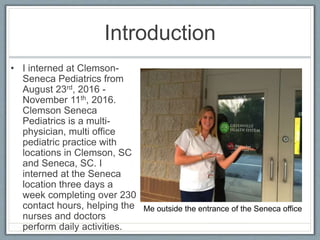
Me outside the entrance of the Seneca office
Seneca Office
• Clemson- Seneca Pediatrics is part of Greenville Health
System’s Children’s Hospital.
• 2 Locations: One in Clemson, SC and one in Seneca,
SC
• The office is located in the Omni Center at Oconee
Memorial Hospital
• 109 Omni Dr Suite B, Seneca, SC 29672
Mission, Values, and Vision
• Mission: Heal compassionately. Teach innovatively.
Improve constantly.
• Values: Together we serve with integrity, respect,
trust and openness.
• Vision: Transform healthcare for the benefit of the
people and communities we serve.
Goals of Clemson-Seneca
Pediatrics
• Clemson-Seneca Pediatrics is dedicated to advancing the
care of children and promoting healthy families.
• Providing quality pediatric care to infants, children and
adolescents from birth through the college years.
• Provide as much education as treatment in order to help
children thrive.
• Focus is on preventive care: keeping your child healthy.
• one-on-one counseling; a handbook on child and adolescent
development; and brochures on nutrition, exercise and injury
prevention.
Services Provided
• Health Maintenance
• Newborn and well-baby care
• Complete physical exams and immunizations
• School and sports physicals
• Nutritional counseling (obesity cholesterol, eating disorders)
• Adolescent medicine (adolescent girls who prefer a female provider may see one of
their choice)
• Acute Care
• Colds, flu, sore throats ear infections
• Bronchitis, croup, laryngitis, pneumonia
• Emergency Care
• Minor lacerations, strains, burns
• Chronic Medical Care
• Allergies and asthma
• Attention deficit disorder (ADD) and learning disabilities
• Skin care: acne, rashes, eczema
Morning Routine
• Each morning when coming in, I was
responsible for several tasks to get the
office ready to see patients.
• These included:
• Making sure all exam rooms were clean
and fully stocked for the day.
• Checking and recording the room
temperature as well as all fridges,
freezers, and incubators.
• These temperatures had to be within a
certain range in order to keep vaccines and
specimens viable.
• Check Hemocue and run test to make
sure it is working properly
• Clean and record that the counters in the
lab are clean.
Clean Exam Room
Hemocue turned
on and ready
Patient Interaction
• After patients have checked
in at the front desk, I call
them back to one of the
exam rooms to take their
vitals, get medical history,
and discuss the reason for
their visit.
• Vital signs include height,
length (patients under 2yrs of
age), weight, temperature,
blood pressure (patients
older than 3), and head
circumference (infants).
This is a picture of
me taking the
height and weight
of a patient.
Scale used
for children
under 30lbs
Patient Interaction Continued
• If the patient is in the office for a sick visit,
I record what their problem is, what their
symptoms are, and how long the problem
has been occurring.
• If the patient is in the office for a well visit,
there is a series of milestone questions
depending on age, that I will ask the
patient and/or guardian. For all children 1
year of age and older I will stick their
finger to check hemoglobin. Children
aged 4 and older will urinate in a cup in
order to check their urine.
• All visits require that I ask what
medications the patient is on, what
allergies they have, and what pharmacy
they use.
This is the area where all
labs are run
Labs
• Over the course of my
internship, I mastered how
to perform the following
tests:
• Hemoglobin tests
• Dip-stick urinalysis
• Rapid Strep tests
• Rapid Flu tests
• Pregnancy tests
• Mono tests
• Rapid- RSV tests
• Blood glucose levels
Me conducting a dip-stick urinalysis
Two rapid-strep tests that
are being conducted
Vision and Hearing Tests
The object on the left is used to check vision
and the object on the right with the headphones
is used to check hearing
Hearing test
box
During a well child visit, vision and
hearing are checked if the patient is
not already being seen by a
Ophthalmologist or Audiologist.
Unless the patient or parent has a
concern, these tests are done at the
ages of 4, 5, 6, 8, 10, 12, 15, 18
Clinical Duties
• I would also draw up vaccines and prepare shot trays. This was
especially helpful to the nurses when flu vaccines started to be
administered because these were given often.
• Another clinical duty I had was to help assist the physicians and
nurses with minor in-office procedures. These included:
• Sutures
• Suture/Staple removal
• Wart removal
• Ear canal flush
• Breathing treatments
Prepared shot
tray
Projects
• There were monthly projects that I performed such as checking
expirations of supplies, vaccines, and over-the counter
medications. I would also record the inventory amount of these
things and alert the nurse if there was a limited supply left of
something. At the end of the month I would check the lab book for
any blanks and use the EMR to find the information to fill these
blanks in.
Medicine cabinet Vaccines Medical Chart Review Crash Box
Projects
• My major project was to
create the 2017 lab book
that would be compatible
with the new EMR, EPIC.
This required me to make
all new lab sheets that
were designed to fit labels
that were printed with
patient information when
a lab was ordered. I
created a new lab books
for the Clemson and
Seneca offices.
Conclusion
My time at Clemson-Seneca Pediatrics was an enriching experience that I learned
a lot from. I quickly learned how to work up patients and run lab tests. This
internship taught me what it is like to work in a healthcare setting as a professional
and the day to day activities that are conducted in a doctor’s office. The people I
worked with were more than willing to help me learn and teach me new things. This
internship has solidified that I am in the right field of work and will be happy with
what I do everyday.

Intern powerpoint

  • 1.
  • 2.
    Introduction • I internedat Clemson- Seneca Pediatrics from August 23rd, 2016 - November 11th, 2016. Clemson Seneca Pediatrics is a multi- physician, multi office pediatric practice with locations in Clemson, SC and Seneca, SC. I interned at the Seneca location three days a week completing over 230 contact hours, helping the nurses and doctors perform daily activities. Me outside the entrance of the Seneca office
  • 3.
    Seneca Office • Clemson-Seneca Pediatrics is part of Greenville Health System’s Children’s Hospital. • 2 Locations: One in Clemson, SC and one in Seneca, SC • The office is located in the Omni Center at Oconee Memorial Hospital • 109 Omni Dr Suite B, Seneca, SC 29672
  • 4.
    Mission, Values, andVision • Mission: Heal compassionately. Teach innovatively. Improve constantly. • Values: Together we serve with integrity, respect, trust and openness. • Vision: Transform healthcare for the benefit of the people and communities we serve.
  • 5.
    Goals of Clemson-Seneca Pediatrics •Clemson-Seneca Pediatrics is dedicated to advancing the care of children and promoting healthy families. • Providing quality pediatric care to infants, children and adolescents from birth through the college years. • Provide as much education as treatment in order to help children thrive. • Focus is on preventive care: keeping your child healthy. • one-on-one counseling; a handbook on child and adolescent development; and brochures on nutrition, exercise and injury prevention.
  • 6.
    Services Provided • HealthMaintenance • Newborn and well-baby care • Complete physical exams and immunizations • School and sports physicals • Nutritional counseling (obesity cholesterol, eating disorders) • Adolescent medicine (adolescent girls who prefer a female provider may see one of their choice) • Acute Care • Colds, flu, sore throats ear infections • Bronchitis, croup, laryngitis, pneumonia • Emergency Care • Minor lacerations, strains, burns • Chronic Medical Care • Allergies and asthma • Attention deficit disorder (ADD) and learning disabilities • Skin care: acne, rashes, eczema
  • 7.
    Morning Routine • Eachmorning when coming in, I was responsible for several tasks to get the office ready to see patients. • These included: • Making sure all exam rooms were clean and fully stocked for the day. • Checking and recording the room temperature as well as all fridges, freezers, and incubators. • These temperatures had to be within a certain range in order to keep vaccines and specimens viable. • Check Hemocue and run test to make sure it is working properly • Clean and record that the counters in the lab are clean. Clean Exam Room Hemocue turned on and ready
  • 8.
    Patient Interaction • Afterpatients have checked in at the front desk, I call them back to one of the exam rooms to take their vitals, get medical history, and discuss the reason for their visit. • Vital signs include height, length (patients under 2yrs of age), weight, temperature, blood pressure (patients older than 3), and head circumference (infants). This is a picture of me taking the height and weight of a patient. Scale used for children under 30lbs
  • 9.
    Patient Interaction Continued •If the patient is in the office for a sick visit, I record what their problem is, what their symptoms are, and how long the problem has been occurring. • If the patient is in the office for a well visit, there is a series of milestone questions depending on age, that I will ask the patient and/or guardian. For all children 1 year of age and older I will stick their finger to check hemoglobin. Children aged 4 and older will urinate in a cup in order to check their urine. • All visits require that I ask what medications the patient is on, what allergies they have, and what pharmacy they use. This is the area where all labs are run
  • 10.
    Labs • Over thecourse of my internship, I mastered how to perform the following tests: • Hemoglobin tests • Dip-stick urinalysis • Rapid Strep tests • Rapid Flu tests • Pregnancy tests • Mono tests • Rapid- RSV tests • Blood glucose levels Me conducting a dip-stick urinalysis Two rapid-strep tests that are being conducted
  • 11.
    Vision and HearingTests The object on the left is used to check vision and the object on the right with the headphones is used to check hearing Hearing test box During a well child visit, vision and hearing are checked if the patient is not already being seen by a Ophthalmologist or Audiologist. Unless the patient or parent has a concern, these tests are done at the ages of 4, 5, 6, 8, 10, 12, 15, 18
  • 12.
    Clinical Duties • Iwould also draw up vaccines and prepare shot trays. This was especially helpful to the nurses when flu vaccines started to be administered because these were given often. • Another clinical duty I had was to help assist the physicians and nurses with minor in-office procedures. These included: • Sutures • Suture/Staple removal • Wart removal • Ear canal flush • Breathing treatments Prepared shot tray
  • 13.
    Projects • There weremonthly projects that I performed such as checking expirations of supplies, vaccines, and over-the counter medications. I would also record the inventory amount of these things and alert the nurse if there was a limited supply left of something. At the end of the month I would check the lab book for any blanks and use the EMR to find the information to fill these blanks in. Medicine cabinet Vaccines Medical Chart Review Crash Box
  • 14.
    Projects • My majorproject was to create the 2017 lab book that would be compatible with the new EMR, EPIC. This required me to make all new lab sheets that were designed to fit labels that were printed with patient information when a lab was ordered. I created a new lab books for the Clemson and Seneca offices.
  • 15.
    Conclusion My time atClemson-Seneca Pediatrics was an enriching experience that I learned a lot from. I quickly learned how to work up patients and run lab tests. This internship taught me what it is like to work in a healthcare setting as a professional and the day to day activities that are conducted in a doctor’s office. The people I worked with were more than willing to help me learn and teach me new things. This internship has solidified that I am in the right field of work and will be happy with what I do everyday.