African Mobile Observatory
2011


Driving Economic and Social Development through Mobile Services


Prepared by:


                                                                  1
Africa Mobile Observatory

Contents

Geographic Scope of this Study...........................................................................................................4


1. Introduction .................................................................................................................................5


2. Executive Summary ......................................................................................................................6


3. Competitive landscape and consolidation .....................................................................................8
   3.1.      Market dynamics .......................................................................................................................... 8
   3.2.      Revenue and pricing trends......................................................................................................... 16
   3.3.      Competitive intensity .................................................................................................................. 18


4. The economic contribution of the mobile industry ....................................................................... 21
   4.1.      The direct contribution of mobile operators to GDP ................................................................... 21
   4.2.      The value-add of the mobile ecosystem...................................................................................... 22
   4.3.      Contribution to employment ....................................................................................................... 25
   4.4.      Contribution to public funding .................................................................................................... 26
   4.5.      The role of mobile communications in developing local industries and driving innovation ....... 28
   4.6.      Summary ..................................................................................................................................... 28


5. Mobile as a driving force for development and innovation .......................................................... 29
   5.1.      Distinctive characteristics ........................................................................................................... 29
   5.2.      Importance of mobile connectivity for the unconnected ............................................................ 30
   5.3.      How the mobile industry will help governments achieve their ICT development goals.............. 32


6. Corporate sustainability: The environmental and social impact ................................................... 34
   6.1.      The social impact of the mobile industry .................................................................................... 34
   6.2.      Role of NGOs ............................................................................................................................... 37
   6.3.      Role of mobile technology in disaster preparedness and relief .................................................. 38
   6.4.      The environmental impact of the mobile industry ...................................................................... 38


7. Spectrum and technology availability ......................................................................................... 42
   7.1.      Access to spectrum...................................................................................................................... 42
   7.2.      Spectrum pricing ......................................................................................................................... 45
   7.3.      Importance of clear roadmap of spectrum allocation ................................................................ 45

                                                                                                                                                           2
8. Infrastructure investment........................................................................................................... 47
   8.1.      Investment in infrastructure ....................................................................................................... 47
   8.2.      Impact of public infrastructure weakness ................................................................................... 49
   8.3.      Limitations to expanding infrastructure ..................................................................................... 50


9. Regulatory enablers to spur further growth ................................................................................ 51
   9.1.      The need for transparent, predictable and consultative regulatory regimes ............................. 51
   9.2.      Reducing ineffective taxation to drive penetration .................................................................... 53
   9.3.      Incentives to drive universal access, not USFs ............................................................................ 55
   9.1.      Importance of liberalised markets .............................................................................................. 56


10. About the Authors...................................................................................................................... 58


                                                                                                                                                  3
Geographic Scope of this Study
Africa comprises a vast region of 541 countries covering 30 million square kilometres and 1.0 billion
people. Referring to Africa as one continent would be to overlook the intricacies and complexities of life
within a huge diversity of peoples, languages and cultures within and across national boundaries.

It would be impossible to cover all these countries in the detail and thoroughness that they deserve.
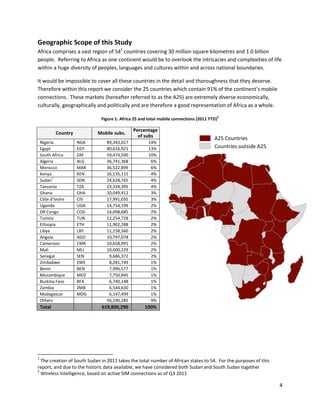
Therefore within this report we consider the 25 countries which contain 91% of the continent’s mobile
connections. These markets (hereafter referred to as the A25) are extremely diverse economically,
culturally, geographically and politically and are therefore a good representation of Africa as a whole.
                                                                                            2
                              Figure 1: Africa 25 and total mobile connections (2011 YTD)

                                              Percentage
            Country         Mobile subs.
                                                of subs                                A25 Countries
    Nigeria           NGA       89,343,017           14%
    Egypt             EGY       80,616,921           13%                               Countries outside A25
    South Africa      ZAF       59,474,500           10%
    Algeria           ALG       36,741,368            6%
    Morocco           MAR       36,522,899            6%
    Kenya             KEN       26,135,115            4%
          1
    Sudan             SDN       24,628,765            4%
    Tanzania          TZA       23,334,395            4%
    Ghana             GHA       20,049,412            3%
    Côte d'Ivoire     CIV       17,991,035            3%
    Uganda            UGA       14,754,199            2%
    DR Congo          COD       14,098,685            2%
    Tunisia           TUN       12,254,728            2%
    Ethiopia          ETH       11,902,288            2%
    Libya             LBY       11,158,560            2%
    Angola            AGO       10,797,078            2%
    Cameroon          CMR       10,658,991            2%
    Mali              MLI       10,000,229            2%
    Senegal           SEN        9,686,372            2%
    Zimbabwe          ZWE        8,281,749            1%
    Benin             BEN        7,996,577            1%
    Mozambique        MOZ        7,750,845            1%
    Burkina Faso      BFA        6,740,148            1%
    Zambia            ZMB        6,544,630            1%
    Madagascar        MDG        6,147,499            1%
    Others                      56,190,285            9%
    Total                     619,800,290           100%


1
  The creation of South Sudan in 2011 takes the total number of African states to 54. For the purposes of this
report, and due to the historic data available, we have considered both Sudan and South Sudan together
2
  Wireless Intelligence, based on active SIM connections as of Q3 2011

                                                                                                                 4
1. Introduction
The Mobile Observatory series includes reports on the large and mature European market, the extensive
and dynamically evolving market of the Asia-Pacific region and the fast growing Latin-American region.
These reports underline the industry’s commitment to transparency and to engaging with a wide set of
stakeholders in planning its future direction.

This is the first African edition in the GSMA Mobile Observatory series. This Observatory provides a
comprehensive review of the African mobile communications industry. Included are the latest statistics
and market developments, as a reference point for mobile industry participants, policy makers and
other interested stakeholders. It covers the state of the industry, including the evolution of competition,
innovation in new products, services and technologies and the industry’s contribution to social and
economic development in Africa.

The report integrates data from a wide range of existing sources to provide a comprehensive picture of
the African mobile industry. These include public sources such as the ITU, World Bank and research by
National Regulatory Authorities as well as commercial providers such as Wireless Intelligence, Informa,
Gartner, Buddecomm and IDC. Where appropriate, data from different sources has been combined to
show more complete industry trends. The regular geographic scope of this study consists of the 54
countries of Africa – both North Africa and sub-Saharan Africa. All references to 2011 YTD correspond to
the first nine months of 2011. All references to African statistics refer to the largest 25 African countries
by number of mobile connections unless stated otherwise.

This report was commissioned by the GSMA and developed independently by A.T. Kearney. The GSMA,
their Members, Associate Members and A.T. Kearney are not responsible for the use that might be
made of this publication. The views expressed in this publication are the sole responsibility of the
authors and do not necessarily reflect the views of the GSMA, their Members or Associate Members.


                                                                                                           5
2. Executive Summary
The mobile industry in Africa is booming. With over 620 million mobile connections as of September
2011, Africa has overtaken Latin America to become the second largest mobile market in the world,
after Asia. Over the past 10 years, the number of mobile connections in Africa has grown an average of
30% per year and is forecast to reach 735 million by the end of 2012.3

Fierce competition has driven down prices and increased penetration. Price wars have been common
across the continent as operators compete for market share with innovative revenue and pricing options
- operators have reduced prices an average of 18% between 2010 and 2011,4 making mobile
connectivity more broadly affordable to the masses. 96% of subscriptions are pre-paid with voice
services currently dominating, however the uptake of data services is increasing rapidly. For example in
Kenya data revenues, including SMS, have increased at a remarkable 67% CAGR over the last 4 years and
now represent 26% of total revenues.

The Mobile Industry in Africa contributes US$56 billion to the regional economy, equivalent to 3.5% of
total GDP. In particular, the mobile ecosystem is estimated to employ over 5 million Africans and is
contributing to bringing mobile services to customers right across the continent. However there remains
huge untapped potential - 36% of Africans, within the 25 largest African mobile markets (A25), still have
no access to mobile services. Projections indicate that raising the whole region to 100% mobile
penetration, could add an additional US$35 billion in aggregate GDP to the region, equivalent to a
further 2% increase.5

The mobile industry in Africa is an enabler of economic development far beyond its immediate domain.
Mobile operators have driven the emergence of a unique industry in innovative mobile services in
Africa. Mobile Value-Added Services have been launched throughout the continent to enable and
support agriculture, banking, education, healthcare and gender equality. In particular, the emergence of
mobile money transfers and mobile banking puts Africa firmly at the forefront of the global Mobile
Money industry. Beyond mobile services, the mobile industry is also contributing to rural electrical
distribution with lower carbon emissions and facilitating the work of NGOs across the continent. Many
African governments have prioritized ICT policy as a key driver for development.

For the mobile industry to continue to serve as a catalyst for growth, sufficient spectrum is needed for
the provision of mobile broadband services. African countries have currently allocated considerably less
spectrum to mobile services than developing countries in Europe, the Americas and Asia. Allocating the
Digital Dividend spectrum to mobile services will enable the mobile industry to accelerate its efforts to
bring connectivity and information to large swathes of rural Africa.

African governments are slowly shifting to more transparent ICT regulation, but limited spectrum
availability remains a key barrier to sustaining long term growth. The GSMA supports a technology

3
  Wireless Intelligence - based on active SIM connections (2011 YTD based on first 9 months data only)
4
  Wireless Intelligence
5
  We do not underestimate the challenges in achieving a goal of 100% mobile penetration. However, this provides
an indication of what could be if mobile communication was brought to the entire African population.

                                                                                                              6
neutral approach to the use of all existing mobile bands; governments in Africa should allow deployment
of mobile technologies that can technically co-exist according to what are relevant internationally
harmonised bands for their region. The GSMA encourages governments in the region to establish clear
guidelines for spectrum planning, licensing, pricing and re-farming. African governments must clarify
future spectrum availability of both the coverage bands (700, 800, and 900 MHz bands) and the capacity
bands (1800, 2100, 2300, 2600, and 3500 MHz bands).

Regulation practices must continue to improve to ensure the effective long term development of the
mobile sector. 64% of African countries remain in the bottom quartile of the World Economic Forum’s
political/regulatory index. GSMA research indicates that total tax intake of governments could be
boosted, by reducing mobile specific taxes across Africa. Universal access has also been promoted by
most African governments using taxation schemes, but there is limited transparency around the
distribution of funds.

By working in partnership, mobile operators and African governments can continue the remarkable
growth story of the African mobile industry. The benefits that mobile services have already brought to
hundreds of millions of Africans can be extended to those who have yet to connect. By so doing, the
African continent can continue to bring not only communication services, but also improved financial
services, healthcare and education to its people and drive an increase in the economic wealth and
development.


                                                                                                         7
3. Competitive landscape and consolidation
     Key Messages

     • With over 620 million mobile connections as of September 2011, Africa has overtaken
       Latin America to become the second largest mobile market in the world, after Asia

     • Africa continues to be the fastest growing mobile market in the world

     • The African mobile market is highly competitive and has experienced significant price
       reductions over the period 2007-2011, with decreases of up to 60% in a matter of months
       in some markets


       3.1. Market dynamics
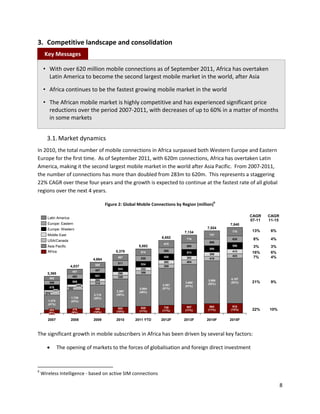
In 2010, the total number of mobile connections in Africa surpassed both Western Europe and Eastern
Europe for the first time. As of September 2011, with 620m connections, Africa has overtaken Latin
America, making it the second largest mobile market in the world after Asia Pacific. From 2007-2011,
the number of connections has more than doubled from 283m to 620m. This represents a staggering
22% CAGR over these four years and the growth is expected to continue at the fastest rate of all global
regions over the next 4 years.
                                                                                                  6
                                        Figure 2: Global Mobile Connections by Region (million)

       Latin America
                                                                                                              CAGR    CAGR
                                                                                                              07-11   11-15
       Europe: Eastern                                                                                7,840
       Europe: Western                                                                     7,524
                                                                                7,134                  770     13%     6%
       Middle East                                                                          747
                                                                    6,652        718                   620     8%      4%
       USA/Canada                                                                           606
                                                                     679
       Asia Pacific                                      5,882                   589                   596      3%     3%
                                                                                            586
       Africa                                5,378                   568                               413
                                                          614                    574
                                                                                            399
                                                                                                               16%     6%
                                                                                                       423
                                              567         530
                                                                     558         382        415                 7%     4%
                                4,664
                                              511                    360         404
                                 508                      534
                       4,037                                         389
                                              524         322
                        457      487
       3,365                                  298         359
                        452      521          338
        382                                                                                           4,107
                                 262                                                        3,906
        396             508
                                 314                                            3,660       (52%)
                                                                                                      (52%)    21%     9%
                          225                                        3,361      (51%)
        478           292                                2,904       (51%)
          177                                2,587       (49%)
      274                       2,115        (48%)
                       1,726    (45%)
       1,375           (43%)
       (41%)
                                                                      738        807         864       910
                                              553         620
        283             378      458
                                             (10%)       (11%)       (11%)      (11%)       (11%)     (12%)    22%    10%
       (8%)            (9%)     (10%)

       2007            2008     2009         2010      2011 YTD     2012F       2013F      2014F      2015F


The significant growth in mobile subscribers in Africa has been driven by several key factors:

              The opening of markets to the forces of globalisation and foreign direct investment


6
    Wireless Intelligence - based on active SIM connections

                                                                                                                              8
   The introduction of low-cost handsets and the reduction of mobile usage prices, driving down
        the minimum cost of mobile ownership
       Substantial economic development in the region, increasing the prosperity of citizens and hence
        an increasing affordability of communication services
       The success of cost-effective pre-paid services (96% of African connections vs 82% in Latin
        America and 52% in Europe in 2011) allowing consumers to take control of their spending and
        gain access to flexible, low-cost voice and SMS services
       The ambitious rollout of mobile network infrastructure by operators to expand geographic and
        population coverage combined with the lack of adequate fixed-line infrastructure and service

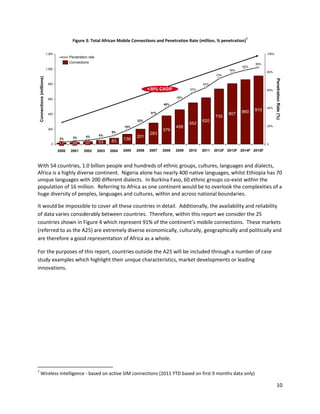
These factors have contributed to a growth in mobile population penetration across Africa from 2% in
2000 to more than 57% ten years later (see Figure 3). 2010 was a land-mark year for Africa as mobile
penetration passed 50% for the first time. Despite this impressive growth, these figures go to underline
the further growth potential and necessary investment required to connect the remaining population.
Whilst mobile connection growth is expected to slow to 11% CAGR from 2011 to 2015, in several
markets such as Zimbabwe and Rwanda connections are still growing at 50% p.a. from a low existing
customer base. By 2015, the total number of connections is estimated to reach 84% of the total African
population.

Throughout this report, we predominantly refer to the number of subscriptions, or number of
connections as a measure of mobile penetration. It is well understood that the use of multiple SIMs is
very common among Africans such that the total number of connections will overestimate the number
of actual mobile customers by some margin. However, accurate data on the number of customers is not
readily available for all of Africa whereas the number of connections is known for the whole continent.
The prevalence of multi-SIM usage is likely to be such that the number of connections may overstate the
number of subscribers by 20-40%.


                                                                                                       9
7
                                              Figure 3: Total African Mobile Connections and Penetration Rate (million, % penetration)

                             1,200                                                                                                                      100%
                                            Penetration rate
                                            Connections                                                                                          85%
                                                                                                                                           82%
                             1,000                                                                                                   78%
                                                                                                                                                        80%
                                                                                                                               73%
    Connections (millions)


                                                                                                                                                               Penetration Rate (%)
                              800                                                                                      63%
                                                                                           +30% CAGR            57%                                     60%

                                                                                                         48%
                              600
                                                                                                  40%
                                                                                                                                                        40%
                                                                                                                                           860   910
                              400                                                           31%                                      807
                                                                                                                              735
                                                                                    22%                                620
                                                                                                                552
                                                                             15%                         458                                            20%
                              200                                                                 379
                                                                      9%
                                                               6%
                                                                                            283
                                              3%      4%                            201
                                     2%
                                                                      83     136
                                0    17      26       37       53                                                                                       0

                                     2000   2001     2002      2003   2004   2005   2006   2007   2008   2009   2010   2011   2012F 2013F 2014F 2015F


With 54 countries, 1.0 billion people and hundreds of ethnic groups, cultures, languages and dialects,
Africa is a highly diverse continent. Nigeria alone has nearly 400 native languages, whilst Ethiopia has 70
unique languages with 200 different dialects. In Burkina Faso, 60 ethnic groups co-exist within the
population of 16 million. Referring to Africa as one continent would be to overlook the complexities of a
huge diversity of peoples, languages and cultures, within and across national boundaries.

It would be impossible to cover all these countries in detail. Additionally, the availability and reliability
of data varies considerably between countries. Therefore, within this report we consider the 25
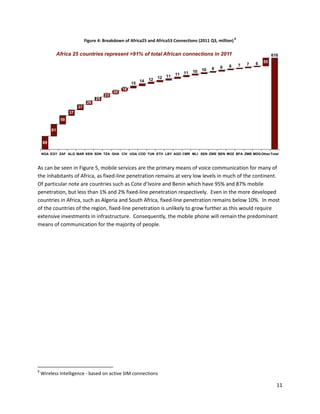
countries shown in Figure 4 which represent 91% of the continent’s mobile connections. These markets
(referred to as the A25) are extremely diverse economically, culturally, geographically and politically and
are therefore a good representation of Africa as a whole.

For the purposes of this report, countries outside the A25 will be included through a number of case
study examples which highlight their unique characteristics, market developments or leading
innovations.


7
      Wireless Intelligence - based on active SIM connections (2011 YTD based on first 9 months data only)

                                                                                                                                                                 10
8
                              Figure 4: Breakdown of Africa25 and Africa53 Connections (2011 Q3, million)

              Africa 25 countries represent >91% of total African connections in 2011                                             619

                                                                                                                         6   55
                                                                                                         8       7   7
                                                                                                 8   8
                                                                                       10   10
                                                                               11 11
                                                                  12   12 11
                                                             14
                                                        15
                                                   18
                                              20
                                         23
                                    25
                               26
                         37
                    37
               59

         81


    89

    NGA EGY ZAF ALG MAR KEN SDN TZA GHA CIV UGA COD TUN ETH LBY AGO CMR MLI SEN ZWE BEN MOZ BFA ZMB MDG Other Total


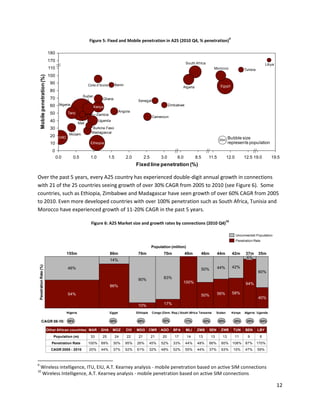
As can be seen in Figure 5, mobile services are the primary means of voice communication for many of
the inhabitants of Africa, as fixed-line penetration remains at very low levels in much of the continent.
Of particular note are countries such as Cote d’Ivoire and Benin which have 95% and 87% mobile
penetration, but less than 1% and 2% fixed-line penetration respectively. Even in the more developed
countries in Africa, such as Algeria and South Africa, fixed-line penetration remains below 10%. In most
of the countries of the region, fixed-line penetration is unlikely to grow further as this would require
extensive investments in infrastructure. Consequently, the mobile phone will remain the predominant
means of communication for the majority of people.


8
    Wireless Intelligence - based on active SIM connections

                                                                                                                                    11
9
                                                              Figure 5: Fixed and Mobile penetration in A25 (2010 Q4, % penetration)

                                180
                                170
                                                                                                                                     South Af rica                                                    Libya
                                110                                                                                                                      Morocco                      Tunisia
                                100
       Mobile penetration (%)


                                  90                          Cote d’Ivoire         Benin
                                                                                                                                  Algeria                      Egypt
                                  80
                                                          Sudan
                                  70                                   Ghana
                                                                                                   Senegal
                                  60    Nigeria                                                                           Zimbabwe
                                                                  Kenya
                                                                                      Angola
                                  50         Tanz.                  Zambia
                                                                                                              Cameroon
                                  40                   Mali
                                                                     Uganda

                                  30                            Burkina Faso
                                                                Madagascar
                                              Mozam.
                                  20 DRC                                                                                                                              Bubble size
                                                                                                                                                              20m
                                  10                           Ethiopia                                                                                               represents population
                                   0
                                       0.0        0.5          1.0            1.5           2.0         2.5         3.0       8.0           8.5      11.5            12.0             12.5 19.0          19.5
                                                                                                  Fixed line penetration (%)

Over the past 5 years, every A25 country has experienced double-digit annual growth in connections
with 21 of the 25 countries seeing growth of over 30% CAGR from 2005 to 2010 (see Figure 6). Some
countries, such as Ethiopia, Zimbabwe and Madagascar have seen growth of over 60% CAGR from 2005
to 2010. Even more developed countries with over 100% penetration such as South Africa, Tunisia and
Morocco have experienced growth of 11-20% CAGR in the past 5 years.
                                                                                                                                                                     10
                                                               Figure 6: A25 Market size and growth rates by connections (2010 Q4)

                                                                                                                                                                                Unconnected Population
                                                                                                                                                                                Penetration Rate
                                                                                                              Population (million)
                                             155m                             86m                  76m               70m             49m       46m           44m              42m     37m       35m
                                                                                                                                                                                      6%
                                                                              14%
    Penetration Rate (%)


                                             46%                                                                                                             44%              42%
                                                                                                                                               50%
                                                                                                                                                                                                60%
                                                                                                   90%               83%
                                                                                                                                  100%                                                94%
                                                                              86%

                                             54%                                                                                                             56%              58%
                                                                                                                                               50%
                                                                                                                                                                                                40%
                                                                                                   10%               17%

                                             Nigeria                          Egypt               Ethiopia    Congo (Dem. Rep.) South Africa Tanzania        Sudan            Kenya   Algeria Uganda

           CAGR 05-10: 36%                                                    40%                  68%               32%             11%          43%         55%              35%     20%       54%

                                Other African countries MAR           GHA       MOZ         CIV   MDG        CMR   AGO      BFA      MLI    ZMB      SEN       ZWE             TUN    BEN       LBY
                                   Population (m)              33      25           24      22     21         21     20      17      14      13         13      13             11       9        6
                                  Penetration Rate            100%    69%       30%         95%   26%        45%    52%     33%      44%     48%     66%       60%            108%    87%       170%
                                  CAGR 2005 - 2010            20%     44%       37%         52%   61%        32%    48%     52%      55%     44%     37%       63%             15%    47%       59%


9
       Wireless intelligence, ITU, EIU, A.T. Kearney analysis - mobile penetration based on active SIM connections
10
       Wireless Intelligence, A.T. Kearney analysis - mobile penetration based on active SIM connections

                                                                                                                                                                                                              12
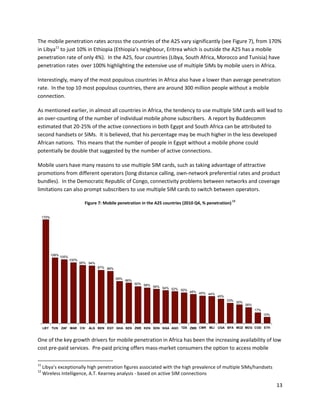
The mobile penetration rates across the countries of the A25 vary significantly (see Figure 7), from 170%
in Libya11 to just 10% in Ethiopia (Ethiopia’s neighbour, Eritrea which is outside the A25 has a mobile
penetration rate of only 4%). In the A25, four countries (Libya, South Africa, Morocco and Tunisia) have
penetration rates over 100% highlighting the extensive use of multiple SIMs by mobile users in Africa.

Interestingly, many of the most populous countries in Africa also have a lower than average penetration
rate. In the top 10 most populous countries, there are around 300 million people without a mobile
connection.

As mentioned earlier, in almost all countries in Africa, the tendency to use multiple SIM cards will lead to
an over-counting of the number of individual mobile phone subscribers. A report by Buddecomm
estimated that 20-25% of the active connections in both Egypt and South Africa can be attributed to
second handsets or SIMs. It is believed, that his percentage may be much higher in the less developed
African nations. This means that the number of people in Egypt without a mobile phone could
potentially be double that suggested by the number of active connections.

Mobile users have many reasons to use multiple SIM cards, such as taking advantage of attractive
promotions from different operators (long distance calling, own-network preferential rates and product
bundles). In the Democratic Republic of Congo, connectivity problems between networks and coverage
limitations can also prompt subscribers to use multiple SIM cards to switch between operators.
                                                                                                                 12
                                   Figure 7: Mobile penetration in the A25 countries (2010 Q4, % penetration)

     170%


            108%
                   105%
                          100%
                                 95% 94%
                                           87% 86%


                                                     69%
                                                           66%
                                                                 60% 58%
                                                                         56% 54%
                                                                                 52% 50%
                                                                                           48% 45%
                                                                                                   44%
                                                                                                         40%
                                                                                                               33%
                                                                                                                      30%
                                                                                                                            26%
                                                                                                                                  17%
                                                                                                                                        10%


     LBY TUN       ZAF MAR CIV       ALG BEN EGY GHA SEN ZWE KEN SDN NGA AGO TZA ZMB CMR           MLI   UGA BFA MOZ MDG COD ETH


One of the key growth drivers for mobile penetration in Africa has been the increasing availability of low
cost pre-paid services. Pre-paid pricing offers mass-market consumers the option to access mobile

11
     Libya’s exceptionally high penetration figures associated with the high prevalence of multiple SIMs/handsets
12
     Wireless Intelligence, A.T. Kearney analysis - based on active SIM connections

                                                                                                                                              13
services at a much lower entry price and with fewer barriers than post-paid contracts – for example, low
denomination cards of CFA500 (US$1.07) in Cote d’Ivoire. Perhaps more importantly, pre-paid services
offer consumers with irregular and low incomes the flexibility to purchase mobile credits only when they
can afford to and without the commitment to a 1-3 year contract requiring regular monthly payments.
Additionally, with limited credit-checking facilities across Africa, the provision of post-paid services tends
to be more complex for operators who have few means of determining an individual’s ability to pay, or
indeed collect payments in such an environment. It is not surprising therefore that pre-paid connections
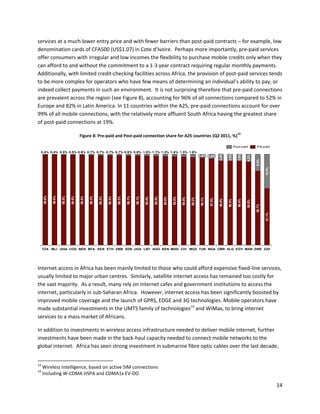
are prevalent across the region (see Figure 8), accounting for 96% of all connections compared to 52% in
Europe and 82% in Latin America. In 11 countries within the A25, pre-paid connections account for over
99% of all mobile connections, with the relatively more affluent South Africa having the greatest share
of post-paid connections at 19%.
                                                                                                                                                                                13
                                     Figure 8: Pre-paid and Post-paid connection share for A25 countries (Q2 2011, %)

                                                                                                                                                                              Post-paid          Pre-paid
 0.4% 0.4% 0.5% 0.5% 0.6% 0.7% 0.7% 0.7% 0.7% 0.9% 0.9% 1.0% 1.1% 1.3% 1.4% 1.5% 1.8%


                                                                                                                                                              3.4%

                                                                                                                                                                      3.5%

                                                                                                                                                                                 3.6%
                                                                                                                                             2.0% 2.5%


                                                                                                                                                                                         4.2%

                                                                                                                                                                                                 9.3%

                                                                                                                                                                                                         18.9%
     99.6%

             99.6%


                                             99.3%
                             99.5%

                                     99.5%
                     99.5%


                                                                             99.1%

                                                                                     99.1%
                                                     99.3%

                                                             99.3%

                                                                     99.3%


                                                                                                     98.9%
                                                                                             99.0%


                                                                                                                     98.6%
                                                                                                             98.8%


                                                                                                                             98.5%

                                                                                                                                     98.2%

                                                                                                                                              98.1%

                                                                                                                                                      97.5%

                                                                                                                                                              96.6%

                                                                                                                                                                      96.5%

                                                                                                                                                                                 96.4%

                                                                                                                                                                                         95.8%

                                                                                                                                                                                                 90.7%

                                                                                                                                                                                                         81.1%
     TZA MLI GHA COD BEN BFA SEN ETH ZMB SDN UGA LBY AGO KEN MDG CIV MOZ TUN NGA CMR ALG EGY MAR ZWE ZAF


Internet access in Africa has been mainly limited to those who could afford expensive fixed-line services,
usually limited to major urban centres. Similarly, satellite internet access has remained too costly for
the vast majority. As a result, many rely on internet cafes and government institutions to access the
internet, particularly in sub-Saharan Africa. However, internet access has been significantly boosted by
improved mobile coverage and the launch of GPRS, EDGE and 3G technologies. Mobile operators have
made substantial investments in the UMTS family of technologies14 and WiMax, to bring internet
services to a mass market of Africans.

In addition to investments in wireless access infrastructure needed to deliver mobile internet, further
investments have been made in the back-haul capacity needed to connect mobile networks to the
global internet. Africa has seen strong investment in submarine fibre optic cables over the last decade,


13
     Wireless Intelligence, based on active SIM connections
14
     Including W-CDMA HSPA and CDMA1x EV-DO

                                                                                                                                                                                                                 14
a trend that is expected to continue. Telegeography estimates that from 2010-2012 there will be an
additional $2.8bn invested in submarine fibre cables in Africa. The activation of cables such as TEAMs,
Seacom, SAT-3 and Lion has provided much needed bandwidth and made possible the provision of
services available in more developed economies, and at lower prices, as the supply of bandwidth
increases. This has already been seen in South Africa, where the introduction of new capacity by
Seacom led to submarine cable access prices declining by 70-90%. In order for end-users to benefit from
these price declines, interconnection with terrestrial networks is necessary. However, terrestrial
backbone is expensive and requires substantial investment in international and national transmission
links. Some progress has been made in sub-Saharan Africa, for example the planned East Africa
Backhaul system to connect Burundi, Kenya, Rwanda and Tanzania. But Central Africa is lagging behind
with much more investment need to bring the cost benefit of new bandwidth to the majority of the
Africa population.

Mobile networks are leading the expansion of broadband internet access across Africa, with broadband
access today largely confined to a small minority of the more developed Africa countries. Poor
infrastructure remains a key barrier to the expansion of broadband. However, the roll-out of 3G
services has provided a viable alternative to fixed broadband, in the form of internet enabled handsets
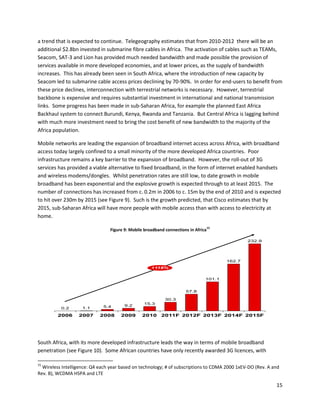
and wireless modems/dongles. Whilst penetration rates are still low, to date growth in mobile
broadband has been exponential and the explosive growth is expected through to at least 2015. The
number of connections has increased from c. 0.2m in 2006 to c. 15m by the end of 2010 and is expected
to hit over 230m by 2015 (see Figure 9). Such is the growth predicted, that Cisco estimates that by
2015, sub-Saharan Africa will have more people with mobile access than with access to electricity at
home.
                                                                                    15
                                 Figure 9: Mobile broadband connections in Africa

                                                                                                 232.9


                                                                                         162.7
                                                     +118%


                                                                                101.1


                                                                      57.8

                                                            30.3
                                                 15.3
                             5.4        9.2
          0.2       1.1

         2006     2007      2008      2009      2010      2011F 2012F 2013F 2014F 2015F


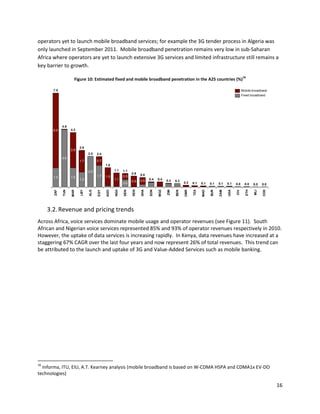
South Africa, with its more developed infrastructure leads the way in terms of mobile broadband
penetration (see Figure 10). Some African countries have only recently awarded 3G licences, with

15
  Wireless Intelligence: Q4 each year based on technology; # of subscriptions to CDMA 2000 1xEV-DO (Rev. A and
Rev. B), WCDMA HSPA and LTE

                                                                                                            15
operators yet to launch mobile broadband services; for example the 3G tender process in Algeria was
only launched in September 2011. Mobile broadband penetration remains very low in sub-Saharan
Africa where operators are yet to launch extensive 3G services and limited infrastructure still remains a
key barrier to growth.
                                                                                                                                           16
                     Figure 10: Estimated fixed and mobile broadband penetration in the A25 countries (%)

       7.5                                                                                                                                 Mobile broadband
                                                                                                                                           Fixed broadband


             4.6
       6.0         4.3


                         2.9
                   2.8
                               2.5   2.4
             4.6
                         1.7         0.7
                                           1.6

                               2.5               1.1   1.1
                                                             0.9   0.8
       1.5         1.5               1.7   1.5         0.5
                         1.2                     1.1               0.6   0.4   0.4   0.3
                                                             0.9                           0.3
                                                       0.6                                       0.2   0.1   0.1   0.1   0.1   0.1   0.0     0.0   0.0   0.0


                                                                                                                               UGA
                                                 NGA


                                                                   GHA


                                                                                                                                             ETH


                                                                                                                                                         COD
                                                                                                       TZA


                                                                                                                   BUR
                                                                               MOZ
                                                             KEN


                                                                         SDN


                                                                                           BEN
                                                       SEN
                         LBY

                               ALG
       ZAF

             TUN


                                                                                                 CMR
                   MAR


                                                                                                             MAD
                                                                                     ZIM


                                                                                                                         ZAM
                                           AGO
                                     EGY


                                                                                                                                                   MLI
                                                                                                                                     CIV
     3.2. Revenue and pricing trends
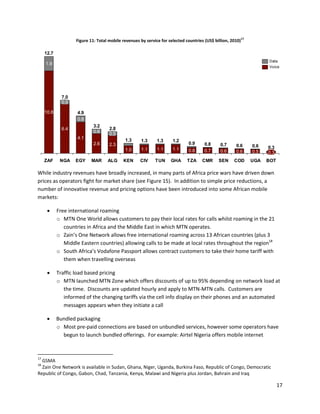
Across Africa, voice services dominate mobile usage and operator revenues (see Figure 11). South
African and Nigerian voice services represented 85% and 93% of operator revenues respectively in 2010.
However, the uptake of data services is increasing rapidly. In Kenya, data revenues have increased at a
staggering 67% CAGR over the last four years and now represent 26% of total revenues. This trend can
be attributed to the launch and uptake of 3G and Value-Added Services such as mobile banking.


16
  Informa, ITU, EIU, A.T. Kearney analysis (mobile broadband is based on W-CDMA HSPA and CDMA1x EV-DO
technologies)

                                                                                                                                                               16
17
                    Figure 11: Total mobile revenues by service for selected countries (US$ billion, 2010)

     12.7
                                                                                                                        Data
     1.9
                                                                                                                        Voice


              7.0
              0.5

     10.8           4.9
                    0.8
                             3.2
              6.4                    2.8
                             0.6     0.5
                    4.1                      1.3     1.3      1.3     1.2
                             2.6     2.3                                      0.9      0.8     0.7     0.6        0.6   0.3
                                             1.0     1.1      1.1     1.1     0.8      0.7     0.6     0.6        0.5   0.3
     ZAF     NGA    EGY     MAR     ALG     KEN      CIV     TUN     GHA     TZA     CMR      SEN     COD         UGA   BOT

While industry revenues have broadly increased, in many parts of Africa price wars have driven down
prices as operators fight for market share (see Figure 15). In addition to simple price reductions, a
number of innovative revenue and pricing options have been introduced into some African mobile
markets:

           Free international roaming
            o MTN One World allows customers to pay their local rates for calls whilst roaming in the 21
               countries in Africa and the Middle East in which MTN operates.
            o Zain’s One Network allows free international roaming across 13 African countries (plus 3
               Middle Eastern countries) allowing calls to be made at local rates throughout the region18
            o South Africa’s Vodafone Passport allows contract customers to take their home tariff with
               them when travelling overseas

           Traffic load based pricing
            o MTN launched MTN Zone which offers discounts of up to 95% depending on network load at
               the time. Discounts are updated hourly and apply to MTN-MTN calls. Customers are
               informed of the changing tariffs via the cell info display on their phones and an automated
               messages appears when they initiate a call

           Bundled packaging
            o Most pre-paid connections are based on unbundled services, however some operators have
              begun to launch bundled offerings. For example: Airtel Nigeria offers mobile internet


17
  GSMA
18
  Zain One Network is available in Sudan, Ghana, Niger, Uganda, Burkina Faso, Republic of Congo, Democratic
Republic of Congo, Gabon, Chad, Tanzania, Kenya, Malawi and Nigeria plus Jordan, Bahrain and Iraq

                                                                                                                              17
bundles, in South Africa MTN offers SMS bundles and Mobinil provides music download
                bundles to users in Egypt.

          3.3. Competitive intensity
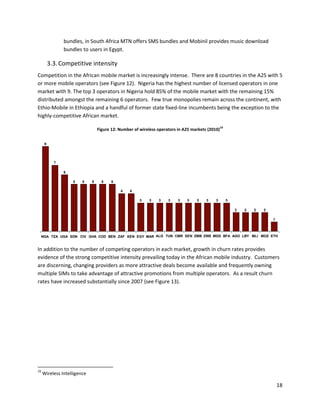
Competition in the African mobile market is increasingly intense. There are 8 countries in the A25 with 5
or more mobile operators (see Figure 12). Nigeria has the highest number of licensed operators in one
market with 9. The top 3 operators in Nigeria hold 85% of the mobile market with the remaining 15%
distributed amongst the remaining 6 operators. Few true monopolies remain across the continent, with
Ethio-Mobile in Ethiopia and a handful of former state fixed-line incumbents being the exception to the
highly-competitive African market.
                                                                                                 19
                                 Figure 12: Number of wireless operators in A25 markets (2010)


      9


            7

                6

                    5   5    5     5    5

                                            4    4

                                                      3   3    3    3    3   3    3    3    3         3

                                                                                                          2   2   2   2

                                                                                                                          1


     NGA TZA UGA SDN CIV GHA COD BEN ZAF KEN EGY MAR ALG TUN CMR SEN ZMB ZWE MDG BFA AGO LBY MLI MOZ ETH


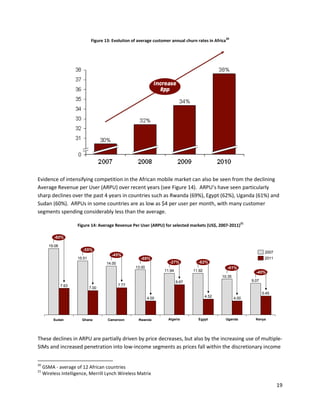
In addition to the number of competing operators in each market, growth in churn rates provides
evidence of the strong competitive intensity prevailing today in the African mobile industry. Customers
are discerning, changing providers as more attractive deals become available and frequently owning
multiple SIMs to take advantage of attractive promotions from multiple operators. As a result churn
rates have increased substantially since 2007 (see Figure 13).


19
     Wireless Intelligence

                                                                                                                              18
20
                                Figure 13: Evolution of average customer annual churn rates in Africa


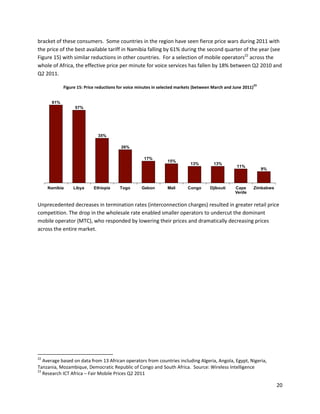
Evidence of intensifying competition in the African mobile market can also be seen from the declining
Average Revenue per User (ARPU) over recent years (see Figure 14). ARPU’s have seen particularly
sharp declines over the past 4 years in countries such as Rwanda (69%), Egypt (62%), Uganda (61%) and
Sudan (60%). ARPUs in some countries are as low as $4 per user per month, with many customer
segments spending considerably less than the average.
                                                                                                                 21
                       Figure 14: Average Revenue Per User (ARPU) for selected markets (US$, 2007-2011)

          -60%

        19.08
                         -55%
                                                                                                                              2007
                                          -45%
                       15.51                             -69%                                                                 2011
                                       14.00                            -27%          -62%
                                                      13.00                                             -61%
                                                                     11.94          11.92                               -40%
                                                                                                   10.35
                                                                             8.67                                     9.07
                7.63                           7.77
                               7.00
                                                                                                                             5.45
                                                              4.00                          4.52             4.00


          Sudan          Ghana          Cameroon        Rwanda         Algeria         Egypt            Uganda          Kenya


These declines in ARPU are partially driven by price decreases, but also by the increasing use of multiple-
SIMs and increased penetration into low-income segments as prices fall within the discretionary income


20
     GSMA - average of 12 African countries
21
     Wireless Intelligence, Merrill Lynch Wireless Matrix

                                                                                                                                     19
bracket of these consumers. Some countries in the region have seen fierce price wars during 2011 with
the price of the best available tariff in Namibia falling by 61% during the second quarter of the year (see
Figure 15) with similar reductions in other countries. For a selection of mobile operators22 across the
whole of Africa, the effective price per minute for voice services has fallen by 18% between Q2 2010 and
Q2 2011.
                                                                                                              23
            Figure 15: Price reductions for voice minutes in selected markets (between March and June 2011)


      61%
                 57%


                             35%

                                        26%

                                                    17%
                                                                15%
                                                                           13%         13%
                                                                                                  11%
                                                                                                                   9%


     Namibia    Libya      Ethiopia     Togo       Gabon        Mali      Congo      Djibouti    Cape         Zimbabwe
                                                                                                 Verde


Unprecedented decreases in termination rates (interconnection charges) resulted in greater retail price
competition. The drop in the wholesale rate enabled smaller operators to undercut the dominant
mobile operator (MTC), who responded by lowering their prices and dramatically decreasing prices
across the entire market.


22
   Average based on data from 13 African operators from countries including Algeria, Angola, Egypt, Nigeria,
Tanzania, Mozambique, Democratic Republic of Congo and South Africa. Source: Wireless Intelligence
23
   Research ICT Africa – Fair Mobile Prices Q2 2011

                                                                                                                         20
4. The economic contribution of the mobile industry
     Key Messages

     • Mobile operators’ revenues in the A25 contributed US$49 billion in 2010, equivalent to
       3.0% of aggregated GDP
     • The total value add of the mobile ecosystem in the A25 is US$56 billion, equivalent to 3.5%
       of GDP
     • The mobile ecosystem plays a major role in regional employment with 5.4 million people
       either directly or indirectly employed in the broader mobile ecosystem24
     • The mobile ecosystem is a major contributor to public funding with US$15 billion
       generated through corporate, income & indirect taxes, social security and regulatory fees


The previous chapter highlighted the dynamism and growth of the mobile industry in Africa and also the
potential to reach the as-yet unconnected members of the population. In this chapter, we focus on the
economic contribution – both direct and indirect – of the mobile industry to the total GDP of countries
in Africa.

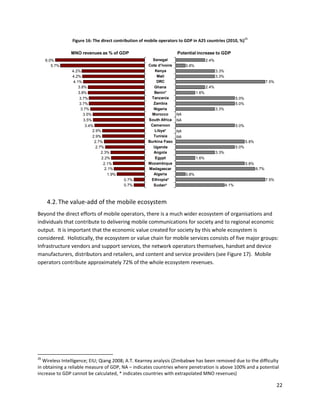
      4.1. The direct contribution of mobile operators to GDP
The incredible up-take of mobile services across Africa in recent years has resulted in total revenues of
mobile operators in the A25 reaching US$49 billion in 2010 (scaling up to all of Africa this figure is likely
to be around US$53 billion25). This equates to a direct contribution of 3.0% to aggregate GDP. At
country level, the direct contribution to GDP ranges from 0.7% in Sudan and Ethiopia, up to 6.0% in
Senegal (see Figure 16).

In recent studies by the World Bank and others, it was shown that there is a direct relationship between
mobile penetration and GDP. In developing countries, it has been shown that for every 10% increase in
mobile penetration there is a 0.81% point increase in a country’s GDP (in developed countries this figure
falls to a 0.60% contribution). Applying this relationship to the A25 countries indicates that raising the
whole region to 100% mobile penetration could add over $35 billion in aggregate GDP to the region, an
increase of 2%. We do not underestimate the challenges in achieving a goal of 100% penetration.
However, this does indicate what could be achieved by governments and operators if they work
together to bring mobile communication to the entire African population.


24
   Mobile ecosystem is considered broadly to consist of 5 groups: Infrastructure vendors and support services, the
network operators themselves, handset and device manufacturers, distributors and retailers, and content and
service providers
25
   Estimate is scaled up based on the GDP of A25 countries relative to the whole of Africa. A25 countries represent
92% of total African GDP

                                                                                                                21
26
                Figure 16: The direct contribution of mobile operators to GDP in A25 countries (2010, %)

               MNO revenues as % of GDP                               Potential increase to GDP
     6.0%                                               Senegal                          2.4%
        5.7%                                          Cote d’Ivoire        0.8%
                4.2%                                     Kenya                                  3.3%
                4.2%                                      Mali                                  3.3%
                 4.1%                                     DRC                                                                      7.5%
                    3.8%                                 Ghana                           2.4%
                    3.8%                                 Benin*                   1.6%
                     3.7%                              Tanzania                                               5.0%
                     3.7%                               Zambia                                                5.0%
                      3.7%                              Nigeria                                 3.3%
                       3.5%                             Morocco       NA
                       3.5%                           South Africa    NA
                        3.4%                           Cameroon                                               5.0%
                            2.9%                         Libya*       NA
                            2.9%                        Tunisia       NA
                             2.7%                     Burkina Faso                                                   5.8%
                              2.7%                      Uganda                                                5.0%
                                 2.3%                   Angola                                  3.3%
                                 2.2%                    Egypt                    1.6%
                                  2.1%                Mozambique                                                     5.8%
                                   2.1%               Madagascar                                                            6.7%
                                    1.9%                Algeria            0.8%
                                           0.7%        Ethiopia*                                                                   7.5%
                                           0.7%         Sudan*                                         4.1%


     4.2. The value-add of the mobile ecosystem
Beyond the direct efforts of mobile operators, there is a much wider ecosystem of organisations and
individuals that contribute to delivering mobile communications for society and to regional economic
output. It is important that the economic value created for society by this whole ecosystem is
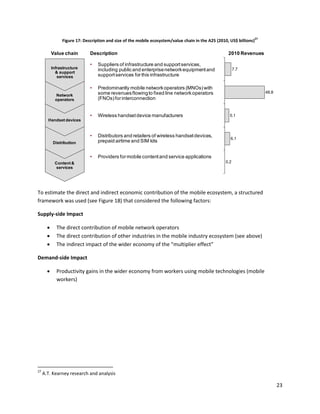
considered. Holistically, the ecosystem or value chain for mobile services consists of five major groups:
Infrastructure vendors and support services, the network operators themselves, handset and device
manufacturers, distributors and retailers, and content and service providers (see Figure 17). Mobile
operators contribute approximately 72% of the whole ecosystem revenues.


26
   Wireless Intelligence; EIU; Qiang 2008; A.T. Kearney analysis (Zimbabwe has been removed due to the difficulty
in obtaining a reliable measure of GDP, NA – indicates countries where penetration is above 100% and a potential
increase to GDP cannot be calculated, * indicates countries with extrapolated MNO revenues)

                                                                                                                                          22
27
                Figure 17: Description and size of the mobile ecosystem/value chain in the A25 (2010, US$ billions)

           Value chain        Description                                                            2010 Revenues

                              •   Suppliers of infrastructure and support services,
           Infrastructure         including public and enterprise network equipment and                   7.7
             & support
              services            support services for this infrastructure

                              •   Predominantly mobile network operators (MNOs) with
                                  some revenues flowing to fixed line network operators                                48.8
              Network
             operators            (FNOs) for interconnection


                              •   Wireless handset device manufacturers                               5.1
       Handset devices


                              •   Distributors and retailers of wireless handset devices,
                                                                                                      6.1
           Distribution           prepaid airtime and SIM kits


                              •   Providers for mobile content and service applications
            Content &                                                                               0.2
             services


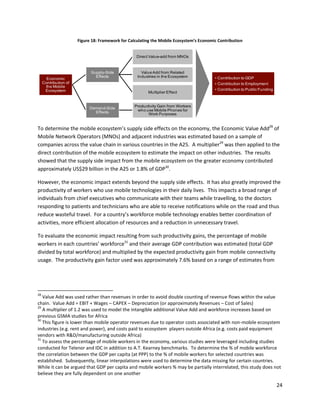
To estimate the direct and indirect economic contribution of the mobile ecosystem, a structured
framework was used (see Figure 18) that considered the following factors:

Supply-side Impact

            The direct contribution of mobile network operators
            The direct contribution of other industries in the mobile industry ecosystem (see above)
            The indirect impact of the wider economy of the “multiplier effect”

Demand-side Impact

            Productivity gains in the wider economy from workers using mobile technologies (mobile
             workers)


27
     A.T. Kearney research and analysis

                                                                                                                              23
Figure 18: Framework for Calculating the Mobile Ecosystem’s Economic Contribution


                                                    Direct Value-add from MNOs


                             Supply-Side              Value Add from Related
                               Effects              Industries in the Ecosystem           • Contribution to GDP
       Economic
     Contribution of                                                                      • Contribution to Employment
      the Mobile
      Ecosystem                                                                           • Contribution to Public Funding
                                                          Multiplier Effect


                                                   Productivity Gain from Workers
                            Demand-Side
                                                    who use Mobile Phones for
                              Effects                     Work Purposes


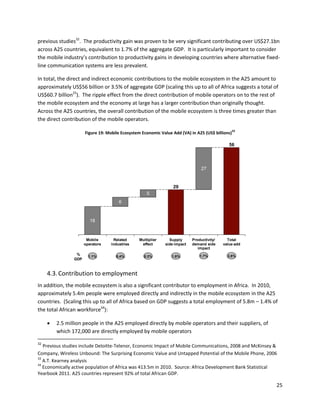
To determine the mobile ecosystem’s supply side effects on the economy, the Economic Value Add28 of
Mobile Network Operators (MNOs) and adjacent industries was estimated based on a sample of
companies across the value chain in various countries in the A25. A multiplier29 was then applied to the
direct contribution of the mobile ecosystem to estimate the impact on other industries. The results
showed that the supply side impact from the mobile ecosystem on the greater economy contributed
approximately US$29 billion in the A25 or 1.8% of GDP30.

However, the economic impact extends beyond the supply side effects. It has also greatly improved the
productivity of workers who use mobile technologies in their daily lives. This impacts a broad range of
individuals from chief executives who communicate with their teams while travelling, to the doctors
responding to patients and technicians who are able to receive notifications while on the road and thus
reduce wasteful travel. For a country’s workforce mobile technology enables better coordination of
activities, more efficient allocation of resources and a reduction in unnecessary travel.

To evaluate the economic impact resulting from such productivity gains, the percentage of mobile
workers in each countries’ workforce31 and their average GDP contribution was estimated (total GDP
divided by total workforce) and multiplied by the expected productivity gain from mobile connectivity
usage. The productivity gain factor used was approximately 7.6% based on a range of estimates from


28
   Value Add was used rather than revenues in order to avoid double counting of revenue flows within the value
chain. Value Add = EBIT + Wages – CAPEX – Depreciation (or approximately Revenues – Cost of Sales)
29
   A multiplier of 1.2 was used to model the intangible additional Value Add and workforce increases based on
previous GSMA studies for Africa
30
   This figure is lower than mobile operator revenues due to operator costs associated with non-mobile ecosystem
industries (e.g. rent and power), and costs paid to ecosystem players outside Africa (e.g. costs paid equipment
vendors with R&D/manufacturing outside Africa)
31
   To assess the percentage of mobile workers in the economy, various studies were leveraged including studies
conducted for Telenor and IDC in addition to A.T. Kearney benchmarks. To determine the % of mobile workforce
the correlation between the GDP per capita (at PPP) to the % of mobile workers for selected countries was
established. Subsequently, linear interpolations were used to determine the data missing for certain countries.
While it can be argued that GDP per capita and mobile workers % may be partially interrelated, this study does not
believe they are fully dependent on one another

                                                                                                                             24
previous studies32. The productivity gain was proven to be very significant contributing over US$27.1bn
across A25 countries, equivalent to 1.7% of the aggregate GDP. It is particularly important to consider
the mobile industry’s contribution to productivity gains in developing countries where alternative fixed-
line communication systems are less prevalent.

In total, the direct and indirect economic contributions to the mobile ecosystem in the A25 amount to
approximately US$56 billion or 3.5% of aggregate GDP (scaling this up to all of Africa suggests a total of
US$60.7 billion25). The ripple effect from the direct contribution of mobile operators on to the rest of
the mobile ecosystem and the economy at large has a larger contribution than originally thought.
Across the A25 countries, the overall contribution of the mobile ecosystem is three times greater than
the direct contribution of the mobile operators.
                                                                                                  33
                      Figure 19: Mobile Ecosystem Economic Value Add (VA) in A25 (US$ billions)

                                                                                              56


                                                                                27


                                                                 29
                                                    5
                                      6


                         18


                       Mobile       Related     Multiplier     Supply      Productivity/     Total
                      operators   industries     effect      side impact   demand side     value add
                                                                              impact
                 %                                                             1.7%          3.5%
                        1.1%         0.4%          0.3%          1.8%
                GDP


     4.3. Contribution to employment
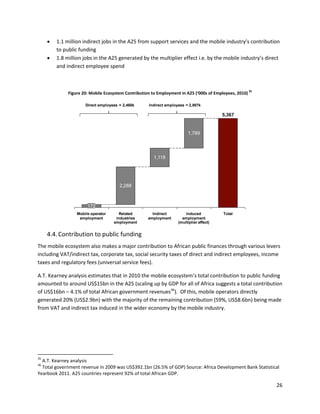
In addition, the mobile ecosystem is also a significant contributor to employment in Africa. In 2010,
approximately 5.4m people were employed directly and indirectly in the mobile ecosystem in the A25
countries. (Scaling this up to all of Africa based on GDP suggests a total employment of 5.8m – 1.4% of
the total African workforce34):

        2.5 million people in the A25 employed directly by mobile operators and their suppliers, of
         which 172,000 are directly employed by mobile operators

32
   Previous studies include Deloitte-Telenor, Economic Impact of Mobile Communications, 2008 and McKinsey &
Company, Wireless Unbound: The Surprising Economic Value and Untapped Potential of the Mobile Phone, 2006
33
   A.T. Kearney analysis
34
   Economically active population of Africa was 413.5m in 2010. Source: Africa Development Bank Statistical
Yearbook 2011. A25 countries represent 92% of total African GDP.

                                                                                                          25
   1.1 million indirect jobs in the A25 from support services and the mobile industry’s contribution
         to public funding
        1.8 million jobs in the A25 generated by the multiplier effect i.e. by the mobile industry’s direct
         and indirect employee spend


                                                                                                         35
              Figure 20: Mobile Ecosystem Contribution to Employment in A25 (‘000s of Employees, 2010)

                      Direct employees = 2,460k      Indirect employees = 2,907k

                                                                                          5,367


                                                                         1,789


                                                       1,118


                                       2,288


                       172
                  Mobile operator      Related         Indirect         Induced           Total
                   employment        industries      employment       employment
                                    employment                      (multiplier effect)


     4.4. Contribution to public funding
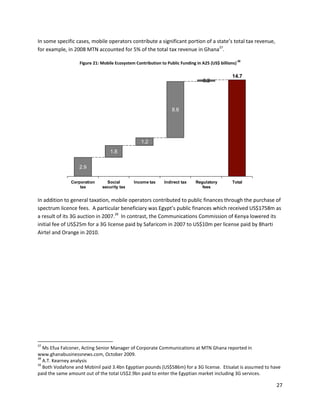
The mobile ecosystem also makes a major contribution to African public finances through various levers
including VAT/indirect tax, corporate tax, social security taxes of direct and indirect employees, income
taxes and regulatory fees (universal service fees).

A.T. Kearney analysis estimates that in 2010 the mobile ecosystem’s total contribution to public funding
amounted to around US$15bn in the A25 (scaling up by GDP for all of Africa suggests a total contribution
of US$16bn – 4.1% of total African government revenues36). Of this, mobile operators directly
generated 20% (US$2.9bn) with the majority of the remaining contribution (59%, US$8.6bn) being made
from VAT and indirect tax induced in the wider economy by the mobile industry.


35
  A.T. Kearney analysis
36
  Total government revenue in 2009 was US$392.1bn (26.5% of GDP) Source: Africa Development Bank Statistical
Yearbook 2011. A25 countries represent 92% of total African GDP.

                                                                                                              26
In some specific cases, mobile operators contribute a significant portion of a state’s total tax revenue,
for example, in 2008 MTN accounted for 5% of the total tax revenue in Ghana37.
                                                                                                      38
                   Figure 21: Mobile Ecosystem Contribution to Public Funding in A25 (US$ billions)

                                                                                                14.7
                                                                                 0.2


                                                                  8.6


                                                  1.2
                                  1.8


                   2.9

               Corporation      Social        Income tax      Indirect tax    Regulatory        Total
                   tax        security tax                                       fees


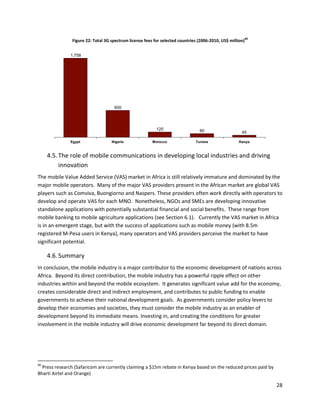
In addition to general taxation, mobile operators contributed to public finances through the purchase of
spectrum licence fees. A particular beneficiary was Egypt’s public finances which received US$1758m as
a result of its 3G auction in 2007.39 In contrast, the Communications Commission of Kenya lowered its
initial fee of US$25m for a 3G license paid by Safaricom in 2007 to US$10m per license paid by Bharti
Airtel and Orange in 2010.


37
   Ms Efua Falconer, Acting Senior Manager of Corporate Communications at MTN Ghana reported in
www.ghanabusinessnews.com, October 2009.
38
   A.T. Kearney analysis
39
   Both Vodafone and Mobinil paid 3.4bn Egyptian pounds (US$586m) for a 3G license. Etisalat is assumed to have
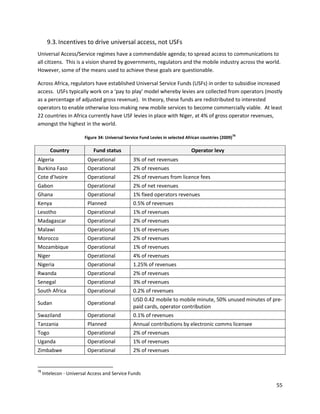
paid the same amount out of the total US$2.9bn paid to enter the Egyptian market including 3G services.

                                                                                                             27
40
                Figure 22: Total 3G spectrum license fees for selected countries (2006-2010, US$ million)


               1,758


                                     600


                                                           120                   80                    45

               Egypt                Nigeria              Morocco               Tunisia                Kenya


     4.5. The role of mobile communications in developing local industries and driving
          innovation
The mobile Value Added Service (VAS) market in Africa is still relatively immature and dominated by the
major mobile operators. Many of the major VAS providers present in the African market are global VAS
players such as Comviva, Buongiorno and Naspers. These providers often work directly with operators to
develop and operate VAS for each MNO. Nonetheless, NGOs and SMEs are developing innovative
standalone applications with potentially substantial financial and social benefits. These range from
mobile banking to mobile agriculture applications (see Section 6.1). Currently the VAS market in Africa
is in an emergent stage, but with the success of applications such as mobile money (with 8.5m
registered M-Pesa users in Kenya), many operators and VAS providers perceive the market to have
significant potential.

     4.6. Summary
In conclusion, the mobile industry is a major contributor to the economic development of nations across
Africa. Beyond its direct contribution, the mobile industry has a powerful ripple effect on other
industries within and beyond the mobile ecosystem. It generates significant value add for the economy,
creates considerable direct and indirect employment, and contributes to public funding to enable
governments to achieve their national development goals. As governments consider policy levers to
develop their economies and societies, they must consider the mobile industry as an enabler of
development beyond its immediate means. Investing in, and creating the conditions for greater
involvement in the mobile industry will drive economic development far beyond its direct domain.


40
  Press research (Safaricom are currently claiming a $15m rebate in Kenya based on the reduced prices paid by
Bharti Airtel and Orange)

                                                                                                                 28
5. Mobile as a driving force for development and innovation
  Key Messages

  • The cost of mobile ownership has declined to the extent that mobile connections in Africa
    include users from a wide range of socio-economic groups
  • At least 36% of Africans within the A25 do not have a mobile connection
  • In most African countries price-per-minute costs for mobile services are comparable to
    those in OECD countries
  • Most African governments have highlighted ICT policy as a key driver for the development
    of health, education and business

    5.1. Distinctive characteristics
Mobile phones are perceived as an essential consumer good and status symbol throughout Africa.
Given the poor state of fixed-line infrastructure, in sub-Saharan Africa in particular, mobiles are often
the preferred (or only) means of communication. These factors have contributed to the rapid uptake of
mobile services across the whole continent. The rapid decrease in prices combined with the broad
availability of pre-paid services means that mobile services are accessible to low-income groups. Airtel
currently offers a basic handset, SIM card and pre-paid credit voucher for around US$20. Even for those
who cannot afford a handset in Africa, it is not uncommon to own a SIM card which they can use in
friends’ or relatives’ phones. As a result, mobile connections now include a range of socio-economic
groups, a trend that is expected to continue as mobile service tariffs and handset prices continue to
decrease.

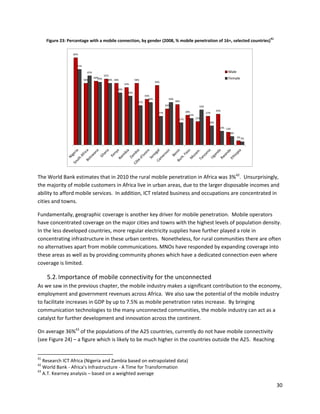
A study by Research ICT Africa (see Figure 23) shows how mobile ownership varies by gender. In
Zambia, Senegal, Benin and Uganda, there tend to be substantially more male mobile customers. This
trend may be attributed to a combination of unequal distribution of income, restrictive social taboos
and illiteracy. Interestingly, the inverse holds true in South Africa, Cameroon and Mozambique where
there tends to be more female mobile customers than male mobile subscribers.


                                                                                                        29
41
     Figure 23: Percentage with a mobile connection, by gender (2008, % mobile penetration of 16+, selected countries)

                  82%


                    71%

                            65%                                                                                                        Male
                                          62%
                          58%
                                  60%
                                    59%     58% 58%             58%                                                                    Female
                                                                                56%
                                                        54%
                                                  49%
                                                          46%
                                                                        43%
                                                                          40%             40%
                                                                  37%                           38%
                                                                                        34%                       33%
                                                                                                        28%                     29%
                                                                                  27%                                   27%
                                                                                                          25%
                                                                                                  21%           22%
                                                                                                                          18%
                                                                                                                                  13% 12%
                                                                                                                                        8%
                                                                                                                                              4% 3%


The World Bank estimates that in 2010 the rural mobile penetration in Africa was 3%42. Unsurprisingly,
the majority of mobile customers in Africa live in urban areas, due to the larger disposable incomes and
ability to afford mobile services. In addition, ICT related business and occupations are concentrated in
cities and towns.

Fundamentally, geographic coverage is another key driver for mobile penetration. Mobile operators
have concentrated coverage on the major cities and towns with the highest levels of population density.
In the less developed countries, more regular electricity supplies have further played a role in
concentrating infrastructure in these urban centres. Nonetheless, for rural communities there are often
no alternatives apart from mobile communications. MNOs have responded by expanding coverage into
these areas as well as by providing community phones which have a dedicated connection even where
coverage is limited.

     5.2. Importance of mobile connectivity for the unconnected
As we saw in the previous chapter, the mobile industry makes a significant contribution to the economy,
employment and government revenues across Africa. We also saw the potential of the mobile industry
to facilitate increases in GDP by up to 7.5% as mobile penetration rates increase. By bringing
communication technologies to the many unconnected communities, the mobile industry can act as a
catalyst for further development and innovation across the continent.

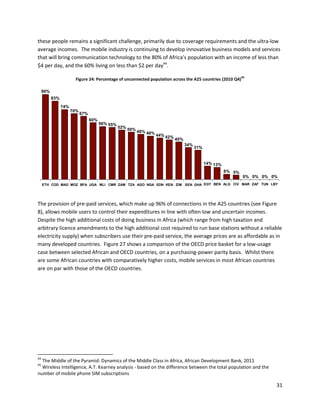
On average 36%43 of the populations of the A25 countries, currently do not have mobile connectivity
(see Figure 24) – a figure which is likely to be much higher in the countries outside the A25. Reaching


41
   Research ICT Africa (Nigeria and Zambia based on extrapolated data)
42
   World Bank - Africa’s Infrastructure - A Time for Transformation
43
   A.T. Kearney analysis – based on a weighted average

                                                                                                                                                           30
these people remains a significant challenge, primarily due to coverage requirements and the ultra-low
average incomes. The mobile industry is continuing to develop innovative business models and services
that will bring communication technology to the 80% of Africa’s population with an income of less than
$4 per day, and the 60% living on less than $2 per day44.
                                                                                                                       45
                        Figure 24: Percentage of unconnected population across the A25 countries (2010 Q4)

     90%
           83%
                 74%
                       70%
                             67%
                                   60%
                                         56% 55%
                                                   52%
                                                         50%
                                                               48% 46%
                                                                         44% 42%
                                                                                   40%
                                                                                         34%
                                                                                               31%


                                                                                                     14% 13%
                                                                                                               6% 5%
                                                                                                                       0% 0% 0% 0%
     ETH COD MAD MOZ BFA UGA MLI CMR ZAM TZA AGO NGA SDN KEN ZIM SEN GHA EGY BEN ALG CIV MAR ZAF TUN LBY


The provision of pre-paid services, which make up 96% of connections in the A25 countries (see Figure
8), allows mobile users to control their expenditures in line with often low and uncertain incomes.
Despite the high additional costs of doing business in Africa (which range from high taxation and
arbitrary licence amendments to the high additional cost required to run base stations without a reliable
electricity supply) when subscribers use their pre-paid service, the average prices are as affordable as in
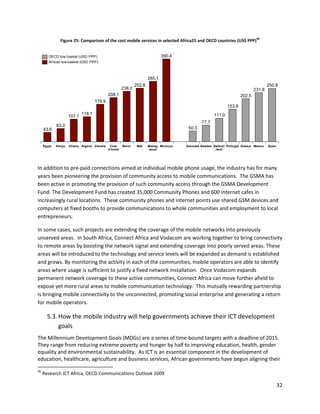
many developed countries. Figure 27 shows a comparison of the OECD price basket for a low-usage
case between selected African and OECD countries, on a purchasing-power parity basis. Whilst there
are some African countries with comparatively higher costs, mobile services in most African countries
are on par with those of the OECD countries.


44
  The Middle of the Pyramid: Dynamics of the Middle Class in Africa, African Development Bank, 2011
45
  Wireless Intelligence, A.T. Kearney analysis - based on the difference between the total population and the
number of mobile phone SIM subscriptions

                                                                                                                                 31
46
               Figure 25: Comparison of the cost mobile services in selected Africa25 and OECD countries (US$ PPP)


        OECD low basket (USD PPP)                                               390.4
        Af rican low basket (USD PPP)


                                                                        285.1
                                                                252.8                                                                     250.8
                                                        238.0                                                                    231.8
                                             208.1                                                                       202.5
                                     176.9
                                                                                                                 153.8
                             118.1                                                                       111.0
                     107.1
                                                                                                  77.7
             63.0
     43.6                                                                                 50.3


     Egypt   Kenya   Ghana Algeria Zambia     Cote      Benin    Mali   Madag- Morocco   Denmark Sweden Switzer- Portugal Greece Mexico   Spain
                                             d’Ivoire                    ascar                           land


In addition to pre-paid connections aimed at individual mobile phone usage, the industry has for many
years been pioneering the provision of community access to mobile communications. The GSMA has
been active in promoting the provision of such community access through the GSMA Development
Fund. The Development Fund has created 35,000 Community Phones and 600 internet cafes in
increasingly rural locations. These community phones and internet points use shared GSM devices and
computers at fixed booths to provide communications to whole communities and employment to local
entrepreneurs.

In some cases, such projects are extending the coverage of the mobile networks into previously
unserved areas. In South Africa, Connect Africa and Vodacom are working together to bring connectivity
to remote areas by boosting the network signal and extending coverage into poorly served areas. These
areas will be introduced to the technology and service levels will be expanded as demand is established
and grows. By monitoring the activity in each of the communities, mobile operators are able to identify
areas where usage is sufficient to justify a fixed network installation. Once Vodacom expands
permanent network coverage to these active communities, Connect Africa can move further afield to
expose yet more rural areas to mobile communication technology. This mutually rewarding partnership
is bringing mobile connectivity to the unconnected, promoting social enterprise and generating a return
for mobile operators.

       5.3. How the mobile industry will help governments achieve their ICT development
            goals
The Millennium Development Goals (MDGs) are a series of time-bound targets with a deadline of 2015.
They range from reducing extreme poverty and hunger by half to improving education, health, gender
equality and environmental sustainability. As ICT is an essential component in the development of
education, healthcare, agriculture and business services, African governments have begun aligning their

46
     Research ICT Africa, OECD Communications Outlook 2009

                                                                                                                                                  32
ICT policy to the MDGs. In 2001, the African Union established the New Partnership for Africa's
Development (NEPAD) along with an e-Africa commission. The mandate of the commission includes:

          Accelerating the development of African inter-country, intra-country and global connectivity,
           and
          Promoting conditions for Africa to be an equal and active participant in the Global Information
           Society

Governments across Africa have responded by establishing customized ICT strategies to promote the
expansion of communications services and to embed it at the heart of development policy. For
example, Ghana has positioned ICT as the fundamental building block for its long term development
strategy:

       “The Government of Ghana is committed to pursuing an ICT for Accelerated Development (ICT4AD)
       Vision aimed at improving the quality of life of the people of Ghana by significantly enriching their
       social, economic and cultural well-being through the rapid development and modernization of the
       economy and society using information and communication technologies as the main engine for
       accelerated and sustainable economic and social development.” 47

Mobile operators are primary stakeholders in supporting expansion of ICT across Africa. Mobile
operators are investing heavily in mobile network coverage to provide the continent with access to ICT
services. Mobile operators are also instrumental in bringing international bandwidth to the continent
through submarine fibre-optic cable initiatives such as EASSy which serves the East Coast of Africa
consists of 16 shareholders who are predominantly mobile operators. Similarly, a 5,000km national
backbone project in South Africa is being jointly funded by Vodacom, MTN and Neotel.

It is clear that to achieve the continent’s ICT development goals, African governments and the mobile
industry must continue to work together in partnership to bring the benefits of communication
technology to the people of Africa.


47
     Ghana Ministry of Communications

                                                                                                           33
6. Corporate sustainability: The environmental and social impact
      Key Messages

     • Mobile operators have driven the emergence of a unique industry in innovative mobile
       services in Africa enabling and promoting agriculture, banking, education, health and
       gender equality
     • 86% of NGO employees use mobile phones which are considered an essential tool
     • Mobile phones can now be used as a mass communication system throughout Africa in the
       event of emergencies and environmental disasters
     • The mobile sector now plays a key role in promoting rural access to electricity and
       sustainable energy

       6.1. The social impact of the mobile industry
By 2015, it is predicted that sub-Saharan Africa will have more people with mobile network access than
have electricity at home48. As mobile service penetration across Africa begins to exceed that of other
core infrastructure, the mobile industry is beginning to have an increasingly significant impact on
society. As well as improving communication, the mobile phone is facilitating improvements in
agriculture, banking, education, healthcare and the empowerment of women.

m-Agri
The International Food Policy Research Institute estimates that 65% of the population in sub-Saharan
Africa relies on subsistence farming. Crop yields can be highly variable which can severely strain
farmers’ ability to feed themselves and their families. One of the key problems is that poor farmers lack
access to vital agricultural information, training and advice on topics such as pests, diseases, weather,
fertilizers and proven farming practices. Mobile connectivity offers a new opportunity to bridge this gap
and to connect the farmer with up-to-date agricultural knowledge.

In Kenya, where 70% of the population is employed in agriculture, the GSMA Development Fund
established M-Kilimo49, a dedicated helpline providing information and advice to small-hold farmers.
Typically, the helpline experts dealt with four main topics of enquiry:

          Agricultural tips and efficient farming practices
          Questions on plant and animal diseases and treatment
          Agriculture-specific weather forecasts
          Market price information

Since the dialogue between the farmer and the helpline expert occurs in real time, most problems can
be resolved during the call. However, complex queries sometimes need more time and M-Kilimo
undertakes to try to resolve these more complicated issues within a 24hr period.

48
     Cisco VNI Forecast February 2011
49
     Kilimo means “agriculture” in Swahili

                                                                                                       34
m-Banking
Mobile banking services have been widely publicized as revolutionizing access to financial services to
low income groups. In Kenya in 2007, Safaricom’s M-Pesa money transfer service was the first to
launch. In the first 30 months of service, 8.5m Kenyans registered50 as M-Pesa users and US$3.7bn
worth of transfers were made (approximately 10% of Kenyan GDP). M-Pesa allows users to deposit,
transfer and withdraw cash via Safaricom’s M-Pesa agents, of which there were 18,000 in April 2010,
compared to 491 bank branches. These developments enable subscribers to transfer money to family
members, make a payment for goods or services or simply save their money in a more secure form than
cash. Money transfer services have since been launched by many other mobile operators in several
other countries including: Ghana, Tanzania, Uganda, Nigeria and South Africa.

Since the original launch of M-Pesa, the mobile money industry has continued to develop in many
African countries. Today, it has reached a level of sophistication not seen anywhere else in the world.
In addition to transaction services, Africans are now able to use mobile banking to access savings
accounts, agriculture insurance, pensions, health insurance, micro-finance loans and life insurance
products. For example, Safaricom in partnership with The Equity Bank in Kenya provides customers with
an M-KESHO account allowing them to save, buy insurance and arrange micro-finance loans all via
mobile banking. Similarly, Tigo Ghana’s “Life Care” service offers Life Insurance with monthly premiums
as low as GHC1 (€0.54).

Studies have shown that in addition to providing greater stability to low income groups, mobile banking
often acts as an entry to more formal banking services. Mbiti and Weil show that the introduction of M-
Pesa has led to a 58% increase in the number of Kenyans who have bank accounts. Therefore, not only
do these innovative mobile services provide an immediate service to the poor, but they act as a catalyst
to the on-going development in the wider economy.

In 2009, the GSMA launched the Mobile Money for the Unbanked (MMU) programme, aimed at
accelerating the provision of money services to those living on less than $2 per day. Supported by a
grant from the Bill & Melinda Gates Foundation, MMU has the goal of reaching 20 million people by
2012 and ultimately to make mobile money a mainstream business.

m-Learning
Education is widely regarded as the best long-term tool to improve the standards of living for the poor.
M-learning initiatives facilitate education and learning in even the most remote locations, and provide a
supplement to bricks-and-mortar schools in areas where schools are sparse and access to education is
limited. Low income groups’ access to education is restricted by many factors including: the cost of
education and expectations that children may undertake child employment, as well as language and
social barriers.


50
  Mobile Banking: The impact of M-Pesa in Kenya. Mbiti, I. and Weil, D.N. (2011). National Bureau of Economic
Research Working Paper Series.

                                                                                                                35
M-learning offers a solution to several of these key challenges. It is inclusive and non-discriminatory, it
can be accessed from wherever the user wishes to learn, can be tailored to individual learning needs
and can progress at each users’ own pace, while fitting around income generating activities. M-learning
can also help to overcome the gender inequality in many developing countries, by providing women
with a safe learning environment without leaving the household or community.

In addition to providing general education, m-learning is also providing valuable support to professionals
in on-the-job training. Community Health Workers (CHW) in the UN’s Millennium Villages in Uganda,
Rwanda and Kenya have access to m-learning modules on their mobile phones. Information on
reproductive health and care for new-borns are two of the subjects CHWs can download from a central
database to their mobile phone. Mobile networks provide the privacy, quality of service and
interoperability required to deliver this learning application, to improve the lives of the communities
that the CHWs serve.

m-Health
Sub-Saharan Africa has the lowest average life expectancy of any region in the world at 52 years. In
Lesotho, it is only 46 years51. In this context, access to appropriate, quality healthcare remains a major
challenge to improving the standard of living for Africa’s population.

Mobile technology is emerging as an important tool to improve the delivery of healthcare across Africa
and is currently being used in a number of areas:

         Capturing and analysing data for disease surveillance
         Providing remote diagnoses via telemedicine
         Supporting community health workers in gathering and managing health information
         Improving access to health education, information and resources through health hotlines
         Coordinating drug and medical supply distribution

In Rwanda, MTN, Voxiva and the GSMA Development Fund have deployed a system to enable
healthcare workers in the field to use mobile phones to collect data related to outbreak of contagious
disease, numbers of patients, drug stocks etc. The use of mobile technology means that this information
is available, and can be acted upon in real time, rather than the traditional paper-based systems which
can cause errors, inefficiency, and delay.

In Ghana and Nigeria, systems have been deployed to allow users to check the authenticity of
pharmaceuticals. Counterfeit drugs are a major issue in Africa and the scheme, endorsed by the West
Africa Health Organization, is being promoted by a number of drug companies. GlaxoSmithKline is one
of the recent pharmaceutical firms to sign up to the initiative; which enable users to send a code printed
on the drug packet via SMS and receive a reply, either verifying the authenticity of the drugs or giving a
warning that the product may be fake and providing a helpline number to call for advice.


51
     UN Human Development Report 2010

                                                                                                         36
m-Women
The GSMA Development Fund formed the mWomen programme after identifying a sizeable gender gap
in mobile phone ownership in middle and lower income countries. Across Africa, women are on average
23% less likely to own a mobile phone than men, meaning that women are missing out on many of the
social and economic benefits that mobile connectivity brings. A recent survey of female mobile phone
users in lower and middle income countries52 showed that 93% of women say they felt safer and more
connected to friends and family with a mobile phone, whereas 85% felt more independent. 41% of
women reported an increase in earnings or professional opportunities due to owning a mobile phone, a
figure which rises to 55% among female business owners.

In Liberia, MTN recognised that women in the market were underserved52 and only required regular
contact with a small circle of family and friends. MTN developed new tariff plans for the “Her & Home”
segment offering discounted calling during relevant times of day and preferential rates for a selected
group of friends and family. The marketing of these services were also designed to appeal to the needs
of women to encourage uptake.

     6.2. Role of NGOs
Non-governmental organisations (NGOs) continue to play an important role in many parts of Africa to
aid development and to provide healthcare, educational, environmental and humanitarian support.
Mobile technologies are enabling these organisations to deliver their services more efficiently and
enabling resources to be more rapidly allocated to those with the greatest need.

A survey by the UN Foundation and the Vodafone Group Foundation found that 86% of NGO employees
use mobile technology to support their work53. The survey listed the benefits of mobile technology for
NGOs as follows: time savings (95%); the ability to mobilize or organise individuals (91%); reaching
audiences that were previously difficult or impossible to reach (74%); the ability to transmit data more
quickly and accurately (67%); and the ability to gather data more quickly and accurately (59%).

NGO uses for mobile technology range from the Tunisian Red Cross providing mobile phones to allow
people fleeing the recent conflict in Libya to call their loved ones; to Cell-life in South Africa providing
HIV/AIDS outpatient services.

In Kenya, mobile operators, NGOs and the GSMA Development Fund are working together to plant trees
under a project helping to reverse the devastating effects of deforestation and drought. The project
provides an income to local Africans who use hand held mobile devices to accurately collect tree
location and growth information, the information is sent via the mobile network to the project head
office in the US.


52
  Women and Mobile: A Global Opportunity, GSMA Development Fund
53
  Wireless Technology for Social Change: Trends in Mobile Use by NGOs 2008, UN Foundation and Vodafone
Group Foundation

                                                                                                               37
6.3. Role of mobile technology in disaster preparedness and relief
Mobile technology is providing new ways for governments and NGOs to cope with natural and man-
made emergencies and disasters. From providing communications infrastructure when all other
infrastructure has been destroyed or damaged to mobilizing charitable donations, mobile technology is
playing key role in coordinating responses to and pre-empting emergencies.

In July 2011, following the most acute drought in east Africa in 60 years, Kenyans donated nearly
US$200,000 in aid for drought victims via SMS within the first 12 hours of the appeal. The appeal went
on to raise US$5m in the first four weeks, reaching an eventual total of US$10m. The money was
administered by the Kenyan Red Cross to help those worst affected by the drought. Including more than
four million Kenyans, many of them small-hold farmers in the north, threatened by mass starvation.

In December 2004, the waves of the infamous Indian Ocean tsunami struck the coast of Tanzania. At
the time, very few of the many fishing boats working along the coast had radios and the only means of
communication was via mobile phone. Miraculously, there were only 13 fatalities along the entire
Tanzanian coast. Since then, the Tanzanian Red Cross has been supporting the UN funded Indian Ocean
Tsunami Early Warning System. In addition to broadcast radio sets, badly needed early-warning
equipment has also been distributed in the form of mobile phones, bicycles and megaphones.

Zain and the GSMA Development Fund have been supporting efforts to pre-empt emergency situations
and improve response rates. Each year up to 5,000 people die from accidents and piracy in Lake
Victoria’s fishing zones. In 2008, an additional 21 radio sites were built to provide mobile coverage up to
20 kilometres into the lake. This initiative was intended to drive further economic and social
development within the lakeside communities and reduce the number of fishing-related deaths each
year. The initiative uses Ericsson’s Extended Range software package to more than double the effective
range of radio base stations and a location-based service that enables emergency authorities to
triangulate the mobile signal of fishermen in distress.

     6.4. The environmental impact of the mobile industry
Mitigating climate change is an unprecedented challenge for the world: a challenge where consumers,
companies, NGOs and governments each have an important role to play. Whilst the mobile industry is
not a major emitter of carbon-dioxide or other greenhouse gases in comparison to some other
industries, it is nonetheless taking an increasingly important role in mitigating the effects of climate
change.

In the African context, the question of energy consumption takes on an additional dimension since much
of the continent is without reliable energy production and distribution. Estimates indicate that only 8%
of the rural population in sub-Saharan Africa has access to electricity, compared to 53% in urban areas54.


54
  Davidson, O., Chenene, M., Kituyi, E., Nkomo, J., Turner, C., and Sebitosi, B. (2006) - Sustainable Energy in sub-
Saharan Africa

                                                                                                                       38
Mobile operators and vendors are finding innovative ways to increase energy efficiency and reduce the
greenhouse gas emissions resulting from the operation of mobile networks and charging of mobile
devices. Improving the energy efficiency of the mobile industry can be achieved broadly in the following
ways:

          Designing low energy base station sites
          Deploying base-stations powered by renewable energy
          Implementing infrastructure optimisation and sharing
          Reducing mobile device life cycle emissions through design and recycling

According to GSMA research, by 2012, there are expected to be around 165,000 base stations across
sub-Saharan Africa which do not have a reliable electricity supply. This is around 79% of all base stations
in sub-Saharan Africa55. Such base stations are typically powered by diesel generators. Reducing this
dependence on diesel is a huge challenge, but mobile operators are making progress to convert to
renewable energy sources. For some time, mobile operators in Africa have been powering base
stations, utilising solar, wind and fuel cells as alternative energy sources. Across all of Africa, solar
power is the most common form of alternative energy used, powering nearly 550 base stations. In
Egypt alone, 266 base stations are solar-powered between Vodafone (166) and Mobinil (100), with a
further 250 in Guinea, Senegal and Mozambique. Safaricom and Telkom in Kenya are combining wind
and solar approaches to power 86 base stations. Another approach, being pioneered by Vodacom South
Africa, is the use of hydrogen fuel cells. When the power supply fails, the fuel cell uses stored hydrogen
to generate electricity without harmful emissions, and only water as a by-product.


55
     Community Power: Using Mobile to Extend the Grid. GSMA, 2010

                                                                                                        39
56
                           Figure 26: Base Stations Powered by Alternative Renewable Energy Sources


                   266
                                                                                                Solar
                                                                                                Wind-Solar Hybrid
                                                                                                Fuel cell
                                                                                                Wind


                            133
                             5
                             21
                                     100      92
                                                      80
                                                              69
                             107              86
                                                                      23
                                              4 2
                                                                               2       1             1          1
                   Egypt   South    Guinea   Kenya Senegal
                                                        Mozambique
                                                                 Lesotho Tanzania Ghana Namibia                D.R.
                           Africa                                                                             Congo


Beyond powering the mobile network, mobile operators also see the great potential of their energy
infrastructure to deliver surplus energy to local communities. Mobile operators are able to provide the
excess power generated to the local communities for lighting, mobile device charging, water pumping.
Safaricom, Kenya’s largest mobile operator has provided diesel, solar, and wind powered infrastructure
for multiple Community Power applications at more than 15 of its off-grid sites in Kenya. Table 1
provides an overview of the community power applications available at these off-grid sites across Kenya.
                                                                                           57
                                     Table 1: Examples of community power sites in Kenya

            Site                     Location                          Community Power Applications
Tegea                         250 km North-West of Mobile phone charging booth
                              Nairobi              Market street lighting
                                                   Lighting and socket power to local community church
                                                   Lighting and socket power to the site landlord and the local
                                                   provincial administration (chief’s house)
Faza Island                   15 km South of           Mobile phone charging booth
                              Saadani, North Kenya     Supply of power to local community school computer room
                              Coast
Chesengoch                    220 km North of          Mobile phone charging booth
                              Nakuru                   Lighting and socket power to mission hospital maternity wing
                                                       Market street lighting
                                                       Lighting and socket power to local community library
Archer’s Post                 600 km North of          Power to local community water pumping system
                              Nairobi

56
     Source: GSMA
57
     Source: Safaricom

                                                                                                                      40
Site                  Location                     Community Power Applications
Konyao                   Near the Kenya-      Mobile phone charging booth
                         Uganda border        Lighting and socket power to a local community school
Kiunga Sankuri           450 km North of        Mobile phone charging booth
                         Mombasa on the east Power to local community radio
                         coast, near the Kenya-
                         Somalia border
Ndau Island, Laisamis,   Across Kenya         Mobile phone charging booths
Nyagoko, Tot, Rhamu,
Sololo, Loiyangalani

The GSMA estimates that across East Africa, there is the potential for 11,000 community power projects
bringing the combined benefits of communication and electricity to rural populations. Access to these
facilities will in turn promote improvements in education, health and quality of life for many low-income
groups.

In conclusion, while it is clear that the provision of mobile communications to the poor in Africa will not
alone eradicate poverty, there are huge strides being made to help the least well-off in society. The
proliferation of mobile communications is also is improving access to financial services, education and
healthcare, and is supporting emergency relief, social equality, and even electricity distribution.

In the next chapters we will turn to look at the regulatory environment in which the mobile industry is
operating in Africa, the investments which mobile operators are making and what more might be done
to enable the mobile industry to continue to drive social and economic development.


                                                                                                         41
7. Spectrum and technology availability
     Key Messages

     • African countries allocated considerably less spectrum to mobile services than developed
       and developing countries in Europe, the Americas and Asia.
     • To enable the mobile industry to continue to act as a catalyst for growth, sufficient
       spectrum is needed for the provision of mobile broadband services through 3G and 4G
       technologies
     • Allocating the Digital Dividend spectrum to mobile services will enable the mobile industry
       to accelerate their efforts to bring connectivity to the large numbers of unconnected
       Africans
     • Governments in the region must establish clear guidelines for spectrum planning, licensing,
       pricing and re-farming.
     • African governments must clarify spectrum availability of both the coverage bands (700,
       800, and 900 MHz bands) and the capacity bands (1800, 2100, 2300, 2600, and 3500 MHz
       bands).

       7.1. Access to spectrum
Compared with Europe, North/Central America and parts of Asia, African countries have released less
spectrum to provide public mobile services. For example, in Morocco and South Africa, less than
210MHz of spectrum has been released to mobile. Only in Nigeria has more than 250MHz been
released.
                                                                                                         58
                            Figure 27: Spectrum licensed in selected African and non-African countries

      594     585
                                                                                                              2.1-2.6GHz
                     513                                                                                      1800-1900MHz
                                                                                                              700-900MHz
                             434
      314
              325                    395
                     285                      360

                             229
                                              120              273
                                     215

                                                                80      220
                                                                                 205      204
      150
              142
                     120                                                                  70
                             140                                        150
                                     110      240              153               155
                                                                                                   98         94
                                                                                          73
      130                                                                                          48         60
              118    108                                                                                               36
                             65       70                                70       50       62       50                   20
                                                                40                                            34      16

 Germany Sweden United      Hong    China   Mexico           Nigeria Tunisia Morocco South      Uganda Botswana Cote
                States      Kong                                                     Africa                    d’Ivoire


To enable the continued deployment mobile broadband service across the continent, a substantial
amount of additional spectrum will be required. This is needed due to the significant increase in data


58
     GSMA, National regulators

                                                                                                                             42
traffic created by these services. A typical smartphone generates 24 times the data traffic, and an
average computer generates 515 times the data traffic of a basic feature phone59. Mobile data traffic is
doubling every year with operators seeing rapid acceptance and uptake by consumers. Whilst the
volume of traffic is growing rapidly, the available spectrum to support this traffic has been fixed in many
countries – risking a reducing in service as networks reach capacity.

As we have seen in previous chapters, mobile services play a relatively large role in the total broadband
provision in Africa because of the underdeveloped fixed access networks. Therefore the availability of
adequate spectrum is necessary to meet the ambitious targets for economic and social development
and government ICT goals. As a result, African regulators began licensing 3G spectrum to enable
operators to meet the ever increasing demand. Since 2006 at least 29 countries have issued 3G licenses
with more 3G licence awards in progress during the second half of 201160.

In addition to the quantity, the type of spectrum released is also important; a considered selection of
the right band to be released will help to drive universal access to mobile broadband. Of particular
importance is having a clear plan of what to do with the Digital Dividend61 (spectrum currently used for
analogue broadcast television). If allocated to mobile services, the Digital Dividend spectrum would
allow for extensive coverage in rural areas, contributing to a reduction in the digital divide and to
connecting the unconnected. The applicability for mobile broadband is twofold. Firstly, coverage in
rural areas requires low frequency bands. This is in contrast to densely populated areas, which with
high levels of traffic would need bands such as 2.3GHz, 2.5-2.69GHz, and 3.5GHz.
                                                                                               62
                                  Figure 28: Mobile broadband coverage with Digital Dividend


Secondly, the cost of providing coverage to a given area using the 800MHz band can be up to 70% less
than in the 2100MHz band. Therefore, allocating additional spectrum in the 800MHz band to mobile
services could reduce the costs of network deployments to a third of the cost of a 2100MHz deployment
(see Figure 29).


59
   Cisco - Cisco Visual Networking Index: Global Mobile Data
60
   Informa - Global 3G and 4G Deployment Status
61
   Digital Dividend refers to the spectrum released in the process of the transition from analogue to digital
television
62
   GSMA estimates

                                                                                                                43
62
                            Figure 29: Relative cost to deploy a mobile network by frequency band


                                                                                                         12.0


                                                                                     7.0


                                                                       5.0


                                                         3.0
                                          2.0
                            1.5
              1.0


              700          800           850           2100          2600           3500                 5800

Allocating the Digital Dividend spectrum is being actively discussed by governments in many African
countries. Target dates for analogue-to-digital switch-over range from June 2012 in Kenya and Nigeria,
to December 2013 in South Africa and 2015 in Egypt. South Africa has agreed to CRASA’s63
recommendation that the 790-862MHz band should be allocated to mobile services in the South African
Development Community (SADC) region. However, governments in other countries are less clear on the
use of the Digital Dividend. The Egyptian and Nigerian governments had originally favoured the 698-
806MHz band for the Digital Dividend.

Regulators should also consider the wider regional and global implications when considering spectrum
allocation. Harmonization is a key factor in promoting adoption and can bring other benefits such as
cost effective roll-out of networks and devices, a reduction in cross-border interference can also
facilitate international roaming. Meanwhile, if harmonization is not achieved there will be an adverse
effect on the technical and economic efficiency of any future rollout.

In addition to mobile mainstream UMTS (e.g. HSPA and LTE) , Africa has the largest number of national
WiMAX networks in the world, with 117 networks deployed in 43 countries having deployed WiMAX as
of May 2011 (compared to just 33 in Latin America and 23 in Asia Pacific). . Spectrum required for
WiMAX varies due to a number of factors (data rates, deployment environment, time or frequency
division duplex) but typically 10MHz TDD (shared between downlink and uplink) is required.64

In the past, African regulators have allocated a substantial amount of spectrum to WiMAX – often in a
fragmented way (for example, there are approximately 15 players in Tanzania) and with few obligations
to launch a service. Worldwide there are only 25 million connections on WiMAX networks, of which
around 5 million are in Africa65. The low uptake has not helped created the economies of scale needed

63
   Communication Regulators' Association of Southern Africa
64
   WiMAX forum
65
   WiMAX forum

                                                                                                                44
to make the end devices affordable. These factors have led to valuable spectrum being tied up by small
operators who in many cases have not launched services.

Regulators across Africa must carefully assess which services are most likely to actually bring the
benefits of mobile communications to their citizens when assigning spectrum to different technologies
and individual organisations. It is crucial that a balance is struck between encouraging competition by
licensing multiple firms to offer services, and the need for each competitor to have the return on
investment incentive to launch services which will benefit the maximum number of people. Spectrum is
a valuable resource and should be carefully managed to bring the maximum benefit to the people of
Africa.

The GSMA supports a technology neutral approach to the use of all existing mobile bands; governments
in Africa should allow deployment of mobile technologies that can technically co-exist according to what
are relevant internationally harmonised bands for their region.

       7.2. Spectrum pricing
As shown in section 4.4, prices paid for 3G spectrum across Africa have varied considerably from almost
$1.8bn in Egypt to $45m in Kenya. On a price per MHz per population basis, Egypt’s spectrum is still 18
times more expensive than Kenya at $0.37/MHz/population versus $0.02/MHz/population in Kenya66.
Clearly governments have some degree of discretion on the pricing of spectrum licenses and there are
good reasons for governments to carefully consider the price and quantity of spectrum offered for sale.

A higher net license fee may appear to be in the best interests of the population since the higher
government income can be spent to provide services to the people. However, operators bidding for
spectrum will always be doing so on commercial grounds. High spectrum fees may dissuade operators
from bidding for spectrum, investing in rural coverage, or may result in higher prices for consumers –
both of which would limit the possible benefits to consumers from the expansion of mobile services.

Governments need to carefully consider the trade-off between maximizing up-front revenues with the
wider societal benefit of mobile operators investing in coverage, capacity, and new services

       7.3. Importance of clear roadmap of spectrum allocation
Spectrum management is among the most important issues for the telecoms industry globally. Spectrum
is a limited resource that governments control and need to best utilise to maximise economic and social
benefits for their citizens. As shown in previous chapters, mobile service is the primary means of
communication for much of the population in Africa and mobile broadband is expected to be the critical
technology that will finally bridge the digital divide and connect the unconnected masses. However, for
ubiquitous and seamless mobile communications and broadband to exist, sufficient spectrum must be
allocated to the industry. To provide the desired mobile services at the lowest possible cost and to allow
consumers to use the widest selection and low cost handsets, the mobile industry needs to be allocated
harmonized frequency in internationally standardized band plans. The licensing and spectrum landscape

66
     Calculated based on 2007 populations

                                                                                                       45
across Africa differs to a certain extent along the lines of emerging and developed economies. In most
developed markets, 3G spectrum licences have been available in the market for a number of years
already. In such markets, the uptake of 3G and the corresponding rapid increase in data traffic, is putting
pressure on the bandwidth available for operators to meet the needs of customers. In many African
markets, 3G licences have only recently been issued (e.g. Tunisia, Togo, Somalia) or will be issued by
early 2012 (Algeria, Gabon).

Governments should design and implement spectrum award procedures in an efficient, technology
neutral and transparent manner to keep participant costs low and deliver benefits to citizens as quickly
as possible. Lack of clarity around the spectrum award procedures can send mixed (and even negative)
signals about the investment climate in a country. In 2010, Mobitel won a dispute in the Nigerian
Federal high court, overruling a decision by the Nigerian Communications Commission (NCC) to cancel
Mobitel’s spectrum licensing within the 2.3GHz band.

Government policies should aim to develop a technology neutral environment (while ensuring
interference is managed and allowing the deployment of internationally harmonised spectrum plans). To
facilitate innovation and a smooth technology development curve, governments should relax
restrictions on the specific technology to be deployed so that, for example, a GSM operator can consider
using its current spectrum allocation for upgrading to 3G technology (UMTS/HSPA) or even fourth
generation technology (LTE). One might consider this as allowing operators to follow a natural upgrade
path, ensuring that they are using the most cost-effective and spectrally-efficient solutions.

Government policies should also be fair to all industry players. Implementing policies with the aim of
ensuring one player (typically the state-owned incumbent) has an advantage of going to market well
before others, does not create a level playing field. For example, the eligibility criteria announced in
September 2011 for Kenyan’s 4G licenses appears to favour two of the four Kenyan operators by
requiring at least 20% national ownership in order to apply.

A similar situation has arisen in South Africa in 2011. The sale of spectrum in the 2.6GHz band has been
delayed due to concerns from operators over the conditions that bidders must have 30% equity owned
by “Historically Disadvantaged Individuals”. While it is entirely reasonable for states to require certain
levels of local ownership, empowering the local population through access to mobile connectivity should
be of primary consideration for policy makers.

Finally, preparing for spectrum awards and implementing award procedures should be carried out
transparently and preparations should include public consultations with market players. Investments in
spectrum have long lead-times and thus require a high degree of certainty. Governments should realise
that there are many ways to promote investment and attract bidders, for example:

       Governments in the region must establish clear guidelines for spectrum planning, licensing,
        pricing and re-farming.
       Clarify future spectrum availability of both the coverage bands (700, 800, and 900 MHz bands)
        and the capacity bands (1800, 2100, 2300, 2600, and 3500 MHz bands).


                                                                                                           46
   Allow deployment of mobile technologies that can technically co-exist according to what are
        relevant internationally harmonised bands for their region.

As countries across Africa begin to consider relaxing restrictions on the deployment of HSPA and LTE
service in the “GSM bands” transparency and public consultation will become increasingly important. To
this end, the Communication Regulators’ Association of Southern Africa (CRASA) which represents the
national regulators in Southern Africa is working to harmonise its ICT policy including establishing clear
guidelines for spectrum planning, licensing, pricing and refarming.

Clearly, spectrum is fundamentally important for the success of the mobile industry. In economic terms
it is an essential input; no spectrum means no networks, and no services. Providing connectivity to all
citizens cannot happen without ensuring the mobile industry receives a sufficient amount of spectrum
for both coverage and capacity. As such, regulators are strongly encouraged to adopt the
recommendations made above to license sufficient spectrum in the necessary frequency bands, priced
to maximize the socio economic benefits for their respective societies.


8. Infrastructure investment
  Key Messages

  • Mobile operators invested over $54bn in infrastructure between 2000 and 2008 to deploy
    GSM networks in sub-Saharan Africa alone
  • These investments have brought mobile coverage to two-thirds of the African population
  • The deployment of 3G networks is on-going in many countries and will require substantial
    additional infrastructure investments from the mobile industry
  • The current state of transport and power infrastructure across Africa continues to hinder
    regional development, investment, and the capacity of the mobile industry to connect the
    unconnected

    8.1. Investment in infrastructure
Between 2000 and 2008, mobile operators invested US$54bn in new infrastructure across sub-Saharan
Africa alone (with additional investment in North Africa where mobile coverage is some of the highest in
the continent). During this period, many operators across Africa deployed their 2G networks, investing
around US$10bn per year to provide coverage to two-thirds of the African population (see Figure 30).
Over the next 5 years, one operator alone plans to invest around US$1.8bn to deploy their new LTE
network.


                                                                                                       47
67
              Figure 30: Total infrastructure investment by mobile operators in sub-Saharan Africa (US$ billion)

                                                                                                               10.9
                                                                                                  10.6
                                                                                     10.2

                                                                        9.1


                                                           5.3


                                              3.1
                                 2.1
                    1.6
        1.2


       2000       2001         2002          2003         2004         2005         2006         2007         2008


Figure 31 highlights the extent to which the mobile industry has invested in Africa, 8 countries in the A25
have deployed extensive GSM networks such that over 90% of the population have mobile coverage.
However, the figure also highlights the extent of the work required to extend coverage to the large
percentage of unconnected population in many states. While many countries have increased
population coverage over the past decade to 50% or greater, there are still some countries, such as
Ethiopia, where coverage remains confined to the major cities.

As discussed in the previous chapter, the deployment of 3G mobile infrastructure is on-going across the
continent with the highest penetration at 49% in South Africa. 3G services currently cover 52% of the
population in South Africa and are expected to reach 85% of the population by 2013. In many cases,
delivering 3G services requires significant investment in network infrastructure in addition to the
purchase of a 3G license. In some cases, due to endemic delays in the licensing process, mobile
operators face difficult choices about when to actually begin necessary network investment. For
example, Zain Malawi received a 3G license from the Malawi Communications Regulatory Authority in
2009 following 3 years of dialogue. By this time, Zain had almost completed the deployment of its 3G
network infrastructure and was able to launch it service less than a year later.


67
     GSMA estimates

                                                                                                                        48
68
                                        Figure 31: 3G & 2G Penetration in A25 countries (Q2 2011)

 173%
                                                                                                                   3G
                                                                                                                   2G
     49%


           113% 111%
                 1% 108%
                         99%
           22%       14% 0% 96% 95% 94%
                             0%     0%
                                11%
                                                  76% 74%
                                                  2%
                                                      8% 64%
 124%                                                         59% 57%
                                                                      55% 54% 52% 51%
                 110%                                     20% 9% 2% 5%        0% 3% 50% 48% 42%
           91%          95% 99% 96%         94%                                       6% 3%
                                      83%                                 25%                 1% 37% 33%
                                                  74%                                             0%
                                                      65%                                             2% 28%
                                                          45% 50% 55% 50%     52% 49%
                                                                                      44% 45% 41%
                                                                                                          1% 19%
                                                                                                  37% 30%     0% 12%
                                                                          29%                             27%        1%
                                                                                                              19%
                                                                                                                  12%

     LBY ZAF TUN MAR CIV ALG EGY BEN GHA SEN SDN KEN MLI NGA AGO ZAM TZA ZIM CMR UGA BFA MOZ MAD COD ETH


       8.2. Impact of public infrastructure weakness
Across Africa the state of public infrastructure varies widely; from central Cape Town, with every
amenity of a European capital or North American city, to vast rural areas of desert and scrubland,
inhabited by subsistence farmers and herdsmen. Only 65% of Africans have access to safe drinking
water (varying from 99% in Egypt and Mauritius, to 30% in Somalia). During 2007, Africa generated a
total of 619TWh of electricity, sufficient only for each person living in the continent to run a single 60W
light bulb for 11 hours during the year69. These limitations represent significant challenges to the further
development of the region and to the mobile industry in serving its customers.

According to a recent report for the GSMA,70 Nigeria produces only enough energy to meet 10% of its
daily power requirements and only 40% of Nigerians are connected to the national grid.

As a result of this limited power supply, mobile operators are forced to explore alternative energy
sources including the use of generators at every base station. In Nigeria, where generators work for up
to 22 hours a day, two generators (costing in total ~US$40,000) are typically used per mobile base
station. The use of diesel generators to power the mobile infrastructure is a significant cost to the
industry. In Nigeria the cost to run a base station can be as high as US$2,000 per month compared to
US$429 per month in India. In more energy reliable markets such as Ghana, Kenya and Tanzania, the
cost can be about half that in Nigeria.

Section 6.4 provides an overview of how mobile operators are attempting to tackle these infrastructure
issues by introducing solar and wind powered base stations and providing excess power to the local
communities who live around base stations.


68
   Wireless Intelligence
69
   Source: Africa Development Bank Statistical Year book 2011 - 619TWh (619 billion kWh) energy production in
2007 divided by the 2007 population of 963 million provides 640Wh per person which is enough energy to power a
60W load for 10.66hours.
70
   Source: Assessment of the economic impact of wireless broadband in Nigeria

                                                                                                                          49
8.3. Limitations to expanding infrastructure
Infrastructure network sharing is a common practice in developed markets in order to reduce capital
expenditure and operating costs through maximising economies of scale. In Europe, extensive network
sharing by some operators is estimated to deliver a cost advantage of up to 59%71. The African mobile
sector is still at a relatively nascent stage, with network sharing limited to only a handful of countries
including South Africa, Nigeria and Ghana. However, network sharing has the potential to significantly
reduce the costs of infrastructure investments in some low penetration markets. For example, the
Democratic Republic of Congo has a penetration rate of only 17% with 5 mobile operators. Network
sharing would enable the operators to expand coverage and increase penetration, while substantially
reducing their respective investment and operating costs.


71
     A.T. Kearney - ‘1+1=1: Network Sharing’, 2009

                                                                                                        50
9. Regulatory enablers to spur further growth
   Key Messages

  • Regulation practices have recently improved in Africa, but 64% of African countries remain
    in the bottom quartile in the World Economic Forum’s political/regulatory index
  • GSMA research indicates that the total tax intake by governments in Africa could be
    boosted by reducing the tax rates on the mobile sector
  • Universal access has been promoted by most African governments using taxation schemes,
    but there is limited transparency around the redistribution of funds

    9.1. The need for transparent, predictable and consultative regulatory regimes
A chief concern of operators globally, is that the regulatory regime in which they operate should be
transparent, predictable and consultative. When making investments, operators seek to avoid regimes
exhibiting poor transparency, favouritism, opaque foreign ownership rules, or inefficient legal processes.

Decisions made by regulators or other policy makers can potentially change the business case for long-
term investment at short notice. Mobile operators are currently considering investing significant funds
into licences and the development of LTE infrastructure. In deciding where and how much to invest, the
level of transparency and predictability in the regulatory regime are clearly important decision criteria.

The World Economic Forum and INSEAD’s annual Networked Readiness Index evaluates and ranks the
political and regulatory environment of countries around the world. The ranking considers factors such
as: the effectiveness of law-making bodies, ICT-related laws and the speed and process to enforce
contracts.

Figure 32 and Table 2 shows that 64% of African countries evaluated were ranked in the bottom quartile
of the index of 138 countries. Africa had no countries ranked in the 1st quartile, 10% in the 2nd quartile
and 27% in the 3rd quartile. On a country level, rankings (out of 138) ranged from the 3 African countries
in the 2nd quartile: Tunisia, Mauritius and South Africa ranked 35th, 47th and 61st respectively, to Burundi
and Chad at the very bottom of the rankings at 137th and 138th. Those at the bottom of the index share
several features: overregulated markets, inefficient political frameworks, poor educational and research
systems, and low mobile and internet penetration rates.


                                                                                                         51
72
                 Figure 32: Distribution of African countries in Global Network Readiness Index (2010-11)


                                                                            21


                                                                  9


                                                       3

                                             0
                                           1st      2nd      3rd      4th
                                         quartile quartile quartile quartile

                                                                                                        73
                    Table 2: Network Readiness Index ranking for selected African countries (2010-11)

      Country        Africa rank          Global rank              Country              Africa rank               Global rank
Tunisia            1                  35                      Benin                18                        114
Mauritius          2                  47                      Algeria              19                        117
South Africa       3                  61                      Tanzania             20                        118
Egypt              4                  74                      Mali                 21                        120
Senegal            5                  80                      Lesotho              22                        121
Kenya              6                  81                      Burkina Faso         23                        122
Namibia            7                  82                      Ethiopia             24                        123
Morocco            8                  83                      Cameroon             25                        125
Cape Verde         9                  84                      Libya                26                        126
Botswana           10                 91                      Madagascar           27                        129
Ghana              11                 99                      Mauritania           28                        130
Zambia             12                 102                     Zimbabwe             29                        132
Nigeria            13                 104                     Angola               30                        133
Malawi             14                 105                     Swaziland            31                        134
Mozambique         15                 106                     Burundi              32                        137
Uganda             16                 107                     Chad                 33                        138
Cote d'Ivoire      17                 113

The stability and predictability of the political and regulatory environment is important for the telecom
industry for a number of reasons:

72
     World Economic Forum & INSEAD - The Networked Readiness Index 2010-2011
73
     World Economic Forum & INSEAD - The Networked Readiness Index 2010-2011

                                                                                                                            52
   The lack of consistency, transparency and industry inclusion in the regulatory process can stifle
           competition in the mobile industry and reduce the level of trust among stakeholders
          Uncertainty in the regulatory regime and lack of a clear long-term path for the industry’s
           development increases the risk profile and can worsen the overall investment climate

In order to ensure a thriving telecoms sector that maximises the benefits for society; governments and
regulators should adopt the following principles and practices:

          Major regulatory decisions (such as spectrum allocation and licensing) should be made in a
           transparent, inclusive and consultative manner drawing inputs and feedback from all industry
           stakeholders
          Regulatory policy should be based on sound and efficient legal system that enable timely
           contract enforcement, adequate appeal processes and effective implementation

       9.2. Reducing ineffective taxation to drive penetration
As we have seen in earlier chapters in this report, the mobile industry makes a significant contribution to
economic growth and development across Africa. As countries emerge from the global economic
downturn, government taxation policy will have a strong influence on the mobile industries ability to
contribute to economic growth. Today, mobile operators face a variety of industry-specific surcharges
such as licence fees, spectrum usage charges, services taxes, USFs etc. In addition, a number of African
countries also employ mobile sector specific charges e.g. specific excise duties (“luxury taxes”) on mobile
handsets, luxury taxes on mobile usage/airtime, luxury taxes on ICT equipment, SIM activation charges
and surtaxes on international incoming traffic, to name but a few.

In sub-Saharan Africa, 12 governments levy luxury taxes on air time and 13 governments levy over 30%
tax on handsets. Gabon charges 80% tax on handsets including $5 special tax at the point of purchase,
plus 30% import duty and 18% VAT. Niger levies a tax of 66% and Cameroon 49% on handsets including
import duty and VAT. Gabon charges 36% tax on airtime purchases comprised of 18% standard VAT plus
an additional 18% airtime specific tax74.

A report commissioned by the GSMA on the impact of taxation on mobile broadband75 assessed the
taxation strategies employed by countries across the world in relation to the mobile industry (see Figure
33). The report identified that taxation strategies ranged from minimising levies to encourage adoption
of mobile services, to sector specific taxes to maximise government revenue. Surprisingly, some of the
more developed countries in Africa such as Nigeria, Tunisia, Ghana, and to a lesser degree Kenya, were
shown to adopt revenue maximisation approaches rather than driving uptake. Countries with tax
maximisation policies should examine their approach to make sure that they are not hampering
overarching development goals. A consequence of these taxation policies is that countries may require
higher public funding to drive universal service and their ICT development goals.


74
     Global Mobile Tax Review, GSMA, 2011
75
     GSMA - The Impact of Taxation on the Development of the Mobile Broadband Sector

                                                                                                           53
76
                             Figure 33: Approach to taxation of selected African countries

                           Tax regime                            Details                          Example Countries
        Low
        Tax                                            Aims at reducing levies with           Angola, Botswana,
                     Universalization and              the purpose of reducing total
                                                       cost of ownership (TCO) and            Lesotho, Sierra Leone,
                        protectionism                  stimulating wireless adoption          Swaziland


                                                                                              Cameroon, Cote d’Ivoire,
                                                       Similar to the above but with          DR Congo, Egypt,
                                                       high value-added taxes on
                         Protectionism                 service which increase                 Madagascar,
                                                       substantially the TCO                  Mozambique, Gambia,
                                                                                              Rwanda, S. Africa
                                                       Introduces sector specific
                                                       service taxes to raising
                                                       government revenues.                   Kenya, Tanzania,
                        Sector distortion              Results in economic                    Uganda, Zambia
                                                       distortion of sectors by
                                                       focussing taxes on telco

                                                       Sector specific taxes are also
                                                       introduced on devices to
                     Tax maximisation and                                                     Nigeria, Burkina Faso,
                                                       maximise government
        High            sector distortion              revenues, with a further               Ghana, Senegal, Tunisia
        Tax                                            impact on distortion


Other studies by GSMA77 found that in many cases, a reduction in mobile-specific taxes can actually
increase total tax revenue while generating significant economic and social benefits for the country. For
example, in Ghana and Cameroon it was estimated that removing mobile-specific taxes would increase
total tax revenue in the first year.

Telecom-specific taxes raise entry barriers to new competition and drive up prices. They push mobile
access beyond the reach of customers who need mobile access the most, those in lower socio-economic
groups. Ultimately, taxation can act as a key lever in encouraging the adoption of mobile services by
lowering prices and breaking down entry barriers for end-customers.

In June 2009 the Kenyan government, recognising the importance of enhancing access to mobile
telephony, decided to exempt mobile handsets from VAT. This has generated significant benefits for
many Kenyans. Handset purchases have increased by more than 200% since the removal of VAT and
penetration rates have increased substantially, from 50% to 70%. This successful policy confirms that
consumption taxes can have a significant impact on consumer behaviour.


76
     GSMA - The Impact of Taxation on the Development of the Mobile Broadband Sector
77
     GSMA - Taxation and the growth of mobile services in sub-Saharan Africa

                                                                                                                         54
9.3. Incentives to drive universal access, not USFs
Universal Access/Service regimes have a commendable agenda; to spread access to communications to
all citizens. This is a vision shared by governments, regulators and the mobile industry across the world.
However, some of the means used to achieve these goals are questionable.

Across Africa, regulators have established Universal Service Funds (USFs) in order to subsidise increased
access. USFs typically work on a ‘pay to play’ model whereby levies are collected from operators (mostly
as a percentage of adjusted gross revenue). In theory, these funds are redistributed to interested
operators to enable otherwise loss-making new mobile services to become commercially viable. At least
22 countries in Africa currently have USF levies in place with Niger, at 4% of gross operator revenues,
amongst the highest in the world.
                                                                                                        78
                        Figure 34: Universal Service Fund Levies in selected African countries (2009)

        Country             Fund status                                        Operator levy
Algeria                   Operational            3% of net revenues
Burkina Faso              Operational            2% of revenues
Cote d’Ivoire             Operational            2% of revenues from licence fees
Gabon                     Operational            2% of net revenues
Ghana                     Operational            1% fixed operators revenues
Kenya                     Planned                0.5% of revenues
Lesotho                   Operational            1% of revenues
Madagascar                Operational            2% of revenues
Malawi                    Operational            1% of revenues
Morocco                   Operational            2% of revenues
Mozambique                Operational            1% of revenues
Niger                     Operational            4% of revenues
Nigeria                   Operational            1.25% of revenues
Rwanda                    Operational            2% of revenues
Senegal                   Operational            3% of revenues
South Africa              Operational            0.2% of revenues
                                                 USD 0.42 mobile to mobile minute, 50% unused minutes of pre-
Sudan                     Operational
                                                 paid cards, operator contribution
Swaziland                 Operational            0.1% of revenues
Tanzania                  Planned                Annual contributions by electronic comms licensee
Togo                      Operational            2% of revenues
Uganda                    Operational            1% of revenues
Zimbabwe                  Operational            2% of revenues


78
     Intelecon - Universal Access and Service Funds

                                                                                                             55
However, the impact of these funds is limited for several reasons. Firstly, according to a 2007 study
commissioned by the GSMA which reviewed USFs in 15 developing countries, most of the monies (74%)
that have been collected had not been distributed79. This implies that either levies are higher than
required or that an effective funds distribution strategy might not exist.

Secondly, there are issues around disbursement. The study highlighted that funds were being unfairly
distributed to fixed-line operators rather than mobile operators. Mobile operators although
contributing approximately one third of USF monies, have received less than 5% of the distributed
funds.

Finally, universal funds can be eaten up by overheads. The Technology Policy institute analysed the
performance of the universal service program in the USA from 1998-2008 and found that of each dollar
distributed to recipient firms, 59% went on general and administrative expenses.

This therefore begs the question of how governments and regulators should reform their USFs and what
should be done with funds already collected but not yet distributed. Governments and regulators are
urged to consider the following:

          USFs should have clear goals, targets, timelines and processes for both the collection and
           distribution of funds to ensure transparency and measurement
          USFs should be reviewed on a regular basis and should be removed upon the achievement of
           the original goals
          Funds collected should be distributed in an open and consultative process involving industry
           stakeholders
          USF allocation policy should be on a least-cost technology basis that drives the highest
           population connectivity at the lowest cost
          USFs should be spent on infrastructure that could be shared amongst multiple players (such as
           towers and backhaul) to achieve greater efficiency of funds

Therefore, whilst Universal Access/Service is a worthy aim, USFs, especially when poorly managed, may
not be the best way to do this. Governments and regulators can positively influence penetration by
reducing telecom-specific taxes which hamper mobile take-up, especially among those at the bottom-of-
the-pyramid. Another lever available to governments is introducing innovative licensing frameworks to
attach coverage requirements for underserved areas to new coveted spectrum/licenses issues (as
carried out successfully in the Philippines).

     9.1. Importance of liberalised markets
With mobile telecommunications providing an important engine for growth, continuing to stimulate
growth and to ensure mobiles remain affordable for all will require further liberalisation and reform of
certain segments of the telecommunication market.


79
     GSMA - Universal Access: How Mobile can Bring Communications to All

                                                                                                       56
For example, the impact of the liberalisation of international gateways on the development of the
nascent African roaming market should be considered. Although there has been much improvement in
the level of competition, international gateway monopolies still exist in at least 50% of sub-Saharan80
African countries. The international call component is a key element in roaming calls given that over
two-thirds of roaming calls are made to family and friends back home. International long distance
termination costs are a large component of wholesale costs which are out of the control of operators in
routes with monopolised international gateways. Even with volume growth, there is no bargaining
power for operators whilst gateways are not liberalised. Liberalisation of international gateways can
reduce end-user prices particularly for roaming and international calls. In the Middle East, international
call prices declined by up to 90% in the years following liberalisation, and roaming call prices between
Arab countries with liberalised gateways were substantially lower than between Arab countries with
gateway monopolies. Similar trends would be expected following the liberalisation of international
gateways in Africa.

Equally, issues remain in relation to the installation of submarine cables and the access to landing
stations. As highlighted earlier, the growth in submarine cable connections with Africa can have a
substantial impact on access prices, particularly when private operators have installed the cable. But
with cables installed by consortium this is not always the case. These consortiums are not usually run as
a primary business. Instead, large players and incumbents join consortium as a means of vertical
integration. Consortium members typically get capacity at cost, whilst smaller shareholders have to pay
a premium to larger shareholders. Non-members then pay a premium over members that is given back
to shareholders as a dividend. Additionally, as access to the landing station is typically controlled by the
incumbent of that country, premium prices are even charged to members of the consortiums. As a
result, consortium cables can initially have little impact on prices when they land in a country as the
members have little incentive to reduce prices in the absence of competition.

Whilst different business models may emerge for the provision of capital needed for these large scale
investments, governments should encourage competition in both mobile access networks and back-haul
services. This will allow the mobile industry to continue to lower costs and to drive uptake of
communication services across the continent.


80
     ITU 2005, GSMA/Case Associates 2007, A.T. Kearney analysis


                                                                                                         57
10.About the Authors
The first African Mobile Observatory was a joint research study between the GSMA, A.T. Kearney and
Wireless Intelligence.

Any questions on the content of this document can be directed to the authors of the study.


The GSM Association (GSMA) is the operator-led trade    A.T. Kearney is a global management consulting
association representing the global mobile industry.    firm that uses strategic insight, tailored solutions
                                                        and a collaborative working style to help clients
The GSMA represents the interests of the worldwide      achieve sustainable results. Since 1926, we have
mobile communications industry. Spanning 219            been trusted advisors on CEO-agenda issues to the
countries, the GSMA unites nearly 800 of the world’s    world’s leading corporations across all major
mobile operators, as well as more than 200 companies    industries. A.T. Kearney’s offices are located in 55
in the broader mobile ecosystem, including handset      major business centres in 38 countries.
makers, software companies, equipment providers,
Internet companies, and media and entertainment         The firm's telecoms practice works with the senior
organisations. The GSMA is focused on innovating,       management teams of fixed line, mobile, cable and
incubating and creating new opportunities for its       satellite operators as well as vendors on their most
membership, all with the end goal of driving the        important strategic and operational challenges.
growth of the mobile communications industry.

GSM Association                                         A.T. Kearney Ltd.
7th Floor,                                              Lansdowne House
5 New Street Square,                                    Berkeley Square
London EC4A 3BF                                         London W1J 6ER
United Kingdom                                          United Kingdom

www.gsmworld.com                                        www.atkearney.com

Authors:                                                Authors:
Tom Phillips, Chief Government and Regulatory Affairs   Mark Page, Partner, Communications, Media and
Officer                                                 High-Tech Practice
                                                        mark.page@atkearney.com
Peter Lyons, Director of Market Development and
Spectrum Policy – Africa and Middle East                Laurent Viviez, Partner, Communications, Media
plyons@gsma.org                                         and High-Tech Practice
                                                        laurent.viviez@atkearney.com

                                                        Dr. Maria Molina, Manager, Communications,
                                                        Media and High-Tech Practice
                                                        Tim Ensor, Consultant, Communications, Media and
                                                        High-Tech Practice


                                                                                                               58

African Mobile Observatory Full Report 2011

  • 1.
    African Mobile Observatory 2011 DrivingEconomic and Social Development through Mobile Services Prepared by: 1
  • 2.
    Africa Mobile Observatory Contents GeographicScope of this Study...........................................................................................................4 1. Introduction .................................................................................................................................5 2. Executive Summary ......................................................................................................................6 3. Competitive landscape and consolidation .....................................................................................8 3.1. Market dynamics .......................................................................................................................... 8 3.2. Revenue and pricing trends......................................................................................................... 16 3.3. Competitive intensity .................................................................................................................. 18 4. The economic contribution of the mobile industry ....................................................................... 21 4.1. The direct contribution of mobile operators to GDP ................................................................... 21 4.2. The value-add of the mobile ecosystem...................................................................................... 22 4.3. Contribution to employment ....................................................................................................... 25 4.4. Contribution to public funding .................................................................................................... 26 4.5. The role of mobile communications in developing local industries and driving innovation ....... 28 4.6. Summary ..................................................................................................................................... 28 5. Mobile as a driving force for development and innovation .......................................................... 29 5.1. Distinctive characteristics ........................................................................................................... 29 5.2. Importance of mobile connectivity for the unconnected ............................................................ 30 5.3. How the mobile industry will help governments achieve their ICT development goals.............. 32 6. Corporate sustainability: The environmental and social impact ................................................... 34 6.1. The social impact of the mobile industry .................................................................................... 34 6.2. Role of NGOs ............................................................................................................................... 37 6.3. Role of mobile technology in disaster preparedness and relief .................................................. 38 6.4. The environmental impact of the mobile industry ...................................................................... 38 7. Spectrum and technology availability ......................................................................................... 42 7.1. Access to spectrum...................................................................................................................... 42 7.2. Spectrum pricing ......................................................................................................................... 45 7.3. Importance of clear roadmap of spectrum allocation ................................................................ 45 2
  • 3.
    8. Infrastructure investment...........................................................................................................47 8.1. Investment in infrastructure ....................................................................................................... 47 8.2. Impact of public infrastructure weakness ................................................................................... 49 8.3. Limitations to expanding infrastructure ..................................................................................... 50 9. Regulatory enablers to spur further growth ................................................................................ 51 9.1. The need for transparent, predictable and consultative regulatory regimes ............................. 51 9.2. Reducing ineffective taxation to drive penetration .................................................................... 53 9.3. Incentives to drive universal access, not USFs ............................................................................ 55 9.1. Importance of liberalised markets .............................................................................................. 56 10. About the Authors...................................................................................................................... 58 3
  • 4.
    Geographic Scope ofthis Study Africa comprises a vast region of 541 countries covering 30 million square kilometres and 1.0 billion people. Referring to Africa as one continent would be to overlook the intricacies and complexities of life within a huge diversity of peoples, languages and cultures within and across national boundaries. It would be impossible to cover all these countries in the detail and thoroughness that they deserve. Therefore within this report we consider the 25 countries which contain 91% of the continent’s mobile connections. These markets (hereafter referred to as the A25) are extremely diverse economically, culturally, geographically and politically and are therefore a good representation of Africa as a whole. 2 Figure 1: Africa 25 and total mobile connections (2011 YTD) Percentage Country Mobile subs. of subs A25 Countries Nigeria NGA 89,343,017 14% Egypt EGY 80,616,921 13% Countries outside A25 South Africa ZAF 59,474,500 10% Algeria ALG 36,741,368 6% Morocco MAR 36,522,899 6% Kenya KEN 26,135,115 4% 1 Sudan SDN 24,628,765 4% Tanzania TZA 23,334,395 4% Ghana GHA 20,049,412 3% Côte d'Ivoire CIV 17,991,035 3% Uganda UGA 14,754,199 2% DR Congo COD 14,098,685 2% Tunisia TUN 12,254,728 2% Ethiopia ETH 11,902,288 2% Libya LBY 11,158,560 2% Angola AGO 10,797,078 2% Cameroon CMR 10,658,991 2% Mali MLI 10,000,229 2% Senegal SEN 9,686,372 2% Zimbabwe ZWE 8,281,749 1% Benin BEN 7,996,577 1% Mozambique MOZ 7,750,845 1% Burkina Faso BFA 6,740,148 1% Zambia ZMB 6,544,630 1% Madagascar MDG 6,147,499 1% Others 56,190,285 9% Total 619,800,290 100% 1 The creation of South Sudan in 2011 takes the total number of African states to 54. For the purposes of this report, and due to the historic data available, we have considered both Sudan and South Sudan together 2 Wireless Intelligence, based on active SIM connections as of Q3 2011 4
  • 5.
    1. Introduction The MobileObservatory series includes reports on the large and mature European market, the extensive and dynamically evolving market of the Asia-Pacific region and the fast growing Latin-American region. These reports underline the industry’s commitment to transparency and to engaging with a wide set of stakeholders in planning its future direction. This is the first African edition in the GSMA Mobile Observatory series. This Observatory provides a comprehensive review of the African mobile communications industry. Included are the latest statistics and market developments, as a reference point for mobile industry participants, policy makers and other interested stakeholders. It covers the state of the industry, including the evolution of competition, innovation in new products, services and technologies and the industry’s contribution to social and economic development in Africa. The report integrates data from a wide range of existing sources to provide a comprehensive picture of the African mobile industry. These include public sources such as the ITU, World Bank and research by National Regulatory Authorities as well as commercial providers such as Wireless Intelligence, Informa, Gartner, Buddecomm and IDC. Where appropriate, data from different sources has been combined to show more complete industry trends. The regular geographic scope of this study consists of the 54 countries of Africa – both North Africa and sub-Saharan Africa. All references to 2011 YTD correspond to the first nine months of 2011. All references to African statistics refer to the largest 25 African countries by number of mobile connections unless stated otherwise. This report was commissioned by the GSMA and developed independently by A.T. Kearney. The GSMA, their Members, Associate Members and A.T. Kearney are not responsible for the use that might be made of this publication. The views expressed in this publication are the sole responsibility of the authors and do not necessarily reflect the views of the GSMA, their Members or Associate Members. 5
  • 6.
    2. Executive Summary Themobile industry in Africa is booming. With over 620 million mobile connections as of September 2011, Africa has overtaken Latin America to become the second largest mobile market in the world, after Asia. Over the past 10 years, the number of mobile connections in Africa has grown an average of 30% per year and is forecast to reach 735 million by the end of 2012.3 Fierce competition has driven down prices and increased penetration. Price wars have been common across the continent as operators compete for market share with innovative revenue and pricing options - operators have reduced prices an average of 18% between 2010 and 2011,4 making mobile connectivity more broadly affordable to the masses. 96% of subscriptions are pre-paid with voice services currently dominating, however the uptake of data services is increasing rapidly. For example in Kenya data revenues, including SMS, have increased at a remarkable 67% CAGR over the last 4 years and now represent 26% of total revenues. The Mobile Industry in Africa contributes US$56 billion to the regional economy, equivalent to 3.5% of total GDP. In particular, the mobile ecosystem is estimated to employ over 5 million Africans and is contributing to bringing mobile services to customers right across the continent. However there remains huge untapped potential - 36% of Africans, within the 25 largest African mobile markets (A25), still have no access to mobile services. Projections indicate that raising the whole region to 100% mobile penetration, could add an additional US$35 billion in aggregate GDP to the region, equivalent to a further 2% increase.5 The mobile industry in Africa is an enabler of economic development far beyond its immediate domain. Mobile operators have driven the emergence of a unique industry in innovative mobile services in Africa. Mobile Value-Added Services have been launched throughout the continent to enable and support agriculture, banking, education, healthcare and gender equality. In particular, the emergence of mobile money transfers and mobile banking puts Africa firmly at the forefront of the global Mobile Money industry. Beyond mobile services, the mobile industry is also contributing to rural electrical distribution with lower carbon emissions and facilitating the work of NGOs across the continent. Many African governments have prioritized ICT policy as a key driver for development. For the mobile industry to continue to serve as a catalyst for growth, sufficient spectrum is needed for the provision of mobile broadband services. African countries have currently allocated considerably less spectrum to mobile services than developing countries in Europe, the Americas and Asia. Allocating the Digital Dividend spectrum to mobile services will enable the mobile industry to accelerate its efforts to bring connectivity and information to large swathes of rural Africa. African governments are slowly shifting to more transparent ICT regulation, but limited spectrum availability remains a key barrier to sustaining long term growth. The GSMA supports a technology 3 Wireless Intelligence - based on active SIM connections (2011 YTD based on first 9 months data only) 4 Wireless Intelligence 5 We do not underestimate the challenges in achieving a goal of 100% mobile penetration. However, this provides an indication of what could be if mobile communication was brought to the entire African population. 6
  • 7.
    neutral approach tothe use of all existing mobile bands; governments in Africa should allow deployment of mobile technologies that can technically co-exist according to what are relevant internationally harmonised bands for their region. The GSMA encourages governments in the region to establish clear guidelines for spectrum planning, licensing, pricing and re-farming. African governments must clarify future spectrum availability of both the coverage bands (700, 800, and 900 MHz bands) and the capacity bands (1800, 2100, 2300, 2600, and 3500 MHz bands). Regulation practices must continue to improve to ensure the effective long term development of the mobile sector. 64% of African countries remain in the bottom quartile of the World Economic Forum’s political/regulatory index. GSMA research indicates that total tax intake of governments could be boosted, by reducing mobile specific taxes across Africa. Universal access has also been promoted by most African governments using taxation schemes, but there is limited transparency around the distribution of funds. By working in partnership, mobile operators and African governments can continue the remarkable growth story of the African mobile industry. The benefits that mobile services have already brought to hundreds of millions of Africans can be extended to those who have yet to connect. By so doing, the African continent can continue to bring not only communication services, but also improved financial services, healthcare and education to its people and drive an increase in the economic wealth and development. 7
  • 8.
    3. Competitive landscapeand consolidation Key Messages • With over 620 million mobile connections as of September 2011, Africa has overtaken Latin America to become the second largest mobile market in the world, after Asia • Africa continues to be the fastest growing mobile market in the world • The African mobile market is highly competitive and has experienced significant price reductions over the period 2007-2011, with decreases of up to 60% in a matter of months in some markets 3.1. Market dynamics In 2010, the total number of mobile connections in Africa surpassed both Western Europe and Eastern Europe for the first time. As of September 2011, with 620m connections, Africa has overtaken Latin America, making it the second largest mobile market in the world after Asia Pacific. From 2007-2011, the number of connections has more than doubled from 283m to 620m. This represents a staggering 22% CAGR over these four years and the growth is expected to continue at the fastest rate of all global regions over the next 4 years. 6 Figure 2: Global Mobile Connections by Region (million) Latin America CAGR CAGR 07-11 11-15 Europe: Eastern 7,840 Europe: Western 7,524 7,134 770 13% 6% Middle East 747 6,652 718 620 8% 4% USA/Canada 606 679 Asia Pacific 5,882 589 596 3% 3% 586 Africa 5,378 568 413 614 574 399 16% 6% 423 567 530 558 382 415 7% 4% 4,664 511 360 404 508 534 4,037 389 524 322 457 487 3,365 298 359 452 521 338 382 4,107 262 3,906 396 508 314 3,660 (52%) (52%) 21% 9% 225 3,361 (51%) 478 292 2,904 (51%) 177 2,587 (49%) 274 2,115 (48%) 1,726 (45%) 1,375 (43%) (41%) 738 807 864 910 553 620 283 378 458 (10%) (11%) (11%) (11%) (11%) (12%) 22% 10% (8%) (9%) (10%) 2007 2008 2009 2010 2011 YTD 2012F 2013F 2014F 2015F The significant growth in mobile subscribers in Africa has been driven by several key factors:  The opening of markets to the forces of globalisation and foreign direct investment 6 Wireless Intelligence - based on active SIM connections 8
  • 9.
    The introduction of low-cost handsets and the reduction of mobile usage prices, driving down the minimum cost of mobile ownership  Substantial economic development in the region, increasing the prosperity of citizens and hence an increasing affordability of communication services  The success of cost-effective pre-paid services (96% of African connections vs 82% in Latin America and 52% in Europe in 2011) allowing consumers to take control of their spending and gain access to flexible, low-cost voice and SMS services  The ambitious rollout of mobile network infrastructure by operators to expand geographic and population coverage combined with the lack of adequate fixed-line infrastructure and service These factors have contributed to a growth in mobile population penetration across Africa from 2% in 2000 to more than 57% ten years later (see Figure 3). 2010 was a land-mark year for Africa as mobile penetration passed 50% for the first time. Despite this impressive growth, these figures go to underline the further growth potential and necessary investment required to connect the remaining population. Whilst mobile connection growth is expected to slow to 11% CAGR from 2011 to 2015, in several markets such as Zimbabwe and Rwanda connections are still growing at 50% p.a. from a low existing customer base. By 2015, the total number of connections is estimated to reach 84% of the total African population. Throughout this report, we predominantly refer to the number of subscriptions, or number of connections as a measure of mobile penetration. It is well understood that the use of multiple SIMs is very common among Africans such that the total number of connections will overestimate the number of actual mobile customers by some margin. However, accurate data on the number of customers is not readily available for all of Africa whereas the number of connections is known for the whole continent. The prevalence of multi-SIM usage is likely to be such that the number of connections may overstate the number of subscribers by 20-40%. 9
  • 10.
    7 Figure 3: Total African Mobile Connections and Penetration Rate (million, % penetration) 1,200 100% Penetration rate Connections 85% 82% 1,000 78% 80% 73% Connections (millions) Penetration Rate (%) 800 63% +30% CAGR 57% 60% 48% 600 40% 40% 860 910 400 31% 807 735 22% 620 552 15% 458 20% 200 379 9% 6% 283 3% 4% 201 2% 83 136 0 17 26 37 53 0 2000 2001 2002 2003 2004 2005 2006 2007 2008 2009 2010 2011 2012F 2013F 2014F 2015F With 54 countries, 1.0 billion people and hundreds of ethnic groups, cultures, languages and dialects, Africa is a highly diverse continent. Nigeria alone has nearly 400 native languages, whilst Ethiopia has 70 unique languages with 200 different dialects. In Burkina Faso, 60 ethnic groups co-exist within the population of 16 million. Referring to Africa as one continent would be to overlook the complexities of a huge diversity of peoples, languages and cultures, within and across national boundaries. It would be impossible to cover all these countries in detail. Additionally, the availability and reliability of data varies considerably between countries. Therefore, within this report we consider the 25 countries shown in Figure 4 which represent 91% of the continent’s mobile connections. These markets (referred to as the A25) are extremely diverse economically, culturally, geographically and politically and are therefore a good representation of Africa as a whole. For the purposes of this report, countries outside the A25 will be included through a number of case study examples which highlight their unique characteristics, market developments or leading innovations. 7 Wireless Intelligence - based on active SIM connections (2011 YTD based on first 9 months data only) 10
  • 11.
    8 Figure 4: Breakdown of Africa25 and Africa53 Connections (2011 Q3, million) Africa 25 countries represent >91% of total African connections in 2011 619 6 55 8 7 7 8 8 10 10 11 11 12 12 11 14 15 18 20 23 25 26 37 37 59 81 89 NGA EGY ZAF ALG MAR KEN SDN TZA GHA CIV UGA COD TUN ETH LBY AGO CMR MLI SEN ZWE BEN MOZ BFA ZMB MDG Other Total As can be seen in Figure 5, mobile services are the primary means of voice communication for many of the inhabitants of Africa, as fixed-line penetration remains at very low levels in much of the continent. Of particular note are countries such as Cote d’Ivoire and Benin which have 95% and 87% mobile penetration, but less than 1% and 2% fixed-line penetration respectively. Even in the more developed countries in Africa, such as Algeria and South Africa, fixed-line penetration remains below 10%. In most of the countries of the region, fixed-line penetration is unlikely to grow further as this would require extensive investments in infrastructure. Consequently, the mobile phone will remain the predominant means of communication for the majority of people. 8 Wireless Intelligence - based on active SIM connections 11
  • 12.
    9 Figure 5: Fixed and Mobile penetration in A25 (2010 Q4, % penetration) 180 170 South Af rica Libya 110 Morocco Tunisia 100 Mobile penetration (%) 90 Cote d’Ivoire Benin Algeria Egypt 80 Sudan 70 Ghana Senegal 60 Nigeria Zimbabwe Kenya Angola 50 Tanz. Zambia Cameroon 40 Mali Uganda 30 Burkina Faso Madagascar Mozam. 20 DRC Bubble size 20m 10 Ethiopia represents population 0 0.0 0.5 1.0 1.5 2.0 2.5 3.0 8.0 8.5 11.5 12.0 12.5 19.0 19.5 Fixed line penetration (%) Over the past 5 years, every A25 country has experienced double-digit annual growth in connections with 21 of the 25 countries seeing growth of over 30% CAGR from 2005 to 2010 (see Figure 6). Some countries, such as Ethiopia, Zimbabwe and Madagascar have seen growth of over 60% CAGR from 2005 to 2010. Even more developed countries with over 100% penetration such as South Africa, Tunisia and Morocco have experienced growth of 11-20% CAGR in the past 5 years. 10 Figure 6: A25 Market size and growth rates by connections (2010 Q4) Unconnected Population Penetration Rate Population (million) 155m 86m 76m 70m 49m 46m 44m 42m 37m 35m 6% 14% Penetration Rate (%) 46% 44% 42% 50% 60% 90% 83% 100% 94% 86% 54% 56% 58% 50% 40% 10% 17% Nigeria Egypt Ethiopia Congo (Dem. Rep.) South Africa Tanzania Sudan Kenya Algeria Uganda CAGR 05-10: 36% 40% 68% 32% 11% 43% 55% 35% 20% 54% Other African countries MAR GHA MOZ CIV MDG CMR AGO BFA MLI ZMB SEN ZWE TUN BEN LBY Population (m) 33 25 24 22 21 21 20 17 14 13 13 13 11 9 6 Penetration Rate 100% 69% 30% 95% 26% 45% 52% 33% 44% 48% 66% 60% 108% 87% 170% CAGR 2005 - 2010 20% 44% 37% 52% 61% 32% 48% 52% 55% 44% 37% 63% 15% 47% 59% 9 Wireless intelligence, ITU, EIU, A.T. Kearney analysis - mobile penetration based on active SIM connections 10 Wireless Intelligence, A.T. Kearney analysis - mobile penetration based on active SIM connections 12
  • 13.
    The mobile penetrationrates across the countries of the A25 vary significantly (see Figure 7), from 170% in Libya11 to just 10% in Ethiopia (Ethiopia’s neighbour, Eritrea which is outside the A25 has a mobile penetration rate of only 4%). In the A25, four countries (Libya, South Africa, Morocco and Tunisia) have penetration rates over 100% highlighting the extensive use of multiple SIMs by mobile users in Africa. Interestingly, many of the most populous countries in Africa also have a lower than average penetration rate. In the top 10 most populous countries, there are around 300 million people without a mobile connection. As mentioned earlier, in almost all countries in Africa, the tendency to use multiple SIM cards will lead to an over-counting of the number of individual mobile phone subscribers. A report by Buddecomm estimated that 20-25% of the active connections in both Egypt and South Africa can be attributed to second handsets or SIMs. It is believed, that his percentage may be much higher in the less developed African nations. This means that the number of people in Egypt without a mobile phone could potentially be double that suggested by the number of active connections. Mobile users have many reasons to use multiple SIM cards, such as taking advantage of attractive promotions from different operators (long distance calling, own-network preferential rates and product bundles). In the Democratic Republic of Congo, connectivity problems between networks and coverage limitations can also prompt subscribers to use multiple SIM cards to switch between operators. 12 Figure 7: Mobile penetration in the A25 countries (2010 Q4, % penetration) 170% 108% 105% 100% 95% 94% 87% 86% 69% 66% 60% 58% 56% 54% 52% 50% 48% 45% 44% 40% 33% 30% 26% 17% 10% LBY TUN ZAF MAR CIV ALG BEN EGY GHA SEN ZWE KEN SDN NGA AGO TZA ZMB CMR MLI UGA BFA MOZ MDG COD ETH One of the key growth drivers for mobile penetration in Africa has been the increasing availability of low cost pre-paid services. Pre-paid pricing offers mass-market consumers the option to access mobile 11 Libya’s exceptionally high penetration figures associated with the high prevalence of multiple SIMs/handsets 12 Wireless Intelligence, A.T. Kearney analysis - based on active SIM connections 13
  • 14.
    services at amuch lower entry price and with fewer barriers than post-paid contracts – for example, low denomination cards of CFA500 (US$1.07) in Cote d’Ivoire. Perhaps more importantly, pre-paid services offer consumers with irregular and low incomes the flexibility to purchase mobile credits only when they can afford to and without the commitment to a 1-3 year contract requiring regular monthly payments. Additionally, with limited credit-checking facilities across Africa, the provision of post-paid services tends to be more complex for operators who have few means of determining an individual’s ability to pay, or indeed collect payments in such an environment. It is not surprising therefore that pre-paid connections are prevalent across the region (see Figure 8), accounting for 96% of all connections compared to 52% in Europe and 82% in Latin America. In 11 countries within the A25, pre-paid connections account for over 99% of all mobile connections, with the relatively more affluent South Africa having the greatest share of post-paid connections at 19%. 13 Figure 8: Pre-paid and Post-paid connection share for A25 countries (Q2 2011, %) Post-paid Pre-paid 0.4% 0.4% 0.5% 0.5% 0.6% 0.7% 0.7% 0.7% 0.7% 0.9% 0.9% 1.0% 1.1% 1.3% 1.4% 1.5% 1.8% 3.4% 3.5% 3.6% 2.0% 2.5% 4.2% 9.3% 18.9% 99.6% 99.6% 99.3% 99.5% 99.5% 99.5% 99.1% 99.1% 99.3% 99.3% 99.3% 98.9% 99.0% 98.6% 98.8% 98.5% 98.2% 98.1% 97.5% 96.6% 96.5% 96.4% 95.8% 90.7% 81.1% TZA MLI GHA COD BEN BFA SEN ETH ZMB SDN UGA LBY AGO KEN MDG CIV MOZ TUN NGA CMR ALG EGY MAR ZWE ZAF Internet access in Africa has been mainly limited to those who could afford expensive fixed-line services, usually limited to major urban centres. Similarly, satellite internet access has remained too costly for the vast majority. As a result, many rely on internet cafes and government institutions to access the internet, particularly in sub-Saharan Africa. However, internet access has been significantly boosted by improved mobile coverage and the launch of GPRS, EDGE and 3G technologies. Mobile operators have made substantial investments in the UMTS family of technologies14 and WiMax, to bring internet services to a mass market of Africans. In addition to investments in wireless access infrastructure needed to deliver mobile internet, further investments have been made in the back-haul capacity needed to connect mobile networks to the global internet. Africa has seen strong investment in submarine fibre optic cables over the last decade, 13 Wireless Intelligence, based on active SIM connections 14 Including W-CDMA HSPA and CDMA1x EV-DO 14
  • 15.
    a trend thatis expected to continue. Telegeography estimates that from 2010-2012 there will be an additional $2.8bn invested in submarine fibre cables in Africa. The activation of cables such as TEAMs, Seacom, SAT-3 and Lion has provided much needed bandwidth and made possible the provision of services available in more developed economies, and at lower prices, as the supply of bandwidth increases. This has already been seen in South Africa, where the introduction of new capacity by Seacom led to submarine cable access prices declining by 70-90%. In order for end-users to benefit from these price declines, interconnection with terrestrial networks is necessary. However, terrestrial backbone is expensive and requires substantial investment in international and national transmission links. Some progress has been made in sub-Saharan Africa, for example the planned East Africa Backhaul system to connect Burundi, Kenya, Rwanda and Tanzania. But Central Africa is lagging behind with much more investment need to bring the cost benefit of new bandwidth to the majority of the Africa population. Mobile networks are leading the expansion of broadband internet access across Africa, with broadband access today largely confined to a small minority of the more developed Africa countries. Poor infrastructure remains a key barrier to the expansion of broadband. However, the roll-out of 3G services has provided a viable alternative to fixed broadband, in the form of internet enabled handsets and wireless modems/dongles. Whilst penetration rates are still low, to date growth in mobile broadband has been exponential and the explosive growth is expected through to at least 2015. The number of connections has increased from c. 0.2m in 2006 to c. 15m by the end of 2010 and is expected to hit over 230m by 2015 (see Figure 9). Such is the growth predicted, that Cisco estimates that by 2015, sub-Saharan Africa will have more people with mobile access than with access to electricity at home. 15 Figure 9: Mobile broadband connections in Africa 232.9 162.7 +118% 101.1 57.8 30.3 15.3 5.4 9.2 0.2 1.1 2006 2007 2008 2009 2010 2011F 2012F 2013F 2014F 2015F South Africa, with its more developed infrastructure leads the way in terms of mobile broadband penetration (see Figure 10). Some African countries have only recently awarded 3G licences, with 15 Wireless Intelligence: Q4 each year based on technology; # of subscriptions to CDMA 2000 1xEV-DO (Rev. A and Rev. B), WCDMA HSPA and LTE 15
  • 16.
    operators yet tolaunch mobile broadband services; for example the 3G tender process in Algeria was only launched in September 2011. Mobile broadband penetration remains very low in sub-Saharan Africa where operators are yet to launch extensive 3G services and limited infrastructure still remains a key barrier to growth. 16 Figure 10: Estimated fixed and mobile broadband penetration in the A25 countries (%) 7.5 Mobile broadband Fixed broadband 4.6 6.0 4.3 2.9 2.8 2.5 2.4 4.6 1.7 0.7 1.6 2.5 1.1 1.1 0.9 0.8 1.5 1.5 1.7 1.5 0.5 1.2 1.1 0.6 0.4 0.4 0.3 0.9 0.3 0.6 0.2 0.1 0.1 0.1 0.1 0.1 0.0 0.0 0.0 0.0 UGA NGA GHA ETH COD TZA BUR MOZ KEN SDN BEN SEN LBY ALG ZAF TUN CMR MAR MAD ZIM ZAM AGO EGY MLI CIV 3.2. Revenue and pricing trends Across Africa, voice services dominate mobile usage and operator revenues (see Figure 11). South African and Nigerian voice services represented 85% and 93% of operator revenues respectively in 2010. However, the uptake of data services is increasing rapidly. In Kenya, data revenues have increased at a staggering 67% CAGR over the last four years and now represent 26% of total revenues. This trend can be attributed to the launch and uptake of 3G and Value-Added Services such as mobile banking. 16 Informa, ITU, EIU, A.T. Kearney analysis (mobile broadband is based on W-CDMA HSPA and CDMA1x EV-DO technologies) 16
  • 17.
    17 Figure 11: Total mobile revenues by service for selected countries (US$ billion, 2010) 12.7 Data 1.9 Voice 7.0 0.5 10.8 4.9 0.8 3.2 6.4 2.8 0.6 0.5 4.1 1.3 1.3 1.3 1.2 2.6 2.3 0.9 0.8 0.7 0.6 0.6 0.3 1.0 1.1 1.1 1.1 0.8 0.7 0.6 0.6 0.5 0.3 ZAF NGA EGY MAR ALG KEN CIV TUN GHA TZA CMR SEN COD UGA BOT While industry revenues have broadly increased, in many parts of Africa price wars have driven down prices as operators fight for market share (see Figure 15). In addition to simple price reductions, a number of innovative revenue and pricing options have been introduced into some African mobile markets:  Free international roaming o MTN One World allows customers to pay their local rates for calls whilst roaming in the 21 countries in Africa and the Middle East in which MTN operates. o Zain’s One Network allows free international roaming across 13 African countries (plus 3 Middle Eastern countries) allowing calls to be made at local rates throughout the region18 o South Africa’s Vodafone Passport allows contract customers to take their home tariff with them when travelling overseas  Traffic load based pricing o MTN launched MTN Zone which offers discounts of up to 95% depending on network load at the time. Discounts are updated hourly and apply to MTN-MTN calls. Customers are informed of the changing tariffs via the cell info display on their phones and an automated messages appears when they initiate a call  Bundled packaging o Most pre-paid connections are based on unbundled services, however some operators have begun to launch bundled offerings. For example: Airtel Nigeria offers mobile internet 17 GSMA 18 Zain One Network is available in Sudan, Ghana, Niger, Uganda, Burkina Faso, Republic of Congo, Democratic Republic of Congo, Gabon, Chad, Tanzania, Kenya, Malawi and Nigeria plus Jordan, Bahrain and Iraq 17
  • 18.
    bundles, in SouthAfrica MTN offers SMS bundles and Mobinil provides music download bundles to users in Egypt. 3.3. Competitive intensity Competition in the African mobile market is increasingly intense. There are 8 countries in the A25 with 5 or more mobile operators (see Figure 12). Nigeria has the highest number of licensed operators in one market with 9. The top 3 operators in Nigeria hold 85% of the mobile market with the remaining 15% distributed amongst the remaining 6 operators. Few true monopolies remain across the continent, with Ethio-Mobile in Ethiopia and a handful of former state fixed-line incumbents being the exception to the highly-competitive African market. 19 Figure 12: Number of wireless operators in A25 markets (2010) 9 7 6 5 5 5 5 5 4 4 3 3 3 3 3 3 3 3 3 3 2 2 2 2 1 NGA TZA UGA SDN CIV GHA COD BEN ZAF KEN EGY MAR ALG TUN CMR SEN ZMB ZWE MDG BFA AGO LBY MLI MOZ ETH In addition to the number of competing operators in each market, growth in churn rates provides evidence of the strong competitive intensity prevailing today in the African mobile industry. Customers are discerning, changing providers as more attractive deals become available and frequently owning multiple SIMs to take advantage of attractive promotions from multiple operators. As a result churn rates have increased substantially since 2007 (see Figure 13). 19 Wireless Intelligence 18
  • 19.
    20 Figure 13: Evolution of average customer annual churn rates in Africa Evidence of intensifying competition in the African mobile market can also be seen from the declining Average Revenue per User (ARPU) over recent years (see Figure 14). ARPU’s have seen particularly sharp declines over the past 4 years in countries such as Rwanda (69%), Egypt (62%), Uganda (61%) and Sudan (60%). ARPUs in some countries are as low as $4 per user per month, with many customer segments spending considerably less than the average. 21 Figure 14: Average Revenue Per User (ARPU) for selected markets (US$, 2007-2011) -60% 19.08 -55% 2007 -45% 15.51 -69% 2011 14.00 -27% -62% 13.00 -61% 11.94 11.92 -40% 10.35 8.67 9.07 7.63 7.77 7.00 5.45 4.00 4.52 4.00 Sudan Ghana Cameroon Rwanda Algeria Egypt Uganda Kenya These declines in ARPU are partially driven by price decreases, but also by the increasing use of multiple- SIMs and increased penetration into low-income segments as prices fall within the discretionary income 20 GSMA - average of 12 African countries 21 Wireless Intelligence, Merrill Lynch Wireless Matrix 19
  • 20.
    bracket of theseconsumers. Some countries in the region have seen fierce price wars during 2011 with the price of the best available tariff in Namibia falling by 61% during the second quarter of the year (see Figure 15) with similar reductions in other countries. For a selection of mobile operators22 across the whole of Africa, the effective price per minute for voice services has fallen by 18% between Q2 2010 and Q2 2011. 23 Figure 15: Price reductions for voice minutes in selected markets (between March and June 2011) 61% 57% 35% 26% 17% 15% 13% 13% 11% 9% Namibia Libya Ethiopia Togo Gabon Mali Congo Djibouti Cape Zimbabwe Verde Unprecedented decreases in termination rates (interconnection charges) resulted in greater retail price competition. The drop in the wholesale rate enabled smaller operators to undercut the dominant mobile operator (MTC), who responded by lowering their prices and dramatically decreasing prices across the entire market. 22 Average based on data from 13 African operators from countries including Algeria, Angola, Egypt, Nigeria, Tanzania, Mozambique, Democratic Republic of Congo and South Africa. Source: Wireless Intelligence 23 Research ICT Africa – Fair Mobile Prices Q2 2011 20
  • 21.
    4. The economiccontribution of the mobile industry Key Messages • Mobile operators’ revenues in the A25 contributed US$49 billion in 2010, equivalent to 3.0% of aggregated GDP • The total value add of the mobile ecosystem in the A25 is US$56 billion, equivalent to 3.5% of GDP • The mobile ecosystem plays a major role in regional employment with 5.4 million people either directly or indirectly employed in the broader mobile ecosystem24 • The mobile ecosystem is a major contributor to public funding with US$15 billion generated through corporate, income & indirect taxes, social security and regulatory fees The previous chapter highlighted the dynamism and growth of the mobile industry in Africa and also the potential to reach the as-yet unconnected members of the population. In this chapter, we focus on the economic contribution – both direct and indirect – of the mobile industry to the total GDP of countries in Africa. 4.1. The direct contribution of mobile operators to GDP The incredible up-take of mobile services across Africa in recent years has resulted in total revenues of mobile operators in the A25 reaching US$49 billion in 2010 (scaling up to all of Africa this figure is likely to be around US$53 billion25). This equates to a direct contribution of 3.0% to aggregate GDP. At country level, the direct contribution to GDP ranges from 0.7% in Sudan and Ethiopia, up to 6.0% in Senegal (see Figure 16). In recent studies by the World Bank and others, it was shown that there is a direct relationship between mobile penetration and GDP. In developing countries, it has been shown that for every 10% increase in mobile penetration there is a 0.81% point increase in a country’s GDP (in developed countries this figure falls to a 0.60% contribution). Applying this relationship to the A25 countries indicates that raising the whole region to 100% mobile penetration could add over $35 billion in aggregate GDP to the region, an increase of 2%. We do not underestimate the challenges in achieving a goal of 100% penetration. However, this does indicate what could be achieved by governments and operators if they work together to bring mobile communication to the entire African population. 24 Mobile ecosystem is considered broadly to consist of 5 groups: Infrastructure vendors and support services, the network operators themselves, handset and device manufacturers, distributors and retailers, and content and service providers 25 Estimate is scaled up based on the GDP of A25 countries relative to the whole of Africa. A25 countries represent 92% of total African GDP 21
  • 22.
    26 Figure 16: The direct contribution of mobile operators to GDP in A25 countries (2010, %) MNO revenues as % of GDP Potential increase to GDP 6.0% Senegal 2.4% 5.7% Cote d’Ivoire 0.8% 4.2% Kenya 3.3% 4.2% Mali 3.3% 4.1% DRC 7.5% 3.8% Ghana 2.4% 3.8% Benin* 1.6% 3.7% Tanzania 5.0% 3.7% Zambia 5.0% 3.7% Nigeria 3.3% 3.5% Morocco NA 3.5% South Africa NA 3.4% Cameroon 5.0% 2.9% Libya* NA 2.9% Tunisia NA 2.7% Burkina Faso 5.8% 2.7% Uganda 5.0% 2.3% Angola 3.3% 2.2% Egypt 1.6% 2.1% Mozambique 5.8% 2.1% Madagascar 6.7% 1.9% Algeria 0.8% 0.7% Ethiopia* 7.5% 0.7% Sudan* 4.1% 4.2. The value-add of the mobile ecosystem Beyond the direct efforts of mobile operators, there is a much wider ecosystem of organisations and individuals that contribute to delivering mobile communications for society and to regional economic output. It is important that the economic value created for society by this whole ecosystem is considered. Holistically, the ecosystem or value chain for mobile services consists of five major groups: Infrastructure vendors and support services, the network operators themselves, handset and device manufacturers, distributors and retailers, and content and service providers (see Figure 17). Mobile operators contribute approximately 72% of the whole ecosystem revenues. 26 Wireless Intelligence; EIU; Qiang 2008; A.T. Kearney analysis (Zimbabwe has been removed due to the difficulty in obtaining a reliable measure of GDP, NA – indicates countries where penetration is above 100% and a potential increase to GDP cannot be calculated, * indicates countries with extrapolated MNO revenues) 22
  • 23.
    27 Figure 17: Description and size of the mobile ecosystem/value chain in the A25 (2010, US$ billions) Value chain Description 2010 Revenues • Suppliers of infrastructure and support services, Infrastructure including public and enterprise network equipment and 7.7 & support services support services for this infrastructure • Predominantly mobile network operators (MNOs) with some revenues flowing to fixed line network operators 48.8 Network operators (FNOs) for interconnection • Wireless handset device manufacturers 5.1 Handset devices • Distributors and retailers of wireless handset devices, 6.1 Distribution prepaid airtime and SIM kits • Providers for mobile content and service applications Content & 0.2 services To estimate the direct and indirect economic contribution of the mobile ecosystem, a structured framework was used (see Figure 18) that considered the following factors: Supply-side Impact  The direct contribution of mobile network operators  The direct contribution of other industries in the mobile industry ecosystem (see above)  The indirect impact of the wider economy of the “multiplier effect” Demand-side Impact  Productivity gains in the wider economy from workers using mobile technologies (mobile workers) 27 A.T. Kearney research and analysis 23
  • 24.
    Figure 18: Frameworkfor Calculating the Mobile Ecosystem’s Economic Contribution Direct Value-add from MNOs Supply-Side Value Add from Related Effects Industries in the Ecosystem • Contribution to GDP Economic Contribution of • Contribution to Employment the Mobile Ecosystem • Contribution to Public Funding Multiplier Effect Productivity Gain from Workers Demand-Side who use Mobile Phones for Effects Work Purposes To determine the mobile ecosystem’s supply side effects on the economy, the Economic Value Add28 of Mobile Network Operators (MNOs) and adjacent industries was estimated based on a sample of companies across the value chain in various countries in the A25. A multiplier29 was then applied to the direct contribution of the mobile ecosystem to estimate the impact on other industries. The results showed that the supply side impact from the mobile ecosystem on the greater economy contributed approximately US$29 billion in the A25 or 1.8% of GDP30. However, the economic impact extends beyond the supply side effects. It has also greatly improved the productivity of workers who use mobile technologies in their daily lives. This impacts a broad range of individuals from chief executives who communicate with their teams while travelling, to the doctors responding to patients and technicians who are able to receive notifications while on the road and thus reduce wasteful travel. For a country’s workforce mobile technology enables better coordination of activities, more efficient allocation of resources and a reduction in unnecessary travel. To evaluate the economic impact resulting from such productivity gains, the percentage of mobile workers in each countries’ workforce31 and their average GDP contribution was estimated (total GDP divided by total workforce) and multiplied by the expected productivity gain from mobile connectivity usage. The productivity gain factor used was approximately 7.6% based on a range of estimates from 28 Value Add was used rather than revenues in order to avoid double counting of revenue flows within the value chain. Value Add = EBIT + Wages – CAPEX – Depreciation (or approximately Revenues – Cost of Sales) 29 A multiplier of 1.2 was used to model the intangible additional Value Add and workforce increases based on previous GSMA studies for Africa 30 This figure is lower than mobile operator revenues due to operator costs associated with non-mobile ecosystem industries (e.g. rent and power), and costs paid to ecosystem players outside Africa (e.g. costs paid equipment vendors with R&D/manufacturing outside Africa) 31 To assess the percentage of mobile workers in the economy, various studies were leveraged including studies conducted for Telenor and IDC in addition to A.T. Kearney benchmarks. To determine the % of mobile workforce the correlation between the GDP per capita (at PPP) to the % of mobile workers for selected countries was established. Subsequently, linear interpolations were used to determine the data missing for certain countries. While it can be argued that GDP per capita and mobile workers % may be partially interrelated, this study does not believe they are fully dependent on one another 24
  • 25.
    previous studies32. Theproductivity gain was proven to be very significant contributing over US$27.1bn across A25 countries, equivalent to 1.7% of the aggregate GDP. It is particularly important to consider the mobile industry’s contribution to productivity gains in developing countries where alternative fixed- line communication systems are less prevalent. In total, the direct and indirect economic contributions to the mobile ecosystem in the A25 amount to approximately US$56 billion or 3.5% of aggregate GDP (scaling this up to all of Africa suggests a total of US$60.7 billion25). The ripple effect from the direct contribution of mobile operators on to the rest of the mobile ecosystem and the economy at large has a larger contribution than originally thought. Across the A25 countries, the overall contribution of the mobile ecosystem is three times greater than the direct contribution of the mobile operators. 33 Figure 19: Mobile Ecosystem Economic Value Add (VA) in A25 (US$ billions) 56 27 29 5 6 18 Mobile Related Multiplier Supply Productivity/ Total operators industries effect side impact demand side value add impact % 1.7% 3.5% 1.1% 0.4% 0.3% 1.8% GDP 4.3. Contribution to employment In addition, the mobile ecosystem is also a significant contributor to employment in Africa. In 2010, approximately 5.4m people were employed directly and indirectly in the mobile ecosystem in the A25 countries. (Scaling this up to all of Africa based on GDP suggests a total employment of 5.8m – 1.4% of the total African workforce34):  2.5 million people in the A25 employed directly by mobile operators and their suppliers, of which 172,000 are directly employed by mobile operators 32 Previous studies include Deloitte-Telenor, Economic Impact of Mobile Communications, 2008 and McKinsey & Company, Wireless Unbound: The Surprising Economic Value and Untapped Potential of the Mobile Phone, 2006 33 A.T. Kearney analysis 34 Economically active population of Africa was 413.5m in 2010. Source: Africa Development Bank Statistical Yearbook 2011. A25 countries represent 92% of total African GDP. 25
  • 26.
    1.1 million indirect jobs in the A25 from support services and the mobile industry’s contribution to public funding  1.8 million jobs in the A25 generated by the multiplier effect i.e. by the mobile industry’s direct and indirect employee spend 35 Figure 20: Mobile Ecosystem Contribution to Employment in A25 (‘000s of Employees, 2010) Direct employees = 2,460k Indirect employees = 2,907k 5,367 1,789 1,118 2,288 172 Mobile operator Related Indirect Induced Total employment industries employment employment employment (multiplier effect) 4.4. Contribution to public funding The mobile ecosystem also makes a major contribution to African public finances through various levers including VAT/indirect tax, corporate tax, social security taxes of direct and indirect employees, income taxes and regulatory fees (universal service fees). A.T. Kearney analysis estimates that in 2010 the mobile ecosystem’s total contribution to public funding amounted to around US$15bn in the A25 (scaling up by GDP for all of Africa suggests a total contribution of US$16bn – 4.1% of total African government revenues36). Of this, mobile operators directly generated 20% (US$2.9bn) with the majority of the remaining contribution (59%, US$8.6bn) being made from VAT and indirect tax induced in the wider economy by the mobile industry. 35 A.T. Kearney analysis 36 Total government revenue in 2009 was US$392.1bn (26.5% of GDP) Source: Africa Development Bank Statistical Yearbook 2011. A25 countries represent 92% of total African GDP. 26
  • 27.
    In some specificcases, mobile operators contribute a significant portion of a state’s total tax revenue, for example, in 2008 MTN accounted for 5% of the total tax revenue in Ghana37. 38 Figure 21: Mobile Ecosystem Contribution to Public Funding in A25 (US$ billions) 14.7 0.2 8.6 1.2 1.8 2.9 Corporation Social Income tax Indirect tax Regulatory Total tax security tax fees In addition to general taxation, mobile operators contributed to public finances through the purchase of spectrum licence fees. A particular beneficiary was Egypt’s public finances which received US$1758m as a result of its 3G auction in 2007.39 In contrast, the Communications Commission of Kenya lowered its initial fee of US$25m for a 3G license paid by Safaricom in 2007 to US$10m per license paid by Bharti Airtel and Orange in 2010. 37 Ms Efua Falconer, Acting Senior Manager of Corporate Communications at MTN Ghana reported in www.ghanabusinessnews.com, October 2009. 38 A.T. Kearney analysis 39 Both Vodafone and Mobinil paid 3.4bn Egyptian pounds (US$586m) for a 3G license. Etisalat is assumed to have paid the same amount out of the total US$2.9bn paid to enter the Egyptian market including 3G services. 27
  • 28.
    40 Figure 22: Total 3G spectrum license fees for selected countries (2006-2010, US$ million) 1,758 600 120 80 45 Egypt Nigeria Morocco Tunisia Kenya 4.5. The role of mobile communications in developing local industries and driving innovation The mobile Value Added Service (VAS) market in Africa is still relatively immature and dominated by the major mobile operators. Many of the major VAS providers present in the African market are global VAS players such as Comviva, Buongiorno and Naspers. These providers often work directly with operators to develop and operate VAS for each MNO. Nonetheless, NGOs and SMEs are developing innovative standalone applications with potentially substantial financial and social benefits. These range from mobile banking to mobile agriculture applications (see Section 6.1). Currently the VAS market in Africa is in an emergent stage, but with the success of applications such as mobile money (with 8.5m registered M-Pesa users in Kenya), many operators and VAS providers perceive the market to have significant potential. 4.6. Summary In conclusion, the mobile industry is a major contributor to the economic development of nations across Africa. Beyond its direct contribution, the mobile industry has a powerful ripple effect on other industries within and beyond the mobile ecosystem. It generates significant value add for the economy, creates considerable direct and indirect employment, and contributes to public funding to enable governments to achieve their national development goals. As governments consider policy levers to develop their economies and societies, they must consider the mobile industry as an enabler of development beyond its immediate means. Investing in, and creating the conditions for greater involvement in the mobile industry will drive economic development far beyond its direct domain. 40 Press research (Safaricom are currently claiming a $15m rebate in Kenya based on the reduced prices paid by Bharti Airtel and Orange) 28
  • 29.
    5. Mobile asa driving force for development and innovation Key Messages • The cost of mobile ownership has declined to the extent that mobile connections in Africa include users from a wide range of socio-economic groups • At least 36% of Africans within the A25 do not have a mobile connection • In most African countries price-per-minute costs for mobile services are comparable to those in OECD countries • Most African governments have highlighted ICT policy as a key driver for the development of health, education and business 5.1. Distinctive characteristics Mobile phones are perceived as an essential consumer good and status symbol throughout Africa. Given the poor state of fixed-line infrastructure, in sub-Saharan Africa in particular, mobiles are often the preferred (or only) means of communication. These factors have contributed to the rapid uptake of mobile services across the whole continent. The rapid decrease in prices combined with the broad availability of pre-paid services means that mobile services are accessible to low-income groups. Airtel currently offers a basic handset, SIM card and pre-paid credit voucher for around US$20. Even for those who cannot afford a handset in Africa, it is not uncommon to own a SIM card which they can use in friends’ or relatives’ phones. As a result, mobile connections now include a range of socio-economic groups, a trend that is expected to continue as mobile service tariffs and handset prices continue to decrease. A study by Research ICT Africa (see Figure 23) shows how mobile ownership varies by gender. In Zambia, Senegal, Benin and Uganda, there tend to be substantially more male mobile customers. This trend may be attributed to a combination of unequal distribution of income, restrictive social taboos and illiteracy. Interestingly, the inverse holds true in South Africa, Cameroon and Mozambique where there tends to be more female mobile customers than male mobile subscribers. 29
  • 30.
    41 Figure 23: Percentage with a mobile connection, by gender (2008, % mobile penetration of 16+, selected countries) 82% 71% 65% Male 62% 58% 60% 59% 58% 58% 58% Female 56% 54% 49% 46% 43% 40% 40% 37% 38% 34% 33% 28% 29% 27% 27% 25% 21% 22% 18% 13% 12% 8% 4% 3% The World Bank estimates that in 2010 the rural mobile penetration in Africa was 3%42. Unsurprisingly, the majority of mobile customers in Africa live in urban areas, due to the larger disposable incomes and ability to afford mobile services. In addition, ICT related business and occupations are concentrated in cities and towns. Fundamentally, geographic coverage is another key driver for mobile penetration. Mobile operators have concentrated coverage on the major cities and towns with the highest levels of population density. In the less developed countries, more regular electricity supplies have further played a role in concentrating infrastructure in these urban centres. Nonetheless, for rural communities there are often no alternatives apart from mobile communications. MNOs have responded by expanding coverage into these areas as well as by providing community phones which have a dedicated connection even where coverage is limited. 5.2. Importance of mobile connectivity for the unconnected As we saw in the previous chapter, the mobile industry makes a significant contribution to the economy, employment and government revenues across Africa. We also saw the potential of the mobile industry to facilitate increases in GDP by up to 7.5% as mobile penetration rates increase. By bringing communication technologies to the many unconnected communities, the mobile industry can act as a catalyst for further development and innovation across the continent. On average 36%43 of the populations of the A25 countries, currently do not have mobile connectivity (see Figure 24) – a figure which is likely to be much higher in the countries outside the A25. Reaching 41 Research ICT Africa (Nigeria and Zambia based on extrapolated data) 42 World Bank - Africa’s Infrastructure - A Time for Transformation 43 A.T. Kearney analysis – based on a weighted average 30
  • 31.
    these people remainsa significant challenge, primarily due to coverage requirements and the ultra-low average incomes. The mobile industry is continuing to develop innovative business models and services that will bring communication technology to the 80% of Africa’s population with an income of less than $4 per day, and the 60% living on less than $2 per day44. 45 Figure 24: Percentage of unconnected population across the A25 countries (2010 Q4) 90% 83% 74% 70% 67% 60% 56% 55% 52% 50% 48% 46% 44% 42% 40% 34% 31% 14% 13% 6% 5% 0% 0% 0% 0% ETH COD MAD MOZ BFA UGA MLI CMR ZAM TZA AGO NGA SDN KEN ZIM SEN GHA EGY BEN ALG CIV MAR ZAF TUN LBY The provision of pre-paid services, which make up 96% of connections in the A25 countries (see Figure 8), allows mobile users to control their expenditures in line with often low and uncertain incomes. Despite the high additional costs of doing business in Africa (which range from high taxation and arbitrary licence amendments to the high additional cost required to run base stations without a reliable electricity supply) when subscribers use their pre-paid service, the average prices are as affordable as in many developed countries. Figure 27 shows a comparison of the OECD price basket for a low-usage case between selected African and OECD countries, on a purchasing-power parity basis. Whilst there are some African countries with comparatively higher costs, mobile services in most African countries are on par with those of the OECD countries. 44 The Middle of the Pyramid: Dynamics of the Middle Class in Africa, African Development Bank, 2011 45 Wireless Intelligence, A.T. Kearney analysis - based on the difference between the total population and the number of mobile phone SIM subscriptions 31
  • 32.
    46 Figure 25: Comparison of the cost mobile services in selected Africa25 and OECD countries (US$ PPP) OECD low basket (USD PPP) 390.4 Af rican low basket (USD PPP) 285.1 252.8 250.8 238.0 231.8 208.1 202.5 176.9 153.8 118.1 111.0 107.1 77.7 63.0 43.6 50.3 Egypt Kenya Ghana Algeria Zambia Cote Benin Mali Madag- Morocco Denmark Sweden Switzer- Portugal Greece Mexico Spain d’Ivoire ascar land In addition to pre-paid connections aimed at individual mobile phone usage, the industry has for many years been pioneering the provision of community access to mobile communications. The GSMA has been active in promoting the provision of such community access through the GSMA Development Fund. The Development Fund has created 35,000 Community Phones and 600 internet cafes in increasingly rural locations. These community phones and internet points use shared GSM devices and computers at fixed booths to provide communications to whole communities and employment to local entrepreneurs. In some cases, such projects are extending the coverage of the mobile networks into previously unserved areas. In South Africa, Connect Africa and Vodacom are working together to bring connectivity to remote areas by boosting the network signal and extending coverage into poorly served areas. These areas will be introduced to the technology and service levels will be expanded as demand is established and grows. By monitoring the activity in each of the communities, mobile operators are able to identify areas where usage is sufficient to justify a fixed network installation. Once Vodacom expands permanent network coverage to these active communities, Connect Africa can move further afield to expose yet more rural areas to mobile communication technology. This mutually rewarding partnership is bringing mobile connectivity to the unconnected, promoting social enterprise and generating a return for mobile operators. 5.3. How the mobile industry will help governments achieve their ICT development goals The Millennium Development Goals (MDGs) are a series of time-bound targets with a deadline of 2015. They range from reducing extreme poverty and hunger by half to improving education, health, gender equality and environmental sustainability. As ICT is an essential component in the development of education, healthcare, agriculture and business services, African governments have begun aligning their 46 Research ICT Africa, OECD Communications Outlook 2009 32
  • 33.
    ICT policy tothe MDGs. In 2001, the African Union established the New Partnership for Africa's Development (NEPAD) along with an e-Africa commission. The mandate of the commission includes:  Accelerating the development of African inter-country, intra-country and global connectivity, and  Promoting conditions for Africa to be an equal and active participant in the Global Information Society Governments across Africa have responded by establishing customized ICT strategies to promote the expansion of communications services and to embed it at the heart of development policy. For example, Ghana has positioned ICT as the fundamental building block for its long term development strategy: “The Government of Ghana is committed to pursuing an ICT for Accelerated Development (ICT4AD) Vision aimed at improving the quality of life of the people of Ghana by significantly enriching their social, economic and cultural well-being through the rapid development and modernization of the economy and society using information and communication technologies as the main engine for accelerated and sustainable economic and social development.” 47 Mobile operators are primary stakeholders in supporting expansion of ICT across Africa. Mobile operators are investing heavily in mobile network coverage to provide the continent with access to ICT services. Mobile operators are also instrumental in bringing international bandwidth to the continent through submarine fibre-optic cable initiatives such as EASSy which serves the East Coast of Africa consists of 16 shareholders who are predominantly mobile operators. Similarly, a 5,000km national backbone project in South Africa is being jointly funded by Vodacom, MTN and Neotel. It is clear that to achieve the continent’s ICT development goals, African governments and the mobile industry must continue to work together in partnership to bring the benefits of communication technology to the people of Africa. 47 Ghana Ministry of Communications 33
  • 34.
    6. Corporate sustainability:The environmental and social impact Key Messages • Mobile operators have driven the emergence of a unique industry in innovative mobile services in Africa enabling and promoting agriculture, banking, education, health and gender equality • 86% of NGO employees use mobile phones which are considered an essential tool • Mobile phones can now be used as a mass communication system throughout Africa in the event of emergencies and environmental disasters • The mobile sector now plays a key role in promoting rural access to electricity and sustainable energy 6.1. The social impact of the mobile industry By 2015, it is predicted that sub-Saharan Africa will have more people with mobile network access than have electricity at home48. As mobile service penetration across Africa begins to exceed that of other core infrastructure, the mobile industry is beginning to have an increasingly significant impact on society. As well as improving communication, the mobile phone is facilitating improvements in agriculture, banking, education, healthcare and the empowerment of women. m-Agri The International Food Policy Research Institute estimates that 65% of the population in sub-Saharan Africa relies on subsistence farming. Crop yields can be highly variable which can severely strain farmers’ ability to feed themselves and their families. One of the key problems is that poor farmers lack access to vital agricultural information, training and advice on topics such as pests, diseases, weather, fertilizers and proven farming practices. Mobile connectivity offers a new opportunity to bridge this gap and to connect the farmer with up-to-date agricultural knowledge. In Kenya, where 70% of the population is employed in agriculture, the GSMA Development Fund established M-Kilimo49, a dedicated helpline providing information and advice to small-hold farmers. Typically, the helpline experts dealt with four main topics of enquiry:  Agricultural tips and efficient farming practices  Questions on plant and animal diseases and treatment  Agriculture-specific weather forecasts  Market price information Since the dialogue between the farmer and the helpline expert occurs in real time, most problems can be resolved during the call. However, complex queries sometimes need more time and M-Kilimo undertakes to try to resolve these more complicated issues within a 24hr period. 48 Cisco VNI Forecast February 2011 49 Kilimo means “agriculture” in Swahili 34
  • 35.
    m-Banking Mobile banking serviceshave been widely publicized as revolutionizing access to financial services to low income groups. In Kenya in 2007, Safaricom’s M-Pesa money transfer service was the first to launch. In the first 30 months of service, 8.5m Kenyans registered50 as M-Pesa users and US$3.7bn worth of transfers were made (approximately 10% of Kenyan GDP). M-Pesa allows users to deposit, transfer and withdraw cash via Safaricom’s M-Pesa agents, of which there were 18,000 in April 2010, compared to 491 bank branches. These developments enable subscribers to transfer money to family members, make a payment for goods or services or simply save their money in a more secure form than cash. Money transfer services have since been launched by many other mobile operators in several other countries including: Ghana, Tanzania, Uganda, Nigeria and South Africa. Since the original launch of M-Pesa, the mobile money industry has continued to develop in many African countries. Today, it has reached a level of sophistication not seen anywhere else in the world. In addition to transaction services, Africans are now able to use mobile banking to access savings accounts, agriculture insurance, pensions, health insurance, micro-finance loans and life insurance products. For example, Safaricom in partnership with The Equity Bank in Kenya provides customers with an M-KESHO account allowing them to save, buy insurance and arrange micro-finance loans all via mobile banking. Similarly, Tigo Ghana’s “Life Care” service offers Life Insurance with monthly premiums as low as GHC1 (€0.54). Studies have shown that in addition to providing greater stability to low income groups, mobile banking often acts as an entry to more formal banking services. Mbiti and Weil show that the introduction of M- Pesa has led to a 58% increase in the number of Kenyans who have bank accounts. Therefore, not only do these innovative mobile services provide an immediate service to the poor, but they act as a catalyst to the on-going development in the wider economy. In 2009, the GSMA launched the Mobile Money for the Unbanked (MMU) programme, aimed at accelerating the provision of money services to those living on less than $2 per day. Supported by a grant from the Bill & Melinda Gates Foundation, MMU has the goal of reaching 20 million people by 2012 and ultimately to make mobile money a mainstream business. m-Learning Education is widely regarded as the best long-term tool to improve the standards of living for the poor. M-learning initiatives facilitate education and learning in even the most remote locations, and provide a supplement to bricks-and-mortar schools in areas where schools are sparse and access to education is limited. Low income groups’ access to education is restricted by many factors including: the cost of education and expectations that children may undertake child employment, as well as language and social barriers. 50 Mobile Banking: The impact of M-Pesa in Kenya. Mbiti, I. and Weil, D.N. (2011). National Bureau of Economic Research Working Paper Series. 35
  • 36.
    M-learning offers asolution to several of these key challenges. It is inclusive and non-discriminatory, it can be accessed from wherever the user wishes to learn, can be tailored to individual learning needs and can progress at each users’ own pace, while fitting around income generating activities. M-learning can also help to overcome the gender inequality in many developing countries, by providing women with a safe learning environment without leaving the household or community. In addition to providing general education, m-learning is also providing valuable support to professionals in on-the-job training. Community Health Workers (CHW) in the UN’s Millennium Villages in Uganda, Rwanda and Kenya have access to m-learning modules on their mobile phones. Information on reproductive health and care for new-borns are two of the subjects CHWs can download from a central database to their mobile phone. Mobile networks provide the privacy, quality of service and interoperability required to deliver this learning application, to improve the lives of the communities that the CHWs serve. m-Health Sub-Saharan Africa has the lowest average life expectancy of any region in the world at 52 years. In Lesotho, it is only 46 years51. In this context, access to appropriate, quality healthcare remains a major challenge to improving the standard of living for Africa’s population. Mobile technology is emerging as an important tool to improve the delivery of healthcare across Africa and is currently being used in a number of areas:  Capturing and analysing data for disease surveillance  Providing remote diagnoses via telemedicine  Supporting community health workers in gathering and managing health information  Improving access to health education, information and resources through health hotlines  Coordinating drug and medical supply distribution In Rwanda, MTN, Voxiva and the GSMA Development Fund have deployed a system to enable healthcare workers in the field to use mobile phones to collect data related to outbreak of contagious disease, numbers of patients, drug stocks etc. The use of mobile technology means that this information is available, and can be acted upon in real time, rather than the traditional paper-based systems which can cause errors, inefficiency, and delay. In Ghana and Nigeria, systems have been deployed to allow users to check the authenticity of pharmaceuticals. Counterfeit drugs are a major issue in Africa and the scheme, endorsed by the West Africa Health Organization, is being promoted by a number of drug companies. GlaxoSmithKline is one of the recent pharmaceutical firms to sign up to the initiative; which enable users to send a code printed on the drug packet via SMS and receive a reply, either verifying the authenticity of the drugs or giving a warning that the product may be fake and providing a helpline number to call for advice. 51 UN Human Development Report 2010 36
  • 37.
    m-Women The GSMA DevelopmentFund formed the mWomen programme after identifying a sizeable gender gap in mobile phone ownership in middle and lower income countries. Across Africa, women are on average 23% less likely to own a mobile phone than men, meaning that women are missing out on many of the social and economic benefits that mobile connectivity brings. A recent survey of female mobile phone users in lower and middle income countries52 showed that 93% of women say they felt safer and more connected to friends and family with a mobile phone, whereas 85% felt more independent. 41% of women reported an increase in earnings or professional opportunities due to owning a mobile phone, a figure which rises to 55% among female business owners. In Liberia, MTN recognised that women in the market were underserved52 and only required regular contact with a small circle of family and friends. MTN developed new tariff plans for the “Her & Home” segment offering discounted calling during relevant times of day and preferential rates for a selected group of friends and family. The marketing of these services were also designed to appeal to the needs of women to encourage uptake. 6.2. Role of NGOs Non-governmental organisations (NGOs) continue to play an important role in many parts of Africa to aid development and to provide healthcare, educational, environmental and humanitarian support. Mobile technologies are enabling these organisations to deliver their services more efficiently and enabling resources to be more rapidly allocated to those with the greatest need. A survey by the UN Foundation and the Vodafone Group Foundation found that 86% of NGO employees use mobile technology to support their work53. The survey listed the benefits of mobile technology for NGOs as follows: time savings (95%); the ability to mobilize or organise individuals (91%); reaching audiences that were previously difficult or impossible to reach (74%); the ability to transmit data more quickly and accurately (67%); and the ability to gather data more quickly and accurately (59%). NGO uses for mobile technology range from the Tunisian Red Cross providing mobile phones to allow people fleeing the recent conflict in Libya to call their loved ones; to Cell-life in South Africa providing HIV/AIDS outpatient services. In Kenya, mobile operators, NGOs and the GSMA Development Fund are working together to plant trees under a project helping to reverse the devastating effects of deforestation and drought. The project provides an income to local Africans who use hand held mobile devices to accurately collect tree location and growth information, the information is sent via the mobile network to the project head office in the US. 52 Women and Mobile: A Global Opportunity, GSMA Development Fund 53 Wireless Technology for Social Change: Trends in Mobile Use by NGOs 2008, UN Foundation and Vodafone Group Foundation 37
  • 38.
    6.3. Role ofmobile technology in disaster preparedness and relief Mobile technology is providing new ways for governments and NGOs to cope with natural and man- made emergencies and disasters. From providing communications infrastructure when all other infrastructure has been destroyed or damaged to mobilizing charitable donations, mobile technology is playing key role in coordinating responses to and pre-empting emergencies. In July 2011, following the most acute drought in east Africa in 60 years, Kenyans donated nearly US$200,000 in aid for drought victims via SMS within the first 12 hours of the appeal. The appeal went on to raise US$5m in the first four weeks, reaching an eventual total of US$10m. The money was administered by the Kenyan Red Cross to help those worst affected by the drought. Including more than four million Kenyans, many of them small-hold farmers in the north, threatened by mass starvation. In December 2004, the waves of the infamous Indian Ocean tsunami struck the coast of Tanzania. At the time, very few of the many fishing boats working along the coast had radios and the only means of communication was via mobile phone. Miraculously, there were only 13 fatalities along the entire Tanzanian coast. Since then, the Tanzanian Red Cross has been supporting the UN funded Indian Ocean Tsunami Early Warning System. In addition to broadcast radio sets, badly needed early-warning equipment has also been distributed in the form of mobile phones, bicycles and megaphones. Zain and the GSMA Development Fund have been supporting efforts to pre-empt emergency situations and improve response rates. Each year up to 5,000 people die from accidents and piracy in Lake Victoria’s fishing zones. In 2008, an additional 21 radio sites were built to provide mobile coverage up to 20 kilometres into the lake. This initiative was intended to drive further economic and social development within the lakeside communities and reduce the number of fishing-related deaths each year. The initiative uses Ericsson’s Extended Range software package to more than double the effective range of radio base stations and a location-based service that enables emergency authorities to triangulate the mobile signal of fishermen in distress. 6.4. The environmental impact of the mobile industry Mitigating climate change is an unprecedented challenge for the world: a challenge where consumers, companies, NGOs and governments each have an important role to play. Whilst the mobile industry is not a major emitter of carbon-dioxide or other greenhouse gases in comparison to some other industries, it is nonetheless taking an increasingly important role in mitigating the effects of climate change. In the African context, the question of energy consumption takes on an additional dimension since much of the continent is without reliable energy production and distribution. Estimates indicate that only 8% of the rural population in sub-Saharan Africa has access to electricity, compared to 53% in urban areas54. 54 Davidson, O., Chenene, M., Kituyi, E., Nkomo, J., Turner, C., and Sebitosi, B. (2006) - Sustainable Energy in sub- Saharan Africa 38
  • 39.
    Mobile operators andvendors are finding innovative ways to increase energy efficiency and reduce the greenhouse gas emissions resulting from the operation of mobile networks and charging of mobile devices. Improving the energy efficiency of the mobile industry can be achieved broadly in the following ways:  Designing low energy base station sites  Deploying base-stations powered by renewable energy  Implementing infrastructure optimisation and sharing  Reducing mobile device life cycle emissions through design and recycling According to GSMA research, by 2012, there are expected to be around 165,000 base stations across sub-Saharan Africa which do not have a reliable electricity supply. This is around 79% of all base stations in sub-Saharan Africa55. Such base stations are typically powered by diesel generators. Reducing this dependence on diesel is a huge challenge, but mobile operators are making progress to convert to renewable energy sources. For some time, mobile operators in Africa have been powering base stations, utilising solar, wind and fuel cells as alternative energy sources. Across all of Africa, solar power is the most common form of alternative energy used, powering nearly 550 base stations. In Egypt alone, 266 base stations are solar-powered between Vodafone (166) and Mobinil (100), with a further 250 in Guinea, Senegal and Mozambique. Safaricom and Telkom in Kenya are combining wind and solar approaches to power 86 base stations. Another approach, being pioneered by Vodacom South Africa, is the use of hydrogen fuel cells. When the power supply fails, the fuel cell uses stored hydrogen to generate electricity without harmful emissions, and only water as a by-product. 55 Community Power: Using Mobile to Extend the Grid. GSMA, 2010 39
  • 40.
    56 Figure 26: Base Stations Powered by Alternative Renewable Energy Sources 266 Solar Wind-Solar Hybrid Fuel cell Wind 133 5 21 100 92 80 69 107 86 23 4 2 2 1 1 1 Egypt South Guinea Kenya Senegal Mozambique Lesotho Tanzania Ghana Namibia D.R. Africa Congo Beyond powering the mobile network, mobile operators also see the great potential of their energy infrastructure to deliver surplus energy to local communities. Mobile operators are able to provide the excess power generated to the local communities for lighting, mobile device charging, water pumping. Safaricom, Kenya’s largest mobile operator has provided diesel, solar, and wind powered infrastructure for multiple Community Power applications at more than 15 of its off-grid sites in Kenya. Table 1 provides an overview of the community power applications available at these off-grid sites across Kenya. 57 Table 1: Examples of community power sites in Kenya Site Location Community Power Applications Tegea 250 km North-West of Mobile phone charging booth Nairobi Market street lighting Lighting and socket power to local community church Lighting and socket power to the site landlord and the local provincial administration (chief’s house) Faza Island 15 km South of Mobile phone charging booth Saadani, North Kenya Supply of power to local community school computer room Coast Chesengoch 220 km North of Mobile phone charging booth Nakuru Lighting and socket power to mission hospital maternity wing Market street lighting Lighting and socket power to local community library Archer’s Post 600 km North of Power to local community water pumping system Nairobi 56 Source: GSMA 57 Source: Safaricom 40
  • 41.
    Site Location Community Power Applications Konyao Near the Kenya- Mobile phone charging booth Uganda border Lighting and socket power to a local community school Kiunga Sankuri 450 km North of Mobile phone charging booth Mombasa on the east Power to local community radio coast, near the Kenya- Somalia border Ndau Island, Laisamis, Across Kenya Mobile phone charging booths Nyagoko, Tot, Rhamu, Sololo, Loiyangalani The GSMA estimates that across East Africa, there is the potential for 11,000 community power projects bringing the combined benefits of communication and electricity to rural populations. Access to these facilities will in turn promote improvements in education, health and quality of life for many low-income groups. In conclusion, while it is clear that the provision of mobile communications to the poor in Africa will not alone eradicate poverty, there are huge strides being made to help the least well-off in society. The proliferation of mobile communications is also is improving access to financial services, education and healthcare, and is supporting emergency relief, social equality, and even electricity distribution. In the next chapters we will turn to look at the regulatory environment in which the mobile industry is operating in Africa, the investments which mobile operators are making and what more might be done to enable the mobile industry to continue to drive social and economic development. 41
  • 42.
    7. Spectrum andtechnology availability Key Messages • African countries allocated considerably less spectrum to mobile services than developed and developing countries in Europe, the Americas and Asia. • To enable the mobile industry to continue to act as a catalyst for growth, sufficient spectrum is needed for the provision of mobile broadband services through 3G and 4G technologies • Allocating the Digital Dividend spectrum to mobile services will enable the mobile industry to accelerate their efforts to bring connectivity to the large numbers of unconnected Africans • Governments in the region must establish clear guidelines for spectrum planning, licensing, pricing and re-farming. • African governments must clarify spectrum availability of both the coverage bands (700, 800, and 900 MHz bands) and the capacity bands (1800, 2100, 2300, 2600, and 3500 MHz bands). 7.1. Access to spectrum Compared with Europe, North/Central America and parts of Asia, African countries have released less spectrum to provide public mobile services. For example, in Morocco and South Africa, less than 210MHz of spectrum has been released to mobile. Only in Nigeria has more than 250MHz been released. 58 Figure 27: Spectrum licensed in selected African and non-African countries 594 585 2.1-2.6GHz 513 1800-1900MHz 700-900MHz 434 314 325 395 285 360 229 120 273 215 80 220 205 204 150 142 120 70 140 150 110 240 153 155 98 94 73 130 48 60 118 108 36 65 70 70 50 62 50 20 40 34 16 Germany Sweden United Hong China Mexico Nigeria Tunisia Morocco South Uganda Botswana Cote States Kong Africa d’Ivoire To enable the continued deployment mobile broadband service across the continent, a substantial amount of additional spectrum will be required. This is needed due to the significant increase in data 58 GSMA, National regulators 42
  • 43.
    traffic created bythese services. A typical smartphone generates 24 times the data traffic, and an average computer generates 515 times the data traffic of a basic feature phone59. Mobile data traffic is doubling every year with operators seeing rapid acceptance and uptake by consumers. Whilst the volume of traffic is growing rapidly, the available spectrum to support this traffic has been fixed in many countries – risking a reducing in service as networks reach capacity. As we have seen in previous chapters, mobile services play a relatively large role in the total broadband provision in Africa because of the underdeveloped fixed access networks. Therefore the availability of adequate spectrum is necessary to meet the ambitious targets for economic and social development and government ICT goals. As a result, African regulators began licensing 3G spectrum to enable operators to meet the ever increasing demand. Since 2006 at least 29 countries have issued 3G licenses with more 3G licence awards in progress during the second half of 201160. In addition to the quantity, the type of spectrum released is also important; a considered selection of the right band to be released will help to drive universal access to mobile broadband. Of particular importance is having a clear plan of what to do with the Digital Dividend61 (spectrum currently used for analogue broadcast television). If allocated to mobile services, the Digital Dividend spectrum would allow for extensive coverage in rural areas, contributing to a reduction in the digital divide and to connecting the unconnected. The applicability for mobile broadband is twofold. Firstly, coverage in rural areas requires low frequency bands. This is in contrast to densely populated areas, which with high levels of traffic would need bands such as 2.3GHz, 2.5-2.69GHz, and 3.5GHz. 62 Figure 28: Mobile broadband coverage with Digital Dividend Secondly, the cost of providing coverage to a given area using the 800MHz band can be up to 70% less than in the 2100MHz band. Therefore, allocating additional spectrum in the 800MHz band to mobile services could reduce the costs of network deployments to a third of the cost of a 2100MHz deployment (see Figure 29). 59 Cisco - Cisco Visual Networking Index: Global Mobile Data 60 Informa - Global 3G and 4G Deployment Status 61 Digital Dividend refers to the spectrum released in the process of the transition from analogue to digital television 62 GSMA estimates 43
  • 44.
    62 Figure 29: Relative cost to deploy a mobile network by frequency band 12.0 7.0 5.0 3.0 2.0 1.5 1.0 700 800 850 2100 2600 3500 5800 Allocating the Digital Dividend spectrum is being actively discussed by governments in many African countries. Target dates for analogue-to-digital switch-over range from June 2012 in Kenya and Nigeria, to December 2013 in South Africa and 2015 in Egypt. South Africa has agreed to CRASA’s63 recommendation that the 790-862MHz band should be allocated to mobile services in the South African Development Community (SADC) region. However, governments in other countries are less clear on the use of the Digital Dividend. The Egyptian and Nigerian governments had originally favoured the 698- 806MHz band for the Digital Dividend. Regulators should also consider the wider regional and global implications when considering spectrum allocation. Harmonization is a key factor in promoting adoption and can bring other benefits such as cost effective roll-out of networks and devices, a reduction in cross-border interference can also facilitate international roaming. Meanwhile, if harmonization is not achieved there will be an adverse effect on the technical and economic efficiency of any future rollout. In addition to mobile mainstream UMTS (e.g. HSPA and LTE) , Africa has the largest number of national WiMAX networks in the world, with 117 networks deployed in 43 countries having deployed WiMAX as of May 2011 (compared to just 33 in Latin America and 23 in Asia Pacific). . Spectrum required for WiMAX varies due to a number of factors (data rates, deployment environment, time or frequency division duplex) but typically 10MHz TDD (shared between downlink and uplink) is required.64 In the past, African regulators have allocated a substantial amount of spectrum to WiMAX – often in a fragmented way (for example, there are approximately 15 players in Tanzania) and with few obligations to launch a service. Worldwide there are only 25 million connections on WiMAX networks, of which around 5 million are in Africa65. The low uptake has not helped created the economies of scale needed 63 Communication Regulators' Association of Southern Africa 64 WiMAX forum 65 WiMAX forum 44
  • 45.
    to make theend devices affordable. These factors have led to valuable spectrum being tied up by small operators who in many cases have not launched services. Regulators across Africa must carefully assess which services are most likely to actually bring the benefits of mobile communications to their citizens when assigning spectrum to different technologies and individual organisations. It is crucial that a balance is struck between encouraging competition by licensing multiple firms to offer services, and the need for each competitor to have the return on investment incentive to launch services which will benefit the maximum number of people. Spectrum is a valuable resource and should be carefully managed to bring the maximum benefit to the people of Africa. The GSMA supports a technology neutral approach to the use of all existing mobile bands; governments in Africa should allow deployment of mobile technologies that can technically co-exist according to what are relevant internationally harmonised bands for their region. 7.2. Spectrum pricing As shown in section 4.4, prices paid for 3G spectrum across Africa have varied considerably from almost $1.8bn in Egypt to $45m in Kenya. On a price per MHz per population basis, Egypt’s spectrum is still 18 times more expensive than Kenya at $0.37/MHz/population versus $0.02/MHz/population in Kenya66. Clearly governments have some degree of discretion on the pricing of spectrum licenses and there are good reasons for governments to carefully consider the price and quantity of spectrum offered for sale. A higher net license fee may appear to be in the best interests of the population since the higher government income can be spent to provide services to the people. However, operators bidding for spectrum will always be doing so on commercial grounds. High spectrum fees may dissuade operators from bidding for spectrum, investing in rural coverage, or may result in higher prices for consumers – both of which would limit the possible benefits to consumers from the expansion of mobile services. Governments need to carefully consider the trade-off between maximizing up-front revenues with the wider societal benefit of mobile operators investing in coverage, capacity, and new services 7.3. Importance of clear roadmap of spectrum allocation Spectrum management is among the most important issues for the telecoms industry globally. Spectrum is a limited resource that governments control and need to best utilise to maximise economic and social benefits for their citizens. As shown in previous chapters, mobile service is the primary means of communication for much of the population in Africa and mobile broadband is expected to be the critical technology that will finally bridge the digital divide and connect the unconnected masses. However, for ubiquitous and seamless mobile communications and broadband to exist, sufficient spectrum must be allocated to the industry. To provide the desired mobile services at the lowest possible cost and to allow consumers to use the widest selection and low cost handsets, the mobile industry needs to be allocated harmonized frequency in internationally standardized band plans. The licensing and spectrum landscape 66 Calculated based on 2007 populations 45
  • 46.
    across Africa differsto a certain extent along the lines of emerging and developed economies. In most developed markets, 3G spectrum licences have been available in the market for a number of years already. In such markets, the uptake of 3G and the corresponding rapid increase in data traffic, is putting pressure on the bandwidth available for operators to meet the needs of customers. In many African markets, 3G licences have only recently been issued (e.g. Tunisia, Togo, Somalia) or will be issued by early 2012 (Algeria, Gabon). Governments should design and implement spectrum award procedures in an efficient, technology neutral and transparent manner to keep participant costs low and deliver benefits to citizens as quickly as possible. Lack of clarity around the spectrum award procedures can send mixed (and even negative) signals about the investment climate in a country. In 2010, Mobitel won a dispute in the Nigerian Federal high court, overruling a decision by the Nigerian Communications Commission (NCC) to cancel Mobitel’s spectrum licensing within the 2.3GHz band. Government policies should aim to develop a technology neutral environment (while ensuring interference is managed and allowing the deployment of internationally harmonised spectrum plans). To facilitate innovation and a smooth technology development curve, governments should relax restrictions on the specific technology to be deployed so that, for example, a GSM operator can consider using its current spectrum allocation for upgrading to 3G technology (UMTS/HSPA) or even fourth generation technology (LTE). One might consider this as allowing operators to follow a natural upgrade path, ensuring that they are using the most cost-effective and spectrally-efficient solutions. Government policies should also be fair to all industry players. Implementing policies with the aim of ensuring one player (typically the state-owned incumbent) has an advantage of going to market well before others, does not create a level playing field. For example, the eligibility criteria announced in September 2011 for Kenyan’s 4G licenses appears to favour two of the four Kenyan operators by requiring at least 20% national ownership in order to apply. A similar situation has arisen in South Africa in 2011. The sale of spectrum in the 2.6GHz band has been delayed due to concerns from operators over the conditions that bidders must have 30% equity owned by “Historically Disadvantaged Individuals”. While it is entirely reasonable for states to require certain levels of local ownership, empowering the local population through access to mobile connectivity should be of primary consideration for policy makers. Finally, preparing for spectrum awards and implementing award procedures should be carried out transparently and preparations should include public consultations with market players. Investments in spectrum have long lead-times and thus require a high degree of certainty. Governments should realise that there are many ways to promote investment and attract bidders, for example:  Governments in the region must establish clear guidelines for spectrum planning, licensing, pricing and re-farming.  Clarify future spectrum availability of both the coverage bands (700, 800, and 900 MHz bands) and the capacity bands (1800, 2100, 2300, 2600, and 3500 MHz bands). 46
  • 47.
    Allow deployment of mobile technologies that can technically co-exist according to what are relevant internationally harmonised bands for their region. As countries across Africa begin to consider relaxing restrictions on the deployment of HSPA and LTE service in the “GSM bands” transparency and public consultation will become increasingly important. To this end, the Communication Regulators’ Association of Southern Africa (CRASA) which represents the national regulators in Southern Africa is working to harmonise its ICT policy including establishing clear guidelines for spectrum planning, licensing, pricing and refarming. Clearly, spectrum is fundamentally important for the success of the mobile industry. In economic terms it is an essential input; no spectrum means no networks, and no services. Providing connectivity to all citizens cannot happen without ensuring the mobile industry receives a sufficient amount of spectrum for both coverage and capacity. As such, regulators are strongly encouraged to adopt the recommendations made above to license sufficient spectrum in the necessary frequency bands, priced to maximize the socio economic benefits for their respective societies. 8. Infrastructure investment Key Messages • Mobile operators invested over $54bn in infrastructure between 2000 and 2008 to deploy GSM networks in sub-Saharan Africa alone • These investments have brought mobile coverage to two-thirds of the African population • The deployment of 3G networks is on-going in many countries and will require substantial additional infrastructure investments from the mobile industry • The current state of transport and power infrastructure across Africa continues to hinder regional development, investment, and the capacity of the mobile industry to connect the unconnected 8.1. Investment in infrastructure Between 2000 and 2008, mobile operators invested US$54bn in new infrastructure across sub-Saharan Africa alone (with additional investment in North Africa where mobile coverage is some of the highest in the continent). During this period, many operators across Africa deployed their 2G networks, investing around US$10bn per year to provide coverage to two-thirds of the African population (see Figure 30). Over the next 5 years, one operator alone plans to invest around US$1.8bn to deploy their new LTE network. 47
  • 48.
    67 Figure 30: Total infrastructure investment by mobile operators in sub-Saharan Africa (US$ billion) 10.9 10.6 10.2 9.1 5.3 3.1 2.1 1.6 1.2 2000 2001 2002 2003 2004 2005 2006 2007 2008 Figure 31 highlights the extent to which the mobile industry has invested in Africa, 8 countries in the A25 have deployed extensive GSM networks such that over 90% of the population have mobile coverage. However, the figure also highlights the extent of the work required to extend coverage to the large percentage of unconnected population in many states. While many countries have increased population coverage over the past decade to 50% or greater, there are still some countries, such as Ethiopia, where coverage remains confined to the major cities. As discussed in the previous chapter, the deployment of 3G mobile infrastructure is on-going across the continent with the highest penetration at 49% in South Africa. 3G services currently cover 52% of the population in South Africa and are expected to reach 85% of the population by 2013. In many cases, delivering 3G services requires significant investment in network infrastructure in addition to the purchase of a 3G license. In some cases, due to endemic delays in the licensing process, mobile operators face difficult choices about when to actually begin necessary network investment. For example, Zain Malawi received a 3G license from the Malawi Communications Regulatory Authority in 2009 following 3 years of dialogue. By this time, Zain had almost completed the deployment of its 3G network infrastructure and was able to launch it service less than a year later. 67 GSMA estimates 48
  • 49.
    68 Figure 31: 3G & 2G Penetration in A25 countries (Q2 2011) 173% 3G 2G 49% 113% 111% 1% 108% 99% 22% 14% 0% 96% 95% 94% 0% 0% 11% 76% 74% 2% 8% 64% 124% 59% 57% 55% 54% 52% 51% 110% 20% 9% 2% 5% 0% 3% 50% 48% 42% 91% 95% 99% 96% 94% 6% 3% 83% 25% 1% 37% 33% 74% 0% 65% 2% 28% 45% 50% 55% 50% 52% 49% 44% 45% 41% 1% 19% 37% 30% 0% 12% 29% 27% 1% 19% 12% LBY ZAF TUN MAR CIV ALG EGY BEN GHA SEN SDN KEN MLI NGA AGO ZAM TZA ZIM CMR UGA BFA MOZ MAD COD ETH 8.2. Impact of public infrastructure weakness Across Africa the state of public infrastructure varies widely; from central Cape Town, with every amenity of a European capital or North American city, to vast rural areas of desert and scrubland, inhabited by subsistence farmers and herdsmen. Only 65% of Africans have access to safe drinking water (varying from 99% in Egypt and Mauritius, to 30% in Somalia). During 2007, Africa generated a total of 619TWh of electricity, sufficient only for each person living in the continent to run a single 60W light bulb for 11 hours during the year69. These limitations represent significant challenges to the further development of the region and to the mobile industry in serving its customers. According to a recent report for the GSMA,70 Nigeria produces only enough energy to meet 10% of its daily power requirements and only 40% of Nigerians are connected to the national grid. As a result of this limited power supply, mobile operators are forced to explore alternative energy sources including the use of generators at every base station. In Nigeria, where generators work for up to 22 hours a day, two generators (costing in total ~US$40,000) are typically used per mobile base station. The use of diesel generators to power the mobile infrastructure is a significant cost to the industry. In Nigeria the cost to run a base station can be as high as US$2,000 per month compared to US$429 per month in India. In more energy reliable markets such as Ghana, Kenya and Tanzania, the cost can be about half that in Nigeria. Section 6.4 provides an overview of how mobile operators are attempting to tackle these infrastructure issues by introducing solar and wind powered base stations and providing excess power to the local communities who live around base stations. 68 Wireless Intelligence 69 Source: Africa Development Bank Statistical Year book 2011 - 619TWh (619 billion kWh) energy production in 2007 divided by the 2007 population of 963 million provides 640Wh per person which is enough energy to power a 60W load for 10.66hours. 70 Source: Assessment of the economic impact of wireless broadband in Nigeria 49
  • 50.
    8.3. Limitations toexpanding infrastructure Infrastructure network sharing is a common practice in developed markets in order to reduce capital expenditure and operating costs through maximising economies of scale. In Europe, extensive network sharing by some operators is estimated to deliver a cost advantage of up to 59%71. The African mobile sector is still at a relatively nascent stage, with network sharing limited to only a handful of countries including South Africa, Nigeria and Ghana. However, network sharing has the potential to significantly reduce the costs of infrastructure investments in some low penetration markets. For example, the Democratic Republic of Congo has a penetration rate of only 17% with 5 mobile operators. Network sharing would enable the operators to expand coverage and increase penetration, while substantially reducing their respective investment and operating costs. 71 A.T. Kearney - ‘1+1=1: Network Sharing’, 2009 50
  • 51.
    9. Regulatory enablersto spur further growth Key Messages • Regulation practices have recently improved in Africa, but 64% of African countries remain in the bottom quartile in the World Economic Forum’s political/regulatory index • GSMA research indicates that the total tax intake by governments in Africa could be boosted by reducing the tax rates on the mobile sector • Universal access has been promoted by most African governments using taxation schemes, but there is limited transparency around the redistribution of funds 9.1. The need for transparent, predictable and consultative regulatory regimes A chief concern of operators globally, is that the regulatory regime in which they operate should be transparent, predictable and consultative. When making investments, operators seek to avoid regimes exhibiting poor transparency, favouritism, opaque foreign ownership rules, or inefficient legal processes. Decisions made by regulators or other policy makers can potentially change the business case for long- term investment at short notice. Mobile operators are currently considering investing significant funds into licences and the development of LTE infrastructure. In deciding where and how much to invest, the level of transparency and predictability in the regulatory regime are clearly important decision criteria. The World Economic Forum and INSEAD’s annual Networked Readiness Index evaluates and ranks the political and regulatory environment of countries around the world. The ranking considers factors such as: the effectiveness of law-making bodies, ICT-related laws and the speed and process to enforce contracts. Figure 32 and Table 2 shows that 64% of African countries evaluated were ranked in the bottom quartile of the index of 138 countries. Africa had no countries ranked in the 1st quartile, 10% in the 2nd quartile and 27% in the 3rd quartile. On a country level, rankings (out of 138) ranged from the 3 African countries in the 2nd quartile: Tunisia, Mauritius and South Africa ranked 35th, 47th and 61st respectively, to Burundi and Chad at the very bottom of the rankings at 137th and 138th. Those at the bottom of the index share several features: overregulated markets, inefficient political frameworks, poor educational and research systems, and low mobile and internet penetration rates. 51
  • 52.
    72 Figure 32: Distribution of African countries in Global Network Readiness Index (2010-11) 21 9 3 0 1st 2nd 3rd 4th quartile quartile quartile quartile 73 Table 2: Network Readiness Index ranking for selected African countries (2010-11) Country Africa rank Global rank Country Africa rank Global rank Tunisia 1 35 Benin 18 114 Mauritius 2 47 Algeria 19 117 South Africa 3 61 Tanzania 20 118 Egypt 4 74 Mali 21 120 Senegal 5 80 Lesotho 22 121 Kenya 6 81 Burkina Faso 23 122 Namibia 7 82 Ethiopia 24 123 Morocco 8 83 Cameroon 25 125 Cape Verde 9 84 Libya 26 126 Botswana 10 91 Madagascar 27 129 Ghana 11 99 Mauritania 28 130 Zambia 12 102 Zimbabwe 29 132 Nigeria 13 104 Angola 30 133 Malawi 14 105 Swaziland 31 134 Mozambique 15 106 Burundi 32 137 Uganda 16 107 Chad 33 138 Cote d'Ivoire 17 113 The stability and predictability of the political and regulatory environment is important for the telecom industry for a number of reasons: 72 World Economic Forum & INSEAD - The Networked Readiness Index 2010-2011 73 World Economic Forum & INSEAD - The Networked Readiness Index 2010-2011 52
  • 53.
    The lack of consistency, transparency and industry inclusion in the regulatory process can stifle competition in the mobile industry and reduce the level of trust among stakeholders  Uncertainty in the regulatory regime and lack of a clear long-term path for the industry’s development increases the risk profile and can worsen the overall investment climate In order to ensure a thriving telecoms sector that maximises the benefits for society; governments and regulators should adopt the following principles and practices:  Major regulatory decisions (such as spectrum allocation and licensing) should be made in a transparent, inclusive and consultative manner drawing inputs and feedback from all industry stakeholders  Regulatory policy should be based on sound and efficient legal system that enable timely contract enforcement, adequate appeal processes and effective implementation 9.2. Reducing ineffective taxation to drive penetration As we have seen in earlier chapters in this report, the mobile industry makes a significant contribution to economic growth and development across Africa. As countries emerge from the global economic downturn, government taxation policy will have a strong influence on the mobile industries ability to contribute to economic growth. Today, mobile operators face a variety of industry-specific surcharges such as licence fees, spectrum usage charges, services taxes, USFs etc. In addition, a number of African countries also employ mobile sector specific charges e.g. specific excise duties (“luxury taxes”) on mobile handsets, luxury taxes on mobile usage/airtime, luxury taxes on ICT equipment, SIM activation charges and surtaxes on international incoming traffic, to name but a few. In sub-Saharan Africa, 12 governments levy luxury taxes on air time and 13 governments levy over 30% tax on handsets. Gabon charges 80% tax on handsets including $5 special tax at the point of purchase, plus 30% import duty and 18% VAT. Niger levies a tax of 66% and Cameroon 49% on handsets including import duty and VAT. Gabon charges 36% tax on airtime purchases comprised of 18% standard VAT plus an additional 18% airtime specific tax74. A report commissioned by the GSMA on the impact of taxation on mobile broadband75 assessed the taxation strategies employed by countries across the world in relation to the mobile industry (see Figure 33). The report identified that taxation strategies ranged from minimising levies to encourage adoption of mobile services, to sector specific taxes to maximise government revenue. Surprisingly, some of the more developed countries in Africa such as Nigeria, Tunisia, Ghana, and to a lesser degree Kenya, were shown to adopt revenue maximisation approaches rather than driving uptake. Countries with tax maximisation policies should examine their approach to make sure that they are not hampering overarching development goals. A consequence of these taxation policies is that countries may require higher public funding to drive universal service and their ICT development goals. 74 Global Mobile Tax Review, GSMA, 2011 75 GSMA - The Impact of Taxation on the Development of the Mobile Broadband Sector 53
  • 54.
    76 Figure 33: Approach to taxation of selected African countries Tax regime Details Example Countries Low Tax Aims at reducing levies with Angola, Botswana, Universalization and the purpose of reducing total cost of ownership (TCO) and Lesotho, Sierra Leone, protectionism stimulating wireless adoption Swaziland Cameroon, Cote d’Ivoire, Similar to the above but with DR Congo, Egypt, high value-added taxes on Protectionism service which increase Madagascar, substantially the TCO Mozambique, Gambia, Rwanda, S. Africa Introduces sector specific service taxes to raising government revenues. Kenya, Tanzania, Sector distortion Results in economic Uganda, Zambia distortion of sectors by focussing taxes on telco Sector specific taxes are also introduced on devices to Tax maximisation and Nigeria, Burkina Faso, maximise government High sector distortion revenues, with a further Ghana, Senegal, Tunisia Tax impact on distortion Other studies by GSMA77 found that in many cases, a reduction in mobile-specific taxes can actually increase total tax revenue while generating significant economic and social benefits for the country. For example, in Ghana and Cameroon it was estimated that removing mobile-specific taxes would increase total tax revenue in the first year. Telecom-specific taxes raise entry barriers to new competition and drive up prices. They push mobile access beyond the reach of customers who need mobile access the most, those in lower socio-economic groups. Ultimately, taxation can act as a key lever in encouraging the adoption of mobile services by lowering prices and breaking down entry barriers for end-customers. In June 2009 the Kenyan government, recognising the importance of enhancing access to mobile telephony, decided to exempt mobile handsets from VAT. This has generated significant benefits for many Kenyans. Handset purchases have increased by more than 200% since the removal of VAT and penetration rates have increased substantially, from 50% to 70%. This successful policy confirms that consumption taxes can have a significant impact on consumer behaviour. 76 GSMA - The Impact of Taxation on the Development of the Mobile Broadband Sector 77 GSMA - Taxation and the growth of mobile services in sub-Saharan Africa 54
  • 55.
    9.3. Incentives todrive universal access, not USFs Universal Access/Service regimes have a commendable agenda; to spread access to communications to all citizens. This is a vision shared by governments, regulators and the mobile industry across the world. However, some of the means used to achieve these goals are questionable. Across Africa, regulators have established Universal Service Funds (USFs) in order to subsidise increased access. USFs typically work on a ‘pay to play’ model whereby levies are collected from operators (mostly as a percentage of adjusted gross revenue). In theory, these funds are redistributed to interested operators to enable otherwise loss-making new mobile services to become commercially viable. At least 22 countries in Africa currently have USF levies in place with Niger, at 4% of gross operator revenues, amongst the highest in the world. 78 Figure 34: Universal Service Fund Levies in selected African countries (2009) Country Fund status Operator levy Algeria Operational 3% of net revenues Burkina Faso Operational 2% of revenues Cote d’Ivoire Operational 2% of revenues from licence fees Gabon Operational 2% of net revenues Ghana Operational 1% fixed operators revenues Kenya Planned 0.5% of revenues Lesotho Operational 1% of revenues Madagascar Operational 2% of revenues Malawi Operational 1% of revenues Morocco Operational 2% of revenues Mozambique Operational 1% of revenues Niger Operational 4% of revenues Nigeria Operational 1.25% of revenues Rwanda Operational 2% of revenues Senegal Operational 3% of revenues South Africa Operational 0.2% of revenues USD 0.42 mobile to mobile minute, 50% unused minutes of pre- Sudan Operational paid cards, operator contribution Swaziland Operational 0.1% of revenues Tanzania Planned Annual contributions by electronic comms licensee Togo Operational 2% of revenues Uganda Operational 1% of revenues Zimbabwe Operational 2% of revenues 78 Intelecon - Universal Access and Service Funds 55
  • 56.
    However, the impactof these funds is limited for several reasons. Firstly, according to a 2007 study commissioned by the GSMA which reviewed USFs in 15 developing countries, most of the monies (74%) that have been collected had not been distributed79. This implies that either levies are higher than required or that an effective funds distribution strategy might not exist. Secondly, there are issues around disbursement. The study highlighted that funds were being unfairly distributed to fixed-line operators rather than mobile operators. Mobile operators although contributing approximately one third of USF monies, have received less than 5% of the distributed funds. Finally, universal funds can be eaten up by overheads. The Technology Policy institute analysed the performance of the universal service program in the USA from 1998-2008 and found that of each dollar distributed to recipient firms, 59% went on general and administrative expenses. This therefore begs the question of how governments and regulators should reform their USFs and what should be done with funds already collected but not yet distributed. Governments and regulators are urged to consider the following:  USFs should have clear goals, targets, timelines and processes for both the collection and distribution of funds to ensure transparency and measurement  USFs should be reviewed on a regular basis and should be removed upon the achievement of the original goals  Funds collected should be distributed in an open and consultative process involving industry stakeholders  USF allocation policy should be on a least-cost technology basis that drives the highest population connectivity at the lowest cost  USFs should be spent on infrastructure that could be shared amongst multiple players (such as towers and backhaul) to achieve greater efficiency of funds Therefore, whilst Universal Access/Service is a worthy aim, USFs, especially when poorly managed, may not be the best way to do this. Governments and regulators can positively influence penetration by reducing telecom-specific taxes which hamper mobile take-up, especially among those at the bottom-of- the-pyramid. Another lever available to governments is introducing innovative licensing frameworks to attach coverage requirements for underserved areas to new coveted spectrum/licenses issues (as carried out successfully in the Philippines). 9.1. Importance of liberalised markets With mobile telecommunications providing an important engine for growth, continuing to stimulate growth and to ensure mobiles remain affordable for all will require further liberalisation and reform of certain segments of the telecommunication market. 79 GSMA - Universal Access: How Mobile can Bring Communications to All 56
  • 57.
    For example, theimpact of the liberalisation of international gateways on the development of the nascent African roaming market should be considered. Although there has been much improvement in the level of competition, international gateway monopolies still exist in at least 50% of sub-Saharan80 African countries. The international call component is a key element in roaming calls given that over two-thirds of roaming calls are made to family and friends back home. International long distance termination costs are a large component of wholesale costs which are out of the control of operators in routes with monopolised international gateways. Even with volume growth, there is no bargaining power for operators whilst gateways are not liberalised. Liberalisation of international gateways can reduce end-user prices particularly for roaming and international calls. In the Middle East, international call prices declined by up to 90% in the years following liberalisation, and roaming call prices between Arab countries with liberalised gateways were substantially lower than between Arab countries with gateway monopolies. Similar trends would be expected following the liberalisation of international gateways in Africa. Equally, issues remain in relation to the installation of submarine cables and the access to landing stations. As highlighted earlier, the growth in submarine cable connections with Africa can have a substantial impact on access prices, particularly when private operators have installed the cable. But with cables installed by consortium this is not always the case. These consortiums are not usually run as a primary business. Instead, large players and incumbents join consortium as a means of vertical integration. Consortium members typically get capacity at cost, whilst smaller shareholders have to pay a premium to larger shareholders. Non-members then pay a premium over members that is given back to shareholders as a dividend. Additionally, as access to the landing station is typically controlled by the incumbent of that country, premium prices are even charged to members of the consortiums. As a result, consortium cables can initially have little impact on prices when they land in a country as the members have little incentive to reduce prices in the absence of competition. Whilst different business models may emerge for the provision of capital needed for these large scale investments, governments should encourage competition in both mobile access networks and back-haul services. This will allow the mobile industry to continue to lower costs and to drive uptake of communication services across the continent. 80 ITU 2005, GSMA/Case Associates 2007, A.T. Kearney analysis 57
  • 58.
    10.About the Authors Thefirst African Mobile Observatory was a joint research study between the GSMA, A.T. Kearney and Wireless Intelligence. Any questions on the content of this document can be directed to the authors of the study. The GSM Association (GSMA) is the operator-led trade A.T. Kearney is a global management consulting association representing the global mobile industry. firm that uses strategic insight, tailored solutions and a collaborative working style to help clients The GSMA represents the interests of the worldwide achieve sustainable results. Since 1926, we have mobile communications industry. Spanning 219 been trusted advisors on CEO-agenda issues to the countries, the GSMA unites nearly 800 of the world’s world’s leading corporations across all major mobile operators, as well as more than 200 companies industries. A.T. Kearney’s offices are located in 55 in the broader mobile ecosystem, including handset major business centres in 38 countries. makers, software companies, equipment providers, Internet companies, and media and entertainment The firm's telecoms practice works with the senior organisations. The GSMA is focused on innovating, management teams of fixed line, mobile, cable and incubating and creating new opportunities for its satellite operators as well as vendors on their most membership, all with the end goal of driving the important strategic and operational challenges. growth of the mobile communications industry. GSM Association A.T. Kearney Ltd. 7th Floor, Lansdowne House 5 New Street Square, Berkeley Square London EC4A 3BF London W1J 6ER United Kingdom United Kingdom www.gsmworld.com www.atkearney.com Authors: Authors: Tom Phillips, Chief Government and Regulatory Affairs Mark Page, Partner, Communications, Media and Officer High-Tech Practice mark.page@atkearney.com Peter Lyons, Director of Market Development and Spectrum Policy – Africa and Middle East Laurent Viviez, Partner, Communications, Media plyons@gsma.org and High-Tech Practice laurent.viviez@atkearney.com Dr. Maria Molina, Manager, Communications, Media and High-Tech Practice Tim Ensor, Consultant, Communications, Media and High-Tech Practice 58