History of computers in
medicine
medicine
 During the First Generation (1938-
During the First Generation (1938-
1956) the use of computer in medicine
was very limited
was very limited
 During the Second Generation (1956 –
During the Second Generation (1956 –
1964), computers were being used in
hospitals for accounting and patient
billing
billing
 Computer use expanded greatly during
Computer use expanded greatly during
the Third Generation (
the Third Generation (1964 – 1972) such
1964 – 1972) such
as experimental patient monitoring, CRT,
measures of heart rate, respiration,
blood pressure, etc.
 Throughout the Fourth Generation (1972 – 1990)
microcomputers were being used for inventory and
pharmacy billing
 On the new Fifth Generation (1990-…..) many
inventions are made using computers and many more
to be invented. Some of them are optical laser, expert
system for diagnosis and treatment planning etc.
 Computers are used in storing patients data
 Computers also keep track of prescribing medicines
 Medical journals, diagnose papers, information about
a certain disease can be found on the Internet,
 Computer programs instruct medical appliances
such as: X-ray machines, emergency alarm-systems
etc.
 Computer software are used to diagnose diseases
 Doctors use internet to prescribe medicine to the
patients that live far away
 Computers are being used for 3-D images in
medicine
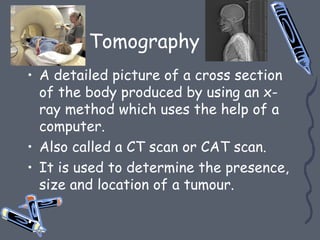
Tomography
• A detailed picture of a cross section
of the body produced by using an x-
ray method which uses the help of a
computer.
• Also called a CT scan or CAT scan.
• It is used to determine the presence,
size and location of a tumour.
•
Tomography
• It is also used to guide a biopsy(the
removal of cells or tissues for
examination under a microscope).
• Moreover it helps to plan radiation
therapy or surgery.
• Besides tomography is used to
determine whether the cancer is
responding to treatment or not.
 Anyone can use
the internet when
there is an
emergency and
the doctor can’t
come right away
 Experts opinions
can be obtained
via internet
 Without the
doctors supervision,
anyone may take
wrong medication
through the
internet
Future goals
Future goals
 Silicon computer chips may be used to
Silicon computer chips may be used to
repair nerve damage or muscle fibers
 Computers can play an important roll in
Computers can play an important roll in
preventing
preventing more than 30 diseases, including
more than 30 diseases, including
cancer, macular degeneration, and
rheumatoid arthritis.
 Feeling of pain can be reduced using virtual
Feeling of pain can be reduced using virtual
reality helmets
reality helmets
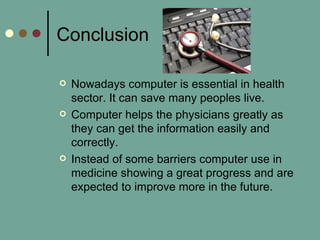
Conclusion
 Nowadays computer is essential in health
sector. It can save many peoples live.
 Computer helps the physicians greatly as
they can get the information easily and
correctly.
 Instead of some barriers computer use in
medicine showing a great progress and are
expected to improve more in the future.
References
References
 By
By Manali Oak
Manali Oak
http://www.buzzle.com/articles/importance-of-computers-in-me
 http://www.worldhealth.net/list/news/computers_and_medicine/
http://www.worldhealth.net/list/news/computers_and_medicine/
 http://www.oslerbooks.com/carrel/kelley48.html
http://www.oslerbooks.com/carrel/kelley48.html
 http://courses.wccnet.edu/computer/mod/m02c.htm
http://courses.wccnet.edu/computer/mod/m02c.htm
 http://www.medterms.com/script/main/art.asp?articlekey=2811
http://www.medterms.com/script/main/art.asp?articlekey=2811
 http://www.cancer.gov/cancertopics/factsheet/detection/CT
http://www.cancer.gov/cancertopics/factsheet/detection/CT
The End

computersandmedicinepowerpoint-111018222638-phpapp02.pdf

  • 2.
    History of computersin History of computers in medicine medicine  During the First Generation (1938- During the First Generation (1938- 1956) the use of computer in medicine 1956) the use of computer in medicine was very limited was very limited  During the Second Generation (1956 – During the Second Generation (1956 – 1964), computers were being used in 1964), computers were being used in hospitals for accounting and patient hospitals for accounting and patient billing billing  Computer use expanded greatly during Computer use expanded greatly during the Third Generation ( the Third Generation (1964 – 1972) such 1964 – 1972) such as experimental patient monitoring, CRT, as experimental patient monitoring, CRT, measures of heart rate, respiration, measures of heart rate, respiration, blood pressure, etc. blood pressure, etc.
  • 3.
     Throughout theFourth Generation (1972 – 1990) microcomputers were being used for inventory and pharmacy billing  On the new Fifth Generation (1990-…..) many inventions are made using computers and many more to be invented. Some of them are optical laser, expert system for diagnosis and treatment planning etc.
  • 4.
     Computers areused in storing patients data  Computers also keep track of prescribing medicines  Medical journals, diagnose papers, information about a certain disease can be found on the Internet,
  • 5.
     Computer programsinstruct medical appliances such as: X-ray machines, emergency alarm-systems etc.  Computer software are used to diagnose diseases  Doctors use internet to prescribe medicine to the patients that live far away  Computers are being used for 3-D images in medicine
  • 6.
    Tomography • A detailedpicture of a cross section of the body produced by using an x- ray method which uses the help of a computer. • Also called a CT scan or CAT scan. • It is used to determine the presence, size and location of a tumour. •
  • 7.
    Tomography • It isalso used to guide a biopsy(the removal of cells or tissues for examination under a microscope). • Moreover it helps to plan radiation therapy or surgery. • Besides tomography is used to determine whether the cancer is responding to treatment or not.
  • 8.
     Anyone canuse the internet when there is an emergency and the doctor can’t come right away  Experts opinions can be obtained via internet  Without the doctors supervision, anyone may take wrong medication through the internet
  • 9.
    Future goals Future goals Silicon computer chips may be used to Silicon computer chips may be used to repair nerve damage or muscle fibers repair nerve damage or muscle fibers  Computers can play an important roll in Computers can play an important roll in preventing preventing more than 30 diseases, including more than 30 diseases, including cancer, macular degeneration, and cancer, macular degeneration, and rheumatoid arthritis. rheumatoid arthritis.  Feeling of pain can be reduced using virtual Feeling of pain can be reduced using virtual reality helmets reality helmets
  • 10.
    Conclusion  Nowadays computeris essential in health sector. It can save many peoples live.  Computer helps the physicians greatly as they can get the information easily and correctly.  Instead of some barriers computer use in medicine showing a great progress and are expected to improve more in the future.
  • 11.
    References References  By By ManaliOak Manali Oak http://www.buzzle.com/articles/importance-of-computers-in-me http://www.buzzle.com/articles/importance-of-computers-in-me  http://www.worldhealth.net/list/news/computers_and_medicine/ http://www.worldhealth.net/list/news/computers_and_medicine/  http://www.oslerbooks.com/carrel/kelley48.html http://www.oslerbooks.com/carrel/kelley48.html  http://courses.wccnet.edu/computer/mod/m02c.htm http://courses.wccnet.edu/computer/mod/m02c.htm  http://www.medterms.com/script/main/art.asp?articlekey=2811 http://www.medterms.com/script/main/art.asp?articlekey=2811  http://www.cancer.gov/cancertopics/factsheet/detection/CT http://www.cancer.gov/cancertopics/factsheet/detection/CT
  • 12.