INTERNET AND MEDIA
ANALYSIS
Puja Devanand
Pratik Maru
Durlabh Giripunje
THE INTERNET
WHAT?
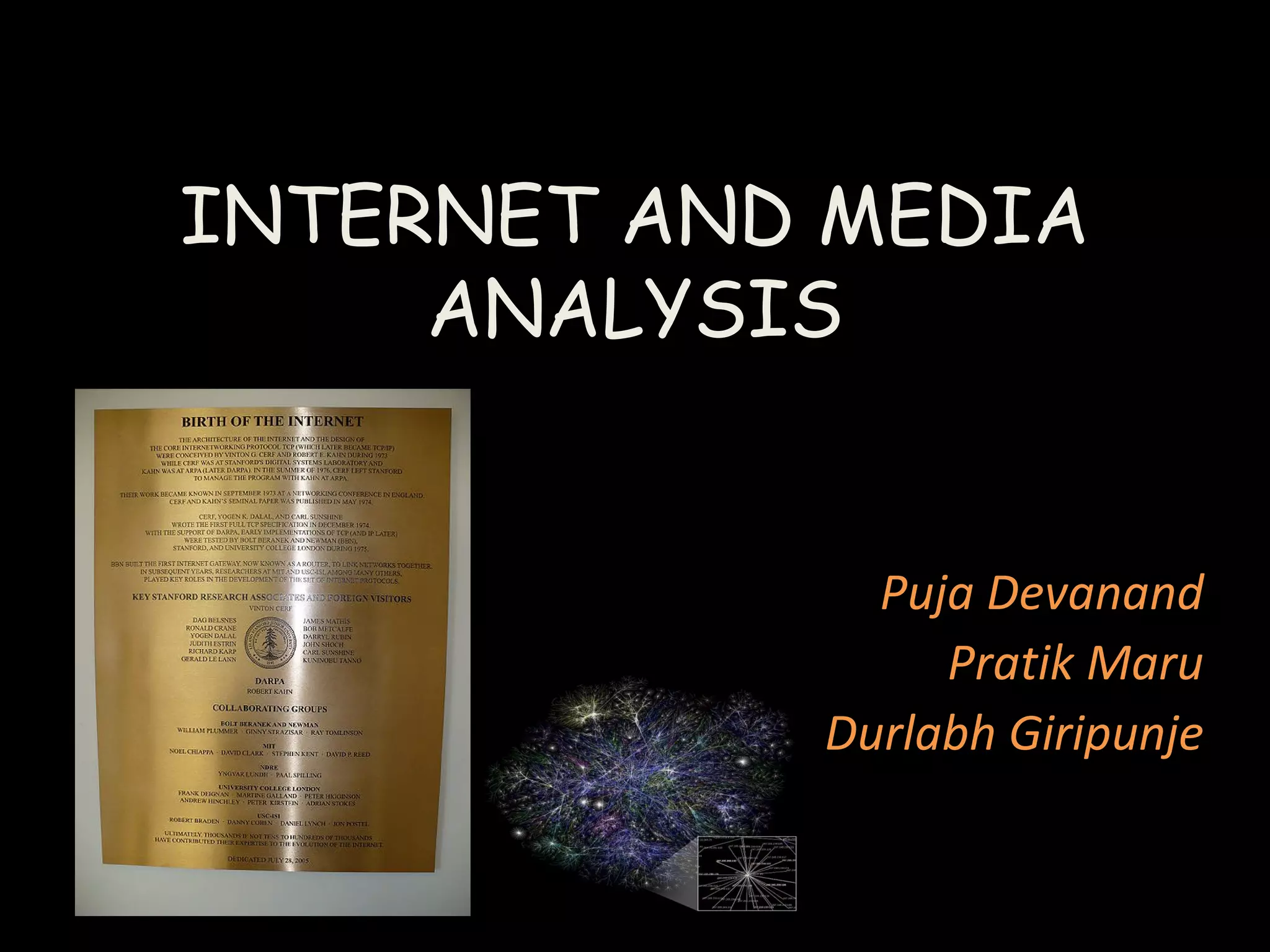
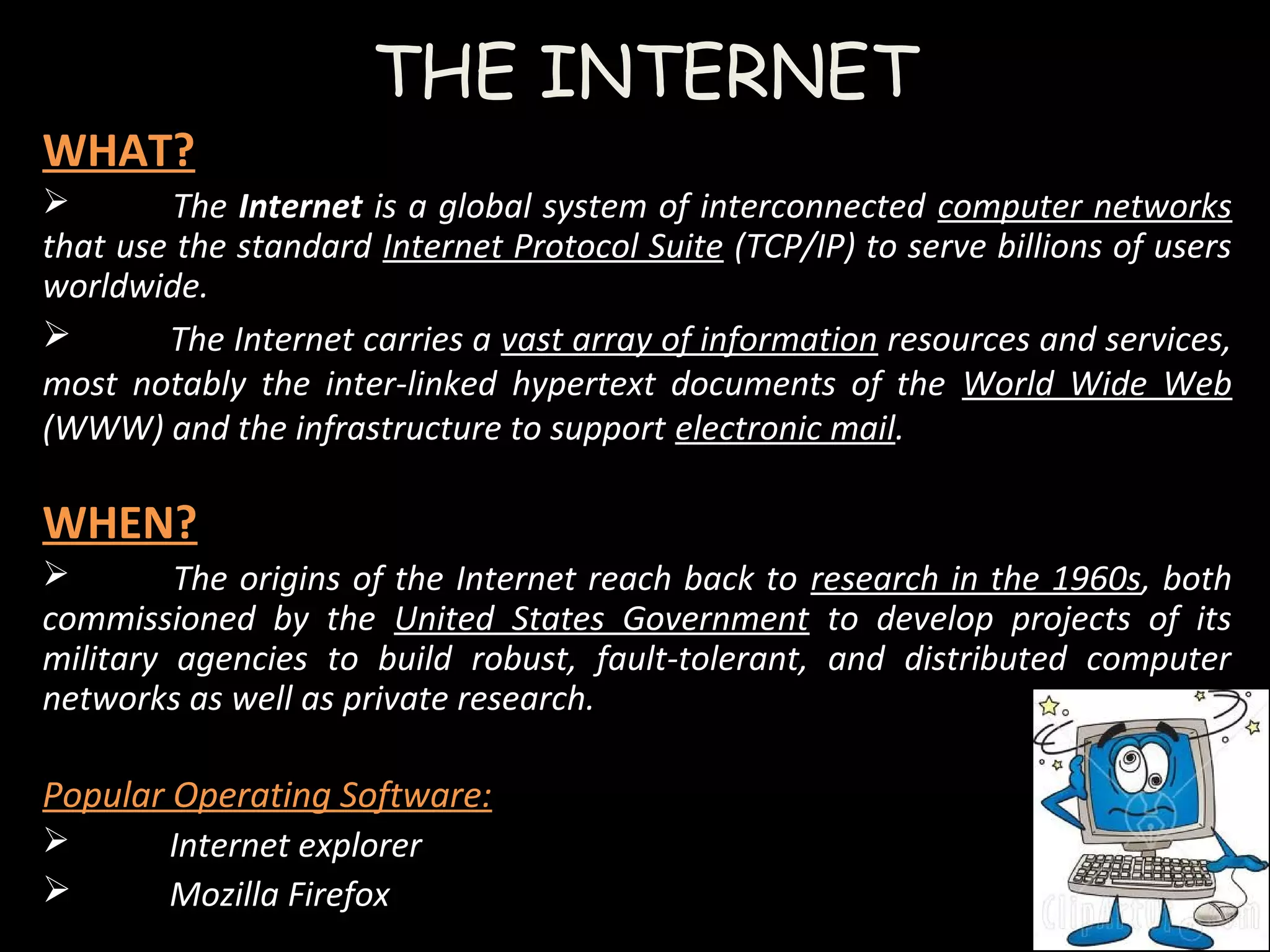
 The Internet is a global system of interconnected computer networks
that use the standard Internet Protocol Suite (TCP/IP) to serve billions of users
worldwide.
 The Internet carries a vast array of information resources and services,
most notably the inter-linked hypertext documents of the World Wide Web
(WWW) and the infrastructure to support electronic mail.
WHEN?
 The origins of the Internet reach back to research in the 1960s, both
commissioned by the United States Government to develop projects of its
military agencies to build robust, fault-tolerant, and distributed computer
networks as well as private research.
Popular Operating Software:
 Internet explorer
 Mozilla Firefox
THE INTERNET
Internet is possibly the most outstanding innovation in the field of
communication in the history of mankind. However, like every single
innovation in science and technology, internet has its own
advantages and disadvantages
ADVANTAGES:
 Communication E.g. Google Gtalk, Yahoo Messenger, etc.
 Information E.g. Google, Yahoo, Microsoft’s Bing
 Entertainment E.g. Online Games, Movies
 Services E.g. Online Banking, Job Searching
 E-Commerce
THE INTERNET
DISADVANTAGES:
 Theft of Personal information
 Spamming
 Virus threat
 Reduction of actual physical contact
 Cyber slacking - estimated employees spend 57 mins. on the Web
instead of working.
E-mail : The concept of sending electronic text messages between parties.
 The language for communication on the Internet is English.
 Common methods of Internet access in homes Include
dial-up, landline broadband , Wi-Fi and 3G Technology cell
phones.
INDIA AND INTERNET
 Ten years ago:
There was limited Internet access but only in a few major cities, all in the
hands of the government.
VSNL - Responsible for Internet activities.
DOT (Department of Telecommunications) provided a connectivity, with miserly
bandwidth and few phone lines.  
 Today: The Internet represents the new wealth frontier for the middle classes -
a good salary and increase in globalization
 No more strict governmental control 
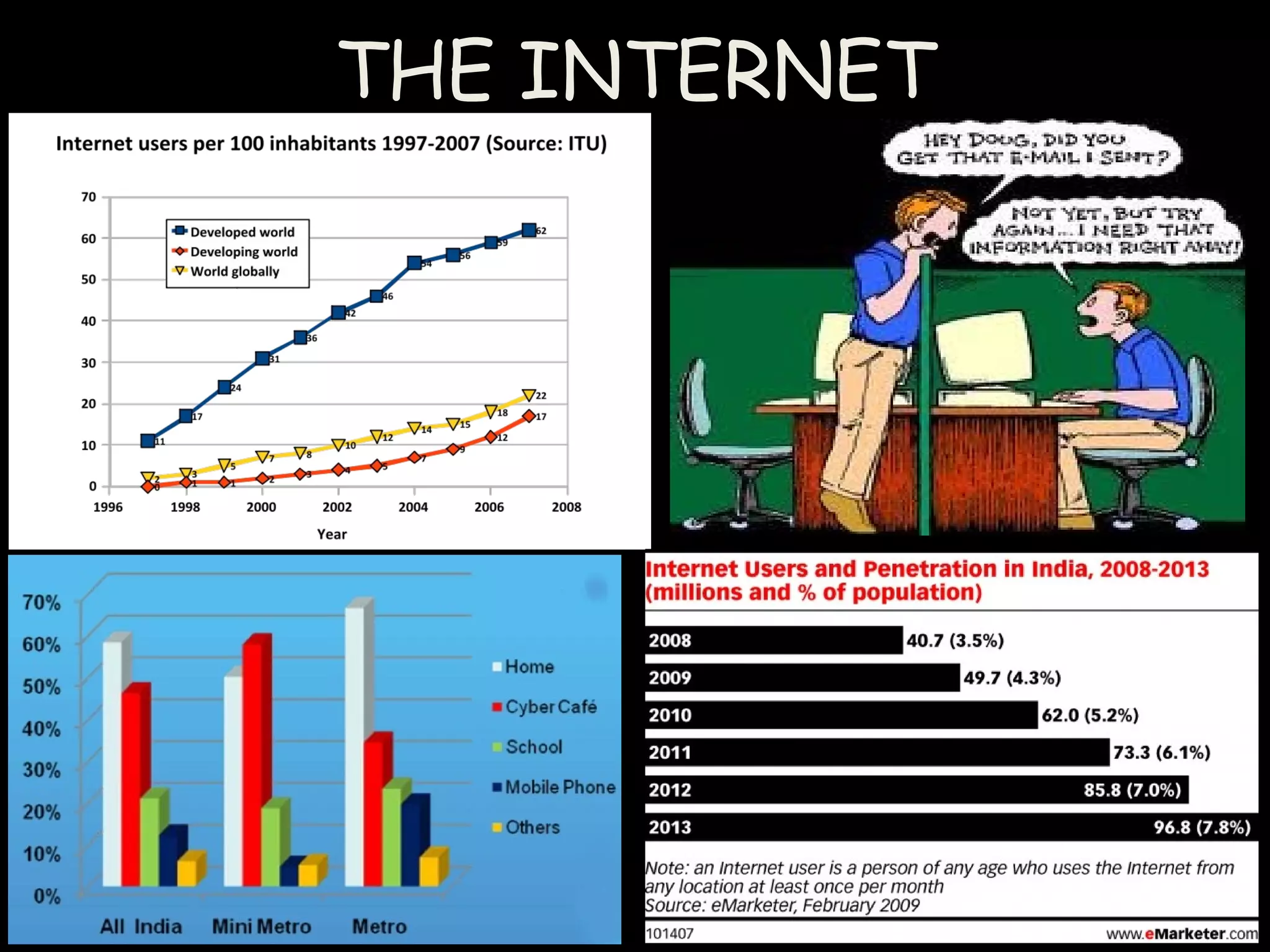
 More than 62 million users
 Increase of Indian content on the net 
 Increase in advertising – targeting the middle class 
 Very useful for business to business transactions
The Internet represents so much potential for India, and the
 demand  for efficient Internet infrastructure is growing rapidly
THE INTERNET
INDIA AND THE MEDIA
WHAT?
 Newspapers, magazines, television and radio and any other channel of
information.
 One of the fastest growing sectors in India, might grow faster than the GDP.
STRENGTHS
 Increasing levels of literacy
 Skilled workforce, innovative ideas
 Intense competition, propelling
growth
 High population
 Swift growth in technology
WEAKNESS
 Inability to adhere to ethical standards
 Technology and innovations not at par
with the world
 Unstable government not encouraging
FDI’s
 Piracy
INDIA AND THE MEDIA
Indian Entertainment & Media industry can be categorised as follows:
 Film Entertainment
 Television
 Music
 Radio
 Print (Primarily Newspapers & Magazines)
 Live Entertainment
Scope for entertainment sector:
Media And Entertainment industry is one of the most flourishing sectors
in India.
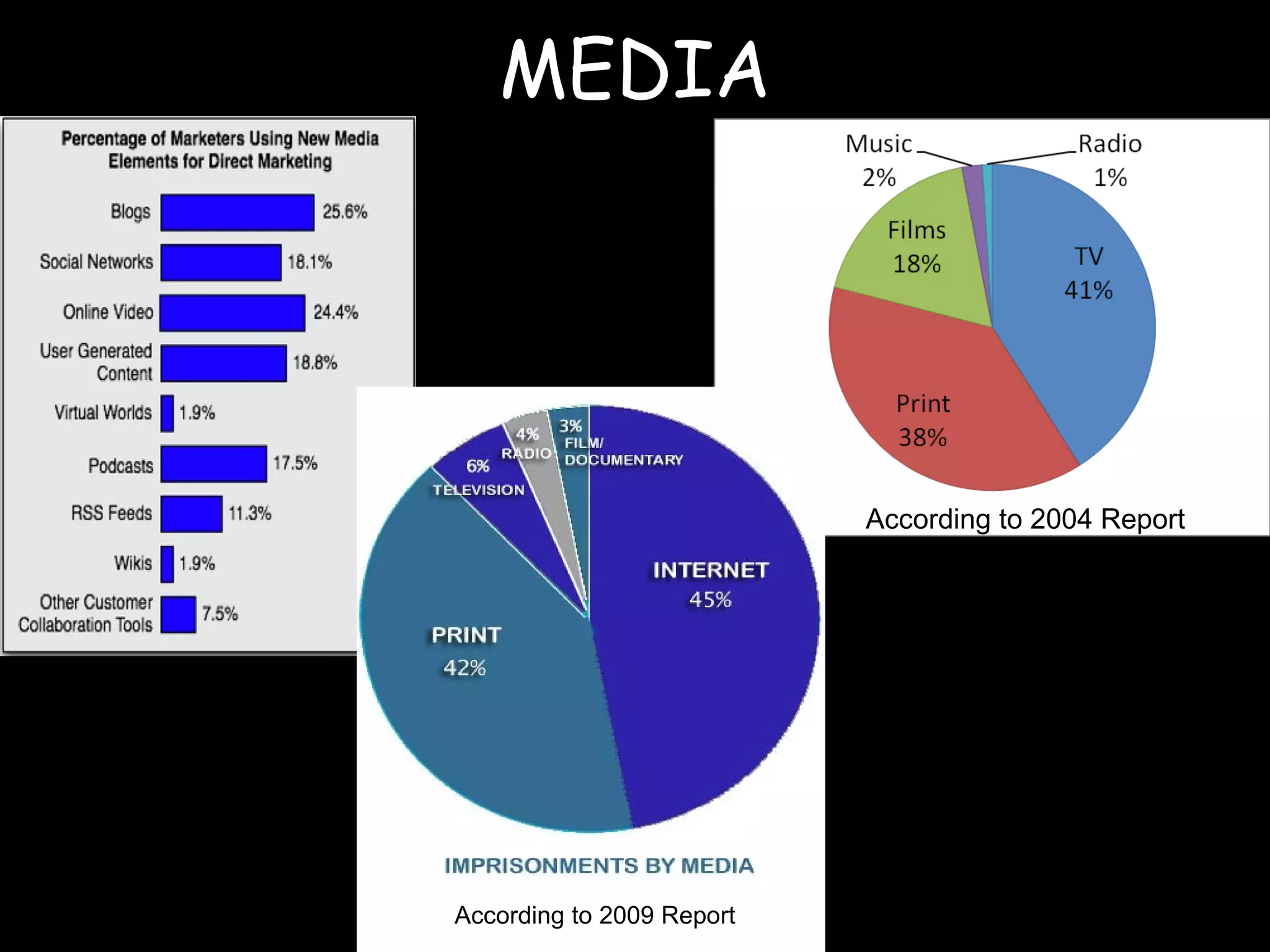
MEDIA
According to 2009 Report
According to 2004 Report
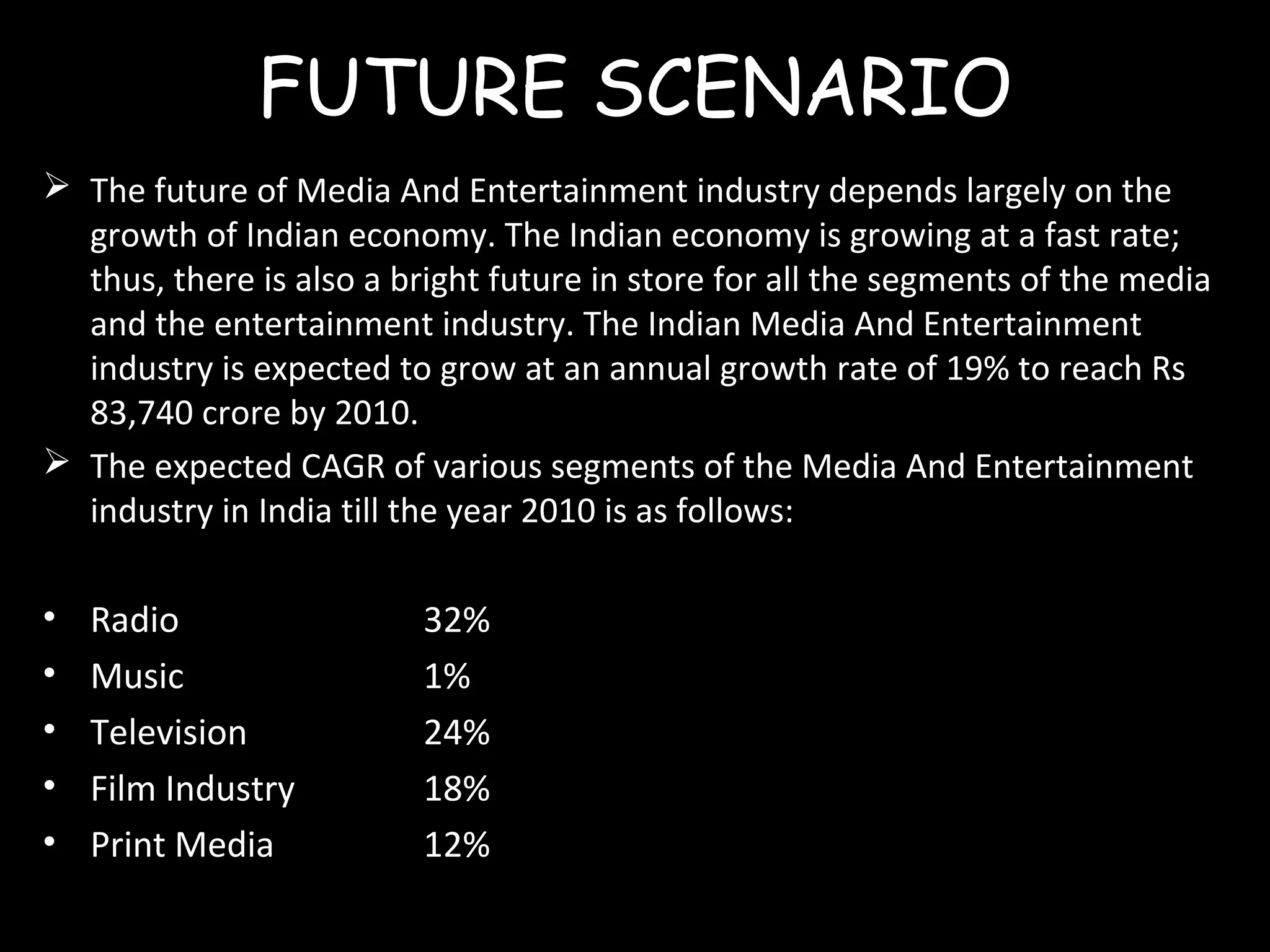
FUTURE SCENARIO
 The future of Media And Entertainment industry depends largely on the
growth of Indian economy. The Indian economy is growing at a fast rate;
thus, there is also a bright future in store for all the segments of the media
and the entertainment industry. The Indian Media And Entertainment
industry is expected to grow at an annual growth rate of 19% to reach Rs
83,740 crore by 2010.
 The expected CAGR of various segments of the Media And Entertainment
industry in India till the year 2010 is as follows:
• Radio 32%
• Music 1%
• Television 24%
• Film Industry 18%
• Print Media 12%
Top Players In Media &
Entertainment Sector
1. Star India
2. Bennett, Coleman & Co. (The Times of India Group)
3. Sony Entertainment Television
4. Zee Telefilms
5. Hindustan Times
6. Television Eighteen India
7. DAINIK JAGRAN
8. Adlabs Films Limited
9. PVR Limited
10.UTV Software Communications Limited
FUN FACTS
• INTERNET
 Checking emails and searching for information are the two most
popular reasons for accessing net over mobile phones. 2.8% of
Urban Indian mobile population used the Internet over their
phones to check emails while 2.5% used the net to search for
information.
 347% Growth in Mobile Internet Browsing in India Since 2009.
 Google is the No. 1 site visited on the internet, Google’s index now
stands at 8 billion pages.
 Internet Addictive Disorder (IAD) or the Internet Overuse Syndrome
(IOS).
Bibliography
• www.google.co.in
• www.wikipedia.org
• www.webopedia.com
• www.sciencenews.org
• www.naukrihub.com
Thank you for your patience.

Internet and media analysis final ppt

  • 1.
    INTERNET AND MEDIA ANALYSIS PujaDevanand Pratik Maru Durlabh Giripunje
  • 2.
    THE INTERNET WHAT?  TheInternet is a global system of interconnected computer networks that use the standard Internet Protocol Suite (TCP/IP) to serve billions of users worldwide.  The Internet carries a vast array of information resources and services, most notably the inter-linked hypertext documents of the World Wide Web (WWW) and the infrastructure to support electronic mail. WHEN?  The origins of the Internet reach back to research in the 1960s, both commissioned by the United States Government to develop projects of its military agencies to build robust, fault-tolerant, and distributed computer networks as well as private research. Popular Operating Software:  Internet explorer  Mozilla Firefox
  • 3.
    THE INTERNET Internet ispossibly the most outstanding innovation in the field of communication in the history of mankind. However, like every single innovation in science and technology, internet has its own advantages and disadvantages ADVANTAGES:  Communication E.g. Google Gtalk, Yahoo Messenger, etc.  Information E.g. Google, Yahoo, Microsoft’s Bing  Entertainment E.g. Online Games, Movies  Services E.g. Online Banking, Job Searching  E-Commerce
  • 4.
    THE INTERNET DISADVANTAGES:  Theftof Personal information  Spamming  Virus threat  Reduction of actual physical contact  Cyber slacking - estimated employees spend 57 mins. on the Web instead of working. E-mail : The concept of sending electronic text messages between parties.  The language for communication on the Internet is English.  Common methods of Internet access in homes Include dial-up, landline broadband , Wi-Fi and 3G Technology cell phones.
  • 5.
    INDIA AND INTERNET Ten years ago: There was limited Internet access but only in a few major cities, all in the hands of the government. VSNL - Responsible for Internet activities. DOT (Department of Telecommunications) provided a connectivity, with miserly bandwidth and few phone lines.    Today: The Internet represents the new wealth frontier for the middle classes - a good salary and increase in globalization  No more strict governmental control   More than 62 million users  Increase of Indian content on the net   Increase in advertising – targeting the middle class   Very useful for business to business transactions The Internet represents so much potential for India, and the  demand  for efficient Internet infrastructure is growing rapidly
  • 6.
  • 7.
    INDIA AND THEMEDIA WHAT?  Newspapers, magazines, television and radio and any other channel of information.  One of the fastest growing sectors in India, might grow faster than the GDP. STRENGTHS  Increasing levels of literacy  Skilled workforce, innovative ideas  Intense competition, propelling growth  High population  Swift growth in technology WEAKNESS  Inability to adhere to ethical standards  Technology and innovations not at par with the world  Unstable government not encouraging FDI’s  Piracy
  • 8.
    INDIA AND THEMEDIA Indian Entertainment & Media industry can be categorised as follows:  Film Entertainment  Television  Music  Radio  Print (Primarily Newspapers & Magazines)  Live Entertainment Scope for entertainment sector: Media And Entertainment industry is one of the most flourishing sectors in India.
  • 9.
    MEDIA According to 2009Report According to 2004 Report
  • 10.
    FUTURE SCENARIO  Thefuture of Media And Entertainment industry depends largely on the growth of Indian economy. The Indian economy is growing at a fast rate; thus, there is also a bright future in store for all the segments of the media and the entertainment industry. The Indian Media And Entertainment industry is expected to grow at an annual growth rate of 19% to reach Rs 83,740 crore by 2010.  The expected CAGR of various segments of the Media And Entertainment industry in India till the year 2010 is as follows: • Radio 32% • Music 1% • Television 24% • Film Industry 18% • Print Media 12%
  • 11.
    Top Players InMedia & Entertainment Sector 1. Star India 2. Bennett, Coleman & Co. (The Times of India Group) 3. Sony Entertainment Television 4. Zee Telefilms 5. Hindustan Times 6. Television Eighteen India 7. DAINIK JAGRAN 8. Adlabs Films Limited 9. PVR Limited 10.UTV Software Communications Limited
  • 12.
    FUN FACTS • INTERNET Checking emails and searching for information are the two most popular reasons for accessing net over mobile phones. 2.8% of Urban Indian mobile population used the Internet over their phones to check emails while 2.5% used the net to search for information.  347% Growth in Mobile Internet Browsing in India Since 2009.  Google is the No. 1 site visited on the internet, Google’s index now stands at 8 billion pages.  Internet Addictive Disorder (IAD) or the Internet Overuse Syndrome (IOS).
  • 13.
    Bibliography • www.google.co.in • www.wikipedia.org •www.webopedia.com • www.sciencenews.org • www.naukrihub.com
  • 14.
    Thank you foryour patience.