Sagar N Patil
psagaripr@gmail.com
 The International Patent Classification (IPC) was created
under the Strasbourg Agreement (1971), a treat administered
by the World Intellectual Property Organization (WIPO).
 It is a hierarchical patent classification system used in over
100 countries to classify the content of patents in a uniform
manner.
 The classification is generally updated on a regular basis by, a
Committee of Experts, consisting of representatives of the
Contracting States.
 The IPC get updated periodically to manage the advances in
technologies. The current version is IPC2013.01.
 The primary purpose of the Classification, is to
facilitate the retrieval of technical subject matter.
 A basis for investigating the state of the art in given
fields of technology.
 Assessment of technological development in various
areas.
 The content of a patent document, may require more
than one classification symbol to be applied.
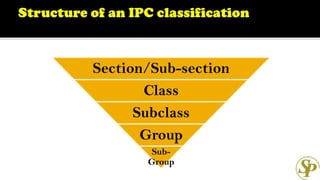
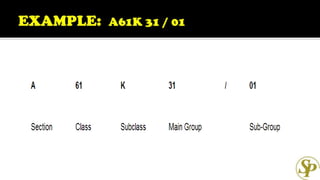
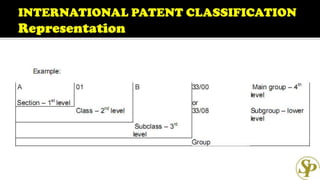
Section/Sub-section
Class
Subclass
Group
Sub-
Group
 Sections are the highest level of hierarchy of the
Classification.
 Section Symbol – Each section is designated by one of the
capital letters A through H
 Section Title – The section title is to be considered as a very
broad indication of the contents of the section.
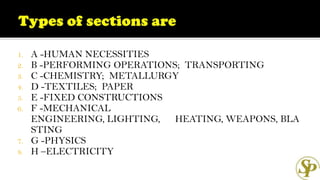
1. A -HUMAN NECESSITIES
2. B -PERFORMING OPERATIONS; TRANSPORTING
3. C -CHEMISTRY; METALLURGY
4. D -TEXTILES; PAPER
5. E -FIXED CONSTRUCTIONS
6. F -MECHANICAL
ENGINEERING, LIGHTING, HEATING, WEAPONS, BLA
STING
7. G -PHYSICS
8. H –ELECTRICITY
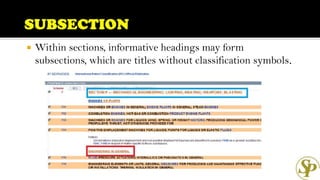
 Within sections, informative headings may form
subsections, which are titles without classification symbols.
 Each section is subdivided into classes which are the second
hierarchical level of the Classification
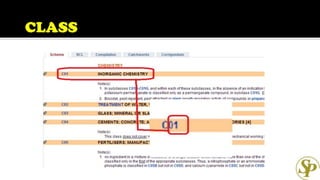
 Class Symbol – Each class symbol consists of the section
symbol followed by a two-digit number.
 Class Title – The class title gives an indication of the content
of the class.
 Class Index – Some classes have an index which is merely an
informative summary giving a broad survey of the content of
the class.
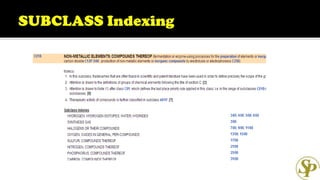
 Each class comprises one or more subclasses which are
the third hierarchical level of the Classification.
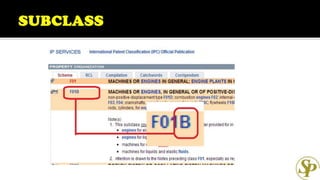
 Subclass Symbol – Each subclass symbol consists of
the class symbol followed by a capital letter.
 Subclass Title – The subclass title indicates as precisely
as possible the content of the subclass.
 Each subclass is broken down into subdivisions referred to as
“groups”, which are either main groups or subgroups.
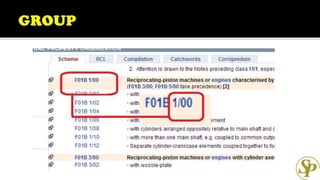
 Group Symbol – Each group symbol consists of the subclass symbol
followed by two numbers separated by an oblique stroke.
 Main Group Symbol – Each main group symbol consists of the
subclass symbol followed by an one- to three-digit number, the oblique
stroke and the number 00.
 Main Group Title – The main group title precisely defines a field of
subject matter within the scope of its subclass considered to be useful
for search purposes.
 Subgroup Symbol – Subgroups form subdivisions under the
main groups. Each subgroup symbol consists of the subclass
symbol followed by the one- to three-digit number of its main
group, the oblique stroke and a number of at least two digits
other than 00.
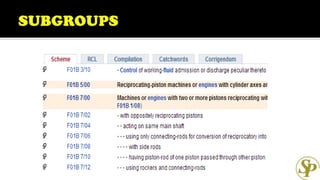
 Subgroups are ordered in the scheme as if their numbers were
decimals of the number before the oblique stroke.
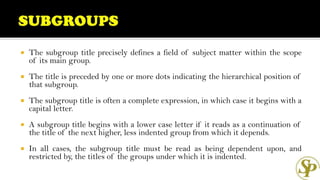
 The subgroup title precisely defines a field of subject matter within the scope
of its main group.
 The title is preceded by one or more dots indicating the hierarchical position of
that subgroup.
 The subgroup title is often a complete expression, in which case it begins with a
capital letter.
 A subgroup title begins with a lower case letter if it reads as a continuation of
the title of the next higher, less indented group from which it depends.
 In all cases, the subgroup title must be read as being dependent upon, and
restricted by, the titles of the groups under which it is indented.
Sagar N Patil
psagaripr@gmail.com

International patent classification

  • 1.
  • 2.
     The InternationalPatent Classification (IPC) was created under the Strasbourg Agreement (1971), a treat administered by the World Intellectual Property Organization (WIPO).
  • 3.
     It isa hierarchical patent classification system used in over 100 countries to classify the content of patents in a uniform manner.  The classification is generally updated on a regular basis by, a Committee of Experts, consisting of representatives of the Contracting States.  The IPC get updated periodically to manage the advances in technologies. The current version is IPC2013.01.
  • 4.
     The primarypurpose of the Classification, is to facilitate the retrieval of technical subject matter.  A basis for investigating the state of the art in given fields of technology.  Assessment of technological development in various areas.  The content of a patent document, may require more than one classification symbol to be applied.
  • 5.
  • 6.
     Sections arethe highest level of hierarchy of the Classification.  Section Symbol – Each section is designated by one of the capital letters A through H  Section Title – The section title is to be considered as a very broad indication of the contents of the section.
  • 7.
    1. A -HUMANNECESSITIES 2. B -PERFORMING OPERATIONS; TRANSPORTING 3. C -CHEMISTRY; METALLURGY 4. D -TEXTILES; PAPER 5. E -FIXED CONSTRUCTIONS 6. F -MECHANICAL ENGINEERING, LIGHTING, HEATING, WEAPONS, BLA STING 7. G -PHYSICS 8. H –ELECTRICITY
  • 8.
     Within sections,informative headings may form subsections, which are titles without classification symbols.
  • 9.
     Each sectionis subdivided into classes which are the second hierarchical level of the Classification  Class Symbol – Each class symbol consists of the section symbol followed by a two-digit number.  Class Title – The class title gives an indication of the content of the class.  Class Index – Some classes have an index which is merely an informative summary giving a broad survey of the content of the class.
  • 11.
     Each classcomprises one or more subclasses which are the third hierarchical level of the Classification.  Subclass Symbol – Each subclass symbol consists of the class symbol followed by a capital letter.  Subclass Title – The subclass title indicates as precisely as possible the content of the subclass.
  • 14.
     Each subclassis broken down into subdivisions referred to as “groups”, which are either main groups or subgroups.  Group Symbol – Each group symbol consists of the subclass symbol followed by two numbers separated by an oblique stroke.  Main Group Symbol – Each main group symbol consists of the subclass symbol followed by an one- to three-digit number, the oblique stroke and the number 00.  Main Group Title – The main group title precisely defines a field of subject matter within the scope of its subclass considered to be useful for search purposes.
  • 16.
     Subgroup Symbol– Subgroups form subdivisions under the main groups. Each subgroup symbol consists of the subclass symbol followed by the one- to three-digit number of its main group, the oblique stroke and a number of at least two digits other than 00.  Subgroups are ordered in the scheme as if their numbers were decimals of the number before the oblique stroke.
  • 17.
     The subgrouptitle precisely defines a field of subject matter within the scope of its main group.  The title is preceded by one or more dots indicating the hierarchical position of that subgroup.  The subgroup title is often a complete expression, in which case it begins with a capital letter.  A subgroup title begins with a lower case letter if it reads as a continuation of the title of the next higher, less indented group from which it depends.  In all cases, the subgroup title must be read as being dependent upon, and restricted by, the titles of the groups under which it is indented.
  • 21.