INTERNAL
CONTROL
group presentation
Internal Controls
Is a process, affected by an entity’s board of
directors, management, and other
personnel, designed to provide reasonable
assurance: That information is reliable,
accurate, and timely. Of compliance with
laws, regulations, contracts, policies, and
procedures.
2
There are five interrelated
components of an internal control
framework:
· Control environment.
· Risk assessment.
· Monitoring.
· Information and Communication.
· Control activities.
1
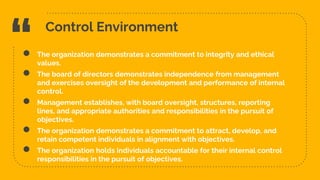
“ Control Environment
4
● The organization demonstrates a commitment to integrity and ethical
values.
● The board of directors demonstrates independence from management
and exercises oversight of the development and performance of internal
control.
● Management establishes, with board oversight, structures, reporting
lines, and appropriate authorities and responsibilities in the pursuit of
objectives.
● The organization demonstrates a commitment to attract, develop, and
retain competent individuals in alignment with objectives.
● The organization holds individuals accountable for their internal control
responsibilities in the pursuit of objectives.
Risk Assessment
5
● There is a susceptibility to or history of
waste, fraud, or errors
● Changes have occurred in the chapter’s
organizational structure, systems, or
personnel
● Controls have not been reviewed for a
substantial period of time
“ Monitoring
6
● Perform ongoing monitoring.
● Conduct separate evaluations.
● Report deficiencies.
Information and Communication
7
● Information is necessary for the business to carry out
internal controls and responsibilities and in achieving
objectives.
● Communication includes both internal and external
communication. It provides the business with information
needed to carry out data to day internal control activities.
● Communication enables employees to understand internal
control responsibilities and their importance to the
achievement of objectives. It also allows for upward flow of
operating information to management.
Control Activity
8
● Ensures management directives are achieved.
● Necessary actions are taken to address such risks to achieve the
entity's objectives.
● Includes the following activities:
 Establishing responsibility
 Segregation of Duties
 Verification Physical Securities
 Maintaining Adequate Documentation
 Independent verification

INTERNAL-CONTROL.pptx

  • 1.
  • 2.
    Internal Controls Is aprocess, affected by an entity’s board of directors, management, and other personnel, designed to provide reasonable assurance: That information is reliable, accurate, and timely. Of compliance with laws, regulations, contracts, policies, and procedures. 2
  • 3.
    There are fiveinterrelated components of an internal control framework: · Control environment. · Risk assessment. · Monitoring. · Information and Communication. · Control activities. 1
  • 4.
    “ Control Environment 4 ●The organization demonstrates a commitment to integrity and ethical values. ● The board of directors demonstrates independence from management and exercises oversight of the development and performance of internal control. ● Management establishes, with board oversight, structures, reporting lines, and appropriate authorities and responsibilities in the pursuit of objectives. ● The organization demonstrates a commitment to attract, develop, and retain competent individuals in alignment with objectives. ● The organization holds individuals accountable for their internal control responsibilities in the pursuit of objectives.
  • 5.
    Risk Assessment 5 ● Thereis a susceptibility to or history of waste, fraud, or errors ● Changes have occurred in the chapter’s organizational structure, systems, or personnel ● Controls have not been reviewed for a substantial period of time
  • 6.
    “ Monitoring 6 ● Performongoing monitoring. ● Conduct separate evaluations. ● Report deficiencies.
  • 7.
    Information and Communication 7 ●Information is necessary for the business to carry out internal controls and responsibilities and in achieving objectives. ● Communication includes both internal and external communication. It provides the business with information needed to carry out data to day internal control activities. ● Communication enables employees to understand internal control responsibilities and their importance to the achievement of objectives. It also allows for upward flow of operating information to management.
  • 8.
    Control Activity 8 ● Ensuresmanagement directives are achieved. ● Necessary actions are taken to address such risks to achieve the entity's objectives. ● Includes the following activities:  Establishing responsibility  Segregation of Duties  Verification Physical Securities  Maintaining Adequate Documentation  Independent verification