


Presented to
The P World’s HR Experience
Presentation from
Hussein Dajani - COO hug digital
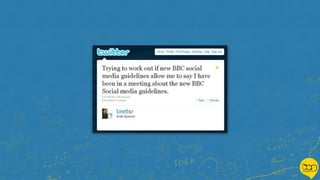
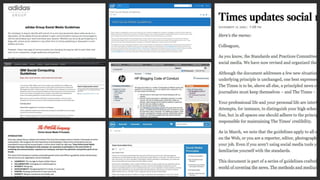
Employee Social Media Guidelines
How many of your employers have a social media policy?
• Employee Code of Conduct for :
• Online Communications
• Company Representation in Online
Communications
• Employee:
• Blogging Disclosure Policy
• Facebook Usage Policy
• Personal Blog Policy
• Personal Social Network Policy
• Personal Twitter Policy
• LinkedIn Policy
• Google Plus Policy
•
• Corporate:
• Blogging Policy
• Blog Use Policy
• Blog Post Approval Process
• Blog Commenting Policy
• Facebook Brand Page Usage Policy
• Facebook Public Comment/Messaging
Policy
• Twitter Account Policy
• YouTube Policy
• YouTube Public Comment Policy
• Company Password Policy
•
Is it reviewed on a yearly basis?
When does your company need
a social media policy?
As soon as a company makes the decision
to engage in social technology,
regardless of whether it employs two or 2000 people.
Who’s responsibility is it?
MARCOMMS HR
LEGAL
Why put guidelines in place?
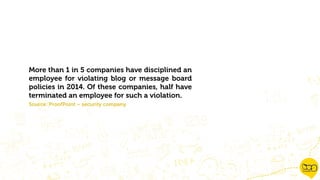
More than 1 in 5 companies have disciplined an
employee for violating blog or message board
policies in 2014. Of these companies, half have
terminated an employee for such a violation.
Source: ProofPoint – security company
Victims of social media
Collage please
Over 20% have investigated the exposure of
confidential, sensitive or private information
via a blog or message board posting.
Source: ProofPoint – security company
One-third of employees surveyed never
consider what their boss or customers
might think before posting material online.
Source: Deloitte Ethics & Workplace Survey
Unauthorized or inappropriate commentary
or posts online can:
– Get the company and the employee in legal trouble,
– Diminish the company’s brand name by creating
negative publicity for the company, owners,
partners, as well as employees,
– Cause damage to the company by releasing non-
public information or proprietary information,
– Cost the employee their job at the company.
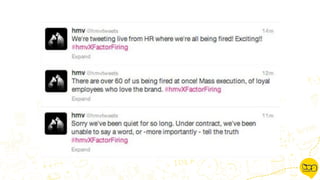
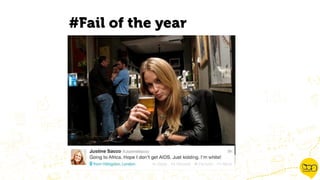
#Fail of the year
Should social media be banned from work?
GenY and newer generations expect to have access.
New generations are entering the workplace and
expect to leverage social media
A recent survey, by Telindus, showed that:
39% of younger workers will consider leaving their jobs if they lost
access to social media sites.
– Blocking access sends a bigger message to younger generations
who value work-life balance
– “We don’t trust you.”
– “Your duties here are more important than the rest of your life”.
and 21% would just be annoyed!
– Younger employees might not quit, but in a competitive job market,
it might be enough to make them choose another employer over you
– Happy employee = engaged employee = higher profits
Social media is simply a new channel to an existing assortment of
channels already accessible to your employees: E-mail, Telephone,
Face-2-face, Etc.
We already have policies and guidelines in place for these channels,
social media is just a new addition.
Your employees are your
brand, their behavior online
reflects on the company.
Employees generally want to
do the right thing, violations
occur due to lack of education.
Policies / guidelines can easily be created
to guide employees on the rights and
wrongs of using social media
– Guide employees: don’t mandate if possible,
tell them how to use it, or discourage use
– Employees will begin to govern themselves
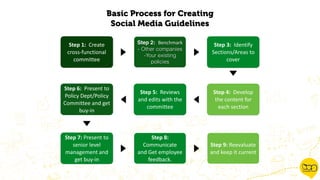
Basic Process for Creating
Social Media Guidelines
Step	1:		Create	
cross-functional	
committee
Step 2: Benchmark
- Other companies
-Your existing
policies
Step	3:		Identify	
Sections/Areas	to	
cover
Step	4:		Develop	
the	content	for	
each	section
Step	5:		Reviews	
and	edits	with	the	
committee
Step	6:		Present	to	
Policy	Dept/Policy	
Committee	and	get	
buy-in
Step	7:	Present	to	
senior	level	
management	and	
get	buy-in
Step	8:	
Communicate	
and	Get	employee	
feedback.
Step	9:	Reevaluate	
and	keep	it	current
You’ve been hugged!
hugdigital.com hugdigital UAE - Egypt - KSA - India

Internal social media guidelines

  • 2.
    Presented to The PWorld’s HR Experience Presentation from Hussein Dajani - COO hug digital
  • 3.
  • 4.
    How many ofyour employers have a social media policy? • Employee Code of Conduct for : • Online Communications • Company Representation in Online Communications • Employee: • Blogging Disclosure Policy • Facebook Usage Policy • Personal Blog Policy • Personal Social Network Policy • Personal Twitter Policy • LinkedIn Policy • Google Plus Policy • • Corporate: • Blogging Policy • Blog Use Policy • Blog Post Approval Process • Blog Commenting Policy • Facebook Brand Page Usage Policy • Facebook Public Comment/Messaging Policy • Twitter Account Policy • YouTube Policy • YouTube Public Comment Policy • Company Password Policy •
  • 5.
    Is it reviewedon a yearly basis?
  • 8.
    When does yourcompany need a social media policy?
  • 9.
    As soon asa company makes the decision to engage in social technology, regardless of whether it employs two or 2000 people.
  • 11.
  • 12.
  • 13.
  • 15.
    More than 1in 5 companies have disciplined an employee for violating blog or message board policies in 2014. Of these companies, half have terminated an employee for such a violation. Source: ProofPoint – security company
  • 16.
    Victims of socialmedia Collage please
  • 17.
    Over 20% haveinvestigated the exposure of confidential, sensitive or private information via a blog or message board posting. Source: ProofPoint – security company
  • 20.
    One-third of employeessurveyed never consider what their boss or customers might think before posting material online. Source: Deloitte Ethics & Workplace Survey
  • 22.
    Unauthorized or inappropriatecommentary or posts online can: – Get the company and the employee in legal trouble, – Diminish the company’s brand name by creating negative publicity for the company, owners, partners, as well as employees, – Cause damage to the company by releasing non- public information or proprietary information, – Cost the employee their job at the company.
  • 23.
  • 25.
    Should social mediabe banned from work?
  • 26.
    GenY and newergenerations expect to have access. New generations are entering the workplace and expect to leverage social media
  • 27.
    A recent survey,by Telindus, showed that: 39% of younger workers will consider leaving their jobs if they lost access to social media sites. – Blocking access sends a bigger message to younger generations who value work-life balance – “We don’t trust you.” – “Your duties here are more important than the rest of your life”.
  • 28.
    and 21% wouldjust be annoyed! – Younger employees might not quit, but in a competitive job market, it might be enough to make them choose another employer over you – Happy employee = engaged employee = higher profits
  • 29.
    Social media issimply a new channel to an existing assortment of channels already accessible to your employees: E-mail, Telephone, Face-2-face, Etc. We already have policies and guidelines in place for these channels, social media is just a new addition.
  • 30.
    Your employees areyour brand, their behavior online reflects on the company.
  • 31.
    Employees generally wantto do the right thing, violations occur due to lack of education.
  • 32.
    Policies / guidelinescan easily be created to guide employees on the rights and wrongs of using social media – Guide employees: don’t mandate if possible, tell them how to use it, or discourage use – Employees will begin to govern themselves
  • 34.
    Basic Process forCreating Social Media Guidelines Step 1: Create cross-functional committee Step 2: Benchmark - Other companies -Your existing policies Step 3: Identify Sections/Areas to cover Step 4: Develop the content for each section Step 5: Reviews and edits with the committee Step 6: Present to Policy Dept/Policy Committee and get buy-in Step 7: Present to senior level management and get buy-in Step 8: Communicate and Get employee feedback. Step 9: Reevaluate and keep it current
  • 35.
    You’ve been hugged! hugdigital.comhugdigital UAE - Egypt - KSA - India