Page 1 of 26


                                 Shipping KPI
             “An Industry Initiative to enhance excellence in ship operation
                    by setting standards for Corporate Governance”


                                Contract No. 175978


                                       Final Report


                        Project Start Date: 2006-06-01
                                 End Date: 2008-12-31

                         Project Manager: Harald Sleire, MARINTEK

                                                        Document type: Report

                Due date: 2008-12-31             Dissemination Level: Open
        Submission date: 2008-12-24               Distribution Group: NFR + Project


              A Project supported by the Research Council of Norway


2008-12-15                       www.shipping-kpi.com
Page 2 of 26


Document summary information

Authors and contributors
Initials     Author                                              Organization          Role
AM           Atle Minsaas                                        MARINTEK              QC Responsible
CAH          Christian August Høy                                MARINTEK              Project Participant
DAN          Dag Atle Nesheim                                    MARINTEK              Project Participant
HS           Harald Sleire                                       MARINTEK              Project Manager
JAN          Jan Arthur Norbeck                                  MARINTEK              Project Participant

Revision history
Rev. Who         Date                  Comment

1.0    HSL    2008-12-15               Updated after QA
0.1    DAN/CH 2008-12-05               Final version for Quality Control by Project Manager and
                                       semi- external reviewer

Quality Control
                                               Who                                     Date
Approved by QC Responsible                     Atle Minsaas                            2008-12-08
Approved by Project Manager                    Harald Sleire                           2008-12-15


                                                Disclaimer

The content of the publication herein is the sole responsibility of the publishers and it does not necessarily
represent the views expressed by the Research Council of Norway or its services.
While the information contained in the documents is believed to be accurate, the authors(s) or any other
participant in the Shipping KPI Project make no warranty of any kind with regard to this material
including, but not limited to the implied warranties of merchantability and fitness for a particular purpose.
None of the Shipping KPI Project Participants shall be responsible or liable in negligence or otherwise
howsoever in respect of any inaccuracy or omission herein.
Without derogating from the generality of the foregoing none of the Shipping KPI Project Participants
shall be liable for any direct or indirect or consequential loss or damage caused by or arising from any
information advice or inaccuracy or omission herein.


2008-12-15                               www.shipping-kpi.com
Page 3 of 26


TABLE OF CONTENT
1       INTRODUCTION .............................................................................................................................................. 4
    1.1         PROJECT BACKGROUND ............................................................................................................................... 4
    1.2         INTRODUCTION TO THE PROJECT .................................................................................................................. 5
    1.3         STRUCTURE OF THE DOCUMENT ................................................................................................................... 5
2       LIST OF ABBREVIATIONS ............................................................................................................................ 6

3       THE SHIPPING KPI PERFORMANCE HIERARCHY ............................................................................... 7
    3.1         PERFORMANCE INDICATORS ........................................................................................................................ 7
    3.2         KEY PERFORMANCE INDICATORS ................................................................................................................ 8
    3.3         SHIPPING PERFORMANCE INDEXES .............................................................................................................. 9
4       PROJECT METHODOLOGY........................................................................................................................ 11
    4.1         PHASE 1: EVALUATION OF EXISTING INDUSTRY KPIS ................................................................................ 11
    4.2         PHASE 2: DEVELOPING THE SHIPPING KPI PERFORMANCE HIERARCHY .................................................... 13
    4.3         PHASE 3: EVALUATION BY STAKEHOLDERS ............................................................................................... 18
5       PROJECT RESULTS ...................................................................................................................................... 19
    5.1         THE SHIPPING KPI PERFORMANCE HIERARCHY ........................................................................................ 19
    5.2         THE SHIPPING KPI DEPOSITORY ................................................................................................................ 19
6       GUIDELINES FOR USE OF THE SHIPPING KPI PERFORMANCE HIERARCHY........................... 22

7       AREAS FOR FURTHER RESEARCH.......................................................................................................... 23
    7.1         VALIDATION AND CALIBRATION OF THE CALCULATION MODEL ................................................................. 23
    7.2         ADDED VALUE BY EXTENDED SHIPPING KPI DEPOSITORY FUNCTIONALITY .............................................. 23
    7.3         BENCHMARKING BY USING THE SHIPPING KPI DEPOSITORY ..................................................................... 24
8       REFERENCES ................................................................................................................................................. 25

9       APPENDIX I ..................................................................................................................................................... 26


List of Figures
FIGURE 1 THE SHIPPING KPI PERFORMANCE HIERARCHY ............................................................................................ 10
FIGURE 2 A THREE PHASED ITERATIVE DEVELOPMENT APPROACH ................................................................................ 11
FIGURE 3 IDENTIFICATION OF BUILDING BLOCKS FOR A NEW KPI FRAMEWORK ........................................................... 13
FIGURE 4 ORIGINAL BSC PERSPECTIVES ...................................................................................................................... 14


List of Tables
TABLE 1 6 GENERIC INDICATOR VALIDATION CRITERIA (KJELLÉN, 2000) ..................................................................... 12
TABLE 2 THE MATCHING MATRIX ................................................................................................................................ 17
TABLE 3 ROLES AND RESPONSIBILITIES IN THE MANAGEMENT OF THE SHIPPING KPI DEPOSITORY .............................. 21


2008-12-15                                                      www.shipping-kpi.com
Page 4 of 26


1     Introduction


1.1       Project background
The lack of an international standard for ship management operational performance reporting has
lead to a situation where many companies are defining, measuring, and reporting performance
information differently. The consequences are:

      •    Too many different Key Performance Indicators (KPIs) which increase the risk for
           confusion and mistakes
      •    Comparison of performance between companies is difficult, if possible at all
      •    Difficult to mobilize organizational focus on quality improvement due to lack of
           aggregated measurements and available benchmarking
      •    New reporting requirements are emerging, especially regarding environmental issues and
           corporate social responsibility (CSR)
      •    Additional manpower is required to present the same information in different formats to
           many stakeholders: Onboard, in office and to external stakeholders
      •    Difficult to document transparent and consistent operational, HSE and CSR performance
           improvements in the shipping industry

In order to improve the situation, a group of leading ship management organizations and ship
owning companies (The Sponsor Group) in November/December 2004 agreed to cooperate to
establish a global industry standard for KPIs in the shipping industry. The members of the
Sponsor Group represent a unique competence and experience ensuring that the development of
the new KPI Standard should be:

      •    Practical to use
      •    A representative and transparent picture of the performance
      •    Economical to implement

During 2005 the company Intellectual Capital Services (ICS) performed a feasibility study
proposing KPIs relevant for an industry standard (ICS 2005), and in February 2006 the Sponsor
Group and MARINTEK agreed to apply for a full scale project with funding from the Research
Council of Norway. The Research Council of Norway decided to fund the research and
development project in June 2006.

With the funding secured, the Sponsor group, fronted by Intermanager and Wilh. Wilhelmsen
ASA as the contractual partner towards the Research Council of Norway hired MARINTEK as
the research partner and project manager. The objective was to develop a global industry standard


2008-12-15                              www.shipping-kpi.com
Page 5 of 26


for performance measurement in ship operations. The new performance measurement standard
should:

      •    Boost performance improvements internally in companies engaged in ship operation
           activities
      •    Provide an efficient communication platform of ship operation performance to internal
           and external stakeholders

A project organization was established with steering group participation from Wilh Wilhelmsen
ASA, Eurasiagroup and Intermanager. Intermanager supported the project with the establishment
of a KPI Working Group consisting of experienced ship managers among their members.


1.2       Introduction to the project
Based on KPIs already captured from the industry, the
MARINTEK team in cooperation with Intermanager’s KPI
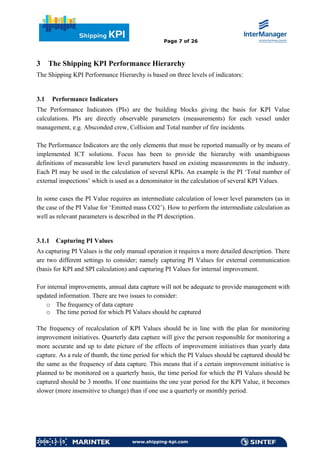
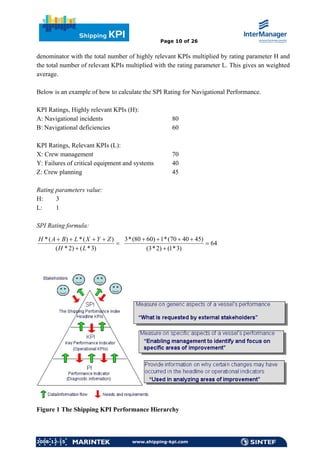
Working Group defined and described the new standard for                         SPI
KPIs. In addition to the KPIs, a set of high level shipping
performance indexes (SPIs) for external communication was                        KPI
developed. The work was performed as an iterative process                         PI
with several quality loops over a two years period.

The KPI standard is now well defined and described in a hierarchy where SPIs (high level
indexes) are calculated from KPIs, and where KPIs are calculated from Performance Indicators
(PIs). The PIs are based on data captured from a vessel or from an organisation.

It has been outside of the scope of the project to interpret the calculated KPI Values, and no
recommendations are given to what is considered as good performance. These considerations
need to be done in collaboration with external stakeholders in order to realize the full potential for
external communication.


1.3       Structure of the document
Chapter 1 gives information about the document structure, project history and general
background. Chapter 3 describes the Shipping KPI Performance Hierarchy at a concept level:
What it is and how it can be utilized. Chapter 4 describes the project’s development process and
methodology; how the Shipping KPI Performance Hierarchy was developed and different tools
that were used in the process. Chapter 5 presents the Shipping KPI Performance Hierarchy in
detail and Chapter 6 present guidelines on how to use the Shipping KPI Performance Hierarchy.
Chapter 7 describes areas for further research.


2008-12-15                              www.shipping-kpi.com
Page 6 of 26


2     List of Abbreviations
CSR          Corporate Social Responsibility

HSE          Health, Safety and Environment

ICS          Intellectual Capital Services

ICT          Information and Communication Technology

ISM          International Safety Management (Code), Part of SOLAS.

KPI          Key Performance Indicator

RCN          Research Council of Norway

PI           Performance Indicator

PSC          Port State Control

SPI          Shipping Performance Index

WS           Workshop


2008-12-15                           www.shipping-kpi.com
Page 7 of 26


3     The Shipping KPI Performance Hierarchy
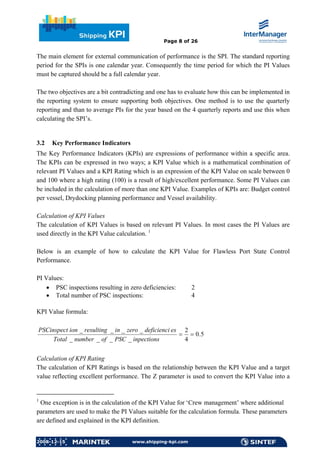
The Shipping KPI Performance Hierarchy is based on three levels of indicators:


3.1     Performance Indicators
The Performance Indicators (PIs) are the building blocks giving the basis for KPI Value
calculations. PIs are directly observable parameters (measurements) for each vessel under
management, e.g. Absconded crew, Collision and Total number of fire incidents.

The Performance Indicators are the only elements that must be reported manually or by means of
implemented ICT solutions. Focus has been to provide the hierarchy with unambiguous
definitions of measurable low level parameters based on existing measurements in the industry.
Each PI may be used in the calculation of several KPIs. An example is the PI ‘Total number of
external inspections’ which is used as a denominator in the calculation of several KPI Values.

In some cases the PI Value requires an intermediate calculation of lower level parameters (as in
the case of the PI Value for ‘Emitted mass CO2’). How to perform the intermediate calculation as
well as relevant parameters is described in the PI description.


3.1.1    Capturing PI Values
As capturing PI Values is the only manual operation it requires a more detailed description. There
are two different settings to consider; namely capturing PI Values for external communication
(basis for KPI and SPI calculation) and capturing PI Values for internal improvement.

For internal improvements, annual data capture will not be adequate to provide management with
updated information. There are two issues to consider:
   o The frequency of data capture
   o The time period for which PI Values should be captured

The frequency of recalculation of KPI Values should be in line with the plan for monitoring
improvement initiatives. Quarterly data capture will give the person responsible for monitoring a
more accurate and up to date picture of the effects of improvement initiatives than yearly data
capture. As a rule of thumb, the time period for which the PI Values should be captured should be
the same as the frequency of data capture. This means that if a certain improvement initiative is
planned to be monitored on a quarterly basis, the time period for which the PI Values should be
captured should be 3 months. If one maintains the one year period for the KPI Value, it becomes
slower (more insensitive to change) than if one use a quarterly or monthly period.


2008-12-15                          www.shipping-kpi.com
Page 8 of 26


The main element for external communication of performance is the SPI. The standard reporting
period for the SPIs is one calendar year. Consequently the time period for which the PI Values
must be captured should be a full calendar year.

The two objectives are a bit contradicting and one has to evaluate how this can be implemented in
the reporting system to ensure supporting both objectives. One method is to use the quarterly
reporting and than to average PIs for the year based on the 4 quarterly reports and use this when
calculating the SPI’s.


3.2   Key Performance Indicators
The Key Performance Indicators (KPIs) are expressions of performance within a specific area.
The KPIs can be expressed in two ways; a KPI Value which is a mathematical combination of
relevant PI Values and a KPI Rating which is an expression of the KPI Value on scale between 0
and 100 where a high rating (100) is a result of high/excellent performance. Some PI Values can
be included in the calculation of more than one KPI Value. Examples of KPIs are: Budget control
per vessel, Drydocking planning performance and Vessel availability.

Calculation of KPI Values
The calculation of KPI Values is based on relevant PI Values. In most cases the PI Values are
used directly in the KPI Value calculation. 1

Below is an example of how to calculate the KPI Value for Flawless Port State Control
Performance.

PI Values:
   • PSC inspections resulting in zero deficiencies:       2
   • Total number of PSC inspections:                      4

KPI Value formula:

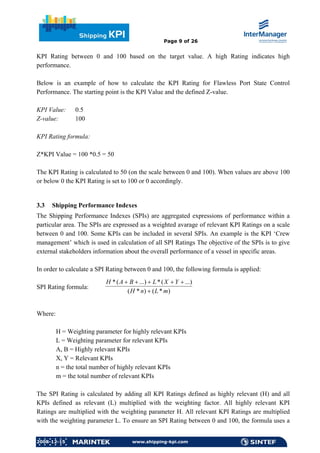
PSCinspect ion _ resulting _ in _ zero _ deficienci es 2
                                                      = = 0 .5
     Total _ number _ of _ PSC _ inpections            4


Calculation of KPI Rating
The calculation of KPI Ratings is based on the relationship between the KPI Value and a target
value reflecting excellent performance. The Z parameter is used to convert the KPI Value into a


1
 One exception is in the calculation of the KPI Value for ‘Crew management’ where additional
parameters are used to make the PI Values suitable for the calculation formula. These parameters
are defined and explained in the KPI definition.


2008-12-15                          www.shipping-kpi.com
Page 9 of 26


KPI Rating between 0 and 100 based on the target value. A high Rating indicates high
performance.

Below is an example of how to calculate the KPI Rating for Flawless Port State Control
Performance. The starting point is the KPI Value and the defined Z-value.

KPI Value:      0.5
Z-value:        100

KPI Rating formula:

Z*KPI Value = 100 *0.5 = 50

The KPI Rating is calculated to 50 (on the scale between 0 and 100). When values are above 100
or below 0 the KPI Rating is set to 100 or 0 accordingly.


3.3   Shipping Performance Indexes
The Shipping Performance Indexes (SPIs) are aggregated expressions of performance within a
particular area. The SPIs are expressed as a weighted avarage of relevant KPI Ratings on a scale
between 0 and 100. Some KPIs can be included in several SPIs. An example is the KPI ‘Crew
management’ which is used in calculation of all SPI Ratings The objective of the SPIs is to give
external stakeholders information about the overall performance of a vessel in specific areas.

In order to calculate a SPI Rating between 0 and 100, the following formula is applied:
                           H * ( A + B + ...) + L * ( X + Y + ...)
SPI Rating formula:
                                    ( H * n) + ( L * m)


Where:

         H = Weighting parameter for highly relevant KPIs
         L = Weighting parameter for relevant KPIs
         A, B = Highly relevant KPIs
         X, Y = Relevant KPIs
         n = the total number of highly relevant KPIs
         m = the total number of relevant KPIs

The SPI Rating is calculated by adding all KPI Ratings defined as highly relevant (H) and all
KPIs defined as relevant (L) multiplied with the weighting factor. All highly relevant KPI
Ratings are multiplied with the weighting parameter H. All relevant KPI Ratings are multiplied
with the weighting parameter L. To ensure an SPI Rating between 0 and 100, the formula uses a


2008-12-15                            www.shipping-kpi.com
Page 10 of 26


denominator with the total number of highly relevant KPIs multiplied by rating parameter H and
the total number of relevant KPIs multiplied with the rating parameter L. This gives an weighted
average.

Below is an example of how to calculate the SPI Rating for Navigational Performance.

KPI Ratings, Highly relevant KPIs (H):
A: Navigational incidents                              80
B: Navigational deficiencies                           60

KPI Ratings, Relevant KPIs (L):
X: Crew management                                     70
Y: Failures of critical equipment and systems          40
Z: Crew planning                                       45

Rating parameters value:
H:     3
L:     1

SPI Rating formula:

H * ( A + B) + L * ( X + Y + Z )   3 * (80 + 60) + 1 * (70 + 40 + 45)
                                 =                                    = 64
       ( H * 2) + ( L * 3)                   (3 * 2) + (1 * 3)


Figure 1 The Shipping KPI Performance Hierarchy


2008-12-15                            www.shipping-kpi.com
Page 11 of 26


4     Project Methodology
In the process of designing the Shipping KPI Performance Hierarchy, we have utilized a three
phased iterative development approach:

Phase 1: Evaluation of existing industry KPIs
Phase 2: Designing the Shipping KPI Performance Hierarchy
Phase 3: Evaluation by Stakeholders


Figure 2 A three phased iterative development approach


4.1       Phase 1: Evaluation of existing industry KPIs
In this phase the members of the Sponsor Group were asked to share their existing KPIs. The idea
was that a new global standard for Shipping KPIs would have to be based on existing KPIs to
ensure data capture feasibility. The rationale for this starting point is twofold: The Shipping KPI
standard must be measurable and the Shipping KPIs must be in demand. KPIs in use are in most
cases based on either internal requirements related to performance or external requirements from
stakeholders.

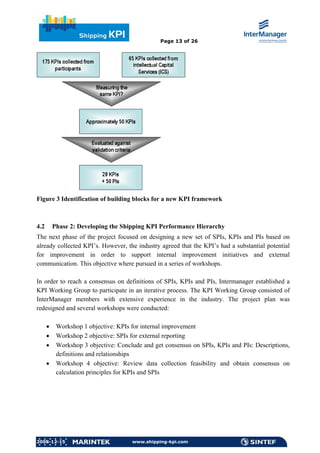
Approximately 175 KPI definitions were collected from the industry. In addition,
65 indicators and KPIs were identified and documented in a feasibility study by ICS (Intellectual
Capital Services).

The collected KPIs were compared and analyzed on basis of three criteria:

      •    Categorizing the KPIs in focus areas
      •    KPIs measuring the same performance were defined as one KPI
      •    KPIs with identical names that measured different performance were renamed


2008-12-15                            www.shipping-kpi.com
Page 12 of 26


Criteria number 1 resulted in organizing KPIs in 8 focus-areas: Statutory Requirements,
Environmental, Technical, Crew Safety, Crew Management, Cargo, Financial and Reputation.

Criteria number 2 and 3 resulted in a reduction of KPIs from 240 to approx. 50.

In the next step the KPIs were validated against a set of criteria described by Kjellén (2000).
These criteria were originally developed for validating indicators to be used in HSE management
systems, but are equally relevant for most types of management and performance indicators.

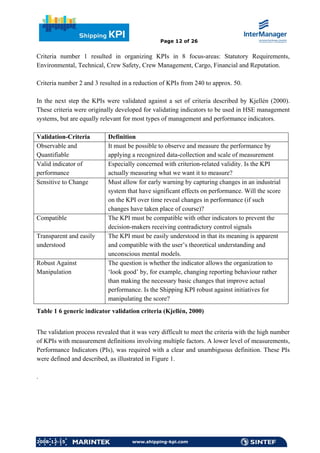
Validation-Criteria         Definition
Observable and              It must be possible to observe and measure the performance by
Quantifiable                applying a recognized data-collection and scale of measurement
Valid indicator of          Especially concerned with criterion-related validity. Is the KPI
performance                 actually measuring what we want it to measure?
Sensitive to Change         Must allow for early warning by capturing changes in an industrial
                            system that have significant effects on performance. Will the score
                            on the KPI over time reveal changes in performance (if such
                            changes have taken place of course)?
Compatible                  The KPI must be compatible with other indicators to prevent the
                            decision-makers receiving contradictory control signals
Transparent and easily      The KPI must be easily understood in that its meaning is apparent
understood                  and compatible with the user’s theoretical understanding and
                            unconscious mental models.
Robust Against              The question is whether the indicator allows the organization to
Manipulation                ‘look good’ by, for example, changing reporting behaviour rather
                            than making the necessary basic changes that improve actual
                            performance. Is the Shipping KPI robust against initiatives for
                            manipulating the score?
Table 1 6 generic indicator validation criteria (Kjellén, 2000)


The validation process revealed that it was very difficult to meet the criteria with the high number
of KPIs with measurement definitions involving multiple factors. A lower level of measurements,
Performance Indicators (PIs), was required with a clear and unambiguous definition. These PIs
were defined and described, as illustrated in Figure 1.

.


2008-12-15                           www.shipping-kpi.com
Page 13 of 26


Figure 3 Identification of building blocks for a new KPI framework


4.2       Phase 2: Developing the Shipping KPI Performance Hierarchy
The next phase of the project focused on designing a new set of SPIs, KPIs and PIs based on
already collected KPI’s. However, the industry agreed that the KPI’s had a substantial potential
for improvement in order to support internal improvement initiatives and external
communication. This objective where pursued in a series of workshops.

In order to reach a consensus on definitions of SPIs, KPIs and PIs, Intermanager established a
KPI Working Group to participate in an iterative process. The KPI Working Group consisted of
InterManager members with extensive experience in the industry. The project plan was
redesigned and several workshops were conducted:

      •    Workshop 1 objective: KPIs for internal improvement
      •    Workshop 2 objective: SPIs for external reporting
      •    Workshop 3 objective: Conclude and get consensus on SPIs, KPIs and PIs: Descriptions,
           definitions and relationships
      •    Workshop 4 objective: Review data collection feasibility and obtain consensus on
           calculation principles for KPIs and SPIs


2008-12-15                            www.shipping-kpi.com
Page 14 of 26


4.2.1   Workshop 1: KPIs for internal improvement
The objective of WS1 was to reach a consensus on KPIs for internal improvement in ship
management organizations. A good starting point was the identified KPIs from phase 1.
However, the general feedback from phase 1 was that the KPI definitions were ambiguous, and it
was unclear whether the KPIs were covering all aspects of internal improvement needs. In
response to these challenges members of the KPI Working Group were invited to identify new
KPIs and to improve existing KPI and PI definitions.

A number of different approaches were evaluated in order to provide a good framework to:
   • Provide a system for company internal improvements
   • Provide a system for industry benchmarking

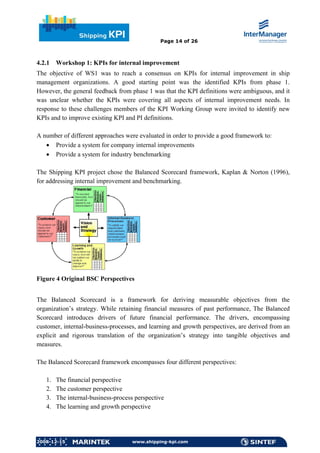
The Shipping KPI project chose the Balanced Scorecard framework, Kaplan & Norton (1996),
for addressing internal improvement and benchmarking.


Figure 4 Original BSC Perspectives


The Balanced Scorecard is a framework for deriving measurable objectives from the
organization’s strategy. While retaining financial measures of past performance, The Balanced
Scorecard introduces drivers of future financial performance. The drivers, encompassing
customer, internal-business-processes, and learning and growth perspectives, are derived from an
explicit and rigorous translation of the organization’s strategy into tangible objectives and
measures.

The Balanced Scorecard framework encompasses four different perspectives:

   1.   The financial perspective
   2.   The customer perspective
   3.   The internal-business-process perspective
   4.   The learning and growth perspective


2008-12-15                          www.shipping-kpi.com
Page 15 of 26


Due to an increasing focus on ‘Corporate Social Responsibility’ within the business community,
the project suggests to add a fifth perspective on HSE issues in order to focus on value creation in
a socially acceptable and desirable manner.

   5. The health-safety-environment perspective

The financial perspective encompasses KPIs focusing on increasing revenues and productivity,
reducing cost and risk and enhancing asset utilization, whereas the customer perspective focuses
on core customer KPIs such as satisfaction, loyalty, retention, acquisition and customer
profitability.

The internal-business-process perspective focuses on measures that are critical for achieving
financial and customer objectives. Typical KPIs describe business processes in quality, time,
productivity and cost. It is important to encompass measures not only focusing on existing
processes, but also new processes that need to be developed in order to meet customer needs and
succeed financially.

The learning and growth perspective encompasses KPIs that provide the infrastructure to enable
ambitious objectives and achievements in the other three perspectives. There are typically three
categories for the learning and growth perspective:

   1. Employee capabilities
   2. Information system capabilities
   3. Motivation, empowerment and alignment

The HSE perspective focuses on KPIs important to stakeholders other than owners and
employees of the company. Three categories are included in this perspective:

   1. Employee and crew health
   2. Asset security
   3. Environmental issues such as emissions, spills etc.

By using The Balanced Scorecard, some new KPIs were identified. However, it was concluded
that financial KPIs were already well defined, and several KPIs within the customer perspective
were regarded as not relevant for the ship management industry. Furthermore, the different
business models within the industry make it difficult to measure meaningful financial and
customer related KPIs.

As a result of the workshop, KPI and PI definitions were considerable improved by the KPI
Working Group. The definitions were sent to all participants in order to comment and verify the
outcome.


2008-12-15                           www.shipping-kpi.com
Page 16 of 26


4.2.2   Workshop 2: SPIs for external reporting
A tool for identification of the SPIs, the Stakeholder Analysis, was introduced to the KPI
Working Group. Traditionally Stakeholder Analysis (SA) is used to identify stakeholders
influencing or being affected by a policy or organizational change. Methods for performing SA as
described by K.Schmeer (1999) were too rigorous for our purpose. We used a more pragmatic
approach in the tradition of System Engineering and Requirements Engineering.

Due to the lack of direct access to a broad set of stakeholders we relied on the earlier Shipping
Model (Maritime IT Drift 1997) and from this model we identified relevant stakeholders. Based
on the Shipping Model, four main shipping functions are identified: Ship Owners, Charterer, Ship
Manager and Ship Operator. A comprehensive list of external stakeholders was created based on
the model. For each stakeholder, its main area of interest was identified.

Because stakeholders can act in different roles, a diverse set of roles were defined. From the roles
we anticipated the information requirements. The hypothesis was that if different roles were
satisfied with information, the stakeholders would get consistent information about performance
in all areas they had an interest.

The result from the work shop was initial SPI descriptions/definitions and initial thoughts on the
SPI – KPI matching matrix (see next section).


4.2.3   Workshop 3: Conclude and get consensus on SPIs, KPIs and PIs
In the previous session the KPI Working Group was introduced to the need for building a
relationship between KPIs and SPIs. In workshop 3 the thoughts from the previous session were
concretized in a KPI – SPI Matching Matrix.

In order to select KPIs to calculate the SPI Ratings, a matching matrix was designed. The
Matching Matrix identifies which KPIs are the best indicators of the performance within each SPI
area.

For each SPI there are three categories of KPIs; Highly relevant (H), Relevant (L) and Not
relevant. Each KPI could only have high relevance (H) for one SPI. The SPIs can consequently
consist of several KPIs with high and low relevance. This exercise was conducted iteratively and
resulted in the following Matching Matrix.


2008-12-15                           www.shipping-kpi.com
Page 17 of 26


                                                      Environmental Performance


                                                                                                                                                                                                Operational Performance
                                                                                                                                                                       Navigation Performance
                                                                                                                                               Technical Performance
                                                                                                                        Security Performance
                              SPIs


                                                                                                   Safety Performance
                                                                                  HR Performance
       KPIs

 Accidental releases of substances as def by MARPOL   H                                                                                        L                                                L
 Ballast water discharge violations                   H                           L
 Budget control per vessel                                                                                                                                                                      H
 Cargo incidents during cargo operations              L                           L                L                                           L                                                H
 Cargo incidents during voyage                        L                           L                L                                           L                                                H
 CO2 emissions                                        H                                                                                        L                                                L
 Condition of class                                                                                                                            H
 Contained spills                                     H                                                                                        L                                                L
 Crew behavior                                                                    H                L                    L
 Crew management                                      L                           H                L                    L                      L                       L                        L
 Crew planning                                        L                           H                L                    L                      L                       L                        L
 Drydocking planning performance                                                                                                                                                                H
 Environmental deficiencies                           H
 Failure of critical equipment and systems            L                                            L                                           H                       L                        L
 Fire and Explosions                                                                               H
 Flawless port state control performance              L                                            H                    L                      L                                                L
 HR deficiencies                                                                  H
 Lost Time Injuries Frequency (LTIF)                                              L                H
 Lost Time Sickness Frequency (LTSF)                                              H
 Navigational deficiencies                                                                                                                                             H
 Navigational incidents                               L                           L                L                                           L                       H                        L
 No of violations of MARPOL Annex 1-6                 H                           L                                                            L
 NOx emissions                                        H                                                                                        L                                                L
 Operational deficiencies                                                                                                                                                                       H
 Port state control deficiency rate
 Port state control detention                         L                                            L                    L                      L                                                H
 Safety deficiencies                                                                               H
 Security deficiencies                                                            L                                     H                                                                       L
 SOx emissions                                        H                                                                                        L                                                L
 Vessel availability                                                              L                                                            L                                                H

Table 2 The Matching Matrix


In addition to a completed Matching Matrix, all SPI, KPI and PI descriptions were revised and
updated accordingly. Furthermore, the KPI Working Group committed to conduct a feasibility
study of data capture, to elaborate on how difficult it would be to provide the data required on PI
level.


2008-12-15                              www.shipping-kpi.com
Page 18 of 26


4.2.4      Workshop 4: Review data collection feasibility and obtain consensus on calculation
           principles for KPIs and SPIs
On basis of the Matching Matrix developed in workshop 3 the formulas for calculating KPI
Values, KPI Ratings and SPI Ratings were developed.

When calculating the KPI Values and Ratings and the SPI Ratings some mathematical challenges
exist. In section 3 an explanation of the formulas for calculating KPI Values, KPI Ratings and
SPI Rating is given.

To get an idea about the complexity of capturing PI Values, we engaged the KPI Working Group
to briefly evaluate to what extent ship management organizations capture data relevant to the PIs
defined in the hierarchy. The result of the evaluation was that for approximately 6-8% of the PIs,
the ship managers do not have data directly available. Hence, the data has to be extracted from
other sources, or the ship managers have to consult sources in order to capture relevant data that
can be transferred to the PI Value. One of the challenges has been that the data captured is not
always directly applicable and have to be reworked or reformatted.

At the end of Workshop 3 it was decided to evaluate further the feasibility of data capture. The
KPI Working Group agreed to collect data for 3 more ships each in their respective fleets for the
fiscal year 2007. This information was used in Workshop 4 to get a picture of the PI Value
ranges, and to what extent it is possible to capture correct data. Based on data from the ship
managers, the calculation formulas for the KPI Values and Ratings and the SPI Ratings were
validated.


4.3       Phase 3: Evaluation by Stakeholders
In phase 3, focus has been on two main issues:

      1. Stakeholder involvement
      2. Dissemination, maintenance and utilization of results


4.3.1      Stakeholder involvement
Results from the project have been presented to several stakeholders including:

      •    Intertanko
      •    Intercargo
      •    OCIMF
      •    Lloyds Maritime Academy


2008-12-15                            www.shipping-kpi.com
Page 19 of 26


The general feedback was positive but some stakeholders have expressed the need for further
validation and calibration of the proposed model, specifically related to the KPI Ratings and SPI
Ratings as both calculations require a notion of what is considered as poor and/or excellent
performance.


4.3.2      Dissemination, maintenance and utilization of Results
An important element in the dissemination and utilization of the Shipping KPI Performance
Hierarchy is the development of a Shipping KPI Depository. This depository consists of an
information structure related to the elements of the Shipping KPI Performance Hierarchy (SPIs,
KPIs and PIs) in addition to the calculation model.

In addition to the design and development of the Shipping KPI Depository, focus in phase 3 has
been on creating a sustainable model for management of the depository and the overall Shipping
KPI Performance Hierarchy.

The potential for enhancement of the depository’s functionality and its added value to the project
as well as the strategy for management of the depository is given in section 7.


5     Project results
This section contains a description of the project results: The Shipping KPI Performance
Hierarchy and the Shipping KPI Depository.

5.1       The Shipping KPI Performance Hierarchy
The Shipping KPI Performance Hierarchy now consists of:

      •    7 Shipping Performance Indexes
      •    30 Key Performance Indicators
      •    58 Performance Indicators

The complete Shipping KPI Performance Hierarchy is presented in appendix I with definitions,
descriptions and some relevant calculation examples.


5.2       The Shipping KPI Depository
The Shipping KPI Performance Hierarchy is available in the web based Shipping KPI Depository
www.shipping-kpi.com.


2008-12-15                            www.shipping-kpi.com
Page 20 of 26


5.2.1   Dissemination and utilization of the Shipping KPI Performance Hierarchy
In addition to general information about the project, its background and methodology, the
depository contains detailed information about the Shipping KPI Performance Hierarchy through:

   1. Description of all Performance Indicators including
         a. Specification of data capture (PI Values)
         b. Their context in light of how the PI Values are used in the hierarchy
         c. Any intermediate calculation formulas that must be applied to be able to obtain the
             PI Values
   2. Description of all Key Performance Indicators including
         a. The KPI’s objective (what to measure)
         b. The KPI Value calculation formula
         c. The KPI Rating calculation formula
   3. Description of all Shipping Performance Indexes including
         a. The SPI’s objective (what to express)
         b. The SPI Rating calculation formula

In order to facilitate a continuous discussion of the Shipping KPI Performance Hierarchy and
allowing for suggestions for improvement as well as involvement of the industry, the depository
will provide a blog where material collected from users/KPI working group will be published in a
Q&A format on individual indicator level.


5.2.2   Hosting and maintaining the depository
A strategy for maintenance of the depository has to be established. Intermanager are responsible
for such maintenance as they have agreed to be the caretaker of the standard in the future.
However, the actual work may be contracted to a different organization, and the Shipping KPI
Depository may be hosted by a 3rd party provider.

The maintenance will at a minimum consist of:
   • Updates and enhancements of the web service
   • Revision of the SPI/KPI/PI descriptions
   • QA support service
   • Management of the ICT platform

The clarification of roles and responsibilities related to the management of the Shipping KPI
Depository is under the responsibility of the Project Steering committee until the end of the
project, after that Intermanager has agreed to take over the maintenance of the Standard.
However, the project has suggested some generic roles and responsibilities that need to be
defined.


2008-12-15                          www.shipping-kpi.com
Page 21 of 26


Role                          Responsibilities
ICT Infrastructure Provider   This is a professional body able to host the depository and able
                              to guarantee a Level of Service as required by the KPI Definition
                              Authority and Policy Responsible
Service Responsible           This is a body that is domain qualified to discuss and advice on
                              the use of the SPIs/KPIs and able to put forward proposals for
                              change, to the KPI Definition Authority and Policy Responsible.
                              There are two sub roles involved:
                              1) Content Responsible which is the responsible editor of the
                              Shipping KPI Depository actually making the changes to the
                              Depository when authorized by the KPI Definition Authority and
                              Policy Responsible.
                              2) Benchmark Responsible who is the responsible manager of the
                              industry benchmark, for the calculations and integrity of the
                              information being uploaded to be used in the benchmark. This
                              role should also perform regularly sensitivity analyses in order to
                              provide qualitative information about the benchmark.
KPI Definition Authority      This is a domain expert body that has the authority to alter the
and Policy Responsible        definition of the SPIs/KPIs/PIs and the calculation model used.
                              Intermanager will head this role preferably in association with
                              other stakeholder organizations.
Table 3 Roles and responsibilities in the management of the Shipping KPI Depository


2008-12-15                          www.shipping-kpi.com
Page 22 of 26


6   Guidelines for use of the Shipping KPI Performance Hierarchy
This section contains guidelines for how to use the Shipping KPI Performance Hierarchy once
implemented in an organization.

There are two main issues to consider:
   • Capturing of Performance Indicator Values with the intent to calculate KPI Values, KPI
       Ratings and SPI Ratings
   • Utilization of the results provided by the Shipping KPI Performance Hierarchy.

As capturing PI Values is the only manual operation it requires a more detailed description. There
are two different objectives to consider; namely capturing PI Values and using the SPI’s for
external communication and capturing PI Values and using the KPI’s for internal improvement.

The main element to be used for internal improvement is the KPI Value as this is the most
accurate and detailed expression of performance. The KPI Value can be trended over time which
will give a good indication of performance development when internal improvement initiatives
are launched.

For internal improvements, annual data capture will not be adequate to provide management with
updated information. There are two issues to consider:
   o The frequency of data capture
   o The time period for which PI Values should be captured

The frequency of recalculation of KPI Values should be in line with the plan for monitoring
improvement initiatives. Quarterly data capture will give the person responsible for monitoring a
more accurate and up to date picture of the effects of improvement initiatives than yearly data
capture. As a rule of thumb, the time period for which the PI Values should be captured should be
the same as the frequency of data capture. This means that if a certain improvement initiative is
planned to be monitored on a quarterly basis, the time period for which the PI Values should be
captured should be 3 months. If one maintains the one year period for the KPI Value, it becomes
slower (more insensitive to change) than if one use a quarterly or monthly period.

The main element for external communication of performance is the SPI. The standard reporting
period for the PIs is one calendar year. Consequently the SPI Ratings will be calculated for a full
calendar year.

The two objectives are a bit contradicting and one has to evaluate how this can be implemented in
the reporting system to ensure supporting both objectives. One method is to use the quarterly
reporting and than to average PIs for the year based on the 4 quarterly reports and use this when
calculating the SPI’s.


2008-12-15                           www.shipping-kpi.com
Page 23 of 26


7     Areas for Further Research
There are several areas for further research identified during the Shipping KPI Project. Three
main areas are described below.

It should be noted that an application to the Research Council of Norway (RCN) for funding of a
phase 2 of the Shipping KPI Project has been sent (RCN decision expected in mid December
2008).

7.1    Validation and calibration of the calculation model
As stated in section 3 there are elements in the Shipping KPI Performance Hierarchy’s
Calculation Model that require further validation and calibration.

KPI Rating formulas must be defined with a ‘zero target value’ in order to rate the KPI Value in a
scale between 0 and 100 (the KPI Rating). This target values is interesting to both the industry
(mainly through the KPI Ratings directly as it defines the unacceptable performance level) and
for external stakeholders (as the KPI Ratings ultimately defines the SPI Ratings).

The two categories of relevance, highly relevant (H) and relevant (L), in the SPI Rating formulas
must be assigned validated weighting parameters to ensure:

             a. The proper SPI Rating on basis of the KPI Ratings
             b. The proper SPI sensitivity to change in the KPI Rating.

These weighting parameters are of interest to both the industry (who’s performance is to be
reflected through the SPI Ratings) and to external stakeholders (who are interpreting the SPI
Ratings).

The two abovementioned issues both require interaction with the industry and external
stakeholders as well as a much more extensive data capture in order to create a suitable basis for
validation and calibration of the calculation model through sensitivity analysis. On proposal to
make the rating more robust is to aim for a grade scale (A, B, …, F). And when enough data
material is available one can apply a normal distribution to ensure that there is a spread, avoiding
potential side effect where all industry is rated in a very narrow band of the rating scale.


7.2    Added value by extended Shipping KPI Depository functionality
In order to make the Shipping KPI Depository more attractive and to enable the development of a
benchmarking service (see 7.3) it is proposed by the Intermanager KPI working group that a
mock-up/prototype SW tool should be developed as an aid to promote and enhance the Shipping
KPI Depository.


2008-12-15                            www.shipping-kpi.com
Page 24 of 26


Such a tool needs to be web based and should have the following main functionalities in addition
to the standard depository functionality described in section 5.2.

      •    SPI/KPI/PI explanatory guide, interpretations and in-depth explanations (Wikipedia-like)
      •    Data upload into the Shipping KPI Depository (for benchmarking purposes)
      •    User management securing anonymity and integrity of data
      •    Graphic data presentation, comparison and interpretations of results


7.3       Benchmarking by using the Shipping KPI Depository
One of the potential added values from the Shipping KPI Project and its resulting Shipping KPI
Performance Hierarchy is the potential for industry wide benchmarking.

Building a benchmarking regime requires several aspects to be in place:
   • Industry standards for all elements in the Shipping KPI Performance Hierarchy
           o Performance Indicators
           o Key Performance Indicators
           o Shipping Performance Indexes
   • Established and transparent calculation models for
           o KPI Values
           o KPI Ratings
           o SPI Ratings
           o Any intermediate calculations (and related parameters) needed to capture the PI
              Values for calculation of KPI Values
   • Data capture methods, reporting tool
   • Data integrity and validation principles established
   • Anonymity preservation
   • Information presentation and interpretation tools

As can be seen in section 5.2, the Shipping KPI project caters for the two first required aspects. It
is therefore important that remaining aspects are developed to complete the required steps in
order to realize the full potential advantage of the developed Shipping KPI Performance
Hierarchy.


2008-12-15                              www.shipping-kpi.com
Page 25 of 26


8   References

Kjellén, U (2000) “Prevention of Accidents Through Experience Feedback” Taylor & Francis,
London

Kaplan R S and Norton D P (1996) “Balanced Scorecard: Translating Strategy into Action”
Harvard Business School Press

ICS (2005) “Key Performance Indicators (KPIs) In Ship Management Companies- Pilot Study”
ICS Ltd, London

K.Schmeer (1999) - Stakeholder Analysis Guidelines
http://www.lachsr.org/documents/policytoolkitforstrengtheninghealthsectorreformpartii-EN.pdf

Maritime IT Drift
The Shipping Model; MARINTEK Rapport 002213 - 1997-05-05, Project No 233404
“Process redesign adapted to the business of fleet management“


2008-12-15                         www.shipping-kpi.com
Page 26 of 26


9   Appendix I

The Shipping KPI Standard, include definitions of all SPI, KPI and PI with selected calculation
examples.


2008-12-15                          www.shipping-kpi.com
Shipping KPI Standard

 Ver 1.1
 2009 FEB 12


 IPR
 The content of this document is the intellectual property of InterManager, the International Ship Managers' Association, and should not be
                                                              InterManager,
 used for any commercial purpose or included in any application or service intended for commercial sale without Intermanager's prior
                                                                   or                                                            prior
 written consent


Copyright © InterManager, the International Ship Managers' Association 2008

No part of this work may be reproduced or transmitted in any form or by any means, or stored in any retrieval system of any nature without
                                                               form                                                          nature
prior written permission, except for permitted fair dealing under the Copyright, Designs and Patents Act 1988. Application for permission for
                                                            under
other use of copyright material including permission to reproduce extracts of the work shall be made to InterManager. Full acknowledgement
                                                          reproduce                                      InterManager.
of author and source must be given.
The Shipping KPI Standard - Concept


                                                                                                 Aggregated indexes for external communication


                                                                           SPI


                                                                           KPI                                     Extended Balanced Score
                                                                                                                   Card for internal improvement
                                                  Processes


                                                                Customer


                                                                                 Learning


                                                                                               HSE
                             Financial                                                                 Others
                                                                                                                                 Corporate
                                                                           PI                                                    measurements


Copyright © InterManager, the International Ship Managers' Association 200[8]
            InterManager,                                                                   Page 2
For Further Information or Help

          Contact:
          Guy Morel                                                             Harald Sleire
          guy.morel@intermanager.org                                            harald.sleire@marintek.sintef.no
          General Secretary                                                     Project Manager
          InterManager                                                          MARINTEK
          Phone    +336 8086 0986                                               Phone      +47 7359 5500


          Or visit the Depository (fully implemented by 31/12-2008)

          http://www.sintef.no/Projectweb/Shipping-KPI/


Copyright © InterManager, the International Ship Managers' Association 200[8]
            InterManager,                                                             Page 3
Shipping Performance Indexes

           “SPI”
The Shipping KPI Standard - SPIs


                                     ••    Environmental performance
                                           Environmental performance
                                     ••    HR performance
                                           HR performance
                                     ••    Safety performance
                                           Safety performance
                                     ••    Security performance
                                           Security performance
                                     ••    Technical Performance
                                           Technical Performance
                                     ••    Navigation Performance
                                           Navigation Performance
                                     ••    Operational Performance
                                           Operational Performance


Copyright © InterManager, the International Ship Managers' Association 200[8]
            InterManager,                                                       Page 5
SPI: Operational Performance
  Operational Performance is a measure of the operational efficiency of the vessel including all cargo transport related
  operations (safe and efficient cargo handling, transport timeliness, reliability and cost efficiency)

  Highly Relevant KPIs (H):                                                     Relevant KPIs (L):
  •A: Cargo incidents during cargo operations                                   •J: Crew management
  •B: Cargo incidents during voyage                                             •K: Failures to critical equipment and systems
  •C: Port state control detention                                              •M: Crew planning
  •D: Vessel availability                                                       •N: Flawless Port state control performance
  •E: Budget control per vessel                                                 •O: Navigational Incidents
  •F: Operational deficiencies                                                  •P: CO2 Emission
  •G: Drydocking planning performance                                           •Q: NOx emission
                                                                                •R: SOx emission
                                                                                •S: Accidental releases of substances as defined by MARPOL
                                                                                •T: Contained spills
                                                                                •U: Security deficiencies


  SPI Rating Formula= (H*(A+B+C+D+E+F+G)) + (L*(J+K+M+N+O+P+Q+R+S+T+U))
                                      (H*7) + (L*11)
  Rating Parameters:
  H=3
  L=1


Copyright © InterManager, the International Ship Managers' Association 200[8]
            InterManager,                                                       Page 6
SPI: Navigational Performance
  Navigational Performance is a measure of the navigational incidents recorded for each vessels.
  Navigational Incident is related to safe navigation.

  Highly Relevant KPIs (H):                                                     Relevant KPIs (L):
  •A: Navigational incidents                                                    •C: Crew management
  •B: Navigational deficiencies                                                 •D: Failures of critical equipment and systems
                                                                                •E: Crew planning


  SPI Rating Formula =                             (H*(A+B)) + (L*(C+D+E))
                                                        (H*2) + (L*3)
  Rating Parameters:
  H=3
  L=1


Copyright © InterManager, the International Ship Managers' Association 200[8]
            InterManager,                                                       Page 7
SPI: Navigational Performance
                                                                Calculation Example

  Highly Relevant KPIs (H):                                                     Relevant KPIs (L):
  •A: Navigational incidents                       80                           •C: Crew management                            70
  •B: Navigational deficiencies                    60                           •D: Failures of critical equipment and systems 40
                                                                                •E: Crew planning                              45


  SPI Rating Formula = (H*(A+B)) + (L*(C+D+E)) = (3 * (80 + 60)) + (1* (70 + 40 + 45)) = 420 + 155 = 64
                           (H*2) + (L*3)                     (3 * 2) + (1* 3)                9
  Rating Parameters:
  H=3
  L=1


Copyright © InterManager, the International Ship Managers' Association 200[8]
            InterManager,                                                       Page 8
SPI: Environmental Performance
  Environmental Performance is a measure of emissions, spills and other forms of pollution that impact the environment,
  caused by the vessel operations.
  Recorded for each vessel.
  Highly Relevant KPIs (H):                                                     Relevant KPIs (L):
  •A: No of Violations of MARPOL Annex 1-6                                      •J: Crew management
  •B: CO2 emission                                                              •K: Failures to critical equipment and systems
  •C: NOx emission                                                              •M: Cargo incidents during cargo operations
  •D: SOx emission                                                              •N: Crew planning
  •E: Ballast water discharge violations                                        •O: Cargo incidents during voyage
  •F: Accidental releases of substances as def by MARPOL                        •P: Port state control detention
  •G: Contained spills                                                          •Q: Flawless port state control performance
  •I: Environmental deficiencies                                                •R: Navigational incidents


  SPI Rating Formula = (H*(A+B+C+D+E+F+G+I)) + (L*(J+K+M+N+O+P+Q+R))
                                       (H*8) + (L*8)
  Rating Parameters:
  H=3
  L=1


Copyright © InterManager, the International Ship Managers' Association 200[8]
            InterManager,                                                       Page 9
SPI: Technical Performance
  Technical Performance is a measure of the technical incidents for each vessel including technical breakdown and technical
  underperformances.
  Highly Relevant KPIs (H):                                                     Relevant KPIs (L):
  •A: Failures to critical equipment and systems                                •C: Crew management
  •B: Condition of class                                                        •D: Cargo incidents during cargo operations
                                                                                •E: Crew planning
                                                                                •F: Cargo incidents during voyage
                                                                                •G: Port state control detention
                                                                                •I: Flawless Port state control performance
                                                                                •J: Navigational Incidents
                                                                                •K: No of violations of MARPOL Annex 1-6
                                                                                •M: CO2 emission
                                                                                •N: NOx emission
                                                                                •O: SOx emission
                                                                                •P: Accidental releases of substances as defined by MARPOL
                                                                                •Q: Contained spills
                                                                                •R: Vessel availability

  SPI Rating Formula = (H*(A+B)) + (L*(C+D+E+F+G+I+J+K+M+N+O+P+Q+R))
                                         (H*2) + (L*14)
  Rating Parameters:
  H=3*                                             * These weighting parameters will have to be updated as the
  L=1*                                               ratio of Highly relevant KPIs (H) and Relevant KPIs (L) is
                                                                                     2:14. This will be done in an eventual validation and
                                                                                     calibration of the overall calculation model


Copyright © InterManager, the International Ship Managers' Association 200[8]
            InterManager,                                                       Page 10
SPI: Safety Performance
  Safety Performance is a measure of accidents/incidents resulting in injuries or death. Environmental damage and safety
  of assets and cargo are covered by different SPIs. An accident is a special form of incident involving injuries or death to
  personnel (OSHAS 18001, ISO 18001).

  Highly Relevant KPIs (H):                                                     Relevant KPIs (L):
  •A: Flawless Port state control performance                                   •E: Crew management
  •B: LTIF                                                                      •F: Failures to critical equipment and systems
  •C: Safety deficiencies                                                       •G: Cargo incidents during cargo operations
  •D: Fire and Explosions                                                       •I: Crew planning
                                                                                •J: Cargo incidents during voyage
                                                                                •K: Port state control detention
                                                                                •M: Navigational incidents
                                                                                •N: Crew behaviour


  SPI Rating Formula = (H*(A+B+C+D)) + (L*(E+F+G+I+J+K+M+N))
                               (H*4) + (L*8)
  Rating Parameters:
  H=3                                         Note: We would also like to include near misses but the
  L=1                                               challenge here is the reporting and quality of such.
                                                                                          Near misses are considered more leading than
                                                                                          lagging and inline with TMSA.


Copyright © InterManager, the International Ship Managers' Association 200[8]
            InterManager,                                                       Page 11
SPI: Security Performance
  Security Performance is a measure of security incidents (as described in the ISPS Code) recorded for each vessel.
  A security incident is an intentional or unintentional breach of security (ref ISPS code).
  Highly Relevant KPIs (H):                                                     Relevant KPIs (L):
  •A: Security deficiencies                                                     •B: Crew management
                                                                                •C: Crew planning
                                                                                •D: Port state control detention
                                                                                •E: Flawless port state control performance
                                                                                •F: Crew behaviour


  SPI Rating Formula = (H*A) + (L*(B+C+D+E+F))
                              (H) + (L*5)
  Rating Parameters:
  H=3
  L=1


Copyright © InterManager, the International Ship Managers' Association 200[8]
            InterManager,                                                       Page 12
SPI: HR Performance
  Human Resources Performance is a measure of the company's ability to employ, retain and develop personnel with the
  required competences in order to ensure safe and efficient operations of the vessels.
  Highly Relevant KPIs (H):                                                     Relevant KPIs (L):
  •B: Crew planning                                                             •F: Cargo incidents during cargo operations
  •A: Crew management                                                           •G: Cargo incidents during voyage
  •C: Crew behaviour                                                            •I: Navigational incidents
  •D: LTSF                                                                      •J: No of violations of MARPOL Annex 1-6
  •E: HR deficiencies                                                           •K: Ballast water discharge violations
                                                                                •M: Security deficiencies
                                                                                •N: Vessel availability
                                                                                •O: LTIF


  SPI Rating Formula = (H*(A+B+C+D+E)) + (L*(F+G+I+J+K+M+N+O))
                                 (H*5) + (L*8)
  Rating Parameters:
  H=3
  L=1


Copyright © InterManager, the International Ship Managers' Association 200[8]
            InterManager,                                                       Page 13
Key Performance Indicators

          “KPI”
The Shipping KPI Standard - KPIs

        • • Accidental releases of substances as def by MARPOL
             Accidental releases of substances as def by MARPOL                           • • HR deficiencies
                                                                                               HR deficiencies
        • • Ballast Water Discharge Violations
             Ballast Water Discharge Violations                                           • • Lost Time Injury Frequency
                                                                                               Lost Time Injury Frequency
        • • Budget control per vessel
             Budget control per vessel                                                    • • Lost Time Sickness Frequency
                                                                                               Lost Time Sickness Frequency
        • • Cargo incidents during cargo operations
             Cargo incidents during cargo operations                                      • • Navigational deficiencies
                                                                                               Navigational deficiencies
        • • Cargo incidents during voyage
             Cargo incidents during voyage                                                • • Navigational Incidents
                                                                                               Navigational Incidents
        • • CO2 emissions
             CO2 emissions                                                                • • No of Violations of MARPOL Annex 1-6
                                                                                               No of Violations of MARPOL Annex 1-6
        • • Condition of Class
             Condition of Class                                                           • • NOx emissions
                                                                                               NOx emissions
        • • Contained Spills
             Contained Spills                                                             • • Operational deficiencies
                                                                                               Operational deficiencies
        • • Crew behaviour
             Crew behaviour                                                               • • Port state control deficiency rate
                                                                                               Port state control deficiency rate
        • • Crew management
             Crew management                                                              • • Port state control detention
                                                                                               Port state control detention
        • • Crew planning
             Crew planning                                                                • • Safety deficiencies
                                                                                               Safety deficiencies
        • • Drydocking Planning Performance
             Drydocking Planning Performance                                              • • Security deficiencies
                                                                                               Security deficiencies
        • • Environmental deficiencies
             Environmental deficiencies                                                   • • SOx emissions
                                                                                               SOx emissions
        • • Failure of critical equipment and systems
             Failure of critical equipment and systems                                    • • Vessel availability
                                                                                               Vessel availability
        • • Fire and Explosions
             Fire and Explosions
        • • Flawless Port state control performance
             Flawless Port state control performance


Copyright © InterManager, the International Ship Managers' Association 200[8]
            InterManager,                                                       Page 15
KPI: Accidental releases of substances as def by MARPOL
 Accidental discharges to the environment in violation of MARPOL in a calendar year.
 Due to difficulties related to measuring the actual volume/quantity of a spill, only number of spills are counted.
 Measured per vessel for internal improvement as well as external communication (input to SPIs).

 Relevant PIs:
 •A: Total number of accidental releases of substances covered by MARPOL, to the environment
 •B: Severe spills of bulk liquid

 KPI Value Formula=                               A+B

 KPI Rating Formula=                              0 = 100 rating
                                                  1 = 50 rating
                                                  > 1 = 0 rating

 Rating Parameters:                               N/A


 This KPI counts the number of (severe) spills of liquid and accidental releases of substances. A severe spill is a spill above
 one barrel.


Copyright © InterManager, the International Ship Managers' Association 200[8]
            InterManager,                                                       Page 16
KPI: Ballast water discharge violations
 Any discharge or exchange of ballast water (or lack of doing so) in a calendar year, not in compliance with applicable rules
 and regulations

 Relevant PIs:
 •Ballast water discharge violations

 KPI Value Formula=                               ∑ Ballast water discharge violations

 KPI Rating Formula=                              0 = 100 rating
                                                  1 = 50 rating
                                                  > 1 = 0 rating


 This KPI counts the number of times where prevailing regulations regarding treatment of ballast water has been violated


Copyright © InterManager, the International Ship Managers' Association 200[8]
            InterManager,                                                       Page 17
KPI: Budget control per vessel
 The overall costs deviation (management, purchasing, operation, M&R, crewing) vs. budgets. Show the ability of the ship
 manager to effectively plan the ship’s operating costs (e.g. predictable costs, good budgeting). The cost deviation is
 adjusted for agreed additional expenditure.
 Measured per fiscal year.
 Measured per vessel for internal improvement as well as external communication (input to SPIs)

 Relevant PIs:
 •Vessel running cost budget
 •Actual running costs and accruals
 •Additional Authorized Expenses (AAE)

                    || Vessel running cost budget - (Actual running costs and accruals - AAE) ||
 KPI Value Formula=                                                                              ∗100%
                                            Vessel running cost budget


 KPI Rating Formula=                              100-(Z*KPI Value)

 Rating Parameters:                               Z= 10

 This KPI measures the deviations from the vessel's running cost budget in percentage by comparing it to the vessel's
 actual running costs and accruals and taking into account additional authorized expense (AAE) as these expenses are in
 fact altering the vessel's running cost budget by being authorized/approved by the ship owner. As the KPI measures
 deviations both positive and negative, the KPI Value is always converted to a positive value


Copyright © InterManager, the International Ship Managers' Association 200[8]
            InterManager,                                                       Page 18
KPI: Budget control per vessel
                                                        Calculation Example
 Relevant PIs:
 •Vessel running cost budget                                        1,2M USD
 •Actual running costs and accruals                                 1,5M USD
 •Additional Authorized Expenses (AAE)                              0,25M USD


 KPI Value Formula=                                                                                                             || 1,2 − (1,5 − 0,25) ||
                                       || Vessel running cost budget - (Actual running costs and accruals - AAE) ||
                                                                                                                    ∗100%
                                                                                                                            =                            ∗100% = 4,17%
                                                               Vessel running cost budget                                                  1,2


 KPI Rating Formula=                              100-(Z*KPI Value) = 100 – (10*4,17) = 100 – 41,7 = 58,3

 Rating Parameters:                               Z= 10


 Please note that as we are measuring deviations both positive and negative, the KPI Value is always converted to a
 positive.


Copyright © InterManager, the International Ship Managers' Association 200[8]
            InterManager,                                                                  Page 19
KPI: Cargo incidents during cargo operations
 The total number of received claims concerning damaged or lost cargo or injured passengers during cargo operations in a
 calendar year. Made relative to the total number of cargo units transported in a calendar year. Measured per vessel for
 internal improvement as well as external communication (input to SPIs)
 Relevant PIs:
 •Total number of damaged or lost cargo units or passengers injured during cargo handling
 •Total number of cargo units or passengers transported
 KPI Value Formula=

              Total number of damaged or lost cargo units or passengers injured during cargo handling
                               Total number of cargo units or passengers transported

 KPI Rating Formula=                              100-(Z*KPI Value)

 Rating Parameters:                               Z= 100000

 This KPI represents a ratio between the total quantity of damaged or lost cargo or injured passengers (during handling
 operations such as loading cargo or boarding passengers) relative to the total quantity of cargo or number of passengers
 handled in a calendar year. By defining the KPI as a ratio, benchmarking is feasible even between different vessel sizes.


Copyright © InterManager, the International Ship Managers' Association 200[8]
            InterManager,                                                       Page 20
KPI: Cargo incidents during cargo operations
                                              Calculation Example
Relevant PIs:
•Total number of damaged or lost cargo units or passengers injured during cargo handling                    4
•Total number of cargo units or passengers transported                                                      150.000


KPI Value Formula=
                                                                                                              4
Total number of damaged or lost cargo units or passengers injured during cargo handling
          Total number of cargo units or passengers transported
                                                                                                       =           = 2,6 *10 −5
                                                                                                           150.000

                                                                                              5   -5
KPI Rating Formula=                               100-(Z*KPI Value) = 100 – (10 *2,6*10 ) = 100 – 2,6 = 97,4

                                                                                5
Rating Parameters:                                Z= 100000 = 10


A KPI Value of 0,001 will give zero rating, 1000 units destroyed out of one million transported


Copyright © InterManager, the International Ship Managers' Association 200[8]
            InterManager,                                                           Page 21
KPI: Cargo incidents during voyage
 The total number of received claims concerning damaged or lost cargo or injured passengers during voyage in a calendar
 year. Made relative to the total number of cargo units transported in a calendar year. Measured per vessel for internal
 improvement as well as external communication (input to SPIs)
 Relevant PIs:
 •Total number of damaged or lost cargo units or passengers injured during voyage
 •Total number of cargo units or passengers transported


 KPI Value Formula=

                    Total number of damaged or lost cargo units or passengers injured during voyage
                                Total number of cargo units or passengers transported

 KPI Rating Formula=                              100-(Z*KPI Value)

 Rating Parameters:                               Z= 1000000


 This KPI represents a ratio between the total quantity of damaged or lost cargo or injured passengers (during the actual
 sea voyage) relative to the total quantity of cargo or number of passengers transported in a calendar year. By defining the
 KPI as a ratio, benchmarking is feasible even between different vessel sizes.


Copyright © InterManager, the International Ship Managers' Association 200[8]
            InterManager,                                                       Page 22
KPI: Cargo incidents during voyage
                                                    Calculation Example
Relevant PIs:
•Total number of damaged or lost cargo units or passengers injured during voyage                            4
•Total number of cargo units or passengers transported                                                      150.000


KPI Value Formula=
                                                                                                              4
Total number of damaged or lost cargo units or passengers injured during voyage
          Total number of cargo units or passengers transported
                                                                                                       =           = 2,6 *10 −5
                                                                                                           150.000

                                                                                              6   -5
KPI Rating Formula=                               100-(Z*KPI Value) = 100 – (10 *2,6*10 ) = 100 – 26 = 74

                                                                                6
Rating Parameters:                                Z= 1000000 = 10


A KPI Value of 0,0001 will give zero rating, 100 units destroyed out of one million transported


Copyright © InterManager, the International Ship Managers' Association 200[8]
            InterManager,                                                           Page 23
KPI: CO2 emissions
 The estimated CO2 efficiency in a calendar year. Measured per vessel for external communication (input to SPIs)

 Relevant PIs:
 •Emitted Mass CO2
 •Transport Work

                                                                                6
 KPI Value Formula=                               Emitted Mass CO2*10
                                                   Transport Work

 KPI Rating Formula=                              100-(Z*KPI Value)

 Rating Parameters:                               Z=7


 This KPI compares emitted mass of CO2 to the vessel’s total transport work, hereby stating the value achieved (transport
 work) by the emission of CO2. As the PI ’Emitted Mass CO2 is to be given in tons, the PI’s value is multiplied by 1 million
 to get the KPI value in g/transport work (tonmile, passengermile, TEUmile, etc).


Copyright © InterManager, the International Ship Managers' Association 200[8]
            InterManager,                                                           Page 24
KPI: CO2 emissions
                                                               Calculation Example
Relevant PIs:
•Emitted Mass CO2                103.500 ton
•Transport Work                  20.710.647.000 tonmile

                                                                                6
KPI Value Formula=                                Emitted Mass CO2*10                 103500 *106
                                                   Transport Work                   =             = 4,98 g / tonmile
                                                                                      20710647000
KPI Rating Formula=                               100-(Z*KPI Value) = 100 – (7 * 4,98) = 65,1

Rating Parameters:                                Z=7
                                                                                                            Some typical emission factors
                                                                                               Ship Type            Index unit   CO2        NOx   SOx
                                                                                               LNG Tanker           g/ tonmile   66,5       1,9   1,2
Z value to be updated (agreed), and need to be differentiated                                  Chemical Tanker      g/ tonmile   23,5       0,7   0,4
between ship size and other factors                                                            Crude Oil Tanker     g/ tonmile    8         0,2   0,1
                                                                                               Bulk Dry             g/ tonmile    7,6       0,2   0,1
                                                                                               Container            g/ tonmile   96,5       2,7   1,7
                                                                                               Refrigerated Cargo   g/ tonmile   124,3      3,5   2,2
                                                                                               RO-RO Cargo          g/ tonmile   94,9       1,8   1,7


Copyright © InterManager, the International Ship Managers' Association 200[8]
            InterManager,                                                           Page 25
KPI: Condition of class
 All condition of class in a calendar year. Condition of class is a written statement from class (ref. IACS). All categories of
 CoC are counted equally.
 Measured per vessel for internal improvement as well as external communication (input to SPIs)
 Relevant PIs:
 •Condition of class


 KPI Value Formula=                               ∑Conditions of class

 KPI Rating Formula=                              100-(Z*KPI Value)

 Rating Parameters:                               Z= 20


 This KPI counts the total number of Conditions of Class issued. Conditions of class is not measured as a ratio because the
 potential denominator (total no of inspections where CoCs can be stated) is said to be relatively low between all vessels


Copyright © InterManager, the International Ship Managers' Association 200[8]
            InterManager,                                                       Page 26
KPI: Condition of class
                                                             Calculation Example
Relevant PIs:
•Condition of class = 3


KPI Value Formula=                                ∑Conditions of class = 3

KPI Rating Formula=                               100-(Z*KPI Value) = 100 – 20*3 = 40

Rating Parameters:                                Z= 20


Copyright © InterManager, the International Ship Managers' Association 200[8]
            InterManager,                                                       Page 27
KPI: Contained Spills
 Contained spills should cover liquid spills including cargo and bunkers contained on the vessel. Summarized per calendar
 year.
 Measured per vessel for internal improvement as well as external communication (input to SPIs).

 Relevant PIs:
 •Total no of contained spills of bulk liquid


 KPI Value Formula=                               ∑ Number of contained spills of bulk liquid

 KPI Rating Formula=                              100-(Z*KPI Value)

 Rating Parameters:                               Z= 33,33


 Some spills are contained but still represent an incident that should be recorded. This KPI counts the total number of
 contained spills and is complementary to the KPI ‘Accidental releases of substances as def by MARPOL, to the
 environment’. No denominator has been proven necessary for benchmarking purposes


Copyright © InterManager, the International Ship Managers' Association 200[8]
            InterManager,                                                       Page 28
KPI: Contained Spills
                                                              Calculation Example
Relevant PIs:
•Total no of contained spills of bulk liquid                      2


KPI Value Formula=                                ∑ Number of contained spills of bulk liquid = 2

KPI Rating Formula=                               100-(Z*KPI Value) = 100 – 33,3*2 = 33,4

Rating Parameters:                                Z= 33,33


Copyright © InterManager, the International Ship Managers' Association 200[8]
            InterManager,                                                       Page 29
KPI: Crew behaviour
 The behaviour of the crew on a vessel. Counted per calendar year and made relative to the average number of crew
 onboard the vessel in a calendar year. If one incident of the same crew breach several categories, each breach should be
 counted individually.
 Measured per vessel for internal improvement as well as external communication (input to SPIs)
 Relevant PIs:
 •A: Absconded Crew
 •B: Criminal offence
 •C: Drugs or alcohol abused
 •D: No of dismissed crew
 •E: No of logged warnings
 •F: Total Exposure hours

 KPI Value Formula=                               (A+B+C+D+E)*(24*365)
                                                           F

 KPI Rating Formula=                              100-(Z*KPI Value)

 Rating Parameters:                               Z= 1000
 This KPI counts the total number of breaches of code of conduct made by the vessel's crew such as substance abuse,
 criminal offences and AWOLs.
 As the number of crew on different vessels vary significantly, total exposure hours (divided by 24*365 to represent the
 average number of crew onboard the vessel) is used as a denominator to enable benchmarking


Copyright © InterManager, the International Ship Managers' Association 200[8]
            InterManager,                                                       Page 30
KPI: Crew behaviour
                                                               Calculation Example
 Relevant PIs:
 •A: Absconded Crew                               0
 •B: Criminal offence                             0
 •C: Drugs or alcohol abused                      0
 •D: No of dismissed crew                         0
 •E: No of logged warnings                        1
 •F: Total Exposure hours                         90.000 (approximately 10 persons onboard)


 KPI Value Formula=                               (A+B+C+D+E)*(24*365) = (0 + 0 + 0 + 0 + 1) * 24 * 365 = 0,0973
                                                           F                        90000
 KPI Rating Formula=                              100-(Z*KPI Value) = 100 – 1000*0,0973 = 100 – 97,3 = 2,7

 Rating Parameters:                               Z= 1000


Copyright © InterManager, the International Ship Managers' Association 200[8]
            InterManager,                                                       Page 31
KPI: Crew management
 The KPI measures the ship management organisation's ability to acquire and maintain the required competence/crew for
 their operations.
 Measured per calendar year. Measured as a company KPI for internal improvement as well as external communication
 (input to SPIs)
 Relevant PIs:
 •D: Training days
 •E: Officer working days
 •F: Number of new cadets
 •G: Average number of vessels under management
 •H: Officer retention rate
                                                    D     F
                                               A∗     + B∗ +C∗H
 KPI Value Formula=                                 E     G

 KPI Value Parameters:                            A=60,83
                                                  B=2
                                                  C=4

 KPI Rating Formula=                               (Z*KPI Value) - 100

 Rating Parameters:                               Z= 35
 This KPI combines the training effort, ability to have new cadets onboard and the officer retention rate to express crew
 management capability of the ship manager. Due to the different score-range for the three ratios, three value parameters
 (A, B and C) are introduced

Copyright © InterManager, the International Ship Managers' Association 200[8]
            InterManager,                                                       Page 32
KPI: Crew management
                                                           Calculation Example
Relevant PIs:
•D: Training days                                                               20
•E: Officer working days                                                        1825 (crew of 5)
•F: Number of new cadets                                                        11
•G: Average number of vessels under management                                  10
•H: Officer retention rate                                                      66,4

                                                        D      F                   20       11
KPI Value Formula=                              = A∗      + B ∗ + C ∗ H = 60,83 *      + 2 * + 0,04 * 66,4 = 0,666 + 2,2 + 2,66 = 5,526
                                                        E      G                  1825      10

KPI Value Parameters:                             A=60,83
                                                  B=2
                                                  C=0,04

KPI Rating Formula=                               (Z*KPI Value) – 100 = 35*5,526 – 100 = 93,4

Rating Parameters:                                Z= 35


Copyright © InterManager, the International Ship Managers' Association 200[8]
            InterManager,                                                          Page 33
KPI: Crew planning
 The ship management organisation’s performance in crew planning.
 Measured per calendar year.
 Measured as a vessel KPI for internal improvement as well as external communication (input to SPIs)

 Relevant PIs:
 •No of crew not relieved on time
 •Violation of rest hours

 KPI Value Formula=                               No of crew not relieved on time + Violation of rest hours

 KPI Rating Formula=                              100-(Z*KPI Value)

 Rating Parameters:                               Z= 10


 This KPI count the ship manager's ability to relieve crew on time as well as avoiding violations of rest hours.


Copyright © InterManager, the International Ship Managers' Association 200[8]
            InterManager,                                                       Page 34
KPI: Crew planning
                                                               Calculation Example
Relevant PIs:
•No of crew not relieved on time                  1
•Violation of rest hours                          4

KPI Value Formula=                                No of crew not relieved on time + Violation of rest hours = 1 + 4 = 5

KPI Rating Formula=                               100-(Z*KPI Value) = 100 – 10*5 = 50

Rating Parameters:                                Z= 10


Copyright © InterManager, the International Ship Managers' Association 200[8]
            InterManager,                                                       Page 35
KPI: Drydocking planning performance
 The deviations (positive or negative) from scheduled drydocking plan related to time and costs per drydocking.
 Summarized per 5 year rolling time period. Measured per vessel for internal improvement as well as external
 communication (input to SPIs)

 Relevant PIs:
 •Agreed drydocking duration
 •Actual drydocking duration
 •Agreed drydocking costs
 •Actual drydocking costs


                                     Actual drydocking duration - Agreed drydocking duration         Actual drydocking costs - Agreed drydocking costs
 KPI Value Formula=                                                                          ∗100% +                                                   ∗100%
                                                  Agreed drydocking duration                                     Agreed drydocking costs


 KPI Rating Formula=                              100-(Z*KPI Value)

 Rating Parameters:                               Z= 2


 This KPI measures the deviations from planned duration and costs of a vessel's drydocking in percentage.
 Both 'positive' and 'negative' deviations are treated equally as the KPI measures the ship managers' ability to create
 accurate plans and not their ability to cut time and costs


Copyright © InterManager, the International Ship Managers' Association 200[8]
            InterManager,                                                        Page 36
KPI: Drydocking planning performance
                                                  Calculation Example
Relevant PIs:
•Agreed drydocking duration                       14 days
•Actual drydocking duration                       16 days
•Agreed drydocking costs                          4M USD
•Actual drydocking costs                          3,9M USD


KPI Value Formula=
                                        Actual drydocking duration - Agreed drydocking duration        Actual drydocking costs - Agreed drydocking costs
                                                                                                *100 +                                                   *100
                                                     Agreed drydocking duration                                    Agreed drydocking costs
                                             16 − 14        3,9 − 4
                                         =           *100 +         *100 = 14,3 + 2,5 = 16,8
                                               14              4
KPI Rating Formula=                               100-(Z*KPI Value) = 100 – 2 * 16,8 = 100 – 33,6 = 66,4

Rating Parameters:                                Z= 2

Be aware that it is the absolute value of the deviation that is used, so both negative and positive deviations reduces your
performance


Copyright © InterManager, the International Ship Managers' Association 200[8]
            InterManager,                                                          Page 37
KPI: Environmental deficiencies
 Environment-related deficiencies, observations and non-conformances, recorded during external inspections and audits in
 a calendar year. Made relative to the total number of external inspections in a calendar year.
 Measured per vessel for internal improvement as well as external communication (input to SPIs)


 Relevant PIs:
 •Total number of environmental related deficiencies
 •Total number of recorded external inspections


 KPI Value Formula=                               Total number of Environmental related deficiencies
                                                    Total number of recorded external inspections

 KPI Rating Formula=                              100-(Z*KPI Value)

 Rating Parameters:                               Z= 33,33


 This KPI is part of a range of KPIs related to deficiencies that are identified during external inspections. These deficiencies
 are categorized depending on their nature such as deficiencies related to environmental issues such as a failure in the Oily
 Water Separator (OWS).

 The total number of recorded external inspection is used as a denominator in all these KPIs (related to deficiencies) to
 enable benchmarking between vessels that are subject to a uneven number of external inspection.


Copyright © InterManager, the International Ship Managers' Association 200[8]
            InterManager,                                                       Page 38
KPI: Environmental deficiencies
                                                        Calculation Example
Relevant PIs:
•Total number of Environmental related deficiencies                             13
•Total number of recorded external inspections                                   3


KPI Value Formula=                                Total no of Environmental related deficiencies       13
                                                                                                   =      = 4,33
                                                  Total number of recorded external inspections         3

KPI Rating Formula=                               100-(Z*KPI Value) = 100 – 33,33*4,33 = 100 – 144,4 = 0 NB!

Rating Parameters:                                Z= 33,33


Worse performance than zero is not recorded. The rating will in this example give a negative number but the KPI Rating is
still zero.


Copyright © InterManager, the International Ship Managers' Association 200[8]
            InterManager,                                                            Page 39
KPI: Failure of critical equipment and systems
 The total number of failures to equipment and systems in the critical list (as required by the ISM code 10.3 and defined in
 the company Safety Management System) resulting in whole or partial unavailability in a calendar year.
 Measured per vessel for internal improvement as well as external communication (input to SPIs)

 Relevant PIs:
 •Failure of critical equipment and systems


 KPI Value Formula=                               ∑Failure of critical equipment and systems

 KPI Rating Formula=                              100-(Z*KPI Value)

 Rating Parameters:                               Z= 20


 As the vessels’ critical lists may vary in size it could be argued that e.g. the number of items on the list could be used as a
 denominator for benchmarking purposes. In any case, a failure to a critical equipment or system is a serious matter,
 regardless of the number of items in the vessel’s critical list, and the KPI ’Failure to critical equipment and systems is kept
 without a denominator


Copyright © InterManager, the International Ship Managers' Association 200[8]
            InterManager,                                                       Page 40
KPI: Failure of critical equipment and systems
                                              Calculation Example
Relevant PIs:
•Failure of critical equipment and systems                        =3


KPI Value Formula=                                ∑Failure of critical equipment and systems = 3

KPI Rating Formula=                               100-(Z*KPI Value) = 100 – 20*3 = 40

Rating Parameters:                                Z= 20


Copyright © InterManager, the International Ship Managers' Association 200[8]
            InterManager,                                                       Page 41
KPI: Fire and Explosions
 The total number of fire and explosions incidents in a calendar year. Measured per vessel for internal improvement as well
 as external communication (input to SPIs)
 Relevant PIs:
 •Total number of fire incidents
 •Total number of explosion incidents

 KPI Value Formula=                               Total number of fire incidents + Total number of explosion incidents

 KPI Rating Formula=                              0 = 100 rating
                                                  1 = 50 rating
                                                  > 1 = 0 rating

 Rating Parameters:                               N/A


 This KPI counts the total number of incidents related to fire and explosions


Copyright © InterManager, the International Ship Managers' Association 200[8]
            InterManager,                                                       Page 42
KPI: Flawless Port state control performance
 The ratio of port state control inspections resulting in zero deficiencies in a calendar year compared to the total number of
 PSC inspections. Measured per vessel for internal improvement as well as external communication (input to SPIs)

 Relevant PIs:
 •PSC inspections resulting in zero deficiencies
 •Total number of PSC inspections


 KPI Value Formula=                               PSC inspections resulting in zero deficiencies
                                                        Total number of PSC inspections

 KPI Rating Formula=                              Z*KPI Value

 Rating Parameters:                               Z= 100


 This KPI is one of three KPIs related to Port State Control Inspections. The three areas covered are; 'Port state control
 deficiency rate' which measures the ratio of the total number of issued deficiencies during port state control inspection
 against the total number of port state control inspections conducted, 'Port state control detention' which measures the
 total number of port state control inspections resulting in a detention and this specific KPI, 'Flawless port state control
 performance' which measures the percentage of port state controls resulting in zero deficiencies against the total number
 of port state control inspections conducted


Copyright © InterManager, the International Ship Managers' Association 200[8]
            InterManager,                                                       Page 43
KPI: Flawless Port state control performance
                                               Calculation Example
Relevant PIs:
•PSC inspections resulting in zero deficiencies                                 2
•Total number of PSC inspections                                                4


KPI Value Formula=                                PSC inspections resulting in zero deficiencies       2
                                                                                                   =     = 0,5
                                                        Total number of PSC inspections                4


KPI Rating Formula=                               Z*KPI Value = 100 *0,5 = 50

Rating Parameters:                                Z= 100


Copyright © InterManager, the International Ship Managers' Association 200[8]
            InterManager,                                                           Page 44
KPI: HR deficiencies
 HR-related deficiencies, observations and non-conformances, recorded in external inspections and audits in a calendar
 year. Made relative to the total number of external inspections in a calendar year.
 Measured per vessel for internal improvement as well as external communication (input to SPIs)
 Relevant PIs:
 •Total number of HR related deficiencies
 •Total number of recorded external inspections


 KPI Value Formula                                        Total number of HR related deficiencies
                                                       Total number of recorded external inspections

 KPI Rating Formula=                              100-(Z*KPI Value)

 Rating Parameters:                               Z= 33,33


 This KPI is part of a range of KPIs related to deficiencies that are identified during external inspections. These deficiencies
 are categorized depending on their nature such as deficiencies related to HR issues such as lack of compliance to resting-
 hours.

 The total number of recorded external inspection is used as a denominator in all these KPIs to enable benchmarking
 between vessels that are subject to a uneven number of external inspection.


Copyright © InterManager, the International Ship Managers' Association 200[8]
            InterManager,                                                       Page 45
KPI: Lost Time Injury Frequency
 The number of Lost Time Injuries (LTI) per million exposure hours (OCIMF). Exposure hours are 24 hours per day while
 serving onboard. Note that injuries during spare-time on board are also included. LTI is the sum of Fatalities, Permanent
 Total Disabilities, Permanent Partial Disabilities and Lost Workday Cases.
 Measured per calendar year.
 Measured per vessel for internal improvement as well as external communication (input to SPIs).

 Relevant PIs:
 •F: Fatalities due to injuries
 •LWC: Lost workday cases
 •PTD: Permanent total disabilities
 •PPD: Permanent partial disabilities
 •TEH: Total exposure hours

 KPI Value Formula=                               F+LWC+PTD+PPD
                                                             -6
                                                     TEH * 10

 KPI Rating Formula=                              100-(Z*KPI Value)

 Rating Parameters:                               Z= 25

 This KPI represents a ratio between Lost Time Injuries (fatalities, lost workday cases and permanent total and partial
 disabilities) against the total exposure hours. The measurement unit for the KPI value is incidents per million hour
 exposure.


Copyright © InterManager, the International Ship Managers' Association 200[8]
            InterManager,                                                       Page 46
KPI: Lost Time Injury Frequency
                                                       Calculation Example
Relevant PIs:
•F: Fatalities due to injuries                                    0
•LWC: Lost workday cases                                          1
•PTD: Permanent total disabilities                                0
•PPD: Permanent partial disabilities                              0
•TEH: Total exposure hours                                        438000 (crew of 10) in 5 years


KPI Value Formula=                                F+LWC+PTD+PPD                      0 +1+ 0 + 0    1
                                                                                =                =      = 2.28
                                                     TEH * 10
                                                             -6
                                                                                    438000 *10 −6 0,438

KPI Rating Formula=                               100-(Z*KPI Value) = 100 – 25*2.28 = 43

Rating Parameters:                                Z= 25


The z-value of 25 indicates that 4 incidents per million exposure hour will give 0 KPI Rating


Copyright © InterManager, the International Ship Managers' Association 200[8]
            InterManager,                                                            Page 47
KPI: Lost Time Sickness Frequency
 The number of cases where a crew member is sick for more than 24 hours per unit exposure hours, including fatalities.
 Exposure hours are 24 hours per day while serving onboard. Note that sickness during onboard spare-time is also
 included.
 Measured per calendar year
 Relevant PIs:
 •A: Number of cases where crew member is sick for more than 24 hours
 •B: Fatalities due to sickness
 •TEH: Total Exposure Hours


 KPI Value Formula=                                 A+B
                                                          -6
                                                  TEH * 10


 KPI Rating Formula=                              100-(Z*KPI Value)

 Rating Parameters:                               Z= 10


 This KPI represents a ratio between the total number of cases where a crew member is sick for more than 24 hours
 as well as the total number of fatalities due to sickness per the total exposure hours (TEH is divided by 1000000). The unit
 of measure for the KPI value is in incidents per million hour exposure.


Copyright © InterManager, the International Ship Managers' Association 200[8]
            InterManager,                                                       Page 48
KPI: Lost Time Sickness Frequency
                                                     Calculation Example
Relevant PIs:
•A: Number of cases where crew member is sick for more than 24 hours                        2
•B: Fatalities due to sickness                                                              0
•TEH: Total Exposure Hours                                                                   438000 (crew of 10) in 5 years


KPI Value Formula=                                  A+B            2+0         2
                                                          -6 =              =      = 4,57
                                                  TEH * 10     438000 *10 −6 0,438


KPI Rating Formula=                               100-(Z*KPI Value) = 100 – 10* 4.57 = 54.3

Rating Parameters:                                Z= 10


The z-value of 10 indicates that 10 incidents per million exposure hour will give 0 KPI Rating


Copyright © InterManager, the International Ship Managers' Association 200[8]
            InterManager,                                                       Page 49
KPI: Navigational deficiencies
 Navigational related deficiencies, observations and non-conformances recorded during external inspections and audits in a
 calendar year. Made relative to the total number of external inspections in a calendar year.
 Measured per vessel for internal improvement as well as external communication (input to SPIs)


 Relevant PIs:
 •Total number of Navigational related deficiencies
 •Total number of recorded external inspections

 KPI Value Formula=                               Total number of Navigational related deficiencies
                                                  Total number of recorded external inspections

 KPI Rating Formula=                              100-(Z*KPI Value)

 Rating Parameters:                               Z= 33,33


 This KPI is part of a range of KPIs related to deficiencies that are identified during external inspections. These deficiencies
 are categorized depending on their nature. An example of a navigational related deficiency is a mal-functioning radar.

 The total number of recorded external inspection is used as a denominator in all these KPIs in order to enable
 benchmarking between vessels that are subject to a uneven number of external inspection.


Copyright © InterManager, the International Ship Managers' Association 200[8]
            InterManager,                                                       Page 50
KPI: Navigational incidents
 Any navigational incident resulting in a collision, allision or grounding in a calendar year. All incidents are counted
 regardless of the cause of the incident.
 Measured per vessel for internal improvement as well as external communication (input to SPIs)
 Relevant PIs:
 •Collision
 •Allision
 •Grounding

 KPI Value Formula=                               (A*Collision) + (B*Allision) + (C*Grounding)

 Value Parameters:                                A= 2
                                                  B= 1
                                                  C= 2

 KPI Rating Formula=                              100-(Z*KPI Value)

 Rating Parameters:                               Z= 50


 This KPI measures the total number of collisions, allisions and groundings recorded in a calendar year.

 The KPI's value is a simple counter where the parameters weight collision and grounding twice as influential to the KPI as
 an allision


Copyright © InterManager, the International Ship Managers' Association 200[8]
            InterManager,                                                       Page 51
KPI: Navigational incidents
                                                          Calculation Example
Relevant PIs:
•Collision                       0
•Allision                        1
•Grounding                       0


KPI Value Formula=                                (A*Collision) + (B*Allision) + (C*Grounding) = 2*0+1*1+2*0=1

Value Parameters:                                 A= 2
                                                  B= 1
                                                  C= 2

KPI Rating Formula=                               100-(Z*KPI Value) = 100 – 50*1 = 50

Rating Parameters:                                Z= 50


Copyright © InterManager, the International Ship Managers' Association 200[8]
            InterManager,                                                       Page 52
KPI: No of violations of MARPOL Annex 1-6
 KPI covering substances overboard (outside operational emissions and oil-spills) in breach of regulation in a calendar year.
 Measured per vessel for internal improvement as well as external communication (input to SPIs).


 Relevant PIs:
 •Number of violations of MARPOL Annex 1-6

 KPI Value Formula=                               ∑ Violations of MARPOL Annex 1-6

 KPI Rating Formula=                              0 = 100 rating
                                                  1 = 50 rating
                                                  > 1 = 0 rating


 This KPI counts the number of times where MARPOL Annex 1-6 has been violated


Copyright © InterManager, the International Ship Managers' Association 200[8]
            InterManager,                                                       Page 53
KPI: NOx emissions
 The estimated NOx efficiency in a calendar year. Measured per vessel for external communication (input to SPIs)
 Relevant PIs:
 •Emitted Mass NOx
 •Transport Work
                                                                                6
 KPI Value Formula=                               Emitted Mass NOx*10
                                                   Transport Work

 KPI Rating Formula=                              100-(Z*KPI Value)

 Rating Parameters:                               Z=250


 This KPI compares emitted mass of NOx to the vessel’s total transport work, hereby stating the value achieved (transport
 work) by the emission of NOx. Because the PI ’Emitted Mass NOx’ is measured in tons, the PI’s value is multiplied by 1
 million in order to get the KPI value in g/ton mile (tonmile, passengermile, TEUmile, etc).


Copyright © InterManager, the International Ship Managers' Association 200[8]
            InterManager,                                                           Page 54
KPI: NOx emissions
                                                               Calculation Example
 Relevant PIs:
 •Emitted Mass NOx                4000ton
 •Transport Work                  20.710.647.000 tonmile


 KPI Value Formula=                               Emitted Mass NOx
                                                   Transport Work =              4500 *106
                                                                                            = 0,217 g / tonmile
                                                                                20710647000
 KPI Rating Formula=                              100-(Z*KPI Value) = 100 – (250 *0,217) = 100 – 54,3 = 45,7


 Rating Parameters:                               Z=250                                                    Some typical emission factors
                                                                                              Ship Type            Index unit   CO2        NOx   SOx
                                                                                              LNG Tanker           g/ tonmile   66,5       1,9   1,2

 Z value to be updated (agreed), and need to be differentiated                                Chemical Tanker      g/ tonmile   23,5       0,7   0,4
 between ship size and other factors                                                          Crude Oil Tanker     g/ tonmile    8         0,2   0,1
                                                                                              Bulk Dry             g/ tonmile    7,6       0,2   0,1
                                                                                              Container            g/ tonmile   96,5       2,7   1,7
                                                                                              Refrigerated Cargo   g/ tonmile   124,3      3,5   2,2
                                                                                              RO-RO Cargo          g/ tonmile   94,9       1,8   1,7


Copyright © InterManager, the International Ship Managers' Association 200[8]
            InterManager,                                                         Page 55
KPI: Operational deficiencies
 Operational related deficiencies, observations and non-conformances, recorded during external inspections and audits in a
 calendar year, not including HR, security, safety and environmental deficiencies. Made relative to the total number of
 external inspections in a calendar year.
 Measured per vessel for internal improvement as well as external communication (input to SPIs)
 Relevant PIs:
 •Total number of Operational related deficiencies
 •Total number of recorded external inspections
 KPI Value Formula=                               Total number of Operational related deficiencies
                                                  Total number of recorded external inspections

 KPI Rating Formula=                              100-(Z*KPI Value)

 Rating Parameters:                               Z= 16,67


 This KPI is part of a range of KPIs related to deficiencies that are identified during external inspections. These deficiencies
 are categorized depending on their nature such as deficiencies related to security or environment. This specific KPI
 (Operational deficiencies) is a KPI that will cover all deficiencies that are not easily related to one of the other more
 specific KPIs within this range.

 The total number of recorded external inspection is used as a denominator in all these KPIs in order to enable
 benchmarking between vessels that are subject to a uneven number of external inspection.


Copyright © InterManager, the International Ship Managers' Association 200[8]
            InterManager,                                                       Page 56
KPI: Port state control deficiency rate
The number of deficiencies reported during Port State Control Inspections in a calendar year. Made relative to the total
number of port state control inspections in a calendar year. Measured per vessel for internal improvement as well as
external communication (input to SPIs)
Relevant PIs:
•Total number of PSC deficiencies
•Total number of PSC inspections


KPI Value Formula=                                Total number of PSC deficiencies
                                                  Total number of PSC inspections

KPI Rating Formula=                               100-(Z*KPI Value)

Rating Parameters:                                Z= 15,2


This KPI is one of three KPIs related to Port State Control Inspections. The three areas covered are; 'Flawless port state
control performance' which measures the percentage of port state controls resulting in zero deficiencies, 'Port state control
detention' which measures the total number of port state control inspections resulting in a detention and this specific KPI,
'Port state control deficiency rate‘, which measures the ratio of the total number of issued deficiencies during port state
control inspection relative to the total number of port state control inspections conducted


Copyright © InterManager, the International Ship Managers' Association 200[8]
            InterManager,                                                       Page 57
KPI: Port state control deficiency rate
                                                    Calculation Example
Relevant PIs:
•Total number of PSC deficiencies                                 6
•Total number of PSC inspections                                  2


KPI Value Formula=                                Total number of PSC deficiencies            12
                                                  Total number of PSC inspections
                                                                                          =      =3
                                                                                               4

KPI Rating Formula=                               100-(Z*KPI Value) = 100 – (15,2*3) = 100 – 45,6 = 54,4

Rating Parameters:                                Z= 15,2


Copyright © InterManager, the International Ship Managers' Association 200[8]
            InterManager,                                                       Page 58
KPI: Port state control detention
 The number of Port State Control Inspections resulting in a detention in a calendar year.
 Measured per vessel for internal improvement as well as external communication (input to SPIs)

 Relevant PIs:
 •Total number of PSC inspections resulting in a detention


 KPI Value Formula=                               Total Number of PSC inspections resulting in a detention


 KPI Rating Formula=                              100 if KPI Value = 0
                                                  0 if KPI Value > 0

 Rating Parameters:                               N/A


 This KPI is one of three KPIs related to Port State Control Inspections. The three areas covered are; 'Flawless port state
 control performance' which measures the percentage of port state controls resulting in zero deficiencies, 'Port state control
 deficiency rate' which measures the ratio of the total number of issued deficiencies during port state control inspection
 against the total number of port state control inspections conducted and this specific KPI, 'Port state control detention'
 which measures the total number of port state control inspections resulting in a detention.

 No denominator is used in this KPI


Copyright © InterManager, the International Ship Managers' Association 200[8]
            InterManager,                                                       Page 59
KPI: Port state control detention
                                                       Calculation Example
Relevant PIs:
•Total number of PSC inspections resulting in a detention                       =1


KPI Value Formula=                                Total Number of PSC inspections resulting in a detention = 1


KPI Rating Formula=                               0
                                                  100 if KPI Value = 0
                                                  0 if KPI Value > 0

Rating Parameters:                                N/A


This KPI is binary. If you have a detention on the vessel your Rating will be zero.


Copyright © InterManager, the International Ship Managers' Association 200[8]
            InterManager,                                                            Page 60
KPI: Safety deficiencies
 Safety related deficiencies, observations and non-conformances, recorded during external inspections and audits in a
 calendar year. Made relative to the total number of external inspections in a calendar year.
 Measured per vessel for internal improvement as well as external communication (input to SPIs)

 Relevant PIs:
 •Total number of Safety related deficiencies
 •Total number of recorded external inspections
 KPI Value Formula=                               Total number of Safety related deficiencies
                                                  Total number of recorded external inspections

 KPI Rating Formula=                              100-(Z*KPI Value)

 Rating Parameters:                               Z= 33,33


 This KPI is part of a range of KPIs related to deficiencies that are identified during external inspections. These deficiencies
 are categorized depending on their nature. An example of a safety deficiency can be misplaced life buoys or fire hoses.

 The total number of recorded external inspection is used as a denominator in all these KPIs in order to enable
 benchmarking between vessels that are subject to a uneven number of external inspection.


Copyright © InterManager, the International Ship Managers' Association 200[8]
            InterManager,                                                       Page 61
KPI: Security deficiencies
 Security related deficiencies, observations and non-conformances, recorded during external inspections and audits in a
 calendar year. Made relative to the total number of external inspections in a calendar year.
 Measured per vessel for internal improvement as well as external communication (input to SPIs)


 Relevant PIs:
 •Total number of Security related deficiencies
 •Total number of recorded external inspections

 KPI Value Formula=                                Total number of Security related deficiencies
                                                  Total number of recorded external inspections

 KPI Rating Formula=                              100-(Z*KPI Value)

 Rating Parameters:                               Z= 33,33


 This KPI is part of a range of KPIs related to deficiencies that are identified during external inspections. These deficiencies
 are categorized depending on their nature. An example of a security deficiency can be lack of compliance to the ISPS
 code.

 The total number of recorded external inspection is used as a denominator in all these KPIs in order to enable
 benchmarking between vessels that are subject to a uneven number of external inspection.


Copyright © InterManager, the International Ship Managers' Association 200[8]
            InterManager,                                                       Page 62
KPI: SOx emissions
 The estimated SOx efficiency in a calendar year. Measured per vessel for external communication (input to SPIs)

 Relevant PIs:
 •Emitted Mass SOx
 •Transport Work

                                                                                6
 KPI Value Formula=                               Emitted Mass SOx*10
                                                   Transport Work

 KPI Rating Formula=                              100-(Z*KPI Value)

 Rating Parameters:                               Z=500


 This KPI compares emitted mass of SOx to the vessel’s total transport work, hereby stating the value achieved (transport
 work) by the emission of SOx. Because the PI ’Emitted Mass SOx’ is measured in tons, the PI’s value is multiplied by 1
 million in order to get the KPI value in g/ton mile (tonmile, passengermile, TEUmile, etc).


Copyright © InterManager, the International Ship Managers' Association 200[8]
            InterManager,                                                           Page 63
KPI: SOx emissions
                                                               Calculation Example
Relevant PIs:
•Emitted Mass SOx                2000ton
•Transport Work                  20.710.647.000 tonmile

                                                                                          6
KPI Value Formula=                                Emitted Mass SOx = 2000 *10   = 0,097 g / tonmile
                                                   Transport Work   20710647000

KPI Rating Formula=                               100-(Z*KPI Value) = 100 – (500 *0,097) = 100 – 48,5 = 51,5

Rating Parameters:                                Z= 500
                                                                                                           Some typical emission factors
                                                                                              Ship Type            Index unit   CO2        NOx   SOx
                                                                                              LNG Tanker           g/ tonmile   66,5       1,9   1,2

Z value to be updated (agreed), and need to be differentiated                                 Chemical Tanker      g/ tonmile   23,5       0,7   0,4
between ship size and other factors                                                           Crude Oil Tanker     g/ tonmile     8        0,2   0,1
                                                                                              Bulk Dry             g/ tonmile    7,6       0,2   0,1
                                                                                              Container            g/ tonmile   96,5       2,7   1,7
                                                                                              Refrigerated Cargo   g/ tonmile   124,3      3,5   2,2
                                                                                              RO-RO Cargo          g/ tonmile   94,9       1,8   1,7


Copyright © InterManager, the International Ship Managers' Association 200[8]
            InterManager,                                                       Page 64
KPI: Vessel availability
 A percentage of the total utilization related to the total availability (subtracting planned off-hire) of a vessel in a calendar
 year. Measured per vessel for internal improvement as well as external communication (input to SPIs).

 Relevant PIs:
 •Actual off-hire
 •Planned off-hire


 KPI Value Formula=                      (1 −
                                                Actual offhire - Planned offhire
                                                                                 ) *100
                                                 (365 ∗ 24) - Planned offhire


 KPI Rating Formula=                               (Z*KPI Value)-100

 Rating Parameters:                                Z=2


 This KPI calculates the vessel utilization as a percentage of the total utilization time available. By subtracting hours of
 planned off-hire from 365x24 (which would be the ’optimal utilization’) the 100% availability is found.


Copyright © InterManager, the International Ship Managers' Association 200[8]
            InterManager,                                                                 Page 65
KPI: Vessel availability
                                                               Calculation Example
Relevant PIs:
•Actual off-hire                 23h
•Planned off-hire                18h


                                                                                                           23 − 18
KPI Value Formula=                            (1 −
                                                     Actual offhire - Planned offhire
                                                                                      ) *100   = (1 −
                                                                                                        (365 * 24) − 18
                                                                                                                        ) *100 = 99,94
                                                      (365 ∗ 24) - Planned offhire


KPI Rating Formula=                                  Z*KPI Value – 100 = 2 * 99,94 - 100 = 99,88

Rating Parameters:                                   Z=2


Copyright © InterManager, the International Ship Managers' Association 200[8]
            InterManager,                                                                Page 66
Performance Indicators

        “PI”
The Shipping KPI Standard - PIs
 • AAE (Additional Authorized Expense)                     • Lost Workday Cases                                 • Total number of damaged or lost cargo
   • AAE (Additional Authorized Expense)                     • Lost Workday Cases                                 • Total number of damaged or lost cargo
 • Absconded crew                                          • No of crew not relieved on time                      units/passengers injured during cargo handling
   • Absconded crew                                          • No of crew not relieved on time                      units/passengers injured during cargo handling
 • Actual drydocking costs                                 • No of dismissed crew                               • Total number of damaged or lost cargo
   • Actual drydocking costs                                 • No of dismissed crew                               • Total number of damaged or lost cargo
 • Actual drydocking duration                              • No of logged warnings                                units/passengers injured during voyage
   • Actual drydocking duration                              • No of logged warnings                                units/passengers injured during voyage
 • Actual off-hire                                         • No of violations of MARPOL Annex 1-6               • Total number of Environmental related
   • Actual off-hire                                         • No of violations of MARPOL Annex 1-6               • Total number of Environmental related
                                                                                                                  deficiencies
 • Actual running Costs and Accruals                       • Number of cases where a crew member is sick            deficiencies
   • Actual running Costs and Accruals                       • Number of cases where a crew member is sick      • Total number of explosion incidents
 • Agreed drydocking costs                                   for more than 24 hours                               • Total number of explosion incidents
   • Agreed drydocking costs                                   for more than 24 hours                           • Total number of fire incidents
 • Agreed drydocking duration                              • Number of new cadets                                 • Total number of fire incidents
   • Agreed drydocking duration                              • Number of new cadets                             • Total number of HR related deficiencies
 • Allision                                                • Officer working days                                 • Total number of HR related deficiencies
   • Allision                                                • Officer working days                             • Total number of navigation related deficiencies
 • Average number of vessels under management              • Officers retention rate                              • Total number of navigation related deficiencies
   • Average number of vessels under management              • Officers retention rate                          • Total number of operational related deficiencies
 • Ballast water discharge violations                      • Permanent Total Disabilities                         • Total number of operational related deficiencies
   • Ballast water discharge violations                      • Permanent Total Disabilities                     • Total number of PSC inspections
 • Collision                                               • Permanent Partial Disabilities                       • Total number of PSC inspections
   • Collision                                               • Permanent Partial Disabilities                   • Total number of PSC deficiencies
 • Condition of class                                      • Planned off-hire                                     • Total number of PSC deficiencies
   • Condition of class                                      • Planned off-hire                                 • Total number of PSC inspections resulting in a
 • Criminal offence                                        • PSC inspections resulting in zero deficiencies       • Total number of PSC inspections resulting in a
   • Criminal offence                                        • PSC inspections resulting in zero deficiencies     detention
 • Drug/alcohol abused                                     • Severe spills of bulk liquid                           detention
   • Drug/alcohol abused                                     • Severe spills of bulk liquid                     • Total number of recorded external inspections
 • Emitted Mass CO2                                        • Total Exposure Hours                                 • Total number of recorded external inspections
   • Emitted Mass CO2                                        • Total Exposure Hours                             • Total number of safety related deficiencies
 • Emitted Mass NOx                                        • Total no of contained spills of bulk liquid          • Total number of safety related deficiencies
   • Emitted Mass NOx                                        • Total no of contained spills of bulk liquid      • Total number of security related deficiencies
 • Emitted Mass SOx                                        • Total number of accidental releases of               • Total number of security related deficiencies
   • Emitted Mass SOx                                        • Total number of accidental releases of           • Training days
 • Failure of critical equipment and systems                 substances covered by MARPOL, to the                 • Training days
   • Failure of critical equipment and systems                 substances covered by MARPOL, to the             • Transport Work
                                                             environment                                          • Transport Work
 • Fatalities due to injuries                                  environment
   • Fatalities due to injuries                            • Total number of cargo units/passengers             • Vessel running cost budget
 • Fatalities due to sickness                                • Total number of cargo units/passengers             • Vessel running cost budget
   • Fatalities due to sickness                              transported                                        • Violation of rest hours
 • Grounding                                                   transported                                        • Violation of rest hours
   • Grounding


Copyright © InterManager, the International Ship Managers' Association 200[8]
            InterManager,                                                               Page 68
PI: AAE (Additional Authorized Expense)

 The amount asked by the ship manager from the ship-owner (or charterer) for additional expenses related to agreed
 exceptional items during a fiscal year

 Used in KPI(s):
 •Budget control pr vessel
 PI Value:
 Total AAE per vessel

 AAE should be given in USD


 Data Capture:


 This PI is used in the calculation of deviation from the vessel's running cost budget as AAE should be withdrawn when
 calculating a vessel's actual running costs and accruals as the AAE are in fact approved by the ship owner hence it can be
 argued that they are in fact part of the vessel's running cost budget


Copyright © InterManager, the International Ship Managers' Association 200[8]
            InterManager,                                                       Page 69
PI: Absconded crew

Number of crew absent without leave (AWOL) in a calendar year

Used in KPI(s):
•Crew behaviour

PI Value:
∑Crew AWOL


Data Capture:
Data concerning this PI is taken from internal reporting and is subject to manipulation and subjective interpretations


This PI is part of 5 PIs related to crew misbehaviour.
All incidents (all PIs) together are used in calculation of the KPI 'Crew behaviour' with the average number of crew
onboard vessel used as a denominator


Copyright © InterManager, the International Ship Managers' Association 200[8]
            InterManager,                                                       Page 70
PI: Actual drydocking costs

 The actual costs of the yard stay for drydocking. Summarized per 5 year rolling time period
 Used in KPI(s):
 •Drydocking planning performance

 PI Value:
 Actual costs

 Costs should be given in USD


 Data Capture:


 This PI is used to be able to measure the deviation from a vessel's drydocking schedule (related to costs) by comparing
 the value to the Agreed drydocking costs. Together with the PIs 'Actual drydocking duration and 'Agreed drydocking
 duration' a KPI called 'Drydocking planning performance' is created


Copyright © InterManager, the International Ship Managers' Association 200[8]
            InterManager,                                                       Page 71
PI: Actual drydocking duration

The actual duration of the yard stay for drydocking. Summarized per 5 year rolling time period

Used in KPI(s):
•Drydocking planning performance

PI Value:
Actual duration

Duration should be given in Days


Data Capture:


This PI is used to be able to measure the deviation from a vessel's drydocking schedule (related to duration) by comparing
the value to the Agreed drydocking duration. Together with the PIs 'Actual drydocking costs' and 'Agreed drydocking costs'
a KPI called 'Drydocking planning performance' is created


Copyright © InterManager, the International Ship Managers' Association 200[8]
            InterManager,                                                       Page 72
PI: Actual off-hire

 The actual number of hours lost in a calendar year due to (full details described in prevailing Charter Party); Interruption
 of service level caused by; deficiency of personnel or stores, repairs, breakdowns and overhaul, neglect of duty of crew,
 medical advice or treatment of crew, detention of vessel or quarantine, planned off-hire, reduction of vessel performance
 regarding speed or cargo handling
 Used in KPI(s):
 •Vessel availability
 PI Value:
 ∑Number of hours claimed by the Charterer through the principals


 Data Capture:


 This PI together with the PI 'Planned off-hire' provides a percentage of the vessel's actual availability in light of (365x24)
 minus the planned off-hire=100%


Copyright © InterManager, the International Ship Managers' Association 200[8]
            InterManager,                                                       Page 73
PI: Actual running costs and accruals
 Total annual (fiscal year) cost per vessel including M&R, purchasing, operation, crewing, insurance and other vessel
 operating costs. Capital expenses such as upgrades, drydockings and modifications are not taken into account.

 Used in KPI(s):
 •Budget control pr vessel

 PI Value:
 Total annual cost per vessel

 Costs should be given in USD


 Data Capture:


 This PI is used to be able to measure the deviation from a vessel's running costs budget represented in percentage by
 comparing it to the PI 'Vessel running costs budget'


Copyright © InterManager, the International Ship Managers' Association 200[8]
            InterManager,                                                       Page 74
PI: Agreed drydocking costs

 The agreed costs of the yard stay for drydocking. Summarized per 5 year rolling time period

 Used in KPI(s):
 •Drydocking planning performance

 PI Value:
 Agreed costs

 Costs should be given in USD


 Data Capture:


 This PI is used to be able to measure the deviation from a vessel's drydocking schedule (related to costs) by comparing
 the value to the Actual drydocking costs. Together with the PIs 'Actual drydocking duration and 'Agreed drydocking
 duration' a KPI called 'Drydocking planning performance' is created


Copyright © InterManager, the International Ship Managers' Association 200[8]
            InterManager,                                                       Page 75
PI: Agreed drydocking duration

 The agreed duration of the yard stay for drydocking. Summarized per 5 year rolling time period

 Used in KPI(s):
 •Drydocking planning performance

 PI Value:
 Agreed duration

 Duration should be given in Days


 Data Capture:


 This PI is used to be able to measure the deviation from a vessel's drydocking schedule (related to duration) by comparing
 the value to the Actual drydocking duration. Together with the PIs 'Actual drydocking costs' and 'Agreed drydocking costs'
 a KPI called 'Drydocking planning performance' is created


Copyright © InterManager, the International Ship Managers' Association 200[8]
            InterManager,                                                       Page 76
PI: Allision

The act of unintentional striking a fixed objects. Summarized pr calendar year

Used in KPI(s):
•Navigational incidents

PI Value:
∑ Allisions


Data Capture:


This PI is one of three PIs used in the KPI 'Navigational incidents'. The two other PIs are Collision' and 'Grounding'. The
categorization of navigational incidents is used to be able to identify the different potential results of a navigational
incident


Copyright © InterManager, the International Ship Managers' Association 200[8]
            InterManager,                                                         Page 77
PI: Average number of vessels under management

The average number of vessels under management in a calendar year

Used in KPI(s):
•Crew management

PI Value:
∑Average number of vessels under management


Data Capture:
All vessels within the fleet should be given the same value on this PI


This PI is one of 5 PIs related to the KPI 'Crew management' which reflects the ship manager's willingness and ability to
acquire and maintain the required competence/crew for their operations. This specific PI gives the average number of
vessels under management (in a calendar year) which is used as a (sub) denominator in the KPI


Copyright © InterManager, the International Ship Managers' Association 200[8]
            InterManager,                                                       Page 78
PI: Ballast water discharge violations

Any discharge or exchange of ballast water (or lack of doing so) in a calendar year, not in compliance with applicable rules
and regulations

Used in KPI(s):
•Ballast water discharge violations

PI Value:
∑Violations


Data Capture:


This PI counts the total number of violations of applicable rules and regulations related to ballast water management.
The PI is the only PI in the KPI 'Ballast water discharge violations' as the potential denominator related to the total number
of ballast water operations is considered as non relevant


Copyright © InterManager, the International Ship Managers' Association 200[8]
            InterManager,                                                       Page 79
PI: Collision

 The total number of recorded collision incidents between two or more floating objects. Summarized pr calendar year

 Used in KPI(s):
 •Navigational incidents

 PI Value:
 ∑ Collisions


 Data Capture:


 This PI is one of three PIs used in the KPI 'Navigational incidents'. The two other PIs are 'Allision' and 'Grounding'. The
 categorization of navigational incidents is used to be able to identify the different potential results of a navigational
 incident


Copyright © InterManager, the International Ship Managers' Association 200[8]
            InterManager,                                                        Page 80
PI: Condition of class

 Existing CoC at time of measurement. Condition of class is a written statement from class (ref. IACS)


 Used in KPI(s):
 •Condition of Class

 PI Value:
 ∑ Condition of class


 Data Capture:
 Data concerning this PI can be taken from class inspection reports


 This PI counts the total number of Conditions of class that are stated for the vessel in a calendar year. The PI is the only
 PI in the KPI 'Condition of class' as there is no need for a common denominator (such as the total number of class
 inspections) in the KPI for benchmarking purposes


Copyright © InterManager, the International Ship Managers' Association 200[8]
            InterManager,                                                       Page 81
PI: Criminal offence

Crew (Officers and Ratings) charged with criminal offence in a calendar year

Used in KPI(s):
•Crew behaviour

PI Value:
∑Crew charged


Data Capture:
Data concerning this PI is taken from internal reporting and is subject to manipulation and subjective interpretations


This PI is part of 5 PIs related to crew misbehaviour.
All incidents (all PIs) together are used in calculation of the KPI 'Crew behaviour' with the average number of crew
onboard vessel used as a denominator


Copyright © InterManager, the International Ship Managers' Association 200[8]
            InterManager,                                                       Page 82
PI: Drug/alcohol abused

 Cases where crew (Officers and Ratings) are caught abusing drugs or alcohol in a calendar year

 Used in KPI(s):
 •Crew behaviour

 PI Value:
 ∑Crew caught abusing


 Data Capture:
 Data concerning this PI is taken from internal reporting and is subject to manipulation and subjective interpretations


 This PI is part of 5 PIs related to crew misbehaviour.
 All incidents (all PIs) together are used in calculation of the KPI 'Crew behaviour' with the average number of crew
 onboard vessel used as a denominator


Copyright © InterManager, the International Ship Managers' Association 200[8]
            InterManager,                                                       Page 83
PI: Emitted mass CO2
The total qty of emitted tons of CO2 in laden and ballast condition in a calendar year

Used in KPI(s):
•CO2 emissions

PI Value:
Fuel Used * Fuel Quality Factor

Fuel Used to be given in ton
Fuel Quality Factor:
3.09 for Distillate fuels
3.02 for Residual Fuels


Data Capture:
Calculation is based on the fuel consumption and fuel quality, so to be accurate the emitted mass should be calculated for
each bunkering (or at least each change in fuel quality) and than aggregated for a year per vessel.


This PI is used in calculation of energy efficiency in the KPI ‘CO2 emissions’ by dividing the value on the PI ‘Transport
work’


Copyright © InterManager, the International Ship Managers' Association 200[8]
            InterManager,                                                       Page 84
PI: Emitted mass NOx

 The total qty of emitted kilos of NOx in laden and ballast condition in a calendar year
 Used in KPI(s):
 •NOx emissions
 PI Value:
 Fuel Used x Engine Speed Factor

 Fuel Used to be given in ton
 Engine Speed Factor:
 93 for RPM < 200
 60 for RPM 200-1000
 50 for RPM > 1000
 Data Capture:
 This PI apply a rule of thumb to be generally applicable. A more accurate method exists for newer vessels which have
 emission certificates, those who have this should use the more accurate method to calculate the emitted mass NOx.


 This PI is used in calculation of value achieved by emitting NOx in the KPI ‘NOx emissions’ by dividing the value on the PI
 ‘Transport work’


Copyright © InterManager, the International Ship Managers' Association 200[8]
            InterManager,                                                       Page 85
PI: Emitted mass SOx

 The total qty of emitted kilos of SOx in laden and ballast condition in a calendar year

 Used in KPI(s):
 •SOx emissions

 PI Value:
 Fuel Used x Sulphur Content Factor

 Fuel Used to be given in ton
 Sulphur Content Factor = Sulphur Content in % x 20


 Data Capture:
 Calculation is based on the fuel consumption and fuel quality, so to be accurate the emitted mass should be calculated for
 each bunkering (or at least each change in sulphur content) and than aggregated for a year per vessel. Sulphur content
 should be taken from fuel quality reports.

 This PI is used in calculation of value achieved by emitting SOx in the KPI ‘SOx emissions’ by dividing the value on the PI
 ‘Transport work’


Copyright © InterManager, the International Ship Managers' Association 200[8]
            InterManager,                                                       Page 86
PI: Failure of critical equipment and systems

 The total number of failures to equipment and systems in the critical list (as required by the ISM code 10.3 and defined in
 the company SMS) resulting in whole or partial unavailability in a calendar year
 Used in KPI(s):
 •Failure to critical equipment and systems


 PI Value:
 ∑ Failures to critical equipment and systems


 Data Capture:


 This PI is the only PI for the KPI ’Failure of critical equipment and systems’. As the vessels’ critical lists may vary in size it
 could be argued that e.g. the number of items on the list could be used as a denominator for benchmarking purposes. In
 any case, a failure to a critical equipment or system is a serious matter, regardless of the number of items in the vessel’s
 critical list, and the KPI ’Failure to critical equipment and systems is kept without a denominator.


Copyright © InterManager, the International Ship Managers' Association 200[8]
            InterManager,                                                       Page 87
PI: Fatalities due to injuries

Crew fatalities due to work-related injuries occurring (extension of OCIMF) in a calendar year

Used in KPI(s):
•Lost Time Injury Frequency

PI Value:
∑Fatalities


Data Capture:


This PI is part of 5 PIs that together form the KPI 'Lost Time Injury Frequency' by counting all lost workday cases,
fatalities due to injuries, permanent total disabilities and permanent partial disabilities and use the total exposure hours as
a denominator to get the frequency


Copyright © InterManager, the International Ship Managers' Association 200[8]
            InterManager,                                                       Page 88
PI: Fatalities due to sickness

The number of crew fatalities other than injury related cases. Including suicide

Used in KPI(s):
•Lost Time Sickness Frequency

PI Value:
∑Cases


Data Capture:


This PI is part of 3 PIs that together form the KPI 'Lost Time Sickness Frequency' by counting cases of sickness over 24
hours as well as fatalities due to sickness and use the total exposure hours as a denominator to get the frequency


Copyright © InterManager, the International Ship Managers' Association 200[8]
            InterManager,                                                       Page 89
PI: Grounding

 Unintentional contact by a vessel with the sea bed. Summarized pr calendar year


 Used in KPI(s):
 •Navigational incidents

 PI Value:
 ∑ Groundings


 Data Capture:


 This PI is one of three PIs used in the KPI 'Navigational incidents'. The two other PIs are ‘Collision' and ‘Allision'. The
 categorization of navigational incidents is used to be able to identify the different potential results of a navigational
 incident


Copyright © InterManager, the International Ship Managers' Association 200[8]
            InterManager,                                                       Page 90
PI: Lost Workday Cases (LWC)

LWC is an injury resulting in an individual being unable to carry out any of his duties or to return to work on the next
scheduled work shift on the day following the injury, unless caused by delays in getting medical treatment ashore
(OCIMF).
Summarized per calendar year.
Used in KPI(s):
•Lost Time Injury Frequency

PI Value:
∑LostWorkdayCases


Data Capture:


This PI is part of 5 PIs that together form the KPI 'Lost Time Injury Frequency' by counting all lost workday cases,
fatalities due to injuries, permanent total disabilities and permanent partial disabilities and use the total exposure hours as
a denominator to get the frequency


Copyright © InterManager, the International Ship Managers' Association 200[8]
            InterManager,                                                       Page 91
PI: No of crew not relieved on time

 Number of crew not relieved within the agreed tenure of contract, excluding extensions initiated by crew measured over a
 calendar year

 Used in KPI(s):
 •Crew planning

 PI Value:
 ∑Crew not relieved within the agreed tenure of contract measured over a cal. year


 Data Capture:


 This PI is used in the KPI 'Crew planning which reflects the ship manager's ability to adhere to agreed tenure of contracts
 as well as official requirements related to rest hours


Copyright © InterManager, the International Ship Managers' Association 200[8]
            InterManager,                                                       Page 92
PI: No of dismissed crew

 Cases where crew has been dismissed due to breach of discipline before end of contract, in a calendar year

 Used in KPI(s):
 •Crew behaviour

 PI Value:
 ∑Crew dismissed


 Data Capture:
 Data concerning this PI is taken from internal reporting and is subject to manipulation and subjective interpretations


 This PI is part of 5 PIs related to crew misbehaviour.
 All incidents (all PIs) together are used in calculation of the KPI 'Crew behaviour' with the average number of crew
 onboard vessel used as a denominator


Copyright © InterManager, the International Ship Managers' Association 200[8]
            InterManager,                                                       Page 93
PI: No of logged warnings

 Any logged warning given by superior to a member of the crew in a calendar year

 Used in KPI(s):
 •Crew behaviour

 PI Value:
 ∑Logged warnings


 Data Capture:
 Data concerning this PI is taken from internal reporting and is subject to manipulation and subjective interpretations


 This PI is part of 5 PIs related to crew misbehaviour.
 All incidents (all PIs) together are used in calculation of the KPI 'Crew behaviour' with the average number of crew
 onboard vessel used as a denominator


Copyright © InterManager, the International Ship Managers' Association 200[8]
            InterManager,                                                       Page 94
PI: No of violations of MARPOL Annex 1-6

No of violations of MARPOL Annex 1-6
Used in KPI(s):
•No of violations of MARPOL Annex 1-6
PI Value:
∑Violations


Data Capture:


This PI counts the number of times where MARPOL Annex 1-6 has been violated and feeds data into the KPI with the same
name


Copyright © InterManager, the International Ship Managers' Association 200[8]
            InterManager,                                                       Page 95
PI: Number of cases where a crew member is sick for more than 24 hours

 The number of cases where crew members are sick for more than 24 hours,
 only counted when the crew member has been onboard the vessel for a minimum of four days.
 Summarized per calendar year

 Used in KPI(s):
 •Lost Time Sickness Frequency
 PI Value:
 ∑Cases


 Data Capture:


 This PI is part of 3 PIs that together form the KPI 'Lost Time Sickness Frequency' by counting cases of sickness over 24
 hours as well as fatalities due to sickness and use the total exposure hours as a denominator to get the frequency


Copyright © InterManager, the International Ship Managers' Association 200[8]
            InterManager,                                                       Page 96
PI: Number of new cadets

 The total no of cadets recruited in a calendar year for the overall organisation

 Used in KPI(s):
 •Crew management

 PI Value:
 ∑New Cadets


 Data Capture:
 As the number of new cadets is calculated on a fleet level, all vessels within the fleet should be given the same value on
 this PI


 This PI is one of 5 PIs related to the KPI 'Crew management' which reflects the ship manager's willingness and ability to
 acquire and maintain the required competence/crew for their operations. This specific PI reflects the total number of new
 cadets assigned to the fleet


Copyright © InterManager, the International Ship Managers' Association 200[8]
            InterManager,                                                       Page 97
PI: Officer working days

 Total number of officer working days in a calendar year (fleet average)
 Used in KPI(s):
 •Crew management

 PI Value:
 ∑Officer working days


 Data Capture:
 As Officer working days is calculated on a fleet level, all vessels within the fleet should be given the same value on this PI


 This PI is one of 5 PIs related to the KPI 'Crew management' which reflects the ship manager's willingness and ability to
 acquire and maintain the required competence/crew for their operations. This specific PI reflects the total number of
 officer working days which is used as a (sub) denominator in the KPI


Copyright © InterManager, the International Ship Managers' Association 200[8]
            InterManager,                                                       Page 98
PI: Officers retention rate
Percentage of officers staying with the organisation after a period, normally a year. Adjusted for unavoidable terminations.

The formula is defined by INTERTANKO Officer Retention Formula. (Corrected) Version 2 Dated 12th March 2008
Source: The above formula is modelled upon the Abelson adjusted turnover rate “Abelson M (1996) Turnover cultures and
turnover audits” in Human Resources Management. But is adjusted by INTERTANKO to create a retention rate formula, as
opposed to a turn over rate formula.
Used in KPI(s):
•Crew management

PI Value:                                          S − (UT + BT )
                  RetentionRate(RR) = 100 −                       ∗100
                                                         AE

S = Total Number of terminations from what ever cause (In effect this means the total number employees that have left the company for what
     ever reason)
UT = Unavoidable Terminations (i.e. retirements or long term illness)
BT = Beneficial Terminations (i.e. sometimes those staff that do leave provide benefit to the company by virtue of leaving, for example under
     performers
AE = The average number of employees working for the company during the same period as calculated, this should be any period of 12 months.

Data Capture:
The officers retention rate is calculated on a fleet level, all vessels within the fleet should be given the same value on this
PI. Data is captured by analysing your employment database a years back and identifying how many of those in the data
base have left and for what reason. The average number of employed officers in the period take into account any
reduction in the officer-need (reduction in fleet size).

This PI is one of 5 PIs related to the KPI 'Crew management' which reflects the ship manager's willingness and ability to
acquire and maintain the required competence/crew for their operations. This specific PI reflects the ship manager's ability
to retain their officers (hence competence and experience).
Copyright © InterManager, the International Ship Managers' Association 200[8]
            InterManager,                                                       Page 99
PI: Officers retention rate
                                                              Calculation Example
Percentage of officers staying with the organisation after a period, normally a year. Adjusted for unavoidable terminations.
Used in KPI(s):
•Crew management

Parameters:
S:  Number of officers left in the period                         96
UT: Unavoidable Terminations                                      10
BT: Beneficial Termination                                        2
AE: Total number of officers in the period                        250


                                              S − (UT + BT )               96 − (10 + 2)
               RetentionRate(RR ) = 100 −                    ∗ 100 = 100 −               ∗100 = 100 - 33,6 = 66,4%
                                                    AE                         250


Copyright © InterManager, the International Ship Managers' Association 200[8]
            InterManager,                                                         Page 100
PI: Permanent Total Disabilities (PTD)

PTD is any work injury which incapacitates an employee permanently and results in termination of employment on medical
grounds (e.g. loss of limb(s) permanent brain damage, loss of sight) and precludes the individual from working either at
sea or ashore (OCIMF). Summarized per calendar year

Used in KPI(s):
•Lost Time Injury Frequency
PI Value:
∑PermanentTotalDisabilities


Data Capture:


This PI is part of 5 PIs that together form the KPI 'Lost Time Injury Frequency' by counting all lost workday cases,
fatalities due to injuries, permanent total disabilities and permanent partial disabilities and use the total exposure hours as
a denominator to get the frequency


Copyright © InterManager, the International Ship Managers' Association 200[8]
            InterManager,                                                       Page 101
PI: Permanent Partial Disabilities (PPD)

PPD is any work injury which results in the complete loss, or permanent loss of use, of any member or part of the body, or
any impairment of functions of parts of the body, regardless of any pre-existing disability of the injured member or
impaired body function, that partially restricts or limits an employees basis to work on a permanent basis at sea. Such an
individual could be employed ashore but not at sea in line with industry guidelines (OCIMF).
Summarized per calendar year

Used in KPI(s):
•Lost Time Injury Frequency
PI Value:
∑PermanentPartialDisabilities


Data Capture:


This PI is part of 5 PIs that together form the KPI 'Lost Time Injury Frequency' by counting all lost workday cases,
fatalities due to injuries, permanent total disabilities and permanent partial disabilities and use the total exposure hours as
a denominator to get the frequency


Copyright © InterManager, the International Ship Managers' Association 200[8]
            InterManager,                                                       Page 102
PI: Planned off-hire

 The number of hours planned for repair and maintenance during a specific calendar year, including Class renewal surveys,
 Intermediate surveys, Dry-dockings, and Modification jobs that are agreed with the charterer/vessel operator

 Used in KPI(s):
 •Vessel availability

 PI Value:
 ∑ Hours planned off-hire


 Data Capture:


 To be able to measure a vessel's availability it is natural to subtract the planned off-hire from a total potential availability
 (typically 365x24) as it is the unplanned unavailability that should be given focus


Copyright © InterManager, the International Ship Managers' Association 200[8]
            InterManager,                                                       Page 103
PI: PSC inspections resulting in zero deficiencies

 The total number of port state control inspections resulting in zero deficiencies (not counting observations - code99) in a
 calendar year


 Used in KPI(s):
 •Flawless port state control performance

 PI Value:
 ∑Port state control inspections resulting in zero deficiencies in a calendar year


 Data Capture:
 Data concerning this PI is captured by counting the number of Port state control inspections where no deficiencies are
 reported.


 This PI is used in the KPI, 'Flawless port state control performance' which measures the percentage of port state controls
 resulting in zero deficiencies against the total number of port state control inspections conducted


Copyright © InterManager, the International Ship Managers' Association 200[8]
            InterManager,                                                       Page 104
PI: Severe spills of bulk liquid
 A severe spill is a spill above one barrel. Summarized per calendar year

 Used in KPI(s):
 •Accidental releases of substances as def by MARPOL

 PI Value:
 ∑Cases


 Data Capture:


 This PI together with the PI ’Total no of accidental releases of substances covered by MARPOL, to the environment’ makes
 the KPI ‘Accidental releases of substances as def by MARPOL’ by counting the total number of spills, liquid (this PI) or
 solids (covered by the PI 'Total no of accidental releases of substances covered by MARPOL, to the environment')


Copyright © InterManager, the International Ship Managers' Association 200[8]
            InterManager,                                                       Page 105
PI: Total Exposure Hours (TEH)

 TEH is the total number of hours the crew stays on a given vessel in a given year. The number is an aggregate of all crew-
 members on a given vessel in a given year. (OCIMF)
 Used in KPI(s):
 •Lost Time Sickness Frequency
 •Lost Time Injury Frequency
 •Crew behaviour
 PI Value:
 ∑Crew days X 24


 Data Capture:
 Aggregate the number of crew days to be able to capture varying crew sizes over the year.


 This PI is used as a denominator in several KPIs on basis of enabling benchmarking of vessels which vary regarding the
 number of crew onboard


Copyright © InterManager, the International Ship Managers' Association 200[8]
            InterManager,                                                       Page 106
PI: Total no of contained spills of bulk liquid

 Total no of contained spills (nothing going overboard) in a calendar year

 Used in KPI(s):
 •Contained spills

 PI Value:
 ∑Cases


 Data Capture:


 Some spills are contained but still represent an incident that should be recorded. This PI counts the total number of
 contained spills and feeds into the KPI ’Contained spills’ as the only PI


Copyright © InterManager, the International Ship Managers' Association 200[8]
            InterManager,                                                       Page 107
PI: Total number of accidental releases of substances
                                     covered by MARPOL, to the environment

Total number of accidental releases of substances covered by MARPOL, to the environment

Used in KPI(s):
•Accidental releases of substances as def by MARPOL
PI Value:
∑Cases


Data Capture:


This PI together with the PI ’Severe spills of bulk liquid’ makes the KPI ’Accidental releases of substances as def by
MARPOL’ by counting the total number of spills, liquid (covered by the PI ’Severe spills of bulk liquid’) or solids (this PI)


Copyright © InterManager, the International Ship Managers' Association 200[8]
            InterManager,                                                       Page 108
PI: Total number of cargo units/passengers transported

 The total number of cargo units/passengers transported in a calendar year
 Used in KPI(s):
 •Cargo incidents during cargo operations
 •Cargo incidents during voyage
 PI Value:
 ∑ Number of cargo units/passenger transported

 For   Container Carriers use number of units
 For   Gas Carriers use cubic metres
 For   PCC/PCTC use units
 For   Bulk use metric tons
 For   Passenger use number of passengers

 Data Capture:
 Data concerning this PI is available from an aggregation of all consignments in a calendar year for the vessel in question.
 It is vital that this PI's unit is in coherence with the unit chosen for the PI ‘Total number of damaged or lost cargo
 units/passengers injured during cargo handling’ or PI ‘Total number of damaged or lost cargo units/passengers injured
 during voyage’, depending on which KPI that is to be calculated


 This PI is used as the denominator in two KPIs ('Cargo incidents during cargo operations' and 'Cargo incidents during
 voyage') both related to cargo incidents or passenger injuries during handling/embarking and voyage.


Copyright © InterManager, the International Ship Managers' Association 200[8]
            InterManager,                                                       Page 109
PI: Tot no of damaged or lost cargo units/passengers injured during cargo
                                          handling
 The total number of damaged or lost cargo units/passengers injured during cargo operations in a calendar year. The
 number is taken from received claims

 Used in KPI(s):
 •Cargo incidents during cargo operations
 PI Value:
 ∑Number of damaged or lost cargo units/passengers injured

 For   Container Carriers use number of units
 For   Gas Carriers use cubic metres
 For   PCC/PCTC use units
 For   Bulk use metric tons
 For   Passenger use number of passengers

 Data Capture:
 Data concerning this PI is taken from official claims reports received by the ship manager from the ship owner/operator
 depending on who the cargo owner directs the claim to.
 It is vital that this PI's unit is in coherence with the unit chosen for the PI 'Total number of cargo units/passengers
 transported' which is the denominator when calculating the relevant KPI's value

 This PI is used in the KPI 'Cargo incidents during handling' and captures data related to damaged or lost cargo as well as
 injured passengers during cargo handling or embarking passengers


Copyright © InterManager, the International Ship Managers' Association 200[8]
            InterManager,                                                       Page 110
PI: Tot no of damaged or lost cargo units/passengers injured during voyage

 The total number of damaged or lost cargo units/passengers injured during voyage in a calendar year. The number is
 taken from received claims
 Used in KPI(s):
 •Cargo incidents during voyage

 PI Value:
 ∑Number of damaged or lost cargo units/passengers injured

 For   Container Carriers use number of units
 For   Gas Carriers use cubic metres
 For   PCC/PCTC use units
 For   Bulk use metric tons
 For   Passenger use number of passengers

 Data Capture:
 Data concerning this PI is taken from official claims reports received by the ship manager from the ship owner/operator
 depending on who the cargo owner directs the claim to.

 It is vital that this PI's unit is in coherence with the unit chosen for the PI 'Total number of cargo units/passengers
 transported' which is the denominator when calculating the relevant KPI's value

 This PI is used in the KPI 'Cargo incidents during voyage' and captures data related to damaged or lost cargo as well as
 injured passengers during voyage


Copyright © InterManager, the International Ship Managers' Association 200[8]
            InterManager,                                                       Page 111
PI: Total number of Environmental related deficiencies

   Includes deficiencies, negative observations and non-conformances of an environmental consequence (local regulations
               and MARPOL) as a result of recorded external inspections and audits in a calendar year

 Used in KPI(s):
 •Environmental deficiencies

 PI Value:
 ∑ Environmental-related deficiencies


 Data Capture:
 Data concerning this PI can be taken from external inspection reports. In any case the categorization of deficiencies
 (according to the PIs in the Shipping KPI hierarchy) must be done subjectively


 This PI is one of several PIs that capture information concerning deficiencies. A system of 6 categories of deficiencies
 (environmental, HR, security, operational, navigational and safety) are feeding values into 6 different KPIs (based on the
 same categorization) with the PI 'Total number of external inspection) as the common denominator in all KPIs for
 benchmarking purposes


Copyright © InterManager, the International Ship Managers' Association 200[8]
            InterManager,                                                       Page 112
PI: Total number of explosion incidents

 The total number of explosion incidents on a vessel in a calendar year

 Used in KPI(s):
 •Fire and Explosions

 PI Value:
 ∑Incidents


 Data Capture:


 This PI counts the total number of explosion incidents onboard a vessel and together with the PI 'Total number of fire
 incidents' form the KPI 'Fire and Explosions'


Copyright © InterManager, the International Ship Managers' Association 200[8]
            InterManager,                                                       Page 113
PI: Total number of fire incidents

The total number of fire incidents on a vessel in a calendar year

Used in KPI(s):
•Fire and Explosions

PI Value:
∑Incidents


Data Capture:


This PI counts the total number of fire incidents onboard a vessel and together with the PI 'Total number of explosion
incidents' form the KPI 'Fire and Explosions'


Copyright © InterManager, the International Ship Managers' Association 200[8]
            InterManager,                                                       Page 114
PI: Total number of HR related deficiencies

 Includes deficiencies, negative observations and non-conformances with a HR consequence as a result of recorded
 external inspections and audits in a calendar year

 Used in KPI(s):
 •HR deficiencies

 PI Value:
 ∑ HR-related deficiencies


 Data Capture:
 Data concerning this PI can be obtained from external inspections by external bodies (class, port, flag, vetting, insurance,
 charterers) also including external ISO/ISM/OHSAS. In any case the categorization of deficiencies (according to the PIs in
 the Shipping KPI Performance Hierarchy) must be done subjectively

 This PI is one of several PIs that capture information concerning deficiencies. A system of 6 categories of deficiencies
 (environmental, HR, security, operational, navigational and safety) are feeding values into 6 different KPIs (based on the
 same categorization) with the PI 'Total number of external inspection) as the common denominator in all KPIs for
 benchmarking purposes


Copyright © InterManager, the International Ship Managers' Association 200[8]
            InterManager,                                                       Page 115
PI: Total number of Navigation related deficiencies

Navigation-related deficiencies, negative observations and non-conformances, recorded during external inspections and
audits in a calendar year

Used in KPI(s):
•Navigational deficiencies

PI Value:
∑ Navigation-related deficiencies


Data Capture:
Data concerning this PI can be obtained from external inspections by external bodies (class, port, flag, vetting, insurance,
charterers) also including external ISO/ISM/OHSAS. In any case the categorization of deficiencies (according to the PIs in
the Shipping KPI Performance Hierarchy) must be done subjectively


This PI is one of several PIs that capture information concerning deficiencies. A system of 6 categories of deficiencies
(environmental, HR, security, operational, navigational and safety) are feeding values into 6 different KPIs (based on the
same categorization) with the PI 'Total number of external inspection) as the common denominator in all KPIs for
benchmarking purposes


Copyright © InterManager, the International Ship Managers' Association 200[8]
            InterManager,                                                       Page 116
PI: Total number of Operational related deficiencies

 Operational-related deficiencies, negative observations and non-conformances, recorded during external inspections and
 audits in a calendar year, not including HR deficiencies, security deficiencies, safety deficiencies and environmental
 deficiencies

 Used in KPI(s):
 •Operational deficiencies

 PI Value:
 ∑ Operational-related deficiencies


 Data Capture:
 Data concerning this PI can be obtained from external inspections by external bodies (class, port, flag, vetting, insurance,
 charterers) also including external ISO/ISM/OHSAS. In any case the categorization of deficiencies (according to the PIs in
 the Shipping KPI Performance Hierarchy) must be done subjectively

 This PI is one of several PIs that capture information concerning deficiencies. A system of 6 categories of deficiencies
 (environmental, HR, security, operational, navigational and safety) are feeding values into 6 different KPIs (based on the
 same categorization) with the PI 'Total number of external inspection) as the common denominator in all KPIs for
 benchmarking purposes


Copyright © InterManager, the International Ship Managers' Association 200[8]
            InterManager,                                                       Page 117
PI: Total number of PSC inspections

 Total number of port state control inspections in a calendar year

 Used in KPI(s):
 •Port state control deficiencies
 •Port state control detentions

 PI Value:
 ∑ Port state control inspections pr calendar year


 Data Capture:
 Data concerning this PI is captured by counting the number of Port state control inspections


 This PI is used as the denominator in two KPIs ('Port state control deficiencies' and Port state control detentions') to
 enable benchmarking of vessels even with a different number of port state control inspections (hence a different risk for
 receiving deficiencies/detentions in the first place)


Copyright © InterManager, the International Ship Managers' Association 200[8]
            InterManager,                                                       Page 118
PI: Total number of PSC deficiencies

 The total number of deficiencies including deficiencies resulting in detention, excluding observations (code99) from port
 state control inspections in a calendar year


 Used in KPI(s):
 •Port state control deficiency rate

 PI Value:
 ∑ Deficiencies


 Data Capture:
 Data concerning this PI can be taken from the Port state control inspection reports issued after each inspection


 A comprehensive picture regarding port state control performance is considered as vital. This PI together with the PI 'Total
 number of PSC inspections' provides a ratio of the total number of deficiencies over the total number of PSC inspections in
 the KPI 'Port state control deficiency rate'.


Copyright © InterManager, the International Ship Managers' Association 200[8]
            InterManager,                                                       Page 119
PI: Total number of PSC inspections resulting in a detention

 The total number of port state control inspections, excluding verifications, resulting in a detention in a calendar year.
  Multiple reasons for detention in one inspection count as ONE


 Used in KPI(s):
 •Port state control detention

 PI Value:
 ∑Number of inspections resulting in a detention


 Data Capture:
 Data concerning this PI can be taken from counting all port state control inspection reports that contains a detention


 This PI counts the number of port state control inspections resulting in a detention. This is because a comprehensive
 picture regarding port state control performance is considered as vital


Copyright © InterManager, the International Ship Managers' Association 200[8]
            InterManager,                                                       Page 120
PI: Total number of recorded external inspections

 Total number of recorded external inspections by external bodies (class, port, flag, vetting, insurance, charterers) also
 including external ISO/ISM/OHSAS audits in a calendar year (excluding voluntary inspections made for the purpose of
 quality improvement)
 Used in KPI(s):
 •Environmental deficiencies
 •HR deficiencies
 •Security deficiencies
 •Operational deficiencies
 •Safety deficiencies
 •Navigational deficiencies
 PI Value:
 ∑ External inspections


 Data Capture:
 Data concerning this PI can be taken from summing up all external inspections for the vessel in question in a calendar
 year

 This PI serves as a common denominator in 6 different KPIs (for benchmarking purposes) related to deficiencies identified
 during external inspections


Copyright © InterManager, the International Ship Managers' Association 200[8]
            InterManager,                                                       Page 121
PI: Total number of Safety related deficiencies

 Safety-related deficiencies, negative observations and non-conformances, recorded during external inspections and audits
 in a calendar year

 Used in KPI(s):
 •Safety deficiencies

 PI Value:
 ∑ Safety-related deficiencies


 Data Capture:
 Data concerning this PI can be obtained from external inspections by external bodies (class, port, flag, vetting, insurance,
 charterers) also including external ISO/ISM/OHSAS. In any case the categorization of deficiencies (according to the PIs in
 the Shipping KPI Performance Hierarchy) must be done subjectively


 This PI is one of several PIs that capture information concerning deficiencies. A system of 6 categories of deficiencies
 (environmental, HR, security, operational, navigational and safety) are feeding values into 6 different KPIs (based on the
 same categorization) with the PI 'Total number of external inspection) as the common denominator in all KPIs for
 benchmarking purposes


Copyright © InterManager, the International Ship Managers' Association 200[8]
            InterManager,                                                       Page 122
PI: Total number of Security related deficiencies

 Total number of security related deficiencies, including negative observations and non-conformances as a result of
 recorded external inspections and audits in a calendar year. A security related deficiency is a result of violation of the ISPS
 code

 Used in KPI(s):
 •Security deficiencies

 PI Value:
 ∑ Security-related deficiencies


 Data Capture:
 Data concerning this PI can be obtained from external inspections by external bodies (class, port, flag, vetting, insurance,
 charterers) also including external ISO/ISM/OHSAS. In any case the categorization of deficiencies (according to the PIs in
 the Shipping KPI Performance Hierarchy) must be done subjectively

 This PI is one of several PIs that capture information concerning deficiencies. A system of 6 categories of deficiencies
 (environmental, HR, security, operational, navigational and safety) are feeding values into 6 different KPIs (based on the
 same categorization) with the PI 'Total number of external inspection) as the common denominator in all KPIs for
 benchmarking purposes


Copyright © InterManager, the International Ship Managers' Association 200[8]
            InterManager,                                                       Page 123
PI: Training days

Total number of training days in a calendar year (fleet average)
Training = Training exceeding statutory requirements performed by formal trainer (excluding computer-based)
Used in KPI(s):
•Crew management

PI Value:
∑Training days


Data Capture:
As Training days is calculated on a fleet level, all vessels within the fleet should be given the same value on this PI


This PI is one of 5 PIs related to the KPI 'Crew management' which reflects the ship manager's willingness and ability to
acquire and maintain the required competence/crew for their operations. This specific PI reflects the ship manager's
willingness to invest in crew training.


Copyright © InterManager, the International Ship Managers' Association 200[8]
            InterManager,                                                       Page 124
PI: Transport Work

Transport work is a product of the cargo transported and the laden distance sailed for a specific vessel in a calendar year.
Used in KPI(s):
•CO2 emissions
•NOx emissions
•SOx emissions
PI Value:
=∑Loaded Cargo * Laden Distance Sailed


Data Capture:
Transport work is given as ton-mile i.e. Loaded cargo is measured in metric tons and laden distance is measured in
nautical miles. For some shipping segments, the metric ton may not be considered applicable as cargo measure and IMO
opens for the usage of different units of measure for different segments. [Container Ships: TEU (empty or full), Passenger
vessels: passengers, Car carriers: car units or occupied lane meters]
NOTE: This is not suitable for the KPI if it is to enable comparison between modes (e.g. bulk vs. containers)
This PI is used as a denominator in KPIs related to emissions in order to be able to say something about the energy
efficiency (related to CO2) and value achieved by emissions (related to NOx and SOx)


Copyright © InterManager, the International Ship Managers' Association 200[8]
            InterManager,                                                       Page 125
PI: Vessel running cost budget

Total annual (fiscal year) budget per vessel including M&R, purchasing, operation, crewing, insurance and other vessel
operating costs.
Capital expenses such as upgrades, drydockings and modifications are not taken into account
Used in KPI(s):
•Budget control pr vessel

PI Value:
Total budget per vessel

Budget should be given in USD


Data Capture:


This PI is used to be able to measure the deviation from a vessel's running costs budget represented in percentage by
comparing
it to the PI 'Actual running costs and accruals'


Copyright © InterManager, the International Ship Managers' Association 200[8]
            InterManager,                                                       Page 126
PI: Violation of rest hours

 This PI measures the number of cases of STCW or ILO violations regarding rest or work hours

 Used in KPI(s):
 •Crew planning

 PI Value:
 ∑Number of cases of work hours violations in a calendar year


 Data Capture:


 This PI is used in the KPI 'Crew planning' which reflects the ship manager's ability to adhere to official requirements
 related to rest hours as well as agreed tenure of contracts


Copyright © InterManager, the International Ship Managers' Association 200[8]
            InterManager,                                                       Page 127

Intermanager kpi

  • 1.
    Page 1 of26 Shipping KPI “An Industry Initiative to enhance excellence in ship operation by setting standards for Corporate Governance” Contract No. 175978 Final Report Project Start Date: 2006-06-01 End Date: 2008-12-31 Project Manager: Harald Sleire, MARINTEK Document type: Report Due date: 2008-12-31 Dissemination Level: Open Submission date: 2008-12-24 Distribution Group: NFR + Project A Project supported by the Research Council of Norway 2008-12-15 www.shipping-kpi.com
  • 2.
    Page 2 of26 Document summary information Authors and contributors Initials Author Organization Role AM Atle Minsaas MARINTEK QC Responsible CAH Christian August Høy MARINTEK Project Participant DAN Dag Atle Nesheim MARINTEK Project Participant HS Harald Sleire MARINTEK Project Manager JAN Jan Arthur Norbeck MARINTEK Project Participant Revision history Rev. Who Date Comment 1.0 HSL 2008-12-15 Updated after QA 0.1 DAN/CH 2008-12-05 Final version for Quality Control by Project Manager and semi- external reviewer Quality Control Who Date Approved by QC Responsible Atle Minsaas 2008-12-08 Approved by Project Manager Harald Sleire 2008-12-15 Disclaimer The content of the publication herein is the sole responsibility of the publishers and it does not necessarily represent the views expressed by the Research Council of Norway or its services. While the information contained in the documents is believed to be accurate, the authors(s) or any other participant in the Shipping KPI Project make no warranty of any kind with regard to this material including, but not limited to the implied warranties of merchantability and fitness for a particular purpose. None of the Shipping KPI Project Participants shall be responsible or liable in negligence or otherwise howsoever in respect of any inaccuracy or omission herein. Without derogating from the generality of the foregoing none of the Shipping KPI Project Participants shall be liable for any direct or indirect or consequential loss or damage caused by or arising from any information advice or inaccuracy or omission herein. 2008-12-15 www.shipping-kpi.com
  • 3.
    Page 3 of26 TABLE OF CONTENT 1 INTRODUCTION .............................................................................................................................................. 4 1.1 PROJECT BACKGROUND ............................................................................................................................... 4 1.2 INTRODUCTION TO THE PROJECT .................................................................................................................. 5 1.3 STRUCTURE OF THE DOCUMENT ................................................................................................................... 5 2 LIST OF ABBREVIATIONS ............................................................................................................................ 6 3 THE SHIPPING KPI PERFORMANCE HIERARCHY ............................................................................... 7 3.1 PERFORMANCE INDICATORS ........................................................................................................................ 7 3.2 KEY PERFORMANCE INDICATORS ................................................................................................................ 8 3.3 SHIPPING PERFORMANCE INDEXES .............................................................................................................. 9 4 PROJECT METHODOLOGY........................................................................................................................ 11 4.1 PHASE 1: EVALUATION OF EXISTING INDUSTRY KPIS ................................................................................ 11 4.2 PHASE 2: DEVELOPING THE SHIPPING KPI PERFORMANCE HIERARCHY .................................................... 13 4.3 PHASE 3: EVALUATION BY STAKEHOLDERS ............................................................................................... 18 5 PROJECT RESULTS ...................................................................................................................................... 19 5.1 THE SHIPPING KPI PERFORMANCE HIERARCHY ........................................................................................ 19 5.2 THE SHIPPING KPI DEPOSITORY ................................................................................................................ 19 6 GUIDELINES FOR USE OF THE SHIPPING KPI PERFORMANCE HIERARCHY........................... 22 7 AREAS FOR FURTHER RESEARCH.......................................................................................................... 23 7.1 VALIDATION AND CALIBRATION OF THE CALCULATION MODEL ................................................................. 23 7.2 ADDED VALUE BY EXTENDED SHIPPING KPI DEPOSITORY FUNCTIONALITY .............................................. 23 7.3 BENCHMARKING BY USING THE SHIPPING KPI DEPOSITORY ..................................................................... 24 8 REFERENCES ................................................................................................................................................. 25 9 APPENDIX I ..................................................................................................................................................... 26 List of Figures FIGURE 1 THE SHIPPING KPI PERFORMANCE HIERARCHY ............................................................................................ 10 FIGURE 2 A THREE PHASED ITERATIVE DEVELOPMENT APPROACH ................................................................................ 11 FIGURE 3 IDENTIFICATION OF BUILDING BLOCKS FOR A NEW KPI FRAMEWORK ........................................................... 13 FIGURE 4 ORIGINAL BSC PERSPECTIVES ...................................................................................................................... 14 List of Tables TABLE 1 6 GENERIC INDICATOR VALIDATION CRITERIA (KJELLÉN, 2000) ..................................................................... 12 TABLE 2 THE MATCHING MATRIX ................................................................................................................................ 17 TABLE 3 ROLES AND RESPONSIBILITIES IN THE MANAGEMENT OF THE SHIPPING KPI DEPOSITORY .............................. 21 2008-12-15 www.shipping-kpi.com
  • 4.
    Page 4 of26 1 Introduction 1.1 Project background The lack of an international standard for ship management operational performance reporting has lead to a situation where many companies are defining, measuring, and reporting performance information differently. The consequences are: • Too many different Key Performance Indicators (KPIs) which increase the risk for confusion and mistakes • Comparison of performance between companies is difficult, if possible at all • Difficult to mobilize organizational focus on quality improvement due to lack of aggregated measurements and available benchmarking • New reporting requirements are emerging, especially regarding environmental issues and corporate social responsibility (CSR) • Additional manpower is required to present the same information in different formats to many stakeholders: Onboard, in office and to external stakeholders • Difficult to document transparent and consistent operational, HSE and CSR performance improvements in the shipping industry In order to improve the situation, a group of leading ship management organizations and ship owning companies (The Sponsor Group) in November/December 2004 agreed to cooperate to establish a global industry standard for KPIs in the shipping industry. The members of the Sponsor Group represent a unique competence and experience ensuring that the development of the new KPI Standard should be: • Practical to use • A representative and transparent picture of the performance • Economical to implement During 2005 the company Intellectual Capital Services (ICS) performed a feasibility study proposing KPIs relevant for an industry standard (ICS 2005), and in February 2006 the Sponsor Group and MARINTEK agreed to apply for a full scale project with funding from the Research Council of Norway. The Research Council of Norway decided to fund the research and development project in June 2006. With the funding secured, the Sponsor group, fronted by Intermanager and Wilh. Wilhelmsen ASA as the contractual partner towards the Research Council of Norway hired MARINTEK as the research partner and project manager. The objective was to develop a global industry standard 2008-12-15 www.shipping-kpi.com
  • 5.
    Page 5 of26 for performance measurement in ship operations. The new performance measurement standard should: • Boost performance improvements internally in companies engaged in ship operation activities • Provide an efficient communication platform of ship operation performance to internal and external stakeholders A project organization was established with steering group participation from Wilh Wilhelmsen ASA, Eurasiagroup and Intermanager. Intermanager supported the project with the establishment of a KPI Working Group consisting of experienced ship managers among their members. 1.2 Introduction to the project Based on KPIs already captured from the industry, the MARINTEK team in cooperation with Intermanager’s KPI Working Group defined and described the new standard for SPI KPIs. In addition to the KPIs, a set of high level shipping performance indexes (SPIs) for external communication was KPI developed. The work was performed as an iterative process PI with several quality loops over a two years period. The KPI standard is now well defined and described in a hierarchy where SPIs (high level indexes) are calculated from KPIs, and where KPIs are calculated from Performance Indicators (PIs). The PIs are based on data captured from a vessel or from an organisation. It has been outside of the scope of the project to interpret the calculated KPI Values, and no recommendations are given to what is considered as good performance. These considerations need to be done in collaboration with external stakeholders in order to realize the full potential for external communication. 1.3 Structure of the document Chapter 1 gives information about the document structure, project history and general background. Chapter 3 describes the Shipping KPI Performance Hierarchy at a concept level: What it is and how it can be utilized. Chapter 4 describes the project’s development process and methodology; how the Shipping KPI Performance Hierarchy was developed and different tools that were used in the process. Chapter 5 presents the Shipping KPI Performance Hierarchy in detail and Chapter 6 present guidelines on how to use the Shipping KPI Performance Hierarchy. Chapter 7 describes areas for further research. 2008-12-15 www.shipping-kpi.com
  • 6.
    Page 6 of26 2 List of Abbreviations CSR Corporate Social Responsibility HSE Health, Safety and Environment ICS Intellectual Capital Services ICT Information and Communication Technology ISM International Safety Management (Code), Part of SOLAS. KPI Key Performance Indicator RCN Research Council of Norway PI Performance Indicator PSC Port State Control SPI Shipping Performance Index WS Workshop 2008-12-15 www.shipping-kpi.com
  • 7.
    Page 7 of26 3 The Shipping KPI Performance Hierarchy The Shipping KPI Performance Hierarchy is based on three levels of indicators: 3.1 Performance Indicators The Performance Indicators (PIs) are the building blocks giving the basis for KPI Value calculations. PIs are directly observable parameters (measurements) for each vessel under management, e.g. Absconded crew, Collision and Total number of fire incidents. The Performance Indicators are the only elements that must be reported manually or by means of implemented ICT solutions. Focus has been to provide the hierarchy with unambiguous definitions of measurable low level parameters based on existing measurements in the industry. Each PI may be used in the calculation of several KPIs. An example is the PI ‘Total number of external inspections’ which is used as a denominator in the calculation of several KPI Values. In some cases the PI Value requires an intermediate calculation of lower level parameters (as in the case of the PI Value for ‘Emitted mass CO2’). How to perform the intermediate calculation as well as relevant parameters is described in the PI description. 3.1.1 Capturing PI Values As capturing PI Values is the only manual operation it requires a more detailed description. There are two different settings to consider; namely capturing PI Values for external communication (basis for KPI and SPI calculation) and capturing PI Values for internal improvement. For internal improvements, annual data capture will not be adequate to provide management with updated information. There are two issues to consider: o The frequency of data capture o The time period for which PI Values should be captured The frequency of recalculation of KPI Values should be in line with the plan for monitoring improvement initiatives. Quarterly data capture will give the person responsible for monitoring a more accurate and up to date picture of the effects of improvement initiatives than yearly data capture. As a rule of thumb, the time period for which the PI Values should be captured should be the same as the frequency of data capture. This means that if a certain improvement initiative is planned to be monitored on a quarterly basis, the time period for which the PI Values should be captured should be 3 months. If one maintains the one year period for the KPI Value, it becomes slower (more insensitive to change) than if one use a quarterly or monthly period. 2008-12-15 www.shipping-kpi.com
  • 8.
    Page 8 of26 The main element for external communication of performance is the SPI. The standard reporting period for the SPIs is one calendar year. Consequently the time period for which the PI Values must be captured should be a full calendar year. The two objectives are a bit contradicting and one has to evaluate how this can be implemented in the reporting system to ensure supporting both objectives. One method is to use the quarterly reporting and than to average PIs for the year based on the 4 quarterly reports and use this when calculating the SPI’s. 3.2 Key Performance Indicators The Key Performance Indicators (KPIs) are expressions of performance within a specific area. The KPIs can be expressed in two ways; a KPI Value which is a mathematical combination of relevant PI Values and a KPI Rating which is an expression of the KPI Value on scale between 0 and 100 where a high rating (100) is a result of high/excellent performance. Some PI Values can be included in the calculation of more than one KPI Value. Examples of KPIs are: Budget control per vessel, Drydocking planning performance and Vessel availability. Calculation of KPI Values The calculation of KPI Values is based on relevant PI Values. In most cases the PI Values are used directly in the KPI Value calculation. 1 Below is an example of how to calculate the KPI Value for Flawless Port State Control Performance. PI Values: • PSC inspections resulting in zero deficiencies: 2 • Total number of PSC inspections: 4 KPI Value formula: PSCinspect ion _ resulting _ in _ zero _ deficienci es 2 = = 0 .5 Total _ number _ of _ PSC _ inpections 4 Calculation of KPI Rating The calculation of KPI Ratings is based on the relationship between the KPI Value and a target value reflecting excellent performance. The Z parameter is used to convert the KPI Value into a 1 One exception is in the calculation of the KPI Value for ‘Crew management’ where additional parameters are used to make the PI Values suitable for the calculation formula. These parameters are defined and explained in the KPI definition. 2008-12-15 www.shipping-kpi.com
  • 9.
    Page 9 of26 KPI Rating between 0 and 100 based on the target value. A high Rating indicates high performance. Below is an example of how to calculate the KPI Rating for Flawless Port State Control Performance. The starting point is the KPI Value and the defined Z-value. KPI Value: 0.5 Z-value: 100 KPI Rating formula: Z*KPI Value = 100 *0.5 = 50 The KPI Rating is calculated to 50 (on the scale between 0 and 100). When values are above 100 or below 0 the KPI Rating is set to 100 or 0 accordingly. 3.3 Shipping Performance Indexes The Shipping Performance Indexes (SPIs) are aggregated expressions of performance within a particular area. The SPIs are expressed as a weighted avarage of relevant KPI Ratings on a scale between 0 and 100. Some KPIs can be included in several SPIs. An example is the KPI ‘Crew management’ which is used in calculation of all SPI Ratings The objective of the SPIs is to give external stakeholders information about the overall performance of a vessel in specific areas. In order to calculate a SPI Rating between 0 and 100, the following formula is applied: H * ( A + B + ...) + L * ( X + Y + ...) SPI Rating formula: ( H * n) + ( L * m) Where: H = Weighting parameter for highly relevant KPIs L = Weighting parameter for relevant KPIs A, B = Highly relevant KPIs X, Y = Relevant KPIs n = the total number of highly relevant KPIs m = the total number of relevant KPIs The SPI Rating is calculated by adding all KPI Ratings defined as highly relevant (H) and all KPIs defined as relevant (L) multiplied with the weighting factor. All highly relevant KPI Ratings are multiplied with the weighting parameter H. All relevant KPI Ratings are multiplied with the weighting parameter L. To ensure an SPI Rating between 0 and 100, the formula uses a 2008-12-15 www.shipping-kpi.com
  • 10.
    Page 10 of26 denominator with the total number of highly relevant KPIs multiplied by rating parameter H and the total number of relevant KPIs multiplied with the rating parameter L. This gives an weighted average. Below is an example of how to calculate the SPI Rating for Navigational Performance. KPI Ratings, Highly relevant KPIs (H): A: Navigational incidents 80 B: Navigational deficiencies 60 KPI Ratings, Relevant KPIs (L): X: Crew management 70 Y: Failures of critical equipment and systems 40 Z: Crew planning 45 Rating parameters value: H: 3 L: 1 SPI Rating formula: H * ( A + B) + L * ( X + Y + Z ) 3 * (80 + 60) + 1 * (70 + 40 + 45) = = 64 ( H * 2) + ( L * 3) (3 * 2) + (1 * 3) Figure 1 The Shipping KPI Performance Hierarchy 2008-12-15 www.shipping-kpi.com
  • 11.
    Page 11 of26 4 Project Methodology In the process of designing the Shipping KPI Performance Hierarchy, we have utilized a three phased iterative development approach: Phase 1: Evaluation of existing industry KPIs Phase 2: Designing the Shipping KPI Performance Hierarchy Phase 3: Evaluation by Stakeholders Figure 2 A three phased iterative development approach 4.1 Phase 1: Evaluation of existing industry KPIs In this phase the members of the Sponsor Group were asked to share their existing KPIs. The idea was that a new global standard for Shipping KPIs would have to be based on existing KPIs to ensure data capture feasibility. The rationale for this starting point is twofold: The Shipping KPI standard must be measurable and the Shipping KPIs must be in demand. KPIs in use are in most cases based on either internal requirements related to performance or external requirements from stakeholders. Approximately 175 KPI definitions were collected from the industry. In addition, 65 indicators and KPIs were identified and documented in a feasibility study by ICS (Intellectual Capital Services). The collected KPIs were compared and analyzed on basis of three criteria: • Categorizing the KPIs in focus areas • KPIs measuring the same performance were defined as one KPI • KPIs with identical names that measured different performance were renamed 2008-12-15 www.shipping-kpi.com
  • 12.
    Page 12 of26 Criteria number 1 resulted in organizing KPIs in 8 focus-areas: Statutory Requirements, Environmental, Technical, Crew Safety, Crew Management, Cargo, Financial and Reputation. Criteria number 2 and 3 resulted in a reduction of KPIs from 240 to approx. 50. In the next step the KPIs were validated against a set of criteria described by Kjellén (2000). These criteria were originally developed for validating indicators to be used in HSE management systems, but are equally relevant for most types of management and performance indicators. Validation-Criteria Definition Observable and It must be possible to observe and measure the performance by Quantifiable applying a recognized data-collection and scale of measurement Valid indicator of Especially concerned with criterion-related validity. Is the KPI performance actually measuring what we want it to measure? Sensitive to Change Must allow for early warning by capturing changes in an industrial system that have significant effects on performance. Will the score on the KPI over time reveal changes in performance (if such changes have taken place of course)? Compatible The KPI must be compatible with other indicators to prevent the decision-makers receiving contradictory control signals Transparent and easily The KPI must be easily understood in that its meaning is apparent understood and compatible with the user’s theoretical understanding and unconscious mental models. Robust Against The question is whether the indicator allows the organization to Manipulation ‘look good’ by, for example, changing reporting behaviour rather than making the necessary basic changes that improve actual performance. Is the Shipping KPI robust against initiatives for manipulating the score? Table 1 6 generic indicator validation criteria (Kjellén, 2000) The validation process revealed that it was very difficult to meet the criteria with the high number of KPIs with measurement definitions involving multiple factors. A lower level of measurements, Performance Indicators (PIs), was required with a clear and unambiguous definition. These PIs were defined and described, as illustrated in Figure 1. . 2008-12-15 www.shipping-kpi.com
  • 13.
    Page 13 of26 Figure 3 Identification of building blocks for a new KPI framework 4.2 Phase 2: Developing the Shipping KPI Performance Hierarchy The next phase of the project focused on designing a new set of SPIs, KPIs and PIs based on already collected KPI’s. However, the industry agreed that the KPI’s had a substantial potential for improvement in order to support internal improvement initiatives and external communication. This objective where pursued in a series of workshops. In order to reach a consensus on definitions of SPIs, KPIs and PIs, Intermanager established a KPI Working Group to participate in an iterative process. The KPI Working Group consisted of InterManager members with extensive experience in the industry. The project plan was redesigned and several workshops were conducted: • Workshop 1 objective: KPIs for internal improvement • Workshop 2 objective: SPIs for external reporting • Workshop 3 objective: Conclude and get consensus on SPIs, KPIs and PIs: Descriptions, definitions and relationships • Workshop 4 objective: Review data collection feasibility and obtain consensus on calculation principles for KPIs and SPIs 2008-12-15 www.shipping-kpi.com
  • 14.
    Page 14 of26 4.2.1 Workshop 1: KPIs for internal improvement The objective of WS1 was to reach a consensus on KPIs for internal improvement in ship management organizations. A good starting point was the identified KPIs from phase 1. However, the general feedback from phase 1 was that the KPI definitions were ambiguous, and it was unclear whether the KPIs were covering all aspects of internal improvement needs. In response to these challenges members of the KPI Working Group were invited to identify new KPIs and to improve existing KPI and PI definitions. A number of different approaches were evaluated in order to provide a good framework to: • Provide a system for company internal improvements • Provide a system for industry benchmarking The Shipping KPI project chose the Balanced Scorecard framework, Kaplan & Norton (1996), for addressing internal improvement and benchmarking. Figure 4 Original BSC Perspectives The Balanced Scorecard is a framework for deriving measurable objectives from the organization’s strategy. While retaining financial measures of past performance, The Balanced Scorecard introduces drivers of future financial performance. The drivers, encompassing customer, internal-business-processes, and learning and growth perspectives, are derived from an explicit and rigorous translation of the organization’s strategy into tangible objectives and measures. The Balanced Scorecard framework encompasses four different perspectives: 1. The financial perspective 2. The customer perspective 3. The internal-business-process perspective 4. The learning and growth perspective 2008-12-15 www.shipping-kpi.com
  • 15.
    Page 15 of26 Due to an increasing focus on ‘Corporate Social Responsibility’ within the business community, the project suggests to add a fifth perspective on HSE issues in order to focus on value creation in a socially acceptable and desirable manner. 5. The health-safety-environment perspective The financial perspective encompasses KPIs focusing on increasing revenues and productivity, reducing cost and risk and enhancing asset utilization, whereas the customer perspective focuses on core customer KPIs such as satisfaction, loyalty, retention, acquisition and customer profitability. The internal-business-process perspective focuses on measures that are critical for achieving financial and customer objectives. Typical KPIs describe business processes in quality, time, productivity and cost. It is important to encompass measures not only focusing on existing processes, but also new processes that need to be developed in order to meet customer needs and succeed financially. The learning and growth perspective encompasses KPIs that provide the infrastructure to enable ambitious objectives and achievements in the other three perspectives. There are typically three categories for the learning and growth perspective: 1. Employee capabilities 2. Information system capabilities 3. Motivation, empowerment and alignment The HSE perspective focuses on KPIs important to stakeholders other than owners and employees of the company. Three categories are included in this perspective: 1. Employee and crew health 2. Asset security 3. Environmental issues such as emissions, spills etc. By using The Balanced Scorecard, some new KPIs were identified. However, it was concluded that financial KPIs were already well defined, and several KPIs within the customer perspective were regarded as not relevant for the ship management industry. Furthermore, the different business models within the industry make it difficult to measure meaningful financial and customer related KPIs. As a result of the workshop, KPI and PI definitions were considerable improved by the KPI Working Group. The definitions were sent to all participants in order to comment and verify the outcome. 2008-12-15 www.shipping-kpi.com
  • 16.
    Page 16 of26 4.2.2 Workshop 2: SPIs for external reporting A tool for identification of the SPIs, the Stakeholder Analysis, was introduced to the KPI Working Group. Traditionally Stakeholder Analysis (SA) is used to identify stakeholders influencing or being affected by a policy or organizational change. Methods for performing SA as described by K.Schmeer (1999) were too rigorous for our purpose. We used a more pragmatic approach in the tradition of System Engineering and Requirements Engineering. Due to the lack of direct access to a broad set of stakeholders we relied on the earlier Shipping Model (Maritime IT Drift 1997) and from this model we identified relevant stakeholders. Based on the Shipping Model, four main shipping functions are identified: Ship Owners, Charterer, Ship Manager and Ship Operator. A comprehensive list of external stakeholders was created based on the model. For each stakeholder, its main area of interest was identified. Because stakeholders can act in different roles, a diverse set of roles were defined. From the roles we anticipated the information requirements. The hypothesis was that if different roles were satisfied with information, the stakeholders would get consistent information about performance in all areas they had an interest. The result from the work shop was initial SPI descriptions/definitions and initial thoughts on the SPI – KPI matching matrix (see next section). 4.2.3 Workshop 3: Conclude and get consensus on SPIs, KPIs and PIs In the previous session the KPI Working Group was introduced to the need for building a relationship between KPIs and SPIs. In workshop 3 the thoughts from the previous session were concretized in a KPI – SPI Matching Matrix. In order to select KPIs to calculate the SPI Ratings, a matching matrix was designed. The Matching Matrix identifies which KPIs are the best indicators of the performance within each SPI area. For each SPI there are three categories of KPIs; Highly relevant (H), Relevant (L) and Not relevant. Each KPI could only have high relevance (H) for one SPI. The SPIs can consequently consist of several KPIs with high and low relevance. This exercise was conducted iteratively and resulted in the following Matching Matrix. 2008-12-15 www.shipping-kpi.com
  • 17.
    Page 17 of26 Environmental Performance Operational Performance Navigation Performance Technical Performance Security Performance SPIs Safety Performance HR Performance KPIs Accidental releases of substances as def by MARPOL H L L Ballast water discharge violations H L Budget control per vessel H Cargo incidents during cargo operations L L L L H Cargo incidents during voyage L L L L H CO2 emissions H L L Condition of class H Contained spills H L L Crew behavior H L L Crew management L H L L L L L Crew planning L H L L L L L Drydocking planning performance H Environmental deficiencies H Failure of critical equipment and systems L L H L L Fire and Explosions H Flawless port state control performance L H L L L HR deficiencies H Lost Time Injuries Frequency (LTIF) L H Lost Time Sickness Frequency (LTSF) H Navigational deficiencies H Navigational incidents L L L L H L No of violations of MARPOL Annex 1-6 H L L NOx emissions H L L Operational deficiencies H Port state control deficiency rate Port state control detention L L L L H Safety deficiencies H Security deficiencies L H L SOx emissions H L L Vessel availability L L H Table 2 The Matching Matrix In addition to a completed Matching Matrix, all SPI, KPI and PI descriptions were revised and updated accordingly. Furthermore, the KPI Working Group committed to conduct a feasibility study of data capture, to elaborate on how difficult it would be to provide the data required on PI level. 2008-12-15 www.shipping-kpi.com
  • 18.
    Page 18 of26 4.2.4 Workshop 4: Review data collection feasibility and obtain consensus on calculation principles for KPIs and SPIs On basis of the Matching Matrix developed in workshop 3 the formulas for calculating KPI Values, KPI Ratings and SPI Ratings were developed. When calculating the KPI Values and Ratings and the SPI Ratings some mathematical challenges exist. In section 3 an explanation of the formulas for calculating KPI Values, KPI Ratings and SPI Rating is given. To get an idea about the complexity of capturing PI Values, we engaged the KPI Working Group to briefly evaluate to what extent ship management organizations capture data relevant to the PIs defined in the hierarchy. The result of the evaluation was that for approximately 6-8% of the PIs, the ship managers do not have data directly available. Hence, the data has to be extracted from other sources, or the ship managers have to consult sources in order to capture relevant data that can be transferred to the PI Value. One of the challenges has been that the data captured is not always directly applicable and have to be reworked or reformatted. At the end of Workshop 3 it was decided to evaluate further the feasibility of data capture. The KPI Working Group agreed to collect data for 3 more ships each in their respective fleets for the fiscal year 2007. This information was used in Workshop 4 to get a picture of the PI Value ranges, and to what extent it is possible to capture correct data. Based on data from the ship managers, the calculation formulas for the KPI Values and Ratings and the SPI Ratings were validated. 4.3 Phase 3: Evaluation by Stakeholders In phase 3, focus has been on two main issues: 1. Stakeholder involvement 2. Dissemination, maintenance and utilization of results 4.3.1 Stakeholder involvement Results from the project have been presented to several stakeholders including: • Intertanko • Intercargo • OCIMF • Lloyds Maritime Academy 2008-12-15 www.shipping-kpi.com
  • 19.
    Page 19 of26 The general feedback was positive but some stakeholders have expressed the need for further validation and calibration of the proposed model, specifically related to the KPI Ratings and SPI Ratings as both calculations require a notion of what is considered as poor and/or excellent performance. 4.3.2 Dissemination, maintenance and utilization of Results An important element in the dissemination and utilization of the Shipping KPI Performance Hierarchy is the development of a Shipping KPI Depository. This depository consists of an information structure related to the elements of the Shipping KPI Performance Hierarchy (SPIs, KPIs and PIs) in addition to the calculation model. In addition to the design and development of the Shipping KPI Depository, focus in phase 3 has been on creating a sustainable model for management of the depository and the overall Shipping KPI Performance Hierarchy. The potential for enhancement of the depository’s functionality and its added value to the project as well as the strategy for management of the depository is given in section 7. 5 Project results This section contains a description of the project results: The Shipping KPI Performance Hierarchy and the Shipping KPI Depository. 5.1 The Shipping KPI Performance Hierarchy The Shipping KPI Performance Hierarchy now consists of: • 7 Shipping Performance Indexes • 30 Key Performance Indicators • 58 Performance Indicators The complete Shipping KPI Performance Hierarchy is presented in appendix I with definitions, descriptions and some relevant calculation examples. 5.2 The Shipping KPI Depository The Shipping KPI Performance Hierarchy is available in the web based Shipping KPI Depository www.shipping-kpi.com. 2008-12-15 www.shipping-kpi.com
  • 20.
    Page 20 of26 5.2.1 Dissemination and utilization of the Shipping KPI Performance Hierarchy In addition to general information about the project, its background and methodology, the depository contains detailed information about the Shipping KPI Performance Hierarchy through: 1. Description of all Performance Indicators including a. Specification of data capture (PI Values) b. Their context in light of how the PI Values are used in the hierarchy c. Any intermediate calculation formulas that must be applied to be able to obtain the PI Values 2. Description of all Key Performance Indicators including a. The KPI’s objective (what to measure) b. The KPI Value calculation formula c. The KPI Rating calculation formula 3. Description of all Shipping Performance Indexes including a. The SPI’s objective (what to express) b. The SPI Rating calculation formula In order to facilitate a continuous discussion of the Shipping KPI Performance Hierarchy and allowing for suggestions for improvement as well as involvement of the industry, the depository will provide a blog where material collected from users/KPI working group will be published in a Q&A format on individual indicator level. 5.2.2 Hosting and maintaining the depository A strategy for maintenance of the depository has to be established. Intermanager are responsible for such maintenance as they have agreed to be the caretaker of the standard in the future. However, the actual work may be contracted to a different organization, and the Shipping KPI Depository may be hosted by a 3rd party provider. The maintenance will at a minimum consist of: • Updates and enhancements of the web service • Revision of the SPI/KPI/PI descriptions • QA support service • Management of the ICT platform The clarification of roles and responsibilities related to the management of the Shipping KPI Depository is under the responsibility of the Project Steering committee until the end of the project, after that Intermanager has agreed to take over the maintenance of the Standard. However, the project has suggested some generic roles and responsibilities that need to be defined. 2008-12-15 www.shipping-kpi.com
  • 21.
    Page 21 of26 Role Responsibilities ICT Infrastructure Provider This is a professional body able to host the depository and able to guarantee a Level of Service as required by the KPI Definition Authority and Policy Responsible Service Responsible This is a body that is domain qualified to discuss and advice on the use of the SPIs/KPIs and able to put forward proposals for change, to the KPI Definition Authority and Policy Responsible. There are two sub roles involved: 1) Content Responsible which is the responsible editor of the Shipping KPI Depository actually making the changes to the Depository when authorized by the KPI Definition Authority and Policy Responsible. 2) Benchmark Responsible who is the responsible manager of the industry benchmark, for the calculations and integrity of the information being uploaded to be used in the benchmark. This role should also perform regularly sensitivity analyses in order to provide qualitative information about the benchmark. KPI Definition Authority This is a domain expert body that has the authority to alter the and Policy Responsible definition of the SPIs/KPIs/PIs and the calculation model used. Intermanager will head this role preferably in association with other stakeholder organizations. Table 3 Roles and responsibilities in the management of the Shipping KPI Depository 2008-12-15 www.shipping-kpi.com
  • 22.
    Page 22 of26 6 Guidelines for use of the Shipping KPI Performance Hierarchy This section contains guidelines for how to use the Shipping KPI Performance Hierarchy once implemented in an organization. There are two main issues to consider: • Capturing of Performance Indicator Values with the intent to calculate KPI Values, KPI Ratings and SPI Ratings • Utilization of the results provided by the Shipping KPI Performance Hierarchy. As capturing PI Values is the only manual operation it requires a more detailed description. There are two different objectives to consider; namely capturing PI Values and using the SPI’s for external communication and capturing PI Values and using the KPI’s for internal improvement. The main element to be used for internal improvement is the KPI Value as this is the most accurate and detailed expression of performance. The KPI Value can be trended over time which will give a good indication of performance development when internal improvement initiatives are launched. For internal improvements, annual data capture will not be adequate to provide management with updated information. There are two issues to consider: o The frequency of data capture o The time period for which PI Values should be captured The frequency of recalculation of KPI Values should be in line with the plan for monitoring improvement initiatives. Quarterly data capture will give the person responsible for monitoring a more accurate and up to date picture of the effects of improvement initiatives than yearly data capture. As a rule of thumb, the time period for which the PI Values should be captured should be the same as the frequency of data capture. This means that if a certain improvement initiative is planned to be monitored on a quarterly basis, the time period for which the PI Values should be captured should be 3 months. If one maintains the one year period for the KPI Value, it becomes slower (more insensitive to change) than if one use a quarterly or monthly period. The main element for external communication of performance is the SPI. The standard reporting period for the PIs is one calendar year. Consequently the SPI Ratings will be calculated for a full calendar year. The two objectives are a bit contradicting and one has to evaluate how this can be implemented in the reporting system to ensure supporting both objectives. One method is to use the quarterly reporting and than to average PIs for the year based on the 4 quarterly reports and use this when calculating the SPI’s. 2008-12-15 www.shipping-kpi.com
  • 23.
    Page 23 of26 7 Areas for Further Research There are several areas for further research identified during the Shipping KPI Project. Three main areas are described below. It should be noted that an application to the Research Council of Norway (RCN) for funding of a phase 2 of the Shipping KPI Project has been sent (RCN decision expected in mid December 2008). 7.1 Validation and calibration of the calculation model As stated in section 3 there are elements in the Shipping KPI Performance Hierarchy’s Calculation Model that require further validation and calibration. KPI Rating formulas must be defined with a ‘zero target value’ in order to rate the KPI Value in a scale between 0 and 100 (the KPI Rating). This target values is interesting to both the industry (mainly through the KPI Ratings directly as it defines the unacceptable performance level) and for external stakeholders (as the KPI Ratings ultimately defines the SPI Ratings). The two categories of relevance, highly relevant (H) and relevant (L), in the SPI Rating formulas must be assigned validated weighting parameters to ensure: a. The proper SPI Rating on basis of the KPI Ratings b. The proper SPI sensitivity to change in the KPI Rating. These weighting parameters are of interest to both the industry (who’s performance is to be reflected through the SPI Ratings) and to external stakeholders (who are interpreting the SPI Ratings). The two abovementioned issues both require interaction with the industry and external stakeholders as well as a much more extensive data capture in order to create a suitable basis for validation and calibration of the calculation model through sensitivity analysis. On proposal to make the rating more robust is to aim for a grade scale (A, B, …, F). And when enough data material is available one can apply a normal distribution to ensure that there is a spread, avoiding potential side effect where all industry is rated in a very narrow band of the rating scale. 7.2 Added value by extended Shipping KPI Depository functionality In order to make the Shipping KPI Depository more attractive and to enable the development of a benchmarking service (see 7.3) it is proposed by the Intermanager KPI working group that a mock-up/prototype SW tool should be developed as an aid to promote and enhance the Shipping KPI Depository. 2008-12-15 www.shipping-kpi.com
  • 24.
    Page 24 of26 Such a tool needs to be web based and should have the following main functionalities in addition to the standard depository functionality described in section 5.2. • SPI/KPI/PI explanatory guide, interpretations and in-depth explanations (Wikipedia-like) • Data upload into the Shipping KPI Depository (for benchmarking purposes) • User management securing anonymity and integrity of data • Graphic data presentation, comparison and interpretations of results 7.3 Benchmarking by using the Shipping KPI Depository One of the potential added values from the Shipping KPI Project and its resulting Shipping KPI Performance Hierarchy is the potential for industry wide benchmarking. Building a benchmarking regime requires several aspects to be in place: • Industry standards for all elements in the Shipping KPI Performance Hierarchy o Performance Indicators o Key Performance Indicators o Shipping Performance Indexes • Established and transparent calculation models for o KPI Values o KPI Ratings o SPI Ratings o Any intermediate calculations (and related parameters) needed to capture the PI Values for calculation of KPI Values • Data capture methods, reporting tool • Data integrity and validation principles established • Anonymity preservation • Information presentation and interpretation tools As can be seen in section 5.2, the Shipping KPI project caters for the two first required aspects. It is therefore important that remaining aspects are developed to complete the required steps in order to realize the full potential advantage of the developed Shipping KPI Performance Hierarchy. 2008-12-15 www.shipping-kpi.com
  • 25.
    Page 25 of26 8 References Kjellén, U (2000) “Prevention of Accidents Through Experience Feedback” Taylor & Francis, London Kaplan R S and Norton D P (1996) “Balanced Scorecard: Translating Strategy into Action” Harvard Business School Press ICS (2005) “Key Performance Indicators (KPIs) In Ship Management Companies- Pilot Study” ICS Ltd, London K.Schmeer (1999) - Stakeholder Analysis Guidelines http://www.lachsr.org/documents/policytoolkitforstrengtheninghealthsectorreformpartii-EN.pdf Maritime IT Drift The Shipping Model; MARINTEK Rapport 002213 - 1997-05-05, Project No 233404 “Process redesign adapted to the business of fleet management“ 2008-12-15 www.shipping-kpi.com
  • 26.
    Page 26 of26 9 Appendix I The Shipping KPI Standard, include definitions of all SPI, KPI and PI with selected calculation examples. 2008-12-15 www.shipping-kpi.com
  • 27.
    Shipping KPI Standard Ver 1.1 2009 FEB 12 IPR The content of this document is the intellectual property of InterManager, the International Ship Managers' Association, and should not be InterManager, used for any commercial purpose or included in any application or service intended for commercial sale without Intermanager's prior or prior written consent Copyright © InterManager, the International Ship Managers' Association 2008 No part of this work may be reproduced or transmitted in any form or by any means, or stored in any retrieval system of any nature without form nature prior written permission, except for permitted fair dealing under the Copyright, Designs and Patents Act 1988. Application for permission for under other use of copyright material including permission to reproduce extracts of the work shall be made to InterManager. Full acknowledgement reproduce InterManager. of author and source must be given.
  • 28.
    The Shipping KPIStandard - Concept Aggregated indexes for external communication SPI KPI Extended Balanced Score Card for internal improvement Processes Customer Learning HSE Financial Others Corporate PI measurements Copyright © InterManager, the International Ship Managers' Association 200[8] InterManager, Page 2
  • 29.
    For Further Informationor Help Contact: Guy Morel Harald Sleire guy.morel@intermanager.org harald.sleire@marintek.sintef.no General Secretary Project Manager InterManager MARINTEK Phone +336 8086 0986 Phone +47 7359 5500 Or visit the Depository (fully implemented by 31/12-2008) http://www.sintef.no/Projectweb/Shipping-KPI/ Copyright © InterManager, the International Ship Managers' Association 200[8] InterManager, Page 3
  • 30.
  • 31.
    The Shipping KPIStandard - SPIs •• Environmental performance Environmental performance •• HR performance HR performance •• Safety performance Safety performance •• Security performance Security performance •• Technical Performance Technical Performance •• Navigation Performance Navigation Performance •• Operational Performance Operational Performance Copyright © InterManager, the International Ship Managers' Association 200[8] InterManager, Page 5
  • 32.
    SPI: Operational Performance Operational Performance is a measure of the operational efficiency of the vessel including all cargo transport related operations (safe and efficient cargo handling, transport timeliness, reliability and cost efficiency) Highly Relevant KPIs (H): Relevant KPIs (L): •A: Cargo incidents during cargo operations •J: Crew management •B: Cargo incidents during voyage •K: Failures to critical equipment and systems •C: Port state control detention •M: Crew planning •D: Vessel availability •N: Flawless Port state control performance •E: Budget control per vessel •O: Navigational Incidents •F: Operational deficiencies •P: CO2 Emission •G: Drydocking planning performance •Q: NOx emission •R: SOx emission •S: Accidental releases of substances as defined by MARPOL •T: Contained spills •U: Security deficiencies SPI Rating Formula= (H*(A+B+C+D+E+F+G)) + (L*(J+K+M+N+O+P+Q+R+S+T+U)) (H*7) + (L*11) Rating Parameters: H=3 L=1 Copyright © InterManager, the International Ship Managers' Association 200[8] InterManager, Page 6
  • 33.
    SPI: Navigational Performance Navigational Performance is a measure of the navigational incidents recorded for each vessels. Navigational Incident is related to safe navigation. Highly Relevant KPIs (H): Relevant KPIs (L): •A: Navigational incidents •C: Crew management •B: Navigational deficiencies •D: Failures of critical equipment and systems •E: Crew planning SPI Rating Formula = (H*(A+B)) + (L*(C+D+E)) (H*2) + (L*3) Rating Parameters: H=3 L=1 Copyright © InterManager, the International Ship Managers' Association 200[8] InterManager, Page 7
  • 34.
    SPI: Navigational Performance Calculation Example Highly Relevant KPIs (H): Relevant KPIs (L): •A: Navigational incidents 80 •C: Crew management 70 •B: Navigational deficiencies 60 •D: Failures of critical equipment and systems 40 •E: Crew planning 45 SPI Rating Formula = (H*(A+B)) + (L*(C+D+E)) = (3 * (80 + 60)) + (1* (70 + 40 + 45)) = 420 + 155 = 64 (H*2) + (L*3) (3 * 2) + (1* 3) 9 Rating Parameters: H=3 L=1 Copyright © InterManager, the International Ship Managers' Association 200[8] InterManager, Page 8
  • 35.
    SPI: Environmental Performance Environmental Performance is a measure of emissions, spills and other forms of pollution that impact the environment, caused by the vessel operations. Recorded for each vessel. Highly Relevant KPIs (H): Relevant KPIs (L): •A: No of Violations of MARPOL Annex 1-6 •J: Crew management •B: CO2 emission •K: Failures to critical equipment and systems •C: NOx emission •M: Cargo incidents during cargo operations •D: SOx emission •N: Crew planning •E: Ballast water discharge violations •O: Cargo incidents during voyage •F: Accidental releases of substances as def by MARPOL •P: Port state control detention •G: Contained spills •Q: Flawless port state control performance •I: Environmental deficiencies •R: Navigational incidents SPI Rating Formula = (H*(A+B+C+D+E+F+G+I)) + (L*(J+K+M+N+O+P+Q+R)) (H*8) + (L*8) Rating Parameters: H=3 L=1 Copyright © InterManager, the International Ship Managers' Association 200[8] InterManager, Page 9
  • 36.
    SPI: Technical Performance Technical Performance is a measure of the technical incidents for each vessel including technical breakdown and technical underperformances. Highly Relevant KPIs (H): Relevant KPIs (L): •A: Failures to critical equipment and systems •C: Crew management •B: Condition of class •D: Cargo incidents during cargo operations •E: Crew planning •F: Cargo incidents during voyage •G: Port state control detention •I: Flawless Port state control performance •J: Navigational Incidents •K: No of violations of MARPOL Annex 1-6 •M: CO2 emission •N: NOx emission •O: SOx emission •P: Accidental releases of substances as defined by MARPOL •Q: Contained spills •R: Vessel availability SPI Rating Formula = (H*(A+B)) + (L*(C+D+E+F+G+I+J+K+M+N+O+P+Q+R)) (H*2) + (L*14) Rating Parameters: H=3* * These weighting parameters will have to be updated as the L=1* ratio of Highly relevant KPIs (H) and Relevant KPIs (L) is 2:14. This will be done in an eventual validation and calibration of the overall calculation model Copyright © InterManager, the International Ship Managers' Association 200[8] InterManager, Page 10
  • 37.
    SPI: Safety Performance Safety Performance is a measure of accidents/incidents resulting in injuries or death. Environmental damage and safety of assets and cargo are covered by different SPIs. An accident is a special form of incident involving injuries or death to personnel (OSHAS 18001, ISO 18001). Highly Relevant KPIs (H): Relevant KPIs (L): •A: Flawless Port state control performance •E: Crew management •B: LTIF •F: Failures to critical equipment and systems •C: Safety deficiencies •G: Cargo incidents during cargo operations •D: Fire and Explosions •I: Crew planning •J: Cargo incidents during voyage •K: Port state control detention •M: Navigational incidents •N: Crew behaviour SPI Rating Formula = (H*(A+B+C+D)) + (L*(E+F+G+I+J+K+M+N)) (H*4) + (L*8) Rating Parameters: H=3 Note: We would also like to include near misses but the L=1 challenge here is the reporting and quality of such. Near misses are considered more leading than lagging and inline with TMSA. Copyright © InterManager, the International Ship Managers' Association 200[8] InterManager, Page 11
  • 38.
    SPI: Security Performance Security Performance is a measure of security incidents (as described in the ISPS Code) recorded for each vessel. A security incident is an intentional or unintentional breach of security (ref ISPS code). Highly Relevant KPIs (H): Relevant KPIs (L): •A: Security deficiencies •B: Crew management •C: Crew planning •D: Port state control detention •E: Flawless port state control performance •F: Crew behaviour SPI Rating Formula = (H*A) + (L*(B+C+D+E+F)) (H) + (L*5) Rating Parameters: H=3 L=1 Copyright © InterManager, the International Ship Managers' Association 200[8] InterManager, Page 12
  • 39.
    SPI: HR Performance Human Resources Performance is a measure of the company's ability to employ, retain and develop personnel with the required competences in order to ensure safe and efficient operations of the vessels. Highly Relevant KPIs (H): Relevant KPIs (L): •B: Crew planning •F: Cargo incidents during cargo operations •A: Crew management •G: Cargo incidents during voyage •C: Crew behaviour •I: Navigational incidents •D: LTSF •J: No of violations of MARPOL Annex 1-6 •E: HR deficiencies •K: Ballast water discharge violations •M: Security deficiencies •N: Vessel availability •O: LTIF SPI Rating Formula = (H*(A+B+C+D+E)) + (L*(F+G+I+J+K+M+N+O)) (H*5) + (L*8) Rating Parameters: H=3 L=1 Copyright © InterManager, the International Ship Managers' Association 200[8] InterManager, Page 13
  • 40.
  • 41.
    The Shipping KPIStandard - KPIs • • Accidental releases of substances as def by MARPOL Accidental releases of substances as def by MARPOL • • HR deficiencies HR deficiencies • • Ballast Water Discharge Violations Ballast Water Discharge Violations • • Lost Time Injury Frequency Lost Time Injury Frequency • • Budget control per vessel Budget control per vessel • • Lost Time Sickness Frequency Lost Time Sickness Frequency • • Cargo incidents during cargo operations Cargo incidents during cargo operations • • Navigational deficiencies Navigational deficiencies • • Cargo incidents during voyage Cargo incidents during voyage • • Navigational Incidents Navigational Incidents • • CO2 emissions CO2 emissions • • No of Violations of MARPOL Annex 1-6 No of Violations of MARPOL Annex 1-6 • • Condition of Class Condition of Class • • NOx emissions NOx emissions • • Contained Spills Contained Spills • • Operational deficiencies Operational deficiencies • • Crew behaviour Crew behaviour • • Port state control deficiency rate Port state control deficiency rate • • Crew management Crew management • • Port state control detention Port state control detention • • Crew planning Crew planning • • Safety deficiencies Safety deficiencies • • Drydocking Planning Performance Drydocking Planning Performance • • Security deficiencies Security deficiencies • • Environmental deficiencies Environmental deficiencies • • SOx emissions SOx emissions • • Failure of critical equipment and systems Failure of critical equipment and systems • • Vessel availability Vessel availability • • Fire and Explosions Fire and Explosions • • Flawless Port state control performance Flawless Port state control performance Copyright © InterManager, the International Ship Managers' Association 200[8] InterManager, Page 15
  • 42.
    KPI: Accidental releasesof substances as def by MARPOL Accidental discharges to the environment in violation of MARPOL in a calendar year. Due to difficulties related to measuring the actual volume/quantity of a spill, only number of spills are counted. Measured per vessel for internal improvement as well as external communication (input to SPIs). Relevant PIs: •A: Total number of accidental releases of substances covered by MARPOL, to the environment •B: Severe spills of bulk liquid KPI Value Formula= A+B KPI Rating Formula= 0 = 100 rating 1 = 50 rating > 1 = 0 rating Rating Parameters: N/A This KPI counts the number of (severe) spills of liquid and accidental releases of substances. A severe spill is a spill above one barrel. Copyright © InterManager, the International Ship Managers' Association 200[8] InterManager, Page 16
  • 43.
    KPI: Ballast waterdischarge violations Any discharge or exchange of ballast water (or lack of doing so) in a calendar year, not in compliance with applicable rules and regulations Relevant PIs: •Ballast water discharge violations KPI Value Formula= ∑ Ballast water discharge violations KPI Rating Formula= 0 = 100 rating 1 = 50 rating > 1 = 0 rating This KPI counts the number of times where prevailing regulations regarding treatment of ballast water has been violated Copyright © InterManager, the International Ship Managers' Association 200[8] InterManager, Page 17
  • 44.
    KPI: Budget controlper vessel The overall costs deviation (management, purchasing, operation, M&R, crewing) vs. budgets. Show the ability of the ship manager to effectively plan the ship’s operating costs (e.g. predictable costs, good budgeting). The cost deviation is adjusted for agreed additional expenditure. Measured per fiscal year. Measured per vessel for internal improvement as well as external communication (input to SPIs) Relevant PIs: •Vessel running cost budget •Actual running costs and accruals •Additional Authorized Expenses (AAE) || Vessel running cost budget - (Actual running costs and accruals - AAE) || KPI Value Formula= ∗100% Vessel running cost budget KPI Rating Formula= 100-(Z*KPI Value) Rating Parameters: Z= 10 This KPI measures the deviations from the vessel's running cost budget in percentage by comparing it to the vessel's actual running costs and accruals and taking into account additional authorized expense (AAE) as these expenses are in fact altering the vessel's running cost budget by being authorized/approved by the ship owner. As the KPI measures deviations both positive and negative, the KPI Value is always converted to a positive value Copyright © InterManager, the International Ship Managers' Association 200[8] InterManager, Page 18
  • 45.
    KPI: Budget controlper vessel Calculation Example Relevant PIs: •Vessel running cost budget 1,2M USD •Actual running costs and accruals 1,5M USD •Additional Authorized Expenses (AAE) 0,25M USD KPI Value Formula= || 1,2 − (1,5 − 0,25) || || Vessel running cost budget - (Actual running costs and accruals - AAE) || ∗100% = ∗100% = 4,17% Vessel running cost budget 1,2 KPI Rating Formula= 100-(Z*KPI Value) = 100 – (10*4,17) = 100 – 41,7 = 58,3 Rating Parameters: Z= 10 Please note that as we are measuring deviations both positive and negative, the KPI Value is always converted to a positive. Copyright © InterManager, the International Ship Managers' Association 200[8] InterManager, Page 19
  • 46.
    KPI: Cargo incidentsduring cargo operations The total number of received claims concerning damaged or lost cargo or injured passengers during cargo operations in a calendar year. Made relative to the total number of cargo units transported in a calendar year. Measured per vessel for internal improvement as well as external communication (input to SPIs) Relevant PIs: •Total number of damaged or lost cargo units or passengers injured during cargo handling •Total number of cargo units or passengers transported KPI Value Formula= Total number of damaged or lost cargo units or passengers injured during cargo handling Total number of cargo units or passengers transported KPI Rating Formula= 100-(Z*KPI Value) Rating Parameters: Z= 100000 This KPI represents a ratio between the total quantity of damaged or lost cargo or injured passengers (during handling operations such as loading cargo or boarding passengers) relative to the total quantity of cargo or number of passengers handled in a calendar year. By defining the KPI as a ratio, benchmarking is feasible even between different vessel sizes. Copyright © InterManager, the International Ship Managers' Association 200[8] InterManager, Page 20
  • 47.
    KPI: Cargo incidentsduring cargo operations Calculation Example Relevant PIs: •Total number of damaged or lost cargo units or passengers injured during cargo handling 4 •Total number of cargo units or passengers transported 150.000 KPI Value Formula= 4 Total number of damaged or lost cargo units or passengers injured during cargo handling Total number of cargo units or passengers transported = = 2,6 *10 −5 150.000 5 -5 KPI Rating Formula= 100-(Z*KPI Value) = 100 – (10 *2,6*10 ) = 100 – 2,6 = 97,4 5 Rating Parameters: Z= 100000 = 10 A KPI Value of 0,001 will give zero rating, 1000 units destroyed out of one million transported Copyright © InterManager, the International Ship Managers' Association 200[8] InterManager, Page 21
  • 48.
    KPI: Cargo incidentsduring voyage The total number of received claims concerning damaged or lost cargo or injured passengers during voyage in a calendar year. Made relative to the total number of cargo units transported in a calendar year. Measured per vessel for internal improvement as well as external communication (input to SPIs) Relevant PIs: •Total number of damaged or lost cargo units or passengers injured during voyage •Total number of cargo units or passengers transported KPI Value Formula= Total number of damaged or lost cargo units or passengers injured during voyage Total number of cargo units or passengers transported KPI Rating Formula= 100-(Z*KPI Value) Rating Parameters: Z= 1000000 This KPI represents a ratio between the total quantity of damaged or lost cargo or injured passengers (during the actual sea voyage) relative to the total quantity of cargo or number of passengers transported in a calendar year. By defining the KPI as a ratio, benchmarking is feasible even between different vessel sizes. Copyright © InterManager, the International Ship Managers' Association 200[8] InterManager, Page 22
  • 49.
    KPI: Cargo incidentsduring voyage Calculation Example Relevant PIs: •Total number of damaged or lost cargo units or passengers injured during voyage 4 •Total number of cargo units or passengers transported 150.000 KPI Value Formula= 4 Total number of damaged or lost cargo units or passengers injured during voyage Total number of cargo units or passengers transported = = 2,6 *10 −5 150.000 6 -5 KPI Rating Formula= 100-(Z*KPI Value) = 100 – (10 *2,6*10 ) = 100 – 26 = 74 6 Rating Parameters: Z= 1000000 = 10 A KPI Value of 0,0001 will give zero rating, 100 units destroyed out of one million transported Copyright © InterManager, the International Ship Managers' Association 200[8] InterManager, Page 23
  • 50.
    KPI: CO2 emissions The estimated CO2 efficiency in a calendar year. Measured per vessel for external communication (input to SPIs) Relevant PIs: •Emitted Mass CO2 •Transport Work 6 KPI Value Formula= Emitted Mass CO2*10 Transport Work KPI Rating Formula= 100-(Z*KPI Value) Rating Parameters: Z=7 This KPI compares emitted mass of CO2 to the vessel’s total transport work, hereby stating the value achieved (transport work) by the emission of CO2. As the PI ’Emitted Mass CO2 is to be given in tons, the PI’s value is multiplied by 1 million to get the KPI value in g/transport work (tonmile, passengermile, TEUmile, etc). Copyright © InterManager, the International Ship Managers' Association 200[8] InterManager, Page 24
  • 51.
    KPI: CO2 emissions Calculation Example Relevant PIs: •Emitted Mass CO2 103.500 ton •Transport Work 20.710.647.000 tonmile 6 KPI Value Formula= Emitted Mass CO2*10 103500 *106 Transport Work = = 4,98 g / tonmile 20710647000 KPI Rating Formula= 100-(Z*KPI Value) = 100 – (7 * 4,98) = 65,1 Rating Parameters: Z=7 Some typical emission factors Ship Type Index unit CO2 NOx SOx LNG Tanker g/ tonmile 66,5 1,9 1,2 Z value to be updated (agreed), and need to be differentiated Chemical Tanker g/ tonmile 23,5 0,7 0,4 between ship size and other factors Crude Oil Tanker g/ tonmile 8 0,2 0,1 Bulk Dry g/ tonmile 7,6 0,2 0,1 Container g/ tonmile 96,5 2,7 1,7 Refrigerated Cargo g/ tonmile 124,3 3,5 2,2 RO-RO Cargo g/ tonmile 94,9 1,8 1,7 Copyright © InterManager, the International Ship Managers' Association 200[8] InterManager, Page 25
  • 52.
    KPI: Condition ofclass All condition of class in a calendar year. Condition of class is a written statement from class (ref. IACS). All categories of CoC are counted equally. Measured per vessel for internal improvement as well as external communication (input to SPIs) Relevant PIs: •Condition of class KPI Value Formula= ∑Conditions of class KPI Rating Formula= 100-(Z*KPI Value) Rating Parameters: Z= 20 This KPI counts the total number of Conditions of Class issued. Conditions of class is not measured as a ratio because the potential denominator (total no of inspections where CoCs can be stated) is said to be relatively low between all vessels Copyright © InterManager, the International Ship Managers' Association 200[8] InterManager, Page 26
  • 53.
    KPI: Condition ofclass Calculation Example Relevant PIs: •Condition of class = 3 KPI Value Formula= ∑Conditions of class = 3 KPI Rating Formula= 100-(Z*KPI Value) = 100 – 20*3 = 40 Rating Parameters: Z= 20 Copyright © InterManager, the International Ship Managers' Association 200[8] InterManager, Page 27
  • 54.
    KPI: Contained Spills Contained spills should cover liquid spills including cargo and bunkers contained on the vessel. Summarized per calendar year. Measured per vessel for internal improvement as well as external communication (input to SPIs). Relevant PIs: •Total no of contained spills of bulk liquid KPI Value Formula= ∑ Number of contained spills of bulk liquid KPI Rating Formula= 100-(Z*KPI Value) Rating Parameters: Z= 33,33 Some spills are contained but still represent an incident that should be recorded. This KPI counts the total number of contained spills and is complementary to the KPI ‘Accidental releases of substances as def by MARPOL, to the environment’. No denominator has been proven necessary for benchmarking purposes Copyright © InterManager, the International Ship Managers' Association 200[8] InterManager, Page 28
  • 55.
    KPI: Contained Spills Calculation Example Relevant PIs: •Total no of contained spills of bulk liquid 2 KPI Value Formula= ∑ Number of contained spills of bulk liquid = 2 KPI Rating Formula= 100-(Z*KPI Value) = 100 – 33,3*2 = 33,4 Rating Parameters: Z= 33,33 Copyright © InterManager, the International Ship Managers' Association 200[8] InterManager, Page 29
  • 56.
    KPI: Crew behaviour The behaviour of the crew on a vessel. Counted per calendar year and made relative to the average number of crew onboard the vessel in a calendar year. If one incident of the same crew breach several categories, each breach should be counted individually. Measured per vessel for internal improvement as well as external communication (input to SPIs) Relevant PIs: •A: Absconded Crew •B: Criminal offence •C: Drugs or alcohol abused •D: No of dismissed crew •E: No of logged warnings •F: Total Exposure hours KPI Value Formula= (A+B+C+D+E)*(24*365) F KPI Rating Formula= 100-(Z*KPI Value) Rating Parameters: Z= 1000 This KPI counts the total number of breaches of code of conduct made by the vessel's crew such as substance abuse, criminal offences and AWOLs. As the number of crew on different vessels vary significantly, total exposure hours (divided by 24*365 to represent the average number of crew onboard the vessel) is used as a denominator to enable benchmarking Copyright © InterManager, the International Ship Managers' Association 200[8] InterManager, Page 30
  • 57.
    KPI: Crew behaviour Calculation Example Relevant PIs: •A: Absconded Crew 0 •B: Criminal offence 0 •C: Drugs or alcohol abused 0 •D: No of dismissed crew 0 •E: No of logged warnings 1 •F: Total Exposure hours 90.000 (approximately 10 persons onboard) KPI Value Formula= (A+B+C+D+E)*(24*365) = (0 + 0 + 0 + 0 + 1) * 24 * 365 = 0,0973 F 90000 KPI Rating Formula= 100-(Z*KPI Value) = 100 – 1000*0,0973 = 100 – 97,3 = 2,7 Rating Parameters: Z= 1000 Copyright © InterManager, the International Ship Managers' Association 200[8] InterManager, Page 31
  • 58.
    KPI: Crew management The KPI measures the ship management organisation's ability to acquire and maintain the required competence/crew for their operations. Measured per calendar year. Measured as a company KPI for internal improvement as well as external communication (input to SPIs) Relevant PIs: •D: Training days •E: Officer working days •F: Number of new cadets •G: Average number of vessels under management •H: Officer retention rate D F A∗ + B∗ +C∗H KPI Value Formula= E G KPI Value Parameters: A=60,83 B=2 C=4 KPI Rating Formula= (Z*KPI Value) - 100 Rating Parameters: Z= 35 This KPI combines the training effort, ability to have new cadets onboard and the officer retention rate to express crew management capability of the ship manager. Due to the different score-range for the three ratios, three value parameters (A, B and C) are introduced Copyright © InterManager, the International Ship Managers' Association 200[8] InterManager, Page 32
  • 59.
    KPI: Crew management Calculation Example Relevant PIs: •D: Training days 20 •E: Officer working days 1825 (crew of 5) •F: Number of new cadets 11 •G: Average number of vessels under management 10 •H: Officer retention rate 66,4 D F 20 11 KPI Value Formula= = A∗ + B ∗ + C ∗ H = 60,83 * + 2 * + 0,04 * 66,4 = 0,666 + 2,2 + 2,66 = 5,526 E G 1825 10 KPI Value Parameters: A=60,83 B=2 C=0,04 KPI Rating Formula= (Z*KPI Value) – 100 = 35*5,526 – 100 = 93,4 Rating Parameters: Z= 35 Copyright © InterManager, the International Ship Managers' Association 200[8] InterManager, Page 33
  • 60.
    KPI: Crew planning The ship management organisation’s performance in crew planning. Measured per calendar year. Measured as a vessel KPI for internal improvement as well as external communication (input to SPIs) Relevant PIs: •No of crew not relieved on time •Violation of rest hours KPI Value Formula= No of crew not relieved on time + Violation of rest hours KPI Rating Formula= 100-(Z*KPI Value) Rating Parameters: Z= 10 This KPI count the ship manager's ability to relieve crew on time as well as avoiding violations of rest hours. Copyright © InterManager, the International Ship Managers' Association 200[8] InterManager, Page 34
  • 61.
    KPI: Crew planning Calculation Example Relevant PIs: •No of crew not relieved on time 1 •Violation of rest hours 4 KPI Value Formula= No of crew not relieved on time + Violation of rest hours = 1 + 4 = 5 KPI Rating Formula= 100-(Z*KPI Value) = 100 – 10*5 = 50 Rating Parameters: Z= 10 Copyright © InterManager, the International Ship Managers' Association 200[8] InterManager, Page 35
  • 62.
    KPI: Drydocking planningperformance The deviations (positive or negative) from scheduled drydocking plan related to time and costs per drydocking. Summarized per 5 year rolling time period. Measured per vessel for internal improvement as well as external communication (input to SPIs) Relevant PIs: •Agreed drydocking duration •Actual drydocking duration •Agreed drydocking costs •Actual drydocking costs Actual drydocking duration - Agreed drydocking duration Actual drydocking costs - Agreed drydocking costs KPI Value Formula= ∗100% + ∗100% Agreed drydocking duration Agreed drydocking costs KPI Rating Formula= 100-(Z*KPI Value) Rating Parameters: Z= 2 This KPI measures the deviations from planned duration and costs of a vessel's drydocking in percentage. Both 'positive' and 'negative' deviations are treated equally as the KPI measures the ship managers' ability to create accurate plans and not their ability to cut time and costs Copyright © InterManager, the International Ship Managers' Association 200[8] InterManager, Page 36
  • 63.
    KPI: Drydocking planningperformance Calculation Example Relevant PIs: •Agreed drydocking duration 14 days •Actual drydocking duration 16 days •Agreed drydocking costs 4M USD •Actual drydocking costs 3,9M USD KPI Value Formula= Actual drydocking duration - Agreed drydocking duration Actual drydocking costs - Agreed drydocking costs *100 + *100 Agreed drydocking duration Agreed drydocking costs 16 − 14 3,9 − 4 = *100 + *100 = 14,3 + 2,5 = 16,8 14 4 KPI Rating Formula= 100-(Z*KPI Value) = 100 – 2 * 16,8 = 100 – 33,6 = 66,4 Rating Parameters: Z= 2 Be aware that it is the absolute value of the deviation that is used, so both negative and positive deviations reduces your performance Copyright © InterManager, the International Ship Managers' Association 200[8] InterManager, Page 37
  • 64.
    KPI: Environmental deficiencies Environment-related deficiencies, observations and non-conformances, recorded during external inspections and audits in a calendar year. Made relative to the total number of external inspections in a calendar year. Measured per vessel for internal improvement as well as external communication (input to SPIs) Relevant PIs: •Total number of environmental related deficiencies •Total number of recorded external inspections KPI Value Formula= Total number of Environmental related deficiencies Total number of recorded external inspections KPI Rating Formula= 100-(Z*KPI Value) Rating Parameters: Z= 33,33 This KPI is part of a range of KPIs related to deficiencies that are identified during external inspections. These deficiencies are categorized depending on their nature such as deficiencies related to environmental issues such as a failure in the Oily Water Separator (OWS). The total number of recorded external inspection is used as a denominator in all these KPIs (related to deficiencies) to enable benchmarking between vessels that are subject to a uneven number of external inspection. Copyright © InterManager, the International Ship Managers' Association 200[8] InterManager, Page 38
  • 65.
    KPI: Environmental deficiencies Calculation Example Relevant PIs: •Total number of Environmental related deficiencies 13 •Total number of recorded external inspections 3 KPI Value Formula= Total no of Environmental related deficiencies 13 = = 4,33 Total number of recorded external inspections 3 KPI Rating Formula= 100-(Z*KPI Value) = 100 – 33,33*4,33 = 100 – 144,4 = 0 NB! Rating Parameters: Z= 33,33 Worse performance than zero is not recorded. The rating will in this example give a negative number but the KPI Rating is still zero. Copyright © InterManager, the International Ship Managers' Association 200[8] InterManager, Page 39
  • 66.
    KPI: Failure ofcritical equipment and systems The total number of failures to equipment and systems in the critical list (as required by the ISM code 10.3 and defined in the company Safety Management System) resulting in whole or partial unavailability in a calendar year. Measured per vessel for internal improvement as well as external communication (input to SPIs) Relevant PIs: •Failure of critical equipment and systems KPI Value Formula= ∑Failure of critical equipment and systems KPI Rating Formula= 100-(Z*KPI Value) Rating Parameters: Z= 20 As the vessels’ critical lists may vary in size it could be argued that e.g. the number of items on the list could be used as a denominator for benchmarking purposes. In any case, a failure to a critical equipment or system is a serious matter, regardless of the number of items in the vessel’s critical list, and the KPI ’Failure to critical equipment and systems is kept without a denominator Copyright © InterManager, the International Ship Managers' Association 200[8] InterManager, Page 40
  • 67.
    KPI: Failure ofcritical equipment and systems Calculation Example Relevant PIs: •Failure of critical equipment and systems =3 KPI Value Formula= ∑Failure of critical equipment and systems = 3 KPI Rating Formula= 100-(Z*KPI Value) = 100 – 20*3 = 40 Rating Parameters: Z= 20 Copyright © InterManager, the International Ship Managers' Association 200[8] InterManager, Page 41
  • 68.
    KPI: Fire andExplosions The total number of fire and explosions incidents in a calendar year. Measured per vessel for internal improvement as well as external communication (input to SPIs) Relevant PIs: •Total number of fire incidents •Total number of explosion incidents KPI Value Formula= Total number of fire incidents + Total number of explosion incidents KPI Rating Formula= 0 = 100 rating 1 = 50 rating > 1 = 0 rating Rating Parameters: N/A This KPI counts the total number of incidents related to fire and explosions Copyright © InterManager, the International Ship Managers' Association 200[8] InterManager, Page 42
  • 69.
    KPI: Flawless Portstate control performance The ratio of port state control inspections resulting in zero deficiencies in a calendar year compared to the total number of PSC inspections. Measured per vessel for internal improvement as well as external communication (input to SPIs) Relevant PIs: •PSC inspections resulting in zero deficiencies •Total number of PSC inspections KPI Value Formula= PSC inspections resulting in zero deficiencies Total number of PSC inspections KPI Rating Formula= Z*KPI Value Rating Parameters: Z= 100 This KPI is one of three KPIs related to Port State Control Inspections. The three areas covered are; 'Port state control deficiency rate' which measures the ratio of the total number of issued deficiencies during port state control inspection against the total number of port state control inspections conducted, 'Port state control detention' which measures the total number of port state control inspections resulting in a detention and this specific KPI, 'Flawless port state control performance' which measures the percentage of port state controls resulting in zero deficiencies against the total number of port state control inspections conducted Copyright © InterManager, the International Ship Managers' Association 200[8] InterManager, Page 43
  • 70.
    KPI: Flawless Portstate control performance Calculation Example Relevant PIs: •PSC inspections resulting in zero deficiencies 2 •Total number of PSC inspections 4 KPI Value Formula= PSC inspections resulting in zero deficiencies 2 = = 0,5 Total number of PSC inspections 4 KPI Rating Formula= Z*KPI Value = 100 *0,5 = 50 Rating Parameters: Z= 100 Copyright © InterManager, the International Ship Managers' Association 200[8] InterManager, Page 44
  • 71.
    KPI: HR deficiencies HR-related deficiencies, observations and non-conformances, recorded in external inspections and audits in a calendar year. Made relative to the total number of external inspections in a calendar year. Measured per vessel for internal improvement as well as external communication (input to SPIs) Relevant PIs: •Total number of HR related deficiencies •Total number of recorded external inspections KPI Value Formula Total number of HR related deficiencies Total number of recorded external inspections KPI Rating Formula= 100-(Z*KPI Value) Rating Parameters: Z= 33,33 This KPI is part of a range of KPIs related to deficiencies that are identified during external inspections. These deficiencies are categorized depending on their nature such as deficiencies related to HR issues such as lack of compliance to resting- hours. The total number of recorded external inspection is used as a denominator in all these KPIs to enable benchmarking between vessels that are subject to a uneven number of external inspection. Copyright © InterManager, the International Ship Managers' Association 200[8] InterManager, Page 45
  • 72.
    KPI: Lost TimeInjury Frequency The number of Lost Time Injuries (LTI) per million exposure hours (OCIMF). Exposure hours are 24 hours per day while serving onboard. Note that injuries during spare-time on board are also included. LTI is the sum of Fatalities, Permanent Total Disabilities, Permanent Partial Disabilities and Lost Workday Cases. Measured per calendar year. Measured per vessel for internal improvement as well as external communication (input to SPIs). Relevant PIs: •F: Fatalities due to injuries •LWC: Lost workday cases •PTD: Permanent total disabilities •PPD: Permanent partial disabilities •TEH: Total exposure hours KPI Value Formula= F+LWC+PTD+PPD -6 TEH * 10 KPI Rating Formula= 100-(Z*KPI Value) Rating Parameters: Z= 25 This KPI represents a ratio between Lost Time Injuries (fatalities, lost workday cases and permanent total and partial disabilities) against the total exposure hours. The measurement unit for the KPI value is incidents per million hour exposure. Copyright © InterManager, the International Ship Managers' Association 200[8] InterManager, Page 46
  • 73.
    KPI: Lost TimeInjury Frequency Calculation Example Relevant PIs: •F: Fatalities due to injuries 0 •LWC: Lost workday cases 1 •PTD: Permanent total disabilities 0 •PPD: Permanent partial disabilities 0 •TEH: Total exposure hours 438000 (crew of 10) in 5 years KPI Value Formula= F+LWC+PTD+PPD 0 +1+ 0 + 0 1 = = = 2.28 TEH * 10 -6 438000 *10 −6 0,438 KPI Rating Formula= 100-(Z*KPI Value) = 100 – 25*2.28 = 43 Rating Parameters: Z= 25 The z-value of 25 indicates that 4 incidents per million exposure hour will give 0 KPI Rating Copyright © InterManager, the International Ship Managers' Association 200[8] InterManager, Page 47
  • 74.
    KPI: Lost TimeSickness Frequency The number of cases where a crew member is sick for more than 24 hours per unit exposure hours, including fatalities. Exposure hours are 24 hours per day while serving onboard. Note that sickness during onboard spare-time is also included. Measured per calendar year Relevant PIs: •A: Number of cases where crew member is sick for more than 24 hours •B: Fatalities due to sickness •TEH: Total Exposure Hours KPI Value Formula= A+B -6 TEH * 10 KPI Rating Formula= 100-(Z*KPI Value) Rating Parameters: Z= 10 This KPI represents a ratio between the total number of cases where a crew member is sick for more than 24 hours as well as the total number of fatalities due to sickness per the total exposure hours (TEH is divided by 1000000). The unit of measure for the KPI value is in incidents per million hour exposure. Copyright © InterManager, the International Ship Managers' Association 200[8] InterManager, Page 48
  • 75.
    KPI: Lost TimeSickness Frequency Calculation Example Relevant PIs: •A: Number of cases where crew member is sick for more than 24 hours 2 •B: Fatalities due to sickness 0 •TEH: Total Exposure Hours 438000 (crew of 10) in 5 years KPI Value Formula= A+B 2+0 2 -6 = = = 4,57 TEH * 10 438000 *10 −6 0,438 KPI Rating Formula= 100-(Z*KPI Value) = 100 – 10* 4.57 = 54.3 Rating Parameters: Z= 10 The z-value of 10 indicates that 10 incidents per million exposure hour will give 0 KPI Rating Copyright © InterManager, the International Ship Managers' Association 200[8] InterManager, Page 49
  • 76.
    KPI: Navigational deficiencies Navigational related deficiencies, observations and non-conformances recorded during external inspections and audits in a calendar year. Made relative to the total number of external inspections in a calendar year. Measured per vessel for internal improvement as well as external communication (input to SPIs) Relevant PIs: •Total number of Navigational related deficiencies •Total number of recorded external inspections KPI Value Formula= Total number of Navigational related deficiencies Total number of recorded external inspections KPI Rating Formula= 100-(Z*KPI Value) Rating Parameters: Z= 33,33 This KPI is part of a range of KPIs related to deficiencies that are identified during external inspections. These deficiencies are categorized depending on their nature. An example of a navigational related deficiency is a mal-functioning radar. The total number of recorded external inspection is used as a denominator in all these KPIs in order to enable benchmarking between vessels that are subject to a uneven number of external inspection. Copyright © InterManager, the International Ship Managers' Association 200[8] InterManager, Page 50
  • 77.
    KPI: Navigational incidents Any navigational incident resulting in a collision, allision or grounding in a calendar year. All incidents are counted regardless of the cause of the incident. Measured per vessel for internal improvement as well as external communication (input to SPIs) Relevant PIs: •Collision •Allision •Grounding KPI Value Formula= (A*Collision) + (B*Allision) + (C*Grounding) Value Parameters: A= 2 B= 1 C= 2 KPI Rating Formula= 100-(Z*KPI Value) Rating Parameters: Z= 50 This KPI measures the total number of collisions, allisions and groundings recorded in a calendar year. The KPI's value is a simple counter where the parameters weight collision and grounding twice as influential to the KPI as an allision Copyright © InterManager, the International Ship Managers' Association 200[8] InterManager, Page 51
  • 78.
    KPI: Navigational incidents Calculation Example Relevant PIs: •Collision 0 •Allision 1 •Grounding 0 KPI Value Formula= (A*Collision) + (B*Allision) + (C*Grounding) = 2*0+1*1+2*0=1 Value Parameters: A= 2 B= 1 C= 2 KPI Rating Formula= 100-(Z*KPI Value) = 100 – 50*1 = 50 Rating Parameters: Z= 50 Copyright © InterManager, the International Ship Managers' Association 200[8] InterManager, Page 52
  • 79.
    KPI: No ofviolations of MARPOL Annex 1-6 KPI covering substances overboard (outside operational emissions and oil-spills) in breach of regulation in a calendar year. Measured per vessel for internal improvement as well as external communication (input to SPIs). Relevant PIs: •Number of violations of MARPOL Annex 1-6 KPI Value Formula= ∑ Violations of MARPOL Annex 1-6 KPI Rating Formula= 0 = 100 rating 1 = 50 rating > 1 = 0 rating This KPI counts the number of times where MARPOL Annex 1-6 has been violated Copyright © InterManager, the International Ship Managers' Association 200[8] InterManager, Page 53
  • 80.
    KPI: NOx emissions The estimated NOx efficiency in a calendar year. Measured per vessel for external communication (input to SPIs) Relevant PIs: •Emitted Mass NOx •Transport Work 6 KPI Value Formula= Emitted Mass NOx*10 Transport Work KPI Rating Formula= 100-(Z*KPI Value) Rating Parameters: Z=250 This KPI compares emitted mass of NOx to the vessel’s total transport work, hereby stating the value achieved (transport work) by the emission of NOx. Because the PI ’Emitted Mass NOx’ is measured in tons, the PI’s value is multiplied by 1 million in order to get the KPI value in g/ton mile (tonmile, passengermile, TEUmile, etc). Copyright © InterManager, the International Ship Managers' Association 200[8] InterManager, Page 54
  • 81.
    KPI: NOx emissions Calculation Example Relevant PIs: •Emitted Mass NOx 4000ton •Transport Work 20.710.647.000 tonmile KPI Value Formula= Emitted Mass NOx Transport Work = 4500 *106 = 0,217 g / tonmile 20710647000 KPI Rating Formula= 100-(Z*KPI Value) = 100 – (250 *0,217) = 100 – 54,3 = 45,7 Rating Parameters: Z=250 Some typical emission factors Ship Type Index unit CO2 NOx SOx LNG Tanker g/ tonmile 66,5 1,9 1,2 Z value to be updated (agreed), and need to be differentiated Chemical Tanker g/ tonmile 23,5 0,7 0,4 between ship size and other factors Crude Oil Tanker g/ tonmile 8 0,2 0,1 Bulk Dry g/ tonmile 7,6 0,2 0,1 Container g/ tonmile 96,5 2,7 1,7 Refrigerated Cargo g/ tonmile 124,3 3,5 2,2 RO-RO Cargo g/ tonmile 94,9 1,8 1,7 Copyright © InterManager, the International Ship Managers' Association 200[8] InterManager, Page 55
  • 82.
    KPI: Operational deficiencies Operational related deficiencies, observations and non-conformances, recorded during external inspections and audits in a calendar year, not including HR, security, safety and environmental deficiencies. Made relative to the total number of external inspections in a calendar year. Measured per vessel for internal improvement as well as external communication (input to SPIs) Relevant PIs: •Total number of Operational related deficiencies •Total number of recorded external inspections KPI Value Formula= Total number of Operational related deficiencies Total number of recorded external inspections KPI Rating Formula= 100-(Z*KPI Value) Rating Parameters: Z= 16,67 This KPI is part of a range of KPIs related to deficiencies that are identified during external inspections. These deficiencies are categorized depending on their nature such as deficiencies related to security or environment. This specific KPI (Operational deficiencies) is a KPI that will cover all deficiencies that are not easily related to one of the other more specific KPIs within this range. The total number of recorded external inspection is used as a denominator in all these KPIs in order to enable benchmarking between vessels that are subject to a uneven number of external inspection. Copyright © InterManager, the International Ship Managers' Association 200[8] InterManager, Page 56
  • 83.
    KPI: Port statecontrol deficiency rate The number of deficiencies reported during Port State Control Inspections in a calendar year. Made relative to the total number of port state control inspections in a calendar year. Measured per vessel for internal improvement as well as external communication (input to SPIs) Relevant PIs: •Total number of PSC deficiencies •Total number of PSC inspections KPI Value Formula= Total number of PSC deficiencies Total number of PSC inspections KPI Rating Formula= 100-(Z*KPI Value) Rating Parameters: Z= 15,2 This KPI is one of three KPIs related to Port State Control Inspections. The three areas covered are; 'Flawless port state control performance' which measures the percentage of port state controls resulting in zero deficiencies, 'Port state control detention' which measures the total number of port state control inspections resulting in a detention and this specific KPI, 'Port state control deficiency rate‘, which measures the ratio of the total number of issued deficiencies during port state control inspection relative to the total number of port state control inspections conducted Copyright © InterManager, the International Ship Managers' Association 200[8] InterManager, Page 57
  • 84.
    KPI: Port statecontrol deficiency rate Calculation Example Relevant PIs: •Total number of PSC deficiencies 6 •Total number of PSC inspections 2 KPI Value Formula= Total number of PSC deficiencies 12 Total number of PSC inspections = =3 4 KPI Rating Formula= 100-(Z*KPI Value) = 100 – (15,2*3) = 100 – 45,6 = 54,4 Rating Parameters: Z= 15,2 Copyright © InterManager, the International Ship Managers' Association 200[8] InterManager, Page 58
  • 85.
    KPI: Port statecontrol detention The number of Port State Control Inspections resulting in a detention in a calendar year. Measured per vessel for internal improvement as well as external communication (input to SPIs) Relevant PIs: •Total number of PSC inspections resulting in a detention KPI Value Formula= Total Number of PSC inspections resulting in a detention KPI Rating Formula= 100 if KPI Value = 0 0 if KPI Value > 0 Rating Parameters: N/A This KPI is one of three KPIs related to Port State Control Inspections. The three areas covered are; 'Flawless port state control performance' which measures the percentage of port state controls resulting in zero deficiencies, 'Port state control deficiency rate' which measures the ratio of the total number of issued deficiencies during port state control inspection against the total number of port state control inspections conducted and this specific KPI, 'Port state control detention' which measures the total number of port state control inspections resulting in a detention. No denominator is used in this KPI Copyright © InterManager, the International Ship Managers' Association 200[8] InterManager, Page 59
  • 86.
    KPI: Port statecontrol detention Calculation Example Relevant PIs: •Total number of PSC inspections resulting in a detention =1 KPI Value Formula= Total Number of PSC inspections resulting in a detention = 1 KPI Rating Formula= 0 100 if KPI Value = 0 0 if KPI Value > 0 Rating Parameters: N/A This KPI is binary. If you have a detention on the vessel your Rating will be zero. Copyright © InterManager, the International Ship Managers' Association 200[8] InterManager, Page 60
  • 87.
    KPI: Safety deficiencies Safety related deficiencies, observations and non-conformances, recorded during external inspections and audits in a calendar year. Made relative to the total number of external inspections in a calendar year. Measured per vessel for internal improvement as well as external communication (input to SPIs) Relevant PIs: •Total number of Safety related deficiencies •Total number of recorded external inspections KPI Value Formula= Total number of Safety related deficiencies Total number of recorded external inspections KPI Rating Formula= 100-(Z*KPI Value) Rating Parameters: Z= 33,33 This KPI is part of a range of KPIs related to deficiencies that are identified during external inspections. These deficiencies are categorized depending on their nature. An example of a safety deficiency can be misplaced life buoys or fire hoses. The total number of recorded external inspection is used as a denominator in all these KPIs in order to enable benchmarking between vessels that are subject to a uneven number of external inspection. Copyright © InterManager, the International Ship Managers' Association 200[8] InterManager, Page 61
  • 88.
    KPI: Security deficiencies Security related deficiencies, observations and non-conformances, recorded during external inspections and audits in a calendar year. Made relative to the total number of external inspections in a calendar year. Measured per vessel for internal improvement as well as external communication (input to SPIs) Relevant PIs: •Total number of Security related deficiencies •Total number of recorded external inspections KPI Value Formula= Total number of Security related deficiencies Total number of recorded external inspections KPI Rating Formula= 100-(Z*KPI Value) Rating Parameters: Z= 33,33 This KPI is part of a range of KPIs related to deficiencies that are identified during external inspections. These deficiencies are categorized depending on their nature. An example of a security deficiency can be lack of compliance to the ISPS code. The total number of recorded external inspection is used as a denominator in all these KPIs in order to enable benchmarking between vessels that are subject to a uneven number of external inspection. Copyright © InterManager, the International Ship Managers' Association 200[8] InterManager, Page 62
  • 89.
    KPI: SOx emissions The estimated SOx efficiency in a calendar year. Measured per vessel for external communication (input to SPIs) Relevant PIs: •Emitted Mass SOx •Transport Work 6 KPI Value Formula= Emitted Mass SOx*10 Transport Work KPI Rating Formula= 100-(Z*KPI Value) Rating Parameters: Z=500 This KPI compares emitted mass of SOx to the vessel’s total transport work, hereby stating the value achieved (transport work) by the emission of SOx. Because the PI ’Emitted Mass SOx’ is measured in tons, the PI’s value is multiplied by 1 million in order to get the KPI value in g/ton mile (tonmile, passengermile, TEUmile, etc). Copyright © InterManager, the International Ship Managers' Association 200[8] InterManager, Page 63
  • 90.
    KPI: SOx emissions Calculation Example Relevant PIs: •Emitted Mass SOx 2000ton •Transport Work 20.710.647.000 tonmile 6 KPI Value Formula= Emitted Mass SOx = 2000 *10 = 0,097 g / tonmile Transport Work 20710647000 KPI Rating Formula= 100-(Z*KPI Value) = 100 – (500 *0,097) = 100 – 48,5 = 51,5 Rating Parameters: Z= 500 Some typical emission factors Ship Type Index unit CO2 NOx SOx LNG Tanker g/ tonmile 66,5 1,9 1,2 Z value to be updated (agreed), and need to be differentiated Chemical Tanker g/ tonmile 23,5 0,7 0,4 between ship size and other factors Crude Oil Tanker g/ tonmile 8 0,2 0,1 Bulk Dry g/ tonmile 7,6 0,2 0,1 Container g/ tonmile 96,5 2,7 1,7 Refrigerated Cargo g/ tonmile 124,3 3,5 2,2 RO-RO Cargo g/ tonmile 94,9 1,8 1,7 Copyright © InterManager, the International Ship Managers' Association 200[8] InterManager, Page 64
  • 91.
    KPI: Vessel availability A percentage of the total utilization related to the total availability (subtracting planned off-hire) of a vessel in a calendar year. Measured per vessel for internal improvement as well as external communication (input to SPIs). Relevant PIs: •Actual off-hire •Planned off-hire KPI Value Formula= (1 − Actual offhire - Planned offhire ) *100 (365 ∗ 24) - Planned offhire KPI Rating Formula= (Z*KPI Value)-100 Rating Parameters: Z=2 This KPI calculates the vessel utilization as a percentage of the total utilization time available. By subtracting hours of planned off-hire from 365x24 (which would be the ’optimal utilization’) the 100% availability is found. Copyright © InterManager, the International Ship Managers' Association 200[8] InterManager, Page 65
  • 92.
    KPI: Vessel availability Calculation Example Relevant PIs: •Actual off-hire 23h •Planned off-hire 18h 23 − 18 KPI Value Formula= (1 − Actual offhire - Planned offhire ) *100 = (1 − (365 * 24) − 18 ) *100 = 99,94 (365 ∗ 24) - Planned offhire KPI Rating Formula= Z*KPI Value – 100 = 2 * 99,94 - 100 = 99,88 Rating Parameters: Z=2 Copyright © InterManager, the International Ship Managers' Association 200[8] InterManager, Page 66
  • 93.
  • 94.
    The Shipping KPIStandard - PIs • AAE (Additional Authorized Expense) • Lost Workday Cases • Total number of damaged or lost cargo • AAE (Additional Authorized Expense) • Lost Workday Cases • Total number of damaged or lost cargo • Absconded crew • No of crew not relieved on time units/passengers injured during cargo handling • Absconded crew • No of crew not relieved on time units/passengers injured during cargo handling • Actual drydocking costs • No of dismissed crew • Total number of damaged or lost cargo • Actual drydocking costs • No of dismissed crew • Total number of damaged or lost cargo • Actual drydocking duration • No of logged warnings units/passengers injured during voyage • Actual drydocking duration • No of logged warnings units/passengers injured during voyage • Actual off-hire • No of violations of MARPOL Annex 1-6 • Total number of Environmental related • Actual off-hire • No of violations of MARPOL Annex 1-6 • Total number of Environmental related deficiencies • Actual running Costs and Accruals • Number of cases where a crew member is sick deficiencies • Actual running Costs and Accruals • Number of cases where a crew member is sick • Total number of explosion incidents • Agreed drydocking costs for more than 24 hours • Total number of explosion incidents • Agreed drydocking costs for more than 24 hours • Total number of fire incidents • Agreed drydocking duration • Number of new cadets • Total number of fire incidents • Agreed drydocking duration • Number of new cadets • Total number of HR related deficiencies • Allision • Officer working days • Total number of HR related deficiencies • Allision • Officer working days • Total number of navigation related deficiencies • Average number of vessels under management • Officers retention rate • Total number of navigation related deficiencies • Average number of vessels under management • Officers retention rate • Total number of operational related deficiencies • Ballast water discharge violations • Permanent Total Disabilities • Total number of operational related deficiencies • Ballast water discharge violations • Permanent Total Disabilities • Total number of PSC inspections • Collision • Permanent Partial Disabilities • Total number of PSC inspections • Collision • Permanent Partial Disabilities • Total number of PSC deficiencies • Condition of class • Planned off-hire • Total number of PSC deficiencies • Condition of class • Planned off-hire • Total number of PSC inspections resulting in a • Criminal offence • PSC inspections resulting in zero deficiencies • Total number of PSC inspections resulting in a • Criminal offence • PSC inspections resulting in zero deficiencies detention • Drug/alcohol abused • Severe spills of bulk liquid detention • Drug/alcohol abused • Severe spills of bulk liquid • Total number of recorded external inspections • Emitted Mass CO2 • Total Exposure Hours • Total number of recorded external inspections • Emitted Mass CO2 • Total Exposure Hours • Total number of safety related deficiencies • Emitted Mass NOx • Total no of contained spills of bulk liquid • Total number of safety related deficiencies • Emitted Mass NOx • Total no of contained spills of bulk liquid • Total number of security related deficiencies • Emitted Mass SOx • Total number of accidental releases of • Total number of security related deficiencies • Emitted Mass SOx • Total number of accidental releases of • Training days • Failure of critical equipment and systems substances covered by MARPOL, to the • Training days • Failure of critical equipment and systems substances covered by MARPOL, to the • Transport Work environment • Transport Work • Fatalities due to injuries environment • Fatalities due to injuries • Total number of cargo units/passengers • Vessel running cost budget • Fatalities due to sickness • Total number of cargo units/passengers • Vessel running cost budget • Fatalities due to sickness transported • Violation of rest hours • Grounding transported • Violation of rest hours • Grounding Copyright © InterManager, the International Ship Managers' Association 200[8] InterManager, Page 68
  • 95.
    PI: AAE (AdditionalAuthorized Expense) The amount asked by the ship manager from the ship-owner (or charterer) for additional expenses related to agreed exceptional items during a fiscal year Used in KPI(s): •Budget control pr vessel PI Value: Total AAE per vessel AAE should be given in USD Data Capture: This PI is used in the calculation of deviation from the vessel's running cost budget as AAE should be withdrawn when calculating a vessel's actual running costs and accruals as the AAE are in fact approved by the ship owner hence it can be argued that they are in fact part of the vessel's running cost budget Copyright © InterManager, the International Ship Managers' Association 200[8] InterManager, Page 69
  • 96.
    PI: Absconded crew Numberof crew absent without leave (AWOL) in a calendar year Used in KPI(s): •Crew behaviour PI Value: ∑Crew AWOL Data Capture: Data concerning this PI is taken from internal reporting and is subject to manipulation and subjective interpretations This PI is part of 5 PIs related to crew misbehaviour. All incidents (all PIs) together are used in calculation of the KPI 'Crew behaviour' with the average number of crew onboard vessel used as a denominator Copyright © InterManager, the International Ship Managers' Association 200[8] InterManager, Page 70
  • 97.
    PI: Actual drydockingcosts The actual costs of the yard stay for drydocking. Summarized per 5 year rolling time period Used in KPI(s): •Drydocking planning performance PI Value: Actual costs Costs should be given in USD Data Capture: This PI is used to be able to measure the deviation from a vessel's drydocking schedule (related to costs) by comparing the value to the Agreed drydocking costs. Together with the PIs 'Actual drydocking duration and 'Agreed drydocking duration' a KPI called 'Drydocking planning performance' is created Copyright © InterManager, the International Ship Managers' Association 200[8] InterManager, Page 71
  • 98.
    PI: Actual drydockingduration The actual duration of the yard stay for drydocking. Summarized per 5 year rolling time period Used in KPI(s): •Drydocking planning performance PI Value: Actual duration Duration should be given in Days Data Capture: This PI is used to be able to measure the deviation from a vessel's drydocking schedule (related to duration) by comparing the value to the Agreed drydocking duration. Together with the PIs 'Actual drydocking costs' and 'Agreed drydocking costs' a KPI called 'Drydocking planning performance' is created Copyright © InterManager, the International Ship Managers' Association 200[8] InterManager, Page 72
  • 99.
    PI: Actual off-hire The actual number of hours lost in a calendar year due to (full details described in prevailing Charter Party); Interruption of service level caused by; deficiency of personnel or stores, repairs, breakdowns and overhaul, neglect of duty of crew, medical advice or treatment of crew, detention of vessel or quarantine, planned off-hire, reduction of vessel performance regarding speed or cargo handling Used in KPI(s): •Vessel availability PI Value: ∑Number of hours claimed by the Charterer through the principals Data Capture: This PI together with the PI 'Planned off-hire' provides a percentage of the vessel's actual availability in light of (365x24) minus the planned off-hire=100% Copyright © InterManager, the International Ship Managers' Association 200[8] InterManager, Page 73
  • 100.
    PI: Actual runningcosts and accruals Total annual (fiscal year) cost per vessel including M&R, purchasing, operation, crewing, insurance and other vessel operating costs. Capital expenses such as upgrades, drydockings and modifications are not taken into account. Used in KPI(s): •Budget control pr vessel PI Value: Total annual cost per vessel Costs should be given in USD Data Capture: This PI is used to be able to measure the deviation from a vessel's running costs budget represented in percentage by comparing it to the PI 'Vessel running costs budget' Copyright © InterManager, the International Ship Managers' Association 200[8] InterManager, Page 74
  • 101.
    PI: Agreed drydockingcosts The agreed costs of the yard stay for drydocking. Summarized per 5 year rolling time period Used in KPI(s): •Drydocking planning performance PI Value: Agreed costs Costs should be given in USD Data Capture: This PI is used to be able to measure the deviation from a vessel's drydocking schedule (related to costs) by comparing the value to the Actual drydocking costs. Together with the PIs 'Actual drydocking duration and 'Agreed drydocking duration' a KPI called 'Drydocking planning performance' is created Copyright © InterManager, the International Ship Managers' Association 200[8] InterManager, Page 75
  • 102.
    PI: Agreed drydockingduration The agreed duration of the yard stay for drydocking. Summarized per 5 year rolling time period Used in KPI(s): •Drydocking planning performance PI Value: Agreed duration Duration should be given in Days Data Capture: This PI is used to be able to measure the deviation from a vessel's drydocking schedule (related to duration) by comparing the value to the Actual drydocking duration. Together with the PIs 'Actual drydocking costs' and 'Agreed drydocking costs' a KPI called 'Drydocking planning performance' is created Copyright © InterManager, the International Ship Managers' Association 200[8] InterManager, Page 76
  • 103.
    PI: Allision The actof unintentional striking a fixed objects. Summarized pr calendar year Used in KPI(s): •Navigational incidents PI Value: ∑ Allisions Data Capture: This PI is one of three PIs used in the KPI 'Navigational incidents'. The two other PIs are Collision' and 'Grounding'. The categorization of navigational incidents is used to be able to identify the different potential results of a navigational incident Copyright © InterManager, the International Ship Managers' Association 200[8] InterManager, Page 77
  • 104.
    PI: Average numberof vessels under management The average number of vessels under management in a calendar year Used in KPI(s): •Crew management PI Value: ∑Average number of vessels under management Data Capture: All vessels within the fleet should be given the same value on this PI This PI is one of 5 PIs related to the KPI 'Crew management' which reflects the ship manager's willingness and ability to acquire and maintain the required competence/crew for their operations. This specific PI gives the average number of vessels under management (in a calendar year) which is used as a (sub) denominator in the KPI Copyright © InterManager, the International Ship Managers' Association 200[8] InterManager, Page 78
  • 105.
    PI: Ballast waterdischarge violations Any discharge or exchange of ballast water (or lack of doing so) in a calendar year, not in compliance with applicable rules and regulations Used in KPI(s): •Ballast water discharge violations PI Value: ∑Violations Data Capture: This PI counts the total number of violations of applicable rules and regulations related to ballast water management. The PI is the only PI in the KPI 'Ballast water discharge violations' as the potential denominator related to the total number of ballast water operations is considered as non relevant Copyright © InterManager, the International Ship Managers' Association 200[8] InterManager, Page 79
  • 106.
    PI: Collision Thetotal number of recorded collision incidents between two or more floating objects. Summarized pr calendar year Used in KPI(s): •Navigational incidents PI Value: ∑ Collisions Data Capture: This PI is one of three PIs used in the KPI 'Navigational incidents'. The two other PIs are 'Allision' and 'Grounding'. The categorization of navigational incidents is used to be able to identify the different potential results of a navigational incident Copyright © InterManager, the International Ship Managers' Association 200[8] InterManager, Page 80
  • 107.
    PI: Condition ofclass Existing CoC at time of measurement. Condition of class is a written statement from class (ref. IACS) Used in KPI(s): •Condition of Class PI Value: ∑ Condition of class Data Capture: Data concerning this PI can be taken from class inspection reports This PI counts the total number of Conditions of class that are stated for the vessel in a calendar year. The PI is the only PI in the KPI 'Condition of class' as there is no need for a common denominator (such as the total number of class inspections) in the KPI for benchmarking purposes Copyright © InterManager, the International Ship Managers' Association 200[8] InterManager, Page 81
  • 108.
    PI: Criminal offence Crew(Officers and Ratings) charged with criminal offence in a calendar year Used in KPI(s): •Crew behaviour PI Value: ∑Crew charged Data Capture: Data concerning this PI is taken from internal reporting and is subject to manipulation and subjective interpretations This PI is part of 5 PIs related to crew misbehaviour. All incidents (all PIs) together are used in calculation of the KPI 'Crew behaviour' with the average number of crew onboard vessel used as a denominator Copyright © InterManager, the International Ship Managers' Association 200[8] InterManager, Page 82
  • 109.
    PI: Drug/alcohol abused Cases where crew (Officers and Ratings) are caught abusing drugs or alcohol in a calendar year Used in KPI(s): •Crew behaviour PI Value: ∑Crew caught abusing Data Capture: Data concerning this PI is taken from internal reporting and is subject to manipulation and subjective interpretations This PI is part of 5 PIs related to crew misbehaviour. All incidents (all PIs) together are used in calculation of the KPI 'Crew behaviour' with the average number of crew onboard vessel used as a denominator Copyright © InterManager, the International Ship Managers' Association 200[8] InterManager, Page 83
  • 110.
    PI: Emitted massCO2 The total qty of emitted tons of CO2 in laden and ballast condition in a calendar year Used in KPI(s): •CO2 emissions PI Value: Fuel Used * Fuel Quality Factor Fuel Used to be given in ton Fuel Quality Factor: 3.09 for Distillate fuels 3.02 for Residual Fuels Data Capture: Calculation is based on the fuel consumption and fuel quality, so to be accurate the emitted mass should be calculated for each bunkering (or at least each change in fuel quality) and than aggregated for a year per vessel. This PI is used in calculation of energy efficiency in the KPI ‘CO2 emissions’ by dividing the value on the PI ‘Transport work’ Copyright © InterManager, the International Ship Managers' Association 200[8] InterManager, Page 84
  • 111.
    PI: Emitted massNOx The total qty of emitted kilos of NOx in laden and ballast condition in a calendar year Used in KPI(s): •NOx emissions PI Value: Fuel Used x Engine Speed Factor Fuel Used to be given in ton Engine Speed Factor: 93 for RPM < 200 60 for RPM 200-1000 50 for RPM > 1000 Data Capture: This PI apply a rule of thumb to be generally applicable. A more accurate method exists for newer vessels which have emission certificates, those who have this should use the more accurate method to calculate the emitted mass NOx. This PI is used in calculation of value achieved by emitting NOx in the KPI ‘NOx emissions’ by dividing the value on the PI ‘Transport work’ Copyright © InterManager, the International Ship Managers' Association 200[8] InterManager, Page 85
  • 112.
    PI: Emitted massSOx The total qty of emitted kilos of SOx in laden and ballast condition in a calendar year Used in KPI(s): •SOx emissions PI Value: Fuel Used x Sulphur Content Factor Fuel Used to be given in ton Sulphur Content Factor = Sulphur Content in % x 20 Data Capture: Calculation is based on the fuel consumption and fuel quality, so to be accurate the emitted mass should be calculated for each bunkering (or at least each change in sulphur content) and than aggregated for a year per vessel. Sulphur content should be taken from fuel quality reports. This PI is used in calculation of value achieved by emitting SOx in the KPI ‘SOx emissions’ by dividing the value on the PI ‘Transport work’ Copyright © InterManager, the International Ship Managers' Association 200[8] InterManager, Page 86
  • 113.
    PI: Failure ofcritical equipment and systems The total number of failures to equipment and systems in the critical list (as required by the ISM code 10.3 and defined in the company SMS) resulting in whole or partial unavailability in a calendar year Used in KPI(s): •Failure to critical equipment and systems PI Value: ∑ Failures to critical equipment and systems Data Capture: This PI is the only PI for the KPI ’Failure of critical equipment and systems’. As the vessels’ critical lists may vary in size it could be argued that e.g. the number of items on the list could be used as a denominator for benchmarking purposes. In any case, a failure to a critical equipment or system is a serious matter, regardless of the number of items in the vessel’s critical list, and the KPI ’Failure to critical equipment and systems is kept without a denominator. Copyright © InterManager, the International Ship Managers' Association 200[8] InterManager, Page 87
  • 114.
    PI: Fatalities dueto injuries Crew fatalities due to work-related injuries occurring (extension of OCIMF) in a calendar year Used in KPI(s): •Lost Time Injury Frequency PI Value: ∑Fatalities Data Capture: This PI is part of 5 PIs that together form the KPI 'Lost Time Injury Frequency' by counting all lost workday cases, fatalities due to injuries, permanent total disabilities and permanent partial disabilities and use the total exposure hours as a denominator to get the frequency Copyright © InterManager, the International Ship Managers' Association 200[8] InterManager, Page 88
  • 115.
    PI: Fatalities dueto sickness The number of crew fatalities other than injury related cases. Including suicide Used in KPI(s): •Lost Time Sickness Frequency PI Value: ∑Cases Data Capture: This PI is part of 3 PIs that together form the KPI 'Lost Time Sickness Frequency' by counting cases of sickness over 24 hours as well as fatalities due to sickness and use the total exposure hours as a denominator to get the frequency Copyright © InterManager, the International Ship Managers' Association 200[8] InterManager, Page 89
  • 116.
    PI: Grounding Unintentionalcontact by a vessel with the sea bed. Summarized pr calendar year Used in KPI(s): •Navigational incidents PI Value: ∑ Groundings Data Capture: This PI is one of three PIs used in the KPI 'Navigational incidents'. The two other PIs are ‘Collision' and ‘Allision'. The categorization of navigational incidents is used to be able to identify the different potential results of a navigational incident Copyright © InterManager, the International Ship Managers' Association 200[8] InterManager, Page 90
  • 117.
    PI: Lost WorkdayCases (LWC) LWC is an injury resulting in an individual being unable to carry out any of his duties or to return to work on the next scheduled work shift on the day following the injury, unless caused by delays in getting medical treatment ashore (OCIMF). Summarized per calendar year. Used in KPI(s): •Lost Time Injury Frequency PI Value: ∑LostWorkdayCases Data Capture: This PI is part of 5 PIs that together form the KPI 'Lost Time Injury Frequency' by counting all lost workday cases, fatalities due to injuries, permanent total disabilities and permanent partial disabilities and use the total exposure hours as a denominator to get the frequency Copyright © InterManager, the International Ship Managers' Association 200[8] InterManager, Page 91
  • 118.
    PI: No ofcrew not relieved on time Number of crew not relieved within the agreed tenure of contract, excluding extensions initiated by crew measured over a calendar year Used in KPI(s): •Crew planning PI Value: ∑Crew not relieved within the agreed tenure of contract measured over a cal. year Data Capture: This PI is used in the KPI 'Crew planning which reflects the ship manager's ability to adhere to agreed tenure of contracts as well as official requirements related to rest hours Copyright © InterManager, the International Ship Managers' Association 200[8] InterManager, Page 92
  • 119.
    PI: No ofdismissed crew Cases where crew has been dismissed due to breach of discipline before end of contract, in a calendar year Used in KPI(s): •Crew behaviour PI Value: ∑Crew dismissed Data Capture: Data concerning this PI is taken from internal reporting and is subject to manipulation and subjective interpretations This PI is part of 5 PIs related to crew misbehaviour. All incidents (all PIs) together are used in calculation of the KPI 'Crew behaviour' with the average number of crew onboard vessel used as a denominator Copyright © InterManager, the International Ship Managers' Association 200[8] InterManager, Page 93
  • 120.
    PI: No oflogged warnings Any logged warning given by superior to a member of the crew in a calendar year Used in KPI(s): •Crew behaviour PI Value: ∑Logged warnings Data Capture: Data concerning this PI is taken from internal reporting and is subject to manipulation and subjective interpretations This PI is part of 5 PIs related to crew misbehaviour. All incidents (all PIs) together are used in calculation of the KPI 'Crew behaviour' with the average number of crew onboard vessel used as a denominator Copyright © InterManager, the International Ship Managers' Association 200[8] InterManager, Page 94
  • 121.
    PI: No ofviolations of MARPOL Annex 1-6 No of violations of MARPOL Annex 1-6 Used in KPI(s): •No of violations of MARPOL Annex 1-6 PI Value: ∑Violations Data Capture: This PI counts the number of times where MARPOL Annex 1-6 has been violated and feeds data into the KPI with the same name Copyright © InterManager, the International Ship Managers' Association 200[8] InterManager, Page 95
  • 122.
    PI: Number ofcases where a crew member is sick for more than 24 hours The number of cases where crew members are sick for more than 24 hours, only counted when the crew member has been onboard the vessel for a minimum of four days. Summarized per calendar year Used in KPI(s): •Lost Time Sickness Frequency PI Value: ∑Cases Data Capture: This PI is part of 3 PIs that together form the KPI 'Lost Time Sickness Frequency' by counting cases of sickness over 24 hours as well as fatalities due to sickness and use the total exposure hours as a denominator to get the frequency Copyright © InterManager, the International Ship Managers' Association 200[8] InterManager, Page 96
  • 123.
    PI: Number ofnew cadets The total no of cadets recruited in a calendar year for the overall organisation Used in KPI(s): •Crew management PI Value: ∑New Cadets Data Capture: As the number of new cadets is calculated on a fleet level, all vessels within the fleet should be given the same value on this PI This PI is one of 5 PIs related to the KPI 'Crew management' which reflects the ship manager's willingness and ability to acquire and maintain the required competence/crew for their operations. This specific PI reflects the total number of new cadets assigned to the fleet Copyright © InterManager, the International Ship Managers' Association 200[8] InterManager, Page 97
  • 124.
    PI: Officer workingdays Total number of officer working days in a calendar year (fleet average) Used in KPI(s): •Crew management PI Value: ∑Officer working days Data Capture: As Officer working days is calculated on a fleet level, all vessels within the fleet should be given the same value on this PI This PI is one of 5 PIs related to the KPI 'Crew management' which reflects the ship manager's willingness and ability to acquire and maintain the required competence/crew for their operations. This specific PI reflects the total number of officer working days which is used as a (sub) denominator in the KPI Copyright © InterManager, the International Ship Managers' Association 200[8] InterManager, Page 98
  • 125.
    PI: Officers retentionrate Percentage of officers staying with the organisation after a period, normally a year. Adjusted for unavoidable terminations. The formula is defined by INTERTANKO Officer Retention Formula. (Corrected) Version 2 Dated 12th March 2008 Source: The above formula is modelled upon the Abelson adjusted turnover rate “Abelson M (1996) Turnover cultures and turnover audits” in Human Resources Management. But is adjusted by INTERTANKO to create a retention rate formula, as opposed to a turn over rate formula. Used in KPI(s): •Crew management PI Value: S − (UT + BT ) RetentionRate(RR) = 100 − ∗100 AE S = Total Number of terminations from what ever cause (In effect this means the total number employees that have left the company for what ever reason) UT = Unavoidable Terminations (i.e. retirements or long term illness) BT = Beneficial Terminations (i.e. sometimes those staff that do leave provide benefit to the company by virtue of leaving, for example under performers AE = The average number of employees working for the company during the same period as calculated, this should be any period of 12 months. Data Capture: The officers retention rate is calculated on a fleet level, all vessels within the fleet should be given the same value on this PI. Data is captured by analysing your employment database a years back and identifying how many of those in the data base have left and for what reason. The average number of employed officers in the period take into account any reduction in the officer-need (reduction in fleet size). This PI is one of 5 PIs related to the KPI 'Crew management' which reflects the ship manager's willingness and ability to acquire and maintain the required competence/crew for their operations. This specific PI reflects the ship manager's ability to retain their officers (hence competence and experience). Copyright © InterManager, the International Ship Managers' Association 200[8] InterManager, Page 99
  • 126.
    PI: Officers retentionrate Calculation Example Percentage of officers staying with the organisation after a period, normally a year. Adjusted for unavoidable terminations. Used in KPI(s): •Crew management Parameters: S: Number of officers left in the period 96 UT: Unavoidable Terminations 10 BT: Beneficial Termination 2 AE: Total number of officers in the period 250 S − (UT + BT ) 96 − (10 + 2) RetentionRate(RR ) = 100 − ∗ 100 = 100 − ∗100 = 100 - 33,6 = 66,4% AE 250 Copyright © InterManager, the International Ship Managers' Association 200[8] InterManager, Page 100
  • 127.
    PI: Permanent TotalDisabilities (PTD) PTD is any work injury which incapacitates an employee permanently and results in termination of employment on medical grounds (e.g. loss of limb(s) permanent brain damage, loss of sight) and precludes the individual from working either at sea or ashore (OCIMF). Summarized per calendar year Used in KPI(s): •Lost Time Injury Frequency PI Value: ∑PermanentTotalDisabilities Data Capture: This PI is part of 5 PIs that together form the KPI 'Lost Time Injury Frequency' by counting all lost workday cases, fatalities due to injuries, permanent total disabilities and permanent partial disabilities and use the total exposure hours as a denominator to get the frequency Copyright © InterManager, the International Ship Managers' Association 200[8] InterManager, Page 101
  • 128.
    PI: Permanent PartialDisabilities (PPD) PPD is any work injury which results in the complete loss, or permanent loss of use, of any member or part of the body, or any impairment of functions of parts of the body, regardless of any pre-existing disability of the injured member or impaired body function, that partially restricts or limits an employees basis to work on a permanent basis at sea. Such an individual could be employed ashore but not at sea in line with industry guidelines (OCIMF). Summarized per calendar year Used in KPI(s): •Lost Time Injury Frequency PI Value: ∑PermanentPartialDisabilities Data Capture: This PI is part of 5 PIs that together form the KPI 'Lost Time Injury Frequency' by counting all lost workday cases, fatalities due to injuries, permanent total disabilities and permanent partial disabilities and use the total exposure hours as a denominator to get the frequency Copyright © InterManager, the International Ship Managers' Association 200[8] InterManager, Page 102
  • 129.
    PI: Planned off-hire The number of hours planned for repair and maintenance during a specific calendar year, including Class renewal surveys, Intermediate surveys, Dry-dockings, and Modification jobs that are agreed with the charterer/vessel operator Used in KPI(s): •Vessel availability PI Value: ∑ Hours planned off-hire Data Capture: To be able to measure a vessel's availability it is natural to subtract the planned off-hire from a total potential availability (typically 365x24) as it is the unplanned unavailability that should be given focus Copyright © InterManager, the International Ship Managers' Association 200[8] InterManager, Page 103
  • 130.
    PI: PSC inspectionsresulting in zero deficiencies The total number of port state control inspections resulting in zero deficiencies (not counting observations - code99) in a calendar year Used in KPI(s): •Flawless port state control performance PI Value: ∑Port state control inspections resulting in zero deficiencies in a calendar year Data Capture: Data concerning this PI is captured by counting the number of Port state control inspections where no deficiencies are reported. This PI is used in the KPI, 'Flawless port state control performance' which measures the percentage of port state controls resulting in zero deficiencies against the total number of port state control inspections conducted Copyright © InterManager, the International Ship Managers' Association 200[8] InterManager, Page 104
  • 131.
    PI: Severe spillsof bulk liquid A severe spill is a spill above one barrel. Summarized per calendar year Used in KPI(s): •Accidental releases of substances as def by MARPOL PI Value: ∑Cases Data Capture: This PI together with the PI ’Total no of accidental releases of substances covered by MARPOL, to the environment’ makes the KPI ‘Accidental releases of substances as def by MARPOL’ by counting the total number of spills, liquid (this PI) or solids (covered by the PI 'Total no of accidental releases of substances covered by MARPOL, to the environment') Copyright © InterManager, the International Ship Managers' Association 200[8] InterManager, Page 105
  • 132.
    PI: Total ExposureHours (TEH) TEH is the total number of hours the crew stays on a given vessel in a given year. The number is an aggregate of all crew- members on a given vessel in a given year. (OCIMF) Used in KPI(s): •Lost Time Sickness Frequency •Lost Time Injury Frequency •Crew behaviour PI Value: ∑Crew days X 24 Data Capture: Aggregate the number of crew days to be able to capture varying crew sizes over the year. This PI is used as a denominator in several KPIs on basis of enabling benchmarking of vessels which vary regarding the number of crew onboard Copyright © InterManager, the International Ship Managers' Association 200[8] InterManager, Page 106
  • 133.
    PI: Total noof contained spills of bulk liquid Total no of contained spills (nothing going overboard) in a calendar year Used in KPI(s): •Contained spills PI Value: ∑Cases Data Capture: Some spills are contained but still represent an incident that should be recorded. This PI counts the total number of contained spills and feeds into the KPI ’Contained spills’ as the only PI Copyright © InterManager, the International Ship Managers' Association 200[8] InterManager, Page 107
  • 134.
    PI: Total numberof accidental releases of substances covered by MARPOL, to the environment Total number of accidental releases of substances covered by MARPOL, to the environment Used in KPI(s): •Accidental releases of substances as def by MARPOL PI Value: ∑Cases Data Capture: This PI together with the PI ’Severe spills of bulk liquid’ makes the KPI ’Accidental releases of substances as def by MARPOL’ by counting the total number of spills, liquid (covered by the PI ’Severe spills of bulk liquid’) or solids (this PI) Copyright © InterManager, the International Ship Managers' Association 200[8] InterManager, Page 108
  • 135.
    PI: Total numberof cargo units/passengers transported The total number of cargo units/passengers transported in a calendar year Used in KPI(s): •Cargo incidents during cargo operations •Cargo incidents during voyage PI Value: ∑ Number of cargo units/passenger transported For Container Carriers use number of units For Gas Carriers use cubic metres For PCC/PCTC use units For Bulk use metric tons For Passenger use number of passengers Data Capture: Data concerning this PI is available from an aggregation of all consignments in a calendar year for the vessel in question. It is vital that this PI's unit is in coherence with the unit chosen for the PI ‘Total number of damaged or lost cargo units/passengers injured during cargo handling’ or PI ‘Total number of damaged or lost cargo units/passengers injured during voyage’, depending on which KPI that is to be calculated This PI is used as the denominator in two KPIs ('Cargo incidents during cargo operations' and 'Cargo incidents during voyage') both related to cargo incidents or passenger injuries during handling/embarking and voyage. Copyright © InterManager, the International Ship Managers' Association 200[8] InterManager, Page 109
  • 136.
    PI: Tot noof damaged or lost cargo units/passengers injured during cargo handling The total number of damaged or lost cargo units/passengers injured during cargo operations in a calendar year. The number is taken from received claims Used in KPI(s): •Cargo incidents during cargo operations PI Value: ∑Number of damaged or lost cargo units/passengers injured For Container Carriers use number of units For Gas Carriers use cubic metres For PCC/PCTC use units For Bulk use metric tons For Passenger use number of passengers Data Capture: Data concerning this PI is taken from official claims reports received by the ship manager from the ship owner/operator depending on who the cargo owner directs the claim to. It is vital that this PI's unit is in coherence with the unit chosen for the PI 'Total number of cargo units/passengers transported' which is the denominator when calculating the relevant KPI's value This PI is used in the KPI 'Cargo incidents during handling' and captures data related to damaged or lost cargo as well as injured passengers during cargo handling or embarking passengers Copyright © InterManager, the International Ship Managers' Association 200[8] InterManager, Page 110
  • 137.
    PI: Tot noof damaged or lost cargo units/passengers injured during voyage The total number of damaged or lost cargo units/passengers injured during voyage in a calendar year. The number is taken from received claims Used in KPI(s): •Cargo incidents during voyage PI Value: ∑Number of damaged or lost cargo units/passengers injured For Container Carriers use number of units For Gas Carriers use cubic metres For PCC/PCTC use units For Bulk use metric tons For Passenger use number of passengers Data Capture: Data concerning this PI is taken from official claims reports received by the ship manager from the ship owner/operator depending on who the cargo owner directs the claim to. It is vital that this PI's unit is in coherence with the unit chosen for the PI 'Total number of cargo units/passengers transported' which is the denominator when calculating the relevant KPI's value This PI is used in the KPI 'Cargo incidents during voyage' and captures data related to damaged or lost cargo as well as injured passengers during voyage Copyright © InterManager, the International Ship Managers' Association 200[8] InterManager, Page 111
  • 138.
    PI: Total numberof Environmental related deficiencies Includes deficiencies, negative observations and non-conformances of an environmental consequence (local regulations and MARPOL) as a result of recorded external inspections and audits in a calendar year Used in KPI(s): •Environmental deficiencies PI Value: ∑ Environmental-related deficiencies Data Capture: Data concerning this PI can be taken from external inspection reports. In any case the categorization of deficiencies (according to the PIs in the Shipping KPI hierarchy) must be done subjectively This PI is one of several PIs that capture information concerning deficiencies. A system of 6 categories of deficiencies (environmental, HR, security, operational, navigational and safety) are feeding values into 6 different KPIs (based on the same categorization) with the PI 'Total number of external inspection) as the common denominator in all KPIs for benchmarking purposes Copyright © InterManager, the International Ship Managers' Association 200[8] InterManager, Page 112
  • 139.
    PI: Total numberof explosion incidents The total number of explosion incidents on a vessel in a calendar year Used in KPI(s): •Fire and Explosions PI Value: ∑Incidents Data Capture: This PI counts the total number of explosion incidents onboard a vessel and together with the PI 'Total number of fire incidents' form the KPI 'Fire and Explosions' Copyright © InterManager, the International Ship Managers' Association 200[8] InterManager, Page 113
  • 140.
    PI: Total numberof fire incidents The total number of fire incidents on a vessel in a calendar year Used in KPI(s): •Fire and Explosions PI Value: ∑Incidents Data Capture: This PI counts the total number of fire incidents onboard a vessel and together with the PI 'Total number of explosion incidents' form the KPI 'Fire and Explosions' Copyright © InterManager, the International Ship Managers' Association 200[8] InterManager, Page 114
  • 141.
    PI: Total numberof HR related deficiencies Includes deficiencies, negative observations and non-conformances with a HR consequence as a result of recorded external inspections and audits in a calendar year Used in KPI(s): •HR deficiencies PI Value: ∑ HR-related deficiencies Data Capture: Data concerning this PI can be obtained from external inspections by external bodies (class, port, flag, vetting, insurance, charterers) also including external ISO/ISM/OHSAS. In any case the categorization of deficiencies (according to the PIs in the Shipping KPI Performance Hierarchy) must be done subjectively This PI is one of several PIs that capture information concerning deficiencies. A system of 6 categories of deficiencies (environmental, HR, security, operational, navigational and safety) are feeding values into 6 different KPIs (based on the same categorization) with the PI 'Total number of external inspection) as the common denominator in all KPIs for benchmarking purposes Copyright © InterManager, the International Ship Managers' Association 200[8] InterManager, Page 115
  • 142.
    PI: Total numberof Navigation related deficiencies Navigation-related deficiencies, negative observations and non-conformances, recorded during external inspections and audits in a calendar year Used in KPI(s): •Navigational deficiencies PI Value: ∑ Navigation-related deficiencies Data Capture: Data concerning this PI can be obtained from external inspections by external bodies (class, port, flag, vetting, insurance, charterers) also including external ISO/ISM/OHSAS. In any case the categorization of deficiencies (according to the PIs in the Shipping KPI Performance Hierarchy) must be done subjectively This PI is one of several PIs that capture information concerning deficiencies. A system of 6 categories of deficiencies (environmental, HR, security, operational, navigational and safety) are feeding values into 6 different KPIs (based on the same categorization) with the PI 'Total number of external inspection) as the common denominator in all KPIs for benchmarking purposes Copyright © InterManager, the International Ship Managers' Association 200[8] InterManager, Page 116
  • 143.
    PI: Total numberof Operational related deficiencies Operational-related deficiencies, negative observations and non-conformances, recorded during external inspections and audits in a calendar year, not including HR deficiencies, security deficiencies, safety deficiencies and environmental deficiencies Used in KPI(s): •Operational deficiencies PI Value: ∑ Operational-related deficiencies Data Capture: Data concerning this PI can be obtained from external inspections by external bodies (class, port, flag, vetting, insurance, charterers) also including external ISO/ISM/OHSAS. In any case the categorization of deficiencies (according to the PIs in the Shipping KPI Performance Hierarchy) must be done subjectively This PI is one of several PIs that capture information concerning deficiencies. A system of 6 categories of deficiencies (environmental, HR, security, operational, navigational and safety) are feeding values into 6 different KPIs (based on the same categorization) with the PI 'Total number of external inspection) as the common denominator in all KPIs for benchmarking purposes Copyright © InterManager, the International Ship Managers' Association 200[8] InterManager, Page 117
  • 144.
    PI: Total numberof PSC inspections Total number of port state control inspections in a calendar year Used in KPI(s): •Port state control deficiencies •Port state control detentions PI Value: ∑ Port state control inspections pr calendar year Data Capture: Data concerning this PI is captured by counting the number of Port state control inspections This PI is used as the denominator in two KPIs ('Port state control deficiencies' and Port state control detentions') to enable benchmarking of vessels even with a different number of port state control inspections (hence a different risk for receiving deficiencies/detentions in the first place) Copyright © InterManager, the International Ship Managers' Association 200[8] InterManager, Page 118
  • 145.
    PI: Total numberof PSC deficiencies The total number of deficiencies including deficiencies resulting in detention, excluding observations (code99) from port state control inspections in a calendar year Used in KPI(s): •Port state control deficiency rate PI Value: ∑ Deficiencies Data Capture: Data concerning this PI can be taken from the Port state control inspection reports issued after each inspection A comprehensive picture regarding port state control performance is considered as vital. This PI together with the PI 'Total number of PSC inspections' provides a ratio of the total number of deficiencies over the total number of PSC inspections in the KPI 'Port state control deficiency rate'. Copyright © InterManager, the International Ship Managers' Association 200[8] InterManager, Page 119
  • 146.
    PI: Total numberof PSC inspections resulting in a detention The total number of port state control inspections, excluding verifications, resulting in a detention in a calendar year. Multiple reasons for detention in one inspection count as ONE Used in KPI(s): •Port state control detention PI Value: ∑Number of inspections resulting in a detention Data Capture: Data concerning this PI can be taken from counting all port state control inspection reports that contains a detention This PI counts the number of port state control inspections resulting in a detention. This is because a comprehensive picture regarding port state control performance is considered as vital Copyright © InterManager, the International Ship Managers' Association 200[8] InterManager, Page 120
  • 147.
    PI: Total numberof recorded external inspections Total number of recorded external inspections by external bodies (class, port, flag, vetting, insurance, charterers) also including external ISO/ISM/OHSAS audits in a calendar year (excluding voluntary inspections made for the purpose of quality improvement) Used in KPI(s): •Environmental deficiencies •HR deficiencies •Security deficiencies •Operational deficiencies •Safety deficiencies •Navigational deficiencies PI Value: ∑ External inspections Data Capture: Data concerning this PI can be taken from summing up all external inspections for the vessel in question in a calendar year This PI serves as a common denominator in 6 different KPIs (for benchmarking purposes) related to deficiencies identified during external inspections Copyright © InterManager, the International Ship Managers' Association 200[8] InterManager, Page 121
  • 148.
    PI: Total numberof Safety related deficiencies Safety-related deficiencies, negative observations and non-conformances, recorded during external inspections and audits in a calendar year Used in KPI(s): •Safety deficiencies PI Value: ∑ Safety-related deficiencies Data Capture: Data concerning this PI can be obtained from external inspections by external bodies (class, port, flag, vetting, insurance, charterers) also including external ISO/ISM/OHSAS. In any case the categorization of deficiencies (according to the PIs in the Shipping KPI Performance Hierarchy) must be done subjectively This PI is one of several PIs that capture information concerning deficiencies. A system of 6 categories of deficiencies (environmental, HR, security, operational, navigational and safety) are feeding values into 6 different KPIs (based on the same categorization) with the PI 'Total number of external inspection) as the common denominator in all KPIs for benchmarking purposes Copyright © InterManager, the International Ship Managers' Association 200[8] InterManager, Page 122
  • 149.
    PI: Total numberof Security related deficiencies Total number of security related deficiencies, including negative observations and non-conformances as a result of recorded external inspections and audits in a calendar year. A security related deficiency is a result of violation of the ISPS code Used in KPI(s): •Security deficiencies PI Value: ∑ Security-related deficiencies Data Capture: Data concerning this PI can be obtained from external inspections by external bodies (class, port, flag, vetting, insurance, charterers) also including external ISO/ISM/OHSAS. In any case the categorization of deficiencies (according to the PIs in the Shipping KPI Performance Hierarchy) must be done subjectively This PI is one of several PIs that capture information concerning deficiencies. A system of 6 categories of deficiencies (environmental, HR, security, operational, navigational and safety) are feeding values into 6 different KPIs (based on the same categorization) with the PI 'Total number of external inspection) as the common denominator in all KPIs for benchmarking purposes Copyright © InterManager, the International Ship Managers' Association 200[8] InterManager, Page 123
  • 150.
    PI: Training days Totalnumber of training days in a calendar year (fleet average) Training = Training exceeding statutory requirements performed by formal trainer (excluding computer-based) Used in KPI(s): •Crew management PI Value: ∑Training days Data Capture: As Training days is calculated on a fleet level, all vessels within the fleet should be given the same value on this PI This PI is one of 5 PIs related to the KPI 'Crew management' which reflects the ship manager's willingness and ability to acquire and maintain the required competence/crew for their operations. This specific PI reflects the ship manager's willingness to invest in crew training. Copyright © InterManager, the International Ship Managers' Association 200[8] InterManager, Page 124
  • 151.
    PI: Transport Work Transportwork is a product of the cargo transported and the laden distance sailed for a specific vessel in a calendar year. Used in KPI(s): •CO2 emissions •NOx emissions •SOx emissions PI Value: =∑Loaded Cargo * Laden Distance Sailed Data Capture: Transport work is given as ton-mile i.e. Loaded cargo is measured in metric tons and laden distance is measured in nautical miles. For some shipping segments, the metric ton may not be considered applicable as cargo measure and IMO opens for the usage of different units of measure for different segments. [Container Ships: TEU (empty or full), Passenger vessels: passengers, Car carriers: car units or occupied lane meters] NOTE: This is not suitable for the KPI if it is to enable comparison between modes (e.g. bulk vs. containers) This PI is used as a denominator in KPIs related to emissions in order to be able to say something about the energy efficiency (related to CO2) and value achieved by emissions (related to NOx and SOx) Copyright © InterManager, the International Ship Managers' Association 200[8] InterManager, Page 125
  • 152.
    PI: Vessel runningcost budget Total annual (fiscal year) budget per vessel including M&R, purchasing, operation, crewing, insurance and other vessel operating costs. Capital expenses such as upgrades, drydockings and modifications are not taken into account Used in KPI(s): •Budget control pr vessel PI Value: Total budget per vessel Budget should be given in USD Data Capture: This PI is used to be able to measure the deviation from a vessel's running costs budget represented in percentage by comparing it to the PI 'Actual running costs and accruals' Copyright © InterManager, the International Ship Managers' Association 200[8] InterManager, Page 126
  • 153.
    PI: Violation ofrest hours This PI measures the number of cases of STCW or ILO violations regarding rest or work hours Used in KPI(s): •Crew planning PI Value: ∑Number of cases of work hours violations in a calendar year Data Capture: This PI is used in the KPI 'Crew planning' which reflects the ship manager's ability to adhere to official requirements related to rest hours as well as agreed tenure of contracts Copyright © InterManager, the International Ship Managers' Association 200[8] InterManager, Page 127