Science Expo 2014
Scientific report
Which kitchen waste is the best for
decomposing using the Bokashi bran?
Jenna Unsworth
Grade 8v
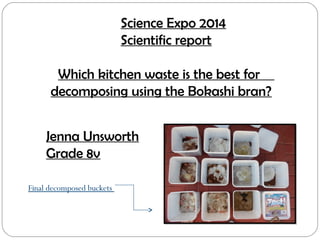
Final decomposed buckets
Question/Problem:
Which kitchen waste is the best for decomposing using the Bokashi bran?
I am investigating whether all types of kitchen waste will fully decompose and
form mould.
HyPotHesis:
My hypothesis is that the fruit and vegetable matter will decompose the
fastest. The carbohydrates group (bread, rice and cereals etc. will be second
best followed by the poultry and meat group and lastly the dairy group.
Hypothesis diagram:
A. Fruit
And
Vegetables
B. Bread
And
Rice
C. Meat
And
Bacon
D. Cheese
And
Yoghurt
introduction:
In this project I am trying to see which kitchen waste decomposes the fastest
and/or the most.
I wanted to do this project as I did not know much about how food waste
decomposes. Kitchen waste is very big problem that appears everyday!
People do not know what to do with their kitchen waste and it just ends up
rotting in their dustbins! It then goes from their dustbin to landfills and causes
more problems.
One of my mom’s friends, Gareth Sparg, sells the Bokashi bran product.
Aim:
My aim is to see if you can decompose all types of kitchen waste
and which one can decomposes the fastest.
Bokashi Bran Product
Compost Information
(This information was collected from Wikipedia) .
Composting above ground
As mentioned Bokashi Boost is optimal if buried under the soil in your garden. However your Bokashi
mix also works really well in an above ground or traditional system. Simply place your fermented
Bokashi Boost food mix directly into your compost bin - this will speed up your composting process by
about 50%.
Why not just bury it?
•You may have run out of room in your garden to bury your Bokashi Boost.
•You may be short on time or motivation and just want to toss your Bokashi Boost mix onto a compost
heap.
Carbon
This provides heat and comes from matter that is often dry and brown such as dead leaves, straw,
bush trimmings etc. The trick is not to use too much of this stuff or it will take years to break down.
Oxygen
Remember that Bokashi Boost is an anaerobic process which is why we use a sealed bucket.
However if you are creating an above ground system you will need to turn your compost heap regularly
to get some oxygen into the mix.
AppArAtus:
Equipment:
•8 Bokashi buckets/ ice-cream buckets work too.
•3x700g Bokashi mix.
•3x even amounts of mixed fruit and vegetables.
•3x even amounts of carbohydrates (brown and white bread cereal).
•3x even amounts of protein (beef and bacon)
•3x dairy (cheese and yoghurt).
•200ml before you add waste and 200mlk after you add waste.
There are no numeral measurements.
Leftover fruit and vegetable
WhAt hAs to be Added to the WAste?
Only the Bokashi mix was added to help the waste decompose.
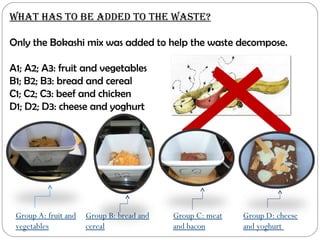
A1; A2; A3: fruit and vegetables
B1; B2; B3: bread and cereal
C1; C2; C3: beef and chicken
D1; D2; D3: cheese and yoghurt
/
Group A: fruit and
vegetables
Group B: bread and
cereal
Group C: meat
and bacon
Group D: cheese
and yoghurt
Method:
To prepare:
•Get 12 ice cream tubs.
•Clean and rinse the buckets.
•Label them accordingly
(A1;A2;A3_B1;B2;B3_C1;C2;C3_D1;D2;D3).
•Add 200ml of Bokashi Bran to each of the 12 buckets.
•Separate each group of kitchen waste.
•Add the waste.
•Add 200ml of Bokashi Bran on the top of the waste.
•Put the lids on and make sure that they are correctly
closed.
•Take notes every Sunday on: temperature; date; day;
time; the number of weeks it has been fermenting and the
changes to the waste. Repeat for 4 weeks.
Before added
into buckets
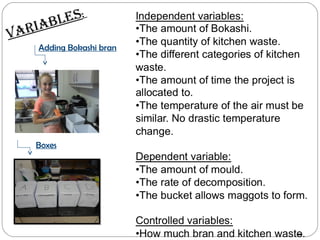
VAriAbles:
Adding Bokashi bran
Boxes
Science Expo: start
Sunday 23-03-14
26 Degrees Celsius
3:35pm
Fruit and
vegetable
Bread
and
cereal
Beef and
bacon
Cheese
and
yoghurt
A1 B1 C1 D1
A2 B2 C2 D2
A3 B3 C3 D3
Group C
Group B
Buckets Results
A: fruit and
vegetable
A small amount of decomposing (1/4).
White mould has appeared. Very slight
smell has come.
B: bread and
cereal
A very small amount of decomposing.
No smell.
C: meat and
bacon
Small amount of decomposing. White
mould (1/4). No smell.
D: cheese and
yoghurt
No decomposing. Pungent smells.
Science Expo: 1
Sunday 02-03-14
26 Degrees Celsius
5:45
Buckets Results
A: fruit and vegetable Very much white decomposing mould.
Slight smell.
B:bread and cereal Varies in size of mould from almost not
to almost everything covered. No smell.
C: meat and bacon Yellow and white fluffy mould. No smell.
Some condensation.
D:cheese and yoghurt Very small amounts of strange coloured
mould. Maggots! Pungent smell.
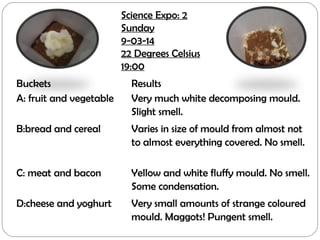
Science Expo: 2
Sunday
9-03-14
22 Degrees Celsius
19:00
Buckets Results
A: fruit and vegetable Fully covered with white mould. Very
slight smell.
B: bread and cereal Very much decomposing. No smell.
C: meat and bacon White and brown mould. Everything is
covered. Slight smell.
D: cheese and yoghurt Half decomposed. Very weird colours
(green, blue, red). Pungent smell.
Maggots!
Science Expo: 3
Sunday
16-03-14
26 Degrees Celsius
11:40 am
Buckets Results
A: fruit and vegetable Everything is decomposed. No smell.
B: bread and cereal Almost everything is decomposed. B1 is the
best buckets in the whole experiment. No
smell.
C: meat and bacon Light brown and white mould. Some
smell.
D: cheese and yoghurt Different colours of decomposing matter.
Maggots. Bad smell.
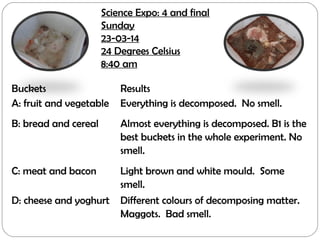
Science Expo: 4 and final
Sunday
23-03-14
24 Degrees Celsius
8:40 am
Bucket (in order) Comments
B: bread and
cereal
The bread and cereal group decomposed the
most and the best as well as forming the most
condensation.
A: fruit and
vegetable
The fruit and vegetable was very close but not all
of the 3 buckets decomposed fully.
C: meat and
bacon
Even though the mould was a very strange
colour, there was a large amount of mould.
D: cheese and
yoghurt
There was quite a bit of decomposing which I
thought was quite surprising, but 2 of the 3
buckets had maggots so that means it did not
work.
.
BiBliography:
The information that I got of
the internet was from:
•Wikipedia
•www.palmtrees.com
•What is Bokashi?
I also received a large
amount of general
information from my mom’s
friend, Gareth Sparg.
acknowledgments:
I would like to thank:
•My mom and dad for
helping me collect kitchen
waste.
•My mom’s friend, Clare
Gaze, for kindly asking the
Waffle House, Ramsgate to
supply me with ice cream
tubs.
•My mom for helping me
take and upload photos
and for buying me all my
stationary and Bokashi
bran buckets.
084 581 2682.
The final Bokashi bran
buckets

Bokashi science project

  • 1.
    Science Expo 2014 Scientificreport Which kitchen waste is the best for decomposing using the Bokashi bran? Jenna Unsworth Grade 8v Final decomposed buckets
  • 2.
    Question/Problem: Which kitchen wasteis the best for decomposing using the Bokashi bran? I am investigating whether all types of kitchen waste will fully decompose and form mould. HyPotHesis: My hypothesis is that the fruit and vegetable matter will decompose the fastest. The carbohydrates group (bread, rice and cereals etc. will be second best followed by the poultry and meat group and lastly the dairy group. Hypothesis diagram: A. Fruit And Vegetables B. Bread And Rice C. Meat And Bacon D. Cheese And Yoghurt
  • 3.
    introduction: In this projectI am trying to see which kitchen waste decomposes the fastest and/or the most. I wanted to do this project as I did not know much about how food waste decomposes. Kitchen waste is very big problem that appears everyday! People do not know what to do with their kitchen waste and it just ends up rotting in their dustbins! It then goes from their dustbin to landfills and causes more problems. One of my mom’s friends, Gareth Sparg, sells the Bokashi bran product. Aim: My aim is to see if you can decompose all types of kitchen waste and which one can decomposes the fastest. Bokashi Bran Product
  • 4.
    Compost Information (This informationwas collected from Wikipedia) . Composting above ground As mentioned Bokashi Boost is optimal if buried under the soil in your garden. However your Bokashi mix also works really well in an above ground or traditional system. Simply place your fermented Bokashi Boost food mix directly into your compost bin - this will speed up your composting process by about 50%. Why not just bury it? •You may have run out of room in your garden to bury your Bokashi Boost. •You may be short on time or motivation and just want to toss your Bokashi Boost mix onto a compost heap. Carbon This provides heat and comes from matter that is often dry and brown such as dead leaves, straw, bush trimmings etc. The trick is not to use too much of this stuff or it will take years to break down. Oxygen Remember that Bokashi Boost is an anaerobic process which is why we use a sealed bucket. However if you are creating an above ground system you will need to turn your compost heap regularly to get some oxygen into the mix.
  • 5.
    AppArAtus: Equipment: •8 Bokashi buckets/ice-cream buckets work too. •3x700g Bokashi mix. •3x even amounts of mixed fruit and vegetables. •3x even amounts of carbohydrates (brown and white bread cereal). •3x even amounts of protein (beef and bacon) •3x dairy (cheese and yoghurt). •200ml before you add waste and 200mlk after you add waste. There are no numeral measurements. Leftover fruit and vegetable
  • 6.
    WhAt hAs tobe Added to the WAste? Only the Bokashi mix was added to help the waste decompose. A1; A2; A3: fruit and vegetables B1; B2; B3: bread and cereal C1; C2; C3: beef and chicken D1; D2; D3: cheese and yoghurt / Group A: fruit and vegetables Group B: bread and cereal Group C: meat and bacon Group D: cheese and yoghurt
  • 7.
    Method: To prepare: •Get 12ice cream tubs. •Clean and rinse the buckets. •Label them accordingly (A1;A2;A3_B1;B2;B3_C1;C2;C3_D1;D2;D3). •Add 200ml of Bokashi Bran to each of the 12 buckets. •Separate each group of kitchen waste. •Add the waste. •Add 200ml of Bokashi Bran on the top of the waste. •Put the lids on and make sure that they are correctly closed. •Take notes every Sunday on: temperature; date; day; time; the number of weeks it has been fermenting and the changes to the waste. Repeat for 4 weeks. Before added into buckets
  • 8.
  • 9.
    Science Expo: start Sunday23-03-14 26 Degrees Celsius 3:35pm Fruit and vegetable Bread and cereal Beef and bacon Cheese and yoghurt A1 B1 C1 D1 A2 B2 C2 D2 A3 B3 C3 D3 Group C Group B
  • 10.
    Buckets Results A: fruitand vegetable A small amount of decomposing (1/4). White mould has appeared. Very slight smell has come. B: bread and cereal A very small amount of decomposing. No smell. C: meat and bacon Small amount of decomposing. White mould (1/4). No smell. D: cheese and yoghurt No decomposing. Pungent smells. Science Expo: 1 Sunday 02-03-14 26 Degrees Celsius 5:45
  • 11.
    Buckets Results A: fruitand vegetable Very much white decomposing mould. Slight smell. B:bread and cereal Varies in size of mould from almost not to almost everything covered. No smell. C: meat and bacon Yellow and white fluffy mould. No smell. Some condensation. D:cheese and yoghurt Very small amounts of strange coloured mould. Maggots! Pungent smell. Science Expo: 2 Sunday 9-03-14 22 Degrees Celsius 19:00
  • 12.
    Buckets Results A: fruitand vegetable Fully covered with white mould. Very slight smell. B: bread and cereal Very much decomposing. No smell. C: meat and bacon White and brown mould. Everything is covered. Slight smell. D: cheese and yoghurt Half decomposed. Very weird colours (green, blue, red). Pungent smell. Maggots! Science Expo: 3 Sunday 16-03-14 26 Degrees Celsius 11:40 am
  • 13.
    Buckets Results A: fruitand vegetable Everything is decomposed. No smell. B: bread and cereal Almost everything is decomposed. B1 is the best buckets in the whole experiment. No smell. C: meat and bacon Light brown and white mould. Some smell. D: cheese and yoghurt Different colours of decomposing matter. Maggots. Bad smell. Science Expo: 4 and final Sunday 23-03-14 24 Degrees Celsius 8:40 am
  • 14.
    Bucket (in order)Comments B: bread and cereal The bread and cereal group decomposed the most and the best as well as forming the most condensation. A: fruit and vegetable The fruit and vegetable was very close but not all of the 3 buckets decomposed fully. C: meat and bacon Even though the mould was a very strange colour, there was a large amount of mould. D: cheese and yoghurt There was quite a bit of decomposing which I thought was quite surprising, but 2 of the 3 buckets had maggots so that means it did not work. .
  • 15.
    BiBliography: The information thatI got of the internet was from: •Wikipedia •www.palmtrees.com •What is Bokashi? I also received a large amount of general information from my mom’s friend, Gareth Sparg. acknowledgments: I would like to thank: •My mom and dad for helping me collect kitchen waste. •My mom’s friend, Clare Gaze, for kindly asking the Waffle House, Ramsgate to supply me with ice cream tubs. •My mom for helping me take and upload photos and for buying me all my stationary and Bokashi bran buckets. 084 581 2682.
  • 16.
    The final Bokashibran buckets