Interlocking Directorates and
Anti-Competitive Risks
AnEnforcementGapinEurope?
Florence Thépot (Glasgow, D&C)
Florian Hugon (D&C)
Mathieu Luinaud (D&C)
CRESSE CONFERENCE
Rhodes - 2 July 2016
2
Introduction
• US: Section 8 Clayton Act prohibits interlocking directorates
between competitors
• The practice of interlocking directorates is the root of many
evils. It offends laws human and divine. Applied to rival
corporations, it tends to the suppression of competition and to
violation of the Sherman law. Applied to corporations which
deal with each other, it tends to disloyalty and to violation of
the fundamental law that no man can serve two
masters(Brandeis, 1914)
• “the Small World of Corporate Governance”/ “cooperative
capitalism’
3
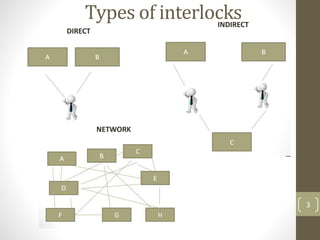
DIRECT
INDIRECT
NETWORK
Types of interlocks
Key facts & trends
• Continental Europe v. Anglo-American countries
• Type of capitalism, Liberal or coordinated market economies, Role of
the banks etc.
• Since 1990s
• Decline but persistance national corporate networks?
• Banks, state, deregulation, internationalisation?
• Functions of corporate networks
• Representation of investors, expertise, social elite…collusion
• Impact of interlocks on the value of the firm
• Negative/Ambivalent (Prinz, 2006)
 little information on intra-sectoral networks
4
5
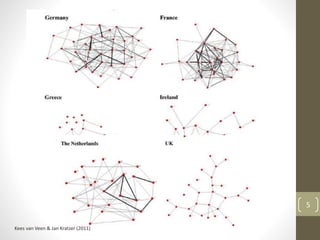
Kees van Veen & Jan Kratzer (2011)
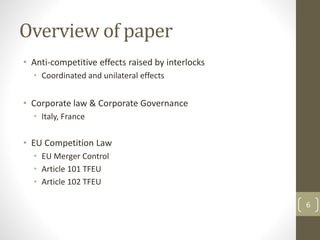
Overview of paper
• Anti-competitive effects raised by interlocks
• Coordinated and unilateral effects
• Corporate law & Corporate Governance
• Italy, France
• EU Competition Law
• EU Merger Control
• Article 101 TFEU
• Article 102 TFEU
6
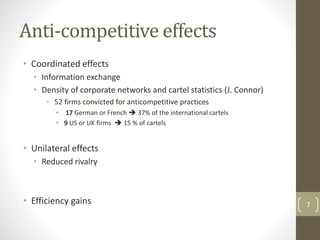
Anti-competitive effects
• Coordinated effects
• Information exchange
• Density of corporate networks and cartel statistics (J. Connor)
• 52 firms convicted for anticompetitive practices
• 17 German or French  37% of the international cartels
• 9 US or UK firms  15 % of cartels
• Unilateral effects
• Reduced rivalry
• Efficiency gains 7
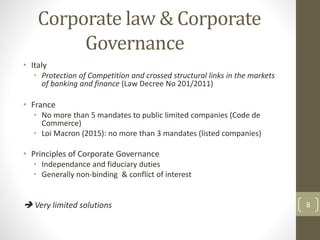
Corporate law & Corporate
Governance
• Italy
• Protection of Competition and crossed structural links in the markets
of banking and finance (Law Decree No 201/2011)
• France
• No more than 5 mandates to public limited companies (Code de
Commerce)
• Loi Macron (2015): no more than 3 mandates (listed companies)
• Principles of Corporate Governance
• Independance and fiduciary duties
• Generally non-binding & conflict of interest
 Very limited solutions 8
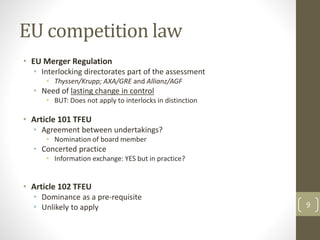
EU competition law
• EU Merger Regulation
• Interlocking directorates part of the assessment
• Thyssen/Krupp; AXA/GRE and Allianz/AGF
• Need of lasting change in control
• BUT: Does not apply to interlocks in distinction
• Article 101 TFEU
• Agreement between undertakings?
• Nomination of board member
• Concerted practice
• Information exchange: YES but in practice?
• Article 102 TFEU
• Dominance as a pre-requisite
• Unlikely to apply 9
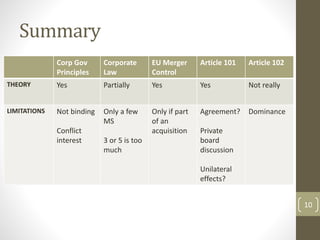
Summary
Corp Gov
Principles
Corporate
Law
EU Merger
Control
Article 101 Article 102
THEORY Yes Partially Yes Yes Not really
LIMITATIONS Not binding
Conflict
interest
Only a few
MS
3 or 5 is too
much
Only if part
of an
acquisition
Agreement?
Private
board
discussion
Unilateral
effects?
Dominance
10
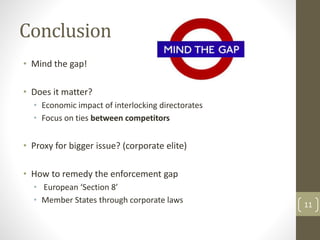
Conclusion
• Mind the gap!
• Does it matter?
• Economic impact of interlocking directorates
• Focus on ties between competitors
• Proxy for bigger issue? (corporate elite)
• How to remedy the enforcement gap
• European ‘Section 8’
• Member States through corporate laws
11

Interlocking Directorates and Anti-Competitive Risks ? An Enforcement Gap in Europe ?

  • 1.
    Interlocking Directorates and Anti-CompetitiveRisks AnEnforcementGapinEurope? Florence Thépot (Glasgow, D&C) Florian Hugon (D&C) Mathieu Luinaud (D&C) CRESSE CONFERENCE Rhodes - 2 July 2016
  • 2.
    2 Introduction • US: Section8 Clayton Act prohibits interlocking directorates between competitors • The practice of interlocking directorates is the root of many evils. It offends laws human and divine. Applied to rival corporations, it tends to the suppression of competition and to violation of the Sherman law. Applied to corporations which deal with each other, it tends to disloyalty and to violation of the fundamental law that no man can serve two masters(Brandeis, 1914) • “the Small World of Corporate Governance”/ “cooperative capitalism’
  • 3.
  • 4.
    Key facts &trends • Continental Europe v. Anglo-American countries • Type of capitalism, Liberal or coordinated market economies, Role of the banks etc. • Since 1990s • Decline but persistance national corporate networks? • Banks, state, deregulation, internationalisation? • Functions of corporate networks • Representation of investors, expertise, social elite…collusion • Impact of interlocks on the value of the firm • Negative/Ambivalent (Prinz, 2006)  little information on intra-sectoral networks 4
  • 5.
    5 Kees van Veen& Jan Kratzer (2011)
  • 6.
    Overview of paper •Anti-competitive effects raised by interlocks • Coordinated and unilateral effects • Corporate law & Corporate Governance • Italy, France • EU Competition Law • EU Merger Control • Article 101 TFEU • Article 102 TFEU 6
  • 7.
    Anti-competitive effects • Coordinatedeffects • Information exchange • Density of corporate networks and cartel statistics (J. Connor) • 52 firms convicted for anticompetitive practices • 17 German or French  37% of the international cartels • 9 US or UK firms  15 % of cartels • Unilateral effects • Reduced rivalry • Efficiency gains 7
  • 8.
    Corporate law &Corporate Governance • Italy • Protection of Competition and crossed structural links in the markets of banking and finance (Law Decree No 201/2011) • France • No more than 5 mandates to public limited companies (Code de Commerce) • Loi Macron (2015): no more than 3 mandates (listed companies) • Principles of Corporate Governance • Independance and fiduciary duties • Generally non-binding & conflict of interest  Very limited solutions 8
  • 9.
    EU competition law •EU Merger Regulation • Interlocking directorates part of the assessment • Thyssen/Krupp; AXA/GRE and Allianz/AGF • Need of lasting change in control • BUT: Does not apply to interlocks in distinction • Article 101 TFEU • Agreement between undertakings? • Nomination of board member • Concerted practice • Information exchange: YES but in practice? • Article 102 TFEU • Dominance as a pre-requisite • Unlikely to apply 9
  • 10.
    Summary Corp Gov Principles Corporate Law EU Merger Control Article101 Article 102 THEORY Yes Partially Yes Yes Not really LIMITATIONS Not binding Conflict interest Only a few MS 3 or 5 is too much Only if part of an acquisition Agreement? Private board discussion Unilateral effects? Dominance 10
  • 11.
    Conclusion • Mind thegap! • Does it matter? • Economic impact of interlocking directorates • Focus on ties between competitors • Proxy for bigger issue? (corporate elite) • How to remedy the enforcement gap • European ‘Section 8’ • Member States through corporate laws 11