INTER PARTES REVIEW
(IPR)
By
Manoj Prajapati
☺ Inter Partes Review (IPR) ?
☺ Litigation Vs IPR
☺ Statutory Bar
☺ Timeline of IPR
☺ Game changing Impact of an IPR
☺ Filing Consideration
☺ How & who can file an IPR ?
☺ Requirements for filing
Content
 An Inter Partes Review (IPR) is, Mini trial on Patent Validity before a panel of Patent Experts,
Patent trial and Appeal Board, for challenging the validity of a United States patent on a ground
that could be raised under 35 U.S.C. §§ 102 or 103, and on the basis of prior art consisting of
patents or printed publications before the United States Patent and Trademark Office (USPTO)
 It is, Litigation “Lite”, focused, faster, less expensive typical patent litigation
 In year 2011, America Invents Act created IPR to replace IPX (Inter Partes Examination)
 Became effective with first IPR filing on 16 September 2012
Inter Partes Review (IPR) ?
Litigation Vs IPR
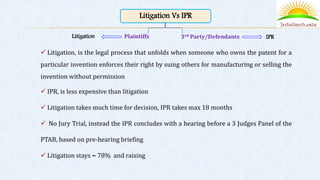
 Litigation, is the legal process that unfolds when someone who owns the patent for a
particular invention enforces their right by suing others for manufacturing or selling the
invention without permission
 IPR, is less expensive than litigation
 Litigation takes much time for decision, IPR takes max 18 months
 No Jury Trial, instead the IPR concludes with a hearing before a 3 Judges Panel of the
PTAB, based on pre-hearing briefing
 Litigation stays ~ 78% and raising
Plaintiffs 3rd Party/Defendants IPRLitigation
Statutory Bar
 Petitioner’s have One year to file a request for IPR, following service of a
complaint under 35 U.S.C. § 315 (b)
 “An IPR may not be instituted if the petition requesting the proceedings
is, filed more than 1 year after the date on which the plaintiffs complaint for
alleging Infringement of the patent
 The time can be extended by up to six months for good cause by the Chief
Administrative Patent Judge, or adjusted by the Board in the case of joinder.
 Petitions must be filed within a year of infringement claims. You will need
to wait nine months for first-to-file patents.
 If patent is describe under section 3(n) (1) of the Leahy-Smith America
Invents Act, the date that is nine months after the date of the grant of the
patent;(https://www.ecfr.gov/cgibin/retrieveECFR?gp=&SID=abf9f1fbe7e2e2f6e1a2427361375cc6&r=PART&n=37y1.0.1.3.12#37:1.0.1.3.12.2)
Timeline of IPR
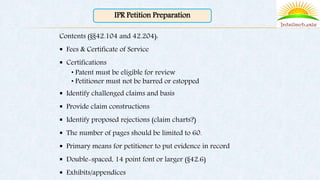
IPR Petition Preparation
Contents (§§42.104 and 42.204):
 Fees & Certificate of Service
 Certifications
• Patent must be eligible for review
• Petitioner must not be barred or estopped
 Identify challenged claims and basis
 Provide claim constructions
 Identify proposed rejections (claim charts?)
 The number of pages should be limited to 60.
 Primary means for petitioner to put evidence in record
 Double-spaced, 14 point font or larger (§42.6)
 Exhibits/appendices
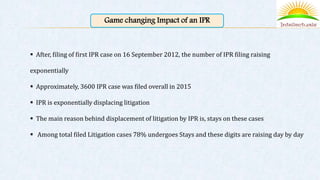
Game changing Impact of an IPR
 After, filing of first IPR case on 16 September 2012, the number of IPR filing raising
exponentially
 Approximately, 3600 IPR case was filed overall in 2015
 IPR is exponentially displacing litigation
 The main reason behind displacement of litigation by IPR is, stays on these cases
 Among total filed Litigation cases 78% undergoes Stays and these digits are raising day by day
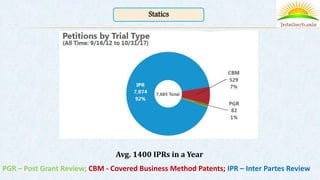
Statics
PGR – Post Grant Review; CBM - Covered Business Method Patents; IPR – Inter Partes Review
Avg. 1400 IPRs in a Year
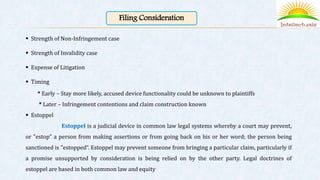
Filing Consideration
 Strength of Non-Infringement case
 Strength of Invalidity case
 Expense of Litigation
 Timing
* Early – Stay more likely, accused device functionality could be unknown to plaintiffs
* Later – Infringement contentions and claim construction known
 Estoppel
Estoppel is a judicial device in common law legal systems whereby a court may prevent,
or "estop" a person from making assertions or from going back on his or her word; the person being
sanctioned is "estopped“. Estoppel may prevent someone from bringing a particular claim, particularly if
a promise unsupported by consideration is being relied on by the other party. Legal doctrines of
estoppel are based in both common law and equity
who can file an IPR ?
 Anyone other than the Patent Owner can file an IPR
 Competitors
- No need to show any dispute between parties
- Response to a cease-and-desist letter
- Clear the way for new product
 Accused Infringers / Litigation Defendants
- A defendants must file an IPR Petition within 1 year of the complaint being served
- The earlier the IPR is filed, the man likely a district court will postpone the litigation pending the IPR
 Investors / Short sellers
How, an IPR can be filed ?
 Application should be filed within 1 year of Suit
 Pages in application should not be more than 60
 Petitioner should file an application with Strong and broad Claim Construction
 Particulars of Invalidity should be included
Requirements for filing
The Petition must fulfilling the following conditions :
 The petition must be accompanied by payment of fee
 Petitioners must identify all the real parties in interest
 Petition must identify each claim challenged, including the ground and evidences
 Copies of Patents and printed application that petitioner relies on
 Affidavits or declarations of supporting evidence and opinions
 Such Other information, as the Director may require by regulation
 Copies of the any of the document must be provided to the Patent Owner or the Designated representatives
Ex Partes Reexamination (proceedings completes in maximum 24 months)
 Tool that allows a patent owner or a third party to lodge a request for the United States Patent Office (USPTO) to
reexamine an already-granted patent based on other patents and publications that they bring to the USPTO's attention.
 Ex parte reexamination has been available since 1981 and continues to be available under the America Invents
Act (AIA).
 An ex parte reexamination can be requested at any time during the enforceability of the patent.
 The requester needs to establish that the prior art creates a substantial and new question of patentability.
 The reexamination is conducted in front of a panel of three experienced examiners within a specialized unit of the
USPTO called the central reexamination unit (CRU).
 Ex parte reexamination proceedings involve only the patent owner and the USPTO. After the request is filed, the
third-party requester is removed from further involvement unless the patent owner files a statement seeking to rebut
their assertions.
 Requests for continued examination (RCEs) are not available in ex parte reexamination proceedings. No legal
estoppel is created by an ex parte reexamination proceeding.
IPX – Inter Partes Reexamination
Administrative proceedings in the USPTO office to challenge invalidity of patents which is already issued.
Max 18 months to complete.
Post Grant Review (PGR)
Post grant review is a trial proceeding conducted at the Board to review the patentability of one or more
claims in a patent on any ground that could be raised under § 282(b)(2) or (3).
Filed by third party
The procedure for conducting post grant review took effect on September 16, 2012, and generally applies to
patents issuing from applications subject to first-inventor-to-file provisions of the AIA.
Inter Partes Review (IPR) - A Brief Understandings

Inter Partes Review (IPR) - A Brief Understandings

  • 1.
  • 2.
    ☺ Inter PartesReview (IPR) ? ☺ Litigation Vs IPR ☺ Statutory Bar ☺ Timeline of IPR ☺ Game changing Impact of an IPR ☺ Filing Consideration ☺ How & who can file an IPR ? ☺ Requirements for filing Content
  • 3.
     An InterPartes Review (IPR) is, Mini trial on Patent Validity before a panel of Patent Experts, Patent trial and Appeal Board, for challenging the validity of a United States patent on a ground that could be raised under 35 U.S.C. §§ 102 or 103, and on the basis of prior art consisting of patents or printed publications before the United States Patent and Trademark Office (USPTO)  It is, Litigation “Lite”, focused, faster, less expensive typical patent litigation  In year 2011, America Invents Act created IPR to replace IPX (Inter Partes Examination)  Became effective with first IPR filing on 16 September 2012 Inter Partes Review (IPR) ?
  • 4.
    Litigation Vs IPR Litigation, is the legal process that unfolds when someone who owns the patent for a particular invention enforces their right by suing others for manufacturing or selling the invention without permission  IPR, is less expensive than litigation  Litigation takes much time for decision, IPR takes max 18 months  No Jury Trial, instead the IPR concludes with a hearing before a 3 Judges Panel of the PTAB, based on pre-hearing briefing  Litigation stays ~ 78% and raising Plaintiffs 3rd Party/Defendants IPRLitigation
  • 5.
    Statutory Bar  Petitioner’shave One year to file a request for IPR, following service of a complaint under 35 U.S.C. § 315 (b)  “An IPR may not be instituted if the petition requesting the proceedings is, filed more than 1 year after the date on which the plaintiffs complaint for alleging Infringement of the patent  The time can be extended by up to six months for good cause by the Chief Administrative Patent Judge, or adjusted by the Board in the case of joinder.  Petitions must be filed within a year of infringement claims. You will need to wait nine months for first-to-file patents.  If patent is describe under section 3(n) (1) of the Leahy-Smith America Invents Act, the date that is nine months after the date of the grant of the patent;(https://www.ecfr.gov/cgibin/retrieveECFR?gp=&SID=abf9f1fbe7e2e2f6e1a2427361375cc6&r=PART&n=37y1.0.1.3.12#37:1.0.1.3.12.2)
  • 6.
  • 7.
    IPR Petition Preparation Contents(§§42.104 and 42.204):  Fees & Certificate of Service  Certifications • Patent must be eligible for review • Petitioner must not be barred or estopped  Identify challenged claims and basis  Provide claim constructions  Identify proposed rejections (claim charts?)  The number of pages should be limited to 60.  Primary means for petitioner to put evidence in record  Double-spaced, 14 point font or larger (§42.6)  Exhibits/appendices
  • 8.
    Game changing Impactof an IPR  After, filing of first IPR case on 16 September 2012, the number of IPR filing raising exponentially  Approximately, 3600 IPR case was filed overall in 2015  IPR is exponentially displacing litigation  The main reason behind displacement of litigation by IPR is, stays on these cases  Among total filed Litigation cases 78% undergoes Stays and these digits are raising day by day
  • 9.
    Statics PGR – PostGrant Review; CBM - Covered Business Method Patents; IPR – Inter Partes Review Avg. 1400 IPRs in a Year
  • 10.
    Filing Consideration  Strengthof Non-Infringement case  Strength of Invalidity case  Expense of Litigation  Timing * Early – Stay more likely, accused device functionality could be unknown to plaintiffs * Later – Infringement contentions and claim construction known  Estoppel Estoppel is a judicial device in common law legal systems whereby a court may prevent, or "estop" a person from making assertions or from going back on his or her word; the person being sanctioned is "estopped“. Estoppel may prevent someone from bringing a particular claim, particularly if a promise unsupported by consideration is being relied on by the other party. Legal doctrines of estoppel are based in both common law and equity
  • 11.
    who can filean IPR ?  Anyone other than the Patent Owner can file an IPR  Competitors - No need to show any dispute between parties - Response to a cease-and-desist letter - Clear the way for new product  Accused Infringers / Litigation Defendants - A defendants must file an IPR Petition within 1 year of the complaint being served - The earlier the IPR is filed, the man likely a district court will postpone the litigation pending the IPR  Investors / Short sellers
  • 12.
    How, an IPRcan be filed ?  Application should be filed within 1 year of Suit  Pages in application should not be more than 60  Petitioner should file an application with Strong and broad Claim Construction  Particulars of Invalidity should be included
  • 13.
    Requirements for filing ThePetition must fulfilling the following conditions :  The petition must be accompanied by payment of fee  Petitioners must identify all the real parties in interest  Petition must identify each claim challenged, including the ground and evidences  Copies of Patents and printed application that petitioner relies on  Affidavits or declarations of supporting evidence and opinions  Such Other information, as the Director may require by regulation  Copies of the any of the document must be provided to the Patent Owner or the Designated representatives
  • 14.
    Ex Partes Reexamination(proceedings completes in maximum 24 months)  Tool that allows a patent owner or a third party to lodge a request for the United States Patent Office (USPTO) to reexamine an already-granted patent based on other patents and publications that they bring to the USPTO's attention.  Ex parte reexamination has been available since 1981 and continues to be available under the America Invents Act (AIA).  An ex parte reexamination can be requested at any time during the enforceability of the patent.  The requester needs to establish that the prior art creates a substantial and new question of patentability.  The reexamination is conducted in front of a panel of three experienced examiners within a specialized unit of the USPTO called the central reexamination unit (CRU).  Ex parte reexamination proceedings involve only the patent owner and the USPTO. After the request is filed, the third-party requester is removed from further involvement unless the patent owner files a statement seeking to rebut their assertions.  Requests for continued examination (RCEs) are not available in ex parte reexamination proceedings. No legal estoppel is created by an ex parte reexamination proceeding.
  • 15.
    IPX – InterPartes Reexamination Administrative proceedings in the USPTO office to challenge invalidity of patents which is already issued. Max 18 months to complete. Post Grant Review (PGR) Post grant review is a trial proceeding conducted at the Board to review the patentability of one or more claims in a patent on any ground that could be raised under § 282(b)(2) or (3). Filed by third party The procedure for conducting post grant review took effect on September 16, 2012, and generally applies to patents issuing from applications subject to first-inventor-to-file provisions of the AIA.