Best U.S. IP Practice
April 2019
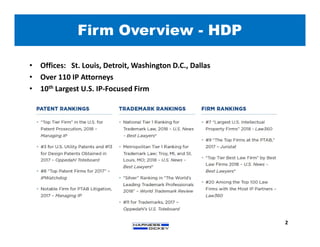
Firm Overview - HDP
• Offices: St. Louis, Detroit, Washington D.C., Dallas
• Over 110 IP Attorneys
• 10th Largest U.S. IP-Focused Firm
2
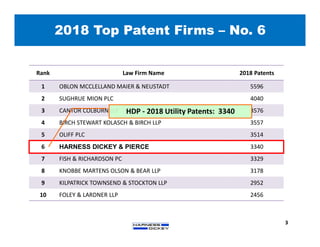
Rank Law Firm Name 2018 Patents
1 OBLON MCCLELLAND MAIER & NEUSTADT 5596
2 SUGHRUE MION PLC 4040
3 CANTOR COLBURN LLP 3576
4 BIRCH STEWART KOLASCH & BIRCH LLP 3557
5 OLIFF PLC 3514
6 HARNESS DICKEY & PIERCE 3340
7 FISH & RICHARDSON PC 3329
8 KNOBBE MARTENS OLSON & BEAR LLP 3178
9 KILPATRICK TOWNSEND & STOCKTON LLP 2952
10 FOLEY & LARDNER LLP 2456
HDP - 2018 Utility Patents: 3340
2018 Top Patent Firms – No. 6
3
Part 1
Freedom To Operate (FTO)
4
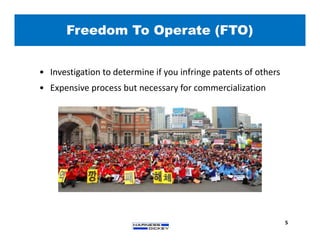
• Investigation to determine if you infringe patents of others
• Expensive process but necessary for commercialization
Freedom To Operate (FTO)
5
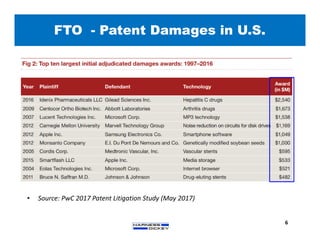
• Source: PwC 2017 Patent Litigation Study (May 2017)
FTO - Patent Damages in U.S.
6
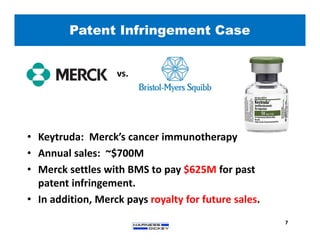
• Keytruda: Merck’s cancer immunotherapy
• Annual sales: ~$700M
• Merck settles with BMS to pay $625M for past
patent infringement.
• In addition, Merck pays royalty for future sales.
Patent Infringement Case
7
vs.
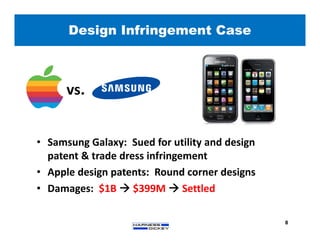
• Samsung Galaxy: Sued for utility and design
patent & trade dress infringement
• Apple design patents: Round corner designs
• Damages: $1B  $399M  Settled
Design Infringement Case
8
vs.
• Oculus (Facebook): Sued for breach of non-
disclosure agreement (NDA) and copyright
infringement
• Damages: $500M (District Court, TX) for TM and
copyright infringement  Settled
TM/Copyright/Trade Secret Case
9
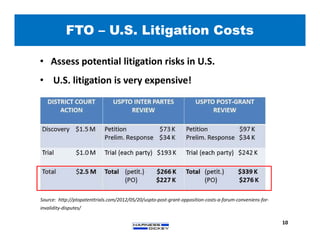
Source: http://ptopatenttrials.com/2012/05/20/uspto-post-grant-opposition-costs-a-forum-conveniens-for-
invalidity-disputes/
FTO – U.S. Litigation Costs
10
• Assess potential litigation risks in U.S.
• U.S. litigation is very expensive!
• Litigation costs
• Infringement – lost profit, reasonable royalty
• Enhanced damage (X3) – willful infringement
• Awards of Attorney Fees – exceptional case
– Octane Fitness Supreme Court case
Total Expense
11
Willful Infringement & Opinion Of Counsel
12
• Willful Infringement
– Enhanced damage (X3)
– Halo Supreme Court decision: lower threshold for willful infringement
 Award of enhanced damages was within the discretion of the trial court
 "Totality of the Circumstances" Framework
• FTO Assessment & Opinion of Counsel
– What is opinion of counsel?
– Opinion of counsel valuable even if not required
• Minimize written record including emails
Attorney-Client Privilege
13
• Attorney-Client Privilege
– Promote frank and full discussions with counsel
• A-C Privilege Waiver
– A privileged communication shared with third parties
– Email c.c. issues
• “PRIVILEGED AND CONFIDENTIAL” works all the time?
Admission Against Interest (AAI)
14
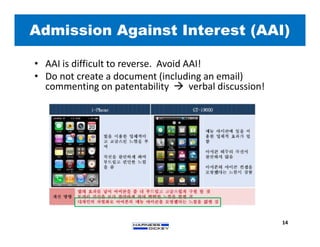
• AAI is difficult to reverse. Avoid AAI!
• Do not create a document (including an email)
commenting on patentability  verbal discussion!
Design Around v. Invalidation
15
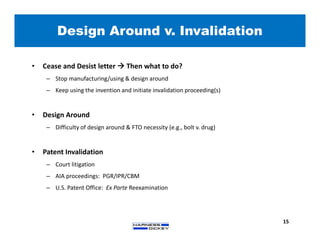
• Cease and Desist letter  Then what to do?
– Stop manufacturing/using & design around
– Keep using the invention and initiate invalidation proceeding(s)
• Design Around
– Difficulty of design around & FTO necessity (e.g., bolt v. drug)
• Patent Invalidation
– Court litigation
– AIA proceedings: PGR/IPR/CBM
– U.S. Patent Office: Ex Parte Reexamination
Patent Invalidation
16
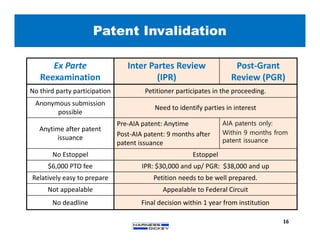
Ex Parte
Reexamination
Inter Partes Review
(IPR)
Post-Grant
Review (PGR)
No third party participation Petitioner participates in the proceeding.
Anonymous submission
possible
Need to identify parties in interest
Anytime after patent
issuance
Pre-AIA patent: Anytime
Post-AIA patent: 9 months after
patent issuance
AIA patents only:
Within 9 months from
patent issuance
No Estoppel Estoppel
$6,000 PTO fee IPR: $30,000 and up/ PGR: $38,000 and up
Relatively easy to prepare Petition needs to be well prepared.
Not appealable Appealable to Federal Circuit
No deadline Final decision within 1 year from institution
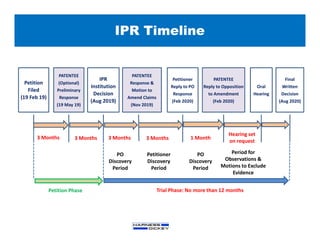
Petition
Filed
(19 Feb 19)
PATENTEE
(Optional)
Preliminary
Response
(19 May 19)
IPR
Institution
Decision
(Aug 2019)
PATENTEE
Response &
Motion to
Amend Claims
(Nov 2019)
Petitioner
Reply to PO
Response
(Feb 2020)
PATENTEE
Reply to Opposition
to Amendment
(Feb 2020)
Oral
Hearing
Final
Written
Decision
(Aug 2020)
PO
Discovery
Period
Petitioner
Discovery
Period
PO
Discovery
Period
Period for
Observations &
Motions to Exclude
Evidence
3 Months
Petition Phase
IPR Timeline
3 Months 3 Months 3 Months 1 Month
Hearing set
on request
Trial Phase: No more than 12 months
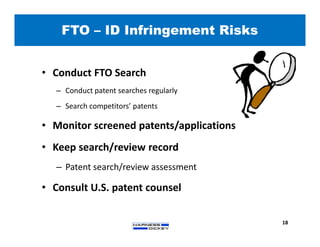
• Conduct FTO Search
– Conduct patent searches regularly
– Search competitors’ patents
• Monitor screened patents/applications
• Keep search/review record
– Patent search/review assessment
• Consult U.S. patent counsel
FTO – ID Infringement Risks
18
Part 2
Patent Preparation/Prosecution
19
Formal Papers
20
• Documents Requiring Signature(s) for US Application :
1) Declaration & Assignment
2) Power of Attorney (37 CFR 1.34. Acting in a representative capacity)
• Practice Tip: Submit the documents early!
 many issues are caused by late filing or no filing.
– Declaration: Unavailable/disgruntled inventors
 Substitute statement
– Assignment: Results in co-ownership (e.g., company and inventor)
– Co-ownership issues: Transfer of the patent, Standing to sue (case law)
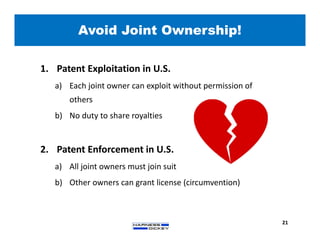
1. Patent Exploitation in U.S.
a) Each joint owner can exploit without permission of
others
b) No duty to share royalties
2. Patent Enforcement in U.S.
a) All joint owners must join suit
b) Other owners can grant license (circumvention)
Avoid Joint Ownership!
21
• Rule 56:
– A duty of candor and good faith in dealing with the Office
• Violation of Rule 56:
– Patent: Unenforceable
– Family patents: The doctrine of the fruit of the poisonous tree
• IDS Submission:
– Never hide “material info”
– When in doubt, just submit the info
Inequitable Conduct
22
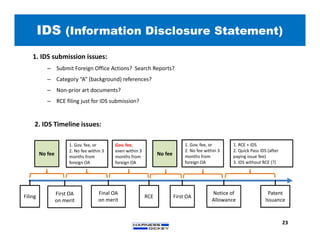
IDS (Information Disclosure Statement)
23
Filing
First OA
on merit
Final OA
on merit
RCE First OA
Notice of
Allowance
Patent
Issuance
No fee
1. Gov. fee, or
2. No fee within 3
months from
foreign OA
Gov. fee,
even within 3
months from
foreign OA
No fee
1. Gov. fee, or
2. No fee within 3
months from
foreign OA
1. RCE + IDS
2. Quick Pass IDS (after
paying issue fee)
3. IDS without RCE (?)
1. IDS submission issues:
– Submit Foreign Office Actions? Search Reports?
– Category “A” (background) references?
– Non-prior art documents?
– RCE filing just for IDS submission?
2. IDS Timeline issues:
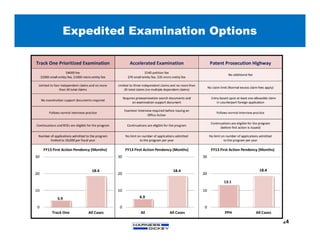
Expedited Examination Options
24
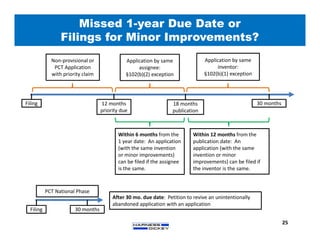
Missed 1-year Due Date or
Filings for Minor Improvements?
25
Filing 12 months
priority due
18 months
publication
30 months
Non-provisional or
PCT Application
with priority claim
Application by same
assignee:
§102(b)(2) exception
Application by same
inventor:
§102(b)(1) exception
Within 6 months from the
1 year date: An application
(with the same invention
or minor improvements)
can be filed if the assignee
is the same.
Within 12 months from the
publication date: An
application (with the same
invention or minor
improvements) can be filed if
the inventor is the same.
Filing 30 months
PCT National Phase
After 30 mo. due date: Petition to revive an unintentionally
abandoned application with an application
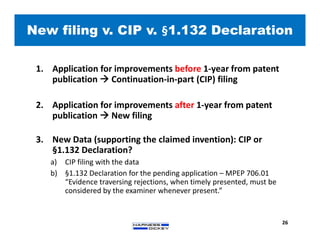
1. Application for improvements before 1-year from patent
publication  Continuation-in-part (CIP) filing
2. Application for improvements after 1-year from patent
publication  New filing
3. New Data (supporting the claimed invention): CIP or
§1.132 Declaration?
a) CIP filing with the data
b) §1.132 Declaration for the pending application – MPEP 706.01
“Evidence traversing rejections, when timely presented, must be
considered by the examiner whenever present.”
New filing v. CIP v. §1.132 Declaration
26
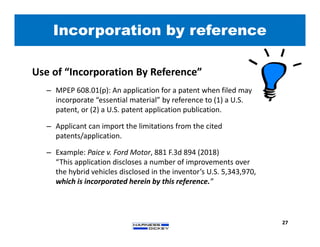
Incorporation by reference
27
Use of “Incorporation By Reference”
– MPEP 608.01(p): An application for a patent when filed may
incorporate “essential material” by reference to (1) a U.S.
patent, or (2) a U.S. patent application publication.
– Applicant can import the limitations from the cited
patents/application.
– Example: Paice v. Ford Motor, 881 F.3d 894 (2018)
“This application discloses a number of improvements over
the hybrid vehicles disclosed in the inventor’s U.S. 5,343,970,
which is incorporated herein by this reference.”
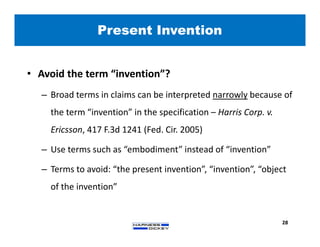
Present Invention
28
• Avoid the term “invention”?
– Broad terms in claims can be interpreted narrowly because of
the term “invention” in the specification – Harris Corp. v.
Ericsson, 417 F.3d 1241 (Fed. Cir. 2005)
– Use terms such as “embodiment” instead of “invention”
– Terms to avoid: “the present invention”, “invention”, “object
of the invention”
Indefiniteness – Reasonable certainty
• Selection of Terms:
– Think twice before using generic descriptions: For example,
“high (or hot) temperature”, “poorly soluble”, “derivative”,
“analog”, “hydrophobic”, “stabilizing agent”, etc.
• Use definitions:
– For example: "Poorly water soluble drug" means a drug that has
a water solubility of less than 1 part in 30 parts of water.
• Include specific examples:
– For example: Examples of the poorly water soluble drugs
include, but are not limited to, famotidine, sildenafil, buspirone
and troglitazone.
29
Means-plus-function
30
• 35 U.S.C. 112(f):
– Means-plus-function language: limited to “corresponding
structure” described in the spec.
– No corresponding structure in the spec  the claim is
invalid as being indefinite.
• Generic placeholders invoking 35 U.S.C. 112(f):
– Mechanism for, module for, device for, unit for, component
for, element for, member for, apparatus for, machine for,
system for
Claim Drafting Practice
31
• Telescoping claim set: broad claims coupled with narrow
claims
• Useful to enforce the patent
• Useful to defend the patent (e.g., IPR/PGR)
• MPF and Functional Language  Not good??
• Useful to have both clearly defined claims and MPF/functional claims
• Broadest reasonable interpretation in PTO examination: Useful to add
definitions to the specification
• Method claim drafting  Remember “single entity rule”!!
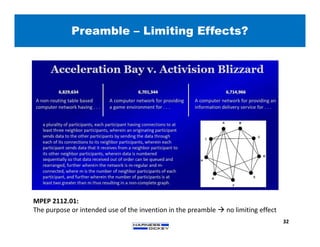
Preamble – Limiting Effects?
32
MPEP 2112.01:
The purpose or intended use of the invention in the preamble  no limiting effect
Claim Drafting – Example
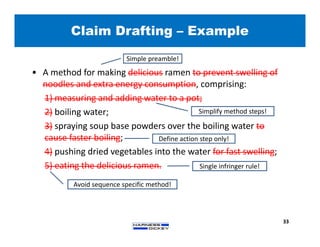
33
• A method for making delicious ramen to prevent swelling of
noodles and extra energy consumption, comprising:
1) measuring and adding water to a pot;
2) boiling water;
3) spraying soup base powders over the boiling water to
cause faster boiling;
4) pushing dried vegetables into the water for fast swelling;
5) eating the delicious ramen.
• A method for making delicious ramen to prevent swelling of
noodles and extra energy consumption, comprising:
1) measuring and adding water to a pot;
2) boiling water;
3) spraying soup base powders over the boiling water to
cause faster boiling;
4) pushing dried vegetables into the water for fast swelling;
5) eating the delicious ramen.
Simple preamble!
Simplify method steps!
Define action step only!
Single infringer rule!
Avoid sequence specific method!
Novelty – Anticipation
34
• Anticipation requirement: A claim is anticipated only if each
and every element as set forth in the claim is found
• Overlapping range: Not necessarily anticipatory
– Ineos USA LLC v. Berry Plastics Corp., 783 F.3d 865, 114 USPQ2d 1568
(Fed. Cir. 2015): When the prior art discloses its own range, rather
than a specific point, then the prior art is only anticipatory if it
describes the claimed range with sufficient specificity.
Prima Facie Obviousness
35
• PFO = Burden shifting ping-pong
• Part 1: PTO establishment of prima facie obviousness (PFO)
– The examiner bears the initial burden of factually supporting any
prima facie conclusion of obviousness.
– If the examiner does not produce a prima facie case, the applicant is
under no obligation to submit evidence of non-obviousness.
• Part 2: Applicant’s rebuttal on PFO
– Applicant may rebut the PFO presumption with evidence of
unexpected results and secondary considerations to support non-
obviousness.
Prima Facie Obviousness Case
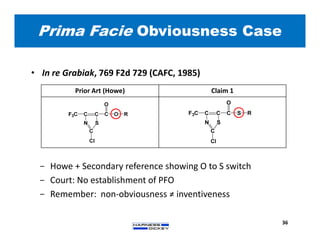
36
• In re Grabiak, 769 F2d 729 (CAFC, 1985)
Prior Art (Howe) Claim 1
- Howe + Secondary reference showing O to S switch
- Court: No establishment of PFO
- Remember: non-obviousness ≠ inventiveness
PFO v. Data
37
• Response to an obviousness rejection
– Argue non-establishment of PFO
– Unexpected outcomes, particularly data
• Do we want to argue unexpected outcomes?
• Do we want/need to submit data as §1.132 declaration?
• PFO v. Unexpected Outcomes (data)
– What if you have both arguments, PFO and data?
• Is it better to argue both?
• Is it a case of commercial importance? Budget v. Output
Common Sense/Ordinary creativity
38
• Obviousness rejection based on “common sense/ordinary
creativity”  may not be a good enough reason to reject a
claim as being obvious.
– Arendi SARL v. Apple:
• Common sense “cannot be used as a wholesale substitute for
reasoned analysis and evidentiary support”
– DSS Technology Management v. Apple:
• “Ordinary creativity” was not a good enough reason to find the
patent obvious
Inherency in Obviousness
39
• Inherency in novelty v. Inherency in obviousness
– MPEP 2112: Something which is old does not become patentable upon the discovery of
a new property.
• Obviousness “cannot be predicated on what is unknown,” and unknown
characteristics of the prior art do not constitute a teaching.
• Honeywell v. Mexichem
– “dismissing properties of the claimed invention as merely inherent, without further
consideration as to unpredictability and unexpectedness, erred as a matter of law.”
Prosecution Disclaimer
40
• Admissions as Prior Art (MPEP 2152)
 Make background descriptions short!
• Prosecution Disclaimer
– Specification descriptions: “present invention,” “the objective of the
invention”
– Arguments in a response
– Arguments in IPR
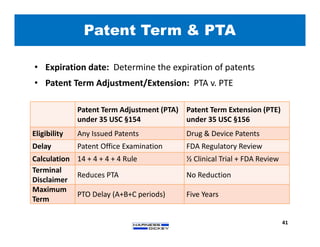
• Expiration date: Determine the expiration of patents
• Patent Term Adjustment/Extension: PTA v. PTE
Patent Term & PTA
41
Patent Term Adjustment (PTA)
under 35 USC §154
Patent Term Extension (PTE)
under 35 USC §156
Eligibility Any Issued Patents Drug & Device Patents
Delay Patent Office Examination FDA Regulatory Review
Calculation 14 + 4 + 4 + 4 Rule ½ Clinical Trial + FDA Review
Terminal
Disclaimer
Reduces PTA No Reduction
Maximum
Term
PTO Delay (A+B+C periods) Five Years
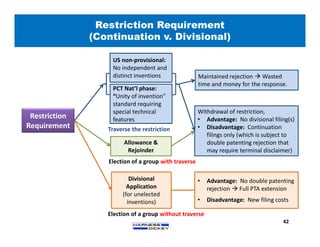
Restriction Requirement
(Continuation v. Divisional)
42
Restriction
Requirement
Allowance &
Rejoinder
Election of a group with traverse
Traverse the restriction
US non-provisional:
No independent and
distinct inventions
PCT Nat’l phase:
“Unity of invention”
standard requiring
special technical
features
Withdrawal of restriction,
• Advantage: No divisional filing(s)
• Disadvantage: Continuation
filings only (which is subject to
double patenting rejection that
may require terminal disclaimer)
Maintained rejection  Wasted
time and money for the response.
Divisional
Application
(for unelected
inventions)
• Advantage: No double patenting
rejection  Full PTA extension
• Disadvantage: New filing costs
Election of a group without traverse
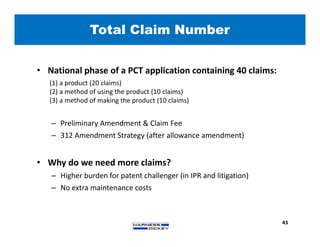
Total Claim Number
43
• National phase of a PCT application containing 40 claims:
(1) a product (20 claims)
(2) a method of using the product (10 claims)
(3) a method of making the product (10 claims)
– Preliminary Amendment & Claim Fee
– 312 Amendment Strategy (after allowance amendment)
• Why do we need more claims?
– Higher burden for patent challenger (in IPR and litigation)
– No extra maintenance costs
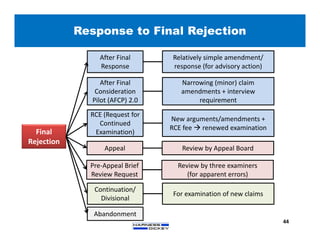
Response to Final Rejection
44
Final
Rejection
After Final
Response
After Final
Consideration
Pilot (AFCP) 2.0
RCE (Request for
Continued
Examination)
Appeal
Pre-Appeal Brief
Review Request
Continuation/
Divisional
Abandonment
Relatively simple amendment/
response (for advisory action)
Narrowing (minor) claim
amendments + interview
requirement
New arguments/amendments +
RCE fee  renewed examination
Review by Appeal Board
Review by three examiners
(for apparent errors)
For examination of new claims
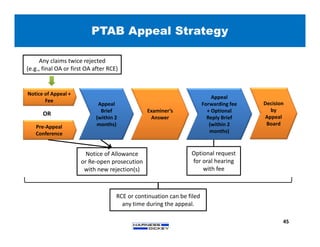
PTAB Appeal Strategy
45
Notice of Appeal +
Fee
Appeal
Brief
(within 2
months)Pre-Appeal
Conference
Examiner’s
Answer
Appeal
Forwarding fee
+ Optional
Reply Brief
(within 2
months)
Decision
by
Appeal
Board
Notice of Allowance
or Re-open prosecution
with new rejection(s)
Optional request
for oral hearing
with fee
OR
Any claims twice rejected
(e.g., final OA or first OA after RCE)
RCE or continuation can be filed
any time during the appeal.
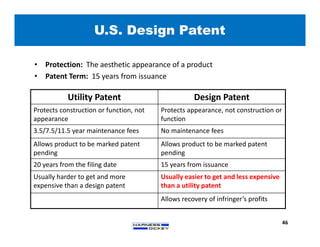
U.S. Design Patent
46
Utility Patent Design Patent
Protects construction or function, not
appearance
Protects appearance, not construction or
function
3.5/7.5/11.5 year maintenance fees No maintenance fees
Allows product to be marked patent
pending
Allows product to be marked patent
pending
20 years from the filing date 15 years from issuance
Usually harder to get and more
expensive than a design patent
Usually easier to get and less expensive
than a utility patent
Allows recovery of infringer’s profits
• Protection: The aesthetic appearance of a product
• Patent Term: 15 years from issuance
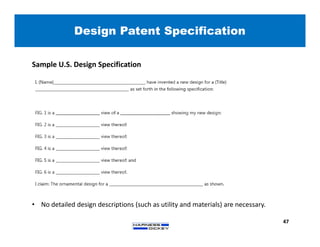
Design Patent Specification
47
Sample U.S. Design Specification
• No detailed design descriptions (such as utility and materials) are necessary.
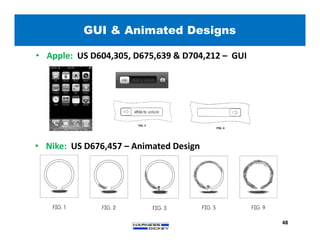
48
GUI & Animated Designs
• Nike: US D676,457 – Animated Design
• Apple: US D604,305, D675,639 & D704,212 – GUI
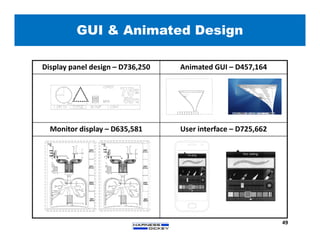
GUI & Animated Design
49
Display panel design – D736,250 Animated GUI – D457,164
Monitor display – D635,581 User interface – D725,662
Questions?
Kisuk Lee
이기석
Patent Attorney (U.S./KR), Partner
Harness, Dickey & Pierce
+1-314-446-7670 – work
+1-314-775-8771 – cell
klee@hdp.com
www.facebook.com/ksluspat – IP blog
50

US patent practice tips

  • 1.
    Best U.S. IPPractice April 2019
  • 2.
    Firm Overview -HDP • Offices: St. Louis, Detroit, Washington D.C., Dallas • Over 110 IP Attorneys • 10th Largest U.S. IP-Focused Firm 2
  • 3.
    Rank Law FirmName 2018 Patents 1 OBLON MCCLELLAND MAIER & NEUSTADT 5596 2 SUGHRUE MION PLC 4040 3 CANTOR COLBURN LLP 3576 4 BIRCH STEWART KOLASCH & BIRCH LLP 3557 5 OLIFF PLC 3514 6 HARNESS DICKEY & PIERCE 3340 7 FISH & RICHARDSON PC 3329 8 KNOBBE MARTENS OLSON & BEAR LLP 3178 9 KILPATRICK TOWNSEND & STOCKTON LLP 2952 10 FOLEY & LARDNER LLP 2456 HDP - 2018 Utility Patents: 3340 2018 Top Patent Firms – No. 6 3
  • 4.
    Part 1 Freedom ToOperate (FTO) 4
  • 5.
    • Investigation todetermine if you infringe patents of others • Expensive process but necessary for commercialization Freedom To Operate (FTO) 5
  • 6.
    • Source: PwC2017 Patent Litigation Study (May 2017) FTO - Patent Damages in U.S. 6
  • 7.
    • Keytruda: Merck’scancer immunotherapy • Annual sales: ~$700M • Merck settles with BMS to pay $625M for past patent infringement. • In addition, Merck pays royalty for future sales. Patent Infringement Case 7 vs.
  • 8.
    • Samsung Galaxy:Sued for utility and design patent & trade dress infringement • Apple design patents: Round corner designs • Damages: $1B  $399M  Settled Design Infringement Case 8 vs.
  • 9.
    • Oculus (Facebook):Sued for breach of non- disclosure agreement (NDA) and copyright infringement • Damages: $500M (District Court, TX) for TM and copyright infringement  Settled TM/Copyright/Trade Secret Case 9
  • 10.
    Source: http://ptopatenttrials.com/2012/05/20/uspto-post-grant-opposition-costs-a-forum-conveniens-for- invalidity-disputes/ FTO –U.S. Litigation Costs 10 • Assess potential litigation risks in U.S. • U.S. litigation is very expensive!
  • 11.
    • Litigation costs •Infringement – lost profit, reasonable royalty • Enhanced damage (X3) – willful infringement • Awards of Attorney Fees – exceptional case – Octane Fitness Supreme Court case Total Expense 11
  • 12.
    Willful Infringement &Opinion Of Counsel 12 • Willful Infringement – Enhanced damage (X3) – Halo Supreme Court decision: lower threshold for willful infringement  Award of enhanced damages was within the discretion of the trial court  "Totality of the Circumstances" Framework • FTO Assessment & Opinion of Counsel – What is opinion of counsel? – Opinion of counsel valuable even if not required • Minimize written record including emails
  • 13.
    Attorney-Client Privilege 13 • Attorney-ClientPrivilege – Promote frank and full discussions with counsel • A-C Privilege Waiver – A privileged communication shared with third parties – Email c.c. issues • “PRIVILEGED AND CONFIDENTIAL” works all the time?
  • 14.
    Admission Against Interest(AAI) 14 • AAI is difficult to reverse. Avoid AAI! • Do not create a document (including an email) commenting on patentability  verbal discussion!
  • 15.
    Design Around v.Invalidation 15 • Cease and Desist letter  Then what to do? – Stop manufacturing/using & design around – Keep using the invention and initiate invalidation proceeding(s) • Design Around – Difficulty of design around & FTO necessity (e.g., bolt v. drug) • Patent Invalidation – Court litigation – AIA proceedings: PGR/IPR/CBM – U.S. Patent Office: Ex Parte Reexamination
  • 16.
    Patent Invalidation 16 Ex Parte Reexamination InterPartes Review (IPR) Post-Grant Review (PGR) No third party participation Petitioner participates in the proceeding. Anonymous submission possible Need to identify parties in interest Anytime after patent issuance Pre-AIA patent: Anytime Post-AIA patent: 9 months after patent issuance AIA patents only: Within 9 months from patent issuance No Estoppel Estoppel $6,000 PTO fee IPR: $30,000 and up/ PGR: $38,000 and up Relatively easy to prepare Petition needs to be well prepared. Not appealable Appealable to Federal Circuit No deadline Final decision within 1 year from institution
  • 17.
    Petition Filed (19 Feb 19) PATENTEE (Optional) Preliminary Response (19May 19) IPR Institution Decision (Aug 2019) PATENTEE Response & Motion to Amend Claims (Nov 2019) Petitioner Reply to PO Response (Feb 2020) PATENTEE Reply to Opposition to Amendment (Feb 2020) Oral Hearing Final Written Decision (Aug 2020) PO Discovery Period Petitioner Discovery Period PO Discovery Period Period for Observations & Motions to Exclude Evidence 3 Months Petition Phase IPR Timeline 3 Months 3 Months 3 Months 1 Month Hearing set on request Trial Phase: No more than 12 months
  • 18.
    • Conduct FTOSearch – Conduct patent searches regularly – Search competitors’ patents • Monitor screened patents/applications • Keep search/review record – Patent search/review assessment • Consult U.S. patent counsel FTO – ID Infringement Risks 18
  • 19.
  • 20.
    Formal Papers 20 • DocumentsRequiring Signature(s) for US Application : 1) Declaration & Assignment 2) Power of Attorney (37 CFR 1.34. Acting in a representative capacity) • Practice Tip: Submit the documents early!  many issues are caused by late filing or no filing. – Declaration: Unavailable/disgruntled inventors  Substitute statement – Assignment: Results in co-ownership (e.g., company and inventor) – Co-ownership issues: Transfer of the patent, Standing to sue (case law)
  • 21.
    1. Patent Exploitationin U.S. a) Each joint owner can exploit without permission of others b) No duty to share royalties 2. Patent Enforcement in U.S. a) All joint owners must join suit b) Other owners can grant license (circumvention) Avoid Joint Ownership! 21
  • 22.
    • Rule 56: –A duty of candor and good faith in dealing with the Office • Violation of Rule 56: – Patent: Unenforceable – Family patents: The doctrine of the fruit of the poisonous tree • IDS Submission: – Never hide “material info” – When in doubt, just submit the info Inequitable Conduct 22
  • 23.
    IDS (Information DisclosureStatement) 23 Filing First OA on merit Final OA on merit RCE First OA Notice of Allowance Patent Issuance No fee 1. Gov. fee, or 2. No fee within 3 months from foreign OA Gov. fee, even within 3 months from foreign OA No fee 1. Gov. fee, or 2. No fee within 3 months from foreign OA 1. RCE + IDS 2. Quick Pass IDS (after paying issue fee) 3. IDS without RCE (?) 1. IDS submission issues: – Submit Foreign Office Actions? Search Reports? – Category “A” (background) references? – Non-prior art documents? – RCE filing just for IDS submission? 2. IDS Timeline issues:
  • 24.
  • 25.
    Missed 1-year DueDate or Filings for Minor Improvements? 25 Filing 12 months priority due 18 months publication 30 months Non-provisional or PCT Application with priority claim Application by same assignee: §102(b)(2) exception Application by same inventor: §102(b)(1) exception Within 6 months from the 1 year date: An application (with the same invention or minor improvements) can be filed if the assignee is the same. Within 12 months from the publication date: An application (with the same invention or minor improvements) can be filed if the inventor is the same. Filing 30 months PCT National Phase After 30 mo. due date: Petition to revive an unintentionally abandoned application with an application
  • 26.
    1. Application forimprovements before 1-year from patent publication  Continuation-in-part (CIP) filing 2. Application for improvements after 1-year from patent publication  New filing 3. New Data (supporting the claimed invention): CIP or §1.132 Declaration? a) CIP filing with the data b) §1.132 Declaration for the pending application – MPEP 706.01 “Evidence traversing rejections, when timely presented, must be considered by the examiner whenever present.” New filing v. CIP v. §1.132 Declaration 26
  • 27.
    Incorporation by reference 27 Useof “Incorporation By Reference” – MPEP 608.01(p): An application for a patent when filed may incorporate “essential material” by reference to (1) a U.S. patent, or (2) a U.S. patent application publication. – Applicant can import the limitations from the cited patents/application. – Example: Paice v. Ford Motor, 881 F.3d 894 (2018) “This application discloses a number of improvements over the hybrid vehicles disclosed in the inventor’s U.S. 5,343,970, which is incorporated herein by this reference.”
  • 28.
    Present Invention 28 • Avoidthe term “invention”? – Broad terms in claims can be interpreted narrowly because of the term “invention” in the specification – Harris Corp. v. Ericsson, 417 F.3d 1241 (Fed. Cir. 2005) – Use terms such as “embodiment” instead of “invention” – Terms to avoid: “the present invention”, “invention”, “object of the invention”
  • 29.
    Indefiniteness – Reasonablecertainty • Selection of Terms: – Think twice before using generic descriptions: For example, “high (or hot) temperature”, “poorly soluble”, “derivative”, “analog”, “hydrophobic”, “stabilizing agent”, etc. • Use definitions: – For example: "Poorly water soluble drug" means a drug that has a water solubility of less than 1 part in 30 parts of water. • Include specific examples: – For example: Examples of the poorly water soluble drugs include, but are not limited to, famotidine, sildenafil, buspirone and troglitazone. 29
  • 30.
    Means-plus-function 30 • 35 U.S.C.112(f): – Means-plus-function language: limited to “corresponding structure” described in the spec. – No corresponding structure in the spec  the claim is invalid as being indefinite. • Generic placeholders invoking 35 U.S.C. 112(f): – Mechanism for, module for, device for, unit for, component for, element for, member for, apparatus for, machine for, system for
  • 31.
    Claim Drafting Practice 31 •Telescoping claim set: broad claims coupled with narrow claims • Useful to enforce the patent • Useful to defend the patent (e.g., IPR/PGR) • MPF and Functional Language  Not good?? • Useful to have both clearly defined claims and MPF/functional claims • Broadest reasonable interpretation in PTO examination: Useful to add definitions to the specification • Method claim drafting  Remember “single entity rule”!!
  • 32.
    Preamble – LimitingEffects? 32 MPEP 2112.01: The purpose or intended use of the invention in the preamble  no limiting effect
  • 33.
    Claim Drafting –Example 33 • A method for making delicious ramen to prevent swelling of noodles and extra energy consumption, comprising: 1) measuring and adding water to a pot; 2) boiling water; 3) spraying soup base powders over the boiling water to cause faster boiling; 4) pushing dried vegetables into the water for fast swelling; 5) eating the delicious ramen. • A method for making delicious ramen to prevent swelling of noodles and extra energy consumption, comprising: 1) measuring and adding water to a pot; 2) boiling water; 3) spraying soup base powders over the boiling water to cause faster boiling; 4) pushing dried vegetables into the water for fast swelling; 5) eating the delicious ramen. Simple preamble! Simplify method steps! Define action step only! Single infringer rule! Avoid sequence specific method!
  • 34.
    Novelty – Anticipation 34 •Anticipation requirement: A claim is anticipated only if each and every element as set forth in the claim is found • Overlapping range: Not necessarily anticipatory – Ineos USA LLC v. Berry Plastics Corp., 783 F.3d 865, 114 USPQ2d 1568 (Fed. Cir. 2015): When the prior art discloses its own range, rather than a specific point, then the prior art is only anticipatory if it describes the claimed range with sufficient specificity.
  • 35.
    Prima Facie Obviousness 35 •PFO = Burden shifting ping-pong • Part 1: PTO establishment of prima facie obviousness (PFO) – The examiner bears the initial burden of factually supporting any prima facie conclusion of obviousness. – If the examiner does not produce a prima facie case, the applicant is under no obligation to submit evidence of non-obviousness. • Part 2: Applicant’s rebuttal on PFO – Applicant may rebut the PFO presumption with evidence of unexpected results and secondary considerations to support non- obviousness.
  • 36.
    Prima Facie ObviousnessCase 36 • In re Grabiak, 769 F2d 729 (CAFC, 1985) Prior Art (Howe) Claim 1 - Howe + Secondary reference showing O to S switch - Court: No establishment of PFO - Remember: non-obviousness ≠ inventiveness
  • 37.
    PFO v. Data 37 •Response to an obviousness rejection – Argue non-establishment of PFO – Unexpected outcomes, particularly data • Do we want to argue unexpected outcomes? • Do we want/need to submit data as §1.132 declaration? • PFO v. Unexpected Outcomes (data) – What if you have both arguments, PFO and data? • Is it better to argue both? • Is it a case of commercial importance? Budget v. Output
  • 38.
    Common Sense/Ordinary creativity 38 •Obviousness rejection based on “common sense/ordinary creativity”  may not be a good enough reason to reject a claim as being obvious. – Arendi SARL v. Apple: • Common sense “cannot be used as a wholesale substitute for reasoned analysis and evidentiary support” – DSS Technology Management v. Apple: • “Ordinary creativity” was not a good enough reason to find the patent obvious
  • 39.
    Inherency in Obviousness 39 •Inherency in novelty v. Inherency in obviousness – MPEP 2112: Something which is old does not become patentable upon the discovery of a new property. • Obviousness “cannot be predicated on what is unknown,” and unknown characteristics of the prior art do not constitute a teaching. • Honeywell v. Mexichem – “dismissing properties of the claimed invention as merely inherent, without further consideration as to unpredictability and unexpectedness, erred as a matter of law.”
  • 40.
    Prosecution Disclaimer 40 • Admissionsas Prior Art (MPEP 2152)  Make background descriptions short! • Prosecution Disclaimer – Specification descriptions: “present invention,” “the objective of the invention” – Arguments in a response – Arguments in IPR
  • 41.
    • Expiration date:Determine the expiration of patents • Patent Term Adjustment/Extension: PTA v. PTE Patent Term & PTA 41 Patent Term Adjustment (PTA) under 35 USC §154 Patent Term Extension (PTE) under 35 USC §156 Eligibility Any Issued Patents Drug & Device Patents Delay Patent Office Examination FDA Regulatory Review Calculation 14 + 4 + 4 + 4 Rule ½ Clinical Trial + FDA Review Terminal Disclaimer Reduces PTA No Reduction Maximum Term PTO Delay (A+B+C periods) Five Years
  • 42.
    Restriction Requirement (Continuation v.Divisional) 42 Restriction Requirement Allowance & Rejoinder Election of a group with traverse Traverse the restriction US non-provisional: No independent and distinct inventions PCT Nat’l phase: “Unity of invention” standard requiring special technical features Withdrawal of restriction, • Advantage: No divisional filing(s) • Disadvantage: Continuation filings only (which is subject to double patenting rejection that may require terminal disclaimer) Maintained rejection  Wasted time and money for the response. Divisional Application (for unelected inventions) • Advantage: No double patenting rejection  Full PTA extension • Disadvantage: New filing costs Election of a group without traverse
  • 43.
    Total Claim Number 43 •National phase of a PCT application containing 40 claims: (1) a product (20 claims) (2) a method of using the product (10 claims) (3) a method of making the product (10 claims) – Preliminary Amendment & Claim Fee – 312 Amendment Strategy (after allowance amendment) • Why do we need more claims? – Higher burden for patent challenger (in IPR and litigation) – No extra maintenance costs
  • 44.
    Response to FinalRejection 44 Final Rejection After Final Response After Final Consideration Pilot (AFCP) 2.0 RCE (Request for Continued Examination) Appeal Pre-Appeal Brief Review Request Continuation/ Divisional Abandonment Relatively simple amendment/ response (for advisory action) Narrowing (minor) claim amendments + interview requirement New arguments/amendments + RCE fee  renewed examination Review by Appeal Board Review by three examiners (for apparent errors) For examination of new claims
  • 45.
    PTAB Appeal Strategy 45 Noticeof Appeal + Fee Appeal Brief (within 2 months)Pre-Appeal Conference Examiner’s Answer Appeal Forwarding fee + Optional Reply Brief (within 2 months) Decision by Appeal Board Notice of Allowance or Re-open prosecution with new rejection(s) Optional request for oral hearing with fee OR Any claims twice rejected (e.g., final OA or first OA after RCE) RCE or continuation can be filed any time during the appeal.
  • 46.
    U.S. Design Patent 46 UtilityPatent Design Patent Protects construction or function, not appearance Protects appearance, not construction or function 3.5/7.5/11.5 year maintenance fees No maintenance fees Allows product to be marked patent pending Allows product to be marked patent pending 20 years from the filing date 15 years from issuance Usually harder to get and more expensive than a design patent Usually easier to get and less expensive than a utility patent Allows recovery of infringer’s profits • Protection: The aesthetic appearance of a product • Patent Term: 15 years from issuance
  • 47.
    Design Patent Specification 47 SampleU.S. Design Specification • No detailed design descriptions (such as utility and materials) are necessary.
  • 48.
    48 GUI & AnimatedDesigns • Nike: US D676,457 – Animated Design • Apple: US D604,305, D675,639 & D704,212 – GUI
  • 49.
    GUI & AnimatedDesign 49 Display panel design – D736,250 Animated GUI – D457,164 Monitor display – D635,581 User interface – D725,662
  • 50.
    Questions? Kisuk Lee 이기석 Patent Attorney(U.S./KR), Partner Harness, Dickey & Pierce +1-314-446-7670 – work +1-314-775-8771 – cell klee@hdp.com www.facebook.com/ksluspat – IP blog 50