2018 North American Internet of Things
Enabling Technology Leadership Award
2018
BEST PRACTICES RESEARCH
© Frost & Sullivan 2018 2 “We Accelerate Growth”
Contents
Background and Company Performance ........................................................................3
Industry Challenges..............................................................................................3
Technology Leverage and Customer Impact.............................................................4
Conclusion...........................................................................................................5
Significance of Enabling Technology Leadership .............................................................6
Understanding Enabling Technology Leadership .............................................................6
Key Benchmarking Criteria ....................................................................................7
Best Practices Award Analysis for Intel Corporation ........................................................7
Decision Support Scorecard ...................................................................................7
Technology Leverage ............................................................................................8
Customer Impact .................................................................................................8
Decision Support Matrix ........................................................................................9
Best Practices Recognition: 10 Steps to Researching, Identifying, and Recognizing Best
Practices .................................................................................................................10
The Intersection between 360-Degree Research and Best Practices Awards.....................11
Research Methodology ........................................................................................11
About Frost & Sullivan ..............................................................................................11
BEST PRACTICES RESEARCH
© Frost & Sullivan 2018 3 “We Accelerate Growth”
Background and Company Performance
Industry Challenges
The Internet of Things (IoT) has been a constant evolution that is leading to the
transformation of different industries and constant innovation in how solutions are
connected and integrated. Disruptive innovation creates entirely new markets, often
transforming existing markets and displacing established competitors that are slow – or
simply refuse – to adopt new ways of doing business. IoT is the catalyst that is driving
this transformation and has the potential to transform every vertical market and industry
by allowing businesses to deconstruct old, inefficient processes and reconstruct processes
through technology in an efficient and reliable manner. Traditionally, the focus has been
on transmitting data from devices to the cloud for management and analysis. However,
this approach dramatically increases data transmission costs (especially with cellular and
satellite connectivity) and increases latency, reducing the ability of organizations to make
real-time business decisions.
The promise of IoT relies on the ability to use sensors to gather data and perform real-
time analytics to make quick business decisions that either generate revenues or save
businesses money through productivity gains. The high latency and increased data
transmission costs compound the issue of high cost of IoT solutions and is one of the
many reasons that some organizations have delayed IoT adoption or expansion from pilot
projects.
One of the ways to alleviate this challenge is to leverage edge computing capabilities.
Frost & Sullivan defines “the edge” as anything at the edge of the network. This includes
hardware devices embedded with sensors (surveillance cameras, vending machines, etc.)
and gateways that aggregate data from multiple devices (aggregators, video encoders,
NVRs, etc.). With edge computing solutions, organizations reduce data transmission costs
and make real-time decisions based on data collected by sensors. These solutions are
especially critical for high bandwidth applications such as video surveillance.
Over the past 10 years, the video surveillance market has seen the pendulum shift from
centralized data processing to edge solutions and back to cloud-based data analytics.
Recently, the pendulum has started the shift back towards edge computing. With
increased processor speeds and computing power, edge devices now have the ability to
process and analyze large amounts of data with relatively low latency. As more devices
come online that require real-time analysis, the importance of edge computing will
continue to increase.
Autonomous vehicles will soon become reality as the mobile networking industry rolls out
5G capabilities that can transmit large amounts of data with relatively low latency.
However, the success of autonomous vehicles depends not just on vehicle to infrastructure
communications (V2I) but also real-time vehicle to vehicle communications (V2V), which
depends on edge computing capabilities. Since the success of this market will depend on a
BEST PRACTICES RESEARCH
© Frost & Sullivan 2018 4 “We Accelerate Growth”
higher level of safety than status quo, technological advances and adoption of edge
computing is paramount.
Intel Corporation has focused on enabling edge computing by working with partners and
customers to develop technology that delivers more powerful processors and sensors
across all the markets in IoT. Be it video surveillance or connected retail, Intel is not only
an enabling technology company, but also leading innovation in the industry to deliver on
the promise of IoT and help the industry migrate from connecting devices to automating
machines and systems.
Technology Leverage and Customer Impact
Leading the Distributed Computing Revolution
The typical IoT architecture has data collected by edge devices using different
communication protocols to transmit data to the cloud where it is managed and analyzed.
With the technological advancements of edge computing, this process is now streamlined
to increase the level of intelligence in each layer so that the data can be stored and
analyzed on edge devices with metadata and exceptions sent to the cloud. With
distributed computing, organizations have the ability to make real-time decisions.
For instance, use cases include using video analytics to track a person across multiple
surveillance cameras, or motion detection in a vending machine to turn on the latest
promotion. With increased edge computing capabilities, vending machine operators can
use facial recognition to target customers based on their demographic information or even
identify rewards members in real-time. These are just a few of the applications that
require edge computing capabilities.
With a scalable portfolio of Intel®
Atom, Core™
and Xeon™
processors, Intel has helped
hardware manufacturers develop more powerful devices that have the ability to perform
data analytics at the edge. Intel has been developing an ecosystem by working with
hardware companies to develop solutions using its processors and chipsets to increase
functionality and embed security protocols to make IoT more secure.
While some of Intel’s competitors are very active in the IoT market, Intel has led the
industry in speeding up innovation cycles and identifying attractive sales channels through
its ecosystem. With established relationships with some of the largest solution providers in
the world, Intel has helped small companies find markets for their products and provides a
level of comfort to the larger companies working with these startups.
IoT is an Ecosystem Play, but Intel has Products in Every Level of the Ecosystem
IoT is an ecosystem play and no company yet has the ability to develop a true end-to-end
solution. However, Intel has a broad portfolio that encompasses compute continuum from
things to network to cloud/datacenter. Organically and through acquisitions, Intel has
developed products from traditional microprocessors, to vision and AI accelerators, to
BEST PRACTICES RESEARCH
© Frost & Sullivan 2018 5 “We Accelerate Growth”
FPGA’s and storage. In addition, Intel is accelerating IoT solutions deployment by
addressing barriers related to security, connectivity and the complexity of solution
deployment. To do that Intel has identified industry specific IoT business problems and
created market ready solutions with ecosystem partners to provide easier path to
deployment and faster time-to-market. Intel’s engagements across almost all levels of the
IoT ecosystem, coupled with their broad portfolio, positions Intel to succeed in the IoT
market.
Advancing the Industry with Innovation and Leadership
In addition to the technology innovation and leadership, Intel is leading the industry in
promoting the value of IoT. By increasing its involvement in industry associations and
standards bodies, Intel is ensuring that the industry adopts best practices in creating
standards that will ensure that diverse range of IoT systems can be integrated into
comprehensive solutions that will help organizations improve their return on investment
(ROI) and increase the success rate of IoT deployments.
In addition, Intel Capital has invested in various early stage startups to create a pipeline
of innovations in the industry, including highly visible companies like Bossa Nova,
Filament, Foghorn, Matroid and Mighty.ai. Intel has invested in essential enabling
technology like drones, AI, AR/VR etc. to create a massive portfolio of innovations that
would help the company scale at cost and make Intel a dominant player in IoT.
Conclusion
Intel Corporation is one of the driving organizations for innovation in IoT. From technology
that leads the industry from the cloud to the edge, to investments in innovative
companies to create a pipeline for growth, Intel is leading the industry to the next
generation of IoT. As processing power in edge devices increases and more applications
demand lower latency, Intel has created the architecture and technology to help
innovative companies deliver organization increased ROI from IoT deployments.
With its strong overall performance, Intel Corporation has earned Frost & Sullivan’s 2018
Enabling Technology Leadership Award in the IoT Industry.
BEST PRACTICES RESEARCH
© Frost & Sullivan 2018 6 “We Accelerate Growth”
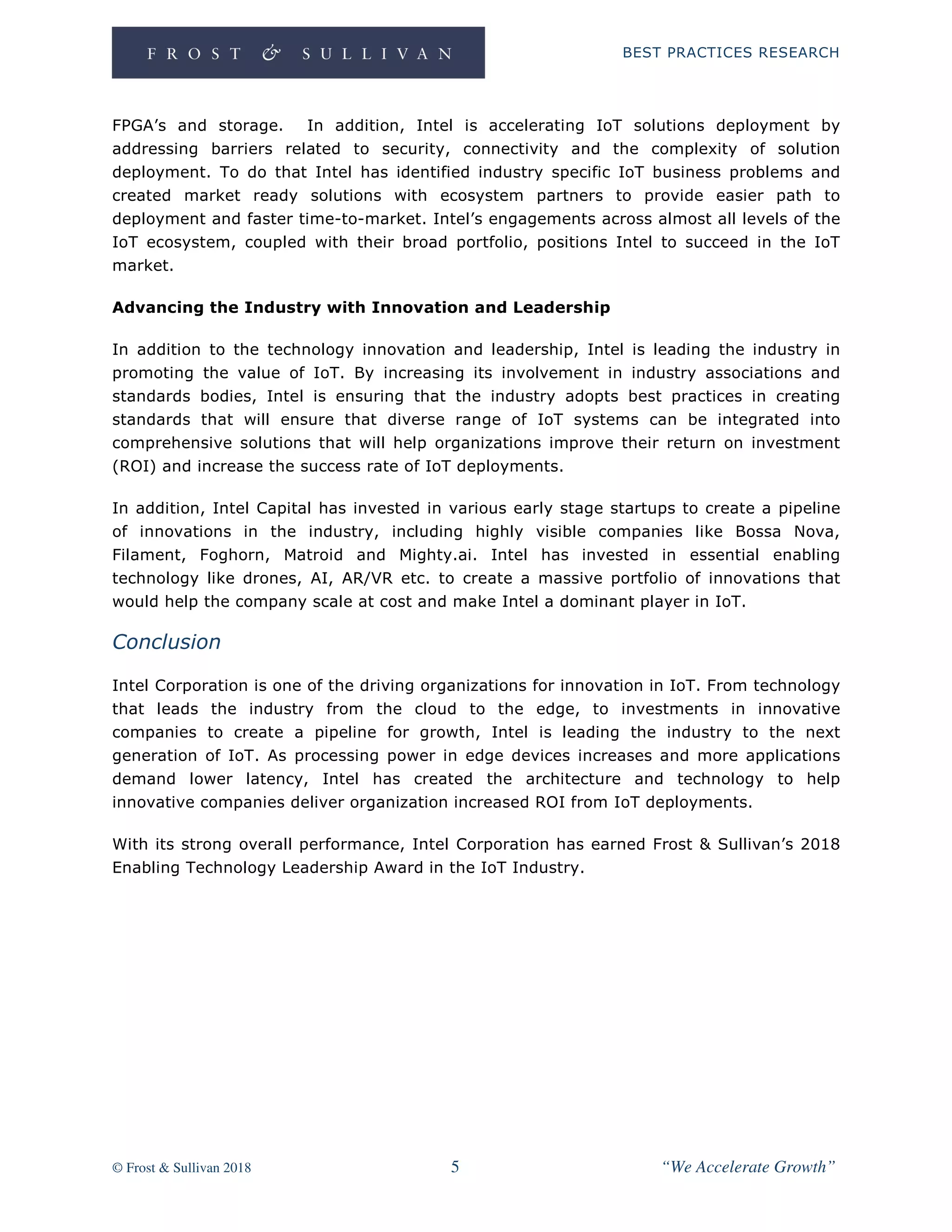
Significance of Enabling Technology Leadership
Ultimately, growth in any organization depends upon customers purchasing from a
company and then making the decision to return time and again. In a sense, then,
everything is truly about the customer—and making those customers happy is the
cornerstone of any long-term successful growth strategy. To achieve these goals through
enabling technology leadership, an organization must be best-in-class in three key areas:
understanding demand, nurturing the brand, and differentiating from the competition.
Understanding Enabling Technology Leadership
Product quality (driven by innovative technology) is the foundation of delivering customer
value. When complemented by an equally rigorous focus on the customer, companies can
begin to differentiate themselves from the competition. From awareness, to consideration,
to purchase, to follow-up support, best-practice organizations deliver a unique and
enjoyable experience that gives customers confidence in the company, its products, and
its integrity.
BEST PRACTICES RESEARCH
© Frost & Sullivan 2018 7 “We Accelerate Growth”
Key Benchmarking Criteria
For the Enabling Technology Leadership Award, Frost & Sullivan analysts independently
evaluated two key factors—Technology Leverage and Customer Impact—according to the
criteria identified below.
Technology Leverage
Criterion 1: Commitment to Innovation
Criterion 2: Commitment to Creativity
Criterion 3: Stage Gate Efficiency
Criterion 4: Commercialization Success
Criterion 5: Application Diversity
Customer Impact
Criterion 1: Price/Performance Value
Criterion 2: Customer Purchase Experience
Criterion 3: Customer Ownership Experience
Criterion 4: Customer Service Experience
Criterion 5: Brand Equity
Best Practices Award Analysis for Intel Corporation
Decision Support Scorecard
To support its evaluation of best practices across multiple business performance
categories, Frost & Sullivan employs a customized Decision Support Scorecard. This tool
allows our research and consulting teams to objectively analyze performance, according to
the key benchmarking criteria listed in the previous section, and to assign ratings on that
basis. The tool follows a 10-point scale that allows for nuances in performance evaluation.
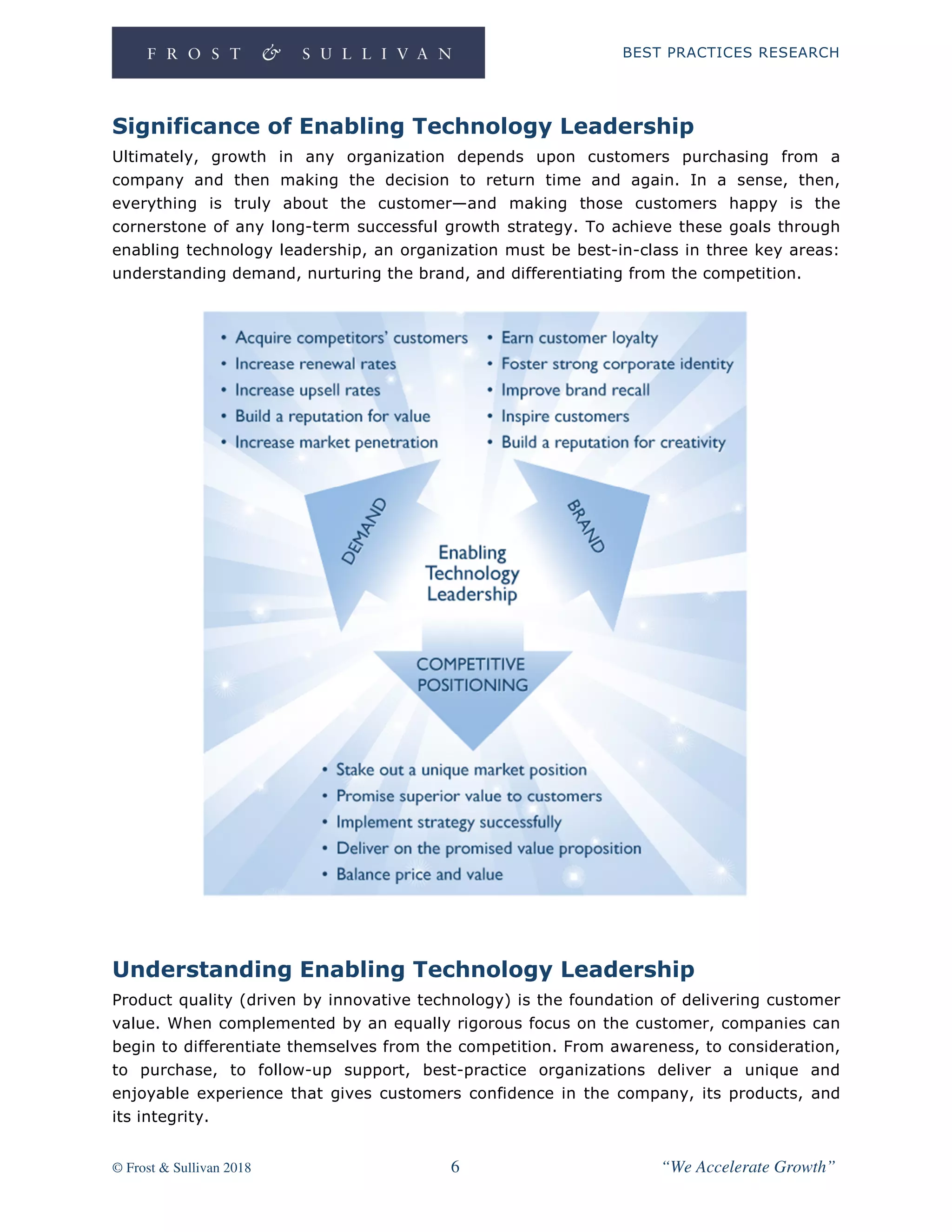
Ratings guidelines are illustrated below.
RATINGS GUIDELINES
The Decision Support Scorecard is organized by Technology Leverage and Customer
Impact (i.e., These are the overarching categories for all 10 benchmarking criteria; the
definitions for each criterion are provided beneath the scorecard.). The research team
confirms the veracity of this weighted scorecard through sensitivity analysis, which
confirms that small changes to the ratings for a specific criterion do not lead to a
significant change in the overall relative rankings of the companies.
BEST PRACTICES RESEARCH
© Frost & Sullivan 2018 8 “We Accelerate Growth”
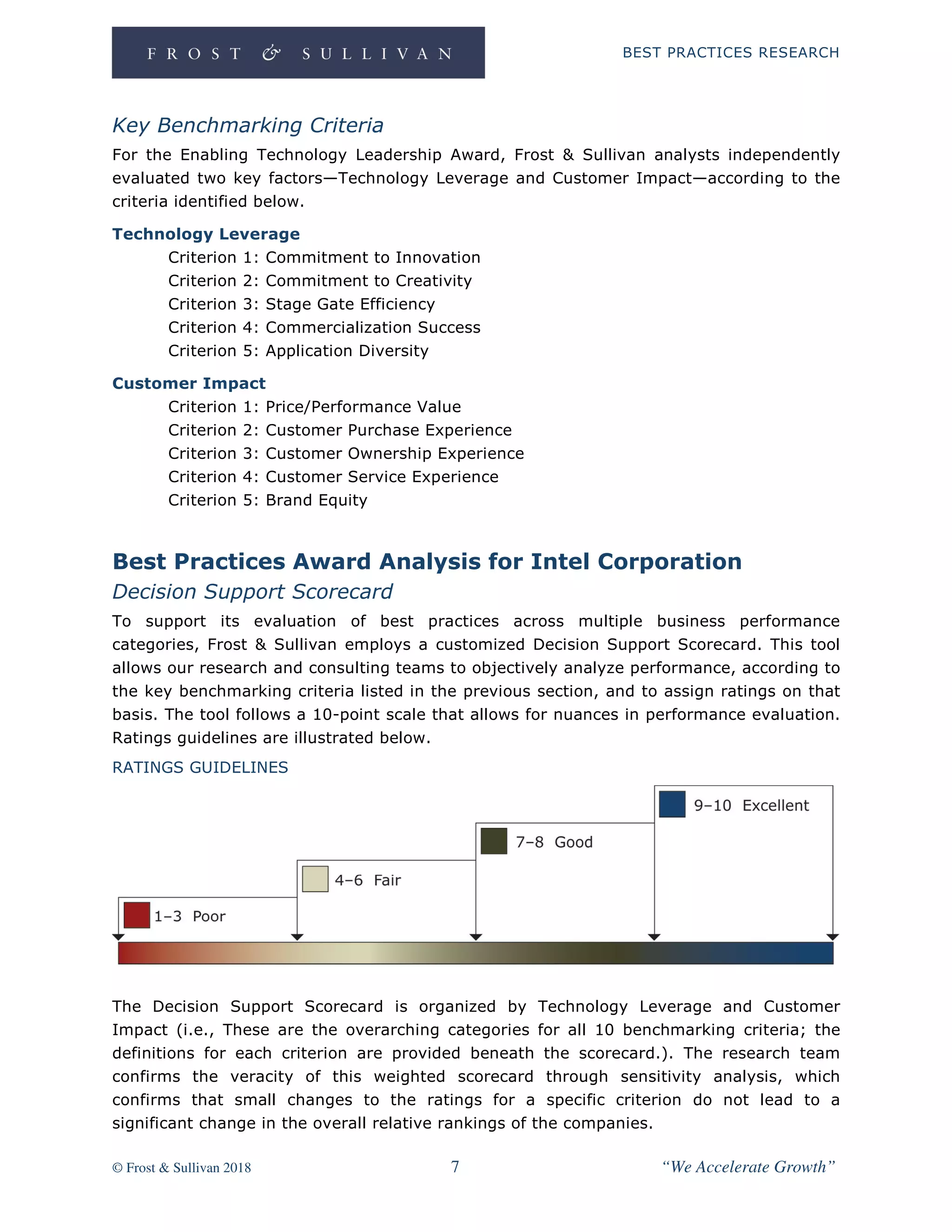
The results of this analysis are shown below. To remain unbiased and to protect the
interests of all organizations reviewed, we have chosen to refer to the other key
participants as Competitor 2 and Competitor 3.
Measurement of 1–10 (1 = poor; 10 = excellent)
Enabling Technology Leadership
Technology
Leverage
Customer
Impact
Average
Rating
Intel Corporation 10.0 9.5 9.75
Competitor 2 8.0 7.0 7.50
Competitor 3 7.0 7.0 7.00
Technology Leverage
Criterion 1: Commitment to Innovation
Requirement: Conscious, ongoing adoption of emerging technologies that enables new
product development and enhances product performance
Criterion 2: Commitment to Creativity
Requirement: Technology leveraged to push the limits of form and function in the pursuit
of “white space” innovation
Criterion 3: Stage Gate Efficiency
Requirement: Adoption of technology to enhance the stage gate process for launching new
products and solutions
Criterion 4: Commercialization Success
Requirement: A proven track record of taking new technologies to market with a high rate
of success
Criterion 5: Application Diversity
Requirement: The development and/or integration of technologies that serve multiple
applications and can be embraced in multiple environments
Customer Impact
Criterion 1: Price/Performance Value
Requirement: Products or services offer the best value for the price, compared to similar
offerings in the market.
Criterion 2: Customer Purchase Experience
Requirement: Customers feel they are buying the most optimal solution that addresses
both their unique needs and their unique constraints.
Criterion 3: Customer Ownership Experience
Requirement: Customers are proud to own the company’s product or service and have a
positive experience throughout the life of the product or service.
Criterion 4: Customer Service Experience
Requirement: Customer service is accessible, fast, stress-free, and of high quality.
BEST PRACTICES RESEARCH
© Frost & Sullivan 2018 9 “We Accelerate Growth”
Criterion 5: Brand Equity
Requirement: Customers have a positive view of the brand and exhibit high brand loyalty.
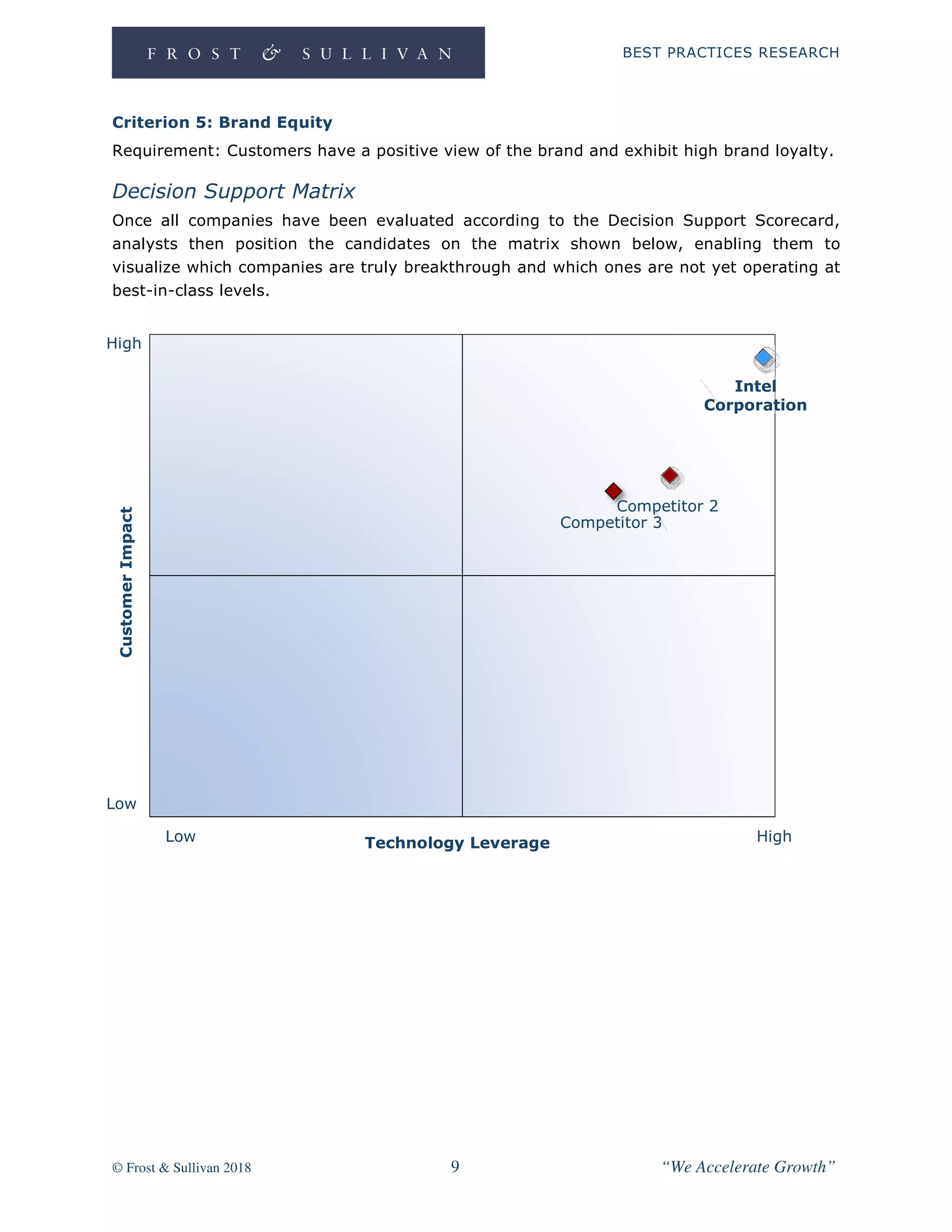
Decision Support Matrix
Once all companies have been evaluated according to the Decision Support Scorecard,
analysts then position the candidates on the matrix shown below, enabling them to
visualize which companies are truly breakthrough and which ones are not yet operating at
best-in-class levels.
High
Low
Low High
CustomerImpact
Technology Leverage
Intel
Corporation
Competitor 2
Competitor 3
BEST PRACTICES RESEARCH
© Frost & Sullivan 2018 10 “We Accelerate Growth”
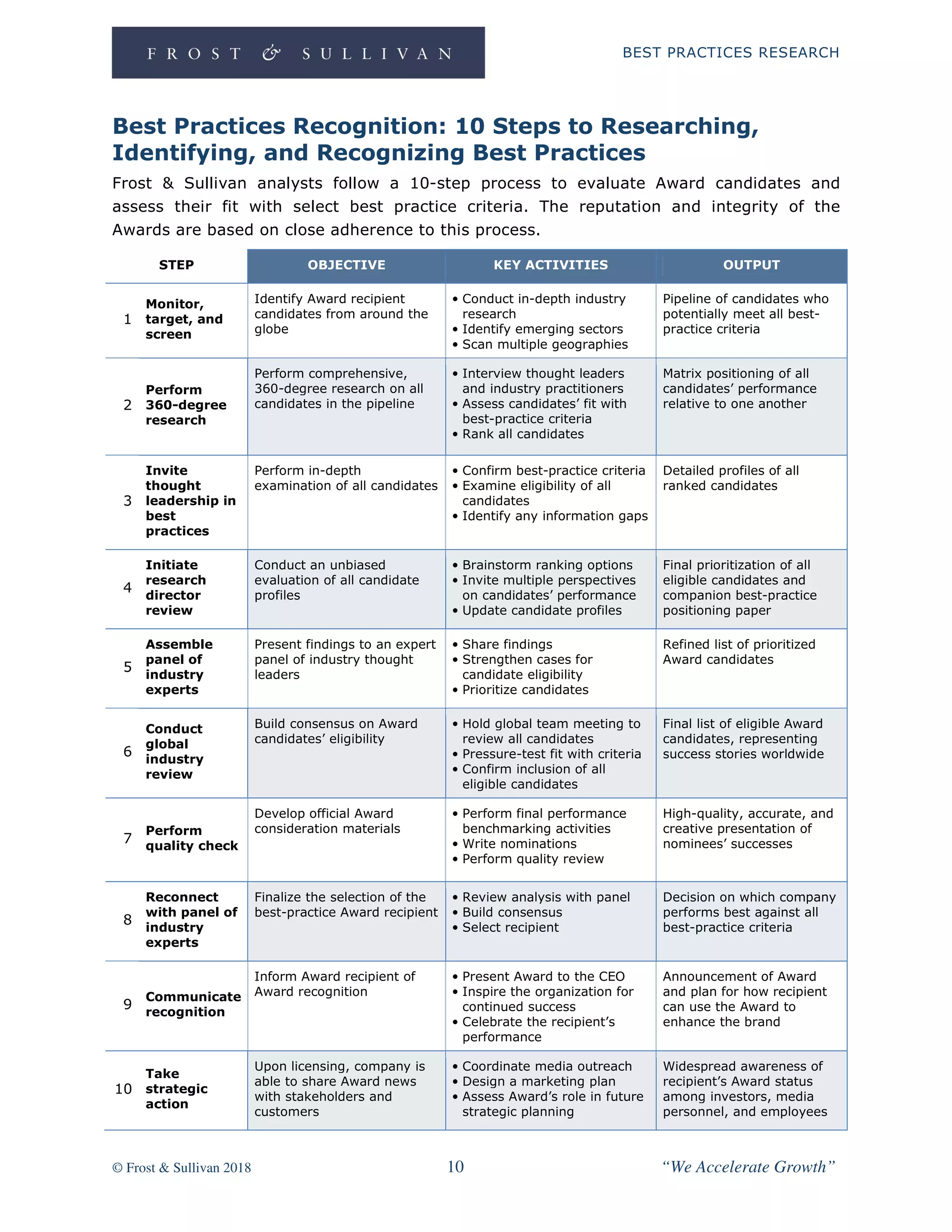
Best Practices Recognition: 10 Steps to Researching,
Identifying, and Recognizing Best Practices
Frost & Sullivan analysts follow a 10-step process to evaluate Award candidates and
assess their fit with select best practice criteria. The reputation and integrity of the
Awards are based on close adherence to this process.
STEP OBJECTIVE KEY ACTIVITIES OUTPUT
1
Monitor,
target, and
screen
Identify Award recipient
candidates from around the
globe
• Conduct in-depth industry
research
• Identify emerging sectors
• Scan multiple geographies
Pipeline of candidates who
potentially meet all best-
practice criteria
2
Perform
360-degree
research
Perform comprehensive,
360-degree research on all
candidates in the pipeline
• Interview thought leaders
and industry practitioners
• Assess candidates’ fit with
best-practice criteria
• Rank all candidates
Matrix positioning of all
candidates’ performance
relative to one another
3
Invite
thought
leadership in
best
practices
Perform in-depth
examination of all candidates
• Confirm best-practice criteria
• Examine eligibility of all
candidates
• Identify any information gaps
Detailed profiles of all
ranked candidates
4
Initiate
research
director
review
Conduct an unbiased
evaluation of all candidate
profiles
• Brainstorm ranking options
• Invite multiple perspectives
on candidates’ performance
• Update candidate profiles
Final prioritization of all
eligible candidates and
companion best-practice
positioning paper
5
Assemble
panel of
industry
experts
Present findings to an expert
panel of industry thought
leaders
• Share findings
• Strengthen cases for
candidate eligibility
• Prioritize candidates
Refined list of prioritized
Award candidates
6
Conduct
global
industry
review
Build consensus on Award
candidates’ eligibility
• Hold global team meeting to
review all candidates
• Pressure-test fit with criteria
• Confirm inclusion of all
eligible candidates
Final list of eligible Award
candidates, representing
success stories worldwide
7
Perform
quality check
Develop official Award
consideration materials
• Perform final performance
benchmarking activities
• Write nominations
• Perform quality review
High-quality, accurate, and
creative presentation of
nominees’ successes
8
Reconnect
with panel of
industry
experts
Finalize the selection of the
best-practice Award recipient
• Review analysis with panel
• Build consensus
• Select recipient
Decision on which company
performs best against all
best-practice criteria
9
Communicate
recognition
Inform Award recipient of
Award recognition
• Present Award to the CEO
• Inspire the organization for
continued success
• Celebrate the recipient’s
performance
Announcement of Award
and plan for how recipient
can use the Award to
enhance the brand
10
Take
strategic
action
Upon licensing, company is
able to share Award news
with stakeholders and
customers
• Coordinate media outreach
• Design a marketing plan
• Assess Award’s role in future
strategic planning
Widespread awareness of
recipient’s Award status
among investors, media
personnel, and employees
BEST PRACTICES RESEARCH
© Frost & Sullivan 2018 11 “We Accelerate Growth”
The Intersection between 360-Degree Research and Best
Practices Awards
Research Methodology
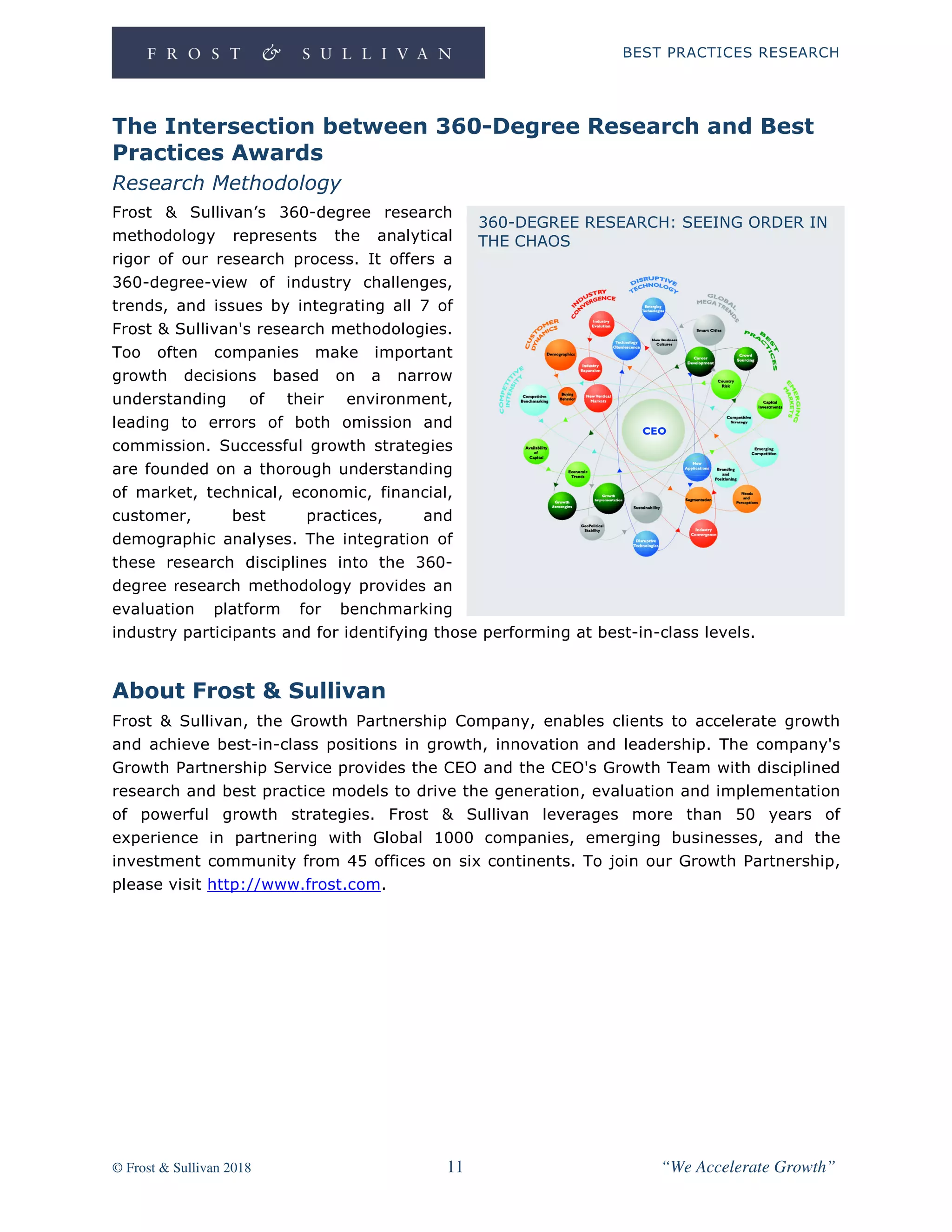
Frost & Sullivan’s 360-degree research
methodology represents the analytical
rigor of our research process. It offers a
360-degree-view of industry challenges,
trends, and issues by integrating all 7 of
Frost & Sullivan's research methodologies.
Too often companies make important
growth decisions based on a narrow
understanding of their environment,
leading to errors of both omission and
commission. Successful growth strategies
are founded on a thorough understanding
of market, technical, economic, financial,
customer, best practices, and
demographic analyses. The integration of
these research disciplines into the 360-
degree research methodology provides an
evaluation platform for benchmarking
industry participants and for identifying those performing at best-in-class levels.
About Frost & Sullivan
Frost & Sullivan, the Growth Partnership Company, enables clients to accelerate growth
and achieve best-in-class positions in growth, innovation and leadership. The company's
Growth Partnership Service provides the CEO and the CEO's Growth Team with disciplined
research and best practice models to drive the generation, evaluation and implementation
of powerful growth strategies. Frost & Sullivan leverages more than 50 years of
experience in partnering with Global 1000 companies, emerging businesses, and the
investment community from 45 offices on six continents. To join our Growth Partnership,
please visit http://www.frost.com.
360-DEGREE RESEARCH: SEEING ORDER IN
THE CHAOS

Intel Corporation Award Write Up

  • 1.
    2018 North AmericanInternet of Things Enabling Technology Leadership Award 2018
  • 2.
    BEST PRACTICES RESEARCH ©Frost & Sullivan 2018 2 “We Accelerate Growth” Contents Background and Company Performance ........................................................................3 Industry Challenges..............................................................................................3 Technology Leverage and Customer Impact.............................................................4 Conclusion...........................................................................................................5 Significance of Enabling Technology Leadership .............................................................6 Understanding Enabling Technology Leadership .............................................................6 Key Benchmarking Criteria ....................................................................................7 Best Practices Award Analysis for Intel Corporation ........................................................7 Decision Support Scorecard ...................................................................................7 Technology Leverage ............................................................................................8 Customer Impact .................................................................................................8 Decision Support Matrix ........................................................................................9 Best Practices Recognition: 10 Steps to Researching, Identifying, and Recognizing Best Practices .................................................................................................................10 The Intersection between 360-Degree Research and Best Practices Awards.....................11 Research Methodology ........................................................................................11 About Frost & Sullivan ..............................................................................................11
  • 3.
    BEST PRACTICES RESEARCH ©Frost & Sullivan 2018 3 “We Accelerate Growth” Background and Company Performance Industry Challenges The Internet of Things (IoT) has been a constant evolution that is leading to the transformation of different industries and constant innovation in how solutions are connected and integrated. Disruptive innovation creates entirely new markets, often transforming existing markets and displacing established competitors that are slow – or simply refuse – to adopt new ways of doing business. IoT is the catalyst that is driving this transformation and has the potential to transform every vertical market and industry by allowing businesses to deconstruct old, inefficient processes and reconstruct processes through technology in an efficient and reliable manner. Traditionally, the focus has been on transmitting data from devices to the cloud for management and analysis. However, this approach dramatically increases data transmission costs (especially with cellular and satellite connectivity) and increases latency, reducing the ability of organizations to make real-time business decisions. The promise of IoT relies on the ability to use sensors to gather data and perform real- time analytics to make quick business decisions that either generate revenues or save businesses money through productivity gains. The high latency and increased data transmission costs compound the issue of high cost of IoT solutions and is one of the many reasons that some organizations have delayed IoT adoption or expansion from pilot projects. One of the ways to alleviate this challenge is to leverage edge computing capabilities. Frost & Sullivan defines “the edge” as anything at the edge of the network. This includes hardware devices embedded with sensors (surveillance cameras, vending machines, etc.) and gateways that aggregate data from multiple devices (aggregators, video encoders, NVRs, etc.). With edge computing solutions, organizations reduce data transmission costs and make real-time decisions based on data collected by sensors. These solutions are especially critical for high bandwidth applications such as video surveillance. Over the past 10 years, the video surveillance market has seen the pendulum shift from centralized data processing to edge solutions and back to cloud-based data analytics. Recently, the pendulum has started the shift back towards edge computing. With increased processor speeds and computing power, edge devices now have the ability to process and analyze large amounts of data with relatively low latency. As more devices come online that require real-time analysis, the importance of edge computing will continue to increase. Autonomous vehicles will soon become reality as the mobile networking industry rolls out 5G capabilities that can transmit large amounts of data with relatively low latency. However, the success of autonomous vehicles depends not just on vehicle to infrastructure communications (V2I) but also real-time vehicle to vehicle communications (V2V), which depends on edge computing capabilities. Since the success of this market will depend on a
  • 4.
    BEST PRACTICES RESEARCH ©Frost & Sullivan 2018 4 “We Accelerate Growth” higher level of safety than status quo, technological advances and adoption of edge computing is paramount. Intel Corporation has focused on enabling edge computing by working with partners and customers to develop technology that delivers more powerful processors and sensors across all the markets in IoT. Be it video surveillance or connected retail, Intel is not only an enabling technology company, but also leading innovation in the industry to deliver on the promise of IoT and help the industry migrate from connecting devices to automating machines and systems. Technology Leverage and Customer Impact Leading the Distributed Computing Revolution The typical IoT architecture has data collected by edge devices using different communication protocols to transmit data to the cloud where it is managed and analyzed. With the technological advancements of edge computing, this process is now streamlined to increase the level of intelligence in each layer so that the data can be stored and analyzed on edge devices with metadata and exceptions sent to the cloud. With distributed computing, organizations have the ability to make real-time decisions. For instance, use cases include using video analytics to track a person across multiple surveillance cameras, or motion detection in a vending machine to turn on the latest promotion. With increased edge computing capabilities, vending machine operators can use facial recognition to target customers based on their demographic information or even identify rewards members in real-time. These are just a few of the applications that require edge computing capabilities. With a scalable portfolio of Intel® Atom, Core™ and Xeon™ processors, Intel has helped hardware manufacturers develop more powerful devices that have the ability to perform data analytics at the edge. Intel has been developing an ecosystem by working with hardware companies to develop solutions using its processors and chipsets to increase functionality and embed security protocols to make IoT more secure. While some of Intel’s competitors are very active in the IoT market, Intel has led the industry in speeding up innovation cycles and identifying attractive sales channels through its ecosystem. With established relationships with some of the largest solution providers in the world, Intel has helped small companies find markets for their products and provides a level of comfort to the larger companies working with these startups. IoT is an Ecosystem Play, but Intel has Products in Every Level of the Ecosystem IoT is an ecosystem play and no company yet has the ability to develop a true end-to-end solution. However, Intel has a broad portfolio that encompasses compute continuum from things to network to cloud/datacenter. Organically and through acquisitions, Intel has developed products from traditional microprocessors, to vision and AI accelerators, to
  • 5.
    BEST PRACTICES RESEARCH ©Frost & Sullivan 2018 5 “We Accelerate Growth” FPGA’s and storage. In addition, Intel is accelerating IoT solutions deployment by addressing barriers related to security, connectivity and the complexity of solution deployment. To do that Intel has identified industry specific IoT business problems and created market ready solutions with ecosystem partners to provide easier path to deployment and faster time-to-market. Intel’s engagements across almost all levels of the IoT ecosystem, coupled with their broad portfolio, positions Intel to succeed in the IoT market. Advancing the Industry with Innovation and Leadership In addition to the technology innovation and leadership, Intel is leading the industry in promoting the value of IoT. By increasing its involvement in industry associations and standards bodies, Intel is ensuring that the industry adopts best practices in creating standards that will ensure that diverse range of IoT systems can be integrated into comprehensive solutions that will help organizations improve their return on investment (ROI) and increase the success rate of IoT deployments. In addition, Intel Capital has invested in various early stage startups to create a pipeline of innovations in the industry, including highly visible companies like Bossa Nova, Filament, Foghorn, Matroid and Mighty.ai. Intel has invested in essential enabling technology like drones, AI, AR/VR etc. to create a massive portfolio of innovations that would help the company scale at cost and make Intel a dominant player in IoT. Conclusion Intel Corporation is one of the driving organizations for innovation in IoT. From technology that leads the industry from the cloud to the edge, to investments in innovative companies to create a pipeline for growth, Intel is leading the industry to the next generation of IoT. As processing power in edge devices increases and more applications demand lower latency, Intel has created the architecture and technology to help innovative companies deliver organization increased ROI from IoT deployments. With its strong overall performance, Intel Corporation has earned Frost & Sullivan’s 2018 Enabling Technology Leadership Award in the IoT Industry.
  • 6.
    BEST PRACTICES RESEARCH ©Frost & Sullivan 2018 6 “We Accelerate Growth” Significance of Enabling Technology Leadership Ultimately, growth in any organization depends upon customers purchasing from a company and then making the decision to return time and again. In a sense, then, everything is truly about the customer—and making those customers happy is the cornerstone of any long-term successful growth strategy. To achieve these goals through enabling technology leadership, an organization must be best-in-class in three key areas: understanding demand, nurturing the brand, and differentiating from the competition. Understanding Enabling Technology Leadership Product quality (driven by innovative technology) is the foundation of delivering customer value. When complemented by an equally rigorous focus on the customer, companies can begin to differentiate themselves from the competition. From awareness, to consideration, to purchase, to follow-up support, best-practice organizations deliver a unique and enjoyable experience that gives customers confidence in the company, its products, and its integrity.
  • 7.
    BEST PRACTICES RESEARCH ©Frost & Sullivan 2018 7 “We Accelerate Growth” Key Benchmarking Criteria For the Enabling Technology Leadership Award, Frost & Sullivan analysts independently evaluated two key factors—Technology Leverage and Customer Impact—according to the criteria identified below. Technology Leverage Criterion 1: Commitment to Innovation Criterion 2: Commitment to Creativity Criterion 3: Stage Gate Efficiency Criterion 4: Commercialization Success Criterion 5: Application Diversity Customer Impact Criterion 1: Price/Performance Value Criterion 2: Customer Purchase Experience Criterion 3: Customer Ownership Experience Criterion 4: Customer Service Experience Criterion 5: Brand Equity Best Practices Award Analysis for Intel Corporation Decision Support Scorecard To support its evaluation of best practices across multiple business performance categories, Frost & Sullivan employs a customized Decision Support Scorecard. This tool allows our research and consulting teams to objectively analyze performance, according to the key benchmarking criteria listed in the previous section, and to assign ratings on that basis. The tool follows a 10-point scale that allows for nuances in performance evaluation. Ratings guidelines are illustrated below. RATINGS GUIDELINES The Decision Support Scorecard is organized by Technology Leverage and Customer Impact (i.e., These are the overarching categories for all 10 benchmarking criteria; the definitions for each criterion are provided beneath the scorecard.). The research team confirms the veracity of this weighted scorecard through sensitivity analysis, which confirms that small changes to the ratings for a specific criterion do not lead to a significant change in the overall relative rankings of the companies.
  • 8.
    BEST PRACTICES RESEARCH ©Frost & Sullivan 2018 8 “We Accelerate Growth” The results of this analysis are shown below. To remain unbiased and to protect the interests of all organizations reviewed, we have chosen to refer to the other key participants as Competitor 2 and Competitor 3. Measurement of 1–10 (1 = poor; 10 = excellent) Enabling Technology Leadership Technology Leverage Customer Impact Average Rating Intel Corporation 10.0 9.5 9.75 Competitor 2 8.0 7.0 7.50 Competitor 3 7.0 7.0 7.00 Technology Leverage Criterion 1: Commitment to Innovation Requirement: Conscious, ongoing adoption of emerging technologies that enables new product development and enhances product performance Criterion 2: Commitment to Creativity Requirement: Technology leveraged to push the limits of form and function in the pursuit of “white space” innovation Criterion 3: Stage Gate Efficiency Requirement: Adoption of technology to enhance the stage gate process for launching new products and solutions Criterion 4: Commercialization Success Requirement: A proven track record of taking new technologies to market with a high rate of success Criterion 5: Application Diversity Requirement: The development and/or integration of technologies that serve multiple applications and can be embraced in multiple environments Customer Impact Criterion 1: Price/Performance Value Requirement: Products or services offer the best value for the price, compared to similar offerings in the market. Criterion 2: Customer Purchase Experience Requirement: Customers feel they are buying the most optimal solution that addresses both their unique needs and their unique constraints. Criterion 3: Customer Ownership Experience Requirement: Customers are proud to own the company’s product or service and have a positive experience throughout the life of the product or service. Criterion 4: Customer Service Experience Requirement: Customer service is accessible, fast, stress-free, and of high quality.
  • 9.
    BEST PRACTICES RESEARCH ©Frost & Sullivan 2018 9 “We Accelerate Growth” Criterion 5: Brand Equity Requirement: Customers have a positive view of the brand and exhibit high brand loyalty. Decision Support Matrix Once all companies have been evaluated according to the Decision Support Scorecard, analysts then position the candidates on the matrix shown below, enabling them to visualize which companies are truly breakthrough and which ones are not yet operating at best-in-class levels. High Low Low High CustomerImpact Technology Leverage Intel Corporation Competitor 2 Competitor 3
  • 10.
    BEST PRACTICES RESEARCH ©Frost & Sullivan 2018 10 “We Accelerate Growth” Best Practices Recognition: 10 Steps to Researching, Identifying, and Recognizing Best Practices Frost & Sullivan analysts follow a 10-step process to evaluate Award candidates and assess their fit with select best practice criteria. The reputation and integrity of the Awards are based on close adherence to this process. STEP OBJECTIVE KEY ACTIVITIES OUTPUT 1 Monitor, target, and screen Identify Award recipient candidates from around the globe • Conduct in-depth industry research • Identify emerging sectors • Scan multiple geographies Pipeline of candidates who potentially meet all best- practice criteria 2 Perform 360-degree research Perform comprehensive, 360-degree research on all candidates in the pipeline • Interview thought leaders and industry practitioners • Assess candidates’ fit with best-practice criteria • Rank all candidates Matrix positioning of all candidates’ performance relative to one another 3 Invite thought leadership in best practices Perform in-depth examination of all candidates • Confirm best-practice criteria • Examine eligibility of all candidates • Identify any information gaps Detailed profiles of all ranked candidates 4 Initiate research director review Conduct an unbiased evaluation of all candidate profiles • Brainstorm ranking options • Invite multiple perspectives on candidates’ performance • Update candidate profiles Final prioritization of all eligible candidates and companion best-practice positioning paper 5 Assemble panel of industry experts Present findings to an expert panel of industry thought leaders • Share findings • Strengthen cases for candidate eligibility • Prioritize candidates Refined list of prioritized Award candidates 6 Conduct global industry review Build consensus on Award candidates’ eligibility • Hold global team meeting to review all candidates • Pressure-test fit with criteria • Confirm inclusion of all eligible candidates Final list of eligible Award candidates, representing success stories worldwide 7 Perform quality check Develop official Award consideration materials • Perform final performance benchmarking activities • Write nominations • Perform quality review High-quality, accurate, and creative presentation of nominees’ successes 8 Reconnect with panel of industry experts Finalize the selection of the best-practice Award recipient • Review analysis with panel • Build consensus • Select recipient Decision on which company performs best against all best-practice criteria 9 Communicate recognition Inform Award recipient of Award recognition • Present Award to the CEO • Inspire the organization for continued success • Celebrate the recipient’s performance Announcement of Award and plan for how recipient can use the Award to enhance the brand 10 Take strategic action Upon licensing, company is able to share Award news with stakeholders and customers • Coordinate media outreach • Design a marketing plan • Assess Award’s role in future strategic planning Widespread awareness of recipient’s Award status among investors, media personnel, and employees
  • 11.
    BEST PRACTICES RESEARCH ©Frost & Sullivan 2018 11 “We Accelerate Growth” The Intersection between 360-Degree Research and Best Practices Awards Research Methodology Frost & Sullivan’s 360-degree research methodology represents the analytical rigor of our research process. It offers a 360-degree-view of industry challenges, trends, and issues by integrating all 7 of Frost & Sullivan's research methodologies. Too often companies make important growth decisions based on a narrow understanding of their environment, leading to errors of both omission and commission. Successful growth strategies are founded on a thorough understanding of market, technical, economic, financial, customer, best practices, and demographic analyses. The integration of these research disciplines into the 360- degree research methodology provides an evaluation platform for benchmarking industry participants and for identifying those performing at best-in-class levels. About Frost & Sullivan Frost & Sullivan, the Growth Partnership Company, enables clients to accelerate growth and achieve best-in-class positions in growth, innovation and leadership. The company's Growth Partnership Service provides the CEO and the CEO's Growth Team with disciplined research and best practice models to drive the generation, evaluation and implementation of powerful growth strategies. Frost & Sullivan leverages more than 50 years of experience in partnering with Global 1000 companies, emerging businesses, and the investment community from 45 offices on six continents. To join our Growth Partnership, please visit http://www.frost.com. 360-DEGREE RESEARCH: SEEING ORDER IN THE CHAOS