INTEGRITY FRAMEWORK
What is the Integrity Framework?
Integrity is a cornerstone of good governance. It is a pre-condition for legitimacy of government
activities and – more generally – for trust in government. That is why integrity management has been
a growing concern for countries around the globe for over a decade.
The Integrity Framework is a systemic and comprehensive approach based on decades of
research and data analysis. It brings together instruments, processes, and structures for fostering
integrity and preventing corruption in public organisations. The Integrity Framework also takes into
account factors and conditions for implementation that influence the integrity of its members, within
and outside of public organisations.
The Framework helps policy makers and managers depart from a fragmented mosaic vision of
integrity management to a dynamic approach supporting policy implementation in public
organizations. It also provides ground for developing data on implementation of integrity instruments
and impact of public organisations.
What are the key components of an Integrity Framework?
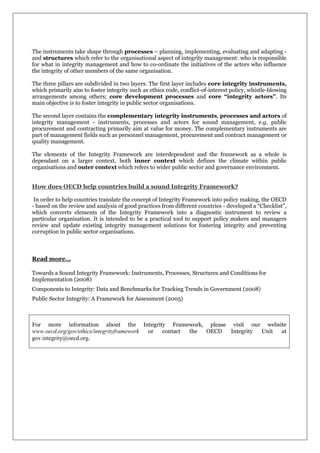
A sound integrity management is based on three main pillars: instruments, processes and
structures. The integrity instruments fulfill the following four main functions (complemented in
the graph below with a sample of examples):
The instruments take shape through processes – planning, implementing, evaluating and adapting -
and structures which refer to the organisational aspect of integrity management: who is responsible
for what in integrity management and how to co-ordinate the initiatives of the actors who influence
the integrity of other members of the same organisation.
The three pillars are subdivided in two layers. The first layer includes core integrity instruments,
which primarily aim to foster integrity such as ethics code, conflict-of-interest policy, whistle-blowing
arrangements among others; core development processes and core “integrity actors”. Its
main objective is to foster integrity in public sector organisations.
The second layer contains the complementary integrity instruments, processes and actors of
integrity management - instruments, processes and actors for sound management, e.g. public
procurement and contracting primarily aim at value for money. The complementary instruments are
part of management fields such as personnel management, procurement and contract management or
quality management.
The elements of the Integrity Framework are interdependent and the framework as a whole is
dependant on a larger context, both inner context which defines the climate within public
organisations and outer context which refers to wider public sector and governance environment.
How does OECD help countries build a sound Integrity Framework?
In order to help countries translate the concept of Integrity Framework into policy making, the OECD
- based on the review and analysis of good practices from different countries - developed a “Checklist”,
which converts elements of the Integrity Framework into a diagnostic instrument to review a
particular organisation. It is intended to be a practical tool to support policy makers and managers
review and update existing integrity management solutions for fostering integrity and preventing
corruption in public sector organisations.
Read more…
Towards a Sound Integrity Framework: Instruments, Processes, Structures and Conditions for
Implementation (2008)
Components to Integrity: Data and Benchmarks for Tracking Trends in Government (2008)
Public Sector Integrity: A Framework for Assessment (2005)
For more information about the Integrity Framework, please visit our website
www.oecd.org/gov/ethics/integrityframework or contact the OECD Integrity Unit at
gov.integrity@oecd.org.

Integrity framework

  • 1.
    INTEGRITY FRAMEWORK What isthe Integrity Framework? Integrity is a cornerstone of good governance. It is a pre-condition for legitimacy of government activities and – more generally – for trust in government. That is why integrity management has been a growing concern for countries around the globe for over a decade. The Integrity Framework is a systemic and comprehensive approach based on decades of research and data analysis. It brings together instruments, processes, and structures for fostering integrity and preventing corruption in public organisations. The Integrity Framework also takes into account factors and conditions for implementation that influence the integrity of its members, within and outside of public organisations. The Framework helps policy makers and managers depart from a fragmented mosaic vision of integrity management to a dynamic approach supporting policy implementation in public organizations. It also provides ground for developing data on implementation of integrity instruments and impact of public organisations. What are the key components of an Integrity Framework? A sound integrity management is based on three main pillars: instruments, processes and structures. The integrity instruments fulfill the following four main functions (complemented in the graph below with a sample of examples):
  • 2.
    The instruments takeshape through processes – planning, implementing, evaluating and adapting - and structures which refer to the organisational aspect of integrity management: who is responsible for what in integrity management and how to co-ordinate the initiatives of the actors who influence the integrity of other members of the same organisation. The three pillars are subdivided in two layers. The first layer includes core integrity instruments, which primarily aim to foster integrity such as ethics code, conflict-of-interest policy, whistle-blowing arrangements among others; core development processes and core “integrity actors”. Its main objective is to foster integrity in public sector organisations. The second layer contains the complementary integrity instruments, processes and actors of integrity management - instruments, processes and actors for sound management, e.g. public procurement and contracting primarily aim at value for money. The complementary instruments are part of management fields such as personnel management, procurement and contract management or quality management. The elements of the Integrity Framework are interdependent and the framework as a whole is dependant on a larger context, both inner context which defines the climate within public organisations and outer context which refers to wider public sector and governance environment. How does OECD help countries build a sound Integrity Framework? In order to help countries translate the concept of Integrity Framework into policy making, the OECD - based on the review and analysis of good practices from different countries - developed a “Checklist”, which converts elements of the Integrity Framework into a diagnostic instrument to review a particular organisation. It is intended to be a practical tool to support policy makers and managers review and update existing integrity management solutions for fostering integrity and preventing corruption in public sector organisations. Read more… Towards a Sound Integrity Framework: Instruments, Processes, Structures and Conditions for Implementation (2008) Components to Integrity: Data and Benchmarks for Tracking Trends in Government (2008) Public Sector Integrity: A Framework for Assessment (2005) For more information about the Integrity Framework, please visit our website www.oecd.org/gov/ethics/integrityframework or contact the OECD Integrity Unit at gov.integrity@oecd.org.