Integration Management
Tools and Techniques
Learning Unit 2
Overview of Integration management
• Integration refers to the coordination of processes; it is one of the most
crucial components of project management, which takes into account
all aspects of a project (Demirkesen & Ozorhon 2017). As the project
becomes more fragmented or complex, the need for integration
management is greater (Rodney et al. 2009). Project integration
management ensures successful coordination amongst project
activities (Demirkesen & Ozorhon 2017). “Project integration includes
characteristics of unification, consolidation, communication and
interrelationship” and this activity should be carried out throughout the
project (Project Management Institute 2017, p.69).
Overview of Integration management
Integration tools and techniques
• Feasibility study
• Progress report
• Project charter
Project charter
• Project charter: A project charter is a structured, fairly short document
that defines the totality of the project- what are the objectives, how
this should be achieved, or who are the stakeholders. It is a key
element in project planning, as it is used throughout the project
lifecycle. A project charter is a document authorising a project to
commence. Therefore, this document must be approved and signed on
time (Project Management Institute 2013).
Project charter
• Project charters are an important part of project management, as they
help plan out the basics of a project and can be referenced throughout
the project's lifecycle.
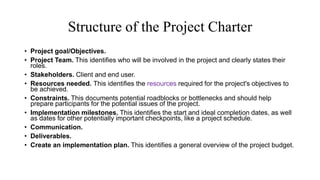
Structure of the Project Charter
• Project goal/Objectives.
• Project Team. This identifies who will be involved in the project and clearly states their
roles.
• Stakeholders. Client and end user.
• Resources needed. This identifies the resources required for the project's objectives to
be achieved.
• Constraints. This documents potential roadblocks or bottlenecks and should help
prepare participants for the potential issues of the project.
• Implementation milestones. This identifies the start and ideal completion dates, as well
as dates for other potentially important checkpoints, like a project schedule.
• Communication.
• Deliverables.
• Create an implementation plan. This identifies a general overview of the project budget.
Progress report
Progress report: A project status report communicates all business-
critical operations, developments and risks related to a project. A
project status report is an overview of where a project stands and how
different aspects of the project are performing (Bonghez et al. 2012).
• Advise on adjusting roles, schedule and budget
Progress Report
• Tone:
• Format: Design and use it for the entire project
• Content:
Feasibility study
• Feasibility study: This is an assessment that takes into account all the
factors associated with a project, including economic, technical, legal
and scheduling requirements- to assess the probability of successfully
completing the project (Tomanek et al. 2014).

Integration Management Tools and Techniques.pptx

  • 1.
    Integration Management Tools andTechniques Learning Unit 2
  • 2.
    Overview of Integrationmanagement • Integration refers to the coordination of processes; it is one of the most crucial components of project management, which takes into account all aspects of a project (Demirkesen & Ozorhon 2017). As the project becomes more fragmented or complex, the need for integration management is greater (Rodney et al. 2009). Project integration management ensures successful coordination amongst project activities (Demirkesen & Ozorhon 2017). “Project integration includes characteristics of unification, consolidation, communication and interrelationship” and this activity should be carried out throughout the project (Project Management Institute 2017, p.69).
  • 3.
  • 4.
    Integration tools andtechniques • Feasibility study • Progress report • Project charter
  • 5.
    Project charter • Projectcharter: A project charter is a structured, fairly short document that defines the totality of the project- what are the objectives, how this should be achieved, or who are the stakeholders. It is a key element in project planning, as it is used throughout the project lifecycle. A project charter is a document authorising a project to commence. Therefore, this document must be approved and signed on time (Project Management Institute 2013).
  • 6.
    Project charter • Projectcharters are an important part of project management, as they help plan out the basics of a project and can be referenced throughout the project's lifecycle.
  • 7.
    Structure of theProject Charter • Project goal/Objectives. • Project Team. This identifies who will be involved in the project and clearly states their roles. • Stakeholders. Client and end user. • Resources needed. This identifies the resources required for the project's objectives to be achieved. • Constraints. This documents potential roadblocks or bottlenecks and should help prepare participants for the potential issues of the project. • Implementation milestones. This identifies the start and ideal completion dates, as well as dates for other potentially important checkpoints, like a project schedule. • Communication. • Deliverables. • Create an implementation plan. This identifies a general overview of the project budget.
  • 8.
    Progress report Progress report:A project status report communicates all business- critical operations, developments and risks related to a project. A project status report is an overview of where a project stands and how different aspects of the project are performing (Bonghez et al. 2012). • Advise on adjusting roles, schedule and budget
  • 9.
    Progress Report • Tone: •Format: Design and use it for the entire project • Content:
  • 10.
    Feasibility study • Feasibilitystudy: This is an assessment that takes into account all the factors associated with a project, including economic, technical, legal and scheduling requirements- to assess the probability of successfully completing the project (Tomanek et al. 2014).