Integration by Parts
by Bryan Kim
Integration by Parts and
the Product Rule
Integration by Parts and the Product Rule
› “Every differentiation rule has a corresponding integration
rule”
– Chain Rule (differentiation)  Substitution Rule (Integration)
› Integration by Parts (integration) is correspondent to the
Product Rule (differentiation)
Integration by Parts and the Product Rule
[ ( ) ( )] ( ) ( ) ( ) ( )
( ) ( ) [ ( ) ( ) ( ) ( )]
( ) ( ) ( ) ( ) ( ) ( )
( ) ( ) ( ) ( ) ( ) ( )
d
f x g x f x g x g x f x
dx
f x g x f x g x g x f x dx
f x g x f x g x dx g x f x dx
f x g x dx f x g x g x f x dx
  
  
  
  

 
 
The product rule
(Equation 1), through
manipulation, results in
Integration by Parts
(Equation 4).
The Formula for
Integration by Parts
The Formula for Integration by Parts
Through substitutions of and , the above
equation ‘simplifies’ to the formula for Integration by Parts:
( ) ( ) ( ) ( ) ( ) ( )f x g x dx f x g x g x f x dx   
( )u f x ( )v g x
udv uv vdu  
Using Integration by Parts
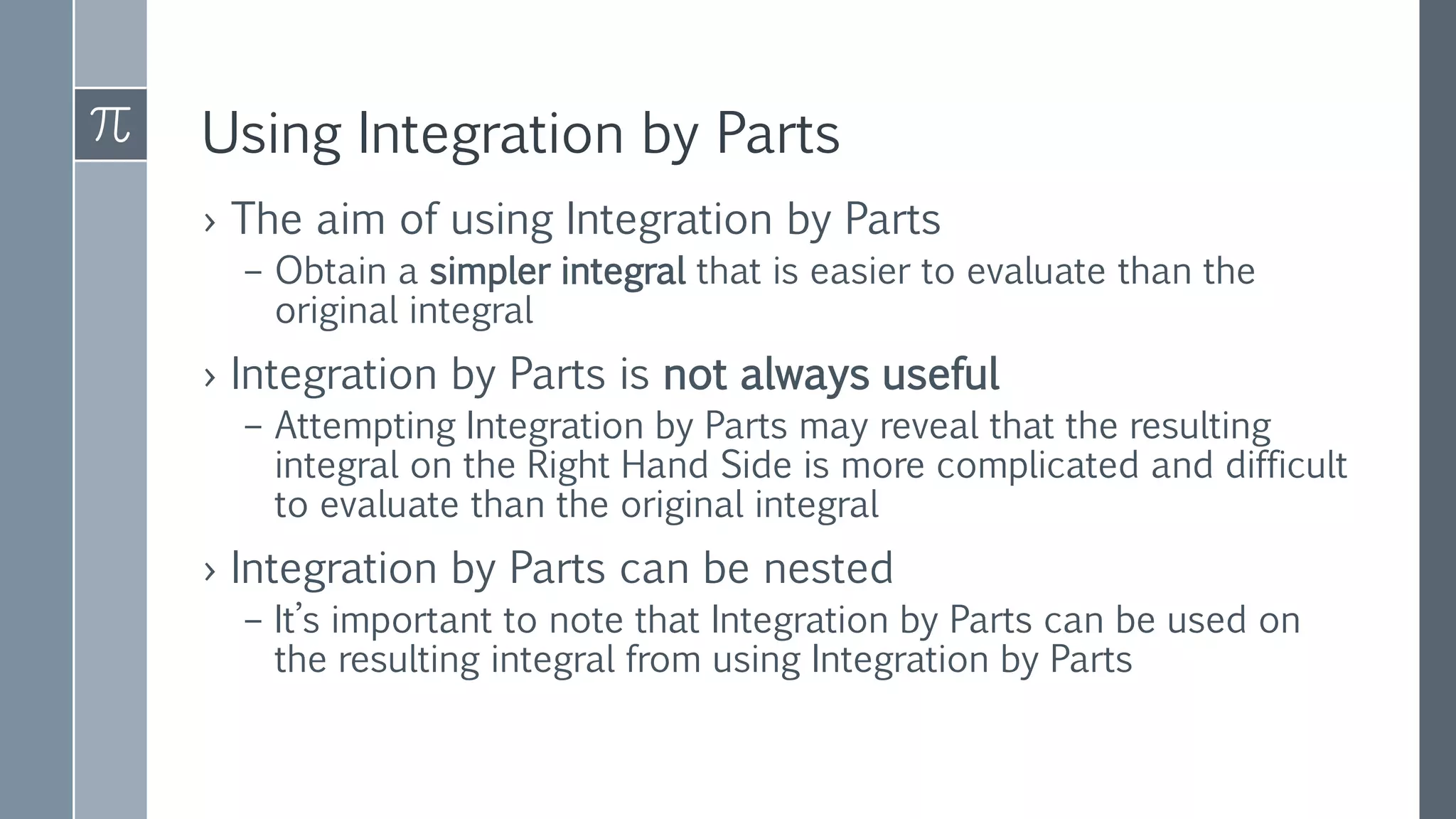
› The aim of using Integration by Parts
– Obtain a simpler integral that is easier to evaluate than the
original integral
› Integration by Parts is not always useful
– Attempting Integration by Parts may reveal that the resulting
integral on the Right Hand Side is more complicated and difficult
to evaluate than the original integral
› Integration by Parts can be nested
– It’s important to note that Integration by Parts can be used on
the resulting integral from using Integration by Parts
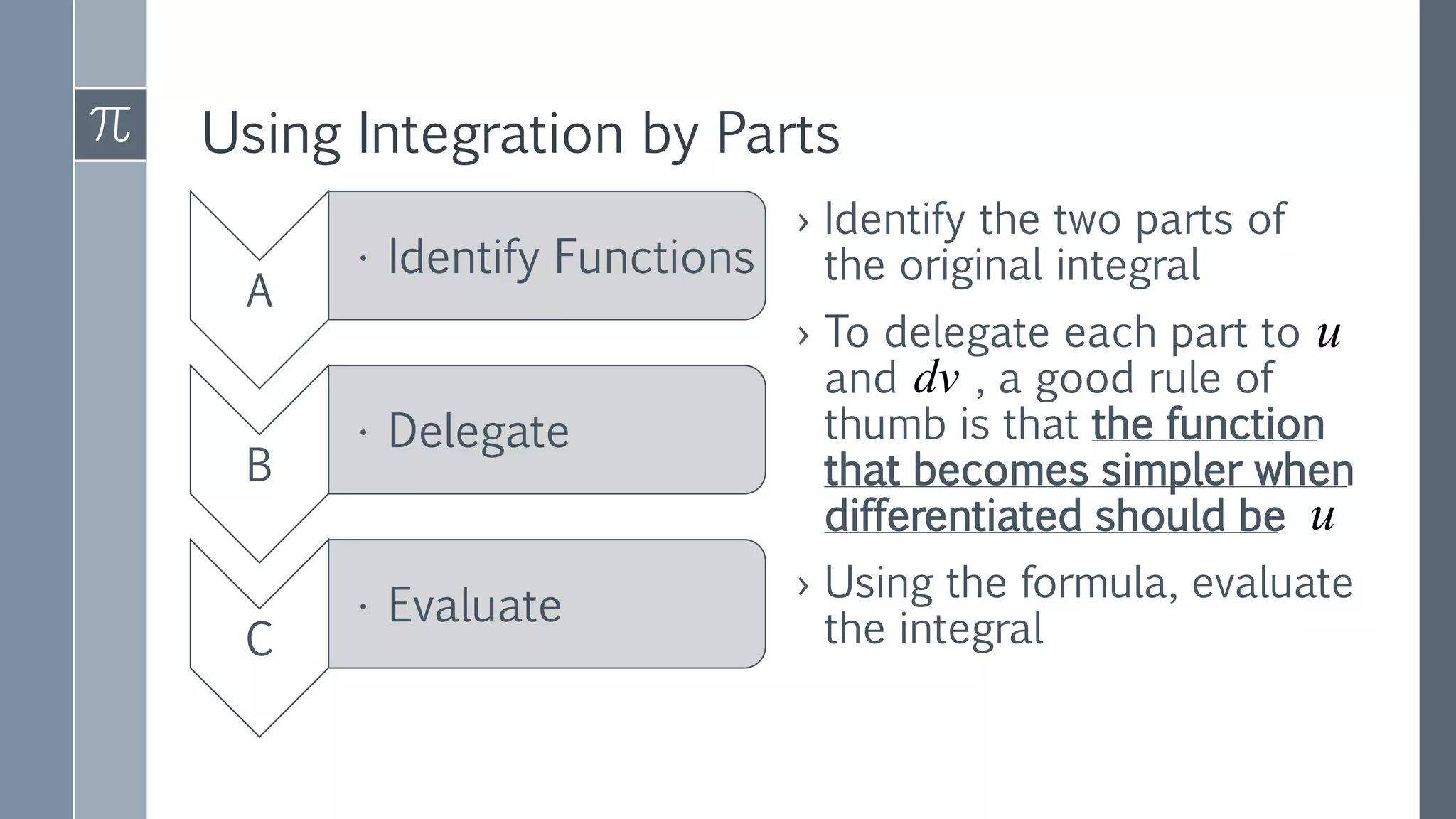
Using Integration by Parts
A
• Identify Functions
B
• Delegate
C
• Evaluate
› Identify the two parts of
the original integral
› To delegate each part to
and , a good rule of
thumb is that the function
that becomes simpler when
differentiated should be
› Using the formula, evaluate
the integral
u
dv
u
Using Integration by Parts
› It can be helpful to use the pattern as shown.
...u 
...du 
...dv 
...v 
Example 1
Evaluate ln xdx
lnu x
1
du dx
x

dv dx
v x
Recalling the formula for Integration by Parts: . Note that the above
integral is quite crucial and the answer should be memorized if possible.
udv uv vdu  
Evaluate ln xdx
ln ln
ln
ln
dx
xdx x x x
x
x x dx
x x x C
 
 
  
 

This is an extremely simple and
straightforward use of
Integration by Parts, but is
sufficient to demonstrate its
power. The given integral would
not very difficult and
complicated to solve without
utilizing Integration by Parts
Example 2
Evaluate sinx
e xdx
sinu x
cosdu xdx
x
dv e dx
x
v e
Recalling the formula for Integration by Parts: . Note that in the above
integral, neither parts become simpler when differentiated. However, in hopes of avoiding
negatives, .
udv uv vdu  
sinu x
Evaluate
sin sin cosx x x
e xdx e x e xdx  
Using the Formula for Integration of Parts is meant to result in an
integral that is simpler to evaluate than the original. In this case, we
result in an integral with equal complexity. However, since the
resulting integral is not more complex, we apply the Formula for
Integration of Parts on the resulting integral.
sinx
e xdx
Evaluate
cosu x
sindu xdx 
x
dv e dx
x
v e
Recalling the formula for Integration by Parts: .udv uv vdu  
cosx
e xdx
Evaluate
cos cos sinx x x
e xdx e x e xdx  
The resulting integral this time is, again, of equal complexity. However,
notice that it is equal to the original integral. Using this, we can
evaluate the original integral and break from this seemingly never-
ending loop.
cosx
e xdx
Evaluate
sin sin cos
sin ( cos sin )
sin cos sin
1
( sin cos )
2
x x x
x x x
x x x
x x
e xdx e x e x
e x e x e xdx
e x e x e xdx
e x e x C
 
  
  
  
 


In this example, utilizing Integration by Parts initially seemed to be
irrelevant, as the resulting integral was equal in complexity to the
original integral. However, “nesting” Integration by Parts allowed to
algebraically manipulate and ultimately solve for the original integral.
sinx
e xdx
Thanks!

Integration By Parts

  • 1.
  • 2.
    Integration by Partsand the Product Rule
  • 3.
    Integration by Partsand the Product Rule › “Every differentiation rule has a corresponding integration rule” – Chain Rule (differentiation)  Substitution Rule (Integration) › Integration by Parts (integration) is correspondent to the Product Rule (differentiation)
  • 4.
    Integration by Partsand the Product Rule [ ( ) ( )] ( ) ( ) ( ) ( ) ( ) ( ) [ ( ) ( ) ( ) ( )] ( ) ( ) ( ) ( ) ( ) ( ) ( ) ( ) ( ) ( ) ( ) ( ) d f x g x f x g x g x f x dx f x g x f x g x g x f x dx f x g x f x g x dx g x f x dx f x g x dx f x g x g x f x dx                  The product rule (Equation 1), through manipulation, results in Integration by Parts (Equation 4).
  • 5.
  • 6.
    The Formula forIntegration by Parts Through substitutions of and , the above equation ‘simplifies’ to the formula for Integration by Parts: ( ) ( ) ( ) ( ) ( ) ( )f x g x dx f x g x g x f x dx    ( )u f x ( )v g x udv uv vdu  
  • 7.
  • 8.
    Using Integration byParts › The aim of using Integration by Parts – Obtain a simpler integral that is easier to evaluate than the original integral › Integration by Parts is not always useful – Attempting Integration by Parts may reveal that the resulting integral on the Right Hand Side is more complicated and difficult to evaluate than the original integral › Integration by Parts can be nested – It’s important to note that Integration by Parts can be used on the resulting integral from using Integration by Parts
  • 9.
    Using Integration byParts A • Identify Functions B • Delegate C • Evaluate › Identify the two parts of the original integral › To delegate each part to and , a good rule of thumb is that the function that becomes simpler when differentiated should be › Using the formula, evaluate the integral u dv u
  • 10.
    Using Integration byParts › It can be helpful to use the pattern as shown. ...u  ...du  ...dv  ...v 
  • 11.
  • 12.
    Evaluate ln xdx lnux 1 du dx x  dv dx v x Recalling the formula for Integration by Parts: . Note that the above integral is quite crucial and the answer should be memorized if possible. udv uv vdu  
  • 13.
    Evaluate ln xdx lnln ln ln dx xdx x x x x x x dx x x x C           This is an extremely simple and straightforward use of Integration by Parts, but is sufficient to demonstrate its power. The given integral would not very difficult and complicated to solve without utilizing Integration by Parts
  • 14.
  • 15.
    Evaluate sinx e xdx sinux cosdu xdx x dv e dx x v e Recalling the formula for Integration by Parts: . Note that in the above integral, neither parts become simpler when differentiated. However, in hopes of avoiding negatives, . udv uv vdu   sinu x
  • 16.
    Evaluate sin sin cosxx x e xdx e x e xdx   Using the Formula for Integration of Parts is meant to result in an integral that is simpler to evaluate than the original. In this case, we result in an integral with equal complexity. However, since the resulting integral is not more complex, we apply the Formula for Integration of Parts on the resulting integral. sinx e xdx
  • 17.
    Evaluate cosu x sindu xdx x dv e dx x v e Recalling the formula for Integration by Parts: .udv uv vdu   cosx e xdx
  • 18.
    Evaluate cos cos sinxx x e xdx e x e xdx   The resulting integral this time is, again, of equal complexity. However, notice that it is equal to the original integral. Using this, we can evaluate the original integral and break from this seemingly never- ending loop. cosx e xdx
  • 19.
    Evaluate sin sin cos sin( cos sin ) sin cos sin 1 ( sin cos ) 2 x x x x x x x x x x x e xdx e x e x e x e x e xdx e x e x e xdx e x e x C                In this example, utilizing Integration by Parts initially seemed to be irrelevant, as the resulting integral was equal in complexity to the original integral. However, “nesting” Integration by Parts allowed to algebraically manipulate and ultimately solve for the original integral. sinx e xdx
  • 20.