Integrating service level agreements optimizing
your OSS for SLA delivery 1st Edition John Lee
pdf download
https://ebookgate.com/product/integrating-service-level-
agreements-optimizing-your-oss-for-sla-delivery-1st-edition-john-
lee/
Get Instant Ebook Downloads – Browse at https://ebookgate.com
Get Your Digital Files Instantly: PDF, ePub, MOBI and More
Quick Digital Downloads: PDF, ePub, MOBI and Other Formats
Service Operations Management Improving Service
Delivery 4th Edition Robert Johnson
https://ebookgate.com/product/service-operations-management-
improving-service-delivery-4th-edition-robert-johnson/
Emarketing Excellence Planning and Optimizing your
Digital Marketing 4th Edition Dave Chaffey
https://ebookgate.com/product/emarketing-excellence-planning-and-
optimizing-your-digital-marketing-4th-edition-dave-chaffey/
E Commerce E Business and E Service 1st Edition Garry
Lee
https://ebookgate.com/product/e-commerce-e-business-and-e-
service-1st-edition-garry-lee/
The Cloud at Your Service 1st Edition Jothy Rosenberg
https://ebookgate.com/product/the-cloud-at-your-service-1st-
edition-jothy-rosenberg/
Upgrade Your Spanish 1st Edition Abigail Lee Six
https://ebookgate.com/product/upgrade-your-spanish-1st-edition-
abigail-lee-six/
RNA Therapeutics Function Design and Delivery 1st
Edition John Karijolich
https://ebookgate.com/product/rna-therapeutics-function-design-
and-delivery-1st-edition-john-karijolich/
Integrating Geographic Information Systems into Library
Services A Guide for Academic Libraries 1st Edition
John Abresch
https://ebookgate.com/product/integrating-geographic-information-
systems-into-library-services-a-guide-for-academic-libraries-1st-
edition-john-abresch/
Integrating Your e Business Enterprise Sams White Book
1st Edition Andre Yee
https://ebookgate.com/product/integrating-your-e-business-
enterprise-sams-white-book-1st-edition-andre-yee/
Managing service level quality across wireless and
fixed networks 1st edition Edition Peter Massam
https://ebookgate.com/product/managing-service-level-quality-
across-wireless-and-fixed-networks-1st-edition-edition-peter-
massam/
T
E
A
M
F
L
Y
Wiley Publishing, Inc.
John J. Lee
Ron Ben-Natan
Integrating Service
Level Agreements
Optimizing Your OSS for SLA Delivery
Integrating Service
Level Agreements
Optimizing Your OSS for SLA Delivery
Wiley Publishing, Inc.
John J. Lee
Ron Ben-Natan
Integrating Service
Level Agreements
Optimizing Your OSS for SLA Delivery
Publisher: Robert Ipsen
Editor: Margaret Eldridge
Developmental Editor: Kathryn Malm
Managing Editor: Pamela Hanley
New Media Editor: Brian Snapp
Text Design & Composition: Wiley Composition Services
Designations used by companies to distinguish their products are often claimed as trademarks. In all
instances where Wiley Publishing, Inc., is aware of a claim, the product names appear in initial capital
or ALL CAPITAL LETTERS. Readers, however, should contact the appropriate companies for more complete
information regarding trademarks and registration.
This book is printed on acid-free paper. ∞
Copyright © 2002 by John J. Lee and Ron Ben-Natan. All rights reserved.
Published by Wiley Publishing, Inc., Indianapolis, Indiana
Published simultaneously in Canada
No part of this publication may be reproduced, stored in a retrieval system, or transmitted in any form
or by any means, electronic, mechanical, photocopying, recording, scanning, or otherwise, except as
permitted under Section 107 or 108 of the 1976 United States Copyright Act, without either the prior
written permission of the Publisher, or authorization through payment of the appropriate per-copy fee
to the Copyright Clearance Center, Inc., 222 Rosewood Drive, Danvers, MA 01923, (978) 750-8400, fax
(978) 750-4470. Requests to the Publisher for permission should be addressed to the Legal Department,
Wiley Publishing, Inc., 10475 Crosspointe Blvd., Indianapolis, IN 46256, (317) 572-3447, fax (317)
572-4447, E-mail: permcoordinator@wiley.com.
Limit of Liability/Disclaimer of Warranty: While the publisher and author have used their best efforts
in preparing this book, they make no representations or warranties with respect to the accuracy or com-
pleteness of the contents of this book and specifically disclaim any implied warranties of mer-
chantability or fitness for a particular purpose. No warranty may be created or extended by sales
representatives or written sales materials. The advice and strategies contained herein may not be suit-
able for your situation. You should consult with a professional where appropriate. Neither the pub-
lisher nor author shall be liable for any loss of profit or any other commercial damages, including but
not limited to special, incidental, consequential, or other damages.
For general information on our other products and services please contact our Customer Care Depart-
ment within the United States at (800) 762-2974, outside the United States at (317) 572-3993 or fax (317)
572-4002.
Wiley also publishes its books in a variety of electronic formats. Some content that appears in print may
not be available in electronic books.
Library of Congress Cataloging-in-Publication Data:
Lee, John (John J.), 1961-
Integrating service level agreements : optimizing your OSS for SLA
delivery / John Lee, Ron Ben-Natan.
p. cm.
Includes bibliographical references and index.
ISBN 0-471-21012-9
1. Telecommunication—Quality control. 2. Service-level agreements.
3. Telecommunication—Customer service. 4. Internet service providers.
5. Information technology. I. Ben-Natan, Ron. II. Title.
TK5102.84 .L44 2002
004.6'068—dc21
2002008682
Printed in the United States of America
10 9 8 7 6 5 4 3 2 1
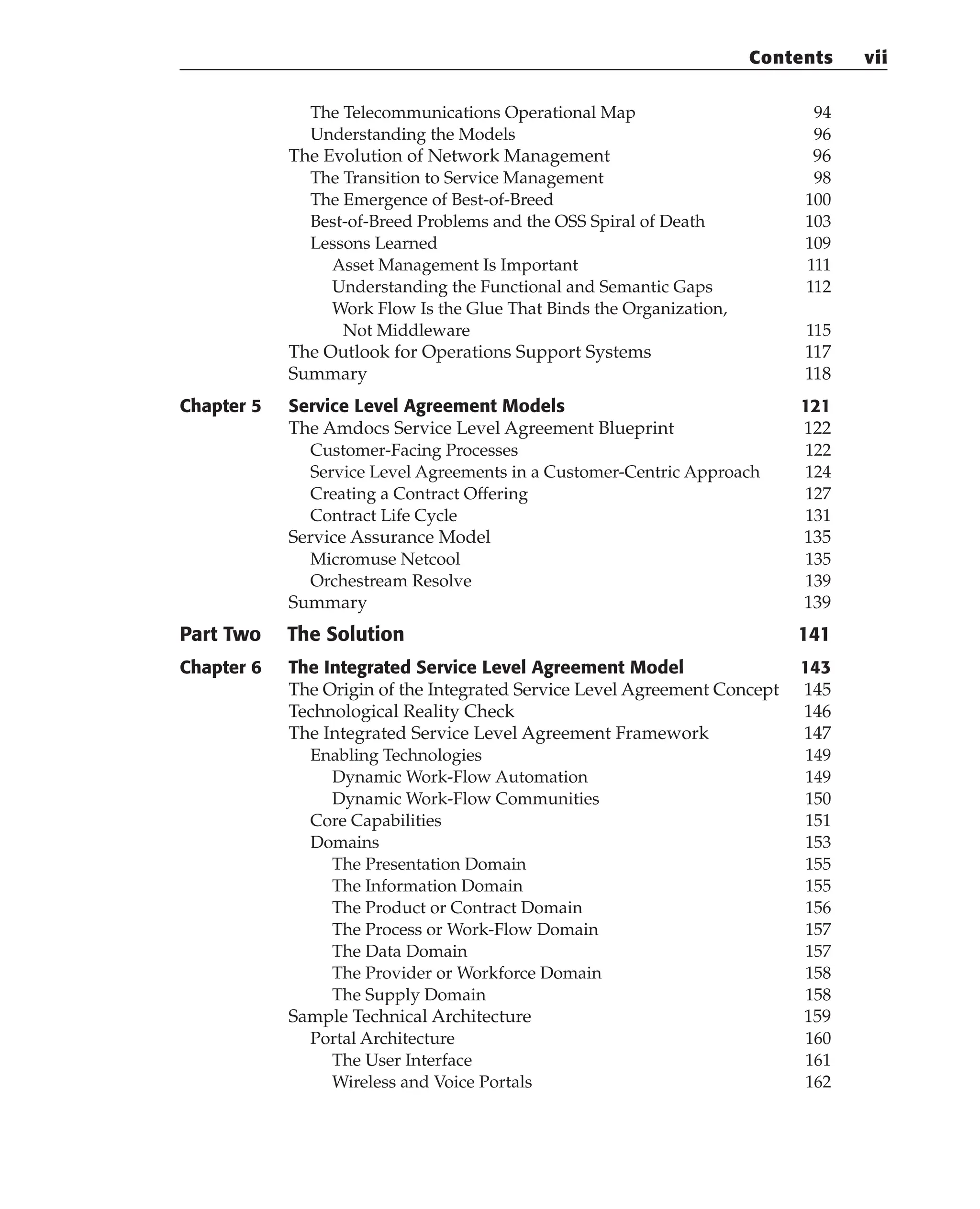
Contents
v
About the Authors xvii
Part One The Problem 1
Chapter 1 What Are Service Level Agreements? 3
Definition 3
Service Level Agreement Roles and Objectives 5
Defining Roles and Accountability 6
Managing Expectations 8
Controling Implementation and Execution 10
Providing Quality of Service Verification 11
Enabling Communications 13
Assessing Return on Investment 14
The Service Level Agreement Life Cycle 14
SLA Development 15
Negotiation and Sales 18
Implementation 19
Execution 19
Assessment 19
Customer-focused Assessments 20
Provider-focused Assessments 20
The Outlook for Service Level Agreements 22
The Growth in Outsourcing 22
The Emergence of Pure Content Providers 24
Summary 25
Chapter 2 The True Intent of Service Level Agreements 27
Evolution 27
Availability 28
Customer Care 29
Understanding Need Hierarchies 30
The Service Level Agreement Need Hierarchy 31
The Emergence of the Business Impact Financial Model 33
Provider-Centric Methodology 34
Business Impact Methodology 36
Big Stick versus Business Impact 37
Service Level Agreement Success Factors 39
Definable End-to-End 40
Successfully Deliverable 41
Meaningful Entitlement Metrics 44
Measurable at the Service Access Point 46
Visible 49
Reconcilable 53
Summary 55
Chapter 3 The Long Ascent to True Service Level Agreement Delivery 57
Why Delivery Is Important 57
Where We’ve Been 58
Some Good Examples of Bad Service Level Agreements 60
Example Summary 64
Understanding the Complexities in the Network Environment 65
The Explosion of Data Networking 67
New Technology 67
The Premise Factor 68
New Market Entrants 70
Tight Labor Markets 72
Organizational Stovepipes 74
Work-Flow Complexity 77
Competition Adds Many More Players 78
New Technology and Business Models Add More Complexity 79
Summary: A Confluence of Factors 81
The Great Boom Commences 82
Operational Reality Interrupts the Party 82
What Issues Lie Ahead for Service Level Agreements? 84
Summary 85
Chapter 4 The Operations Support System 87
The Operations Support System 88
Thought Leadership and Industry Models 90
The TeleManagement Forum 90
The Telecommunications Management Network Model 90
The Network Element Layer 92
The Element Management Layer 92
The Network Management Layer 92
The Service Management Layer 93
The Business Management Layer 94
vi Contents
The Telecommunications Operational Map 94
Understanding the Models 96
The Evolution of Network Management 96
The Transition to Service Management 98
The Emergence of Best-of-Breed 100
Best-of-Breed Problems and the OSS Spiral of Death 103
Lessons Learned 109
Asset Management Is Important 111
Understanding the Functional and Semantic Gaps 112
Work Flow Is the Glue That Binds the Organization,
Not Middleware 115
The Outlook for Operations Support Systems 117
Summary 118
Chapter 5 Service Level Agreement Models 121
The Amdocs Service Level Agreement Blueprint 122
Customer-Facing Processes 122
Service Level Agreements in a Customer-Centric Approach 124
Creating a Contract Offering 127
Contract Life Cycle 131
Service Assurance Model 135
Micromuse Netcool 135
Orchestream Resolve 139
Summary 139
Part Two The Solution 141
Chapter 6 The Integrated Service Level Agreement Model 143
The Origin of the Integrated Service Level Agreement Concept 145
Technological Reality Check 146
The Integrated Service Level Agreement Framework 147
Enabling Technologies 149
Dynamic Work-Flow Automation 149
Dynamic Work-Flow Communities 150
Core Capabilities 151
Domains 153
The Presentation Domain 155
The Information Domain 155
The Product or Contract Domain 156
The Process or Work-Flow Domain 157
The Data Domain 157
The Provider or Workforce Domain 158
The Supply Domain 158
Sample Technical Architecture 159
Portal Architecture 160
The User Interface 161
Wireless and Voice Portals 162
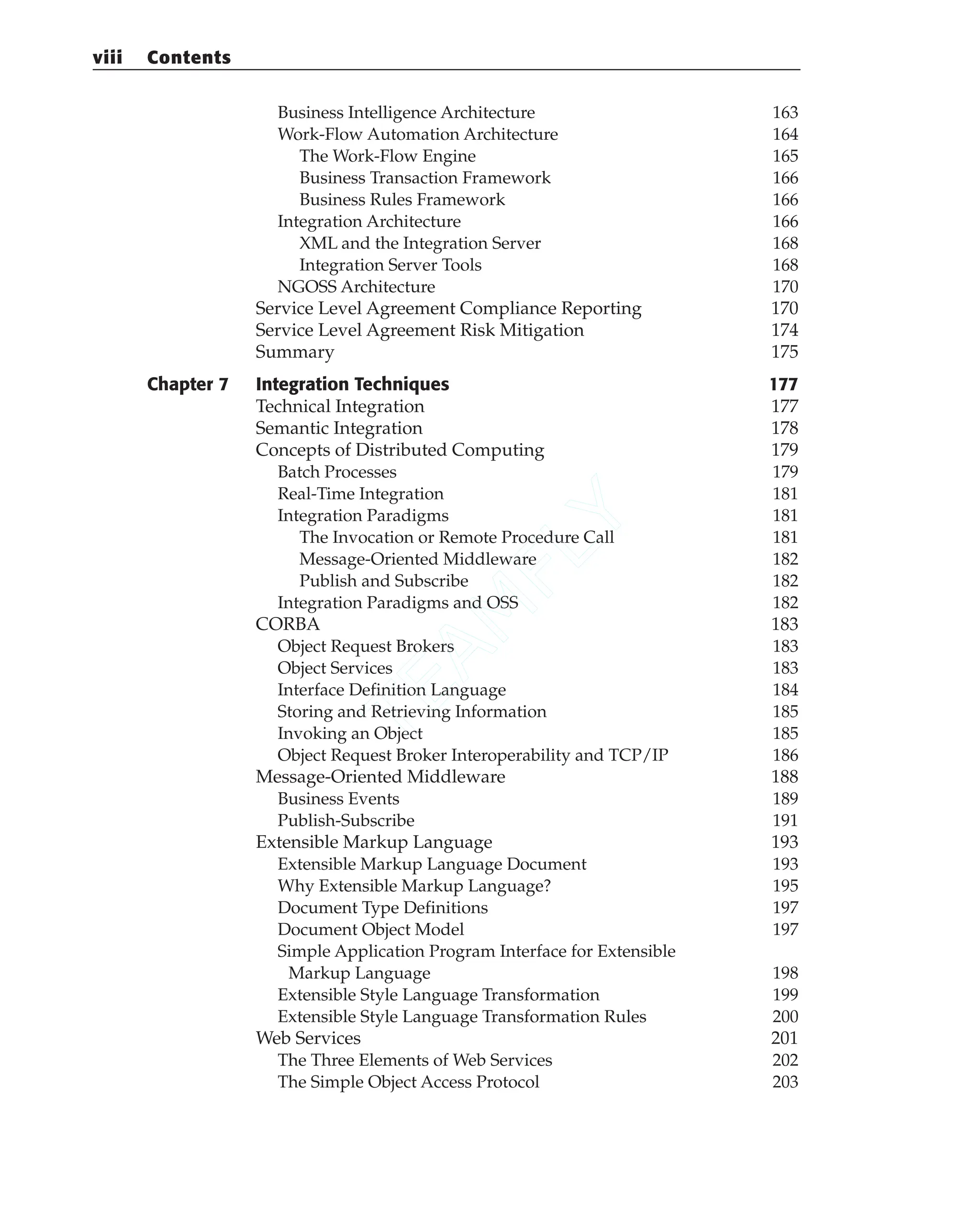
Contents vii
Business Intelligence Architecture 163
Work-Flow Automation Architecture 164
The Work-Flow Engine 165
Business Transaction Framework 166
Business Rules Framework 166
Integration Architecture 166
XML and the Integration Server 168
Integration Server Tools 168
NGOSS Architecture 170
Service Level Agreement Compliance Reporting 170
Service Level Agreement Risk Mitigation 174
Summary 175
Chapter 7 Integration Techniques 177
Technical Integration 177
Semantic Integration 178
Concepts of Distributed Computing 179
Batch Processes 179
Real-Time Integration 181
Integration Paradigms 181
The Invocation or Remote Procedure Call 181
Message-Oriented Middleware 182
Publish and Subscribe 182
Integration Paradigms and OSS 182
CORBA 183
Object Request Brokers 183
Object Services 183
Interface Definition Language 184
Storing and Retrieving Information 185
Invoking an Object 185
Object Request Broker Interoperability and TCP/IP 186
Message-Oriented Middleware 188
Business Events 189
Publish-Subscribe 191
Extensible Markup Language 193
Extensible Markup Language Document 193
Why Extensible Markup Language? 195
Document Type Definitions 197
Document Object Model 197
Simple Application Program Interface for Extensible
Markup Language 198
Extensible Style Language Transformation 199
Extensible Style Language Transformation Rules 200
Web Services 201
The Three Elements of Web Services 202
The Simple Object Access Protocol 203
viii Contents
T
E
A
M
F
L
Y
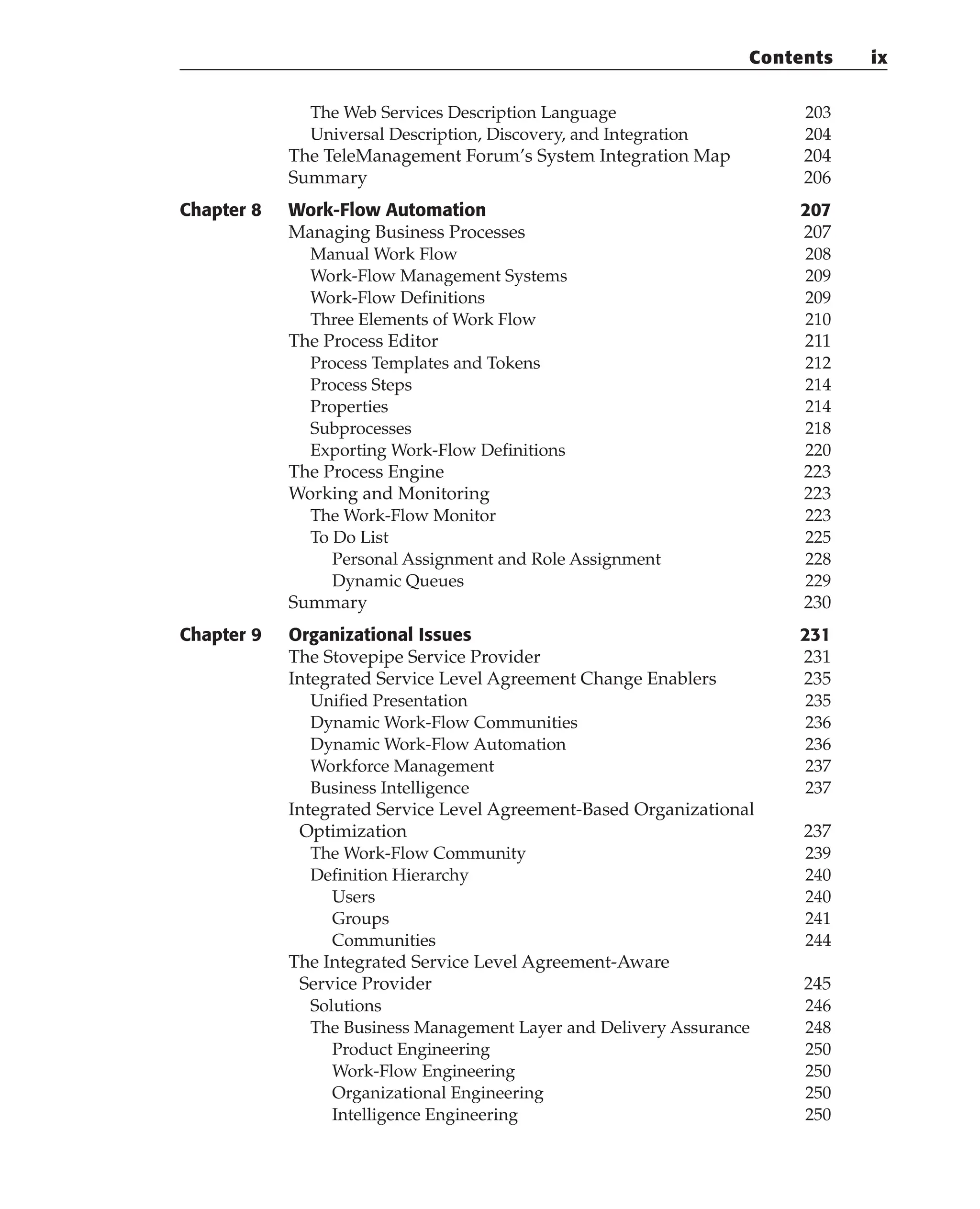
The Web Services Description Language 203
Universal Description, Discovery, and Integration 204
The TeleManagement Forum’s System Integration Map 204
Summary 206
Chapter 8 Work-Flow Automation 207
Managing Business Processes 207
Manual Work Flow 208
Work-Flow Management Systems 209
Work-Flow Definitions 209
Three Elements of Work Flow 210
The Process Editor 211
Process Templates and Tokens 212
Process Steps 214
Properties 214
Subprocesses 218
Exporting Work-Flow Definitions 220
The Process Engine 223
Working and Monitoring 223
The Work-Flow Monitor 223
To Do List 225
Personal Assignment and Role Assignment 228
Dynamic Queues 229
Summary 230
Chapter 9 Organizational Issues 231
The Stovepipe Service Provider 231
Integrated Service Level Agreement Change Enablers 235
Unified Presentation 235
Dynamic Work-Flow Communities 236
Dynamic Work-Flow Automation 236
Workforce Management 237
Business Intelligence 237
Integrated Service Level Agreement-Based Organizational
Optimization 237
The Work-Flow Community 239
Definition Hierarchy 240
Users 240
Groups 241
Communities 244
The Integrated Service Level Agreement-Aware
Service Provider 245
Solutions 246
The Business Management Layer and Delivery Assurance 248
Product Engineering 250
Work-Flow Engineering 250
Organizational Engineering 250
Intelligence Engineering 250
Contents ix
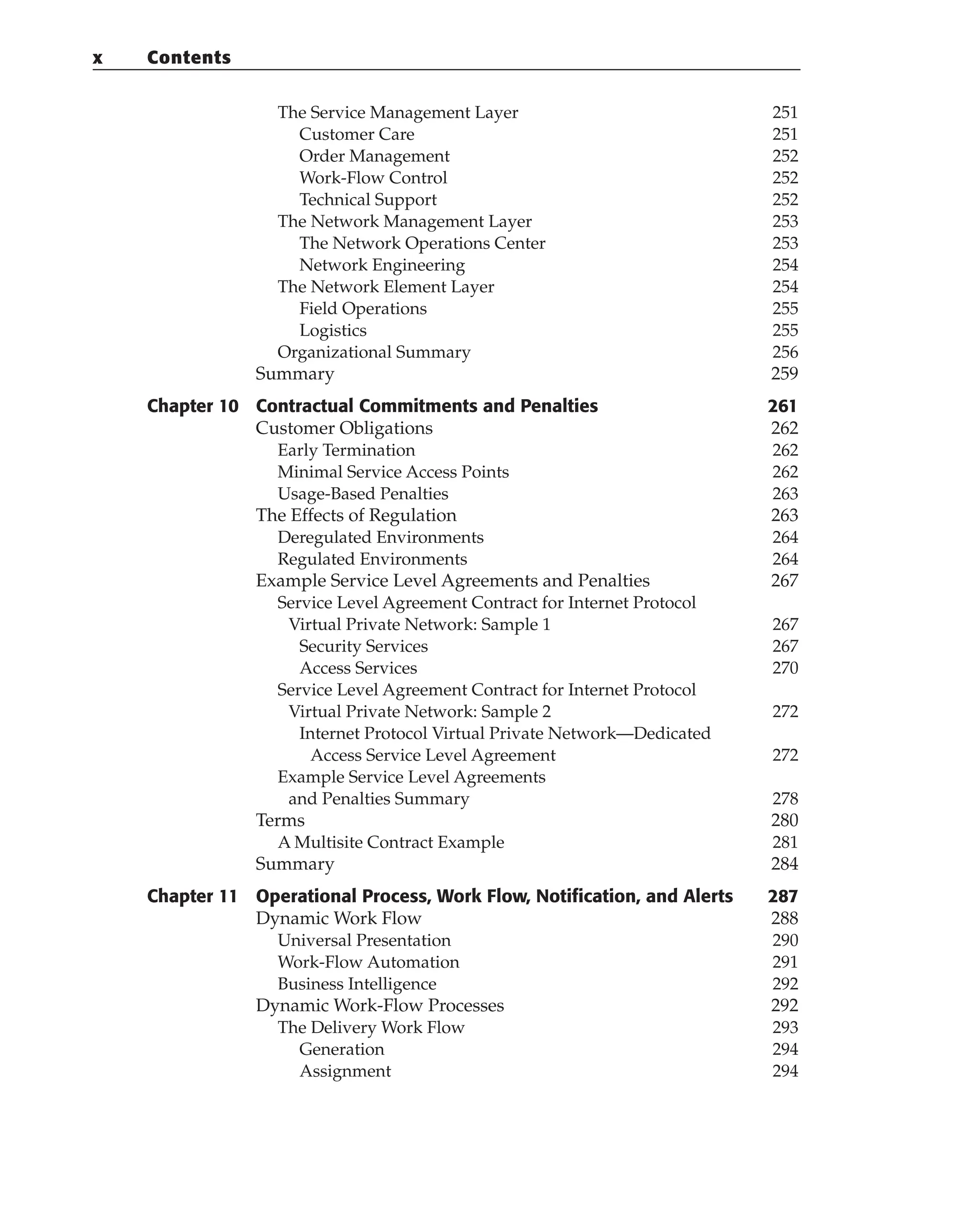
The Service Management Layer 251
Customer Care 251
Order Management 252
Work-Flow Control 252
Technical Support 252
The Network Management Layer 253
The Network Operations Center 253
Network Engineering 254
The Network Element Layer 254
Field Operations 255
Logistics 255
Organizational Summary 256
Summary 259
Chapter 10 Contractual Commitments and Penalties 261
Customer Obligations 262
Early Termination 262
Minimal Service Access Points 262
Usage-Based Penalties 263
The Effects of Regulation 263
Deregulated Environments 264
Regulated Environments 264
Example Service Level Agreements and Penalties 267
Service Level Agreement Contract for Internet Protocol
Virtual Private Network: Sample 1 267
Security Services 267
Access Services 270
Service Level Agreement Contract for Internet Protocol
Virtual Private Network: Sample 2 272
Internet Protocol Virtual Private Network—Dedicated
Access Service Level Agreement 272
Example Service Level Agreements
and Penalties Summary 278
Terms 280
A Multisite Contract Example 281
Summary 284
Chapter 11 Operational Process, Work Flow, Notification, and Alerts 287
Dynamic Work Flow 288
Universal Presentation 290
Work-Flow Automation 291
Business Intelligence 292
Dynamic Work-Flow Processes 292
The Delivery Work Flow 293
Generation 294
Assignment 294
x Contents
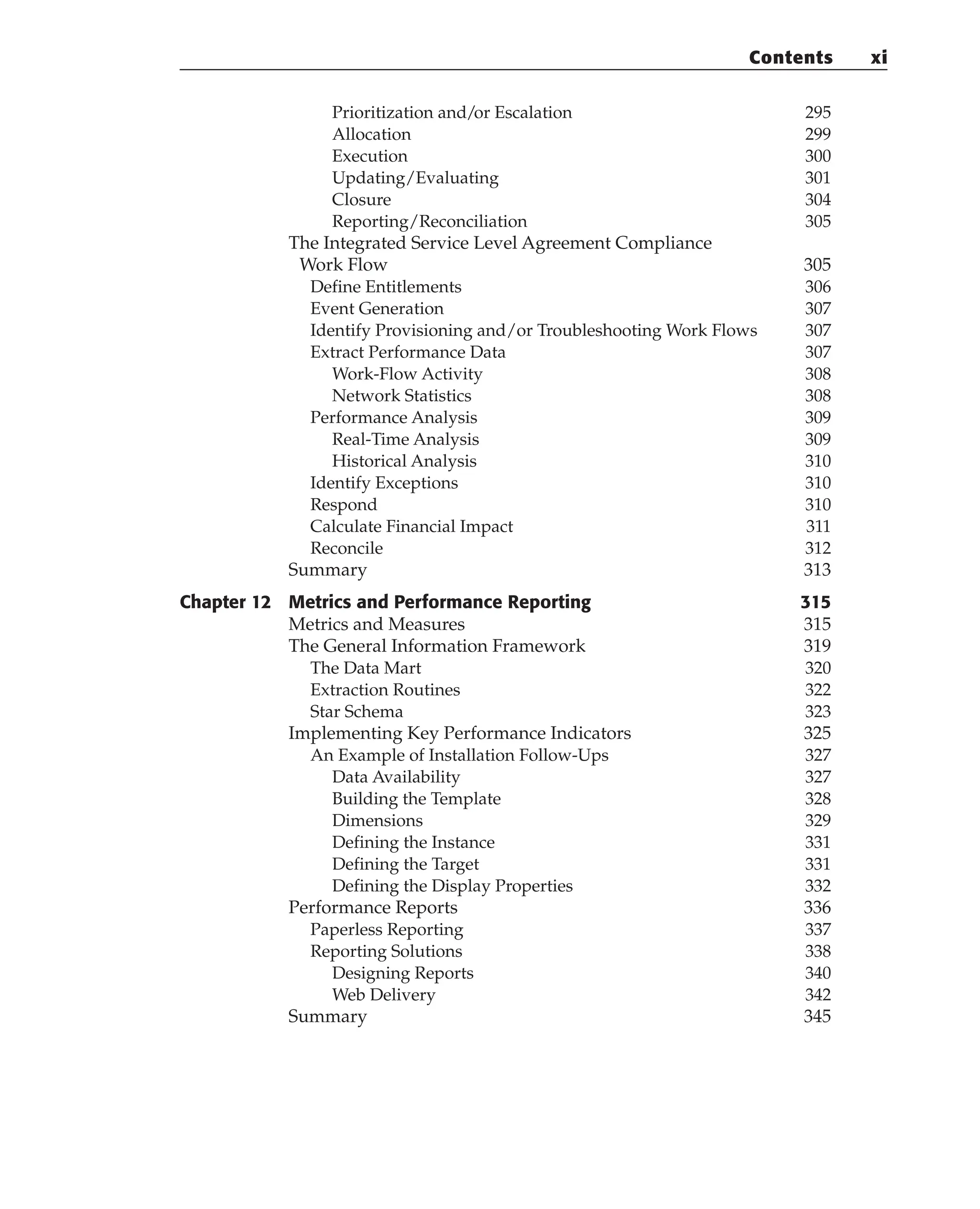
Prioritization and/or Escalation 295
Allocation 299
Execution 300
Updating/Evaluating 301
Closure 304
Reporting/Reconciliation 305
The Integrated Service Level Agreement Compliance
Work Flow 305
Define Entitlements 306
Event Generation 307
Identify Provisioning and/or Troubleshooting Work Flows 307
Extract Performance Data 307
Work-Flow Activity 308
Network Statistics 308
Performance Analysis 309
Real-Time Analysis 309
Historical Analysis 310
Identify Exceptions 310
Respond 310
Calculate Financial Impact 311
Reconcile 312
Summary 313
Chapter 12 Metrics and Performance Reporting 315
Metrics and Measures 315
The General Information Framework 319
The Data Mart 320
Extraction Routines 322
Star Schema 323
Implementing Key Performance Indicators 325
An Example of Installation Follow-Ups 327
Data Availability 327
Building the Template 328
Dimensions 329
Defining the Instance 331
Defining the Target 331
Defining the Display Properties 332
Performance Reports 336
Paperless Reporting 337
Reporting Solutions 338
Designing Reports 340
Web Delivery 342
Summary 345
Contents xi
Chapter 13 Service Level Agreement Portals:
A Unified Presentation Layer 347
Unified Presentation 348
Information Portals 348
Enterprise Information Portals 349
The Service Level Agreement Portal 349
Uniform Resource Locator Automation and Scripting 352
Automating the Flow 357
Uniform Resource Locator Automation Using Work Flow 360
An Application Session 360
Web “Scraping” 360
Chaining Requests 361
Enter Work Flow 361
Using the Work-Flow Token 361
Extracting Data from Scraped Pages 362
Security, Access Control, and Profiles 363
Integrating Interface Layers 364
Directory Services and the Lightweight Directory
Access Protocol 365
Summary 366
Chapter 14 Notification, Mobile Computing, and Wireless Access 369
Notification 370
Synchronous and Asynchronous Notification 371
Internet-Based Notification 371
Paging 373
Telocator Alphanumeric Protocol and Simple
Mail Transfer Protocol 376
Simple Network Paging Protocol 380
Wireless Communications Transfer Protocol 381
Short Message Service 383
Workforce Management 384
Meeting Service Level Agreements through Efficient
Use of the Workforce 384
Mobile Computing 387
Wireless Infrastructure for Mobile Computing 388
Summary 390
Chapter 15 Service Marketplaces and Bandwidth Exchanges 391
The Liquidity Issue 393
Success Factors 395
Product 395
Price 395
Implementation 395
Quality 396
Settlement 396
Consolidating the Factors 396
xii Contents
The Vision 396
The Need 399
Solutions 401
Product 402
Price 403
Implementation 404
Quality 405
Settlement 406
The Outlook for Exchanges 406
Summary 409
Chapter 16 Applying the Model to Other Industries 411
Utilities 412
Customer Service and Service Delivery 417
Quality Assurance 422
ISO 9000 422
Six Sigma 423
Summary 425
Appendix Acronyms 427
Bibliography 433
Index 437
Contents xiii
“There is a wisdom of the head and a wisdom of the heart”
Charles Dickens
To our wives, Becky and Rinat, whose endless dedication and
tireless support form the foundation of our success.
John J. Lee is Vice President of Strategy and Business Solutions at ViryaNet, a
company that provides wireless workforce solutions. He is an expert in the
development of operation and business support systems and a frequent con-
tributor to industry publications.
Ron Ben-Natan is CTO at ViryaNet and has been building distributed systems
and applications at companies like Intel, Merrill Lynch, J. P. Morgan, and
AT&T Bell Labs for the past 20 years. He has authored several successful books
on distributed systems and the application of advanced technologies in busi-
ness environments.
About the Authors
xvii
T
E
A
M
F
L
Y
PART
One
The Problem
3
In Chapter 1 we will describe SLAs, discuss why they are important, and
demonstrate why they are on the way to becoming the driving concept behind
all service models.
Service level agreements (SLAs) are about making promises. In the case of
telecommunications, these are the promises that underlie all the fiber being
laid; all the optics and electronics being developed, bought, installed, and
turned up and the exact same promises that drove venture capitalists and
investors to back all those telecom businesses that had absolutely no chance—
none whatsoever—of ever making a dime.
Definition
In its most basic form, a service level agreement (SLA) is a contract or agree-
ment that formalizes a business relationship, or part of the relationship,
between two parties. Most often it takes the form of a negotiated contract
made between a service provider and a customer and defines a price paid in
exchange for an entitlement to a product or service to be delivered under cer-
tain terms, conditions, and with certain financial guarantees.
The TeleManagement Forum’s SLA Management Handbook defines an SLA
as “[a] formal negotiated agreement between two parties, sometimes called a
What Are Service Level
Agreements?
C HAPTE R
1
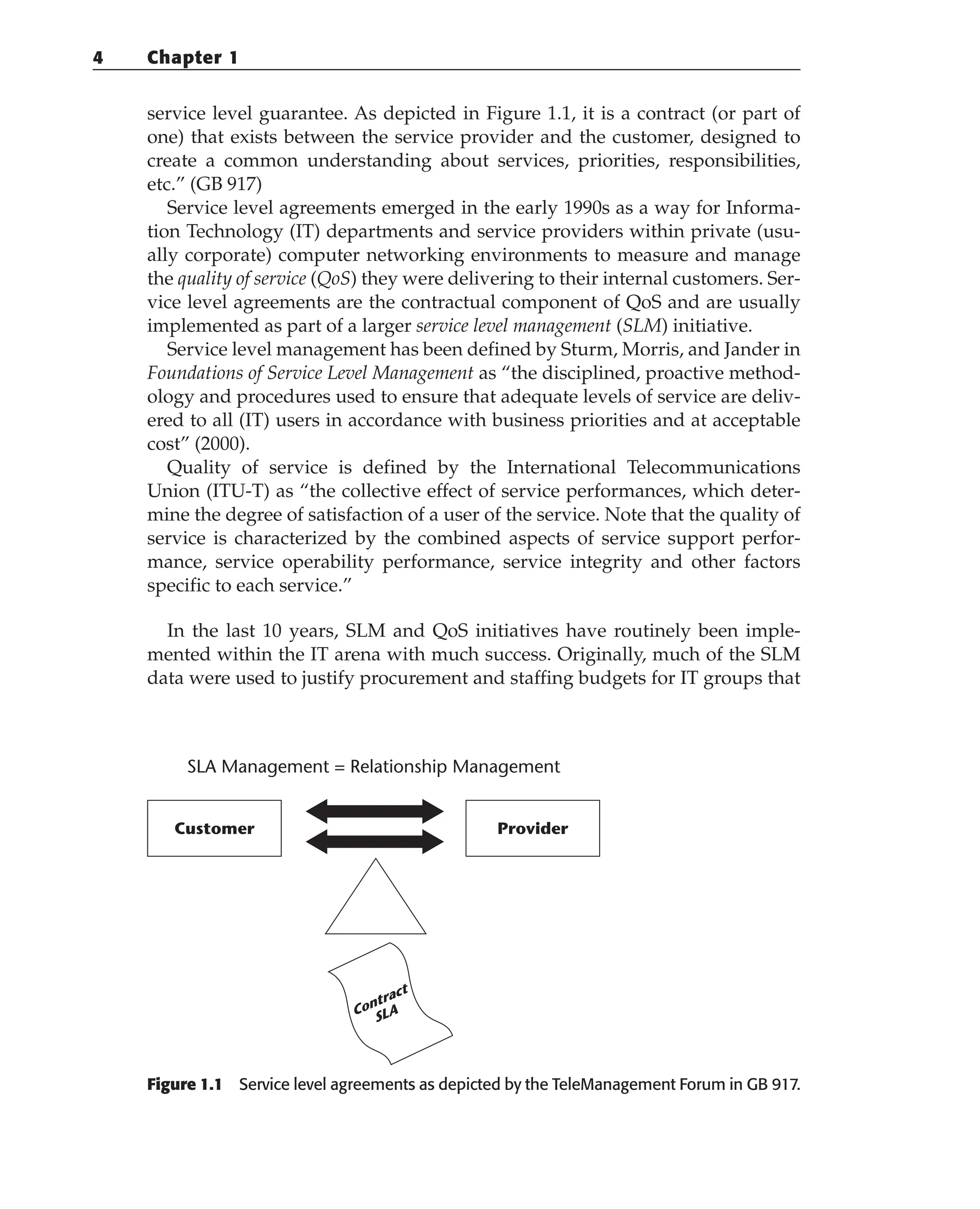
service level guarantee. As depicted in Figure 1.1, it is a contract (or part of
one) that exists between the service provider and the customer, designed to
create a common understanding about services, priorities, responsibilities,
etc.” (GB 917)
Service level agreements emerged in the early 1990s as a way for Informa-
tion Technology (IT) departments and service providers within private (usu-
ally corporate) computer networking environments to measure and manage
the quality of service (QoS) they were delivering to their internal customers. Ser-
vice level agreements are the contractual component of QoS and are usually
implemented as part of a larger service level management (SLM) initiative.
Service level management has been defined by Sturm, Morris, and Jander in
Foundations of Service Level Management as “the disciplined, proactive method-
ology and procedures used to ensure that adequate levels of service are deliv-
ered to all (IT) users in accordance with business priorities and at acceptable
cost” (2000).
Quality of service is defined by the International Telecommunications
Union (ITU-T) as “the collective effect of service performances, which deter-
mine the degree of satisfaction of a user of the service. Note that the quality of
service is characterized by the combined aspects of service support perfor-
mance, service operability performance, service integrity and other factors
specific to each service.”
In the last 10 years, SLM and QoS initiatives have routinely been imple-
mented within the IT arena with much success. Originally, much of the SLM
data were used to justify procurement and staffing budgets for IT groups that
Figure 1.1 Service level agreements as depicted by the TeleManagement Forum in GB 917.
Customer
SLA Management = Relationship Management
Provider
Contract
SLA
4 Chapter 1
were still considered cost centers and whose real value to the business was not
yet fully appreciated. Much of the reporting consisted of QoS data showing
customer satisfaction owing to contributions made by IT to user productivity
and the bottom line.
Much has changed in the last 10 years. The value of computers in all seg-
ments and industries within the business world (as well as in our personal
lives) has gone from unproven to absolutely essential. We have entered an era
of business specialization, industry consolidation, and realization of large effi-
ciency gains owing largely to technology.
The standardization of hardware, networking, operating system, and many
business software standards has made a relative commodity of providing tra-
ditional IT department functions such as PC hardware configuration, network
connectivity, and email access.
Today the products and services that are routinely contracted for and
managed using SLAs seem almost limitless. In the telecommunications space,
customers most typically demand financial guarantees on the accurate and
timely performance of the network itself, normally measured using statistical
indicators such as circuit availability, reliability, and other key performance indi-
cators (KPIs), as well as service-related activities such as provisioning, installa-
tions, trouble response, and fault correction.
Other areas such as responsive customer service, accurate billing, and
immediate availability of additional network capacity can also be guaranteed
by an SLA. It seems that the main qualifying criteria is that the service be mis-
sion-critical and provided by an outside source. SLAs are also used extensively
in other industries, most notably in the utility, transportation, and manufac-
turing fields.
Service Level Agreement Roles and Objectives
Implementing a service level management (SLM) program that works for both
the service provider and the customer is a very difficult undertaking. Service
level agreements are technically complex to pull off from an operational stand-
point, but, more important, the perception of the roles that SLAs should play
differs greatly for the service provider as compared with the customer. In this
chapter we discuss primarily the service provider’s point of view; the cus-
tomer’s needs are discussed at length in Chapter 2. The roles most commonly
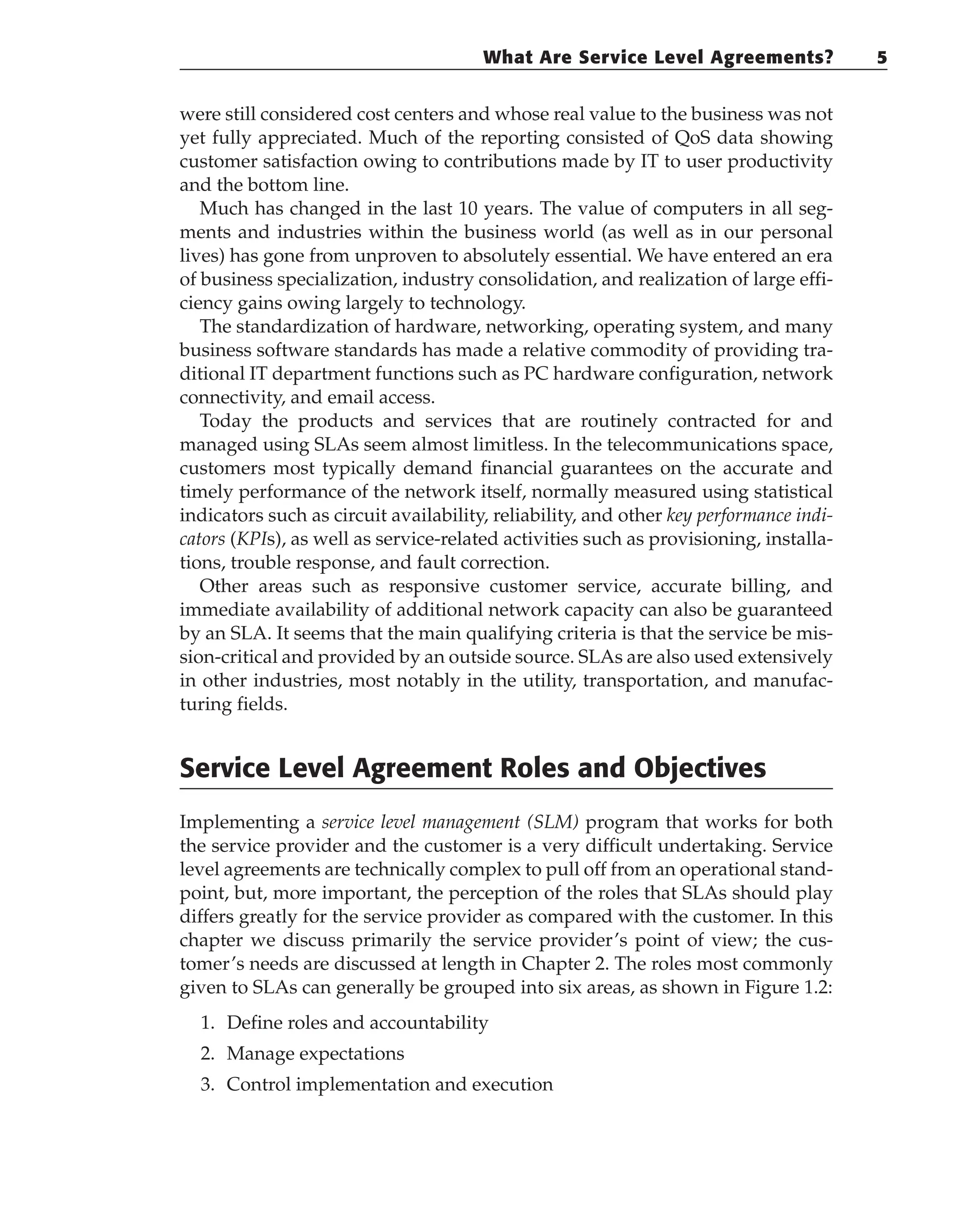
given to SLAs can generally be grouped into six areas, as shown in Figure 1.2:
1. Define roles and accountability
2. Manage expectations
3. Control implementation and execution
What Are Service Level Agreements? 5
4. Provide verification
5. Enable communications
6. Assess return on investment
Defining Roles and Accountability
It is important that both parties to an SLA understand the respective roles and
responsibilities defined in the agreement. A number of industry factors have
made establishing roles, responsibilities, and performance (and financial)
accountability increasingly difficult on both the network and services side of
the SLA equation.
Deregulation and the unprecedented growth in technology, customer
demand, and new service offerings experienced over the last decade have cre-
ated a unique environment in which hundreds of service providers depend on
their competition to help them to deliver end-to-end services. Since 1984 the
“network” and “the cloud” (the worldwide telecom WAN relative to the
user’s LAN perspective) have become a virtual maze of equipment and capac-
ity owned by a multitude of service providers, including leased lines, indefea-
sible rights to use (IRUs), bandwidth swaps, unbundled network elements (UNE),
carrier hotels, collocations, and “meet-me” rooms.
To make it all work, the myriad providers have executed an almost endless
number of collocation, interconnection, and capacity leasing agreements with
each other, creating a complex web of overlapping business relationships. In
the process, networks have become so intertwined and interdependent that
many service providers cannot function without the other providers in their
competitive space.
Figure 1.2 The roles played by service level agreements.
Prove Return on Investment
Enable Communications
Provider Verification
Control Delivery & Execution
Manage Expectations
Define Roles and Accountability
6 Chapter 1
Within the industry, the term coopetition has been coined to describe this
strangely symbiotic situation. The TeleManagement Forum (TMF) has also rec-
ognized the phenomenon and the implication for SLAs. The SLA Management
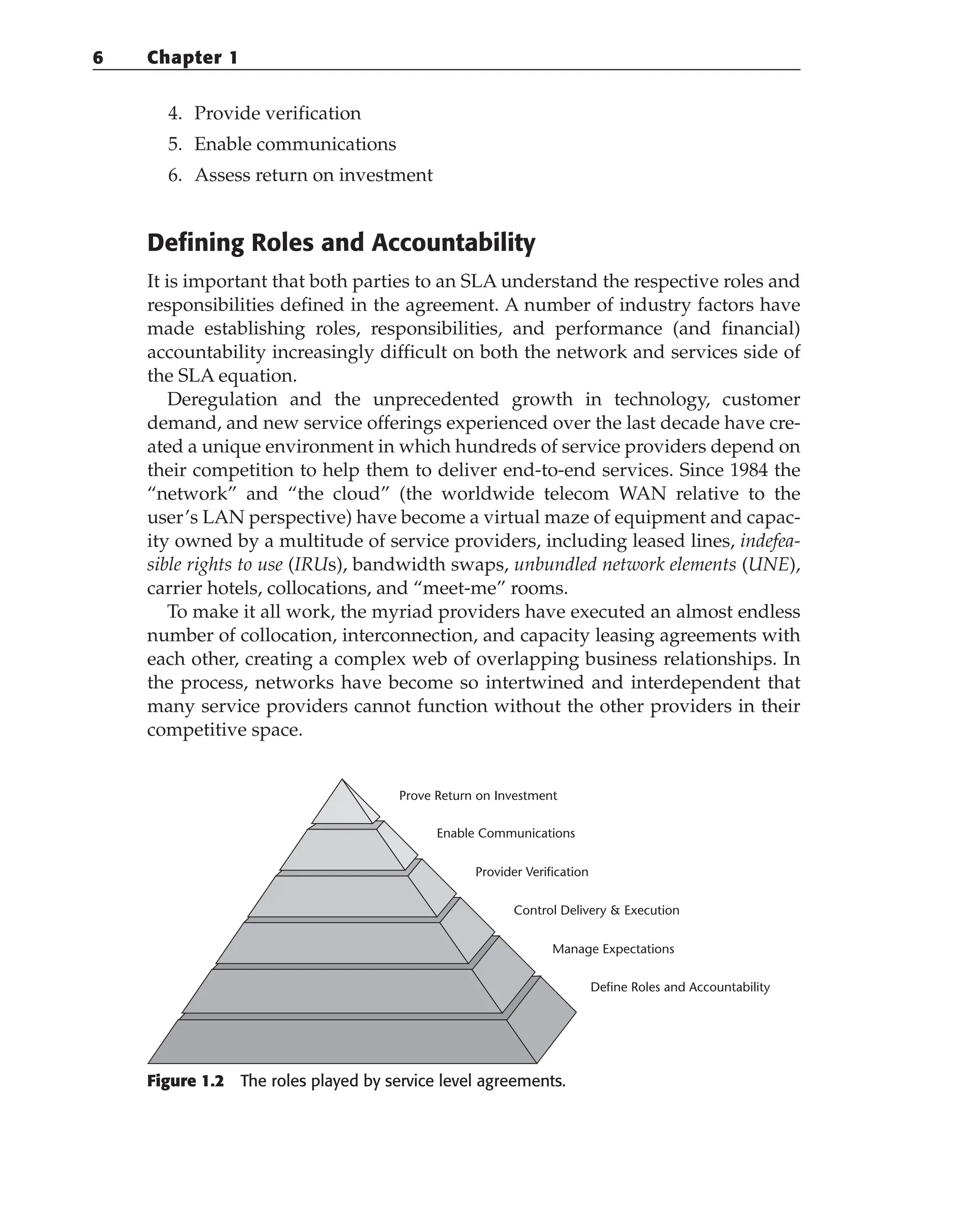
Handbook uses the term value chain of service provision to describe a scenario
wherein a number of different service providers are related through a series of
SLA relationships that eventually terminate at the end user. A service provider
in one SLA can be the customer in another SLA, and vice versa. Today, thou-
sands of different value chains exist—each with any number of service
providers (and potential SLAs) imbedded in it. The companies represented in
these value chains span the entire cross section of telecommunications, as
shown in Figure 1.3.
Other factors, including the increased outsourcing of customer care to large
call-center providers, service fulfillment to third-party installers, network
monitoring to managed network service providers, and so on, have increas-
ingly blurred the landscape, fragmented the lines of communication, confused
end-to-end workflow processes, and made organizational continuity and
accountability all but invisible to the customer.
Service level agreements will be used to reestablish the chain of account-
ability. As outlined by the TMF, each instance of SLA execution will consist of
a service provider and a customer. In a well-developed SLA, the roles and
responsibilities of each party will be defined as concretely as possible, along
with the associated responsibility, liabilities, and recourse available to both
parties.
Figure 1.3 TeleManagement Forum’s value chain of service provision.
Internal
Provider
End
Customer
Provider
Service
Provider
Customer
End Users
Service
Provider
Service
Provider
Customer
Provider
Service
Provider
Customer
Provider
Customer
Provider
Customer
What Are Service Level Agreements? 7
Service level agreements simplify the customer’s contractual recourse
because the service provider functions as the final guarantor of the end-to-end
network. That way, no matter the complexity of the underlying service (multi-
ple service providers, different technologies, and so forth), the customer can
hold the service provider solely responsible for delivery to his or her service
access point.
To mitigate the associated risks, the service provider (in its role as customer
of another service provider) may in turn demand SLAs to cover that relation-
ship. The result is a flow-down effect in which the risks of guaranteeing service
to the end customer are spread through multiple SLAs over the end-to-end
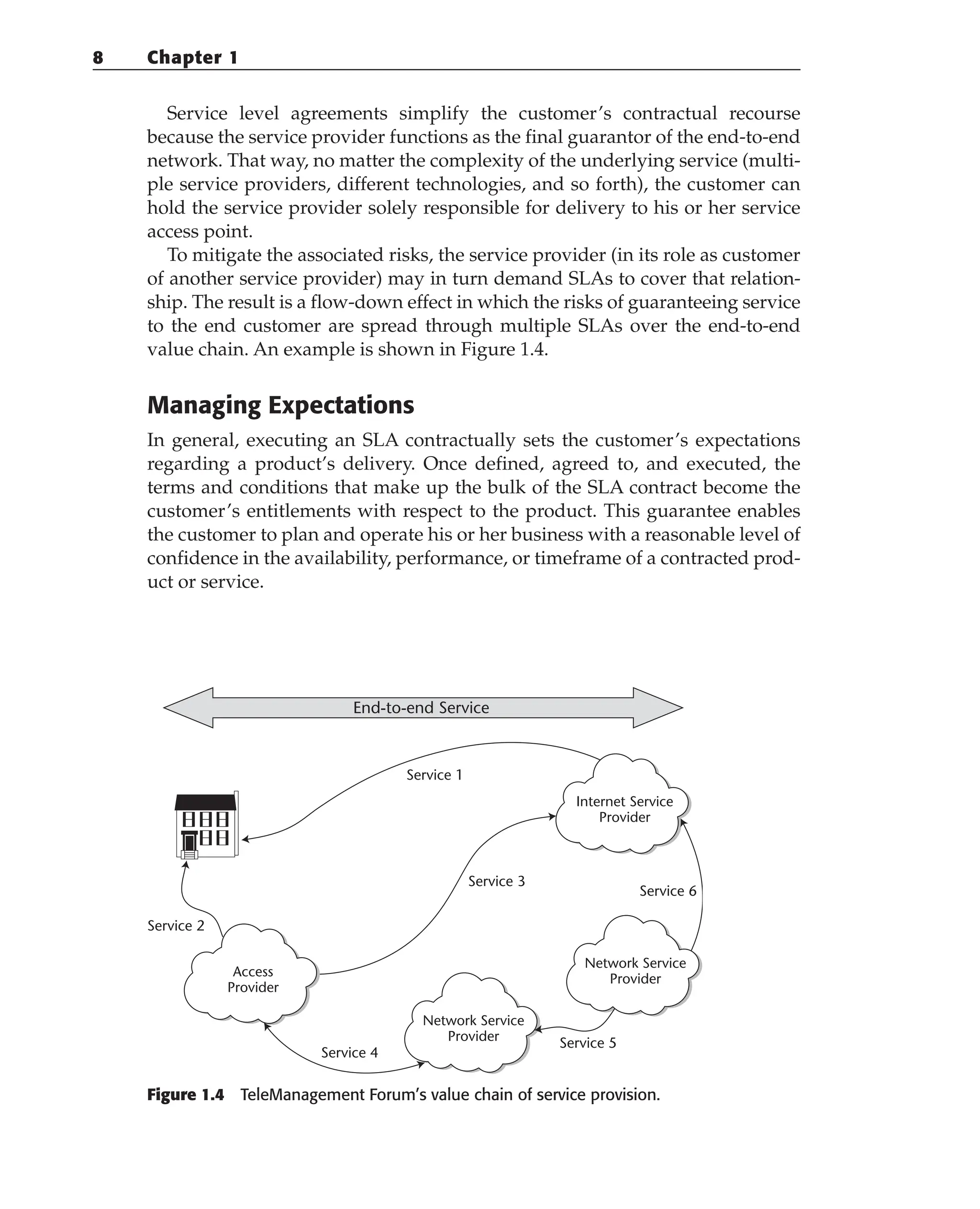
value chain. An example is shown in Figure 1.4.
Managing Expectations
In general, executing an SLA contractually sets the customer’s expectations
regarding a product’s delivery. Once defined, agreed to, and executed, the
terms and conditions that make up the bulk of the SLA contract become the
customer’s entitlements with respect to the product. This guarantee enables
the customer to plan and operate his or her business with a reasonable level of
confidence in the availability, performance, or timeframe of a contracted prod-
uct or service.
Figure 1.4 TeleManagement Forum’s value chain of service provision.
Internet Service
Provider
Network Service
Provider
Network Service
Provider
Access
Provider
Service 1
Service 2
Service 4
Service 3
Service 6
Service 5
End-to-end Service
8 Chapter 1
Multiple SLA options (platinum, gold, silver, bronze, and so forth) for the
same product or service give the customer the opportunity to weigh competing
priorities within his or her own company and understand the relationship of
his or her needs to those of other businesses. These options help the customer
to allocate financial resources appropriately: He or she may opt for higher lev-
els of availability or quicker response times at additional cost only for the most
mission-critical links and decide to settle for a lower level of service for the rest.
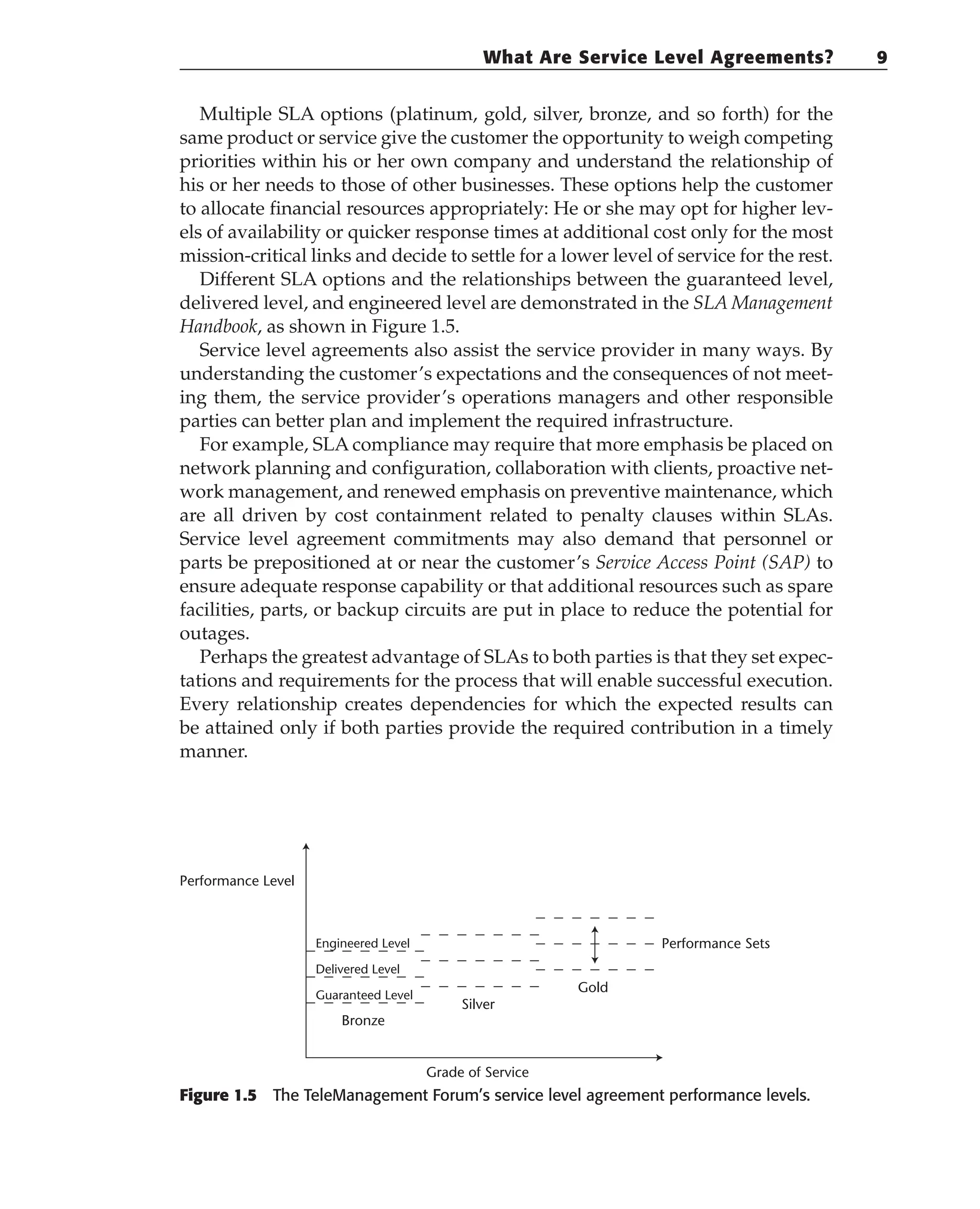
Different SLA options and the relationships between the guaranteed level,
delivered level, and engineered level are demonstrated in the SLA Management
Handbook, as shown in Figure 1.5.
Service level agreements also assist the service provider in many ways. By
understanding the customer’s expectations and the consequences of not meet-
ing them, the service provider’s operations managers and other responsible
parties can better plan and implement the required infrastructure.
For example, SLA compliance may require that more emphasis be placed on
network planning and configuration, collaboration with clients, proactive net-
work management, and renewed emphasis on preventive maintenance, which
are all driven by cost containment related to penalty clauses within SLAs.
Service level agreement commitments may also demand that personnel or
parts be prepositioned at or near the customer’s Service Access Point (SAP) to
ensure adequate response capability or that additional resources such as spare
facilities, parts, or backup circuits are put in place to reduce the potential for
outages.
Perhaps the greatest advantage of SLAs to both parties is that they set expec-
tations and requirements for the process that will enable successful execution.
Every relationship creates dependencies for which the expected results can
be attained only if both parties provide the required contribution in a timely
manner.
Figure 1.5 The TeleManagement Forum’s service level agreement performance levels.
Performance Level
Grade of Service
Guaranteed Level
Delivered Level
Engineered Level
Bronze
Silver
Gold
Performance Sets
What Are Service Level Agreements? 9
Service level agreements formalize this relationship and, more important,
place timeframes, thresholds, and escalation procedures around the execution
phase of service fulfillment, assurance, and other areas, such as billing. Both
the service provider and the customer are better able to plan because many of
the “unknowns” are covered in the SLA, such as volumes, locations, QoS, and
costs.
Controlling Implementation and Execution
The SLA is a reference document for managing the execution of the contract
and ensuring the timely delivery and continued performance of the product or
service within the defined entitlements.
Customers tend to use SLAs to ensure preferential treatment for their par-
ticular service needs relative to all the others in the service provider’s network.
The expectations are clearly set, and during the implementation and execution
phases of the contract, the service provider must deliver on these expectations.
For the service provider, delivering the contracted service translates into
ensuring that sufficient resources are available to consistently meet or exceed
the SLA commitments. The service provider must have an understanding of
all the commitments that have been made over the entire customer base and
how the requirement for delivering on these commitments affect the support-
ing organizations.
Service level agreement entitlements have a tendency to affect the service
provider’s support organization in two ways: (1) They tend to reprioritize the
work based on a potential financial impact, and (2) they tend to shorten the
time available to perform the work.
Historically, field service organizations have prioritized work based on the
impact to the network hardware. Automated network management systems
generated much of the fault identification and were usually configured so that
fault alarms or outages on the most critical hardware (such as switches) and
larger pipes took precedence over those on the smaller, less critical ones. Service
orders usually got done after all the trouble tickets were closed. Preventive
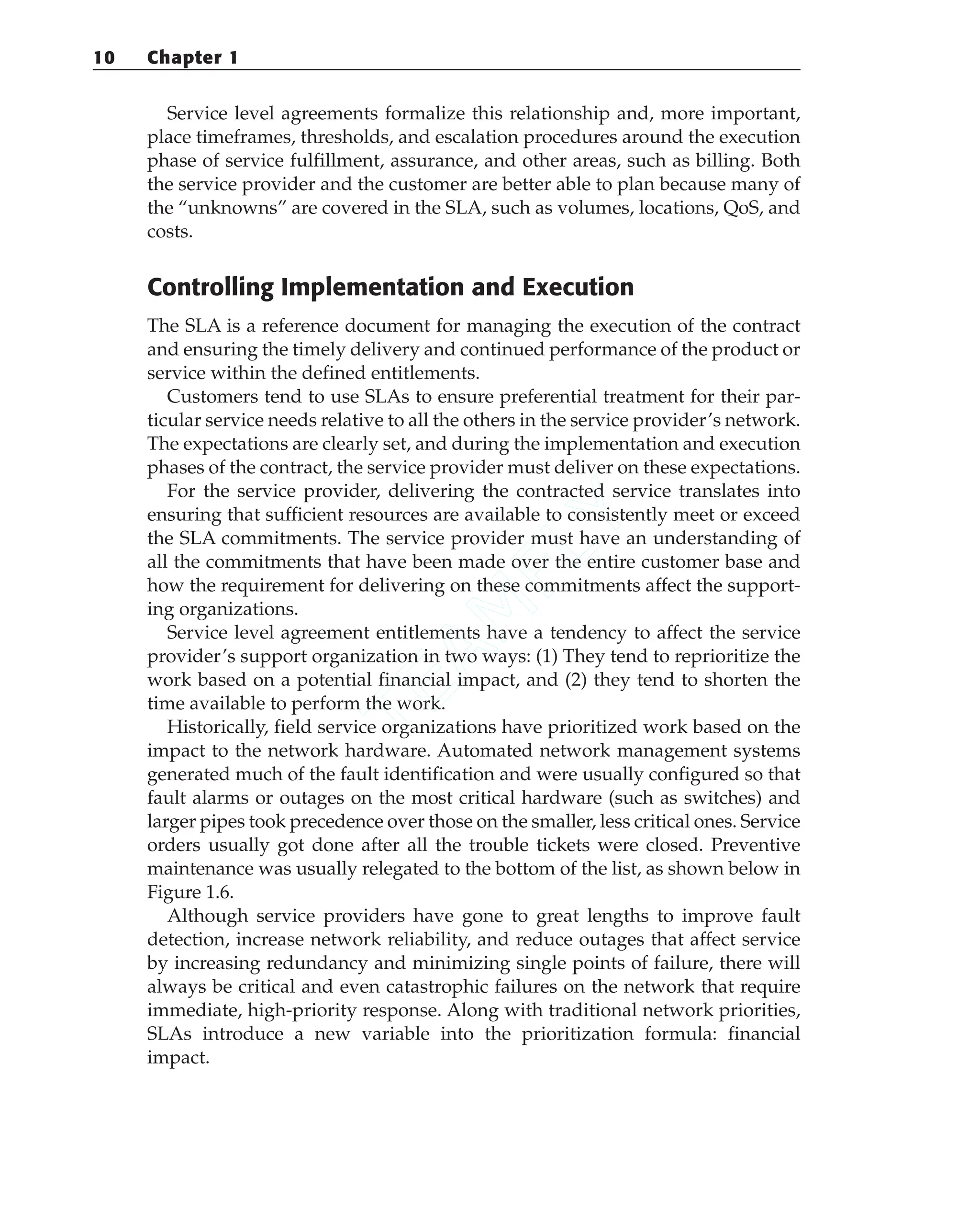
maintenance was usually relegated to the bottom of the list, as shown below in
Figure 1.6.
Although service providers have gone to great lengths to improve fault
detection, increase network reliability, and reduce outages that affect service
by increasing redundancy and minimizing single points of failure, there will
always be critical and even catastrophic failures on the network that require
immediate, high-priority response. Along with traditional network priorities,
SLAs introduce a new variable into the prioritization formula: financial
impact.
10 Chapter 1
T
E
A
M
F
L
Y
Figure 1.6 Conventional operational priorities.
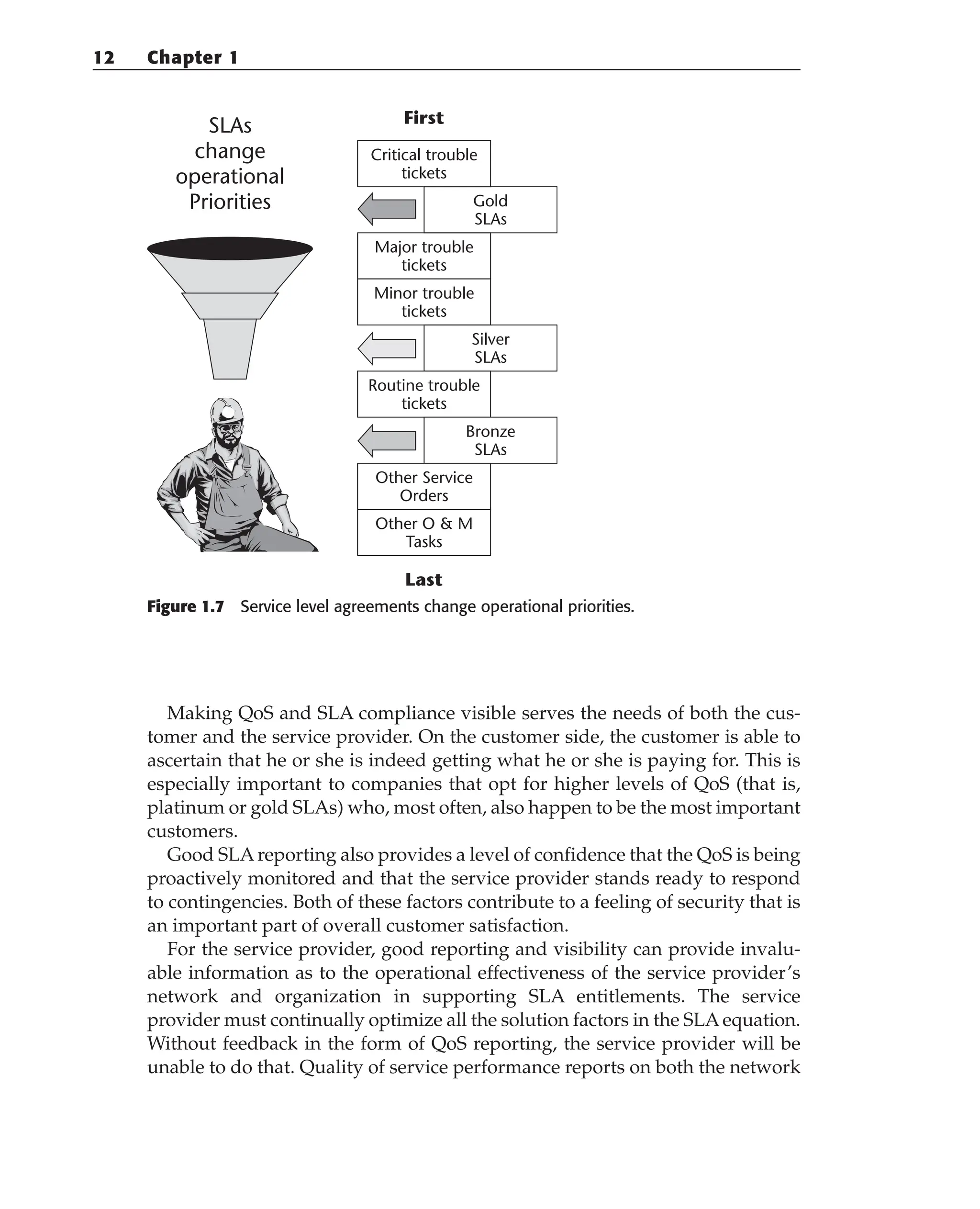
The growing use of SLAs will force service providers to reprioritize the
workload in order to meet the entitlements or risk financial damages. With ser-
vice providers offering a number of SLA options in order to differentiate their
product from the competition’s, tasks, circuits, and services are no longer cre-
ated equal from a prioritization standpoint. Services covered by an SLA will
have to go to the front of the line—which, going back to the beginning of this
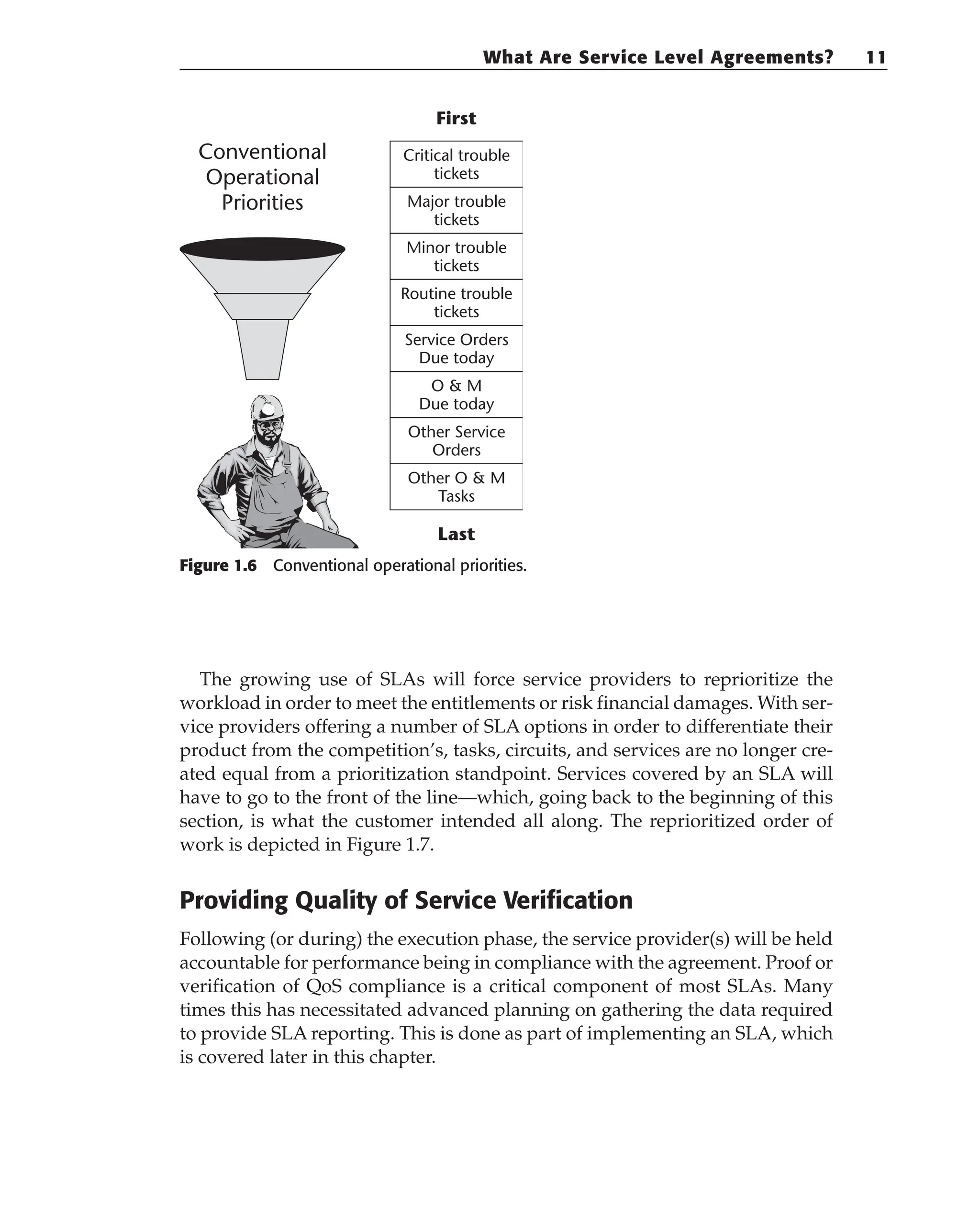
section, is what the customer intended all along. The reprioritized order of
work is depicted in Figure 1.7.
Providing Quality of Service Verification
Following (or during) the execution phase, the service provider(s) will be held
accountable for performance being in compliance with the agreement. Proof or
verification of QoS compliance is a critical component of most SLAs. Many
times this has necessitated advanced planning on gathering the data required
to provide SLA reporting. This is done as part of implementing an SLA, which
is covered later in this chapter.
Critical trouble
tickets
Conventional
Operational
Priorities
First
Last
Major trouble
tickets
Minor trouble
tickets
Routine trouble
tickets
Service Orders
Due today
O & M
Due today
Other Service
Orders
Other O & M
Tasks
What Are Service Level Agreements? 11
Figure 1.7 Service level agreements change operational priorities.
Making QoS and SLA compliance visible serves the needs of both the cus-
tomer and the service provider. On the customer side, the customer is able to
ascertain that he or she is indeed getting what he or she is paying for. This is
especially important to companies that opt for higher levels of QoS (that is,
platinum or gold SLAs) who, most often, also happen to be the most important
customers.
Good SLA reporting also provides a level of confidence that the QoS is being
proactively monitored and that the service provider stands ready to respond
to contingencies. Both of these factors contribute to a feeling of security that is
an important part of overall customer satisfaction.
For the service provider, good reporting and visibility can provide invalu-
able information as to the operational effectiveness of the service provider’s
network and organization in supporting SLA entitlements. The service
provider must continually optimize all the solution factors in the SLAequation.
Without feedback in the form of QoS reporting, the service provider will be
unable to do that. Quality of service performance reports on both the network
Critical trouble
tickets
SLAs
change
operational
Priorities
First
Gold
SLAs
Major trouble
tickets
Minor trouble
tickets
Silver
SLAs
Routine trouble
tickets
Bronze
SLAs
Other Service
Orders
Last
Other O & M
Tasks
12 Chapter 1
and activity sides of SLAs can also provide input into the SLA assessment
process. The assessment process is covered later in this chapter.
Enabling Communications
Service level agreements provide a framework for both service providers and
customers to address their needs, expectations, performance relative to those
expectations, and progress on action items that may be undertaken to improve
upon either the SLA itself or the service provider’s performance.
There are three inherent points in an SLA’s life cycle that require good com-
munications between the customer and service provider: (1) during the devel-
opment of a negotiated SLA, (2) during the implementation and execution of
the SLA-covered services, and (3) during customer-focused assessments.
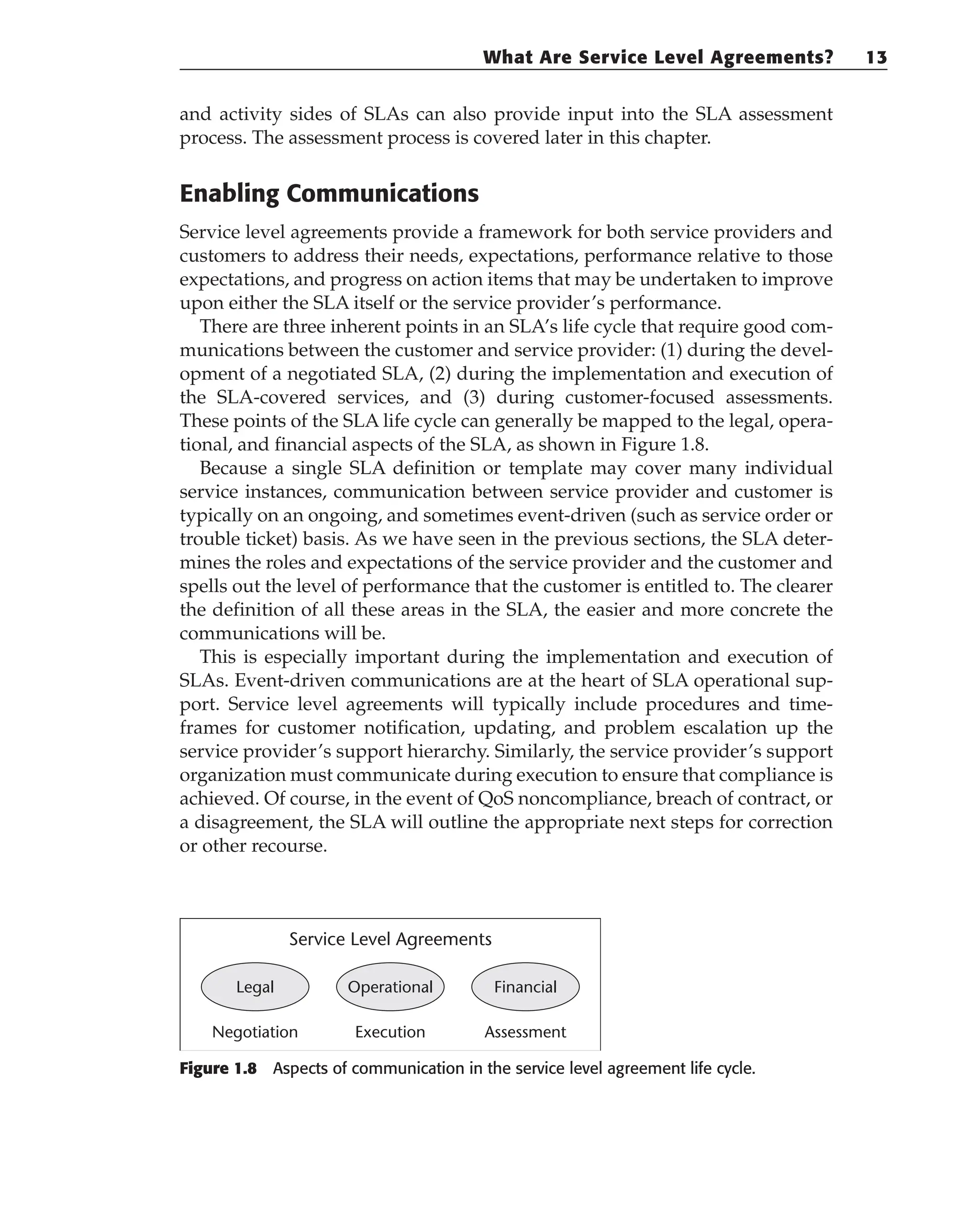
These points of the SLA life cycle can generally be mapped to the legal, opera-
tional, and financial aspects of the SLA, as shown in Figure 1.8.
Because a single SLA definition or template may cover many individual
service instances, communication between service provider and customer is
typically on an ongoing, and sometimes event-driven (such as service order or
trouble ticket) basis. As we have seen in the previous sections, the SLA deter-
mines the roles and expectations of the service provider and the customer and
spells out the level of performance that the customer is entitled to. The clearer
the definition of all these areas in the SLA, the easier and more concrete the
communications will be.
This is especially important during the implementation and execution of
SLAs. Event-driven communications are at the heart of SLA operational sup-
port. Service level agreements will typically include procedures and time-
frames for customer notification, updating, and problem escalation up the
service provider’s support hierarchy. Similarly, the service provider’s support
organization must communicate during execution to ensure that compliance is
achieved. Of course, in the event of QoS noncompliance, breach of contract, or
a disagreement, the SLA will outline the appropriate next steps for correction
or other recourse.
Figure 1.8 Aspects of communication in the service level agreement life cycle.
Legal
Negotiation
Operational
Execution
Service Level Agreements
Financial
Assessment
What Are Service Level Agreements? 13
Assessing Return on Investment
The ability to calculate return on investment (ROI) is a key reason that SLAs are
becoming more prevalent. As we will be discussing in Chapter 2, the customer
uses SLAs to protect his or her business’s ability to operate. He or she is even
willing to pay extra in order to get a higher level of comfort and security.
The ROI assessment can be considered the financial aspect of verifying that
the correct QoS levels were selected for the business. It should be noted that
routine verification of QoS differs from a business assessment of ROI in a num-
ber of significant ways. Verification is usually ongoing and event driven, con-
centrating on day-to-day compliance, while ROI assessments are usually more
periodic and are intended to measure the impact of the QoS performance (and
SLA noncompliance) on the customer’s business. It can be said that the verifi-
cation process is tactical, while the ROI assessment is more strategic to the
business.
In most cases, the SLA executor (usually the person responsible for repre-
senting the customer in negotiating SLAs) is accountable to his or her man-
agement chain for both the costs associated with the services delivered under
SLA and the decisions made as to what QoS level is right for a specific appli-
cation or site. Like the service provider, the SLA executor must provide finan-
cial justification and police the QoS for compliance; he or she must then make
further decisions on continuance of service under the current SLA or what
changes should be made.
The customer could decide that the QoS level he or she is receiving is appro-
priate, overkill for his or her application, not good enough (which may neces-
sitate upgrading his or her QoS level), or that the service provider’s level of
compliance is unacceptable. More and more SLAs are providing opt-out
clauses for noncompliance, usually with some built-in correction period. If a
service provider is unable to come into compliance even after the correction
period, the customer can opt out and terminate the contract.
The Service Level Agreement Life Cycle
In order to satisfy the roles and objectives that have already been discussed,
the service provider needs to adopt an organized approach to managing SLAs
whereby the service provider examines each SLA individually in order to
make decisions on deployment, value to the business, terms and conditions to
include, and a number of other considerations that should be addressed. Such
an approach facilitates comparing the service provider’s offerings with the
customer’s needs and other SLAs available in the marketplace, which help the
service provider fit a particular SLA into the overall SLM program or corpo-
rate strategy.
14 Chapter 1
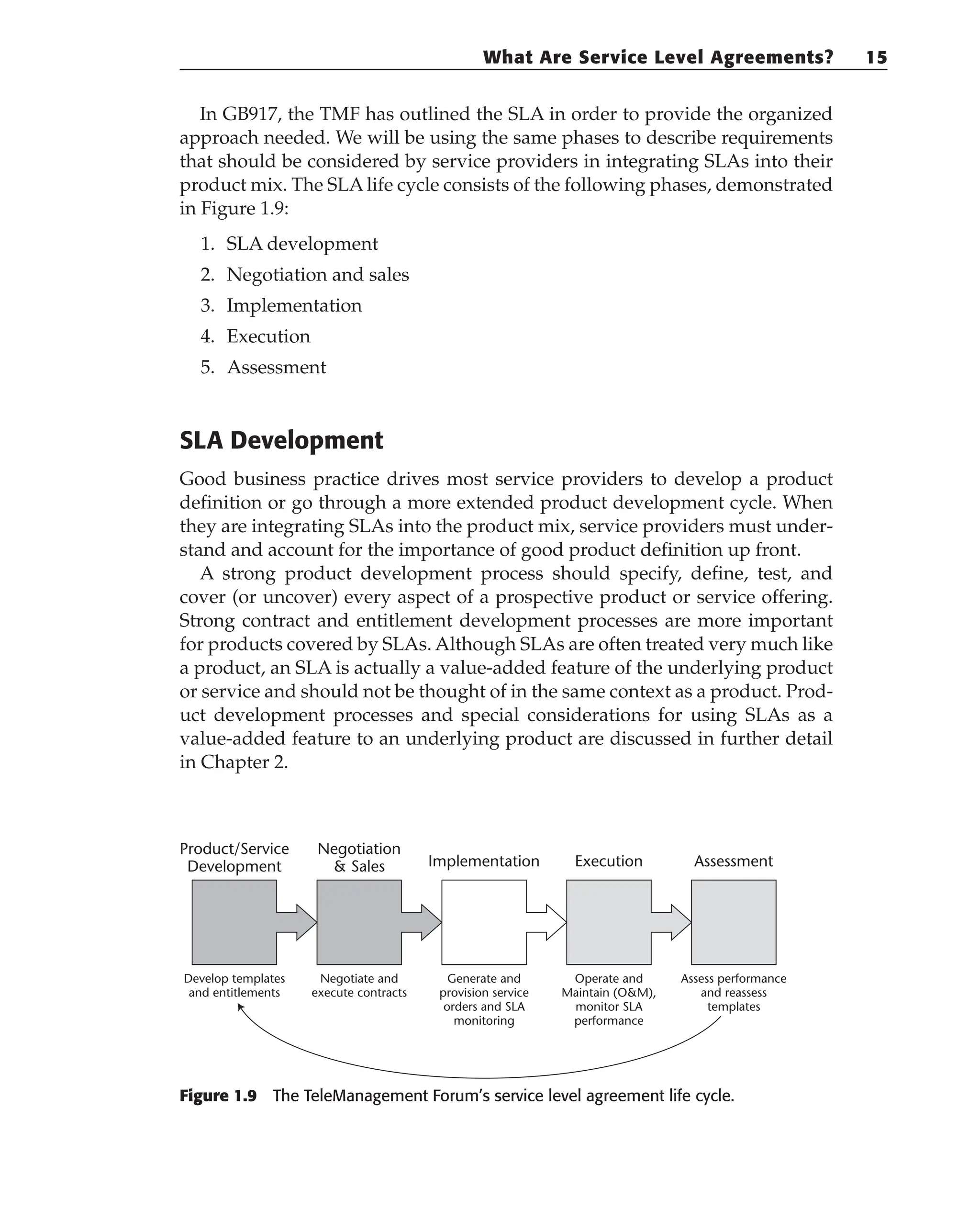
In GB917, the TMF has outlined the SLA in order to provide the organized
approach needed. We will be using the same phases to describe requirements
that should be considered by service providers in integrating SLAs into their
product mix. The SLA life cycle consists of the following phases, demonstrated
in Figure 1.9:
1. SLA development
2. Negotiation and sales
3. Implementation
4. Execution
5. Assessment
SLA Development
Good business practice drives most service providers to develop a product
definition or go through a more extended product development cycle. When
they are integrating SLAs into the product mix, service providers must under-
stand and account for the importance of good product definition up front.
A strong product development process should specify, define, test, and
cover (or uncover) every aspect of a prospective product or service offering.
Strong contract and entitlement development processes are more important
for products covered by SLAs. Although SLAs are often treated very much like
a product, an SLA is actually a value-added feature of the underlying product
or service and should not be thought of in the same context as a product. Prod-
uct development processes and special considerations for using SLAs as a
value-added feature to an underlying product are discussed in further detail
in Chapter 2.
Figure 1.9 The TeleManagement Forum’s service level agreement life cycle.
Product/Service
Development
Develop templates
and entitlements
Negotiation
& Sales
Negotiate and
execute contracts
Implementation
Generate and
provision service
orders and SLA
monitoring
Execution
Operate and
Maintain (O&M),
monitor SLA
performance
Assessment
Assess performance
and reassess
templates
What Are Service Level Agreements? 15
Contrary to common practice, not all products are truly suitable for use with
SLAs. Attributes that are specific to service level agreements, such as customer
needs, contractual entitlements, terms and conditions, reporting requirements,
and SLA pricing may initially be derived from the information accumulated as
part of the product development cycle. From that point forward, SLAs differ
substantially from products in several ways:
■
■ There may be a one-many relationship among several SLAs and a sin-
gle product or product bundle. (Note: A single SLA definition may be
used across a number of different products, but this does not constitute
a one-many relationship between a single SLA and multiple products.)
During both contracting and execution, invoking SLA entitlements is
presumed to be an event-driven occurrence (service order, trouble
ticket, and so forth) usually representative of a single product instance
delivered to a single SAP.
■
■ Service level agreements may be bundled with a product, unbundled
from the product, or even be selectable, with several optional levels
of QoS.
■
■ Service level agreement life cycles do not necessarily run concurrent
with the underlying product.
Service providers must take these differences into account when they are
developing SLAs. The use of SLAs potentially exposes the service provider to
a financial downside (in the form of penalties) beyond the normal risks associ-
ated with introducing a new product. Because the potential for sustaining
losses greatly exceeds that for making revenues, service providers should give
careful consideration to numerous factors when making SLA deployment
decisions; for instance, they should understand the impact that introducing
a new SLA may have on the profitability and life cycle of the underlying
product.
From an accounting perspective, for example, SLA penalties paid out to cus-
tomers have to come from somewhere. The logical place is the product’s
monthly recurring charge (MRC), which is normally used for penalty calcula-
tion anyway. If excessive QoS penalties make a product unprofitable, does the
service provider drop the SLA, the product, or both? When multiyear SLA
contracts are in place, is the service provider even able to pursue such an
option? These questions must be addresses as part of the service provider’s
strategy.
On the other hand, a well-thought-out SLA can provide a revenue boost,
and a service provider may elect to provide customers with several SLA
options for bundling with a product. Service level agreements should include
detailed information on the parties involved, the relationship that exists
among them, and the products or services that are covered under the SLA.
Specific terms and conditions should be defined that detail when and how the
16 Chapter 1
services are to be performed or delivered and the responsibilities of the parties;
the agreement should also stipulate the exact frequency, locations, and meth-
ods through which the performance is to be measured and reported.
Finally, the SLA should provide a framework for taking corrective actions,
the time frames for corrective actions, measurement guidelines, formulas for
computing penalties, and whether further recourse is available when the
SLA’s terms are not met. From a purely contractual standpoint, the contract
information that should be considered when developing an SLA is illustrated
in the framework that follows:
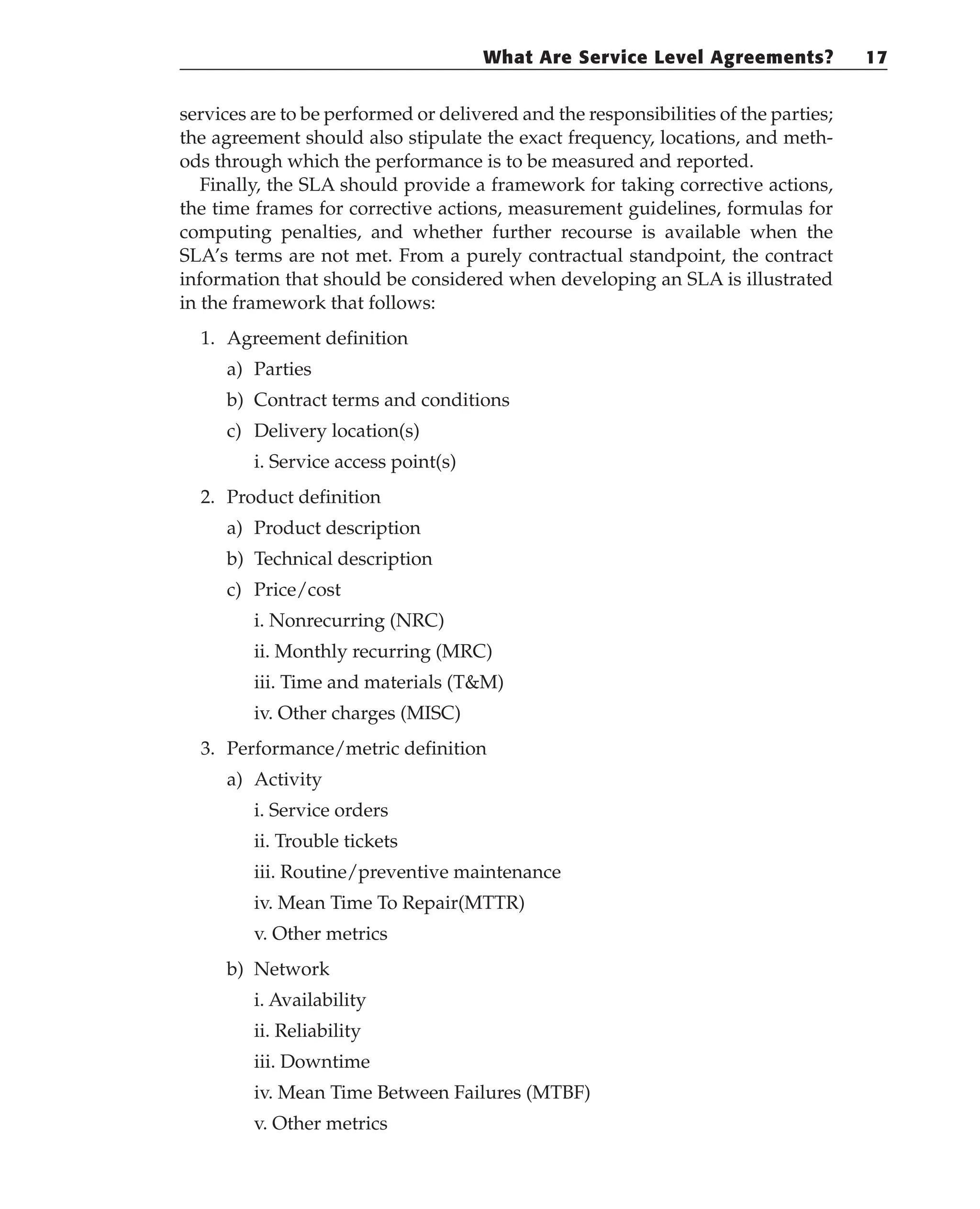
1. Agreement definition
a) Parties
b) Contract terms and conditions
c) Delivery location(s)
i. Service access point(s)
2. Product definition
a) Product description
b) Technical description
c) Price/cost
i. Nonrecurring (NRC)
ii. Monthly recurring (MRC)
iii. Time and materials (T&M)
iv. Other charges (MISC)
3. Performance/metric definition
a) Activity
i. Service orders
ii. Trouble tickets
iii. Routine/preventive maintenance
iv. Mean Time To Repair(MTTR)
v. Other metrics
b) Network
i. Availability
ii. Reliability
iii. Downtime
iv. Mean Time Between Failures (MTBF)
v. Other metrics
What Are Service Level Agreements? 17
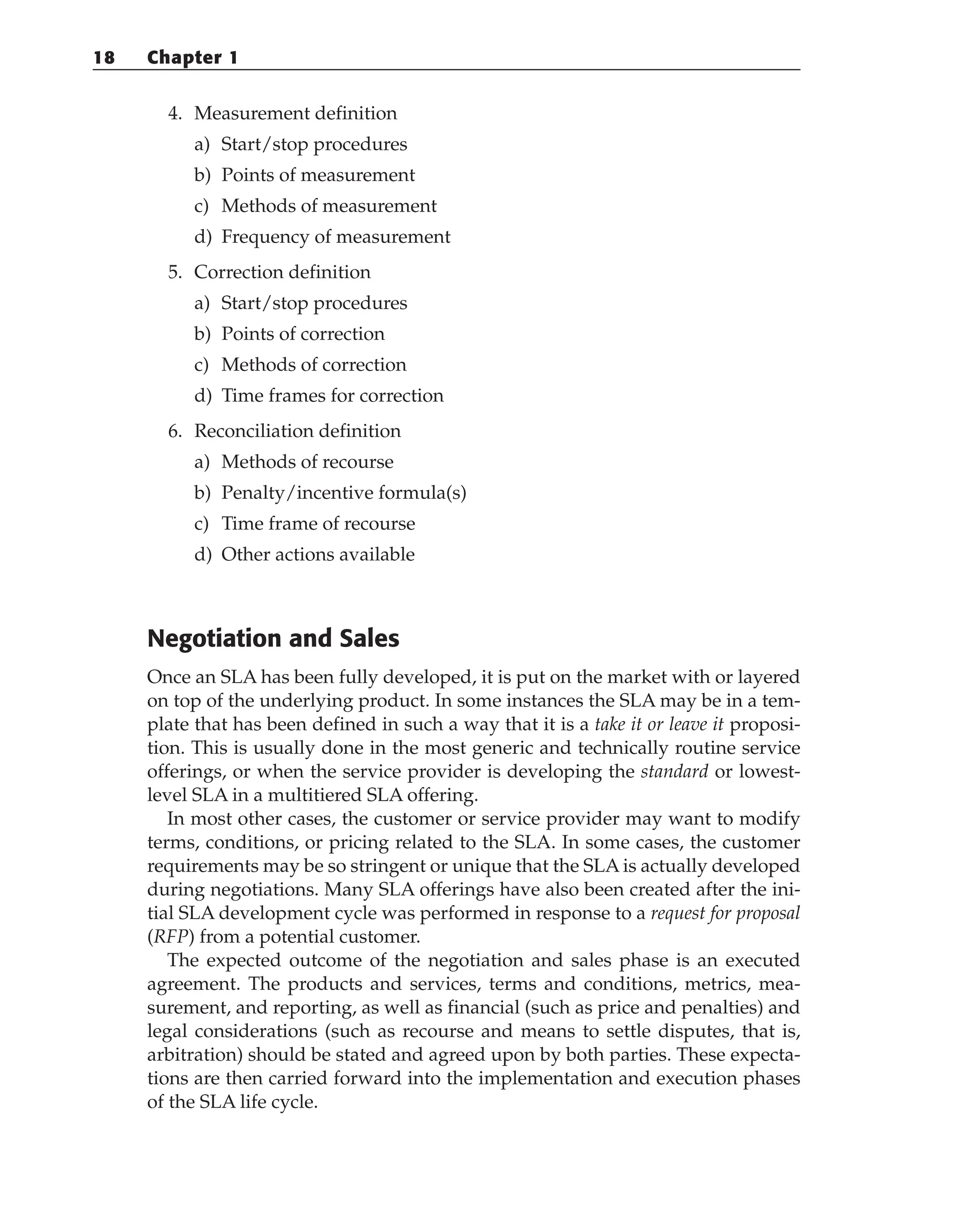
4. Measurement definition
a) Start/stop procedures
b) Points of measurement
c) Methods of measurement
d) Frequency of measurement
5. Correction definition
a) Start/stop procedures
b) Points of correction
c) Methods of correction
d) Time frames for correction
6. Reconciliation definition
a) Methods of recourse
b) Penalty/incentive formula(s)
c) Time frame of recourse
d) Other actions available
Negotiation and Sales
Once an SLA has been fully developed, it is put on the market with or layered
on top of the underlying product. In some instances the SLA may be in a tem-
plate that has been defined in such a way that it is a take it or leave it proposi-
tion. This is usually done in the most generic and technically routine service
offerings, or when the service provider is developing the standard or lowest-
level SLA in a multitiered SLA offering.
In most other cases, the customer or service provider may want to modify
terms, conditions, or pricing related to the SLA. In some cases, the customer
requirements may be so stringent or unique that the SLA is actually developed
during negotiations. Many SLA offerings have also been created after the ini-
tial SLA development cycle was performed in response to a request for proposal
(RFP) from a potential customer.
The expected outcome of the negotiation and sales phase is an executed
agreement. The products and services, terms and conditions, metrics, mea-
surement, and reporting, as well as financial (such as price and penalties) and
legal considerations (such as recourse and means to settle disputes, that is,
arbitration) should be stated and agreed upon by both parties. These expecta-
tions are then carried forward into the implementation and execution phases
of the SLA life cycle.
18 Chapter 1
Implementation
Another word for SLA implementation in the telecommunications arena is
provisioning. During this phase, the services are ordered, activated, and config-
ured for SLA compliance. This may mean that certain baseline measurements
are taken, new monitoring capabilities installed, thresholds set, additional
reports configured, or almost any number of other possibilities.
While SLAs may be negotiated and agreed to for a large number of products
or services, the actual provisioning process usually calls for service to be
ordered and turned up individually. This means that implementation is actu-
ally on a per instance basis, as opposed to the prior phases of the SLAlife cycle.
Each instance of the service will normally be tracked by a unique identifier,
such as a telephone number, circuit ID, Common-Language Location Identifi-
cation (CLLI) code, Internet protocol (IP) address, and so forth, and have other
discriminating parameters, such as the SAP.
Likewise, each instance may have unique SLA requirements that must be
configured, measured, and reported on individually through the execution
phase of the service. Like the service itself, the SLAcompliance measures taken
should be “signed off” on or accepted by the customer before billing for that
instance is allowed to begin. Implementation is discussed in detail in Chapters
6 and 11.
Execution
The execution phase is the normal day-to-day operation and associated activ-
ities related to the service being delivered. This includes measurement of SLA
entitlements on an ongoing basis. Extraordinary events such as circuit degra-
dation, outages, maintenance downtime, and even failure of the capability to
measure performance (Operations Support System (OSS) downtime) should be
recorded and measured and the impact to the business assessed and reported.
Reconciliation should be performed on those SLAs that have immediate or
real-time penalty requirements, while those that have historical or aggregate
statistical reporting requirements should be archived for later (periodic) rec-
onciliation. Different functions related to execution are discussed in several of
the later chapters.
Assessment
The SLA should be assessed periodically. Assessment is not the same thing as
financial reconciliation, which was addressed earlier in the chapter. (Reconcil-
iation on a per instance or per incident basis is part of the execution phase of
the SLA.) There are two types of assessments: (1) customer-focused assess-
ments and (2) provider-focused assessments.
What Are Service Level Agreements? 19
Customer-focused Assessments
Customer-focused assessments concentrate on the service provider’s perfor-
mance from the customer’s viewpoint. The key metric in this type of review is
SLA compliance (primarily availability) and customer satisfaction. The com-
ponents of customer satisfaction are discussed in Chapter 2 and are contained
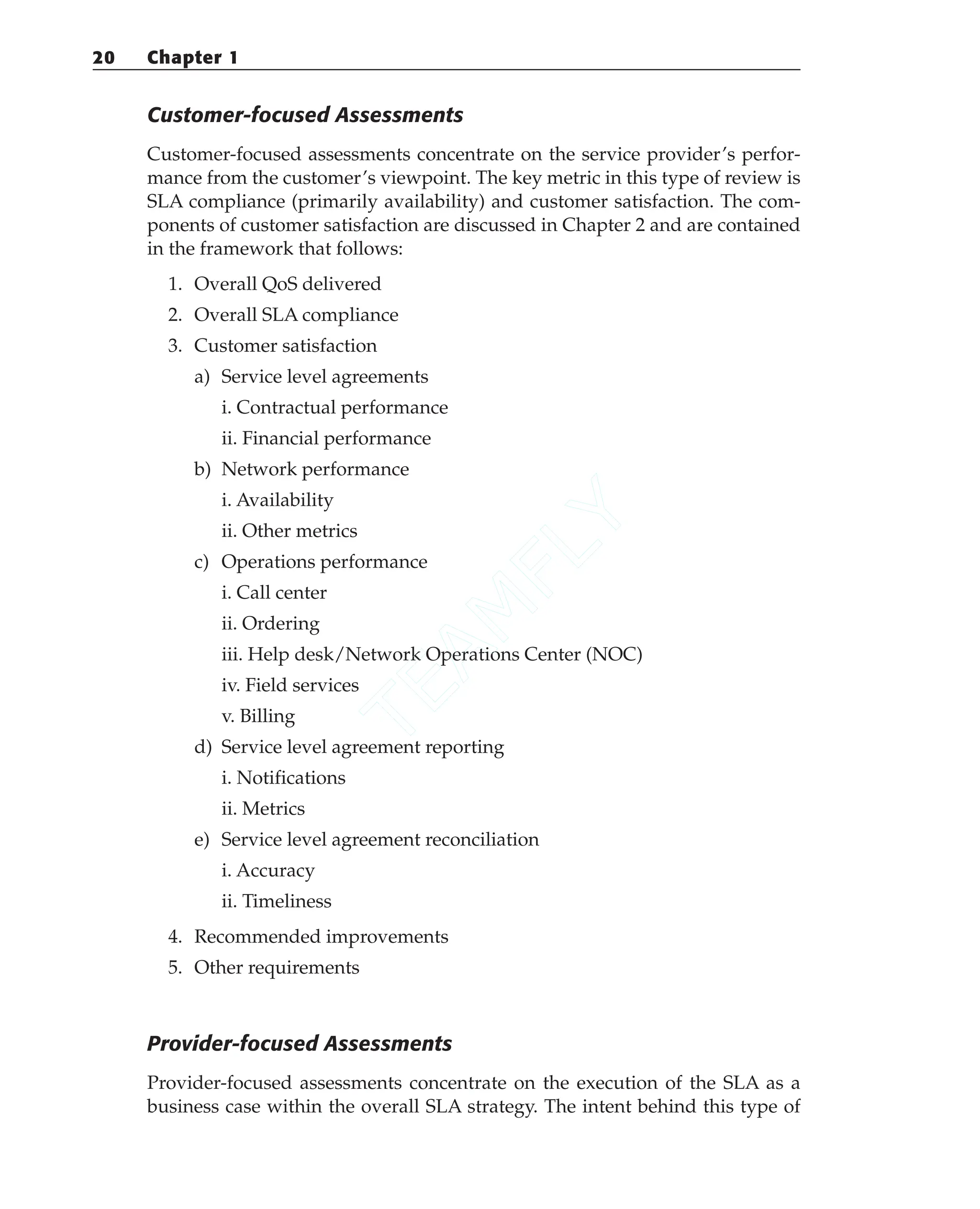
in the framework that follows:
1. Overall QoS delivered
2. Overall SLA compliance
3. Customer satisfaction
a) Service level agreements
i. Contractual performance
ii. Financial performance
b) Network performance
i. Availability
ii. Other metrics
c) Operations performance
i. Call center
ii. Ordering
iii. Help desk/Network Operations Center (NOC)
iv. Field services
v. Billing
d) Service level agreement reporting
i. Notifications
ii. Metrics
e) Service level agreement reconciliation
i. Accuracy
ii. Timeliness
4. Recommended improvements
5. Other requirements
Provider-focused Assessments
Provider-focused assessments concentrate on the execution of the SLA as a
business case within the overall SLA strategy. The intent behind this type of
20 Chapter 1
T
E
A
M
F
L
Y
review is to optimize the use of the SLA by the service provider in order to
improve profitability through achieving better compliance or reducing penalty
exposure by changing the commitment contained within the SLAs. The key
metrics in this type of review are delivered QoS, SLA profitability, and recom-
mended improvements. A possible framework for a provider-focused review
is outlined below:
1. Overall QoS delivered to all customers
2. Overall SLA compliance to all customers
a) Service level agreement compliance by network/subnet
i. Availability
ii. Other metrics
b) Service level agreement compliance by organization
i. Call center
ii. Ordering
iii. Help desk/NOC
iv. Field services
v. Billing
c) Service level agreement reporting compliance
i. Notifications
ii. Metrics
d) Service level agreement reconciliation compliance
i. Accuracy
ii. Timeliness
3. Overall SLA profitability
4. Service level agreement profitability breakdown
a. Platinum
i. Revenues
ii. Penalties
b) Gold
i. Revenues
ii. Penalties
c) Silver
i. Revenues
ii. Penalties
What Are Service Level Agreements? 21
e) Bronze
i. Revenues
ii. Penalties
5. Recommended improvements
a) Scope
b) Timeline
6. Other requirements
The Outlook for Service Level Agreements
The use of SLA contracts will continue to grow, and eventually SLAs will
become the prevailing business model for delivery of a large number of prod-
ucts and services. We’ve already discussed the dependencies created by
coopetition in the telecommunications space. The end result of all this interde-
pendency will be an SLA flow-down effect that will drive many thousands of
SLAs as service providers (acting as customers, in turn) to use SLAs to protect
their own ability to deliver SLA-based services to their customers. Flow-down
SLAs will be addressed in later chapters. There are a number of other reasons
for this, but two in particular stand out: the growth in outsourcing and the
emergence of pure content providers.
The Growth in Outsourcing
The long-standing trend has been toward corporate outsourcing of many basic
IT functions. Reliable connectivity to the outside world via the Internet (pri-
marily in the form of email) and private networks has been the lifeblood of
much of the world’s financial, commerce, and business markets for years. The
emergence of email as a primary business tool, e-commerce, and a dramatic
increase in network and data outsourcing have brought more attention to the
value of SLAs as a means of ensuring the optimal performance of the network,
and, by extension, the associated mission-critical applications. Nothing shuts
down office productivity more quickly than email going down (unless it’s the
power going out!).
Not only are basic IT functions being outsourced, so are many mission-
critical functions that were formerly the exclusive domain of internal organi-
zations, including the operation and maintenance of enterprise applications,
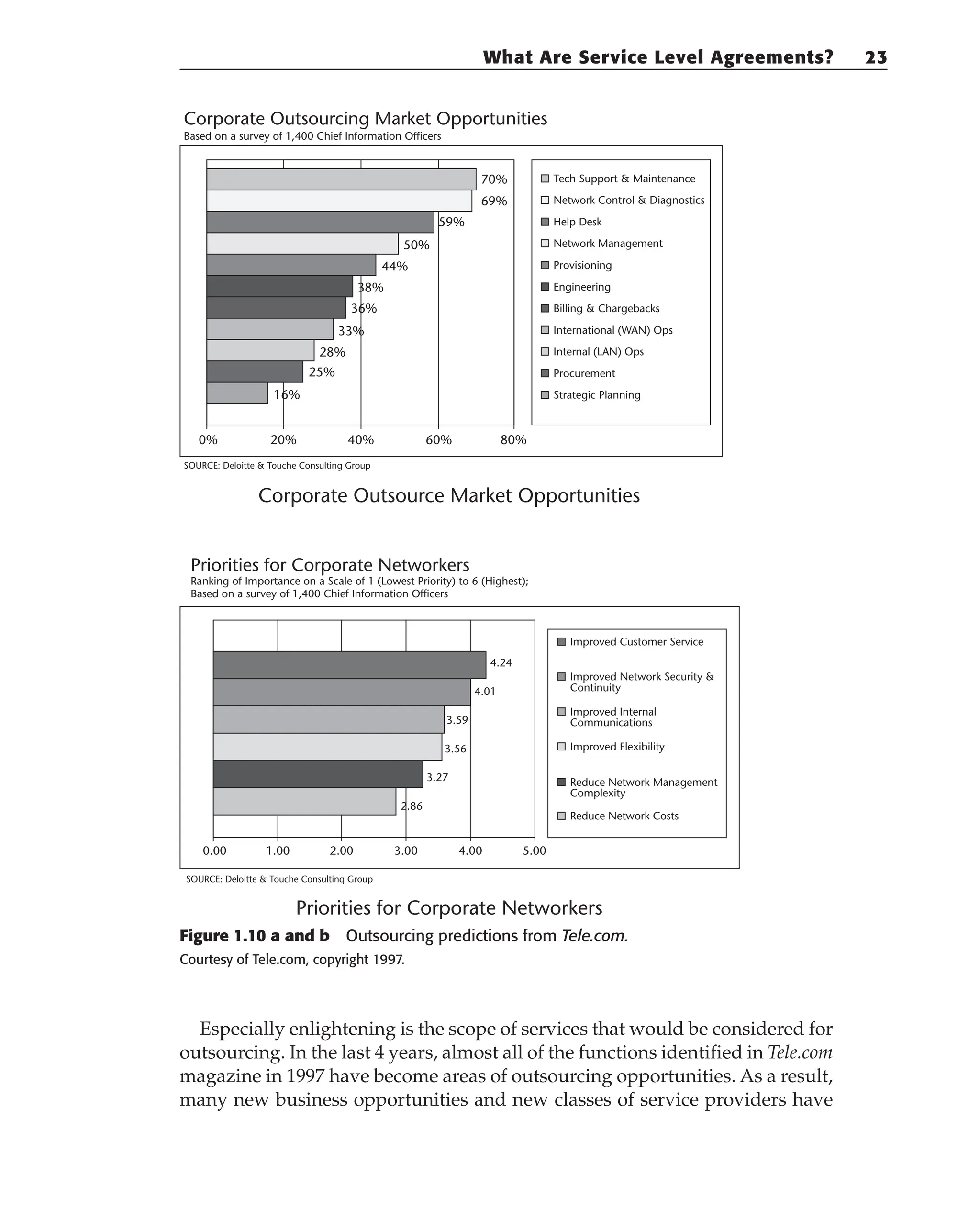
entire data centers, and even data storage. Figure 1.10 a and b from Tele.com
magazine as early as May 1997, show the areas that Chief Investment Officers
(CIOs) would consider for outsourcing and their priorities.
22 Chapter 1
Figure 1.10 a and b Outsourcing predictions from Tele.com.
Courtesy of Tele.com, copyright 1997.
Especially enlightening is the scope of services that would be considered for
outsourcing. In the last 4 years, almost all of the functions identified in Tele.com
magazine in 1997 have become areas of outsourcing opportunities. As a result,
many new business opportunities and new classes of service providers have
70% Tech Support & Maintenance
69%
59%
50%
44%
38%
36%
33%
28%
25%
4.24
4.01
3.59
3.56
3.27
2.86
16%
0% 20% 40%
Corporate Outsourcing Market Opportunities
Corporate Outsource Market Opportunities
Priorities for Corporate Networkers
Based on a survey of 1,400 Chief Information Officers
Priorities for Corporate Networkers
SOURCE: Deloitte & Touche Consulting Group
60% 80%
0.00 1.00 3.00
2.00 4.00 5.00
Improved Customer Service
Improved Network Security &
Continuity
Improved Internal
Communications
Improved Flexibility
Reduce Network Management
Complexity
Reduce Network Costs
Network Control & Diagnostics
Help Desk
Network Management
Provisioning
Engineering
Billing & Chargebacks
International (WAN) Ops
Internal (LAN) Ops
Procurement
Strategic Planning
Ranking of Importance on a Scale of 1 (Lowest Priority) to 6 (Highest);
Based on a survey of 1,400 Chief Information Officers
What Are Service Level Agreements? 23
been created, such as application service providers (ASPs) and data storage services
(DSSs). These new service providers are, in many cases, emerging content
providers.
Some of these outsourced service areas (such as bandwidth availability) are
so critical to the continued operation of certain business enterprises that cus-
tomers are unwilling to accept any service interruptions. The availability of
these mission-critical products and services is the primary driver behind using
SLAs.
The expectation is one of continued growth. Among the most recent predic-
tions, Red Herring quotes Wall Street analysts as saying that revenues seen by
data center outsourcers will grow from $3.5 billion in 2000 to $28.5 billion in
2005, a sevenfold increase.
In another example, Red Herring quotes the research firm IDC as projecting
a data storage outsourcing resurgence after the business arena’s initial rough
start. The market is expected to grow from $21 billion in 1999 to $40 billion in
2003.
The Emergence of Pure Content Providers
A new industry is evolving in the form of pure content providers. These high-
tech businesses (such as those discussed previously, ISPs,ASPs (Salesforce.com),
e-commerce companies (Amazon.com), and even specialized entertainment
channels available on the Internet or cable TV) will consist of established com-
panies, startups, and many variations on the two.
New business models will spring up and continue to astound us. For exam-
ple, according to Cap Gemini, Ernst, & Young, Napster grew to 35 million
users in under 2 years. This translated to a compound annual growth rate of
over 3,000 percent!
There are many indicators that pure content providers will experience con-
tinued strong growth. As an example, Jupiter Media Metrix was quoted in
CEO magazine as estimating that spending by enterprises just on streaming
video technology will explode from $140 million in 2000 to $2.8 billion in 2005.
Whatever business model, industry, or method of inception, the emerging
content providers will all have one thing in common—they will be dependent
on someone else to get their products to market. These businesses will live or
die based on their customers’ ability to access their content electronically.
Telecom service providers control this access in the form of bandwidth.
Without bandwidth, the content providers have no means to market. There-
fore they will want to guarantee that this access is available, reliable, scalable,
and robust. They will use SLAs to get those guarantees.
24 Chapter 1
Discovering Diverse Content Through
Random Scribd Documents
particular evening affected me even more uncomfortably than usual,
and I felt that I could not go in and see him—perhaps even have to
discuss the very subject that was weighing on my mind, when I
wanted to be alone to nurse my own mortification, and lull my fears
to rest by myself. I crept into the hall quietly and fetched a cloak and
hood, and then, running round to the yard, I called the St. Bernard.
He came, leaping and jumping upon me, this friend with whom I
was always in tune. I opened the gate gently, and together we went
out upon the road.
I think Taff and I must have walked three miles. The roads were
stiff and slippery, the air was like a knife; but I did not care. The
quick movement and the solitude and the quiet of the coming night
soothed me. We got up upon the downs where lonely homesteads
stud the country here and there, and came back again along the
cliffs that crown the marsh-land. There I stood a long while face to
face with the quiet world upon which the moon had now risen in the
deep blue of a twilight sky. It looked down upon the wide, white
marsh upon whose frozen bosom gray vapors floated lightly; it
looked down upon the dark town that rose yonder so sombre and
distinct out of the mystery of the landscape; the channel that flows
to the sea lay cold and blue and motionless at the foot of the hill like
a sheet of steel. It made me shudder. There was not a ripple upon
its deathly breast. The snow around was far more tender. For the
first time in my life I felt the sadness of the world; I realized that
there was something in it which I could not understand; I
remembered that there was such a thing as death.
CHAPTER VII.
I did not escape Mr. Hoad by my walk. He had stayed to tea. I do
not think that he was a favorite of mother's, but she always made a
great point of welcoming all father's friends to the house, and I saw
that she had welcomed him to-night. He sat in the place of honor
beside her, and there were sundry alterations on the tea-table, and a
pot of special marmalade in the middle.
It was very late when I came in. I took off my things in the hall
and went in without smoothing my hair. I thought I should have
been in disgrace for coming in late, and for having my hair in
disorder when a guest was present; but mother had forgotten her
displeasure, and smiled as she pushed my cup towards me. She
never made any allusion to by-gone differences—her anger never
lasted long.
The mood that I had brought with me from without was still upon
me, and when I saw that father's face had lost its gray pallor, that
his eyes shone with their usual fire, and that his voice was strong
and healthy, I sighed a sigh of relief and told myself that I was a
fool, and that Mr. Hoad must really be a good fellow if he could so
soon chase away the gloom from my parent's brow.
"Your husband looks wonderfully well again, Mrs. Maliphant," he
was saying; "it's quite surprising how soon he has pulled round.
When I met the doctor the other day driving from town, and
stopped to ask after him, he said it would be weeks before he could
be about again. But he has got a splendid constitution—must have.
Not that I would wish to detract from your powers of nursing. We all
have heard how wonderful they are."
Mr. Hoad smiled at mother, but she did not smile back again.
There were people whom she kept at arm's-length, even though
carefully civil to them. I don't suppose she knew this, for she was a
shy woman, but I recollect it well.
"We can all nurse those we are fond of," she said. "I'm sure I'm
very pleased to think you should find Mr. Maliphant looking better."
"Better! Nonsense!" exclaimed father. "I'm as well as I ever was in
my life. Don't let's hear any more about that, wife, there's a dear
soul."
"Nay, you shall hear no more about it than need be from me,
Laban, I can promise you that," smiled mother, pouring out the tea,
while Joyce, from the opposite side of the table, where she was
cutting up the seed-cake that she had made with her own hands the
day before, asked the guest after his two daughters.
"They are very busy," answered Mr. Hoad. "A large acquaintance,
you know—it involves a great deal of calling. I'm afraid they have
been remiss here."
"Oh, I pray, don't mention such a thing, Mr. Hoad," exclaimed
mother, hastily. "We don't pay calls ourselves. We are plain folk, and
don't hold with fashionable ways."
Mr. Hoad smiled rather uncomfortably.
"And we have not much to amuse them with," I put in. "We do
nothing that young ladies do."
I saw mother purse up her lips at this, and I was vexed that I had
said it, but father laughed and said: "No, Hoad, my girls are simple
farmer's daughters, and have learned more about gardening and
house-keeping than they have about French and piano-playing,
though Meg can sing a ballad when she chooses as well as I want to
hear it."
I declared my voice was nothing to Miss Hoad's; and Joyce,
always gracious, looked across to Mr. Hoad and said: "I wonder
whether Miss Jessie would sing something for us at our village
concert?"
"I'll ask her," said Mr. Hoad, a little diffidently. "I'm never sure
about my daughters' engagements. They have so many
engagements."
"We shall be very pleased to see them here any afternoon for a
practice, sha'n't we, mother?" added Joyce.
"The young ladies will always be welcome," replied mother, a little
stiffly; and I hastened to add, I fear less graciously:
"But pray don't let them break any engagements for us."
Mr. Hoad smiled again, and then father turned to him and they
took up the thread of their own talk where they had left it.
"You certainly ought to know that young fellow I was speaking of,"
Mr. Hoad began. "I was struck with him at once. A wonderful gift of
expressing himself, and just that kind of way with him that always
wins people—one can't explain it. Handsome, too, and full of
enthusiasm."
"Enthusiasm don't always carry weight," objected father. "It's
rather apt to fly too high."
"Bound to fly high when you have got to get over the heads of
other folks," laughed Mr. Hoad.
Father looked annoyed. "I wasn't joking, I wasn't joking," said he.
"If men want to go in for great work, they can't afford to take it
lightly." And then he added with one of his quick looks, "But don't
misunderstand me, Hoad. Enthusiasm of the right kind never takes
things lightly. It's the only sort of stuff that wins great battles,
because it has plenty of courage and don't know the meaning of
failure. Only there's such lots of stuff that's called enthusiasm and is
nothing but gas. I should like to see this young man and judge for
myself. God forbid I should think youth a stumbling-block. Youth is
the time for doing as well as for dreaming."
Father sighed, and though I could not tell why at the time, I can
guess now that it was from the recollection of that friend of his who
must have been the type of youthful enthusiasm thus to have left his
memory and the strength of his convictions so many years in the
heart of another.
"Well, you can see him easily enough," said Mr. Hoad. "He's
staying in your village, I believe. He's a nephew of Squire
Broderick's."
"What! Captain Forrester?" cried I.
"Ah, you know him of course, Miss Maliphant. Trust the young
ladies for finding out the handsome men," said Mr. Hoad, turning to
me with his most irritating expression of gallantry. I bit my lips with
annoyance at having opened my mouth to the man, especially as he
glanced across at Joyce with a horribly knowing look, at which of
course she blushed, making me very angry.
"I fancy the squire and he don't get on so extra well together,"
said Mr. Hoad. "Squire don't like the look of the lad that'll step into
his shoes, if he don't make haste and marry and have a son of his
own, I suppose."
"I should think this smart captain had best not reckon too much
on the property," said mother, stiffly, up in arms at once for her
favorite. "The squire's young enough yet to marry and have a dozen
sons."
"Yes, yes, ma'am, only joking, only joking," declared Mr. Hoad. "I
shouldn't think the lad gave the property a thought."
"If he's the kind of man you say, he can't possibly care about
property," said I, glibly, talking of what I could not understand.
Father smiled, but smiled kindly, at me. Mr. Hoad laughed outright
and made me furious.
"I see you're up in all the party phrases, young lady," said he.
"How did you come to know the young man, Hoad?" asked father,
without giving me time to reply. "You seem to have become friends
in a very short time."
"He came to me on a matter of business," repeated Hoad,
evasively. "I fancy he's pretty hard up. Only got his captain's pay and
a little private property, on his father's side, I suppose, and no doubt
gives more than he can spare to these societies and things."
Father was silent. Probably he knew, what I had no notion of, that
there was another branch to Mr. Hoad's profession besides that of a
solicitor. Evidently he did not like to be reminded of the fact, for he
knitted his brow and let his jaw fall, as he always did when annoyed.
"I don't know how we came to talk politics," Hoad went on, "but
we did, and I thought to myself, 'Why, here's just the man for
Maliphant.' I never knew any one else go as far as you do; but this
young fellow—why, he nearly beat you, 'pon my soul he did!"
"Politics!" echoed father, frowning more unmistakably than ever;
"what have they got to do with the matter?"
"Come, now, Maliphant, you're not going to keep that farce up
forever," cried Mr. Hoad, in his most intimate and good-natured
fashion. Oh, how I resented it when he would treat father as though
he were on perfect equality with him! For my father's daughter I was
intolerant; but then Mr. Hoad patronized, and patronizing was not
necessary in order to be consistent.
"What do you mean?" asked father.
"It was all very well for you to swear you would have nothing to
do with us before," continued Mr. Hoad. "You did not think we
should ever get hold of a man who looked at things as you do. But
now we have. And if you really have the Radical cause at heart, as
you say, you will be able to get him in for the county. He has got
everything in his favor—good name, good presence, good-breeding.
Those are the men to run your notions; not your measly, workaday
fellows—they have no influence with the masses."
Father rose from the table. His eyebrows nearly met in their
overhanging shagginess, and his eyes were small and brilliant.
"I don't think I understand you, Hoad," said he. "We seem to be
at cross-purposes. Do you mean to say that this young man wants to
get into Parliament?"
"Oh, no plans, no plans whatever, I should say," said Hoad. "He
merely asked me who was going to contest the Tory seat; and when
I asked him if he was a Radical, he aired a few sentiments which, as
I tell you, are quite in your line. But I should think we might easily
persuade him—he seemed so very eager. If you would back our
man, Maliphant, we should be safe whoever he was, I do believe,"
added the solicitor, emphatically. "He has a really wonderful
influence with the working-classes, that husband of yours, ma'am,"
he finished up, turning to mother.
"Yes," said she, proudly; "Laban's a fine orator. When I heard him
speak at the meeting the other day he fairly took my breath away,
that he did."
Mother looked up at father with a pleased smile, for she loved to
hear him praised, but for my own part I knew very well that he was
in no mood for pleasant speeches.
"I have always told you, Hoad, that it's no part of my scheme to
go in for politics," said he, in a low voice, but very decisively. "I see
no reason to change my mind."
"Well, my dear fellow, but that's absurd," answered Mr. Hoad, still
in that provokingly friendly fashion. "However do you expect to get
what you want?"
"Not through Parliament, anyhow," said father, laconically. "I never
heard of any Act of Parliament that gave bread to the poor out of
the waste of the rich. I'll wait to support Parliament till I see one of
the law-makers there lift up a finger to right the poor miserable
children who swarm and starve in the London streets, and whose
little faces grow mean and sharp with the learning to cheat those
who cheat them of their daily bread."
I can see him now, his lip trembling, his eye bright, his hands
clinched. It was the cry with which he ended every discourse; this
tender pity for the many children who must needs hunger while
others waste, who must needs learn sin while others are shielded
from even knowing that there is such a thing; those innocent
sinners, outcasts from good, patient because hopeless, yet often
enough incurably happy even in the very centre of evil—they were
always in his heart. It was his most cherished hope in some way to
succor them, by some means to bring the horror of their
helplessness home to the hearts of those who had happy children of
their own.
I held my face down that no one should see my tears, and I knew
that father took out his big colored pocket-handkerchief and blew his
nose very hard. Mr. Hoad, however, was not so easily affected.
"Ah, you were right, Mrs. Maliphant," said he, in a loud, emphatic
voice. "Your husband would make a very fine orator. All the more
reason it's a sin and a shame he should hide his talents under a
bushel. Now, don't you agree with me?"
"Oh, Laban knows best what he has got to do," answered mother.
"I think it's a great pity for women to mix themselves up in these
matters. They have plenty to do attending to the practical affairs of
life."
Mr. Hoad burst into a loud fit of laughter. "Ah, you've got a clever
wife, Maliphant," cried he. "She's put her finger upon the weak joint
in your armor! Yes, that's it, my boy. They're fine sentiments, but
they aren't practical; they won't wash. But you would soon see,
when you really got into the thing, that the best way to make the
first step towards what you want is not to ask for the whole lot at
once. The thin edge of the wedge—that's the art. And I should be
inclined to think this young fellow was not wanting in tact."
"Anyhow," answered father, quietly, "if Squire Broderick's nephew
were minded to oppose the Tory candidate for this county, I should
certainly not wish—as Squire Broderick's old friend—to support him
in his venture."
"Ah, you're very scrupulous, Maliphant," laughed Mr. Hoad. But
then, seeing his mistake, he added, quickly, "Quite right, perfectly
right of course, and I don't suppose the young man has any
intention of doing anything of the kind."
"No doubt it was rather that the wish was father to the thought in
you, Hoad," answered father, frankly.
"Ah, well, you may be as obstinate as you like, Maliphant," said
the solicitor, trying to take father's good-tempered effort as a cue for
jocoseness, "but we can get on very well without you if the young
ladies will only give us their kind support. I hope you won't be such
an old curmudgeon as to forbid that; and I hope," added he, turning
to Joyce with that sugary smile of his, "that the young ladies will not
withdraw their patronage if, after all, a less handsome man than
Captain Forrester should be our Radical candidate."
"Oh, thank you," said Joyce, blushing furiously, and looking up
with distressed blue eyes; "indeed, we scarcely know Captain
Forrester at all. We couldn't possibly be of any use to you."
"Of course not," cried I. "Whoever were the candidate we should
not canvass. We never canvass. We are not politicians."
I wonder that nobody smiled, but nobody did. Father was too busy
with his thoughts, and perhaps Mr. Hoad was too much astonished.
But as though to cover my priggishness, Joyce said, sweetly, when
Mr. Hoad rose to go: "You won't forget the concert, will you? And,
please, will you tell Miss Bessie that I shall be very glad to do what I
can to help her with her bazaar work?"
He promised to remember both messages, and shook hands with
her in a kind of lingering way, which I remember was a manner he
always had towards a pretty girl. I thought mother took leave of him
a little shortly. Father alone accompanied him out into the hall, and
saw him into the smart little gig that came round from the stable to
pick him up. I went to the pantry for the tray to clear the tea-things.
When I came back again into the parlor Joyce had gone up-stairs,
and father and mother were alone. I do not know why it was, but as
soon as I came in I felt sure that the discussion with Hoad, eager as
it had been at the time, was not occupying father's mind. I felt sure
that mother had alluded to that more important matter hotly spoken
of after the squire's visit. She was standing by the fire, and father
held her hand in his. He asked me to bring a lamp into his study,
and went out. I glanced at mother.
"What does father want to go to work for so late?" said I. "Why
don't he sit and smoke his pipe as usual?"
Mother did not answer; her back was turned towards me, but
there was something in its expression which made me feel sure that
she was crying.
"But he seems much better to-night, mother," I added, coming up
behind her; "he was quite himself over that argument."
"Yes, dear, yes; he can always wake up over those things,"
answered she, and sure enough there was a tremble in her voice,
and every trace of the dignity that she had used towards me since
the scene at the dinner-table had entirely disappeared.
"Dear mother, why do you fret?" said I, softly. "I'm sure there's no
need."
"No, no, of course there's no need," she repeated. "But,
Margaret," added she, hurriedly, as though she were half ashamed
of what she were saying, "if he could be brought to see that plan of
the squire's in a better light, I'm sure it would be a good thing. I
don't think his heart has ever been in farm-work, and I can't a-bear
to see him working so hard now he is old. It would have been
different, you see, if—if little John had lived."
I kissed her silently. The innocent slight to my own capacities,
which had so occupied my mind an hour ago, passed unnoticed by
me. And as father that night at family prayers rolled forth in his
sonorous voice the beautiful language of the Psalms, the words, "He
hath respect unto the lowly, but the proud he knoweth afar off,"
sank into my heart, and I thought that I should never again want to
set myself up above my betters.
CHAPTER VIII.
I lay awake quite half an hour that night, and I made up my mind
—just as seriously as though my feelings were likely to prove an
important influence—that I would in no way try to bias my father in
his decision about taking a bailiff. But real as was my trouble about
this matter that to me was so mighty, it was all put to flight the next
morning by an occurrence of more personal and immediate interest.
Such is the blessed elasticity of youth. The occurrence was one
which not only brought the remembrance of Captain Forrester, and
my romantic dreams for Joyce, once more vividly to my mind, but it
also gave no small promise of enjoyment to myself. It consisted in
the sudden appearance of a groom from the Manor, who delivered
into my hands a note for mother.
It was morning when he came; mother was still in the kitchen
with Deborah, and Joyce and I had not finished making our beds
and dusting our room. But I do not think there was any delay in the
answering of that door-bell. I remember how cross I was when
mother would insist on finishing all her business before she opened
the note; she went into the poultry-yard and decided what chickens
and what ducks should be killed for the week's dinners, she went
into the dairy to look at the cream, she even went up herself into
the loft to get apples before she would go and find her spectacles in
the parlor. And yet any one could have imagined that a note from
the squire meant something very important. And so, indeed, it did. It
contained a formal invitation to a grand ball to be given at the
Manor-house. The card did not say a "grand" ball, but of course we
knew that it would be a grand ball. We were fairly dazed with
excitement. Actually a ball in our quiet little village. Such a thing had
not been known since I had been grown up, and I had not even
heard of its having occurred since the days when young Mrs.
Broderick had come to the Manor as a bride. Of course we had been
to dances in town once or twice—once to the Hoads', and once to a
county ball, got up at the White Hart Inn, but I think these were
really the only two occasions on which I had danced anywhere out
of the dancing academy. Joyce, being a little older, could count about
three more such exciting moments in her life. The card was passed
round from hand to hand, and then stuck up on the mantle-shelf in
front of the clock, as though there were any danger that any of the
family would be likely to forget on what day and at what hour Squire
Broderick had invited us to "dancing" at the Manor.
"I wonder what has made the squire give a ball now," said mother.
"I suppose it's the prospect of the elections. He thinks he owes it to
the county."
"Why on earth should he owe the county a ball because of the
elections?" cried I. "He is not going to stand, and I don't think he
can suppose that a ball would be likely to do the Farnham interests
much good, if that's the only man they have got to put forward on
the Conservative side."
"I don't think it's a young girl's business to talk in that flippant
way, Margaret," said the mother. Father was not present just then. "I
don't think it's becoming in young folk to talk about matters they
can't possibly understand."
I was nettled at this, but I did not dare to answer mother back.
"You never heard your father talk like that of Mr. Farnham, I'm
sure," added mother. "He likes him a great deal better than he does
Mr. Thorne, although Mr. Thorne is a Radical."
"Well, I should think so! Mr. Thorne is a capitalist, and father
doesn't think that men who have made such large fortunes in
business ought to exist," cried I, boldly, applying a theory to an
individual as I thought I had been taught. "It is no use his being a
Radical, nor giving money to the poor, because he oughtn't to have
the money. It's dreadful to think of his having bought a beautiful old
place like the Priory with money that he has ground out of his
workpeople. No, nobody will ever like Mr. Thorne in the
neighborhood."
"I know squire and he don't hold together at all," answered
mother. "Though they do say Mr. Thorne bought the property
through that handsome young spark of a nephew of the squire's.
The families were acquainted up North."
"Who told you that, mother?" asked I, quickly.
"Miss Farnham said so when she called yesterday," replied mother.
"And she said it was Mr. Thorne was going to contest the seat with
her brother, so I don't know how Mr. Hoad could have come
suggesting that young captain to your father as he did yesterday. A
rich man like the manufacturer would be sure to have much more
chance."
I was silent. I was a little out of my depth. "I don't believe Mr.
Hoad knew anything at all about it," I said. "How could a man be
going to contest a seat against the candidate that his own uncle was
backing? It's ridiculous. Mr. Hoad has always got something to say."
"Margaret, you really shouldn't allow yourself to pass so many
opinions on folk," repeated mother. "First Mr. Farnham, and then Mr.
Thorne, and now Mr. Hoad. It's not pretty in young women."
"Very well, mother, I won't do it again," said I, merrily. "At all
events Parliament doesn't matter much, father says so; and anyhow,
squire's going to give us a ball, and nothing can matter so much as
that."
Nothing did matter half so much to us three just then, it is true.
Mother was just as much excited as we were, and we all fell to
discussing the fashions with just as much eagerness, if not as much
knowledge, as if we had been London born and bred.
"You must look over your clothes and see you have got everything
neat. Joyce, I suppose you will wear your white embroidered
'India'?" said the mother. And from that it was a very natural step to
go and look at the white muslin, and at the other clothes that our
simple wardrobes boasted, so that we spent every bit of that
morning that was not taken up with urgent household duties in
turning over frocks and laces and ribbons, and determining what we
should wear, and what wanted washing before we did wear it. Yes, I
think I thought of my dress that day for the first time in my life.
There was no need to think of Joyce's, because she was sure to be
admired, but if there was any chance of my looking well it could only
be because of some happy thought with regard to my costume; and
so when mother suggested that she should give me her lovely old
sea-green shot silk to be made up for the occasion, my heart leaped
for joy. I was very much excited. For Joyce, because I had quite
made up my mind that it was Captain Forrester who had persuaded
the squire to give this ball; and for myself, because it was really a
great event in the life of any girl, and I was passionately fond of
dancing. I spent the afternoon washing my old lace ruffles, and
pulling them out tenderly before the fire, and all the time I was
humming waltz tunes, and wondering who would dance with me,
and picturing Joyce to myself whirling round in the arms of Captain
Forrester. I thought of Joyce and her lover so much that it was
scarcely a surprise to me when, just as the light was beginning to
fade and tea-time was near, I heard a sharp ring at the front door,
and running to the back passage window with my lace in my hand, I
saw that Squire Broderick was standing in the porch, and with him
his nephew Captain Forrester. I heard Joyce fly through the hall to
the kitchen. I think she must have seen the two gentlemen pass
down the road, and then she ran back again into the parlor, and
Deborah went to the door.
"Mrs. Maliphant at home?" said the squire's cheery voice; and
scarcely waiting for a reply, he strode through to the front room.
I threw down my lace, turned down my sleeves, and without any
more attention to my toilet I ran down-stairs. Mother had gone to do
some little errands in the village and had not come in; Joyce stood
alone with the visitors. She had her plain dark-blue every-day gown
on, but the soft little frills at her throat and wrists were clean. I
remember thinking how fortunate it was that they were clean. She
was standing in the window with Captain Forrester, who was
admiring our view over the marsh.
"It's a most beautiful country," said he. And his eyes wandered
from the plain without that the shades of evening were slowly
darkening to the face at his side that shone so fair against the little
frilled muslin curtain which she held aside with her hand.
The squire sat at the table; he had taken up the morning paper,
and I supposed that the frown on his face was summoned there by
something that he read in the columns of this the Liberal journal.
Captain Forrester left Joyce and came towards me as soon as I
entered the room.
"Miss Maliphant, I am delighted to meet you again," said he, with
his pleasant polished manner that had the art of never making one
feel that he was saying a thing merely to be agreeable. "After our
little adventure of the other day, I felt that it was impossible for me
to leave the neighborhood without trying to make our acquaintance
fast."
"Oh, are you leaving the neighborhood?" said I—I am afraid a little
too anxiously.
"Well, not just yet," smiled Captain Forrester. "I think I shall stay
till over the ball."
"Nonsense, Frank," said the squire, rising and pushing the paper
away from him. "Of course you will stay over the ball." Then turning
to me, he said, merrily, "No difficulty about you young ladies coming,
I hope?"
"I don't know, Mr. Broderick," answered I. "You must wait and ask
mother. It's a very grand affair for two such simple girls as Joyce and
me."
"Oh, Margaret, I think we shall be allowed to go," put in Joyce, in
her gentle, matter-of-fact voice. "You know we went to a very late
ball last Christmas in town."
Considering that we had been sitting over frocks all the morning,
this would have been nonsense, excepting that Joyce never could
see a joke.
"I think I shall have to take Mrs. Maliphant in hand myself if she
makes any objection," said the squire, "for we certainly can't spare
you and your sister."
Joyce blushed, and Captain Forrester turned to her and was going
to say something which I think would have been complimentary,
when father entered the room. He had his rough, brown, ill-cut suit
on, and his blue handkerchief twisted twice round his neck and tied
loosely in front, and did not look at all the same kind of man as the
two in front of him. I noticed it for the first time that evening. I was
not at all ashamed of it. If I had been questioned, I should have said
that I was very proud of it, but I just noticed it, and I wondered if
Captain Forrester noticed it too. It certainly was very odd that it
never should have occurred to me before, that this lover whom I had
picked out for Joyce belonged to the very same class as the squire,
whom I thought so unsuitable to her. I suppose it was because
Captain Forrester was not a landed proprietor, and that any man
who belonged to the noble career of soldiering atoned for his birth
by his profession.
"How are you, Maliphant?" said the squire, grasping him by the
hand as though there had been no such thing as any uncomfortable
parting between them. "I'm glad to see you are none the worse for
this cursed east wind. It's enough to upset many a younger and
stronger man."
Father had taken the proffered hand, but not very cordially. I am
not sure that he ever shook hands very cordially with people;
perhaps it was partly owing to the stiffness in his fingers, but I
believe that he regarded it as a useless formality. I imagine this
because I, too, have always had a dislike to kissings and hand-
shakings, when a simple "good-day" seemed to me to serve the
purpose well enough.
"Pooh!" said father, in answer to the squire's remark. "A man who
has his work out-doors all the year round, Squire Broderick, needs
must take little account whether the wind be in the east or the
south, except as how it'll affect his crops and his flock."
The squire took no notice of this speech. It was so very evident
that it was spoken with a view to the vexed question.
"I've brought my nephew round," said he, and Captain Forrester
left Joyce's side as he said it, and came forward with his pleasant
smile and just the proper amount of deference added to his usual
charming manner. "He wanted to see the Grange," added the squire,
again with that frown upon his brow that I could not understand, but
which no doubt proceeded, as he had affirmed, from the effect of
the east wind upon his temper.
"I'm very glad to see you, sir," said father, shortly. "I hear you
rendered my daughters some assistance the other day."
Captain Forrester smiled. "It could scarcely be called assistance,"
he said. "Your daughter"—and he looked at me to distinguish me
from Joyce—"would have been capable of driving the horse, I am
sure."
"Oh, I understood the mare reared," answered father.
"Well, she is not a good horse for a lady to drive," allowed Captain
Forrester, as though the confession were wrung from him; and I
wondered how he guessed that it annoyed me to be thought
incapable of managing the mare. "But some women drive as well as
any man."
The squire took up the paper again. I did not think it was good-
manners of him.
"What a splendid view you have from this house," continued
Captain Forrester. "I think it's much finer than from our place."
The squire's shoulders moved with an impatient movement. The
article he was reading must decidedly have annoyed him.
"Yes," answered Joyce; "but you should come and see it in
summer or in autumn. It's very bleak now. The spring is so late this
year."
"Ay; I don't remember a snowfall in March these five years," said
father.
"But it has a beautiful effect on this plain," continued the young
man, moving away into the window again. And then turning round
to Joyce, he added, "Do you sketch, Miss Maliphant?"
"No, no," answered father for her. "We have no time for such
things. We have all of us plenty to do without any accomplishments."
"Miss Margaret can sing 'Robin Adair,'" put in the squire, "as well
as I want to hear it, accomplishments or not."
"Indeed," said Captain Forrester, with a show of interest. "I hope
she will sing it to me some day."
He said it with a certain air of patronage, which I found afterwards
came from his own excellent knowledge of music.
"Are you fond of singing?" said I, simply. I was too much of a
country girl to think of denying the charge. I was very fond of good
music; it was second nature to me, inherited, I suppose, from some
forgotten ancestor, and picking out tunes on the old piano was the
only thing that ever kept me willingly in-doors. Father delighted in
my simple singing of simple ditties, and so did the squire; I had
grown used to thinking it was a talent in me, my only one, and I was
not ashamed of owning up to it. "I'll sing it to you now if you like."
"That's very kind of you," said the young man, with a little smile.
And I sat down and sang the old tune through. I remember that, for
the first time in my life, I was really nervous. Captain Forrester stood
by the piano. He was very kind; I don't know that any one had ever
said so much to me about my voice before, but in spite of it all I
knew for the first time that I knew nothing. I felt angrily ashamed
when Joyce, in reply to pressing questions about her musical
capacity, answered that I had all the talent, and began telling of the
village concerts that I was wont to get up for the poor people, and
of how there was one next week, when he must go and hear me
sing.
"Certainly I will," he answered, pleasantly, "and do anything I can
to help you. I have had some practice at that kind of thing."
"Why don't you say you are a regular professional at it, Frank?"
put in the squire, I fancied a little crossly. "He's always getting up
village concerts—a regular godsend at that kind of thing."
Frank laughed, and said he hoped we would employ him after
such a character, and then he asked what was our programme.
Joyce told him. I was going to sing, and Miss Hoad was going to sing
—and she sang beautifully, for she had learned in London—and then
I would sing with the blacksmith, and Miss Thorne would play with
the grocer on the cornet, and glees and comic songs would fill up
the remainder. The smile upon Captain Forrester's face clouded just
a little at the mention of Miss Thorne.
"Miss Thorne is not very proficient on the piano," said he. "Have
you already asked her to perform?"
"Do you know Miss Thorne?" asked Joyce, surprised.
"Yes," answered the captain; "she lived in the village where I was
brought up as a boy—not far from Manchester. Her father was a
great manufacturer, you know."
"Yes; we know that well enough." And I glanced uneasily at
father; for if he knew that this young fellow was a friend of the
Thornes, I was afraid it would set him against him. Luckily, he was
busy talking to the squire.
"She's a very nice girl," said Joyce, kindly, wanting to be
agreeable, although indeed we knew no more of Mary Thorne than
shaking hands with her coming out of church on a Sunday
afternoon.
"Charming," acquiesced the captain; "but she's not a good
musician, and I shouldn't ask her to perform unless you're obliged
to."
We said we were not obliged to; but Joyce said she wouldn't like
to do anything unkind, and she was afraid Mary Thorne wanted to
be asked to perform. And then they two retired into the window
again, discussing the concert and the view, and I soon saw proudly
that they were talking as though they had known one another for
years. It generally took a long while for any one to get through the
first ice with Joyce, but this man had an easy way with him; he was
so sympathetic in his personality—so kind and frank and natural.
"That's a most ridiculous article in the Herald," said the squire to
father. "I wonder Blair can put in such stuff. He's a sensible man."
"I wonder you'll admit even that, squire," answered father, with a
little laugh. The paper, I need not say, was the Liberal organ.
"Oh, well," smiled the other, "I can see the good in a man though
I don't agree with him. But I think that"—pointing to the print—"is
beneath contempt."
"I don't hold with it myself," answered father; "the man has got no
pluck."
"Oh no, of course—doesn't go far enough for you, Maliphant,"
laughed the squire; and at that moment mother came in or I do not
know what father would have answered. She came in slowly, and
stood a moment in the door-way looking round upon us all. Joyce
blushed scarlet, and came forward out of the recess. The squire rose
and hastened towards her.
"We have been invading your house while you have been away,
Mrs. Maliphant," said he. "That wasn't polite, was it? But you'll
forgive me, I know."
Mother's eyes scarcely rested on him; they travelled past him to
Captain Forrester, who stood in the window.
"My nephew, Frank Forrester," said the squire, hastily following her
look. The captain advanced and bowed to mother. He could do
nothing more, for she did not hold out her hand.
"I am very glad to see any friend of yours, squire," said she. And
then she turned away from him, and unfastened her cloak, which I
took from her and hung up in the hall.
"Joyce, lay the cloth," said she. "We'll have tea at once." I left the
room with sister.
"Never mind," whispered I, outside, as we fetched the pretty
white egg-shell cups that always came out when we had any
company; "mother doesn't mean to be queer. She is just a little cold
now, because she wants Captain Forrester to understand it wasn't
with her leave we let him drive us home. But she isn't really cross."
"Cross! Oh, Margaret, no—of course not," echoed Joyce. She was
taking down a plate from under a pile of cups, and said no more at
the moment. I was ashamed and half vexed. That was the worst of
Joyce. Sometimes she would reprove one when one was actually
fighting her battles.
"Of course we ought not to have done it," continued she, setting
the cups in order on the tray. "I felt it at the time."
"Then, why in the world didn't you say so?" cried I.
"I didn't know how to say so; you scarcely gave me a chance,"
answered she. "Of course, I know you did it because I was so
stupidly frightened, but it makes me rather uncomfortable now."
"Oh, I thought you seemed to get on very well with Captain
Forrester, just now," said I, huffily, kneeling down to reach the cake
on the bottom shelf. "You seemed quite civil to him, and you didn't
look uncomfortable."
"Didn't I? I'm glad," answered Joyce, simply. "Of course one wants
to be civil to the squire's friends in father's house. And I do think he
is a very polite gentleman."
She took up the tray and moved on into the parlor, and I went
across into the kitchen to fetch the urn. I had never been envious of
Joyce's beauty up to the present time. Nothing had happened to
make me so, and I was fully occupied in being proud of it. But if her
beauty was of such little account to her that she had not even been
pleased by this handsome man's admiration of it—well, I thought I
could have made better use of it.
When I went into the parlor again the groups were all changed.
Father stood by the fire and the squire had risen. Father had his
hands crossed behind his back and his sarcastic expression on, and
the squire was talking loudly. Joyce was laying the cloth, and mother
stood by the window where sister had stood before; Captain
Forrester was talking to her as if he had never cared to do anything
else. I could not hear what they were saying, the squire's voice was
too loud; but I could see that mother was quite civil.
"I never liked that man Hoad," the squire was saying, and I felt a
throb of satisfaction as I heard him. "I don't believe he's
straightforward. Do anything for money, that's my feeling."
"He's a friend of mine," said father, stiffly.
"Oh, well, of course, if he's a friend of yours, well and good,"
answered Mr. Broderick, shortly. "You probably know him better than
I do. But I don't like him. I should never be able to trust him."
"Perhaps that is because you do not know him," suggested father.
"No doubt, no doubt," answered the squire.
"I hear he has turned Radical now," added he, coming to the real
core of the grievance. "He used to call himself a Liberal, but now I
hear he calls himself a Radical, and is going to put up some Radical
candidate to oppose us."
"Yes, I know," answered father, too honest to deny the charge.
"Oh, do you know who it is?" asked the squire, sharply.
"No, I don't," answered father, in the same way.
The squire paused a moment, then he said, unable to keep it in,
"Are you going to support him too?"
The color went out of father's face; I knew he was angry.
"Well, Mr. Broderick, I don't know what sort of a candidate it'll be,"
said he, in a provoking manner. "There's Radicals and Radicals."
The squire smacked his boot with his walking-stick and did not
answer. Captain Forrester came forward, for mother had gone to the
table to make the tea.
"Did I hear you say that you were a Radical, Mr. Maliphant?" asked
the young man, looking at father.
"I am not a Tory," answered father, without looking up. I thought
his tone was cruelly curt.
"Well, I am a Socialist," answered Frank Forrester, with an air that
would have been defiant had it not been too pleasant-spoken. Father
smiled. The words must have provoked that—would have provoked
more if the speaker had not been so good-tempered.
"Ah, I know what you young fellows mean by a Socialist," he
murmured.
"I should say I went about as far as most men in England," said
Frank, looking at him in that open-eyed fixed way that he used
towards men as well as towards women.
"I should say that you went farther than you can see," said the
Squire, laconically.
Frank laughed, good-humoredly. "Ah, I refuse to quarrel with you,
uncle," said he, taking hold of the squire's arm in a friendly fashion.
It was said as though he would imply that he could quarrel with
other people when he liked, but his look belied his words.
"If you will let me, I'll come in and have a chat one of these days,
Mr. Maliphant," continued he. "When uncle is not by, you know." He
said the words as though he felt sure that his request would be
granted, and yet with his confidence there was a graceful deference
to the elder man which was very fascinating. Why did father look at
him as he did? Did he feel something that I felt? And what was it
that I felt? I do not know.
"I am a busy man and haven't much time for talk, sir, but you're
welcome when you like to call," answered father, civilly, not warmly.
The squire had sat down again while his nephew and father were
exchanging these few words. He crossed one knee over the other
and sat there striking his foot with his hand—a provoking habit that
he had when he was trying to control his temper.
"There'll be a nice pair of you," said he, trying to turn the matter
off into a joke. "It's a pity, Frank, that you have no vote to help Mr.
Maliphant's candidate with."
"I don't know that any so-called Radical candidate would or could
do much in Parliament to help the questions that I have at heart,"
said Captain Forrester. "As Mr. Maliphant justly observed, there are
Radicals and Radicals, and the political Radical has very little in
common with those who consider merely social problems."
Father did look up now, and his eyes shone as I had seen them
shine when he was talking to the working-men, for though I had not
often heard him—the chief of his discourses being given in the
village club—I had once been to a large meeting in town where he
had been the chief speaker.
"One never knows where to have any of you fellows," laughed the
squire, rather uncomfortably. "You always led me to believe,
Maliphant, that you would have nothing to do with political party
spirit. You always said that no party yet invented would advance the
interests of the people in a genuine fashion, and now, as soon as a
Radical candidate appears, you talk of supporting him."
"I am not aware that I talked of supporting him," said father.
"But you won't return a Radical," continued the squire, not hearing
the remark. "The country isn't ripe for that sort of thing yet,
whatever you may think it will be. You're very influential, I know.
And if you're not with us, as I once hoped you might be, you'll be a
big weight against us. But with all your influence you won't return a
Radical. The Tories are too strong; they're much stronger than they
were last election, and then Sethurst was an old-fashioned Liberal
and a well-known man in the county besides. You won't return a
Radical. I don't believe there's a county in England would return
what you would call a Radical, and certainly not ours."
"I don't believe there is," said father, quietly.
"Then why do you want to support this candidate?"
"I don't," answered father. "I'm a man of my word, Squire
Broderick. I told you long ago I'd have nothing to do with politics,
and no more I will. If I am to be of any use, I must do it in another
way—I must work from another level. The county may return what it
likes for all I shall trouble about it."
"Well, 'pon my soul," began the squire, but at that moment
mother's voice came from the tea-table. She saw that a hot
argument was imminent, and she never could abide an argument. I
think that father, too, must have been disinclined for one, for when
she said, "Father, your tea is poured out," he took the hint at once.
The squire looked disappointed for a moment, but I think he was so
glad that father's influence was not going to take political shape
against his candidate that he forgave all else.
Mother was just making Captain Forrester welcome beside her as
the newest guest, when Deborah opened the door and ushered in
Mr. Hoad. I had quite forgotten that father had invited him. He stood
a moment as it were appraising the company. His eyes rested for
less than an instant on Squire Broderick, on Captain Forrester, and
then shifted immediately to mother.
"Oh, I am afraid that I intrude, Mrs. Maliphant," said he.
"Not at all, not at all, Hoad," declared father. "Come in; we
expected you."
Mother rose and offered him her hand. Then Captain Forrester,
who had been looking at him, came forward and offered his too in
his most genial manner. It was not till long afterwards that I found
out that he made a special point of always being most genial to
those people whom he considered ever so little beneath him.
Welcome to Our Bookstore - The Ultimate Destination for Book Lovers
Are you passionate about books and eager to explore new worlds of
knowledge? At our website, we offer a vast collection of books that
cater to every interest and age group. From classic literature to
specialized publications, self-help books, and children’s stories, we
have it all! Each book is a gateway to new adventures, helping you
expand your knowledge and nourish your soul
Experience Convenient and Enjoyable Book Shopping Our website is more
than just an online bookstore—it’s a bridge connecting readers to the
timeless values of culture and wisdom. With a sleek and user-friendly
interface and a smart search system, you can find your favorite books
quickly and easily. Enjoy special promotions, fast home delivery, and
a seamless shopping experience that saves you time and enhances your
love for reading.
Let us accompany you on the journey of exploring knowledge and
personal growth!
ebookgate.com

Integrating service level agreements optimizing your OSS for SLA delivery 1st Edition John Lee
  • 1.
    Integrating service levelagreements optimizing your OSS for SLA delivery 1st Edition John Lee pdf download https://ebookgate.com/product/integrating-service-level- agreements-optimizing-your-oss-for-sla-delivery-1st-edition-john- lee/ Get Instant Ebook Downloads – Browse at https://ebookgate.com

  • 2.
    Get Your DigitalFiles Instantly: PDF, ePub, MOBI and More Quick Digital Downloads: PDF, ePub, MOBI and Other Formats Service Operations Management Improving Service Delivery 4th Edition Robert Johnson https://ebookgate.com/product/service-operations-management- improving-service-delivery-4th-edition-robert-johnson/ Emarketing Excellence Planning and Optimizing your Digital Marketing 4th Edition Dave Chaffey https://ebookgate.com/product/emarketing-excellence-planning-and- optimizing-your-digital-marketing-4th-edition-dave-chaffey/ E Commerce E Business and E Service 1st Edition Garry Lee https://ebookgate.com/product/e-commerce-e-business-and-e- service-1st-edition-garry-lee/ The Cloud at Your Service 1st Edition Jothy Rosenberg https://ebookgate.com/product/the-cloud-at-your-service-1st- edition-jothy-rosenberg/
  • 3.
    Upgrade Your Spanish1st Edition Abigail Lee Six https://ebookgate.com/product/upgrade-your-spanish-1st-edition- abigail-lee-six/ RNA Therapeutics Function Design and Delivery 1st Edition John Karijolich https://ebookgate.com/product/rna-therapeutics-function-design- and-delivery-1st-edition-john-karijolich/ Integrating Geographic Information Systems into Library Services A Guide for Academic Libraries 1st Edition John Abresch https://ebookgate.com/product/integrating-geographic-information- systems-into-library-services-a-guide-for-academic-libraries-1st- edition-john-abresch/ Integrating Your e Business Enterprise Sams White Book 1st Edition Andre Yee https://ebookgate.com/product/integrating-your-e-business- enterprise-sams-white-book-1st-edition-andre-yee/ Managing service level quality across wireless and fixed networks 1st edition Edition Peter Massam https://ebookgate.com/product/managing-service-level-quality- across-wireless-and-fixed-networks-1st-edition-edition-peter- massam/
  • 4.
  • 5.
    Wiley Publishing, Inc. JohnJ. Lee Ron Ben-Natan Integrating Service Level Agreements Optimizing Your OSS for SLA Delivery
  • 7.
  • 9.
    Wiley Publishing, Inc. JohnJ. Lee Ron Ben-Natan Integrating Service Level Agreements Optimizing Your OSS for SLA Delivery
  • 10.
    Publisher: Robert Ipsen Editor:Margaret Eldridge Developmental Editor: Kathryn Malm Managing Editor: Pamela Hanley New Media Editor: Brian Snapp Text Design & Composition: Wiley Composition Services Designations used by companies to distinguish their products are often claimed as trademarks. In all instances where Wiley Publishing, Inc., is aware of a claim, the product names appear in initial capital or ALL CAPITAL LETTERS. Readers, however, should contact the appropriate companies for more complete information regarding trademarks and registration. This book is printed on acid-free paper. ∞ Copyright © 2002 by John J. Lee and Ron Ben-Natan. All rights reserved. Published by Wiley Publishing, Inc., Indianapolis, Indiana Published simultaneously in Canada No part of this publication may be reproduced, stored in a retrieval system, or transmitted in any form or by any means, electronic, mechanical, photocopying, recording, scanning, or otherwise, except as permitted under Section 107 or 108 of the 1976 United States Copyright Act, without either the prior written permission of the Publisher, or authorization through payment of the appropriate per-copy fee to the Copyright Clearance Center, Inc., 222 Rosewood Drive, Danvers, MA 01923, (978) 750-8400, fax (978) 750-4470. Requests to the Publisher for permission should be addressed to the Legal Department, Wiley Publishing, Inc., 10475 Crosspointe Blvd., Indianapolis, IN 46256, (317) 572-3447, fax (317) 572-4447, E-mail: permcoordinator@wiley.com. Limit of Liability/Disclaimer of Warranty: While the publisher and author have used their best efforts in preparing this book, they make no representations or warranties with respect to the accuracy or com- pleteness of the contents of this book and specifically disclaim any implied warranties of mer- chantability or fitness for a particular purpose. No warranty may be created or extended by sales representatives or written sales materials. The advice and strategies contained herein may not be suit- able for your situation. You should consult with a professional where appropriate. Neither the pub- lisher nor author shall be liable for any loss of profit or any other commercial damages, including but not limited to special, incidental, consequential, or other damages. For general information on our other products and services please contact our Customer Care Depart- ment within the United States at (800) 762-2974, outside the United States at (317) 572-3993 or fax (317) 572-4002. Wiley also publishes its books in a variety of electronic formats. Some content that appears in print may not be available in electronic books. Library of Congress Cataloging-in-Publication Data: Lee, John (John J.), 1961- Integrating service level agreements : optimizing your OSS for SLA delivery / John Lee, Ron Ben-Natan. p. cm. Includes bibliographical references and index. ISBN 0-471-21012-9 1. Telecommunication—Quality control. 2. Service-level agreements. 3. Telecommunication—Customer service. 4. Internet service providers. 5. Information technology. I. Ben-Natan, Ron. II. Title. TK5102.84 .L44 2002 004.6'068—dc21 2002008682 Printed in the United States of America 10 9 8 7 6 5 4 3 2 1
  • 11.
    Contents v About the Authorsxvii Part One The Problem 1 Chapter 1 What Are Service Level Agreements? 3 Definition 3 Service Level Agreement Roles and Objectives 5 Defining Roles and Accountability 6 Managing Expectations 8 Controling Implementation and Execution 10 Providing Quality of Service Verification 11 Enabling Communications 13 Assessing Return on Investment 14 The Service Level Agreement Life Cycle 14 SLA Development 15 Negotiation and Sales 18 Implementation 19 Execution 19 Assessment 19 Customer-focused Assessments 20 Provider-focused Assessments 20 The Outlook for Service Level Agreements 22 The Growth in Outsourcing 22 The Emergence of Pure Content Providers 24 Summary 25 Chapter 2 The True Intent of Service Level Agreements 27 Evolution 27 Availability 28
  • 12.
    Customer Care 29 UnderstandingNeed Hierarchies 30 The Service Level Agreement Need Hierarchy 31 The Emergence of the Business Impact Financial Model 33 Provider-Centric Methodology 34 Business Impact Methodology 36 Big Stick versus Business Impact 37 Service Level Agreement Success Factors 39 Definable End-to-End 40 Successfully Deliverable 41 Meaningful Entitlement Metrics 44 Measurable at the Service Access Point 46 Visible 49 Reconcilable 53 Summary 55 Chapter 3 The Long Ascent to True Service Level Agreement Delivery 57 Why Delivery Is Important 57 Where We’ve Been 58 Some Good Examples of Bad Service Level Agreements 60 Example Summary 64 Understanding the Complexities in the Network Environment 65 The Explosion of Data Networking 67 New Technology 67 The Premise Factor 68 New Market Entrants 70 Tight Labor Markets 72 Organizational Stovepipes 74 Work-Flow Complexity 77 Competition Adds Many More Players 78 New Technology and Business Models Add More Complexity 79 Summary: A Confluence of Factors 81 The Great Boom Commences 82 Operational Reality Interrupts the Party 82 What Issues Lie Ahead for Service Level Agreements? 84 Summary 85 Chapter 4 The Operations Support System 87 The Operations Support System 88 Thought Leadership and Industry Models 90 The TeleManagement Forum 90 The Telecommunications Management Network Model 90 The Network Element Layer 92 The Element Management Layer 92 The Network Management Layer 92 The Service Management Layer 93 The Business Management Layer 94 vi Contents
  • 13.
    The Telecommunications OperationalMap 94 Understanding the Models 96 The Evolution of Network Management 96 The Transition to Service Management 98 The Emergence of Best-of-Breed 100 Best-of-Breed Problems and the OSS Spiral of Death 103 Lessons Learned 109 Asset Management Is Important 111 Understanding the Functional and Semantic Gaps 112 Work Flow Is the Glue That Binds the Organization, Not Middleware 115 The Outlook for Operations Support Systems 117 Summary 118 Chapter 5 Service Level Agreement Models 121 The Amdocs Service Level Agreement Blueprint 122 Customer-Facing Processes 122 Service Level Agreements in a Customer-Centric Approach 124 Creating a Contract Offering 127 Contract Life Cycle 131 Service Assurance Model 135 Micromuse Netcool 135 Orchestream Resolve 139 Summary 139 Part Two The Solution 141 Chapter 6 The Integrated Service Level Agreement Model 143 The Origin of the Integrated Service Level Agreement Concept 145 Technological Reality Check 146 The Integrated Service Level Agreement Framework 147 Enabling Technologies 149 Dynamic Work-Flow Automation 149 Dynamic Work-Flow Communities 150 Core Capabilities 151 Domains 153 The Presentation Domain 155 The Information Domain 155 The Product or Contract Domain 156 The Process or Work-Flow Domain 157 The Data Domain 157 The Provider or Workforce Domain 158 The Supply Domain 158 Sample Technical Architecture 159 Portal Architecture 160 The User Interface 161 Wireless and Voice Portals 162 Contents vii
  • 14.
    Business Intelligence Architecture163 Work-Flow Automation Architecture 164 The Work-Flow Engine 165 Business Transaction Framework 166 Business Rules Framework 166 Integration Architecture 166 XML and the Integration Server 168 Integration Server Tools 168 NGOSS Architecture 170 Service Level Agreement Compliance Reporting 170 Service Level Agreement Risk Mitigation 174 Summary 175 Chapter 7 Integration Techniques 177 Technical Integration 177 Semantic Integration 178 Concepts of Distributed Computing 179 Batch Processes 179 Real-Time Integration 181 Integration Paradigms 181 The Invocation or Remote Procedure Call 181 Message-Oriented Middleware 182 Publish and Subscribe 182 Integration Paradigms and OSS 182 CORBA 183 Object Request Brokers 183 Object Services 183 Interface Definition Language 184 Storing and Retrieving Information 185 Invoking an Object 185 Object Request Broker Interoperability and TCP/IP 186 Message-Oriented Middleware 188 Business Events 189 Publish-Subscribe 191 Extensible Markup Language 193 Extensible Markup Language Document 193 Why Extensible Markup Language? 195 Document Type Definitions 197 Document Object Model 197 Simple Application Program Interface for Extensible Markup Language 198 Extensible Style Language Transformation 199 Extensible Style Language Transformation Rules 200 Web Services 201 The Three Elements of Web Services 202 The Simple Object Access Protocol 203 viii Contents T E A M F L Y
  • 15.
    The Web ServicesDescription Language 203 Universal Description, Discovery, and Integration 204 The TeleManagement Forum’s System Integration Map 204 Summary 206 Chapter 8 Work-Flow Automation 207 Managing Business Processes 207 Manual Work Flow 208 Work-Flow Management Systems 209 Work-Flow Definitions 209 Three Elements of Work Flow 210 The Process Editor 211 Process Templates and Tokens 212 Process Steps 214 Properties 214 Subprocesses 218 Exporting Work-Flow Definitions 220 The Process Engine 223 Working and Monitoring 223 The Work-Flow Monitor 223 To Do List 225 Personal Assignment and Role Assignment 228 Dynamic Queues 229 Summary 230 Chapter 9 Organizational Issues 231 The Stovepipe Service Provider 231 Integrated Service Level Agreement Change Enablers 235 Unified Presentation 235 Dynamic Work-Flow Communities 236 Dynamic Work-Flow Automation 236 Workforce Management 237 Business Intelligence 237 Integrated Service Level Agreement-Based Organizational Optimization 237 The Work-Flow Community 239 Definition Hierarchy 240 Users 240 Groups 241 Communities 244 The Integrated Service Level Agreement-Aware Service Provider 245 Solutions 246 The Business Management Layer and Delivery Assurance 248 Product Engineering 250 Work-Flow Engineering 250 Organizational Engineering 250 Intelligence Engineering 250 Contents ix
  • 16.
    The Service ManagementLayer 251 Customer Care 251 Order Management 252 Work-Flow Control 252 Technical Support 252 The Network Management Layer 253 The Network Operations Center 253 Network Engineering 254 The Network Element Layer 254 Field Operations 255 Logistics 255 Organizational Summary 256 Summary 259 Chapter 10 Contractual Commitments and Penalties 261 Customer Obligations 262 Early Termination 262 Minimal Service Access Points 262 Usage-Based Penalties 263 The Effects of Regulation 263 Deregulated Environments 264 Regulated Environments 264 Example Service Level Agreements and Penalties 267 Service Level Agreement Contract for Internet Protocol Virtual Private Network: Sample 1 267 Security Services 267 Access Services 270 Service Level Agreement Contract for Internet Protocol Virtual Private Network: Sample 2 272 Internet Protocol Virtual Private Network—Dedicated Access Service Level Agreement 272 Example Service Level Agreements and Penalties Summary 278 Terms 280 A Multisite Contract Example 281 Summary 284 Chapter 11 Operational Process, Work Flow, Notification, and Alerts 287 Dynamic Work Flow 288 Universal Presentation 290 Work-Flow Automation 291 Business Intelligence 292 Dynamic Work-Flow Processes 292 The Delivery Work Flow 293 Generation 294 Assignment 294 x Contents
  • 17.
    Prioritization and/or Escalation295 Allocation 299 Execution 300 Updating/Evaluating 301 Closure 304 Reporting/Reconciliation 305 The Integrated Service Level Agreement Compliance Work Flow 305 Define Entitlements 306 Event Generation 307 Identify Provisioning and/or Troubleshooting Work Flows 307 Extract Performance Data 307 Work-Flow Activity 308 Network Statistics 308 Performance Analysis 309 Real-Time Analysis 309 Historical Analysis 310 Identify Exceptions 310 Respond 310 Calculate Financial Impact 311 Reconcile 312 Summary 313 Chapter 12 Metrics and Performance Reporting 315 Metrics and Measures 315 The General Information Framework 319 The Data Mart 320 Extraction Routines 322 Star Schema 323 Implementing Key Performance Indicators 325 An Example of Installation Follow-Ups 327 Data Availability 327 Building the Template 328 Dimensions 329 Defining the Instance 331 Defining the Target 331 Defining the Display Properties 332 Performance Reports 336 Paperless Reporting 337 Reporting Solutions 338 Designing Reports 340 Web Delivery 342 Summary 345 Contents xi
  • 18.
    Chapter 13 ServiceLevel Agreement Portals: A Unified Presentation Layer 347 Unified Presentation 348 Information Portals 348 Enterprise Information Portals 349 The Service Level Agreement Portal 349 Uniform Resource Locator Automation and Scripting 352 Automating the Flow 357 Uniform Resource Locator Automation Using Work Flow 360 An Application Session 360 Web “Scraping” 360 Chaining Requests 361 Enter Work Flow 361 Using the Work-Flow Token 361 Extracting Data from Scraped Pages 362 Security, Access Control, and Profiles 363 Integrating Interface Layers 364 Directory Services and the Lightweight Directory Access Protocol 365 Summary 366 Chapter 14 Notification, Mobile Computing, and Wireless Access 369 Notification 370 Synchronous and Asynchronous Notification 371 Internet-Based Notification 371 Paging 373 Telocator Alphanumeric Protocol and Simple Mail Transfer Protocol 376 Simple Network Paging Protocol 380 Wireless Communications Transfer Protocol 381 Short Message Service 383 Workforce Management 384 Meeting Service Level Agreements through Efficient Use of the Workforce 384 Mobile Computing 387 Wireless Infrastructure for Mobile Computing 388 Summary 390 Chapter 15 Service Marketplaces and Bandwidth Exchanges 391 The Liquidity Issue 393 Success Factors 395 Product 395 Price 395 Implementation 395 Quality 396 Settlement 396 Consolidating the Factors 396 xii Contents
  • 19.
    The Vision 396 TheNeed 399 Solutions 401 Product 402 Price 403 Implementation 404 Quality 405 Settlement 406 The Outlook for Exchanges 406 Summary 409 Chapter 16 Applying the Model to Other Industries 411 Utilities 412 Customer Service and Service Delivery 417 Quality Assurance 422 ISO 9000 422 Six Sigma 423 Summary 425 Appendix Acronyms 427 Bibliography 433 Index 437 Contents xiii
  • 21.
    “There is awisdom of the head and a wisdom of the heart” Charles Dickens To our wives, Becky and Rinat, whose endless dedication and tireless support form the foundation of our success.
  • 23.
    John J. Leeis Vice President of Strategy and Business Solutions at ViryaNet, a company that provides wireless workforce solutions. He is an expert in the development of operation and business support systems and a frequent con- tributor to industry publications. Ron Ben-Natan is CTO at ViryaNet and has been building distributed systems and applications at companies like Intel, Merrill Lynch, J. P. Morgan, and AT&T Bell Labs for the past 20 years. He has authored several successful books on distributed systems and the application of advanced technologies in busi- ness environments. About the Authors xvii
  • 24.
  • 25.
  • 27.
    3 In Chapter 1we will describe SLAs, discuss why they are important, and demonstrate why they are on the way to becoming the driving concept behind all service models. Service level agreements (SLAs) are about making promises. In the case of telecommunications, these are the promises that underlie all the fiber being laid; all the optics and electronics being developed, bought, installed, and turned up and the exact same promises that drove venture capitalists and investors to back all those telecom businesses that had absolutely no chance— none whatsoever—of ever making a dime. Definition In its most basic form, a service level agreement (SLA) is a contract or agree- ment that formalizes a business relationship, or part of the relationship, between two parties. Most often it takes the form of a negotiated contract made between a service provider and a customer and defines a price paid in exchange for an entitlement to a product or service to be delivered under cer- tain terms, conditions, and with certain financial guarantees. The TeleManagement Forum’s SLA Management Handbook defines an SLA as “[a] formal negotiated agreement between two parties, sometimes called a What Are Service Level Agreements? C HAPTE R 1
  • 28.
    service level guarantee.As depicted in Figure 1.1, it is a contract (or part of one) that exists between the service provider and the customer, designed to create a common understanding about services, priorities, responsibilities, etc.” (GB 917) Service level agreements emerged in the early 1990s as a way for Informa- tion Technology (IT) departments and service providers within private (usu- ally corporate) computer networking environments to measure and manage the quality of service (QoS) they were delivering to their internal customers. Ser- vice level agreements are the contractual component of QoS and are usually implemented as part of a larger service level management (SLM) initiative. Service level management has been defined by Sturm, Morris, and Jander in Foundations of Service Level Management as “the disciplined, proactive method- ology and procedures used to ensure that adequate levels of service are deliv- ered to all (IT) users in accordance with business priorities and at acceptable cost” (2000). Quality of service is defined by the International Telecommunications Union (ITU-T) as “the collective effect of service performances, which deter- mine the degree of satisfaction of a user of the service. Note that the quality of service is characterized by the combined aspects of service support perfor- mance, service operability performance, service integrity and other factors specific to each service.” In the last 10 years, SLM and QoS initiatives have routinely been imple- mented within the IT arena with much success. Originally, much of the SLM data were used to justify procurement and staffing budgets for IT groups that Figure 1.1 Service level agreements as depicted by the TeleManagement Forum in GB 917. Customer SLA Management = Relationship Management Provider Contract SLA 4 Chapter 1
  • 29.
    were still consideredcost centers and whose real value to the business was not yet fully appreciated. Much of the reporting consisted of QoS data showing customer satisfaction owing to contributions made by IT to user productivity and the bottom line. Much has changed in the last 10 years. The value of computers in all seg- ments and industries within the business world (as well as in our personal lives) has gone from unproven to absolutely essential. We have entered an era of business specialization, industry consolidation, and realization of large effi- ciency gains owing largely to technology. The standardization of hardware, networking, operating system, and many business software standards has made a relative commodity of providing tra- ditional IT department functions such as PC hardware configuration, network connectivity, and email access. Today the products and services that are routinely contracted for and managed using SLAs seem almost limitless. In the telecommunications space, customers most typically demand financial guarantees on the accurate and timely performance of the network itself, normally measured using statistical indicators such as circuit availability, reliability, and other key performance indi- cators (KPIs), as well as service-related activities such as provisioning, installa- tions, trouble response, and fault correction. Other areas such as responsive customer service, accurate billing, and immediate availability of additional network capacity can also be guaranteed by an SLA. It seems that the main qualifying criteria is that the service be mis- sion-critical and provided by an outside source. SLAs are also used extensively in other industries, most notably in the utility, transportation, and manufac- turing fields. Service Level Agreement Roles and Objectives Implementing a service level management (SLM) program that works for both the service provider and the customer is a very difficult undertaking. Service level agreements are technically complex to pull off from an operational stand- point, but, more important, the perception of the roles that SLAs should play differs greatly for the service provider as compared with the customer. In this chapter we discuss primarily the service provider’s point of view; the cus- tomer’s needs are discussed at length in Chapter 2. The roles most commonly given to SLAs can generally be grouped into six areas, as shown in Figure 1.2: 1. Define roles and accountability 2. Manage expectations 3. Control implementation and execution What Are Service Level Agreements? 5
  • 30.
    4. Provide verification 5.Enable communications 6. Assess return on investment Defining Roles and Accountability It is important that both parties to an SLA understand the respective roles and responsibilities defined in the agreement. A number of industry factors have made establishing roles, responsibilities, and performance (and financial) accountability increasingly difficult on both the network and services side of the SLA equation. Deregulation and the unprecedented growth in technology, customer demand, and new service offerings experienced over the last decade have cre- ated a unique environment in which hundreds of service providers depend on their competition to help them to deliver end-to-end services. Since 1984 the “network” and “the cloud” (the worldwide telecom WAN relative to the user’s LAN perspective) have become a virtual maze of equipment and capac- ity owned by a multitude of service providers, including leased lines, indefea- sible rights to use (IRUs), bandwidth swaps, unbundled network elements (UNE), carrier hotels, collocations, and “meet-me” rooms. To make it all work, the myriad providers have executed an almost endless number of collocation, interconnection, and capacity leasing agreements with each other, creating a complex web of overlapping business relationships. In the process, networks have become so intertwined and interdependent that many service providers cannot function without the other providers in their competitive space. Figure 1.2 The roles played by service level agreements. Prove Return on Investment Enable Communications Provider Verification Control Delivery & Execution Manage Expectations Define Roles and Accountability 6 Chapter 1
  • 31.
    Within the industry,the term coopetition has been coined to describe this strangely symbiotic situation. The TeleManagement Forum (TMF) has also rec- ognized the phenomenon and the implication for SLAs. The SLA Management Handbook uses the term value chain of service provision to describe a scenario wherein a number of different service providers are related through a series of SLA relationships that eventually terminate at the end user. A service provider in one SLA can be the customer in another SLA, and vice versa. Today, thou- sands of different value chains exist—each with any number of service providers (and potential SLAs) imbedded in it. The companies represented in these value chains span the entire cross section of telecommunications, as shown in Figure 1.3. Other factors, including the increased outsourcing of customer care to large call-center providers, service fulfillment to third-party installers, network monitoring to managed network service providers, and so on, have increas- ingly blurred the landscape, fragmented the lines of communication, confused end-to-end workflow processes, and made organizational continuity and accountability all but invisible to the customer. Service level agreements will be used to reestablish the chain of account- ability. As outlined by the TMF, each instance of SLA execution will consist of a service provider and a customer. In a well-developed SLA, the roles and responsibilities of each party will be defined as concretely as possible, along with the associated responsibility, liabilities, and recourse available to both parties. Figure 1.3 TeleManagement Forum’s value chain of service provision. Internal Provider End Customer Provider Service Provider Customer End Users Service Provider Service Provider Customer Provider Service Provider Customer Provider Customer Provider Customer What Are Service Level Agreements? 7
  • 32.
    Service level agreementssimplify the customer’s contractual recourse because the service provider functions as the final guarantor of the end-to-end network. That way, no matter the complexity of the underlying service (multi- ple service providers, different technologies, and so forth), the customer can hold the service provider solely responsible for delivery to his or her service access point. To mitigate the associated risks, the service provider (in its role as customer of another service provider) may in turn demand SLAs to cover that relation- ship. The result is a flow-down effect in which the risks of guaranteeing service to the end customer are spread through multiple SLAs over the end-to-end value chain. An example is shown in Figure 1.4. Managing Expectations In general, executing an SLA contractually sets the customer’s expectations regarding a product’s delivery. Once defined, agreed to, and executed, the terms and conditions that make up the bulk of the SLA contract become the customer’s entitlements with respect to the product. This guarantee enables the customer to plan and operate his or her business with a reasonable level of confidence in the availability, performance, or timeframe of a contracted prod- uct or service. Figure 1.4 TeleManagement Forum’s value chain of service provision. Internet Service Provider Network Service Provider Network Service Provider Access Provider Service 1 Service 2 Service 4 Service 3 Service 6 Service 5 End-to-end Service 8 Chapter 1
  • 33.
    Multiple SLA options(platinum, gold, silver, bronze, and so forth) for the same product or service give the customer the opportunity to weigh competing priorities within his or her own company and understand the relationship of his or her needs to those of other businesses. These options help the customer to allocate financial resources appropriately: He or she may opt for higher lev- els of availability or quicker response times at additional cost only for the most mission-critical links and decide to settle for a lower level of service for the rest. Different SLA options and the relationships between the guaranteed level, delivered level, and engineered level are demonstrated in the SLA Management Handbook, as shown in Figure 1.5. Service level agreements also assist the service provider in many ways. By understanding the customer’s expectations and the consequences of not meet- ing them, the service provider’s operations managers and other responsible parties can better plan and implement the required infrastructure. For example, SLA compliance may require that more emphasis be placed on network planning and configuration, collaboration with clients, proactive net- work management, and renewed emphasis on preventive maintenance, which are all driven by cost containment related to penalty clauses within SLAs. Service level agreement commitments may also demand that personnel or parts be prepositioned at or near the customer’s Service Access Point (SAP) to ensure adequate response capability or that additional resources such as spare facilities, parts, or backup circuits are put in place to reduce the potential for outages. Perhaps the greatest advantage of SLAs to both parties is that they set expec- tations and requirements for the process that will enable successful execution. Every relationship creates dependencies for which the expected results can be attained only if both parties provide the required contribution in a timely manner. Figure 1.5 The TeleManagement Forum’s service level agreement performance levels. Performance Level Grade of Service Guaranteed Level Delivered Level Engineered Level Bronze Silver Gold Performance Sets What Are Service Level Agreements? 9
  • 34.
    Service level agreementsformalize this relationship and, more important, place timeframes, thresholds, and escalation procedures around the execution phase of service fulfillment, assurance, and other areas, such as billing. Both the service provider and the customer are better able to plan because many of the “unknowns” are covered in the SLA, such as volumes, locations, QoS, and costs. Controlling Implementation and Execution The SLA is a reference document for managing the execution of the contract and ensuring the timely delivery and continued performance of the product or service within the defined entitlements. Customers tend to use SLAs to ensure preferential treatment for their par- ticular service needs relative to all the others in the service provider’s network. The expectations are clearly set, and during the implementation and execution phases of the contract, the service provider must deliver on these expectations. For the service provider, delivering the contracted service translates into ensuring that sufficient resources are available to consistently meet or exceed the SLA commitments. The service provider must have an understanding of all the commitments that have been made over the entire customer base and how the requirement for delivering on these commitments affect the support- ing organizations. Service level agreement entitlements have a tendency to affect the service provider’s support organization in two ways: (1) They tend to reprioritize the work based on a potential financial impact, and (2) they tend to shorten the time available to perform the work. Historically, field service organizations have prioritized work based on the impact to the network hardware. Automated network management systems generated much of the fault identification and were usually configured so that fault alarms or outages on the most critical hardware (such as switches) and larger pipes took precedence over those on the smaller, less critical ones. Service orders usually got done after all the trouble tickets were closed. Preventive maintenance was usually relegated to the bottom of the list, as shown below in Figure 1.6. Although service providers have gone to great lengths to improve fault detection, increase network reliability, and reduce outages that affect service by increasing redundancy and minimizing single points of failure, there will always be critical and even catastrophic failures on the network that require immediate, high-priority response. Along with traditional network priorities, SLAs introduce a new variable into the prioritization formula: financial impact. 10 Chapter 1 T E A M F L Y
  • 35.
    Figure 1.6 Conventionaloperational priorities. The growing use of SLAs will force service providers to reprioritize the workload in order to meet the entitlements or risk financial damages. With ser- vice providers offering a number of SLA options in order to differentiate their product from the competition’s, tasks, circuits, and services are no longer cre- ated equal from a prioritization standpoint. Services covered by an SLA will have to go to the front of the line—which, going back to the beginning of this section, is what the customer intended all along. The reprioritized order of work is depicted in Figure 1.7. Providing Quality of Service Verification Following (or during) the execution phase, the service provider(s) will be held accountable for performance being in compliance with the agreement. Proof or verification of QoS compliance is a critical component of most SLAs. Many times this has necessitated advanced planning on gathering the data required to provide SLA reporting. This is done as part of implementing an SLA, which is covered later in this chapter. Critical trouble tickets Conventional Operational Priorities First Last Major trouble tickets Minor trouble tickets Routine trouble tickets Service Orders Due today O & M Due today Other Service Orders Other O & M Tasks What Are Service Level Agreements? 11
  • 36.
    Figure 1.7 Servicelevel agreements change operational priorities. Making QoS and SLA compliance visible serves the needs of both the cus- tomer and the service provider. On the customer side, the customer is able to ascertain that he or she is indeed getting what he or she is paying for. This is especially important to companies that opt for higher levels of QoS (that is, platinum or gold SLAs) who, most often, also happen to be the most important customers. Good SLA reporting also provides a level of confidence that the QoS is being proactively monitored and that the service provider stands ready to respond to contingencies. Both of these factors contribute to a feeling of security that is an important part of overall customer satisfaction. For the service provider, good reporting and visibility can provide invalu- able information as to the operational effectiveness of the service provider’s network and organization in supporting SLA entitlements. The service provider must continually optimize all the solution factors in the SLAequation. Without feedback in the form of QoS reporting, the service provider will be unable to do that. Quality of service performance reports on both the network Critical trouble tickets SLAs change operational Priorities First Gold SLAs Major trouble tickets Minor trouble tickets Silver SLAs Routine trouble tickets Bronze SLAs Other Service Orders Last Other O & M Tasks 12 Chapter 1
  • 37.
    and activity sidesof SLAs can also provide input into the SLA assessment process. The assessment process is covered later in this chapter. Enabling Communications Service level agreements provide a framework for both service providers and customers to address their needs, expectations, performance relative to those expectations, and progress on action items that may be undertaken to improve upon either the SLA itself or the service provider’s performance. There are three inherent points in an SLA’s life cycle that require good com- munications between the customer and service provider: (1) during the devel- opment of a negotiated SLA, (2) during the implementation and execution of the SLA-covered services, and (3) during customer-focused assessments. These points of the SLA life cycle can generally be mapped to the legal, opera- tional, and financial aspects of the SLA, as shown in Figure 1.8. Because a single SLA definition or template may cover many individual service instances, communication between service provider and customer is typically on an ongoing, and sometimes event-driven (such as service order or trouble ticket) basis. As we have seen in the previous sections, the SLA deter- mines the roles and expectations of the service provider and the customer and spells out the level of performance that the customer is entitled to. The clearer the definition of all these areas in the SLA, the easier and more concrete the communications will be. This is especially important during the implementation and execution of SLAs. Event-driven communications are at the heart of SLA operational sup- port. Service level agreements will typically include procedures and time- frames for customer notification, updating, and problem escalation up the service provider’s support hierarchy. Similarly, the service provider’s support organization must communicate during execution to ensure that compliance is achieved. Of course, in the event of QoS noncompliance, breach of contract, or a disagreement, the SLA will outline the appropriate next steps for correction or other recourse. Figure 1.8 Aspects of communication in the service level agreement life cycle. Legal Negotiation Operational Execution Service Level Agreements Financial Assessment What Are Service Level Agreements? 13
  • 38.
    Assessing Return onInvestment The ability to calculate return on investment (ROI) is a key reason that SLAs are becoming more prevalent. As we will be discussing in Chapter 2, the customer uses SLAs to protect his or her business’s ability to operate. He or she is even willing to pay extra in order to get a higher level of comfort and security. The ROI assessment can be considered the financial aspect of verifying that the correct QoS levels were selected for the business. It should be noted that routine verification of QoS differs from a business assessment of ROI in a num- ber of significant ways. Verification is usually ongoing and event driven, con- centrating on day-to-day compliance, while ROI assessments are usually more periodic and are intended to measure the impact of the QoS performance (and SLA noncompliance) on the customer’s business. It can be said that the verifi- cation process is tactical, while the ROI assessment is more strategic to the business. In most cases, the SLA executor (usually the person responsible for repre- senting the customer in negotiating SLAs) is accountable to his or her man- agement chain for both the costs associated with the services delivered under SLA and the decisions made as to what QoS level is right for a specific appli- cation or site. Like the service provider, the SLA executor must provide finan- cial justification and police the QoS for compliance; he or she must then make further decisions on continuance of service under the current SLA or what changes should be made. The customer could decide that the QoS level he or she is receiving is appro- priate, overkill for his or her application, not good enough (which may neces- sitate upgrading his or her QoS level), or that the service provider’s level of compliance is unacceptable. More and more SLAs are providing opt-out clauses for noncompliance, usually with some built-in correction period. If a service provider is unable to come into compliance even after the correction period, the customer can opt out and terminate the contract. The Service Level Agreement Life Cycle In order to satisfy the roles and objectives that have already been discussed, the service provider needs to adopt an organized approach to managing SLAs whereby the service provider examines each SLA individually in order to make decisions on deployment, value to the business, terms and conditions to include, and a number of other considerations that should be addressed. Such an approach facilitates comparing the service provider’s offerings with the customer’s needs and other SLAs available in the marketplace, which help the service provider fit a particular SLA into the overall SLM program or corpo- rate strategy. 14 Chapter 1
  • 39.
    In GB917, theTMF has outlined the SLA in order to provide the organized approach needed. We will be using the same phases to describe requirements that should be considered by service providers in integrating SLAs into their product mix. The SLA life cycle consists of the following phases, demonstrated in Figure 1.9: 1. SLA development 2. Negotiation and sales 3. Implementation 4. Execution 5. Assessment SLA Development Good business practice drives most service providers to develop a product definition or go through a more extended product development cycle. When they are integrating SLAs into the product mix, service providers must under- stand and account for the importance of good product definition up front. A strong product development process should specify, define, test, and cover (or uncover) every aspect of a prospective product or service offering. Strong contract and entitlement development processes are more important for products covered by SLAs. Although SLAs are often treated very much like a product, an SLA is actually a value-added feature of the underlying product or service and should not be thought of in the same context as a product. Prod- uct development processes and special considerations for using SLAs as a value-added feature to an underlying product are discussed in further detail in Chapter 2. Figure 1.9 The TeleManagement Forum’s service level agreement life cycle. Product/Service Development Develop templates and entitlements Negotiation & Sales Negotiate and execute contracts Implementation Generate and provision service orders and SLA monitoring Execution Operate and Maintain (O&M), monitor SLA performance Assessment Assess performance and reassess templates What Are Service Level Agreements? 15
  • 40.
    Contrary to commonpractice, not all products are truly suitable for use with SLAs. Attributes that are specific to service level agreements, such as customer needs, contractual entitlements, terms and conditions, reporting requirements, and SLA pricing may initially be derived from the information accumulated as part of the product development cycle. From that point forward, SLAs differ substantially from products in several ways: ■ ■ There may be a one-many relationship among several SLAs and a sin- gle product or product bundle. (Note: A single SLA definition may be used across a number of different products, but this does not constitute a one-many relationship between a single SLA and multiple products.) During both contracting and execution, invoking SLA entitlements is presumed to be an event-driven occurrence (service order, trouble ticket, and so forth) usually representative of a single product instance delivered to a single SAP. ■ ■ Service level agreements may be bundled with a product, unbundled from the product, or even be selectable, with several optional levels of QoS. ■ ■ Service level agreement life cycles do not necessarily run concurrent with the underlying product. Service providers must take these differences into account when they are developing SLAs. The use of SLAs potentially exposes the service provider to a financial downside (in the form of penalties) beyond the normal risks associ- ated with introducing a new product. Because the potential for sustaining losses greatly exceeds that for making revenues, service providers should give careful consideration to numerous factors when making SLA deployment decisions; for instance, they should understand the impact that introducing a new SLA may have on the profitability and life cycle of the underlying product. From an accounting perspective, for example, SLA penalties paid out to cus- tomers have to come from somewhere. The logical place is the product’s monthly recurring charge (MRC), which is normally used for penalty calcula- tion anyway. If excessive QoS penalties make a product unprofitable, does the service provider drop the SLA, the product, or both? When multiyear SLA contracts are in place, is the service provider even able to pursue such an option? These questions must be addresses as part of the service provider’s strategy. On the other hand, a well-thought-out SLA can provide a revenue boost, and a service provider may elect to provide customers with several SLA options for bundling with a product. Service level agreements should include detailed information on the parties involved, the relationship that exists among them, and the products or services that are covered under the SLA. Specific terms and conditions should be defined that detail when and how the 16 Chapter 1
  • 41.
    services are tobe performed or delivered and the responsibilities of the parties; the agreement should also stipulate the exact frequency, locations, and meth- ods through which the performance is to be measured and reported. Finally, the SLA should provide a framework for taking corrective actions, the time frames for corrective actions, measurement guidelines, formulas for computing penalties, and whether further recourse is available when the SLA’s terms are not met. From a purely contractual standpoint, the contract information that should be considered when developing an SLA is illustrated in the framework that follows: 1. Agreement definition a) Parties b) Contract terms and conditions c) Delivery location(s) i. Service access point(s) 2. Product definition a) Product description b) Technical description c) Price/cost i. Nonrecurring (NRC) ii. Monthly recurring (MRC) iii. Time and materials (T&M) iv. Other charges (MISC) 3. Performance/metric definition a) Activity i. Service orders ii. Trouble tickets iii. Routine/preventive maintenance iv. Mean Time To Repair(MTTR) v. Other metrics b) Network i. Availability ii. Reliability iii. Downtime iv. Mean Time Between Failures (MTBF) v. Other metrics What Are Service Level Agreements? 17
  • 42.
    4. Measurement definition a)Start/stop procedures b) Points of measurement c) Methods of measurement d) Frequency of measurement 5. Correction definition a) Start/stop procedures b) Points of correction c) Methods of correction d) Time frames for correction 6. Reconciliation definition a) Methods of recourse b) Penalty/incentive formula(s) c) Time frame of recourse d) Other actions available Negotiation and Sales Once an SLA has been fully developed, it is put on the market with or layered on top of the underlying product. In some instances the SLA may be in a tem- plate that has been defined in such a way that it is a take it or leave it proposi- tion. This is usually done in the most generic and technically routine service offerings, or when the service provider is developing the standard or lowest- level SLA in a multitiered SLA offering. In most other cases, the customer or service provider may want to modify terms, conditions, or pricing related to the SLA. In some cases, the customer requirements may be so stringent or unique that the SLA is actually developed during negotiations. Many SLA offerings have also been created after the ini- tial SLA development cycle was performed in response to a request for proposal (RFP) from a potential customer. The expected outcome of the negotiation and sales phase is an executed agreement. The products and services, terms and conditions, metrics, mea- surement, and reporting, as well as financial (such as price and penalties) and legal considerations (such as recourse and means to settle disputes, that is, arbitration) should be stated and agreed upon by both parties. These expecta- tions are then carried forward into the implementation and execution phases of the SLA life cycle. 18 Chapter 1
  • 43.
    Implementation Another word forSLA implementation in the telecommunications arena is provisioning. During this phase, the services are ordered, activated, and config- ured for SLA compliance. This may mean that certain baseline measurements are taken, new monitoring capabilities installed, thresholds set, additional reports configured, or almost any number of other possibilities. While SLAs may be negotiated and agreed to for a large number of products or services, the actual provisioning process usually calls for service to be ordered and turned up individually. This means that implementation is actu- ally on a per instance basis, as opposed to the prior phases of the SLAlife cycle. Each instance of the service will normally be tracked by a unique identifier, such as a telephone number, circuit ID, Common-Language Location Identifi- cation (CLLI) code, Internet protocol (IP) address, and so forth, and have other discriminating parameters, such as the SAP. Likewise, each instance may have unique SLA requirements that must be configured, measured, and reported on individually through the execution phase of the service. Like the service itself, the SLAcompliance measures taken should be “signed off” on or accepted by the customer before billing for that instance is allowed to begin. Implementation is discussed in detail in Chapters 6 and 11. Execution The execution phase is the normal day-to-day operation and associated activ- ities related to the service being delivered. This includes measurement of SLA entitlements on an ongoing basis. Extraordinary events such as circuit degra- dation, outages, maintenance downtime, and even failure of the capability to measure performance (Operations Support System (OSS) downtime) should be recorded and measured and the impact to the business assessed and reported. Reconciliation should be performed on those SLAs that have immediate or real-time penalty requirements, while those that have historical or aggregate statistical reporting requirements should be archived for later (periodic) rec- onciliation. Different functions related to execution are discussed in several of the later chapters. Assessment The SLA should be assessed periodically. Assessment is not the same thing as financial reconciliation, which was addressed earlier in the chapter. (Reconcil- iation on a per instance or per incident basis is part of the execution phase of the SLA.) There are two types of assessments: (1) customer-focused assess- ments and (2) provider-focused assessments. What Are Service Level Agreements? 19
  • 44.
    Customer-focused Assessments Customer-focused assessmentsconcentrate on the service provider’s perfor- mance from the customer’s viewpoint. The key metric in this type of review is SLA compliance (primarily availability) and customer satisfaction. The com- ponents of customer satisfaction are discussed in Chapter 2 and are contained in the framework that follows: 1. Overall QoS delivered 2. Overall SLA compliance 3. Customer satisfaction a) Service level agreements i. Contractual performance ii. Financial performance b) Network performance i. Availability ii. Other metrics c) Operations performance i. Call center ii. Ordering iii. Help desk/Network Operations Center (NOC) iv. Field services v. Billing d) Service level agreement reporting i. Notifications ii. Metrics e) Service level agreement reconciliation i. Accuracy ii. Timeliness 4. Recommended improvements 5. Other requirements Provider-focused Assessments Provider-focused assessments concentrate on the execution of the SLA as a business case within the overall SLA strategy. The intent behind this type of 20 Chapter 1 T E A M F L Y
  • 45.
    review is tooptimize the use of the SLA by the service provider in order to improve profitability through achieving better compliance or reducing penalty exposure by changing the commitment contained within the SLAs. The key metrics in this type of review are delivered QoS, SLA profitability, and recom- mended improvements. A possible framework for a provider-focused review is outlined below: 1. Overall QoS delivered to all customers 2. Overall SLA compliance to all customers a) Service level agreement compliance by network/subnet i. Availability ii. Other metrics b) Service level agreement compliance by organization i. Call center ii. Ordering iii. Help desk/NOC iv. Field services v. Billing c) Service level agreement reporting compliance i. Notifications ii. Metrics d) Service level agreement reconciliation compliance i. Accuracy ii. Timeliness 3. Overall SLA profitability 4. Service level agreement profitability breakdown a. Platinum i. Revenues ii. Penalties b) Gold i. Revenues ii. Penalties c) Silver i. Revenues ii. Penalties What Are Service Level Agreements? 21
  • 46.
    e) Bronze i. Revenues ii.Penalties 5. Recommended improvements a) Scope b) Timeline 6. Other requirements The Outlook for Service Level Agreements The use of SLA contracts will continue to grow, and eventually SLAs will become the prevailing business model for delivery of a large number of prod- ucts and services. We’ve already discussed the dependencies created by coopetition in the telecommunications space. The end result of all this interde- pendency will be an SLA flow-down effect that will drive many thousands of SLAs as service providers (acting as customers, in turn) to use SLAs to protect their own ability to deliver SLA-based services to their customers. Flow-down SLAs will be addressed in later chapters. There are a number of other reasons for this, but two in particular stand out: the growth in outsourcing and the emergence of pure content providers. The Growth in Outsourcing The long-standing trend has been toward corporate outsourcing of many basic IT functions. Reliable connectivity to the outside world via the Internet (pri- marily in the form of email) and private networks has been the lifeblood of much of the world’s financial, commerce, and business markets for years. The emergence of email as a primary business tool, e-commerce, and a dramatic increase in network and data outsourcing have brought more attention to the value of SLAs as a means of ensuring the optimal performance of the network, and, by extension, the associated mission-critical applications. Nothing shuts down office productivity more quickly than email going down (unless it’s the power going out!). Not only are basic IT functions being outsourced, so are many mission- critical functions that were formerly the exclusive domain of internal organi- zations, including the operation and maintenance of enterprise applications, entire data centers, and even data storage. Figure 1.10 a and b from Tele.com magazine as early as May 1997, show the areas that Chief Investment Officers (CIOs) would consider for outsourcing and their priorities. 22 Chapter 1
  • 47.
    Figure 1.10 aand b Outsourcing predictions from Tele.com. Courtesy of Tele.com, copyright 1997. Especially enlightening is the scope of services that would be considered for outsourcing. In the last 4 years, almost all of the functions identified in Tele.com magazine in 1997 have become areas of outsourcing opportunities. As a result, many new business opportunities and new classes of service providers have 70% Tech Support & Maintenance 69% 59% 50% 44% 38% 36% 33% 28% 25% 4.24 4.01 3.59 3.56 3.27 2.86 16% 0% 20% 40% Corporate Outsourcing Market Opportunities Corporate Outsource Market Opportunities Priorities for Corporate Networkers Based on a survey of 1,400 Chief Information Officers Priorities for Corporate Networkers SOURCE: Deloitte & Touche Consulting Group SOURCE: Deloitte & Touche Consulting Group 60% 80% 0.00 1.00 3.00 2.00 4.00 5.00 Improved Customer Service Improved Network Security & Continuity Improved Internal Communications Improved Flexibility Reduce Network Management Complexity Reduce Network Costs Network Control & Diagnostics Help Desk Network Management Provisioning Engineering Billing & Chargebacks International (WAN) Ops Internal (LAN) Ops Procurement Strategic Planning Ranking of Importance on a Scale of 1 (Lowest Priority) to 6 (Highest); Based on a survey of 1,400 Chief Information Officers What Are Service Level Agreements? 23
  • 48.
    been created, suchas application service providers (ASPs) and data storage services (DSSs). These new service providers are, in many cases, emerging content providers. Some of these outsourced service areas (such as bandwidth availability) are so critical to the continued operation of certain business enterprises that cus- tomers are unwilling to accept any service interruptions. The availability of these mission-critical products and services is the primary driver behind using SLAs. The expectation is one of continued growth. Among the most recent predic- tions, Red Herring quotes Wall Street analysts as saying that revenues seen by data center outsourcers will grow from $3.5 billion in 2000 to $28.5 billion in 2005, a sevenfold increase. In another example, Red Herring quotes the research firm IDC as projecting a data storage outsourcing resurgence after the business arena’s initial rough start. The market is expected to grow from $21 billion in 1999 to $40 billion in 2003. The Emergence of Pure Content Providers A new industry is evolving in the form of pure content providers. These high- tech businesses (such as those discussed previously, ISPs,ASPs (Salesforce.com), e-commerce companies (Amazon.com), and even specialized entertainment channels available on the Internet or cable TV) will consist of established com- panies, startups, and many variations on the two. New business models will spring up and continue to astound us. For exam- ple, according to Cap Gemini, Ernst, & Young, Napster grew to 35 million users in under 2 years. This translated to a compound annual growth rate of over 3,000 percent! There are many indicators that pure content providers will experience con- tinued strong growth. As an example, Jupiter Media Metrix was quoted in CEO magazine as estimating that spending by enterprises just on streaming video technology will explode from $140 million in 2000 to $2.8 billion in 2005. Whatever business model, industry, or method of inception, the emerging content providers will all have one thing in common—they will be dependent on someone else to get their products to market. These businesses will live or die based on their customers’ ability to access their content electronically. Telecom service providers control this access in the form of bandwidth. Without bandwidth, the content providers have no means to market. There- fore they will want to guarantee that this access is available, reliable, scalable, and robust. They will use SLAs to get those guarantees. 24 Chapter 1
  • 49.
    Discovering Diverse ContentThrough Random Scribd Documents
  • 50.
    particular evening affectedme even more uncomfortably than usual, and I felt that I could not go in and see him—perhaps even have to discuss the very subject that was weighing on my mind, when I wanted to be alone to nurse my own mortification, and lull my fears to rest by myself. I crept into the hall quietly and fetched a cloak and hood, and then, running round to the yard, I called the St. Bernard. He came, leaping and jumping upon me, this friend with whom I was always in tune. I opened the gate gently, and together we went out upon the road. I think Taff and I must have walked three miles. The roads were stiff and slippery, the air was like a knife; but I did not care. The quick movement and the solitude and the quiet of the coming night soothed me. We got up upon the downs where lonely homesteads stud the country here and there, and came back again along the cliffs that crown the marsh-land. There I stood a long while face to face with the quiet world upon which the moon had now risen in the deep blue of a twilight sky. It looked down upon the wide, white marsh upon whose frozen bosom gray vapors floated lightly; it looked down upon the dark town that rose yonder so sombre and distinct out of the mystery of the landscape; the channel that flows to the sea lay cold and blue and motionless at the foot of the hill like a sheet of steel. It made me shudder. There was not a ripple upon its deathly breast. The snow around was far more tender. For the first time in my life I felt the sadness of the world; I realized that there was something in it which I could not understand; I remembered that there was such a thing as death.
  • 51.
    CHAPTER VII. I didnot escape Mr. Hoad by my walk. He had stayed to tea. I do not think that he was a favorite of mother's, but she always made a great point of welcoming all father's friends to the house, and I saw that she had welcomed him to-night. He sat in the place of honor beside her, and there were sundry alterations on the tea-table, and a pot of special marmalade in the middle. It was very late when I came in. I took off my things in the hall and went in without smoothing my hair. I thought I should have been in disgrace for coming in late, and for having my hair in disorder when a guest was present; but mother had forgotten her displeasure, and smiled as she pushed my cup towards me. She never made any allusion to by-gone differences—her anger never lasted long. The mood that I had brought with me from without was still upon me, and when I saw that father's face had lost its gray pallor, that his eyes shone with their usual fire, and that his voice was strong and healthy, I sighed a sigh of relief and told myself that I was a fool, and that Mr. Hoad must really be a good fellow if he could so soon chase away the gloom from my parent's brow. "Your husband looks wonderfully well again, Mrs. Maliphant," he was saying; "it's quite surprising how soon he has pulled round. When I met the doctor the other day driving from town, and stopped to ask after him, he said it would be weeks before he could be about again. But he has got a splendid constitution—must have. Not that I would wish to detract from your powers of nursing. We all have heard how wonderful they are." Mr. Hoad smiled at mother, but she did not smile back again. There were people whom she kept at arm's-length, even though
  • 52.
    carefully civil tothem. I don't suppose she knew this, for she was a shy woman, but I recollect it well. "We can all nurse those we are fond of," she said. "I'm sure I'm very pleased to think you should find Mr. Maliphant looking better." "Better! Nonsense!" exclaimed father. "I'm as well as I ever was in my life. Don't let's hear any more about that, wife, there's a dear soul." "Nay, you shall hear no more about it than need be from me, Laban, I can promise you that," smiled mother, pouring out the tea, while Joyce, from the opposite side of the table, where she was cutting up the seed-cake that she had made with her own hands the day before, asked the guest after his two daughters. "They are very busy," answered Mr. Hoad. "A large acquaintance, you know—it involves a great deal of calling. I'm afraid they have been remiss here." "Oh, I pray, don't mention such a thing, Mr. Hoad," exclaimed mother, hastily. "We don't pay calls ourselves. We are plain folk, and don't hold with fashionable ways." Mr. Hoad smiled rather uncomfortably. "And we have not much to amuse them with," I put in. "We do nothing that young ladies do." I saw mother purse up her lips at this, and I was vexed that I had said it, but father laughed and said: "No, Hoad, my girls are simple farmer's daughters, and have learned more about gardening and house-keeping than they have about French and piano-playing, though Meg can sing a ballad when she chooses as well as I want to hear it." I declared my voice was nothing to Miss Hoad's; and Joyce, always gracious, looked across to Mr. Hoad and said: "I wonder whether Miss Jessie would sing something for us at our village concert?"
  • 53.
    "I'll ask her,"said Mr. Hoad, a little diffidently. "I'm never sure about my daughters' engagements. They have so many engagements." "We shall be very pleased to see them here any afternoon for a practice, sha'n't we, mother?" added Joyce. "The young ladies will always be welcome," replied mother, a little stiffly; and I hastened to add, I fear less graciously: "But pray don't let them break any engagements for us." Mr. Hoad smiled again, and then father turned to him and they took up the thread of their own talk where they had left it. "You certainly ought to know that young fellow I was speaking of," Mr. Hoad began. "I was struck with him at once. A wonderful gift of expressing himself, and just that kind of way with him that always wins people—one can't explain it. Handsome, too, and full of enthusiasm." "Enthusiasm don't always carry weight," objected father. "It's rather apt to fly too high." "Bound to fly high when you have got to get over the heads of other folks," laughed Mr. Hoad. Father looked annoyed. "I wasn't joking, I wasn't joking," said he. "If men want to go in for great work, they can't afford to take it lightly." And then he added with one of his quick looks, "But don't misunderstand me, Hoad. Enthusiasm of the right kind never takes things lightly. It's the only sort of stuff that wins great battles, because it has plenty of courage and don't know the meaning of failure. Only there's such lots of stuff that's called enthusiasm and is nothing but gas. I should like to see this young man and judge for myself. God forbid I should think youth a stumbling-block. Youth is the time for doing as well as for dreaming." Father sighed, and though I could not tell why at the time, I can guess now that it was from the recollection of that friend of his who must have been the type of youthful enthusiasm thus to have left his
  • 54.
    memory and thestrength of his convictions so many years in the heart of another. "Well, you can see him easily enough," said Mr. Hoad. "He's staying in your village, I believe. He's a nephew of Squire Broderick's." "What! Captain Forrester?" cried I. "Ah, you know him of course, Miss Maliphant. Trust the young ladies for finding out the handsome men," said Mr. Hoad, turning to me with his most irritating expression of gallantry. I bit my lips with annoyance at having opened my mouth to the man, especially as he glanced across at Joyce with a horribly knowing look, at which of course she blushed, making me very angry. "I fancy the squire and he don't get on so extra well together," said Mr. Hoad. "Squire don't like the look of the lad that'll step into his shoes, if he don't make haste and marry and have a son of his own, I suppose." "I should think this smart captain had best not reckon too much on the property," said mother, stiffly, up in arms at once for her favorite. "The squire's young enough yet to marry and have a dozen sons." "Yes, yes, ma'am, only joking, only joking," declared Mr. Hoad. "I shouldn't think the lad gave the property a thought." "If he's the kind of man you say, he can't possibly care about property," said I, glibly, talking of what I could not understand. Father smiled, but smiled kindly, at me. Mr. Hoad laughed outright and made me furious. "I see you're up in all the party phrases, young lady," said he. "How did you come to know the young man, Hoad?" asked father, without giving me time to reply. "You seem to have become friends in a very short time."
  • 55.
    "He came tome on a matter of business," repeated Hoad, evasively. "I fancy he's pretty hard up. Only got his captain's pay and a little private property, on his father's side, I suppose, and no doubt gives more than he can spare to these societies and things." Father was silent. Probably he knew, what I had no notion of, that there was another branch to Mr. Hoad's profession besides that of a solicitor. Evidently he did not like to be reminded of the fact, for he knitted his brow and let his jaw fall, as he always did when annoyed. "I don't know how we came to talk politics," Hoad went on, "but we did, and I thought to myself, 'Why, here's just the man for Maliphant.' I never knew any one else go as far as you do; but this young fellow—why, he nearly beat you, 'pon my soul he did!" "Politics!" echoed father, frowning more unmistakably than ever; "what have they got to do with the matter?" "Come, now, Maliphant, you're not going to keep that farce up forever," cried Mr. Hoad, in his most intimate and good-natured fashion. Oh, how I resented it when he would treat father as though he were on perfect equality with him! For my father's daughter I was intolerant; but then Mr. Hoad patronized, and patronizing was not necessary in order to be consistent. "What do you mean?" asked father. "It was all very well for you to swear you would have nothing to do with us before," continued Mr. Hoad. "You did not think we should ever get hold of a man who looked at things as you do. But now we have. And if you really have the Radical cause at heart, as you say, you will be able to get him in for the county. He has got everything in his favor—good name, good presence, good-breeding. Those are the men to run your notions; not your measly, workaday fellows—they have no influence with the masses." Father rose from the table. His eyebrows nearly met in their overhanging shagginess, and his eyes were small and brilliant.
  • 56.
    "I don't thinkI understand you, Hoad," said he. "We seem to be at cross-purposes. Do you mean to say that this young man wants to get into Parliament?" "Oh, no plans, no plans whatever, I should say," said Hoad. "He merely asked me who was going to contest the Tory seat; and when I asked him if he was a Radical, he aired a few sentiments which, as I tell you, are quite in your line. But I should think we might easily persuade him—he seemed so very eager. If you would back our man, Maliphant, we should be safe whoever he was, I do believe," added the solicitor, emphatically. "He has a really wonderful influence with the working-classes, that husband of yours, ma'am," he finished up, turning to mother. "Yes," said she, proudly; "Laban's a fine orator. When I heard him speak at the meeting the other day he fairly took my breath away, that he did." Mother looked up at father with a pleased smile, for she loved to hear him praised, but for my own part I knew very well that he was in no mood for pleasant speeches. "I have always told you, Hoad, that it's no part of my scheme to go in for politics," said he, in a low voice, but very decisively. "I see no reason to change my mind." "Well, my dear fellow, but that's absurd," answered Mr. Hoad, still in that provokingly friendly fashion. "However do you expect to get what you want?" "Not through Parliament, anyhow," said father, laconically. "I never heard of any Act of Parliament that gave bread to the poor out of the waste of the rich. I'll wait to support Parliament till I see one of the law-makers there lift up a finger to right the poor miserable children who swarm and starve in the London streets, and whose little faces grow mean and sharp with the learning to cheat those who cheat them of their daily bread." I can see him now, his lip trembling, his eye bright, his hands clinched. It was the cry with which he ended every discourse; this
  • 57.
    tender pity forthe many children who must needs hunger while others waste, who must needs learn sin while others are shielded from even knowing that there is such a thing; those innocent sinners, outcasts from good, patient because hopeless, yet often enough incurably happy even in the very centre of evil—they were always in his heart. It was his most cherished hope in some way to succor them, by some means to bring the horror of their helplessness home to the hearts of those who had happy children of their own. I held my face down that no one should see my tears, and I knew that father took out his big colored pocket-handkerchief and blew his nose very hard. Mr. Hoad, however, was not so easily affected. "Ah, you were right, Mrs. Maliphant," said he, in a loud, emphatic voice. "Your husband would make a very fine orator. All the more reason it's a sin and a shame he should hide his talents under a bushel. Now, don't you agree with me?" "Oh, Laban knows best what he has got to do," answered mother. "I think it's a great pity for women to mix themselves up in these matters. They have plenty to do attending to the practical affairs of life." Mr. Hoad burst into a loud fit of laughter. "Ah, you've got a clever wife, Maliphant," cried he. "She's put her finger upon the weak joint in your armor! Yes, that's it, my boy. They're fine sentiments, but they aren't practical; they won't wash. But you would soon see, when you really got into the thing, that the best way to make the first step towards what you want is not to ask for the whole lot at once. The thin edge of the wedge—that's the art. And I should be inclined to think this young fellow was not wanting in tact." "Anyhow," answered father, quietly, "if Squire Broderick's nephew were minded to oppose the Tory candidate for this county, I should certainly not wish—as Squire Broderick's old friend—to support him in his venture."
  • 58.
    "Ah, you're veryscrupulous, Maliphant," laughed Mr. Hoad. But then, seeing his mistake, he added, quickly, "Quite right, perfectly right of course, and I don't suppose the young man has any intention of doing anything of the kind." "No doubt it was rather that the wish was father to the thought in you, Hoad," answered father, frankly. "Ah, well, you may be as obstinate as you like, Maliphant," said the solicitor, trying to take father's good-tempered effort as a cue for jocoseness, "but we can get on very well without you if the young ladies will only give us their kind support. I hope you won't be such an old curmudgeon as to forbid that; and I hope," added he, turning to Joyce with that sugary smile of his, "that the young ladies will not withdraw their patronage if, after all, a less handsome man than Captain Forrester should be our Radical candidate." "Oh, thank you," said Joyce, blushing furiously, and looking up with distressed blue eyes; "indeed, we scarcely know Captain Forrester at all. We couldn't possibly be of any use to you." "Of course not," cried I. "Whoever were the candidate we should not canvass. We never canvass. We are not politicians." I wonder that nobody smiled, but nobody did. Father was too busy with his thoughts, and perhaps Mr. Hoad was too much astonished. But as though to cover my priggishness, Joyce said, sweetly, when Mr. Hoad rose to go: "You won't forget the concert, will you? And, please, will you tell Miss Bessie that I shall be very glad to do what I can to help her with her bazaar work?" He promised to remember both messages, and shook hands with her in a kind of lingering way, which I remember was a manner he always had towards a pretty girl. I thought mother took leave of him a little shortly. Father alone accompanied him out into the hall, and saw him into the smart little gig that came round from the stable to pick him up. I went to the pantry for the tray to clear the tea-things. When I came back again into the parlor Joyce had gone up-stairs, and father and mother were alone. I do not know why it was, but as
  • 59.
    soon as Icame in I felt sure that the discussion with Hoad, eager as it had been at the time, was not occupying father's mind. I felt sure that mother had alluded to that more important matter hotly spoken of after the squire's visit. She was standing by the fire, and father held her hand in his. He asked me to bring a lamp into his study, and went out. I glanced at mother. "What does father want to go to work for so late?" said I. "Why don't he sit and smoke his pipe as usual?" Mother did not answer; her back was turned towards me, but there was something in its expression which made me feel sure that she was crying. "But he seems much better to-night, mother," I added, coming up behind her; "he was quite himself over that argument." "Yes, dear, yes; he can always wake up over those things," answered she, and sure enough there was a tremble in her voice, and every trace of the dignity that she had used towards me since the scene at the dinner-table had entirely disappeared. "Dear mother, why do you fret?" said I, softly. "I'm sure there's no need." "No, no, of course there's no need," she repeated. "But, Margaret," added she, hurriedly, as though she were half ashamed of what she were saying, "if he could be brought to see that plan of the squire's in a better light, I'm sure it would be a good thing. I don't think his heart has ever been in farm-work, and I can't a-bear to see him working so hard now he is old. It would have been different, you see, if—if little John had lived." I kissed her silently. The innocent slight to my own capacities, which had so occupied my mind an hour ago, passed unnoticed by me. And as father that night at family prayers rolled forth in his sonorous voice the beautiful language of the Psalms, the words, "He hath respect unto the lowly, but the proud he knoweth afar off," sank into my heart, and I thought that I should never again want to set myself up above my betters.
  • 61.
    CHAPTER VIII. I layawake quite half an hour that night, and I made up my mind —just as seriously as though my feelings were likely to prove an important influence—that I would in no way try to bias my father in his decision about taking a bailiff. But real as was my trouble about this matter that to me was so mighty, it was all put to flight the next morning by an occurrence of more personal and immediate interest. Such is the blessed elasticity of youth. The occurrence was one which not only brought the remembrance of Captain Forrester, and my romantic dreams for Joyce, once more vividly to my mind, but it also gave no small promise of enjoyment to myself. It consisted in the sudden appearance of a groom from the Manor, who delivered into my hands a note for mother. It was morning when he came; mother was still in the kitchen with Deborah, and Joyce and I had not finished making our beds and dusting our room. But I do not think there was any delay in the answering of that door-bell. I remember how cross I was when mother would insist on finishing all her business before she opened the note; she went into the poultry-yard and decided what chickens and what ducks should be killed for the week's dinners, she went into the dairy to look at the cream, she even went up herself into the loft to get apples before she would go and find her spectacles in the parlor. And yet any one could have imagined that a note from the squire meant something very important. And so, indeed, it did. It contained a formal invitation to a grand ball to be given at the Manor-house. The card did not say a "grand" ball, but of course we knew that it would be a grand ball. We were fairly dazed with excitement. Actually a ball in our quiet little village. Such a thing had not been known since I had been grown up, and I had not even heard of its having occurred since the days when young Mrs. Broderick had come to the Manor as a bride. Of course we had been
  • 62.
    to dances intown once or twice—once to the Hoads', and once to a county ball, got up at the White Hart Inn, but I think these were really the only two occasions on which I had danced anywhere out of the dancing academy. Joyce, being a little older, could count about three more such exciting moments in her life. The card was passed round from hand to hand, and then stuck up on the mantle-shelf in front of the clock, as though there were any danger that any of the family would be likely to forget on what day and at what hour Squire Broderick had invited us to "dancing" at the Manor. "I wonder what has made the squire give a ball now," said mother. "I suppose it's the prospect of the elections. He thinks he owes it to the county." "Why on earth should he owe the county a ball because of the elections?" cried I. "He is not going to stand, and I don't think he can suppose that a ball would be likely to do the Farnham interests much good, if that's the only man they have got to put forward on the Conservative side." "I don't think it's a young girl's business to talk in that flippant way, Margaret," said the mother. Father was not present just then. "I don't think it's becoming in young folk to talk about matters they can't possibly understand." I was nettled at this, but I did not dare to answer mother back. "You never heard your father talk like that of Mr. Farnham, I'm sure," added mother. "He likes him a great deal better than he does Mr. Thorne, although Mr. Thorne is a Radical." "Well, I should think so! Mr. Thorne is a capitalist, and father doesn't think that men who have made such large fortunes in business ought to exist," cried I, boldly, applying a theory to an individual as I thought I had been taught. "It is no use his being a Radical, nor giving money to the poor, because he oughtn't to have the money. It's dreadful to think of his having bought a beautiful old place like the Priory with money that he has ground out of his
  • 63.
    workpeople. No, nobodywill ever like Mr. Thorne in the neighborhood." "I know squire and he don't hold together at all," answered mother. "Though they do say Mr. Thorne bought the property through that handsome young spark of a nephew of the squire's. The families were acquainted up North." "Who told you that, mother?" asked I, quickly. "Miss Farnham said so when she called yesterday," replied mother. "And she said it was Mr. Thorne was going to contest the seat with her brother, so I don't know how Mr. Hoad could have come suggesting that young captain to your father as he did yesterday. A rich man like the manufacturer would be sure to have much more chance." I was silent. I was a little out of my depth. "I don't believe Mr. Hoad knew anything at all about it," I said. "How could a man be going to contest a seat against the candidate that his own uncle was backing? It's ridiculous. Mr. Hoad has always got something to say." "Margaret, you really shouldn't allow yourself to pass so many opinions on folk," repeated mother. "First Mr. Farnham, and then Mr. Thorne, and now Mr. Hoad. It's not pretty in young women." "Very well, mother, I won't do it again," said I, merrily. "At all events Parliament doesn't matter much, father says so; and anyhow, squire's going to give us a ball, and nothing can matter so much as that." Nothing did matter half so much to us three just then, it is true. Mother was just as much excited as we were, and we all fell to discussing the fashions with just as much eagerness, if not as much knowledge, as if we had been London born and bred. "You must look over your clothes and see you have got everything neat. Joyce, I suppose you will wear your white embroidered 'India'?" said the mother. And from that it was a very natural step to go and look at the white muslin, and at the other clothes that our
  • 64.
    simple wardrobes boasted,so that we spent every bit of that morning that was not taken up with urgent household duties in turning over frocks and laces and ribbons, and determining what we should wear, and what wanted washing before we did wear it. Yes, I think I thought of my dress that day for the first time in my life. There was no need to think of Joyce's, because she was sure to be admired, but if there was any chance of my looking well it could only be because of some happy thought with regard to my costume; and so when mother suggested that she should give me her lovely old sea-green shot silk to be made up for the occasion, my heart leaped for joy. I was very much excited. For Joyce, because I had quite made up my mind that it was Captain Forrester who had persuaded the squire to give this ball; and for myself, because it was really a great event in the life of any girl, and I was passionately fond of dancing. I spent the afternoon washing my old lace ruffles, and pulling them out tenderly before the fire, and all the time I was humming waltz tunes, and wondering who would dance with me, and picturing Joyce to myself whirling round in the arms of Captain Forrester. I thought of Joyce and her lover so much that it was scarcely a surprise to me when, just as the light was beginning to fade and tea-time was near, I heard a sharp ring at the front door, and running to the back passage window with my lace in my hand, I saw that Squire Broderick was standing in the porch, and with him his nephew Captain Forrester. I heard Joyce fly through the hall to the kitchen. I think she must have seen the two gentlemen pass down the road, and then she ran back again into the parlor, and Deborah went to the door. "Mrs. Maliphant at home?" said the squire's cheery voice; and scarcely waiting for a reply, he strode through to the front room. I threw down my lace, turned down my sleeves, and without any more attention to my toilet I ran down-stairs. Mother had gone to do some little errands in the village and had not come in; Joyce stood alone with the visitors. She had her plain dark-blue every-day gown on, but the soft little frills at her throat and wrists were clean. I remember thinking how fortunate it was that they were clean. She
  • 65.
    was standing inthe window with Captain Forrester, who was admiring our view over the marsh. "It's a most beautiful country," said he. And his eyes wandered from the plain without that the shades of evening were slowly darkening to the face at his side that shone so fair against the little frilled muslin curtain which she held aside with her hand. The squire sat at the table; he had taken up the morning paper, and I supposed that the frown on his face was summoned there by something that he read in the columns of this the Liberal journal. Captain Forrester left Joyce and came towards me as soon as I entered the room. "Miss Maliphant, I am delighted to meet you again," said he, with his pleasant polished manner that had the art of never making one feel that he was saying a thing merely to be agreeable. "After our little adventure of the other day, I felt that it was impossible for me to leave the neighborhood without trying to make our acquaintance fast." "Oh, are you leaving the neighborhood?" said I—I am afraid a little too anxiously. "Well, not just yet," smiled Captain Forrester. "I think I shall stay till over the ball." "Nonsense, Frank," said the squire, rising and pushing the paper away from him. "Of course you will stay over the ball." Then turning to me, he said, merrily, "No difficulty about you young ladies coming, I hope?" "I don't know, Mr. Broderick," answered I. "You must wait and ask mother. It's a very grand affair for two such simple girls as Joyce and me." "Oh, Margaret, I think we shall be allowed to go," put in Joyce, in her gentle, matter-of-fact voice. "You know we went to a very late ball last Christmas in town."
  • 66.
    Considering that wehad been sitting over frocks all the morning, this would have been nonsense, excepting that Joyce never could see a joke. "I think I shall have to take Mrs. Maliphant in hand myself if she makes any objection," said the squire, "for we certainly can't spare you and your sister." Joyce blushed, and Captain Forrester turned to her and was going to say something which I think would have been complimentary, when father entered the room. He had his rough, brown, ill-cut suit on, and his blue handkerchief twisted twice round his neck and tied loosely in front, and did not look at all the same kind of man as the two in front of him. I noticed it for the first time that evening. I was not at all ashamed of it. If I had been questioned, I should have said that I was very proud of it, but I just noticed it, and I wondered if Captain Forrester noticed it too. It certainly was very odd that it never should have occurred to me before, that this lover whom I had picked out for Joyce belonged to the very same class as the squire, whom I thought so unsuitable to her. I suppose it was because Captain Forrester was not a landed proprietor, and that any man who belonged to the noble career of soldiering atoned for his birth by his profession. "How are you, Maliphant?" said the squire, grasping him by the hand as though there had been no such thing as any uncomfortable parting between them. "I'm glad to see you are none the worse for this cursed east wind. It's enough to upset many a younger and stronger man." Father had taken the proffered hand, but not very cordially. I am not sure that he ever shook hands very cordially with people; perhaps it was partly owing to the stiffness in his fingers, but I believe that he regarded it as a useless formality. I imagine this because I, too, have always had a dislike to kissings and hand- shakings, when a simple "good-day" seemed to me to serve the purpose well enough.
  • 67.
    "Pooh!" said father,in answer to the squire's remark. "A man who has his work out-doors all the year round, Squire Broderick, needs must take little account whether the wind be in the east or the south, except as how it'll affect his crops and his flock." The squire took no notice of this speech. It was so very evident that it was spoken with a view to the vexed question. "I've brought my nephew round," said he, and Captain Forrester left Joyce's side as he said it, and came forward with his pleasant smile and just the proper amount of deference added to his usual charming manner. "He wanted to see the Grange," added the squire, again with that frown upon his brow that I could not understand, but which no doubt proceeded, as he had affirmed, from the effect of the east wind upon his temper. "I'm very glad to see you, sir," said father, shortly. "I hear you rendered my daughters some assistance the other day." Captain Forrester smiled. "It could scarcely be called assistance," he said. "Your daughter"—and he looked at me to distinguish me from Joyce—"would have been capable of driving the horse, I am sure." "Oh, I understood the mare reared," answered father. "Well, she is not a good horse for a lady to drive," allowed Captain Forrester, as though the confession were wrung from him; and I wondered how he guessed that it annoyed me to be thought incapable of managing the mare. "But some women drive as well as any man." The squire took up the paper again. I did not think it was good- manners of him. "What a splendid view you have from this house," continued Captain Forrester. "I think it's much finer than from our place." The squire's shoulders moved with an impatient movement. The article he was reading must decidedly have annoyed him.
  • 68.
    "Yes," answered Joyce;"but you should come and see it in summer or in autumn. It's very bleak now. The spring is so late this year." "Ay; I don't remember a snowfall in March these five years," said father. "But it has a beautiful effect on this plain," continued the young man, moving away into the window again. And then turning round to Joyce, he added, "Do you sketch, Miss Maliphant?" "No, no," answered father for her. "We have no time for such things. We have all of us plenty to do without any accomplishments." "Miss Margaret can sing 'Robin Adair,'" put in the squire, "as well as I want to hear it, accomplishments or not." "Indeed," said Captain Forrester, with a show of interest. "I hope she will sing it to me some day." He said it with a certain air of patronage, which I found afterwards came from his own excellent knowledge of music. "Are you fond of singing?" said I, simply. I was too much of a country girl to think of denying the charge. I was very fond of good music; it was second nature to me, inherited, I suppose, from some forgotten ancestor, and picking out tunes on the old piano was the only thing that ever kept me willingly in-doors. Father delighted in my simple singing of simple ditties, and so did the squire; I had grown used to thinking it was a talent in me, my only one, and I was not ashamed of owning up to it. "I'll sing it to you now if you like." "That's very kind of you," said the young man, with a little smile. And I sat down and sang the old tune through. I remember that, for the first time in my life, I was really nervous. Captain Forrester stood by the piano. He was very kind; I don't know that any one had ever said so much to me about my voice before, but in spite of it all I knew for the first time that I knew nothing. I felt angrily ashamed when Joyce, in reply to pressing questions about her musical capacity, answered that I had all the talent, and began telling of the
  • 69.
    village concerts thatI was wont to get up for the poor people, and of how there was one next week, when he must go and hear me sing. "Certainly I will," he answered, pleasantly, "and do anything I can to help you. I have had some practice at that kind of thing." "Why don't you say you are a regular professional at it, Frank?" put in the squire, I fancied a little crossly. "He's always getting up village concerts—a regular godsend at that kind of thing." Frank laughed, and said he hoped we would employ him after such a character, and then he asked what was our programme. Joyce told him. I was going to sing, and Miss Hoad was going to sing —and she sang beautifully, for she had learned in London—and then I would sing with the blacksmith, and Miss Thorne would play with the grocer on the cornet, and glees and comic songs would fill up the remainder. The smile upon Captain Forrester's face clouded just a little at the mention of Miss Thorne. "Miss Thorne is not very proficient on the piano," said he. "Have you already asked her to perform?" "Do you know Miss Thorne?" asked Joyce, surprised. "Yes," answered the captain; "she lived in the village where I was brought up as a boy—not far from Manchester. Her father was a great manufacturer, you know." "Yes; we know that well enough." And I glanced uneasily at father; for if he knew that this young fellow was a friend of the Thornes, I was afraid it would set him against him. Luckily, he was busy talking to the squire. "She's a very nice girl," said Joyce, kindly, wanting to be agreeable, although indeed we knew no more of Mary Thorne than shaking hands with her coming out of church on a Sunday afternoon. "Charming," acquiesced the captain; "but she's not a good musician, and I shouldn't ask her to perform unless you're obliged
  • 70.
    to." We said wewere not obliged to; but Joyce said she wouldn't like to do anything unkind, and she was afraid Mary Thorne wanted to be asked to perform. And then they two retired into the window again, discussing the concert and the view, and I soon saw proudly that they were talking as though they had known one another for years. It generally took a long while for any one to get through the first ice with Joyce, but this man had an easy way with him; he was so sympathetic in his personality—so kind and frank and natural. "That's a most ridiculous article in the Herald," said the squire to father. "I wonder Blair can put in such stuff. He's a sensible man." "I wonder you'll admit even that, squire," answered father, with a little laugh. The paper, I need not say, was the Liberal organ. "Oh, well," smiled the other, "I can see the good in a man though I don't agree with him. But I think that"—pointing to the print—"is beneath contempt." "I don't hold with it myself," answered father; "the man has got no pluck." "Oh no, of course—doesn't go far enough for you, Maliphant," laughed the squire; and at that moment mother came in or I do not know what father would have answered. She came in slowly, and stood a moment in the door-way looking round upon us all. Joyce blushed scarlet, and came forward out of the recess. The squire rose and hastened towards her. "We have been invading your house while you have been away, Mrs. Maliphant," said he. "That wasn't polite, was it? But you'll forgive me, I know." Mother's eyes scarcely rested on him; they travelled past him to Captain Forrester, who stood in the window. "My nephew, Frank Forrester," said the squire, hastily following her look. The captain advanced and bowed to mother. He could do nothing more, for she did not hold out her hand.
  • 71.
    "I am veryglad to see any friend of yours, squire," said she. And then she turned away from him, and unfastened her cloak, which I took from her and hung up in the hall. "Joyce, lay the cloth," said she. "We'll have tea at once." I left the room with sister. "Never mind," whispered I, outside, as we fetched the pretty white egg-shell cups that always came out when we had any company; "mother doesn't mean to be queer. She is just a little cold now, because she wants Captain Forrester to understand it wasn't with her leave we let him drive us home. But she isn't really cross." "Cross! Oh, Margaret, no—of course not," echoed Joyce. She was taking down a plate from under a pile of cups, and said no more at the moment. I was ashamed and half vexed. That was the worst of Joyce. Sometimes she would reprove one when one was actually fighting her battles. "Of course we ought not to have done it," continued she, setting the cups in order on the tray. "I felt it at the time." "Then, why in the world didn't you say so?" cried I. "I didn't know how to say so; you scarcely gave me a chance," answered she. "Of course, I know you did it because I was so stupidly frightened, but it makes me rather uncomfortable now." "Oh, I thought you seemed to get on very well with Captain Forrester, just now," said I, huffily, kneeling down to reach the cake on the bottom shelf. "You seemed quite civil to him, and you didn't look uncomfortable." "Didn't I? I'm glad," answered Joyce, simply. "Of course one wants to be civil to the squire's friends in father's house. And I do think he is a very polite gentleman." She took up the tray and moved on into the parlor, and I went across into the kitchen to fetch the urn. I had never been envious of Joyce's beauty up to the present time. Nothing had happened to make me so, and I was fully occupied in being proud of it. But if her
  • 72.
    beauty was ofsuch little account to her that she had not even been pleased by this handsome man's admiration of it—well, I thought I could have made better use of it. When I went into the parlor again the groups were all changed. Father stood by the fire and the squire had risen. Father had his hands crossed behind his back and his sarcastic expression on, and the squire was talking loudly. Joyce was laying the cloth, and mother stood by the window where sister had stood before; Captain Forrester was talking to her as if he had never cared to do anything else. I could not hear what they were saying, the squire's voice was too loud; but I could see that mother was quite civil. "I never liked that man Hoad," the squire was saying, and I felt a throb of satisfaction as I heard him. "I don't believe he's straightforward. Do anything for money, that's my feeling." "He's a friend of mine," said father, stiffly. "Oh, well, of course, if he's a friend of yours, well and good," answered Mr. Broderick, shortly. "You probably know him better than I do. But I don't like him. I should never be able to trust him." "Perhaps that is because you do not know him," suggested father. "No doubt, no doubt," answered the squire. "I hear he has turned Radical now," added he, coming to the real core of the grievance. "He used to call himself a Liberal, but now I hear he calls himself a Radical, and is going to put up some Radical candidate to oppose us." "Yes, I know," answered father, too honest to deny the charge. "Oh, do you know who it is?" asked the squire, sharply. "No, I don't," answered father, in the same way. The squire paused a moment, then he said, unable to keep it in, "Are you going to support him too?" The color went out of father's face; I knew he was angry.
  • 73.
    "Well, Mr. Broderick,I don't know what sort of a candidate it'll be," said he, in a provoking manner. "There's Radicals and Radicals." The squire smacked his boot with his walking-stick and did not answer. Captain Forrester came forward, for mother had gone to the table to make the tea. "Did I hear you say that you were a Radical, Mr. Maliphant?" asked the young man, looking at father. "I am not a Tory," answered father, without looking up. I thought his tone was cruelly curt. "Well, I am a Socialist," answered Frank Forrester, with an air that would have been defiant had it not been too pleasant-spoken. Father smiled. The words must have provoked that—would have provoked more if the speaker had not been so good-tempered. "Ah, I know what you young fellows mean by a Socialist," he murmured. "I should say I went about as far as most men in England," said Frank, looking at him in that open-eyed fixed way that he used towards men as well as towards women. "I should say that you went farther than you can see," said the Squire, laconically. Frank laughed, good-humoredly. "Ah, I refuse to quarrel with you, uncle," said he, taking hold of the squire's arm in a friendly fashion. It was said as though he would imply that he could quarrel with other people when he liked, but his look belied his words. "If you will let me, I'll come in and have a chat one of these days, Mr. Maliphant," continued he. "When uncle is not by, you know." He said the words as though he felt sure that his request would be granted, and yet with his confidence there was a graceful deference to the elder man which was very fascinating. Why did father look at him as he did? Did he feel something that I felt? And what was it that I felt? I do not know.
  • 74.
    "I am abusy man and haven't much time for talk, sir, but you're welcome when you like to call," answered father, civilly, not warmly. The squire had sat down again while his nephew and father were exchanging these few words. He crossed one knee over the other and sat there striking his foot with his hand—a provoking habit that he had when he was trying to control his temper. "There'll be a nice pair of you," said he, trying to turn the matter off into a joke. "It's a pity, Frank, that you have no vote to help Mr. Maliphant's candidate with." "I don't know that any so-called Radical candidate would or could do much in Parliament to help the questions that I have at heart," said Captain Forrester. "As Mr. Maliphant justly observed, there are Radicals and Radicals, and the political Radical has very little in common with those who consider merely social problems." Father did look up now, and his eyes shone as I had seen them shine when he was talking to the working-men, for though I had not often heard him—the chief of his discourses being given in the village club—I had once been to a large meeting in town where he had been the chief speaker. "One never knows where to have any of you fellows," laughed the squire, rather uncomfortably. "You always led me to believe, Maliphant, that you would have nothing to do with political party spirit. You always said that no party yet invented would advance the interests of the people in a genuine fashion, and now, as soon as a Radical candidate appears, you talk of supporting him." "I am not aware that I talked of supporting him," said father. "But you won't return a Radical," continued the squire, not hearing the remark. "The country isn't ripe for that sort of thing yet, whatever you may think it will be. You're very influential, I know. And if you're not with us, as I once hoped you might be, you'll be a big weight against us. But with all your influence you won't return a Radical. The Tories are too strong; they're much stronger than they were last election, and then Sethurst was an old-fashioned Liberal
  • 75.
    and a well-knownman in the county besides. You won't return a Radical. I don't believe there's a county in England would return what you would call a Radical, and certainly not ours." "I don't believe there is," said father, quietly. "Then why do you want to support this candidate?" "I don't," answered father. "I'm a man of my word, Squire Broderick. I told you long ago I'd have nothing to do with politics, and no more I will. If I am to be of any use, I must do it in another way—I must work from another level. The county may return what it likes for all I shall trouble about it." "Well, 'pon my soul," began the squire, but at that moment mother's voice came from the tea-table. She saw that a hot argument was imminent, and she never could abide an argument. I think that father, too, must have been disinclined for one, for when she said, "Father, your tea is poured out," he took the hint at once. The squire looked disappointed for a moment, but I think he was so glad that father's influence was not going to take political shape against his candidate that he forgave all else. Mother was just making Captain Forrester welcome beside her as the newest guest, when Deborah opened the door and ushered in Mr. Hoad. I had quite forgotten that father had invited him. He stood a moment as it were appraising the company. His eyes rested for less than an instant on Squire Broderick, on Captain Forrester, and then shifted immediately to mother. "Oh, I am afraid that I intrude, Mrs. Maliphant," said he. "Not at all, not at all, Hoad," declared father. "Come in; we expected you." Mother rose and offered him her hand. Then Captain Forrester, who had been looking at him, came forward and offered his too in his most genial manner. It was not till long afterwards that I found out that he made a special point of always being most genial to those people whom he considered ever so little beneath him.
  • 76.
    Welcome to OurBookstore - The Ultimate Destination for Book Lovers Are you passionate about books and eager to explore new worlds of knowledge? At our website, we offer a vast collection of books that cater to every interest and age group. From classic literature to specialized publications, self-help books, and children’s stories, we have it all! Each book is a gateway to new adventures, helping you expand your knowledge and nourish your soul Experience Convenient and Enjoyable Book Shopping Our website is more than just an online bookstore—it’s a bridge connecting readers to the timeless values of culture and wisdom. With a sleek and user-friendly interface and a smart search system, you can find your favorite books quickly and easily. Enjoy special promotions, fast home delivery, and a seamless shopping experience that saves you time and enhances your love for reading. Let us accompany you on the journey of exploring knowledge and personal growth! ebookgate.com