Integrated 
Business 
Planning 
Process 
Presented 
to 
the 
Association 
for 
Progressive 
Communications 
By Charles P. Sitkin, Consultant 
In affiliation with Carnegie-Mellon University
Outline 
of 
Presentation 
• Evolution of Management Concerns 
• Strategic Planning 
• The Mission 
• Strategic Excellence Positions 
• Goals and Objectives 
• Action Plans 
• Operating Plan and Budget 
• Results Management
Integrated 
Planning 
Process 
Strategic 
Plan 
Operational 
Plan 
Results 
Management 
Mission 
Goals 
Objectives 
Strategies 
Financial 
Projection 
Analyses 
Key 
Result 
Areas 
Operational 
Objectives 
Performance 
Indicators 
Action 
Plans 
Budgets 
Control 
System 
Results 
Connective 
Action 
Reward 
System
The 
Evolution 
of 
Management 
Concerns
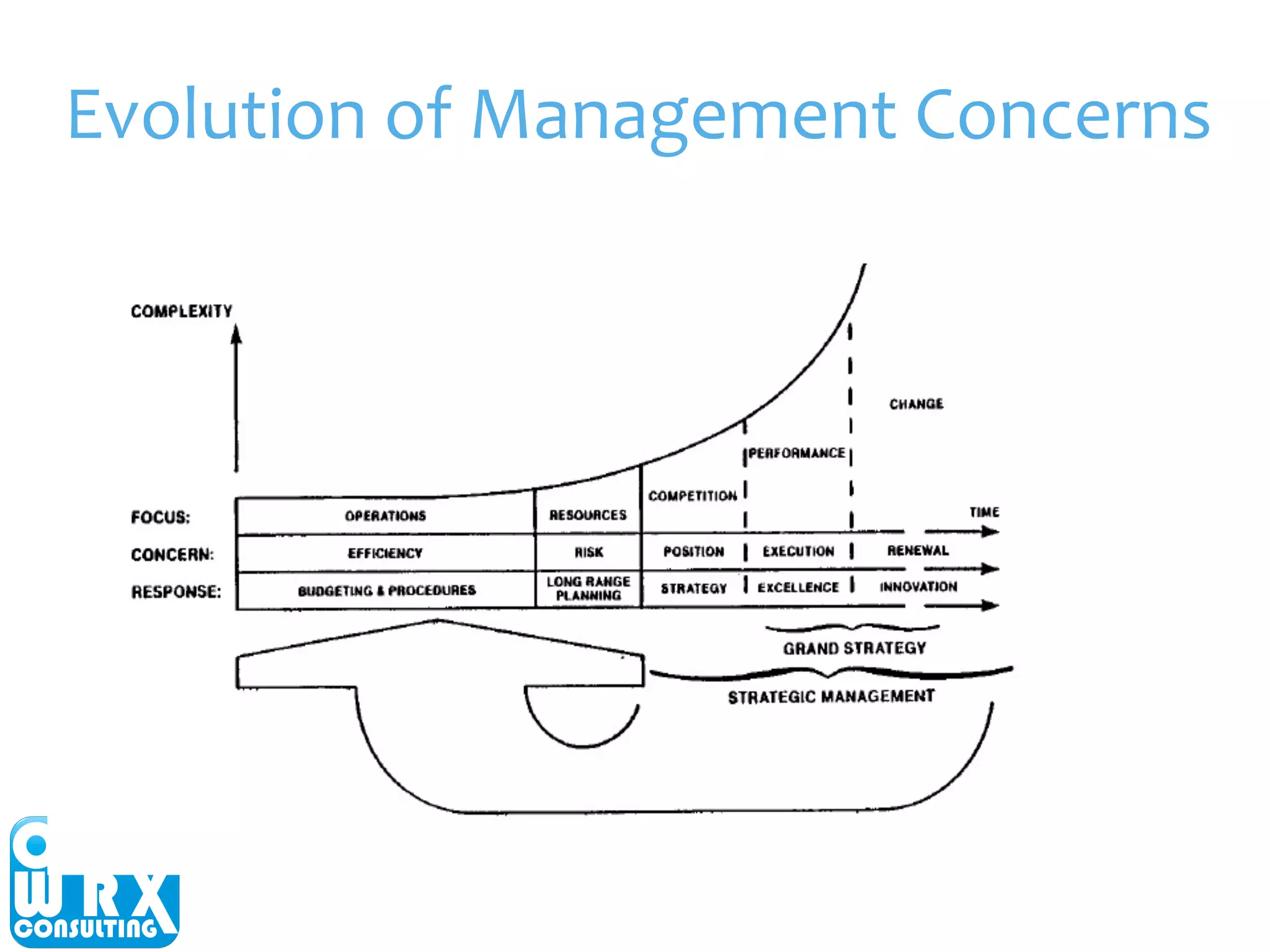
Evolution 
of 
Management 
Concerns
Strategic 
Planning
Business, 
Operational, 
Strategic? 
• Business Plan 
• Normally prepared to acquire financing 
• Operational Plan 
• Identifies specific results to be accomplished within a given 
time period 
• Budget 
• Expresses operational plan in financial terms 
• Strategic Plan 
• Identifies the basic concept and direction of an organization
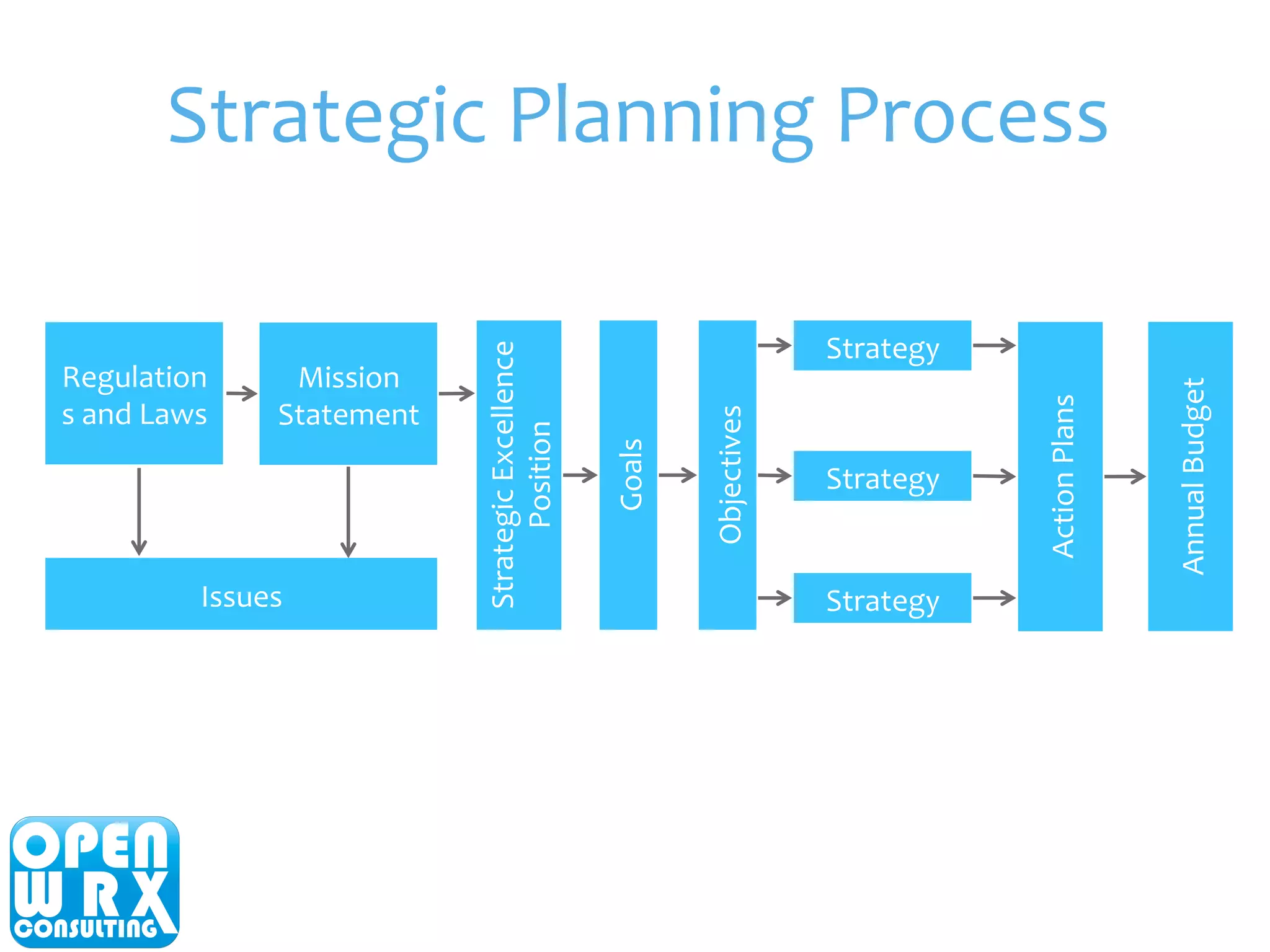
Strategic 
Planning 
Process 
Mission 
Statement 
Regulation 
s 
and 
Laws 
Issues 
Strategic 
Excellence 
Position 
Goals 
Objectives 
Strategy 
Strategy 
Strategy 
Action 
Plans 
Annual 
Budget
The 
Mission
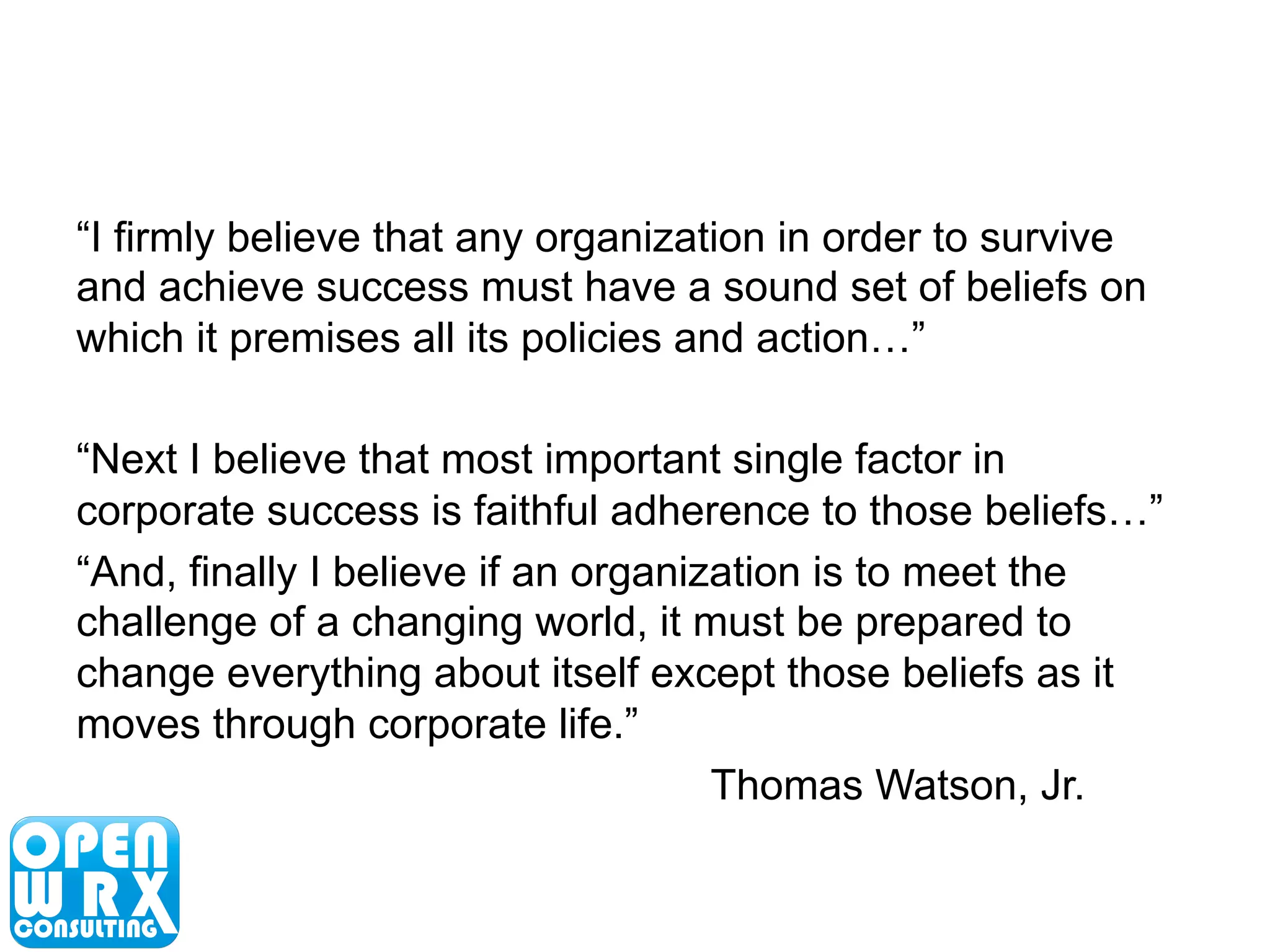
“I firmly believe that any organization in order to survive 
and achieve success must have a sound set of beliefs on 
which it premises all its policies and action…” 
“Next I believe that most important single factor in 
corporate success is faithful adherence to those beliefs…” 
“And, finally I believe if an organization is to meet the 
challenge of a changing world, it must be prepared to 
change everything about itself except those beliefs as it 
moves through corporate life.” 
Thomas Watson, Jr.
The 
Mission 
• Purpose 
• Values
Mission 
• Shared purposes provide FOCUS by driving strategy 
• Shared values provide CONTROL by guiding execution
Example 
Mission 
Statement 
Bread Machine Industry Association 
The mission of the BMIA is to expand and promote the long-term 
growth and use of all aspects of the bread machine industry for the 
mutual benefit of our members and consumers 
___________ 
Freehold Actors’ Studio & Lab 
The mission of Freehold is to deepen the transformational power of 
theatre to inspire through education, experimentation and performance.
Strategic 
Excellence 
Positions
Strategic 
Excellence 
Positions 
Products/ 
Markets 
A 
Products/ 
Markets 
B 
Products/ 
Markets 
C 
Marketing 
R 
+ 
D 
Production 
Personnel 
Finance
Strategic 
Excellence 
Positions 
Products/ 
Markets 
B 
Products/ SEP 
Markets 
A 
Products/ 
Markets 
C 
Marketing 
R+D 
Production 
Personnel 
Finance
Strategic 
Excellence 
Positions 
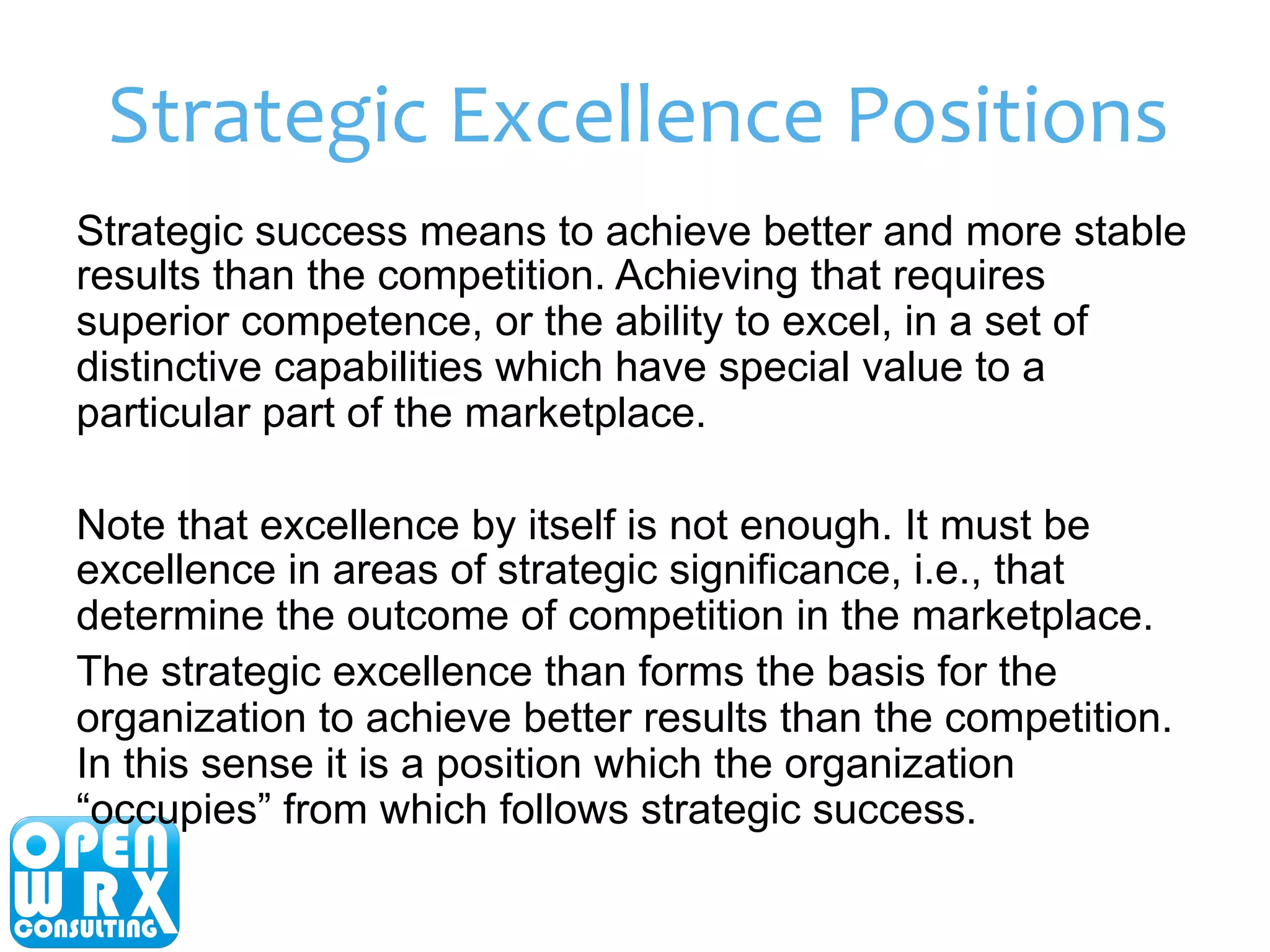
Strategic success means to achieve better and more stable 
results than the competition. Achieving that requires 
superior competence, or the ability to excel, in a set of 
distinctive capabilities which have special value to a 
particular part of the marketplace. 
Note that excellence by itself is not enough. It must be 
excellence in areas of strategic significance, i.e., that 
determine the outcome of competition in the marketplace. 
The strategic excellence than forms the basis for the 
organization to achieve better results than the competition. 
In this sense it is a position which the organization 
“occupies” from which follows strategic success.
Strategic 
Excellence 
Position 
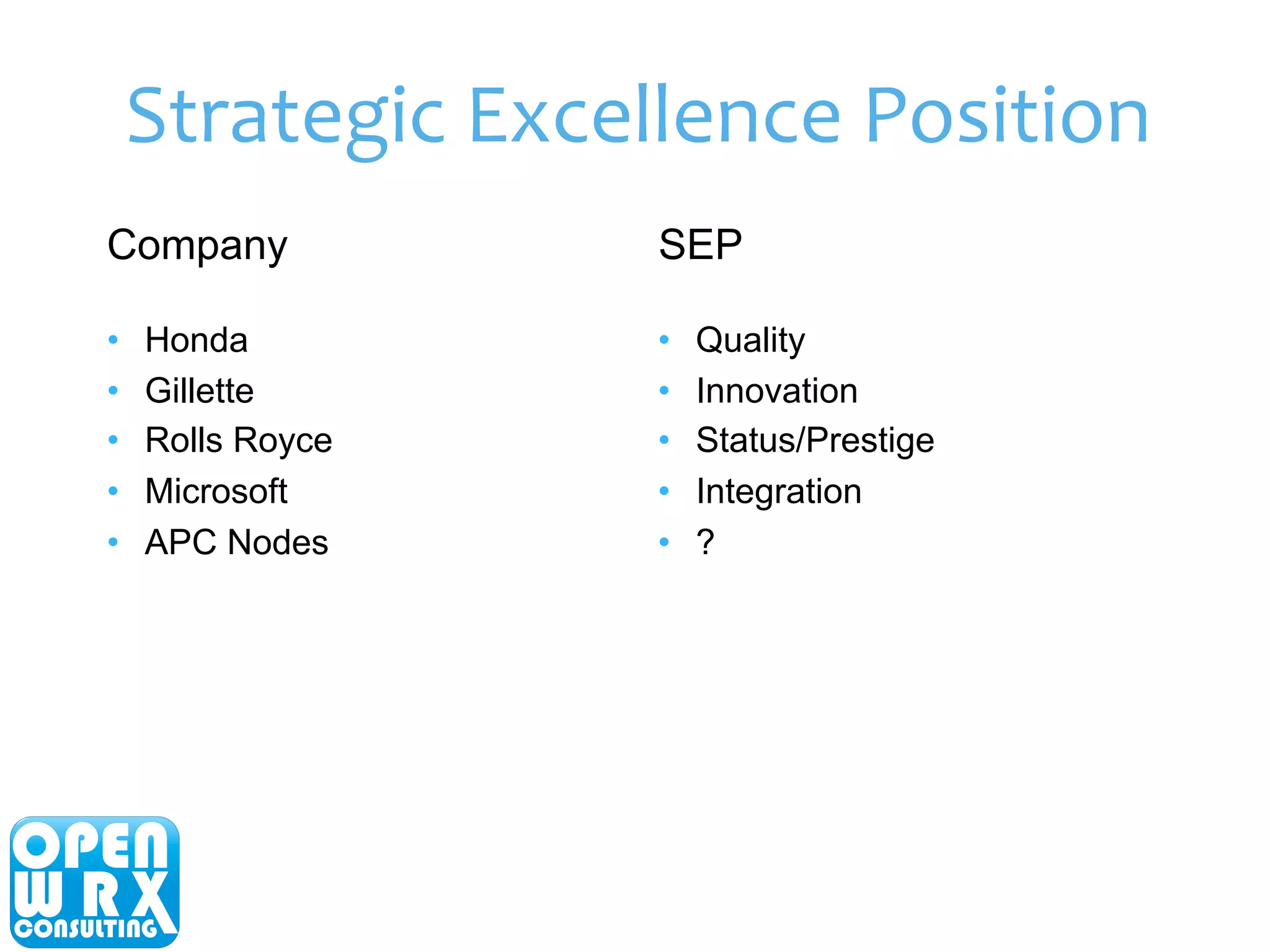
Company 
SEP 
• Honda 
• Quality 
• Gillette 
• Innovation 
• Rolls Royce 
• Status/Prestige 
• Microsoft 
• Integration 
• APC Nodes 
• ?
SEP 
Example 
BMIA Example 
• Provide for the Unified Presence of the bread machine 
industry category in its marketplace 
• Provide for intra-industry communications within the 
bread machine industry.
Goals
Goals 
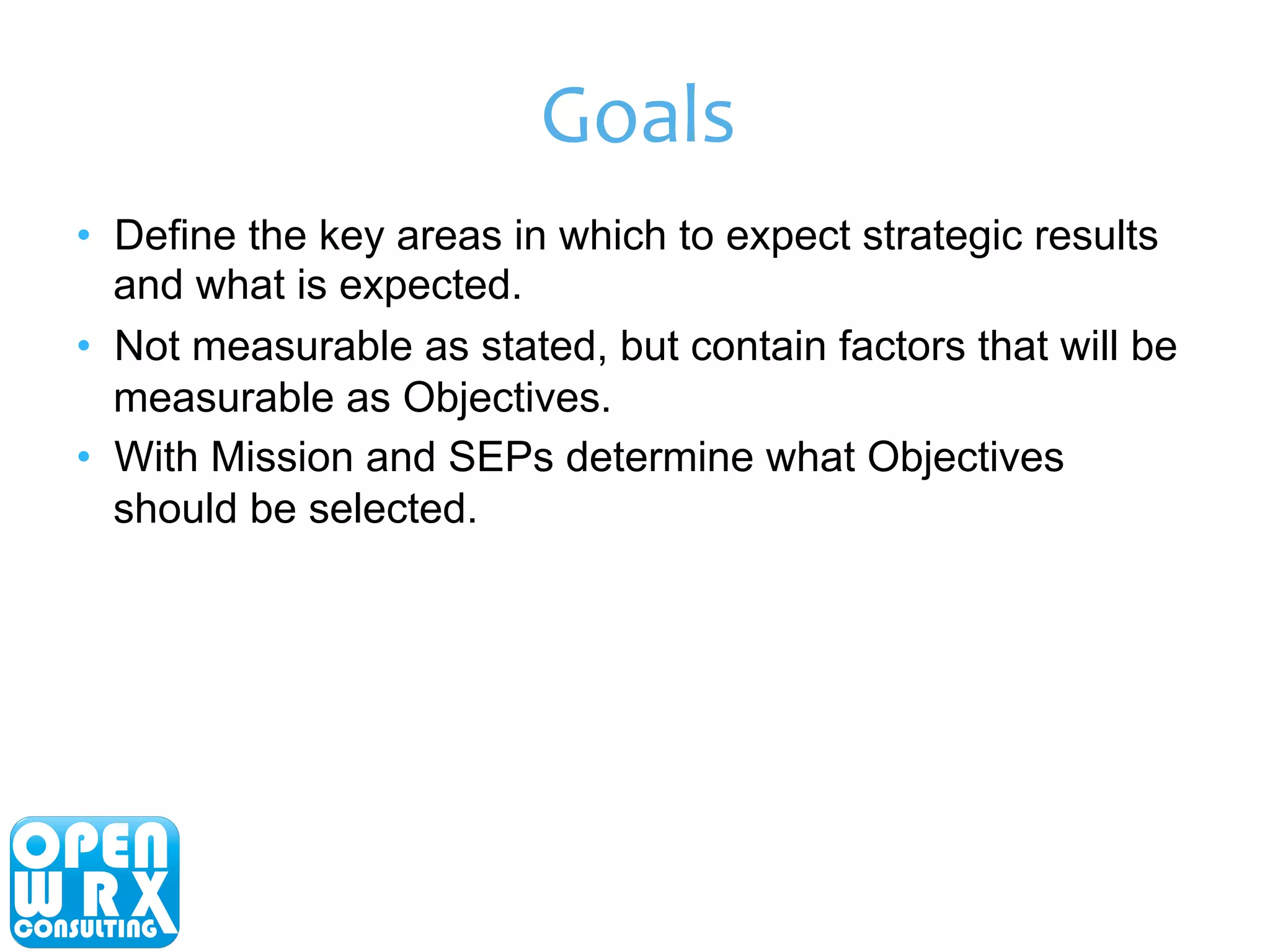
• Define the key areas in which to expect strategic results 
and what is expected. 
• Not measurable as stated, but contain factors that will be 
measurable as Objectives. 
• With Mission and SEPs determine what Objectives 
should be selected.
Objectives
Objectives 
• Statement of measurable results 
• Tied to Goals, provide the basis for operational planning 
and budgeting 
• Four general characteristics: 
• Starts with the word “To” 
• Specifies a single measurable result 
• Specifies a target date or time span for Completion 
• Must be realistic and attainable, but represents a significant 
challenge
Goal 
and 
Objectives 
Example 
Goal One 
Educate consumers about the benefits of bread machines, facilitate their 
purchase decisions, and encourage usage. 
Objectives 
1.1 To create a media kit for a distribution to key newspapers, magazines, 
and the 1997 Housewares Show by January 10, 1997. 
1.2 To host a New York City magazine editors event “Coming Out Party” 
for all new bread machine products (members only) by June 30, 1997. 
1.3 To explore partnerships with like minded industry associations for the 
purpose of producing a jointly sponsored media campaign in 1997. 
1.4 To evaluate and report on the possibility of a BMIA web page by 
August 31, 1997
Three 
Classes 
of 
Objectives 
Innovative 
Problem 
Solving 
Regular/Routine
Action 
Plans
Action 
Plans 
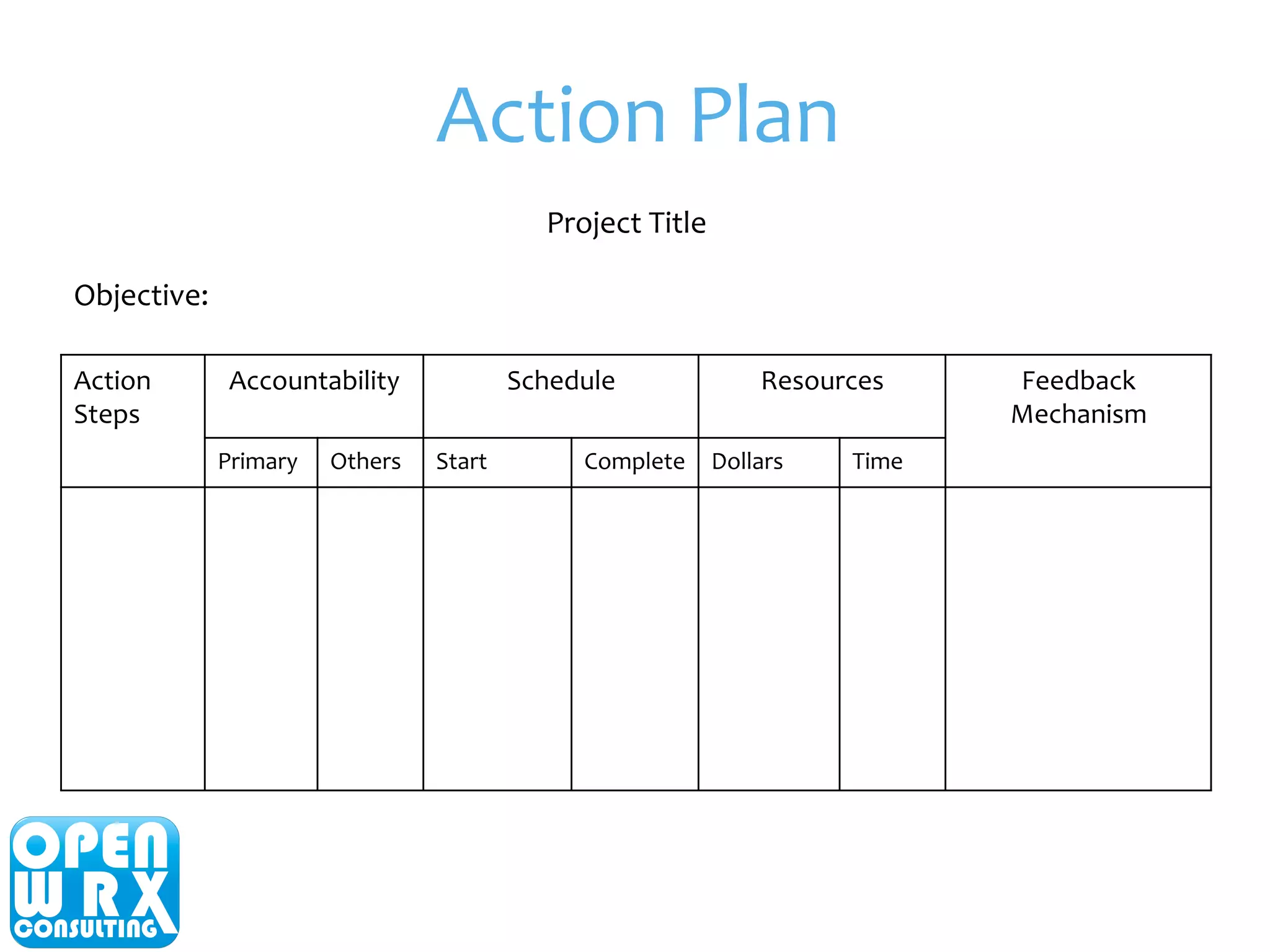
• Specify steps or actions required to attain an objective. 
• Designate who will be held accountable for seeing each 
step or action is completed 
• Define when these steps or actions will be carried out 
• Define resources needed to be allocated in order to carry 
out the required steps or actions 
• Define feedback mechanisms needed to monitor 
progress within each action step
Action 
Plan 
Action 
Steps 
Project 
Title 
Accountability 
Schedule 
Resources 
Feedback 
Mechanism 
Primary 
Others 
Start 
Complete 
Dollars 
Time 
Objective:
Operational 
Plans
Integrated 
Planning 
Process 
Strategic 
Plan 
Operational 
Plan 
Results 
Management 
Mission 
Goals 
Objectives 
Strategies 
Financial 
Projection 
Analyses 
Key 
Result 
Areas 
Operational 
Objectives 
Performance 
Indicators 
Action 
Plans 
Budgets 
Control 
System 
Results 
Connective 
Action 
Reward 
System
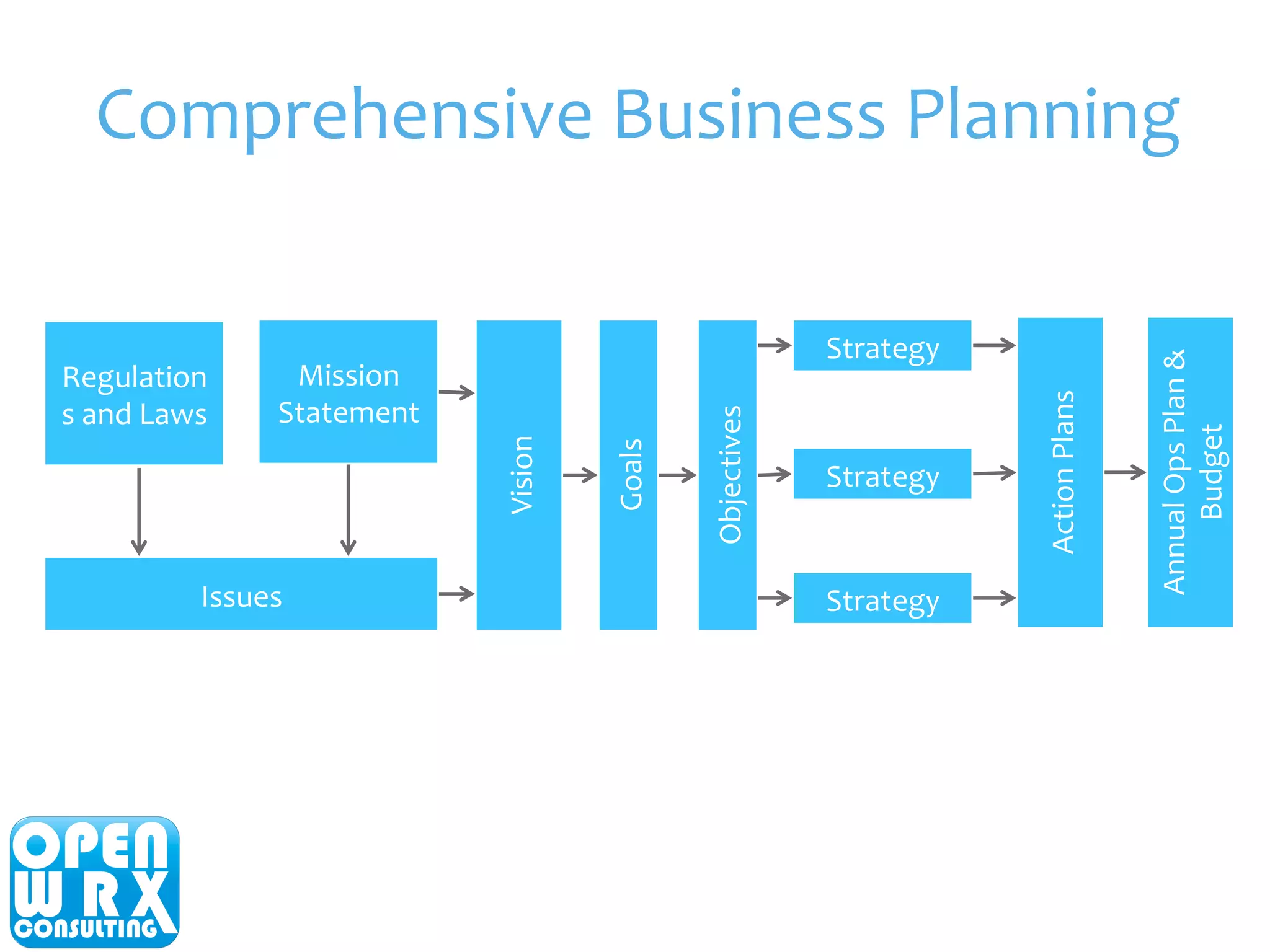
Comprehensive 
Business 
Planning 
Mission 
Statement 
Regulation 
s 
and 
Laws 
Issues 
Vision 
Goals 
Objectives 
Strategy 
Strategy 
Strategy 
Action 
Plans 
Annual 
Ops 
Plan 
& 
Budget
Operational 
Planning 
Framework 
Issues 
Analysis 
Key 
Result 
Areas 
Performance 
Indicators 
Objectives 
Action 
Plans 
Budgets
Operational 
Objectives 
• Statements of measurable results to be accomplished 
within the time frame of the operational plan. 
• Standards of performance related to financial and 
operating results that can be tracked on a regular basis
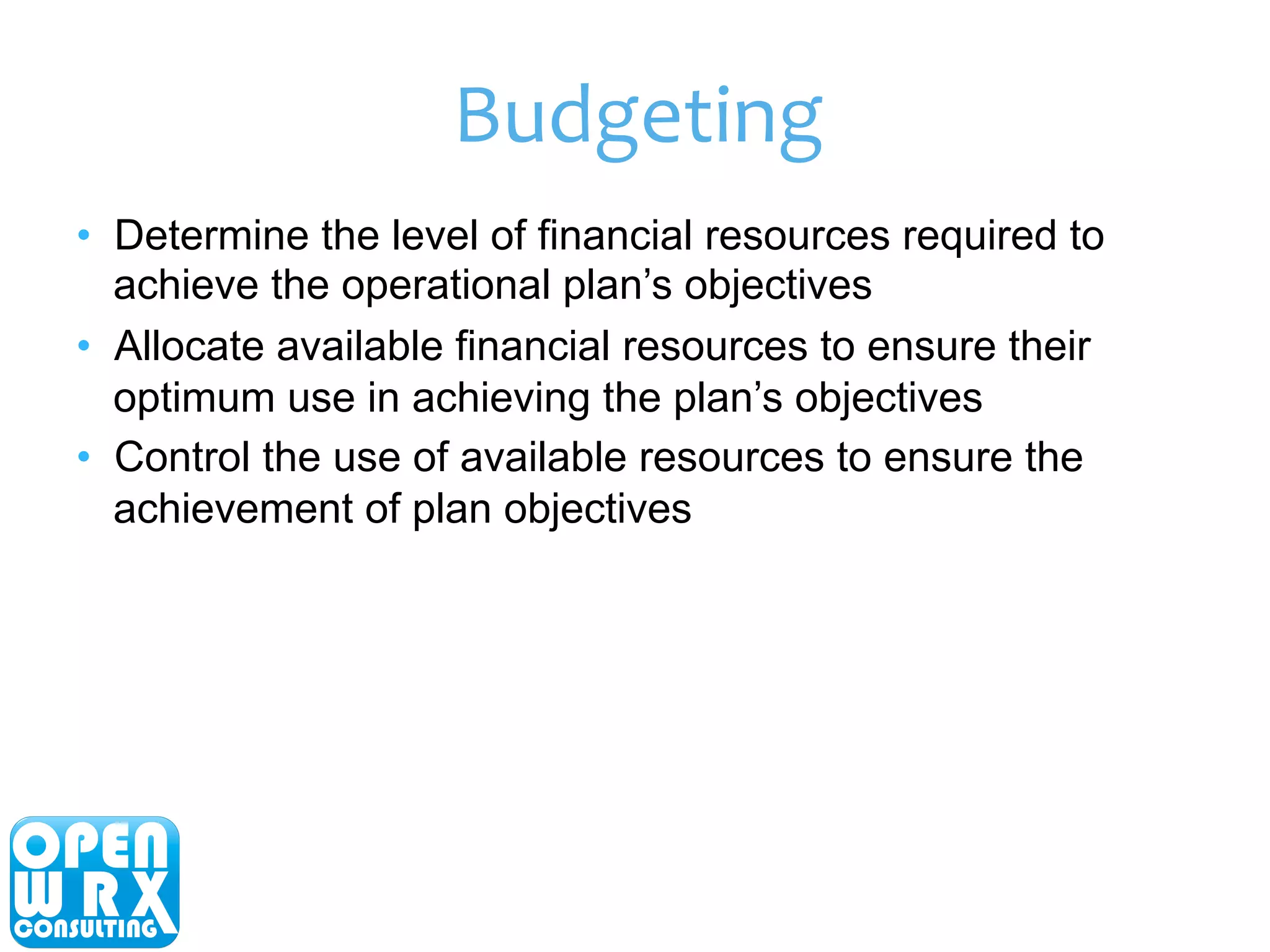
Budgeting 
• Determine the level of financial resources required to 
achieve the operational plan’s objectives 
• Allocate available financial resources to ensure their 
optimum use in achieving the plan’s objectives 
• Control the use of available resources to ensure the 
achievement of plan objectives
Budgeting 
Problems 
• Budgets can grow to be so complex that they become 
expensive, cumbersome, and even meaningless 
• Budget objectives may come to supersede enterprise 
objectives – budgets should be considered a tool, not an 
end in themselves. Enterprise goals should supersede 
business unit plans 
• Budgets may contribute to inefficiencies by continuing 
initial expenditures without proper evaluation 
• Budgets as a pressure device defeat their basic purpose
Results 
Management
Integrated 
Planning 
Process 
Strategic 
Plan 
Operational 
Plan 
Results 
Management 
Mission 
Goals 
Objectives 
Strategies 
Financial 
Projection 
Analyses 
Key 
Result 
Areas 
Operational 
Objectives 
Performance 
Indicators 
Action 
Plans 
Budgets 
Control 
System 
Results 
Connective 
Action 
Reward 
System
Results 
Management 
• Control Systems 
• Management Reports 
• Organizational Results 
• Individual Results 
• Corrective Action 
• Reward System
“I believe the real difference between success and failure in a 
corporation can vary often be traced to the question of how well 
the organization brings out the great energies and talents of its 
people. What does it do to help these people find common cause 
with each other? And how can it sustain this common cause and 
sense of direction through the many changes which take place 
from one generation to another…” 
“The basic philosophy, spirit, and drive of an organization have 
far more to do with its relative achievements than do 
technological or economic resources, organizational structure, 
innovation and timing. All these things weigh heavily in success. 
But they are, I think, transcended by how strongly the people in 
the organization believe in its basic precepts and faithfully they 
carry them out.” 
Thomas Watson, Jr.
Supporting 
Discussions
Issues 
Analyses
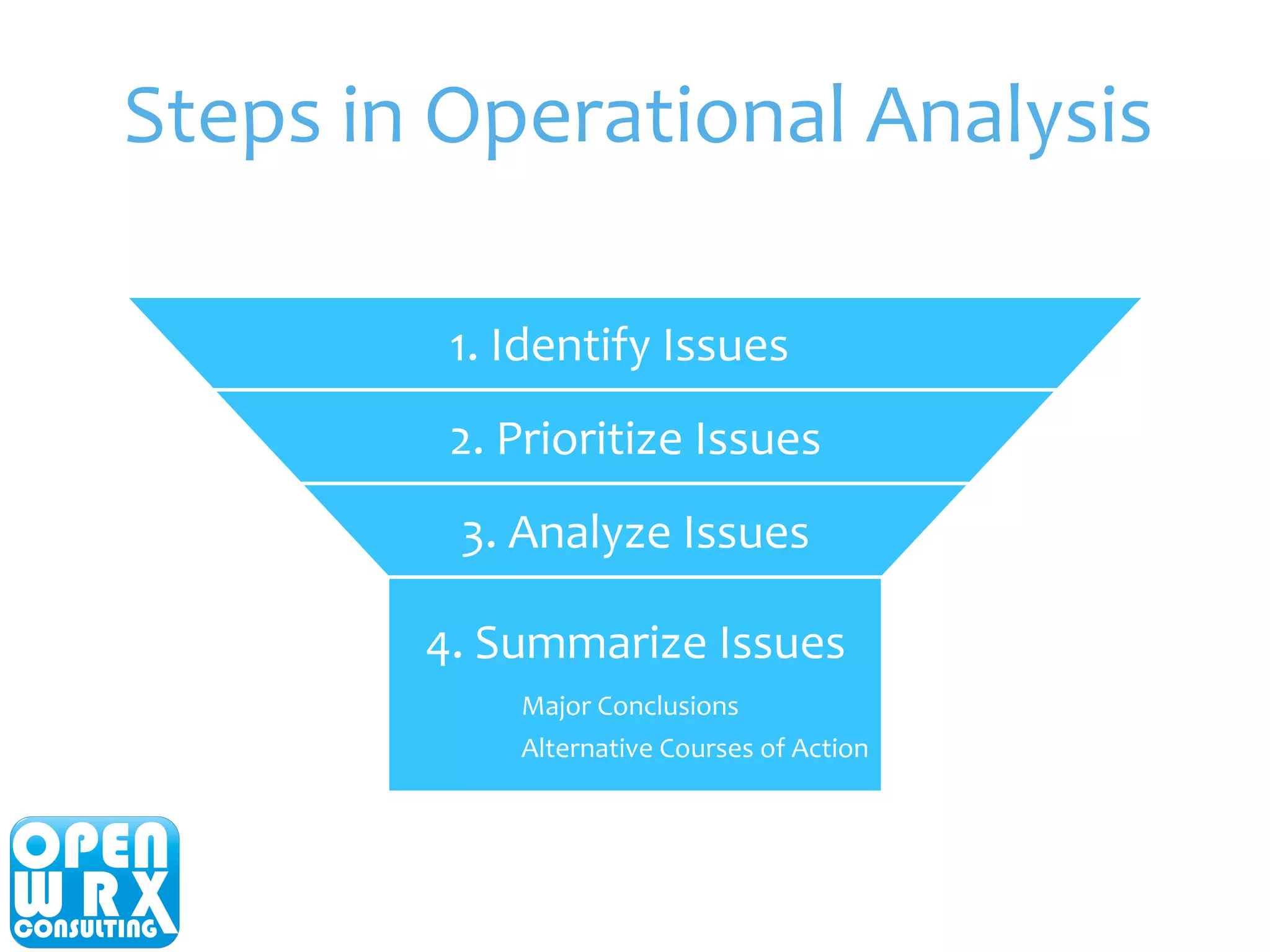
Steps 
in 
Operational 
Analysis 
1. 
Identify 
Issues 
2. 
Prioritize 
Issues 
3. 
Analyze 
Issues 
4. 
Summarize 
Issues 
Major 
Conclusions 
Alternative 
Courses 
of 
Action
Identify 
Issues 
• Most critical issues facing the business unit, what might 
be their impact 
• Issues likely to have greatest effect on profitability 
• Issues likely to have greatest effect on long-term success 
of the business unit 
• What changes have taken/will take place effecting the 
business units performance in the coming year 
• What cross-functional problems or opportunities are lilkey 
to have impact on the business unit’s performance 
• What are major impediments to conforming to your 
Mission
Analyze 
Issues 
• What is the Issue 
• What data/information is available (or needed) to resolve 
the issues 
• What appear to be the factors causing this to be an issue 
for the organization 
• What types of results are needed in this area.
Key 
Result 
Areas
Key 
Result 
Areas 
Guidelines 
• Those 4 to 6 major areas wherein performance is 
essential during the coming year 
• Include both financial and non-financial areas 
• Will no cover the entire organization—will identify the 
critical few areas where priority efforts should be directed 
• Most will require cross-functional effort 
• Each will be limited, generally, to 2 or 3 words and will not 
be measurable as stated, but will contain factors that 
could be measurable
Indicators 
of 
Performance 
• Measurable factors, falling logically within a given key 
result area, on which objectives may be set 
• May be hard numbers, percentages, significant 
achievements, or problems to be overcome 
• Identify what will be measured, not how much or in which 
direction 
• Represent factors that can be measured on an ongoing 
basis
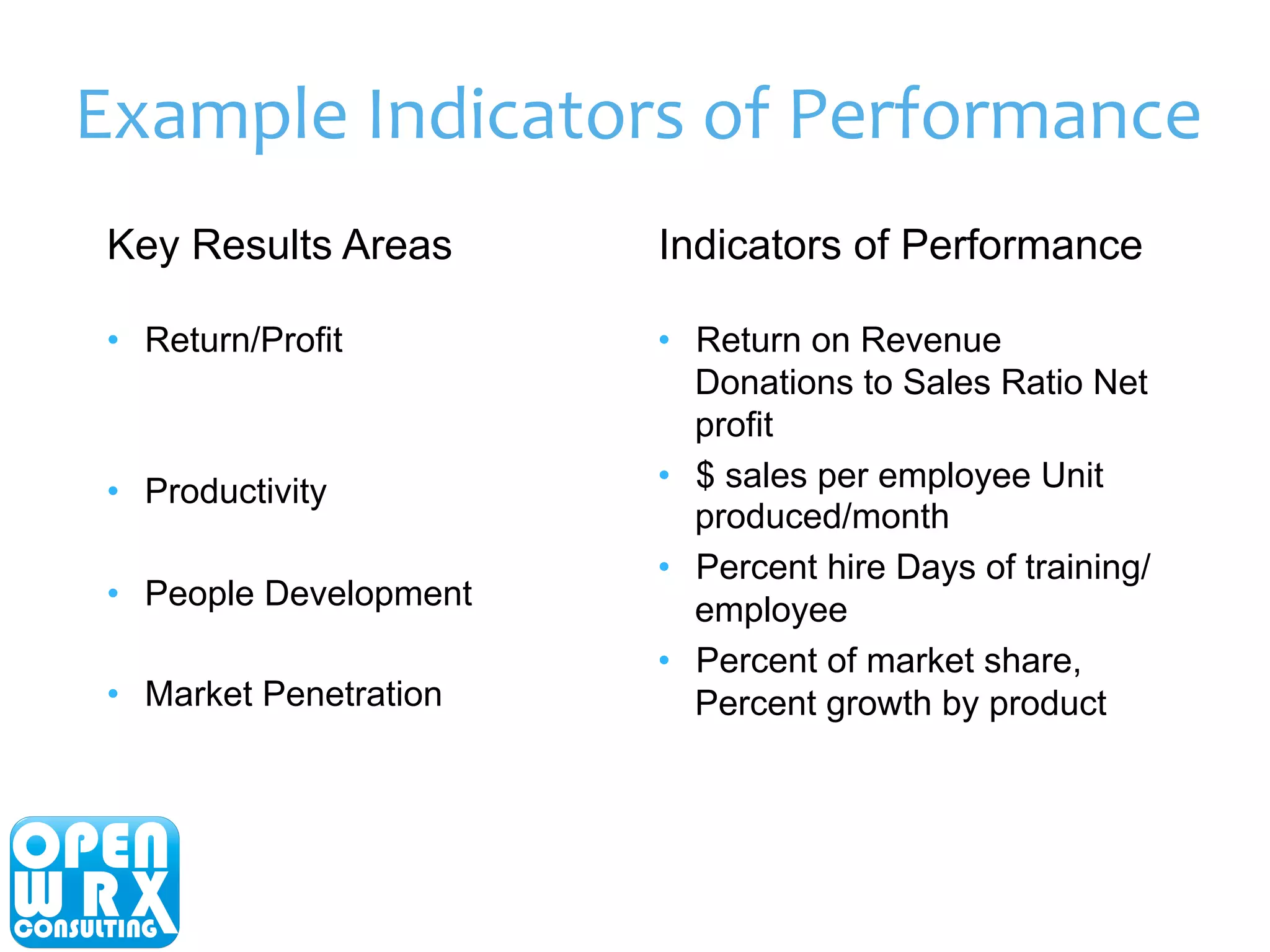
Example 
Indicators 
of 
Performance 
Key Results Areas 
• Return/Profit 
• Productivity 
• People Development 
• Market Penetration 
Indicators of Performance 
• Return on Revenue 
Donations to Sales Ratio Net 
profit 
• $ sales per employee Unit 
produced/month 
• Percent hire Days of training/ 
employee 
• Percent of market share, 
Percent growth by product
Strategies
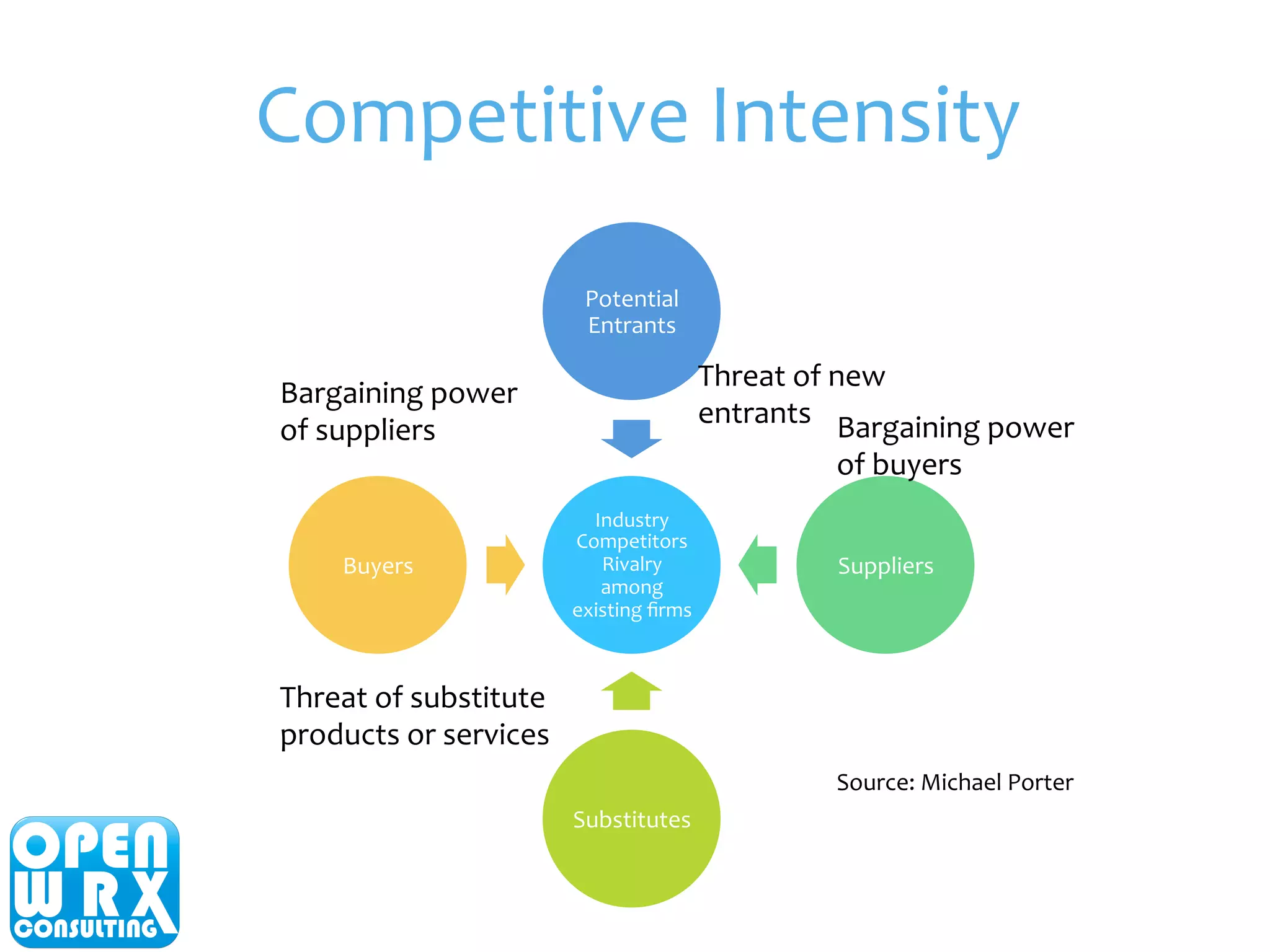
Competitive 
Intensity 
Potential 
Entrants 
Industry 
Competitors 
Rivalry 
among 
existing 
firms 
Suppliers 
Substitutes 
Bargaining 
power 
of 
suppliers 
Buyers 
Threat 
of 
new 
entrants 
Bargaining 
power 
of 
buyers 
Threat 
of 
substitute 
products 
or 
services 
Source: 
Michael 
Porter
Strategic 
Implementation 
• Direct Means 
• Indirect Means 
• Time Related Aspects
Direct 
Means 
• Action Plans and Project Plans 
• Procedures/Management Systems 
• Planning and Budgeting 
• Management Information Systems 
• Organizational Structure
Indirect 
Means 
• Communication 
• Symbolic Actions 
• Institutionalizing Actions 
• Fostering Innovation 
• Corporate Culture
Time 
Related 
Aspects 
• Research and Development 
• Manufacturing Life Cycle 
• Marketing Cycle 
• Economic Trends 
• Competition
Strategic 
Plan 
Outline 
• Executive Summary 
• Current Situation and Vision 
• Critical Issues 
• Mission 
• Strategic Excellence Positions 
• Goals and Objectives 
• Action Plans
Operation 
Plan 
Content 
• Executive Summary 
• Business Unit Description 
• Product and Services 
• Operational Analysis: Issues and Conclusions 
• Key Result Areas & Indicators of Performance 
• Operational Objectives 
• Action Plans 
• Budgets 
• Plan Implementation and Review Schedule 
• Appendices
Metrics 
IBP 1 – Product Review 
• IBP 1.1 – Monthly Status Update 
• IBP 1.2 – PRM Analysis & Preparation 
• IBP 1.3 – Conduct Product Review 
IBP 2 – Demand Review 
• IBP2.1 – Demand Data Collection & 
Analysis 
• IBP2.2 – Develop Demand Plan 
• IBP2.3 – Conduct Demand Review 
IBP4 – Supply Review 
• IBP3.1 – Supply Data Collection & 
Analysis 
• IBP3.2 – Develop Supply Plan 
• IBP3.3 – Conduct Supply Review 
IBP4 – Financial Appraisal 
• IBP4.1 – Financial Data Collection & 
Analysis 
• IBP4.2 – Analyze Past Performance 
• IBP4.3 – Analyze Current Performance 
• IBP4.4 – Cost/Benefit Issue Resolution 
• IBP4.5 – Budgeting & Business Planning 
IBP 5 – Integrated Reconciliation 
• IBP5.1 – Assumption Validation 
• IBP5.2 – Resolve Planning Conflicts 
• IBP5.3 – Manage Corrective Actions 
• IBP 5.4 – Resolve Gaps & Issues 
IBP6 – Management Biz Review 
• IBP6.1 – Holistic IBP Process Design 
• IBP6.2 – Conduct MBR 
Source: 
Olive 
Wight 
Americas

Integrated Business Planning Process

  • 1.
    Integrated Business Planning Process Presented to the Association for Progressive Communications By Charles P. Sitkin, Consultant In affiliation with Carnegie-Mellon University
  • 2.
    Outline of Presentation • Evolution of Management Concerns • Strategic Planning • The Mission • Strategic Excellence Positions • Goals and Objectives • Action Plans • Operating Plan and Budget • Results Management
  • 3.
    Integrated Planning Process Strategic Plan Operational Plan Results Management Mission Goals Objectives Strategies Financial Projection Analyses Key Result Areas Operational Objectives Performance Indicators Action Plans Budgets Control System Results Connective Action Reward System
  • 4.
    The Evolution of Management Concerns
  • 5.
  • 6.
  • 7.
    Business, Operational, Strategic? • Business Plan • Normally prepared to acquire financing • Operational Plan • Identifies specific results to be accomplished within a given time period • Budget • Expresses operational plan in financial terms • Strategic Plan • Identifies the basic concept and direction of an organization
  • 8.
    Strategic Planning Process Mission Statement Regulation s and Laws Issues Strategic Excellence Position Goals Objectives Strategy Strategy Strategy Action Plans Annual Budget
  • 9.
  • 10.
    “I firmly believethat any organization in order to survive and achieve success must have a sound set of beliefs on which it premises all its policies and action…” “Next I believe that most important single factor in corporate success is faithful adherence to those beliefs…” “And, finally I believe if an organization is to meet the challenge of a changing world, it must be prepared to change everything about itself except those beliefs as it moves through corporate life.” Thomas Watson, Jr.
  • 11.
    The Mission •Purpose • Values
  • 12.
    Mission • Sharedpurposes provide FOCUS by driving strategy • Shared values provide CONTROL by guiding execution
  • 13.
    Example Mission Statement Bread Machine Industry Association The mission of the BMIA is to expand and promote the long-term growth and use of all aspects of the bread machine industry for the mutual benefit of our members and consumers ___________ Freehold Actors’ Studio & Lab The mission of Freehold is to deepen the transformational power of theatre to inspire through education, experimentation and performance.
  • 14.
  • 15.
    Strategic Excellence Positions Products/ Markets A Products/ Markets B Products/ Markets C Marketing R + D Production Personnel Finance
  • 16.
    Strategic Excellence Positions Products/ Markets B Products/ SEP Markets A Products/ Markets C Marketing R+D Production Personnel Finance
  • 17.
    Strategic Excellence Positions Strategic success means to achieve better and more stable results than the competition. Achieving that requires superior competence, or the ability to excel, in a set of distinctive capabilities which have special value to a particular part of the marketplace. Note that excellence by itself is not enough. It must be excellence in areas of strategic significance, i.e., that determine the outcome of competition in the marketplace. The strategic excellence than forms the basis for the organization to achieve better results than the competition. In this sense it is a position which the organization “occupies” from which follows strategic success.
  • 18.
    Strategic Excellence Position Company SEP • Honda • Quality • Gillette • Innovation • Rolls Royce • Status/Prestige • Microsoft • Integration • APC Nodes • ?
  • 19.
    SEP Example BMIAExample • Provide for the Unified Presence of the bread machine industry category in its marketplace • Provide for intra-industry communications within the bread machine industry.
  • 20.
  • 21.
    Goals • Definethe key areas in which to expect strategic results and what is expected. • Not measurable as stated, but contain factors that will be measurable as Objectives. • With Mission and SEPs determine what Objectives should be selected.
  • 22.
  • 23.
    Objectives • Statementof measurable results • Tied to Goals, provide the basis for operational planning and budgeting • Four general characteristics: • Starts with the word “To” • Specifies a single measurable result • Specifies a target date or time span for Completion • Must be realistic and attainable, but represents a significant challenge
  • 24.
    Goal and Objectives Example Goal One Educate consumers about the benefits of bread machines, facilitate their purchase decisions, and encourage usage. Objectives 1.1 To create a media kit for a distribution to key newspapers, magazines, and the 1997 Housewares Show by January 10, 1997. 1.2 To host a New York City magazine editors event “Coming Out Party” for all new bread machine products (members only) by June 30, 1997. 1.3 To explore partnerships with like minded industry associations for the purpose of producing a jointly sponsored media campaign in 1997. 1.4 To evaluate and report on the possibility of a BMIA web page by August 31, 1997
  • 25.
    Three Classes of Objectives Innovative Problem Solving Regular/Routine
  • 26.
  • 27.
    Action Plans •Specify steps or actions required to attain an objective. • Designate who will be held accountable for seeing each step or action is completed • Define when these steps or actions will be carried out • Define resources needed to be allocated in order to carry out the required steps or actions • Define feedback mechanisms needed to monitor progress within each action step
  • 28.
    Action Plan Action Steps Project Title Accountability Schedule Resources Feedback Mechanism Primary Others Start Complete Dollars Time Objective:
  • 29.
  • 30.
    Integrated Planning Process Strategic Plan Operational Plan Results Management Mission Goals Objectives Strategies Financial Projection Analyses Key Result Areas Operational Objectives Performance Indicators Action Plans Budgets Control System Results Connective Action Reward System
  • 31.
    Comprehensive Business Planning Mission Statement Regulation s and Laws Issues Vision Goals Objectives Strategy Strategy Strategy Action Plans Annual Ops Plan & Budget
  • 32.
    Operational Planning Framework Issues Analysis Key Result Areas Performance Indicators Objectives Action Plans Budgets
  • 33.
    Operational Objectives •Statements of measurable results to be accomplished within the time frame of the operational plan. • Standards of performance related to financial and operating results that can be tracked on a regular basis
  • 34.
    Budgeting • Determinethe level of financial resources required to achieve the operational plan’s objectives • Allocate available financial resources to ensure their optimum use in achieving the plan’s objectives • Control the use of available resources to ensure the achievement of plan objectives
  • 35.
    Budgeting Problems •Budgets can grow to be so complex that they become expensive, cumbersome, and even meaningless • Budget objectives may come to supersede enterprise objectives – budgets should be considered a tool, not an end in themselves. Enterprise goals should supersede business unit plans • Budgets may contribute to inefficiencies by continuing initial expenditures without proper evaluation • Budgets as a pressure device defeat their basic purpose
  • 36.
  • 37.
    Integrated Planning Process Strategic Plan Operational Plan Results Management Mission Goals Objectives Strategies Financial Projection Analyses Key Result Areas Operational Objectives Performance Indicators Action Plans Budgets Control System Results Connective Action Reward System
  • 38.
    Results Management •Control Systems • Management Reports • Organizational Results • Individual Results • Corrective Action • Reward System
  • 39.
    “I believe thereal difference between success and failure in a corporation can vary often be traced to the question of how well the organization brings out the great energies and talents of its people. What does it do to help these people find common cause with each other? And how can it sustain this common cause and sense of direction through the many changes which take place from one generation to another…” “The basic philosophy, spirit, and drive of an organization have far more to do with its relative achievements than do technological or economic resources, organizational structure, innovation and timing. All these things weigh heavily in success. But they are, I think, transcended by how strongly the people in the organization believe in its basic precepts and faithfully they carry them out.” Thomas Watson, Jr.
  • 40.
  • 41.
  • 42.
    Steps in Operational Analysis 1. Identify Issues 2. Prioritize Issues 3. Analyze Issues 4. Summarize Issues Major Conclusions Alternative Courses of Action
  • 43.
    Identify Issues •Most critical issues facing the business unit, what might be their impact • Issues likely to have greatest effect on profitability • Issues likely to have greatest effect on long-term success of the business unit • What changes have taken/will take place effecting the business units performance in the coming year • What cross-functional problems or opportunities are lilkey to have impact on the business unit’s performance • What are major impediments to conforming to your Mission
  • 44.
    Analyze Issues •What is the Issue • What data/information is available (or needed) to resolve the issues • What appear to be the factors causing this to be an issue for the organization • What types of results are needed in this area.
  • 45.
  • 46.
    Key Result Areas Guidelines • Those 4 to 6 major areas wherein performance is essential during the coming year • Include both financial and non-financial areas • Will no cover the entire organization—will identify the critical few areas where priority efforts should be directed • Most will require cross-functional effort • Each will be limited, generally, to 2 or 3 words and will not be measurable as stated, but will contain factors that could be measurable
  • 47.
    Indicators of Performance • Measurable factors, falling logically within a given key result area, on which objectives may be set • May be hard numbers, percentages, significant achievements, or problems to be overcome • Identify what will be measured, not how much or in which direction • Represent factors that can be measured on an ongoing basis
  • 48.
    Example Indicators of Performance Key Results Areas • Return/Profit • Productivity • People Development • Market Penetration Indicators of Performance • Return on Revenue Donations to Sales Ratio Net profit • $ sales per employee Unit produced/month • Percent hire Days of training/ employee • Percent of market share, Percent growth by product
  • 49.
  • 50.
    Competitive Intensity Potential Entrants Industry Competitors Rivalry among existing firms Suppliers Substitutes Bargaining power of suppliers Buyers Threat of new entrants Bargaining power of buyers Threat of substitute products or services Source: Michael Porter
  • 51.
    Strategic Implementation •Direct Means • Indirect Means • Time Related Aspects
  • 52.
    Direct Means •Action Plans and Project Plans • Procedures/Management Systems • Planning and Budgeting • Management Information Systems • Organizational Structure
  • 53.
    Indirect Means •Communication • Symbolic Actions • Institutionalizing Actions • Fostering Innovation • Corporate Culture
  • 54.
    Time Related Aspects • Research and Development • Manufacturing Life Cycle • Marketing Cycle • Economic Trends • Competition
  • 55.
    Strategic Plan Outline • Executive Summary • Current Situation and Vision • Critical Issues • Mission • Strategic Excellence Positions • Goals and Objectives • Action Plans
  • 56.
    Operation Plan Content • Executive Summary • Business Unit Description • Product and Services • Operational Analysis: Issues and Conclusions • Key Result Areas & Indicators of Performance • Operational Objectives • Action Plans • Budgets • Plan Implementation and Review Schedule • Appendices
  • 57.
    Metrics IBP 1– Product Review • IBP 1.1 – Monthly Status Update • IBP 1.2 – PRM Analysis & Preparation • IBP 1.3 – Conduct Product Review IBP 2 – Demand Review • IBP2.1 – Demand Data Collection & Analysis • IBP2.2 – Develop Demand Plan • IBP2.3 – Conduct Demand Review IBP4 – Supply Review • IBP3.1 – Supply Data Collection & Analysis • IBP3.2 – Develop Supply Plan • IBP3.3 – Conduct Supply Review IBP4 – Financial Appraisal • IBP4.1 – Financial Data Collection & Analysis • IBP4.2 – Analyze Past Performance • IBP4.3 – Analyze Current Performance • IBP4.4 – Cost/Benefit Issue Resolution • IBP4.5 – Budgeting & Business Planning IBP 5 – Integrated Reconciliation • IBP5.1 – Assumption Validation • IBP5.2 – Resolve Planning Conflicts • IBP5.3 – Manage Corrective Actions • IBP 5.4 – Resolve Gaps & Issues IBP6 – Management Biz Review • IBP6.1 – Holistic IBP Process Design • IBP6.2 – Conduct MBR Source: Olive Wight Americas