INTEGRAL CALCULUS:
A COMPREHENSIVE
OVERVIEW
Presented by Simbisai Chinhema
Sect 43 BI
Reg. No: 241FA14061
WHAT IS INTEGRAL CALCULUS?
• Integral calculus is the study of:
• - Antiderivatives (reversing differentiation).
• - Calculating areas under curves.
• Applications in real life such as in physics, engineering, and
economics.
WHY STUDY INTEGRAL
CALCULUS?
• - Solves practical problems like motion, area, and volume.
• - Provides tools for understanding rates of change.
• - Crucial for scientific and engineering advancements.
KEY CONCEPT: ANTIDERIVATIVE
• Integration reverses differentiation:
• Take for example!
• If F'(x) = f(x), then F(x) is the antiderivative of f(x). then
• f(x) = 2x F(x) = x^2 + C.
→
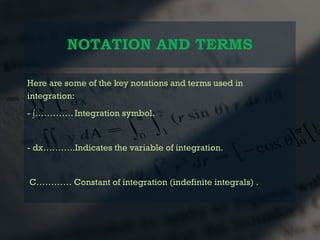
NOTATION AND TERMS
Here are some of the key notations and terms used in
integration:
- ∫…………. Integration symbol.
- dx………..Indicates the variable of integration.
C………… Constant of integration (indefinite integrals) .
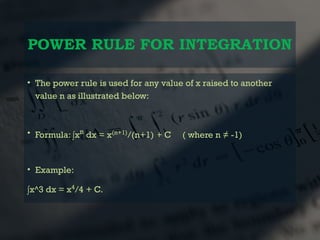
POWER RULE FOR INTEGRATION
• The power rule is used for any value of x raised to another
value n as illustrated below:
• Formula: ∫xn
dx = x(n+1)
/(n+1) + C ( where n ≠ -1)
• Example:
∫x^3 dx = x4
/4 + C.
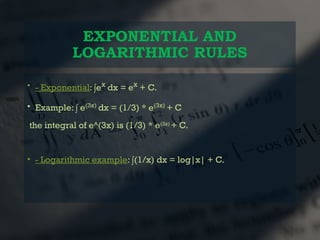
EXPONENTIAL AND
LOGARITHMIC RULES
• - Exponential: ∫ex
dx = ex
+ C.
• Example: ∫ e(3x)
dx = (1/3) * e(3x)
+ C
the integral of e^(3x) is (1/3) * e(3x)
+ C.
• - Logarithmic example: ∫(1/x) dx = log|x| + C.
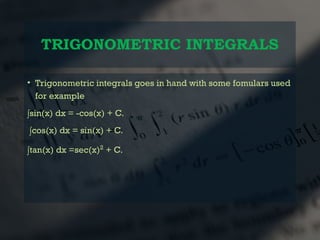
TRIGONOMETRIC INTEGRALS
• Trigonometric integrals goes in hand with some fomulars used
for example
∫sin(x) dx = -cos(x) + C.
∫cos(x) dx = sin(x) + C.
∫tan(x) dx =sec(x)2
+ C.
INTEGRATION BY SUBSTITUTION
• Used to simplify complex integrals:
• Substitute u = g(x), then integrate in terms of u.
EXAMPLE: SUBSTITUTION
• Evaluate: ∫2x e^(x^2) dx
• Solution:
• - Let u = x^2 du = 2x dx.
→
• - ∫e^u du = e^u + C = e^(x^2) + C.
INTEGRATION BY PARTS
• Formula: ∫f(x)g(x) dv = f(x) ∫ g(x) dx- ∫f(x)’ * ∫ g(x) dx .
• Used when the integrand is a product of two functions.
• To chose the first function wisely there is need to use the ILATE
I…...Inverse function
L…...Logarithmic function
A……Arithmetic function
T……Trigonometrical function
E…….Exponential function
EXAMPLE: INTEGRATION BY
PARTS
• Evaluate: ∫x sin(x) dx
• Solution:
• - Let u = x, dv = sin(x) dx.
• - ∫x sin(x) dx = -x cos(x) + sin(x) + C.
DEFINITE INTEGRATION
• Calculates area under a curve between two points:
• ∫[a to b] f(x) dx = F(b) - F(a).
EXAMPLE: DEFINITE
INTEGRATION
• Evaluate: ∫[0 to 2] 3x^2 dx
• Solution:
• ∫3x^2 dx = x^3 [x^3] from 0 to 2 = 8.
→
APPLICATIONS: TANGENTS AND
NORMALS
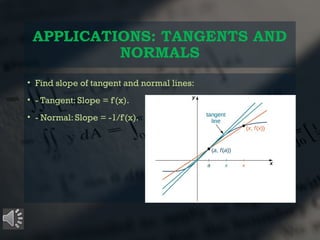
• Find slope of tangent and normal lines:
• - Tangent: Slope = f'(x).
• - Normal: Slope = -1/f'(x).
EXAMPLE: TANGENT LINE
• Find the tangent to y = x^2 at x = 1.
• Solution:
• - Slope = 2x f'(1) = 2.
→
• - Equation: y - 1 = 2(x - 1).
APPLICATIONS: PHYSICS
• - Velocity: v(t) = ∫a(t) dt + C.
• - Position: x(t) = ∫v(t) dt + C.
EXAMPLE: MOTION
• Given a(t) = 2t, find v(t) and x(t).
• Solution:
• - v(t) = ∫2t dt = t^2 + C1.
• - x(t) = ∫(t^2) dt = t^3/3 + C2.
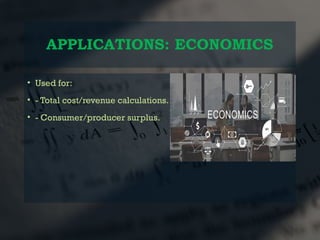
APPLICATIONS: ECONOMICS
• Used for:
• - Total cost/revenue calculations.
• - Consumer/producer surplus.
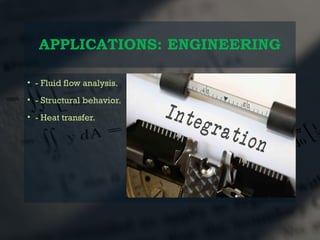
APPLICATIONS: ENGINEERING
• - Fluid flow analysis.
• - Structural behavior.
• - Heat transfer.
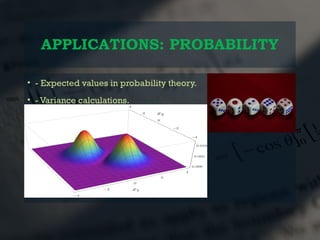
APPLICATIONS: PROBABILITY
• - Expected values in probability theory.
• - Variance calculations.
SUMMARY
• - Integration reverses differentiation.
• - Methods: Substitution, parts, partial fractions.
• - Applications span physics, engineering, and more.
THANK YOU!

Integral_Calculus_Presentation_Detailed.pptx

  • 1.
    INTEGRAL CALCULUS: A COMPREHENSIVE OVERVIEW Presentedby Simbisai Chinhema Sect 43 BI Reg. No: 241FA14061
  • 2.
    WHAT IS INTEGRALCALCULUS? • Integral calculus is the study of: • - Antiderivatives (reversing differentiation). • - Calculating areas under curves. • Applications in real life such as in physics, engineering, and economics.
  • 3.
    WHY STUDY INTEGRAL CALCULUS? •- Solves practical problems like motion, area, and volume. • - Provides tools for understanding rates of change. • - Crucial for scientific and engineering advancements.
  • 4.
    KEY CONCEPT: ANTIDERIVATIVE •Integration reverses differentiation: • Take for example! • If F'(x) = f(x), then F(x) is the antiderivative of f(x). then • f(x) = 2x F(x) = x^2 + C. →
  • 5.
    NOTATION AND TERMS Hereare some of the key notations and terms used in integration: - ∫…………. Integration symbol. - dx………..Indicates the variable of integration. C………… Constant of integration (indefinite integrals) .
  • 6.
    POWER RULE FORINTEGRATION • The power rule is used for any value of x raised to another value n as illustrated below: • Formula: ∫xn dx = x(n+1) /(n+1) + C ( where n ≠ -1) • Example: ∫x^3 dx = x4 /4 + C.
  • 7.
    EXPONENTIAL AND LOGARITHMIC RULES •- Exponential: ∫ex dx = ex + C. • Example: ∫ e(3x) dx = (1/3) * e(3x) + C the integral of e^(3x) is (1/3) * e(3x) + C. • - Logarithmic example: ∫(1/x) dx = log|x| + C.
  • 8.
    TRIGONOMETRIC INTEGRALS • Trigonometricintegrals goes in hand with some fomulars used for example ∫sin(x) dx = -cos(x) + C. ∫cos(x) dx = sin(x) + C. ∫tan(x) dx =sec(x)2 + C.
  • 9.
    INTEGRATION BY SUBSTITUTION •Used to simplify complex integrals: • Substitute u = g(x), then integrate in terms of u.
  • 10.
    EXAMPLE: SUBSTITUTION • Evaluate:∫2x e^(x^2) dx • Solution: • - Let u = x^2 du = 2x dx. → • - ∫e^u du = e^u + C = e^(x^2) + C.
  • 11.
    INTEGRATION BY PARTS •Formula: ∫f(x)g(x) dv = f(x) ∫ g(x) dx- ∫f(x)’ * ∫ g(x) dx . • Used when the integrand is a product of two functions. • To chose the first function wisely there is need to use the ILATE I…...Inverse function L…...Logarithmic function A……Arithmetic function T……Trigonometrical function E…….Exponential function
  • 12.
    EXAMPLE: INTEGRATION BY PARTS •Evaluate: ∫x sin(x) dx • Solution: • - Let u = x, dv = sin(x) dx. • - ∫x sin(x) dx = -x cos(x) + sin(x) + C.
  • 13.
    DEFINITE INTEGRATION • Calculatesarea under a curve between two points: • ∫[a to b] f(x) dx = F(b) - F(a).
  • 14.
    EXAMPLE: DEFINITE INTEGRATION • Evaluate:∫[0 to 2] 3x^2 dx • Solution: • ∫3x^2 dx = x^3 [x^3] from 0 to 2 = 8. →
  • 15.
    APPLICATIONS: TANGENTS AND NORMALS •Find slope of tangent and normal lines: • - Tangent: Slope = f'(x). • - Normal: Slope = -1/f'(x).
  • 16.
    EXAMPLE: TANGENT LINE •Find the tangent to y = x^2 at x = 1. • Solution: • - Slope = 2x f'(1) = 2. → • - Equation: y - 1 = 2(x - 1).
  • 17.
    APPLICATIONS: PHYSICS • -Velocity: v(t) = ∫a(t) dt + C. • - Position: x(t) = ∫v(t) dt + C.
  • 18.
    EXAMPLE: MOTION • Givena(t) = 2t, find v(t) and x(t). • Solution: • - v(t) = ∫2t dt = t^2 + C1. • - x(t) = ∫(t^2) dt = t^3/3 + C2.
  • 19.
    APPLICATIONS: ECONOMICS • Usedfor: • - Total cost/revenue calculations. • - Consumer/producer surplus.
  • 20.
    APPLICATIONS: ENGINEERING • -Fluid flow analysis. • - Structural behavior. • - Heat transfer.
  • 21.
    APPLICATIONS: PROBABILITY • -Expected values in probability theory. • - Variance calculations.
  • 22.
    SUMMARY • - Integrationreverses differentiation. • - Methods: Substitution, parts, partial fractions. • - Applications span physics, engineering, and more.
  • 23.