Crystal Physics
• MillerIndices are a fundamental notation
system in crystallography for planes and
directions in crystal lattices. This document
provides an in-depth analysis of Miller Indices,
including their determination, importance,
and applications in various fields of science
and technology.
• Abstract
Introduction
• Miller Indicesare a set of three integers (h, k,
l) that denote the orientation of a crystal
plane or direction in a crystalline material.
They are essential in crystallography for
specifying and communicating the geometry
of crystal planes and directions.
5.
Features of Millerindices of crystal
planes
• A plane parallel to one of the coordinate axes
has an intercept of infinity
• All the parallel equidistant planes have the
miller indices
• If the miller indices of two planes have same
ratio then the planes are parallel to each other
• If (h,k,l) are the miller indices of a plane, the
plane cuts the axes into h,k and l equal
segments
6.
• Importance inCrystallography
• Analyzing physical properties like optical,
electrical, and mechanical properties.
• Identifying
• crystal planes and
• directions.
• Understanding
• crystal symmetry and
• structure.
7.
Applications in VariousFields
• - X-ray Diffraction: Determines crystal
structures.
• - Electron Microscopy: Studies crystallographic
orientations and defects.
• - Material Science: Analyzes grain boundaries
and phase transitions.
• - Thin Films and Nanostructures: Designs
materials at the nanoscale.
• - Semiconductors: Analyzes and fabricates
semiconductor devices.
8.
Determining Miller Indices
•1. Identify intercepts of the plane with axes (a,
b, c).
• 2. Take reciprocals of the intercepts.
• 3. Clear fractions by multiplying by a common
factor.
• 4. Reduce to the smallest set of integers, if
necessary.
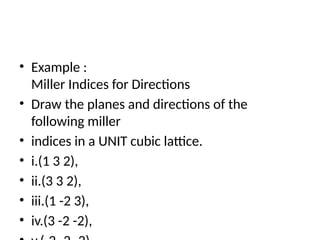
• Example :
MillerIndices for Directions
• Draw the planes and directions of the
following miller
• indices in a UNIT cubic lattice.
• i.(1 3 2),
• ii.(3 3 2),
• iii.(1 -2 3),
• iv.(3 -2 -2),
Importance of MillerIndices
• 1 Crystallographic Studies
• Miller Indices are used in:
• X-ray Diffraction: To index diffraction
• peaks and determine the crystal structure.
• Electron Microscopy: To analyze
• crystal orientation and defects.
• Transmission Electron Microscopy
• (TEM): To study dislocations and other
• defects.
14.
(h k l):Plane notation.
• Common Notations
• [u v w]: Direction notation.
• <u v w>: Family of directions.
• {h k l}: Family of planes.
Conclusion
• Miller Indicesdescribe crystal planes and
directions.
• Used in X-ray diffraction, material science, and
semiconductors.
• Continue research to develop advanced
materials and technologies.






![(h k l): Plane notation.
• Common Notations
• [u v w]: Direction notation.
• <u v w>: Family of directions.
• {h k l}: Family of planes.](https://image.slidesharecdn.com/crystalphysicsmillerindicesupdatedtemplate-250512151836-5a8cd0aa/85/Crystal_Physics_Miller_Indices_Updated_Template-pptx-14-320.jpg)


