1
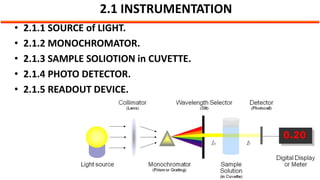
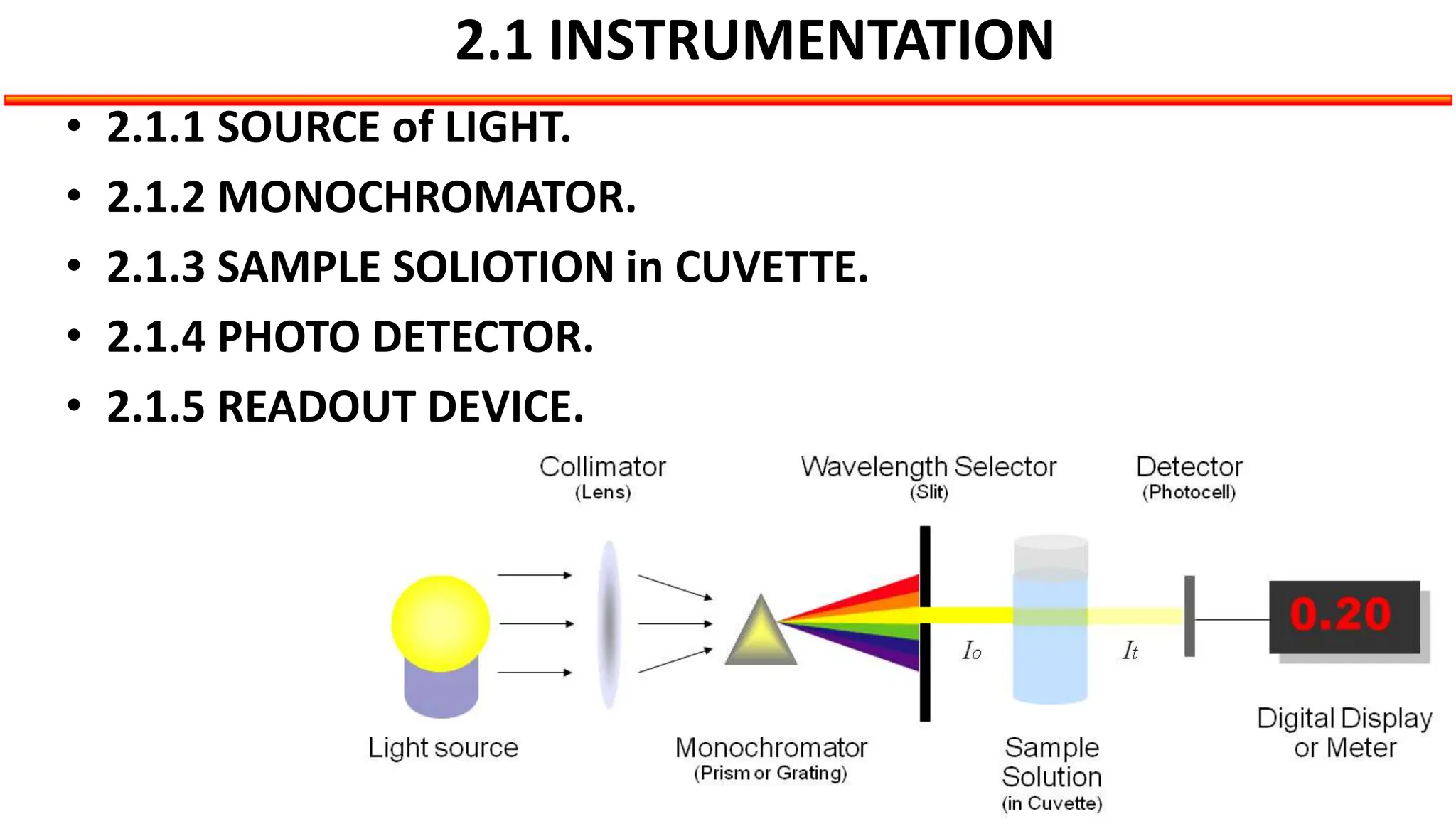
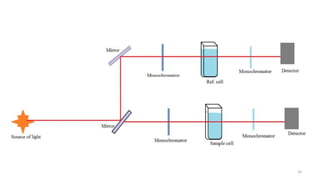
• 2.1.1 SOURCE of LIGHT.
• 2.1.2 MONOCHROMATOR.
• 2.1.3 SAMPLE SOLIOTION in CUVETTE.
• 2.1.4 PHOTO DETECTOR.
• 2.1.5 READOUT DEVICE.
2.1 INSTRUMENTATION
SOURCE of LIGHT
2
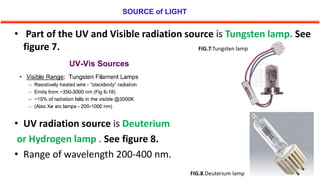
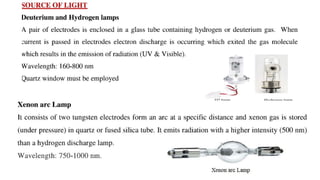
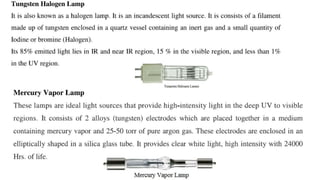
• Part of the UV and Visible radiation source is Tungsten lamp. See
figure 7.
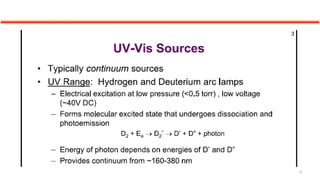
• UV radiation source is Deuterium
or Hydrogen lamp . See figure 8.
• Range of wavelength 200-400 nm.
FIG.7.Tungsten lamp
FIG.8.Deuterium lamp
3
4
5
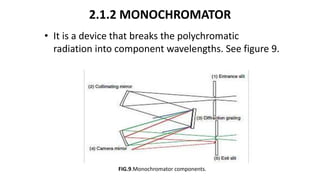
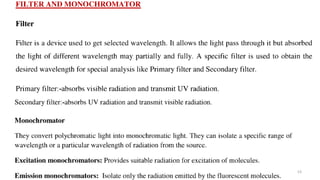
2.1.2 MONOCHROMATOR
• It is a device that breaks the polychromatic
radiation into component wavelengths. See figure 9.
FIG.9.Monochromator components.
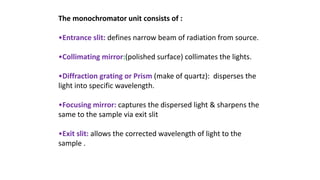
The monochromator unit consists of :
•Entrance slit: defines narrow beam of radiation from source.
•Collimating mirror:(polished surface) collimates the lights.
•Diffraction grating or Prism (make of quartz): disperses the
light into specific wavelength.
•Focusing mirror: captures the dispersed light & sharpens the
same to the sample via exit slit
•Exit slit: allows the corrected wavelength of light to the
sample .
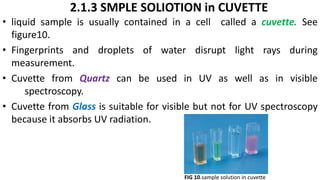
2.1.3 SMPLE SOLIOTION in CUVETTE
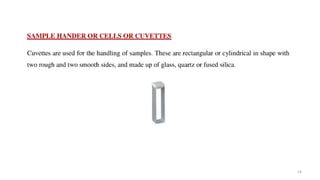
• liquid sample is usually contained in a cell called a cuvette. See
figure10.
• Fingerprints and droplets of water disrupt light rays during
measurement.
• Cuvette from Quartz can be used in UV as well as in visible
spectroscopy.
• Cuvette from Glass is suitable for visible but not for UV spectroscopy
because it absorbs UV radiation.
FIG 10.sample solution in cuvette
9
10
11
12
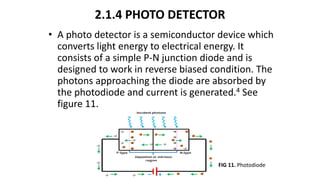
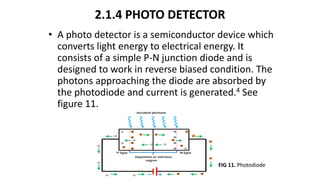
2.1.4 PHOTO DETECTOR
• A photo detector is a semiconductor device which
converts light energy to electrical energy. It
consists of a simple P-N junction diode and is
designed to work in reverse biased condition. The
photons approaching the diode are absorbed by
the photodiode and current is generated.4 See
figure 11.
FIG 11. Photodiode
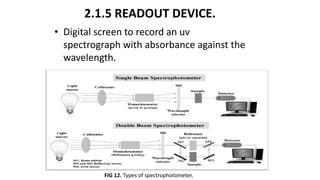
2.1.5 READOUT DEVICE.
• Digital screen to record an uv
spectrograph with absorbance against the
wavelength.
-----------------------------------------------
-
2.2 TYPES of SPECTROPHOTOMETER
FIG 12. Types of spectrophotometer.
• UV-Vis spectroscopy is used heavily in many different
research areas to identify or quantify a sample.
• Chemical field:
1. Detection of impurities.
2. Structure of organic compounds (single or double
bond, presence or absence of functional group).
3. Kinetics of reaction.
4. Manufacturing drugs.
• Biological fields
1. quantify the amount of protein and DNA in a sample
2. quantify the amount of bacterial cells in a cell culture
2.3 Applications of UV-VIS Spectroscopy.
conclusion
• Major advantages of uv-vis spectroscopy are:
1. High sensitivity.
2. Require only small volume of sample.
3. Linearity over wide range of concentration.
4. Can be used with gradient elution.
• Major disadvantages of uv-vis spectroscopy are:
1. Not linear for high concentration.
2. Does not work with compounds that do not absorb
light at this wavelength region.
3. Generates significant heat and requires external
cooling.
31
32
33
34
35
36
37
38
39
40
41
42
43
44
45
46
47
48
49
50
51
52
53
54
55
56
57
58
2.1.4 PHOTO DETECTOR
• A photo detector is a semiconductor device which
converts light energy to electrical energy. It
consists of a simple P-N junction diode and is
designed to work in reverse biased condition. The
photons approaching the diode are absorbed by
the photodiode and current is generated.4 See
figure 11.
FIG 11. Photodiode
60
61
62
63

instrumentation UV.pptx

  • 1.
    1 • 2.1.1 SOURCEof LIGHT. • 2.1.2 MONOCHROMATOR. • 2.1.3 SAMPLE SOLIOTION in CUVETTE. • 2.1.4 PHOTO DETECTOR. • 2.1.5 READOUT DEVICE. 2.1 INSTRUMENTATION
  • 2.
    SOURCE of LIGHT 2 •Part of the UV and Visible radiation source is Tungsten lamp. See figure 7. • UV radiation source is Deuterium or Hydrogen lamp . See figure 8. • Range of wavelength 200-400 nm. FIG.7.Tungsten lamp FIG.8.Deuterium lamp
  • 3.
  • 4.
  • 5.
  • 6.
    2.1.2 MONOCHROMATOR • Itis a device that breaks the polychromatic radiation into component wavelengths. See figure 9. FIG.9.Monochromator components.
  • 7.
    The monochromator unitconsists of : •Entrance slit: defines narrow beam of radiation from source. •Collimating mirror:(polished surface) collimates the lights. •Diffraction grating or Prism (make of quartz): disperses the light into specific wavelength. •Focusing mirror: captures the dispersed light & sharpens the same to the sample via exit slit •Exit slit: allows the corrected wavelength of light to the sample .
  • 8.
    2.1.3 SMPLE SOLIOTIONin CUVETTE • liquid sample is usually contained in a cell called a cuvette. See figure10. • Fingerprints and droplets of water disrupt light rays during measurement. • Cuvette from Quartz can be used in UV as well as in visible spectroscopy. • Cuvette from Glass is suitable for visible but not for UV spectroscopy because it absorbs UV radiation. FIG 10.sample solution in cuvette
  • 9.
  • 10.
  • 11.
  • 12.
  • 13.
    2.1.4 PHOTO DETECTOR •A photo detector is a semiconductor device which converts light energy to electrical energy. It consists of a simple P-N junction diode and is designed to work in reverse biased condition. The photons approaching the diode are absorbed by the photodiode and current is generated.4 See figure 11. FIG 11. Photodiode
  • 14.
    2.1.5 READOUT DEVICE. •Digital screen to record an uv spectrograph with absorbance against the wavelength. ----------------------------------------------- - 2.2 TYPES of SPECTROPHOTOMETER FIG 12. Types of spectrophotometer.
  • 29.
    • UV-Vis spectroscopyis used heavily in many different research areas to identify or quantify a sample. • Chemical field: 1. Detection of impurities. 2. Structure of organic compounds (single or double bond, presence or absence of functional group). 3. Kinetics of reaction. 4. Manufacturing drugs. • Biological fields 1. quantify the amount of protein and DNA in a sample 2. quantify the amount of bacterial cells in a cell culture 2.3 Applications of UV-VIS Spectroscopy.
  • 30.
    conclusion • Major advantagesof uv-vis spectroscopy are: 1. High sensitivity. 2. Require only small volume of sample. 3. Linearity over wide range of concentration. 4. Can be used with gradient elution. • Major disadvantages of uv-vis spectroscopy are: 1. Not linear for high concentration. 2. Does not work with compounds that do not absorb light at this wavelength region. 3. Generates significant heat and requires external cooling.
  • 31.
  • 32.
  • 33.
  • 34.
  • 35.
  • 36.
  • 37.
  • 38.
  • 39.
  • 40.
  • 41.
  • 42.
  • 43.
  • 44.
  • 45.
  • 46.
  • 47.
  • 48.
  • 49.
  • 50.
  • 51.
  • 52.
  • 53.
  • 54.
  • 55.
  • 56.
  • 57.
  • 58.
  • 59.
    2.1.4 PHOTO DETECTOR •A photo detector is a semiconductor device which converts light energy to electrical energy. It consists of a simple P-N junction diode and is designed to work in reverse biased condition. The photons approaching the diode are absorbed by the photodiode and current is generated.4 See figure 11. FIG 11. Photodiode
  • 60.
  • 61.
  • 62.
  • 63.