Bilateral Finland–Sudan Technical Assistance within the Framework of the Eastern Nile Watershed Management Project 1 of 107
Institutional Assessment
Community Watershed Management Component
2015
Bo Lager & Noon Abdelrahman
2015-12-20
Bilateral Finland–Sudan Technical Assistance within the Framework of the Eastern Nile Watershed Management Project 2 of 107
1. Contents
1. Contents ................................................................................................................................................ 2
2. Executive Summary............................................................................................................................... 4
3. Methodology and objectives................................................................................................................. 6
4. Introduction........................................................................................................................................... 8
5. Watershed Management – The concept............................................................................................. 12
6. Main watersheds in Sudan.................................................................................................................. 15
7. Successful watershed management in Sudan?................................................................................... 18
8. What is the appropriate institutional setting for watersheds in Sudan?............................................ 22
9. Legal framework for IWRM in Sudan .................................................................................................. 28
10. Land tenure ..................................................................................................................................... 31
11. Water and land as a source of conflict............................................................................................ 34
12. Foreign investment in agricultural sector ....................................................................................... 36
12.1. Carbon Finance........................................................................................................................ 38
13. Institutions....................................................................................................................................... 40
13.1. Academia................................................................................................................................. 40
13.1.1. UNESCO Chair...................................................................................................................... 40
13.1.2. University of Khartoum (UOFK) - Faculty of geographical and environmental studies ...... 41
13.1.3. Ahfad University for women (AUW).................................................................................... 41
13.2. Civil Society Organisations ...................................................................................................... 42
13.2.1. Nile Basin Discourse ............................................................................................................ 42
13.2.2. Sudanese Environment Conservation Society (SECS).......................................................... 43
13.2.3. Environmentalist Society..................................................................................................... 44
13.2.4. Pastoralist Union – Gedarif State ........................................................................................ 45
13.2.5. Pastoralists Union - Dinder Locality..................................................................................... 47
13.2.6. Practical Action.................................................................................................................... 48
13.2.7. Village Development Committee (VDC) – AlZorog, Lower Atbara...................................... 49
13.2.8. Village Development Committee (VDC) Kenidra VDC......................................................... 50
13.2.9. Village Development Committee (VDC) Jaldok VDC ........................................................... 51
13.3. International organizations ..................................................................................................... 53
13.3.1. United National Environmental Program (UNEP) ............................................................... 53
13.3.2. Nile Basin Initiative (NBI)..................................................................................................... 54
13.3.3. Cooperative Framework Agreement (CFA) ......................................................................... 55
Bilateral Finland–Sudan Technical Assistance within the Framework of the Eastern Nile Watershed Management Project 3 of 107
13.3.4. RAMSAR convention............................................................................................................ 56
13.3.5. International Fund for Agricultural Development (IFAD).................................................... 56
13.3.6. World Bank.......................................................................................................................... 57
13.3.7. IWRM - Sida International training programmes................................................................ 58
13.4. Government institutions ......................................................................................................... 60
13.4.1. Sudan’s National Comprehensive 25 years Strategy (2007-2031)...................................... 60
13.4.2. Forest National Corporation (FNC) – Federal level ............................................................. 62
13.4.3. Forest National Corporation (FNC) – River Nile State......................................................... 66
13.4.4. State level – River Nile state................................................................................................ 68
13.4.5. Locality Administration – El Damer locality......................................................................... 71
13.4.6. State Water Corporation..................................................................................................... 72
13.4.7. Hudeiba Agricultural Research Station................................................................................ 74
13.4.8. Agricultural Research Corporation in El Damazin ............................................................... 75
13.4.9. Wildlife Research Station (Dinder)...................................................................................... 76
13.4.10. Range and Pasture Directorate – Blue Nile state (El Damazin)..................................... 77
13.4.11. Dinder National Park (DNP)............................................................................................. 78
13.4.12. Ministry of Finance – Sennar state.................................................................................. 79
13.4.13. Ministry of Water Resources, Irrigation and Electricity (MWRIE)................................... 80
13.4.14. Higher Council for Environment and Natural Resources (HCENR).................................. 81
13.4.15. Ministry of Environment and Physical Development...................................................... 82
13.4.16. Ministry of Agriculture .................................................................................................... 83
13.5. Private sector........................................................................................................................... 84
13.5.1. Report for Kenidra Cooperative Association....................................................................... 84
13.5.2. Dal Group............................................................................................................................. 84
14. Major issues and recommendations............................................................................................... 86
Annex 1 References..................................................................................................................................... 91
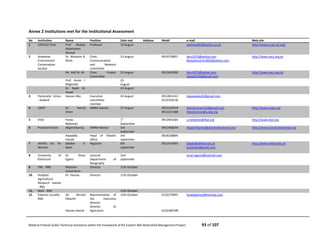
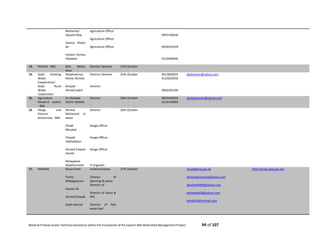
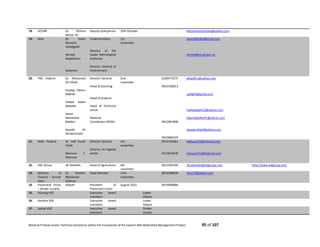
Annex 2 Institutions met for the Institutional Assessment......................................................................... 93
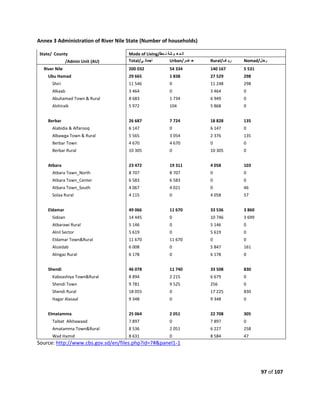
Annex 3 Administration of River Nile State (Number of households) ........................................................ 97
Annex 4 CWMP map.................................................................................................................................... 98
Annex 5 CWMP area of implementation .................................................................................................... 99
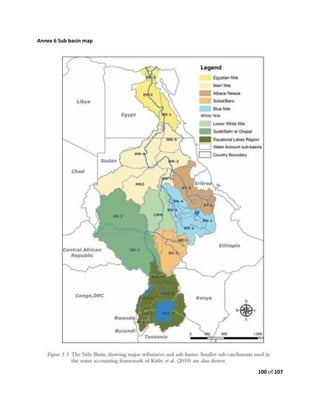
Annex 6 Sub basin map ............................................................................................................................. 100
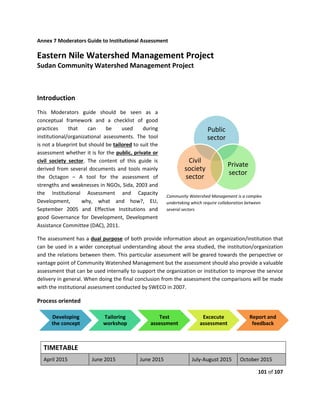
Annex 7 Moderators Guide to Institutional Assessment .......................................................................... 101
Bilateral Finland–Sudan Technical Assistance within the Framework of the Eastern Nile Watershed Management Project 4 of 107
2. Executive Summary
This report presents the findings from an institutional assessment carried out between September and
November 2015. The overall aim of the study was to provide information that contributes to a better
conceptual understanding about Community Watershed Management in Sudan. The assessment is
meant to include organizations and institutions that cut across the Sudan society from Federal level
down to community level and include civil society (NGOs, CBOs), academic, government institutions and
private sector.
The study was funded under the budget for Technical Assistance (TA) for the Eastern Nile Watershed
Management Project (ENWMP) - Sudan Component hereafter called the Community Watershed
Management Project (CWMP). The TA is financed by the Government of Finland (GoF) and implemented
by NIRAS Finland Oy.
The assessment should be viewed as one in a rich flora of documentations available on the sustainable
management of natural resources in Sudan. The audience for this report is interested policy makers,
donors, project developer’s and project workers in Sudan and outside.
The assessment shows that more attention is required by all stakeholders in Sudan in order for
Community Watershed Management (CWM) to be incorporated into policies, institutions and
community processes. Despite much efforts have been done in introducing the concept of CWM there is
still a scope for developing the concept further to be fully accepted and integrated.
Watersheds are part of the ecosystems and our natural environment which constitute the platform upon
which our entire existence is based. The ecosystem services which these watersheds provide and on
which we depend include not only the air that we breathe and the joy of wildlife, but form the very basis
of our food production, freshwater supply, filtering of pollution, buffers against pests and diseases and
buffers against disasters such as floods, drought, landslides and soil loss.
The assessment is recognizing that how effective the watershed is of delivering the environmental
services mentioned above is mainly dependent on the governance of these resources. Governance of
water resources and food systems must involve public policy and private sector in interaction with civil
society and consumers. Combined customary and statutory mechanisms of land tenure exist in Sudan
and should be recognized. The devolution of power of the natural resource management to local
communities is a pre requisite for sustainable CWM. Effective water use requires coordination with
energy planning, agricultural production, domestic water provision and water for industrial use.
Coordination mechanisms are necessary to capitalize on potential synergies in the use of water and to
reduce negative externalities and trade-offs.
The assessment identifies seven issues (described in chapter 14 Challenges and recommendations) which
are important to advance the concept of CWM to take root in Sudan. These issues are:
Issue 1. Policy and legislation
The policy and legislation with regards to CWM is very complex in Sudan and therefore a comprehensive
study should be conducted that can clarify which legislation is impacting on CWM and any other
legislative issues pertinent in relation to CWM with the aim of advice on overlapping legislation and gaps
Bilateral Finland–Sudan Technical Assistance within the Framework of the Eastern Nile Watershed Management Project 5 of 107
in policies and laws. The study should be able to suggest were clarification in legislation is necessary and
were changes/improvement is necessary.
Issue 2. Resource mapping
The Sudan’s natural resource base and watersheds should be described in detail and therefore a
nationwide natural resource mapping exercise which is based on the main watersheds and sub
watersheds in Sudan should be done. The mapping should contain detailed information using a
combination of remote sensing and participatory methodologies. The assessment should map and
describe all main and sub-watersheds including key environmental hotspots in Sudan.
Issue 3. Institutional building
Strong national institutions are crucial for sustainable management of watersheds. Therefore, exploring
an appropriate institutional setup of Integrated Water Resource Managment (IWRM) at Federal-, State-
and Locality level is important. IWRM in its essence is intersectoral and for effective implementation an
enabling framework for integrated development planning at locality level should be promoted involving
wide spectra of topics as part of the institutional setup (Health, Agriculture, Infrastructure, Water etc.).
Issue 4. Capacity building
Capacity building in areas of CWM is of key concern for organizations and institutions in Sudan so as to
capacitate them to efficiently, effectively and sustainably fulfil their responsibilities and strengthen their
role in the delivery of services.
Issue 5. Cooperative Framework Agreement (CFA)
The CFA which should replace the Nile Basin Initiative (NBI) needs ratifications to enter into force and
effect in order to create an enabling environment for cooperation in watershed management in the Nile
Basin.
Issue 6. Land reforms and land tenure
A land tenure policy that strengthens customary rights (e.g. through registration) and the introduction of
a land use policy by the government that recognizes customary rights would benefit CWM. Pastoralism
has to be included more clearly in the IWRM concept in Sudan and policies and legal instruments has to
be adjusted to effectively incorporate livestock sector in the IWRM approach with respect to water, land
and natural resources management.
Issue 7. Dinder National Park (DNP)
A new initiative is necessary for DNP which should be driven by the government of Sudan that builds on
the last five years of experience of the CWMP in particular in areas of creating of buffer zones and
conflict resolution approach. Since the DNP has a sister park on the other side of the border in Ethiopia
one idea would be to consider the creation of a kind of Peace Park (www.peacepark.org) between Sudan
and Ethiopia.
Bilateral Finland–Sudan Technical Assistance within the Framework of the Eastern Nile Watershed Management Project 6 of 107
3. Methodology and objectives
This Institutional Assessment (IA) is aiming at painting a comprehensive map over the complex issues
related to institutions and the connections between them and Community Watershed Management
(CWM) in the Sudan context. The assessment also presents the brief description (Chapter 13) of selected
government, academic, private sector and civil society organizations in Sudan but don’t claim to be
covering every corner of society or every organization but a representative selection.
The social and ecological interface is a critical aspect of CWM and it is this interface which forms the
analytical framework for this IA. The assessment vantage point is CWM and aims to better understand
the socio-ecological interrelationships in CWM to enhance the sustainable management of natural
resources which view humans as natural part of the ecosystem.
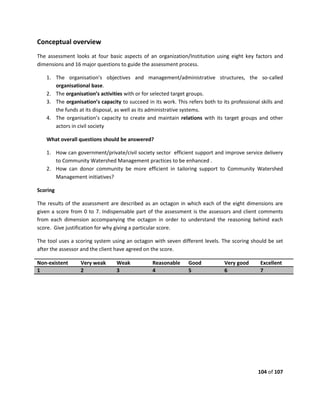
The assessment have used a methodology (see Annex 6 Moderators Guide to Institutional Assessment)
which is based on dialogue or stakeholder consultations with organizations that covers a horizontal cross
section of society from public, academic, civil society and private sector and vertically from the federal
level to the village level and with organizations with a stake in CWM in Sudan. The dialogue are circling
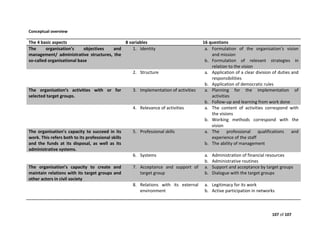
around four basic aspects, with the vantage point at CWM, of an organization/institution, these aspects
are 1) The organization’s objectives and management/administrative structures, the so-called
organizational base; 2) The organization’s activities with or for selected target groups; 3) The
organization’s capacity to succeed in its work. This refers both to its professional skills and the funds at
its disposal, as well as its administrative systems and 4) The organization’s capacity to create and
maintain relations with its target groups and other actors. The four basic aspects have been further
subdivided into eight variables linked to the aspects; these are 1) Identity; 2) Structure; 3)
Implementation of activities; 4) Relevance of activities; 5) Professional skills; 6) Systems; 7) Acceptance
and support of target group and 8) Relations with its external environment.
During the assessment from September to November 2015 the assessment team, which consist of Bo
Lager, Team Leader, Noon Abdelraham (Project assistant), Hawa Fadalla Deng (Community Mobiliser)
and Nasir Yousif Gaboush Braema (Protected Area Management Specialist) interviewed 29 organizations
and institutions in Sudan. All institutions met and participants in this assessment are listed in Annex 2
Institutions met. The more detailed description of each institution met is described in the stakeholder
mapping in Chapter 13 Institutions met for the Institutional Assessment. The report is based on
stakeholder dialogue carried out in the two targeted areas of Atbara and Dinder National Park and with
relevant organizations at the federal level in Khartoum.
The assessment is also drawing lessons from the institutional assessment that was done 2007 as
preparatory work for the Eastern Nile Watershed Management project – Community Watershed
Management Component in 2007 by SWECO in collaboration with Afhad University. The SWECO
institutional assessment comprises: (i) full documentation of existing players relevant to the three areas,
their capacities and interest in terms of supporting the projects; (ii) capacity building institutional
strengthening activities to enhance the administrations’, local communities, civil society and other socio-
professional groups’, planning, implementation, monitoring and evaluation capacity; (iii) identified
implementing agencies and possible partnership modalities; and (iv) an assessment of Micro Finance
institutions and Saving and Credit Associations. The SWECO assessment made an effort to identify
Bilateral Finland–Sudan Technical Assistance within the Framework of the Eastern Nile Watershed Management Project 7 of 107
existing institutions directly or indirectly involved in watershed management and dividing the
stakeholders into two groups’ community organizations which will implement and maintain the
interventions, and external institutions (government, NGO, private) which support the implementation.
Bilateral Finland–Sudan Technical Assistance within the Framework of the Eastern Nile Watershed Management Project 8 of 107
4. Introduction
Community Watershed Management (CWM) is
crucial for the sustainable management of natural
resources such as freshwater, agricultural land,
forests, fisheries and wildlife and necessary for the
maintenance of ecosystem services. The resilience of
these ecosystem services is highly dependent on the
institutions and social structures that are set to
manage them, from the communities whose
livelihoods and food security depend on production
from agroecosystem, the private sector who’s
businesses are built on agriculture and forestry
ecosystems and for public institutions responsible for
developing and implementing effective policies and
legislations. Therefore, managing the watersheds is a collaborative endeavor which requires a conducive
governance system consisting of institutional arrangements, decision making processes, policy and
legislative instruments and different sector interests. The CWM approach has to take this into
consideration.
This Institutional Assessment (IA) is aiming at painting a comprehensive map over the complex issues
related to institutions and the relations between them and Community Watershed Management (CWM)
in the Sudan context.
A comprehensive understanding of the actors, policies, legislation and governance are all a fundamental
prerequisite for effective watershed management. CWM is a function in which the most important parts
are strong government institutions and coherent policy framework. The report should give a conceptual
understanding of the issues and be a resource mainly for the Sudan Government, policy makers, project
developers and donors who are planning to institutionalize the concept of watershed management or
implement watershed projects in Sudan.
The report is prepared as part of the Eastern Nile Watershed Management Project – Sudan component
(CWMP) with financial support from the Finnish government, Government of Sudan and the Global
Key Messages:
1. Managing the watersheds is a collaborative endeavor which requires a conducive governance system
consisting of institutional arrangements, decision making processes, policy and legislative instruments
and different sector interests.
2. Watersheds are fundamental for the existence of life, food production, supply of fresh water, filtration
of pollution, buffers against pest and diseases, climatic regulation and buffer against disasters.
3. CWM is not yet a well-established concept in the Sudanese natural resource management or its
institutions.
4. Despite these efforts, for CWM to take root considerable more actions and commitment is required by
the Sudanese government in the next 5-10 years to institutionalize IWRM in the government structure
and in the society at large.
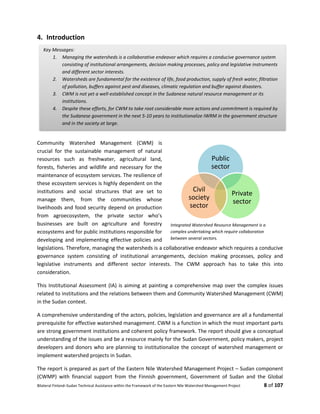
Public
sector
Private
sector
Civil
society
sector
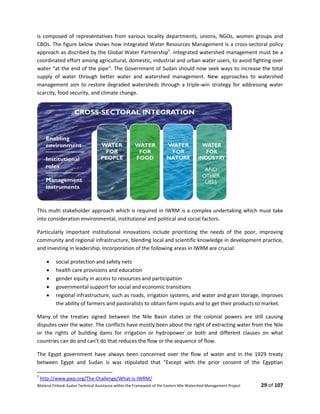
Integrated Watershed Resource Management is a
complex undertaking which require collaboration
between several sectors.
Bilateral Finland–Sudan Technical Assistance within the Framework of the Eastern Nile Watershed Management Project 9 of 107
Environmental Facility (GEF). The CWMP is a
component of the larger ENWMP which is one of
the Nile Basin Initiative (NBI) projects. The Project
Identification Document (PID) for Eastern Nile
Subsidiary Action Program (ENSAP) establishes
the long-term goals and objectives for the first
ENSAP investment program for the Integrated
Development of the Eastern Nile (IDEN).The
project was first endorsed by the Eastern Nile
Council of Ministers (ENCOM) already in 2001
(confirmed by ENCOM in 2004) but the
implementation started in 2010 after a thorough
appraisal during 2009. The ENWMP was first
planned to be implemented between 2010 and
2014 (Later the CWMP was extended to
December 2015). CWMP is one of the first
watershed management projects being
implemented in Sudan.
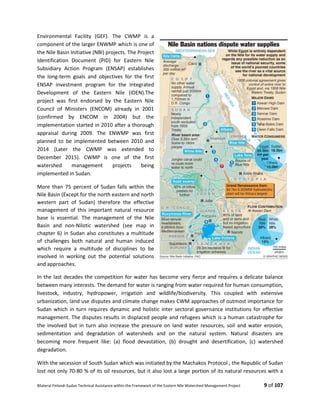
More than 75 percent of Sudan falls within the
Nile Basin (Except for the north eastern and north
western part of Sudan) therefore the effective
management of this important natural resource
base is essential. The management of the Nile
Basin and non-Nilotic watershed (see map in
chapter 6) in Sudan also constitutes a multitude
of challenges both natural and human induced
which require a multitude of disciplines to be
involved in working out the potential solutions
and approaches.
In the last decades the competition for water has become very fierce and requires a delicate balance
between many interests. The demand for water is ranging from water required for human consumption,
livestock, industry, hydropower, irrigation and wildlife/biodiversity. This coupled with extensive
urbanization, land use disputes and climate change makes CWM approaches of outmost importance for
Sudan which in turn requires dynamic and holistic inter sectoral governance institutions for effective
management. The disputes results in displaced people and refugees which is a human catastrophe for
the involved but in turn also increase the pressure on land water resources, soil and water erosion,
sedimentation and degradation of watersheds and on the natural system. Natural disasters are
becoming more frequent like: (a) flood devastation, (b) drought and desertification, (c) watershed
degradation.
With the secession of South Sudan which was initiated by the Machakos Protocol , the Republic of Sudan
lost not only 70-80 % of its oil resources, but it also lost a large portion of its natural resources with a
Bilateral Finland–Sudan Technical Assistance within the Framework of the Eastern Nile Watershed Management Project 10 of 107
large proportion of its land being left arid or semi-arid lands. This makes the Republic of Sudan more
susceptible to climate change and other shocks like flooding and further stresses the importance of
CWM in Sudan.
In Sudan, the population growth is around 2% (World Bank) per annum and poverty levels are high.
Urbanization process in Sudan has been quick in de last decade, despite this the population of Sudan
remains mainly rural and people are to a large extent dependent on natural resources for their
livelihoods. In 1955/56 the population of Sudan was 10.1 million and in the 2008 population census 39.2
million was counted (included south Sudan).
The pressure on the natural resources has increased with growing population exacerbated by
accelerating climate change and displacement of people due to conflict. Intensification of agriculture
along the River Nile has been extensive from internal actors, but in the last decade the interest to invest
in Sudan’s fertile land has also emerged from foreign countries like China and the Arab world.
Unfortunately, this has led to falling crop yields and degraded soils both in traditional rain fed and
mechanized agriculture. It is important to recognize that the type of vegetation, tilling practices and
organic matter content in the soil affect infiltration and water holding capacity and water flows. Changes
in land use over large areas can have significant effects on water fluxes.
Today, the CWM concept is not yet well-established in the management of Sudanese natural resources
or in its institutions. There are several projects that have attempted to introduce the concept of CWM in
Sudan, including the Eastern Nile Watershed Management Project (ENWMP) – Community Watershed
Management Component (CWMP). The overall objective of the Eastern Nile Watershed Management
Project has been to promote a wider adoption of sustainable land and water management practices and
technologies, to reduce land degradation and to increase agricultural productivity. The Purpose of the
CWMP is to reduce land degradation and increase agricultural productivity, improve water quality, and
conserve biodiversity. In Sudan, at the federal level, the Ministry of Water Resources, Irrigation and
Electricity (MWRIE), has the overall national responsibility for water resources in Sudan. MWRIE has
been the lead implementing agency for the Community Watershed Management Project (CWMP) since
2009 at the national level and in four States, namely, River Nile, Blue Nile, Sennar and Gedarif States (see
Annex 4 CWMP map).
Despite these efforts, for CWM to take root considerably more actions and commitment is required by
the Sudanese government in the next 5-10 years to institutionalize CWM in the government structure
and in the society at large in order to be able to change the negative trend of degradation of natural
resources and mitigate and adapt to future effect of climate change. The way forward is to build on the
experiences from projects like the CWMP, UNEP and others and design a CWM approach that will
support these efforts and provide an opportunity for guiding this change process through the recognition
of international principles of Integrated Water Resource Management (IWRM). This will require
adaptation of future development policies and strategies, commitment to the implementation of
legislation, effective monitoring of natural resources, deeper coordination between government
institutions and more participation from non-state actors (private and civil society).
Perhaps the most urgent matter is to designate the institution and modality which should be in charge of
coordinating CWM in Sudan in the future and give this institution the mandate and resources to
Bilateral Finland–Sudan Technical Assistance within the Framework of the Eastern Nile Watershed Management Project 11 of 107
implement the CWM approach at federal, State and locality level. The ultimate goal is to improve the
performance of service delivery in public, private and civil society organizations. The success and
functionality of these organizations is the key to watershed management and ultimately poverty
reduction. This also requires close coordination among farmer networks, community-based
organizations, government line departments and other stakeholders. It is expected that the assessment
can help strengthen organizations and to help the government to make informed choices designing
sector reforms and national development strategies.
Bilateral Finland–Sudan Technical Assistance within the Framework of the Eastern Nile Watershed Management Project 12 of 107
5. Watershed Management – The concept
The availability of water is a precondition for social and economic development and poverty alleviation
in the Nile Basin. In Sudan, 81%1
of Sudan’s energy comes from hydropower (2011 years statistics) and a
large part of its agriculture is heavily dependent on irrigation. The concept of watershed management is
a technical approach of managing a geographical area which is demarcated based on the topography and
the flow of water to emphasize the upstream-downstream interaction and dependency. Watershed
management does not explicitly take social or economic factors into consideration when delineating the
area under management.
By adding the word community in font of watershed management the concept becomes more inclusive
and underpinning that the watershed is managed by the
local community. It also describes a decentralized way of
governance, meaning the power delegated to the
communities who should take part in the management of
the watershed as legal institutions. Community watershed
management (CWM) is a globally recognized concept
which has gained appreciation in the last two decades as
an effective way of sustainable managing the complex
system of a watershed. It can be seen as a bottom up
approach to watershed management, using participatory approaches in its planning and implementation
which allow a more equitable way of accessing natural resources. CWM has a wider definition and is
entrenched in other similar concepts like Integrated Water Resources Management (IWRM), Catchment
management or River Basin Management which are including all sectors of society in its models. IWRM is
getting increasingly more attention in Sudan and around the world. The importance of sustainable
management of the watersheds is evident in the light of increasingly environmental degradation which is
widespread in Sudan because of increasing pressure from increasing population, agricultural
intensification, unsustainable extraction of natural resources, climate change and political unrest.
Integrated Water Resources Management (IWRM) has been defined by the Global Water Partnership
(GWP) as "a process which promotes the coordinated development and management of water, land and
related resources, in order to maximize the economic and social welfare in an equitable manner without
1
http://www.iea.org/statistics/statisticssearch/report/?year=2013&country=Sudan&product=ElectricityandHeat
Key Messages:
1. Community watershed management (CWM) is a globally recognized concept for effectively and
sustainably manage the complex system of a watershed.
2. Climate change is an additional factor which has to be taken into consideration for IWRM , adding the
concept of resilience in the IWRM approach.
3. Community watershed management takes a more holistic approach which takes into account both
customary and formal management arrangements of governance of natural resources to ensure
equitable access to land and water ensuring local ownership.
The most common definition of watershed
is an area of land that drains all the
streams and rainfall to a common outlet
such as the outflow of a reservoir, mouth
of a bay, or any point along a stream
channel. The word watershed is sometimes
used interchangeably with drainage basin
or catchment.
Bilateral Finland–Sudan Technical Assistance within the Framework of the Eastern Nile Watershed Management Project 13 of 107
compromising the sustainability of vital ecosystems", Wikipedia, 20152
. IWRM is based on three
principles of social equity, economic efficiency and ecological sustainability.
Landscape approach is similar to the watershed approach and includes a combination of local
ecosystems connected across space encompassing agricultural and pastoral lands, human settlements,
and natural and degraded habitats (Milder et al. 2012).
In the watershed approach, the unit of a watershed is based on delineation of the topography to include
all catchments of rivers and streams, and may correspond to the landscape approach. The landscape
approaches seeks to support food production, natural resource conservation, and livelihood security
goals by better understanding and recognizing interconnections between different land uses and the
stakeholders that derive benefits from them (Sayer et al. 2013). Climate change is an additional factor
which has to be taken into consideration for IWRM which also brings in the concept of resilience in the
IWRM approach. With resilience we mean both the resilience of the agroecosystems but also the
resilience of the communities, and these two aspects have become more uncertain due to climate
change which impacts on the management of the watersheds.
In Sudan, some of the areas where the community watershed management approach has been
implemented the landscape is very flat which makes it difficult to determine clear and distinctive
watershed areas based on topography. This compromises the use of the watershed approach and
therefore the landscape approach might be a suitable approach to use under these topographic
circumstances.
Adding the word management at the end, IWRM, Catchment management, Watershed management
means there is a distinctive organization overlooking the management of the watershed. This
organization could be a commission (Lake Victoria Basin Commission), association, council or authority.
Watershed management should take onboard all aspects of water, rainwater, groundwater, irrigation,
sewage water, waste water etc. in its approach.
The real sense of community watershed management implies a more holistic approach which takes into
account both customary and formal management arrangements of governance of natural resources to
ensure equitable access to land and water ensuring local ownership.
One principle that appears in documentation about CWM is that participation of all stakeholders is a
prerequisite to watershed planning and Community Based Natural Resource Management (CBNRM). This
is also true in the CWMP and one of five main lessons learnt from the CWMP is: “Bottom-up community-
based participatory planning and collaborative implementation is essential to generate ownership, cost-
effective joint implementation, impact and sustainability”. The SWECO assessment was also very clear on
this point saying with regards to participatory methods that Sudan in 2007, few localities used
participatory processes or make any attempt to involve communities in the planning, and interaction
with the People's Committees is limited in most localities. Therefor this aspect was emphasized in the
Community Watershed Management Project (CWMP). The SWECO assessment also concludes that the
planning and managerial capacities in Sudan in terms of CWM are still weak and that they would require
intensive retraining and capacity development. Inclusion of women, female headed households,
nomadic pastoralist also needs to be improved according to SWECO in 2007 and this situation still needs
2
https://en.wikipedia.org/wiki/Integrated_water_resources_management
Bilateral Finland–Sudan Technical Assistance within the Framework of the Eastern Nile Watershed Management Project 14 of 107
to be addressed in future projects. Integrating local, cultural, scientific, empirical and experimental
knowledge is widely considered an essential ingredient in IWRM strategies. It implies and entails a
participatory approach to management that promotes collaborations between farmers, vulnerable
community members, national and international governmental institutions, and development partners.
There are a number of very useful Guidelines on participatory watershed management that can be
downloaded from the internet and one that is recommended is from The ProAct Network who have
developed for Sudan as part of a UNEP programme a tool kit on Community Environmental Action
Planning3
which consist of three books:
1) Community Environmental Action Planning Toolkit – Participatory Tools and Methods to Engage
Communities
2) Community Environmental Action Planning – Getting organized A facilitators Guide
3) Community Environmental Action Planning - A handbook for Practitioners in Sudan
This toolkit is a very comprehensive set of tools for any project who want to start an environmental
project in Sudan. The toolkit was developed to assist in building regional and national capacity in
Community Environmental Action Planning (CEAP) in Darfur with funding from UKaid and describes 40
tried and tested participatory tools and approaches.
In addition to this, the CWMP have also produced the Community Watershed Management Guidelines
which also gives very useful information to practitioners in watershed management and will be available
online. These guidelines apart from describing the planning steps in CWM, also includes InfoTechs
describing in detail 49 different soil and water conservation technologies.
3
http://www.proactnetwork.org/proactwebsite_3/index.php/our-programmes/community-environmental-
projects/community-action-plans
Bilateral Finland–Sudan Technical Assistance within the Framework of the Eastern Nile Watershed Management Project 15 of 107
6. Main watersheds in Sudan
The watersheds of Sudan are managed by many actors through a variety of institutional and
organizational setups stretching from federal level down to the community level with governance
arrangements varying from statutory to customary with a multitude of legislations and policies affecting
the governance.
At the regional level the Nile Basin has been managed since more than hundred years through a set of
treaties between the riparian states, of which the Cooperative Framework Agreement (CFA) is the most
recent one. Two of the countries (Egypt and Sudan) are yet to ratify the framework. The CFA will replace
the NBI which has done tremendous efforts and achievement during the last 15 years with regards to the
management of the watersheds in the Nile Basin. Despite the good efforts of managing the Nile Basin, it
is too large a unit to be managed effectively and therefore has to be divided up into smaller
management units. Even the subdivision of the Nile Basin into sub basin, as shown below provides very
large areas spanning over several countries. In a Federal country like Sudan, the transboundary aspects
of crossing between States also provide challenges sometimes as complicated as crossing between
countries. However there is no deliberate management of the sub watershed in the Sudan part of the
Nile basin. This would require the establishment of a governance system for the main watersheds of
Sudan which stretches over national boundaries incorporating complex system of transboundary
management issues and international relations. This has become more accentuated after the secession
of South Sudan since the livestock routes are crossing the boundaries of both South Sudan and Ethiopia.
A good example in the Nile Basin is the creation of the Lake Victoria Basin Commission (LVBC) by the East
African Community (EAC) in 2001 in which Kenya, Uganda, Rwanda, Tanzania and Burundi established
the LVBC. There is an immense amount of lessons that Sudan can learn from LVBC on how to go about
the challenges of governance, funding, management, information sharing etc. of a major watershed.
Another successful example in Ethiopia, is the establishment of the Abay River Authority with two sub-
basin organizations, which was part of the Tana Beles Integrated Water Resource Development
Programme. In Sudan the IWRM concept has been introduced to the relevant government departments.
In particular UNEP has been very instrumental in introducing the concept during the last ten years which
has been crucially for awareness at federal level and the management of the smaller catchment below
the sub catchments.
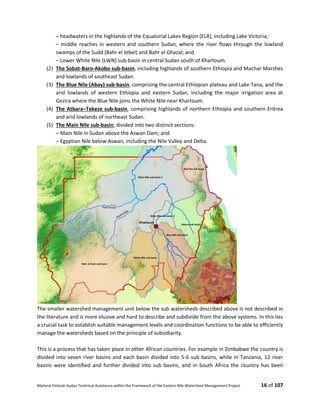
The major tributaries and sub-basins (Seleshi Bekele Awulachew et.al, 2012) of the Nile basin are:
(1) The White Nile sub-basin, divided into three sections:
Key Messages:
1. In a Federal country like Sudan, the transboundary aspects of crossing between States also provide
challenges as complicated as crossing between countries. However there is no deliberate management
of the sub watershed in the Sudan part of the Nile basin.
2. There is an immense amount of lessons that Sudan can learn from Lake Victoria Basin Commission
(LVBC) on how to go about the challenges of governance, funding, management, information sharing
etc. of a major watershed.
3. The subsidiary principle has proven to be very efficient in planning, monitoring, maintenance and
operation of water systems.
Bilateral Finland–Sudan Technical Assistance within the Framework of the Eastern Nile Watershed Management Project 16 of 107
– headwaters in the highlands of the Equatorial Lakes Region (ELR), including Lake Victoria;
– middle reaches in western and southern Sudan, where the river flows through the lowland
swamps of the Sudd (Bahr el Jebel) and Bahr el Ghazal; and
– Lower White Nile (LWN) sub-basin in central Sudan south of Khartoum.
(2) The Sobat-Baro-Akobo sub-basin, including highlands of southern Ethiopia and Machar Marshes
and lowlands of southeast Sudan.
(3) The Blue Nile (Abay) sub-basin, comprising the central Ethiopian plateau and Lake Tana, and the
arid lowlands of western Ethiopia and eastern Sudan, including the major irrigation area at
Gezira where the Blue Nile joins the White Nile near Khartoum.
(4) The Atbara–Tekeze sub-basin, comprising highlands of northern Ethiopia and southern Eritrea
and arid lowlands of northeast Sudan.
(5) The Main Nile sub-basin, divided into two distinct sections:
– Main Nile in Sudan above the Aswan Dam; and
– Egyptian Nile below Aswan, including the Nile Valley and Delta.
The smaller watershed management unit below the sub watersheds described above is not described in
the literature and is more elusive and hard to describe and subdivide from the above systems. In this lies
a crucial task to establish suitable management levels and coordination functions to be able to efficiently
manage the watersheds based on the principle of subsidiarity.
This is a process that has taken place in other African countries. For example in Zimbabwe the country is
divided into seven river basins and each basin divided into 5-6 sub basins, while in Tanzania, 12 river
basins were identified and further divided into sub basins, and in South Africa the country has been
Bilateral Finland–Sudan Technical Assistance within the Framework of the Eastern Nile Watershed Management Project 17 of 107
divided into nine river basins (UNEP, 2014). The subsidiary principle has proven to be very efficient in
planning, monitoring, maintenance and operation of water resources.
Bilateral Finland–Sudan Technical Assistance within the Framework of the Eastern Nile Watershed Management Project 18 of 107
7. Successful watershed management in Sudan?
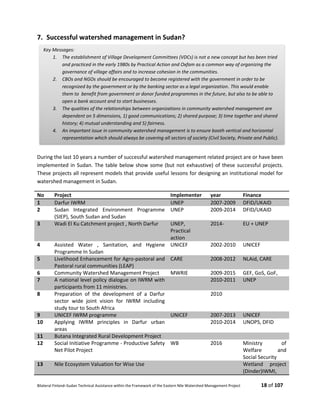
During the last 10 years a number of successful watershed management related project are or have been
implemented in Sudan. The table below show some (but not exhaustive) of these successful projects.
These projects all represent models that provide useful lessons for designing an institutional model for
watershed management in Sudan.
No Project Implementer year Finance
1 Darfur IWRM UNEP 2007-2009 DFID/UKAID
2 Sudan Integrated Environment Programme
(SIEP), South Sudan and Sudan
UNEP 2009-2014 DFID/UKAID
3 Wadi El Ku Catchment project , North Darfur UNEP,
Practical
action
2014- EU + UNEP
4 Assisted Water , Sanitation, and Hygiene
Programme In Sudan
UNICEF 2002-2010 UNICEF
5 Livelihood Enhancement for Agro-pastoral and
Pastoral rural communities (LEAP)
CARE 2008-2012 NLAid, CARE
6 Community Watershed Management Project MWRIE 2009-2015 GEF, GoS, GoF,
7 A national level policy dialogue on IWRM with
participants from 11 ministries.
2010-2011 UNEP
8 Preparation of the development of a Darfur
sector wide joint vision for IWRM including
study tour to South Africa
2010
9 UNICEF IWRM programme UNICEF 2007-2013 UNICEF
10 Applying IWRM principles in Darfur urban
areas
2010-2014 UNOPS, DFID
11 Butana Integrated Rural Development Project
12 Social Initiative Programme - Productive Safety
Net Pilot Project
WB 2016 Ministry of
Welfare and
Social Security
13 Nile Ecosystem Valuation for Wise Use Wetland project
(Dinder)IWMI,
Key Messages:
1. The establishment of Village Development Committees (VDCs) is not a new concept but has been tried
and practiced in the early 1980s by Practical Action and Oxfam as a common way of organizing the
governance of village affairs and to increase cohesion in the communities.
2. CBOs and NGOs should be encouraged to become registered with the government in order to be
recognized by the government or by the banking sector as a legal organization. This would enable
them to benefit from government or donor funded programmes in the future, but also to be able to
open a bank account and to start businesses.
3. The qualities of the relationships between organizations in community watershed management are
dependent on 5 dimensions, 1) good communications; 2) shared purpose; 3) time together and shared
history; 4) mutual understanding and 5) fairness.
4. An important issue in community watershed management is to ensure booth vertical and horizontal
representation which should always be covering all sectors of society (Civil Society, Private and Public).
Bilateral Finland–Sudan Technical Assistance within the Framework of the Eastern Nile Watershed Management Project 19 of 107
www.iwmi.org
14 Sudan Mechanized Farming Project WB World Bank
Community Watershed Management Project (CWMP)
The CWMP is a component of the larger Eastern Nile Watershed Management Programme which is one
of the Nile Basin Initiative (NBI) projects and implemented by the Ministry of Water Resources, irrigation
and Electricity (MWRIE). The overall objective of the project was to promote a wider adoption of
sustainable land and water management practices and technologies, to reduce land degradation and to
increase agricultural productivity. The Purpose of the CWMP was to reduce land degradation and
increase agricultural productivity, improve water quality, and conserve biodiversity. The CWMP has been
implemented in four States, namely, River Nile, Blue Nile, Sennar and Gedarif States and financed by the
Government of Sudan, Government of Finland and Global Environmental Facility (GEF) and the World
bank have administered the Trust Fund. The project started operating in four locations in Sudan but efter
the secession of South Sudan and unrest started in Bau area (Blue Nile State) only two geographical
locations remained in Sudan (Atbara and Dinder), see Annex 5 CWMP area of implementation. The
CWMP implementation modality builds on the effective relationship with the Village Development
Committees (VDCs) who have been further organized in Watershed Management Teams (WMTs) which
consist of representatives from a cluster of VDCs. One of the challenges in this regards is the difficulties
of demarcation/delineating the watershed into areas acknowledged by local communities because of the
prevailing topography and population characteristics. As a matter of fact the WMTs don’t know their
area by geographic extension but by the participating VDCs. VDCs appear to be an appropriate entry
point for further development of effective constellations of watershed management in Sudan. The
building of human capital in individuals and in organizations it’s crucial to build in a comprehensive
understanding of watershed management directed both to individuals and to organizations. CWMP
made a deliberate strategic choice of building its intervention on the VDC.
CWMP has been supporting community based approaches and local village institutions which are crucial
in the community watershed management concept. This support has to be strategic and long term, it
would take many years to build up the capacity of CBOs and NGOs. The establishment of Village
Development Committees (VDCs) is not a new concept but has been tried and practiced in the early
1980s by Practical Action and Oxfam as a common way of organizing the governance of village affairs
and to increase cohesion in the communities. The CARE project has also worked with the same VDC
concept in the Kass area in 2005-2007. The VDC is responsible for development and service provision and
is separated from the political function which today is under the Popular Committees which is affiliated
to the government. The VDCs are basically membership based community based organizations (CBOs)
which represent the village population and collaborate with external service providers like the
government line departments, private sector or NGOs.
Sometimes the VDCs and CBOs are forming network organizations to better serve their members in
terms of negotiating power or market advantages. These networks have proven successful and for
example Practical Action has supported a network of 18 VDCs in Darfur (Jaspars, 2010). The
organizations and networks mentioned here are playing a very prominent role in addressing livelihood
Bilateral Finland–Sudan Technical Assistance within the Framework of the Eastern Nile Watershed Management Project 20 of 107
problems in Sudan and to increase people’s participation and democratic principles and to support these
would strengthen the human right based approach in Sudan.
It is important to support the civil society sector so as to create strong CBOs and NGOs. These
organizations should be encouraged to become registered with the government in order to be
recognized by the government or by the banking sector as a legal organization so as to benefit from
government or donor funded programmes in the future but also to be able to open a bank account and
to start businesses. The most common way of registration in Sudan is to register at the state level with
Humanitarian Aid Commission (HAC).
UNEP’s Sudan Integrated Environment Project (SIEP) 2007-2013 used the relationship based approach
and the concept of IWRM to promote sustainable environmental governance. This approach builds on
the understanding of the existing relationships between government and the resource users and choices
people do in the communities because of these relationships. The objective was “to promote sustainable
and equitable environmental governance to create peacebuilding and development impacts”. SIEP was
implemented with 5 themes, climate change, Community Based Natural Resource Management
(CBNRM), forestry, IWRM and livelihoods. UNEP is arguing that activities like tree planting require you to
seriously look into environmental governance, institutions and land tenure issues for it to become
successful. The qualities of the relationships are dependent on 5 dimensions, 1) good communications;
2) shared purpose; 3) time together and shared history; 4) mutual understanding and 5) fairness. The
approach is very generic in its form and supports the development of shared visions, sense of “we”,
power sharing, co-management, confidence building, equality, subsidiarity principle and face to face
interactions.
The continuation of the SIEP project was the Wadi El Ku Catchment Project also implemented by UNEP in
collaboration with Practical Action. It also used IWRM and environmental governance as a key approach.
The project focused on CBNRM, capacity building, institutional support, mainstreaming and advocacy
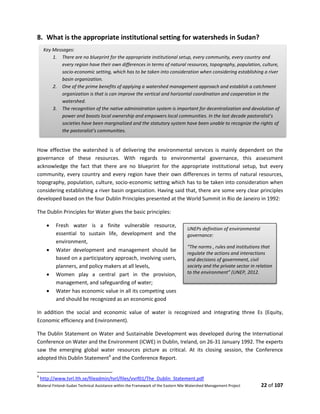
and awareness rising. The project promoted good governance through a network of CBNRM committees
and a cross-government catchment management group (UNEP, 2014) which are brought together in the
Catchment Management Forum supporting the dialogue between communities and government. The
Forum was also joined by a Civil Society Advisory Group to enhance the work.
Bilateral Finland–Sudan Technical Assistance within the Framework of the Eastern Nile Watershed Management Project 21 of 107
Note: from Relationships and Resources, Environmental governance for peacebuilding and resilient
livelihoods in Sudan, UNEP 2014
There is a huge array of possible representation constellations at this level called by different names but
the functionality the same, River Councils, Catchment councils, Water Users Associations, Water Boards,
Catchment Water Organizations, watershed management teams and this will and can probably vary from
one area to the other from one country to another. The important issue here is to ensure both vertical
and horizontal representation which should always be covering all sectors of society (Civil Society,
Private and Public) and well established cooperation modality within and between line ministries from
Federal down to Locality level. According to the Dublin Statement on Water and Sustainable
Development, principle no 2, Water development and management should be based on a participatory
approach, involving users, planners and policy-makers at all levels. Working out the authorities and legal
issues connected and how the “institution” should be financed are crucial challenges. The first step for
the institution is to develop a plan on water use and conservation for its area, a plan which should be
approved by the appropriate authority. The CWMP did considerable work on this by working out
participatory model for Participatory Land Use Plan (PLUP) and Community Action Plan (CAP).
FAO reseeding of Wadis (Wadis is seasonal watercourses) project is also an interesting similar model,
focusing on one of the causes of conflict between the farmers and the pastoralists is the access for
livestock to these Wadis because of surrounding agricultural land. Therefore, the FAO project focused on
reseeding and physical demarcation and management of the cattle routes.
The UNICEF WES project is regarded as successful development interventions, and is at the forefront
among other donors in relation to watershed management. Despite the challenges it encountered over
the years, it developed from being fully dependent on UNICEF support in almost all program aspects with
a minor governmental contribution, to become an independent body supported by Government and
UNICEF. This is the key development process that avoids building parallel structures.
Another good example of community watershed management at the local level in Sudan is the
Community Environmental Action Plan (CEAP), developed with support from United Nations High
Commissioner for Refugees (UNHCR) for refugee camps in Eastern Sudan, UNEP (2013).
Bilateral Finland–Sudan Technical Assistance within the Framework of the Eastern Nile Watershed Management Project 22 of 107
8. What is the appropriate institutional setting for watersheds in Sudan?
How effective the watershed is of delivering the environmental services is mainly dependent on the
governance of these resources. With regards to environmental governance, this assessment
acknowledge the fact that there are no blueprint for the appropriate institutional setup, but every
community, every country and every region have their own differences in terms of natural resources,
topography, population, culture, socio-economic setting which has to be taken into consideration when
considering establishing a river basin organization. Having said that, there are some very clear principles
developed based on the four Dublin Principles presented at the World Summit in Rio de Janeiro in 1992:
The Dublin Principles for Water gives the basic principles:
 Fresh water is a finite vulnerable resource,
essential to sustain life, development and the
environment,
 Water development and management should be
based on a participatory approach, involving users,
planners, and policy makers at all levels,
 Women play a central part in the provision,
management, and safeguarding of water;
 Water has economic value in all its competing uses
and should be recognized as an economic good
In addition the social and economic value of water is recognized and integrating three Es (Equity,
Economic efficiency and Environment).
The Dublin Statement on Water and Sustainable Development was developed during the International
Conference on Water and the Environment (ICWE) in Dublin, Ireland, on 26-31 January 1992. The experts
saw the emerging global water resources picture as critical. At its closing session, the Conference
adopted this Dublin Statement4
and the Conference Report.
4
http://www.tvrl.lth.se/fileadmin/tvrl/files/vvrf01/The_Dublin_Statement.pdf
Key Messages:
1. There are no blueprint for the appropriate institutional setup, every community, every country and
every region have their own differences in terms of natural resources, topography, population, culture,
socio-economic setting, which has to be taken into consideration when considering establishing a river
basin organization.
2. One of the prime benefits of applying a watershed management approach and establish a catchment
organization is that is can improve the vertical and horizontal coordination and cooperation in the
watershed.
3. The recognition of the native administration system is important for decentralization and devolution of
power and boosts local ownership and empowers local communities. In the last decade pastoralist’s
societies have been marginalized and the statutory system have been unable to recognize the rights of
the pastoralist’s communities.
UNEPs definition of environmental
governance:
“The norms , rules and institutions that
regulate the actions and interactions
and decisions of government, civil
society and the private sector in relation
to the environment” (UNEP, 2012.
Bilateral Finland–Sudan Technical Assistance within the Framework of the Eastern Nile Watershed Management Project 23 of 107
The first question to ask in every specific circumstance is whether watershed is an appropriate
management unit for governing of natural resources and why there is a need for a special watershed
management organization. Why not just manage land as we have always done using the traditional
administrative system of each country instead management based of hydrological boundaries. What is
the comparative advantage of follow the hydrological boundaries and not the administrative boundaries.
One thing we know based on years of experience of implementing IWRM is that it can’t be effective
without participation of local communities and that community watershed management starts at the
lowest level, e.g. at the land users, being farmers, cooperation’s, pastoralists, etc. the subsidiarity
principle. One of the prime benefits of applying a watershed management approach and establish a
catchment organization is that it can improve the vertical and horizontal coordination and cooperation in
the watershed. Watershed management is today an established global recognized concept for managing
natural resources. One of the first priorities after such an institution has been established is to develop a
comprehensive science based integrated watershed management plan with inputs from all stakeholders
in the watershed and builds on consensus in the decision making process and sharing of power. The
institution should also make sure to establish the feedback information flow back to the communities
and other stakeholders. The strength and empowerment of the community is determined on the
participation, influence and information sharing from the watershed institution. In return the
communities will provide social control, enforcement of regulations and monitoring the activities.
This assessment is trying to understand, in the context of Sudan, how government, civil society and
private sector relate in regards to watershed management. According to UNEP, “weak management of
the environment is widely recognized as a contributing factor to poverty and conflict in Sudan” (UNEP,
2012). Sudan is a federal country divided up at National (Federal), State, Locality and Community
(Popular Committee) levels, see Annex 3 Administration of River Nile State (Number of households). All
levels play an equal important role in the management of the watersheds. The States are having a very
strong status of autonomy and in terms of land ownership according to UNEP, all land that falls within a
particular state, unless explicitly attributed to a specific federal institution belong to that state (UNEP,
2012). It is also evident that each state and locality can develop state legislation, local orders and by-
laws.
An equally important institution in Sudan for environmental governance is the Native Administration.
This institution is not getting much recognition in various reports on the subject of IWRM in Sudan,
which is regrettable. Recognizing the traditional (Native) administration system (Nazara) would be
important for sustainable management of the watersheds in Sudan. The Nazara preside over local
administrative and judicial affairs and consists of three administrative tiers: the Nazars, who are the
highest officials within the administrative and judicial structure; the Omdas who are medium level
leaders, and who are usually heads of tribal subsections; and the Sheikhs, who are village or camp
headman. All of these Native Administrators are granted legal powers to maintain law and order, to
monitor development within their respective constituencies, and to collect taxes. Both Sheikhs and
Omda report to the Locality officials.
Internationally, pastoralism is getting more recognition for the contribution that livestock production
contributes to the national economy. In Sudan the pastoralists are contributing tremendously to
livelihoods and therefore pastoralists must be part of the development and management of the
Bilateral Finland–Sudan Technical Assistance within the Framework of the Eastern Nile Watershed Management Project 24 of 107
watersheds. It is important to better understand the complex dynamics of pastoralism since they
contribute to about 60% of the Agricultural value of the GDP in Sudan and are sometimes being blamed
and responsible for land degradation and conflict. According to the 2008 census 2.7 million people were
counted as “nomadic” in Sudan and that 3,936,131 households (59.2%) are engaged in animal
husbandry. In some cases pastoralists have become marginalized in particular during the conflict in
Darfur, pastoralists have experienced their life becoming harder due to limitation of migratory routes
imposed on them.
Local institutions are crucial for managing the natural resources assets they are usually governed by a set
of complicated rules, traditions, laws, and agreements from both statutory and customary systems and
in most circumstances these systems overlap. The native administration also plays an important role in
today’s managment of the local resources.
The State government is headed by Wali (Governor), who is appointed by the President. Each State has
its own Legislative Assembly with an executive administration, which consists of the following ministries:
 Finance, Economic Planning and Labor Forces
 Agriculture, Animal Resource and Irrigation
 Physical Planning and Public Utilities
 Health
 Education
 Social Affairs
In the report “Towards Integrated Water Resources Management – International experience in
development of river basin organizations”, UNEP is distinguishing between four different watershed
institutions:
 Commissions, councils, committees with a coordinating mandate.
 Authorities, with all the mandates of an independent, single purpose organization.
 Agencies, corporations, specially created bodies at arms-length of the government.
 Partnerships, voluntary organization under private law.
Watershed management requires a multidisciplinary approach which obviously involves all relevant line
ministries like Ministry of Agriculture and Forestry; Ministry of Water Resources, Irrigation and
Electricity; and range management. Any institutional setup will include these departments in one way or
another. The underpinning idea with watershed management is to decentralize power in order to
achieve higher efficiency in service delivery and in increase transparency and accountability in the
system.
In the case of Sudan the river basin as described under chapter 4 is very large, for example the Atbara
River Basin is 227,128 km2
and with its largest part on the Ethiopian side. Despite that Atbara watershed
is only a sub watershed of the larger Nile Basin it still requires further sub division in terms of
institutional arrangements that crosses over several levels from Federal level down to the community
Bilateral Finland–Sudan Technical Assistance within the Framework of the Eastern Nile Watershed Management Project 25 of 107
level. Alongside development the appropriate institutional arrangement for the watershed, equally
important is that the legislation is providing a conducive environment for the same.
Therefore, the key question is what is the appropriate institutional setup?
In this assessment we include a thorough description of institutions which have a stake in watershed
management or a potential stake in watershed management. These institutions are described in Chapter
13.
At the Federal level, the Ministry of Water Resources, Irrigation and Electricity (MWRIE) governs the
water sector in Sudan and is a natural focal point for taking the lead in developing and advancing the
community watershed management (CWM) and Integrated Water Resource Management (IWRM)
concepts in Sudan. MWRIE has been the lead implementing agency for the Eastern Nile Watershed
Management Project – Community Watershed Management Component. The ministry should also
through a comprehensive participatory process pave the way for this decentralization process. The
MWRIE should develop national policies, strategies and plans for water resources, research in irrigation
hydrology, cooperation in the NB, monitoring of ground waters, flood mitigation and assessment of
water resources.
At the federal level the main responsibilities would be to provide a regulatory framework for the
watershed management institution and to support in capacity building of the same and to provide and
source funding for its functionality. MWRIE should determine the level of decision making power to be
delegated to the institution. But crucial is that the delegation should be accompanied with
empowerment of the communities. After capacity is built up and after testing the efficiency and
accountability of the new institution more management responsibilities can be handed over (devolution
of power) including handling finance. Part of the finance for the new institution should come from the
charges taken out by the National State Water Corporations. Within State government’s water affairs
(irrigation, drinking water supply) are managed under slightly varying set-ups but generally under State
Ministry of Agriculture, Forestry and Livestock and Ministry of Physical Planning and Public Utilities.
The watershed management framework can be seen as a Public Private partnership (PPP) whereby the
private-, public and Civil Society sectors are collaborating at the catchment level. Other important
ministries in Sudan for watershed management are the Ministry of Agriculture and Forestry, HCENR,
Ministry of Tourism and Wildlife and others.
The recognition of the native administration system is important for decentralization and devolution of
power and boosts local ownership and empowers local communities. In the last decade pastoralist’s
societies have been marginalized and the statutory system has been unable to recognize the rights of the
pastoralist’s communities. More efforts have to be put in place to understand the pastoralist system
including pasture land and migratory corridors and understand the carrying capacity of the system. The
watershed management concept in Sudan has to embrace the pastoral system and distant itself from the
opinion that pastoralism is backward and only destructive to the environment and stop defining the area
under pastoralism using the subtraction principle of what is left after subtracting agricultural land and
urban areas.
Bilateral Finland–Sudan Technical Assistance within the Framework of the Eastern Nile Watershed Management Project 26 of 107
River basin commissions
The Nile River Basin is the longest river in the world and cover approximately 3 million km2
with an
annual flow of 84 km3
measured at Aswan High Dam. It is shared between 11 riparian countries (Abdalla,
2013). Therefore any management intervention requires transboundary management solutions. Despite
the long history of cooperation on water issues in the Nile Basin there are still many issues unsolved to
achieve a comprehensive agreement on the management of the basin, see chapter 13.3.3 Cooperative
Framework Agreement (CFA). For instance, the 1997 UN Convention on Non-Navigational Uses of
International Watercourses builds on the fundamental obligation not to cause significant harm to others,
such as through water pollution. In addition, the International Freshwater Treaties Database lists more
than 400 transboundary water agreements that have been developed for various purposes in river basins
that cross political boundaries. The Nile Basin countries are not yet party to the Watercourses
Convention adopted by UN in 1997.
Many river basins in Sudan are shared between several countries and or by several provinces/States. This
requires new management solutions for the watersheds. The establishment of a Basin Commission is one
of the solutions for better management of watersheds/basins and today there are many good examples
of Basin Commission solution that can help coordinating many different programmes and projects in the
basin and also between line departments between countries but also between sectors within a country.
The table below provides examples of basin level management solution:
No Basin organization Description
1 Lake Chad Basin
Commission
Established in 1964, the signatory of the agreement were: Cameroon,
Chad, Niger and Nigeria
2 The Senegal River
Development Organization
Established in 1972, comprising Guinea, Mali, Mauritania and
Senegal, (represents a success)
3 The Mano River Union Established in 1973 by
Liberia and Sierra Leone, Guinea joined the
Union in 1980
4 The Gambia River Basin
Organization
Established in 1978
5 The Niger Basin Authority Established as commission in 1980, between nine countries: Benin,
Burkina Faso, Cameron, Chad and Cote’ d’Ivoire Guinea, Mali, Niger
and Nigeria. Later the role of the
authority has been modified to be an implementation
agency;
6 The Okavango River Basin
Commission
Based on the International Law (Helsinki Rules) was signed in 1994,
between Angola, Botswana and Namibia.
7 Lake Victoria Basin
Commission
The East African Community (EAC) established the Lake Victoria Basin
Commission formerly known as the Lake Victoria Development
Programme in 2001, as a mechanism for coordinating the various
interventions on the Lake and its Basin; and serving as a center for
promotion of investments and information sharing among the
various stakeholders.
8 Zambezi Watercourse
Commission
The Zambezi Watercourse Commission (ZAMCOM) is a river basin
organization set up by countries that share the Zambezi River Basin,
Bilateral Finland–Sudan Technical Assistance within the Framework of the Eastern Nile Watershed Management Project 27 of 107
as stipulated in the 2004 ZAMCOM Agreement and in accordance
with the revised SADC Protocol on Shared Watercourses of 2000. The
Riparian States to the Zambezi River Basin are: the Republic of
Angola, the Republic of Botswana, the Republic of Malawi, the
Republic of Mozambique, the Republic of Namibia, the Republic of
Tanzania , the Republic of Zambia and the Republic of Zimbabwe.
Bilateral Finland–Sudan Technical Assistance within the Framework of the Eastern Nile Watershed Management Project 28 of 107
9. Legal framework for IWRM in Sudan
The framework of laws and policies are fundamental for efficient IWRM in Sudan. UNEP have described
the legal frameworks in Sudan very well in the report “Environmental Governance in Sudan – An Expert
Review”, UNEP 2012 for more detailed description of the legislation we refer you to this publication. This
chapter is mainly referring to this publication in combination with interviews with public servants
working in the relevant Government offices. The complexities of IWRM require that the national policies
and strategies are up to date with the latest development in relation to IWRM. The Government of the
Republic of Sudan has to carefully weigh the demand for water resources between domestic, industrial,
agriculture and hydropower and make sure that they are matching all other related legislation on
poverty reduction, food security, human rights, agriculture etc. The legislation also need to be forward
thinking in the light of climate change and the scarcity of water sources are most likely to exacerbate in
the next two decades.
The legislative framework also has to properly acknowledge the native and traditional set of regulation
that exists and therefore we will try in this chapter to discuss some of the main features of these two
aspects of traditional land management and conflict resolution. In relation to water is the latest
legislation from 2008, the Public Water Corporation Act which in combination with the 1995 Water
Resources Act and the Groundwater Regulation Act (GRA) 1998 is most important in relation to
governance of the watersheds in Sudan. GRA mandates the Groundwater and Wadis Directory. The
Ministry of Water Resources, Irrigation and Electricity are responsible for water at the federal level.
Issues related to drinking water are handled by the Public Water Corporation and at the state level the
responsibility is delegated to the State Water Corporations.
Since the watershed management is such a new concept for Sudan the legislation and regulation in this
regards have not been able to keep up with the rapid development of the concept in the last 5 years. The
Government of Sudan should follow up and develop appropriate and relevant legislation and sufficient
support at federal and state level for the concept of CWM to take root. Projects like the Eastern Nile
Watershed Management Project – Community Watershed Management Component have from 2010
developed and tested a model for watershed management which could be scaled up to other parts of
Sudan and also compared with other excellent initiatives on the same concept like the Practical
Action/UNEP initiative, “The Wadi El Ku Catchment Management Project” and other similar initiatives.
According to several sources, one of the major challenges for watershed management in Sudan is the
disconnect between different sectors with a stake in watershed management. This is the reason why
SWECO assessment was recommending in 2007 the project to support and improve both inter-sectoral
and participatory planning in IWRM by establishing this project specific Local Executive Committee that
Key Messages:
1. The Government of the Republic of Sudan has to carefully weigh the demand for water resources
between domestic, industrial, agriculture and hydropower and make sure that they are matching all
other related legislation on poverty reduction, food security, human rights, agriculture etc.
2. Integrated watershed management must be a coordinated effort among agricultural, domestic,
industrial and urban water users, to avoid fighting over water “at the end of the pipe”.
Bilateral Finland–Sudan Technical Assistance within the Framework of the Eastern Nile Watershed Management Project 29 of 107
is composed of representatives from various locality departments, unions, NGOs, women groups and
CBOs. The figure below shows how Integrated Water Resources Management is a cross-sectoral policy
approach as discribed by the Global Water Partnership5
. Integrated watershed management must be a
coordinated effort among agricultural, domestic, industrial and urban water users, to avoid fighting over
water “at the end of the pipe”. The Government of Sudan should now seek ways to increase the total
supply of water through better water and watershed management. New approaches to watershed
management aim to restore degraded watersheds through a triple-win strategy for addressing water
scarcity, food security, and climate change.
This multi stakeholder approach which is required in IWRM is a complex undertaking which must take
into consideration environmental, institutional and political and social factors.
Particularly important institutional innovations include prioritizing the needs of the poor, improving
community and regional infrastructure, blending local and scientific knowledge in development practice,
and investing in leadership. Incorporation of the following areas in IWRM are crucial:
 social protection and safety nets
 health care provisions and education
 gender equity in access to resources and participation
 governmental support for social and economic transitions
 regional infrastructure, such as roads, irrigation systems, and water and grain storage, improves
the ability of farmers and pastoralists to obtain farm inputs and to get their products to market.
Many of the treaties signed between the Nile Basin states or the colonial powers are still causing
disputes over the water. The conflicts have mostly been about the right of extracting water from the Nile
or the rights of building dams for irrigation or hydropower or both and different clauses on what
countries can do and can’t do that reduces the flow or the sequence of flow.
The Egypt government have always been concerned over the flow of water and in the 1929 treaty
between Egypt and Sudan is was stipulated that “Except with the prior consent of the Egyptian
5
http://www.gwp.org/The-Challenge/What-is-IWRM/
Bilateral Finland–Sudan Technical Assistance within the Framework of the Eastern Nile Watershed Management Project 30 of 107
Government, no irrigation works shall be undertaken nor electric generators installed along the Nile and
its branches nor on the lakes from which they flow if these lakes are situated in Sudan or in countries
under British administration, which could jeopardize the interests of Egypt either by reducing the
quantity of water flowing into Egypt or appreciably changing the date of its flow or causing its level to
drop.”
From the 70s the Sudan government strategies, plans and frameworks have mainly been promoting
economic development in mining and agricultural sector with less attention on environmental
protection. This changed with the National Comprehensive Strategy (NCS), 1992-2002 which was
developed before the Earth Summit in Rio 1992 and in which popular participation, environmental
impact assessment and sustainability was stressed. The NCS was followed by the Five-Year National
Strategic Plan (NSP), 2007-2011 which was more comprehensive than its predecessor including the
millennium development goals, peace process, poverty reduction, good governance and public
accountability.
Sudan have ratified most important international environmental conventions like the United Nations
Framework Convention on Climate Change (UNFCCC), Convention on Biological Diversity (CBD),
Convention to Combat Desertification (UNCCD), Kyoto protocol, Cartagena Protocol on Biosafety and the
Stockholm Convention on Persistent Organic Pollutants.
Sudan is one of the first African countries to pass sectoral laws for the protection of the environment.
However, these laws are further supported by an umbrella law represented by the Environmental
Conservation Act (2001). The Act includes general principles and guidelines to be considered in
implementing development projects and makes it the responsibility of the project proponents, before
embarking on any development activity, to carry out an environmental impact assessment (EIA).
To implement the provisions of the Act, a Higher Council for Environment and Natural Resources
(HCENR) was established in 1991 and a Ministry for Environment and Physical Development (MEPD) in
1995. Environmental protection is further supported by the Interim National Constitution of the Republic
of the Sudan (2005) based on the provisions and articles of the Comprehensive Peace Agreement (CPA)
2005. It endorses the rights of citizens to live in a clean environment (Article 11) and directs attention to
the protection and conservation of natural resources. Article 43 (2) allows the Government to
expropriate land for developmental purposes and compensate the owners.
Bilateral Finland–Sudan Technical Assistance within the Framework of the Eastern Nile Watershed Management Project 31 of 107
10.Land tenure
Land rights and access to water are often closely interconnected. To protect the interests of subsistence
farmers, disadvantaged and marginalized farmers, including women farmers and indigenous people’s
legislation around land tenure is very important. Likewise, the land and water rights of such groups must
be taken into account before authorities grant licenses to private actors whose operations risk
interfering with indigenous people’s traditional ways of living.
Most of Sudan’s lands are organized by customary and traditional rules and regulations. According
statutory law under the Unregistered Land Act 1970 all unregistered land (including customary land
which is unregistered land) is owned by the government and can be made available by the government
for any public purpose. This has been the basis for making land available for investments in the ever
expanding large scale mechanized farms. In many circumstances rural communities do enjoy usufruct
rights, but without any real tenure security. Private ownership is found only in areas along the Nile
where land registration was carried according to Land Registration & Settlement Act of 1925. Most of
areas away from the Nile are under traditional communal tenure where rights over land less than full
ownership are recognized. Hence, in these areas four forms of land tenure emerged. These are:
 Government lands with community rights;
 Government lands with no community rights (unoccupied lands, wetlands, water catchments,
etc);
 Hawakir (land recognized as tribal homeland – Dar, or areas granted to individuals by previous
Sultans); and,
 Lease (license): land granted by the government to investors for a limited number of years.
These regulations are specified in the Interim Constitution Part 13 under Chapter II Land Resources, in
Article 186. It is stated that:
 The regulation of land tenure, usage and exercise of rights thereon shall be a concurrent
competence, exercised at the appropriate level of government;
 Rights in land owned by the government of the Sudan shall be exercised through the appropriate
or designated level of government.
Key Messages:
1. In relation to land tenure the important legislation came into effect in 1970 with the Unregistered Land
Act (ULA) which basically nationalized all unregistered land in Sudan and which deems any unregistered
land, before the enactment of this law, as being registered in the name of the government.
2. The native administration continues to maintain a strong presence and maintains its role and
importance as the principal local – level governance mechanism.
3. Common ownership arrangements as custodians of forest reserves in Sudan through the Forestry
National Corporation is one example how customary and community based NRM systems can work for
the benefit of the communities.
Bilateral Finland–Sudan Technical Assistance within the Framework of the Eastern Nile Watershed Management Project 32 of 107
All levels of government shall institute a process to progressively develop and amend the relevant laws
to incorporate customary laws, practices, local heritage and international trends and practices.
Nevertheless, legislation in Sudan is complex and there is overlapping legislation between federal and
state legislation, between statutory and customary legislation and between statutory and Islamic law.
Much of the federal legislation goes back to the colonial period. In relation to land tenure the important
legislation came into effect in 1970 with the Unregistered Land Act (ULA) which basically nationalized all
unregistered land in Sudan and which deems any unregistered land, before the enactment of this law, as
being registered in the name of the government. The ULA came in the same time as the government
decided to abandon the Native Administration (NA) which was established by the British in the 1920s.
The dissolution of the NA was never enacted or recognized according to sources the assessment team
has been talking to and the NA was again reinstated in 1987. The ULA was superseded by the 1984 Civil
Transaction Act which regulates the different issues related to civil transactions with respect to titles on
land, means of land acquisition, easement rights and conditions to be observed by land users and gives
guidelines and details for practical implementation of the 1970 Act. The Act also gives provision of Sharia
Law and further strengthens the State ownership of land and management of their natural resources.
The Interim National Constitution of Sudan (2005) replaced the 1998 constitution of Sudan. The new
constitution gives special articles with regards to land ownership; management of natural resources but
up to this date Sudan does not have a government structure for the management of land administration,
this role falls into different sectors of the government.
The issue of land administration is probably one of the areas which should attain greater attention in the
future to be able to resolve the land tenure issues which discourage optimal use of large areas in the
irrigated and rain-fed sectors. The difference between the native structure versus the modern
administrative structure still prevail and according to UNEP (2013), the governance of livestock mobility
at the national , State and locality level is reflected in the plethora of national and state-level legislation,
norms, and traditions that are continually evolving. Despite significant changes over the past century,
the native administration continues to maintain a strong presence and maintains its role and importance
as the principal local – level governance mechanism connected through a hierarchical leadership
structure which interfaces with systems of state-level government at all levels.
The management of Pasture land is regulated in the 2002 Forest and Renewable Natural Resources Act
which gives the communities access rights and opportunities to manage pasture land under the authority
of the State Range and Pasture Departments. Unfortunately, this Act was under the Forest National
Corporation (FNC) who according to UNEP (2012) are biased towards sedentary communities. The same
law also regulates the management of Sudan’s forests, soils and pastures and the Forest National
Corporation (FNC) Act and Forest Policy Act of 1989. The legislation gives provision for Community Forest
Management (CFM). The FNC is governed by a board of directors and answers to the MoA and is
responsible for policies with regards to forests; propose legislation, technical supervision and awareness
raising, monitoring and research. The FNC pay 40% tax of profit from the forests to the State Ministry of
Agriculture.
African Union Policy Framework on pastoralism begins by stating the pastoralists are custodians of key
national resources found in arid and semi-arid areas and, as a system, pastoralism helps to protect and
safeguard these resources the strategy continues to say that “appropriate propastoral policy and
Bilateral Finland–Sudan Technical Assistance within the Framework of the Eastern Nile Watershed Management Project 33 of 107
institutional reforms can empower pastoral people and promote equitable access to resources, facilities
and services, and guarantee sustainable land use and environmental management”.
Common ownership arrangements as custodians of forest reserves in Sudan through the Forestry
National Corporation is one example how customary and community based NRM systems can work for
the benefit of the communities. Common property regimes or management systems can be said to exist
when an identifiable group controls the rights to use resources, and designs and implements rules to
define who may use the resources and how. The problem occurs when the natural resource based is
overused which is the case in many countries in the Sahel region were pastoralists and farmers are often
using the same natural resources which are resulting in severe degradation.
Bilateral Finland–Sudan Technical Assistance within the Framework of the Eastern Nile Watershed Management Project 34 of 107
11.Water and land as a source of conflict
Annual water availability per capita have decreased in the last couple of decades because of population
growth and increased utilization in the agricultural sector. Water resources are being more and more
critical for the survival of people and in the coming decades this competition for water resources will
escalate between nations but also within nations and between competing uses and services. So while
water can be regarded as a threat in term of increased incidence of conflict it can also be looked upon as
an opportunity for deeper collaboration and economic integration in the region. The relationships
between NRM and conflicts are complex since the government and resource users (customary and
statutory) might have different view on how these should be governed. The key to effective governance
is how to balance these different views without excluding anyone and to establish a common vision for
the area management that builds on the strengths of the different actors. IWRM, Community Based
Natural Resource Management (CBNRM), Community Forest Management (CFM), community watershed
management, group ranching and river catchments are good example of this kind of co-management of
common resources.
It is widely believed that shortages of water for food production in particular in the MENA region would
be a major source of conflict in the future and even causes wars between countries (Starr, 1991; Bulloch
and Darwish, 1993). This conclusion assumed that unless a country had enough water to produce the
food it needed the state would look into options, including war, for increasing its water availability.
According to UNEP report 2014 the conflict in Darfur between 2003 and 2005 was between pastoralists
and agriculturalist/agro-pastoralist groups (UNEP, 2014). Some military units have also been directly
involved in illegal cutting of trees for financing their activities. The recent escalation in the conflict in
Darfur have led to the displacement of 2 million people from the traditionally farming communities
leaving large areas of land vacant or only seasonally occupied for farming purposes. In addition the
economic sanctions, decline in the economy as a result of 75% loss of oil revenues after secession of
South Sudan has further crippled the livelihoods of people in Sudan.
There is a very close link between conflict and the lack of environmental management whereby the lack
of effective environmental governance creates a degradation of environment and conflict between
resource users. This fact was clearly spelled out in the 2011 Doha Document for Peace in Darfur6
which
states in paragraph 172 “Competition over pasture and water between herders and farmers is a serious
6
http://unamid.unmissions.org/portals/unamid/ddpd%20english.pdf
Key Messages:
1. The key to effective governance of watersheds is how to balance different views without excluding
anyone and to establish a common vision for the area management that builds on the strengths of the
different actors.
2. There is a very close link between conflict and the lack of environmental management whereby the lack
of effective environmental governance creates a degradation of environment and conflict between
resource users.
Bilateral Finland–Sudan Technical Assistance within the Framework of the Eastern Nile Watershed Management Project 35 of 107
problem”. IWRM has the potentially to strengthen both the peace building process and at the same time
improve environmental governance.
As Prof. Abdalla Abdelsalam Ahmed clearly is spelling out in his report “The Dilemma of the Nile
Transboundary Water and the Way Forward” from 2013. Abdalla ask himself “Is the water in the 21st
century a potential for conflict? The answer unfortunately is yes!”
Bilateral Finland–Sudan Technical Assistance within the Framework of the Eastern Nile Watershed Management Project 36 of 107
12.Foreign investment in agricultural sector
The interest for foreign investments in the agricultural sector has increase in Sudan in the last 10 years.
These investments are a sign of a growing demand for food and fuel which has put pressure on Sudan’s
agricultural lands to produce more usually undertaken by private investors but more recently also by
states like United Arab Emirates, Saudi Arabia, Kuwait, Egypt, China and South Korea. For a long time
Sudan has been viewed as the bread basket of the Arab world. Of course during the colonial era this was
common practice for cash crops, what is new now is the demand to secure land for more basic food and
feed crops—including wheat, rice, corn, and soybeans—and for biofuels. South Korea imports more than
70% of its grain, China is also nervous about its future food supply, as it faces aquifer depletion and the
heavy loss of cropland to urbanization and industrial development. For example, in early 2012 Al Ghurair
Foods, a company based in the UAE, announced it would lease 250,000 acres in Sudan for 99 years on
which to grow wheat, other grains, and soybeans. The plan is that the resulting harvests will go to the
UAE and other Gulf countries (Lester R. Brown, 2013). When Saudi Arabia decided to invest in cropland,
it created King Abdullah’s Initiative for Saudi Agricultural investment Abroad, a program to facilitate land
acquisitions and farming in other countries, including Sudan, Egypt, Ethiopia, Turkey, Ukraine,
Kazakhstan, the Philippines, Vietnam and Brazil.
Some sources believe that from 2004 and 2008, “the total of land acquisition in Sudan amounted to 4.0
million hectares of land on leases whose average term is fifty years”7
. According to information from
GRAIN8
countries like Brazil, China, Egypt, Philippines, Qatar, Saudi Arabia, South Korea, United Arab
Emirates and Jordon invested heavily in agriculture projects in Sudan.
The Egyptian Qalaa Holdings on their website say they have 574,000 feddans (241,000 hectare) of land in
Sudan and South Sudan and further describing “Large-scale farming is the most efficient, scalable and
sustainable way to make significant strides in boosting productivity, while ensuring that local farmers
continue to have access to land and resources”. This is just one investor of many of the agro export
investments in the Nile Basin and delta who are involved in the reclamation of desert land for agro
business and agro export market.
Another entity that has its headquarters in Sudan is the Arab Authority of Agricultural Investment and
Development (AAAID). The idea for establishing AAAID came after October War 1973, where the leaders
in the Arab countries agreed upon the importance of achieving food security for the Arab Nations. The
studies carried out by Arab Fund for Economic and Social Development proved that Sudan with its
potential agricultural resources could provide a significant quantity of food, so that Sudan was chosen to
be the beginning for Joint Arab Action to provide the largest amount of food products for the Arab
countries.
7
http://www.ihdp.unu.edu/docs/Publications/GLP/GLP_report_01.pdf
8
https://www.grain.org/
Key Messages:
1. Some sources believe that from 2004 and 2008, “the total of land acquisition in Sudan amounted to 4.0
million hectares of land on leases whose average term is fifty years”.
Bilateral Finland–Sudan Technical Assistance within the Framework of the Eastern Nile Watershed Management Project 37 of 107
Main areas of agricultural activities include plant production, animal production, agricultural processing,
and related activities (services and inputs), support activities (research, developmental programs,
technology transfer, training), marketing and inter Arab trade9
.
Why is this important for watershed management in Sudan? To achieve sustainable management of the
watershed in Sudan these business schemes must be involved in the process because they occupy a
considerable land area directly affecting the watersheds. The consequences, as these companies are
taking prime agricultural land and irrigation resources, can be considerable and potentially be pushing
small scale farmers to marginal land or to migrate to urban areas. In addition, in connection to any
investment in the natural resources sector it’s important to stress the principle of “polluters pay
principle” which is a key concept. In environmental law, the polluter pays principle is enacted to make
the party responsible for producing pollution responsible for paying for the damage done to the natural
environment. This means that competing uses of water also makes the concept of pricing of water easier
to justify and can contribute to increased coverage of water services, save water through efficient water
use and facilitate the most cost effective use taking social and economic consideration.
The Gezira scheme is one of the largest irrigation projects in the world and it is totally owned by the
Sudanese government, but foreign investment to the scheme has been discussed. The Gezira Scheme is
in the Sudanese state of Al Jazirah, just southeast of the confluence of the Blue and White Nile rivers at
the city of Khartoum. The Gezira Scheme was begun by the British and distributes water from the Blue
Nile through canals and ditches to tenant farms lying between the Blue and White Nile rivers. Farmers
cooperate with the Sudanese government and the Gezira Board. This network of canals and ditches is
4,300 kilometers long, and with the completion in the early 1960s of the Manaqil Extension on the
western side of the Gezira Scheme, the irrigated area now covers 880,000 hectares, about half the
country's total land under irrigation. The main crop grown in this region is still cotton. The Gezira
Scheme's consumption of water exceeded eight billion cubic meters which is 40% of the Sudan share as
stipulated by the 1959 Nile Water Agreement with Egypt. In the Gezira scheme the farmers are usually
tenants of 15-20 feddans each. The irrigation schemes (like Gazira) are either federal or state schemes
managed as corporations with a board of directors appointed by the Minister of Water Resources,
Irrigation and Electricity. The head of the Gezira scheme is the Minister himself.
It is argued that Egypt interest in Sudan´s agricultural land is to use both Sudanese land and Egyptian
farmers to produce agricultural products for the ever growing Egyptian population. This tends to ignore
the fate of Sudanese farmers as well as how such activity would be irrigated. It is acceptable for those
investors coming from the Gulf countries and others since they have no border relationship nor sharing
in the Nile waters. The same attempts of getting land for cultivation are being undertaken in Ethiopia but
on a rather small scale. When Egypt imports 1 kg wheat it means that Egypt has imported 1,000 L of
water (www.waterfootprint.org). When Jordan imports 1 kg of rice from South Asia, it has added
between 2,500 and 4,000 L of water to its water budget. Trade implies a massive resource transfer not
only of water, but also energy and other inputs in food production. For countries that lack both energy
and water the ability to access these resources through the import of food is very important.
9
http://www.aaaid.org/english/AAAID_ID.htm
Bilateral Finland–Sudan Technical Assistance within the Framework of the Eastern Nile Watershed Management Project 38 of 107
Certain Egyptian companies came to the Sudan with the intention of acquiring large tracts of land for
agriculture. A company called Boulton, which is Egyptian owned, declared a type of cooperation with
Kenana Sugar Company to invest in Sudanese agriculture. This company came under criticism in the
Sudanese media because the intention was to boost agricultural production which was to be exported to
Egypt and part of it processed in Egypt since Sudan is claimed to have no industrial base especially in
food industries. So the value added of such production will go to Egypt, and not Sudan.
During the seventies and eighties a number of joint companies were established between the Sudan and
Egypt. Such companies remained idle and ineffective in producing anything. They just held large tracts of
land without ever being able to make such land produce any food whether for the Sudan or for Egypt. As
a result of the Sudanese intention to concentrate on agriculture and also as a result of consequences of
the recent international financial crisis, Sudan was able to attract a cascade of investors who wished to
invest in agriculture since the Sudan is rich in such natural resource. A number of Arab and other
investors showed their keen intention to invest in agriculture. These countries included China, and a
number of Gulf countries as well as Jordan.
The global and independent Land Matrix10
would be a useful monitoring tool to promote transparency
and accountability in decisions over land acquisitions and investment.
12.1. Carbon Finance
Carbon finance is an undeveloped area in Sudan so far but the potential is large in the energy,
agricultural and in the forestry sectors. At the moment there are only two Clean Development
Mechanism (CDM) projects registered in Sudan, these are:
Registered Title Host
Parties
Other
Parties
Methodology
*
Reductions
**
Ref
14 May 13 100 MW Wind Power Project in
Dongola
Sudan ACM0002 ver.
13
91780 9632
18 Dec 14 Omdurman Landfill Municipal Solid
Waste Composting Project
Sudan ACM0022 46789 10081
Increasing poor people access to Liquefied petroleum gas (LPG) in North Darfur
The Practical Action is implementing the Improving Poor People Access to LPG Practical Action with
financial support from Carbon Clear and in strategic partnership with Women Development Association
Networks (WDAN), Forest National Corporation, Nile Petroleum Company, Civil Defense Authority, and
Sudanese Standards Metrological Organization (SSMO), managed to help 1,000 households to access LPG
sets benefiting 6,500 beneficiaries (3,575 female; 2,925 male), through adopting a revolving fund
approach. This contributed to reducing the pressure on dwindling forests, save money, reducing disease
of respiratory infections, eyes hazards for women and children who spend more time at home and
women who take the responsibility of cooking as well as collecting the fire wood and charcoal. During
2014 the project reduced emissions of about 40,000 tons of greenhouse gases.
10
www.landmatrix.org
Bilateral Finland–Sudan Technical Assistance within the Framework of the Eastern Nile Watershed Management Project 39 of 107
Sudan - Forest Carbon Partnership Facility (FCPF) REDD Readiness
The FCPF REDD Readiness Project objective is to strengthen Sudan’s capacity to design a socially and
environmentally sound national Reducing Emissions from Deforestation and Forest Degradation Plus.
The Sudan Readiness Preparation Proposal (R-PP) presents all activities that the Government of Sudan
envisages to achieve REDD+ readiness. The total estimated funding required to achieve this readiness
over the next three years is US$7.82 million, of which US$3.80 million will be funded by the FCPF11
.
US$0.32 million will be provided by the Government of Sudan. The Government has requested support
from the UN-REDD Program and the Food and Agriculture Organization (FAO) for the remaining balance
of approximately US$4.0 million. The FCPF grant will fund a first phase of readiness preparation activities
and it will be organized along four components that correspond with the components and sub-
components of the Sudan R-PP.
Sub-component 1.1: Set up and operation of the National REDD+ Secretariat (US$470,000). This sub-
component will fund the day-to-day operations of the National REDD+ Management Unit (REDD+ Unit)
and establish the human and technical capacity to support REDD+ readiness preparation activities. The
REDD + Unit is housed in the Forest National Corporation.
Sub-component 1.2: Set up and operation of the National REDD+ Steering Committee, Technical Advisory
Committee and REDD+ Technical Working Groups.
Sub-component 1.3: Strengthen sub-national REDD+ institutional structures.
Sub-component 1.4: Capacity building for REDD+ institutional arrangements.
Sub-component 1.5: Feedback and Grievance Redress Mechanism for REDD+.
Subcomponent 1.6: Program monitoring and evaluation.
11
https://www.forestcarbonpartnership.org/sudan
Bilateral Finland–Sudan Technical Assistance within the Framework of the Eastern Nile Watershed Management Project 40 of 107
13.Institutions
The purpose of this chapter is to identify and describe some of the most important organizations or
institutions that are indirectly or directly involved in community watershed management in Sudan. The
selection is not exhaustive, but describes a cross section of academic, government, private and civil
society organizations in Sudan.
13.1. Academia
13.1.1. UNESCO Chair
UNESCO Chairs programme12
was launched in 1992 by UNESCO to promote international inter-university
cooperation and networking to enhance institutional capacities through knowledge sharing and
collaborative work. The UNESCO Chair in Water Resources (UNESCO-CWR) was established in 1994 and
hosted at Omdurman Islamic University13
. The Sudan chair for water resources is a regional chair that
serves the Nile Basin. The institution is foremost an academic institution which offers masters and PhD
courses.
Vision and Mission
Vision: “We are committed to promote the role of water in life”.
Mission: UNESCO-CWR mission is "to build, enhance and strengthen capacity for sustainable water
resources development and management through education, research, consultancy, and knowledge
dissemination”.
The main objectives of the UNESCO-CWR are to promote integrated research systems, capacity building,
information transfer, consultancy, awareness and documentation & dissemination of critical issues in
water resources and related fields. At the moment the UNESCO-CWR is running a PhD programme in the
field of water resources management and three master programmes:
 MSc Hydrology
 MSc Water Resources Development and Management (WRDM)
 MSc Environmental Engineering
All three MSc have topics covering watershed management.
The UNESCO-CWR has also established (2011) a consultancy firm called KIMA specialized in water
resources assessments, hydrology, IWRM, design of water projects, environmental engineering and
remote sensing.
During 2014, approximately 50 MSc students graduated from UNESCOs programmes which take from 2
to 4 years to complete. At the moment they have 8 PhD students registered. The MSc students have very
different backgrounds and these programs are popular not only among students interested in natural
resources but also among politicians, economists and lawyers who can get a deeper understanding
12
http://en.unesco.org/unitwin-unesco-chairs-programme
13
http://www.ucwr-sd.org/
Bilateral Finland–Sudan Technical Assistance within the Framework of the Eastern Nile Watershed Management Project 41 of 107
about NRM issues. Students under normal circumstances pay around 10,000 SDG as tuition fees for a
two year MSc.
13.1.2. University of Khartoum (UOFK) - Faculty of geographical and environmental
studies
UOFK14
history goes back to 1898 and has since then gone through different stages starting 1936 with
the establishment of the School of Law. By 1940 the College included schools of Agriculture, Arts, Law,
Science, Engineering and Veterinary Science. Each School was attached to the government department
in which the graduates would be expected to work.
In relation to watershed management the UOFK has several faculties that are involved in natural
resources management like the faculties of agriculture, animal production, forestry and veterinary
sciences. Under Humanities/Social Studies the UOFK has the faculty of geographical and environmental
studies which is well known for good academic performance and research, it became a faculty in 2010.
The faculty gives both undergraduate; MSc and PhD programmes in the area of environmental and
geographic sciences and the graduated student have a good labor market. The faculty is divided up in
four departments, 1) Planning and development; 2) GIS and Ecology; 3) Cartography and 4) Population
studies. They have a strong GIS lab within their premises. The faculty is providing MSc programmes in
GIS, environment and development, Environment and conflict and at the moment the faculty has 400
students enrolled of which 80-100 MSc graduates every year. The faculty has partnership with
universities around the world (Lund, Bergen, Swansea, Clark, California, Durban and Alberta).
The UOFK also have an institute for Desertification & Desert Cultivation Studies which is a potential
important stakeholder in watershed management.
13.1.3. Ahfad University for women (AUW)
Ahfad got its university status in 1995 and now has an enrollment of over 5,000 students. AUW15
is the
oldest and largest private university in Sudan. It may be the only private women's university in Africa. In
Arabic, "Ahfad" means for "our grandchildren". The founder, Babiker Badri, aptly and wisely chose this
name for the initial Ahfad schools, which Yusuf (his son) preserved when he established the Ahfad
University College for Women. Indeed, Babiker's grandchildren are among the leaders and faculty of The
Ahfad University for Women today. AUW have six different programs, Schools of Health Sciences, School
of Psychology & Preschool Education, School of Management Studies, School of Rural Extension
Education & Development, School of Medicine and School of Pharmacy. The main language of instruction
is English.
The Ahfad University appear in this institutional assessment because of its training programme on rural
extension education & Development and its development and participation (feasibility studies,
assessments and project preparations) in many rural development programmes in Sudan financed by
World Bank, UNDP, WHO, WFP, UNFA, NGOs or the Government. The School of Rural Extension
14
http://www.uofk.edu
15
http://www.ahfad.org
Bilateral Finland–Sudan Technical Assistance within the Framework of the Eastern Nile Watershed Management Project 42 of 107
Education and Development (REED) started 1987 and emphasizes in changing the status of Sudanese
women by enabling them to assume responsible roles in the development. The School of REED program
aims towards graduating generalists who are committed to work to improve the conditions of the rural
communities. A special scholarship program is offered for 18 students from deprived rural areas of the
Sudan, these scholarships are set for students from Darfur, Kordufan, Northern and Eastern States. Each
summer during school vacation, all undergraduate students participate in civic engagement program in
rural areas (70 villages) of Sudan for 1-3 weeks. The aim behind the program is to improve the quality of
life of the villagers, train the communities on diversified fields as well as assist developmental projects in
implementation. For the many students who are from urban areas, these field assignments provide
them their first exposure to village life.
AUW is an independent, transparent, solid academic institution with good financial status controlled by
internal and external auditors. Furthermore, AUW is an umbrella institution for two civil society
organizations namely the Babiker Badri Scientific society and KAFFA for development NGO. The faculty
staff has been involved in many sustainable rural development programmes and post conflict
development activities in relation to watershed management. Environmental management and water
resources management (supply and demand) are compulsory courses integrated in the programs
provided at the university. About 1,000 students (from all over Sudan and internationally) are enrolled in
the undergraduate programme in rural development. The main employer for graduates is CBOs and
NGOs but also the Ministry of Agriculture have employed graduates to support fieldwork. The Ministry of
Education is also employing graduates as teachers at primary and secondary schools. In addition AUW
also has various MSc programmes such as micro finance, MBA, Human Nutrition, Gender &
Development, Gender & Governance, Gender & Peace studies etc.
13.2. Civil Society Organisations
13.2.1. Nile Basin Discourse
The Nile communities in Sudan face considerable challenges including poverty, instability, rapid
population growth and environmental degradation. At the official level, the long dialogue among the
Basin countries to create a regional partnership to facilitate the common pursuit of sustainable
development and management of Nile waters has resulted in adopting the Nile Basin Initiative (NBI). The
shared vision component of the NBI proposes "to achieve sustainable socio-economic development
through the equitable utilization of, and benefit from, the common Nile Basin water resources". The Nile
Basin Discourse16 (NBD) is the civil society network (http://www.nilebasindiscourse.org/ ) equivalent to
NBI with over 850 members from 11 countries and partner organizations within the Nile Basin region.
NBD offers a public platform for dialogue, partnership and cooperation among civil society organizations
in the Nile Basin. It provides knowledge and builds capacity to strengthen the voice of civil society
organizations within the Nile Basin Region.
The NBD has signed a Memorandum of Understanding with the Nile Basin Initiative, a coalition of ten
countries’ governments along the Nile, and participates in high level meetings. The NBD has developed a
unique voice in the Initiative’s goal to advance benefit sharing. NBD aims to divert attention from
16
http://www.nilebasindiscourse.org/
Bilateral Finland–Sudan Technical Assistance within the Framework of the Eastern Nile Watershed Management Project 43 of 107
contentious issues such as water allocation, thereby preventing futile competition in the region. The
Nile’s water resources serve as entry points for broader and deeper transboundary and regional
cooperation, as envisioned by the NBI. Benefit sharing focuses on various ways to improve cooperation
such as optimal use of water, poverty eradication, promoting economic integration, sustainable
resources management and development, and cooperation to seek win-win gains.
Our Vision
A Nile Basin in which there is sustainable social and economic development for all peoples of the Nile
Basin, free of conflict, leading to achievement of justice, human rights, good governance, poverty
eradication and protection of the environment.
Our Mission
To ensure that a fully-informed and basin-wide civil society develops and plays a key role in achieving the
vision, through pro-active and critical influencing of projects, programmes and policies of the Nile Basin
Initiative and other development processes.
However, much is left to be done at the civil society and community level. One of the major concerns of
Friends of the Nile in Sudan (the FONS network which is establishing the Sudan National Discourse
Forum) is that there is little or no involvement of many communities in the NBI-related development
activities. FONS believes that in the absence of participation by most of the stakeholders, Nile-related
decisions could have high social and environmental costs in the future. To prevent this from happening,
FONS is setting up a Sudan Nile Discourse Forum (SNDF) to provide a mechanism for community
participation in Nile decision making.
13.2.2. Sudanese Environment Conservation Society (SECS)
SECS17
were established in 1975 by staff and students (50 founding members) from Khartoum University
and is the first environmental civil society organizations in Sudan, and in fact one of the oldest civil
society organizations in Sudan. SECS have a broad network of branches spread all over Sudan. SECS was
officially registered at the Humanitarian Aid Commission, Ministry of Humanitarian Affairs as a pioneer
national environmental NGO. Today SECS have more than 10,000 members and 100 branches in Sudan
but only 15 staff is presently employed by the organization. The main purpose of SECS is to create
awareness, lobby and advocate about environmental issues and support best practices in environmental
conservation. At the moment they are active in the special lobby group against the construction of dams
in Sudan as well as the Ethiopian renaissance Dam.
Goals:
Achieving sustainable development through participation of all stakeholders in environmental
conservation.
Specific Objectives:
 "To propagate environmental awareness.
 "To conserve the environment in collaboration with the Government institutions and the
relevant national and international NGOs.
17
http://www.secs.org.sd/
Bilateral Finland–Sudan Technical Assistance within the Framework of the Eastern Nile Watershed Management Project 44 of 107
 "To implement pilot environmental rehabilitation projects at community level.
 To advocate for enforcement of environmental laws and challenge infringes on the environment.
Target Groups
The society targets all the Sudanese community, with special emphasis on the local communities and the
multipliers (teachers, media personnel and talent people) SECS also targets women, primary school
students, decision makers, lawyers, farmers, pastoralists and local leaders. Standard membership fee is
10 SDG annual fee and students pay 3 SDG.
SECS have implemented several projects in the last 10 years in relation to NRM and watershed
management with funding from Concern Worldwide (WASH, “Water for Peace Project”), EU & Oxfam
Novib (Community Environmental Governance Initiative18
and Eco-Peace project implemented in west
Rahad locality and replicated in Northern Kordofan). Oxfam Novib has also supported SECS to build up
the organisation (management and lobby and advocacy) and establish 9 SECS branches in 6 States. SECS
have also received funding from EU “to improve environmental management and reduce poverty in the
state of Khartoum, “Eco-neighborhoods” to contribute towards achieving the MDGs and another project,
Eco peace & Natural Resource Management in North Kordofan. SECS is also partnering with Ford
Foundation, IUCN and UNEP. SECS receives CSR support from Haggar group co. however is attempting
to receive more CSR support from the Sudanese private sector.
13.2.3. Environmentalist Society
The Environmentalist Society was founded in 1986 and registered in the Humanitarian Aid Commission
(HAC) as non-governmental organization. The main goal of the Environmentalist Society is environmental
conservation, but its activities cover all aspects related to development projects with emphasis placed
upon capacity building, raising awareness and peacebuilding. The society has approximately 350
members in Sudan. The main objectives of the organization can be summarized as follows:
 To support local communities in implementing environmentally sustainable development projects.
 To mobilize its members to help local communities in their development.
 To raise awareness about the global, national and local environmental problems with emphasis on
hot issues faced by local communities.
 To carry out research and study on environmental issues that affects quality of life.
 To create partnerships and work in relation with local environmental problems with emphasis on hot
issues faced by local community.
 To promote the issues of human rights, conflict reconciliation and peacebuilding in different parts of
the country.
 To promote women’s participation in environmental issues.
ES believes that conflict resolution and peacebuilding can be achieved through social work and the
creation of appropriate links between different tribes and groups in conflict, making use of traditional
norms and regulations that maintained harmony and coexistence in Sudan for generations. Through such
18
http://secs.org.sd/old/files/cegi.pdf
Bilateral Finland–Sudan Technical Assistance within the Framework of the Eastern Nile Watershed Management Project 45 of 107
vision ES designs its activities in close collaboration with local communities that guide the means of
implementation.
13.2.4. Pastoralist Union – Gedarif State
Livestock is a cornerstone in Sudan’s agriculture, and it’s absolutely crucial for the IWRM framework to
make sure that the area of pastoralism is comprehensively included. Despite this, the
legal/administrative framework in Sudan rests on a legacy that favors settled communities and crop
farming according to a study by UNEP (2013). Unfortunately, in general pastoralism is not well
understood and in Sudan the concept of pastoralism has been treated as a cultural activity rather than
an agricultural production system talking about “nomadic culture” and “historic migration routes”
instead of regarding pastoralism as an important economic activity.
It’s difficult to judge whether the pastoralist union should be in the civil society sector or in the
government sector since it seems it has close ties to government. The Pastoralist Union broke loose
from the farmer union in 1992 and got a designated seat in the parliament. In 2013 the farmer union and
pastoralist union were dissolved by the government because the government wanted to create producer
associations instead. Despite this the pastoralist union is still very much alive. The Pastoralist Union in
Gedarif State was established in 1994 and has 12 branches at Locality level each with 12-15 members in
the executive board. In Gedarif State the pastoralist Union has between 5,000 and 6,000 members. It is
estimated that there are approximately 8 million heads of livestock in the state. The Pastoralist union
can provide the following services to its members:
 Issue ID cards
 Issue certificate of ownership
In the past, before 2013, three basic vaccines were provided free of charge by the government but today
the pastoralist pay about 200-250 SDG to vaccinate 100 head.
The State Union is represented by two members from the Locality and the Federal level has two
representatives from the State level. The Union at the Locality level has an executive board consisting of
12 people. The nominations and election to executive boards is based on tribal belonging and people
from the Popular Committees are elected. In the State the Union is normally meeting once every month.
The Pastoralist Union is suffering from lack of resources to carry out their work but it is generally
believed the Union is more effective at the Locality level. The Union is open to people above 15 years of
age who owns animal resources and membership is available at both State of Locality level. There are no
women members however if they are owners of livestock, they can be represented at the union through
a male relative. Members don’t pay any membership fee but they can buy a membership card for 10
SDG.
The payment of taxes for pastoralists are based on the number of livestock owned, 10 SDG/cow/year, 5
SDG/sheep/year and 15 SDG/camel/year. The Union at state level receives 20,000 SDG from the State
per month to use for operational costs of the executive committee. The Locality level union doesn’t
receive anything. The pastoralist union at the state level can issue a certificate (cost 50 SDG) of
ownership to the pastoralist that describes the kind and number of livestock in possession. This
Bilateral Finland–Sudan Technical Assistance within the Framework of the Eastern Nile Watershed Management Project 46 of 107
certificate can be used as collateral to obtain bank loans. The pastoralists don’t pay any taxes on sale of
livestock, only market fees. In addition to these taxes the pastoralist, each adult, is supposed to pay the
Islamic charity tax (Zaka’at).
There are eight cattle routes (300 km) in Gedarif state which are mainly utilized to move cattle during
the dry season from Butana to the border of Ethiopia and to Dinder National Park. The UNEP report
argue that the “last generation of pastoralists has seen rangelands shrink 20-50% on a national scale”
and only in Gedarif State grazing lands was reduced from 78.5% of the state area in 1941 to 18,6% in
2002, which has increased the tension between farmers and pastoralists. There are very few services
that is provided along these routes, and the mechanized farms are encroaching the routes. There are no
water points, and DNP Authorities confiscate (2000-3000 heads per year) and kill animals, and
sometimes bandits kill or steal animals and sometimes kill the pastoralist (5-6 every year). There is a
clear legislation (from 1997) which stipulates the rights of pastoralists to use these cattle routes and the
demarcation of the routes. The farmers know about these routes and the regulations, but often don’t
respect them. According to the law trespassing on the cattle routes can give 6 months in jail plus fine.
The cattle routes are the responsibility of the Ministry of Animal resources & Fishery. The expansion of
mechanized farming during 70s, 80s and 90s has caused a lot of disputes between farmers and
pastoralists, pastoralists/farmers and DNP authorities. In 2007 the DNP authorities confiscated animals
from 102 individuals who violated the park. Previously, livestock and pastoralists had a stronger
influence on the government in Sudan before the growing importance of the oil industry . Gedarif
farmers are mainly large scale mechanized farmers managing farms larger than 1,000 feddans.
Illiteracy rate among the pastoralists is very high compared to other groups in Sudan and therefore
education is one of the most important intervention for development projects dealing with the
pastoralists.
The pastoral system supports at least 500,000 households in Sudan and the value of subsistence milk
alone at the time of the 2008 census was according to a study by UNEP above 500 million USD per year.
The vast areas of arid and semi-arid land in Sudan make pastoralism a suitable option of production.
Traditionally moving livestock has been and still is a common occupation in Sudan for both nomadic as
well as settled communities with limited movements. The secession of South Sudan created disruption of
the cattle routes and complicated the issue of livestock migration since many pastoralists move their
herds to and back over the border between Sudan, South Sudan and Ethiopia. The secession also shifted
the ecology of Sudan towards more aridity because the South which was cut off, receives more than 600
mm of rain compared to the north with receives less than 100 in the far north. In the last decades
pastoralists in Sudan have seen a rapid change in the way they live their life because of a rapid expansion
of land under cultivation and intensification of agriculture. According to UNEP the rangeland has been
reduced because the government has actively promoted mechanized agriculture, which has led to that
land under cultivation has increased from 2 million hectares in 1954 to about 14 million in 1994 (UNEP,
2013). Large scale mechanized farmers consider themselves as lawful users of the land and see
pastoralists, despite of their customary land rights, as lawless intruders. Mechanized agriculture has not
only limited the pastoralists grazing areas but also contributed to rapid deforestation in Sudan. It’s
important that the government supports a coherent strategy to deal with the multitude of land tenure
related conflicts between small scale rain fed farmers, nomadic and transhumant pastoralists and large
Bilateral Finland–Sudan Technical Assistance within the Framework of the Eastern Nile Watershed Management Project 47 of 107
scale mechanized farmers by developing cattle routes, constructing hafirs and establishing new water
wells to avoid further disputes and land degradation.
Traditionally, pastoralists have always been allowed to graze crop residues but this practice have been
reduced since the demand of crop residues have increase rapidly and today there is even a lucrative
market for crop residues in Sudan. This has also led large scale farmers to fence their lands, which has
severely interfered with the customary cattle routes in Sudan and the feeding opportunities for the
animals.
When weather is becoming more unpredictable in the climate change scenarios the pastoralists have
started to receive more recognition as a more resilient livelihood, because it is expected that pastoralist
systems has higher resilience to climate change since it is more used to mitigate climate variability. We
need to reevaluate pastoral system on the merit also of the resilience to climate change.
13.2.5. Pastoralists Union - Dinder Locality
Pastoralists Union was formed with the aim to assist the nomads by provision of services, extension and
development allowing best keeping of livestock and conflict resolution with farmers mainly. The Union at
the locality level under any circumstances does not receive support from the government. Of great
importance to the Union is the preparation of the Agricultural map. According to social and cultural
norms women participation in the union is 0%.The Union is registered to the Registrar of Corporations
and Business Administration. The domain of its action is concentrating on making compromise with
Dinder NP authorities when herds are being confiscated by DNP authorities.
Tasks and responsibilities usually are allocated on traditional basis that depends on tribes and clans.
There is no clear cut mechanism to handle matters, and of course illiteracy has aggravated the situation.
The Union is facing difficulties in making its own plans and executing activities since it has to look after 4
million heads of livestock, while the locality area is no more than 48% of which 25% occupied by DNP
and the rest by agricultural schemes. It works within a narrow domain, putting emphasis on assisting
small herders, but there is a need for a clear agricultural map for the locality as the lands of the locality
are totally allocated for agricultural activities only. Extension services offered by the government do not
exist. Services offered by the project are appreciated by herders especially range seed broadcasting and
water structures/Hafirs at Alshammya, but did not meet their expectation at UmDahab due to the fact
that the grazing grounds are distant from the latter water structure and pastoralist are forced to buy
fodder. The Union does not provide Educational service. Its members were able to attend some
workshops on different fields of agro-products use as forage.
Only the president of the Union has a good understanding of the CWM concept and the activities
provided by the project to the people.
Formal training that has been given to members includes preservation and improvement of fodder
crops. Quite good number of men benefited from these at a rate of 73 tribes and clans leaders were
involved with the project activities. Good practices learnt were the use of molasses in fodder
improvement and opening of livestock drinking water Hafirs. All training session were valuable, however
Bilateral Finland–Sudan Technical Assistance within the Framework of the Eastern Nile Watershed Management Project 48 of 107
more emphasis should have been placed upon educating the pastoralists. There is no system of
incentives, promotion, encouragement or recognition by a certain body.
The current and medium monetary situation of the Union relay entirely on support provided by the head
of the Union. In future other sources will be available including subscription fees.
The Union is a semi-organized body based on membership. Meetings are held occasionally depending on
circumstances. The Union is a permanent body, which provides assistance to herders. There is no legal
framework under which it performs it's duties.
13.2.6. Practical Action
The Practical Action (PA) is an International Non-Governmental Organization (INGO) with presence in 16
countries around the world. PA has been present in Sudan since 1974, and established a country office
in 1990 and two sub offices in Northern Darfur and Kassala and has about 70 employees of which more
than 50% are women. During 2012/2013 PA had a budget of 1,103,884.00 GBP mainly funding from EU,
UNEP and UNDP. PA vision is one of a “Technology Justice; a sustainable world free of poverty and
injustice in which technology is used for the benefit of all”. PA is partnering with organizations like EU,
UNEP, Comic relief, DFID, FAO, CHF (Community Human Fund), WFP, Christian Aid and Carbon Clear
(UK)19
.
Mission is to contribute to poor people’s wellbeing, using technology to challenge poverty by:
 building the capabilities of poor men and women,
 improving their access to technical options and knowledge, and
 Working with them to influence social, economic and institutional systems for innovation and
the use of technology.
Practical Action's current work in Sudan is now organized under three international programme goals:
 Energy - to enable access to clean, reliable and affordable energy services
 Food security, livelihoods and disaster risk reduction - to have sustainable systems of
agriculture, natural resource management and market access developed to provide food security
and livelihoods
 Urban sanitation - to establish and strengthen a community-based approach to waste
management
Watershed management is integrated in PA activities, like water harvesting and soil and water
conservation. The IWRM concept is rather new for PA and implemented in three levels, Community,
Technology and Policy taking into account upstream and downstream interventions. The project “The
Wadi El Ku Catchment Management Project” is implemented in collaboration with UNEP in partnership
with Federal and State Government and Practical Action and local communities in North Darfur and
involves 34 village councils and approximately 81,000 people covering > 50 km2
. The project started 2013
(inception phase) and will come to an end in 2017. One of the outcomes of the project is to demonstrate
19
http://carbon-clear.com/sd/
Bilateral Finland–Sudan Technical Assistance within the Framework of the Eastern Nile Watershed Management Project 49 of 107
how integrated catchment management approach in practice can reverse the negative impact from the
conflict in Darfur, changing climate, poor water use, deforestation, erosion and soil fertility depletion. In
the Wadi El Ku project PA established a catchment forum hosted at the Ministry of Agriculture (who
takes a leading role) and the forum have three committees which are crucial for the governance of the
project these are:
 Advisory committee (State level)
 Technical committee (State level)
 Community committee (NGOs and CBOs)
The project has established three networks in the project area consisting of 70-80 Village Development
Committees (VDCs) in each network, CBOs and women groups. Several Women Development
Association networks have also been established consisting of more than 70 CBOs. The government line
departments support these networks. All 250 VDCs in the three networks are registered with
Humanitarian Aid Council (HAC) and have their own bank accounts.
The plan is that the catchment forum should replace the advisory and technical committees mention
above in the long run and provide the long term sustainability of the project. It is regarded crucial to
bring the big landowners (landlords) in to these forums. The catchment forum has 32-33 members and is
responsible for coordinating and advocating.
The communities are being supported by the project with subject matter packages (agriculture,
livestock, water harvesting etc.) of information on IWRM. PA has been able to engage the private sector,
e.g. The Nile Petroleum Company who has established a system of providing Liquid Petroleum Gas (LPG)
to 8,000 households in the project. The support consists of the canister (2.5 kg) affordable to poor
people, pipe and cooker in a revolving fund system (See chapter 12.1 on carbon finance).
The Native Administration is part of the project and plays a very important role in terms of mobilizing the
community and contributions according to PA the project would not be able to move without the close
collaboration of the NA. The geographical mandates of the NA are well known in the project area.
The government installed popular committees have limited functions in the project because they are
seen as the government arm. The government extension system is seen as very weak all over Sudan
mainly because of limited resources for outreach activities and logistics. Therefore it’s important to train
local village extension agents in different technologies.
13.2.7. Village Development Committee (VDC) – AlZorog, Lower Atbara
The VDCs are civil society organizations (CSOs) established at the village level. The VDC have been
developed or revitalized during the Community Watershed Management Project are based on villages
own development aspirations transforming the village from the current situation to a better status and
can build a sustainable civil society that are able to take charge and carry on development activities in
the village such as farming and livestock breeding in coordination with stakeholders and development
partners or other donors. The highest decision making body in the VDC is the General Assembly (GA)
which is elected by villagers so as to represent every household in the village. The general assembly
Bilateral Finland–Sudan Technical Assistance within the Framework of the Eastern Nile Watershed Management Project 50 of 107
includes 80 members who already paid VDC monthly fees. VDC members are chosen on the basis of
their honesty and experience. The main ambition is livestock breading however, there hasn’t been an
opportunity or fund to peruse this goal. Currently there is no clear documented visions and plans for
this VDC.
The VDC haven’t received any funds from any other organization than CWMP. The VDC leases land from
the FNC (Forestry National Cooperation) for farming in addition to small privately owned areas which
compensates for the small area of our land.
The head of VDC accompanied by three other members does most of the follow up work, they check on
farmers and sort out any situation that may need intervention on the spot, then communicate it to the
rest of the VDC. Not everyone could benefit from CWMP assistance unless they have good experience,
most of VDC members went to at least middle school, many of them were active members in PCs
(Popular Committees) so most of them have good experience in book keeping and how to organize
meetings and mobilize people.
The VDC is waiting for the registration so as to become a registered organization, whereby they can
attract more support from donors. Vulnerable people are our target group and we work to satisfy their
needs. We try to reach donors but, without registration (in HAC) we won’t expect any good results. We
dream that our VDC would grow to 300 members in the coming three years and we aspire to provide
assistance to our village, surrounding villages and even the CWMP. . There was no prior knowledge from
the VDC members on the possibilities of registration in HAC until presented by the CWMP.
There is no governmental agricultural extension, neither veterinarian vaccination nor health campaigns
however, some livestock vaccination support to cattle herders in the range lands and the only
governmental body that we frequently encounter is the Forestry National Corporation (FNC) whom give
instructions so as to protect the trees.
The village’s health centre collapsed and now we don’t have any health facility, the VDC contacted the
locality to support the local basic school, which the locality donated a tent that it is used as grade one
class. The representative of the villages cluster in the state parliament had promised assistance in these
matters.
The Village Development Committee would like the support to continue and is saying “We would like to
get more CWMP support with horticulture seedlings because it proved profitable when CWMP provided
it for farmers”.
The village depends mostly on the NCP representative (National Congress Party) to voice its demands
to officials, however , it depends on personal connections with the officials.
13.2.8. Village Development Committee (VDC) Kenidra VDC
The VDC was formed in 2011 it has four members – three' M' and one' F' the VDC was not formed in a
general assembly or chosen democratically because to the small number of community participating in
the development work at that time. In 2015 the VDC was updated in a general assembly meeting
Bilateral Finland–Sudan Technical Assistance within the Framework of the Eastern Nile Watershed Management Project 51 of 107
consisting of 30 members and it currently has 15 members ( 4 F- 11 M) ,3 members represent the
executive office
The VDC is following the activities of the CWMP for agriculture , rangeland , forest, animal Production
sub- grant in addition to the activities of the cooperative association in the village and there is no conflict
of agricultural land used because the land belongs to the Cooperative association.
The VDC possesses notebooks for recording meetings minutes , books of accounts .Meetings are held,
but on an irregular basis. The VDC reports to the project whenever requested to do so.
The VDC is registered in HAC and has a constitution.
Some VDC members received training by the cooperative societies management and by CWMP to raise
their capacity building.
The follow-up activities is implemented by the Executive Office (3 members) and allocated them 30% of
the profits as incentives. The level of education among the members is basic mainly primary- secondary
education while the majority is illiterate
Islamic charity “Zakat” supported the VDC with 2 engines with total amount of 17 000 Sudanese
pounds)
There are non-profit organizations that supports the VDC in the services areas such as education, water
i.e. United Nations and Aleshiraaf Alkheeriah Organization, Petroleum Company
The VDC considers that the sustainability of the CWMP in Sudan lies in the formation of a WM unit as a
private entity under the umbrella of the Ministry of Agriculture.
13.2.9. Village Development Committee (VDC) Jaldok VDC
Jaldok VDC was formed with the aim to assist the village residents by provision of services, materials and
knowledge pertaining to cultivation, keeping of livestock and drinking water harvesting. The vision and
strategic plans are not yet formulated though they are internally inherited and reflected in terms of
solidarity in executing different tasks. Democracy is being adopted while making decisions. Women
participation in the VDC is by 25%. The VDC is not yet registered under HAC and its main domain of
action is only at the village level.
Tasks and responsibilities usually are carried out by the active members of the VDC namely the
president, the vice-president and treasury book keeper depending on activities being implemented.
Democracy which is termed shura in Arabic is the best way of making decisions. Communal solidarity is
the outstanding social value that could be sensed when executing tasks. There is no clear-cut system for
allocation of tasks and responsibilities among VDC members. Furthermore there is no job description for
the recruitment of new staff members, rather the selected group of VDC members agree to advocate
certain individuals to carry out certain tasks based on their personal judgments. Everyone is questionable
before the general assembly. No conflicts exist among the VDC members being of religious, political or of
personal origins. Usually good governance is practiced in recruitment of members, a reasonable
Bilateral Finland–Sudan Technical Assistance within the Framework of the Eastern Nile Watershed Management Project 52 of 107
percentage of women representation is guaranteed in the committee and in the implementation of
different activities (25%).
The VDC is capable of making its own plans and execute activities to a fair level, but needs capacity
building in monitoring them. It works within a narrow domain, putting emphasis on assisting small
households to improve their income through certain activities. But since it has no resources, it depends
entirely on sub-grants occasionally offered by the CWMP; therefore, it doesn't always keep its promises
to villagers in terms of quality and quantity of services and goods it offers. Plans are realistic and
ambitious and to some extent there is equilibrium between the objectives and available resources.
Participatory approach was exercised at different steps of plan formulation. Extension services offered
by the government are scarce. There is no clinic, electricity, and higher secondary/senior school .Services
offered by the project are appreciated by villagers, but did not meet their expectations, since some
planned activities were not implemented. Participatory land use approach was practiced to a fair degree
at certain sites. Community action plan was generated, agreed upon, and being circulated among
concerned institutes and is effective.
The steering committee is weak and shows no cooperation with neighboring villages. Much has been
implemented concerning the sub-grants including horticulture, demo-farm, livestock husbandry and
maintenance of hand pumps. The benefited clients were positive to the activities and highly admired
what has been achieved so far. The VDC does not provide Educational service. Its members were able to
attend 11 workshops on different fields of agro-production and public health. There is a monitoring
system and discussions on what have been achieved and how they affect the future plans. The VDC is
quite aware about the cost of activities and what has been achieved on the ground. Activities that have
been perfectly implemented include rain-fed agriculture, provision of improved seeds and water
catchment trench. On the other hand, things that did not go well included hand pumps maintenance
training. Of considerable importance and stuck in minds were horticulture demo-farms, bee keeping and
honey production and use of new methods in land preparation techniques in establishment of fruit
farms on scientific basis.
Members of the VDC have a poor idea of services they provide to people. Since it was not formulated,
there is no conflict between the vision of the VDC and activities. There is continuous discussion
concerning the output of livestock rearing activities. The project (CWMP) has met our expectation to a
degree that could be described as GOOD.
The VDC members’ capacity needs to be upgraded so that it can improve its performance. Educational
level of the members varies from illiterate people to higher secondary school level, unfortunately the
former represent the majority. The members are capable of managing present simple activities. The VDC
does not provide training to its members, however they received capacity building training in different
fields which were highly appreciated and met the consent of trainees. The capacity training field which is
still lacking is hand pump maintenance training. Formal training that have been given to 75 trainees
included members of the VDC covered areas of agro-production, livestock nutrition, agro-forestry and
environmental protection through soil and water conservation techniques. Quite good number of men
and women benefited from these at a rate of 102 females and 148 men who were involved with the
project activities as mentioned above. No capacity building infrastructure support was provided, but new
Bilateral Finland–Sudan Technical Assistance within the Framework of the Eastern Nile Watershed Management Project 53 of 107
cultivation techniques were taught to farmers. Good practices learnt were agro-forestry and
intercropping and of remarkable importance was participation of women in the VDC, management of
demo-farms and livestock sub-grants .All training sessions were valuable, however more training in all
fields is required. The most important areas of training required are training on management of
organization, archiving, accounting and book keeping in addition to materials and professional staff to
lead them. Removal of illiteracy is yet the biggest challenge hindering the pace of community
development. There is no system of incentives, promotion, encouragement or recognition by a certain
body. VDC president usually attends meetings and is quite aware about the activities, but there are no
real plans to improve the VDC members and issues related to gender participation is not seriously
discussed.
The current and medium monetary situation of the VDC relay entirely on sub-grants provided by the
project. In future other sources will be available including subscription fees, donation and others. Other
than support provided by the project, there is no regular support being provided to the VDC by the
government or donors. Documents pertaining to sub-grants are well kept but there is no effective
system of payment or responsibilities to formal institutions. There is no membership fees collected from
members or anyone else. The VDC depends 100% on the project. No annual audit system procedure is
carried out by any person.
The VDC receives no grants, governmental microfinance, sales revenues, or subscription fees only sub-
grants provided by the project. The VDC previously used to hold regular meetings, but now it is
occasionally being held. No reports are available except on sub-grants.
Usually vulnerable people are targeted including youth, women, orphans, small producers. The targeted
community individuals are about 50. Outcomes of activities met the expectation of individuals to an
acceptable degree. There is a good relation between the VDC and targeted groups and the former is
looked upon as a legal body. Targeted groups usually participate in planning and implementation of
activities, but not in reporting. A good example for this interaction is the livestock sub-grant, where
women group benefited from it and found a new source of income. Moreover, new beneficiaries are
agreed upon in a democratic atmosphere.
The VDC is an organized body based on membership. It consists of 12 members. Meetings are held
occasionally depending on activities advancement. The committee is a permanent body, which provides
assistance to vulnerable people and subsistent producers. There is no legal framework under which it
performs its duties, also there is no clear cut national policies and roles it plays in poverty reduction. It is
not a part of any network be it national, regional or international. There is little or no link actually
between governmental and civil societies. The private sector does not contribute to activities in any
form. The VDC signed no initiatives or referendum with any networks.
13.3. International organizations
13.3.1. United National Environmental Program (UNEP)
After the peace agreement in 2006 UNEP started activities in Sudan and in 2007 they completed a major
environmental assessment of Sudan and established an active country presence in Khartoum, Juba and
Bilateral Finland–Sudan Technical Assistance within the Framework of the Eastern Nile Watershed Management Project 54 of 107
Elfasher. From the environmental assessment the Sudan Integrated Environment Programme (SIEP)20
was developed and this project came to an end in 2014 and at the moment a 2nd
phase is being
considered.
UNEP is working with Sudanese institutions at national, state and local levels. This requires close
collaboration with local leaders, civil society and the international community to encourage the
sustainable development of the country’s natural resources. The ultimate aim of UNEP interventions is
to assist the people of Sudan to achieve peace, recovery and development on an environmentally
sustainable basis. Sudan’s Ministry of Environment, Forestry and Physical Development is UNEP’s
government counterpart. The principal UNEP Sudan donor is UKaid from the Department for
International Development. The main interventions are in:
 Integrated Water Resources Management (IWRM)
 Climate change
 Conflict resolution
 Livelihoods improvement
 Environmental protection
 Environmental governance
UNEP has been involved in IWRM and started the intervention by doing an institutional analysis and
thereafter with advocacy and training on the above topics with a particular focus in the conflict areas of
Darfur. However, the response was slow among institutions and UNEP changed its approach to a more
learning by seeing which involved a study tour to peer institutions in South Africa. The study tour
consisted of a multi sectoral team of technical manager’s team from Sudan. The 15 days study tour
focused on real implementation of working together in catchment approach and water supply and water
resources sectors and was a breakthrough for the UNEP work in Sudan and helped to integrate IWRM in
the participating institutions like the MoWRIE at the federal level and the Water cooperation at the state
level.
UNEP have supported the development of the National Water Policy which is still a draft despite the
time and efforts, the process has been good and included support from South Africa. The policy is yet to
be endorsed by the minister and thereafter approved by the Council of ministers and lastly taken by the
Parliament.
UNEP have produced a number of very informative reports about natural resource management in
Sudan which can be downloaded from their website21
.
13.3.2. Nile Basin Initiative (NBI)
The cooperation between the Nile Basin states goes back to 1960s with the first Hydromet Survey
Project. The NBI was established in 1999 by the Council of Ministers of Water Affairs of the Nile Basin
20
http://postconflict.unep.ch/publications/UNEP_Sudan_SIEP_poster.pdf
21
http://www.unep.org/disastersandconflicts/CountryOperations/Sudan/Sudanpublications/tabid/54237/Default.aspx
Bilateral Finland–Sudan Technical Assistance within the Framework of the Eastern Nile Watershed Management Project 55 of 107
States with the main objective “to achieve sustainable socio-economic development through the
equitable utilization of, and benefits from, the common Nile Basin water resources”. The NBI is based on
a vision and entails a “Strategic Action Program” that consists of two complementary programs the
Shared Vision Program and Subsidiary Action Program (SAP). The SAP projects are implemented through
two main sub-basins setups the ENSAP (Eastern Nile Subsidiary Action Program)—Sudan, Egypt and
Ethiopia. Eritrea is an observer and it may join in the future; the NESAP (Nile Equatorial Lakes Region
Subsidiary Action Program)—Burundi, DRC, Kenya, Rwanda, Tanzania and Uganda as well as the
downstream riparian Egypt and Sudan.
The main objective of the NBI was to negotiate and conclude a cooperative framework agreement (CFA)
that would incorporate the principles, structures and institutions of the NBI, and that would be inclusive
of all Nile riparians (Salman, 2014).
A coordination unit ENTRO has been established for ENSAP. ENTRO is a sub-regional organ that is linked
to the Nile Basin Initiative (NBI) and its organization. At country level ENSAP has the National Focal
Points (NFP), National Coordinators and Working Groups for the individual investment projects, and
National Social Development Coordinators (NSDCs). ENTRO, as a sub-regional organization, has a distinct
role and profile in working for the sustainable integrated development of the Eastern Nile under the
umbrella of the NBI. It serves ENCOM and ENSAPT in their pursuit to ensure cooperation and joint action
in the Eastern Nile.
13.3.3. Cooperative Framework Agreement (CFA)
The CFA is the new agreement which should follow the Nile Basin Initiative (NBI). The agreement have so
far been signed by six countries, Burundi, Ethiopia, Kenya, Rwanda, Tanzania and Uganda while rejected
by Egypt, Sudan, DR of Congo, Eritrea and South Sudan. The work on the CFA started already 1999 but
because of disagreements with regards to the treaties all countries have not ratifies the framework
(Sudan is one). However, five countries signed in 2010. The CFA established the principle that each State
has the right to use, within its territory, the waters of the Nile River and is one of the sticking points
/reason why Egypt has not signed because its arguing the 1959 agreement is the legal binding document
for the management of the Nile water. One of the main objectives of the CFA is to establish the Nile
Basin Commission. The new CFA is introducing the concept of “Water security” which gives the right of
all Nile Basin States to access to and use of the Nile River system for health, agriculture, livelihoods,
production and the environment”. All countries except Egypt and Sudan ratified this part and Egypt has
always argued veto power over decisions.
Egypt and Sudan oppose the signed version of the CFA because it does not incorporate their concerns
under the 1902, 1929 and 1959 treaties. As a result, the division of the Nile basin countries into lower
and upper riparians have sharpened and escalated. In the 1959 treaty, Sudan and Egypt basically agreed
to split the water allocation between them which of course the other riparian states could not accept.
In addition to the disputes over the CFA, another dispute erupted in March 2011 when Ethiopia
announced its plans to build the Grand Ethiopian Renaissance Dam (known formerly as the Grand
Millenium Dam). Ethiopia claims that the dam will benefit Egypt and Sudan, through flood and sediment
control, and regulation of the river flow. It will generate electricity which will benefit the whole region. In
Bilateral Finland–Sudan Technical Assistance within the Framework of the Eastern Nile Watershed Management Project 56 of 107
2011, the three countries agreed to establish an international panel of experts to assess the impact of
the dam on the Blue Nile and this work is still ongoing. Egypt and Sudan, the two lower riparians, insisted
on the validity and binding obligations on the upper riparians of the treaties concluded in 1902 and 1929,
which the upstream riparians have persistently and completely rejected. Those two treaties purportedly
give Egypt and Sudan veto power over any project in any of the upper riparian states (Salman, 2014).
13.3.4. RAMSAR convention
Sudan has several very important wetland areas which are acknowledged by the Ramsar Convention.
These areas forms important resources and “ecosystem services” for the management of watersheds in
Sudan since they are habitat for a rich wildlife, freshwater supply, food and building materials,
biodiversity, flood control (sponge absorbing excess water), groundwater recharge, climate change
mitigation, giant filter trapping sediments and controls and normalizes water quality. At the moment
three wet land areas are recognized by the Ramsar Convention in Sudan they are 1) Dinder National Park
(site 146122
); 2) Suakin-Gulf of Agis (site 186023
); 3) Dongonab Bay-Marsa Waiai (site 185924
). Information
about these is recorded in the Ramsar Information Sheets (RIS) for these three sites as wetlands of
international importance. HCENR has made considerable efforts to have Sudan join Ramsar Convention
and has made use of the convention guidelines as an important strategy for achieving the goal of
sustainable use of Sudan’s wetlands resources. Sudan submitted the necessary documents to join the
convention by 9 November 2004 and became party to Ramsar Convention by the 7th of May 2005.
The Higher Council for Environment and Natural Resources (HCENR) is the focal point for Ramsar
Convention had established a National Wetland Committee (NWC) composed of almost all stakeholders.
Members of NWC represent the following bodies:
• Ministry of Environment and Physical Development.
• Ministry of Water Resources, Irrigation & Electricity.
• Ministry of Agriculture and Forestry.
• Ministry of Science and Technology (WRC).
• Forests National Corporation (FNC).
• Wildlife Conservation General Administration.
• Institute of Environmental Studies (Univ. of Khartoum).
• Hydrology Department (Univ. of Khartoum).
• Sudanese Environment Conservation Society (SECS).
• UNESCO Sudanese National Commission.
13.3.5. International Fund for Agricultural Development (IFAD)
IFAD has been working in Sudan since the end of the 70s for broad based agricultural and livelihoods
investments in the southern part of the country (Kordofan, Blue Nile, Sennar, Gadaref and Kassala
States). The overall development goal as described in the IFAD Country Strategic Opportunities
Programme (COSOP) is to increase food security and income for poor rural people. This will be pursued
22
https://rsis.ramsar.org/ris/1461
23
https://rsis.ramsar.org/ris/1860
24
https://rsis.ramsar.org/ris/1859
Bilateral Finland–Sudan Technical Assistance within the Framework of the Eastern Nile Watershed Management Project 57 of 107
through two strategic objectives: (i) productivity of crops, livestock and forestry in rain fed farming
systems is enhanced and made more resilient; and (ii) access of poor rural households to sustainable
rural finance services, markets and profitable value chains is increased.
IFADs policy is to support the Government of Sudan own development efforts in areas of agriculture,
livestock, irrigation and forestry. Over more than 3 decades IFAD had contributed to 20 projects,
benefitting 566,000 households, in Sudan with an overall project budget of 747.1 million USD (IFAD
contribution 286.1 million USD).
IFAD have started a new project on resilience and livestock with the strategic objectives focusing on
productivity and access to financial services and market in the natural resources management sector for
poor small and medium scale farmers in rural areas. In Sudan the focus is in the large areas of rain fed
agriculture in a context were disputes between farmers and pastoralists are common, the projects
include a strong component of conflict resolution and reconciliation. Presently IFAD are implementing
the results-based country strategic opportunities programme (RB-COSOP) for Sudan covers the period
2013-2018. The programme has six different projects in Sudan:
 Livestock Marketing and Resilience Programme25
, 2014-, 119.1 MUSD
 Western Sudan Resources Management Programme26
, 2005-2013, 52.2 MUSD.
 Butana Integrated Rural Development Project27
, 2006-2014, 29.9 MUSD
 Revitalizing the Sudan Gum Arabic Production and Marketing Project28
, 2009-2013, 10 MUSD
 Rural Access Project29
, 2009-, 15 MUSD
 Supporting Small-scale Traditional Rain fed Producers in Sinnar State Project30
, 2010-, 21.2 MUSD
 Seed Development Project31
, 2011-, 17.5 MUSD
13.3.6. World Bank
The World Bank Group’s (WBG) engagement with Sudan, mainly through the $590 million Multi-Donor
Trust Fund-North (MDTF-N) from 2005-2013, goes well beyond stabilizing a war-torn nation and
providing emergency assistance. During the eight years of its existence, the Fund supported 15 projects
that helped reconstruct or build basic infrastructure, provide services and revitalize national institutions.
The World Bank continues to leverage a $120 million portfolio through trust funds and partnerships with
a primary focus on knowledge and technical support for extreme poverty reduction, stability and better
economic governance32
.
One of the projects is the Revitalizing the Sudan Gum Arabic Production and Marketing Project
implemented by IFAD (see info above under IFAD).
25
http://operations.ifad.org/web/ifad/operations/country/project/tags/sudan/1732/project_overview
26
http://operations.ifad.org/web/ifad/operations/country/project/tags/sudan/1277/project_overview
27
http://operations.ifad.org/web/ifad/operations/country/project/tags/sudan/1332/project_overview
28
http://www.worldbank.org/projects/P110588/revitilizing-sudan-gum-arabic-production-marketing?lang=en
29
http://operations.ifad.org/web/ifad/operations/country/project/tags/sudan/1503/project_overview
30
http://operations.ifad.org/web/ifad/operations/country/project/tags/sudan/1524/project_overview
31
http://operations.ifad.org/web/ifad/operations/country/project/tags/sudan/1612/project_overview
32
http://www.worldbank.org/en/country/sudan/overview#3
Bilateral Finland–Sudan Technical Assistance within the Framework of the Eastern Nile Watershed Management Project 58 of 107
13.3.7. IWRM - Sida International training programmes
The Swedish International Development Cooperation Agency (Sida) has in the last 10-15 years been
promoted IWRM and Transboundary Watershed Management through their International Training
Program Support. Unfortunately, very few Sudanese have participated in this kind of training because of
the sanctions imposed on Sudan. However, it is important to mention this here since it has been a very
successful approach in building the capacity of professionals in areas of water resources, IWRM and
transboundary management throughout the whole world. Below are just a few training programmes
implemented by Sida over a number of years and it will give the reader what has been done in term of
capacity building on IWRM. These programmes could be revived and a comprehensive programme could
be tailored for the Sudan context.
Education for Sustainable Development in a River Basin Context
Between 2009 and 2010, and funded by the Swedish international development Cooperation agency
(Sida) the Education for Sustainable Development in a River Basin Context was implemented as part of its
bilateral development assistance and implemented by NIRAS. The justification for this program was that
improved water management is perceived fundamental to a more sustainable use and fair distribution of
water, and many countries are pursuing the implementation of Integrated Water Resources
Management (IWRM) as a more holistic, inclusive, open and fair approach to water resources
management. The programme is divided into four interlinked modules:
1. Change Processes in Organisational Settings
2. Understanding Integrated Water Resource Management IWRM in sustainable
development.
3. Education responses for Sustainable Development
4. Tools and Methods for Participatory Planning
Integrated Sustainable Coastal Development
Between 2012 and 2013, the Integrated Sustainable Coastal Development funded by the Swedish
international development Cooperation agency (Sida) as part of its bilateral development assistance and
implemented by NIRAS. The programme is divided into different interlinked modules:
5. The ecological, economic and social challenges of sustainable coastal development and
planning, including environmental protection, effects of climate change, poverty
alleviation, human rights, gender and urbanization.
6. Experiences from coastal development, planning and management in Europe and in the
MENA region, including the programme participants’ own experiences.
7. Legal and administrative mechanisms and good governance for integrated coastal
development.
8. Methods and tools, e.g. EIA, for analysis of the environmental, economic and social state
of coastal zones.
9. The planning process, including method and tools for integrated physical planning and
experiences from ICZM.
Bilateral Finland–Sudan Technical Assistance within the Framework of the Eastern Nile Watershed Management Project 59 of 107
10. Change process theory and tools, including organizational and system analysis, the role
of the change agent, and strategic communication
IWRM Zambezi training programme
Between 2006 and 2011 SIDA International Training Programme organized IWRM and TWM trainings
implemented by Ramboll Natura (NIRAS) in collaboration with WaterNet and the African Centre for
Water Resources. The trainings were held five times during the programme period aimed to build
capacity for supporting and consolidating the development process of IWRM in the riparian countries,
including cross-border collaboration. Furthermore, trainings aimed to enhance the capacity of riparian
countries staff and organizations to address issues and challenges in the management of the basin and
encourage participants to become involved in dialogue and contribute to regional networking on IWRM.
The content and implementation of the programme had the objective to define medium and long term
measures in support of integrated water resources management and protection against floods,
droughts, pollution and environmental degradation in the river basin.
Integrated Water Resources Management (IWRM)
The programme was running between the years 2005 and 2010. The objectives of the Sida funded
programmes in Integrated Water Resources Management (IWRM)33
were to support and stimulate the
development of IWRM in our participants' home countries and to encourage them to involve in and
contribute to networking on IWRM. The following programmes were offered:
1. IWRM Global
2. IWRM Zambezi
3. IWRM for West Africa (GIRE)
4. IWRM Indonesia
Transboundary Water Management
The programme on Transboundary Water Management (TWM) were running between the years 2006
and 2011. The main objectives of the Sida funded programmes in TWM were to identify the advantages
of collaborative transboundary water management strategies and improve the participants' abilities to
apply these strategies in their respective organizations. The following programmes were offered:
1. TWM Global
2. TWM Lake Victoria
3. TWM MENA
4. TWM ET
5.
33
http://www.niras.com/business-areas/development-consulting/international-training-programmes/previous-
programmes.aspx#sthash.uHcvrKGj.dpuf
Bilateral Finland–Sudan Technical Assistance within the Framework of the Eastern Nile Watershed Management Project 60 of 107
13.4. Government institutions
There are three levels of government institutional authority in Sudan; national (federal) level, state level
and locality level it could be argued that the Popular Committee forms the fourth level and is the
government arm at the community level. The State government is headed by Wali (Governor), who is
appointed by the President. Each State has its own Legislative Assembly with an executive
administration. Three basic levels of institutional authority: National level (Federal), 17 states and each
state is divided in localities. State level, Locality level (within the jurisdiction of localities, there are
administrative units and village councils). Each State has an elected parliament and consists of a number
of Localities, 176 in the whole of Sudan.
13.4.1. Sudan’s National Comprehensive 25 years Strategy (2007-2031)
The Sudan National Comprehensive 25 years Strategy is covering all sectors of Sudan and should be
implemented between 2007 and 2031. The strategy supports the integrated management of natural
resources conservation and in particular stresses the importance of water resources, watershed
management and natural resources management. Some important areas mentioned in the strategy
which relates to watershed management are:
Agriculture
The strategy underlines the importance of an agricultural sector which focuses on both crop and animal
sectors. The strategy regards this sector to be the national economic locomotive and therefore occupies
the forefront in terms of contribution to national economy. The strategy is rationalizing the use of
suitable agricultural technological packages, enhancing extension service and promoting agriculture
methods to meet the needs of enhanced production for food security and job creation. It also mention
the underlying importance of incorporating agriculture and broad based rural development.
Forestry
The strategy wants to increase the forestry area by natural and artificial breeding in reserved forests and
national forests. Expanding forest plantation areas in rain fed and irrigated sectors and implementing the
national plan for land uses and completing the allocation of 25% of the total land for grazing and forests
in order to benefit livestock and wild life thereby contributing to balanced environment and life.
Emphasis is placed on increasing forest reservation and applying criteria and indicators of sustainable
forest management and to control tree over cutting and prioritization of tree species according to their
commercial demand for the various types of wood utilization.
Irrigation
Rehabilitating infra-structure of irrigation, agricultural engineering, transport and storage in order to
upgrade the efficiency of water uses, introducing appropriate technologies to optimize water uses and
disseminate water awareness. Protecting water resources by controlling dams and irrigation canals
silting, combating papyrus in water basins and canals, combating contamination and regulating water
uses to prevent quantitative and qualitative deterioration.
Bilateral Finland–Sudan Technical Assistance within the Framework of the Eastern Nile Watershed Management Project 61 of 107
Poverty reduction
Rehabilitating and expanding rural development projects and area development schemes, as important
means of fighting poverty. The strategy want to direct the economic policies towards poverty reduction
strategies and increasing the human development rates and indicators up to international standards. The
strategy is aiming at reducing poverty rates by more than 50% during the first fifteen years and by more
than 80% by the end of the strategy.
Water resources
The strategy mentions the water sector as being a priority and vital services for the community and
should be protected for optimal use and averting the threats of environmental and dangerous toxic
wastes. The strategy wants to maximize the benefits of the Nile Basin Initiative that aims at common
sharing of waters, and realization of sustainable development in this area and develop available water by
increasing reservoirs and rivers and ravines storage capacity, exploiting artesian water, expanding water
catchments methods and providing drinking water for society’s and livestock. Attain sustainable water
supply sources with proper management system based on cost recovery basis. Support water research to
identify the efficient management of the water resources to ensure safe use and protection of both
ground and services water supply resources. Reform the institutions involved in water sector to achieve
more decentralization of the water authorities. Issue water laws and regulations to protect and regulate
the water resources utilization from mal-practices and pollution Rehabilitation of the deteriorating water
supply sources and introduction of simple low cost technologies particularly at the rural areas. Protecting
water resources by controlling dams and irrigation canals silting, combating papyrus in water basins and
canals, combating contamination and regulating water uses to prevent quantitative and qualitative
deterioration. The strategy is aiming at increasing water availability for individuals in urban areas from
50 litres per day to 90 litres per day and to increase water availability for individuals in rural areas from 9
litres per day to 20 litres per day.
Pastoralism
The strategy stipulates prioritization of livestock health procedures and pasture reseeding according to
species palatability by livestock. The economic benefits derived from the livestock necessitate immediate
legal and institutional reform. The strategy is aiming at balanced agricultural and livestock development
and rearranging investment activities through legislations, laws, flexible and stable policies and adequate
funding.
Land tenure
Land legislation should recognize, after settlement of customary rights in a due process of law, and
where possible allocate and demarcate land for the different uses of cultivation, grazing, roads, livestock
corridors of movement. The increasing settlement of nomads should be accompanied by recognition of
their customary grazing rights. Combining the strategy to combat desertification with that for conserving
biodiversity, the following are linkages between the two strategies concerning food security (quoted
from Sudan Study on Biodiversity). Uses of gas energy from the new petroleum industry will relief the
pressure on biomass energy.
Bilateral Finland–Sudan Technical Assistance within the Framework of the Eastern Nile Watershed Management Project 62 of 107
The Executive Programme for Agricultural Revival (Green Revival) 2008-
The Green Revival underlines the agriculture as the main sector for the Sudanese economy and the main
source of income and livelihood for 70% of the population. The Green Revival (GR) wants to ascertain
agriculture as the leading sector of the economy. This innovative trend is manifested in the declaration
of the "Green Mobilization" and the preparation of the Five Year Strategic Plans. In continuation of this
driving force, a high committee under the supervision of His Excellency the Vice President has been
formulated to revise the current status of agriculture and articulate a future vision and action plan for
Agricultural Revival. The committee which consisted of distinguished persons concerned with the
sector's development has put together a fully integrated programme that constitutes a national strategy
for the Agricultural Revival as well as a compass for streamlining the current programmes and plans of
ministries and institutions in the centre and states in addition to establishing a monitoring and follow-up
system for addressing the results and impacts of the programme.
The achievement of the agricultural revival rests on a number of factors among which is protection and
development of the natural resources. Natural resources are the most valuable assets of the country. If
used rationally, these assets could induce sustainable socio-economic development. To play this role,
natural resources should be developed and protected with a view to meeting the needs of the present
and future generations. This requires:
 Development of forests, range and pastures and restoration of the vegetative cover.
 Rational land use to preserve soil fertility, avert soil erosion and fighting desertification.
 Development of gum arabic belt.
 Preservation and use of biodiversity.
 Management and protection of the environment from pollution.
 Facilitate the use of natural gas as a substitute for wood on a large scale in the rural areas.
 Promoting competition between the states in achieving high records of re-afforestation and
protection of the environment through the "Green State" initiative advocated by the Forests
National Corporation.
13.4.2. Forest National Corporation (FNC) – Federal level
Institutionalised forestry activities started in Sudan for more than one hundred years ago, following the
start of the Anglo Egyptian condominium rule in 1898. Accordingly, the first Forest Act was promulgated
towards the end of 1901 and the Department of Wood and Forests was established in January 1902.
Forests National Corporation (FNC) is a Para-statal institution formerly named Forest Department and
National Forest Administration was established since 1902 with long term stable responsibilities and
independence in matters of forest administration, and the status given to its personnel by law. The FNC
is under the Ministry of Agriculture at the moment but in the past it used to belong to Ministry of
Environment but operates quite autonomously. FNC is financed through the federal budget through the
Ministry of Agriculture and at the moment FNC have 3,200 staff (some additional seasonal labourers
during rainy season) is represented in every state (18 offices) of Sudan and the state FNC is led by a
director who reports to Director General at the federal level but with a copy to the state minister. Under
the state it is divided up in administrative circles, divisions and sectors. The work covers conservation,
management of forests, protection and plantation management. All forests are the property of the
Bilateral Finland–Sudan Technical Assistance within the Framework of the Eastern Nile Watershed Management Project 63 of 107
Government (President). FNC is self-financed through support from federal government, taxes, state
development sectors, NGO support and from agricultural schemes
FNC at federal level is divided up in three sectors:
 Technical Management of the forest
 Investment
 Finance and administration
The technical management of the forest section is further divided into directories (Planning,
Afforestation, Info/Extension and Forest Inventory/Technical Administraton). FNC is managing about 15
million feddans of forest land in Sudan (6.3 million hectare). The forest area is divided into:
 Registered Forest Reserves
 Community Forests
Registered Forest Reserves is further divided into Protection Forests (main part) and Production Forests.
The registered forests can be sub leased to communities (through contract arrangements). This is
normally done using a kind of Taungya system34
, whereby farmers are farming the land simultaneously
as the forest is being established. The Community Forests belong to the people and is registered by the
land registrar and acknowledged by FNC (letter). Land use on community forests cannot be changed
unless it is being expropriated by the government (by Presidential decision). There are 200,000 feddans
of registered community forests in Sudan.
FNC is supporting two private sector (private/public partnership) schemes in Sudan:
 Planting Mahogany in Sennar state
 Ziziphus plantation
According to remote sensing estimation Sudan forest cover is 10.6 %. A new forest inventory is supposed
to start at the end of 2015. The mechanised farming is regarded as the main driving force for
deforestation in Sudan. In 2015 a new presidential decree banned all tree cutting, a decision FNC is
happy with. According to the FAO Global Forest Resources Assessment 2010 for Sudan35
, it is estimated
that Sudan lost 54,243 hectare per year of forests between 2000 and 2008.
According to the legislation in Sudan all agricultural land should have a tree cover, 10% on rain fed
agricultural land and 5% on irrigated land.
FNC is producing 10 million seedlings every year (all indigenous species) and 200 tons of seeds are
collected and redistributed to establish forests.
FNC is awarding 10 MSc scholarships every year for studies within Sudan and 1-2 every year for MSc
studies abroad. FNC is also supporting the annual tree celebration day, supporting the adoption of
34
http://www.agriinfo.in/?page=topic&superid=2&topicid=1687
35
http://www.fao.org/forestry/fra/67090/en/sdn/
Bilateral Finland–Sudan Technical Assistance within the Framework of the Eastern Nile Watershed Management Project 64 of 107
improved stove among households, women forests (FNC support 50 women forests in Darfur states).
Other projects that FNC are lead implementing agency are:
 Carbon sequestration in Butana area through reforestation supported by IFAD and GEF.
 REDD+ programme (REDD preparedness) through support from Forest Carbon Partnership
(World Bank), see chapter 12.1.
 Gum Arabic support project in North Kordofan state supported by French Development
Corporation/IFAD and a multi donor trust Fund. Involves market information system, micro
finance support and improving the quality of gum Arabic. France (Nexira company36
) are the
main importer of gum Arabic followed by USA and India.
 Reforestation project supported by oil industry (Private/Public partnership).
 Focal point for Great Green Wall project.
FNC has positively reputed career with bilateral and multilateral donor assisted projects especially in
rural areas, experiences include direct and indirect cooperation with international organisations and
NGOs including (FAO, UNDP, UNSO, WFP, IFAD, WB, UNEP, UNIDO, ILO, FINNIDA, DANIDA, SOS Sahel,
CARE). Implementation of Joint Afforestation Projects Sudan Government / Donors such as Fuel Wood
Development for Energy in Sudan with FAO, Sudan Finland Afforestation Project, Restocking of the Gum
Belt Projects, UNSO Afforestation and Reforestation Project in Northern Region of the Sudan, CARE
Sudan project, SOS Sahel afforestation projects and Irish Aid afforestation project.
The functions and role of FNC are:
• To lay down the general forestry policies,
• To make the rules and methods which secure the good utilization and development of forests,
• To achieve full protection of the environment;
• To propose laws which achieve the implementation of the approved policies for the
development of forests;
• To supervise technically all forests of the country;
• To disseminate awareness about forests;
• To conduct studies and forest planning; increase the reserved forest areas up to a minimum of
20% of the area of the country;
• To intensify tree plantation and supply seedlings;
• To develop Gum Arabic and other minor forest products; and coordinate with other bodies to
implement forest policies particularly project combating desertification.
The objectives of the corporation also include:
• Intensifying afforestation activities;
• Encouraging the establishment of forests and range lands and rendering technical advice to both
private and public sector in that regard;
• Developing the production of different types of gums and non-wood forest products and fodder;
• Encouraging popular participation; present a good model for sustainable development; and
facilitating trans-boundary grazing.
36
http://www.nexira.com/
Bilateral Finland–Sudan Technical Assistance within the Framework of the Eastern Nile Watershed Management Project 65 of 107
Since 1995, FNC is trying to secure external funding but support was only obtained by 8 projects since
2005 compared to > 30 foreign assisted projects in 1980s.
Partnerships with national private sector and national civil societies are developing positively towards
sustainable forest management. The forest act empowered the FNC with necessary competence and
authority including the authority for providing technical supervision for forestry and natural resources
sectors; training and qualifying technical staff in the field of forests and natural resources; dissemination
of awareness in matters of forests and natural resources; laying out necessary plans for assessing forests
and natural resources; increasing the forests and natural resources areas by reserving not less than 25%
of the total area of the country; coordinating efforts with the competent authorities in matters relating
to land use and land investment; cooperating with competent authorities in forest related fields such as
range and natural resources.
One of the principal functions of the FNC is to secure the rational exploitation of the forest domain and
its development as well as the protection of the environment. Forests protecting trans-water movement
and important federal structures, and forests located on the desert fringes are protected and managed
by FNC. One of the major task undertaken by the FNC is the protection of watershed areas such as the
conservation and sustainable management of the riverine Acacia nilotica (Sunut) forests growing along
the Blue and White Niles in addition to conservation and management of natural and planted forests in
Jabel Marra , El Ain and other mountainous areas.
Stakeholders of forestry sector are well defined, consulted and involved almost in all planning processes
and implementation of plans, the validating fact is that areas for popular afforestation implemented
have become increasingly faster in growth than that of formal afforestation (most of this area is private
gum gardens of mainly poor households supported by FNC and other stakeholder Institutions).
Categories of stakeholders involved in forestry sector Policies Plans and Processes include:
- Line ministries and related government departments at both federal and State levels,
- Recipients of forest goods and services (farmers, pastoralists, local communities, Gum Arabic
Producing Associations , the private sector),
- Institutes technically supporting FNC (education and research);
- Civil society organization such as farmers, pastoralists and women unions and related national
NGO, and international organizations), FNC staff (current and retired employees). A notable
example of the involvement of local communities is the formation of hundreds of gum Arabic
producers associations (GAPA) for better production and marketing of gum Arabic.
The vision of Sudan National Forest Policy (2006) is stated as: ”Forestry resources will be used in a
rational, efficient and sustainable manner according to the values and in response to the needs of the
people of the Sudan, thus creating jobs and opportunities for trade that will help alleviate poverty,
achieve food security and bring about improvements to the country's physical environment”.
The national goals of Sudan National Forest Policy (2006) are narrated as: governance, population
welfare, create a greener Sudan, maintaining competitiveness, peoples’ participation, land use and
tenure conflict resolution, development of job and income generation programs and conservation of
biodiversity. Specific policy objectives focus on desertification, deforestation, conservation of
Bilateral Finland–Sudan Technical Assistance within the Framework of the Eastern Nile Watershed Management Project 66 of 107
biodiversity, conflict in land ownership, non-wood forest goods and services, forestry industrialization,
energy, oil and forestry.
The declared political will to conserve the environment and to better use the natural resources is
expressed in the Comprehensive National Strategy (1992-2002), The Sudan National vision (2007-2031)
and other different national documents such as: National Action Programme for Combating
Desertification, Biodiversity Strategy and Action Plan, National REDD + RRP, in addition to legislations in
related sectors. Financial commitments need to be improved and supported from the international
community.
Forests & Rural development: Forests play an important role in poverty alleviation in the Sudan through
its direct support to rural communities, provision of energy and through its contribution to food security,
after separation of South Sudan the role of forests faced a great challenge to finance the inevitable
situation of large scale afforestation programme needed to conserve forest genetic resources.
The forest policy 2006, consider improving people’s wellbeing and especially responding to the needs of
the poor as central focus. Accountability within the forest sector is controlled by the Forest National
Corporation act and other civil service regulations. The Forestry Policy verifies the government
commitment to put emphasis on poor people and their needs, good governance, liberalization of market
goods, involvement of the local communities and the private sector and other topics central to the
policy. The forest laws 1989 and 2002, recognized, honored and enforced multiple property rights,
including communal and private forestland ownership. This helps to achieve forest governance, food
security, income generation and poverty alleviation of forest-dependent communities.
13.4.3. Forest National Corporation (FNC) – River Nile State
FNC is an independent authority under the supervision of the federal minister of agriculture. FNC has a
national strategy and federal work plans. FNC structure follows the federal structure but each state
consists of zones that do not necessary match localities and administrational units boundaries. FNC has a
central planning procedure that is done by the Department of Planning (FNC) on federal level. Planning
take a bottom up approach where zones and states contributes their plans and needs to the centre,
however some projects may descend from top like The National Tree Census. FNC goal is to transform
20% of Sudan’s area into forest land. FNC are working closely with communities as they are an important
part of FNC. El Damer Office in Nile River State was established in 1940. The FNC mandate is to “plant
more trees, fight desertification and protect the environment”. The State FNC is mainly involved in
rehabilitation of reserved forest and support to four community forests and establishing irrigation
system (400 feddans) in the plantations. In the reserved forests FNC is trying to bring farmers who don’t
own land to come and farm while at the same time establish the trees. This is a form of Tangya system
which seems to be commonly used by FNC in Sudan. The main benefits for the farmers are that they get
agricultural land to cultivate crops during a couple of years while protecting the trees. FNC are also
involved in establishing shelterbelts, sand dune fixation and various extension programmes.
The demand for seedlings is very high. The FNC at the state level have 139 employees (28 women and
111 men) plus 15 seconded and paid from MoA. Employees are paid from 750 to 1,500 SDG per month.
FNC is managing one central nursery (in El Edamer) and four locality nurseries with the target of
producing 215,000 seedlings (in 2014 they produced 172,000). Part of the seedlings is distributed to
communities and others are planted in empty spaces in the reserved forests. According to the SWECO
Bilateral Finland–Sudan Technical Assistance within the Framework of the Eastern Nile Watershed Management Project 67 of 107
assessment in 2007 the River Nile State’s Forestry Service had 156 members of staff (1 Director; 6
deputy directors; 15 inspectors; 9 technicians, 9 rangers and 116 forest guards and nursery laborers)
among them three where BSc degree, three diploma and 34 high school certificate holders. Today
minimum requirement qualification for technical staff is a bachelor degree three years diploma for
assistants.
Staffing in River Nile State:
Locality Staff Seconded
State HQ 19 0
Elmatamma 13 2
Shendi 22 3
El Damer 62 2
Berber 15 1
Atbara 8 7
139 15
The FNC are implementing a school programme with the aim of establishing trees at the school
compounds and in addition FNC are promoting tree planting in other government institutions. They also
train women in establishing and managing nurseries, who can sell seedlings for 1-3 SDG per seedling.
Taxes on forest products are a general tax at 10% of the price of products at the state level:
 Timber
 Fuelwood (charcoal)
 Forest fruits
Other income comes from rent of FNC land inside reserved forests
Community forest
Community forest belongs and is being managed by the communities and FNC is providing technical
advice, training and seedlings to the communities. The community forest is registered by the FNC but at
the moment no community forest has been registered in River Nile state. However three are in the
process of being registered. Trees from the community forest belong to the community. The products
from the community forests are free from tax under 5 years.
Reserved forest
The reserved forests belong to FNC and have a management plan and are usually managed in a type of
Tanguya approach whereby farmers are allowed to cultivate the land in the forest until the trees have
been established. The FNC signs a contract with the communities which clearly specify the usufruit
rights. There are no private forests in the State. FNC manages 208,750 feddans (87,675 hectare) in the
state and additional 1,200 feddans suggested reserved forest to be added soon. All land in Sudan
belongs to the government.
According to the legislation all agricultural land (rainfed) should have 10% tree cover, this is rarely
followed by farmers and FNC and MoA should enforce this regulation. It was expressed by the state FNC
that they think that FNC is closer associated and better placed within the Ministry of Environment than
Bilateral Finland–Sudan Technical Assistance within the Framework of the Eastern Nile Watershed Management Project 68 of 107
with the Ministry of Agriculture. Pastoralists has been mentioned to be the reason why large scale
farmers do not comply with their obligation to reserve 10% of their area for trees because herds either
trample or eat the newly planted trees or they are destroyed by fires which are purposely set by
pastoralists to make fresh grass grow.
Community involvement with FNC is mainly in areas of buying charcoal permits or leasing FNC land for
farming. River Nile land and water are scares, people want land to farm, wood for fuel so they encroach
on the forests. FNC used to sell permits for charcoal, this would create cash proceeds for FNC, however
these permits are sometimes abused. Lately, a presidential decree prohibited cutting any form of timber,
regardless of the purpose.
13.4.4. State level – River Nile state
Department of Animal Resources (DAR) at locality level (El Edamer Locality)
The DAR at the locality level has the responsibility of animal resources, livestock health and vaccinations
of animals. Awareness raising, extension, field days and mass media are all important tools in the
diffusion of information to local communities. Today they can keep quick and easy communication with
the communities through mobile network. The department also has the responsibility for fish
production. The Department of Animal Resource’s (DARs) at the locality level has a long history which
goes back to 1930s when it was established as a decree in 1930, first as veterinary services with the
vision to achieve developed, healthy and well managed animal resources that contribute to the
development of human livelihood. DAR is part of a federal system that builds up from locality level, to
state level and up to the federal ministry. Strategies are prepared first at state level and then
consolidated in Khartoum. The DAR at the locality is listening to the communities’ needs and opinions
and includes it in state plans. Localities monitor slaughterhouses on weekly bases, and train breeders
and vaccinate animals every year. Each activity contributes to the fulfillment of the DARs vision. DAR has
very limited resources, in particular availability of transport, but despite this they are trying to meet the
demand from pastoralists with regards to vaccination of herds against disease outbreaks or train
pastoralist on best practices which directly positively affect human lives. The minimum required
qualification for technical staff is a bachelor degree and a three years diploma for assistants. DAR, being
a governmental commission must adhere to all governmental laws and regulations. DAR work with
breeders, shepherds and animal traders to protect them and the community at large from outbreaks of
diseases, and all dangers emerging from dealing with animals and animal products. The law and
regulations dictates procedures that must be followed. As one DAR officer expressed, “The harsh
environment and inadequacy of resources makes our mission tougher we try to manage but sometimes
it’s just out of your hands: you see a disaster is on the way but, you just cannot do anything about it”.
The staffing situation at El Edamer locality is as follows:
Staff category No
Livestock specialists 9
Range and fodder 1
Fish production 3
Lab technicians 2
Support staff (community level) 35
Bilateral Finland–Sudan Technical Assistance within the Framework of the Eastern Nile Watershed Management Project 69 of 107
Adm staff (drivers, accounting) 6
Para vets 32
The locality has a population of 86,000 people and the department is serving 20,000 people and more
than 500,000 head of livestock. They prepare the annual work plan and budget at the locality level and
submit it to the State for approval. Under normal circumstances, only about 10 % of the budget is
financed (implemented). The biggest challenge for the department is their mobility (only one vehicle)
which is seriously inadequate. The limited funding also limits the quality of services they can provide to
the communities. The department keeps close collaboration with other local government departments
like State planning, infrastructure and MoA but also with the Federal Ministry of Livestock and Animal
Resources.
Department of extension and technology transfer - State level
This department has four sections, 1) Extension; 2) Seed production; 3) Rural Women Development and
4) Technology transfer agricultural development.
The main objective is to increase the agricultural production through extension of technological
packages produced at the Agricultural Research Station through methodologies like field days, demo
farms, seminars and video programs. There are 87 extensionists working at the state level and about
70% of them are women. A majority of the extension workers have a BSc in Agriculture. The department
has one local office in each locality, for example in El Edamer Locality office they have 20 extensionists.
One of the reasons for the high rate of women at the department is believed to be a result of low salary
levels. The State head office has six employees. Even this department has a very low level of financing
level of budgeted interventions (<10%). The source of finance comes from both Federal level and State
level but the main (>80%) from the State level. They have a severe lack of transport with only one car
and one motorcycle at state level and each locality have four motorcycles each. The department also
keeps tractors and drivers so as to be able to meet the demand for mechanization of the agriculture
however they only cover 10-15% of this market the remaining is provided by the private sector. The lack
of labor in agriculture is regarded as one of the bottleneck for agricultural development therefore
mechanization of agriculture is important and contributes to lower the cost of production.
Department of horticulture- State level
The horticultural department has more than 70 employees and is managing 10 seedling nurseries
covering the whole state, they also issue licenses for private nurseries and today there are 15 private
nurseries in operation with a license. They also have 36 greenhouses. The department has several
sections like 1) Decoration and gardening; 2) Spices; 3) Medicine and perfume. Many of the nursey
workers lack training and are illiterate. The department got their budget approved of 1 million SDG but
only 200,000 SDG was received.
Environmental Council- State level
The environmental council is established based on new legislation from 2002 and 2008 with the
objective is to conduct environmental impact assessment and to create environmental awareness
Bilateral Finland–Sudan Technical Assistance within the Framework of the Eastern Nile Watershed Management Project 70 of 107
(campaigns, radio program and workshops) and conserving the environmental balance. They are also
operating an environmental lab which they have received from Ministry of Health. The council is working
closely together with Ministry of health, State Water Corporation, FNC and MoA. They are located at the
ministry of Agriculture and have 11 employees of which six are technicians and five support staff (7 male
and 4 women). The council is divided into 1) Finance and administration; 2) M&E and 3) Technology with
two special committees, Natural Resources and desertification and Pollution, sanitation and evaluation.
Some of the immediate concern and responsibility of the council are pollution from the five cement
factories in the state and from goldmining (mercury poisoning). There is a concern that the Ministry of
Mining is not taking enough environmental precautions. The council are lacking transport and budget
resources are very minimal.
Department of Range Management
Department of Range Management is responsible for managing the natural range, irrigation for fodder
production and water harvesting. They have received a 5 million SDG budget from the Federal
government, 60% of the budget comes from Federal level and 40% from the State (taxation). Important
tasks for the department are to improve the production of fodder grasses through awareness
campaigning and demo farms. Equally important is the support for soil and water harvesting
technologies in range management, establishment of hafirs, drilling of wells and demarcation and
management of the 30 animal routes in the state. The department cooperates with IFAD and FAO. The
department is directly responsible for:
 10 million feddans of range (4.2 million hectare).
 300 traditional hafirs (3,000-5,000 m3)
 63 modern hafirs (>70,000 m3)
 60 water points
 10 traditional wells (>100 meter)
81 wadis (seasonal rivers) bring water from neighboring states and therefore collaboration between
states is very important. There are six water check dams in the state with total capacity of more than 50
million m3. The state is planning to develop 34 new dams but only four are in the pipeline for the next
five years.
Ministry of Agriculture – Blue Nile state (El Damazin)
The MoA main responsibility is to ensure high production in the animal and agricultural sectors while
ensuring sustainable use of land, water and animal and protecting the environment. They are working
with capacity building of farmers in a wide range of areas related to agriculture like distribution of
seedlings and seeds and preserve water. The Ministry of Agriculture is divided in the following
departments:
 General Department
 Horticulture
 Extension
 Planning and info
Bilateral Finland–Sudan Technical Assistance within the Framework of the Eastern Nile Watershed Management Project 71 of 107
 Livestock, fisheries and range
 Forestry
 Soil conservation and land use
 Plant protection
All departments are suffering mobility problem and most department only have one vehicle. During long
periods staff can stay idle because of lack of vehicle or lack of resources to buy fuel. The ministry has
1,032 employees and 95% of the budget comes from the State. The MoA collaborated with FAO, UNDP
and Practical Action. The Extension department has implemented Farmer Field School (FFS) after being
trained by FAO in the state and at the moment 25 FFS are active in Roseries locality. The Roseries Dam is
entirely a hydropower plant but during the fluctuation (being filled during September-November) of the
waterbody farmers utilize the land for agriculture.
A company from Saudi Arabia with a concession on agricultural land is subleasing the land to small scale
farmers.
The State has sent a formal request to be exempted from the presidential decree of cutting trees.
Challenges:
 Pastoralists moving across international and state boundaries
 Communications between departments
 Budget scarcity
 Deforestation (caused by agriculture, cutting trees for households and charcoal)
 Extended mechanized farming and intensification
 In two Localities the MoA don’t have access because of the conflict.
 Farmers use traditional seeds
 Presidential decree on cutting trees (very difficult to implement, negative impact on poor
people, reducing tax income for FNC).
13.4.5. Locality Administration – El Damer locality
The Localities are governed by a Locality committee headed by a Commissioner (Mutamad) who has the
status of a State Minister. Decision-making at the Locality level is taken by a Locality Council composed
of representatives of the villages within the Locality’s boundaries. The locality administration has
constraints in terms of human and financial resource and hence difficulties in fulfilling all its
responsibilities. There is also lack of transport within several of the administrative units. The Locality
level has the responsibility for land use planning within its jurisdiction but their capacity needs to be
strengthened in the area of development planning. Under normal circumstances at the Locality level
they would have the following ministries represented agriculture, health, education, finance, youth and
sports, physical planning and public utilities, welfare and Ministry of Local Governance.
The El Damer locality covers an area of 31,467 km2 (1,589,000 feddans) with a population of 355,000.
13,800 km2 is range lands, 54,000 feddans (22,680 hectare) of reserved forests. The Locality is organized
Bilateral Finland–Sudan Technical Assistance within the Framework of the Eastern Nile Watershed Management Project 72 of 107
under the Ministry of Local Authority in a similar fashion as the State, for example the Agricultural
Department are organized in different directorates:
1. Land and agricultural directorate
2. Seeds
3. Horticultural
4. Extension
5. Plant protection
6. Agricultural scheme irrigation and agricultural planning
The locality has 134 employees of which about 75% are women. The government planning period starts
in October. In the past salaries were paid from agricultural royalties but today salaries is paid directly
from the federal level. Therefore, salaries are not even considered in the Locality budget. The Locality
has developed a 5-year development plan for 2015-2019. The locality is one of six localities in River Nile
State:
State/Locality Population according to
latest census
River Nile State 1,120,441
Ed Damer 284,148

Atbara 134,586
Shendi 269,446
El Matama 151,889

Barber 152,377
Abu Hamed 127,995

Further, Ed Damer Locality in River Nile State has six administrative locations (El Engas, EL Zaidab, El Nile,
El Damer town, Atbarawi, and Sidon) is led by a Commissioner (El Muhtamad) and an Executive
Manager.
13.4.6. State Water Corporation
Rural water supply is the responsibility of State Drinking and Rural Water Corporation under the Ministry
of Physical Planning and Public Utilities which is also the case for the Nile State and Ed Damer Locality.
Generate some resources from water fees…Ministry of physical Planning and Public Utilities.
The state water cooperation is headed by the director general and a staff of 400 and it consists of five
departments, namely:
- Urban/Towns water
- Rural water
- Projects Implementation unit
- Waste management
- Environment
- There are departments on the locality level as well.
Bilateral Finland–Sudan Technical Assistance within the Framework of the Eastern Nile Watershed Management Project 73 of 107
The main responsibilities of the state water cooperation include planning, developing strategies and
programs for water for the state, annual and monthly reports for the cooperation, technical advises
raised to state government in relation to water, in addition to maintenance and services for water
installations in towns and in rural areas. Furthermore, the cooperation is responsible of all the wells in
the state, of two Nilotic water treatment stations in Eldamazin and Roseries towns. The total number of
users in Eldamazin is 12,000. A water tariff was established four years ago due to high costs of water
treatments and is 20 SDG per month per household in urban areas and it is not based on a flow meter
but rather as a fixed rate.
The state water cooperation receives most of its budget from the imposed tariffs and from the state
government, while some funds are allocated from the federal level for new projects. Maintenance costs
are 70% covered from tariffs while 30% is covered state governments’ funds and state water cooperation
small investments. Moreover, the cooperation has several partners such as UNICEF, ADRA, IOM and JICA
whom all financially contribute to the overall budget. Due to the low budget of the cooperation and the
issue of low income vs. high expenditure, the cooperation had opted to find solution in raising the tariffs
for users however it has always found opposition and lack of support to be adopted from politicians. The
increase of tariffs might balance the income vs. the expenditure dilemma.
One of the main challenges facing the state water cooperation at the moment is due to the outbreak of
armed conflict in the state which transformed some villagers into becoming IDPs surrounding cities and
towns, using the water without payment and thus ultimately raising the need to extend the network to
provide water services properly to the IDPs. The total population of Blue Nile state is 1 million including
IDPs from within the state. 65% of urban areas have access to clean water while 54% in rural areas have
access to clean water.
As for the rural water department, it works with water yards since there are no networks in the rural
areas. Mainly the water yards stations work with diesel but there are 32 stations that work with solar
energy. The tariff is 15 SDG for the rural HH and at the rural areas there are usually financial receipts
nevertheless due to extreme poverty payments are not 100% nor are on regular basis. As for services
and maintenance the income from the rural areas is very low, thus there is a suggestion to raise it to 35
SDG however it hasn’t been approved by the state government. Other sources of water at the rural
areas are hafirs for both human and livestock use and small dams. Water points such as wells and hafirs
that are for humans’ use are managed by the cooperation in collaboration with the communities through
agreements. While other hafirs on the animal routes are managed under public tenders. In addition
pumps are used to pump water from the hafirs to the water yards. There is a total of over 100 hafirs in
Blue Nile state alone.
In relation to the changes in water tables and the situation of water in general in the state, during the
summer from May onwards, in some wells there is a noticeable 2-5 Meters dropdown, rural areas by the
mountains there is a visible problems between April to July however rural areas by the Nile don’t face
dropdowns. Furthermore, the overall situation has improved significantly as an effect of heightening of
the Rosaries dam. As to the quality of the water there is a lab that does regular check on the quality of
the water. Some wells use to produce salty water which due to regular checks has improved.
Bilateral Finland–Sudan Technical Assistance within the Framework of the Eastern Nile Watershed Management Project 74 of 107
The role of the waste management department is to work with communities to put up hand pumps,
construction of communal latrines and HH latrines for the IDPs however since last year it has been
moved under the responsibility of the Ministry of Health and projects under this unit has been mainly
financed by UNICEF.
As to irrigation, the Ministry of Agriculture is responsible body for the water canals. However the water
cooperation is considered as a main stakeholder in WM in the state level as one of its tasks is to provide
sites selection for water points for animal routes.
13.4.7. Hudeiba Agricultural Research Station
Hudeiba Agricultural Research Station is one of 26 agricultural research stations in Sudan under MoA and
was established in 1960 with technical and financial support from the German government. Today the
station is entirely supported with Federal government funding (90%) with small research grants also
from ICARDA, CEAT and CIMMIT. The station receives 80,000 SDG per month for operational costs. The
station has nine departments:
 Breeding
 Soil and water management
 Forage
 Agronomy
 Protection (weed and entomology)
 Horticulture
 Engineering
 Agroforestry
 Socio Economy
The research station is collaborating closely with the Ministry of Agriculture during field days and
managing research sites, producing leaflets, designing farm trials, organizing Farmer Field Schools (FFS).
The station is developing and releasing information packages to MoA and farmers based on the research
conducted (diffusion of information). The staff are expressing a change in how the communities are
perceiving women extension workers and the way women are participating in agricultural activities
saying that “Communities more flexible today with women workers”.
The station has 150 employees both technical and support of which more than 50% are women. 21 are
researchers (6 women). The station manages 600 feddans (250 hectare). The station is conducting
research in a wide range of areas, one is intercropping and rotational agriculture with wheat and at the
moment they are testing 15 varieties of wheat another area is agroforestry in which they have
established 23 different technologies. A third interesting area is the optimal utilization of the dam area
for horticultural crops in particular improved varieties of Sorghum. Sudan encompass such a variety of
ecological zones (from 150 mm precipitation in the north of the state to 0 mm in the north, salinization
and organic matter content) a therefore need more research on adaptation of new varieties of crops and
more diversity is needed.
Future important research topics are:
Bilateral Finland–Sudan Technical Assistance within the Framework of the Eastern Nile Watershed Management Project 75 of 107
 Weed research (Striga and IPM)
 Fertilization (optimal rates)
 Treatment of salt affected soils
 Intercropping with leguminous crops
 Water and heat stress
 Irrigation techniques
 Generally soil research (better soil assessment tools for easy prioritization of crops and systems)
13.4.8. Agricultural Research Corporation in El Damazin
As mentioned before (Huiba Research Station) there is an agricultural research station in each state in
Sudan. The Agricultural Research Corporation in Blue Nile State started in 1992 and is under the Ministry
of Agriculture and has a mandate to:
 Conduct on farm research
 Establish field demonstrations
 Transfer new technologies to staff at the MoA and farmers.
 Service the entire agricultural sector with new ideas and test new varieties of crops and methods
 Research is geared towards ensuring food security and economic development.
 Develop extension methods and plant protection strategies.
Focus research is on agriculture in rain fed condition with the aim at increasing yield through the
introduction of early varieties (Sorghum and Sesame) so as to be able to utilize the rainy season from
May to mid-October. The station has started important research activities in the Roseries Dam to better
understand how farmers can better utilize the agricultural land in the flooded area which surface when
dam water recede using maize, fodder crops and horticultural crops in combination with leguminous sp.
In January the dam levels decreases and farmers start utilizing the land (>110,000 feddans or 46,000
hectare) when water subsiding and the farmers can grow (one season) up to early July (usually between
5 and 15 feddans per farmer) on land which is regarded as village land. More knowledge is needed in this
area and close collaboration between farmers and the Dam Authorities so the farmers can know the
schedule of dam refilling. The station has six departments: 1) Agriculture; 2) Forest; 3) Ecology; 4)
Vegetable and horticulture; 5) Weeds and 6) Agricultural engineering
Staffing situation at the station:
Staff category No
Scientists 7
Assistants 3
Technicians 4
Worker and administrative staff 34
Total 58
The funding situation for the station is difficult and the resources have to be shared wisely between the
different research areas.
Bilateral Finland–Sudan Technical Assistance within the Framework of the Eastern Nile Watershed Management Project 76 of 107
The station is involved in the forestry sector and in particular important work for the station is Gum
Arabic, forest management (transfer of seedlings) and development of agroforestry models. Agroforestry
is very important for Sudan since the technology can provide income to farmers, income to the state
(taxes), improve soil fertility and enhance wildlife. The station is assuming that 5-6 % of the state is
covered with forest. One private Sudanese company is investing in the gum arabica (Acacia senegal)
production in the state. The station is very much involved in scientific forest seed collection of more than
10 different species because the Blue Nile State is an important source for forest seeds and it also
provide forest seeds to the neighboring states (FNC). The station is certifying the forest seeds before
being redistributed to ensure high quality.
Other important research areas are pasture development, collection of meteorological data for
establishment of an early warning system.
The station would like to see more of long term thinking in research from the federal level, whereby they
can test new drought resistant crop varieties for a possible climate change scenario in the State. This is
seen as a very important task for the station in the future.
There are three foreign companies investing in the agricultural sector in the state:
 Sudan/Brazil have 50 schemes (1 scheme is 1000 feddans or 420 hectare)
 Sudan/Arab league have 219 schemes
 Sudan/Egypt <100 schemes
The station is seeking collaboration with local, national and international NGOs and have a collaboration
with World Vision on a two year project supporting small scale farmers.
13.4.9. Wildlife Research Station (Dinder)
The Wildlife Research Station in Dinder was established with the aim to facilitate researches
that would lead to the conservation of wildlife resources in Dinder National Park including the
entire environment, biodiversity and fragile microhabitat. The vision and mission are well
established and documented by the staff. Women working at the station are two representing
26% of its working force. The station is a governmental body operating under Wildlife Research
Center (WRC) in Khartoum, which is under Animal Resource Research Corporation. The latter is
an organ of the Ministry of Animal Resources, Fisheries and Range. The domain of its action is
within the states of Sinnar, Gedarif and Blue Nile. The strategies of the station integrate with
that of the WRC, aiming to disseminate awareness and conservation education among different
sectors of the society and encourage ecotourism in short and long terms. Tasks and
responsibilities usually are carried out by a qualified staff. There is a clear cut system for
allocation of tasks and responsibilities among staff which is comprised of a Director,
researchers, research assistants, technicians and supporting staff. The educational level of the
staff varies from higher secondary school level to postgraduate .The annual budget for
implementing activities is prepared, discussed and approved or adjusted. On the other hand
reports on performance and implementation of activities are written and circulated. To prevent
corruption and mismanagement there is one bank account for the Animal Resource Research
Bilateral Finland–Sudan Technical Assistance within the Framework of the Eastern Nile Watershed Management Project 77 of 107
Corp. through which all dealings are tracked. Services offered by the project are appreciated by
the station especially the implementation of biosphere concept and establishment of some
structures in Dinder National Park. Of considerable importance and stuck in minds were the
construction of watch towers within the DNP. Usually undergraduate students represent the
majority of the targeted groups. This also includes decision makers, students and wildlife
rangers.
13.4.10. Range and Pasture Directorate – Blue Nile state (El Damazin)
The directorate falls under the umbrella of the MoAAR and was established already in 1960 and was at
that time situated in Singa in 1970 the office moved to El Damazin. Today, 45 staff members work in the
office mainly with managing the rangelands in terms of:
 Production, range improvements (seed collection is being organised in Ingessana and Roseries),
construction of water points.
 Protection
 Conflict resolution in cattle routes.
 Re-opening of cattle routes
 The Departments within the directorate include natural range, irrigated range, routes protection
and forage farms. The staff comprises of engineers, technicians and IT specialists and support
staff and 2 guards. 20 female staff out of the 45 whom are mainly researches and work with
producing surveys due to the difficulties in participating in field activities due to strict social and
cultural norms.
The department is very much involved in looking after the cattle routes which were established back in
the beginning of the 50s. This needs careful planning and sensitization of all stakeholders (native
administration, police and communities). There are currently eight cattle routes in the state, 4 in the
western part and 4 in the eastern part of the state. There is an agreement on the management of the
cattle routes in the eastern part of the state from the 90s with the support from EU and the World Bank.
To improve the productivity of the land the department has started a reseeding programme of the cattle
routes covering 2,000 acre per year. Today there are more than 70 km of cattle routes ranging between
150 to 500 meters wide. The department believes there are about 5,000 herders/pastoralists in the state
in addition to pastoralists coming from neighboring states. To meet the demand of grazing land
suggestions have been forwarded to use old 1935 border for Dinder National Park (DNP) and make the
difference between the old border and the new (1986) border a buffer zone (20 km) for grazing and
agriculture and other livelihood activities. This would help keep the livestock out of the park, reduce the
conflicts (confiscating of animals and killing of people) and be in according to the intention of the
biosphere reserve which was established in 1979.
In the 70s, mechanized agriculture was introduced in the state which resulted in rapid deforestation of
the area and the conflict between farmers and pastoralists started when farmers encroached on the
cattle routes and the pastoralists encroached on the agricultural land. In 1985, there was a dry spell in
the state (and in the region) which resulted in some pastoralists started to settle in the eastern part of
the state but still moving the cattle from the north to south during the dry period. Because of the
Bilateral Finland–Sudan Technical Assistance within the Framework of the Eastern Nile Watershed Management Project 78 of 107
drought, other people also started to move into the area in particular in the east and started farming
which also accelerated environmental degradation and deforestation.
From the point of view of the range and pasture directorate it is considered unreasonable the
abolishment of the pastoralist union due to the important role it plays in facilitation between the
directorate and the pastoralists. Furthermore, the union contributes positively in raising awareness, and
information sharing as well as assistance from the union on the Cattle route between ALazaza – Menza
to spread information to the pastoralist communities.
13.4.11. Dinder National Park (DNP)
The national park and surrounding areas fall under different institutional structures and management
authorities but primarily the National Park Falls under the centralized government. The states (three
states and three localities) with a stake in the park participate in decision making through state
governments whereas the areas adjacent to the park fall principally under state government with some
support from national institutions such as the Higher Council for Environment and Natural Resources.
The relevant institutional framework includes the committee of the three states known as the Dinder
Park Committee under the minister of the environment which is to coordinate the efforts of the three
states. Land allocation and use outside the park fall under the MoA of the three states. All of these states
have plans for the development of cattle corridors which can be used by pastoralists.
National Park Authority is part of the Wildlife Conservation General Administration under the Ministry of
Internal Affairs with two management sections the first being administration which is responsible for
policy and planning and the second being technical which is responsible for implementation and policing.
National parks are created under the 1935 wild animals ordinance and the control of the parks is
delegated to the Director of the Wildlife Administration. The 1939 National Parks regulations restrict the
use of parks and specifically prohibit the use of firearms and any soil modifying operations in national
parks.
Sudan is a signatory of a number of relevant international conventions related to the national park
including the convention on biodiversity, the Man and the Biosphere convention and the world heritage
sites convention. In practice limited efforts has been done to implement the requirements of these
conventions and in particular although Dinder NP was declared a biosphere reserve in 1979 it is only in
the recent years that the management of DNP is making an attempt to implement the requirements of a
biosphere reserve.
The focus of parks management has been on law enforcement and in particular on the prevention of
poaching, despite this the loss of animal resources and biodiversity has been considerable over the last
20 years. In light of this emphasis the parks rangers are all members of the police force and as a result
may be freely moved between duties within this force. In the future the focus of the park management
should shift from law enforcement to management of the DNP as a natural resource. The police force
still have very important role in prevention of illegal hunting but the park management should be
managed as a biosphere reserve. The big task for the park authorities now is to increase the income for
the park by making the DNP more attractive for international tourists who want to come and explore the
park wildlife. The rest camp in the park is managed by a tourism organization known as Nadus but the
Bilateral Finland–Sudan Technical Assistance within the Framework of the Eastern Nile Watershed Management Project 79 of 107
service and accommodation is very poor. The task of increasing the attractiveness of the park is a very
big task which requires commitment from many stakeholders and in particular from the government
who need to increase the accessibility of the park by building new access roads and roads within the park
itself. The people living inside and adjacent to the park should be seen as important resources in this
regard and the prime beneficiaries from increased tourism in the DNP.
The CWMP has been able to change the game in DNP in terms of increasing the collaboration between
the main stakeholders in the park (The park authorities, farmers and the pastoralists). The CWMP have
involved the communities in the locality planning and budgeting process through participatory
approaches and been able to revitalized the Village Development Committee (VDCs) along River Rahad
and River Dinder. In these areas the VDCs have even formed apex organizations (Community Watershed
Teams) for the effective representation of their interests. The CWMP have been facilitating these VDCs
to be registered at the Humanitarian Aid Commission (HAC) and thereby become officially registered as
civil society organizations.
One of the great achievements of the CWMP in DNP has been the creation of a mutually agreed buffer
zone in the park which gives members of the communities living inside the DNP the customary rights to
agricultural land inside the park within the 5 km buffer zone. In this buffer zone communities do enjoy
usufruct rights, but without any real tenure security.
The CWMP has also managed to create a dialogue between the pastoralists and farmers for better
management of the cattle routes which before was creating conflicts because of encroachment. And
despite that the large scale mechanized farm operators often consider themselves the "lawful" users of
the land and in the past have seen pastoralists as the "lawless" intruders. Now the situation has
improved and the pastoralists are being acknowledged their customary land right. Cattle routes traverse
several localities and states which must be addressed concurrently to avoid conflicts in the future. Also
interventions like provision of hafirs and dams have to be carefully thought of to make sure they benefit
both sedentary farmers as well as the pastoralists.
13.4.12. Ministry of Finance – Sennar state
The ministry has seven departments
1. Financial department which is divided into two
A. Expenditure
B. Revenue
2. Development planning department which is also divided into two main sub departments
A. Community development
B. Project Identification
3. Accounting bureau which is concerned with looking into external auditing in addition to
accounting
4. Human resources department which includes recruitment for all public sector of the state
5. Trade & Economy department with main focus on commodities and goods produced in the state
6. Internal auditing department that audits mainly the accounting bureau
7. Investment department that looks into all the investment in the different sectors in the state.
Bilateral Finland–Sudan Technical Assistance within the Framework of the Eastern Nile Watershed Management Project 80 of 107
The state has 3 budgets namely HR budget which accounts for approx... 43%, 20% and development
budget 37%. The state has two main sections of financing through local collection of resources’ taxation
which accounts to 40% of total budget and through grants from the Federal MoF which accounts for 60%
of total budget. The budget from the Federal MoF is divided into two types of grants either free grant or
with conditions. The free grant is usually directed towards the HR budget and the conditioned grants are
directed towards development projects which usually are for specific projects that are outlined by the
federal MoF. The Annual Budget plans are carried out through proposals for annual budget that has to
be raised from state ministries to the state MoF. The state MoF is responsible of checking the balance
between income & expenditure, carry out negotiations with state ministries and conduct reconciliation
of annual budgets. Secondly, the council of ministers negotiations and approval is need and thirdly and
last step is the approval from the state parliament. The Annual budget is disbursed to ministries and
localities on monthly basis. Furthermore there are resources that are allocated by constitution that need
to be incorporated to annual budget. The Localities are paid from the HR budget. Budgets do not face
delays in disbursement however in most cases only 80% or less of the approved budget is disbursed.
Taxation:
There are 3 types of taxes in the state
1. National: income tax collected from the state and localities which is directly disbursed at the
federal level.
2. State: taxes that enters the state treasury
3. Locality: taxes at this level are small scale such as service fees that stay at the locality level.
The total no. of paid staff for all sennar state is 22,000. They are divided into approximately 10,000 in
ministries and 12,000 at localities. Staff at the state MoF is 1,500 including financial staff, support staff
and accountants both at other state ministries and at the localities. 60% of state staff is teachers, 30%
health workers and 10% remaining other occupations.
Gender Balance:
Women are a majority of the state staff representing 60%. In the state MoF and state Ministry of
Education more than 70% of the staff are women, men work more in private sector, gold mining or have
migrated abroad.
The CWMP is an integrated project with diversified activities that fall under the mandate of several
ministries. The same project structure should be kept at the state level with supervision from the MoA as
the current status. As to the federal level, it should be for technical advice however emphasis that the
main body/structure for CWM should be at the state level; which is closer to the watersheds and
communities alike. Further emphasis on the importance of the continuation of the project.
13.4.13. Ministry of Water Resources, Irrigation and Electricity (MWRIE)
MWRIE is responsible for overseeing, governance and management of all water resources in Sudan. It
develops policies, laws and legislation in relation to water resources. The Ministry is divided into
directorates, 1) Planning and Policy; 2) Dams Directorate (with Dams implementation Unit); 3) Nile
Water Resources; 4) Ground water and Wadis; 5) Soil and water conservation. There is a second
undersecretary responsible for matters related to irrigation.
Bilateral Finland–Sudan Technical Assistance within the Framework of the Eastern Nile Watershed Management Project 81 of 107
The ministry has the responsibility for an equitable distribution of drinking water and in this regard they
also have responsibility over sanitary aspects of drinking water. The drinking water department is divided
into one rural and one urban section. The drinking water resources for the capital, Khartoum, has its own
management structure
The ministry also has an important stake in large agricultural investment project in particular those
which involve irrigation and therefore also close coordination with the Ministry of Agriculture and
Forestry is necessary.
At the moment, the Ministry is developing a Water atlas over drinking water in Sudan which will show
the sources of water, who have access to water, all ground water resources and a database of all
boreholes in Sudan. The Atlas should be ready by 2016.
The Nile Water Resources Directorate is responsible for monitoring (quality and quantity) of the Nile and
its tributaries, mainly four large watershed and the collaboration with international institutions and
organizations. The directorate also handles the collaboration with IGAD, ENTRO and NBI. The Dams
directorate handles the five existing major dams and the design of one future planned dam construction.
The ministry also keeps an early warning system mainly for the downstream dam areas to be able to
warn or evacuate people during an emergency situation. This system keeps records of floods and water
levels in the dams.
The hydrologic research center is part of the MWRIE and responsible for research in areas of water
resources with the aim of maximizing the utilization of water.
13.4.14. Higher Council for Environment and Natural Resources (HCENR)
HCENR was established in 1991 and is the responsible authority for environmental management in
Sudan, the work by the council is guided by the Environmental Policy Act from 1998 in which for example
the EIA is regulated. In the beginning the council was directly under the president but was later (1995)
moved to the Ministry of Environment. The council should function as the coordination body between
institutions and ministries involved in environmental sector of Sudan. The council is drawing up the
strategy for environmental work in Sudan and prepares work plans and reports. The Higher Council for
Environment and Natural Resources (HCENR) is coordinating eight ministries and is responsible for areas
related to environment through its technical secretariat:
 International Conventions and agreements
 Climate Change, National Adaptation Programme of Action (NAPA)
 Biodiversity issues.
It is responsible for most (UN Convention to Combat Desertification37
belong to Ministry of Agriculture)
of the international conventions and agreements which Sudan has ratified.
37
http://www.unccd.int/en/Pages/default.aspx
Bilateral Finland–Sudan Technical Assistance within the Framework of the Eastern Nile Watershed Management Project 82 of 107
Conventions Date of Ratification
1. UNFCCC 19 Nov. 1993
2. UNCBD 30 Oct. 1995
3. UNCCD 16 November, 1995
4. Vienna Convention on ODS 29th
April 1993
The council is the focal point for:
 Climate change
 Biodiversity
 Pollution
 Providing EIA license to projects and investment schemes
The council implements a project on climate change with support from Global Environmental Facility
(GEF) and Canadian CIDA.
The council has representation at the state level (local HCENR councils).
13.4.15. Ministry of Environment and Physical Development
The Ministry of Environment and Physical Development (MEPD) was established by a Presidential Decree
in 2003 with the wide mandate covering construction, planning and environmental issues. Simultaneous
with the MEPD the Higher Council for Environment and Natural Resources (HCENR) was also established
as a coordinating body for inter sectoral environmental issues. The HCENR is one of the government
bodies which could be considered for taking charge of IWRM issues in Sudan with the minister of MEPD
as the chairperson especially since its mandate include integration of sectors and for international liaison
and agreements. The responsibility of HCENR is to coordinate and supervise in regards to functions like:
 Develop policies in relation to environment
 Coordinate environmental issues between different ministries
 Reviewing legislation
 Support research
 Promote environmental awareness and education.
Today it has six departments among them are Environment; Biodiversity; HCENR; Physical Development
and Metrology (26 weather stations around Sudan that provide detailed climatic data). During several
years also the Forestry National Coorporation was situated with the MEPD but recently it moved to the
MoA.
The ministry is also leading the work on climate change and adaptation to climate change in the country
and is setting up a database, recording and forecasting climate data and developing climate change
scenarios.
The ministry is coordinating many activities with other ministries in particular with the MWRIE and are
overseeing issues related to, pollution; industrial establishment; laws and acts; pesticide use; runoff;
Bilateral Finland–Sudan Technical Assistance within the Framework of the Eastern Nile Watershed Management Project 83 of 107
environmental studies; awareness about the environment; fisheries; coastal and marine management
and encouraging the states to take responsibility for environmental protection. The ministry has
developed cooperation with Finnish Meteorological Institute (FMI); VIASALA, WMO, WFP, FAO; JICA;
GEF; UNDP and ADB. The cooperation with UNDP involves two projects in disaster risk management and
Climate change finance.
13.4.16. Ministry of Agriculture
The Ministry of Agriculture (MoA) main objective is to look after the agricultural sector in Sudan and to
secure high, efficient and sustainable production that meet peoples need for food security and export
market. Irrigation provided by dams is crucial for the agricultural sector in Sudan and requires close
collaboration between the Ministry of Agriculture and Ministry of Water Resources, Irrigation and
Electricity (MWRIE). Generally, the all irrigation dams are managed by MWRIEW but once the water has
left the dams the responsibility for management is with the MoA. Under normal circumstance, each dam
is managed by a committee at the level of the irrigation scheme with representatives from the different
ministries and from the farmers of the schemes.
The agricultural sector is faced with a multitude of challenges, one of them being climate change
resulting in higher temperatures and more climate variations and to cope with these future scenarios of
water scarcity and higher temperatures the agricultural sector have to invest in interventions that use
water more efficiently than today in particular in the existing irrigation schemes, provide more irrigated
water to farmers, manage the available water resources sustainable (physical and biological soil and
water conservation) and to save water (water harvesting). This will require increased investment in
infrastructure, new techniques and in research.
All agricultural land in Sudan belongs to the government but can be leased out for example to
agricultural investment. At the moment the lease arrangement of 25-30 years are common for large
scale mechanized farmers, but the MoA are planning to shorten this period to 10-15 years. The lease fee
is determined by the MoA and Ministry of Finance at the state level (in the past it was the Federal level)
and is paid to the State level Ministry of Finance. The MoA are providing services to these large
mechanized farms strictly on a fee basis which is established on the federal level, the farmers are looked
upon as clients only. The lease agreements can be used as collateral for bank loans. The lease agreement
doesn’t allow the farmers to construct any permanent buildings on the land. The lease agreement
stipulates the kind of crops and the rotation of crops (fallow periods if any). The legislation is demanding
10% of the mechanized farm land to be covered with trees (5% in irrigated land). If the government
decides to expropriate leased land the farmer will be duly compensated.
Any investment in the agricultural sector by a foreign country or company falls under the Investment
law/Act from 2013. Foreign investments in agriculture are exempted from taxes for 5 years and from
customs duties. At the moment there is an investment demand for forage (in particular alfalfa). Foreign
investment into agriculture in Sudan is regarded as big potential to earn foreign exchange and
development in the agricultural sector. All foreign investment in agricultural sector is negotiated and
signed at the federal level with close coordination with State. Some of the foreign companies have also
engaged themselves in corporate social responsibility project linked to their business investment.
Bilateral Finland–Sudan Technical Assistance within the Framework of the Eastern Nile Watershed Management Project 84 of 107
The MoA is implementing a number of projects in relation to NRM, among them are:
 International Development Desertification and Drought Resilience Initiative financed by IGAD
which deals with issues related to migration, disaster management and climate change. The
initiative is implemented across borders in a cluster approach.
 Small Scale Agriculture Project funded by FAO.
Research priorities are in areas of water harvesting, improved crop varieties and integrated solutions
involving water harvesting and conservation agriculture.
13.5. Private sector
13.5.1. Report for Kenidra Cooperative Association
The Kenidra Cooperative Association (CA) was formed in 1975 and situated in Atbara area, it has a legal
certificate accredited by cooperative management associations, the number of members of the assembly
is 65 members, the contributions from the beginning is purchase of shares (5 SDG per member).
The Cooperative Association is managed by a committee composed of 11 members that was formed in
the presence of a general assembly, five members is part of the executive office, the constitution of the
associations is a standard template of the constitution of the cooperative associations in Sudan.
The association is well managed and keep records/minutes of all meetings held, it keeps books of
accounts , meetings are held on an irregular basis. Committee members have received training by the
cooperative society management and CWMP have training members in various topics related to
agriculture and business development.
The area that belongs to Cooperative Association is 81 feddans and divided between shareholders of the
CA with loans from the Agricultural Bank. This gives them an annual fund of 21,000 Sudanese pounds
per year. Net profit for the activity of the Agricultural Society was about 30,000 Sudanese pounds in
2014. CWMP supported the cultivation of alfalfa and horticultural production. The CWMP sub grant
scheme supported the CA with 2 engines (= 17 000 Sudanese pounds) for pumping water for irrigation.
13.5.2. Dal Group
DAL Group38
is the largest and most diversified company conglomerate in Sudan. The Group operates
across six sectors - food, agriculture, engineering, real estate, medical services and education - with each
of the businesses playing a leading role in its field. Dal Group was born out of another British company
established during the British colonial era of Egypt/Sudan in 1951. Dal Food was established in 1963 with
100% Sudanese ownership. Today four African countries own subsidiaries of the company. In the
beginning the company was the agent for Caterpillar in Sudan (this was the main business). The company
slowly moved into earth moving machines and power generators.
38
http://www.dalgroup.com/
Bilateral Finland–Sudan Technical Assistance within the Framework of the Eastern Nile Watershed Management Project 85 of 107
The first intervention in water management was in the Gezira scheme where Dal was involved from 1963
to 1980s in earth moving and land formation. In 1984 Caterpillar started production of excavators in
Sudan and shortly afterwards the production of agricultural equipment. Dal continued to develop into a
service company for agricultural investments and became one of the biggest companies in Africa in the
sector. The DAL family comprises more than 5,500 employees drawn from 26 different nationalities. In
the group there are Dal Dairy, Dal Food, Dal Agriculture these are in particular interesting for the
institutional assessment since their businesses have an influence on the watershed.
In recent year there has been a big interest in investing in production of fodder species like alfaalfa in
particular from the Gulf states. Sugar production has also become interesting for investment projects.
However both alfaalfa and sugarcane requires large quantities of water. Some would argue that
Sugarcane should not be grown in Sudan because of the very high water requirement.
Crop Production Water requirement
Alfaalfa 1 kg 1,300 kg
Sugar 1 kg 2,600 kg
DAL Dairy is the top dairy processing factory in Sudan and markets its products under the CAPO brand.
Since its establishment in 1997 it has evolved and today it has 5,000 cows in its production. The company
is expected to increase the number of heads to 50,000 in the next couple of years. The dairy company
has 600 employees. They are producing their own fodder (mainly alfaalfa) on 30,000 feddans of which
15% of production is used on their own farm, 15% sold on the local market and 70% exported. The Dal
Dairy provides 3 % of Dal Group turnover. Up to now the demand is not very high in Sudan and the
people still prefer to drink raw milk but other products are becoming more popular like fresh milk in
bottle, yogurt, flavor yogurt, sweet cream, butter and drinking yogurt. The business is supporting more
than 1,000 local farmers who are selling their milk to Dal Dairy through a network of collection centers.
The Dal Group has an extensive CSR programe involving milk collectors, improved livelihoods, school milk
(20,000 pupils) program (Supported by USAID), a certain portion of disabled personnel/staff hired,
Disabled people marketing Dal products through small canteens and supporting 12-20 fresh graduates
with a 2 year in-house high quality trainee program. In addition, 15 veterinaries giving free consultation
to all farmers.
The Dairy business is paying 50,000 USD per month in water tariffs to the government and it’s estimated
that 8 % of the revenue is lease fees. The water pumping station is pumping 330 m3 per hour during 22
hours per day for their production of feed in 105 circular production units with a diameter of 880 meter.
Apparently, the Saudi government is paying Saudi farmers 300 Riyal /ton for not producing forages
because of the very high water requirement for production. This is providing more business for Sudanese
farmers.
Bilateral Finland–Sudan Technical Assistance within the Framework of the Eastern Nile Watershed Management Project 86 of 107
14.Major issues and recommendations
Issues Recommendations
Issue 1. Policy and legislation
The environmental legislation in Sudan
related to community watershed
management (CWM) is very complex and
cuts across horizontally between
different sectors as agriculture, forestry,
land tenure and water but also vertically
between federal and state level
legislation.
It is therefore suggested to undertake a comprehensive study that can
clarify which legislation is impacting on CWM and any other legislative
issues pertinent in relation to CWM with the aim of advice on
overlapping legislation and gaps in policies and laws. The study should
be able to suggest were clarification in legislation is necessary and
were changes/improvement is necessary. This study should be taking
an IWRM approach resulting in comprehensive legal and institutional
frameworks for positive changes towards clear policy and legal
framework for IWRM in Sudan. The study should be undertaken by
professionals in environmental legislation and watershed
management experts together. The aim of this study could also be to
produce popular “community” version of relevant legislations and/or
“Legislative guidelines for laymen in Integrated Water Resource
Management”. This will result in raising trust and confidence building
in the communities and the awareness among the public about their
rights and responsibilities in relation to watershed management and
more transparent legislation and ultimately more democratic
processes and social justice. This study will require both ample time
and resources to achieve a useful output.
Issue 2. Resource mapping
The documentation on the natural
resources in the watersheds in Sudan are
not very comprehensive. To be able to
govern the watersheds in Sudan
effectively we need to know more about
each watershed and sub watershed.
It is suggested to conduct a nationwide natural resource mapping
based on the main- and sub watersheds in Sudan, a “Watershed Atlas
of Sudan”. The mapping should contain detailed information using a
combination of remote sensing and participatory methodologies. The
assessment should map up and describe all main and sub-watersheds
including key environmental hotspots in Sudan. The mapping exercise
should be carried out as a participatory land use planning starting
from the locality level. The assessment should be led by the locality
administration with clear conditions and guidance from federal and
state level line departments. After the locality mapping has been done
the maps are merged at the state level and combined into a
masterplan for watershed planning. The communities in each locality
should be involved from the start. The resource mapping should
follow a decentralization process with directives for sectoral planning
and at locality level, the Locality has the responsibility for land use
planning within its jurisdiction. Certain capacity building has to be
organized before the commencement of the resource mapping in
areas of watershed management, participatory methodologies, GIS
and remote sensing.
Issue 3. Institutional building
For the concept of IWRM to be fully
accepted and integrated in the Sudan
context it needs more efforts, and more
IWRM has to be institutionalized vertically and horizontally. This
means finding appropriate institutional setup of IWRM at Federal-,
State- and Locality level. IWRM in its essence is inter sectoral and for
Bilateral Finland–Sudan Technical Assistance within the Framework of the Eastern Nile Watershed Management Project 87 of 107
Issues Recommendations
projects have to be implemented to
develop appropriate institutional
arrangements and models. Watershed
management and IWRM has not got
appropriate attention yet and this will
only be possible with strong functional
institutions having clear mandates and
are accountable and willing to
collaborate across sectors.
effective implementation an enabling framework for integrated
development planning at locality level should be promoted involving
wide spectra of topics as part of the institutional setup (Health,
Agriculture, Infrastructure, Water etc.). Improved procedures for
integrated and participatory planning should be applied at all levels.
Therefore a dedicated Federal body chaired by the president for
community watershed management and IWRM need to be identified
in Sudan and sufficient political and financial commitment should be
attached to this institution. The institution can be in the form of a
permanent committee on IWRM. The institution should be sufficiently
funded by the government. One of the responsibilities for this federal
body should be to raise the awareness about IWRM in Sudan at all
levels of society.
At State and locality level, NGOs and CBOs are playing crucial roles in
IWRM related activities like agriculture, livestock and water resource
management. It’s of crucial importance to empower all local
organisations and ensure that the civil society is represented in this
work at all levels. It is a well-accepted lesson that community
participation is the most effective approach for environmental
governance. Establishment of Basin Commissions could be one
approach for the management of main and sub watersheds with a
shared vision and transboundary and cross state platform for
collaboration.
The new institution should build on the knowledge that has been built
in Sudan over the last 10 years by UNEP, World Bank, Practical Action,
IFAD and other development programs and bank on the best
practices from these projects and conduct a National model project
that can serve as a National Model and champion for IWRM in Sudan.
In Sudan, more attention should be given expose decision makers,
government staff and civil society and to study other successful
integrated watershed management initiatives around the world and
learning from lessons from international environmental frameworks
and from experiences from other African countries.
Issue 4. Capacity building
Despite the investment by the NBI and
other programmes the sustainable
development and management of the
water resource is constrained by limited
capacity, including institutions, social
structures and human resources.
Capacity building in areas of watershed
management is of key concern for
organisations and institutions in Sudan so
as to capacitate them to efficiently,
effectively and sustainably fulfill their
responsibilities and strengthen their role
in the delivery of services. The Integrated
There are a number of pertinent areas for capacity building which are
crucial 1) Strategic planning 2) Participatory planning, 3) IWRM, 4)
Stakeholder participation and joint management, 5) Use of Interactive
Maps, GIS and remote sensing technology, 6) Leadership,
organizational development and team building, 7) formation of
community based organizations, 8) needs assessment and planning, 9)
Financial accounting, procurement and management, 10) Conflict
resolution, 11) Financial services, 12) Human Right Based Approach
(HRBA) and 13) Gender sensitization. Further capacity building of
Sudanese stakeholders can be organized like the International training
programmes (see 13.3.7 IWRM - Sida International training
programmes). IWRM must recognize and ensure women involvement
in collecting, distributing and managing natural resources, and
Bilateral Finland–Sudan Technical Assistance within the Framework of the Eastern Nile Watershed Management Project 88 of 107
Issues Recommendations
management of water resources
necessarily requires technical and
management capacities among a range
of national and local level institutions
including community levels
organizations. In particular at the State
and locality level the technical and
management capacities are weak and
would require intensive capacity
development interventions.
therefore an equal distribution of men and women should be ensured
in future capacity building interventions.
Focus on institutional strengthening and capacity building of
government institutions (not individuals) that are responsible and
accountable to deliver services to its constituencies. This would
increase the sense of ownership and sustainability of training
programmes. In Sudan the institutional structures and capacity for
effective water resources management are weak and often well
trained professionals are commonly over-burdened and under-
resourced.
It is important in any watershed management project to build civil
society organizations at the community and state level, this means
training VDCs, CBOs and NGOs with the focus on improving service
delivery, transparency and accountability to its members. The support
should ensure the inclusion of vulnerable segments of the population
in decision-making. Development agencies, NGOs, and governmental
organizations should coordinate and harmonize their efforts
(awareness campaigns) to promote community watershed
management including farm level, household, ecosystem, watershed
and local/regional markets interventions. It’s important to
acknowledge that women rarely receive extension information or
participate in trainings and field days and this unequal access to
information between men and women need corrective measures. The
approach to capacity building should be moving from technocratic
approach to a more holistic (including topics of health, nutrition,
sanitation) approach in extension and training with clear linkages to
community watershed management. Providing incentives for cross-
agency, multi-sector coordination will be important to this learning
process.
One of the key obstacles for people is access to financial services.
Therefore, more attention should be placed on training on market,
business development and financial literacy. The existing finance
institutions and Saving and credit Associations could play an
important role here to be involved in development programmes so as
to boost entrepreneurship and business development.
There are many research results from the agricultural research
stations which can be transferred or extended to the community.
Unfortunately because of funding obstacles and logistical problem this
is not possible and communities cannot fully benefit from technology
innovations.
Issue 5. Cooperative Framework Agreement (CFA)
The Cooperative Framework Agreement
(CFA) is supposed to replace the Nile
Basin Initiative (NBI) but unfortunately all
The CFA needs ratifications to enter into force and effect in order to
create an enabling environment for cooperation in the Nile Basin.
Indeed, it is time for both Egypt and Sudan to remove the “colonial
Bilateral Finland–Sudan Technical Assistance within the Framework of the Eastern Nile Watershed Management Project 89 of 107
Issues Recommendations
NBI countries have not yet ratified the
agreement.
treaties” out of the flow of Nile negotiations and to join the CFA.
Egypt and Sudan both recognize that these treaties are outdated and
non-functional because they have simply been totally ignored by the
other riparians, both in theory and in practice. Such a bold, albeit
realistic, step would generate a new and genuine spirit for
cooperation among the Nile states, and reignite the goodwill for the
region. It will also pave the way for an equitable sharing of the
benefits of the common Nile waters by the eleven riparians, without
real harm to either Egypt or Sudan (Salman, 2014). The CFA will allow
sharing of water resources according to equal benefits not sharing
area or volume.
Issue 6. Land reforms and land tenure
Land tenure is a very complex issue in
Sudan and is sometimes the triggering
factor for many of the disputes erupting
between farmers and pastoralists,
between DNP authorities and
pastoralists/farmers encroaching into
DNP. Land issues are falling between
chairs of many ministries and institutions
MWRIE, MoA, Ministry of Investment
and Forest National Corporation (FNC).
The existence of two parallel (The
statutory law on the one hand and
customary law on the other) and partly
contradicting land tenure systems create
uncertainties for farmers and
pastoralists. According to statutory law
all unregistered land (including
customary land which is unregistered
land) is owned by the government and
can be made available by the
government for any public purpose. This
has been the basis for making land
available for investments in the ever
expanding large scale mechanized farms
which for long have been seen by the
government to be the major path to
development in Sudan.
A land tenure reform that strengthen customary rights (e.g. through
registration) and the introduction of a land use policy by the
government that recognizes customary rights would benefit CWM.
This is true for example in Ethiopia land registration have boosted
farmer’s investment in their land (e.g. tree planting). Pastoralism has
to be included more clearly in the IWRM concept in Sudan and
policies and legal instruments has to be adjusted to incorporate
livestock sector in the IWRM approach with respect to water, land and
natural resources management.
The native administration is lacking the legal frame and is mostly
ignored by the government. The native administrative system was
dissolved in the 70s because the socialist political system at the time
wanted to get rid of the native system. Before the land was in the
hand of the State governors (Walis) but after recent changes in the
constitution the land is owned by the president.
According to Sudanese Environment Conservation Society (SECS)
more than 7 million feddans (2.9 million hectare) has been leased out
to the Gulf states. The government of Sudan offer 90 years lease at a
nominal fee of about 50 cents/feddan. It is believed that as many as
32 foreign countries (mainly the Gulf states) have invested in land
only in Khartoum State. Sudan is seen as the breadbasket for the Arab
world for example in Sennar State 6-7% of the land is controlled by 17
people and one person controlling 300,000 feddans. There is a risk
that communities are pushed to the marginal lands which result in
further environmental degradation without investing in the
restoration in land.
Issue 7. Dinder National Park (DNP)
The park was established in 1935 and it is
one of two parks in Sudan designated as
Biosphere Reserves. Dinder is also the
first Ramsar site in Sudan. The park lies
along the transition ecotone between
two floristic regions, the Ethiopian high
plateau and the arid Sahara Sudanian
There have been many efforts in protecting the DNP and the last
effort has been done by the CWMP between 2010 and 2015. Between
2002 and 2006, the park benefited from a USD 750,000 Global
Environment Facility (GEF) grant that resulted in increased capacity
for the wildlife force and a well thought out management plan with a
strong emphasis on community involvement in the conservation of
the park. This funding ceased in early 2006 and again the preservation
Bilateral Finland–Sudan Technical Assistance within the Framework of the Eastern Nile Watershed Management Project 90 of 107
Issues Recommendations
biomes. DNP is a biodiversity treasure for
Sudan and the world. The park is
threatened by encroachment from cattle
herders who are being displaced from
their traditional grazing lands and
because of the expansion of crop
agriculture. Game counts between 1971
and 2001 have shown a quick decline in
most large mammal species such as
waterbuck, reedbuck, oribi and others.
Other species have been extinct in
Dinder since it was gazetted, including
African bush elephant, black rhinoceros,
Giraffes disappeared in the 1980s,
hippopotamus, tora hartebeest, Nubian
giraffe, Soemmerring's gazelle, and the
Nile crocodile.
of the park suffering from lack of resources.
Without further injection of funding by the government or the
international community, it is very likely that the gains achieved by
these two interventions by CWMP and GEF will risk of being lost and
that further degradation of the DNP will continue. A new initiative is
necessary for DNP which should be driven by the government of
Sudan that builds on the last five years of experience of the CWMP in
particular in areas of creating of buffer zones and conflict resolution
approach.
Since the DNP has a sister park on the other side of the border in
Ethiopia one idea would be to consider the creation of a kind of Peace
Park (www.peacepark.org) between Sudan and Ethiopia.
Bilateral Finland–Sudan Technical Assistance within the Framework of the Eastern Nile Watershed Management Project 91 of 107
Annex 1 References
Abdalla Abdelsalam Ahmed (2013). The Dilemma of the Nile Transboundary Water and the Way
Forward. Journal of Earth Science and Engineering 3 (2013), 301-313. http://www.ucwr-
sd.org/research/scientific%20papers/the%20dilemma%20of%20nile%20water%20transboundary.pdf
Dale Whittington et.al (2014).The Grand Renaissance Dam and prospects for cooperation on the Eastern
Nile. Water Policy (2014) 1-14.
SWECO (2007). Watershed Management Fast Track Project, Sudan Detailed Project Preparation Study,
Interim Institutional Assessment Report,
Arjun Bhargava (2012), “An Interview with Ms. Abby Onencan of the Nile Basin Discourse”, World Water
Forum 2012
Dr. Salman M.A. Salman (2014). Entry into Force of the UN Watercourses Convention –
Where are the Nile Basin Countries? International Water Law Blog.
http://www.internationalwaterlaw.org/blog/2014/06/02/dr-salman-m-a-salman-entry-into-force-of-
the-un-watercourses-convention-where-are-the-nile-basin-countries/
EU Water Framework Directive, http://ec.europa.eu/environment/water/water-
framework/index_en.html
UNEP (2012), Environmental Governance in Sudan – An Expert Review, UNEP.
http://postconflict.unep.ch/publications/UNEP_Sudan_env_gov_review.pdf
UNEP (2013), Governance for Peace over Natural Resources, UNEP.
UNEP (2014), Towards Integrated Water Resources Management – International experience in
development of river basin organisations.
http://www.unep.org/disastersandconflicts/portals/155/countries/Sudan/pdf/SudanWRM.pdf
UNEP (2014), Relationships and Resources, Environmental governance for peacebuilding and resilient
livelihoods in Sudan. UNEP. http://postconflict.unep.ch/publications/UNEP_Sudan_RnR.pdf
Seleshi Bekele Awulachew et.al (2012). The Nile River Basin – Water, Agriculture, Governance and
Livelihoods. Earthscan.
Marion Dixon (2014), Agri-food industry growth and the land grab in north-east Africa.
Lester R. Brown (2013), Food, Fuel, and the Global Land Grab, The Futurist.
Yagoub Abdalla Mohamed et.al (2015), Community Watershed Management Project- Sudan
Component: Environmental Auditing of Water Harvesting Structures Implemented in Project Areas
UNEP (2013), Standing Wealth – Pastoralist Livestock Production and Local Livelihoods in Sudan, UNEP.
Lundqvist, J., Grönwall, J. and Jägerskog, A. (2015). Water, food security and human dignity – a
nutritionperspective. Ministry of Enterprise and Innovation, Swedish FAO Committee, Stockholm.
UNEP (2013). Pastoralism in Practice: Monitoring Livestock Mobility in Contemporary Sudan.
Jaspars Susanne, (2010). Coping and change in protracted conflict: The role of community groups and
institutions in addressing food security and threats to livelihoods. A case study of North Darfur.
Humanitarian Policy Group. http://www.odi.org/sites/odi.org.uk/files/odi-assets/publications-opinion-
files/5964.pdf
ProAct Network, (2013). Community Environmental Action Planning Toolkit – Participatory Tools and
Methods to Engage Communities, UNEP.
http://www.proactnetwork.org/proactwebsite_3/index.php/publications
Bilateral Finland–Sudan Technical Assistance within the Framework of the Eastern Nile Watershed Management Project 92 of 107
ProAct Network, (2013). Community Environmental Action Planning – Getting organized A facilitators
Guide, UNEP. http://www.proactnetwork.org/proactwebsite_3/index.php/publications
ProAct Network, (2013). Community Environmental Action PlanningA handbook for Practitioners in
Sudan, UNEP. http://www.proactnetwork.org/proactwebsite_3/index.php/publications
IFAD, (2013). Republic of the Sudan, Country strategic opportunities programme.
Hailu Menale Wassie, 2011, Potentials and Challenges of Alatish and Dinder National Parks (Ethiopia,
Sudan) for implementing Transboundery Park Cooperation. Master Thesis, Management of Protected
Area’s Program, University of Klagenfurt, Austria.
Bilateral Finland–Sudan Technical Assistance within the Framework of the Eastern Nile Watershed Management Project 93 of 107
Annex 2 Institutions met for the Institutional Assessment
No Institution Name Position Date met Address Mobil e-mail Web site
1 UNESCO Chair Prof. Abdalla
Abdelsalam
Ahmed
Professor 19 August aaahmed55@yahoo.co.uk http://www.ucwr-sd.org/
2 Sudanese
Environment
Conservation
Society
Dr. Mutasim B.
Nimir
Chair,
Communication
and Network
committee
23 August 0919378857 Secs1975@yahoo.com
Mutasimnimir2002@yahoo.com
http://www.secs.org.sd
Mr. Adil M. Ali Chair, Project
Committee
23 August 0912642060 Secs1975@yahoo.com
Sanjak1956@gmail.com
http://www.secs.org.sd
Prof. Assim I.
Maghrabi
23
August
Dr. Nadir M.
Awad
23 August
3 Pastoralist Union
- Gedarif
Hassan Abo Executive
committee
member
24 August 0912851412
0123339130
Hassanabo22@gmail.com
4 UNEP Dr. Hamid
Omer
IWRM Advisor 27 August 0912165974
0912211588
Hamid.omer122@gmail.com
Hamid.omer@unep.org
http://www.unep.org
5 IFAD Yonas
Mekonen
1st
September
0912941465 y.mekonen@ifad.org http://www.ifad.org
6 Practical Action Abjad Alsarraj IWRM Advisor 3rd
september
0912408244 Abjad.Alsarraj@practicalactionsd.org http://www.practicalactionsd.org
Awadalla
Hamid
Head of Elfashir
office
3rd
september
0918238895
7 AHFAD Uni for
Women
Babiker A.
Badri
Registrar 6th
september
0912915693 bbadri@ahfad.edu.sd
bushkash@gmail.com
http://www.ahfad.edu.sd
8 University of
Khartoum
Dr. Omer
Egemi
Lecturer
Department of
Geography
2nd
september
omer.egemi@hotmail.com
9 FNC - RNS Mutasim
Ismail Amin
Director 11th October
10. Hudybia
Agricultural
Research station
- RNS
Dr. Hassan Director 11th October
11. MoA - RNS 12th October
12. Eldamer Locality -
RNS
Ali Ahmed
Elbashir
Hassan Hamid
Representative of
the Executive
director
Director of
Agriculure
12th October 0122279491
0122284708
localaldamar@hotmail.com
Bilateral Finland–Sudan Technical Assistance within the Framework of the Eastern Nile Watershed Management Project 94 of 107
Mohamed
Eljozoli Elhaj
Osama Eltahir
Ali
Hisham Osman
Elbadawi
Agriculture Officer
Agriculture Officer
Agriculture Officer
0997330930
0926561918
0122480446
13. MoAAR - BNS Bilal Mohd.
Nour
Director General 25th October
14. State Drinking
Water
Cooperation/
State Rural
Water
cooperation
Abdelrahman
Mohd. Ahmed
Alrayah
Ahmed Jebril
Director General
Director
25th October 0912802925
0123029250
0903293194
abdonimer@yahoo.com
15. Agriculture
Research station
- BNS
Dr.Abubakr
Eltahir Abdalla
Director 26th October 0915456456
0123318094
abubakeraam@yahoo.com
16. Range and
Pasture
directorate - BNS
Ahmed
Mohamed al
awad
Elhadi
Mosabel
Eltayeb
Salahaldeen
Ahmed Eltayeb
Hamid
Motwakeel
Abdelmoniem
Director
Range Officer
Range Officer
Range Officer
IT engineer
26th October
17. MoWRIE Musa Omer
Fariha
Abdelgayoum
Hassan Ali
Ahmed Eltayeb
Salah Hamad
Undersecretary
Director of
planning & policy
Director of
Director of Dams &
WR
Director of Nile
water bed
27th October musa@wre.gov.sd
farhienghanema@yahoo.com
abashar9999@yahoo.com
aeltayeba58@yahoo.com
bdreldin@hotmail.com
http://www.wre.gov.sd/
Bilateral Finland–Sudan Technical Assistance within the Framework of the Eastern Nile Watershed Management Project 95 of 107
18. HCENR Dr. Khitma
Mohd. Ali
Deputy chairperson 29th October khitmamohammed@yahoo.com
19. MoE Dr. Omer
Mustafa
Abdelgadir
Ahmed
Abdelkarim
Sulieman
Undersecretary
Director of the
Sudan Metrological
Authority
Director General of
Environment
1st
november
omeralkhidir@gmail.com
ahmed@ersad.gov.sd
20. FNC - Federal Dr. Mohamed
Ali Elhadi
Elsadig Elamin
Bakheit
Fadwa Adam
Abbaker
Adam
Mohamed
Babiker
Sayeda Ali
Ahmed Khalil
Director General
Head of planning
Head of projects
Head of Technical
sector
National
Coordinator REDD+
2nd
november
0183471575
0923100013
0912891898
0922882329
elhadifnc@yahoo.com
sadig99@gmail.com
Fadwaadam15@yahoo.com
Adambabiker41@yahoo.com
Sayeda.khalil@yahoo.com
21. MoA - Federal Dr. Adil Yousif
Eltaib
Mansour F.
Mansour
Director General
Director of irrigated
sector
3rd
november
0912316561
0123815678
Adilyousif3@hotmail.com
mansourfm@hotmail.com
22. DAL Group Ali Alsheikh Head of Agriculture 4th
november
0912305440 Ali.alsheikh@dalgroup.com http://www.dalgroup.com
23. Ministry of
Finance – Sennar
state
Dr. Ibrahim
Mohamed
Suliman
State Minister 11th
november
0912308546 Ihim37@yahoo.com
24. Pastoralist Union
– Dinder Locality
Albadri President of
Pastoralist Union
August 2015 0919968886
25. Alzorog VDC Executive board
members
Lower
Atbara
26. Kenidra VDC Executive board
members
Lower
Atbara
27. Jaldok VDC Executive board
members
Dinder
Cluster
Bilateral Finland–Sudan Technical Assistance within the Framework of the Eastern Nile Watershed Management Project 96 of 107
28. Wild life
Research station
Dinder
29. Kenidra
Cooperative
Association
Atbara
97 of 107
Annex 3 Administration of River Nile State (Number of households)
State/ County Mode of Living/‫مط‬ ‫ن‬ ‫شة‬ ‫ي‬ ‫ع‬ ‫م‬ ‫ال‬
/Admin Unit (AU) Total/‫ي‬ ‫اجمال‬ Urban/‫ضر‬ ‫ح‬ Rural/‫ف‬ ‫ري‬ Nomad/‫رحل‬
River Nile 200 032 54 334 140 167 5 531
Ubu Hamad 29 665 1 838 27 529 298
Shiri 11 546 0 11 248 298
Alkaab 3 464 0 3 464 0
Abuhamad Town & Rural 8 683 1 734 6 949 0
Alshiraik 5 972 104 5 868 0
Berbar 26 687 7 724 18 828 135
Alabidia & Alfarooq 6 147 0 6 147 0
Albawga Town & Rural 5 565 3 054 2 376 135
Berbar Town 4 670 4 670 0 0
Berbar Rural 10 305 0 10 305 0
Atbara 23 472 19 311 4 058 103
Atbara Town_North 8 707 8 707 0 0
Atbara Town_Center 6 583 6 583 0 0
Atbara Town_South 4 067 4 021 0 46
Solaa Rural 4 115 0 4 058 57
Eldamar 49 066 11 670 33 536 3 860
Sidoan 14 445 0 10 746 3 699
Atbarawi Rural 5 146 0 5 146 0
Alnil Sector 5 619 0 5 619 0
Eldamar Town&Rural 11 670 11 670 0 0
Alzaidab 6 008 0 5 847 161
Alingaz Rural 6 178 0 6 178 0
Shendi 46 078 11 740 33 508 830
Kaboashiya Town&Rural 8 894 2 215 6 679 0
Shendi Town 9 781 9 525 256 0
Shendi Rural 18 055 0 17 225 830
Hagar Alasaal 9 348 0 9 348 0
Elmatamma 25 064 2 051 22 708 305
Taibat Alkhawaad 7 897 0 7 897 0
Amatamma Town&Rural 8 536 2 051 6 227 258
Wad Hamid 8 631 0 8 584 47
Source: http://www.cbs.gov.sd/en/files.php?id=7#&panel1-1
98 of 107
Annex 4 CWMP map
99 of 107
Annex 5 CWMP area of implementation
Atbara area:
Dinder area:
100 of 107
Annex 6 Sub basin map
101 of 107
Annex 7 Moderators Guide to Institutional Assessment
Eastern Nile Watershed Management Project
Sudan Community Watershed Management Project
Introduction
This Moderators guide should be seen as a
conceptual framework and a checklist of good
practices that can be used during
institutional/organizational assessments. The tool
is not a blueprint but should be tailored to suit the
assessment whether it is for the public, private or
civil society sector. The content of this guide is
derived from several documents and tools mainly
the Octagon – A tool for the assessment of
strengths and weaknesses in NGOs, Sida, 2003 and
the Institutional Assessment and Capacity
Development, why, what and how?, EU,
September 2005 and Effective Institutions and
good Governance for Development, Development
Assistance Committee (DAC), 2011.
The assessment has a dual purpose of both provide information about an organization/institution that
can be used in a wider conceptual understanding about the area studied, the institution/organization
and the relations between them. This particular assessment will be geared towards the perspective or
vantage point of Community Watershed Management but the assessment should also provide a valuable
assessment that can be used internally to support the organization or institution to improve the service
delivery in general. When doing the final conclusion from the assessment the comparisons will be made
with the institutional assessment conducted by SWECO in 2007.
Process oriented
TIMETABLE
April 2015 June 2015 June 2015 July-August 2015 October 2015
Developing
the concept
Tailoring
workshop
Test
assessment
Excecute
assessment
Report and
feedback
Public
sector
Private
sector
Civil
society
sector
Community Watershed Management is a complex
undertaking which require collaboration between
several sectors
102 of 107
The method used for this assessment is not a in the form of a questionnaire survey but instead to
engage in a dialogue with the organization or institution. The assessment is not assessing the CWMP
project but look at the external factors (outside the organizational boundaries) influencing institutions
work on Community Watershed Management (this is the vantage point) and in which context they
operate.
The tool consists of:
1. The quick guide to institutional/organizational assessment
2. Data entry form in an excel sheet with a detailed guide for the topics to be covered in the
dialogue with the institution.
Why this assessment?
As stated in the ToR for the Technical Assistance (TA) for 2015 the main focus for the TA support during
the last year will be in consolidating project achievements, fostering sustainability issues, institutional
assessment as well as evaluating the impact of the project. As part of this the project will conduct an
institutional assessment.
The assessment ultimate goal is to improve the performance of service delivery in public, private and
civil society organisations. The success and functionality of these
organizations is the key to poverty reduction. It is expected that
the assessment can help strengthen organisations and to help
the government to make informed choices designing sector
reforms and national development strategies.
Mode of assessment
The assessment should be carried out as a participatory process
in which the institution/organization themselves should be in
charge of assessing their own strengths and weaknesses. Be
sensitive, be participative and involve the partner in the process. Try to establish a dialogue and joint
analysis. Be realistic, unrealistic targets can be counterproductive. Focus on the causes of weaknesses
and strengths instead of focusing on the symptoms (low income, poor resources, no capacity building
etc). The assessment should lead to suggestions how the organization/institution can improve
performance. If the assessment is repeated the organization/institution should be able to measure
changes over time. Make sure you only play the role as the facilitator of the assessment to catalyst
change.
The car metaphor
“Start by looking at how often the car
transported what amounts of goods
or passengers and whereto. The
quality of the roads, the supporting
facilities and gasoline supply. Only
then would the hood be lifted and the
engine taken apart”
103 of 107
Important to think about
 Dialogue not monolog.
 Discuss more, assess less.
 The assessment should benefit the institution/organization first.
 We are not evaluating the project!!
 Try to capture any changes taken place in the institution/organization or any changes in the
outputs
 Try to look beyond the narrow boundaries of the organization/institution.
Avoid empty phrases
 …lack of funds…lack of transportation…lack of skilled staff…lack of computers…assist developing
capacity…this invites for the conclusion that what is needed is only more funds.
 …conduct on-the-job training of staff…
How handle controversial themes
 Cut out the lip service of reading policy texts.
 Ask for proactive and factual arrangements and processes.
How long should the assessment take?
The assessment should not take more than ½ -1 day. Following the steps:
1. Moderator explains the octagon and its 8 dimensions.
2. Thereafter, let the participants from the organization apply the octagon themselves.
3. Let them identify what is missing to achieve the full score (7) on each dimension.
4. Group discussion on the strength and weaknesses of the organization.
5. Final agreement on the scoring.
6. And finally a plan of action.
Who will be assessing who?
The Community Mobilisers will be assessing Locality based organisations, VDC, CBOs etc. The assessment
at the State and National level will be conducted by Team Leader (TL), TL assistant and the Capacity
Building and Training Coordinator (CBTC).
104 of 107
Conceptual overview
The assessment looks at four basic aspects of an organization/Institution using eight key factors and
dimensions and 16 major questions to guide the assessment process.
1. The organisation’s objectives and management/administrative structures, the so-called
organisational base.
2. The organisation’s activities with or for selected target groups.
3. The organisation’s capacity to succeed in its work. This refers both to its professional skills and
the funds at its disposal, as well as its administrative systems.
4. The organisation’s capacity to create and maintain relations with its target groups and other
actors in civil society
What overall questions should be answered?
1. How can government/private/civil society sector efficient support and improve service delivery
to Community Watershed Management practices to be enhanced .
2. How can donor community be more efficient in tailoring support to Community Watershed
Management initiatives?
Scoring
The results of the assessment are described as an octagon in which each of the eight dimensions are
given a score from 0 to 7. Indispensable part of the assessment is the assessors and client comments
from each dimension accompanying the octagon in order to understand the reasoning behind each
score. Give justification for why giving a particular score.
The tool uses a scoring system using an octagon with seven different levels. The scoring should be set
after the assessor and the client have agreed on the score.
Non-existent Very weak Weak Reasonable Good Very good Excellent
1 2 3 4 5 6 7
105 of 107
Which organisations/Institutions should be assessed?
Government No Civil society No Private No
National level
MoWRE 1 Farmers Union 1
MoA 1 Pastoralist Union 1
MoE 1 Sudanese Environmental
Conservation Society
National Council for
Water Resources
1 Forest National Corporation 1
National Watershed
Working group
Forest National
Corporation (NFC)
State level
River Nile State 1 Farmers Union 1
Sennar State 1 Pastoralist Union 1
Gedarif State 1
Blue Nile State 1
Local level
Locality committee,
commissioner
6 Village Development
Committees (VDC)
Community Watershed
0
1
2
3
4
5
6
7
1. Identity
2. Structure
3. Implementation
4. Relevance
5. Qualifications and
experience
6. Systems
7. Target groups
8. The working
environment
Average score
106 of 107
Team
Farmer associations
Key informants
Universities
Note: At the State and Locality level meetings should include all relevant line departments to Community
Watershed Management which involves activities in many sectors like water, forest, agriculture, range
management, animal health and livelihoods.
Who should participate?
Let the senior management decide who should participate in the assessment. Ideally there should be 3-7
participants from the organization and they should be as diverse as possible including senior officials and
preferable both women and men.
Be action oriented
Agree on acceptable and feasible goals both in short -, but also on medium and long term.
Who should be involved?
Evaluation of the assessment
Let the representatives of the institution/organization score how valuable the assessment have been for
them.
Non-
existent
Very weak Weak Reasonable Good Very good Excellent
1 2 3 4 5 6 7
Feedback is a must
You have to provide feedback to the institution/organization after completion of the report. Make sure
you inform about this at the beginning of the assessment.
107 of 107
Conceptual overview
The 4 basic aspects 8 variables 16 questions
The organisation’s objectives and
management/ administrative structures, the
so-called organisational base
1. Identity a. Formulation of the organisation’s vision
and mission
b. Formulation of relevant strategies in
relation to the vision
2. Structure a. Application of a clear division of duties and
responsibilities
b. Application of democratic rules
The organisation’s activities with or for
selected target groups.
3. Implementation of activities a. Planning for the implementation of
activities
b. Follow-up and learning from work done
4. Relevance of activities a. The content of activities correspond with
the visions
b. Working methods correspond with the
vision
The organisation’s capacity to succeed in its
work. This refers both to its professional skills
and the funds at its disposal, as well as its
administrative systems.
5. Professional skills a. The professional qualifications and
experience of the staff
b. The ability of management
6. Systems a. Administration of financial resources
b. Administrative routines
The organisation’s capacity to create and
maintain relations with its target groups and
other actors in civil society
7. Acceptance and support of
target group
a. Support and acceptance by target groups
b. Dialogue with the target groups
8. Relations with its external
environment
a. Legitimacy for its work
b. Active participation in networks

Institutional Assessment Report

  • 1.
    Bilateral Finland–Sudan TechnicalAssistance within the Framework of the Eastern Nile Watershed Management Project 1 of 107 Institutional Assessment Community Watershed Management Component 2015 Bo Lager & Noon Abdelrahman 2015-12-20
  • 2.
    Bilateral Finland–Sudan TechnicalAssistance within the Framework of the Eastern Nile Watershed Management Project 2 of 107 1. Contents 1. Contents ................................................................................................................................................ 2 2. Executive Summary............................................................................................................................... 4 3. Methodology and objectives................................................................................................................. 6 4. Introduction........................................................................................................................................... 8 5. Watershed Management – The concept............................................................................................. 12 6. Main watersheds in Sudan.................................................................................................................. 15 7. Successful watershed management in Sudan?................................................................................... 18 8. What is the appropriate institutional setting for watersheds in Sudan?............................................ 22 9. Legal framework for IWRM in Sudan .................................................................................................. 28 10. Land tenure ..................................................................................................................................... 31 11. Water and land as a source of conflict............................................................................................ 34 12. Foreign investment in agricultural sector ....................................................................................... 36 12.1. Carbon Finance........................................................................................................................ 38 13. Institutions....................................................................................................................................... 40 13.1. Academia................................................................................................................................. 40 13.1.1. UNESCO Chair...................................................................................................................... 40 13.1.2. University of Khartoum (UOFK) - Faculty of geographical and environmental studies ...... 41 13.1.3. Ahfad University for women (AUW).................................................................................... 41 13.2. Civil Society Organisations ...................................................................................................... 42 13.2.1. Nile Basin Discourse ............................................................................................................ 42 13.2.2. Sudanese Environment Conservation Society (SECS).......................................................... 43 13.2.3. Environmentalist Society..................................................................................................... 44 13.2.4. Pastoralist Union – Gedarif State ........................................................................................ 45 13.2.5. Pastoralists Union - Dinder Locality..................................................................................... 47 13.2.6. Practical Action.................................................................................................................... 48 13.2.7. Village Development Committee (VDC) – AlZorog, Lower Atbara...................................... 49 13.2.8. Village Development Committee (VDC) Kenidra VDC......................................................... 50 13.2.9. Village Development Committee (VDC) Jaldok VDC ........................................................... 51 13.3. International organizations ..................................................................................................... 53 13.3.1. United National Environmental Program (UNEP) ............................................................... 53 13.3.2. Nile Basin Initiative (NBI)..................................................................................................... 54 13.3.3. Cooperative Framework Agreement (CFA) ......................................................................... 55
  • 3.
    Bilateral Finland–Sudan TechnicalAssistance within the Framework of the Eastern Nile Watershed Management Project 3 of 107 13.3.4. RAMSAR convention............................................................................................................ 56 13.3.5. International Fund for Agricultural Development (IFAD).................................................... 56 13.3.6. World Bank.......................................................................................................................... 57 13.3.7. IWRM - Sida International training programmes................................................................ 58 13.4. Government institutions ......................................................................................................... 60 13.4.1. Sudan’s National Comprehensive 25 years Strategy (2007-2031)...................................... 60 13.4.2. Forest National Corporation (FNC) – Federal level ............................................................. 62 13.4.3. Forest National Corporation (FNC) – River Nile State......................................................... 66 13.4.4. State level – River Nile state................................................................................................ 68 13.4.5. Locality Administration – El Damer locality......................................................................... 71 13.4.6. State Water Corporation..................................................................................................... 72 13.4.7. Hudeiba Agricultural Research Station................................................................................ 74 13.4.8. Agricultural Research Corporation in El Damazin ............................................................... 75 13.4.9. Wildlife Research Station (Dinder)...................................................................................... 76 13.4.10. Range and Pasture Directorate – Blue Nile state (El Damazin)..................................... 77 13.4.11. Dinder National Park (DNP)............................................................................................. 78 13.4.12. Ministry of Finance – Sennar state.................................................................................. 79 13.4.13. Ministry of Water Resources, Irrigation and Electricity (MWRIE)................................... 80 13.4.14. Higher Council for Environment and Natural Resources (HCENR).................................. 81 13.4.15. Ministry of Environment and Physical Development...................................................... 82 13.4.16. Ministry of Agriculture .................................................................................................... 83 13.5. Private sector........................................................................................................................... 84 13.5.1. Report for Kenidra Cooperative Association....................................................................... 84 13.5.2. Dal Group............................................................................................................................. 84 14. Major issues and recommendations............................................................................................... 86 Annex 1 References..................................................................................................................................... 91 Annex 2 Institutions met for the Institutional Assessment......................................................................... 93 Annex 3 Administration of River Nile State (Number of households) ........................................................ 97 Annex 4 CWMP map.................................................................................................................................... 98 Annex 5 CWMP area of implementation .................................................................................................... 99 Annex 6 Sub basin map ............................................................................................................................. 100 Annex 7 Moderators Guide to Institutional Assessment .......................................................................... 101
  • 4.
    Bilateral Finland–Sudan TechnicalAssistance within the Framework of the Eastern Nile Watershed Management Project 4 of 107 2. Executive Summary This report presents the findings from an institutional assessment carried out between September and November 2015. The overall aim of the study was to provide information that contributes to a better conceptual understanding about Community Watershed Management in Sudan. The assessment is meant to include organizations and institutions that cut across the Sudan society from Federal level down to community level and include civil society (NGOs, CBOs), academic, government institutions and private sector. The study was funded under the budget for Technical Assistance (TA) for the Eastern Nile Watershed Management Project (ENWMP) - Sudan Component hereafter called the Community Watershed Management Project (CWMP). The TA is financed by the Government of Finland (GoF) and implemented by NIRAS Finland Oy. The assessment should be viewed as one in a rich flora of documentations available on the sustainable management of natural resources in Sudan. The audience for this report is interested policy makers, donors, project developer’s and project workers in Sudan and outside. The assessment shows that more attention is required by all stakeholders in Sudan in order for Community Watershed Management (CWM) to be incorporated into policies, institutions and community processes. Despite much efforts have been done in introducing the concept of CWM there is still a scope for developing the concept further to be fully accepted and integrated. Watersheds are part of the ecosystems and our natural environment which constitute the platform upon which our entire existence is based. The ecosystem services which these watersheds provide and on which we depend include not only the air that we breathe and the joy of wildlife, but form the very basis of our food production, freshwater supply, filtering of pollution, buffers against pests and diseases and buffers against disasters such as floods, drought, landslides and soil loss. The assessment is recognizing that how effective the watershed is of delivering the environmental services mentioned above is mainly dependent on the governance of these resources. Governance of water resources and food systems must involve public policy and private sector in interaction with civil society and consumers. Combined customary and statutory mechanisms of land tenure exist in Sudan and should be recognized. The devolution of power of the natural resource management to local communities is a pre requisite for sustainable CWM. Effective water use requires coordination with energy planning, agricultural production, domestic water provision and water for industrial use. Coordination mechanisms are necessary to capitalize on potential synergies in the use of water and to reduce negative externalities and trade-offs. The assessment identifies seven issues (described in chapter 14 Challenges and recommendations) which are important to advance the concept of CWM to take root in Sudan. These issues are: Issue 1. Policy and legislation The policy and legislation with regards to CWM is very complex in Sudan and therefore a comprehensive study should be conducted that can clarify which legislation is impacting on CWM and any other legislative issues pertinent in relation to CWM with the aim of advice on overlapping legislation and gaps
  • 5.
    Bilateral Finland–Sudan TechnicalAssistance within the Framework of the Eastern Nile Watershed Management Project 5 of 107 in policies and laws. The study should be able to suggest were clarification in legislation is necessary and were changes/improvement is necessary. Issue 2. Resource mapping The Sudan’s natural resource base and watersheds should be described in detail and therefore a nationwide natural resource mapping exercise which is based on the main watersheds and sub watersheds in Sudan should be done. The mapping should contain detailed information using a combination of remote sensing and participatory methodologies. The assessment should map and describe all main and sub-watersheds including key environmental hotspots in Sudan. Issue 3. Institutional building Strong national institutions are crucial for sustainable management of watersheds. Therefore, exploring an appropriate institutional setup of Integrated Water Resource Managment (IWRM) at Federal-, State- and Locality level is important. IWRM in its essence is intersectoral and for effective implementation an enabling framework for integrated development planning at locality level should be promoted involving wide spectra of topics as part of the institutional setup (Health, Agriculture, Infrastructure, Water etc.). Issue 4. Capacity building Capacity building in areas of CWM is of key concern for organizations and institutions in Sudan so as to capacitate them to efficiently, effectively and sustainably fulfil their responsibilities and strengthen their role in the delivery of services. Issue 5. Cooperative Framework Agreement (CFA) The CFA which should replace the Nile Basin Initiative (NBI) needs ratifications to enter into force and effect in order to create an enabling environment for cooperation in watershed management in the Nile Basin. Issue 6. Land reforms and land tenure A land tenure policy that strengthens customary rights (e.g. through registration) and the introduction of a land use policy by the government that recognizes customary rights would benefit CWM. Pastoralism has to be included more clearly in the IWRM concept in Sudan and policies and legal instruments has to be adjusted to effectively incorporate livestock sector in the IWRM approach with respect to water, land and natural resources management. Issue 7. Dinder National Park (DNP) A new initiative is necessary for DNP which should be driven by the government of Sudan that builds on the last five years of experience of the CWMP in particular in areas of creating of buffer zones and conflict resolution approach. Since the DNP has a sister park on the other side of the border in Ethiopia one idea would be to consider the creation of a kind of Peace Park (www.peacepark.org) between Sudan and Ethiopia.
  • 6.
    Bilateral Finland–Sudan TechnicalAssistance within the Framework of the Eastern Nile Watershed Management Project 6 of 107 3. Methodology and objectives This Institutional Assessment (IA) is aiming at painting a comprehensive map over the complex issues related to institutions and the connections between them and Community Watershed Management (CWM) in the Sudan context. The assessment also presents the brief description (Chapter 13) of selected government, academic, private sector and civil society organizations in Sudan but don’t claim to be covering every corner of society or every organization but a representative selection. The social and ecological interface is a critical aspect of CWM and it is this interface which forms the analytical framework for this IA. The assessment vantage point is CWM and aims to better understand the socio-ecological interrelationships in CWM to enhance the sustainable management of natural resources which view humans as natural part of the ecosystem. The assessment have used a methodology (see Annex 6 Moderators Guide to Institutional Assessment) which is based on dialogue or stakeholder consultations with organizations that covers a horizontal cross section of society from public, academic, civil society and private sector and vertically from the federal level to the village level and with organizations with a stake in CWM in Sudan. The dialogue are circling around four basic aspects, with the vantage point at CWM, of an organization/institution, these aspects are 1) The organization’s objectives and management/administrative structures, the so-called organizational base; 2) The organization’s activities with or for selected target groups; 3) The organization’s capacity to succeed in its work. This refers both to its professional skills and the funds at its disposal, as well as its administrative systems and 4) The organization’s capacity to create and maintain relations with its target groups and other actors. The four basic aspects have been further subdivided into eight variables linked to the aspects; these are 1) Identity; 2) Structure; 3) Implementation of activities; 4) Relevance of activities; 5) Professional skills; 6) Systems; 7) Acceptance and support of target group and 8) Relations with its external environment. During the assessment from September to November 2015 the assessment team, which consist of Bo Lager, Team Leader, Noon Abdelraham (Project assistant), Hawa Fadalla Deng (Community Mobiliser) and Nasir Yousif Gaboush Braema (Protected Area Management Specialist) interviewed 29 organizations and institutions in Sudan. All institutions met and participants in this assessment are listed in Annex 2 Institutions met. The more detailed description of each institution met is described in the stakeholder mapping in Chapter 13 Institutions met for the Institutional Assessment. The report is based on stakeholder dialogue carried out in the two targeted areas of Atbara and Dinder National Park and with relevant organizations at the federal level in Khartoum. The assessment is also drawing lessons from the institutional assessment that was done 2007 as preparatory work for the Eastern Nile Watershed Management project – Community Watershed Management Component in 2007 by SWECO in collaboration with Afhad University. The SWECO institutional assessment comprises: (i) full documentation of existing players relevant to the three areas, their capacities and interest in terms of supporting the projects; (ii) capacity building institutional strengthening activities to enhance the administrations’, local communities, civil society and other socio- professional groups’, planning, implementation, monitoring and evaluation capacity; (iii) identified implementing agencies and possible partnership modalities; and (iv) an assessment of Micro Finance institutions and Saving and Credit Associations. The SWECO assessment made an effort to identify
  • 7.
    Bilateral Finland–Sudan TechnicalAssistance within the Framework of the Eastern Nile Watershed Management Project 7 of 107 existing institutions directly or indirectly involved in watershed management and dividing the stakeholders into two groups’ community organizations which will implement and maintain the interventions, and external institutions (government, NGO, private) which support the implementation.
  • 8.
    Bilateral Finland–Sudan TechnicalAssistance within the Framework of the Eastern Nile Watershed Management Project 8 of 107 4. Introduction Community Watershed Management (CWM) is crucial for the sustainable management of natural resources such as freshwater, agricultural land, forests, fisheries and wildlife and necessary for the maintenance of ecosystem services. The resilience of these ecosystem services is highly dependent on the institutions and social structures that are set to manage them, from the communities whose livelihoods and food security depend on production from agroecosystem, the private sector who’s businesses are built on agriculture and forestry ecosystems and for public institutions responsible for developing and implementing effective policies and legislations. Therefore, managing the watersheds is a collaborative endeavor which requires a conducive governance system consisting of institutional arrangements, decision making processes, policy and legislative instruments and different sector interests. The CWM approach has to take this into consideration. This Institutional Assessment (IA) is aiming at painting a comprehensive map over the complex issues related to institutions and the relations between them and Community Watershed Management (CWM) in the Sudan context. A comprehensive understanding of the actors, policies, legislation and governance are all a fundamental prerequisite for effective watershed management. CWM is a function in which the most important parts are strong government institutions and coherent policy framework. The report should give a conceptual understanding of the issues and be a resource mainly for the Sudan Government, policy makers, project developers and donors who are planning to institutionalize the concept of watershed management or implement watershed projects in Sudan. The report is prepared as part of the Eastern Nile Watershed Management Project – Sudan component (CWMP) with financial support from the Finnish government, Government of Sudan and the Global Key Messages: 1. Managing the watersheds is a collaborative endeavor which requires a conducive governance system consisting of institutional arrangements, decision making processes, policy and legislative instruments and different sector interests. 2. Watersheds are fundamental for the existence of life, food production, supply of fresh water, filtration of pollution, buffers against pest and diseases, climatic regulation and buffer against disasters. 3. CWM is not yet a well-established concept in the Sudanese natural resource management or its institutions. 4. Despite these efforts, for CWM to take root considerable more actions and commitment is required by the Sudanese government in the next 5-10 years to institutionalize IWRM in the government structure and in the society at large. Public sector Private sector Civil society sector Integrated Watershed Resource Management is a complex undertaking which require collaboration between several sectors.
  • 9.
    Bilateral Finland–Sudan TechnicalAssistance within the Framework of the Eastern Nile Watershed Management Project 9 of 107 Environmental Facility (GEF). The CWMP is a component of the larger ENWMP which is one of the Nile Basin Initiative (NBI) projects. The Project Identification Document (PID) for Eastern Nile Subsidiary Action Program (ENSAP) establishes the long-term goals and objectives for the first ENSAP investment program for the Integrated Development of the Eastern Nile (IDEN).The project was first endorsed by the Eastern Nile Council of Ministers (ENCOM) already in 2001 (confirmed by ENCOM in 2004) but the implementation started in 2010 after a thorough appraisal during 2009. The ENWMP was first planned to be implemented between 2010 and 2014 (Later the CWMP was extended to December 2015). CWMP is one of the first watershed management projects being implemented in Sudan. More than 75 percent of Sudan falls within the Nile Basin (Except for the north eastern and north western part of Sudan) therefore the effective management of this important natural resource base is essential. The management of the Nile Basin and non-Nilotic watershed (see map in chapter 6) in Sudan also constitutes a multitude of challenges both natural and human induced which require a multitude of disciplines to be involved in working out the potential solutions and approaches. In the last decades the competition for water has become very fierce and requires a delicate balance between many interests. The demand for water is ranging from water required for human consumption, livestock, industry, hydropower, irrigation and wildlife/biodiversity. This coupled with extensive urbanization, land use disputes and climate change makes CWM approaches of outmost importance for Sudan which in turn requires dynamic and holistic inter sectoral governance institutions for effective management. The disputes results in displaced people and refugees which is a human catastrophe for the involved but in turn also increase the pressure on land water resources, soil and water erosion, sedimentation and degradation of watersheds and on the natural system. Natural disasters are becoming more frequent like: (a) flood devastation, (b) drought and desertification, (c) watershed degradation. With the secession of South Sudan which was initiated by the Machakos Protocol , the Republic of Sudan lost not only 70-80 % of its oil resources, but it also lost a large portion of its natural resources with a
  • 10.
    Bilateral Finland–Sudan TechnicalAssistance within the Framework of the Eastern Nile Watershed Management Project 10 of 107 large proportion of its land being left arid or semi-arid lands. This makes the Republic of Sudan more susceptible to climate change and other shocks like flooding and further stresses the importance of CWM in Sudan. In Sudan, the population growth is around 2% (World Bank) per annum and poverty levels are high. Urbanization process in Sudan has been quick in de last decade, despite this the population of Sudan remains mainly rural and people are to a large extent dependent on natural resources for their livelihoods. In 1955/56 the population of Sudan was 10.1 million and in the 2008 population census 39.2 million was counted (included south Sudan). The pressure on the natural resources has increased with growing population exacerbated by accelerating climate change and displacement of people due to conflict. Intensification of agriculture along the River Nile has been extensive from internal actors, but in the last decade the interest to invest in Sudan’s fertile land has also emerged from foreign countries like China and the Arab world. Unfortunately, this has led to falling crop yields and degraded soils both in traditional rain fed and mechanized agriculture. It is important to recognize that the type of vegetation, tilling practices and organic matter content in the soil affect infiltration and water holding capacity and water flows. Changes in land use over large areas can have significant effects on water fluxes. Today, the CWM concept is not yet well-established in the management of Sudanese natural resources or in its institutions. There are several projects that have attempted to introduce the concept of CWM in Sudan, including the Eastern Nile Watershed Management Project (ENWMP) – Community Watershed Management Component (CWMP). The overall objective of the Eastern Nile Watershed Management Project has been to promote a wider adoption of sustainable land and water management practices and technologies, to reduce land degradation and to increase agricultural productivity. The Purpose of the CWMP is to reduce land degradation and increase agricultural productivity, improve water quality, and conserve biodiversity. In Sudan, at the federal level, the Ministry of Water Resources, Irrigation and Electricity (MWRIE), has the overall national responsibility for water resources in Sudan. MWRIE has been the lead implementing agency for the Community Watershed Management Project (CWMP) since 2009 at the national level and in four States, namely, River Nile, Blue Nile, Sennar and Gedarif States (see Annex 4 CWMP map). Despite these efforts, for CWM to take root considerably more actions and commitment is required by the Sudanese government in the next 5-10 years to institutionalize CWM in the government structure and in the society at large in order to be able to change the negative trend of degradation of natural resources and mitigate and adapt to future effect of climate change. The way forward is to build on the experiences from projects like the CWMP, UNEP and others and design a CWM approach that will support these efforts and provide an opportunity for guiding this change process through the recognition of international principles of Integrated Water Resource Management (IWRM). This will require adaptation of future development policies and strategies, commitment to the implementation of legislation, effective monitoring of natural resources, deeper coordination between government institutions and more participation from non-state actors (private and civil society). Perhaps the most urgent matter is to designate the institution and modality which should be in charge of coordinating CWM in Sudan in the future and give this institution the mandate and resources to
  • 11.
    Bilateral Finland–Sudan TechnicalAssistance within the Framework of the Eastern Nile Watershed Management Project 11 of 107 implement the CWM approach at federal, State and locality level. The ultimate goal is to improve the performance of service delivery in public, private and civil society organizations. The success and functionality of these organizations is the key to watershed management and ultimately poverty reduction. This also requires close coordination among farmer networks, community-based organizations, government line departments and other stakeholders. It is expected that the assessment can help strengthen organizations and to help the government to make informed choices designing sector reforms and national development strategies.
  • 12.
    Bilateral Finland–Sudan TechnicalAssistance within the Framework of the Eastern Nile Watershed Management Project 12 of 107 5. Watershed Management – The concept The availability of water is a precondition for social and economic development and poverty alleviation in the Nile Basin. In Sudan, 81%1 of Sudan’s energy comes from hydropower (2011 years statistics) and a large part of its agriculture is heavily dependent on irrigation. The concept of watershed management is a technical approach of managing a geographical area which is demarcated based on the topography and the flow of water to emphasize the upstream-downstream interaction and dependency. Watershed management does not explicitly take social or economic factors into consideration when delineating the area under management. By adding the word community in font of watershed management the concept becomes more inclusive and underpinning that the watershed is managed by the local community. It also describes a decentralized way of governance, meaning the power delegated to the communities who should take part in the management of the watershed as legal institutions. Community watershed management (CWM) is a globally recognized concept which has gained appreciation in the last two decades as an effective way of sustainable managing the complex system of a watershed. It can be seen as a bottom up approach to watershed management, using participatory approaches in its planning and implementation which allow a more equitable way of accessing natural resources. CWM has a wider definition and is entrenched in other similar concepts like Integrated Water Resources Management (IWRM), Catchment management or River Basin Management which are including all sectors of society in its models. IWRM is getting increasingly more attention in Sudan and around the world. The importance of sustainable management of the watersheds is evident in the light of increasingly environmental degradation which is widespread in Sudan because of increasing pressure from increasing population, agricultural intensification, unsustainable extraction of natural resources, climate change and political unrest. Integrated Water Resources Management (IWRM) has been defined by the Global Water Partnership (GWP) as "a process which promotes the coordinated development and management of water, land and related resources, in order to maximize the economic and social welfare in an equitable manner without 1 http://www.iea.org/statistics/statisticssearch/report/?year=2013&country=Sudan&product=ElectricityandHeat Key Messages: 1. Community watershed management (CWM) is a globally recognized concept for effectively and sustainably manage the complex system of a watershed. 2. Climate change is an additional factor which has to be taken into consideration for IWRM , adding the concept of resilience in the IWRM approach. 3. Community watershed management takes a more holistic approach which takes into account both customary and formal management arrangements of governance of natural resources to ensure equitable access to land and water ensuring local ownership. The most common definition of watershed is an area of land that drains all the streams and rainfall to a common outlet such as the outflow of a reservoir, mouth of a bay, or any point along a stream channel. The word watershed is sometimes used interchangeably with drainage basin or catchment.
  • 13.
    Bilateral Finland–Sudan TechnicalAssistance within the Framework of the Eastern Nile Watershed Management Project 13 of 107 compromising the sustainability of vital ecosystems", Wikipedia, 20152 . IWRM is based on three principles of social equity, economic efficiency and ecological sustainability. Landscape approach is similar to the watershed approach and includes a combination of local ecosystems connected across space encompassing agricultural and pastoral lands, human settlements, and natural and degraded habitats (Milder et al. 2012). In the watershed approach, the unit of a watershed is based on delineation of the topography to include all catchments of rivers and streams, and may correspond to the landscape approach. The landscape approaches seeks to support food production, natural resource conservation, and livelihood security goals by better understanding and recognizing interconnections between different land uses and the stakeholders that derive benefits from them (Sayer et al. 2013). Climate change is an additional factor which has to be taken into consideration for IWRM which also brings in the concept of resilience in the IWRM approach. With resilience we mean both the resilience of the agroecosystems but also the resilience of the communities, and these two aspects have become more uncertain due to climate change which impacts on the management of the watersheds. In Sudan, some of the areas where the community watershed management approach has been implemented the landscape is very flat which makes it difficult to determine clear and distinctive watershed areas based on topography. This compromises the use of the watershed approach and therefore the landscape approach might be a suitable approach to use under these topographic circumstances. Adding the word management at the end, IWRM, Catchment management, Watershed management means there is a distinctive organization overlooking the management of the watershed. This organization could be a commission (Lake Victoria Basin Commission), association, council or authority. Watershed management should take onboard all aspects of water, rainwater, groundwater, irrigation, sewage water, waste water etc. in its approach. The real sense of community watershed management implies a more holistic approach which takes into account both customary and formal management arrangements of governance of natural resources to ensure equitable access to land and water ensuring local ownership. One principle that appears in documentation about CWM is that participation of all stakeholders is a prerequisite to watershed planning and Community Based Natural Resource Management (CBNRM). This is also true in the CWMP and one of five main lessons learnt from the CWMP is: “Bottom-up community- based participatory planning and collaborative implementation is essential to generate ownership, cost- effective joint implementation, impact and sustainability”. The SWECO assessment was also very clear on this point saying with regards to participatory methods that Sudan in 2007, few localities used participatory processes or make any attempt to involve communities in the planning, and interaction with the People's Committees is limited in most localities. Therefor this aspect was emphasized in the Community Watershed Management Project (CWMP). The SWECO assessment also concludes that the planning and managerial capacities in Sudan in terms of CWM are still weak and that they would require intensive retraining and capacity development. Inclusion of women, female headed households, nomadic pastoralist also needs to be improved according to SWECO in 2007 and this situation still needs 2 https://en.wikipedia.org/wiki/Integrated_water_resources_management
  • 14.
    Bilateral Finland–Sudan TechnicalAssistance within the Framework of the Eastern Nile Watershed Management Project 14 of 107 to be addressed in future projects. Integrating local, cultural, scientific, empirical and experimental knowledge is widely considered an essential ingredient in IWRM strategies. It implies and entails a participatory approach to management that promotes collaborations between farmers, vulnerable community members, national and international governmental institutions, and development partners. There are a number of very useful Guidelines on participatory watershed management that can be downloaded from the internet and one that is recommended is from The ProAct Network who have developed for Sudan as part of a UNEP programme a tool kit on Community Environmental Action Planning3 which consist of three books: 1) Community Environmental Action Planning Toolkit – Participatory Tools and Methods to Engage Communities 2) Community Environmental Action Planning – Getting organized A facilitators Guide 3) Community Environmental Action Planning - A handbook for Practitioners in Sudan This toolkit is a very comprehensive set of tools for any project who want to start an environmental project in Sudan. The toolkit was developed to assist in building regional and national capacity in Community Environmental Action Planning (CEAP) in Darfur with funding from UKaid and describes 40 tried and tested participatory tools and approaches. In addition to this, the CWMP have also produced the Community Watershed Management Guidelines which also gives very useful information to practitioners in watershed management and will be available online. These guidelines apart from describing the planning steps in CWM, also includes InfoTechs describing in detail 49 different soil and water conservation technologies. 3 http://www.proactnetwork.org/proactwebsite_3/index.php/our-programmes/community-environmental- projects/community-action-plans
  • 15.
    Bilateral Finland–Sudan TechnicalAssistance within the Framework of the Eastern Nile Watershed Management Project 15 of 107 6. Main watersheds in Sudan The watersheds of Sudan are managed by many actors through a variety of institutional and organizational setups stretching from federal level down to the community level with governance arrangements varying from statutory to customary with a multitude of legislations and policies affecting the governance. At the regional level the Nile Basin has been managed since more than hundred years through a set of treaties between the riparian states, of which the Cooperative Framework Agreement (CFA) is the most recent one. Two of the countries (Egypt and Sudan) are yet to ratify the framework. The CFA will replace the NBI which has done tremendous efforts and achievement during the last 15 years with regards to the management of the watersheds in the Nile Basin. Despite the good efforts of managing the Nile Basin, it is too large a unit to be managed effectively and therefore has to be divided up into smaller management units. Even the subdivision of the Nile Basin into sub basin, as shown below provides very large areas spanning over several countries. In a Federal country like Sudan, the transboundary aspects of crossing between States also provide challenges sometimes as complicated as crossing between countries. However there is no deliberate management of the sub watershed in the Sudan part of the Nile basin. This would require the establishment of a governance system for the main watersheds of Sudan which stretches over national boundaries incorporating complex system of transboundary management issues and international relations. This has become more accentuated after the secession of South Sudan since the livestock routes are crossing the boundaries of both South Sudan and Ethiopia. A good example in the Nile Basin is the creation of the Lake Victoria Basin Commission (LVBC) by the East African Community (EAC) in 2001 in which Kenya, Uganda, Rwanda, Tanzania and Burundi established the LVBC. There is an immense amount of lessons that Sudan can learn from LVBC on how to go about the challenges of governance, funding, management, information sharing etc. of a major watershed. Another successful example in Ethiopia, is the establishment of the Abay River Authority with two sub- basin organizations, which was part of the Tana Beles Integrated Water Resource Development Programme. In Sudan the IWRM concept has been introduced to the relevant government departments. In particular UNEP has been very instrumental in introducing the concept during the last ten years which has been crucially for awareness at federal level and the management of the smaller catchment below the sub catchments. The major tributaries and sub-basins (Seleshi Bekele Awulachew et.al, 2012) of the Nile basin are: (1) The White Nile sub-basin, divided into three sections: Key Messages: 1. In a Federal country like Sudan, the transboundary aspects of crossing between States also provide challenges as complicated as crossing between countries. However there is no deliberate management of the sub watershed in the Sudan part of the Nile basin. 2. There is an immense amount of lessons that Sudan can learn from Lake Victoria Basin Commission (LVBC) on how to go about the challenges of governance, funding, management, information sharing etc. of a major watershed. 3. The subsidiary principle has proven to be very efficient in planning, monitoring, maintenance and operation of water systems.
  • 16.
    Bilateral Finland–Sudan TechnicalAssistance within the Framework of the Eastern Nile Watershed Management Project 16 of 107 – headwaters in the highlands of the Equatorial Lakes Region (ELR), including Lake Victoria; – middle reaches in western and southern Sudan, where the river flows through the lowland swamps of the Sudd (Bahr el Jebel) and Bahr el Ghazal; and – Lower White Nile (LWN) sub-basin in central Sudan south of Khartoum. (2) The Sobat-Baro-Akobo sub-basin, including highlands of southern Ethiopia and Machar Marshes and lowlands of southeast Sudan. (3) The Blue Nile (Abay) sub-basin, comprising the central Ethiopian plateau and Lake Tana, and the arid lowlands of western Ethiopia and eastern Sudan, including the major irrigation area at Gezira where the Blue Nile joins the White Nile near Khartoum. (4) The Atbara–Tekeze sub-basin, comprising highlands of northern Ethiopia and southern Eritrea and arid lowlands of northeast Sudan. (5) The Main Nile sub-basin, divided into two distinct sections: – Main Nile in Sudan above the Aswan Dam; and – Egyptian Nile below Aswan, including the Nile Valley and Delta. The smaller watershed management unit below the sub watersheds described above is not described in the literature and is more elusive and hard to describe and subdivide from the above systems. In this lies a crucial task to establish suitable management levels and coordination functions to be able to efficiently manage the watersheds based on the principle of subsidiarity. This is a process that has taken place in other African countries. For example in Zimbabwe the country is divided into seven river basins and each basin divided into 5-6 sub basins, while in Tanzania, 12 river basins were identified and further divided into sub basins, and in South Africa the country has been
  • 17.
    Bilateral Finland–Sudan TechnicalAssistance within the Framework of the Eastern Nile Watershed Management Project 17 of 107 divided into nine river basins (UNEP, 2014). The subsidiary principle has proven to be very efficient in planning, monitoring, maintenance and operation of water resources.
  • 18.
    Bilateral Finland–Sudan TechnicalAssistance within the Framework of the Eastern Nile Watershed Management Project 18 of 107 7. Successful watershed management in Sudan? During the last 10 years a number of successful watershed management related project are or have been implemented in Sudan. The table below show some (but not exhaustive) of these successful projects. These projects all represent models that provide useful lessons for designing an institutional model for watershed management in Sudan. No Project Implementer year Finance 1 Darfur IWRM UNEP 2007-2009 DFID/UKAID 2 Sudan Integrated Environment Programme (SIEP), South Sudan and Sudan UNEP 2009-2014 DFID/UKAID 3 Wadi El Ku Catchment project , North Darfur UNEP, Practical action 2014- EU + UNEP 4 Assisted Water , Sanitation, and Hygiene Programme In Sudan UNICEF 2002-2010 UNICEF 5 Livelihood Enhancement for Agro-pastoral and Pastoral rural communities (LEAP) CARE 2008-2012 NLAid, CARE 6 Community Watershed Management Project MWRIE 2009-2015 GEF, GoS, GoF, 7 A national level policy dialogue on IWRM with participants from 11 ministries. 2010-2011 UNEP 8 Preparation of the development of a Darfur sector wide joint vision for IWRM including study tour to South Africa 2010 9 UNICEF IWRM programme UNICEF 2007-2013 UNICEF 10 Applying IWRM principles in Darfur urban areas 2010-2014 UNOPS, DFID 11 Butana Integrated Rural Development Project 12 Social Initiative Programme - Productive Safety Net Pilot Project WB 2016 Ministry of Welfare and Social Security 13 Nile Ecosystem Valuation for Wise Use Wetland project (Dinder)IWMI, Key Messages: 1. The establishment of Village Development Committees (VDCs) is not a new concept but has been tried and practiced in the early 1980s by Practical Action and Oxfam as a common way of organizing the governance of village affairs and to increase cohesion in the communities. 2. CBOs and NGOs should be encouraged to become registered with the government in order to be recognized by the government or by the banking sector as a legal organization. This would enable them to benefit from government or donor funded programmes in the future, but also to be able to open a bank account and to start businesses. 3. The qualities of the relationships between organizations in community watershed management are dependent on 5 dimensions, 1) good communications; 2) shared purpose; 3) time together and shared history; 4) mutual understanding and 5) fairness. 4. An important issue in community watershed management is to ensure booth vertical and horizontal representation which should always be covering all sectors of society (Civil Society, Private and Public).
  • 19.
    Bilateral Finland–Sudan TechnicalAssistance within the Framework of the Eastern Nile Watershed Management Project 19 of 107 www.iwmi.org 14 Sudan Mechanized Farming Project WB World Bank Community Watershed Management Project (CWMP) The CWMP is a component of the larger Eastern Nile Watershed Management Programme which is one of the Nile Basin Initiative (NBI) projects and implemented by the Ministry of Water Resources, irrigation and Electricity (MWRIE). The overall objective of the project was to promote a wider adoption of sustainable land and water management practices and technologies, to reduce land degradation and to increase agricultural productivity. The Purpose of the CWMP was to reduce land degradation and increase agricultural productivity, improve water quality, and conserve biodiversity. The CWMP has been implemented in four States, namely, River Nile, Blue Nile, Sennar and Gedarif States and financed by the Government of Sudan, Government of Finland and Global Environmental Facility (GEF) and the World bank have administered the Trust Fund. The project started operating in four locations in Sudan but efter the secession of South Sudan and unrest started in Bau area (Blue Nile State) only two geographical locations remained in Sudan (Atbara and Dinder), see Annex 5 CWMP area of implementation. The CWMP implementation modality builds on the effective relationship with the Village Development Committees (VDCs) who have been further organized in Watershed Management Teams (WMTs) which consist of representatives from a cluster of VDCs. One of the challenges in this regards is the difficulties of demarcation/delineating the watershed into areas acknowledged by local communities because of the prevailing topography and population characteristics. As a matter of fact the WMTs don’t know their area by geographic extension but by the participating VDCs. VDCs appear to be an appropriate entry point for further development of effective constellations of watershed management in Sudan. The building of human capital in individuals and in organizations it’s crucial to build in a comprehensive understanding of watershed management directed both to individuals and to organizations. CWMP made a deliberate strategic choice of building its intervention on the VDC. CWMP has been supporting community based approaches and local village institutions which are crucial in the community watershed management concept. This support has to be strategic and long term, it would take many years to build up the capacity of CBOs and NGOs. The establishment of Village Development Committees (VDCs) is not a new concept but has been tried and practiced in the early 1980s by Practical Action and Oxfam as a common way of organizing the governance of village affairs and to increase cohesion in the communities. The CARE project has also worked with the same VDC concept in the Kass area in 2005-2007. The VDC is responsible for development and service provision and is separated from the political function which today is under the Popular Committees which is affiliated to the government. The VDCs are basically membership based community based organizations (CBOs) which represent the village population and collaborate with external service providers like the government line departments, private sector or NGOs. Sometimes the VDCs and CBOs are forming network organizations to better serve their members in terms of negotiating power or market advantages. These networks have proven successful and for example Practical Action has supported a network of 18 VDCs in Darfur (Jaspars, 2010). The organizations and networks mentioned here are playing a very prominent role in addressing livelihood
  • 20.
    Bilateral Finland–Sudan TechnicalAssistance within the Framework of the Eastern Nile Watershed Management Project 20 of 107 problems in Sudan and to increase people’s participation and democratic principles and to support these would strengthen the human right based approach in Sudan. It is important to support the civil society sector so as to create strong CBOs and NGOs. These organizations should be encouraged to become registered with the government in order to be recognized by the government or by the banking sector as a legal organization so as to benefit from government or donor funded programmes in the future but also to be able to open a bank account and to start businesses. The most common way of registration in Sudan is to register at the state level with Humanitarian Aid Commission (HAC). UNEP’s Sudan Integrated Environment Project (SIEP) 2007-2013 used the relationship based approach and the concept of IWRM to promote sustainable environmental governance. This approach builds on the understanding of the existing relationships between government and the resource users and choices people do in the communities because of these relationships. The objective was “to promote sustainable and equitable environmental governance to create peacebuilding and development impacts”. SIEP was implemented with 5 themes, climate change, Community Based Natural Resource Management (CBNRM), forestry, IWRM and livelihoods. UNEP is arguing that activities like tree planting require you to seriously look into environmental governance, institutions and land tenure issues for it to become successful. The qualities of the relationships are dependent on 5 dimensions, 1) good communications; 2) shared purpose; 3) time together and shared history; 4) mutual understanding and 5) fairness. The approach is very generic in its form and supports the development of shared visions, sense of “we”, power sharing, co-management, confidence building, equality, subsidiarity principle and face to face interactions. The continuation of the SIEP project was the Wadi El Ku Catchment Project also implemented by UNEP in collaboration with Practical Action. It also used IWRM and environmental governance as a key approach. The project focused on CBNRM, capacity building, institutional support, mainstreaming and advocacy and awareness rising. The project promoted good governance through a network of CBNRM committees and a cross-government catchment management group (UNEP, 2014) which are brought together in the Catchment Management Forum supporting the dialogue between communities and government. The Forum was also joined by a Civil Society Advisory Group to enhance the work.
  • 21.
    Bilateral Finland–Sudan TechnicalAssistance within the Framework of the Eastern Nile Watershed Management Project 21 of 107 Note: from Relationships and Resources, Environmental governance for peacebuilding and resilient livelihoods in Sudan, UNEP 2014 There is a huge array of possible representation constellations at this level called by different names but the functionality the same, River Councils, Catchment councils, Water Users Associations, Water Boards, Catchment Water Organizations, watershed management teams and this will and can probably vary from one area to the other from one country to another. The important issue here is to ensure both vertical and horizontal representation which should always be covering all sectors of society (Civil Society, Private and Public) and well established cooperation modality within and between line ministries from Federal down to Locality level. According to the Dublin Statement on Water and Sustainable Development, principle no 2, Water development and management should be based on a participatory approach, involving users, planners and policy-makers at all levels. Working out the authorities and legal issues connected and how the “institution” should be financed are crucial challenges. The first step for the institution is to develop a plan on water use and conservation for its area, a plan which should be approved by the appropriate authority. The CWMP did considerable work on this by working out participatory model for Participatory Land Use Plan (PLUP) and Community Action Plan (CAP). FAO reseeding of Wadis (Wadis is seasonal watercourses) project is also an interesting similar model, focusing on one of the causes of conflict between the farmers and the pastoralists is the access for livestock to these Wadis because of surrounding agricultural land. Therefore, the FAO project focused on reseeding and physical demarcation and management of the cattle routes. The UNICEF WES project is regarded as successful development interventions, and is at the forefront among other donors in relation to watershed management. Despite the challenges it encountered over the years, it developed from being fully dependent on UNICEF support in almost all program aspects with a minor governmental contribution, to become an independent body supported by Government and UNICEF. This is the key development process that avoids building parallel structures. Another good example of community watershed management at the local level in Sudan is the Community Environmental Action Plan (CEAP), developed with support from United Nations High Commissioner for Refugees (UNHCR) for refugee camps in Eastern Sudan, UNEP (2013).
  • 22.
    Bilateral Finland–Sudan TechnicalAssistance within the Framework of the Eastern Nile Watershed Management Project 22 of 107 8. What is the appropriate institutional setting for watersheds in Sudan? How effective the watershed is of delivering the environmental services is mainly dependent on the governance of these resources. With regards to environmental governance, this assessment acknowledge the fact that there are no blueprint for the appropriate institutional setup, but every community, every country and every region have their own differences in terms of natural resources, topography, population, culture, socio-economic setting which has to be taken into consideration when considering establishing a river basin organization. Having said that, there are some very clear principles developed based on the four Dublin Principles presented at the World Summit in Rio de Janeiro in 1992: The Dublin Principles for Water gives the basic principles:  Fresh water is a finite vulnerable resource, essential to sustain life, development and the environment,  Water development and management should be based on a participatory approach, involving users, planners, and policy makers at all levels,  Women play a central part in the provision, management, and safeguarding of water;  Water has economic value in all its competing uses and should be recognized as an economic good In addition the social and economic value of water is recognized and integrating three Es (Equity, Economic efficiency and Environment). The Dublin Statement on Water and Sustainable Development was developed during the International Conference on Water and the Environment (ICWE) in Dublin, Ireland, on 26-31 January 1992. The experts saw the emerging global water resources picture as critical. At its closing session, the Conference adopted this Dublin Statement4 and the Conference Report. 4 http://www.tvrl.lth.se/fileadmin/tvrl/files/vvrf01/The_Dublin_Statement.pdf Key Messages: 1. There are no blueprint for the appropriate institutional setup, every community, every country and every region have their own differences in terms of natural resources, topography, population, culture, socio-economic setting, which has to be taken into consideration when considering establishing a river basin organization. 2. One of the prime benefits of applying a watershed management approach and establish a catchment organization is that is can improve the vertical and horizontal coordination and cooperation in the watershed. 3. The recognition of the native administration system is important for decentralization and devolution of power and boosts local ownership and empowers local communities. In the last decade pastoralist’s societies have been marginalized and the statutory system have been unable to recognize the rights of the pastoralist’s communities. UNEPs definition of environmental governance: “The norms , rules and institutions that regulate the actions and interactions and decisions of government, civil society and the private sector in relation to the environment” (UNEP, 2012.
  • 23.
    Bilateral Finland–Sudan TechnicalAssistance within the Framework of the Eastern Nile Watershed Management Project 23 of 107 The first question to ask in every specific circumstance is whether watershed is an appropriate management unit for governing of natural resources and why there is a need for a special watershed management organization. Why not just manage land as we have always done using the traditional administrative system of each country instead management based of hydrological boundaries. What is the comparative advantage of follow the hydrological boundaries and not the administrative boundaries. One thing we know based on years of experience of implementing IWRM is that it can’t be effective without participation of local communities and that community watershed management starts at the lowest level, e.g. at the land users, being farmers, cooperation’s, pastoralists, etc. the subsidiarity principle. One of the prime benefits of applying a watershed management approach and establish a catchment organization is that it can improve the vertical and horizontal coordination and cooperation in the watershed. Watershed management is today an established global recognized concept for managing natural resources. One of the first priorities after such an institution has been established is to develop a comprehensive science based integrated watershed management plan with inputs from all stakeholders in the watershed and builds on consensus in the decision making process and sharing of power. The institution should also make sure to establish the feedback information flow back to the communities and other stakeholders. The strength and empowerment of the community is determined on the participation, influence and information sharing from the watershed institution. In return the communities will provide social control, enforcement of regulations and monitoring the activities. This assessment is trying to understand, in the context of Sudan, how government, civil society and private sector relate in regards to watershed management. According to UNEP, “weak management of the environment is widely recognized as a contributing factor to poverty and conflict in Sudan” (UNEP, 2012). Sudan is a federal country divided up at National (Federal), State, Locality and Community (Popular Committee) levels, see Annex 3 Administration of River Nile State (Number of households). All levels play an equal important role in the management of the watersheds. The States are having a very strong status of autonomy and in terms of land ownership according to UNEP, all land that falls within a particular state, unless explicitly attributed to a specific federal institution belong to that state (UNEP, 2012). It is also evident that each state and locality can develop state legislation, local orders and by- laws. An equally important institution in Sudan for environmental governance is the Native Administration. This institution is not getting much recognition in various reports on the subject of IWRM in Sudan, which is regrettable. Recognizing the traditional (Native) administration system (Nazara) would be important for sustainable management of the watersheds in Sudan. The Nazara preside over local administrative and judicial affairs and consists of three administrative tiers: the Nazars, who are the highest officials within the administrative and judicial structure; the Omdas who are medium level leaders, and who are usually heads of tribal subsections; and the Sheikhs, who are village or camp headman. All of these Native Administrators are granted legal powers to maintain law and order, to monitor development within their respective constituencies, and to collect taxes. Both Sheikhs and Omda report to the Locality officials. Internationally, pastoralism is getting more recognition for the contribution that livestock production contributes to the national economy. In Sudan the pastoralists are contributing tremendously to livelihoods and therefore pastoralists must be part of the development and management of the
  • 24.
    Bilateral Finland–Sudan TechnicalAssistance within the Framework of the Eastern Nile Watershed Management Project 24 of 107 watersheds. It is important to better understand the complex dynamics of pastoralism since they contribute to about 60% of the Agricultural value of the GDP in Sudan and are sometimes being blamed and responsible for land degradation and conflict. According to the 2008 census 2.7 million people were counted as “nomadic” in Sudan and that 3,936,131 households (59.2%) are engaged in animal husbandry. In some cases pastoralists have become marginalized in particular during the conflict in Darfur, pastoralists have experienced their life becoming harder due to limitation of migratory routes imposed on them. Local institutions are crucial for managing the natural resources assets they are usually governed by a set of complicated rules, traditions, laws, and agreements from both statutory and customary systems and in most circumstances these systems overlap. The native administration also plays an important role in today’s managment of the local resources. The State government is headed by Wali (Governor), who is appointed by the President. Each State has its own Legislative Assembly with an executive administration, which consists of the following ministries:  Finance, Economic Planning and Labor Forces  Agriculture, Animal Resource and Irrigation  Physical Planning and Public Utilities  Health  Education  Social Affairs In the report “Towards Integrated Water Resources Management – International experience in development of river basin organizations”, UNEP is distinguishing between four different watershed institutions:  Commissions, councils, committees with a coordinating mandate.  Authorities, with all the mandates of an independent, single purpose organization.  Agencies, corporations, specially created bodies at arms-length of the government.  Partnerships, voluntary organization under private law. Watershed management requires a multidisciplinary approach which obviously involves all relevant line ministries like Ministry of Agriculture and Forestry; Ministry of Water Resources, Irrigation and Electricity; and range management. Any institutional setup will include these departments in one way or another. The underpinning idea with watershed management is to decentralize power in order to achieve higher efficiency in service delivery and in increase transparency and accountability in the system. In the case of Sudan the river basin as described under chapter 4 is very large, for example the Atbara River Basin is 227,128 km2 and with its largest part on the Ethiopian side. Despite that Atbara watershed is only a sub watershed of the larger Nile Basin it still requires further sub division in terms of institutional arrangements that crosses over several levels from Federal level down to the community
  • 25.
    Bilateral Finland–Sudan TechnicalAssistance within the Framework of the Eastern Nile Watershed Management Project 25 of 107 level. Alongside development the appropriate institutional arrangement for the watershed, equally important is that the legislation is providing a conducive environment for the same. Therefore, the key question is what is the appropriate institutional setup? In this assessment we include a thorough description of institutions which have a stake in watershed management or a potential stake in watershed management. These institutions are described in Chapter 13. At the Federal level, the Ministry of Water Resources, Irrigation and Electricity (MWRIE) governs the water sector in Sudan and is a natural focal point for taking the lead in developing and advancing the community watershed management (CWM) and Integrated Water Resource Management (IWRM) concepts in Sudan. MWRIE has been the lead implementing agency for the Eastern Nile Watershed Management Project – Community Watershed Management Component. The ministry should also through a comprehensive participatory process pave the way for this decentralization process. The MWRIE should develop national policies, strategies and plans for water resources, research in irrigation hydrology, cooperation in the NB, monitoring of ground waters, flood mitigation and assessment of water resources. At the federal level the main responsibilities would be to provide a regulatory framework for the watershed management institution and to support in capacity building of the same and to provide and source funding for its functionality. MWRIE should determine the level of decision making power to be delegated to the institution. But crucial is that the delegation should be accompanied with empowerment of the communities. After capacity is built up and after testing the efficiency and accountability of the new institution more management responsibilities can be handed over (devolution of power) including handling finance. Part of the finance for the new institution should come from the charges taken out by the National State Water Corporations. Within State government’s water affairs (irrigation, drinking water supply) are managed under slightly varying set-ups but generally under State Ministry of Agriculture, Forestry and Livestock and Ministry of Physical Planning and Public Utilities. The watershed management framework can be seen as a Public Private partnership (PPP) whereby the private-, public and Civil Society sectors are collaborating at the catchment level. Other important ministries in Sudan for watershed management are the Ministry of Agriculture and Forestry, HCENR, Ministry of Tourism and Wildlife and others. The recognition of the native administration system is important for decentralization and devolution of power and boosts local ownership and empowers local communities. In the last decade pastoralist’s societies have been marginalized and the statutory system has been unable to recognize the rights of the pastoralist’s communities. More efforts have to be put in place to understand the pastoralist system including pasture land and migratory corridors and understand the carrying capacity of the system. The watershed management concept in Sudan has to embrace the pastoral system and distant itself from the opinion that pastoralism is backward and only destructive to the environment and stop defining the area under pastoralism using the subtraction principle of what is left after subtracting agricultural land and urban areas.
  • 26.
    Bilateral Finland–Sudan TechnicalAssistance within the Framework of the Eastern Nile Watershed Management Project 26 of 107 River basin commissions The Nile River Basin is the longest river in the world and cover approximately 3 million km2 with an annual flow of 84 km3 measured at Aswan High Dam. It is shared between 11 riparian countries (Abdalla, 2013). Therefore any management intervention requires transboundary management solutions. Despite the long history of cooperation on water issues in the Nile Basin there are still many issues unsolved to achieve a comprehensive agreement on the management of the basin, see chapter 13.3.3 Cooperative Framework Agreement (CFA). For instance, the 1997 UN Convention on Non-Navigational Uses of International Watercourses builds on the fundamental obligation not to cause significant harm to others, such as through water pollution. In addition, the International Freshwater Treaties Database lists more than 400 transboundary water agreements that have been developed for various purposes in river basins that cross political boundaries. The Nile Basin countries are not yet party to the Watercourses Convention adopted by UN in 1997. Many river basins in Sudan are shared between several countries and or by several provinces/States. This requires new management solutions for the watersheds. The establishment of a Basin Commission is one of the solutions for better management of watersheds/basins and today there are many good examples of Basin Commission solution that can help coordinating many different programmes and projects in the basin and also between line departments between countries but also between sectors within a country. The table below provides examples of basin level management solution: No Basin organization Description 1 Lake Chad Basin Commission Established in 1964, the signatory of the agreement were: Cameroon, Chad, Niger and Nigeria 2 The Senegal River Development Organization Established in 1972, comprising Guinea, Mali, Mauritania and Senegal, (represents a success) 3 The Mano River Union Established in 1973 by Liberia and Sierra Leone, Guinea joined the Union in 1980 4 The Gambia River Basin Organization Established in 1978 5 The Niger Basin Authority Established as commission in 1980, between nine countries: Benin, Burkina Faso, Cameron, Chad and Cote’ d’Ivoire Guinea, Mali, Niger and Nigeria. Later the role of the authority has been modified to be an implementation agency; 6 The Okavango River Basin Commission Based on the International Law (Helsinki Rules) was signed in 1994, between Angola, Botswana and Namibia. 7 Lake Victoria Basin Commission The East African Community (EAC) established the Lake Victoria Basin Commission formerly known as the Lake Victoria Development Programme in 2001, as a mechanism for coordinating the various interventions on the Lake and its Basin; and serving as a center for promotion of investments and information sharing among the various stakeholders. 8 Zambezi Watercourse Commission The Zambezi Watercourse Commission (ZAMCOM) is a river basin organization set up by countries that share the Zambezi River Basin,
  • 27.
    Bilateral Finland–Sudan TechnicalAssistance within the Framework of the Eastern Nile Watershed Management Project 27 of 107 as stipulated in the 2004 ZAMCOM Agreement and in accordance with the revised SADC Protocol on Shared Watercourses of 2000. The Riparian States to the Zambezi River Basin are: the Republic of Angola, the Republic of Botswana, the Republic of Malawi, the Republic of Mozambique, the Republic of Namibia, the Republic of Tanzania , the Republic of Zambia and the Republic of Zimbabwe.
  • 28.
    Bilateral Finland–Sudan TechnicalAssistance within the Framework of the Eastern Nile Watershed Management Project 28 of 107 9. Legal framework for IWRM in Sudan The framework of laws and policies are fundamental for efficient IWRM in Sudan. UNEP have described the legal frameworks in Sudan very well in the report “Environmental Governance in Sudan – An Expert Review”, UNEP 2012 for more detailed description of the legislation we refer you to this publication. This chapter is mainly referring to this publication in combination with interviews with public servants working in the relevant Government offices. The complexities of IWRM require that the national policies and strategies are up to date with the latest development in relation to IWRM. The Government of the Republic of Sudan has to carefully weigh the demand for water resources between domestic, industrial, agriculture and hydropower and make sure that they are matching all other related legislation on poverty reduction, food security, human rights, agriculture etc. The legislation also need to be forward thinking in the light of climate change and the scarcity of water sources are most likely to exacerbate in the next two decades. The legislative framework also has to properly acknowledge the native and traditional set of regulation that exists and therefore we will try in this chapter to discuss some of the main features of these two aspects of traditional land management and conflict resolution. In relation to water is the latest legislation from 2008, the Public Water Corporation Act which in combination with the 1995 Water Resources Act and the Groundwater Regulation Act (GRA) 1998 is most important in relation to governance of the watersheds in Sudan. GRA mandates the Groundwater and Wadis Directory. The Ministry of Water Resources, Irrigation and Electricity are responsible for water at the federal level. Issues related to drinking water are handled by the Public Water Corporation and at the state level the responsibility is delegated to the State Water Corporations. Since the watershed management is such a new concept for Sudan the legislation and regulation in this regards have not been able to keep up with the rapid development of the concept in the last 5 years. The Government of Sudan should follow up and develop appropriate and relevant legislation and sufficient support at federal and state level for the concept of CWM to take root. Projects like the Eastern Nile Watershed Management Project – Community Watershed Management Component have from 2010 developed and tested a model for watershed management which could be scaled up to other parts of Sudan and also compared with other excellent initiatives on the same concept like the Practical Action/UNEP initiative, “The Wadi El Ku Catchment Management Project” and other similar initiatives. According to several sources, one of the major challenges for watershed management in Sudan is the disconnect between different sectors with a stake in watershed management. This is the reason why SWECO assessment was recommending in 2007 the project to support and improve both inter-sectoral and participatory planning in IWRM by establishing this project specific Local Executive Committee that Key Messages: 1. The Government of the Republic of Sudan has to carefully weigh the demand for water resources between domestic, industrial, agriculture and hydropower and make sure that they are matching all other related legislation on poverty reduction, food security, human rights, agriculture etc. 2. Integrated watershed management must be a coordinated effort among agricultural, domestic, industrial and urban water users, to avoid fighting over water “at the end of the pipe”.
  • 29.
    Bilateral Finland–Sudan TechnicalAssistance within the Framework of the Eastern Nile Watershed Management Project 29 of 107 is composed of representatives from various locality departments, unions, NGOs, women groups and CBOs. The figure below shows how Integrated Water Resources Management is a cross-sectoral policy approach as discribed by the Global Water Partnership5 . Integrated watershed management must be a coordinated effort among agricultural, domestic, industrial and urban water users, to avoid fighting over water “at the end of the pipe”. The Government of Sudan should now seek ways to increase the total supply of water through better water and watershed management. New approaches to watershed management aim to restore degraded watersheds through a triple-win strategy for addressing water scarcity, food security, and climate change. This multi stakeholder approach which is required in IWRM is a complex undertaking which must take into consideration environmental, institutional and political and social factors. Particularly important institutional innovations include prioritizing the needs of the poor, improving community and regional infrastructure, blending local and scientific knowledge in development practice, and investing in leadership. Incorporation of the following areas in IWRM are crucial:  social protection and safety nets  health care provisions and education  gender equity in access to resources and participation  governmental support for social and economic transitions  regional infrastructure, such as roads, irrigation systems, and water and grain storage, improves the ability of farmers and pastoralists to obtain farm inputs and to get their products to market. Many of the treaties signed between the Nile Basin states or the colonial powers are still causing disputes over the water. The conflicts have mostly been about the right of extracting water from the Nile or the rights of building dams for irrigation or hydropower or both and different clauses on what countries can do and can’t do that reduces the flow or the sequence of flow. The Egypt government have always been concerned over the flow of water and in the 1929 treaty between Egypt and Sudan is was stipulated that “Except with the prior consent of the Egyptian 5 http://www.gwp.org/The-Challenge/What-is-IWRM/
  • 30.
    Bilateral Finland–Sudan TechnicalAssistance within the Framework of the Eastern Nile Watershed Management Project 30 of 107 Government, no irrigation works shall be undertaken nor electric generators installed along the Nile and its branches nor on the lakes from which they flow if these lakes are situated in Sudan or in countries under British administration, which could jeopardize the interests of Egypt either by reducing the quantity of water flowing into Egypt or appreciably changing the date of its flow or causing its level to drop.” From the 70s the Sudan government strategies, plans and frameworks have mainly been promoting economic development in mining and agricultural sector with less attention on environmental protection. This changed with the National Comprehensive Strategy (NCS), 1992-2002 which was developed before the Earth Summit in Rio 1992 and in which popular participation, environmental impact assessment and sustainability was stressed. The NCS was followed by the Five-Year National Strategic Plan (NSP), 2007-2011 which was more comprehensive than its predecessor including the millennium development goals, peace process, poverty reduction, good governance and public accountability. Sudan have ratified most important international environmental conventions like the United Nations Framework Convention on Climate Change (UNFCCC), Convention on Biological Diversity (CBD), Convention to Combat Desertification (UNCCD), Kyoto protocol, Cartagena Protocol on Biosafety and the Stockholm Convention on Persistent Organic Pollutants. Sudan is one of the first African countries to pass sectoral laws for the protection of the environment. However, these laws are further supported by an umbrella law represented by the Environmental Conservation Act (2001). The Act includes general principles and guidelines to be considered in implementing development projects and makes it the responsibility of the project proponents, before embarking on any development activity, to carry out an environmental impact assessment (EIA). To implement the provisions of the Act, a Higher Council for Environment and Natural Resources (HCENR) was established in 1991 and a Ministry for Environment and Physical Development (MEPD) in 1995. Environmental protection is further supported by the Interim National Constitution of the Republic of the Sudan (2005) based on the provisions and articles of the Comprehensive Peace Agreement (CPA) 2005. It endorses the rights of citizens to live in a clean environment (Article 11) and directs attention to the protection and conservation of natural resources. Article 43 (2) allows the Government to expropriate land for developmental purposes and compensate the owners.
  • 31.
    Bilateral Finland–Sudan TechnicalAssistance within the Framework of the Eastern Nile Watershed Management Project 31 of 107 10.Land tenure Land rights and access to water are often closely interconnected. To protect the interests of subsistence farmers, disadvantaged and marginalized farmers, including women farmers and indigenous people’s legislation around land tenure is very important. Likewise, the land and water rights of such groups must be taken into account before authorities grant licenses to private actors whose operations risk interfering with indigenous people’s traditional ways of living. Most of Sudan’s lands are organized by customary and traditional rules and regulations. According statutory law under the Unregistered Land Act 1970 all unregistered land (including customary land which is unregistered land) is owned by the government and can be made available by the government for any public purpose. This has been the basis for making land available for investments in the ever expanding large scale mechanized farms. In many circumstances rural communities do enjoy usufruct rights, but without any real tenure security. Private ownership is found only in areas along the Nile where land registration was carried according to Land Registration & Settlement Act of 1925. Most of areas away from the Nile are under traditional communal tenure where rights over land less than full ownership are recognized. Hence, in these areas four forms of land tenure emerged. These are:  Government lands with community rights;  Government lands with no community rights (unoccupied lands, wetlands, water catchments, etc);  Hawakir (land recognized as tribal homeland – Dar, or areas granted to individuals by previous Sultans); and,  Lease (license): land granted by the government to investors for a limited number of years. These regulations are specified in the Interim Constitution Part 13 under Chapter II Land Resources, in Article 186. It is stated that:  The regulation of land tenure, usage and exercise of rights thereon shall be a concurrent competence, exercised at the appropriate level of government;  Rights in land owned by the government of the Sudan shall be exercised through the appropriate or designated level of government. Key Messages: 1. In relation to land tenure the important legislation came into effect in 1970 with the Unregistered Land Act (ULA) which basically nationalized all unregistered land in Sudan and which deems any unregistered land, before the enactment of this law, as being registered in the name of the government. 2. The native administration continues to maintain a strong presence and maintains its role and importance as the principal local – level governance mechanism. 3. Common ownership arrangements as custodians of forest reserves in Sudan through the Forestry National Corporation is one example how customary and community based NRM systems can work for the benefit of the communities.
  • 32.
    Bilateral Finland–Sudan TechnicalAssistance within the Framework of the Eastern Nile Watershed Management Project 32 of 107 All levels of government shall institute a process to progressively develop and amend the relevant laws to incorporate customary laws, practices, local heritage and international trends and practices. Nevertheless, legislation in Sudan is complex and there is overlapping legislation between federal and state legislation, between statutory and customary legislation and between statutory and Islamic law. Much of the federal legislation goes back to the colonial period. In relation to land tenure the important legislation came into effect in 1970 with the Unregistered Land Act (ULA) which basically nationalized all unregistered land in Sudan and which deems any unregistered land, before the enactment of this law, as being registered in the name of the government. The ULA came in the same time as the government decided to abandon the Native Administration (NA) which was established by the British in the 1920s. The dissolution of the NA was never enacted or recognized according to sources the assessment team has been talking to and the NA was again reinstated in 1987. The ULA was superseded by the 1984 Civil Transaction Act which regulates the different issues related to civil transactions with respect to titles on land, means of land acquisition, easement rights and conditions to be observed by land users and gives guidelines and details for practical implementation of the 1970 Act. The Act also gives provision of Sharia Law and further strengthens the State ownership of land and management of their natural resources. The Interim National Constitution of Sudan (2005) replaced the 1998 constitution of Sudan. The new constitution gives special articles with regards to land ownership; management of natural resources but up to this date Sudan does not have a government structure for the management of land administration, this role falls into different sectors of the government. The issue of land administration is probably one of the areas which should attain greater attention in the future to be able to resolve the land tenure issues which discourage optimal use of large areas in the irrigated and rain-fed sectors. The difference between the native structure versus the modern administrative structure still prevail and according to UNEP (2013), the governance of livestock mobility at the national , State and locality level is reflected in the plethora of national and state-level legislation, norms, and traditions that are continually evolving. Despite significant changes over the past century, the native administration continues to maintain a strong presence and maintains its role and importance as the principal local – level governance mechanism connected through a hierarchical leadership structure which interfaces with systems of state-level government at all levels. The management of Pasture land is regulated in the 2002 Forest and Renewable Natural Resources Act which gives the communities access rights and opportunities to manage pasture land under the authority of the State Range and Pasture Departments. Unfortunately, this Act was under the Forest National Corporation (FNC) who according to UNEP (2012) are biased towards sedentary communities. The same law also regulates the management of Sudan’s forests, soils and pastures and the Forest National Corporation (FNC) Act and Forest Policy Act of 1989. The legislation gives provision for Community Forest Management (CFM). The FNC is governed by a board of directors and answers to the MoA and is responsible for policies with regards to forests; propose legislation, technical supervision and awareness raising, monitoring and research. The FNC pay 40% tax of profit from the forests to the State Ministry of Agriculture. African Union Policy Framework on pastoralism begins by stating the pastoralists are custodians of key national resources found in arid and semi-arid areas and, as a system, pastoralism helps to protect and safeguard these resources the strategy continues to say that “appropriate propastoral policy and
  • 33.
    Bilateral Finland–Sudan TechnicalAssistance within the Framework of the Eastern Nile Watershed Management Project 33 of 107 institutional reforms can empower pastoral people and promote equitable access to resources, facilities and services, and guarantee sustainable land use and environmental management”. Common ownership arrangements as custodians of forest reserves in Sudan through the Forestry National Corporation is one example how customary and community based NRM systems can work for the benefit of the communities. Common property regimes or management systems can be said to exist when an identifiable group controls the rights to use resources, and designs and implements rules to define who may use the resources and how. The problem occurs when the natural resource based is overused which is the case in many countries in the Sahel region were pastoralists and farmers are often using the same natural resources which are resulting in severe degradation.
  • 34.
    Bilateral Finland–Sudan TechnicalAssistance within the Framework of the Eastern Nile Watershed Management Project 34 of 107 11.Water and land as a source of conflict Annual water availability per capita have decreased in the last couple of decades because of population growth and increased utilization in the agricultural sector. Water resources are being more and more critical for the survival of people and in the coming decades this competition for water resources will escalate between nations but also within nations and between competing uses and services. So while water can be regarded as a threat in term of increased incidence of conflict it can also be looked upon as an opportunity for deeper collaboration and economic integration in the region. The relationships between NRM and conflicts are complex since the government and resource users (customary and statutory) might have different view on how these should be governed. The key to effective governance is how to balance these different views without excluding anyone and to establish a common vision for the area management that builds on the strengths of the different actors. IWRM, Community Based Natural Resource Management (CBNRM), Community Forest Management (CFM), community watershed management, group ranching and river catchments are good example of this kind of co-management of common resources. It is widely believed that shortages of water for food production in particular in the MENA region would be a major source of conflict in the future and even causes wars between countries (Starr, 1991; Bulloch and Darwish, 1993). This conclusion assumed that unless a country had enough water to produce the food it needed the state would look into options, including war, for increasing its water availability. According to UNEP report 2014 the conflict in Darfur between 2003 and 2005 was between pastoralists and agriculturalist/agro-pastoralist groups (UNEP, 2014). Some military units have also been directly involved in illegal cutting of trees for financing their activities. The recent escalation in the conflict in Darfur have led to the displacement of 2 million people from the traditionally farming communities leaving large areas of land vacant or only seasonally occupied for farming purposes. In addition the economic sanctions, decline in the economy as a result of 75% loss of oil revenues after secession of South Sudan has further crippled the livelihoods of people in Sudan. There is a very close link between conflict and the lack of environmental management whereby the lack of effective environmental governance creates a degradation of environment and conflict between resource users. This fact was clearly spelled out in the 2011 Doha Document for Peace in Darfur6 which states in paragraph 172 “Competition over pasture and water between herders and farmers is a serious 6 http://unamid.unmissions.org/portals/unamid/ddpd%20english.pdf Key Messages: 1. The key to effective governance of watersheds is how to balance different views without excluding anyone and to establish a common vision for the area management that builds on the strengths of the different actors. 2. There is a very close link between conflict and the lack of environmental management whereby the lack of effective environmental governance creates a degradation of environment and conflict between resource users.
  • 35.
    Bilateral Finland–Sudan TechnicalAssistance within the Framework of the Eastern Nile Watershed Management Project 35 of 107 problem”. IWRM has the potentially to strengthen both the peace building process and at the same time improve environmental governance. As Prof. Abdalla Abdelsalam Ahmed clearly is spelling out in his report “The Dilemma of the Nile Transboundary Water and the Way Forward” from 2013. Abdalla ask himself “Is the water in the 21st century a potential for conflict? The answer unfortunately is yes!”
  • 36.
    Bilateral Finland–Sudan TechnicalAssistance within the Framework of the Eastern Nile Watershed Management Project 36 of 107 12.Foreign investment in agricultural sector The interest for foreign investments in the agricultural sector has increase in Sudan in the last 10 years. These investments are a sign of a growing demand for food and fuel which has put pressure on Sudan’s agricultural lands to produce more usually undertaken by private investors but more recently also by states like United Arab Emirates, Saudi Arabia, Kuwait, Egypt, China and South Korea. For a long time Sudan has been viewed as the bread basket of the Arab world. Of course during the colonial era this was common practice for cash crops, what is new now is the demand to secure land for more basic food and feed crops—including wheat, rice, corn, and soybeans—and for biofuels. South Korea imports more than 70% of its grain, China is also nervous about its future food supply, as it faces aquifer depletion and the heavy loss of cropland to urbanization and industrial development. For example, in early 2012 Al Ghurair Foods, a company based in the UAE, announced it would lease 250,000 acres in Sudan for 99 years on which to grow wheat, other grains, and soybeans. The plan is that the resulting harvests will go to the UAE and other Gulf countries (Lester R. Brown, 2013). When Saudi Arabia decided to invest in cropland, it created King Abdullah’s Initiative for Saudi Agricultural investment Abroad, a program to facilitate land acquisitions and farming in other countries, including Sudan, Egypt, Ethiopia, Turkey, Ukraine, Kazakhstan, the Philippines, Vietnam and Brazil. Some sources believe that from 2004 and 2008, “the total of land acquisition in Sudan amounted to 4.0 million hectares of land on leases whose average term is fifty years”7 . According to information from GRAIN8 countries like Brazil, China, Egypt, Philippines, Qatar, Saudi Arabia, South Korea, United Arab Emirates and Jordon invested heavily in agriculture projects in Sudan. The Egyptian Qalaa Holdings on their website say they have 574,000 feddans (241,000 hectare) of land in Sudan and South Sudan and further describing “Large-scale farming is the most efficient, scalable and sustainable way to make significant strides in boosting productivity, while ensuring that local farmers continue to have access to land and resources”. This is just one investor of many of the agro export investments in the Nile Basin and delta who are involved in the reclamation of desert land for agro business and agro export market. Another entity that has its headquarters in Sudan is the Arab Authority of Agricultural Investment and Development (AAAID). The idea for establishing AAAID came after October War 1973, where the leaders in the Arab countries agreed upon the importance of achieving food security for the Arab Nations. The studies carried out by Arab Fund for Economic and Social Development proved that Sudan with its potential agricultural resources could provide a significant quantity of food, so that Sudan was chosen to be the beginning for Joint Arab Action to provide the largest amount of food products for the Arab countries. 7 http://www.ihdp.unu.edu/docs/Publications/GLP/GLP_report_01.pdf 8 https://www.grain.org/ Key Messages: 1. Some sources believe that from 2004 and 2008, “the total of land acquisition in Sudan amounted to 4.0 million hectares of land on leases whose average term is fifty years”.
  • 37.
    Bilateral Finland–Sudan TechnicalAssistance within the Framework of the Eastern Nile Watershed Management Project 37 of 107 Main areas of agricultural activities include plant production, animal production, agricultural processing, and related activities (services and inputs), support activities (research, developmental programs, technology transfer, training), marketing and inter Arab trade9 . Why is this important for watershed management in Sudan? To achieve sustainable management of the watershed in Sudan these business schemes must be involved in the process because they occupy a considerable land area directly affecting the watersheds. The consequences, as these companies are taking prime agricultural land and irrigation resources, can be considerable and potentially be pushing small scale farmers to marginal land or to migrate to urban areas. In addition, in connection to any investment in the natural resources sector it’s important to stress the principle of “polluters pay principle” which is a key concept. In environmental law, the polluter pays principle is enacted to make the party responsible for producing pollution responsible for paying for the damage done to the natural environment. This means that competing uses of water also makes the concept of pricing of water easier to justify and can contribute to increased coverage of water services, save water through efficient water use and facilitate the most cost effective use taking social and economic consideration. The Gezira scheme is one of the largest irrigation projects in the world and it is totally owned by the Sudanese government, but foreign investment to the scheme has been discussed. The Gezira Scheme is in the Sudanese state of Al Jazirah, just southeast of the confluence of the Blue and White Nile rivers at the city of Khartoum. The Gezira Scheme was begun by the British and distributes water from the Blue Nile through canals and ditches to tenant farms lying between the Blue and White Nile rivers. Farmers cooperate with the Sudanese government and the Gezira Board. This network of canals and ditches is 4,300 kilometers long, and with the completion in the early 1960s of the Manaqil Extension on the western side of the Gezira Scheme, the irrigated area now covers 880,000 hectares, about half the country's total land under irrigation. The main crop grown in this region is still cotton. The Gezira Scheme's consumption of water exceeded eight billion cubic meters which is 40% of the Sudan share as stipulated by the 1959 Nile Water Agreement with Egypt. In the Gezira scheme the farmers are usually tenants of 15-20 feddans each. The irrigation schemes (like Gazira) are either federal or state schemes managed as corporations with a board of directors appointed by the Minister of Water Resources, Irrigation and Electricity. The head of the Gezira scheme is the Minister himself. It is argued that Egypt interest in Sudan´s agricultural land is to use both Sudanese land and Egyptian farmers to produce agricultural products for the ever growing Egyptian population. This tends to ignore the fate of Sudanese farmers as well as how such activity would be irrigated. It is acceptable for those investors coming from the Gulf countries and others since they have no border relationship nor sharing in the Nile waters. The same attempts of getting land for cultivation are being undertaken in Ethiopia but on a rather small scale. When Egypt imports 1 kg wheat it means that Egypt has imported 1,000 L of water (www.waterfootprint.org). When Jordan imports 1 kg of rice from South Asia, it has added between 2,500 and 4,000 L of water to its water budget. Trade implies a massive resource transfer not only of water, but also energy and other inputs in food production. For countries that lack both energy and water the ability to access these resources through the import of food is very important. 9 http://www.aaaid.org/english/AAAID_ID.htm
  • 38.
    Bilateral Finland–Sudan TechnicalAssistance within the Framework of the Eastern Nile Watershed Management Project 38 of 107 Certain Egyptian companies came to the Sudan with the intention of acquiring large tracts of land for agriculture. A company called Boulton, which is Egyptian owned, declared a type of cooperation with Kenana Sugar Company to invest in Sudanese agriculture. This company came under criticism in the Sudanese media because the intention was to boost agricultural production which was to be exported to Egypt and part of it processed in Egypt since Sudan is claimed to have no industrial base especially in food industries. So the value added of such production will go to Egypt, and not Sudan. During the seventies and eighties a number of joint companies were established between the Sudan and Egypt. Such companies remained idle and ineffective in producing anything. They just held large tracts of land without ever being able to make such land produce any food whether for the Sudan or for Egypt. As a result of the Sudanese intention to concentrate on agriculture and also as a result of consequences of the recent international financial crisis, Sudan was able to attract a cascade of investors who wished to invest in agriculture since the Sudan is rich in such natural resource. A number of Arab and other investors showed their keen intention to invest in agriculture. These countries included China, and a number of Gulf countries as well as Jordan. The global and independent Land Matrix10 would be a useful monitoring tool to promote transparency and accountability in decisions over land acquisitions and investment. 12.1. Carbon Finance Carbon finance is an undeveloped area in Sudan so far but the potential is large in the energy, agricultural and in the forestry sectors. At the moment there are only two Clean Development Mechanism (CDM) projects registered in Sudan, these are: Registered Title Host Parties Other Parties Methodology * Reductions ** Ref 14 May 13 100 MW Wind Power Project in Dongola Sudan ACM0002 ver. 13 91780 9632 18 Dec 14 Omdurman Landfill Municipal Solid Waste Composting Project Sudan ACM0022 46789 10081 Increasing poor people access to Liquefied petroleum gas (LPG) in North Darfur The Practical Action is implementing the Improving Poor People Access to LPG Practical Action with financial support from Carbon Clear and in strategic partnership with Women Development Association Networks (WDAN), Forest National Corporation, Nile Petroleum Company, Civil Defense Authority, and Sudanese Standards Metrological Organization (SSMO), managed to help 1,000 households to access LPG sets benefiting 6,500 beneficiaries (3,575 female; 2,925 male), through adopting a revolving fund approach. This contributed to reducing the pressure on dwindling forests, save money, reducing disease of respiratory infections, eyes hazards for women and children who spend more time at home and women who take the responsibility of cooking as well as collecting the fire wood and charcoal. During 2014 the project reduced emissions of about 40,000 tons of greenhouse gases. 10 www.landmatrix.org
  • 39.
    Bilateral Finland–Sudan TechnicalAssistance within the Framework of the Eastern Nile Watershed Management Project 39 of 107 Sudan - Forest Carbon Partnership Facility (FCPF) REDD Readiness The FCPF REDD Readiness Project objective is to strengthen Sudan’s capacity to design a socially and environmentally sound national Reducing Emissions from Deforestation and Forest Degradation Plus. The Sudan Readiness Preparation Proposal (R-PP) presents all activities that the Government of Sudan envisages to achieve REDD+ readiness. The total estimated funding required to achieve this readiness over the next three years is US$7.82 million, of which US$3.80 million will be funded by the FCPF11 . US$0.32 million will be provided by the Government of Sudan. The Government has requested support from the UN-REDD Program and the Food and Agriculture Organization (FAO) for the remaining balance of approximately US$4.0 million. The FCPF grant will fund a first phase of readiness preparation activities and it will be organized along four components that correspond with the components and sub- components of the Sudan R-PP. Sub-component 1.1: Set up and operation of the National REDD+ Secretariat (US$470,000). This sub- component will fund the day-to-day operations of the National REDD+ Management Unit (REDD+ Unit) and establish the human and technical capacity to support REDD+ readiness preparation activities. The REDD + Unit is housed in the Forest National Corporation. Sub-component 1.2: Set up and operation of the National REDD+ Steering Committee, Technical Advisory Committee and REDD+ Technical Working Groups. Sub-component 1.3: Strengthen sub-national REDD+ institutional structures. Sub-component 1.4: Capacity building for REDD+ institutional arrangements. Sub-component 1.5: Feedback and Grievance Redress Mechanism for REDD+. Subcomponent 1.6: Program monitoring and evaluation. 11 https://www.forestcarbonpartnership.org/sudan
  • 40.
    Bilateral Finland–Sudan TechnicalAssistance within the Framework of the Eastern Nile Watershed Management Project 40 of 107 13.Institutions The purpose of this chapter is to identify and describe some of the most important organizations or institutions that are indirectly or directly involved in community watershed management in Sudan. The selection is not exhaustive, but describes a cross section of academic, government, private and civil society organizations in Sudan. 13.1. Academia 13.1.1. UNESCO Chair UNESCO Chairs programme12 was launched in 1992 by UNESCO to promote international inter-university cooperation and networking to enhance institutional capacities through knowledge sharing and collaborative work. The UNESCO Chair in Water Resources (UNESCO-CWR) was established in 1994 and hosted at Omdurman Islamic University13 . The Sudan chair for water resources is a regional chair that serves the Nile Basin. The institution is foremost an academic institution which offers masters and PhD courses. Vision and Mission Vision: “We are committed to promote the role of water in life”. Mission: UNESCO-CWR mission is "to build, enhance and strengthen capacity for sustainable water resources development and management through education, research, consultancy, and knowledge dissemination”. The main objectives of the UNESCO-CWR are to promote integrated research systems, capacity building, information transfer, consultancy, awareness and documentation & dissemination of critical issues in water resources and related fields. At the moment the UNESCO-CWR is running a PhD programme in the field of water resources management and three master programmes:  MSc Hydrology  MSc Water Resources Development and Management (WRDM)  MSc Environmental Engineering All three MSc have topics covering watershed management. The UNESCO-CWR has also established (2011) a consultancy firm called KIMA specialized in water resources assessments, hydrology, IWRM, design of water projects, environmental engineering and remote sensing. During 2014, approximately 50 MSc students graduated from UNESCOs programmes which take from 2 to 4 years to complete. At the moment they have 8 PhD students registered. The MSc students have very different backgrounds and these programs are popular not only among students interested in natural resources but also among politicians, economists and lawyers who can get a deeper understanding 12 http://en.unesco.org/unitwin-unesco-chairs-programme 13 http://www.ucwr-sd.org/
  • 41.
    Bilateral Finland–Sudan TechnicalAssistance within the Framework of the Eastern Nile Watershed Management Project 41 of 107 about NRM issues. Students under normal circumstances pay around 10,000 SDG as tuition fees for a two year MSc. 13.1.2. University of Khartoum (UOFK) - Faculty of geographical and environmental studies UOFK14 history goes back to 1898 and has since then gone through different stages starting 1936 with the establishment of the School of Law. By 1940 the College included schools of Agriculture, Arts, Law, Science, Engineering and Veterinary Science. Each School was attached to the government department in which the graduates would be expected to work. In relation to watershed management the UOFK has several faculties that are involved in natural resources management like the faculties of agriculture, animal production, forestry and veterinary sciences. Under Humanities/Social Studies the UOFK has the faculty of geographical and environmental studies which is well known for good academic performance and research, it became a faculty in 2010. The faculty gives both undergraduate; MSc and PhD programmes in the area of environmental and geographic sciences and the graduated student have a good labor market. The faculty is divided up in four departments, 1) Planning and development; 2) GIS and Ecology; 3) Cartography and 4) Population studies. They have a strong GIS lab within their premises. The faculty is providing MSc programmes in GIS, environment and development, Environment and conflict and at the moment the faculty has 400 students enrolled of which 80-100 MSc graduates every year. The faculty has partnership with universities around the world (Lund, Bergen, Swansea, Clark, California, Durban and Alberta). The UOFK also have an institute for Desertification & Desert Cultivation Studies which is a potential important stakeholder in watershed management. 13.1.3. Ahfad University for women (AUW) Ahfad got its university status in 1995 and now has an enrollment of over 5,000 students. AUW15 is the oldest and largest private university in Sudan. It may be the only private women's university in Africa. In Arabic, "Ahfad" means for "our grandchildren". The founder, Babiker Badri, aptly and wisely chose this name for the initial Ahfad schools, which Yusuf (his son) preserved when he established the Ahfad University College for Women. Indeed, Babiker's grandchildren are among the leaders and faculty of The Ahfad University for Women today. AUW have six different programs, Schools of Health Sciences, School of Psychology & Preschool Education, School of Management Studies, School of Rural Extension Education & Development, School of Medicine and School of Pharmacy. The main language of instruction is English. The Ahfad University appear in this institutional assessment because of its training programme on rural extension education & Development and its development and participation (feasibility studies, assessments and project preparations) in many rural development programmes in Sudan financed by World Bank, UNDP, WHO, WFP, UNFA, NGOs or the Government. The School of Rural Extension 14 http://www.uofk.edu 15 http://www.ahfad.org
  • 42.
    Bilateral Finland–Sudan TechnicalAssistance within the Framework of the Eastern Nile Watershed Management Project 42 of 107 Education and Development (REED) started 1987 and emphasizes in changing the status of Sudanese women by enabling them to assume responsible roles in the development. The School of REED program aims towards graduating generalists who are committed to work to improve the conditions of the rural communities. A special scholarship program is offered for 18 students from deprived rural areas of the Sudan, these scholarships are set for students from Darfur, Kordufan, Northern and Eastern States. Each summer during school vacation, all undergraduate students participate in civic engagement program in rural areas (70 villages) of Sudan for 1-3 weeks. The aim behind the program is to improve the quality of life of the villagers, train the communities on diversified fields as well as assist developmental projects in implementation. For the many students who are from urban areas, these field assignments provide them their first exposure to village life. AUW is an independent, transparent, solid academic institution with good financial status controlled by internal and external auditors. Furthermore, AUW is an umbrella institution for two civil society organizations namely the Babiker Badri Scientific society and KAFFA for development NGO. The faculty staff has been involved in many sustainable rural development programmes and post conflict development activities in relation to watershed management. Environmental management and water resources management (supply and demand) are compulsory courses integrated in the programs provided at the university. About 1,000 students (from all over Sudan and internationally) are enrolled in the undergraduate programme in rural development. The main employer for graduates is CBOs and NGOs but also the Ministry of Agriculture have employed graduates to support fieldwork. The Ministry of Education is also employing graduates as teachers at primary and secondary schools. In addition AUW also has various MSc programmes such as micro finance, MBA, Human Nutrition, Gender & Development, Gender & Governance, Gender & Peace studies etc. 13.2. Civil Society Organisations 13.2.1. Nile Basin Discourse The Nile communities in Sudan face considerable challenges including poverty, instability, rapid population growth and environmental degradation. At the official level, the long dialogue among the Basin countries to create a regional partnership to facilitate the common pursuit of sustainable development and management of Nile waters has resulted in adopting the Nile Basin Initiative (NBI). The shared vision component of the NBI proposes "to achieve sustainable socio-economic development through the equitable utilization of, and benefit from, the common Nile Basin water resources". The Nile Basin Discourse16 (NBD) is the civil society network (http://www.nilebasindiscourse.org/ ) equivalent to NBI with over 850 members from 11 countries and partner organizations within the Nile Basin region. NBD offers a public platform for dialogue, partnership and cooperation among civil society organizations in the Nile Basin. It provides knowledge and builds capacity to strengthen the voice of civil society organizations within the Nile Basin Region. The NBD has signed a Memorandum of Understanding with the Nile Basin Initiative, a coalition of ten countries’ governments along the Nile, and participates in high level meetings. The NBD has developed a unique voice in the Initiative’s goal to advance benefit sharing. NBD aims to divert attention from 16 http://www.nilebasindiscourse.org/
  • 43.
    Bilateral Finland–Sudan TechnicalAssistance within the Framework of the Eastern Nile Watershed Management Project 43 of 107 contentious issues such as water allocation, thereby preventing futile competition in the region. The Nile’s water resources serve as entry points for broader and deeper transboundary and regional cooperation, as envisioned by the NBI. Benefit sharing focuses on various ways to improve cooperation such as optimal use of water, poverty eradication, promoting economic integration, sustainable resources management and development, and cooperation to seek win-win gains. Our Vision A Nile Basin in which there is sustainable social and economic development for all peoples of the Nile Basin, free of conflict, leading to achievement of justice, human rights, good governance, poverty eradication and protection of the environment. Our Mission To ensure that a fully-informed and basin-wide civil society develops and plays a key role in achieving the vision, through pro-active and critical influencing of projects, programmes and policies of the Nile Basin Initiative and other development processes. However, much is left to be done at the civil society and community level. One of the major concerns of Friends of the Nile in Sudan (the FONS network which is establishing the Sudan National Discourse Forum) is that there is little or no involvement of many communities in the NBI-related development activities. FONS believes that in the absence of participation by most of the stakeholders, Nile-related decisions could have high social and environmental costs in the future. To prevent this from happening, FONS is setting up a Sudan Nile Discourse Forum (SNDF) to provide a mechanism for community participation in Nile decision making. 13.2.2. Sudanese Environment Conservation Society (SECS) SECS17 were established in 1975 by staff and students (50 founding members) from Khartoum University and is the first environmental civil society organizations in Sudan, and in fact one of the oldest civil society organizations in Sudan. SECS have a broad network of branches spread all over Sudan. SECS was officially registered at the Humanitarian Aid Commission, Ministry of Humanitarian Affairs as a pioneer national environmental NGO. Today SECS have more than 10,000 members and 100 branches in Sudan but only 15 staff is presently employed by the organization. The main purpose of SECS is to create awareness, lobby and advocate about environmental issues and support best practices in environmental conservation. At the moment they are active in the special lobby group against the construction of dams in Sudan as well as the Ethiopian renaissance Dam. Goals: Achieving sustainable development through participation of all stakeholders in environmental conservation. Specific Objectives:  "To propagate environmental awareness.  "To conserve the environment in collaboration with the Government institutions and the relevant national and international NGOs. 17 http://www.secs.org.sd/
  • 44.
    Bilateral Finland–Sudan TechnicalAssistance within the Framework of the Eastern Nile Watershed Management Project 44 of 107  "To implement pilot environmental rehabilitation projects at community level.  To advocate for enforcement of environmental laws and challenge infringes on the environment. Target Groups The society targets all the Sudanese community, with special emphasis on the local communities and the multipliers (teachers, media personnel and talent people) SECS also targets women, primary school students, decision makers, lawyers, farmers, pastoralists and local leaders. Standard membership fee is 10 SDG annual fee and students pay 3 SDG. SECS have implemented several projects in the last 10 years in relation to NRM and watershed management with funding from Concern Worldwide (WASH, “Water for Peace Project”), EU & Oxfam Novib (Community Environmental Governance Initiative18 and Eco-Peace project implemented in west Rahad locality and replicated in Northern Kordofan). Oxfam Novib has also supported SECS to build up the organisation (management and lobby and advocacy) and establish 9 SECS branches in 6 States. SECS have also received funding from EU “to improve environmental management and reduce poverty in the state of Khartoum, “Eco-neighborhoods” to contribute towards achieving the MDGs and another project, Eco peace & Natural Resource Management in North Kordofan. SECS is also partnering with Ford Foundation, IUCN and UNEP. SECS receives CSR support from Haggar group co. however is attempting to receive more CSR support from the Sudanese private sector. 13.2.3. Environmentalist Society The Environmentalist Society was founded in 1986 and registered in the Humanitarian Aid Commission (HAC) as non-governmental organization. The main goal of the Environmentalist Society is environmental conservation, but its activities cover all aspects related to development projects with emphasis placed upon capacity building, raising awareness and peacebuilding. The society has approximately 350 members in Sudan. The main objectives of the organization can be summarized as follows:  To support local communities in implementing environmentally sustainable development projects.  To mobilize its members to help local communities in their development.  To raise awareness about the global, national and local environmental problems with emphasis on hot issues faced by local communities.  To carry out research and study on environmental issues that affects quality of life.  To create partnerships and work in relation with local environmental problems with emphasis on hot issues faced by local community.  To promote the issues of human rights, conflict reconciliation and peacebuilding in different parts of the country.  To promote women’s participation in environmental issues. ES believes that conflict resolution and peacebuilding can be achieved through social work and the creation of appropriate links between different tribes and groups in conflict, making use of traditional norms and regulations that maintained harmony and coexistence in Sudan for generations. Through such 18 http://secs.org.sd/old/files/cegi.pdf
  • 45.
    Bilateral Finland–Sudan TechnicalAssistance within the Framework of the Eastern Nile Watershed Management Project 45 of 107 vision ES designs its activities in close collaboration with local communities that guide the means of implementation. 13.2.4. Pastoralist Union – Gedarif State Livestock is a cornerstone in Sudan’s agriculture, and it’s absolutely crucial for the IWRM framework to make sure that the area of pastoralism is comprehensively included. Despite this, the legal/administrative framework in Sudan rests on a legacy that favors settled communities and crop farming according to a study by UNEP (2013). Unfortunately, in general pastoralism is not well understood and in Sudan the concept of pastoralism has been treated as a cultural activity rather than an agricultural production system talking about “nomadic culture” and “historic migration routes” instead of regarding pastoralism as an important economic activity. It’s difficult to judge whether the pastoralist union should be in the civil society sector or in the government sector since it seems it has close ties to government. The Pastoralist Union broke loose from the farmer union in 1992 and got a designated seat in the parliament. In 2013 the farmer union and pastoralist union were dissolved by the government because the government wanted to create producer associations instead. Despite this the pastoralist union is still very much alive. The Pastoralist Union in Gedarif State was established in 1994 and has 12 branches at Locality level each with 12-15 members in the executive board. In Gedarif State the pastoralist Union has between 5,000 and 6,000 members. It is estimated that there are approximately 8 million heads of livestock in the state. The Pastoralist union can provide the following services to its members:  Issue ID cards  Issue certificate of ownership In the past, before 2013, three basic vaccines were provided free of charge by the government but today the pastoralist pay about 200-250 SDG to vaccinate 100 head. The State Union is represented by two members from the Locality and the Federal level has two representatives from the State level. The Union at the Locality level has an executive board consisting of 12 people. The nominations and election to executive boards is based on tribal belonging and people from the Popular Committees are elected. In the State the Union is normally meeting once every month. The Pastoralist Union is suffering from lack of resources to carry out their work but it is generally believed the Union is more effective at the Locality level. The Union is open to people above 15 years of age who owns animal resources and membership is available at both State of Locality level. There are no women members however if they are owners of livestock, they can be represented at the union through a male relative. Members don’t pay any membership fee but they can buy a membership card for 10 SDG. The payment of taxes for pastoralists are based on the number of livestock owned, 10 SDG/cow/year, 5 SDG/sheep/year and 15 SDG/camel/year. The Union at state level receives 20,000 SDG from the State per month to use for operational costs of the executive committee. The Locality level union doesn’t receive anything. The pastoralist union at the state level can issue a certificate (cost 50 SDG) of ownership to the pastoralist that describes the kind and number of livestock in possession. This
  • 46.
    Bilateral Finland–Sudan TechnicalAssistance within the Framework of the Eastern Nile Watershed Management Project 46 of 107 certificate can be used as collateral to obtain bank loans. The pastoralists don’t pay any taxes on sale of livestock, only market fees. In addition to these taxes the pastoralist, each adult, is supposed to pay the Islamic charity tax (Zaka’at). There are eight cattle routes (300 km) in Gedarif state which are mainly utilized to move cattle during the dry season from Butana to the border of Ethiopia and to Dinder National Park. The UNEP report argue that the “last generation of pastoralists has seen rangelands shrink 20-50% on a national scale” and only in Gedarif State grazing lands was reduced from 78.5% of the state area in 1941 to 18,6% in 2002, which has increased the tension between farmers and pastoralists. There are very few services that is provided along these routes, and the mechanized farms are encroaching the routes. There are no water points, and DNP Authorities confiscate (2000-3000 heads per year) and kill animals, and sometimes bandits kill or steal animals and sometimes kill the pastoralist (5-6 every year). There is a clear legislation (from 1997) which stipulates the rights of pastoralists to use these cattle routes and the demarcation of the routes. The farmers know about these routes and the regulations, but often don’t respect them. According to the law trespassing on the cattle routes can give 6 months in jail plus fine. The cattle routes are the responsibility of the Ministry of Animal resources & Fishery. The expansion of mechanized farming during 70s, 80s and 90s has caused a lot of disputes between farmers and pastoralists, pastoralists/farmers and DNP authorities. In 2007 the DNP authorities confiscated animals from 102 individuals who violated the park. Previously, livestock and pastoralists had a stronger influence on the government in Sudan before the growing importance of the oil industry . Gedarif farmers are mainly large scale mechanized farmers managing farms larger than 1,000 feddans. Illiteracy rate among the pastoralists is very high compared to other groups in Sudan and therefore education is one of the most important intervention for development projects dealing with the pastoralists. The pastoral system supports at least 500,000 households in Sudan and the value of subsistence milk alone at the time of the 2008 census was according to a study by UNEP above 500 million USD per year. The vast areas of arid and semi-arid land in Sudan make pastoralism a suitable option of production. Traditionally moving livestock has been and still is a common occupation in Sudan for both nomadic as well as settled communities with limited movements. The secession of South Sudan created disruption of the cattle routes and complicated the issue of livestock migration since many pastoralists move their herds to and back over the border between Sudan, South Sudan and Ethiopia. The secession also shifted the ecology of Sudan towards more aridity because the South which was cut off, receives more than 600 mm of rain compared to the north with receives less than 100 in the far north. In the last decades pastoralists in Sudan have seen a rapid change in the way they live their life because of a rapid expansion of land under cultivation and intensification of agriculture. According to UNEP the rangeland has been reduced because the government has actively promoted mechanized agriculture, which has led to that land under cultivation has increased from 2 million hectares in 1954 to about 14 million in 1994 (UNEP, 2013). Large scale mechanized farmers consider themselves as lawful users of the land and see pastoralists, despite of their customary land rights, as lawless intruders. Mechanized agriculture has not only limited the pastoralists grazing areas but also contributed to rapid deforestation in Sudan. It’s important that the government supports a coherent strategy to deal with the multitude of land tenure related conflicts between small scale rain fed farmers, nomadic and transhumant pastoralists and large
  • 47.
    Bilateral Finland–Sudan TechnicalAssistance within the Framework of the Eastern Nile Watershed Management Project 47 of 107 scale mechanized farmers by developing cattle routes, constructing hafirs and establishing new water wells to avoid further disputes and land degradation. Traditionally, pastoralists have always been allowed to graze crop residues but this practice have been reduced since the demand of crop residues have increase rapidly and today there is even a lucrative market for crop residues in Sudan. This has also led large scale farmers to fence their lands, which has severely interfered with the customary cattle routes in Sudan and the feeding opportunities for the animals. When weather is becoming more unpredictable in the climate change scenarios the pastoralists have started to receive more recognition as a more resilient livelihood, because it is expected that pastoralist systems has higher resilience to climate change since it is more used to mitigate climate variability. We need to reevaluate pastoral system on the merit also of the resilience to climate change. 13.2.5. Pastoralists Union - Dinder Locality Pastoralists Union was formed with the aim to assist the nomads by provision of services, extension and development allowing best keeping of livestock and conflict resolution with farmers mainly. The Union at the locality level under any circumstances does not receive support from the government. Of great importance to the Union is the preparation of the Agricultural map. According to social and cultural norms women participation in the union is 0%.The Union is registered to the Registrar of Corporations and Business Administration. The domain of its action is concentrating on making compromise with Dinder NP authorities when herds are being confiscated by DNP authorities. Tasks and responsibilities usually are allocated on traditional basis that depends on tribes and clans. There is no clear cut mechanism to handle matters, and of course illiteracy has aggravated the situation. The Union is facing difficulties in making its own plans and executing activities since it has to look after 4 million heads of livestock, while the locality area is no more than 48% of which 25% occupied by DNP and the rest by agricultural schemes. It works within a narrow domain, putting emphasis on assisting small herders, but there is a need for a clear agricultural map for the locality as the lands of the locality are totally allocated for agricultural activities only. Extension services offered by the government do not exist. Services offered by the project are appreciated by herders especially range seed broadcasting and water structures/Hafirs at Alshammya, but did not meet their expectation at UmDahab due to the fact that the grazing grounds are distant from the latter water structure and pastoralist are forced to buy fodder. The Union does not provide Educational service. Its members were able to attend some workshops on different fields of agro-products use as forage. Only the president of the Union has a good understanding of the CWM concept and the activities provided by the project to the people. Formal training that has been given to members includes preservation and improvement of fodder crops. Quite good number of men benefited from these at a rate of 73 tribes and clans leaders were involved with the project activities. Good practices learnt were the use of molasses in fodder improvement and opening of livestock drinking water Hafirs. All training session were valuable, however
  • 48.
    Bilateral Finland–Sudan TechnicalAssistance within the Framework of the Eastern Nile Watershed Management Project 48 of 107 more emphasis should have been placed upon educating the pastoralists. There is no system of incentives, promotion, encouragement or recognition by a certain body. The current and medium monetary situation of the Union relay entirely on support provided by the head of the Union. In future other sources will be available including subscription fees. The Union is a semi-organized body based on membership. Meetings are held occasionally depending on circumstances. The Union is a permanent body, which provides assistance to herders. There is no legal framework under which it performs it's duties. 13.2.6. Practical Action The Practical Action (PA) is an International Non-Governmental Organization (INGO) with presence in 16 countries around the world. PA has been present in Sudan since 1974, and established a country office in 1990 and two sub offices in Northern Darfur and Kassala and has about 70 employees of which more than 50% are women. During 2012/2013 PA had a budget of 1,103,884.00 GBP mainly funding from EU, UNEP and UNDP. PA vision is one of a “Technology Justice; a sustainable world free of poverty and injustice in which technology is used for the benefit of all”. PA is partnering with organizations like EU, UNEP, Comic relief, DFID, FAO, CHF (Community Human Fund), WFP, Christian Aid and Carbon Clear (UK)19 . Mission is to contribute to poor people’s wellbeing, using technology to challenge poverty by:  building the capabilities of poor men and women,  improving their access to technical options and knowledge, and  Working with them to influence social, economic and institutional systems for innovation and the use of technology. Practical Action's current work in Sudan is now organized under three international programme goals:  Energy - to enable access to clean, reliable and affordable energy services  Food security, livelihoods and disaster risk reduction - to have sustainable systems of agriculture, natural resource management and market access developed to provide food security and livelihoods  Urban sanitation - to establish and strengthen a community-based approach to waste management Watershed management is integrated in PA activities, like water harvesting and soil and water conservation. The IWRM concept is rather new for PA and implemented in three levels, Community, Technology and Policy taking into account upstream and downstream interventions. The project “The Wadi El Ku Catchment Management Project” is implemented in collaboration with UNEP in partnership with Federal and State Government and Practical Action and local communities in North Darfur and involves 34 village councils and approximately 81,000 people covering > 50 km2 . The project started 2013 (inception phase) and will come to an end in 2017. One of the outcomes of the project is to demonstrate 19 http://carbon-clear.com/sd/
  • 49.
    Bilateral Finland–Sudan TechnicalAssistance within the Framework of the Eastern Nile Watershed Management Project 49 of 107 how integrated catchment management approach in practice can reverse the negative impact from the conflict in Darfur, changing climate, poor water use, deforestation, erosion and soil fertility depletion. In the Wadi El Ku project PA established a catchment forum hosted at the Ministry of Agriculture (who takes a leading role) and the forum have three committees which are crucial for the governance of the project these are:  Advisory committee (State level)  Technical committee (State level)  Community committee (NGOs and CBOs) The project has established three networks in the project area consisting of 70-80 Village Development Committees (VDCs) in each network, CBOs and women groups. Several Women Development Association networks have also been established consisting of more than 70 CBOs. The government line departments support these networks. All 250 VDCs in the three networks are registered with Humanitarian Aid Council (HAC) and have their own bank accounts. The plan is that the catchment forum should replace the advisory and technical committees mention above in the long run and provide the long term sustainability of the project. It is regarded crucial to bring the big landowners (landlords) in to these forums. The catchment forum has 32-33 members and is responsible for coordinating and advocating. The communities are being supported by the project with subject matter packages (agriculture, livestock, water harvesting etc.) of information on IWRM. PA has been able to engage the private sector, e.g. The Nile Petroleum Company who has established a system of providing Liquid Petroleum Gas (LPG) to 8,000 households in the project. The support consists of the canister (2.5 kg) affordable to poor people, pipe and cooker in a revolving fund system (See chapter 12.1 on carbon finance). The Native Administration is part of the project and plays a very important role in terms of mobilizing the community and contributions according to PA the project would not be able to move without the close collaboration of the NA. The geographical mandates of the NA are well known in the project area. The government installed popular committees have limited functions in the project because they are seen as the government arm. The government extension system is seen as very weak all over Sudan mainly because of limited resources for outreach activities and logistics. Therefore it’s important to train local village extension agents in different technologies. 13.2.7. Village Development Committee (VDC) – AlZorog, Lower Atbara The VDCs are civil society organizations (CSOs) established at the village level. The VDC have been developed or revitalized during the Community Watershed Management Project are based on villages own development aspirations transforming the village from the current situation to a better status and can build a sustainable civil society that are able to take charge and carry on development activities in the village such as farming and livestock breeding in coordination with stakeholders and development partners or other donors. The highest decision making body in the VDC is the General Assembly (GA) which is elected by villagers so as to represent every household in the village. The general assembly
  • 50.
    Bilateral Finland–Sudan TechnicalAssistance within the Framework of the Eastern Nile Watershed Management Project 50 of 107 includes 80 members who already paid VDC monthly fees. VDC members are chosen on the basis of their honesty and experience. The main ambition is livestock breading however, there hasn’t been an opportunity or fund to peruse this goal. Currently there is no clear documented visions and plans for this VDC. The VDC haven’t received any funds from any other organization than CWMP. The VDC leases land from the FNC (Forestry National Cooperation) for farming in addition to small privately owned areas which compensates for the small area of our land. The head of VDC accompanied by three other members does most of the follow up work, they check on farmers and sort out any situation that may need intervention on the spot, then communicate it to the rest of the VDC. Not everyone could benefit from CWMP assistance unless they have good experience, most of VDC members went to at least middle school, many of them were active members in PCs (Popular Committees) so most of them have good experience in book keeping and how to organize meetings and mobilize people. The VDC is waiting for the registration so as to become a registered organization, whereby they can attract more support from donors. Vulnerable people are our target group and we work to satisfy their needs. We try to reach donors but, without registration (in HAC) we won’t expect any good results. We dream that our VDC would grow to 300 members in the coming three years and we aspire to provide assistance to our village, surrounding villages and even the CWMP. . There was no prior knowledge from the VDC members on the possibilities of registration in HAC until presented by the CWMP. There is no governmental agricultural extension, neither veterinarian vaccination nor health campaigns however, some livestock vaccination support to cattle herders in the range lands and the only governmental body that we frequently encounter is the Forestry National Corporation (FNC) whom give instructions so as to protect the trees. The village’s health centre collapsed and now we don’t have any health facility, the VDC contacted the locality to support the local basic school, which the locality donated a tent that it is used as grade one class. The representative of the villages cluster in the state parliament had promised assistance in these matters. The Village Development Committee would like the support to continue and is saying “We would like to get more CWMP support with horticulture seedlings because it proved profitable when CWMP provided it for farmers”. The village depends mostly on the NCP representative (National Congress Party) to voice its demands to officials, however , it depends on personal connections with the officials. 13.2.8. Village Development Committee (VDC) Kenidra VDC The VDC was formed in 2011 it has four members – three' M' and one' F' the VDC was not formed in a general assembly or chosen democratically because to the small number of community participating in the development work at that time. In 2015 the VDC was updated in a general assembly meeting
  • 51.
    Bilateral Finland–Sudan TechnicalAssistance within the Framework of the Eastern Nile Watershed Management Project 51 of 107 consisting of 30 members and it currently has 15 members ( 4 F- 11 M) ,3 members represent the executive office The VDC is following the activities of the CWMP for agriculture , rangeland , forest, animal Production sub- grant in addition to the activities of the cooperative association in the village and there is no conflict of agricultural land used because the land belongs to the Cooperative association. The VDC possesses notebooks for recording meetings minutes , books of accounts .Meetings are held, but on an irregular basis. The VDC reports to the project whenever requested to do so. The VDC is registered in HAC and has a constitution. Some VDC members received training by the cooperative societies management and by CWMP to raise their capacity building. The follow-up activities is implemented by the Executive Office (3 members) and allocated them 30% of the profits as incentives. The level of education among the members is basic mainly primary- secondary education while the majority is illiterate Islamic charity “Zakat” supported the VDC with 2 engines with total amount of 17 000 Sudanese pounds) There are non-profit organizations that supports the VDC in the services areas such as education, water i.e. United Nations and Aleshiraaf Alkheeriah Organization, Petroleum Company The VDC considers that the sustainability of the CWMP in Sudan lies in the formation of a WM unit as a private entity under the umbrella of the Ministry of Agriculture. 13.2.9. Village Development Committee (VDC) Jaldok VDC Jaldok VDC was formed with the aim to assist the village residents by provision of services, materials and knowledge pertaining to cultivation, keeping of livestock and drinking water harvesting. The vision and strategic plans are not yet formulated though they are internally inherited and reflected in terms of solidarity in executing different tasks. Democracy is being adopted while making decisions. Women participation in the VDC is by 25%. The VDC is not yet registered under HAC and its main domain of action is only at the village level. Tasks and responsibilities usually are carried out by the active members of the VDC namely the president, the vice-president and treasury book keeper depending on activities being implemented. Democracy which is termed shura in Arabic is the best way of making decisions. Communal solidarity is the outstanding social value that could be sensed when executing tasks. There is no clear-cut system for allocation of tasks and responsibilities among VDC members. Furthermore there is no job description for the recruitment of new staff members, rather the selected group of VDC members agree to advocate certain individuals to carry out certain tasks based on their personal judgments. Everyone is questionable before the general assembly. No conflicts exist among the VDC members being of religious, political or of personal origins. Usually good governance is practiced in recruitment of members, a reasonable
  • 52.
    Bilateral Finland–Sudan TechnicalAssistance within the Framework of the Eastern Nile Watershed Management Project 52 of 107 percentage of women representation is guaranteed in the committee and in the implementation of different activities (25%). The VDC is capable of making its own plans and execute activities to a fair level, but needs capacity building in monitoring them. It works within a narrow domain, putting emphasis on assisting small households to improve their income through certain activities. But since it has no resources, it depends entirely on sub-grants occasionally offered by the CWMP; therefore, it doesn't always keep its promises to villagers in terms of quality and quantity of services and goods it offers. Plans are realistic and ambitious and to some extent there is equilibrium between the objectives and available resources. Participatory approach was exercised at different steps of plan formulation. Extension services offered by the government are scarce. There is no clinic, electricity, and higher secondary/senior school .Services offered by the project are appreciated by villagers, but did not meet their expectations, since some planned activities were not implemented. Participatory land use approach was practiced to a fair degree at certain sites. Community action plan was generated, agreed upon, and being circulated among concerned institutes and is effective. The steering committee is weak and shows no cooperation with neighboring villages. Much has been implemented concerning the sub-grants including horticulture, demo-farm, livestock husbandry and maintenance of hand pumps. The benefited clients were positive to the activities and highly admired what has been achieved so far. The VDC does not provide Educational service. Its members were able to attend 11 workshops on different fields of agro-production and public health. There is a monitoring system and discussions on what have been achieved and how they affect the future plans. The VDC is quite aware about the cost of activities and what has been achieved on the ground. Activities that have been perfectly implemented include rain-fed agriculture, provision of improved seeds and water catchment trench. On the other hand, things that did not go well included hand pumps maintenance training. Of considerable importance and stuck in minds were horticulture demo-farms, bee keeping and honey production and use of new methods in land preparation techniques in establishment of fruit farms on scientific basis. Members of the VDC have a poor idea of services they provide to people. Since it was not formulated, there is no conflict between the vision of the VDC and activities. There is continuous discussion concerning the output of livestock rearing activities. The project (CWMP) has met our expectation to a degree that could be described as GOOD. The VDC members’ capacity needs to be upgraded so that it can improve its performance. Educational level of the members varies from illiterate people to higher secondary school level, unfortunately the former represent the majority. The members are capable of managing present simple activities. The VDC does not provide training to its members, however they received capacity building training in different fields which were highly appreciated and met the consent of trainees. The capacity training field which is still lacking is hand pump maintenance training. Formal training that have been given to 75 trainees included members of the VDC covered areas of agro-production, livestock nutrition, agro-forestry and environmental protection through soil and water conservation techniques. Quite good number of men and women benefited from these at a rate of 102 females and 148 men who were involved with the project activities as mentioned above. No capacity building infrastructure support was provided, but new
  • 53.
    Bilateral Finland–Sudan TechnicalAssistance within the Framework of the Eastern Nile Watershed Management Project 53 of 107 cultivation techniques were taught to farmers. Good practices learnt were agro-forestry and intercropping and of remarkable importance was participation of women in the VDC, management of demo-farms and livestock sub-grants .All training sessions were valuable, however more training in all fields is required. The most important areas of training required are training on management of organization, archiving, accounting and book keeping in addition to materials and professional staff to lead them. Removal of illiteracy is yet the biggest challenge hindering the pace of community development. There is no system of incentives, promotion, encouragement or recognition by a certain body. VDC president usually attends meetings and is quite aware about the activities, but there are no real plans to improve the VDC members and issues related to gender participation is not seriously discussed. The current and medium monetary situation of the VDC relay entirely on sub-grants provided by the project. In future other sources will be available including subscription fees, donation and others. Other than support provided by the project, there is no regular support being provided to the VDC by the government or donors. Documents pertaining to sub-grants are well kept but there is no effective system of payment or responsibilities to formal institutions. There is no membership fees collected from members or anyone else. The VDC depends 100% on the project. No annual audit system procedure is carried out by any person. The VDC receives no grants, governmental microfinance, sales revenues, or subscription fees only sub- grants provided by the project. The VDC previously used to hold regular meetings, but now it is occasionally being held. No reports are available except on sub-grants. Usually vulnerable people are targeted including youth, women, orphans, small producers. The targeted community individuals are about 50. Outcomes of activities met the expectation of individuals to an acceptable degree. There is a good relation between the VDC and targeted groups and the former is looked upon as a legal body. Targeted groups usually participate in planning and implementation of activities, but not in reporting. A good example for this interaction is the livestock sub-grant, where women group benefited from it and found a new source of income. Moreover, new beneficiaries are agreed upon in a democratic atmosphere. The VDC is an organized body based on membership. It consists of 12 members. Meetings are held occasionally depending on activities advancement. The committee is a permanent body, which provides assistance to vulnerable people and subsistent producers. There is no legal framework under which it performs its duties, also there is no clear cut national policies and roles it plays in poverty reduction. It is not a part of any network be it national, regional or international. There is little or no link actually between governmental and civil societies. The private sector does not contribute to activities in any form. The VDC signed no initiatives or referendum with any networks. 13.3. International organizations 13.3.1. United National Environmental Program (UNEP) After the peace agreement in 2006 UNEP started activities in Sudan and in 2007 they completed a major environmental assessment of Sudan and established an active country presence in Khartoum, Juba and
  • 54.
    Bilateral Finland–Sudan TechnicalAssistance within the Framework of the Eastern Nile Watershed Management Project 54 of 107 Elfasher. From the environmental assessment the Sudan Integrated Environment Programme (SIEP)20 was developed and this project came to an end in 2014 and at the moment a 2nd phase is being considered. UNEP is working with Sudanese institutions at national, state and local levels. This requires close collaboration with local leaders, civil society and the international community to encourage the sustainable development of the country’s natural resources. The ultimate aim of UNEP interventions is to assist the people of Sudan to achieve peace, recovery and development on an environmentally sustainable basis. Sudan’s Ministry of Environment, Forestry and Physical Development is UNEP’s government counterpart. The principal UNEP Sudan donor is UKaid from the Department for International Development. The main interventions are in:  Integrated Water Resources Management (IWRM)  Climate change  Conflict resolution  Livelihoods improvement  Environmental protection  Environmental governance UNEP has been involved in IWRM and started the intervention by doing an institutional analysis and thereafter with advocacy and training on the above topics with a particular focus in the conflict areas of Darfur. However, the response was slow among institutions and UNEP changed its approach to a more learning by seeing which involved a study tour to peer institutions in South Africa. The study tour consisted of a multi sectoral team of technical manager’s team from Sudan. The 15 days study tour focused on real implementation of working together in catchment approach and water supply and water resources sectors and was a breakthrough for the UNEP work in Sudan and helped to integrate IWRM in the participating institutions like the MoWRIE at the federal level and the Water cooperation at the state level. UNEP have supported the development of the National Water Policy which is still a draft despite the time and efforts, the process has been good and included support from South Africa. The policy is yet to be endorsed by the minister and thereafter approved by the Council of ministers and lastly taken by the Parliament. UNEP have produced a number of very informative reports about natural resource management in Sudan which can be downloaded from their website21 . 13.3.2. Nile Basin Initiative (NBI) The cooperation between the Nile Basin states goes back to 1960s with the first Hydromet Survey Project. The NBI was established in 1999 by the Council of Ministers of Water Affairs of the Nile Basin 20 http://postconflict.unep.ch/publications/UNEP_Sudan_SIEP_poster.pdf 21 http://www.unep.org/disastersandconflicts/CountryOperations/Sudan/Sudanpublications/tabid/54237/Default.aspx
  • 55.
    Bilateral Finland–Sudan TechnicalAssistance within the Framework of the Eastern Nile Watershed Management Project 55 of 107 States with the main objective “to achieve sustainable socio-economic development through the equitable utilization of, and benefits from, the common Nile Basin water resources”. The NBI is based on a vision and entails a “Strategic Action Program” that consists of two complementary programs the Shared Vision Program and Subsidiary Action Program (SAP). The SAP projects are implemented through two main sub-basins setups the ENSAP (Eastern Nile Subsidiary Action Program)—Sudan, Egypt and Ethiopia. Eritrea is an observer and it may join in the future; the NESAP (Nile Equatorial Lakes Region Subsidiary Action Program)—Burundi, DRC, Kenya, Rwanda, Tanzania and Uganda as well as the downstream riparian Egypt and Sudan. The main objective of the NBI was to negotiate and conclude a cooperative framework agreement (CFA) that would incorporate the principles, structures and institutions of the NBI, and that would be inclusive of all Nile riparians (Salman, 2014). A coordination unit ENTRO has been established for ENSAP. ENTRO is a sub-regional organ that is linked to the Nile Basin Initiative (NBI) and its organization. At country level ENSAP has the National Focal Points (NFP), National Coordinators and Working Groups for the individual investment projects, and National Social Development Coordinators (NSDCs). ENTRO, as a sub-regional organization, has a distinct role and profile in working for the sustainable integrated development of the Eastern Nile under the umbrella of the NBI. It serves ENCOM and ENSAPT in their pursuit to ensure cooperation and joint action in the Eastern Nile. 13.3.3. Cooperative Framework Agreement (CFA) The CFA is the new agreement which should follow the Nile Basin Initiative (NBI). The agreement have so far been signed by six countries, Burundi, Ethiopia, Kenya, Rwanda, Tanzania and Uganda while rejected by Egypt, Sudan, DR of Congo, Eritrea and South Sudan. The work on the CFA started already 1999 but because of disagreements with regards to the treaties all countries have not ratifies the framework (Sudan is one). However, five countries signed in 2010. The CFA established the principle that each State has the right to use, within its territory, the waters of the Nile River and is one of the sticking points /reason why Egypt has not signed because its arguing the 1959 agreement is the legal binding document for the management of the Nile water. One of the main objectives of the CFA is to establish the Nile Basin Commission. The new CFA is introducing the concept of “Water security” which gives the right of all Nile Basin States to access to and use of the Nile River system for health, agriculture, livelihoods, production and the environment”. All countries except Egypt and Sudan ratified this part and Egypt has always argued veto power over decisions. Egypt and Sudan oppose the signed version of the CFA because it does not incorporate their concerns under the 1902, 1929 and 1959 treaties. As a result, the division of the Nile basin countries into lower and upper riparians have sharpened and escalated. In the 1959 treaty, Sudan and Egypt basically agreed to split the water allocation between them which of course the other riparian states could not accept. In addition to the disputes over the CFA, another dispute erupted in March 2011 when Ethiopia announced its plans to build the Grand Ethiopian Renaissance Dam (known formerly as the Grand Millenium Dam). Ethiopia claims that the dam will benefit Egypt and Sudan, through flood and sediment control, and regulation of the river flow. It will generate electricity which will benefit the whole region. In
  • 56.
    Bilateral Finland–Sudan TechnicalAssistance within the Framework of the Eastern Nile Watershed Management Project 56 of 107 2011, the three countries agreed to establish an international panel of experts to assess the impact of the dam on the Blue Nile and this work is still ongoing. Egypt and Sudan, the two lower riparians, insisted on the validity and binding obligations on the upper riparians of the treaties concluded in 1902 and 1929, which the upstream riparians have persistently and completely rejected. Those two treaties purportedly give Egypt and Sudan veto power over any project in any of the upper riparian states (Salman, 2014). 13.3.4. RAMSAR convention Sudan has several very important wetland areas which are acknowledged by the Ramsar Convention. These areas forms important resources and “ecosystem services” for the management of watersheds in Sudan since they are habitat for a rich wildlife, freshwater supply, food and building materials, biodiversity, flood control (sponge absorbing excess water), groundwater recharge, climate change mitigation, giant filter trapping sediments and controls and normalizes water quality. At the moment three wet land areas are recognized by the Ramsar Convention in Sudan they are 1) Dinder National Park (site 146122 ); 2) Suakin-Gulf of Agis (site 186023 ); 3) Dongonab Bay-Marsa Waiai (site 185924 ). Information about these is recorded in the Ramsar Information Sheets (RIS) for these three sites as wetlands of international importance. HCENR has made considerable efforts to have Sudan join Ramsar Convention and has made use of the convention guidelines as an important strategy for achieving the goal of sustainable use of Sudan’s wetlands resources. Sudan submitted the necessary documents to join the convention by 9 November 2004 and became party to Ramsar Convention by the 7th of May 2005. The Higher Council for Environment and Natural Resources (HCENR) is the focal point for Ramsar Convention had established a National Wetland Committee (NWC) composed of almost all stakeholders. Members of NWC represent the following bodies: • Ministry of Environment and Physical Development. • Ministry of Water Resources, Irrigation & Electricity. • Ministry of Agriculture and Forestry. • Ministry of Science and Technology (WRC). • Forests National Corporation (FNC). • Wildlife Conservation General Administration. • Institute of Environmental Studies (Univ. of Khartoum). • Hydrology Department (Univ. of Khartoum). • Sudanese Environment Conservation Society (SECS). • UNESCO Sudanese National Commission. 13.3.5. International Fund for Agricultural Development (IFAD) IFAD has been working in Sudan since the end of the 70s for broad based agricultural and livelihoods investments in the southern part of the country (Kordofan, Blue Nile, Sennar, Gadaref and Kassala States). The overall development goal as described in the IFAD Country Strategic Opportunities Programme (COSOP) is to increase food security and income for poor rural people. This will be pursued 22 https://rsis.ramsar.org/ris/1461 23 https://rsis.ramsar.org/ris/1860 24 https://rsis.ramsar.org/ris/1859
  • 57.
    Bilateral Finland–Sudan TechnicalAssistance within the Framework of the Eastern Nile Watershed Management Project 57 of 107 through two strategic objectives: (i) productivity of crops, livestock and forestry in rain fed farming systems is enhanced and made more resilient; and (ii) access of poor rural households to sustainable rural finance services, markets and profitable value chains is increased. IFADs policy is to support the Government of Sudan own development efforts in areas of agriculture, livestock, irrigation and forestry. Over more than 3 decades IFAD had contributed to 20 projects, benefitting 566,000 households, in Sudan with an overall project budget of 747.1 million USD (IFAD contribution 286.1 million USD). IFAD have started a new project on resilience and livestock with the strategic objectives focusing on productivity and access to financial services and market in the natural resources management sector for poor small and medium scale farmers in rural areas. In Sudan the focus is in the large areas of rain fed agriculture in a context were disputes between farmers and pastoralists are common, the projects include a strong component of conflict resolution and reconciliation. Presently IFAD are implementing the results-based country strategic opportunities programme (RB-COSOP) for Sudan covers the period 2013-2018. The programme has six different projects in Sudan:  Livestock Marketing and Resilience Programme25 , 2014-, 119.1 MUSD  Western Sudan Resources Management Programme26 , 2005-2013, 52.2 MUSD.  Butana Integrated Rural Development Project27 , 2006-2014, 29.9 MUSD  Revitalizing the Sudan Gum Arabic Production and Marketing Project28 , 2009-2013, 10 MUSD  Rural Access Project29 , 2009-, 15 MUSD  Supporting Small-scale Traditional Rain fed Producers in Sinnar State Project30 , 2010-, 21.2 MUSD  Seed Development Project31 , 2011-, 17.5 MUSD 13.3.6. World Bank The World Bank Group’s (WBG) engagement with Sudan, mainly through the $590 million Multi-Donor Trust Fund-North (MDTF-N) from 2005-2013, goes well beyond stabilizing a war-torn nation and providing emergency assistance. During the eight years of its existence, the Fund supported 15 projects that helped reconstruct or build basic infrastructure, provide services and revitalize national institutions. The World Bank continues to leverage a $120 million portfolio through trust funds and partnerships with a primary focus on knowledge and technical support for extreme poverty reduction, stability and better economic governance32 . One of the projects is the Revitalizing the Sudan Gum Arabic Production and Marketing Project implemented by IFAD (see info above under IFAD). 25 http://operations.ifad.org/web/ifad/operations/country/project/tags/sudan/1732/project_overview 26 http://operations.ifad.org/web/ifad/operations/country/project/tags/sudan/1277/project_overview 27 http://operations.ifad.org/web/ifad/operations/country/project/tags/sudan/1332/project_overview 28 http://www.worldbank.org/projects/P110588/revitilizing-sudan-gum-arabic-production-marketing?lang=en 29 http://operations.ifad.org/web/ifad/operations/country/project/tags/sudan/1503/project_overview 30 http://operations.ifad.org/web/ifad/operations/country/project/tags/sudan/1524/project_overview 31 http://operations.ifad.org/web/ifad/operations/country/project/tags/sudan/1612/project_overview 32 http://www.worldbank.org/en/country/sudan/overview#3
  • 58.
    Bilateral Finland–Sudan TechnicalAssistance within the Framework of the Eastern Nile Watershed Management Project 58 of 107 13.3.7. IWRM - Sida International training programmes The Swedish International Development Cooperation Agency (Sida) has in the last 10-15 years been promoted IWRM and Transboundary Watershed Management through their International Training Program Support. Unfortunately, very few Sudanese have participated in this kind of training because of the sanctions imposed on Sudan. However, it is important to mention this here since it has been a very successful approach in building the capacity of professionals in areas of water resources, IWRM and transboundary management throughout the whole world. Below are just a few training programmes implemented by Sida over a number of years and it will give the reader what has been done in term of capacity building on IWRM. These programmes could be revived and a comprehensive programme could be tailored for the Sudan context. Education for Sustainable Development in a River Basin Context Between 2009 and 2010, and funded by the Swedish international development Cooperation agency (Sida) the Education for Sustainable Development in a River Basin Context was implemented as part of its bilateral development assistance and implemented by NIRAS. The justification for this program was that improved water management is perceived fundamental to a more sustainable use and fair distribution of water, and many countries are pursuing the implementation of Integrated Water Resources Management (IWRM) as a more holistic, inclusive, open and fair approach to water resources management. The programme is divided into four interlinked modules: 1. Change Processes in Organisational Settings 2. Understanding Integrated Water Resource Management IWRM in sustainable development. 3. Education responses for Sustainable Development 4. Tools and Methods for Participatory Planning Integrated Sustainable Coastal Development Between 2012 and 2013, the Integrated Sustainable Coastal Development funded by the Swedish international development Cooperation agency (Sida) as part of its bilateral development assistance and implemented by NIRAS. The programme is divided into different interlinked modules: 5. The ecological, economic and social challenges of sustainable coastal development and planning, including environmental protection, effects of climate change, poverty alleviation, human rights, gender and urbanization. 6. Experiences from coastal development, planning and management in Europe and in the MENA region, including the programme participants’ own experiences. 7. Legal and administrative mechanisms and good governance for integrated coastal development. 8. Methods and tools, e.g. EIA, for analysis of the environmental, economic and social state of coastal zones. 9. The planning process, including method and tools for integrated physical planning and experiences from ICZM.
  • 59.
    Bilateral Finland–Sudan TechnicalAssistance within the Framework of the Eastern Nile Watershed Management Project 59 of 107 10. Change process theory and tools, including organizational and system analysis, the role of the change agent, and strategic communication IWRM Zambezi training programme Between 2006 and 2011 SIDA International Training Programme organized IWRM and TWM trainings implemented by Ramboll Natura (NIRAS) in collaboration with WaterNet and the African Centre for Water Resources. The trainings were held five times during the programme period aimed to build capacity for supporting and consolidating the development process of IWRM in the riparian countries, including cross-border collaboration. Furthermore, trainings aimed to enhance the capacity of riparian countries staff and organizations to address issues and challenges in the management of the basin and encourage participants to become involved in dialogue and contribute to regional networking on IWRM. The content and implementation of the programme had the objective to define medium and long term measures in support of integrated water resources management and protection against floods, droughts, pollution and environmental degradation in the river basin. Integrated Water Resources Management (IWRM) The programme was running between the years 2005 and 2010. The objectives of the Sida funded programmes in Integrated Water Resources Management (IWRM)33 were to support and stimulate the development of IWRM in our participants' home countries and to encourage them to involve in and contribute to networking on IWRM. The following programmes were offered: 1. IWRM Global 2. IWRM Zambezi 3. IWRM for West Africa (GIRE) 4. IWRM Indonesia Transboundary Water Management The programme on Transboundary Water Management (TWM) were running between the years 2006 and 2011. The main objectives of the Sida funded programmes in TWM were to identify the advantages of collaborative transboundary water management strategies and improve the participants' abilities to apply these strategies in their respective organizations. The following programmes were offered: 1. TWM Global 2. TWM Lake Victoria 3. TWM MENA 4. TWM ET 5. 33 http://www.niras.com/business-areas/development-consulting/international-training-programmes/previous- programmes.aspx#sthash.uHcvrKGj.dpuf
  • 60.
    Bilateral Finland–Sudan TechnicalAssistance within the Framework of the Eastern Nile Watershed Management Project 60 of 107 13.4. Government institutions There are three levels of government institutional authority in Sudan; national (federal) level, state level and locality level it could be argued that the Popular Committee forms the fourth level and is the government arm at the community level. The State government is headed by Wali (Governor), who is appointed by the President. Each State has its own Legislative Assembly with an executive administration. Three basic levels of institutional authority: National level (Federal), 17 states and each state is divided in localities. State level, Locality level (within the jurisdiction of localities, there are administrative units and village councils). Each State has an elected parliament and consists of a number of Localities, 176 in the whole of Sudan. 13.4.1. Sudan’s National Comprehensive 25 years Strategy (2007-2031) The Sudan National Comprehensive 25 years Strategy is covering all sectors of Sudan and should be implemented between 2007 and 2031. The strategy supports the integrated management of natural resources conservation and in particular stresses the importance of water resources, watershed management and natural resources management. Some important areas mentioned in the strategy which relates to watershed management are: Agriculture The strategy underlines the importance of an agricultural sector which focuses on both crop and animal sectors. The strategy regards this sector to be the national economic locomotive and therefore occupies the forefront in terms of contribution to national economy. The strategy is rationalizing the use of suitable agricultural technological packages, enhancing extension service and promoting agriculture methods to meet the needs of enhanced production for food security and job creation. It also mention the underlying importance of incorporating agriculture and broad based rural development. Forestry The strategy wants to increase the forestry area by natural and artificial breeding in reserved forests and national forests. Expanding forest plantation areas in rain fed and irrigated sectors and implementing the national plan for land uses and completing the allocation of 25% of the total land for grazing and forests in order to benefit livestock and wild life thereby contributing to balanced environment and life. Emphasis is placed on increasing forest reservation and applying criteria and indicators of sustainable forest management and to control tree over cutting and prioritization of tree species according to their commercial demand for the various types of wood utilization. Irrigation Rehabilitating infra-structure of irrigation, agricultural engineering, transport and storage in order to upgrade the efficiency of water uses, introducing appropriate technologies to optimize water uses and disseminate water awareness. Protecting water resources by controlling dams and irrigation canals silting, combating papyrus in water basins and canals, combating contamination and regulating water uses to prevent quantitative and qualitative deterioration.
  • 61.
    Bilateral Finland–Sudan TechnicalAssistance within the Framework of the Eastern Nile Watershed Management Project 61 of 107 Poverty reduction Rehabilitating and expanding rural development projects and area development schemes, as important means of fighting poverty. The strategy want to direct the economic policies towards poverty reduction strategies and increasing the human development rates and indicators up to international standards. The strategy is aiming at reducing poverty rates by more than 50% during the first fifteen years and by more than 80% by the end of the strategy. Water resources The strategy mentions the water sector as being a priority and vital services for the community and should be protected for optimal use and averting the threats of environmental and dangerous toxic wastes. The strategy wants to maximize the benefits of the Nile Basin Initiative that aims at common sharing of waters, and realization of sustainable development in this area and develop available water by increasing reservoirs and rivers and ravines storage capacity, exploiting artesian water, expanding water catchments methods and providing drinking water for society’s and livestock. Attain sustainable water supply sources with proper management system based on cost recovery basis. Support water research to identify the efficient management of the water resources to ensure safe use and protection of both ground and services water supply resources. Reform the institutions involved in water sector to achieve more decentralization of the water authorities. Issue water laws and regulations to protect and regulate the water resources utilization from mal-practices and pollution Rehabilitation of the deteriorating water supply sources and introduction of simple low cost technologies particularly at the rural areas. Protecting water resources by controlling dams and irrigation canals silting, combating papyrus in water basins and canals, combating contamination and regulating water uses to prevent quantitative and qualitative deterioration. The strategy is aiming at increasing water availability for individuals in urban areas from 50 litres per day to 90 litres per day and to increase water availability for individuals in rural areas from 9 litres per day to 20 litres per day. Pastoralism The strategy stipulates prioritization of livestock health procedures and pasture reseeding according to species palatability by livestock. The economic benefits derived from the livestock necessitate immediate legal and institutional reform. The strategy is aiming at balanced agricultural and livestock development and rearranging investment activities through legislations, laws, flexible and stable policies and adequate funding. Land tenure Land legislation should recognize, after settlement of customary rights in a due process of law, and where possible allocate and demarcate land for the different uses of cultivation, grazing, roads, livestock corridors of movement. The increasing settlement of nomads should be accompanied by recognition of their customary grazing rights. Combining the strategy to combat desertification with that for conserving biodiversity, the following are linkages between the two strategies concerning food security (quoted from Sudan Study on Biodiversity). Uses of gas energy from the new petroleum industry will relief the pressure on biomass energy.
  • 62.
    Bilateral Finland–Sudan TechnicalAssistance within the Framework of the Eastern Nile Watershed Management Project 62 of 107 The Executive Programme for Agricultural Revival (Green Revival) 2008- The Green Revival underlines the agriculture as the main sector for the Sudanese economy and the main source of income and livelihood for 70% of the population. The Green Revival (GR) wants to ascertain agriculture as the leading sector of the economy. This innovative trend is manifested in the declaration of the "Green Mobilization" and the preparation of the Five Year Strategic Plans. In continuation of this driving force, a high committee under the supervision of His Excellency the Vice President has been formulated to revise the current status of agriculture and articulate a future vision and action plan for Agricultural Revival. The committee which consisted of distinguished persons concerned with the sector's development has put together a fully integrated programme that constitutes a national strategy for the Agricultural Revival as well as a compass for streamlining the current programmes and plans of ministries and institutions in the centre and states in addition to establishing a monitoring and follow-up system for addressing the results and impacts of the programme. The achievement of the agricultural revival rests on a number of factors among which is protection and development of the natural resources. Natural resources are the most valuable assets of the country. If used rationally, these assets could induce sustainable socio-economic development. To play this role, natural resources should be developed and protected with a view to meeting the needs of the present and future generations. This requires:  Development of forests, range and pastures and restoration of the vegetative cover.  Rational land use to preserve soil fertility, avert soil erosion and fighting desertification.  Development of gum arabic belt.  Preservation and use of biodiversity.  Management and protection of the environment from pollution.  Facilitate the use of natural gas as a substitute for wood on a large scale in the rural areas.  Promoting competition between the states in achieving high records of re-afforestation and protection of the environment through the "Green State" initiative advocated by the Forests National Corporation. 13.4.2. Forest National Corporation (FNC) – Federal level Institutionalised forestry activities started in Sudan for more than one hundred years ago, following the start of the Anglo Egyptian condominium rule in 1898. Accordingly, the first Forest Act was promulgated towards the end of 1901 and the Department of Wood and Forests was established in January 1902. Forests National Corporation (FNC) is a Para-statal institution formerly named Forest Department and National Forest Administration was established since 1902 with long term stable responsibilities and independence in matters of forest administration, and the status given to its personnel by law. The FNC is under the Ministry of Agriculture at the moment but in the past it used to belong to Ministry of Environment but operates quite autonomously. FNC is financed through the federal budget through the Ministry of Agriculture and at the moment FNC have 3,200 staff (some additional seasonal labourers during rainy season) is represented in every state (18 offices) of Sudan and the state FNC is led by a director who reports to Director General at the federal level but with a copy to the state minister. Under the state it is divided up in administrative circles, divisions and sectors. The work covers conservation, management of forests, protection and plantation management. All forests are the property of the
  • 63.
    Bilateral Finland–Sudan TechnicalAssistance within the Framework of the Eastern Nile Watershed Management Project 63 of 107 Government (President). FNC is self-financed through support from federal government, taxes, state development sectors, NGO support and from agricultural schemes FNC at federal level is divided up in three sectors:  Technical Management of the forest  Investment  Finance and administration The technical management of the forest section is further divided into directories (Planning, Afforestation, Info/Extension and Forest Inventory/Technical Administraton). FNC is managing about 15 million feddans of forest land in Sudan (6.3 million hectare). The forest area is divided into:  Registered Forest Reserves  Community Forests Registered Forest Reserves is further divided into Protection Forests (main part) and Production Forests. The registered forests can be sub leased to communities (through contract arrangements). This is normally done using a kind of Taungya system34 , whereby farmers are farming the land simultaneously as the forest is being established. The Community Forests belong to the people and is registered by the land registrar and acknowledged by FNC (letter). Land use on community forests cannot be changed unless it is being expropriated by the government (by Presidential decision). There are 200,000 feddans of registered community forests in Sudan. FNC is supporting two private sector (private/public partnership) schemes in Sudan:  Planting Mahogany in Sennar state  Ziziphus plantation According to remote sensing estimation Sudan forest cover is 10.6 %. A new forest inventory is supposed to start at the end of 2015. The mechanised farming is regarded as the main driving force for deforestation in Sudan. In 2015 a new presidential decree banned all tree cutting, a decision FNC is happy with. According to the FAO Global Forest Resources Assessment 2010 for Sudan35 , it is estimated that Sudan lost 54,243 hectare per year of forests between 2000 and 2008. According to the legislation in Sudan all agricultural land should have a tree cover, 10% on rain fed agricultural land and 5% on irrigated land. FNC is producing 10 million seedlings every year (all indigenous species) and 200 tons of seeds are collected and redistributed to establish forests. FNC is awarding 10 MSc scholarships every year for studies within Sudan and 1-2 every year for MSc studies abroad. FNC is also supporting the annual tree celebration day, supporting the adoption of 34 http://www.agriinfo.in/?page=topic&superid=2&topicid=1687 35 http://www.fao.org/forestry/fra/67090/en/sdn/
  • 64.
    Bilateral Finland–Sudan TechnicalAssistance within the Framework of the Eastern Nile Watershed Management Project 64 of 107 improved stove among households, women forests (FNC support 50 women forests in Darfur states). Other projects that FNC are lead implementing agency are:  Carbon sequestration in Butana area through reforestation supported by IFAD and GEF.  REDD+ programme (REDD preparedness) through support from Forest Carbon Partnership (World Bank), see chapter 12.1.  Gum Arabic support project in North Kordofan state supported by French Development Corporation/IFAD and a multi donor trust Fund. Involves market information system, micro finance support and improving the quality of gum Arabic. France (Nexira company36 ) are the main importer of gum Arabic followed by USA and India.  Reforestation project supported by oil industry (Private/Public partnership).  Focal point for Great Green Wall project. FNC has positively reputed career with bilateral and multilateral donor assisted projects especially in rural areas, experiences include direct and indirect cooperation with international organisations and NGOs including (FAO, UNDP, UNSO, WFP, IFAD, WB, UNEP, UNIDO, ILO, FINNIDA, DANIDA, SOS Sahel, CARE). Implementation of Joint Afforestation Projects Sudan Government / Donors such as Fuel Wood Development for Energy in Sudan with FAO, Sudan Finland Afforestation Project, Restocking of the Gum Belt Projects, UNSO Afforestation and Reforestation Project in Northern Region of the Sudan, CARE Sudan project, SOS Sahel afforestation projects and Irish Aid afforestation project. The functions and role of FNC are: • To lay down the general forestry policies, • To make the rules and methods which secure the good utilization and development of forests, • To achieve full protection of the environment; • To propose laws which achieve the implementation of the approved policies for the development of forests; • To supervise technically all forests of the country; • To disseminate awareness about forests; • To conduct studies and forest planning; increase the reserved forest areas up to a minimum of 20% of the area of the country; • To intensify tree plantation and supply seedlings; • To develop Gum Arabic and other minor forest products; and coordinate with other bodies to implement forest policies particularly project combating desertification. The objectives of the corporation also include: • Intensifying afforestation activities; • Encouraging the establishment of forests and range lands and rendering technical advice to both private and public sector in that regard; • Developing the production of different types of gums and non-wood forest products and fodder; • Encouraging popular participation; present a good model for sustainable development; and facilitating trans-boundary grazing. 36 http://www.nexira.com/
  • 65.
    Bilateral Finland–Sudan TechnicalAssistance within the Framework of the Eastern Nile Watershed Management Project 65 of 107 Since 1995, FNC is trying to secure external funding but support was only obtained by 8 projects since 2005 compared to > 30 foreign assisted projects in 1980s. Partnerships with national private sector and national civil societies are developing positively towards sustainable forest management. The forest act empowered the FNC with necessary competence and authority including the authority for providing technical supervision for forestry and natural resources sectors; training and qualifying technical staff in the field of forests and natural resources; dissemination of awareness in matters of forests and natural resources; laying out necessary plans for assessing forests and natural resources; increasing the forests and natural resources areas by reserving not less than 25% of the total area of the country; coordinating efforts with the competent authorities in matters relating to land use and land investment; cooperating with competent authorities in forest related fields such as range and natural resources. One of the principal functions of the FNC is to secure the rational exploitation of the forest domain and its development as well as the protection of the environment. Forests protecting trans-water movement and important federal structures, and forests located on the desert fringes are protected and managed by FNC. One of the major task undertaken by the FNC is the protection of watershed areas such as the conservation and sustainable management of the riverine Acacia nilotica (Sunut) forests growing along the Blue and White Niles in addition to conservation and management of natural and planted forests in Jabel Marra , El Ain and other mountainous areas. Stakeholders of forestry sector are well defined, consulted and involved almost in all planning processes and implementation of plans, the validating fact is that areas for popular afforestation implemented have become increasingly faster in growth than that of formal afforestation (most of this area is private gum gardens of mainly poor households supported by FNC and other stakeholder Institutions). Categories of stakeholders involved in forestry sector Policies Plans and Processes include: - Line ministries and related government departments at both federal and State levels, - Recipients of forest goods and services (farmers, pastoralists, local communities, Gum Arabic Producing Associations , the private sector), - Institutes technically supporting FNC (education and research); - Civil society organization such as farmers, pastoralists and women unions and related national NGO, and international organizations), FNC staff (current and retired employees). A notable example of the involvement of local communities is the formation of hundreds of gum Arabic producers associations (GAPA) for better production and marketing of gum Arabic. The vision of Sudan National Forest Policy (2006) is stated as: ”Forestry resources will be used in a rational, efficient and sustainable manner according to the values and in response to the needs of the people of the Sudan, thus creating jobs and opportunities for trade that will help alleviate poverty, achieve food security and bring about improvements to the country's physical environment”. The national goals of Sudan National Forest Policy (2006) are narrated as: governance, population welfare, create a greener Sudan, maintaining competitiveness, peoples’ participation, land use and tenure conflict resolution, development of job and income generation programs and conservation of biodiversity. Specific policy objectives focus on desertification, deforestation, conservation of
  • 66.
    Bilateral Finland–Sudan TechnicalAssistance within the Framework of the Eastern Nile Watershed Management Project 66 of 107 biodiversity, conflict in land ownership, non-wood forest goods and services, forestry industrialization, energy, oil and forestry. The declared political will to conserve the environment and to better use the natural resources is expressed in the Comprehensive National Strategy (1992-2002), The Sudan National vision (2007-2031) and other different national documents such as: National Action Programme for Combating Desertification, Biodiversity Strategy and Action Plan, National REDD + RRP, in addition to legislations in related sectors. Financial commitments need to be improved and supported from the international community. Forests & Rural development: Forests play an important role in poverty alleviation in the Sudan through its direct support to rural communities, provision of energy and through its contribution to food security, after separation of South Sudan the role of forests faced a great challenge to finance the inevitable situation of large scale afforestation programme needed to conserve forest genetic resources. The forest policy 2006, consider improving people’s wellbeing and especially responding to the needs of the poor as central focus. Accountability within the forest sector is controlled by the Forest National Corporation act and other civil service regulations. The Forestry Policy verifies the government commitment to put emphasis on poor people and their needs, good governance, liberalization of market goods, involvement of the local communities and the private sector and other topics central to the policy. The forest laws 1989 and 2002, recognized, honored and enforced multiple property rights, including communal and private forestland ownership. This helps to achieve forest governance, food security, income generation and poverty alleviation of forest-dependent communities. 13.4.3. Forest National Corporation (FNC) – River Nile State FNC is an independent authority under the supervision of the federal minister of agriculture. FNC has a national strategy and federal work plans. FNC structure follows the federal structure but each state consists of zones that do not necessary match localities and administrational units boundaries. FNC has a central planning procedure that is done by the Department of Planning (FNC) on federal level. Planning take a bottom up approach where zones and states contributes their plans and needs to the centre, however some projects may descend from top like The National Tree Census. FNC goal is to transform 20% of Sudan’s area into forest land. FNC are working closely with communities as they are an important part of FNC. El Damer Office in Nile River State was established in 1940. The FNC mandate is to “plant more trees, fight desertification and protect the environment”. The State FNC is mainly involved in rehabilitation of reserved forest and support to four community forests and establishing irrigation system (400 feddans) in the plantations. In the reserved forests FNC is trying to bring farmers who don’t own land to come and farm while at the same time establish the trees. This is a form of Tangya system which seems to be commonly used by FNC in Sudan. The main benefits for the farmers are that they get agricultural land to cultivate crops during a couple of years while protecting the trees. FNC are also involved in establishing shelterbelts, sand dune fixation and various extension programmes. The demand for seedlings is very high. The FNC at the state level have 139 employees (28 women and 111 men) plus 15 seconded and paid from MoA. Employees are paid from 750 to 1,500 SDG per month. FNC is managing one central nursery (in El Edamer) and four locality nurseries with the target of producing 215,000 seedlings (in 2014 they produced 172,000). Part of the seedlings is distributed to communities and others are planted in empty spaces in the reserved forests. According to the SWECO
  • 67.
    Bilateral Finland–Sudan TechnicalAssistance within the Framework of the Eastern Nile Watershed Management Project 67 of 107 assessment in 2007 the River Nile State’s Forestry Service had 156 members of staff (1 Director; 6 deputy directors; 15 inspectors; 9 technicians, 9 rangers and 116 forest guards and nursery laborers) among them three where BSc degree, three diploma and 34 high school certificate holders. Today minimum requirement qualification for technical staff is a bachelor degree three years diploma for assistants. Staffing in River Nile State: Locality Staff Seconded State HQ 19 0 Elmatamma 13 2 Shendi 22 3 El Damer 62 2 Berber 15 1 Atbara 8 7 139 15 The FNC are implementing a school programme with the aim of establishing trees at the school compounds and in addition FNC are promoting tree planting in other government institutions. They also train women in establishing and managing nurseries, who can sell seedlings for 1-3 SDG per seedling. Taxes on forest products are a general tax at 10% of the price of products at the state level:  Timber  Fuelwood (charcoal)  Forest fruits Other income comes from rent of FNC land inside reserved forests Community forest Community forest belongs and is being managed by the communities and FNC is providing technical advice, training and seedlings to the communities. The community forest is registered by the FNC but at the moment no community forest has been registered in River Nile state. However three are in the process of being registered. Trees from the community forest belong to the community. The products from the community forests are free from tax under 5 years. Reserved forest The reserved forests belong to FNC and have a management plan and are usually managed in a type of Tanguya approach whereby farmers are allowed to cultivate the land in the forest until the trees have been established. The FNC signs a contract with the communities which clearly specify the usufruit rights. There are no private forests in the State. FNC manages 208,750 feddans (87,675 hectare) in the state and additional 1,200 feddans suggested reserved forest to be added soon. All land in Sudan belongs to the government. According to the legislation all agricultural land (rainfed) should have 10% tree cover, this is rarely followed by farmers and FNC and MoA should enforce this regulation. It was expressed by the state FNC that they think that FNC is closer associated and better placed within the Ministry of Environment than
  • 68.
    Bilateral Finland–Sudan TechnicalAssistance within the Framework of the Eastern Nile Watershed Management Project 68 of 107 with the Ministry of Agriculture. Pastoralists has been mentioned to be the reason why large scale farmers do not comply with their obligation to reserve 10% of their area for trees because herds either trample or eat the newly planted trees or they are destroyed by fires which are purposely set by pastoralists to make fresh grass grow. Community involvement with FNC is mainly in areas of buying charcoal permits or leasing FNC land for farming. River Nile land and water are scares, people want land to farm, wood for fuel so they encroach on the forests. FNC used to sell permits for charcoal, this would create cash proceeds for FNC, however these permits are sometimes abused. Lately, a presidential decree prohibited cutting any form of timber, regardless of the purpose. 13.4.4. State level – River Nile state Department of Animal Resources (DAR) at locality level (El Edamer Locality) The DAR at the locality level has the responsibility of animal resources, livestock health and vaccinations of animals. Awareness raising, extension, field days and mass media are all important tools in the diffusion of information to local communities. Today they can keep quick and easy communication with the communities through mobile network. The department also has the responsibility for fish production. The Department of Animal Resource’s (DARs) at the locality level has a long history which goes back to 1930s when it was established as a decree in 1930, first as veterinary services with the vision to achieve developed, healthy and well managed animal resources that contribute to the development of human livelihood. DAR is part of a federal system that builds up from locality level, to state level and up to the federal ministry. Strategies are prepared first at state level and then consolidated in Khartoum. The DAR at the locality is listening to the communities’ needs and opinions and includes it in state plans. Localities monitor slaughterhouses on weekly bases, and train breeders and vaccinate animals every year. Each activity contributes to the fulfillment of the DARs vision. DAR has very limited resources, in particular availability of transport, but despite this they are trying to meet the demand from pastoralists with regards to vaccination of herds against disease outbreaks or train pastoralist on best practices which directly positively affect human lives. The minimum required qualification for technical staff is a bachelor degree and a three years diploma for assistants. DAR, being a governmental commission must adhere to all governmental laws and regulations. DAR work with breeders, shepherds and animal traders to protect them and the community at large from outbreaks of diseases, and all dangers emerging from dealing with animals and animal products. The law and regulations dictates procedures that must be followed. As one DAR officer expressed, “The harsh environment and inadequacy of resources makes our mission tougher we try to manage but sometimes it’s just out of your hands: you see a disaster is on the way but, you just cannot do anything about it”. The staffing situation at El Edamer locality is as follows: Staff category No Livestock specialists 9 Range and fodder 1 Fish production 3 Lab technicians 2 Support staff (community level) 35
  • 69.
    Bilateral Finland–Sudan TechnicalAssistance within the Framework of the Eastern Nile Watershed Management Project 69 of 107 Adm staff (drivers, accounting) 6 Para vets 32 The locality has a population of 86,000 people and the department is serving 20,000 people and more than 500,000 head of livestock. They prepare the annual work plan and budget at the locality level and submit it to the State for approval. Under normal circumstances, only about 10 % of the budget is financed (implemented). The biggest challenge for the department is their mobility (only one vehicle) which is seriously inadequate. The limited funding also limits the quality of services they can provide to the communities. The department keeps close collaboration with other local government departments like State planning, infrastructure and MoA but also with the Federal Ministry of Livestock and Animal Resources. Department of extension and technology transfer - State level This department has four sections, 1) Extension; 2) Seed production; 3) Rural Women Development and 4) Technology transfer agricultural development. The main objective is to increase the agricultural production through extension of technological packages produced at the Agricultural Research Station through methodologies like field days, demo farms, seminars and video programs. There are 87 extensionists working at the state level and about 70% of them are women. A majority of the extension workers have a BSc in Agriculture. The department has one local office in each locality, for example in El Edamer Locality office they have 20 extensionists. One of the reasons for the high rate of women at the department is believed to be a result of low salary levels. The State head office has six employees. Even this department has a very low level of financing level of budgeted interventions (<10%). The source of finance comes from both Federal level and State level but the main (>80%) from the State level. They have a severe lack of transport with only one car and one motorcycle at state level and each locality have four motorcycles each. The department also keeps tractors and drivers so as to be able to meet the demand for mechanization of the agriculture however they only cover 10-15% of this market the remaining is provided by the private sector. The lack of labor in agriculture is regarded as one of the bottleneck for agricultural development therefore mechanization of agriculture is important and contributes to lower the cost of production. Department of horticulture- State level The horticultural department has more than 70 employees and is managing 10 seedling nurseries covering the whole state, they also issue licenses for private nurseries and today there are 15 private nurseries in operation with a license. They also have 36 greenhouses. The department has several sections like 1) Decoration and gardening; 2) Spices; 3) Medicine and perfume. Many of the nursey workers lack training and are illiterate. The department got their budget approved of 1 million SDG but only 200,000 SDG was received. Environmental Council- State level The environmental council is established based on new legislation from 2002 and 2008 with the objective is to conduct environmental impact assessment and to create environmental awareness
  • 70.
    Bilateral Finland–Sudan TechnicalAssistance within the Framework of the Eastern Nile Watershed Management Project 70 of 107 (campaigns, radio program and workshops) and conserving the environmental balance. They are also operating an environmental lab which they have received from Ministry of Health. The council is working closely together with Ministry of health, State Water Corporation, FNC and MoA. They are located at the ministry of Agriculture and have 11 employees of which six are technicians and five support staff (7 male and 4 women). The council is divided into 1) Finance and administration; 2) M&E and 3) Technology with two special committees, Natural Resources and desertification and Pollution, sanitation and evaluation. Some of the immediate concern and responsibility of the council are pollution from the five cement factories in the state and from goldmining (mercury poisoning). There is a concern that the Ministry of Mining is not taking enough environmental precautions. The council are lacking transport and budget resources are very minimal. Department of Range Management Department of Range Management is responsible for managing the natural range, irrigation for fodder production and water harvesting. They have received a 5 million SDG budget from the Federal government, 60% of the budget comes from Federal level and 40% from the State (taxation). Important tasks for the department are to improve the production of fodder grasses through awareness campaigning and demo farms. Equally important is the support for soil and water harvesting technologies in range management, establishment of hafirs, drilling of wells and demarcation and management of the 30 animal routes in the state. The department cooperates with IFAD and FAO. The department is directly responsible for:  10 million feddans of range (4.2 million hectare).  300 traditional hafirs (3,000-5,000 m3)  63 modern hafirs (>70,000 m3)  60 water points  10 traditional wells (>100 meter) 81 wadis (seasonal rivers) bring water from neighboring states and therefore collaboration between states is very important. There are six water check dams in the state with total capacity of more than 50 million m3. The state is planning to develop 34 new dams but only four are in the pipeline for the next five years. Ministry of Agriculture – Blue Nile state (El Damazin) The MoA main responsibility is to ensure high production in the animal and agricultural sectors while ensuring sustainable use of land, water and animal and protecting the environment. They are working with capacity building of farmers in a wide range of areas related to agriculture like distribution of seedlings and seeds and preserve water. The Ministry of Agriculture is divided in the following departments:  General Department  Horticulture  Extension  Planning and info
  • 71.
    Bilateral Finland–Sudan TechnicalAssistance within the Framework of the Eastern Nile Watershed Management Project 71 of 107  Livestock, fisheries and range  Forestry  Soil conservation and land use  Plant protection All departments are suffering mobility problem and most department only have one vehicle. During long periods staff can stay idle because of lack of vehicle or lack of resources to buy fuel. The ministry has 1,032 employees and 95% of the budget comes from the State. The MoA collaborated with FAO, UNDP and Practical Action. The Extension department has implemented Farmer Field School (FFS) after being trained by FAO in the state and at the moment 25 FFS are active in Roseries locality. The Roseries Dam is entirely a hydropower plant but during the fluctuation (being filled during September-November) of the waterbody farmers utilize the land for agriculture. A company from Saudi Arabia with a concession on agricultural land is subleasing the land to small scale farmers. The State has sent a formal request to be exempted from the presidential decree of cutting trees. Challenges:  Pastoralists moving across international and state boundaries  Communications between departments  Budget scarcity  Deforestation (caused by agriculture, cutting trees for households and charcoal)  Extended mechanized farming and intensification  In two Localities the MoA don’t have access because of the conflict.  Farmers use traditional seeds  Presidential decree on cutting trees (very difficult to implement, negative impact on poor people, reducing tax income for FNC). 13.4.5. Locality Administration – El Damer locality The Localities are governed by a Locality committee headed by a Commissioner (Mutamad) who has the status of a State Minister. Decision-making at the Locality level is taken by a Locality Council composed of representatives of the villages within the Locality’s boundaries. The locality administration has constraints in terms of human and financial resource and hence difficulties in fulfilling all its responsibilities. There is also lack of transport within several of the administrative units. The Locality level has the responsibility for land use planning within its jurisdiction but their capacity needs to be strengthened in the area of development planning. Under normal circumstances at the Locality level they would have the following ministries represented agriculture, health, education, finance, youth and sports, physical planning and public utilities, welfare and Ministry of Local Governance. The El Damer locality covers an area of 31,467 km2 (1,589,000 feddans) with a population of 355,000. 13,800 km2 is range lands, 54,000 feddans (22,680 hectare) of reserved forests. The Locality is organized
  • 72.
    Bilateral Finland–Sudan TechnicalAssistance within the Framework of the Eastern Nile Watershed Management Project 72 of 107 under the Ministry of Local Authority in a similar fashion as the State, for example the Agricultural Department are organized in different directorates: 1. Land and agricultural directorate 2. Seeds 3. Horticultural 4. Extension 5. Plant protection 6. Agricultural scheme irrigation and agricultural planning The locality has 134 employees of which about 75% are women. The government planning period starts in October. In the past salaries were paid from agricultural royalties but today salaries is paid directly from the federal level. Therefore, salaries are not even considered in the Locality budget. The Locality has developed a 5-year development plan for 2015-2019. The locality is one of six localities in River Nile State: State/Locality Population according to latest census River Nile State 1,120,441 Ed Damer 284,148
 Atbara 134,586 Shendi 269,446 El Matama 151,889
 Barber 152,377 Abu Hamed 127,995
 Further, Ed Damer Locality in River Nile State has six administrative locations (El Engas, EL Zaidab, El Nile, El Damer town, Atbarawi, and Sidon) is led by a Commissioner (El Muhtamad) and an Executive Manager. 13.4.6. State Water Corporation Rural water supply is the responsibility of State Drinking and Rural Water Corporation under the Ministry of Physical Planning and Public Utilities which is also the case for the Nile State and Ed Damer Locality. Generate some resources from water fees…Ministry of physical Planning and Public Utilities. The state water cooperation is headed by the director general and a staff of 400 and it consists of five departments, namely: - Urban/Towns water - Rural water - Projects Implementation unit - Waste management - Environment - There are departments on the locality level as well.
  • 73.
    Bilateral Finland–Sudan TechnicalAssistance within the Framework of the Eastern Nile Watershed Management Project 73 of 107 The main responsibilities of the state water cooperation include planning, developing strategies and programs for water for the state, annual and monthly reports for the cooperation, technical advises raised to state government in relation to water, in addition to maintenance and services for water installations in towns and in rural areas. Furthermore, the cooperation is responsible of all the wells in the state, of two Nilotic water treatment stations in Eldamazin and Roseries towns. The total number of users in Eldamazin is 12,000. A water tariff was established four years ago due to high costs of water treatments and is 20 SDG per month per household in urban areas and it is not based on a flow meter but rather as a fixed rate. The state water cooperation receives most of its budget from the imposed tariffs and from the state government, while some funds are allocated from the federal level for new projects. Maintenance costs are 70% covered from tariffs while 30% is covered state governments’ funds and state water cooperation small investments. Moreover, the cooperation has several partners such as UNICEF, ADRA, IOM and JICA whom all financially contribute to the overall budget. Due to the low budget of the cooperation and the issue of low income vs. high expenditure, the cooperation had opted to find solution in raising the tariffs for users however it has always found opposition and lack of support to be adopted from politicians. The increase of tariffs might balance the income vs. the expenditure dilemma. One of the main challenges facing the state water cooperation at the moment is due to the outbreak of armed conflict in the state which transformed some villagers into becoming IDPs surrounding cities and towns, using the water without payment and thus ultimately raising the need to extend the network to provide water services properly to the IDPs. The total population of Blue Nile state is 1 million including IDPs from within the state. 65% of urban areas have access to clean water while 54% in rural areas have access to clean water. As for the rural water department, it works with water yards since there are no networks in the rural areas. Mainly the water yards stations work with diesel but there are 32 stations that work with solar energy. The tariff is 15 SDG for the rural HH and at the rural areas there are usually financial receipts nevertheless due to extreme poverty payments are not 100% nor are on regular basis. As for services and maintenance the income from the rural areas is very low, thus there is a suggestion to raise it to 35 SDG however it hasn’t been approved by the state government. Other sources of water at the rural areas are hafirs for both human and livestock use and small dams. Water points such as wells and hafirs that are for humans’ use are managed by the cooperation in collaboration with the communities through agreements. While other hafirs on the animal routes are managed under public tenders. In addition pumps are used to pump water from the hafirs to the water yards. There is a total of over 100 hafirs in Blue Nile state alone. In relation to the changes in water tables and the situation of water in general in the state, during the summer from May onwards, in some wells there is a noticeable 2-5 Meters dropdown, rural areas by the mountains there is a visible problems between April to July however rural areas by the Nile don’t face dropdowns. Furthermore, the overall situation has improved significantly as an effect of heightening of the Rosaries dam. As to the quality of the water there is a lab that does regular check on the quality of the water. Some wells use to produce salty water which due to regular checks has improved.
  • 74.
    Bilateral Finland–Sudan TechnicalAssistance within the Framework of the Eastern Nile Watershed Management Project 74 of 107 The role of the waste management department is to work with communities to put up hand pumps, construction of communal latrines and HH latrines for the IDPs however since last year it has been moved under the responsibility of the Ministry of Health and projects under this unit has been mainly financed by UNICEF. As to irrigation, the Ministry of Agriculture is responsible body for the water canals. However the water cooperation is considered as a main stakeholder in WM in the state level as one of its tasks is to provide sites selection for water points for animal routes. 13.4.7. Hudeiba Agricultural Research Station Hudeiba Agricultural Research Station is one of 26 agricultural research stations in Sudan under MoA and was established in 1960 with technical and financial support from the German government. Today the station is entirely supported with Federal government funding (90%) with small research grants also from ICARDA, CEAT and CIMMIT. The station receives 80,000 SDG per month for operational costs. The station has nine departments:  Breeding  Soil and water management  Forage  Agronomy  Protection (weed and entomology)  Horticulture  Engineering  Agroforestry  Socio Economy The research station is collaborating closely with the Ministry of Agriculture during field days and managing research sites, producing leaflets, designing farm trials, organizing Farmer Field Schools (FFS). The station is developing and releasing information packages to MoA and farmers based on the research conducted (diffusion of information). The staff are expressing a change in how the communities are perceiving women extension workers and the way women are participating in agricultural activities saying that “Communities more flexible today with women workers”. The station has 150 employees both technical and support of which more than 50% are women. 21 are researchers (6 women). The station manages 600 feddans (250 hectare). The station is conducting research in a wide range of areas, one is intercropping and rotational agriculture with wheat and at the moment they are testing 15 varieties of wheat another area is agroforestry in which they have established 23 different technologies. A third interesting area is the optimal utilization of the dam area for horticultural crops in particular improved varieties of Sorghum. Sudan encompass such a variety of ecological zones (from 150 mm precipitation in the north of the state to 0 mm in the north, salinization and organic matter content) a therefore need more research on adaptation of new varieties of crops and more diversity is needed. Future important research topics are:
  • 75.
    Bilateral Finland–Sudan TechnicalAssistance within the Framework of the Eastern Nile Watershed Management Project 75 of 107  Weed research (Striga and IPM)  Fertilization (optimal rates)  Treatment of salt affected soils  Intercropping with leguminous crops  Water and heat stress  Irrigation techniques  Generally soil research (better soil assessment tools for easy prioritization of crops and systems) 13.4.8. Agricultural Research Corporation in El Damazin As mentioned before (Huiba Research Station) there is an agricultural research station in each state in Sudan. The Agricultural Research Corporation in Blue Nile State started in 1992 and is under the Ministry of Agriculture and has a mandate to:  Conduct on farm research  Establish field demonstrations  Transfer new technologies to staff at the MoA and farmers.  Service the entire agricultural sector with new ideas and test new varieties of crops and methods  Research is geared towards ensuring food security and economic development.  Develop extension methods and plant protection strategies. Focus research is on agriculture in rain fed condition with the aim at increasing yield through the introduction of early varieties (Sorghum and Sesame) so as to be able to utilize the rainy season from May to mid-October. The station has started important research activities in the Roseries Dam to better understand how farmers can better utilize the agricultural land in the flooded area which surface when dam water recede using maize, fodder crops and horticultural crops in combination with leguminous sp. In January the dam levels decreases and farmers start utilizing the land (>110,000 feddans or 46,000 hectare) when water subsiding and the farmers can grow (one season) up to early July (usually between 5 and 15 feddans per farmer) on land which is regarded as village land. More knowledge is needed in this area and close collaboration between farmers and the Dam Authorities so the farmers can know the schedule of dam refilling. The station has six departments: 1) Agriculture; 2) Forest; 3) Ecology; 4) Vegetable and horticulture; 5) Weeds and 6) Agricultural engineering Staffing situation at the station: Staff category No Scientists 7 Assistants 3 Technicians 4 Worker and administrative staff 34 Total 58 The funding situation for the station is difficult and the resources have to be shared wisely between the different research areas.
  • 76.
    Bilateral Finland–Sudan TechnicalAssistance within the Framework of the Eastern Nile Watershed Management Project 76 of 107 The station is involved in the forestry sector and in particular important work for the station is Gum Arabic, forest management (transfer of seedlings) and development of agroforestry models. Agroforestry is very important for Sudan since the technology can provide income to farmers, income to the state (taxes), improve soil fertility and enhance wildlife. The station is assuming that 5-6 % of the state is covered with forest. One private Sudanese company is investing in the gum arabica (Acacia senegal) production in the state. The station is very much involved in scientific forest seed collection of more than 10 different species because the Blue Nile State is an important source for forest seeds and it also provide forest seeds to the neighboring states (FNC). The station is certifying the forest seeds before being redistributed to ensure high quality. Other important research areas are pasture development, collection of meteorological data for establishment of an early warning system. The station would like to see more of long term thinking in research from the federal level, whereby they can test new drought resistant crop varieties for a possible climate change scenario in the State. This is seen as a very important task for the station in the future. There are three foreign companies investing in the agricultural sector in the state:  Sudan/Brazil have 50 schemes (1 scheme is 1000 feddans or 420 hectare)  Sudan/Arab league have 219 schemes  Sudan/Egypt <100 schemes The station is seeking collaboration with local, national and international NGOs and have a collaboration with World Vision on a two year project supporting small scale farmers. 13.4.9. Wildlife Research Station (Dinder) The Wildlife Research Station in Dinder was established with the aim to facilitate researches that would lead to the conservation of wildlife resources in Dinder National Park including the entire environment, biodiversity and fragile microhabitat. The vision and mission are well established and documented by the staff. Women working at the station are two representing 26% of its working force. The station is a governmental body operating under Wildlife Research Center (WRC) in Khartoum, which is under Animal Resource Research Corporation. The latter is an organ of the Ministry of Animal Resources, Fisheries and Range. The domain of its action is within the states of Sinnar, Gedarif and Blue Nile. The strategies of the station integrate with that of the WRC, aiming to disseminate awareness and conservation education among different sectors of the society and encourage ecotourism in short and long terms. Tasks and responsibilities usually are carried out by a qualified staff. There is a clear cut system for allocation of tasks and responsibilities among staff which is comprised of a Director, researchers, research assistants, technicians and supporting staff. The educational level of the staff varies from higher secondary school level to postgraduate .The annual budget for implementing activities is prepared, discussed and approved or adjusted. On the other hand reports on performance and implementation of activities are written and circulated. To prevent corruption and mismanagement there is one bank account for the Animal Resource Research
  • 77.
    Bilateral Finland–Sudan TechnicalAssistance within the Framework of the Eastern Nile Watershed Management Project 77 of 107 Corp. through which all dealings are tracked. Services offered by the project are appreciated by the station especially the implementation of biosphere concept and establishment of some structures in Dinder National Park. Of considerable importance and stuck in minds were the construction of watch towers within the DNP. Usually undergraduate students represent the majority of the targeted groups. This also includes decision makers, students and wildlife rangers. 13.4.10. Range and Pasture Directorate – Blue Nile state (El Damazin) The directorate falls under the umbrella of the MoAAR and was established already in 1960 and was at that time situated in Singa in 1970 the office moved to El Damazin. Today, 45 staff members work in the office mainly with managing the rangelands in terms of:  Production, range improvements (seed collection is being organised in Ingessana and Roseries), construction of water points.  Protection  Conflict resolution in cattle routes.  Re-opening of cattle routes  The Departments within the directorate include natural range, irrigated range, routes protection and forage farms. The staff comprises of engineers, technicians and IT specialists and support staff and 2 guards. 20 female staff out of the 45 whom are mainly researches and work with producing surveys due to the difficulties in participating in field activities due to strict social and cultural norms. The department is very much involved in looking after the cattle routes which were established back in the beginning of the 50s. This needs careful planning and sensitization of all stakeholders (native administration, police and communities). There are currently eight cattle routes in the state, 4 in the western part and 4 in the eastern part of the state. There is an agreement on the management of the cattle routes in the eastern part of the state from the 90s with the support from EU and the World Bank. To improve the productivity of the land the department has started a reseeding programme of the cattle routes covering 2,000 acre per year. Today there are more than 70 km of cattle routes ranging between 150 to 500 meters wide. The department believes there are about 5,000 herders/pastoralists in the state in addition to pastoralists coming from neighboring states. To meet the demand of grazing land suggestions have been forwarded to use old 1935 border for Dinder National Park (DNP) and make the difference between the old border and the new (1986) border a buffer zone (20 km) for grazing and agriculture and other livelihood activities. This would help keep the livestock out of the park, reduce the conflicts (confiscating of animals and killing of people) and be in according to the intention of the biosphere reserve which was established in 1979. In the 70s, mechanized agriculture was introduced in the state which resulted in rapid deforestation of the area and the conflict between farmers and pastoralists started when farmers encroached on the cattle routes and the pastoralists encroached on the agricultural land. In 1985, there was a dry spell in the state (and in the region) which resulted in some pastoralists started to settle in the eastern part of the state but still moving the cattle from the north to south during the dry period. Because of the
  • 78.
    Bilateral Finland–Sudan TechnicalAssistance within the Framework of the Eastern Nile Watershed Management Project 78 of 107 drought, other people also started to move into the area in particular in the east and started farming which also accelerated environmental degradation and deforestation. From the point of view of the range and pasture directorate it is considered unreasonable the abolishment of the pastoralist union due to the important role it plays in facilitation between the directorate and the pastoralists. Furthermore, the union contributes positively in raising awareness, and information sharing as well as assistance from the union on the Cattle route between ALazaza – Menza to spread information to the pastoralist communities. 13.4.11. Dinder National Park (DNP) The national park and surrounding areas fall under different institutional structures and management authorities but primarily the National Park Falls under the centralized government. The states (three states and three localities) with a stake in the park participate in decision making through state governments whereas the areas adjacent to the park fall principally under state government with some support from national institutions such as the Higher Council for Environment and Natural Resources. The relevant institutional framework includes the committee of the three states known as the Dinder Park Committee under the minister of the environment which is to coordinate the efforts of the three states. Land allocation and use outside the park fall under the MoA of the three states. All of these states have plans for the development of cattle corridors which can be used by pastoralists. National Park Authority is part of the Wildlife Conservation General Administration under the Ministry of Internal Affairs with two management sections the first being administration which is responsible for policy and planning and the second being technical which is responsible for implementation and policing. National parks are created under the 1935 wild animals ordinance and the control of the parks is delegated to the Director of the Wildlife Administration. The 1939 National Parks regulations restrict the use of parks and specifically prohibit the use of firearms and any soil modifying operations in national parks. Sudan is a signatory of a number of relevant international conventions related to the national park including the convention on biodiversity, the Man and the Biosphere convention and the world heritage sites convention. In practice limited efforts has been done to implement the requirements of these conventions and in particular although Dinder NP was declared a biosphere reserve in 1979 it is only in the recent years that the management of DNP is making an attempt to implement the requirements of a biosphere reserve. The focus of parks management has been on law enforcement and in particular on the prevention of poaching, despite this the loss of animal resources and biodiversity has been considerable over the last 20 years. In light of this emphasis the parks rangers are all members of the police force and as a result may be freely moved between duties within this force. In the future the focus of the park management should shift from law enforcement to management of the DNP as a natural resource. The police force still have very important role in prevention of illegal hunting but the park management should be managed as a biosphere reserve. The big task for the park authorities now is to increase the income for the park by making the DNP more attractive for international tourists who want to come and explore the park wildlife. The rest camp in the park is managed by a tourism organization known as Nadus but the
  • 79.
    Bilateral Finland–Sudan TechnicalAssistance within the Framework of the Eastern Nile Watershed Management Project 79 of 107 service and accommodation is very poor. The task of increasing the attractiveness of the park is a very big task which requires commitment from many stakeholders and in particular from the government who need to increase the accessibility of the park by building new access roads and roads within the park itself. The people living inside and adjacent to the park should be seen as important resources in this regard and the prime beneficiaries from increased tourism in the DNP. The CWMP has been able to change the game in DNP in terms of increasing the collaboration between the main stakeholders in the park (The park authorities, farmers and the pastoralists). The CWMP have involved the communities in the locality planning and budgeting process through participatory approaches and been able to revitalized the Village Development Committee (VDCs) along River Rahad and River Dinder. In these areas the VDCs have even formed apex organizations (Community Watershed Teams) for the effective representation of their interests. The CWMP have been facilitating these VDCs to be registered at the Humanitarian Aid Commission (HAC) and thereby become officially registered as civil society organizations. One of the great achievements of the CWMP in DNP has been the creation of a mutually agreed buffer zone in the park which gives members of the communities living inside the DNP the customary rights to agricultural land inside the park within the 5 km buffer zone. In this buffer zone communities do enjoy usufruct rights, but without any real tenure security. The CWMP has also managed to create a dialogue between the pastoralists and farmers for better management of the cattle routes which before was creating conflicts because of encroachment. And despite that the large scale mechanized farm operators often consider themselves the "lawful" users of the land and in the past have seen pastoralists as the "lawless" intruders. Now the situation has improved and the pastoralists are being acknowledged their customary land right. Cattle routes traverse several localities and states which must be addressed concurrently to avoid conflicts in the future. Also interventions like provision of hafirs and dams have to be carefully thought of to make sure they benefit both sedentary farmers as well as the pastoralists. 13.4.12. Ministry of Finance – Sennar state The ministry has seven departments 1. Financial department which is divided into two A. Expenditure B. Revenue 2. Development planning department which is also divided into two main sub departments A. Community development B. Project Identification 3. Accounting bureau which is concerned with looking into external auditing in addition to accounting 4. Human resources department which includes recruitment for all public sector of the state 5. Trade & Economy department with main focus on commodities and goods produced in the state 6. Internal auditing department that audits mainly the accounting bureau 7. Investment department that looks into all the investment in the different sectors in the state.
  • 80.
    Bilateral Finland–Sudan TechnicalAssistance within the Framework of the Eastern Nile Watershed Management Project 80 of 107 The state has 3 budgets namely HR budget which accounts for approx... 43%, 20% and development budget 37%. The state has two main sections of financing through local collection of resources’ taxation which accounts to 40% of total budget and through grants from the Federal MoF which accounts for 60% of total budget. The budget from the Federal MoF is divided into two types of grants either free grant or with conditions. The free grant is usually directed towards the HR budget and the conditioned grants are directed towards development projects which usually are for specific projects that are outlined by the federal MoF. The Annual Budget plans are carried out through proposals for annual budget that has to be raised from state ministries to the state MoF. The state MoF is responsible of checking the balance between income & expenditure, carry out negotiations with state ministries and conduct reconciliation of annual budgets. Secondly, the council of ministers negotiations and approval is need and thirdly and last step is the approval from the state parliament. The Annual budget is disbursed to ministries and localities on monthly basis. Furthermore there are resources that are allocated by constitution that need to be incorporated to annual budget. The Localities are paid from the HR budget. Budgets do not face delays in disbursement however in most cases only 80% or less of the approved budget is disbursed. Taxation: There are 3 types of taxes in the state 1. National: income tax collected from the state and localities which is directly disbursed at the federal level. 2. State: taxes that enters the state treasury 3. Locality: taxes at this level are small scale such as service fees that stay at the locality level. The total no. of paid staff for all sennar state is 22,000. They are divided into approximately 10,000 in ministries and 12,000 at localities. Staff at the state MoF is 1,500 including financial staff, support staff and accountants both at other state ministries and at the localities. 60% of state staff is teachers, 30% health workers and 10% remaining other occupations. Gender Balance: Women are a majority of the state staff representing 60%. In the state MoF and state Ministry of Education more than 70% of the staff are women, men work more in private sector, gold mining or have migrated abroad. The CWMP is an integrated project with diversified activities that fall under the mandate of several ministries. The same project structure should be kept at the state level with supervision from the MoA as the current status. As to the federal level, it should be for technical advice however emphasis that the main body/structure for CWM should be at the state level; which is closer to the watersheds and communities alike. Further emphasis on the importance of the continuation of the project. 13.4.13. Ministry of Water Resources, Irrigation and Electricity (MWRIE) MWRIE is responsible for overseeing, governance and management of all water resources in Sudan. It develops policies, laws and legislation in relation to water resources. The Ministry is divided into directorates, 1) Planning and Policy; 2) Dams Directorate (with Dams implementation Unit); 3) Nile Water Resources; 4) Ground water and Wadis; 5) Soil and water conservation. There is a second undersecretary responsible for matters related to irrigation.
  • 81.
    Bilateral Finland–Sudan TechnicalAssistance within the Framework of the Eastern Nile Watershed Management Project 81 of 107 The ministry has the responsibility for an equitable distribution of drinking water and in this regard they also have responsibility over sanitary aspects of drinking water. The drinking water department is divided into one rural and one urban section. The drinking water resources for the capital, Khartoum, has its own management structure The ministry also has an important stake in large agricultural investment project in particular those which involve irrigation and therefore also close coordination with the Ministry of Agriculture and Forestry is necessary. At the moment, the Ministry is developing a Water atlas over drinking water in Sudan which will show the sources of water, who have access to water, all ground water resources and a database of all boreholes in Sudan. The Atlas should be ready by 2016. The Nile Water Resources Directorate is responsible for monitoring (quality and quantity) of the Nile and its tributaries, mainly four large watershed and the collaboration with international institutions and organizations. The directorate also handles the collaboration with IGAD, ENTRO and NBI. The Dams directorate handles the five existing major dams and the design of one future planned dam construction. The ministry also keeps an early warning system mainly for the downstream dam areas to be able to warn or evacuate people during an emergency situation. This system keeps records of floods and water levels in the dams. The hydrologic research center is part of the MWRIE and responsible for research in areas of water resources with the aim of maximizing the utilization of water. 13.4.14. Higher Council for Environment and Natural Resources (HCENR) HCENR was established in 1991 and is the responsible authority for environmental management in Sudan, the work by the council is guided by the Environmental Policy Act from 1998 in which for example the EIA is regulated. In the beginning the council was directly under the president but was later (1995) moved to the Ministry of Environment. The council should function as the coordination body between institutions and ministries involved in environmental sector of Sudan. The council is drawing up the strategy for environmental work in Sudan and prepares work plans and reports. The Higher Council for Environment and Natural Resources (HCENR) is coordinating eight ministries and is responsible for areas related to environment through its technical secretariat:  International Conventions and agreements  Climate Change, National Adaptation Programme of Action (NAPA)  Biodiversity issues. It is responsible for most (UN Convention to Combat Desertification37 belong to Ministry of Agriculture) of the international conventions and agreements which Sudan has ratified. 37 http://www.unccd.int/en/Pages/default.aspx
  • 82.
    Bilateral Finland–Sudan TechnicalAssistance within the Framework of the Eastern Nile Watershed Management Project 82 of 107 Conventions Date of Ratification 1. UNFCCC 19 Nov. 1993 2. UNCBD 30 Oct. 1995 3. UNCCD 16 November, 1995 4. Vienna Convention on ODS 29th April 1993 The council is the focal point for:  Climate change  Biodiversity  Pollution  Providing EIA license to projects and investment schemes The council implements a project on climate change with support from Global Environmental Facility (GEF) and Canadian CIDA. The council has representation at the state level (local HCENR councils). 13.4.15. Ministry of Environment and Physical Development The Ministry of Environment and Physical Development (MEPD) was established by a Presidential Decree in 2003 with the wide mandate covering construction, planning and environmental issues. Simultaneous with the MEPD the Higher Council for Environment and Natural Resources (HCENR) was also established as a coordinating body for inter sectoral environmental issues. The HCENR is one of the government bodies which could be considered for taking charge of IWRM issues in Sudan with the minister of MEPD as the chairperson especially since its mandate include integration of sectors and for international liaison and agreements. The responsibility of HCENR is to coordinate and supervise in regards to functions like:  Develop policies in relation to environment  Coordinate environmental issues between different ministries  Reviewing legislation  Support research  Promote environmental awareness and education. Today it has six departments among them are Environment; Biodiversity; HCENR; Physical Development and Metrology (26 weather stations around Sudan that provide detailed climatic data). During several years also the Forestry National Coorporation was situated with the MEPD but recently it moved to the MoA. The ministry is also leading the work on climate change and adaptation to climate change in the country and is setting up a database, recording and forecasting climate data and developing climate change scenarios. The ministry is coordinating many activities with other ministries in particular with the MWRIE and are overseeing issues related to, pollution; industrial establishment; laws and acts; pesticide use; runoff;
  • 83.
    Bilateral Finland–Sudan TechnicalAssistance within the Framework of the Eastern Nile Watershed Management Project 83 of 107 environmental studies; awareness about the environment; fisheries; coastal and marine management and encouraging the states to take responsibility for environmental protection. The ministry has developed cooperation with Finnish Meteorological Institute (FMI); VIASALA, WMO, WFP, FAO; JICA; GEF; UNDP and ADB. The cooperation with UNDP involves two projects in disaster risk management and Climate change finance. 13.4.16. Ministry of Agriculture The Ministry of Agriculture (MoA) main objective is to look after the agricultural sector in Sudan and to secure high, efficient and sustainable production that meet peoples need for food security and export market. Irrigation provided by dams is crucial for the agricultural sector in Sudan and requires close collaboration between the Ministry of Agriculture and Ministry of Water Resources, Irrigation and Electricity (MWRIE). Generally, the all irrigation dams are managed by MWRIEW but once the water has left the dams the responsibility for management is with the MoA. Under normal circumstance, each dam is managed by a committee at the level of the irrigation scheme with representatives from the different ministries and from the farmers of the schemes. The agricultural sector is faced with a multitude of challenges, one of them being climate change resulting in higher temperatures and more climate variations and to cope with these future scenarios of water scarcity and higher temperatures the agricultural sector have to invest in interventions that use water more efficiently than today in particular in the existing irrigation schemes, provide more irrigated water to farmers, manage the available water resources sustainable (physical and biological soil and water conservation) and to save water (water harvesting). This will require increased investment in infrastructure, new techniques and in research. All agricultural land in Sudan belongs to the government but can be leased out for example to agricultural investment. At the moment the lease arrangement of 25-30 years are common for large scale mechanized farmers, but the MoA are planning to shorten this period to 10-15 years. The lease fee is determined by the MoA and Ministry of Finance at the state level (in the past it was the Federal level) and is paid to the State level Ministry of Finance. The MoA are providing services to these large mechanized farms strictly on a fee basis which is established on the federal level, the farmers are looked upon as clients only. The lease agreements can be used as collateral for bank loans. The lease agreement doesn’t allow the farmers to construct any permanent buildings on the land. The lease agreement stipulates the kind of crops and the rotation of crops (fallow periods if any). The legislation is demanding 10% of the mechanized farm land to be covered with trees (5% in irrigated land). If the government decides to expropriate leased land the farmer will be duly compensated. Any investment in the agricultural sector by a foreign country or company falls under the Investment law/Act from 2013. Foreign investments in agriculture are exempted from taxes for 5 years and from customs duties. At the moment there is an investment demand for forage (in particular alfalfa). Foreign investment into agriculture in Sudan is regarded as big potential to earn foreign exchange and development in the agricultural sector. All foreign investment in agricultural sector is negotiated and signed at the federal level with close coordination with State. Some of the foreign companies have also engaged themselves in corporate social responsibility project linked to their business investment.
  • 84.
    Bilateral Finland–Sudan TechnicalAssistance within the Framework of the Eastern Nile Watershed Management Project 84 of 107 The MoA is implementing a number of projects in relation to NRM, among them are:  International Development Desertification and Drought Resilience Initiative financed by IGAD which deals with issues related to migration, disaster management and climate change. The initiative is implemented across borders in a cluster approach.  Small Scale Agriculture Project funded by FAO. Research priorities are in areas of water harvesting, improved crop varieties and integrated solutions involving water harvesting and conservation agriculture. 13.5. Private sector 13.5.1. Report for Kenidra Cooperative Association The Kenidra Cooperative Association (CA) was formed in 1975 and situated in Atbara area, it has a legal certificate accredited by cooperative management associations, the number of members of the assembly is 65 members, the contributions from the beginning is purchase of shares (5 SDG per member). The Cooperative Association is managed by a committee composed of 11 members that was formed in the presence of a general assembly, five members is part of the executive office, the constitution of the associations is a standard template of the constitution of the cooperative associations in Sudan. The association is well managed and keep records/minutes of all meetings held, it keeps books of accounts , meetings are held on an irregular basis. Committee members have received training by the cooperative society management and CWMP have training members in various topics related to agriculture and business development. The area that belongs to Cooperative Association is 81 feddans and divided between shareholders of the CA with loans from the Agricultural Bank. This gives them an annual fund of 21,000 Sudanese pounds per year. Net profit for the activity of the Agricultural Society was about 30,000 Sudanese pounds in 2014. CWMP supported the cultivation of alfalfa and horticultural production. The CWMP sub grant scheme supported the CA with 2 engines (= 17 000 Sudanese pounds) for pumping water for irrigation. 13.5.2. Dal Group DAL Group38 is the largest and most diversified company conglomerate in Sudan. The Group operates across six sectors - food, agriculture, engineering, real estate, medical services and education - with each of the businesses playing a leading role in its field. Dal Group was born out of another British company established during the British colonial era of Egypt/Sudan in 1951. Dal Food was established in 1963 with 100% Sudanese ownership. Today four African countries own subsidiaries of the company. In the beginning the company was the agent for Caterpillar in Sudan (this was the main business). The company slowly moved into earth moving machines and power generators. 38 http://www.dalgroup.com/
  • 85.
    Bilateral Finland–Sudan TechnicalAssistance within the Framework of the Eastern Nile Watershed Management Project 85 of 107 The first intervention in water management was in the Gezira scheme where Dal was involved from 1963 to 1980s in earth moving and land formation. In 1984 Caterpillar started production of excavators in Sudan and shortly afterwards the production of agricultural equipment. Dal continued to develop into a service company for agricultural investments and became one of the biggest companies in Africa in the sector. The DAL family comprises more than 5,500 employees drawn from 26 different nationalities. In the group there are Dal Dairy, Dal Food, Dal Agriculture these are in particular interesting for the institutional assessment since their businesses have an influence on the watershed. In recent year there has been a big interest in investing in production of fodder species like alfaalfa in particular from the Gulf states. Sugar production has also become interesting for investment projects. However both alfaalfa and sugarcane requires large quantities of water. Some would argue that Sugarcane should not be grown in Sudan because of the very high water requirement. Crop Production Water requirement Alfaalfa 1 kg 1,300 kg Sugar 1 kg 2,600 kg DAL Dairy is the top dairy processing factory in Sudan and markets its products under the CAPO brand. Since its establishment in 1997 it has evolved and today it has 5,000 cows in its production. The company is expected to increase the number of heads to 50,000 in the next couple of years. The dairy company has 600 employees. They are producing their own fodder (mainly alfaalfa) on 30,000 feddans of which 15% of production is used on their own farm, 15% sold on the local market and 70% exported. The Dal Dairy provides 3 % of Dal Group turnover. Up to now the demand is not very high in Sudan and the people still prefer to drink raw milk but other products are becoming more popular like fresh milk in bottle, yogurt, flavor yogurt, sweet cream, butter and drinking yogurt. The business is supporting more than 1,000 local farmers who are selling their milk to Dal Dairy through a network of collection centers. The Dal Group has an extensive CSR programe involving milk collectors, improved livelihoods, school milk (20,000 pupils) program (Supported by USAID), a certain portion of disabled personnel/staff hired, Disabled people marketing Dal products through small canteens and supporting 12-20 fresh graduates with a 2 year in-house high quality trainee program. In addition, 15 veterinaries giving free consultation to all farmers. The Dairy business is paying 50,000 USD per month in water tariffs to the government and it’s estimated that 8 % of the revenue is lease fees. The water pumping station is pumping 330 m3 per hour during 22 hours per day for their production of feed in 105 circular production units with a diameter of 880 meter. Apparently, the Saudi government is paying Saudi farmers 300 Riyal /ton for not producing forages because of the very high water requirement for production. This is providing more business for Sudanese farmers.
  • 86.
    Bilateral Finland–Sudan TechnicalAssistance within the Framework of the Eastern Nile Watershed Management Project 86 of 107 14.Major issues and recommendations Issues Recommendations Issue 1. Policy and legislation The environmental legislation in Sudan related to community watershed management (CWM) is very complex and cuts across horizontally between different sectors as agriculture, forestry, land tenure and water but also vertically between federal and state level legislation. It is therefore suggested to undertake a comprehensive study that can clarify which legislation is impacting on CWM and any other legislative issues pertinent in relation to CWM with the aim of advice on overlapping legislation and gaps in policies and laws. The study should be able to suggest were clarification in legislation is necessary and were changes/improvement is necessary. This study should be taking an IWRM approach resulting in comprehensive legal and institutional frameworks for positive changes towards clear policy and legal framework for IWRM in Sudan. The study should be undertaken by professionals in environmental legislation and watershed management experts together. The aim of this study could also be to produce popular “community” version of relevant legislations and/or “Legislative guidelines for laymen in Integrated Water Resource Management”. This will result in raising trust and confidence building in the communities and the awareness among the public about their rights and responsibilities in relation to watershed management and more transparent legislation and ultimately more democratic processes and social justice. This study will require both ample time and resources to achieve a useful output. Issue 2. Resource mapping The documentation on the natural resources in the watersheds in Sudan are not very comprehensive. To be able to govern the watersheds in Sudan effectively we need to know more about each watershed and sub watershed. It is suggested to conduct a nationwide natural resource mapping based on the main- and sub watersheds in Sudan, a “Watershed Atlas of Sudan”. The mapping should contain detailed information using a combination of remote sensing and participatory methodologies. The assessment should map up and describe all main and sub-watersheds including key environmental hotspots in Sudan. The mapping exercise should be carried out as a participatory land use planning starting from the locality level. The assessment should be led by the locality administration with clear conditions and guidance from federal and state level line departments. After the locality mapping has been done the maps are merged at the state level and combined into a masterplan for watershed planning. The communities in each locality should be involved from the start. The resource mapping should follow a decentralization process with directives for sectoral planning and at locality level, the Locality has the responsibility for land use planning within its jurisdiction. Certain capacity building has to be organized before the commencement of the resource mapping in areas of watershed management, participatory methodologies, GIS and remote sensing. Issue 3. Institutional building For the concept of IWRM to be fully accepted and integrated in the Sudan context it needs more efforts, and more IWRM has to be institutionalized vertically and horizontally. This means finding appropriate institutional setup of IWRM at Federal-, State- and Locality level. IWRM in its essence is inter sectoral and for
  • 87.
    Bilateral Finland–Sudan TechnicalAssistance within the Framework of the Eastern Nile Watershed Management Project 87 of 107 Issues Recommendations projects have to be implemented to develop appropriate institutional arrangements and models. Watershed management and IWRM has not got appropriate attention yet and this will only be possible with strong functional institutions having clear mandates and are accountable and willing to collaborate across sectors. effective implementation an enabling framework for integrated development planning at locality level should be promoted involving wide spectra of topics as part of the institutional setup (Health, Agriculture, Infrastructure, Water etc.). Improved procedures for integrated and participatory planning should be applied at all levels. Therefore a dedicated Federal body chaired by the president for community watershed management and IWRM need to be identified in Sudan and sufficient political and financial commitment should be attached to this institution. The institution can be in the form of a permanent committee on IWRM. The institution should be sufficiently funded by the government. One of the responsibilities for this federal body should be to raise the awareness about IWRM in Sudan at all levels of society. At State and locality level, NGOs and CBOs are playing crucial roles in IWRM related activities like agriculture, livestock and water resource management. It’s of crucial importance to empower all local organisations and ensure that the civil society is represented in this work at all levels. It is a well-accepted lesson that community participation is the most effective approach for environmental governance. Establishment of Basin Commissions could be one approach for the management of main and sub watersheds with a shared vision and transboundary and cross state platform for collaboration. The new institution should build on the knowledge that has been built in Sudan over the last 10 years by UNEP, World Bank, Practical Action, IFAD and other development programs and bank on the best practices from these projects and conduct a National model project that can serve as a National Model and champion for IWRM in Sudan. In Sudan, more attention should be given expose decision makers, government staff and civil society and to study other successful integrated watershed management initiatives around the world and learning from lessons from international environmental frameworks and from experiences from other African countries. Issue 4. Capacity building Despite the investment by the NBI and other programmes the sustainable development and management of the water resource is constrained by limited capacity, including institutions, social structures and human resources. Capacity building in areas of watershed management is of key concern for organisations and institutions in Sudan so as to capacitate them to efficiently, effectively and sustainably fulfill their responsibilities and strengthen their role in the delivery of services. The Integrated There are a number of pertinent areas for capacity building which are crucial 1) Strategic planning 2) Participatory planning, 3) IWRM, 4) Stakeholder participation and joint management, 5) Use of Interactive Maps, GIS and remote sensing technology, 6) Leadership, organizational development and team building, 7) formation of community based organizations, 8) needs assessment and planning, 9) Financial accounting, procurement and management, 10) Conflict resolution, 11) Financial services, 12) Human Right Based Approach (HRBA) and 13) Gender sensitization. Further capacity building of Sudanese stakeholders can be organized like the International training programmes (see 13.3.7 IWRM - Sida International training programmes). IWRM must recognize and ensure women involvement in collecting, distributing and managing natural resources, and
  • 88.
    Bilateral Finland–Sudan TechnicalAssistance within the Framework of the Eastern Nile Watershed Management Project 88 of 107 Issues Recommendations management of water resources necessarily requires technical and management capacities among a range of national and local level institutions including community levels organizations. In particular at the State and locality level the technical and management capacities are weak and would require intensive capacity development interventions. therefore an equal distribution of men and women should be ensured in future capacity building interventions. Focus on institutional strengthening and capacity building of government institutions (not individuals) that are responsible and accountable to deliver services to its constituencies. This would increase the sense of ownership and sustainability of training programmes. In Sudan the institutional structures and capacity for effective water resources management are weak and often well trained professionals are commonly over-burdened and under- resourced. It is important in any watershed management project to build civil society organizations at the community and state level, this means training VDCs, CBOs and NGOs with the focus on improving service delivery, transparency and accountability to its members. The support should ensure the inclusion of vulnerable segments of the population in decision-making. Development agencies, NGOs, and governmental organizations should coordinate and harmonize their efforts (awareness campaigns) to promote community watershed management including farm level, household, ecosystem, watershed and local/regional markets interventions. It’s important to acknowledge that women rarely receive extension information or participate in trainings and field days and this unequal access to information between men and women need corrective measures. The approach to capacity building should be moving from technocratic approach to a more holistic (including topics of health, nutrition, sanitation) approach in extension and training with clear linkages to community watershed management. Providing incentives for cross- agency, multi-sector coordination will be important to this learning process. One of the key obstacles for people is access to financial services. Therefore, more attention should be placed on training on market, business development and financial literacy. The existing finance institutions and Saving and credit Associations could play an important role here to be involved in development programmes so as to boost entrepreneurship and business development. There are many research results from the agricultural research stations which can be transferred or extended to the community. Unfortunately because of funding obstacles and logistical problem this is not possible and communities cannot fully benefit from technology innovations. Issue 5. Cooperative Framework Agreement (CFA) The Cooperative Framework Agreement (CFA) is supposed to replace the Nile Basin Initiative (NBI) but unfortunately all The CFA needs ratifications to enter into force and effect in order to create an enabling environment for cooperation in the Nile Basin. Indeed, it is time for both Egypt and Sudan to remove the “colonial
  • 89.
    Bilateral Finland–Sudan TechnicalAssistance within the Framework of the Eastern Nile Watershed Management Project 89 of 107 Issues Recommendations NBI countries have not yet ratified the agreement. treaties” out of the flow of Nile negotiations and to join the CFA. Egypt and Sudan both recognize that these treaties are outdated and non-functional because they have simply been totally ignored by the other riparians, both in theory and in practice. Such a bold, albeit realistic, step would generate a new and genuine spirit for cooperation among the Nile states, and reignite the goodwill for the region. It will also pave the way for an equitable sharing of the benefits of the common Nile waters by the eleven riparians, without real harm to either Egypt or Sudan (Salman, 2014). The CFA will allow sharing of water resources according to equal benefits not sharing area or volume. Issue 6. Land reforms and land tenure Land tenure is a very complex issue in Sudan and is sometimes the triggering factor for many of the disputes erupting between farmers and pastoralists, between DNP authorities and pastoralists/farmers encroaching into DNP. Land issues are falling between chairs of many ministries and institutions MWRIE, MoA, Ministry of Investment and Forest National Corporation (FNC). The existence of two parallel (The statutory law on the one hand and customary law on the other) and partly contradicting land tenure systems create uncertainties for farmers and pastoralists. According to statutory law all unregistered land (including customary land which is unregistered land) is owned by the government and can be made available by the government for any public purpose. This has been the basis for making land available for investments in the ever expanding large scale mechanized farms which for long have been seen by the government to be the major path to development in Sudan. A land tenure reform that strengthen customary rights (e.g. through registration) and the introduction of a land use policy by the government that recognizes customary rights would benefit CWM. This is true for example in Ethiopia land registration have boosted farmer’s investment in their land (e.g. tree planting). Pastoralism has to be included more clearly in the IWRM concept in Sudan and policies and legal instruments has to be adjusted to incorporate livestock sector in the IWRM approach with respect to water, land and natural resources management. The native administration is lacking the legal frame and is mostly ignored by the government. The native administrative system was dissolved in the 70s because the socialist political system at the time wanted to get rid of the native system. Before the land was in the hand of the State governors (Walis) but after recent changes in the constitution the land is owned by the president. According to Sudanese Environment Conservation Society (SECS) more than 7 million feddans (2.9 million hectare) has been leased out to the Gulf states. The government of Sudan offer 90 years lease at a nominal fee of about 50 cents/feddan. It is believed that as many as 32 foreign countries (mainly the Gulf states) have invested in land only in Khartoum State. Sudan is seen as the breadbasket for the Arab world for example in Sennar State 6-7% of the land is controlled by 17 people and one person controlling 300,000 feddans. There is a risk that communities are pushed to the marginal lands which result in further environmental degradation without investing in the restoration in land. Issue 7. Dinder National Park (DNP) The park was established in 1935 and it is one of two parks in Sudan designated as Biosphere Reserves. Dinder is also the first Ramsar site in Sudan. The park lies along the transition ecotone between two floristic regions, the Ethiopian high plateau and the arid Sahara Sudanian There have been many efforts in protecting the DNP and the last effort has been done by the CWMP between 2010 and 2015. Between 2002 and 2006, the park benefited from a USD 750,000 Global Environment Facility (GEF) grant that resulted in increased capacity for the wildlife force and a well thought out management plan with a strong emphasis on community involvement in the conservation of the park. This funding ceased in early 2006 and again the preservation
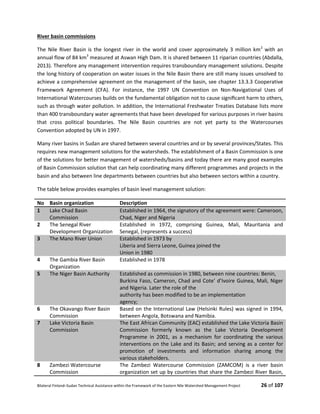
  • 90.
    Bilateral Finland–Sudan TechnicalAssistance within the Framework of the Eastern Nile Watershed Management Project 90 of 107 Issues Recommendations biomes. DNP is a biodiversity treasure for Sudan and the world. The park is threatened by encroachment from cattle herders who are being displaced from their traditional grazing lands and because of the expansion of crop agriculture. Game counts between 1971 and 2001 have shown a quick decline in most large mammal species such as waterbuck, reedbuck, oribi and others. Other species have been extinct in Dinder since it was gazetted, including African bush elephant, black rhinoceros, Giraffes disappeared in the 1980s, hippopotamus, tora hartebeest, Nubian giraffe, Soemmerring's gazelle, and the Nile crocodile. of the park suffering from lack of resources. Without further injection of funding by the government or the international community, it is very likely that the gains achieved by these two interventions by CWMP and GEF will risk of being lost and that further degradation of the DNP will continue. A new initiative is necessary for DNP which should be driven by the government of Sudan that builds on the last five years of experience of the CWMP in particular in areas of creating of buffer zones and conflict resolution approach. Since the DNP has a sister park on the other side of the border in Ethiopia one idea would be to consider the creation of a kind of Peace Park (www.peacepark.org) between Sudan and Ethiopia.
  • 91.
    Bilateral Finland–Sudan TechnicalAssistance within the Framework of the Eastern Nile Watershed Management Project 91 of 107 Annex 1 References Abdalla Abdelsalam Ahmed (2013). The Dilemma of the Nile Transboundary Water and the Way Forward. Journal of Earth Science and Engineering 3 (2013), 301-313. http://www.ucwr- sd.org/research/scientific%20papers/the%20dilemma%20of%20nile%20water%20transboundary.pdf Dale Whittington et.al (2014).The Grand Renaissance Dam and prospects for cooperation on the Eastern Nile. Water Policy (2014) 1-14. SWECO (2007). Watershed Management Fast Track Project, Sudan Detailed Project Preparation Study, Interim Institutional Assessment Report, Arjun Bhargava (2012), “An Interview with Ms. Abby Onencan of the Nile Basin Discourse”, World Water Forum 2012 Dr. Salman M.A. Salman (2014). Entry into Force of the UN Watercourses Convention – Where are the Nile Basin Countries? International Water Law Blog. http://www.internationalwaterlaw.org/blog/2014/06/02/dr-salman-m-a-salman-entry-into-force-of- the-un-watercourses-convention-where-are-the-nile-basin-countries/ EU Water Framework Directive, http://ec.europa.eu/environment/water/water- framework/index_en.html UNEP (2012), Environmental Governance in Sudan – An Expert Review, UNEP. http://postconflict.unep.ch/publications/UNEP_Sudan_env_gov_review.pdf UNEP (2013), Governance for Peace over Natural Resources, UNEP. UNEP (2014), Towards Integrated Water Resources Management – International experience in development of river basin organisations. http://www.unep.org/disastersandconflicts/portals/155/countries/Sudan/pdf/SudanWRM.pdf UNEP (2014), Relationships and Resources, Environmental governance for peacebuilding and resilient livelihoods in Sudan. UNEP. http://postconflict.unep.ch/publications/UNEP_Sudan_RnR.pdf Seleshi Bekele Awulachew et.al (2012). The Nile River Basin – Water, Agriculture, Governance and Livelihoods. Earthscan. Marion Dixon (2014), Agri-food industry growth and the land grab in north-east Africa. Lester R. Brown (2013), Food, Fuel, and the Global Land Grab, The Futurist. Yagoub Abdalla Mohamed et.al (2015), Community Watershed Management Project- Sudan Component: Environmental Auditing of Water Harvesting Structures Implemented in Project Areas UNEP (2013), Standing Wealth – Pastoralist Livestock Production and Local Livelihoods in Sudan, UNEP. Lundqvist, J., Grönwall, J. and Jägerskog, A. (2015). Water, food security and human dignity – a nutritionperspective. Ministry of Enterprise and Innovation, Swedish FAO Committee, Stockholm. UNEP (2013). Pastoralism in Practice: Monitoring Livestock Mobility in Contemporary Sudan. Jaspars Susanne, (2010). Coping and change in protracted conflict: The role of community groups and institutions in addressing food security and threats to livelihoods. A case study of North Darfur. Humanitarian Policy Group. http://www.odi.org/sites/odi.org.uk/files/odi-assets/publications-opinion- files/5964.pdf ProAct Network, (2013). Community Environmental Action Planning Toolkit – Participatory Tools and Methods to Engage Communities, UNEP. http://www.proactnetwork.org/proactwebsite_3/index.php/publications
  • 92.
    Bilateral Finland–Sudan TechnicalAssistance within the Framework of the Eastern Nile Watershed Management Project 92 of 107 ProAct Network, (2013). Community Environmental Action Planning – Getting organized A facilitators Guide, UNEP. http://www.proactnetwork.org/proactwebsite_3/index.php/publications ProAct Network, (2013). Community Environmental Action PlanningA handbook for Practitioners in Sudan, UNEP. http://www.proactnetwork.org/proactwebsite_3/index.php/publications IFAD, (2013). Republic of the Sudan, Country strategic opportunities programme. Hailu Menale Wassie, 2011, Potentials and Challenges of Alatish and Dinder National Parks (Ethiopia, Sudan) for implementing Transboundery Park Cooperation. Master Thesis, Management of Protected Area’s Program, University of Klagenfurt, Austria.
  • 93.
    Bilateral Finland–Sudan TechnicalAssistance within the Framework of the Eastern Nile Watershed Management Project 93 of 107 Annex 2 Institutions met for the Institutional Assessment No Institution Name Position Date met Address Mobil e-mail Web site 1 UNESCO Chair Prof. Abdalla Abdelsalam Ahmed Professor 19 August aaahmed55@yahoo.co.uk http://www.ucwr-sd.org/ 2 Sudanese Environment Conservation Society Dr. Mutasim B. Nimir Chair, Communication and Network committee 23 August 0919378857 Secs1975@yahoo.com Mutasimnimir2002@yahoo.com http://www.secs.org.sd Mr. Adil M. Ali Chair, Project Committee 23 August 0912642060 Secs1975@yahoo.com Sanjak1956@gmail.com http://www.secs.org.sd Prof. Assim I. Maghrabi 23 August Dr. Nadir M. Awad 23 August 3 Pastoralist Union - Gedarif Hassan Abo Executive committee member 24 August 0912851412 0123339130 Hassanabo22@gmail.com 4 UNEP Dr. Hamid Omer IWRM Advisor 27 August 0912165974 0912211588 Hamid.omer122@gmail.com Hamid.omer@unep.org http://www.unep.org 5 IFAD Yonas Mekonen 1st September 0912941465 y.mekonen@ifad.org http://www.ifad.org 6 Practical Action Abjad Alsarraj IWRM Advisor 3rd september 0912408244 Abjad.Alsarraj@practicalactionsd.org http://www.practicalactionsd.org Awadalla Hamid Head of Elfashir office 3rd september 0918238895 7 AHFAD Uni for Women Babiker A. Badri Registrar 6th september 0912915693 bbadri@ahfad.edu.sd bushkash@gmail.com http://www.ahfad.edu.sd 8 University of Khartoum Dr. Omer Egemi Lecturer Department of Geography 2nd september omer.egemi@hotmail.com 9 FNC - RNS Mutasim Ismail Amin Director 11th October 10. Hudybia Agricultural Research station - RNS Dr. Hassan Director 11th October 11. MoA - RNS 12th October 12. Eldamer Locality - RNS Ali Ahmed Elbashir Hassan Hamid Representative of the Executive director Director of Agriculure 12th October 0122279491 0122284708 localaldamar@hotmail.com
  • 94.
    Bilateral Finland–Sudan TechnicalAssistance within the Framework of the Eastern Nile Watershed Management Project 94 of 107 Mohamed Eljozoli Elhaj Osama Eltahir Ali Hisham Osman Elbadawi Agriculture Officer Agriculture Officer Agriculture Officer 0997330930 0926561918 0122480446 13. MoAAR - BNS Bilal Mohd. Nour Director General 25th October 14. State Drinking Water Cooperation/ State Rural Water cooperation Abdelrahman Mohd. Ahmed Alrayah Ahmed Jebril Director General Director 25th October 0912802925 0123029250 0903293194 abdonimer@yahoo.com 15. Agriculture Research station - BNS Dr.Abubakr Eltahir Abdalla Director 26th October 0915456456 0123318094 abubakeraam@yahoo.com 16. Range and Pasture directorate - BNS Ahmed Mohamed al awad Elhadi Mosabel Eltayeb Salahaldeen Ahmed Eltayeb Hamid Motwakeel Abdelmoniem Director Range Officer Range Officer Range Officer IT engineer 26th October 17. MoWRIE Musa Omer Fariha Abdelgayoum Hassan Ali Ahmed Eltayeb Salah Hamad Undersecretary Director of planning & policy Director of Director of Dams & WR Director of Nile water bed 27th October musa@wre.gov.sd farhienghanema@yahoo.com abashar9999@yahoo.com aeltayeba58@yahoo.com bdreldin@hotmail.com http://www.wre.gov.sd/
  • 95.
    Bilateral Finland–Sudan TechnicalAssistance within the Framework of the Eastern Nile Watershed Management Project 95 of 107 18. HCENR Dr. Khitma Mohd. Ali Deputy chairperson 29th October khitmamohammed@yahoo.com 19. MoE Dr. Omer Mustafa Abdelgadir Ahmed Abdelkarim Sulieman Undersecretary Director of the Sudan Metrological Authority Director General of Environment 1st november omeralkhidir@gmail.com ahmed@ersad.gov.sd 20. FNC - Federal Dr. Mohamed Ali Elhadi Elsadig Elamin Bakheit Fadwa Adam Abbaker Adam Mohamed Babiker Sayeda Ali Ahmed Khalil Director General Head of planning Head of projects Head of Technical sector National Coordinator REDD+ 2nd november 0183471575 0923100013 0912891898 0922882329 elhadifnc@yahoo.com sadig99@gmail.com Fadwaadam15@yahoo.com Adambabiker41@yahoo.com Sayeda.khalil@yahoo.com 21. MoA - Federal Dr. Adil Yousif Eltaib Mansour F. Mansour Director General Director of irrigated sector 3rd november 0912316561 0123815678 Adilyousif3@hotmail.com mansourfm@hotmail.com 22. DAL Group Ali Alsheikh Head of Agriculture 4th november 0912305440 Ali.alsheikh@dalgroup.com http://www.dalgroup.com 23. Ministry of Finance – Sennar state Dr. Ibrahim Mohamed Suliman State Minister 11th november 0912308546 Ihim37@yahoo.com 24. Pastoralist Union – Dinder Locality Albadri President of Pastoralist Union August 2015 0919968886 25. Alzorog VDC Executive board members Lower Atbara 26. Kenidra VDC Executive board members Lower Atbara 27. Jaldok VDC Executive board members Dinder Cluster
  • 96.
    Bilateral Finland–Sudan TechnicalAssistance within the Framework of the Eastern Nile Watershed Management Project 96 of 107 28. Wild life Research station Dinder 29. Kenidra Cooperative Association Atbara
  • 97.
    97 of 107 Annex3 Administration of River Nile State (Number of households) State/ County Mode of Living/‫مط‬ ‫ن‬ ‫شة‬ ‫ي‬ ‫ع‬ ‫م‬ ‫ال‬ /Admin Unit (AU) Total/‫ي‬ ‫اجمال‬ Urban/‫ضر‬ ‫ح‬ Rural/‫ف‬ ‫ري‬ Nomad/‫رحل‬ River Nile 200 032 54 334 140 167 5 531 Ubu Hamad 29 665 1 838 27 529 298 Shiri 11 546 0 11 248 298 Alkaab 3 464 0 3 464 0 Abuhamad Town & Rural 8 683 1 734 6 949 0 Alshiraik 5 972 104 5 868 0 Berbar 26 687 7 724 18 828 135 Alabidia & Alfarooq 6 147 0 6 147 0 Albawga Town & Rural 5 565 3 054 2 376 135 Berbar Town 4 670 4 670 0 0 Berbar Rural 10 305 0 10 305 0 Atbara 23 472 19 311 4 058 103 Atbara Town_North 8 707 8 707 0 0 Atbara Town_Center 6 583 6 583 0 0 Atbara Town_South 4 067 4 021 0 46 Solaa Rural 4 115 0 4 058 57 Eldamar 49 066 11 670 33 536 3 860 Sidoan 14 445 0 10 746 3 699 Atbarawi Rural 5 146 0 5 146 0 Alnil Sector 5 619 0 5 619 0 Eldamar Town&Rural 11 670 11 670 0 0 Alzaidab 6 008 0 5 847 161 Alingaz Rural 6 178 0 6 178 0 Shendi 46 078 11 740 33 508 830 Kaboashiya Town&Rural 8 894 2 215 6 679 0 Shendi Town 9 781 9 525 256 0 Shendi Rural 18 055 0 17 225 830 Hagar Alasaal 9 348 0 9 348 0 Elmatamma 25 064 2 051 22 708 305 Taibat Alkhawaad 7 897 0 7 897 0 Amatamma Town&Rural 8 536 2 051 6 227 258 Wad Hamid 8 631 0 8 584 47 Source: http://www.cbs.gov.sd/en/files.php?id=7#&panel1-1
  • 98.
    98 of 107 Annex4 CWMP map
  • 99.
    99 of 107 Annex5 CWMP area of implementation Atbara area: Dinder area:
  • 100.
    100 of 107 Annex6 Sub basin map
  • 101.
    101 of 107 Annex7 Moderators Guide to Institutional Assessment Eastern Nile Watershed Management Project Sudan Community Watershed Management Project Introduction This Moderators guide should be seen as a conceptual framework and a checklist of good practices that can be used during institutional/organizational assessments. The tool is not a blueprint but should be tailored to suit the assessment whether it is for the public, private or civil society sector. The content of this guide is derived from several documents and tools mainly the Octagon – A tool for the assessment of strengths and weaknesses in NGOs, Sida, 2003 and the Institutional Assessment and Capacity Development, why, what and how?, EU, September 2005 and Effective Institutions and good Governance for Development, Development Assistance Committee (DAC), 2011. The assessment has a dual purpose of both provide information about an organization/institution that can be used in a wider conceptual understanding about the area studied, the institution/organization and the relations between them. This particular assessment will be geared towards the perspective or vantage point of Community Watershed Management but the assessment should also provide a valuable assessment that can be used internally to support the organization or institution to improve the service delivery in general. When doing the final conclusion from the assessment the comparisons will be made with the institutional assessment conducted by SWECO in 2007. Process oriented TIMETABLE April 2015 June 2015 June 2015 July-August 2015 October 2015 Developing the concept Tailoring workshop Test assessment Excecute assessment Report and feedback Public sector Private sector Civil society sector Community Watershed Management is a complex undertaking which require collaboration between several sectors
  • 102.
    102 of 107 Themethod used for this assessment is not a in the form of a questionnaire survey but instead to engage in a dialogue with the organization or institution. The assessment is not assessing the CWMP project but look at the external factors (outside the organizational boundaries) influencing institutions work on Community Watershed Management (this is the vantage point) and in which context they operate. The tool consists of: 1. The quick guide to institutional/organizational assessment 2. Data entry form in an excel sheet with a detailed guide for the topics to be covered in the dialogue with the institution. Why this assessment? As stated in the ToR for the Technical Assistance (TA) for 2015 the main focus for the TA support during the last year will be in consolidating project achievements, fostering sustainability issues, institutional assessment as well as evaluating the impact of the project. As part of this the project will conduct an institutional assessment. The assessment ultimate goal is to improve the performance of service delivery in public, private and civil society organisations. The success and functionality of these organizations is the key to poverty reduction. It is expected that the assessment can help strengthen organisations and to help the government to make informed choices designing sector reforms and national development strategies. Mode of assessment The assessment should be carried out as a participatory process in which the institution/organization themselves should be in charge of assessing their own strengths and weaknesses. Be sensitive, be participative and involve the partner in the process. Try to establish a dialogue and joint analysis. Be realistic, unrealistic targets can be counterproductive. Focus on the causes of weaknesses and strengths instead of focusing on the symptoms (low income, poor resources, no capacity building etc). The assessment should lead to suggestions how the organization/institution can improve performance. If the assessment is repeated the organization/institution should be able to measure changes over time. Make sure you only play the role as the facilitator of the assessment to catalyst change. The car metaphor “Start by looking at how often the car transported what amounts of goods or passengers and whereto. The quality of the roads, the supporting facilities and gasoline supply. Only then would the hood be lifted and the engine taken apart”
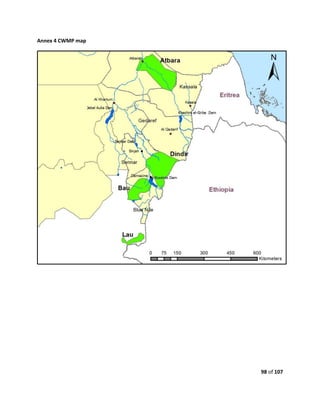
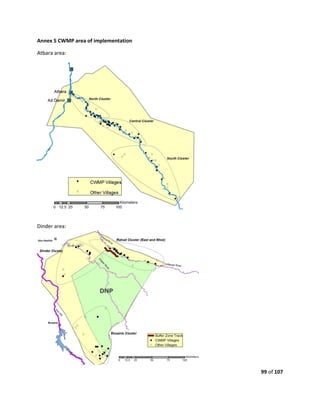
  • 103.
    103 of 107 Importantto think about  Dialogue not monolog.  Discuss more, assess less.  The assessment should benefit the institution/organization first.  We are not evaluating the project!!  Try to capture any changes taken place in the institution/organization or any changes in the outputs  Try to look beyond the narrow boundaries of the organization/institution. Avoid empty phrases  …lack of funds…lack of transportation…lack of skilled staff…lack of computers…assist developing capacity…this invites for the conclusion that what is needed is only more funds.  …conduct on-the-job training of staff… How handle controversial themes  Cut out the lip service of reading policy texts.  Ask for proactive and factual arrangements and processes. How long should the assessment take? The assessment should not take more than ½ -1 day. Following the steps: 1. Moderator explains the octagon and its 8 dimensions. 2. Thereafter, let the participants from the organization apply the octagon themselves. 3. Let them identify what is missing to achieve the full score (7) on each dimension. 4. Group discussion on the strength and weaknesses of the organization. 5. Final agreement on the scoring. 6. And finally a plan of action. Who will be assessing who? The Community Mobilisers will be assessing Locality based organisations, VDC, CBOs etc. The assessment at the State and National level will be conducted by Team Leader (TL), TL assistant and the Capacity Building and Training Coordinator (CBTC).
  • 104.
    104 of 107 Conceptualoverview The assessment looks at four basic aspects of an organization/Institution using eight key factors and dimensions and 16 major questions to guide the assessment process. 1. The organisation’s objectives and management/administrative structures, the so-called organisational base. 2. The organisation’s activities with or for selected target groups. 3. The organisation’s capacity to succeed in its work. This refers both to its professional skills and the funds at its disposal, as well as its administrative systems. 4. The organisation’s capacity to create and maintain relations with its target groups and other actors in civil society What overall questions should be answered? 1. How can government/private/civil society sector efficient support and improve service delivery to Community Watershed Management practices to be enhanced . 2. How can donor community be more efficient in tailoring support to Community Watershed Management initiatives? Scoring The results of the assessment are described as an octagon in which each of the eight dimensions are given a score from 0 to 7. Indispensable part of the assessment is the assessors and client comments from each dimension accompanying the octagon in order to understand the reasoning behind each score. Give justification for why giving a particular score. The tool uses a scoring system using an octagon with seven different levels. The scoring should be set after the assessor and the client have agreed on the score. Non-existent Very weak Weak Reasonable Good Very good Excellent 1 2 3 4 5 6 7
  • 105.
    105 of 107 Whichorganisations/Institutions should be assessed? Government No Civil society No Private No National level MoWRE 1 Farmers Union 1 MoA 1 Pastoralist Union 1 MoE 1 Sudanese Environmental Conservation Society National Council for Water Resources 1 Forest National Corporation 1 National Watershed Working group Forest National Corporation (NFC) State level River Nile State 1 Farmers Union 1 Sennar State 1 Pastoralist Union 1 Gedarif State 1 Blue Nile State 1 Local level Locality committee, commissioner 6 Village Development Committees (VDC) Community Watershed 0 1 2 3 4 5 6 7 1. Identity 2. Structure 3. Implementation 4. Relevance 5. Qualifications and experience 6. Systems 7. Target groups 8. The working environment Average score
  • 106.
    106 of 107 Team Farmerassociations Key informants Universities Note: At the State and Locality level meetings should include all relevant line departments to Community Watershed Management which involves activities in many sectors like water, forest, agriculture, range management, animal health and livelihoods. Who should participate? Let the senior management decide who should participate in the assessment. Ideally there should be 3-7 participants from the organization and they should be as diverse as possible including senior officials and preferable both women and men. Be action oriented Agree on acceptable and feasible goals both in short -, but also on medium and long term. Who should be involved? Evaluation of the assessment Let the representatives of the institution/organization score how valuable the assessment have been for them. Non- existent Very weak Weak Reasonable Good Very good Excellent 1 2 3 4 5 6 7 Feedback is a must You have to provide feedback to the institution/organization after completion of the report. Make sure you inform about this at the beginning of the assessment.
  • 107.
    107 of 107 Conceptualoverview The 4 basic aspects 8 variables 16 questions The organisation’s objectives and management/ administrative structures, the so-called organisational base 1. Identity a. Formulation of the organisation’s vision and mission b. Formulation of relevant strategies in relation to the vision 2. Structure a. Application of a clear division of duties and responsibilities b. Application of democratic rules The organisation’s activities with or for selected target groups. 3. Implementation of activities a. Planning for the implementation of activities b. Follow-up and learning from work done 4. Relevance of activities a. The content of activities correspond with the visions b. Working methods correspond with the vision The organisation’s capacity to succeed in its work. This refers both to its professional skills and the funds at its disposal, as well as its administrative systems. 5. Professional skills a. The professional qualifications and experience of the staff b. The ability of management 6. Systems a. Administration of financial resources b. Administrative routines The organisation’s capacity to create and maintain relations with its target groups and other actors in civil society 7. Acceptance and support of target group a. Support and acceptance by target groups b. Dialogue with the target groups 8. Relations with its external environment a. Legitimacy for its work b. Active participation in networks