Institution-Wide Assessment Practice:
Initiating Sustainable Strategies to Foster a
Culture of Assessment and Scholarly Inquiry

Dr. Linda Townsend
Longwood University
Office of Assessment and Institutional Research

March 5, 2014

Connections 2014
What challenges have you faced?

Challenges to Institution-Wide
Assessment Brainstorm
15 Elements of Assessment Success (Weiner, 2009)
"Only when an institution is on the path to
meeting these standards can its claim to
have a culture of assessment be taken
seriously."
http://www.aaup.org/article/establishing
-culture-assessment#.UlcBZX_AHdM
Stepping stones on the assessment culture pathway
Longwood University's stepping stones include:
– Faculty ownership
– Comprehensive
program review
– Ongoing professional
development

– Information sharing

– Celebration of
successes
– Continuous journey
for improvement
Faculty ownership of assessment programs
•

Faculty Senate: Committee on
Academic Outcomes Assessment
and Program Review

•

Department Assessment
Committees

•

Program Coordinators responsible
for assessment report entry in
WEAVEonline

•

Faculty Competency Team Leaders
for assessment of 6 core
competencies CT, IL, OC, QR, SR, WC

•

Faculty of General Education
Committee responsible for review
of GE goal/outcome assessment
Comprehensive program review
• Longwood University Program Review Policy (Revised April
2011)
– Emphasis on program quality enhancement
– Aligned with SACS principles and SCHEV requirements
– Identification of roles in the program report review process :
• Department Chair and Department Program Review Team
• External Review Team (Committee on Academic Outcomes Assessment
and Program Review)
• Dean and Associate/Assistant Dean responsible for assessment
• Dean and Provost
Ongoing professional development
• Interactive assessment • Academic &
report writing
Nonacademic
workshops - academic &
Assessment Coaches
nonacademic
• Using WEAVE in
• WEAVE Introductory and
institutional planning
Tips & Tricks workshops
and budgeting
• WEAVE One-on-One Help
session sign-ups
Information sharing
• Institutional Effectiveness audit process
– Assessment Coaches use of 2011-12 audit
comments
– One-on-one coach consultations for
feedback and support
IE Audit Comments Example
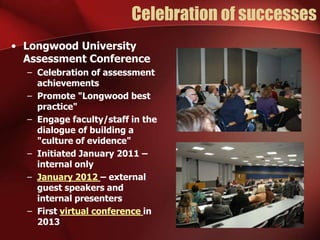
Celebration of successes
• Longwood University
Assessment Conference
– Celebration of assessment
achievements
– Promote "Longwood best
practice"
– Engage faculty/staff in the
dialogue of building a
"culture of evidence"
– Initiated January 2011 –
internal only
– January 2012 – external
guest speakers and
internal presenters
– First virtual conference in
2013
Continuous journey for improvement
• Longwood Assessment Mini-grant Program (LAMP)
– Initiated January 2012
– Encourage campus-wide participation in research on and
practice in assessment
– Develop scholarship of assessment and explore Longwood’s
best practice models in conducting assessment
– Expected to share major findings/experience of assessment at
the Longwood Assessment Conference and other professional
conferences
What are other strategies for meeting the
challenges & fostering an assessment
culture?

Other Strategies Brainstorm
“Perhaps the most compelling indicator of an
assessment culture is what occurs when any new
initiative or proposal is advanced. Automatically, the
questions asked will be: What are the goals and
objectives? How will we assess the effort?”
(Weiner, 2009)

The path to a culture of assessment – alone or altogether?

Institution wide assessment practice-connections2014conferencepresentation

  • 1.
    Institution-Wide Assessment Practice: InitiatingSustainable Strategies to Foster a Culture of Assessment and Scholarly Inquiry Dr. Linda Townsend Longwood University Office of Assessment and Institutional Research March 5, 2014 Connections 2014
  • 2.
    What challenges haveyou faced? Challenges to Institution-Wide Assessment Brainstorm
  • 3.
    15 Elements ofAssessment Success (Weiner, 2009) "Only when an institution is on the path to meeting these standards can its claim to have a culture of assessment be taken seriously." http://www.aaup.org/article/establishing -culture-assessment#.UlcBZX_AHdM
  • 4.
    Stepping stones onthe assessment culture pathway Longwood University's stepping stones include: – Faculty ownership – Comprehensive program review – Ongoing professional development – Information sharing – Celebration of successes – Continuous journey for improvement
  • 5.
    Faculty ownership ofassessment programs • Faculty Senate: Committee on Academic Outcomes Assessment and Program Review • Department Assessment Committees • Program Coordinators responsible for assessment report entry in WEAVEonline • Faculty Competency Team Leaders for assessment of 6 core competencies CT, IL, OC, QR, SR, WC • Faculty of General Education Committee responsible for review of GE goal/outcome assessment
  • 6.
    Comprehensive program review •Longwood University Program Review Policy (Revised April 2011) – Emphasis on program quality enhancement – Aligned with SACS principles and SCHEV requirements – Identification of roles in the program report review process : • Department Chair and Department Program Review Team • External Review Team (Committee on Academic Outcomes Assessment and Program Review) • Dean and Associate/Assistant Dean responsible for assessment • Dean and Provost
  • 7.
    Ongoing professional development •Interactive assessment • Academic & report writing Nonacademic workshops - academic & Assessment Coaches nonacademic • Using WEAVE in • WEAVE Introductory and institutional planning Tips & Tricks workshops and budgeting • WEAVE One-on-One Help session sign-ups
  • 8.
    Information sharing • InstitutionalEffectiveness audit process – Assessment Coaches use of 2011-12 audit comments – One-on-one coach consultations for feedback and support IE Audit Comments Example
  • 9.
    Celebration of successes •Longwood University Assessment Conference – Celebration of assessment achievements – Promote "Longwood best practice" – Engage faculty/staff in the dialogue of building a "culture of evidence" – Initiated January 2011 – internal only – January 2012 – external guest speakers and internal presenters – First virtual conference in 2013
  • 10.
    Continuous journey forimprovement • Longwood Assessment Mini-grant Program (LAMP) – Initiated January 2012 – Encourage campus-wide participation in research on and practice in assessment – Develop scholarship of assessment and explore Longwood’s best practice models in conducting assessment – Expected to share major findings/experience of assessment at the Longwood Assessment Conference and other professional conferences
  • 11.
    What are otherstrategies for meeting the challenges & fostering an assessment culture? Other Strategies Brainstorm
  • 12.
    “Perhaps the mostcompelling indicator of an assessment culture is what occurs when any new initiative or proposal is advanced. Automatically, the questions asked will be: What are the goals and objectives? How will we assess the effort?” (Weiner, 2009) The path to a culture of assessment – alone or altogether?

Editor's Notes

  • #3 Brainstorming activity – accessible to all online for viewing
  • #4 American Association of University Professors – Academe Online
  • #5 Define each
  • #6 The committee shall be responsible for promoting the quality and effectiveness of the academic curriculum. The committee will monitor, oversee, and evaluate academic Biennial Reports and Program Reviews to ascertain the extent of compliance with Longwood’s assessment policy. The committee will evaluate all academic assessment reports except for those related to general education (which is under the purview of the Committee on General Education). The committee will also make recommendations to the Senate on issues related to assessment of academic programs. From previous SCHEV team leader meeting discussions, collaboration of WCC, CTC, ILC derived. Faculty raters for WCC, CTC, ILC, and OCC are from multiple disciplines representative of the 3 academic colleges. SRC & QRC collaborated on the communication to students and lab scheduling. After the spring 2013 presentation of competency findings to the GE Committee members, faculty have initiated a review of writing-intensive (WI) course syllabi for further clarification of WI policy with faculty and potential WI policy revision.
  • #7 CAOAPR members rewrote and streamlined the self-study component so that it would be aligned with SACS principles and SCHEV requirements. Disliked the negative tone of the old policy, noting how the stated purpose of the process was a “recommendation for program termination or continuation.” As a result, CAOAPR members reorganized the policy and placed an emphasis on quality enhancement. Under new policy, 2011-12 program review (PR) began.To further improve the PR process, a PR template developed by a program going through 2011-12 PR was adopted and modified by CAOAPR members for use by and consistency for all programs going through 2012-13 PR.
  • #9 Share 2012-13 Assessment Coach comments :What did you learn from being an assessment coach?What did you learn about yourself from this experience? Strengths and weaknesses you discovered for yourself?What do you believe went well this summer? What do you wish could have gone better?What suggestions would you have if OAIR is able to continue the Assessment Coach approach?
  • #10 “Celebrating participation in assessment is of tremendous value.” (Weiner, 2009)
  • #11 Faculty involved in feedback on proposals and in selection processShare proposal titles for 2013. Share data on proposal submissions and acceptance increase from 2012.
  • #12 Brainstorming activity – accessible to all online for viewing