Inspirational Britons
As a tutor group you are going to
read through the following stories.
As a class you have to decide on
one person -half the class have to
come up with a piece of work that
describes all of the benefits of the
invention.
The other half have to come up
with a piece of work that
describes what life could be like
without these people's influence.
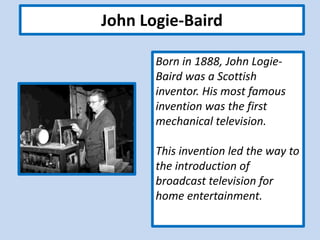
John Logie-Baird
Born in 1888, John Logie-
Baird was a Scottish
inventor. His most famous
invention was the first
mechanical television.
This invention led the way to
the introduction of
broadcast television for
home entertainment.
The Beatles
An English rock band, the Beatles were formed in Liverpool in 1960. They are
widely regarded as one of the most influential bands of all time – not only
have their songs the most covered in modern history but the Shea Stadium
show in 1965 was played to a (then record) crowd of 55, 600. This led a shift
away from music being played in clubs and concert halls and led to the birth
of stadium and arena shows.
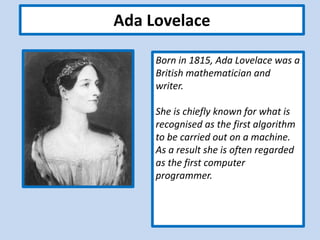
Ada Lovelace
Born in 1815, Ada Lovelace was a
British mathematician and
writer.
She is chiefly known for what is
recognised as the first algorithm
to be carried out on a machine.
As a result she is often regarded
as the first computer
programmer.
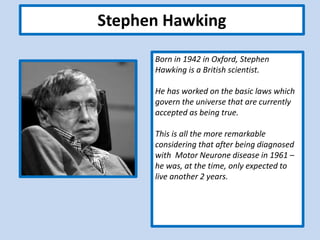
Stephen Hawking
Born in 1942 in Oxford, Stephen
Hawking is a British scientist.
He has worked on the basic laws which
govern the universe that are currently
accepted as being true.
This is all the more remarkable
considering that after being diagnosed
with Motor Neurone disease in 1961 –
he was, at the time, only expected to
live another 2 years.
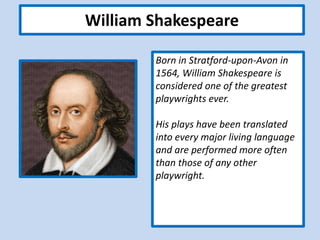
William Shakespeare
Born in Stratford-upon-Avon in
1564, William Shakespeare is
considered one of the greatest
playwrights ever.
His plays have been translated
into every major living language
and are performed more often
than those of any other
playwright.
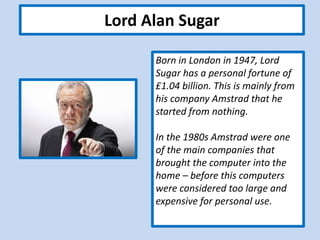
Lord Alan Sugar
Born in London in 1947, Lord
Sugar has a personal fortune of
£1.04 billion. This is mainly from
his company Amstrad that he
started from nothing.
In the 1980s Amstrad were one
of the main companies that
brought the computer into the
home – before this computers
were considered too large and
expensive for personal use.
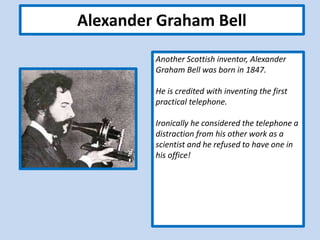
Alexander Graham Bell
Another Scottish inventor, Alexander
Graham Bell was born in 1847.
He is credited with inventing the first
practical telephone.
Ironically he considered the telephone a
distraction from his other work as a
scientist and he refused to have one in
his office!
Sir Tim Berners-Lee
Born in London in 1955.
He is the inventor of the World Wide
Web and the language (HTML) that it is
based on.
He is also the founder of the World
Wide Web Consortium that continues
to oversee the development of the
World Wide Web.
His decision to not charge anyone to
use his invention is one of the reasons
the World Wide Web has become so
easy to use and access.
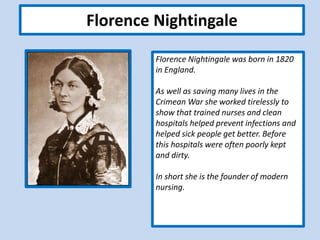
Florence Nightingale
Florence Nightingale was born in 1820
in England.
As well as saving many lives in the
Crimean War she worked tirelessly to
show that trained nurses and clean
hospitals helped prevent infections and
helped sick people get better. Before
this hospitals were often poorly kept
and dirty.
In short she is the founder of modern
nursing.
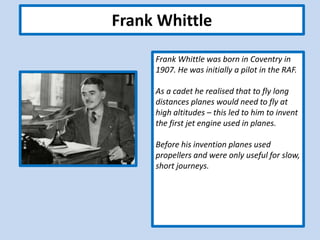
Frank Whittle
Frank Whittle was born in Coventry in
1907. He was initially a pilot in the RAF.
As a cadet he realised that to fly long
distances planes would need to fly at
high altitudes – this led to him to invent
the first jet engine used in planes.
Before his invention planes used
propellers and were only useful for slow,
short journeys.
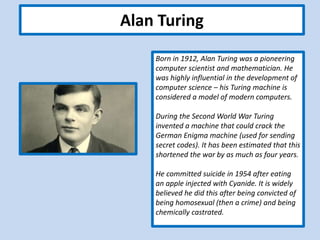
Alan Turing
Born in 1912, Alan Turing was a pioneering
computer scientist and mathematician. He
was highly influential in the development of
computer science – his Turing machine is
considered a model of modern computers.
During the Second World War Turing
invented a machine that could crack the
German Enigma machine (used for sending
secret codes). It has been estimated that this
shortened the war by as much as four years.
He committed suicide in 1954 after eating
an apple injected with Cyanide. It is widely
believed he did this after being convicted of
being homosexual (then a crime) and being
chemically castrated.

Inspirational British People

  • 1.
    Inspirational Britons As atutor group you are going to read through the following stories. As a class you have to decide on one person -half the class have to come up with a piece of work that describes all of the benefits of the invention. The other half have to come up with a piece of work that describes what life could be like without these people's influence.
  • 2.
    John Logie-Baird Born in1888, John Logie- Baird was a Scottish inventor. His most famous invention was the first mechanical television. This invention led the way to the introduction of broadcast television for home entertainment.
  • 3.
    The Beatles An Englishrock band, the Beatles were formed in Liverpool in 1960. They are widely regarded as one of the most influential bands of all time – not only have their songs the most covered in modern history but the Shea Stadium show in 1965 was played to a (then record) crowd of 55, 600. This led a shift away from music being played in clubs and concert halls and led to the birth of stadium and arena shows.
  • 4.
    Ada Lovelace Born in1815, Ada Lovelace was a British mathematician and writer. She is chiefly known for what is recognised as the first algorithm to be carried out on a machine. As a result she is often regarded as the first computer programmer.
  • 5.
    Stephen Hawking Born in1942 in Oxford, Stephen Hawking is a British scientist. He has worked on the basic laws which govern the universe that are currently accepted as being true. This is all the more remarkable considering that after being diagnosed with Motor Neurone disease in 1961 – he was, at the time, only expected to live another 2 years.
  • 6.
    William Shakespeare Born inStratford-upon-Avon in 1564, William Shakespeare is considered one of the greatest playwrights ever. His plays have been translated into every major living language and are performed more often than those of any other playwright.
  • 7.
    Lord Alan Sugar Bornin London in 1947, Lord Sugar has a personal fortune of £1.04 billion. This is mainly from his company Amstrad that he started from nothing. In the 1980s Amstrad were one of the main companies that brought the computer into the home – before this computers were considered too large and expensive for personal use.
  • 8.
    Alexander Graham Bell AnotherScottish inventor, Alexander Graham Bell was born in 1847. He is credited with inventing the first practical telephone. Ironically he considered the telephone a distraction from his other work as a scientist and he refused to have one in his office!
  • 9.
    Sir Tim Berners-Lee Bornin London in 1955. He is the inventor of the World Wide Web and the language (HTML) that it is based on. He is also the founder of the World Wide Web Consortium that continues to oversee the development of the World Wide Web. His decision to not charge anyone to use his invention is one of the reasons the World Wide Web has become so easy to use and access.
  • 10.
    Florence Nightingale Florence Nightingalewas born in 1820 in England. As well as saving many lives in the Crimean War she worked tirelessly to show that trained nurses and clean hospitals helped prevent infections and helped sick people get better. Before this hospitals were often poorly kept and dirty. In short she is the founder of modern nursing.
  • 11.
    Frank Whittle Frank Whittlewas born in Coventry in 1907. He was initially a pilot in the RAF. As a cadet he realised that to fly long distances planes would need to fly at high altitudes – this led to him to invent the first jet engine used in planes. Before his invention planes used propellers and were only useful for slow, short journeys.
  • 12.
    Alan Turing Born in1912, Alan Turing was a pioneering computer scientist and mathematician. He was highly influential in the development of computer science – his Turing machine is considered a model of modern computers. During the Second World War Turing invented a machine that could crack the German Enigma machine (used for sending secret codes). It has been estimated that this shortened the war by as much as four years. He committed suicide in 1954 after eating an apple injected with Cyanide. It is widely believed he did this after being convicted of being homosexual (then a crime) and being chemically castrated.