1
Insight about the Rites of Hajj
in Light of the Qur‟aan, Sunnah,
and Reports from the Companions
ِ‫ك‬ ِ‫َاس‬‫ن‬َ‫م‬ْ‫ل‬‫ا‬ ِ‫م‬‫ا‬َ‫ك‬ ْ‫ح‬َ‫ي‬ِ‫ب‬ ِ‫ك‬ ِ‫َّاس‬‫ن‬‫ال‬ ُ‫ور‬ ِ‫ص‬ْ‫ب‬َ‫ت‬
ِ‫ة‬َ‫ب‬‫ا‬َ‫ح‬ َّ‫الص‬ ِ‫عَن‬ ِ‫ور‬ُ‫ث‬ْ‫ا‬َ‫م‬ْ‫ل‬‫ا‬َ‫و‬ ِ‫َّة‬‫ن‬ ُّ‫الس‬َ‫و‬ ِ‫َاب‬‫ت‬ِ‫ك‬ْ‫ل‬‫ا‬ ِ‫ء‬ْ‫و‬ َ‫ض‬ ‫ى‬َ‫ل‬َ‫ع‬
By „Abdul-Muhsin ibn Hamad al-„Abbaad al-Badr
General Presidency for Affairs of the Two Sacred Mosques
Agency for Affairs of the Prophet‟s Mosque
Translation Department
For Free
Distribution
2
Copyright © 2014 (1435h)
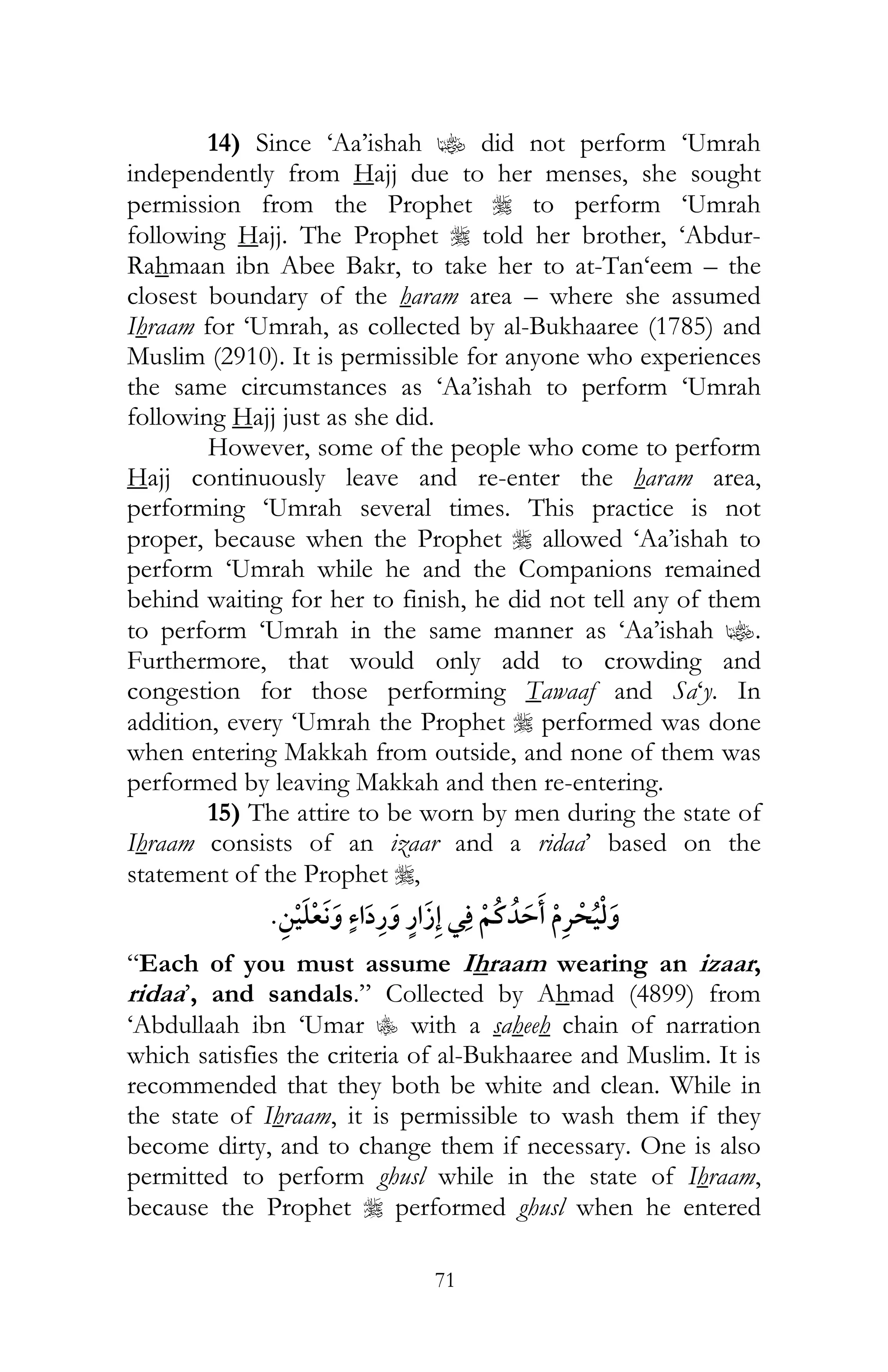
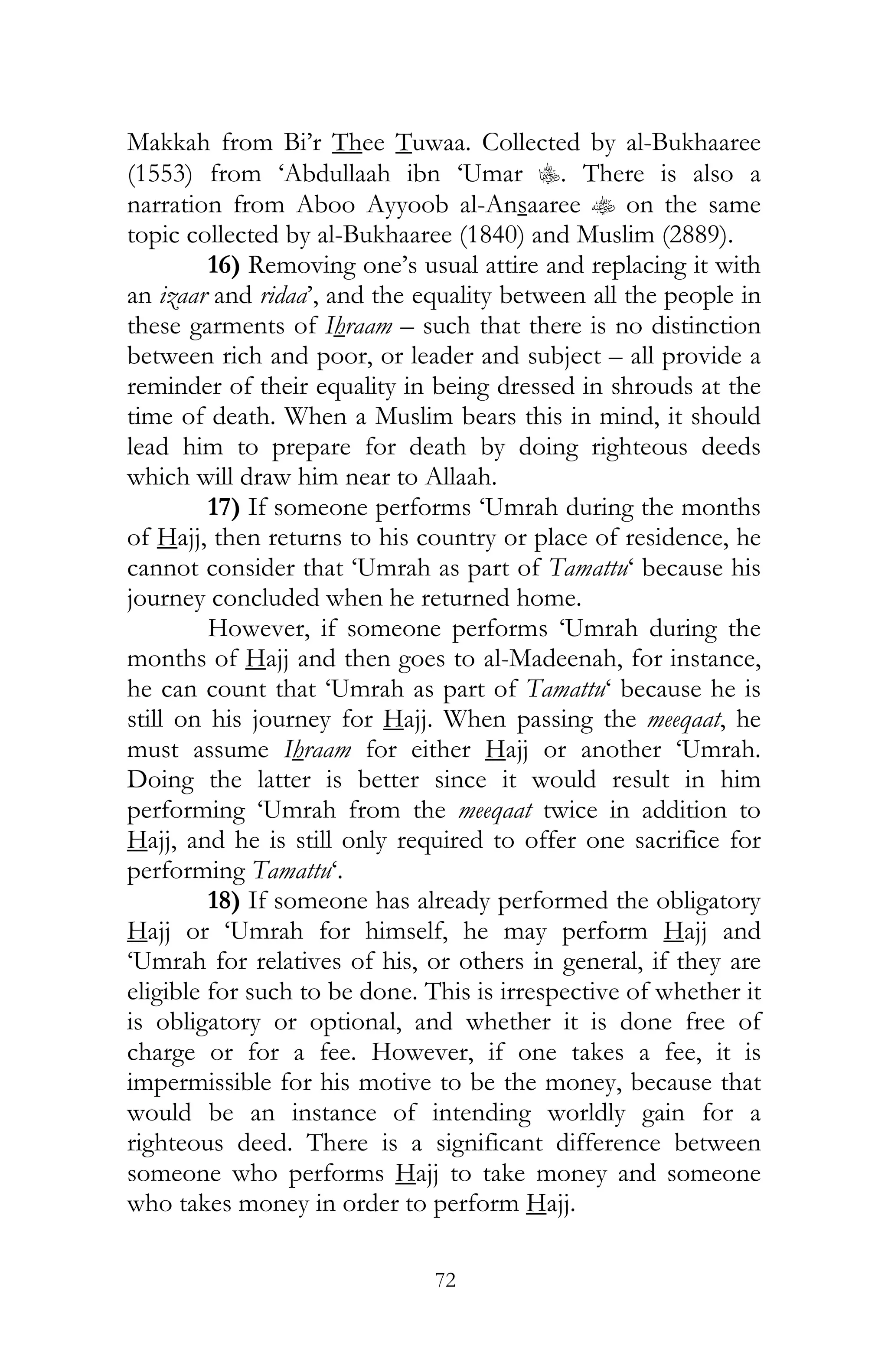
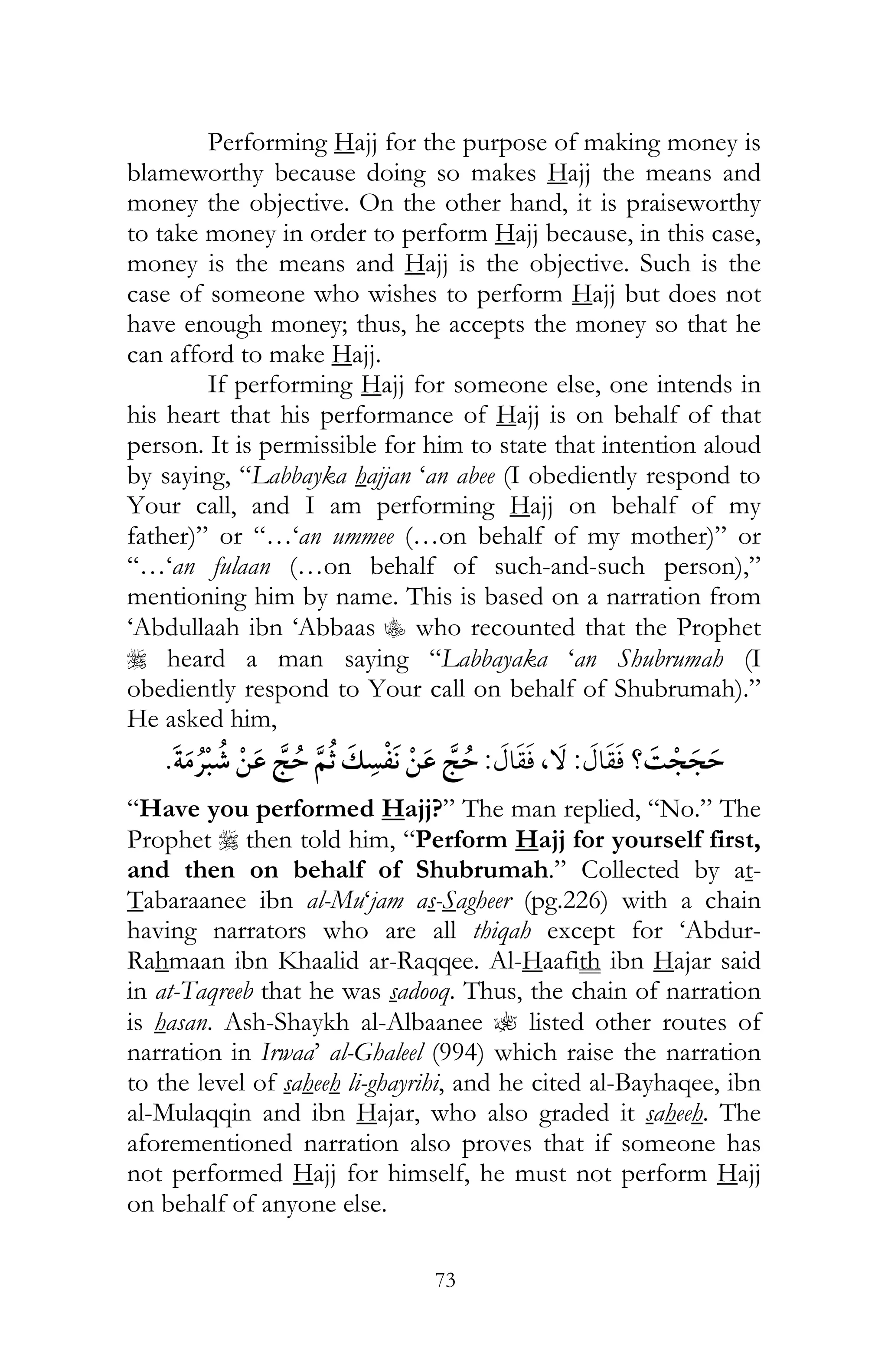
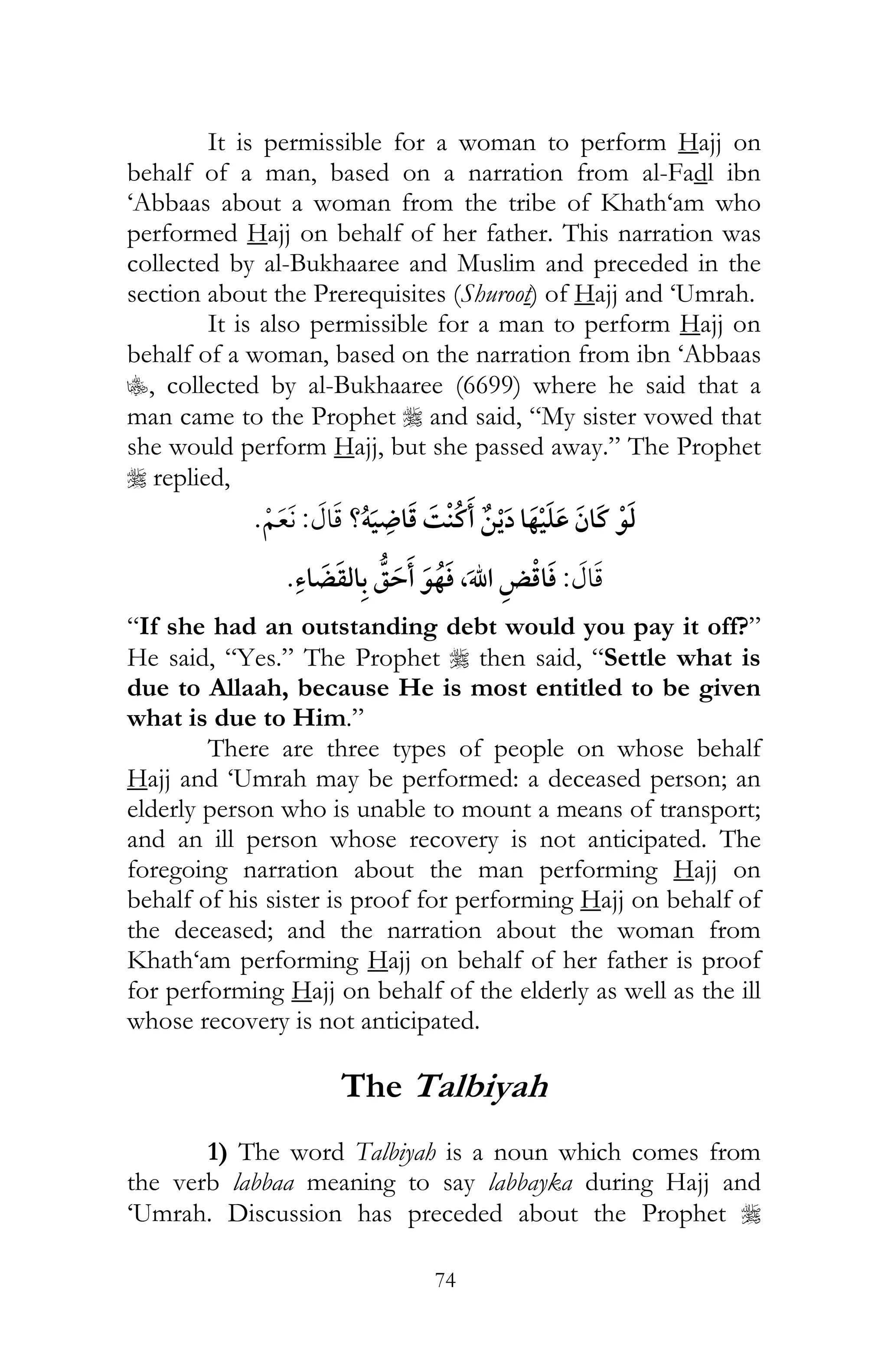
General Presidency for Affairs of the Two Sacred Mosques
gph.gov.sa
3
Table of Contents
Introduction............................................................................ 5
Manners to be Observed during Hajj and ‘Umrah........... 8
The Virtues of Hajj and ‘Umrah.......................................... 12
The Obligation of Hajj and ‘Umrah.................................... 17
Prerequisites (Shuroot) of Hajj and ‘Umrah ........................ 21
Pillars (Arkaan) of Hajj and ‘Umrah................................... 27
Obligatory Rites (Waajibaat) of Hajj and ‘Umrah.............. 31
Recommended Acts (Mustahabbaat)
During Hajj and ‘Umrah............................................... 37
The Meeqaat Points with Respect to Place and Time ....... 38
Prohibited Acts while in Ihraam........................................... 44
Summarized and Detailed Descriptions
of Hajj and ‘Umrah........................................................ 60
Preparation for Ihraam........................................................... 61
Ihraam....................................................................................... 62
The Talbiyah ............................................................................ 74
Entering al-Masjid al-Haraam ................................................ 79
Tawaaf ...................................................................................... 81
Drinking Zamzam Water...................................................... 91
Sa‘y between as-Safaa and al-Marwah ................................... 92
Shaving or Shortening the Hair........................................... 96
Assuming Ihraam for Hajj from Makkah on the
Eighth of Thul-Hijjah and Departing to Minaa........ 97
Being Present in ‘Arafah....................................................... 99
A Collection of Du‘aa’ and Thikr
from the Qur’aan and Authentic Sunnah................... 105
Spending the Night in Muzdalifah ...................................... 129
Rites Performed on the Day of Sacrifice............................ 131
Spending the Nights in Minaa
Throughout the Days of Tashreeq ................................ 139
Stoning the Jamaraat During the Days of Tashreeq ............ 141
Farewell Tawaaf (Tawaaf al-Wadaa‘)...................................... 148
Visiting the Prophet’s Masjid r........................................... 148
4
ijk
In the Name of Allaah, the Most Merciful, the Bestower of Mercy
5
Introduction
All praise is due to Allaah, al-Malik (owner of all), al-
Quddoos, as-Salaam (perfect in every way, absolved of any
imperfection). He obligated specific duties and decreed laws
perfectly. He designated the performance of Hajj to His
Sanctified House as one of the pillars and tremendous
foundations of Islaam.
I testify that none has the right to be worshipped
except Allaah alone, having no partner; Owner of infinite
favour, bounty, majesty and generosity. I further testify that
Muhammad r is His worshipping servant and Messenger;
the exemplary role model and leader; the best of all who
established Salaat, gave Zakaat, performed Hajj and ‘Umrah,
and fasted.
May Allaah send salaah, salaam, and blessings upon
him, his noble and elite family, his Companions who guided
mankind and shone as lamps in the darkness, and upon all
who succeeded them, treading their path with clean hearts
and acknowledging them with fine words,
{LKJI H GFE
WV UTSRQ PONMz
“They say: Our Lord, forgive us and our brothers who
preceded us in Eemaan, and do not place in our hearts
any rancour towards those who have Eemaan. Our
Lord, You are Most Kind, Most Merciful.” [al-Hashr
(59):10]
It is well established among all Muslims – the
learned and the lay – that the greatest blessing bestowed by
Allaah upon all jinn and humans in the later generations was
the sending of His noble Messenger, Muhammad – may the
finest salaah and most perfect salaam be sent upon him – to
bring them out of the darkness into the light, and guide
them to the right path. Thus, he directed his Ummah to all
6
good, warned them against every evil, and articulately
conveyed the message.
Allaah has founded His sound, pristine, upright
religion upon five pillars: the Shahaadah that none has the
right to be worshipped except Allaah, and that Muhammad
is His Messenger; establishing Salaat; paying Zakaat; fasting
Ramadaan; and performing Hajj at the Sanctified House of
Allaah. This is established in the well-known hadeeth of
Jibreel where he questioned the Prophet r about Islaam,
Eemaan, Ihsaan, the Hour, and its signs. At the end of the
hadeeth, the Prophet r said, “That was Jibreel. He came
to teach you your religion.” When the Prophet r was
asked about Islaam he said,
ï,
, , ¯ ,
ï ¯ ¯
“Islaam is that you testify that none has the right to be
worshipped except Allaah, and that Muhammad is the
Messenger of Allaah; establish Salaat; give Zakaat; fast
Ramadaan; and perform Hajj at the House if you are
able to do so.” Reported by Muslim (93) from ‘Umar ibn
al-Khattaab t.
In Saheeh al-Bukhaaree (8) and Saheeh Muslim (113),
ibn ‘Umar C said, “The Messenger of Allaah r said,
¯:, ï
, , , ,
“Islaam is built upon five: testifying that none has the
right to be worshipped except Allaah, and that
Muhammad is the Messenger of Allaah; establishing
Salaat; giving Zakaat; performing Hajj; and fasting
Ramadaan.”
7
The most tremendous and significant of these pillars
are the two testimonies: one for the sole right of worship
belonging to Allaah, and the other for the Messengership of
His Prophet, Muhammad r. These two testimonies dictate
that none be worshipped other than Allaah, and that acts of
worship conform to the directives of the Messenger of
Allaah r. A person’s actions will be of no avail to him in the
hereafter unless done sincerely for Allaah and in conformity
with the Sunnah of the Messenger of Allaah r.
The greatest pillar after the testimony is Salaat,
which is the cornerstone of Islaam. It inhibits from lewdness
and evil; it is the last aspect of the religion that will be lost as
long as this world exists; it is the first thing for which every
individual will be held to account on the Day of
Resurrection; and it forms a strong bond between the
servant and his Lord due to its repeated performance five
times over the course of each day and night.
After Salaat comes Zakaat. Allaah has paired these
two pillars in many aayaat of the Qur’aan. The good of
Zakaat extends to others, since not only does the one who
gives it earn a tremendous reward, but it benefits the poor
who receive it as well. It is a small amount which Allaah has
obligated to be taken annually from the wealth of the rich.
Its payment does not harm the rich, while the advantage it
yields for the underprivileged is immense.
Following Zakaat is fasting one month of the year,
that being Ramadaan.
Then comes the performance of Hajj which is
obligatory only once in a lifetime.
Classical and contemporary scholars have written
many works about the rulings of Hajj and ‘Umrah, some
lengthy and others brief. One of the best summarized works
is that of our Shaykh, ‘Abdul-‘Azeez ibn ‘Abdillaah ibn Baaz
?, entitled at-Tahqeeq wal-Eedaah li-Katheer min Masaa’il al-
Hajj wal-‘Umrah waz-Ziyaarah ‘alaa daw’ al-Kitaab was-Sunnah
[translated in English under the title Verifying & Explaining
8
Many Matters of Hajj, Umrah, & Ziyarah in the Light of the
Qur’an & Sunnah]. It has been printed numerous times and
translated into many languages. It has proven very useful
and gained widespread acceptance among students of
Islaam. The first edition – in 1363h – was printed at the
expense of King ‘Abdul-‘Azeez ?. The author ? continued
to add further notes and research to subsequent editions
until his death in 1420h.
I desired quite some time ago to write a short work
about Hajj and ‘Umrah, and Allaah made that desire a reality
this year, 1428h, in the form of this brief book which I
entitled, Tabseer an-Naasik bi-Ahkaam al-Manaasik ‘alaa daw’
al-Kitaab was-Sunnah wal-Ma’thoor ‘an as-Sahaabah [Insight
about the Rites of Hajj in Light of the Qur’aan, Sunnah, and
Reports from the Companions].
I ask Allaah, the Most Mighty and Majestic, to accept
this work of mine; grant me reward for it; make it useful to
students of Islaam and all those who set out to the
Sanctified House of Allaah; reward all those who spread it
and assist in doing so; grant the Muslims understanding of
their religion, and make them steadfast upon the truth.
Indeed, He hears all and responds.
Manners to be Observed
during Hajj and ‘Umrah
1) The most crucial thing one must ensure while
performing Hajj and ‘Umrah is to make his actions sincerely
for Allaah, free of showing off and ostentation, in order to
attain the complete reward. In Saheeh Muslim (7475) Aboo
Hurayrah t narrated that the Messenger of Allaah r said,
:¯, ¯
ï ¯ ï ¯ , ¯ ¯ ï ¯
9
“Allaah, Most Glorious and Exalted, said: I have
absolutely no need for a partner. If someone performs a
deed in which he associates anything along with Me, I
shall reject him and his deed.”
In Sunan ibn Maajah (2890), with a da‘eef chain of
narration, Anas t narrated that the Messenger of Allaah r
said during his Hajj,
,
“O Allaah! A Hajj without wanting to be seen or heard
of by others.” Ash-Shaykh al-Albaanee ? listed other
narrations in as-Silsilah as-Saheehah (2617) which strengthen it
to the level of hasan li-ghayrihi.
2) One performing Hajj must endeavour to know
the rulings of Hajj and ‘Umrah so that he can perform them
from a standpoint of clear knowledge. He should acquire a
book about the topic, and among the most useful ones he
can obtain is that of our Shaykh ‘Abdul-‘Azeez ibn Baaz ?
– mentioned previously – and he should also ask the people
of knowledge about things before doing them, so as to avoid
making any errors.
3) On the journey for Hajj, one should be keen to
maintain the company of good people from whom he can
acquire knowledge and admirable conduct. In Saheeh al-
Bukhaaree (5534) and Saheeh Muslim (6692) Aboo Moosaa al-
Ash‘aree t reported that the Prophet r said,
,¯ , ¯
,ï ,ï
, ¯ ¯ ,
“Good and bad company are like a musk seller and a
blacksmith. The musk seller will either give you some,
or you will buy some from him, or you will find a
pleasant scent from him. The blacksmith will either
10
burn your clothes, or you will find a repulsive scent
from him.”
4) One must take enough money with him on his
journey so that he will not need anything from others. The
Messenger of Allaah r said,
ï , ï ¯
“When someone refrains from asking of people and
desiring what they have, Allaah shall make him
content; and when someone tries to be independent of
needing other people, Allaah shall enrich him.”
Reported by al-Bukhaaree (1469) and Muslim (2424) from
Aboo Sa‘eed al-Khudree t.
5) One should adorn himself with noble conduct
and deal with others in a respectable fashion. The Messenger
of Allaah r said,
, ,¯
“Observe Taqwaa of Allaah wherever you may be;
follow up a bad deed with a good deed and it will wipe
it out; and behave well towards others.” Reported by at-
Tirmithee (1987) with a hasan chain of narration from Aboo
Tharr t.
Also in Saheeh Muslim (4776) is the narration of
‘Abdullaah ibn ‘Amr ibn al-‘Aas C from the Prophet r, a
portion of which says,
ï ï , , ¯
,¯ï ¯
“Thus, if someone wishes to be saved from the hellfire
and admitted to Jannah, he must ensure that death
finds him in a state where he has Eemaan in Allaah and
the Last Day, and he must do to others what he wishes
to be done to him,” meaning that he should treat others in
11
the manner which he would like them to treat him.
6) One should occupy himself with thikr of Allaah,
du‘aa’, seeking forgiveness, and saying only good things. He
should fill his time doing things that will have a praiseworthy
result in this life and the hereafter. The Messenger of Allaah
r said,
¯ ¯ ¯
“Whoever has Eemaan in Allaah and the Last Day must
either speak good or remain silent.” Reported by al-
Bukhaaree (6475) and Muslim (74) from Aboo Hurayrah t.
The Messenger of Allaah r also said,
¯:¯
“There are two blessings which many people misuse:
health and free time.” Reported by al-Bukhaaree (6412)
from ibn ‘Abbaas C.
7) One must beware of harming others, whether by
word or deed, based on the statement of the Messenger of
Allaah r,
ï
“The Muslim is he from whose tongue and hand the
Muslims are safe.” Reported by al-Bukhaaree (10) and
Muslim (64).
If afflicted with the bad habit of smoking, one must
also beware of harming others with the repulsive smell of his
smoke. In fact, he must stop smoking altogether and repent
to Allaah U, because smoking is detrimental to health and
wastes wealth.
A Muslim should strive his utmost to personify these
fine characteristics and manners in all situations, especially
while on his journey for Hajj and ‘Umrah.
12
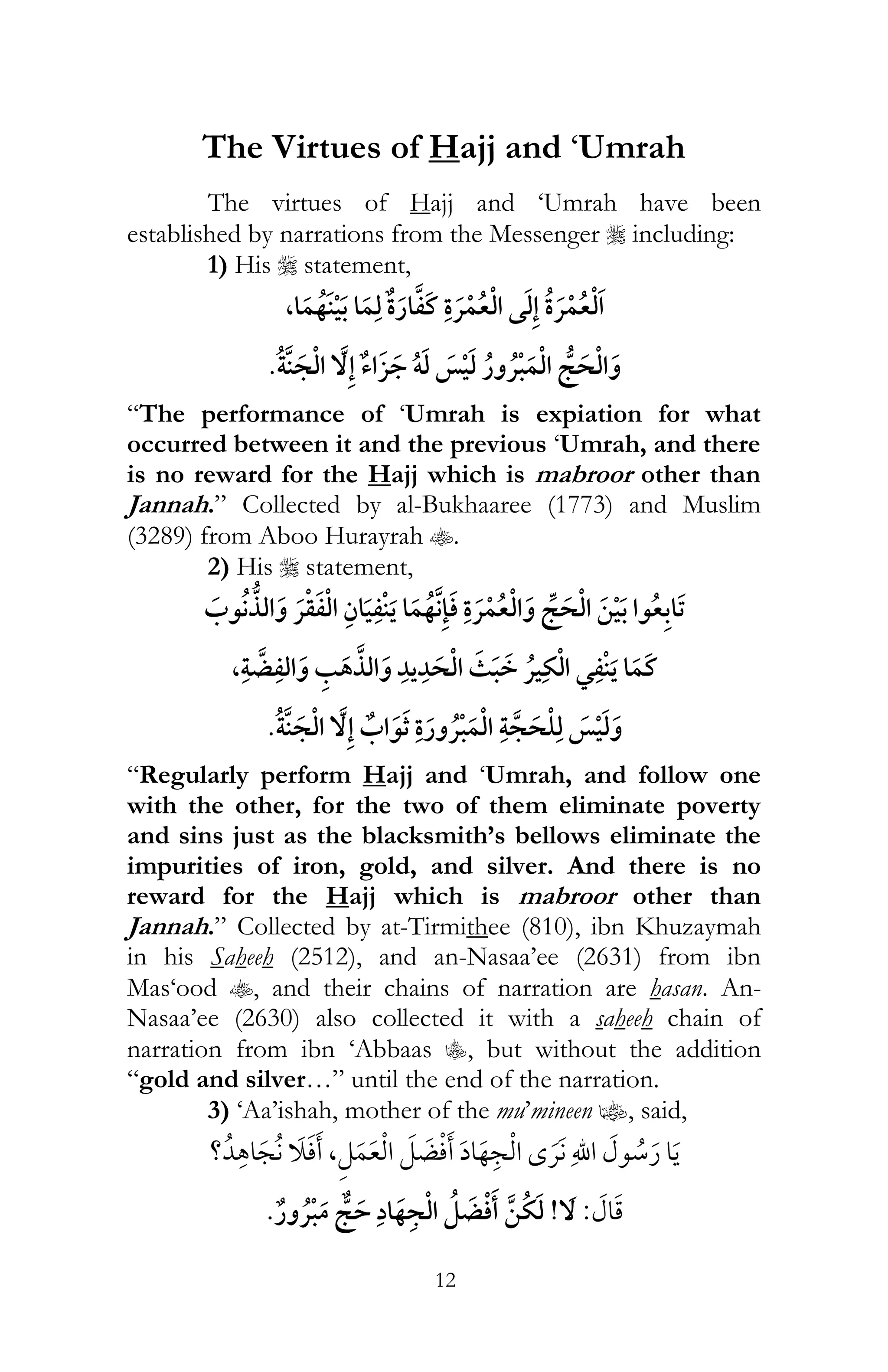
The Virtues of Hajj and ‘Umrah
The virtues of Hajj and ‘Umrah have been
established by narrations from the Messenger r including:
1) His r statement,
, ¯ ¯
ï ¯
“The performance of ‘Umrah is expiation for what
occurred between it and the previous ‘Umrah, and there
is no reward for the Hajj which is mabroor other than
Jannah.” Collected by al-Bukhaaree (1773) and Muslim
(3289) from Aboo Hurayrah t.
2) His r statement,
¯ ¯
, ¯ ¯ ¯
¯
“Regularly perform Hajj and ‘Umrah, and follow one
with the other, for the two of them eliminate poverty
and sins just as the blacksmith’s bellows eliminate the
impurities of iron, gold, and silver. And there is no
reward for the Hajj which is mabroor other than
Jannah.” Collected by at-Tirmithee (810), ibn Khuzaymah
in his Saheeh (2512), and an-Nasaa’ee (2631) from ibn
Mas‘ood t, and their chains of narration are hasan. An-
Nasaa’ee (2630) also collected it with a saheeh chain of
narration from ibn ‘Abbaas C, but without the addition
“gold and silver…” until the end of the narration.
3) ‘Aa’ishah, mother of the mu’mineen z, said,
¯,?
:!¯
13
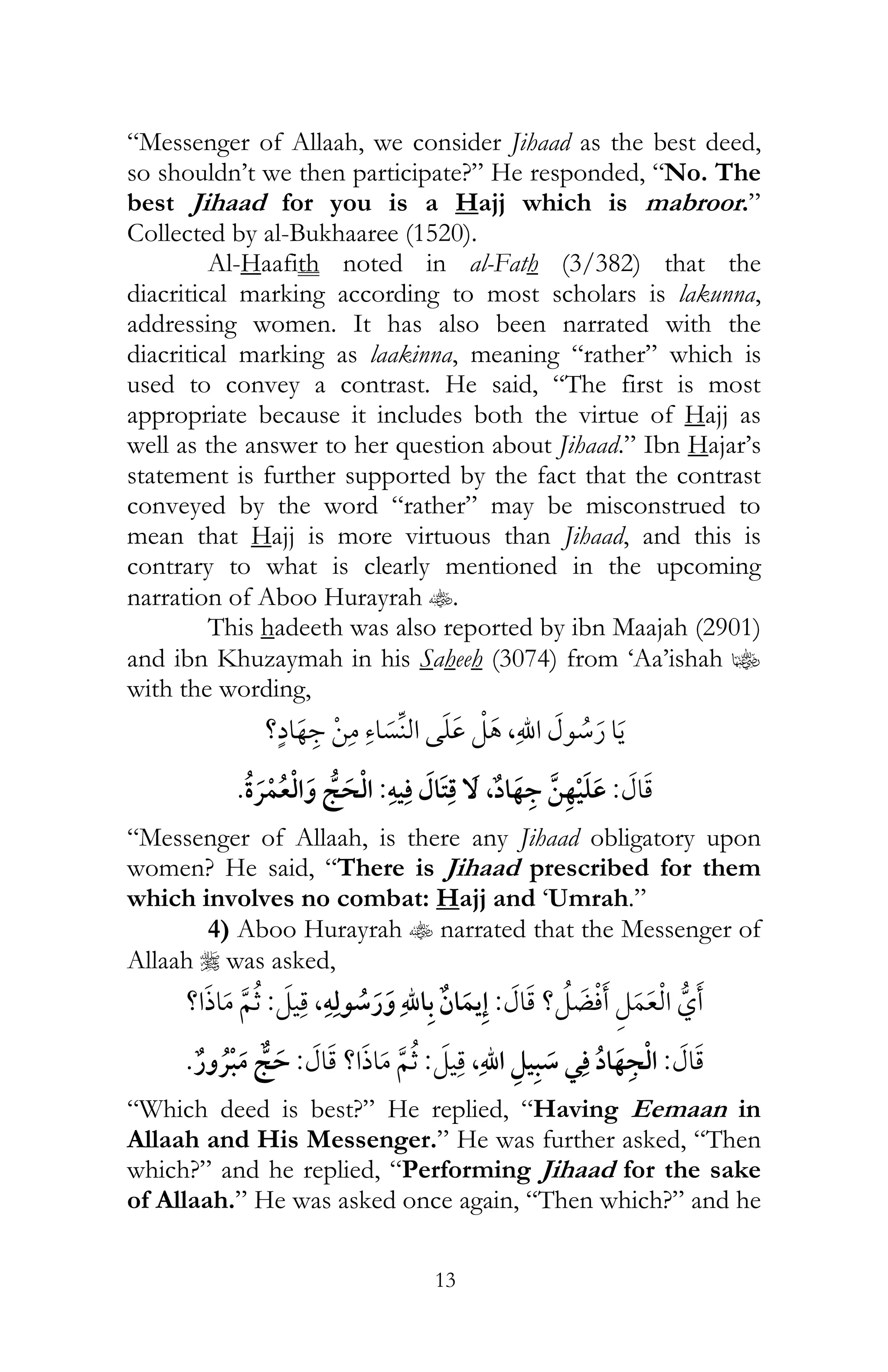
“Messenger of Allaah, we consider Jihaad as the best deed,
so shouldn’t we then participate?” He responded, “No. The
best Jihaad for you is a Hajj which is mabroor.”
Collected by al-Bukhaaree (1520).
Al-Haafith noted in al-Fath (3/382) that the
diacritical marking according to most scholars is lakunna,
addressing women. It has also been narrated with the
diacritical marking as laakinna, meaning “rather” which is
used to convey a contrast. He said, “The first is most
appropriate because it includes both the virtue of Hajj as
well as the answer to her question about Jihaad.” Ibn Hajar’s
statement is further supported by the fact that the contrast
conveyed by the word “rather” may be misconstrued to
mean that Hajj is more virtuous than Jihaad, and this is
contrary to what is clearly mentioned in the upcoming
narration of Aboo Hurayrah t.
This hadeeth was also reported by ibn Maajah (2901)
and ibn Khuzaymah in his Saheeh (3074) from ‘Aa’ishah z
with the wording,
,?
:ï ,:¯
“Messenger of Allaah, is there any Jihaad obligatory upon
women? He said, “There is Jihaad prescribed for them
which involves no combat: Hajj and ‘Umrah.”
4) Aboo Hurayrah t narrated that the Messenger of
Allaah r was asked,
?:ï,:?
:¯,:?:¯
“Which deed is best?” He replied, “Having Eemaan in
Allaah and His Messenger.” He was further asked, “Then
which?” and he replied, “Performing Jihaad for the sake
of Allaah.” He was asked once again, “Then which?” and he
14
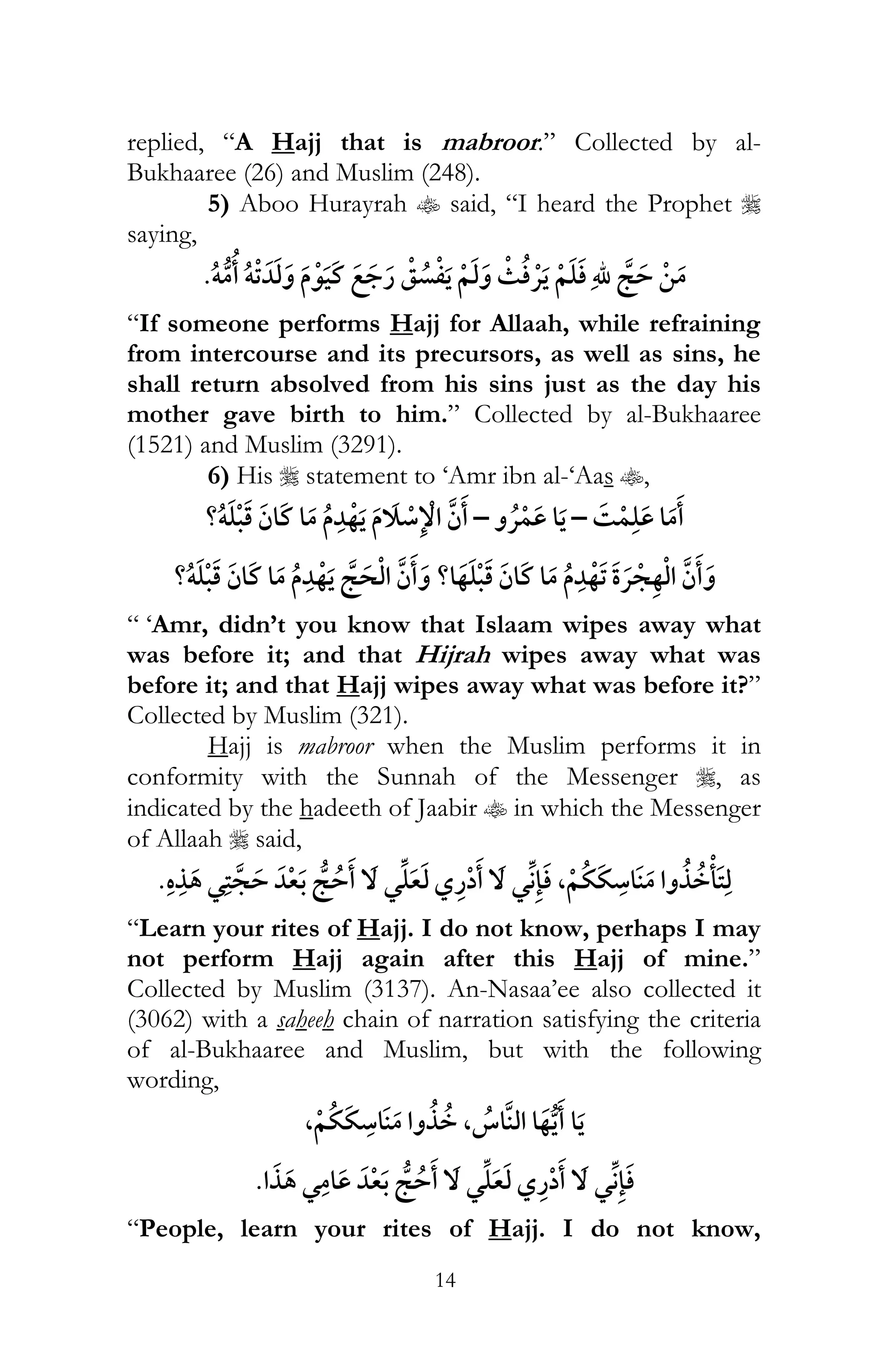
replied, “A Hajj that is mabroor.” Collected by al-
Bukhaaree (26) and Muslim (248).
5) Aboo Hurayrah t said, “I heard the Prophet r
saying,
¯ï ï
“If someone performs Hajj for Allaah, while refraining
from intercourse and its precursors, as well as sins, he
shall return absolved from his sins just as the day his
mother gave birth to him.” Collected by al-Bukhaaree
(1521) and Muslim (3291).
6) His r statement to ‘Amr ibn al-‘Aas t,
¯–¯–?ï
?ï ? ¯
“ ‘Amr, didn’t you know that Islaam wipes away what
was before it; and that Hijrah wipes away what was
before it; and that Hajj wipes away what was before it?”
Collected by Muslim (321).
Hajj is mabroor when the Muslim performs it in
conformity with the Sunnah of the Messenger r, as
indicated by the hadeeth of Jaabir t in which the Messenger
of Allaah r said,
¯ ¯ ¯ ,
“Learn your rites of Hajj. I do not know, perhaps I may
not perform Hajj again after this Hajj of mine.”
Collected by Muslim (3137). An-Nasaa’ee also collected it
(3062) with a saheeh chain of narration satisfying the criteria
of al-Bukhaaree and Muslim, but with the following
wording,
, ,
¯ ¯¯
“People, learn your rites of Hajj. I do not know,
15
perhaps I may not perform Hajj again after this year of
mine.”
For Hajj to be mabroor, one must also stay away from
marital relations, sins, and everything that is prohibited while
in the state of Ihraam. The indicator of a Muslim’s Hajj being
mabroor is for him to transform after Hajj from bad to good,
or from good to even better. If he was afflicted with
committing sins prior to Hajj, he must sincerely repent
during Hajj, completely abandon the sins, regret what he had
done, and firmly resolve to not return to them in the future.
If the sins involved taking the property of others, he must
return those things to them unless they pardon him. If the
sins involved harm done to others by word or deed, he must
seek their pardon, unless he knows that informing them will
lead to greater evil, division, or hatred. In that case, he
simply seeks their pardon with general words while praising
them as they rightfully deserve, and also praying for them.
Thus, by performing Hajj, he opens for himself the gates of
goodness, and begins a new life filled with Taqwaa of Allaah,
and diligent obedience to the commands of Allaah. If one
was in a bad state prior to Hajj and he remains so
afterwards, that is an indication that he was unsuccessful in
attaining a Hajj that is mabroor.
The sins expiated by good deeds – such as Salaat,
Hajj, and others – are the minor ones, as in the statement of
Allaah U,
{ihgfedcbjz
“If you avoid the major sins from which you are
forbidden, We shall forgive you for your lesser sins.” [an-
Nisaa’ (4):31]. It is also based on the statement of the
Prophet r,
, , ,
¯ ¯ ¯
16
“The five daily prayers, one Friday to the next Friday,
and one Ramadaan to the next Ramadaan are expiation
for what occurred between them, as long as the major
sins are avoided.” Collected by Muslim (552) from Aboo
Hurayrah t.
Major sins, however, are only expiated by
repentance. Hence, when one performing Hajj repents from
sins, major and minor, he returns from Hajj sinless, just as
the day his mother bore him. However, if he does not
repent from them, and still commits them or is determined
to do so, he will be held to account for that.
Regarding the statement of Allaah U,
{dcba`_~
nmlkjihgfez
“Whoever does a good deed shall have the reward of
ten like it, and whoever does a bad deed shall receive
no recompense except for it alone, and no wrong shall
be done to them” [al-An‘aam (6):160], ibn Katheer
commented
You must realize that any time a person does not
commit a sin, he is one of three people.
The first is a person who forsakes the sin
for Allaah. Thus, a good deed is recorded for
him, due to him avoiding the sin for Allaah, the
Most Exalted. This deliberate avoidance involves
action and intention, and this is why a good deed
is recorded for him, as reflected by the wording
of some narrations in the saheeh collections
[Muslim (336) and similar to it al-Bukhaaree
(7501)]
¯ ¯ ¯ ï
“since he left it for My sake.”
The second type is a person who leaves
the sin out of forgetfulness or being oblivious to
17
it. Thus, nothing is recorded for or against him,
because he neither intended good nor committed
evil.
The third type is a person who desists
from the sin out of inability and laziness, after
having sought out the means that would enable
him to commit the sin. Such an individual is
considered the same as one who actually commits
it, as reported in a saheeh narration where the
Prophet r said,
, ¯
:!?
:ï ¯ ï
“If two Muslims confront each other with
their swords drawn, the assassin and the
victim will both be in the hellfire.” They said,
“Messenger of Allaah! This applies to the
assassin, but what about the victim?” He replied,
“He eagerly desired to kill his companion.
[Collected by al-Bukhaaree (31) and Muslim
(7253) from Aboo Bakrah t].
The Obligation of Hajj and ‘Umrah
Hajj and ‘Umrah are both obligatory as soon as one
is able to perform them. They are obligatory once in a
lifetime, and whatever is beyond that is optional. They may
also become obligatory if someone vows to do so. Thus, if
someone makes a vow to perform Hajj or ‘Umrah, it is
obligatory for him to fulfill his vow. Furthermore, when one
begins an optional Hajj or ‘Umrah, he must complete it
based on the statement of Allaah U,
{¥¤£¢z
“And complete Hajj and ‘Umrah for Allaah.” [al-Baqarah
(2):196].
18
Hajj is obligatory based on evidence from the
Qur’aan, Sunnah, and scholarly consensus. Allaah U says,
{¦¥¤£¢¡~}|
¨§®¬«ª©z
“And performance of Hajj at the House is an obligation
people must fulfill for Allaah if able to do so; and if
anyone rejects it, then Allaah does not need any of His
creation.” [Aali ‘Imraan (3):97].
The Prophet r said,
¯:, ï
, , , ,
“Islaam is built upon five: testifying that none has the
right to be worshipped except Allaah, and that
Muhammad is the Messenger of Allaah; establishing
Salaat; giving Zakaat; performing Hajj; and fasting
Ramadaan.” Collected by al-Bukhaaree (8) and Muslim
(113) from ‘Abdullaah ibn ‘Umar C.
The Prophet r also said in the well-known hadeeth
of Jibreel,
ï,
, , ¯ ,
¯ ¯ï
“Islaam is that you testify that none has the right to be
worshipped except Allaah, and that Muhammad is the
Messenger of Allaah; establish Salaat; give Zakaat; fast
Ramadaan; and perform Hajj at the House if you are
able to do so.” Collected by Muslim (93) from ‘Umar ibn
al-Khattaab t.
19
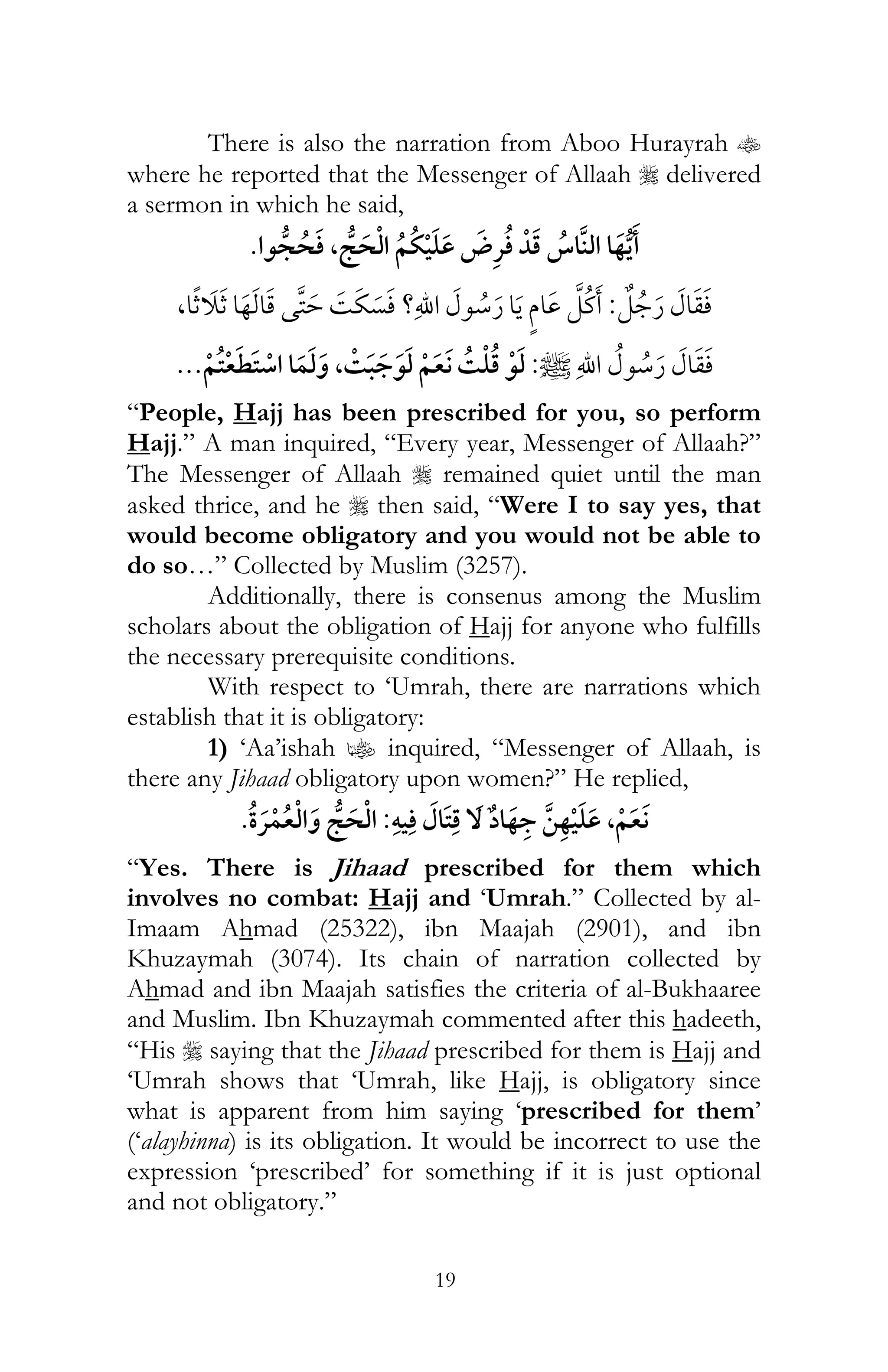
There is also the narration from Aboo Hurayrah t
where he reported that the Messenger of Allaah r delivered
a sermon in which he said,
¯,
:, ¯ ?
:,¯ ¯
“People, Hajj has been prescribed for you, so perform
Hajj.” A man inquired, “Every year, Messenger of Allaah?”
The Messenger of Allaah r remained quiet until the man
asked thrice, and he r then said, “Were I to say yes, that
would become obligatory and you would not be able to
do so…” Collected by Muslim (3257).
Additionally, there is consenus among the Muslim
scholars about the obligation of Hajj for anyone who fulfills
the necessary prerequisite conditions.
With respect to ‘Umrah, there are narrations which
establish that it is obligatory:
1) ‘Aa’ishah z inquired, “Messenger of Allaah, is
there any Jihaad obligatory upon women?” He replied,
ï ,:¯
“Yes. There is Jihaad prescribed for them which
involves no combat: Hajj and ‘Umrah.” Collected by al-
Imaam Ahmad (25322), ibn Maajah (2901), and ibn
Khuzaymah (3074). Its chain of narration collected by
Ahmad and ibn Maajah satisfies the criteria of al-Bukhaaree
and Muslim. Ibn Khuzaymah commented after this hadeeth,
“His r saying that the Jihaad prescribed for them is Hajj and
‘Umrah shows that ‘Umrah, like Hajj, is obligatory since
what is apparent from him saying ‘prescribed for them’
(‘alayhinna) is its obligation. It would be incorrect to use the
expression ‘prescribed’ for something if it is just optional
and not obligatory.”
20
2) The statement of the Prophet r which was
narrated by ‘Umar t in the hadeeth of Jibreel,
, , ï
,¯ , ¯ ,
, ,
“Islaam is that you testify that none has the right to be
worshipped except Allaah, and that Muhammad is the
Messenger of Allaah; establish Salaat; give Zakaat;
perform Hajj and ‘Umrah; perform ghusl from
janaabah; perform wudoo’ completely and perfectly;
and fast Ramadaan.” Collected by ibn Khuzaymah (3065)
with a saheeh chain of narrators who are all thiqah (having
sound integrity and impeccable retention), and also by ad-
Daaraqutnee (2/282) who said, “It has a verified saheeh chain
of narration.”
3) Aboo Razeen al-‘Uqaylee t narrated that he went
to the Prophet r and said, “Messenger of Allaah, my father
is an old man who cannot perform Hajj or ‘Umrah, or even
sit on a mount.” He responded,
¯
“Perform Hajj on behalf of your father, and perform
‘Umrah [on his behalf].” Collected by at-Tirmithee (930)
who said, “This is a hasan saheeh hadeeth,” and it fulfills the
criteria of Muslim.
4) As-Subayy ibn Ma‘bad said to ‘Umar ibn al-
Khattaab t, “Ameer al-Mu’mineen, I used to be a Christian
bedouin and I later accepted Islaam. I was eagerly looking
forward to participating in Jihaad, but I found out that Hajj
and ‘Umrah are obligatory for me to perform. So, I went to
a man among my people and he told me, ‘Combine the two
of them [Hajj and ‘Umrah] and offer the sacrifice that is
within your means.’ Thus, I set out with the intention of
21
combining them.” ‘Umar t said to him, “You were guided
to the Sunnah of your Prophet r.” Collected by Aboo
Daawood (1799) with a saheeh chain of narrators satisfying
the criteria of al-Bukhaaree and Muslim.
Prerequisites (Shuroot)
of Hajj and ‘Umrah
Hajj and ‘Umrah are both obligatory upon every
Muslim who is of sound mind, mature, free, and capable;
there is an additional sixth prerequisite for women, which is
that they must have a mahram who will travel with them.
[1) Islaam]
A non-Muslim is not commanded to perform Hajj
or ‘Umrah prior to accepting Islaam. Even if he was to
perform them, neither would be deemed valid because he
must have Eemaan first in order to fulfill the foundational
obligation. However, he will still be held to account for the
subsidiary branches of the Sharee‘ah stemming from that
foundation, according to the correct scholarly view about
this issue. Allaah U has said,
{y{z
}|b a`_~cz
“And punishment and destruction await those who
associate partners with Allaah; those who do not give
Zakaat and they deny the hereafter.” [Fussilat (41):6-7].
This view is also based on the answer given by kuffaar as to
why they entered the hellfire:
{ñðïîíüûȋöõôóò
‫ﰨ‬‫ﰩ‬‫ﰪ‬‫ﰫ‬‫ﰬ‬‫ﰲ‬‫ﰱ‬‫ﰰ‬‫ﰯ‬ ‫ﰮ‬ ‫ﰭ‬z
“They said: We were not among those who prayed; we
22
did not feed the poor; we would indulge in ill-talk along
with others; and we used to deny the Day of
Reckoning; until death came to us.” [al-Muddaththir
(74):43-47]. Allaah also said,
{rxwvu tsyz
“Thus, he neither had Eemaan nor did he pray.
Instead, he belied and turned away.”[al-Qiyaamah (75):31-
32].
The reason behind addressing them about the
subsidiary branches is that they shall be taken to account for
neglecting both the foundations and the branches. For this
reason, the kuffaar will be at various depths in the hellfire,
just as the Muslims will be at various ranks in Jannah. The
disparity among the kuffaar in the depths of the hellfire is
based on the severity of their kufr; the munaafiqoon, majoos,
and people of the scripture, for instance, have varying
degrees of kufr. The disparity is also based on the extent of
their harm and how much they divert others from the path
of Allaah. This is as Allaah U said,
{FEDC BA
MLKJ IHGz
“Those who committed kufr and diverted others from
the path of Allaah – We shall increase them in torment
beyond their punishment due to the corruption they
spread.” [an-Nahl (16):88]. Ibn Katheer explained that this
means punishment for their kufr and punishment for
diverting people from following the truth. Allaah U also
said,
{©¨§¦¥¤ £¢
°¯® ¬«ªz
“Indeed, those who committed kufr after having
23
Eemaan, and then increased in kufr, their repentance
will not be accepted, and they are the ones who are
astray.” [Aali ‘Imraan (3):90]. Allaah also said,
{¥¤£¢¡ ~}|
°¯®¬«ª©¨§ ¦z
“Certainly, those who commit kufr and persist in doing
so – Allaah shall never forgive them or guide them to
any path; except the path to the hellfire, to abide there
eternally.” [an-Nisaa’ (4):168-169].
[2) Sound Mind]
A mentally unsound person is not commanded to
perform Hajj or ‘Umrah, and neither would be valid if he
was to perform them, due to him lacking the faculty of
reasoning. This is based on the statement of the Prophet r,
:,¯
, ¯
“The pen has been lifted from three: the sleeping until
he wakes, the young until he matures, and the insane
until he regains his mental faculty.” Collected by Aboo
Daawood (4403) from ‘Alee t with a saheeh chain of
narration which satisfies the criteria of al-Bukhaaree and
Muslim. There are also saheeh narrations about this from
‘Aa’ishah and ibn ‘Abbaas y.
[3 and 4) Maturity and Freedom]
Hajj and ‘Umrah are not obligatory upon a child or
slave. However, if they were to perform them, that would be
acceptable as an optional Hajj or ‘Umrah, and whoever
brought them would be rewarded as well. This is based on
the narration from ibn ‘Abbaas C where he said, “A woman
raised her child up and said, ‘Messenger of Allaah, is his Hajj
valid?’ He replied,
24
¯ ,
‘Yes; and you will be rewarded.’” Collected by Muslim
(3254).
Also, al-Bukhaaree collected in his Saheeh (1858) that
as-Saa’ib ibn Yazeed C said, “I was taken for Hajj with the
Messenger of Allaah r when I was seven years old.”
However, that does not fulfill the obligatory Hajj
which a pillar of Islaam. Therefore, when a child matures, or
a slave is freed, he must perform Hajj again. This is based on
the statement of ibn ‘Abbaas C, “Memorize the following
from me, and do not say it is the statement of ibn ‘Abbaas.
Any slave taken for Hajj by his master must perform Hajj
once free, and any child taken for Hajj by his family must
perform Hajj once becoming an adult...” Collected by ibn
Abee Shaybah (14875) with a saheeh chain of narration. Ibn
Abee Shaybah was a Shaykh of al-Bukhaaree and Muslim,
and his chain of narration fulfills their criteria. In addition,
al-Bayhaqee (4/325) collected this same narration, but in his
version it was quoted as a statement of the Messenger of
Allaah r himself. Also, the fact that ibn ‘Abbaas C said,
“Memorize the following from me, and do not say it is the
statement of ibn ‘Abbaas,” implies that it was said by the
Messenger of Allaah r.
[5) Ability]
To perform Hajj, one must also be both physically
and financially capable, based on the statement of Allaah U,
{¥¤£¢ ¡ ~}|z
“And performance of Hajj at the House is an obligation
people must fulfill for Allaah if able to do so.” [Aali
‘Imraan (3):97]. Therefore, Hajj and ‘Umrah are not
obligatory for someone unable to perform them due to old
age, chronic illness, or lacking sufficient funds despite being
able-bodied. If someone has enough money, but is not
physically able, he must depute someone else to perform
25
Hajj and ‘Umrah on his behalf. This is permissible based on
the previously mentioned narration of Aboo Razeen al-
‘Uqaylee, where he went to the Prophet r and said,
“Messenger of Allaah, my father is an old man who cannot
perform Hajj or ‘Umrah, or even sit on a mount.” The
Prophet r responded, “Perform Hajj on behalf of your
father, and perform ‘Umrah [on his behalf].”
In addition al-Fadl ibn ‘Abbaas C narrated that a
woman from Khath‘am came during the year of the Farewell
Hajj and said, “Messenger of Allaah, the obligation from
Allaah upon His servants to perform Hajj has found my
father as an old man who can no longer sit upright on a
mount. Would it fulfill the obligation if I perform Hajj on
his behalf?” He replied, “Yes.” Collected by al-Bukhaaree
(1854) and Muslim (3252). This narration also shows the
validity of a woman performing Hajj on behalf of a man.
If someone dies without performing Hajj, a
sufficient amount – if available – is to be set aside from his
estate, and it is acceptable for someone else to perform Hajj
on his behalf. This is based on the narration of Buraydah ibn
al-Husayb t which mentions that a woman whose mother
died said to the Prophet r, “She never performed Hajj.
Should I perform Hajj on her behalf?” He replied,
¯
“Perform Hajj on her behalf.” Collected by Muslim
(2697).
A physically and financially able woman is still not
considered legally capable without the presence of a mahram
who will perform Hajj with her. This is based on the
statement of the Prophet r,
¯¯, ¯
¯:,¯ ¯ ¯
26
¯ ¯ ¯ ,,:¯
“A woman must not travel without a mahram, and no
man may enter her presence unless a mahram is with
her.” A man said, “Messenger of Allaah, I wish to join a
certain army, but my wife wishes to perform Hajj.” He told
him, “Go with her.” Collected by al-Bukhaaree (1862) and
Muslim (3272) from ibn ‘Abbaas C. Here, the Prophet r
advised the questioner not to participate in Jihaad so that he
could accompany his wife for Hajj.
If a woman performs Hajj without a mahram, her
Hajj is valid; however, she is sinful for having travelled
without a mahram. The presence of a mahram is a prerequisite
for the obligation of Hajj upon her, but not for its validity. A
woman residing in Makkah may perform Hajj with
trustworthy company since performing Hajj from Makkah
does not involve travel. For her, there is no prerequisite
condition of having a mahram.
A woman’s mahram can be her husband, as well as
anyone whom she is permanently prohibited from marrying,
either based on lineage or any other legitimate reason. The
mahram based on lineage includes her father, son, brother,
paternal uncle, and maternal uncle.
Other legitimate reasons that make someone a
mahram are the relationships which result from nursing and
marriage. The mahram based on relationships resulting from
nursing includes her milk-father, milk-son, milk-brother, and
paternal and maternal milk-uncles. The mahram based on
relationships resulting from marriage include her father-in-
law [husband’s father], stepson [husband’s son], stepfather
[mother’s husband] who has consummated the marriage,
and son-in-law [daughter’s husband].
“Legitimate reasons” was mentioned to exclude a
mulaa‘in (former husband from a marriage dissolved due to
accusation of adultery). Although the woman is permanently
prohibited from marrying that man, he is still not a mahram
27
for her.
Likewise, a man is not a mahram for a woman whom
he cannot marry for a temporary reason, such as his wife’s
sister, her paternal aunt, maternal aunt, and her niece
[brother’s or sister’s daughter], because one can only be a
mahram for someone to whom marriage is permanently
impermissible.
Pillars (Arkaan) of Hajj and ‘Umrah
The pillars are those acts which must be completed
and may not be substituted by anything else. ‘Umrah has
three pillars: Ihraam, Tawaaf, and Sa‘y. Hajj also has these
three as essential elements along with an additional fourth,
which is being present at ‘Arafah.
[1) Ihraam]
Ihraam is the intention to commence the rites of Hajj
or ‘Umrah, and such does not take place without firm
intention in the heart, based on the saying of the Prophet r,
¯ ,
“Indeed, all actions are only by intentions, and every
person shall certainly have only what he intended.”
Collected by al-Bukhaaree (1) and Muslim (4927) from
‘Umar ibn al-Khattaab t. Ibn al-Munthir said in al-Ijmaa‘
(pg. 55), “The scholars have agreed that if someone intended
to commence Hajj, but mistakenly said ‘Umrah in his initial
Talbiyah, or intended ‘Umrah but said Hajj, the intention in
his heart is what is given consideration, not the statement he
uttered.”
[2 and 3) Tawaaf and Sa‘y ]
The Tawaaf which is a pillar of Hajj is Tawaaf al-
Ifaadah, and it is performed after departure from ‘Arafah and
Muzdalifah, based on the statement of Allaah U,
{¤£¢z
28
“And they must perform Tawaaf at the ancient,
protected House.” [al-Hajj (22):29]. It is also based on the
narration from ‘Aa’ishah z where she said, “We performed
Hajj with the Messenger of Allaah r, and after performing
Tawaaf al-Ifaadah on the Day of Sacrifice, Safiyyah had her
menses. The Prophet r desired from her what a man desires
from his wife, so I told him,
,:?¯
:,¯ ¯:¯
‘Messenger of Allaah, she is on her menses.’ He said, ‘Is she
going to keep us back?’ They replied, ‘Messenger of
Allaah, she performed Tawaaf al-Ifaadah on the Day of
Sacrifice,’ so he said, ‘Then leave.’” Collected by al-
Bukhaaree (1733) and Muslim (3223).
His statement, “Is she going to keep us back”
meant “is she going to detain us in Makkah until her menses
finish and she then performs Tawaaf al-Ifaadah?” Ibn
Qudaamah commented on this in al-Mughnee (5/311) saying
[Tawaaf] is a pillar of Hajj without which Hajj
remains incomplete. We do not know of any
scholarly contention about this, as Allaah U said,
‘And they must perform Tawaaf at the
ancient, protected House.’ Ibn ‘Abdil-Barr said
it is among the mandatory duties (faraa’id) of Hajj
and there is no scholarly contention about that.
The Tawaaf which is a pillar of ‘Umrah is the first
one performed upon arriving in Makkah. The author of
Bidaayah al-Mujtahid (1/344) said, “The scholars have agreed
that there is no [Tawaaf] obligatory upon someone
performing ‘Umrah except Tawaaf al-Qudoom,” and that
refers to the Tawaaf during ‘Umrah. Ibn Qudaamah also said
in al-Mughnee (5/312) while discussing the evidences for
Tawaaf al-Ifaadah being a pillar (rukn) of Hajj, “And since
Hajj is one of the two sets of rites performed, Tawaaf is a
29
pillar of it just as it is for ‘Umrah.”
Linguistically, ‘Umrah means a visit. In the legal,
religious context, it refers to visiting the Ka‘bah to perform
Tawaaf there, along with Sa‘y between as-Safaa and al-
Marwah. The Prophet r performed Tawaaf around the
Ka‘bah and Sa‘y between as-Safaa and al-Marwah during
‘Umrah al-Qadaa’ and ‘Umrah from al-Ji‘irraanah. Al-
Bukhaaree (1793) and Muslim (2999) collected the narration
where ‘Amr ibn Deenaar said, “We asked ibn ‘Umar C if it
was permissible for a person who finished Tawaaf during
‘Umrah, but not Sa‘y between as-Safaa and al-Marwah, to
engage in marital relations with his wife. He told us, ‘The
Prophet r came, performed seven circuits of Tawaaf around
the House, performed two rak‘ah of prayer behind the
Maqaam, and went between as-Safaa and al-Marwah seven
times; and you have for yourselves, in the Messenger of
Allaah, a fine example.’”
Thus, Sa‘y for ‘Umrah is done after Tawaaf based on
the action of the Prophet r when he performed ‘Umrah al-
Qadaa’ and ‘Umrah from al-Ji‘irraanah, as well as the
narration of ibn ‘Umar C.
The Sa‘y of Hajj is to be done after Tawaaf al-Ifaadah
by anyone performing Tamattu‘. As for those performing
Qiraan or Ifraad, Sa‘y may be done following either Tawaaf al-
Qudoom or Tawaaf al-Ifaadah. If one does not perform Sa‘y
after Tawaaf al-Qudoom, he must do so after Tawaaf al-Ifaadah.
Allaah U said,
{{zyxwv u
f edcba `_~}|z
“Indeed, as-Safaa and al-Marwah are among the rites of
Allaah. Thus, when someone comes to the House for
Hajj or ‘Umrah, there is no sin upon him for
performing Sa‘y between the two of them.” [al-Baqarah
(2):158].
30
Also, the Messenger of Allaah r said, “People,
perform Sa‘y. Indeed, Sa‘y has been prescribed for you.”
Collected by ad-Daaraqutnee (2/255), and al-Bayhaqee also
collected it (5/97) through ad-Daaraqutnee’s chain of
narration. The narrators of ad-Daaraqutnee are thiqah
(having sound integrity and impeccable retention) except for
Ma‘roof ibn Mushkaan, and ibn Hajar said in at-Taqreeb that
he is sadooq (a narrator with sound integrity and good
retention). Therefore, the chain of narration for this hadeeth
is hasan. An-Nawawee graded it hasan in al-Majmoo‘ (8/82),
and al-Mizzee and ibn ‘Abdil-Haadee both graded it saheeh.
The interested reader can refer to Irwaa’ al-Ghaleel (1072) of
ash-Shaykh al-Albaanee ? where he mentioned other routes
of narration for this hadeeth.
‘Aa’ishah z said, “Allaah does not consider
anyone’s Hajj or ‘Umrah complete if he does not perform
Sa‘y between as-Safaa and al-Marwah.” Collected by al-
Bukhaaree (1790) and Muslim (3080). Ibn Jareer – in his
Tafseer of the aayah from Soorah al-Baqarah – mentioned this
narration with a slight variation in wording which says, “I
swear! If someone does not perform Sa‘y between as-Safaa
and al-Marwah, he has not performed Hajj because Allaah,
Most Glorious and Exalted, said ‘Indeed as-Safaa and al-
Marwah are among the rites of Allaah.’” Its chain of
narration satisfies the criteria of al-Bukhaaree and Muslim.
There is scholarly consensus about these three being
pillars of Hajj and ‘Umrah, with the exception of Sa‘y which
the majority of scholars regard as a pillar.
[4) Being Present at ‘Arafah ]
The additional fourth pillar which applies to Hajj is
being present at ‘Arafah. Allaah U has said,
{o nmlz
“Therefore, when you depart from ‘Arafaat…” [al-
Baqarah (2):198]. Departure from ‘Arafah can only take place
after having already been there. Being present at ‘Arafah is
31
the pillar of Hajj which, if missed, renders one’s Hajj null.
This is based on the narration of ‘Abdur-Rahmaan ibn
Ya‘mar t who said, “I saw some people from Najd come to
Messenger of Allaah r while he was in ‘Arafah. They said,
‘Messenger of Allaah, how is Hajj to be performed?’ He
replied,
, ¯¯ï
‘Hajj is ‘Arafah, so whoever comes [to ‘Arafah] before
Fajr prayer, during the night of Muzdalifah, his Hajj is
valid.’” This narration is in the four Sunan collections, and
this is the wording collected by ibn Maajah (3015). It has a
saheeh chain of narration which satisfies the criteria of al-
Bukhaaree and Muslim, except for Bukayr ibn ‘Ataa’ who is
thiqah. Ibn al-Munthir said in al-Ijmaa‘ (pg. 64), “The scholars
have agreed that being present at ‘Arafah is mandatory, and
there is no Hajj for someone who was not present at
‘Arafah.”
Obligatary Rites (Waajibaat)
of Hajj and ‘Umrah
The obligatory rites of Hajj and ‘Umrah are those
acts which must be performed. If one omits any obligatory
rite, he must compensate for it by offering a sacrifice. He is
not permitted to eat from the sacrifice, and instead must
distribute it to the needy of the haram. This is based on the
statement of ibn ‘Abbaas C, “Whoever forgot or omitted
any of his rites must offer a sacrifice.” Collected by Maalik
in al-Muwatta’ (1/419) with a saheeh chain of narration.
There are two obligatory rites for ‘Umrah and seven
for Hajj.
1) Assuming Ihraam from the Meeqaat
The Messenger r delineated these places and said,
32
¯ ,, ¯
,
“They are for their residents, as well as everyone who
comes to them from elsewhere, intending to perform
Hajj or ‘Umrah. If someone resides within those
boundaries, he assumes Ihraam from wherever he sets
out; even the residents of Makkah assume Ihraam from
Makkah.” Collected by al-Bukhaaree (1845) and Muslim
(2804) from ibn ‘Abbaas C. Thus, if someone comes to any
meeqaat point and wishes to perform Hajj or ‘Umrah –
regardless of whether or not he is a resident of the area
specific to that meeqaat – he must assume Ihraam from it.
2) Shaving the Head or Shortening the Hair
Upon Exiting Ihraam
This applies to both Hajj and ‘Umrah. Allaah U
said,
{¨§¦¥¤£¢¡ª©
µ´ ³ ²±°¯®¬«z
“Allaah shall most certainly fulfill for His Messenger
the vision he saw with truth. You shall indeed enter al-
Masjid al-Haraam, if Allaah wills, in safety; some with
heads shaved and some with hair shortened, having no
fear.” [al-Fath (48):27], and also based on His statement,
{¶µ´ ³² ±°¯z
“And do not shave your heads until the sacrificial
animal reaches the place of sacrifice.” [al-Baqarah
(2):196]. Doing so is also based on the statement of the
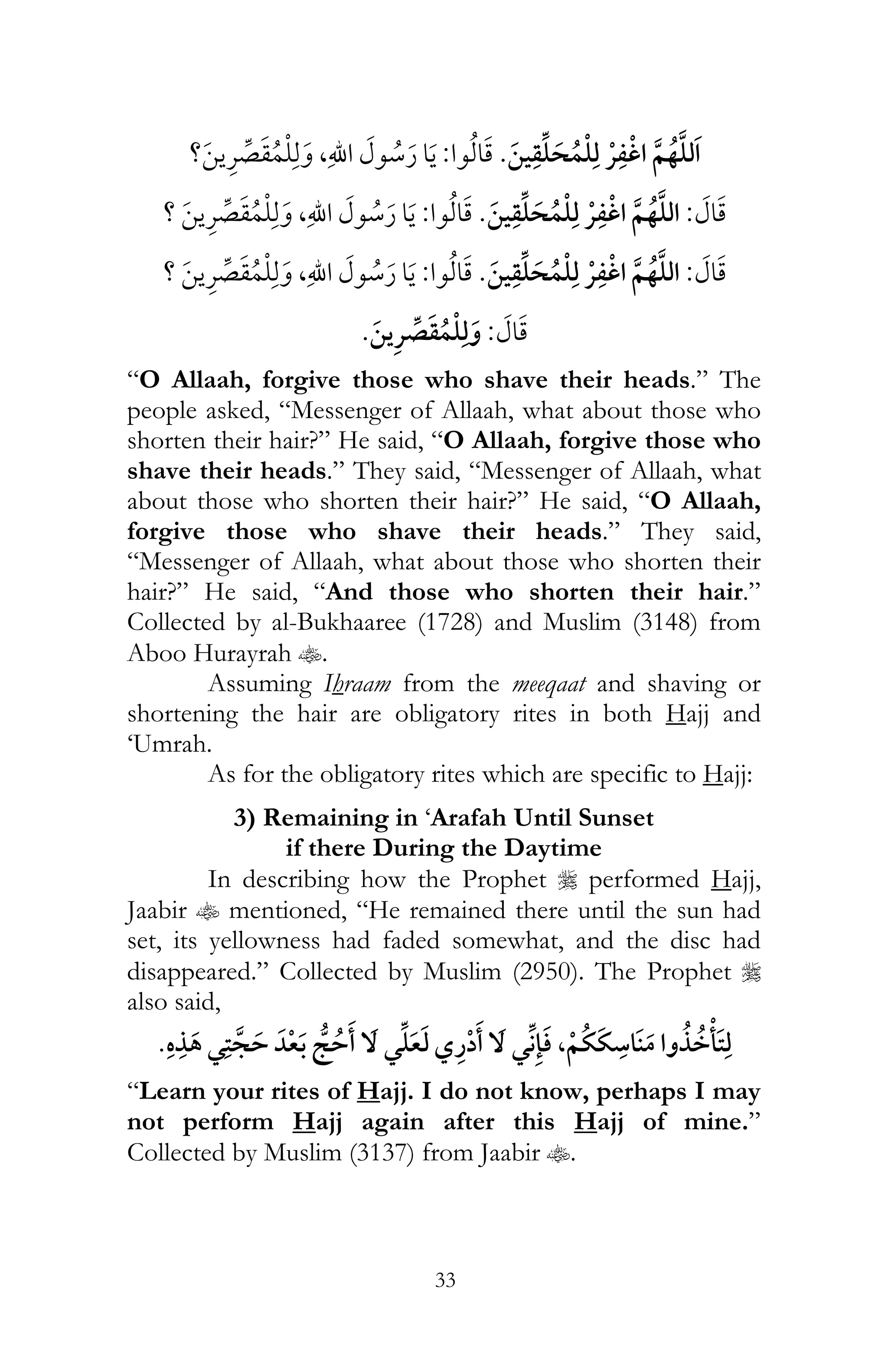
Messenger r,
33
¯:,? ¯
:¯:,? ¯
:¯:,? ¯
:¯
“O Allaah, forgive those who shave their heads.” The
people asked, “Messenger of Allaah, what about those who
shorten their hair?” He said, “O Allaah, forgive those who
shave their heads.” They said, “Messenger of Allaah, what
about those who shorten their hair?” He said, “O Allaah,
forgive those who shave their heads.” They said,
“Messenger of Allaah, what about those who shorten their
hair?” He said, “And those who shorten their hair.”
Collected by al-Bukhaaree (1728) and Muslim (3148) from
Aboo Hurayrah t.
Assuming Ihraam from the meeqaat and shaving or
shortening the hair are obligatory rites in both Hajj and
‘Umrah.
As for the obligatory rites which are specific to Hajj:
3) Remaining in ‘Arafah Until Sunset
if there During the Daytime
In describing how the Prophet r performed Hajj,
Jaabir t mentioned, “He remained there until the sun had
set, its yellowness had faded somewhat, and the disc had
disappeared.” Collected by Muslim (2950). The Prophet r
also said,
¯ ¯ ¯ ,
“Learn your rites of Hajj. I do not know, perhaps I may
not perform Hajj again after this Hajj of mine.”
Collected by Muslim (3137) from Jaabir t.
34
4) Spending the Night in Muzdalifah
Allaah U said,
{qpo nml
t srz
“Therefore, when you depart from ‘Arafaat, engage in
thikr of Allaah at al-Mash‘ar al-Haraam.” [al-Baqarah
(2):198] Al-Mash‘ar al-Haraam refers to Muzdalifah.
It is also based on the Prophet r having spent all
night there until the morning, and granting a concession to
the weak among women and children to leave for Minaa
towards the end of the night. This was collected by al-
Bukhaaree (1676) and Muslim (3130) from ibn ‘Umar C. It
was also collected by al-Bukhaaree (1677) and Muslim
(3126) from ibn ‘Abbaas C. The fact that the Prophet r
granted this concession implies that it is obligatory to spend
the night in Muzdalifah, because if that was not the case
there would be no need to grant a concession.
5) Stoning the Jamaraat
Stoning Jamrah al-‘Aqabah on the Day of Sacrifice, before or
after zawaal, and stoning the three jamaraat after zawaal
during the days of tashreeq also comprise an obligatory rite.
Jaabir t stated, “The Messenger of Allaah r stoned the
[third] jamrah on the Day of Sacrifice in the morning. On
subsequent days, he did so after zawaal (once the sun began
its descent after midday).” Collected by Muslim (3141).
Ibn ‘Abbaas C also narrated,
¯, ¯:¯
ï:¯ ¯:¯ ¯
:¯ ¯:¯
“The Prophet r was asked questions while in Minaa on the
35
Day of Sacrifice to which he replied, “There is no harm in
doing that.” A man said, “I shaved my head before
sacrificing.” He r responded, “Sacrifice and there is no
harm in doing that.” He said, “I stoned after zawaal.” He
r replied, “There is no harm in doing that.” Collected by
al-Bukhaaree (1735).
This is further supported by the statement ibn ‘Umar
C who said, “[On the days of tashreeq] we would wait until
after zawaal and then stone.” Collected by al-Bukhaaree
(1746). In addition, the narration from ‘Aasim ibn ‘Adee t
mentions “that the Messenger of Allaah r granted
concession to the shepherds allowing them not to spend the
night [in Minaa]. They would stone on the Day of Sacrifice,
and were allowed to combine stoning for the following two
days in one of the two.” Collected by an-Nasaa’ee (3069)
and others with a saheeh chain of narration. The concession
given by the Prophet r to shepherds allowing them to
combine stoning for two days into one, but not allowing
them to omit it altogether, implies that is an obligation.
6) Spending the Nights of Tashreeq in Minaa
There three nights for those who wish to delay, and
two for those who wish to hasten their departure. This is
based on the statement of Allaah U,
{K JIHGFEDCB
WVUTS RQPON MLz
“And engage in thikr of Allaah during the few
appointed days. Then, whoever hastens in two days,
there is no sin upon him; and whoever delays, there is
no sin upon him. This is for the one who observes
Taqwaa.” [al-Baqarah (2):203]. In addition, the Prophet r
spent those nights in Minaa and departed on the thirteenth
subsequent to stoning the jamaraat after zawaal.
Furthermore, shepherds, as well as individuals
responsible for supplying water to those performing Hajj,
36
were granted the concession by the Prophet r to not spend
the nights of tashreeq in Minaa. This is based on the
previously cited narration from ‘Aasim ibn ‘Adee in addition
to the narration of ibn ‘Umar C who said, “al-‘Abbaas ibn
‘Abdil-Muttalib sought permission from the Messenger of
Allaah r to remain in Makkah during the nights of tashreeq
in order to fulfill his responsibility of supplying people with
water, so he allowed him to so.” Collected by al-Bukhaaree
(1634) and Muslim (3177). The concession granted to water
suppliers and shepherds to not spend the nights in Minaa
implies that spending the nights there is an obligatory duty.
A similar concession applies to those who have
responsibilities which require them to be out of Minaa, such
as soldiers, doctors, and others like them.
7) Tawaaf al-Wadaa‘
The Prophet r performed Tawaaf al-Wadaa‘ when he
departed from Makkah, and ibn ‘Abbaas t also stated,
“People were commanded to make their last rite [Tawaaf al-
Wadaa‘] at the House, but women on their menses were
excused.” Collected by al-Bukhaaree (1755) and Muslim
(3220). The concession made for menstruating women to
omit Tawaaf al-Wadaa‘ shows that it is an obligatory act. This
concession also applies to those experiencing post-natal
bleeding.
Ibn ‘Abbaas C also said, “People were departing in
all directions [after leaving Minaa, some having performed
Tawaaf and others not], so the Messenger of Allaah r said,
¯ ¯ ¯
‘No one should leave without making his last rite
[Tawaaf al-Wadaa‘] at the House.’” Collected by Muslim
(3219).
Additionally, ‘Aa’ishah z narrated that Safiyyah had
her menses, so the Prophet r said, “Is she going to keep
us back?” But once he knew that she had already
performed Tawaaf al-Ifaadah on the Day of Sacrifice he said,
37
“Then leave.” Collected by al-Bukhaaree (1733) and
Muslim (3223), and it was mentioned previously in the
section entitled “Pillars (Arkaan) of Hajj and ‘Umrah.”
Recommended Acts (Mustahabbaat)
During Hajj and ‘Umrah
Recommended acts are those which one should
perform in Hajj and ‘Umrah so as to earn the reward for
them. If someone misses any of them, he is not sinful and is
not obliged to offer a sacrifice. However, if he neglects them
out of aversion to them, he is sinful in doing so because the
Messenger r said,
¯ ¯ ¯
“Whoever turns away from my Sunnah is not from me.”
Collected by al-Bukhaaree (5063) and Muslim (1401). The
word Sunnah in this narration refers to all that has come in
the Qur’aan and Sunnah, whether fard, waajib, or mustahabb.
The recommended acts of Hajj and ‘Umrah are
numerous. They include: [men] walking briskly and
uncovering the right shoulder during the initial Tawaaf
performed for Hajj or ‘Umrah upon arrival in Makkah;
kissing the Black Stone, touching it, or pointing to it during
Tawaaf and saying “Allaahu Akbar” when doing so; touching
the Yemeni corner; performing two rak‘ah of prayer after
Tawaaf, irrespective of whether the Tawaaf is obligatory or
optional; drinking Zamzam water; ascending as-Safaa and al-
Marwah and supplicating there while facing the qiblah; [men]
running between the designated markers during Sa‘y;
remaining in Minaa during the day on the eighth of Thul-
Hijjah, as well as the eve of ‘Arafah; raising one’s hands in
du‘aa’ after stoning the first and second jamaraat; saying
“Allaahu Akbar” when stoning the jamaraat; among other
encouraged practices.
38
The Meeqaat Points with Respect to
Place and Time
The meeqaat points with respect to place are the
locations at which someone must assume Ihraam before
passing them if he wishes to perform Hajj or ‘Umrah. These
locations were specified by the Messenger of Allaah r.
Ibn ‘Abbaas C stated, “The Messenger of Allaah r
set Thul-Hulayfah as the meeqaat for the people of al-
Madeenah; al-Juhfah for the people of ash-Shaam; Qarn al-
Manaazil for the people of Najd; and Yalamlam for the
people of Yemen. They are for their residents, as well as all
others who come to them from elsewhere, intending to
perform Hajj or ‘Umrah. If someone resides within those
boundaries, he assumes Ihraam from wherever he sets out;
even the residents of Makkah assume Ihraam from Makkah.”
Collected by al-Bukhaaree (1524) and Muslim (2803).
The statement, “the residents of Makkah assume
Ihraam from Makkah” refers to Ihraam for Hajj, since they do
so from their homes. However, assuming Ihraam for ‘Umrah
must be done from outside the boundaries of the haram area.
This is based on the Prophet r instructing ‘Aa’ishah z to
go outside the boundaries of the haram area and assume
Ihraam from at-Tan‘eem, as collected by al-Bukhaaree (1762)
and Muslim (2910) from ‘Aa’ishah z.
These two narrations show that the residents of
Makkah combine between being inside and outside of the
haram area when performing Hajj and ‘Umrah. These four
meeqaat points were also mentioned by ibn ‘Umar C, as
collected by al-Bukhaaree (133) and Muslim (2805).
The fifth meeqaat point is Thaatu ‘Irq which is for the
people of Iraq. It is mentioned along with the other four
meeqaat points in a narration from ‘Aa’ishah z collected by
an-Nasaa’ee (2656) with a saheeh chain of narrators who are
all thiqah. It was also mentioned individually in a narration
collected by Aboo Daawood (1739) where ‘Aa’ishah z said
39
that the Messenger of Allaah r designated Thaatu ‘Irq as the
meeqaat for the people of Iraq. Its narrators are the same as
those in the chain of an-Nasaa’ee except for the narrator
immediately before an-Nasaa’ee himself.
There is, however, a narration in Saheeh al-Bukhaaree
(1531) from ibn ‘Umar C saying, “When these two towns
[al-Basrah and al-Koofah] were conquered, people went to
‘Umar and said, ‘Ameer al-Mu’mineen! The Messenger of
Allaah r set Qarn as the meeqaat for the people of Najd, but
it is out of our way. It is quite difficult for us to travel to
Qarn if we wished to go there.’ He responded, ‘Then look
for an equivalent point along the way from your direction,’
and he set that point for them as Thaatu ‘Irq.”
This narration is understood to mean that the
previously mentioned hadeeth from the Prophet r had not
reached ‘Umar. As a result, he set Thaatu ‘Irq based on his
own judgement and reasoning, and this was one of several
instances where his view coincided with revelation.
If someone does not directly pass any of these
meeqaat points, he assumes Ihraam from a point that is in line
with them, whether coming by land, air, or sea. If he
assumes Ihraam prior to reaching the meeqaat, that is
acceptable, but not preferred. Ibn al-Munthir said in al-Ijmaa‘
(pg. 54), “The scholars have agreed that if someone assumes
Ihraam before reaching any of the meeqaat points, his Ihraam
is still valid.”
If someone passes any of the meeqaat points – or any
equivalent point – without intending to perform Hajj or
‘Umrah, he is not obliged to assume Ihraam. This is implied
by the statement of the Prophet r,
¯
“…intending to perform Hajj or ‘Umrah.”
If someone passes the meeqaat which applies to him
without assuming Ihraam, but then does so at a different
meeqaat, there is nothing wrong with that if he did not intend
40
to begin the rites from his own meeqaat. Examples of this
include a person who passes Yalamlam while coming from
Yemen but intends to visit al-Madeenah first, or a person
who arrives in Jeddah by plane but intends to travel to al-
Madeenah to visit the Masjid of the Messenger r and then
assume Ihraam from Thul-Hulayfah, which is the meeqaat for
the residents of al-Madeenah. Such people pass their own
meeqaat on the way to visit al-Madeenah, and then assume
Ihraam from the meeqaat which applies to al-Madeenah.
If someone assumes Ihraam from the meeqaat that
applies to him, but after arriving in Jeddah is compelled to
go to al-Madeenah, he must remain in the state of Ihraam. It
is not permissible for someone who has begun the rites of
Hajj or ‘Umrah to interrupt them; he must complete them
based on the statement of Allaah U,
{¥¤£¢z
“And complete Hajj and ‘Umrah for Allaah.” [al-Baqarah
(2):196].
The meeqaat points with respect to time are the
months during which one can assume Ihraam for Hajj and
‘Umrah. With respect to ‘Umrah, it can be performed at any
time of the year because there is no evidence confining it to
certain months. Ihraam for Hajj, however, can only be
assumed during the months of Shawwaal, Thul-Qa‘dah, and
the first ten nights of Thul-Hijjah, based on the statement of
Allaah U,
{HGFEDC BA
LK JIPON Mz
“Hajj is in the well-known months. Thus, those who
intend to perform Hajj during them must avoid
intercourse and its percursors, sins, and disputing
during Hajj.” [al-Baqarah (2):197]. These months were
specified by ibn ‘Umar C [as being Shawwaal, Thul-Qa‘dah,
41
and the first ten days of Thul-Hijjah] as collected by al-
Bukhaaree, without a complete chain of narrators, in the
chapter about the statement of Allaah “Hajj is in the well-
known months.” This same narration was collected by al-
Haakim (2/276) with a complete chain. He graded it a saheeh
narration satisfying the criteria of al-Bukhaaree and Muslim,
and ath-Thahabee concurred. In addition, ibn Katheer
attributed this view in his Tafseer to ‘Umar, ‘Alee, ibn
Mas‘ood, ibn az-Zubayr, and ibn ‘Abbaas y. In fact, ibn
‘Abbaas C said, “One should not assume Ihraam for Hajj
except during the months of Hajj. Assuming Ihraam for Hajj
during the months of Hajj is most certainly from the Sunnah
pertaining to Hajj.” Collected by ibn Khuzaymah in his
Saheeh (2596) with a saheeh chain of narration satisfying the
criteria of al-Bukhaaree, who also cited it with an incomplete
chain of narrators in the chapter about the statement of
Allaah, “Hajj is in the well-known months.” He said, “Ibn
‘Abbaas C stated, ‘From the Sunnah is that you not assume
Ihraam for Hajj except during the months of Hajj.’”
Whenever a Companion says something is “from the
Sunnah,” it takes the ruling of what is narrated from the
Prophet r himself.
Hence, the period for assuming Ihraam for Hajj starts
on the first night of Shawwaal and ends at Fajr on the Day
of Sacrifice; it is seventy nights in total if both Shawwaal and
Thul-Qa‘dah are complete [each having thirty days]; sixty
nine if one of them is incomplete [having only twenty-nine
days]; and sixty eight if both are incomplete. The first of
these nights is the eve of ‘Eed al-Fitr, and the last of them is
the eve of ‘Eed al-Ad-haa.
The fact that some rites of Hajj must still be
completed on the Day of Sacrifice and the days of tashreeq
does not present any contradiction, because the intent here
is the validity of assuming Ihraam during these months as
Allaah said,
42
{EHGFz
“Thus, those who intend to perform Hajj during them,”
and one cannot assume Ihraam after Fajr dawns on the Day
of Sacrifice, as the time for being present at ‘Arafah would
have ended by then.
There is also no problem here in using the plural
form “months” (ash-hur) to refer to less than three
[considering that nouns in Arabic have a special dual form,
while the plural refers to three or more]. Allaah has said,
{fedz
“…as your hearts (quloobukumaa) have a certain
inclination” [at-Tahreem (66):4] in reference to just two
hearts, as well as,
{lkjihg
tsrqpon mz
“And mention Daawood and Sulaymaan, when they
gave judgement about the field in which the sheep of
certain people grazed at night and spoiled the crops;
and We were witness to their judgement (li-
hukmihim)” [al-Anbiyaa’ (21):78]. Here, the plural “their
judgement” (li-hukmihim) is used to refer to just two people.
Another instance of using a plural to refer to just
two is the statement of Allaah,
{»º ¹¸ ¶µz
“And if the deceased left behind any siblings (ikhwah),
then his mother receives a sixth.” [an-Nisaa’ (4):11]. The
inheritance which the mother receives is a sixth rather than a
third if there are two or more siblings.
Yet another example of using a word to refer to only
a portion of the meaning it carries is,
43
{N MLK JIHz
“Then, whoever hastens in two days, there is no sin
upon him.” [al-Baqarah (2):203]. In reality, it is only a day-
and-a-half.
In the case where someone assumes Ihraam for Hajj
outside the months of Hajj, his Ihraam is still valid, but he
must perform ‘Umrah instead. Thus, he performs Tawaaf,
Sa‘y, shaves his head or trims his hair, and exits the state of
Ihraam. There is no connection between that ‘Umrah and
performing Tamattu‘ – one of the three types of Hajj –
because he did not assume Ihraam for that ‘Umrah during
the months of Hajj.
As for the inviolable months (al-Ash-hur al-Hurum),
Allaah has said,
{utvw~}|{zyx
¤£¢¡¦¥z
“Indeed, the number of months Allaah has decreed is
twelve months, recorded with Allaah, since the day He
created the heavens and the Earth. Among them are
four which are inviolable (hurum).” [at-Tawbah (9):36].
Those are Thul-Qa‘dah, Thul-Hijjah, Muharram, and Rajab;
the first three are consecutive, while Rajab falls in the middle
of the year, separate from them. The three consecutive
months are: the one in which Hajj itself is performed, the
month prior to it in which people travel to the location of
Hajj, and the month after it in which people return from
Hajj.
Thus, Muharram and Rajab are among the inviolable
months, but they are not among the months of Hajj.
Shawwaal is one of the months of Hajj, but it is not among
the inviolable months. Thul-Qa‘dah is among the inviolable
months and the months of Hajj. Thul-Hijjah is among the
inviolable months, and the first ten days of it are part of the
44
months of Hajj.
In the pre-Islaamic Jaahiliyyah period, the Arabs
revered the inviolable months and would not fight during
them. This is why when the delegation of ‘Abd al-Qays
requested the Prophet r to teach them what they could
convey to those they left behind, and enter Jannah as a result,
they said, “Messenger of Allaah, we are only able to come to
you during the inviolable months, since there lies between us
and you a group of non-Muslims from the tribe of Mudar.”
Collected by al-Bukhaaree (53) and Muslim (115).
Elaboration about these inviolable months is found
in the narration of Aboo Bakrah t collected by al-
Bukhaaree (3197) and Muslim (4383).
Prohibited Acts while in Ihraam
In the section entitled “Pillars (Arkaan) of Hajj and
‘Umrah,” discussion preceded about Ihraam being the
intention of commencing the rites of Hajj or ‘Umrah. This
intention is called Ihraam because, once made, it renders
certain acts impermissible (haraam) which were permissible
prior to it. This is similar to the initial takbeer of Salaat which
is called takbeeratul-ihraam, since it renders certain things
impermissible (haraam) which were permissible prior to it.
The acts which are prohibited while in the state of
Ihraam are nine: removing hair; clipping nails; applying
fragrances; men covering their heads; men wearing any
garment specifically tailored to fit the body; killing land-
dwelling game; marriage contracts; intercourse; and other
forms of intimacy.
1) Removing Hair
This applies to the head, moustache, pubic area,
underarms, and elsewhere. It is based on the statement of
Allaah U,
45
{»º¹¸¶µ´ ³² ±°¯
ÇÆÅ ÄàÁÀ¿¾½¼z
“Do not shave your heads until the sacrificial animal
reaches the place of sacrifice. However, if anyone
among you is ill or has an ailment in his scalp, and he
needs to shave it as a result, he must offer a fidyah of
either fasting [three days], charity [feeding six poor
people], or offering a sacrifice.” [al-Baqarah (2):196]. The
same applies to hair on the remainder of the body, as
removing it is considered a form of unnecessary luxury
during the state of Ihraam.
With respect to the beard, it is impermissible to
shave or remove any of it, regardless of whether or not one
is in the state of Ihraam. This is evident from the narration of
ibn ‘Umar C where the Messenger of Allaah r said,
¯:,
“Differ from the mushrikoon: cut your moustaches
short and leave the beards to grow.” Collected by al-
Bukhaaree (5892) and Muslim (602). Its wording as collected
by al-Bukhaaree is
¯
“Let the beards grow in full.” Another narration collected
by al-Bukhaaree (5893) and Muslim (600) has the wording
“Leave the beards to grow.” Also, in a narration from
Aboo Hurayrah t the Messenger of Allaah r said,
,,
“Cut the moustaches, and let the beards grow; differ
from the majoos.” Collected by Muslim (603).
46
These two narrations contain four different words
which obligate growing the beard. Our Shaykh, ‘Abdul-
‘Azeez ibn Baaz ?, said in his book about the rites of Hajj,
“The problem has become quite prevalent in our time as
many men contravene this Sunnah, advocate not having a
beard, and are pleased to resemble non-Muslims and
women. The problem is even greater if such individuals
associate themselves with knowledge and education. Indeed,
to Allaah we belong and to Him we shall return.”
Our Shaykh Muhammad al-Ameen ash-Shinqeetee
? mentioned in Adwaa’ al-Bayaan (4/630), when explaining
the story of Haaroon and Moosaa from Soorah Taa Haa, how
the Qur’aan establishes that the beard is to be left to grow,
and that such was among the qualities of the Noble
Messengers. He also said, “[The Prophet r] had a thick
beard, and he was the finest looking and handsomest among
all creation. Furthermore, no one shaved among the men
who conquered Persia and Rome, and to whom the east and
west surrendered.”
2) Clipping Nails
Ibn al-Munthir stated in al-Ijmaa‘ (pg.57), “The
scholars have agreed that it is prohibited for someone in
Ihraam to remove any [part] of his nails.”
Regarding the tafseer of the statement of Allaah,
{~}|z
“Then, let them end their unkemptness” [al-Hajj (22):29],
ibn Katheer said, “ ‘Alee ibn Abee Talhah reported from ibn
‘Abbaas C that it means ending the state of Ihraam by
shaving the head, wearing normal clothing, cutting the nails,
etc. Similar was reported from him by ‘Ataa’ and Mujaahid.
‘Ikrimah and Muhammad ibn Ka‘b al-Qurathee also held the
same view.”
There is a narration in Saheeh Muslim (5119) from
Umm Salamah z where the Prophet r said,
47
,¯
¯
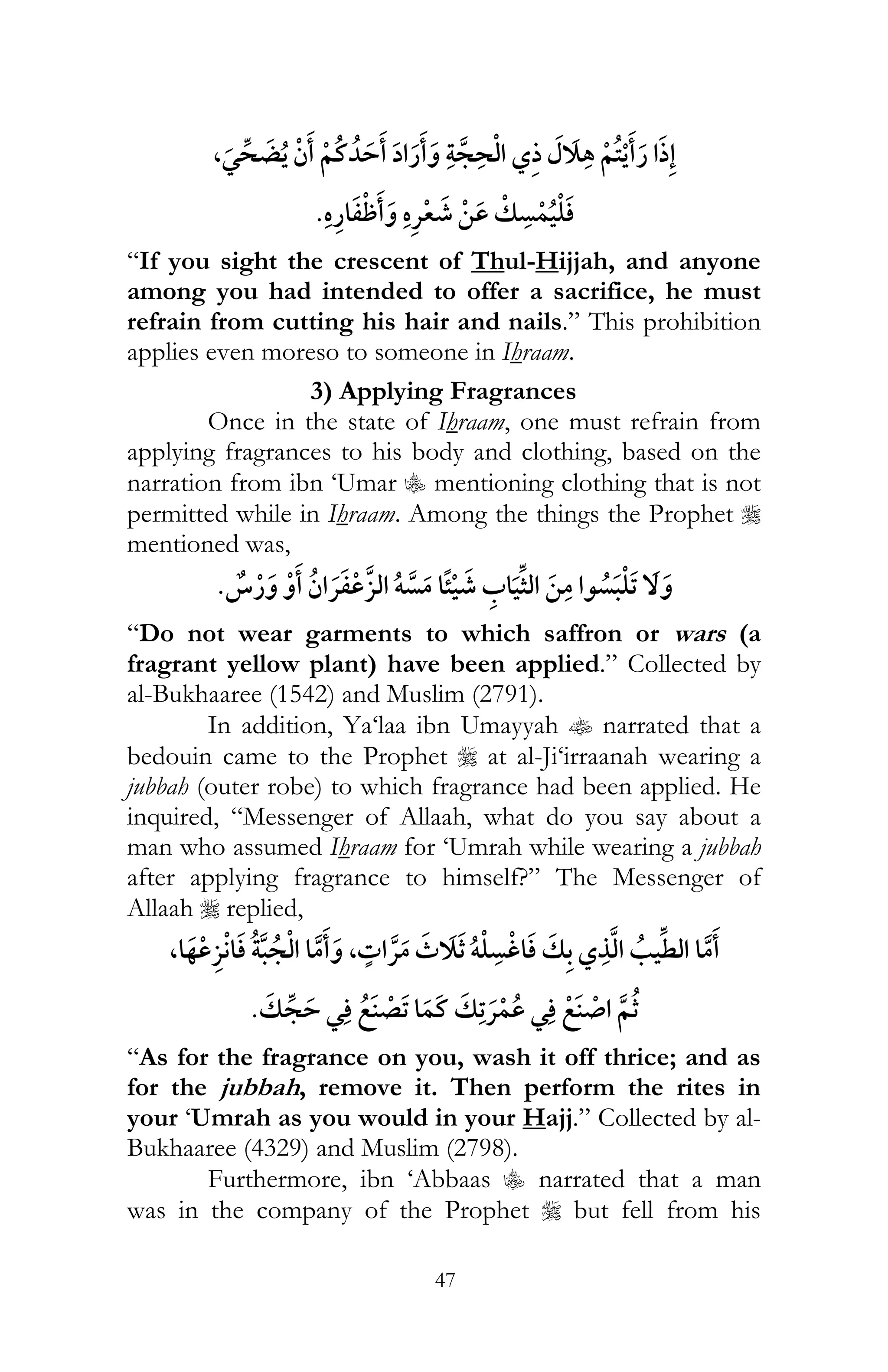
“If you sight the crescent of Thul-Hijjah, and anyone
among you had intended to offer a sacrifice, he must
refrain from cutting his hair and nails.” This prohibition
applies even moreso to someone in Ihraam.
3) Applying Fragrances
Once in the state of Ihraam, one must refrain from
applying fragrances to his body and clothing, based on the
narration from ibn ‘Umar C mentioning clothing that is not
permitted while in Ihraam. Among the things the Prophet r
mentioned was,
¯ ï
“Do not wear garments to which saffron or wars (a
fragrant yellow plant) have been applied.” Collected by
al-Bukhaaree (1542) and Muslim (2791).
In addition, Ya‘laa ibn Umayyah t narrated that a
bedouin came to the Prophet r at al-Ji‘irraanah wearing a
jubbah (outer robe) to which fragrance had been applied. He
inquired, “Messenger of Allaah, what do you say about a
man who assumed Ihraam for ‘Umrah while wearing a jubbah
after applying fragrance to himself?” The Messenger of
Allaah r replied,
¯ï, ¯,
¯ ¯ ¯
“As for the fragrance on you, wash it off thrice; and as
for the jubbah, remove it. Then perform the rites in
your ‘Umrah as you would in your Hajj.” Collected by al-
Bukhaaree (4329) and Muslim (2798).
Furthermore, ibn ‘Abbaas C narrated that a man
was in the company of the Prophet r but fell from his
48
mount, breaking his neck and dying while in the state of
Ihraam. The Messenger of Allaah r said,
,,¯ ,ï ¯
ï ,ï ¯
“Wash him with water mixed with leaves from the sidr
tree, shroud him in his two garments, and do not apply
any fragrance to him or cover his head, for he will be
raised on the Day of Resurrection saying the Talbiyah.”
Collected by al-Bukhaaree (1851) and Muslim (2892).
These narrations show that one must not use
fragrances while in Ihraam, as they are a form of unnecessary
luxury. However, prior to assuming Ihraam, it is permissible
to apply fragrance to one’s body but not clothing, and there
is no harm in it remaining on the body after assuming
Ihraam. This falls under the principle
¯ ¯
which states that there are certain things which are
permissible when continuing from a previous state, but
prohibited when initiated independently. Proof for this is in
the narration from ‘Aa’ishah z who said, “I used to apply
fragrance to the Messenger of Allaah r when he was
preparing to assume Ihraam, as well as when he exited Ihraam
and had not yet performed Tawaaf at the House.” Collected
by al-Bukhaaree (1539) and Muslim (2841). She also said, “It
is as if I can see the gleam left by the fragrance where the
Prophet’s r hair parted, while he was in Ihraam.” Collected
by al-Bukhaaree (271) and Muslim (2832).
4) [Men] Covering the Head or Face
with Something in Direct Contact with Them
Ibn ‘Umar C narrated that the Prophet r detailed
what someone in Ihraam cannot wear; among the items
mentioned were,
49
,
“Do not wear shirts or turbans.” Collected by al-
Bukhaaree (1542) and Muslim (2791).
Ibn ‘Abbaas C also reported that a man in Ihraam
was thrown off his camel and died as a result. The Prophet
r said,
,ï ï ¯ ,ï ¯
ï
“Wash him with water mixed with leaves from the sidr
tree, shroud him in his two garments, and do not cover
his head or face because he will be raised on the Day of
Resurrection saying the Talbiyah.” Collected by Muslim
(2896).
However, shading oneself with something not
affixed to the head – such as an umbrella, the roof of a car, a
piece of fabric, or a tent – is permissible because the
Prophet r was shaded with a piece of fabric when he stoned
Jamrah al-‘Aqabah. This was collected by Muslim (3138) from
Umm al-Husayn z.
There is also the narration from Jaabir t describing
how the Prophet r performed Hajj and it mentioned that he
r stayed in a tent set up for him at Namirah until the sun
began its descent after midday. Collected by Muslim (2950).
5) Men Wearing Clothing that is Makheet
[Makheet is commonly translated as “stitched” or
“sewn”], and it refers to garments tailored to fit the entire
body, such as a long tunic or shirt; or tailored to fit just a
portion of the body, such as trousers, socks made from
leather or cloth, vests, etc. This is based on the narration
from ibn ‘Umar C where a man said, “Messenger of Allaah,
what may be worn by someone in Ihraam?” The Messenger
of Allaah r replied,
50
,, ¯ ,, ¯
,,
¯ ï ,
“He must not wear shirts, turbans, trousers, hooded
robes, or khuff (a certain type of leather socks); except
if he cannot find sandals, in which case he may wear
two khuff, but he must cut them to fit below the ankles.
He also must not wear garments to which saffron or
wars (a fragrant yellow plant) have been applied.”
Collected by al-Bukhaaree (1542) and Muslim (2791). As
long as khuff remain below the ankles, they are similar to
sandals in permissibility, as indicated by this hadeeth. The
command to cut the portion above the ankles was given
earlier while the Prophet r was still in al-Madeenah.
However, the command to wear khuff without cutting them
was given while he was at ‘Arafah. Ibn ‘Abbaas C reported
that he heard the Prophet r delivering the sermon at
‘Arafah and he said,
,
¯,¯
“If someone in Ihraam cannot find sandals, he may
wear khuff; and if he cannot find an izaar [garment for
the lower half of the body], he may wear trousers.”
Collected by al-Bukhaaree (1841) and Muslim (2794). This
sermon was heard by those making Hajj from all areas,
which indicates that it abrogated the previous command to
cut the khuff as narrated by ibn ‘Umar C.
While in Ihraam, one is allowed to tie the ends of his
izaar together, or fasten them with a string, belt, or money
belt, even if they have stitching. One may also wear sandals
that are stitched. The same applies to an izaar [lower
garment] or ridaa’ [upper garment] if their edges are
51
hemmed, or if one of them is made of two pieces stitched
together. This is because the prohibition of wearing
something makheet applies to what is worn in the manner for
which it is tailored, such as a shirt or trousers. Therefore, if a
man reaches the meeqaat intending to perform Hajj or
‘Umrah and does not have an izaar or ridaa’, it is permissible
for him to use his thawb as an izaar, wearing it in the manner
of an izaar, as long as it covers the area from his navel to his
knees; and he may use another garment, or even his
trousers, as a ridaa’; or he may wear trousers and use
whatever garment he has as a ridaa’ until he finds an actual
izaar and ridaa’.
While in Ihraam, one is allowed to wear a ring, watch,
or other similar items such as a brace or fabric tied to the
knee or calf, as necessary.
A woman may wear whatever clothes are permissible
for her under normal circumstances. She is only prohibited
from wearing gloves and anything specifically tailored to fit
the face, such as a niqaab or burqu‘. This is based on the
statement of the Prophet r,
¯, ¯
“A woman in Ihraam must not wear a niqaab or
gloves.” Collected by al-Bukhaaree (1838) from ibn ‘Umar
C.
Despite being in Ihraam, if a woman is in the
presence of men who are not her mahram, she must cover
her hands with her clothing and her face with her khimaar
(headpiece), based on the statement of ‘Aa’ishah z, “Men
riding their mounts would pass us while we were in the state
of Ihraam with the Messenger of Allaah r. When they came
near, each of us would drape her jilbaab down from her head
over her face, and once they had passed us we would
uncover.” This is collected by Aboo Daawood (1833) and
others with a da‘eef chain of narration. It was also collected
by ad-Daaraqutnee in his Sunan (2764) from Umm Salamah
52
z, but his chain contains the same weak narrator found in
the chain for the narration from ‘Aa’ishah z.
There is, however, a narration from ‘Aa’ishah which
strengthens what preceded, and it is reported with a saheeh
chain that satisfies the criteria of al-Bukhaaree and Muslim.
It is found in the Sunan of Sa‘eed ibn Mansoor, as
mentioned in Fath al-Baaree (3/406), and it states that she
said, “A woman drapes her jilbaab down from her head over
her face.”
In a saheeh supporting narration, collected by Maalik
in al-Muwatta’ (1/328), Faatimah bint al-Munthir said, “We
used to cover our faces while in the state of Ihraam, and we
did this in the company of Asmaa’ bint Abee Bakr as-
Siddeeq.”
Al-Haakim also collected it in al-Mustadrak (1/454)
from Asmaa’ z who said, “We used to cover our faces
from the men and comb our hair while in Ihraam back then
as well [during the time of the Prophet r].” Al-Haakim said
this is a saheeh narration satisfying the criteria of al-
Bukhaaree and Muslim, although they did not collect it in
their books, and ath-Thahabee concurred.
Additionally, as cited in Fath al-Baaree (3/406), ibn al-
Munthir said, “The scholars have agreed that a woman is
permitted to wear any clothing and footwear specifically
tailored for the body, and she may cover her head and hair
[with garments specifically tailored for that purpose]. As for
her face, she may lightly drape a garment to cover it from
the glances of men.”
Throughout the passage of centuries, women – both
in and out of the state of Ihraam – continued to cover their
faces from non-mahram men, until the advent of women
exposing themselves early in the fourteenth century after the
Hijrah. Al-Haafith ibn Hajar said in al-Fath (9/324), “It has
continuously been the practice of women, past and present,
to cover their faces from unrelated [non-mahram] men.”
If someone commits any of the preceding five
53
prohibitions out of ignorance or forgetfulness, he is not
liable in any way. However, when the ignorant comes to
know, and the forgetful remembers, he must remove any
garment, head covering, or fragrance as necessary.
If someone does these things willfully and without
any legitimate excuse, he is sinful in doing so and must offer
a fidyah.
If someone does any of them out of necessity, he
must also offer a fidyah, but he is not considered sinful.
However, this is with the exception of fragrances because
there is no necessity which demands their usage.
The fidyah to be offered for committing any of these
prohibitions is to sacrifice a sheep, feed six poor people
giving each of them a half saa‘, or fast three days. One has
the option to choose any of the three based on the
statement of Allaah U,
{À¿¾½¼»º ¹¸
ÇÆÅÄÃÂÁz
“However, if anyone among you is ill or has an ailment
in his scalp, and he needs to shave it as a result, he
must offer a fidyah of fasting, charity, or sacrifice.” [al-
Baqarah (2):196]. The generality of fidyah here was explained
by the Sunnah in the narration of Ka‘b ibn ‘Ujrah t when
lice had infested his scalp. The Messenger of Allaah r told
him to shave his head and then gave him the option to
sacrifice a sheep, feed six poor people giving each of them a
half saa‘, or fast three days. This was collected by al-
Bukhaaree (4517) and Muslim (2883). This is the fidyah for
shaving the head specified by the Qur’aan and Sunnah, and
it applies to the previously mentioned prohibitions as well,
since they all share the common feature of being
unnecessary luxuries.
54
6) Killing Land-Dwelling Game
Allaah U said,
{²± °¯®¬«ªz
“People of Eemaan, do not kill game while you are in
Ihraam.” [al-Maa’idah (5):95].
{PONMLK Jz
“And hunting game on land is unlawful for you while
you are in Ihraam.” [al-Maa’idah (5):96].
{lkjihz
“…and do not take hunting game to be lawful while
you are in Ihraam.” [al-Maa’idah (5):1].
{°¯®z
“And once you exit Ihraam, you may hunt.” [al-Maa’idah
(5):2]. These aayaat show that from the time someone enters
the state of Ihraam for Hajj or ‘Umrah until he exits it, he
must not kill any land-dwelling game.
It is not even permissible for him to assist in hunting
game or point it out to someone who is not in Ihraam. This
is based on a narration from Aboo Qataadah t who was on
a journey with some of the Companions. They were in
Ihraam but he was not. Upon spotting some wild donkeys,
Aboo Qataadah t pursued and slaughtered one of them, of
which they all ate. The narration continues, “We then asked,
‘Can we eat the meat of game while we are in Ihraam?’ So we
carried the remaining meat with us. The Prophet r asked,
¯?
::¯
‘Did any of you tell him to chase it, or point it out him?’
They said no, so he said, ‘Then eat the meat that
remains.’” Collected by al-Bukhaaree (1824) and Muslim
55
(2855).
In the Qur’aan, Allaah has explained the penalty of
intentionally killing land-dwelling game. He U said,
{¾½¼»º¹¸¶µ´
ÈÇÆÅÄÃÂÁÀ¿
ÑÐÏÎÍÌËÊ Éz
“And anyone among you who kills game intentionally
must either offer a sacrificial animal equivalent to what
he killed, as judged by two just men among you,
brought to the Ka‘bah; or offer an expiation – feeding
the needy, or its equivalent in fasting – in order for him
to taste the consequence of his deed.” [al-Maa’idah
(5):95]. Therefore, if someone kills game which is
comparable to a sacrificial animal, he has the choice between
sacrificing the comparable animal within the haram area to be
distributed there, while not consuming any of it himself; or
using its value to feed the poor, each of them receiving half
a saa‘; or fasting a number of days equal to the number of
those needy people. If there is no sacrificial animal
comparable to the game animal killed, he chooses between
feeding or fasting as previously mentioned.
What is apparent from the aayah is the obligation of
the foregoing penalty in the case of someone who killed
game intentionally, not forgetfully or mistakenly. This is the
correct view according to our Shaykh, ‘Abdul-‘Azeez ibn
Baaz, as in the collection of his writings and verdicts
(17/203), and according to our Shaykh, Muhammad al-
Ameen ash-Shinqeetee, as in Adwaa’ al-Bayaan (2/169), as
well as ash-Shaykh ‘Abdur-Rahmaan as-Sa‘dee in the tafseer
of the aforementioned aayah in Soorah al-Maa’idah.
As for hunting game in the haram area, it is
prohibited regardless of whether or not one is in the state of
Ihraam. In fact, game is not even to be disturbed from its
56
place. It is also impermissible to cut the trees and vegetation
in the haram area that Allaah has allowed to grow and have
not been planted by humans. This is based on the narration
from ibn ‘Abbaas C where the Prophet r said,
, ,¯ , ¯
, ¯ , , ¯ ¯
, ¯¯ ,
“Indeed, Allaah has made Makkah sacred. Its sanctity
was never made violable to anyone before me, and it
will not be violable to anyone after me; such was lawful
for me only during a few hours of a day. Its fresh
vegetation is not to be uprooted, its trees are not to be
cut, its game is not to be disturbed, and property lost
there is not to be picked up except by someone who
wants to announce that it has been found.” Collected by
al-Bukhaaree (1833) and Muslim (3302).
The same applies to the haram area of al-Madeenah,
based on the narration of Jaabir t where the Prophet r
said,
, ¯ ¯ ¯ , ¯ ¯
,
“Indeed, Ibraaheem declared Makkah sacred, and I
have declared al-Madeenah sacred in what lies between
its two black mountains. Its thorny shrubs are not to be
cut, and its game is not to be hunted.” Collected by
Muslim (3317).
In addition, property lost al-Madeenah is not to be
picked up except by someone who wants to announce that it
has been found. This is based on the narration from ‘Alee t
collected by Aboo Daawood (2035) with a saheeh chain of
narration. The reason why lost property, specifically in these
two haram areas, is not to be picked up except by someone
57
who announces it has been found is because people
continually return to them, and one may find what he once
lost even after the passage of years. Therefore, Makkah and
al-Madeenah should have a designated authority to hold lost
items for safekeeping, and return those items to their
rightful owners whenever they come looking for them.
Furthermore, when Allaah forbade killing game in the haram
area and protected them within it, He also prohibited
destroying their sources of nourishment. Thus, He
prohibited cutting the trees and vegetation. In this way,
game animals are afforded both protection and nourishment
within the haram area.
7) Marriage Contracts
This is regardless of whether the person carrying it
out is a groom or guardian, and the same applies to a
proposal. ‘Uthmaan ibn ‘Affaan t narrated that the
Messenger of Allaah r said,
, ¯ ¯¯ ,¯
“Someone in Ihraam is not to get married, arrange a
marriage for anyone else, or propose.” Collected by
Muslim (3446).
If a marriage contract is concluded by someone in
Ihraam, it is invalid and considered a marriage of shubhah
(although it took place, certain preventative factors were
present, or certain necessary conditions were not fulfilled).
As such, if he wishes to remain in that marriage, he must do
so by way of a new, valid marriage contract.
8) Intercourse
9) Other Forms of Intimacy
Allaah U said,
{HGFEDCBA
PONMLKJIz
“Hajj is in the well-known months. Thus, those who
58
intend to perform Hajj during them must avoid rafath,
fusooq, and jidaal during Hajj.” [al-Baqarah (2):197].
Rafath includes marital relations – intercourse and other
forms of intimacy – as well as obscene words and deeds.
Fusooq comprises all sins. Jidaal here refers to argumentation
that is based upon falsehood and that produces enmity and
animosity.
However, there is no harm in argumentation done in
a positive, constructive manner with the objective of
reaching the truth. In fact, this is commanded by Allaah in
His saying U,
{¢¡~z
“And argue with them in the manner which is best.”
[an-Nahl (16):125], and also
{IHGFEDCB
MLK Jz
“And do not argue with people of the scripture unless it
is in the manner which is best; except for those among
them who obstinately reject what you say and show
open animosity.” [al-‘Ankaboot (29):46].
There is no Sunnah reported from the Prophet r
which specifies what must be done if a person engages in
acts of intimacy, or intercourse itself, while in Ihraam.
However, there are reports from some Companions. Among
them is the narration from ‘Amr ibn Shu‘ayb from his father
that “a man came to ‘Abdullaah ibn ‘Amr asking him what
must be done by someone in Ihraam who had intercourse
with his wife. [‘Abdullaah ibn ‘Amr] pointed towards
‘Abdullaah ibn ‘Umar and told the man ‘Go and ask him.’”
Shu‘ayb continued, “The man did not know who he was, so
I went along with him and he posed the question to ibn
‘Umar who told him, ‘Your Hajj is null and void.’ The man
asked, ‘What should I do?’ Ibn ‘Umar replied, ‘Join the
59
people and do as they do [completing your Hajj along with
them]. If you are alive next year, you must perform Hajj
again and offer a sacrifice.’ At that, the man returned to
‘Abdullaah ibn ‘Amr to tell him what happened and I was
still with him. Ibn ‘Amr told him, ‘Go to ibn ‘Abbaas and
ask him.’ So, I went with him to ibn ‘Abbaas who told him
the same as ibn ‘Umar. The man returned to ‘Abdullaah ibn
‘Amr to tell him what ibn ‘Abbaas said, and I was still with
him. He then inquired, ‘What do you have to say?’
[‘Abdullaah ibn ‘Amr] responded, ‘I say what the two of
them said.’” Collected by al-Haakim (2/65) who
commented, “This is a hadeeth reported by thiqaat (narrators
having sound integrity and impeccable retention), all of
whom are huffaath (narrators having outstanding memory
and knowledge of hadeeth). It clearly establishes Shu‘ayb ibn
Muhammad narrated directly from his grandfather,
‘Abdullaah ibn ‘Amr,” and ath-Thahabee concurred. Al-
Bayhaqee collected it from the same route as al-Haakim
(5/167) and he said, “This is a saheeh chain of narration, and
it proves the legitimacy of Shu‘ayb ibn Muhammad ibn
‘Abdillaah having heard from his grandfather, ‘Abdullaah
ibn ‘Amr.”
In this saheeh narration, ‘Abdullaah ibn ‘Amr,
‘Abdullaah ibn ‘Abbaas, and ‘Abdullaah ibn ‘Umar y all
agreed about the invalidity of Hajj for someone who had
intercourse, as well as the fact that he must still complete
Hajj, perform it again the following year, and offer a
sacrifice. Their saying, “Join the people and do as they do”
shows that intercourse occurred while in the state of Ihraam,
and prior to the stage of partial exit from it.
The sacrifice – which is actually a fidyah in this case –
is a camel to be sacrificed and apportioned among the needy
within the haram area. If one engages in intercourse after
only partially exiting the state of Ihraam, there is scholarly
consensus that his Hajj is still valid and that the sacrifice in
his case is a sheep.
60
With respect to ‘Umrah, if one had intercourse
before performing Sa‘y or Tawaaf, his ‘Umrah is invalidated;
but, he must still complete it, and perform another ‘Umrah
in its place, assuming Ihraam from the meeqaat where he
commenced his initial ‘Umrah. He must also offer a sheep as
fidyah to be distributed among the poor in the haram area. If
intercourse took place after Sa‘y, but before shaving the
head or shortening the hair, that does not invalidate ‘Umrah,
but one must offer a sheep as fidyah.
If one engages in martial intimacy excluding
intercourse and ejaculates as a result, his Hajj is not
invalidated because such an act does not does have a
specifically defined penalty, and is not as severe as
intercourse, which invalidates Hajj. However, one must still
offer a camel if such occurs before the preliminary stage of
exiting Ihraam, and offer a sheep if it occurs afterwards. A
woman does the same as a man regarding all that has
preceded, except if she engaged in marital relations against
her will. In such a situation, she is not obligated to offer a
sacrifice.
Summarized and Detailed
Descriptions of Hajj and ‘Umrah
The summarized description of ‘Umrah is as follows:
one assumes Ihraam at the meeqaat, performs Tawaaf around
the Ka‘bah, performs Sa‘y between as-Safaa and al-Marwah,
and then either shaves or shortens the hair on the head.
Residents of Makkah must assume Ihraam for ‘Umrah from
outside the boundaries of the haram area.
The summarized description of Hajj is: when
coming from abroad, one assumes Ihraam from the meeqaat.
Residents of Makkah, however, as well as those who stay in
Makkah after performing ‘Umrah for Tamattu‘, assume
Ihraam for Hajj from Makkah.
Anyone performing Qiraan or Ifraad, completes
61
Tawaaf al-Qudoom and Sa‘y, although it is permissible to delay
Sa‘y until after Tawaaf al-Ifaadah.
The person performing Hajj stays in Minaa on the
eigth of Thul-Hijjah. On the ninth, he heads to ‘Arafah, and
then spends the night in Muzdalifah. On the day of ‘Eed
(tenth of Thul-Hijjah), he stones Jamrah al-‘Aqabah (the third
pillar), sacrifices if required, shaves his head or shortens his
hair, and then performs Tawaaf al-Ifaadah. Anyone
performing Tamattu‘ must complete Sa‘y at this point, as well
as those performing Qiraan or Ifraad, if they did not
complete Sa‘y after Tawaaf al-Qudoom. Then, one spends the
nights of tashreeq in Minaa, stones the three jamaraat after
zawaal during the days of tashreeq, and concludes by
performing Tawaaf al-Wadaa‘ when he wishes to depart from
Makkah.
The detailed descriptions of ‘Umrah and Hajj
are as follows:
Preparation for Ihraam
Anyone travelling by land for ‘Umrah or Hajj from a
location near one of the meeqaat points, such as al-
Madeenah, can prepare himself for Ihraam from his
residence. This includes cutting the nails, trimming the
moustache, shaving the pubic area, removing underarm hair,
performing ghusl, applying fragrance, and wearing the izaar
and ridaa’. He then assumes Ihraam at the meeqaat.
If one is assuming Ihraam after the first of Thul-
Hijjah, and he intends to offer a sacrifice, he should not
remove any part of his hair or nails when preparing for
Ihraam. This is based on the narration from Umm Salamah
z where the Prophet r said,
,¯
¯
62
“If you sight the crescent of Thul-Hijjah, and anyone
among you had intended to offer a sacrifice, he must
refrain from cutting his hair and nails.” Collected by
Muslim (5119). This excludes shortening one’s hair upon
completion of ‘Umrah performed in the first ten days of
Thul-Hijjah, because doing so is among the obligatory acts
(waajibaat) of ‘Umrah.
In the case where one comes to the meeqaat [by land]
from a distant place – such as someone from Yemen who is
coming through Yalamlam – he stops at the meeqaat and
prepares for Ihraam there by performing ghusl, removing
what may require removal, wearing the izaar and ridaa’, and
then assuming Ihraam at that location.
If one comes by plane, he may prepare for Ihraam by
performing ghusl and wearing his izaar and ridaa’ while still in
his home country. He then assumes Ihraam from a point in
line with the meeqaat or close to it.
Ihraam
1) Ihraam refers to the intention of commencing the
rites of Hajj or ‘Umrah. No one is considered to be in the
state of Ihraam until this intention is present. This is based
on the statement of the Prophet r,
“Verily, all actions are only by intentions.” Collected by
al-Bukhaaree (1) and Muslim (4927). Wearing the izaar and
ridaa’ without the intention is not Ihraam; it is simply
preparation for Ihraam. Thus, one intends in his heart which
rites he is performing: if Tamattu‘, he intends ‘Umrah; if
Ifraad, he intends Hajj; and if Qiraan, he intends Hajj and
‘Umrah. This applies to one who passes a meeqaat or any
point in line with it by land, air, or sea during the months of
Hajj, which are Shawwaal, Thul-Qa‘dah and the first ten
nights of Thul-Hijjah. If assuming Ihraam outside the
63
months of Hajj, one must do so for ‘Umrah. This ‘Umrah
has no connection to performing Hajj.
2) It is recommended to mention the rites one has
intended, such as “Labbayka ‘Umratan” or “Labbayaka
Hajjan” or “Labbayaka ‘Umratan wa Hajjan,” because the
Prophet r performed Qiraan and he declared his Talbiyah for
Hajj and ‘Umrah. This was narrated by Anas t where he
said, “I heard the Messenger of Allaah r say,
¯
‘Labbayka ‘Umratan wa Hajjan (I obediently respond
to Your call to perform ‘Umrah and Hajj).’” Collected by
Muslim (2995).
One may also say, “Labbaykallaahumma ‘Umratan” or
“Labbaykallaahumma Hajjan” or “Labbaykallaahumma ‘Umratan
wa Hajjan” based on the narration from Jaabir t where he
said, “We arrived with the Messenger of Allaah r while
saying, ‘Labbaykallaahumma labbayaka bil-Hajj,’ but the
Messenger of Allaah r ordered us to change it to ‘Umrah
and we did so.” Collected by al-Bukhaaree (1570).
One must not make any outward declaration for
something he intends in any situation other than Hajj and
‘Umrah; not for Tawaaf, Sa‘y, Salaat, Zakaat, fasting, or
anything else because there is nothing from the Sunnah of
the Messenger of Allaah r which substantiates doing so.
Had there been any good in it, the Companions of the
Messenger of Allaah r and others among the Salaf of this
Ummah would have been the first to do so.
3) One may stipulate a condition when assuming
Ihraam by saying,
¯ ¯ ¯
“Fa in habasanee haabisun fa mahillee haythu habastanee (If
something prevents me from going further, then I will exit
the state of Ihraam where You stop me)”, as in the narration
from ‘Aa’ishah z where she said, “The Prophet r went to
64
Dubaa‘ah bint az-Zubayr ibn ‘Abdil-Muttalib and she said,
‘Messenger of Allaah, I desire to perform Hajj but I feel ill.’
The Prophet r told her, ‘Perform Hajj and stipulate:
¯ ¯
I will exit the state of Ihraam where You stop me.’”
Collected by al-Bukhaaree (5089) and Muslim (2903). By
stipulating this condition, one can exit the state of Ihraam
without being subject to any penalty if he is prevented from
completing Hajj or ‘Umrah due to illness, motor accident, or
other reasons.
4) If one assumes Ihraam from Thul-Hulayfah – the
meeqaat for those coming from the direction of al-Madeenah
– he may perform an obligatory or optional prayer there and
assume Ihraam following it. This is based on the narration of
‘Abdullaah ibn ‘Abbaas C from ‘Umar ibn al-Khattaab t
who said, “I heard the Messenger of Allaah r at Waadee al-
‘Aqeeq saying,
¯,¯:¯,
:¯ ¯
‘A messenger came to me from my Lord during the
night and told me to perform prayer in this blessed
valley, and to assume Ihraam for ‘Umrah and Hajj
combined.’” Collected by al-Bukhaaree (1534).
The best thing to do is assume Ihraam once having
mounted one’s means of transport. This is based on the
narration of ‘Abdullaah ibn ‘Umar C who said, “The
Prophet r began saying the Talbiyah when his mount stood
up with him on its back.” Collected by al-Bukhaaree (1552)
and Muslim (2821). Also, there is a chapter in Saheeh al-
Bukhaaree entitled “Saying al-Hamdu lillaah, Subhaanallaah, and
Allaahu Akbar prior to the Talbiyah when mounting one’s
animal” where al-Bukhaaree cited the narration of Anas t
(1551) proving that point. Ibn Hajar explained, “This ruling
65
(i.e. the recommendation of saying Subhaanallaah and the
other things mentioned with it prior to the Talbiyah) is rarely
mentioned by anyone despite its validity as an established
practice.”
5) One must not pass the meeqaat without assuming
Ihraam because the Prophet r defined the meeqaat points and
said, “They are for their residents, as well as anyone
who comes to them from elsewhere, intending to
perform Hajj or ‘Umrah…” Discussion about this
preceded in the section explaining the meeqaat points.
6) If one’s home lies between the meeqaat and
Makkah, he assumes Ihraam from his home. He must not go
beyond his home without assuming Ihraam because it serves
as his meeqaat. When the Prophet r designated the meeqaat
points and commanded assuming Ihraam from them he said,
“If someone resides within those boundaries, he
assumes Ihraam from wherever he sets out; even the
residents of Makkah assume Ihraam from Makkah,” as
has preceded.
7) Residents of Makkah assume Ihraam for Hajj from
Makkah. However, everyone in Makkah – residents or not –
must assume Ihraam for ‘Umrah from outside the haram area.
This is based on the narration about ‘Aa’ishah z
performing ‘Umrah from at-Tan‘eem after Hajj with the
approval of the Messenger of Allaah r, as collected by al-
Bukhaaree (1785) and Muslim (2910).
Thus, when the residents of Makkah assume Ihraam
for ‘Umrah from outside the haram area, their performance
of ‘Umrah combines being both in and out of the haram.
Similarly, they assume Ihraam for Hajj from Makkah and
later go to ‘Arafah, which lies outside the haram area. In
doing so, they combine between being in and out of the
haram boundaries as well.
8) Tamattu‘ refers to one assuming Ihraam for
‘Umrah from the meeqaat during the months of Hajj;
performing Tawaaf, Sa‘y, and shaving or shortening one’s
66
hair, thereby exiting Ihraam; then assuming Ihraam for Hajj
on the eighth of Thul-Hijjah, and performing the rites of
Hajj. Anyone performing Tamattu‘ must sacrifice a sheep, or
have a one-seventh share in sacrificing a camel or cow. If
unable to offer a sacrifice, he must fast three days during
Hajj and seven more when he returns home. This is based
on the statement of Allaah,
{ÔÓÒÑÐÏÎÍÌË
âáàßÞÝÜÛÚÙØ×ÖÕãä
ìëêéèçæåz
“And whoever performs ‘Umrah in the months of Hajj,
before performing the rites of Hajj itself, must offer a
sacrifice within his means. However, if unable to do so,
he must fast three days during the months of Hajj and
seven days after returning home. Those are ten days in
all. This is for him whose family does not reside in
Makkah.” [al-Baqarah (2):196]. This sacrifice, which is
obligatory for anyone performing Tamattu‘ or Qiraan, is one
of gratitude to Allaah, not compensation. It is done to
express thanks to Allaah U for having completed the rites
of both Hajj and ‘Umrah in one journey, not as reparation
for omitting any obligatory rite of Hajj. In explaining “And
whoever performs ‘Umrah in the months of Hajj, before
performing the rites of Hajj itself, must offer a sacrifice
within his means,” ibn Katheer commented
[“Whoever performs ‘Umrah in the months of
Hajj”] includes those who assume Ihraam for
Hajj and ‘Umrah together, as well as those who
assume Ihraam for ‘Umrah first and then, after its
completion, reassume Ihraam for Hajj. The latter
is the specific type of Tamattu‘ often referred to
by the scholars of fiqh. However, the more
general meaning of Tamattu‘ includes both
67
categories as proven by saheeh narrations in which
some narrators said, “The Messenger of Allaah r
performed Tamattu‘,” while others said, “He
performed Qiraan,” even though there is
agreement that he brought along his animal to
sacrifice.
Qiraan refers to one assuming Ihraam from the
meeqaat for ‘Umrah and Hajj combined. Upon arrival in
Makkah, one performs Tawaaf al-Qudoom, Sa‘y between as-
Safaa and al-Marwah, and then remains in the state of Ihraam
until the Day of Sacrifice. After stoning Jamrah al-‘Aqabah
and either shaving his head or shortening his hair, he exits
the state of Ihraam. He must also offer a sacrifice just as in
the case of someone performing Tamattu‘.
Ifraad refers to one assuming Ihraam from the meeqaat
for Hajj only. He then performs all rites as done in Qiraan
except that he does not offer a sacrifice.
9) The best mode of Hajj is Tamattu‘. Some of the
Companions who performed Hajj with the Messenger of
Allaah r assumed Ihraam for ‘Umrah (Tamattu‘), while others
did so for Hajj (Ifraad), and yet others did so for Hajj and
‘Umrah together (Qiraan). However, when they reached
Makkah, the Prophet r commanded everyone who initially
intended to perform Qiraan or Ifraad to change their Ihraam
to ‘Umrah and perform Tamattu‘ instead, provided that they
did not bring a sacrificial animal. It must be borne in mind
that the Prophet r would not direct them to something
unless it is best and most complete. The Prophet r,
however, was performing Qiraan and since he brought his
sacrificial animal with him he remained in the state of
Ihraam. When the Companions y inquired about that he
told them,
,¯ ¯ ¯ ¯
¯¯
68
“Had I previously known what I now know, I would
not have brought along an animal to sacrifice; and if I
had no sacrificial animal with me, I would have exited
the state of Ihraam.” Collected by al-Bukhaaree (1651) and
Muslim (2943) from the narration of Jaabir t.
10) Some scholars hold that Tamattu‘ is obligatory,
but the majority of scholars hold that it is not obligatory
because Aboo Bakr, ‘Umar and ‘Uthmaan y performed
Ifraad, and they were among the rightly guided Khulafaa’. Had
they understood the Prophet’s r command to change their
intention for Hajj to ‘Umrah as an implication that Tamattu‘
was obligatory, they would not have done otherwise.
Another proof that Qiraan and Ifraad are valid is that
the Prophet r informed us that close to the end of this
world, when ‘Eesaa r descends from the heavens, he will
perform Hajj in one of these three modes. In Saheeh Muslim
(3030), Hanthalah al-Aslamee stated, “I heard Aboo
Hurayrah t narrate that the Prophet r said,
, ¯ ¯ , ¯
, ¯
‘By the One in whose hand my soul lies, the son of
Maryam shall assume Ihraam from the mountain pass
of ar-Rawhaa’ for either Hajj, ‘Umrah, or both of them
together.’”
11) If someone is performing Qiraan or Ifraad and
brings along his sacrificial animal – whether walking or
carrying it by vehicle – he must remain in the state of Ihraam
until the animal reaches its appointed place on the Day of
Sacrifice. This was done by the Messenger of Allaah r.
If someone performing Qiraan or Ifraad does not
bring a sacrificial animal, it is best for him to change his
initial intention and make his Ihraam for ‘Umrah, based on
the aforementioned command of the Prophet r.
69
If someone performs ‘Umrah outside the months of
Hajj, or during them without intending to perform Hajj, and
brings a sacrificial animal, he must sacrifice his animal upon
completing ‘Umrah. This is because the Prophet r brought
a sacrificial animal during the ‘Umrah of al-Hudaybiyah, and
when the mushrikoon prevented him from performing
‘Umrah, he sacrificed his animal at al-Hudaybiyah.
If someone intending to perform Tamattu‘ assumes
Ihraam for ‘Umrah, but has brought with him a sacrificial
animal, he must assume Ihraam for Hajj along with ‘Umrah.
This would mean he performs Qiraan and remains in the
state of Ihraam until the Day of Sacrifice, as in the narration
from ‘Aa’ishah z about that, collected by al-Bukhaaree
(1556 and 4395) and Muslim (2910).
12) If a man or woman has a young child who has
not yet reached the age of maturity, it is permissible to bring
the child to perform Hajj and ‘Umrah along with them. If
the child has reached the age of discretion, he assumes
Ihraam with the permission of his guardians. If the child has
not yet reached the age of discretion, his guardians may
assume Ihraam for him, making the intention on his behalf.
However, having a child assume Ihraam is not obligatory
upon the guardians, and there is no penalty for the child not
assuming Ihraam.
Hajj and ‘Umrah performed by a child are
considered optional and do not fulfill the requirement of
performing the Hajj and ‘Umrah which are obligatory for an
adult Muslim. The child must still perform Hajj and ‘Umrah
after becoming an adult, as has preceded in the section
about the Prerequisites (Shuroot) of Hajj and ‘Umrah.
If the child is unable to stone the jamaraat, his
guardian does so for him. Ibn al-Munthir said in al-Ijmaa‘
(pg.66), “The scholars have agreed that it is permissible for
someone to stone on behalf of a child who cannot do so by
himself.” Aside from this, a child, male or female, performs
the same rites any adult would, and is prohibited from the
70
same things which an adult is prohibited.
If a guardian performs Tawaaf and Sa‘y while carrying
his child, he must intend Tawaaf and Sa‘y for himself as well
as the child. It is not necessary for a guardian to perform a
separate Tawaaf on behalf of his child because the Prophet r
did not give any such command to the woman who raised
up her infant son and asked, “Is his Hajj valid?” to which
the Messenger r replied, “Yes; and you will be
rewarded.” Collected by Muslim, and it preceded in
Prerequisites (Shuroot) of Hajj and ‘Umrah.
13) If a woman experiencing menses or post-natal
bleeding passes the meeqaat intending to perform Hajj or
‘Umrah, she must assume Ihraam. She does everything that
others do except for Tawaaf, which she completes after
performing ghusl once the bleeding stops. This is based on
the long hadeeth of Jaabir t in which he described how the
Prophet r performed Hajj. A part of the hadeeth says, “We
set out with him until reaching Thul-Hulayfah where Asmaa’
bint ‘Umays gave birth to Muhammad ibn Abee Bakr. She
then sent word to the Prophet r asking what she should do,
so he responded,
¯ ,¯,¯ ¯
‘Perform ghusl, stop the blood flow with a protective
cloth, and assume Ihraam.’” Collected by Muslim (2950).
In another narration, ‘Aa’ishah z assumed Ihraam
for ‘Umrah with the Prophet r during the Farewell Hajj.
However, her menses began and lasted until after the people
had left Makkah to perform the rites of Hajj. The Prophet r
told her to assume Ihraam for Hajj along with ‘Umrah, which
meant she performed Qiraan. The Prophet r told her,
¯¯¯ ¯ ¯
“Perform Hajj the way anyone else would, but do not
perform Tawaaf at the House until your menses finish.”
Collected by al-Bukhaaree (305) and Muslim (2919).
71
14) Since ‘Aa’ishah z did not perform ‘Umrah
independently from Hajj due to her menses, she sought
permission from the Prophet r to perform ‘Umrah
following Hajj. The Prophet r told her brother, ‘Abdur-
Rahmaan ibn Abee Bakr, to take her to at-Tan‘eem – the
closest boundary of the haram area – where she assumed
Ihraam for ‘Umrah, as collected by al-Bukhaaree (1785) and
Muslim (2910). It is permissible for anyone who experiences
the same circumstances as ‘Aa’ishah to perform ‘Umrah
following Hajj just as she did.
However, some of the people who come to perform
Hajj continuously leave and re-enter the haram area,
performing ‘Umrah several times. This practice is not
proper, because when the Prophet r allowed ‘Aa’ishah to
perform ‘Umrah while he and the Companions remained
behind waiting for her to finish, he did not tell any of them
to perform ‘Umrah in the same manner as ‘Aa’ishah z.
Furthermore, that would only add to crowding and
congestion for those performing Tawaaf and Sa‘y. In
addition, every ‘Umrah the Prophet r performed was done
when entering Makkah from outside, and none of them was
performed by leaving Makkah and then re-entering.
15) The attire to be worn by men during the state of
Ihraam consists of an izaar and a ridaa’ based on the
statement of the Prophet r,
¯ ¯
“Each of you must assume Ihraam wearing an izaar,
ridaa’, and sandals.” Collected by Ahmad (4899) from
‘Abdullaah ibn ‘Umar C with a saheeh chain of narration
which satisfies the criteria of al-Bukhaaree and Muslim. It is
recommended that they both be white and clean. While in
the state of Ihraam, it is permissible to wash them if they
become dirty, and to change them if necessary. One is also
permitted to perform ghusl while in the state of Ihraam,
because the Prophet r performed ghusl when he entered
72
Makkah from Bi’r Thee Tuwaa. Collected by al-Bukhaaree
(1553) from ‘Abdullaah ibn ‘Umar C. There is also a
narration from Aboo Ayyoob al-Ansaaree t on the same
topic collected by al-Bukhaaree (1840) and Muslim (2889).
16) Removing one’s usual attire and replacing it with
an izaar and ridaa’, and the equality between all the people in
these garments of Ihraam – such that there is no distinction
between rich and poor, or leader and subject – all provide a
reminder of their equality in being dressed in shrouds at the
time of death. When a Muslim bears this in mind, it should
lead him to prepare for death by doing righteous deeds
which will draw him near to Allaah.
17) If someone performs ‘Umrah during the months
of Hajj, then returns to his country or place of residence, he
cannot consider that ‘Umrah as part of Tamattu‘ because his
journey concluded when he returned home.
However, if someone performs ‘Umrah during the
months of Hajj and then goes to al-Madeenah, for instance,
he can count that ‘Umrah as part of Tamattu‘ because he is
still on his journey for Hajj. When passing the meeqaat, he
must assume Ihraam for either Hajj or another ‘Umrah.
Doing the latter is better since it would result in him
performing ‘Umrah from the meeqaat twice in addition to
Hajj, and he is still only required to offer one sacrifice for
performing Tamattu‘.
18) If someone has already performed the obligatory
Hajj or ‘Umrah for himself, he may perform Hajj and
‘Umrah for relatives of his, or others in general, if they are
eligible for such to be done. This is irrespective of whether it
is obligatory or optional, and whether it is done free of
charge or for a fee. However, if one takes a fee, it is
impermissible for his motive to be the money, because that
would be an instance of intending worldly gain for a
righteous deed. There is a significant difference between
someone who performs Hajj to take money and someone
who takes money in order to perform Hajj.
73
Performing Hajj for the purpose of making money is
blameworthy because doing so makes Hajj the means and
money the objective. On the other hand, it is praiseworthy
to take money in order to perform Hajj because, in this case,
money is the means and Hajj is the objective. Such is the
case of someone who wishes to perform Hajj but does not
have enough money; thus, he accepts the money so that he
can afford to make Hajj.
If performing Hajj for someone else, one intends in
his heart that his performance of Hajj is on behalf of that
person. It is permissible for him to state that intention aloud
by saying, “Labbayka hajjan ‘an abee (I obediently respond to
Your call, and I am performing Hajj on behalf of my
father)” or “…‘an ummee (…on behalf of my mother)” or
“…‘an fulaan (…on behalf of such-and-such person),”
mentioning him by name. This is based on a narration from
‘Abdullaah ibn ‘Abbaas C who recounted that the Prophet
r heard a man saying “Labbayaka ‘an Shubrumah (I
obediently respond to Your call on behalf of Shubrumah).”
He asked him,
?¯:,:¯
“Have you performed Hajj?” The man replied, “No.” The
Prophet r then told him, “Perform Hajj for yourself first,
and then on behalf of Shubrumah.” Collected by at-
Tabaraanee ibn al-Mu‘jam as-Sagheer (pg.226) with a chain
having narrators who are all thiqah except for ‘Abdur-
Rahmaan ibn Khaalid ar-Raqqee. Al-Haafith ibn Hajar said
in at-Taqreeb that he was sadooq. Thus, the chain of narration
is hasan. Ash-Shaykh al-Albaanee ? listed other routes of
narration in Irwaa’ al-Ghaleel (994) which raise the narration
to the level of saheeh li-ghayrihi, and he cited al-Bayhaqee, ibn
al-Mulaqqin and ibn Hajar, who also graded it saheeh. The
aforementioned narration also proves that if someone has
not performed Hajj for himself, he must not perform Hajj
on behalf of anyone else.
74
It is permissible for a woman to perform Hajj on
behalf of a man, based on a narration from al-Fadl ibn
‘Abbaas about a woman from the tribe of Khath‘am who
performed Hajj on behalf of her father. This narration was
collected by al-Bukhaaree and Muslim and preceded in the
section about the Prerequisites (Shuroot) of Hajj and ‘Umrah.
It is also permissible for a man to perform Hajj on
behalf of a woman, based on the narration from ibn ‘Abbaas
C, collected by al-Bukhaaree (6699) where he said that a
man came to the Prophet r and said, “My sister vowed that
she would perform Hajj, but she passed away.” The Prophet
r replied,
?ï ¯:
:,
“If she had an outstanding debt would you pay it off?”
He said, “Yes.” The Prophet r then said, “Settle what is
due to Allaah, because He is most entitled to be given
what is due to Him.”
There are three types of people on whose behalf
Hajj and ‘Umrah may be performed: a deceased person; an
elderly person who is unable to mount a means of transport;
and an ill person whose recovery is not anticipated. The
foregoing narration about the man performing Hajj on
behalf of his sister is proof for performing Hajj on behalf of
the deceased; and the narration about the woman from
Khath‘am performing Hajj on behalf of her father is proof
for performing Hajj on behalf of the elderly as well as the ill
whose recovery is not anticipated.
The Talbiyah
1) The word Talbiyah is a noun which comes from
the verb labbaa meaning to say labbayka during Hajj and
‘Umrah. Discussion has preceded about the Prophet r
75
saying “labbayka ‘umratan wa hajjan” when he assumed Ihraam.
The word labbayka is a respectful response given
when one is called, and there are numerous instances where
the Prophet r called a Companion and he would reply
“labbayka, Messenger of Allaah,” and some would also say,
“labbayka wa sa‘dayaka.” Such instances in Saheeh al-Bukhaaree
occur in hadeeth numbers 128, 457, 5375, and 6268. In
addition, chapter 167 of Kitaab al-Adab in Sunan Abee
Daawood is entitled “A person calling someone else who
replies by saying labbayka.” Also, in al-Adab al-Mufrad by al-
Imaam al-Bukhaaree, chapter 427 is entitled, “He who says
labbayka when replying.”
In the case of Hajj, Allaah U called mankind to
perform its rites at the Sanctified House when He said to
Ibraaheem r,
{_~}|{zyxw
dc ba `z
“And proclaim Hajj to mankind. They will come to you
on foot and on every lean camel; and they will come
from every deep and distant mountain pass.” [al-Hajj
(22):27]. Thus, when the Muslim reaches the meeqaat and
begins the rites of Hajj, he begins to say the Talbiyah which
bears the meaning, “My Lord, You have called me to
perform Hajj at Your House, and facilitated the means for
me to do so; therefore, labbaykallaahumma labbayaka (I
respond to You continuously, time after time).”
2) The Talbiyah said by the Prophet r was:
, ¯ ,
¯ ,
labbaykallaahumma labbayka; labbayka laa shareeka laka
labbayka; innal-hamda wan-ni‘mata laka wal-mulka; laa shareeka
laka; meaning: “I obediently answer Your call, O Allaah,
76
I obediently answer. I obediently answer Your call,
testifying that You have no partner, I obediently
answer. To You belong all praise, favour, and
dominion. You have no partner.” This wording was
collected by al-Bukhaaree (1549) and Muslim (2811) from
‘Abdullaah ibn ‘Umar C.
There is also a narration collected by al-Bukhaaree
(5915) and Muslim (2814) where ibn ‘Umar C stated after
narrating the words of the Talbiyah, “He would not add
anything to those words.”
The Talbiyah of the Messenger of Allaah r is also
found in the long hadeeth of Jaabir t collected by Muslim
(2950) with the same words as the narration of ibn ‘Umar C.
Al-Bukhaaree also collected (1550) a narration from
‘Aa’ishah z which does not have the words “laa shareeka
laka” at the end.
Additionally, there is a narration in Sunan an-Nasaa’ee
(2752) with a saheeh chain satisfying the criteria of al-
Bukhaaree and Muslim where Aboo Hurayrah t said, “Part
of the Prophet’s r Talbiyah was,
ï
“I obediently respond to You, the true God who
deserves all worship.” Also, after hadeeth 2812 in Saheeh
Muslim, it says that ‘Abdullaah ibn ‘Umar would add,
, ,¯ , ¯
“I obediently respond to Your call and continuously
seek Your assistance. All good lies in Your two hands. I
obediently respond to Your call, and I desire and strive
for what is with You.” Additionally, in Saheeh Muslim, after
hadeeth 2814, it says that ‘Abdullaah ibn ‘Umar used to
narrate that ‘Umar would say the Talbiyah said by the
Messenger of Allaah r:
77
,¯ ¯ ,,
¯
“I obediently answer Your call, O Allaah, I obediently
answer. I continuously answer Your call in obedience
and continuously seek Your assistance. All good lies in
Your two hands. I obediently answer Your call, and I
desire and strive for what is with You.”
3) The Talbiyah said by the Messenger of Allaah r
contains affirmation of Tawheed and rejection of Shirk, which
is also included in the phrase “laa ilaaha illallaah (there is
none worthy of worship except Allaah).” The phrase
“labbaykallaahumma labbayka” has the meaning of “illallaah”,
and the phrase “laa shareeka laka” carries the meaning of “laa
ilaaha.”
Like all other acts of worship, Hajj must be
performed sincerely for the Face of Allaah, and in
accordance with the Sunnah of the Messenger of Allaah r.
Sincerity to Allaah and conformity with the Sunnah are the
two requisite conditions which must be present for any
action to be accepted. The Talbiyah is also glorification and
praise of Allaah, declaring Him as the Supreme Sovereign,
the Bestower of tremendous bounty, and the One who truly
deserves all praise.
As for the Talbiyah said by the mushrikoon, it reflected
a complete contradiction of Tawheed, by making an open
declaration of Shirk. They used to say, “labbayka laa shareeka
laka illaa shareekan huwa laka; tamlikuhu wa maa malaka”
meaning: “I obediently answer Your call. You have no
partner, except a partner belonging to You; You own him
and all his possessions.” In Saheeh Muslim (2815) there is a
narration from ibn ‘Abbaas C who said, “The mushrikoon
used to say “labbayka laa shareeka laka labbayka.” So, the
Messenger of Allaah r told them, “Waylakum! Qad,
qad!”, but they would continue, “illaa shareekan huwa laka;
78
tamlikuhu wa maa malaka” and they would say this while
performing Tawaaf around the House.” His saying
“Waylakum! Qad, qad!” means: just say the portion of your
statement that contains Tawheed, and do not add the portion
containing Shirk.
4) It is recommended for men to raise their voices
when saying the Talbiyah. This is based on the narration of
as-Saa’ib ibn Khallaad t that the Prophet r said,
¯ ¯ ¯:¯
¯
“Jibreel came to me and said, ‘Muhammad, order your
Companions to raise their voices with the Talbiyah.’”
Collected by an-Nasaa’ee (2753) and others with a saheeh
chain of narration.
As it relates to women, they should lower their
voices when saying the Talbiyah. At-Tirmithee said after
hadeeth 927, “It is disliked for a woman to raise her voice
with the Talbiyah.”
5) One begins saying the Talbiyah in Hajj or ‘Umrah
from the time of assuming Ihraam. When performing Hajj,
one stops saying the Talbiyah after stoning Jamrah al-‘Aqabah.
This is based on the narration from al-Fadl ibn ‘Abbaas C
collected by al-Bukhaaree (1685) stating that the Prophet r
continued saying the Talbiyah until stoning the jamrah. Ibn
Hajar commented in Fath al-Baaree (3/533),
The scholars differed as to whether the Talbiyah
is discontinued from the time of throwing the
first pebble or after the completion of stoning.
The majority hold the view that it is the former,
while Ahmad and some companions of ash-
Shaafi‘ee hold the latter. The proof for the latter
view is a narration collected by ibn Khuzaymah
from Ja‘far ibn Muhammad, from his father,
from ‘Alee ibn al-Husayn, from ibn ‘Abbaas,
79
from al-Fadl who said, “I departed from ‘Arafah
with the Prophet r who continued saying the
Talbiyah until stoning Jamrah al-‘Aqabah; he would
say ‘Allaahu Akbar’ with each pebble, then he
discontinued the Talbiyah with the last pebble.”
Ibn Khuzaymah said that this saheeh narration
explains what is left ambiguous in other
narrations, which is to say that “until he stoned
Jamrah al-‘Aqabah” means when he finished
stoning it.
This hadeeth is in Saheeh ibn Khuzaymah (2887) where he
narrates from his Shaykh, ‘Umar ibn Hafs ibn Ghiyaath ash-
Shaybaanee, from his father with the previously mentioned
chain of transmitters and the same wording. Ibn
Khuzaymah said after it, “This narration explicitly states that
he discontinued the Talbiyah with the last pebble, not the
first.” The name of ibn Khuzaymah’s Shaykh, ‘Umar, was
mistakenly written as Muhammad [in the published version
of Saheeh ibn Khuzaymah]. Al-Bayhaqee has the same
narration in his Sunan (5/137) with his chain of narration
going through ibn Khuzaymah with the name written
correctly.
If one is performing ‘Umrah, he discontinues the
Talbiyah at the beginning of Tawaaf. This has been
authentically reported as a statement of ibn ‘Abbaas as can
be found in Sunan al-Bayhaqee (5/104). Also, at-Tirmithee
mentioned after hadeeth 919 that most of the scholars hold
this view, and among them are Sufyaan, ash-Shaafi‘ee,
Ahmad, and Ishaaq. However, the report which at-
Tirmithee collected from ibn ‘Abbaas from the Prophet r
has a da‘eef chain of narration.
Entering al-Masjid al-Haraam
1) The term al-Masjid al-Haraam is used to refer to
two things: one of them is the masjid where the Ka‘bah is
80
located, and the other is all of Makkah. The proof for the
second usage is the statement of Allaah I,
{TSRQPO
[ZYXWVUz
“People of Eemaan! The mushrikoon are certainly
impure, so they are not to come near al-Masjid al-
Haraam after this year of theirs.” [at-Tawbah (9):28].
2) When a person wishes to enter al-Masjid al-
Haraam, or any other masjid, he should do so with his right
foot first. This is based on the narration from Anas t
collected by al-Haakim in his Mustadrak (1/218) which he
graded saheeh according to the criteria of Muslim, and ath-
Thahabee concurred. When entering, one says,
,,,
ï , ¯ ï, ¯
¯ ¯
“I enter in the name of Allaah. O Allaah, send salaah
and salaam upon the Messenger of Allaah. I seek
refuge in Allaah, the Supreme; in His Noble Face; and
in His eternal dominance, from shaytaan, the outcast.
O Allaah, open for me the gates of Your Mercy.” This
prayer is a combination of narrations in Saheeh Muslim
(1652), Sunan Abee Daawood (466), Jaami‘ at-Tirmithee (314),
‘Amal al-Yawm wal-Laylah by ibn as-Sunnee (89), and Fadl as-
Salaah ‘alaa an-Nabee r by Ismaa‘eel al-Qaadee (82).
3) When one is performing Hajj or ‘Umrah, he
enters al-Masjid al-Haraam from whichever direction is
feasible. Upon entering, he sees the Ka‘bah in real life, not as
an image; he sees the people around it performing Tawaaf
and praying. The Ka‘bah is the qiblah faced by Muslims
around the world when they pray and supplicate; it is the
81
focal point of all directions. People form concentric circles
around it when in prayer: the smallest circle being the one
nearest the Ka‘bah, and the largest being at the farthest ends
of the earth.
4) If someone enters al-Masjid al-Haraam to perform
Tawaaf, tahiyyatul-masjid is the performance of Tawaaf itself
followed by two rak‘ah of prayer behind the maqaam.
However, if entering the Masjid to pray, recite Qur’aan, or
for other acts of worship, tahiyyatul-masjid is to perform
Salaat. This is based on the statement of the Prophet r,
¯
“When any one of you enters the masjid, he must not
sit until he performs two rak‘ah of prayer.” Collected by
al-Bukhaaree (1163) and Muslim (1654) from Aboo
Qataadah t.
Tawaaf
1) Tawaaf is an act of worship designated by Allaah
U to be performed specifically at the Ka‘bah. It is
impermissible to perform Tawaaf at any other location; not
around a grave; or anything else. If Tawaaf takes place
somewhere else, such an act is not sanctioned by Allaah. In
fact, it is nothing but an innovated act ascribed to Islaam
which Allaah has not permitted. Accordingly, is acceptable
to say that there are multitudes of people performing prayers
to Allaah, giving charity, fasting, or engaged in His thikr in
every place. However, it is incorrect to say that there are
multitudes of people performing Tawaaf for Allaah in every
place, because Tawaaf is only legitimate in Islaam when done
around the Ka‘bah.
2) There are several types of Tawaaf, each having its
own ruling. Tawaaf performed for ‘Umrah is a pillar (rukn) of
‘Umrah; Tawaaf al-Ifaadah is a pillar (rukn) of Hajj; and Tawaaf
82
al-Wadaa‘ is an obligatory rite (waajib) [of Hajj]. All other
types of Tawaaf are recommended (mustahabb).
Evidence showing that Tawaaf al-Ifaadah and the
Tawaaf of ‘Umrah are pillars (arkaan) preceded in the section
entitled “Pillars (Arkaan) of Hajj and ‘Umrah.” The proofs
showing that Tawaaf al-Wadaa‘ is an obligatory rite (waajib)
have also preceded in the section entitled “Obligatory rites
(Waajibaat) of Hajj and ‘Umrah.”
Among the narrations that mention the merits of
Tawaaf in general is the hadeeth narrated by ibn ‘Umar C, a
portion of which says,
¯
“Performing seven complete circuits of Tawaaf at this
House is equivalent to freeing a slave.” Collected by at-
Tirmithee (959) who commented, “It is a hasan hadeeth.”
Likewise, it was collected by al-Baghawee in Sharh as-Sunnah
(1916) who also said, “It is a hasan hadeeth.”
When performing Tawaaf, one [only] touches two
corners of the Ka‘bah: the Black Stone and the Yemeni
corner. There is reward for doing so, as collected by an-
Nasaa’ee (2919) with a hasan chain of narration from
‘Abdullaah ibn ‘Ubayd ibn ‘Umayr who said that a man
asked ‘Abdullaah ibn ‘Umar C, “Aboo ‘Abdir-Rahmaan,
how come you only touch these two corners?” He replied,
“I heard the Messenger of Allaah r say,
:
‘Touching the two of them effaces sins,’ and I heard him
saying,
,
‘Performing seven circuits of Tawaaf is equivalent to
freeing a slave.’”
3) Tawaaf consists of seven rounds, each one
beginning and concluding at the Black Stone. The Black
83
Stone lies in the corner next to the door of the Ka‘bah. To
perform Tawaaf, one must be clean from impurities, both
physical (khabath) and ritual (hadath). One keeps the Ka‘bah
to his left and performs Tawaaf outside the Hijr since it is
part of the Ka‘bah. Performing even a single circut of Tawaaf
through the Hijr area renders that circuit of Tawaaf invalid
because one must go around the entire Ka‘bah each time, as
done by the Prophet r. Furthermore, Tawaaf is acceptable
only if done within the Masjid, not outside of it. Ibn al-
Munthir stated in al-Ijmaa‘ (pg.62), “The scholars have
agreed that Tawaaf is invalid if performed outside the
Masjid.”
4) During Tawaaf, when one reaches the Black
Stone, he kisses it if able. Otherwise, he touches it with his
hand or something else, and kisses that item. If unable to do
that, he gestures towards it. The basis for kissing the Black
Stone is the narration of ‘Aabis ibn Rabee‘ah who reported
that ‘Umar t reached the Black Stone, kissed it, and said, “I
know you are merely a stone which can do no harm or yield
any benefit. Had I not seen the Messenger of Allaah r kiss
you, I would not have kissed you.” Collected in Saheeh al-
Bukhaaree (1597) and Saheeh Muslim (3070)
Also, al-Bukhaaree (1611) collected a narration from
az-Zubayr ibn ‘Arabee who said that a man asked ibn ‘Umar
C about touching the Black Stone, and he replied, “I saw
the Messenger of Allaah r touch it and kiss it…”
Proof for touching the Black Stone and kissing what
touched it can be found in the narration collected by Muslim
(3065) from Naafi‘ who said, “I saw ibn ‘Umar touch the
Black Stone with his hand and then kiss his hand. He said, ‘I
have not stopped doing this since the time I saw the
Messenger of Allaah r do so.’” There is also proof in the
narration from Abut-Tufayl t who said, “I saw the
Messenger of Allaah r perform Tawaaf around the House,
touch the Black Stone using a staff he had with him, and
then kiss the staff.” Collected by Muslim (3077).
84
Proof for gesturing towards the Black Stone can be
found in the narration of ibn ‘Abbaas C who said, “The
Prophet r performed Tawaaf around the House while riding
a camel. Each time he passed the Black Stone, he would
gesture towards it.” Collected by al-Bukhaaree (1612).
Addioinally, the Messenger r performed Tawaaf riding
camelback and touched the Black Stone using a staff, as
collected by al-Bukhaaree (1607) and Muslim (3073).
However, if kissing or touching the Black Stone
involves harming others, one must not do so; instead, he
should continue his Tawaaf. Touching the Black Stone is a
recommended deed, whereas harming others is
impermissible, and impermissible means are not to be used
in order to carry out recommended deeds.
When one touches or kisses the Black Stone he says
¯ ,
“Bismillaahi wallaahu akbar (In the name of Allaah; Allaah is
the Greatest),” and if he points to it he says,
¯
“Allaahu akbar (Allaah is the Greatest).” This is based on the
narration from ibn ‘Abbaas C where he said, “The Prophet
r performed Tawaaf around the House on a camel. Each
time he passed the Black Stone, he pointed towards it using
something he had with him and said, ‘Allaahu akbar’.”
Collected by al-Bukhaaree (1613). There is also a saheeh
narration from ibn ‘Umar C that mentions he would say
both “Bismillaah” and “Allaahu akbar” when touching the
Black Stone, as collected by al-Bayhaqee (5/79). Ibn Hajar
said in at-Talkhees (2/247), “al-Bayhaqee and at-Tabaraanee –
in al-Awsat and ad-Du‘aa’ – reported that when ibn ‘Umar
touched the Stone he would say ‘Bismillaahi wallaahu akbar,’
and its chain of narration is saheeh.”
5) Upon reaching the Yemeni corner during Tawaaf,
one touches it with his hand if able, but does not kiss it or
85
kiss his hand. If one is unable to touch it, he proceeds in his
Tawaaf and does not point towards it. This is based on the
narration of ibn ‘Umar C who said, “I did not see the
Prophet r touch any part of the House except for the two
Yemeni corners.” Collected by al-Bukhaaree (1609) and
Muslim (3061). There is a similar narration from ibn ‘Abbaas
C in Saheeh Muslim (3066).
The only legislated thing to do at this corner is
touching it, not kissing it, saying any specific words, or
gesturing towards it.
6) One must not touch any walls or corners of the
Ka‘bah except for the two Yemeni corners. This is based on
the two preceding narrations from ibn ‘Umar and ibn
‘Abbaas. Additionally, there is a narration from Ya‘laa ibn
Umayyah t who said, “I performed Tawaaf with ‘Umar ibn
al-Khattaab, and when I reached the corner after the door,
near the Hijr, I took his hand to make him touch the corner.
However, he said, ‘Did you not perform Tawaaf with the
Messenger of Allaah r?’ I replied that I did. He said, ‘Did
you see him touch this corner?’ I said no. He said, ‘Then
leave it alone and proceed, because in the Messenger of
Allaah r you have a fine example’.” Collected by Ahmad
(253) with a saheeh chain of narration fulfilling the criteria of
Muslim.
7) Similar to the walls and other corners of the
Ka‘bah, stones and structures in any other place are not to be
kissed or touched. Rather, it is imperative to limit oneself to
what is found in the Sunnah regarding kissing and touching
the Black Stone, and touching the Yemeni corner. This is
why ‘Umar t said about the Black Stone, as has preceded,
“Had I not seen the Messenger of Allaah r kiss you, I
would not have kissed you.” Al-Imaam an-Nawawee ?
wrote in Al-Majmoo‘ Sharh al-Muhaththab (8/206)
Tawaaf around the grave of the Prophet r is
impermissible, and it is disliked to put one’s back
or midsection against the wall around the grave,
86
as mentioned by Aboo ‘Abdillaah al-Haleemee
and others. They further said it is reprehensible
to wipe it with one’s hand or to kiss it. In fact,
proper conduct dictates that one maintain a
distance from it similar to the way he would if
meeting him r in his lifetime. This is the correct
thing to do, as has been stated and agreed upon
by the scholars. One must not be deceived by the
incorrect actions of many laymen. Following
practices and doing deeds are to be based on
saheeh narrations as well as statements of the
scholars. No attention is to be given to the
innovations and ignorant practices of laymen or
others. It is reported in the two Saheeh collections
from ‘Aa’ishah z that the Messenger of Allaah
r said,
¯ï
“Whoever introduces something into this
religion of ours which does not belong to it
shall have it rejected,” and, in a narration in
Saheeh Muslim, he said,
¯ ï
“Whoever does a deed that does not conform
to our command shall have it rejected.”
Aboo Hurayrah t also reported that the
Messenger of Allaah r said,
,¯ , ¯
¯
“Do not take my grave as a place of
gathering or frequent visitation; but send
salaah upon me, because it will reach me
wherever you may be.” This was reported by
Aboo Daawood with a saheeh chain. In addition,
al-Fudayl ibn ‘Iyaad ? made a statement along
the lines of, “Follow the paths of guidance, and it
will do you no harm if there are only a few who
87
tread them; and beware of the paths of
misguidance, and do not be misled by the
multitude of those headed to their demise.”
Furthermore, whoever thinks that wiping an
object with his hand, or something similar, will
bring him more blessing, then this idea comes
from his own ignorance and heedlessness.
Blessing is only acquired by valid, legislated
means. How could bounty be sought by
opposing what is correct?
The hadeeth which an-Nawawee alluded to is in Saheeh al-
Bukhaaree (2697) and Saheeh Muslim (4492) from ‘Aa’ishah z
with the wording,
ï ¯ ¯
“Whoever introduces something into this matter of ours
which does not belong to it shall have it rejected.” The other
wording in Saheeh Muslim (4493) is even more general than
the first wording, because the second wording applies to
whoever did the deed, regardless of whether he himself
initiated the innovation or he merely followed someone else
who did so. Ibn Taymiyyah said in Majmoo‘ al-Fataawaa
(27/79)
The scholars have agreed that if someone visits
the grave of the Prophet r or the grave of any
other Prophet or righteous person – such as
Companions, the family of the Prophet, or others
– he is not to wipe or kiss it. In fact, it is not
legislated in Islaam to kiss any inanimate object
in the world except the Black Stone. In the two
Saheeh collections it is established that ‘Umar t
said, “I swear by Allaah! Indeed, I know that you
are merely a stone that can cause no harm or
yield any benefit. Had I not seen the Messenger
of Allaah r kiss you, I would not have kissed
you.” Consequently, the scholars have agreed
that it is not the Sunnah for one to kiss or touch
88
the two corners of the House near the Hijr, the
walls of the House, the Maqaam Ibraaheem, the
rock at Bayt al-Maqdis, or the grave of any
Prophets or righteous people.
8) There are no specifically defined words to be said
during Tawaaf. Rather, one should engage in thikr of Allaah,
du‘aa’, and recite from the Qur’aan as best able. It is
preferred to say the thikr and du‘aa’ authentically reported
from the Messenger of Allaah r, and to say between the
Yemeni corner and the Black Stone,
¯ , ¯, ¯
“Our Lord, grant us good in this world, good in the
hereafter, and save us from the torment of the fire.”
Collected by Ahmad (15398) and Aboo Daawood (1892)
with a hasan chain of narration.
The practice of some people who say specific
supplications during each round of Tawaaf has no basis. It is,
in fact, an innovated practice.
9) Kissing the Black Stone and touching it, as well as
touching the Yemeni corner, are done only during Tawaaf,
since it was only reported that the Prophet r did this during
Tawaaf.
However, in Saheeh Muslim (2950), Jaabir reported
that the Prophet touched the Black Stone [without kissing it]
after completing two rak‘ah of prayer following Tawaaf
during the Farewell Hajj. Thus, doing so is best, as such was
done by the Prophet r.
Touching the Black Stone outside of Tawaaf is also
permissible based on a report which establishes that ibn
‘Umar C would not leave the Masjid until having touched
the Black Stone, whether in or out of Tawaaf. This was
collected in the Musannaf of ibn Abee Shaybah (13571), who
was among the Shuyookh of al-Bukhaaree and Muslim, and
the chain of narration for this report fulfils the criteria of
them both.
89
10) Idtibaa‘ is recommended in Tawaaf for ‘Umrah, as
well as Tawaaf al-Qudoom in the case of those performing
Qiraan or Ifraad. Idtibaa‘ is for a man to place the edge of his
ridaa’ under the right armpit, and the end of it over his left
shoulder. That applies to all rounds of Tawaaf. Ibn ‘Abbaas
C said, “The Messenger of Allaah r and his Companions
performed ‘Umrah form al-Ji‘irraanah. They walked very
briskly around the House, and placed the edges of their
upper garments under their armpits and threw the ends of
them over their left shoulders.” This was collected by Aboo
Daawood (1884) with a saheeh chain of narration. There is
also the narration from Ya‘laa ibn Umayyah t that “The
Prophet r performed Tawaaf at the House dressed in the
manner of idtibaa‘ and he was wearing a burd (square
garment).” Collected by at-Tirmithee (859) who said it is a
hasan saheeh hadeeth. Idtibaa‘ is done only in this Tawaaf. Any
other time one is in the state of Ihraam, his ridaa’ should
cover both shoulders.
11) It is further recommended in this Tawaaf for men
to perform ramal – walking at a brisk pace with short steps –
because the Prophet r and his Companions did so during
‘Umrah al-Qadaa’ as collected by al-Bukhaaree (1602) and
Muslim (3059). In addition, ibn ‘Umar C said, “Whenever
the Messenger of Allaah r performed Tawaaf upon arriving
for Hajj or ‘Umrah, he would do so very briskly for three
rounds and then walk for four.” Collected by al-Bukhaaree
(1603) and Muslim (3049). Muslim (2950) also collected the
long hadeeth of Jaabir who said, “…when we reached the
House with him r, he touched the Black Stone, performed
ramal for three rounds, and walked for four.”
Women, however, do not perform ramal. Ibn al-
Munthir said in al-Ijmaa‘ (pg.61), “The scholars have agreed
that women do not perform ramal around the House or
during Sa‘y between as-Safaa and al-Marwah.”
12) Ramal was first performed when the Prophet r
and his Companions arrived for ‘Umrah al-Qadaa’ in the
90
seventh year after Hijrah. Some of the mushrikoon remarked,
“Those coming to you are a people who have been
weakened by the fever of Yathrib.” Thus, the Prophet r
ordered his Companions to perform ramal during the first
three rounds of Tawaaf in order to display their strength
before the non-Muslims. Collected by al-Bukhaaree (1602)
and Muslim (3059). This is, in fact, an instance which falls
under his r saying,
¯
“War is deception.” Collected by al-Bukhaaree (3030) and
Muslim (4539).
The practice of ramal continued afterwards as well. It
was done by the Prophet r and Companions in the Farewell
Hajj, as mentioned in the previous narrations of ibn ‘Umar
and Jaabir. Also, al-Bukhaaree (1604) collected that ‘Umar
ibn al-Khattaab t said, “What do we have to do with ramal?
We only did it to show up the mushrikoon, and Allaah
destroyed them.” He then said, “It was something the
Prophet r did; thus, we would not like to abandon it.”
13) If one doubts how many rounds he has
completed, he should act based on what seems most correct
to him. If unable to determine that, he should use the
number he is certain of, which is the lesser one. For
example, a person performs five rounds of Tawaaf, and then
becomes uncertain as to whether he is in his fifth or sixth
round. If it is most probable to him that it is the sixth, he
should consider it so, and perform one more round.
However, if that does not seem most likely to him, he
should use the number he is certain about – the lesser one –
and perform two more rounds.
If the iqaamah for prayer is called during a round of
Tawaaf, one prays and then completes Tawaaf from the point
where he prayed.
14) After completing Tawaaf, it is recommended to
perform two rak‘ah of prayer behind the Maqaam, if feasible,
91
and to recite Soorah al-Kaafiroon and Soorah al-Ikhlaas in them.
If unable to pray there, one may do so in any part of the
Masjid. This was reported in the long hadeeth of Jaabir
collected by Muslim (2950), as well as a narration from
‘Abdullaah ibn ‘Umar C who said, “The Prophet r arrived,
performed seven rounds of Tawaaf at the House, offered
two rak‘ah of prayer behind the Maqaam, and then set out to
as-Safaa.” Collected by al-Bukhaaree (1627) and Muslim
(2999).
Drinking Zamzam Water
1) It is recommended to drink Zamzam water, which
is the water Allaah caused to flow for Ismaa‘eel r and his
mother, Haajar. It has continued to flow [from that time] by
the will, favour, and kindness of Allaah. The story behind it
can be found in Saheeh al-Bukhaaree (3364).
The Prophet r drank from it and poured some of it
over his head during the Farewell Hajj after completing his
Tawaaf and prayer behind the Maqaam, as collected in the
Musnad of al-Imaam Ahmad (15243) with a saheeh chain of
narration fulfilling the criteria of Muslim. The Prophet r
also drank from it after Tawaaf al-Ifaadah as mentioned at the
end of the long hadeeth of Jaabir in Saheeh Muslim (2950).
2) Regarding the virtue of this water, there is a
lengthy narration from Aboo Tharr in Saheeh Muslim (6359)
where it was described with the words,
,
“It is indeed blessed, and a source of nourishment.”
This narration was also collected by Aboo Daawood at-
Tayaalisee in his Musnad (459) with the same chain of
narration as Muslim, but with the addition,
“and cure for illness.”
92
There is also a narration from Jaabir t who
reported that the Prophet r said,
ï ¯
“Zamzam water is for whatever it is drank for.”
Collected by ibn Maajah (3062) and others. Some scholars
have graded it hasan, while others graded it saheeh. Refer to
Irwaa’ al-Ghaleel by al-Albaanee ? (1123).
Ibn al-Qayyim stated in Zaad al-Ma‘aad (4/392),
“Zamzam is the master of all waters. It is the finest and
most revered water there is. It is the most beloved of all
water to the soul, the most precious of them all, and utterly
priceless to all people.”
3) When one comes for Hajj or ‘Umrah, he may
carry some Zamzam water back to his homeland to drink
from, use as a cure, or give as a gift. Zamzam is among the
most precious gifts because it is blessed water with healing
properties. At-Tirmithee collected in his Jaami‘ (963), with a
hasan chain of narration, that ‘Aa’ishah z used to carry back
Zamzam water and inform others that the Messenger of
Allaah r used to do the same.
Sa‘y Between as-Safaa and al-Marwah
1) When someone performing ‘Umrah completes
Tawaaf, he proceeds to perform Sa‘y between as-Safaa and
al-Marwah. Those performing Qiraan or Ifraad, can also
perform Sa‘y after Tawaaf al-Qudoom, although they are
allowed to delay Sa‘y until after Tawaaf al-Ifaadah. The
Prophet r performed Qiraan and completed Sa‘y following
Tawaaf al-Qudoom, as in the long hadeeth of Jaabir collected
by Muslim (2950).
In the chapter entitled “The Pillars (Arkaan) of Hajj
and ‘Umrah,” the ruling of Sa‘y between as-Safaa and al-
Marwah was clarified. It is best for Sa‘y to immediately
follow Tawaaf, although there is no harm in delaying it for a
93
valid reason.
2) Sa‘y between as-Safaa and al-Marwah consists of
seven laps. One begins at as-Safaa and concludes at al-
Marwah. Going from as-Safaa to al-Marwah counts as one
lap, and from al-Marwah to as-Safaa as another lap. Thus,
the odd laps are those from as-Safaa to al-Marwah, and there
are four odd laps: the first, third, fifth, and seventh. The
even laps are those from al-Marwah to as-Safaa, and there
are three such laps: the second, fourth, and sixth.
When nearing as-Safaa to commence Sa‘y, one
recites.
{zyxwvuz
“Verily, as-Safaa and al-Marwah are among the rites of
Allaah,” and he says,
ï
“We begin with what Allaah began,” since the Prophet r
did this, as reported in the long hadeeth of Jaabir. It means
that since Allaah mentioned as-Safaa before al-Marwah in
His statement, we will begin with as-Safaa in our action.
The full distance between as-Safaa and al-Marwah is
to be covered in each lap. Men run between the designated
green markers, which indicate where the bottom of the
valley used to be. For the remainder of Sa‘y, one walks, as
reported in the long hadeeth of Jaabir.
At the beginning of each lap, one stands on as-Safaa
or al-Marwah, facing the Ka‘bah, declaring the Tawheed of
Allaah, saying “Allaahu akbar,” and saying,
ï ï ,ï ¯ , ï
, ï ,¯ ¯
, ¯ ,
94
“None deserves worship except Allaah alone, having no
partner. His is the dominion, His is all praise, and He is able
to do all things. None has the right to be worshipped except
Allaah alone. He fulfilled His promise, aided His
worshipping servant, and vanquished the alliance of enemies
by Himself.” One says that three times and supplicates
further in between them, as in the long hadeeth of Jaabir.
There are no specific words to be said during Sa‘y.
Rather, one should engage in thikr of Allaah, du‘aa’, and
recite from the Qur’aan. Similar has already been said about
Tawaaf.
3) There is nothing to prove that tahaarah is a
necessary prerequisite for Sa‘y. Ibn al-Munthir stated in al-
Ijmaa‘ (pg.63), “There is scholarly consensus that it is
acceptable for someone to perform Sa‘y between as-Safaa
and al-Marwah without being in a state of tahaarah.”
4) Sa‘y was originally done by Haajar, the mother of
Ismaa‘eel. Her story is in Saheeh al-Bukhaaree (3364), narrated
by ibn ‘Abbaas C, a portion of which says that the Prophet
r commented,
¯
“Thus, that is why people perform Sa‘y between the two
of them.”
5) Sa‘y is only to be done during Hajj or ‘Umrah. It
is a pillar (rukn) for each of them, as has preceded. Sa‘y is not
to be performed as an optional act of worship because there
is no proof to substantiate doing so. However, Tawaaf may
be done as an optional act of worship, as has preceded in
the section about Tawaaf.
The statement of Allaah U, [at the end of the aayah
mentioning Sa‘y between as-Safaa and al-Marwah]
{nmlkjihz
“And whoever does any optional good deed, then
Allaah is Shaakir, ‘Aleem” [al-Baqarah (2):158] refers to the
95
optional performance of Hajj or ‘Umrah. Ibn Jareer
commented in his Tafseer, “It means that if someone
performed an optional Hajj or ‘Umrah after performing the
obligatory Hajj, then Allaah is Shaakir in that He will accept
and reward one for his optional performance, as long as he
intends the Face of Allaah; ‘Aleem in that He knows all that
one intends in his optional deeds.”
In Fath al-Baaree (3/499) al-Haafith ibn Hajar quoted
at-Tahaawee as saying,
Allaah’s statement “And whoever does any
optional good deed” is not a proof that Sa‘y is an
optional rite, because this aayah actually refers to
the performance of Hajj and ‘Umrah. The aayah
does not specifically refer to Sa‘y, as there is
consensus among the Muslim scholars that it is
not valid for someone to perform Sa‘y as an
optional act of worship outside of Hajj or ‘Umrah,
and Allaah knows best.
In addition, when explaining the narration of Jaabir, an-
Nawawee said in his explanation of Saheeh Muslim (9/24),
The Chapter explaining that Sa‘y is not to be
repeated. His saying, “The Prophet r and his
Companions [who performed Qiraan with him]
only performed Sa‘y between as-Safaa and al-
Marwah once, at the time of [the Prophet’s]
initial Tawaaf,” proves that Sa‘y in Hajj and
‘Umrah is not to be repeated. On the contrary, it
is to be done only once, and it is disliked to
perform it repeatedly because doing so is
considered bid‘ah (a reprehensible innovation).
It has also been said that “And whoever does any optional
good deed” means: does a deed which is acceptable to
perform optionally, such as Salaat, charity, fasting, Hajj,
‘Umrah, reciting Qur’aan, and other such deeds. Ash-Shaykh
96
‘Abdur-Rahmaan as-Sa‘dee ? mentioned the previous
explanation in his Tafseer and then said,
This proves that the more an individual increases
in obedience to Allaah, the more he increases in
goodness, perfection, and rank with Allaah due
to the increase in his Eemaan. Moreover, the
qualification of optional deeds as “good”
indicates that one who does an innovated
optional deed, one not legislated by Allaah or His
Messenger r, will simply toil without benefit. In
fact, that deed will be detremintal to him if he
deliberately did it knowing that it was not
prescribed.
Shaving or Shortening the Hair
1) One of the obligatory rites (waajibaat) of Hajj and
‘Umrah is to shave the head or shorten the hair, as has
preceded with its proofs in the chapter entitled “Obligatory
Rites (Waajibaat) of Hajj and ‘Umrah.”
2) Shaving is better than shortening the hair when
exiting the state of Ihraam for Hajj, and the same applies to
‘Umrah except if one is performing Tamattu‘. In that case, if
he exits the state of Ihraam for ‘Umrah prior to Hajj by a
duration that would allow some hair to grow, shaving is
better. However, if he exits Ihraam for ‘Umrah close to the
time of Hajj, it is better to shorten so that there would be
some hair left for him to shave when exiting the state of
Ihraam for Hajj. This is because when the Companions who
performed Tamattu‘ arrived in Makkah with the Messenger
of Allaah r on the fourth of Thul-Hijjah, they shortened
their hair when exiting Ihraam after ‘Umrah. The long
hadeeth of Jaabir collected by Muslim (2950) mentions, “All
of the people exited the state of Ihraam by shortening their
hair, except the Prophet r and those who had sacrificial
animals with them.”
97
However, under any other circumstances, shaving
the head is better than shortening the hair because the
Prophet r prayed three times for Allaah to forgive those
who shave their heads and only once for those who shorten
their hair, as collected by al-Bukhaaree (1728) and Muslim
(3148). Also, shaving the head is a means of drawing near to
Allaah by giving up the adornment of one’s hair.
3) For men, shaving or shortening is to cover the
head. It is not sufficient to shave or shorten hair from a part
of the head while leaving the remainder. Shortening is to be
done with scissors or electric clippers, and shaving with a
razor.
With regard to women, they are to cut approximately
the length of a fingertip from the ends of their hair. This is
based on the statement of the Prophet r,
¯ ,
“Women are not to shave; they only shorten.” Collected
by Aboo Daawood (1985) from ibn ‘Abbaas with a saheeh
chain of narration.
4) When exiting the state of Ihraam for ‘Umrah or
Hajj, it is permissible for one to shave or shorten his own
hair. Similarly, it is permissible for him to shave or shorten
someone else’s hair who is extiting Ihraam. This is because
shaving or shortening the hair is one of the obligatory rites
(waajibaat) of Hajj and ‘Umrah; hence, it is not among the
acts prohibited when in the state of Ihraam.
Assuming Ihraam for Hajj from Makkah
on the Eighth of Thul-Hijjah and
Departing to Minaa
1) On the eighth of Thul-Hijjah – the Day of
Tarwiyah – the residents of Makkah, as well as those who
stay in Makkah after completing ‘Umrah for Tamattu‘,
98
assume Ihraam for Hajj from their residences in Makkah.
They then depart to Minaa and pray Thuhr, ‘Asr, Maghrib,
‘Ishaa’, and Fajr while there, shortening but not combining
any of them. Such was done by the Companions who exited
Ihraam after ‘Umrah in the company of the Messenger of
Allaah r, and was also done by others who were residents
of Makkah. As for the Messenger r and those who brought
along their sacrificial animals, they remained in Ihraam.
Anyone who goes to Minaa prior to the eighth
assumes Ihraam from Minaa itself and does not have to go to
Makkah in order to assume Ihraam.
2) People assuming Ihraam from Makkah – whether
its residents or others – must neither go to al-Masjid al-
Haraam to assume Ihraam there, nor perform farewell Tawaaf
due to their departure for Hajj. They are also not to perform
Sa‘y for Hajj before its time; rather, they must perform Sa‘y
after Tawaaf al-Ifaadah. The Companions who assumed
Ihraam for Hajj from Makkah did none of the
aforementioned things; they simply assumed Ihraam and
departed to Minaa.
3) Everyone living in Makkah or coming from
abroad is equal regarding shortening and combining prayers
at various points of Hajj. This is because the Prophet r did
not command the residents of Makkah who performed Hajj
with him to complete their prayers in full.
In al-Muwatta’ (1/403), Maalik collected a report with
a saheeh chain of narration from Zayd ibn Aslam, from his
father who said, “‘Umar ibn al-Khattaab led prayer in
Makkah, shortening it to two rak‘ah. After finishing he said,
‘People of Makkah, complete your prayer, as we are a group
of travelers.’ Later on, ‘Umar led prayer in Minaa, shortening
it to two rak‘ah; however, it did not reach us that he said
anything to them.”
Aboo Daawood collected a narration (1229) saying
that while the Prophet r was in Makkah, he himself ordered
its residents to complete their prayer. However, its chain of
99
narration is da‘eef.
Residents of Makkah shorten and combine prayers
as part of the rites Hajj itself. Thus, if any resident of
Makkah sets out with those performing Hajj, but did not
himself assume Ihraam for Hajj, he is not allowed to shorten
or combine prayers.
4) If anyone performing Tamattu‘ assumes Ihraam for
Hajj, but later realizes he did not perform Tawaaf or Sa‘y for
‘Umrah, or did not complete all rounds of Tawaaf or laps of
Sa‘y, his Hajj becomes Qiraan. This is because once he
begins the rites of Hajj he can no longer complete his
‘Umrah. A proof for this is found in what happened when
‘Aa’ishah z experienced her menses, which prevented her
from performing ‘Umrah prior to Hajj. The Prophet r told
her to assume Ihraam for Hajj, which meant that she
performed Qiraan as a result, as collected by al-Bukhaaree
(305) and Muslim (2919).
If someone performing Tamattu‘ completes Tawaaf
and Sa‘y for ‘Umrah, but assumes Ihraam for Hajj before
shaving or shortening the hair, he is still considered to be
performing Tamattu‘. However, due to him omitting an
obligation (waajib) of ‘Umrah, he must offer a fidyah – either
a sheep, one-seventh share of a camel, or one-seventh share
of a cow – to be fed to the poor living within the haram
boundaries, and he is not to consume any of it.
Being Present in ‘Arafah
1) It is recommended to depart from Minaa to
‘Arafah after sunrise on the Day of ‘Arafah, based on the
narration of Jaabir collected by Muslim (2950).
When proceeding to ‘Arafah, one should say the
Takbeer and Talbiyah. This is based on a narration from
‘Abdullaah ibn ‘Umar C who said, “We set out in the
morning with the Messenger of Allaah r from Minaa to
‘Arafaat. Some of us were saying the Talbiyah and others
100
were saying the Takbeer.” Collected by Muslim (3095). It is
also based on the narration of Anas t who was asked,
“What did you do on this day while with the Messenger of
Allaah r?” He replied, “Some among us said the Talbiyah,
and the Prophet r not reprimand them; others said the
Takbeer, and he r did not reprimand them.” Collected by al-
Bukhaaree (1659) and Muslim (3097).
2) Upon arriving in ‘Arafah, one settles there for the
day after making sure that he is actually within the
boundaries of ‘Arafah. This is known by the signs that
indicate its borders. Being present in ‘Arafah is a pillar (rukn)
without which Hajj is incomplete. The Prophet r said,
¯
“Hajj is ‘Arafah” as has preceded in the chapter about the
Pillars (Arkaan) of Hajj and ‘Umrah.
3) The time for being in ‘Arafah begins immediately
after zawaal on the Day of ‘Arafah, and extends until dawn
on the Day of Sacrifice. This is based on the narration of
Jaabir t which mentions that the Prophet r was present in
‘Arafah after zawaal.
Some scholars hold the view that the time for being
in ‘Arafah begins from dawn on the Day of ‘Arafah. This is
based on a narration from ‘Urwah ibn Mudarris t who said,
“I came to the Messenger of Allaah r at Muzdalifah and
said, ‘Messenger of Allaah, I have come from the mountain
of Tay’. I have exhausted my mount and tired myself out. By
Allaah! I left no sand dune without stopping at it. Is my Hajj
valid?’ The Messenger of Allaah r replied,
¯ ,,
ï ï
‘If someone performs this prayer (Fajr) with us and was
in ‘Arafaat prior to that, whether in the day or night, his
Hajj is complete and he may end his unkempt state’.”
101
Collected by Aboo Daawood (1950) and others with a saheeh
chain of narration.
If someone is in ‘Arafah before zawaal, he should
also remain there after zawaal.
Nevertheless, one is considered to have fulfilled the
pillar of “being present at ‘Arafah” even if he is only there
before zawaal, based on the narration of ‘Urwah ibn
Mudarris t.
4) Anyone present in ‘Arafah during the day must
stay until sunset and not leave before then, as mentioned in
the long hadeeth of Jaabir. This has preceded in the chapter
about Obligatory Rites (Waajibaat) of Hajj and ‘Umrah.
5) Those performing Hajj pray Thuhr and ‘Asr in
‘Arafah at the beginning of Thuhr time, shortened and
combined, calling out the athaan once and the iqaamah twice,
as in the narration of Jaabir t. It is recommended for the
Imaam, or anyone he may have deputed, to deliver a sermon
to the masses prior to praying Thuhr and ‘Asr. In the
sermon, he should explain the rulings pertaining to what
remains of Hajj, and other matters as well, in emulation of
the Messenger of Allaah r as reported in the narration of
Jaabir.
6) It is best for those performing Hajj not to fast on
the Day of ‘Arafah. This gives them more energy for thikr of
Allaah and du‘aa’ on that auspicious day. Furthermore, the
Prophet r was not fasting when he was in ‘Arafah. Umm al-
Fadl bint al-Haarith z narrated that some people who were
with her on the Day of ‘Arafah disputed about whether or
not the Prophet r was fasting; some said he was, and others
said he was not. So she sent a cup of milk to him while he
was on his camel and he drank it. Collected by al-Bukhaaree
(1988) and Muslim (2632)
As it relates to those not performing Hajj, it is best
for them to fast on the Day of ‘Arafah. In fact, the Day of
‘Arafah is the best day for optional fasting, based on the
narration from Aboo Qataadah t,who said, “The Prophet
102
r was asked about fasting the Day of ‘Arafah. He said,
¯
‘It is expiation for the previous and coming year’.”
Collected by Muslim (2747). Another wording collected by
Muslim (2746) says,
¯ , ¯
¯ ,ï ¯ ¯
“I hope that for fasting the Day of ‘Arafah, Allaah will
forgive the year prior to it as well as the year following
it.”
7) On this auspicious day, one faces the qiblah from
anywhere within ‘Arafah and frequently repeats the Talbiyah,
various forms of thikr and du‘aa’, and implores Allaah
ardently and persistently, asking Him for the good of both
this world and the hereafter. In doing so, he pleases his
Lord, the Most Perfect. He also humiliates and disgraces
shaytaan, and performs deeds that enrage and grieve him,
such as sincerely repenting to Allaah U, which absolves one
from sins and misdeeds. On this tremendous day, one must
not preoccupy himself by walking around ‘Arafah, or going
to the mountain called Jabal ar-Rahmah and climbing it,
because there is no proof that substantiates doing so.
8) The largest gathering of Muslims for the purpose
of worship takes place in ‘Arafah. This gathering should
remind the Muslim of the Day of Resurrection when all
creatures will be gathered, the first of them and the last of
them. He, therefore, prepares himself for that day by doing
righteous deeds in order to succeed in attaining happiness in
this world and the hereafter.
9) Among the virtues of the Day of ‘Arafah, and
being present in ‘Arafah, is the statement of the Prophet r,
103
, ¯ ï ¯
, ¯ ï:?
“There is no day on which Allaah frees more servants
from the hellfire than the day of ‘Arafah. He draws near
and then boasts to the angels about them saying, ‘What
is it that these people are seeking?’” Collected by Muslim
(3288) from ‘Aa’ishah z.
The Prophet r also said about du‘aa’ on the Day of
‘Arafah,
¯ ¯ ¯ , ¯ ¯:
ï ï ,ï ¯ ï
¯ ¯
“The best du‘aa’ is the one made on the day of ‘Arafah,
and the best thing I and the other Prophets before me
have said is, ‘There is none worthy of worship except
Allaah alone, having no partner. To Him belong all
dominion and praise, and He is able to do all things.’”
Collected by at-Tirmithee (3585) from ‘Abdullaah ibn ‘Umar
C and it is hasan li-ghayrihi. See as-Silsilah as-Saheehah by al-
Albaanee ? (1503).
Regarding raising the hands while making du‘aa’ in
‘Arafah, Usaamah ibn Zayd C said, “In ‘Arafaat, I was riding
behind the Prophet r on the same animal, and he raised his
hands while making du‘aa’. His camel leaned over and its
reins fell, so the Prophet r took hold of the reins with one
hand and kept the other one raised.” Collected by an-
Nasaa’ee (3011) with a saheeh chain of narration.
There is no specific du‘aa’ or prayer to be said in
‘Arafah. Rather, one engages in thikr and du‘aa’, says the
Talbiyah, and recites Qur’aan. All forms of thikr and du‘aa’
that one says should be from the Book of Allaah and the
104
authentic Sunnah of the Messenger of Allaah r. This is
because the Qur’aan and Sunnah are characterized by
jawaami‘ al-kalim (succinct, comprehensive speech) which is a
safeguard from error and deficiency.
It is appropriate at this point to mention a number
of du‘aa’ and thikr established in the Book of Allaah and
Sunnah of the Messenger r. A Muslim should use them to
invoke Allaah while in ‘Arafah and Muzdalifah, during
Tawaaf and Sa‘y, and at any other time. He may also choose
to say any of these du‘aa’ during Salaat (i.e. in prostration,
and before the salaam). This is based on the narration
collected by Muslim (1074) from ibn ‘Abbaas C who said
that the Prophet r said,
, ¯ ¯ ¯ ¯
¯, ¯ ï
, ¯
“I have been prohibited from reciting the Qur’aan
when bowing (rukoo‘) or prostrating (sujood). As for
rukoo‘, extol the Lord U in it; and as for sujood, exert
yourself in du‘aa’ because it is likely to be accepted.”
In addition, there is a narration from ‘Abdullaah ibn
Mas‘ood t describing the tashahhud. At the end of the
narration, the Prophet r said,
¯ï ï
“He can then choose whatever du‘aa’ he likes and
supplicate using it.” Collected by al-Bukhaaree (835) and
Muslim (898). After reporting this hadeeth in his Sunan
(884), al-Imaam Aboo Daawood stated that Ahmad said, “I
prefer that the individual performing an obligatory prayer
supplicates with du‘aa’ from the Qur’aan.” This is not
considered to be recitation of the Qur’aan in rukoo‘ and
sujood, which is prohibited. Rather, it is actually du‘aa’. If
105
someone in sujood says, for instance,
{°¯®¬«ª©¨z
My Lord, expand my chest for me (to accept
responsibility and persevere through adversity), and
make things easy for me. [Ta-Ha (20): 25-26], or
{x}|{zyz
“My Lord, I have certainly wronged myself; thus,
forgive me” [al-Qasas (28):16], he is supplicating, not
reciting.
A Collection of Du‘aa’ and Thikr from the
Qur’aan and Authentic Sunnah
{º¹¸¶µ ´ ³²±°
¾½¼»z
Allaah is sufficient for me. None has the right to be
worshipped except Him. Upon Him alone I rely, and
He is Lord of the Majestic Throne. [at-Tawbah (9):129]
{´³²± ° ¯®¬«ª©¨z
Thus, may Allaah, the True Sovereign, be exalted.
None has the right to be worshipped except Him; Lord
of the Noble Throne. [al-Mu’minoon (23):116]
{e djihg fz
All praise is due to Allaah, and may He grant peace and
safety to His worshipping servants whom He has
chosen. [an-Naml (27):59]
106
{ONMLKJIHGFEDCBA
R QPz
All praise is due to Allaah, who owns everything in the
heavens and everything in the earth. To Him belongs
all praise in the Hereafter, and He is the Most Wise, the
All-Acquainted. [Saba’ (34):1]
{½¼»º¹ ¸z
Allaah is sufficient for me. All those who rely place their
full reliance upon Him alone. [az-Zumar (39):38]
, ï ï ,ï ¯ ï
¯ ¯
There is none worthy of worship except Allaah alone,
having no partner. To Him belong all dominion and praise,
and He is able to do all things.1
There is no movement or power except by Allaah.2
Allaah is sufficient for us, and the best to whom we entrust
all affairs.3
___________________________
1 Collected by at-Tirmithee (3585) from ibn ‘Umar C and it is hasan li-
ghayrihi. See as-Silsilah as-Saheehah by al-Albaanee ? (1503).
2 Collected by al-Bukhaaree (4202) and Muslim (6868) from Aboo
Moosaa al-Ash‘aree t. The narration describes this phrase as being one
of the treasures of Jannah.
3 Collected by al-Bukhaaree (4563) from ibn ‘Abbaas C.
107
,
Allaah is most perfect in every way, deserving of all praise;
Allaah is most perfect in every way, and He is the Greatest.1
¯ , ï ,ï ,
Allaah is most perfect in every way, all praise belongs to
Allaah, none has the right to be worshipped except Allaah,
and Allaah is the Greatest.2
,ï ,ï ,
ï ,ï ¯
Allaah is most perfect in every way and praise is due to Him
as abundantly as the number of His creatures, as much as
pleases Him, as great as the weight of His Throne, and as
infinitely as His inexhaustible words.3
, ¯ ï , ¯ ¯ ,ï ¯ ï
,,
¯ ¯ ¯ ¯ ¯
None has the right to be worshipped except Allaah alone,
having no partner. Allaah is truly the Most Great. Allaah
deserves innumerable praises. Allaah, Lord of all creation, is
___________________________
1 Collected by al-Bukhaaree (6682) and Muslim (6846) from Aboo
Hurayrah t with the wording: “There are two words which are light
upon the tongue, heavy in the scale, beloved to the Most Merciful:
subhaanallaahi wa bi-hamdihi, subhaanallaahil-‘atheem”.
2 Collected by Muslim (5601) from Samurah ibn Jundub t. The
narration describes these four words as being the most beloved
statements to Allaah.
3 Collected by Muslim (6913) from Juwayriyah z.
108
perfect and has no faults. There is neither movement nor
power except by Allaah, the Almighty, Most Wise. O Allaah,
forgive me, have mercy upon me, guide me, and provide for
me.1
, , ¯
I am pleased with Allaah as Lord, Islaam as a religion, and
Muhammad r as a Messenger.2
¯ ï , , ,
O Allaah, You are most perfect in every way, deserving of all
praise. Your Name contains immense blessing, Your Majesty
is exalted, and there is none worthy of worship but You.3
, ¯ ï , ï
¯ ¯ , ï
None has the right to be worshipped except Allaah, the
Most Great, the Most Forbearing. None has the right to be
worshipped except Allaah, Lord of the Tremendous Throne.
None has the right to be worshipped except Allaah, Lord of
___________________________
1 Collected by Muslim (6848) from Sa‘d ibn Abee Waqqaas t.
2 Collected by Aboo Daawood (1529) with a saheeh chain of narration
from Aboo Sa‘eed al-Khudree t with the wording, “If someone says, ‘I
am pleased with Allaah as Lord, Islaam as a religion, and Muhammad r
as a Messenger’, he will be guaranteed entrance to Jannah.” Muslim
collected a narration from him similar in meaning (4879), and also
collected it (151) from al-‘Abbaas t with the wording, “One shall taste
Eemaan if he is pleased with Allaah as Lord, Islaam as a religion, and
Muhammad r as a Messenger.”
3 Collected by an-Nasaa’ee in ‘Amal al-Yawm wal-Laylah (849) with a
saheeh chain of narration, and others collected it as well. See as-Silsilah as-
Saheehah by al-Albaanee ? (2598). The Prophet r described these words
as being the most beloved of speech to Allaah.
109
the heavens, Lord of the earth, and Lord of the Noble
Throne.1
{ONMLKJIHz
Our Lord, accept from us. You are indeed All-Hearing
and All-Knowing. [al-Baqarah (2):127]
{´³²±°¯®¬
¸¶µz
Our Lord, grant us good in this life, good in the
hereafter, and save us from the punishment of the
hellfire. [al-Baqarah (2):201]
{¾½¼»º¹¸¶
ÄÃÂÁÀ¿ÊÉÈÇÆÅ
ÙØ×ÖÕÔÓÒÑÐÏÎÍÌË
ßÞÝÜÛÚz
Our Lord, do not take us to account when we forget or
fall into error. Our Lord, do not place upon us a burden
like that which You placed upon those before us. Our
Lord, do not impose upon us what we cannot bear.
Pardon us, grant us forgiveness, and have mercy upon
us. You are our Protector, so grant us victory over the
people who disbelieve in You. [al-Baqarah (2):286]
___________________________
1 Collected by al-Bukhaaree (6346) and Muslim (6921) from ibn ‘Abbaas
C.
110
{ÉÈÇÆÅÄÃÂÁÀ¿¾½
ÌËÊz
Our Lord, do not allow our hearts to go astray after You
have guided us, and grant us mercy from Yourself.
Indeed, You alone are the Bestower. [Aali ‘Imraan (3):8]
{KJIHGFEDCz
Our Lord, we indeed have Eemaan; thus, forgive our
sins and save us from the torment of the hellfire. [Aali
‘Imraan (3):16]
{P ONMLKJIHGQz
My Lord, grant me from Yourself righteous children;
You most certainly hear all prayers. [Aali ‘Imraan (3):38]
{FEDCBA
IHGz
Our Lord, we have Eemaan in what You revealed, and
we followed the Messenger, so record us among those
who bear witness. [Aali ‘Imraan (3):53]
{°¯®¬«ª©±²³µ´
À¿¾½¼ »º¹¸¶Á
ÄÃÂÅÏÎÍÌËÊÉÈÇÆz
Our Lord, we indeed heard a caller inviting to Eemaan
saying, ‘Have Eemaan in Your Lord’; thus, we
111
believed. Our Lord, forgive our sins, expiate our
misdeeds, and allow us to be among the righteous
when we die. Our Lord, grant us what You have
promised us by way of Your Messengers, and do not
disgrace us on the Day of Resurrection. You certainly
never go back on Your promise. [Aali ‘Imraan (3):193-194]
{LKJIHGFEDCBz
Our Lord, we have wronged ourselves, and if You do
not forgive us and have mercy upon us, we shall most
certainly be among those who suffer great loss. [al-A‘raaf
(7):23]
{kjilnmz
Our Lord, do not place us with the people who are
oppressive. [al-A‘raaf (7):47]
{ÛÚÙØ×ÖÕÔÓÒ
IHGFEDCBAz
You are our Guardian; thus, forgive us and have mercy
upon us, as You are the best of those who forgive. And
decree for us good in this world and the hereafter. [al-
A‘raaf (7):155-156]
{~}|{zyxwvu
¤£¢¡z
Upon Allaah we rely. Our Lord, do not make us a test
for those who are oppressive; and save us, by Your
Mercy, from the people who disbelieve in You. [Yoonus
(10):85-86]
112
{¾½¼»º¹¸¶µ´³
ÁÀ¿ÂÃÄÆÅz
My Lord, make me someone who establishes Salaat, as
well as my children. Our Lord, accept my prayer. Our
Lord, forgive me, my parents, and all who have
Eemaan on the Day of Reckoning. [Ibraaheem (14): 40-41]
{«ª¯® ¬z
My Lord, have mercy on both my parents, as they
raised me when I was young. [al-Israa’ (17): 24]
{mlkji hgfedz
Our Lord, grant us Mercy from Yourself, and ease for
us the path to guidance in all our affairs. [al-Kahf (18): 10]
{°¯®¬«ª©¨z
My Lord, expand my chest for me (to accept
responsibility and persevere through adversity), and
make things easy for me. [Ta-Ha (20): 25-26]
{SRQz
My Lord, increase me in knowledge. [Taa Haa (20): 114]
{tsr qpo nmlz
There is none worthy of worship except You, the Most
Perfect. I was indeed among those who perpetrated
tremendous wrongdoing. [al-Anbiyaa’ (21): 87]
113
{qponmlk
tsruvz
My Lord, I seek refuge with You from the whisperings
of the shayaateen, and I seek refuge with You lest they
come near me. [al-Mu’minoon (23): 97-98]
{hgjiklnmz
Our Lord, we have Eemaan, so forgive us and have
mercy upon us, for You are the best of those who show
mercy. [al-Mu’minoon (23): 109]
{ÎÍÌÏÑÐz
My Lord, forgive and have mercy, for You are the best
of those who show mercy. [al-Mu’minoon (23): 118]
{¾½¼»º¹Â ÁÀ¿z
Our Lord, avert from us the torment of the hellfire.
Truly, its torment is inseparable and permanent. [al-
Furqaan (25): 65]
{}|{zyxwv u
~z
Our Lord, grant comfort to our eyes by our wives and
children, and make us leaders for the people of
Taqwaa. [al-Furqaan (25):74]
114
{¡~}|{zyxw
¤£¢ª©¨§¦¥z
My Lord, grant me the ability to be grateful for Your
blessings which You have bestowed upon me and upon
my parents; and to do righteous deeds which please
You; and place me, by Your Mercy, among Your
righteous worshipping servants. [an-Naml (27):19]
{x{zy}|z
My Lord, I have certainly wronged myself; thus, forgive
me. [al-Qasas (28):16]
{ÃÂÁÅÄz
My Lord, grant me righteous children. [as-Saaffaat
(37):100]
{dcba`_^][ZY
qponmlkjihgfez
My Lord, grant me the ability to be grateful for Your
blessings which You have bestowed upon me and upon
my parents; and to do righteous deeds which please
You; and make my children righteous. Truly, I have
turned to You in repentance, and I am indeed among
those who submit to You in Islaam. [al-Ahqaaf (46):15]
115
{LKJI H GF
QPONMWVUTSRz
Our Lord, forgive us and our brothers who preceded us
in Eemaan, and do not place in our hearts any rancour
towards those who have Eemaan. Our Lord, You are
Most Kind, Most Merciful. [al-Hashr (59):10]
{ÐÏÎÍÌËÊÉÈÇÆÅÄ
Ñ× ÖÕÔÓÒÙ Øz
Our Lord, upon You we have relied, to You we have
repented, and to You is our return. Our Lord, do not
make us a test for those who disbelieve in You. Forgive
us, our Lord, You are indeed the Almighty, Most Wise.
[al-Mumtahinah (60):4-5]
, ¯ ,¯ ï ¯ ¯
,¯ ¯ ,¯
,¯ ¯ ¯ ,¯¯ ¯ ï
O Allaah, You are my Lord. None has the right to be
worshipped except You. You created me, I am Your
worshipping servant, and I fulfil my covenant and promise
to You as I am best able. I seek refuge with You from the
evil I have done. I acknowledge before You all Your
blessings upon me, and I confess to You all my sins. Thus,
forgive me, as no one can forgive sins except you.1
___________________________
1 Collected by al-Bukhaaree (6306) from Shaddaad ibn Aws t and the
Prophet r described this prayer as being sayyid al-istighfaar (the best
means of seeking forgiveness).
116
¯ , ¯ ¯ ¯ ¯,¯
¯ ¯ ¯ , ¯ ¯ ¯
O Allaah, I have done great injustice to myself, and none
forgives sins except You. Thus, grant me forgiveness from
Yourself and have mercy upon me. Indeed, You alone are
Most Forgiving, Most Merciful.1
, , ¯
¯ , ,
O Allaah, I seek refuge with You from anxiety, grief,
helplessness, laziness, cowardice, stinginess, being overcome
by debt, and being overpowered by men.2
, , ¯
,¯,
¯
O Allaah, I seek refuge with You from stinginess. I seek
refuge with You from cowardice. I seek refuge with You
from being brought back to a most abject state in my old
age. I seek refuge with You from the trials of this world, and
I seek refuge with You from torment in the grave.3
___________________________
1 Collected by al-Bukhaaree (843) and Muslim (6869) from Aboo Bakr
t.
2 Collected by al-Bukhaaree (6369) from Anas t.
3 Collected by al-Bukhaaree (6365) from Sa‘d ibn Abee Waqqaas t.
117
, ¯ , ¯ ¯
,¯ ¯, ¯ ,
, ¯ ,¯
¯ , ¯ ¯
¯ , ¯
¯ ¯
O Allaah I seek refuge with You from laziness, senility, sin,
and being heavily in debt. I seek refuge with You from the
trials and torment in the grave, the trials and torment of the
Fire, and the evils of being tested with wealth. I seek refuge
with You from the trials of poverty, and I seek refuge with
You from the affliction of al-Maseeh ad-Dajjaal. O Allaah,
wash away my misdeeds with water from snow and hail.
Cleanse my heart from misdeeds as You cleanse a white
garment from all impurities. Distance me from my misdeeds
as You have distanced between the East and West.1
¯ ¯ ,¯ ¯ ¯ ¯¯ ,ï ¯ ¯
, ¯ , ¯ ¯ ,¯ ï
,¯ ¯ , ¯ ¯ ¯ ¯ ,
¯¯ ¯ ¯ ,¯ ¯
___________________________
1 Collected by al-Bukhaaree (6368) and Muslim (6871) from ‘Aa’ishah
z.
118
My Lord, forgive me for my sins, ignorance, extravagance in
all my doings, and for all which You know even better than
me. O Allaah, forgive the wrong I have done whether
mistakenly, wilfully, ignorantly, or deliberately; all of that has
emanated from me. O Allaah forgive my past and future
sins, as well as what I have concealed and what I have done
openly. You are the One who advances some and holds
others back, and You are able to do all things.1
, ¯
, ¯ , ¯ , ¯
¯ ¯ ¯¯ ,ï
¯ ¯ , ¯ ¯ ¯ , ¯
, , ¯ ¯ , ¯
¯
O Allaah, Lord of the heavens, Lord of the earth, Lord of
the Tremendous Throne; our Lord, and the Lord of all
things; the One who causes grains and seeds to split and
sprout; the One who revealed the Tawraah, Injeel, and
Furqaan. I seek refuge with You from the evil of all things
over which you have full control. O Allaah, You are the first
and nothing is before You. You are the last and nothing is
after You. You are the Most High and nothing is above
You. You are the Most Near and nothing is nearer than
You. Settle our debts, and enrich us so that we are spared
from poverty.2
___________________________
1 Collected by al-Bukhaaree (6398) and Muslim (6901) from Aboo
Moosaa t.
2 Collected by Muslim (6889) from Aboo Hurayrah t.
119
¯ ¯ ¯ ¯
O Allaah, I seek refuge with You from the evil of that which
I have done, and from the evil of that which I have not
done.1
¯ ¯ ¯ , ¯ ¯ ¯ ¯
, ¯ ¯ ¯ ¯ ¯ ,¯
,¯ ¯ ¯¯ ¯
O Allaah, rectify for me the affairs of my religion, in which
lies my protection. Rectify for me all affairs of my worldly
life, in which lies my livelihood. Rectify for me my hereafter,
which is my final abode. Make life for me an increase in all
good things, and make death for me a relief from all evil
things.2
, , ¯
O Allaah, I implore You to grant me guidance, taqwaa, self-
restraint, and independence of means.3
, ¯ , , , , ¯
, ¯ ¯ , ¯ ,¯
¯ , ¯¯ ,
, ,
___________________________
1 Collected by Muslim (6895) from ‘Aa’ishah z.
2 Collected by Muslim (6903) from Aboo Hurayrah t.
3 Collected by Muslim (6904) from ibn Mas‘ood t.
120
O Allaah, I seek refuge with You from helplessness, laziness,
cowardice, stinginess, senility, and torment in the grave. O
Allaah, grant my soul taqwaa and purify it, as You are the
best to purify it. You are its Guardian and Master. O Allaah,
I seek refuge with You from knowledge which is of no
benefit, a heart devoid of humility to You, a soul that is not
satisfied, and prayers that go unanswered.1
,¯ ,¯ ,¯ ,¯
¯ ¯ ,¯ ¯ ï ¯ ,¯
,
O Allaah, to You I have submitted, in You I have believed,
upon You I have placed my reliance, to You I have turned
in repentance, and with Your aid I have confronted
adversaries. O Allaah, none has the right to be worshipped
except You. I seek refuge in Your Might from allowing me
to go astray. You are the Ever-living, the One who never
dies, whereas jinn and men shall all die.2
, , ¯
,
O Allaah, I seek refuge with You from the disappearance of
Your blessing; change in the well-being You have granted
me; being suddenly afflicted with Your wrath; and from all
things that anger You.3
___________________________
1 Collected by Muslim (6906) from Zayd ibn Arqam t.
2 Collected by al-Bukhaaree (7383) and Muslim (6899) from ibn ‘Abbaas
C.
3 Collected by Muslim (6934) from ibn ‘Umar C.
121
¯¯
O Allaah – the One who directs all hearts – direct our hearts
to Your obedience.1
¯ ï , ¯ ï ,ï ï ,ï ¯ ¯ ¯
O Allaah, forgive all my sins: the minute and the enormous;
the first and the last, those done openly and those
concealed.2
, ¯ , ¯ ¯
¯ , ¯, ï
¯ , ï ¯ ¯
O Allaah, Lord of Jibraa’eel, Meekaa’eel, and Israafeel;
Originator of the heavens and the earth; Knower of all
things seen and unseen; You judge between Your servants
regarding matters about which they differ. Guide me – by
Your permission – to the truth over which others have
differed. Indeed, You guide whom You will to a straight
path.3
, , ¯ ¯
¯ ¯ , ¯ ,
O Allaah, I earnestly seek refuge in Your pleasure from
Your wrath, and in Your pardon from Your punishment. I
seek refuge with You from Yourself. I cannot praise You
___________________________
1 Collected by Muslim (6750) from ‘Abdullaah ibn ‘Amr C.
2 Collected by Muslim (1084) from Aboo Hurayrah t.
3 Collected by Muslim (1811) from ‘Aa’ishah z.
122
sufficiently; You are as You have praised Yourself.1
, , , ¯
O Allaah, I earnestly seek refuge with You from the distress
of calamity, being overtaken by misery, evil resulting from
preordained matters, and the spite of enemies.2
¯ , ¯ ¯ , ¯ ¯¯ , ¯
, ¯ , ¯ , ¯ , ¯
¯ ¯ , ¯ , , ¯
¯ ,
O Allaah, place light in my heart, upon my tongue, in my
hearing, in my sight, above me, beneath me, at my right, at
my left, in front of me, behind me, within my soul, and grant
me abundant light.3
¯ ,¯
, , ¯
, ¯ ¯ ¯ ,
O Allaah, send salaah upon Muhammad and upon the family
of Muhammad, just as You have sent salaah upon Ibraaheem
___________________________
1 Collected by Muslim (1090) from ‘Aa’ishah z.
2 Collected by al-Bukhaaree (6347) and Muslim (6877) from Aboo
Hurayrah t, with the wording, “The Messenger of Allaah r would seek
refuge from…”
3 Collected by al-Bukhaaree (6316) and Muslim (1797) from ibn ‘Abbaas
C.
123
and upon the family of Ibraaheem. Indeed, You are Most
Praiseworthy, Most Glorious. O Allaah, bless Muhammad
and the family of Muhammad, just as You have blessed
Ibraaheem and the family of Ibraaheem. Indeed, You are
Most Praiseworthy, Most Glorious.1
ï ¯ ,ï ï ,ï ¯ ¯
ï ¯ ,ï ï ,ï ¯ ,
, ¯ ¯ ,
¯ ¯ , ï ¯
,, ¯
¯ ¯ ï
O Allaah, I ask You for all good things, both in the
immediate and distant future, whether I know about them or
not. I seek refuge with You from all evil things, both in the
immediate and distant future, whether I know about them or
not. O Allaah, I ask You for the good which Your
worshipping servant and Prophet asked of You, and I seek
refuge with You from the evil which Your worshipping
servant and Prophet sought refuge. O Allaah, I ask You to
grant me Jannah, as well as all words and deeds which take
one closer to it. I seek refuge in You from the hellfire, as
well as all words and deeds which take one closer to it. I
implore You to grant me good in all that You have ordained
for me.2
___________________________
1 Collected by al-Bukhaaree (3370) and Muslim (908) from Ka‘b ibn
‘Ujrah t.
2 Collected by ibn Maajah (3846) with a saheeh chain of narration from
‘Aa’ishah z. See as-Silsilah as-Saheehah of al-Albaanee ? (1542).
124
¯ ¯ , ,¯
,¯ ¯ ¯ ¯ ,¯ ¯
,¯ ¯ ¯ , ¯ ¯
¯ , , ¯ ¯
¯ ,¯ ,
¯ ¯ , , ¯ ,
, , ¯ ¯
O Allaah, by Your knowledge of all things unseen and Your
power over all creation, allow me to live for as long as You
know that life will be good for me, and cause me to die
when You know that death will be best for me. O Allaah,
grant me fear of You in secret and in public. Make me fair
and truthful whether I am pleased or angry. Grant me
moderation in times of poverty and affluence. Grant me
Your everlasting grace. Grant me unending happiness. Make
me pleased with Your decree. Grant me a tranquil life after
death. Grant me the delight of looking at Your Face, and a
longing to meet You in a manner that does not entail any
painful difficulty or trial that will lead me astray. O Allaah,
beautify us with the adornment of Eemaan, and make us
guides for others, as well as rightly guided ourselves.1
___________________________
1 Collected by an-Nasaa’ee (1305) with a hasan chain of narration from
‘Ammar ibn Yaasir t.
125
¯ , ¯ ¯ ¯
¯ ¯,¯ ¯ ,¯ ¯
,¯ ,¯ , ¯ ,¯
¯ ,¯ ,¯
O Allaah, I implore You to pardon me and grant me well-
being in this world and the hereafter. O Allaah, I implore
You to pardon me and grant me well-being in my religion,
worldly affairs, family, and property. O Allaah, conceal my
faults and calm my fears. O Allaah, protect me from in front
and behind, on my right and my left, and from above, and I
seek refuge in Your Greatness from being suddenly afflicted
from beneath myself.1
¯ , ¯ , ¯
,ï¯ ¯ ¯ ,¯ ï
ï ¯
O Allaah, Knower of the seen and the unseen, Originator of
the heavens and the earth, Lord and Master of everything. I
testify that there is none worthy of worship but You. I seek
refuge in You from the evil of my own soul, and from the
evil of shaytaan and the shirk he incites.2
___________________________
1 Collected by Aboo Daawood (5074) and others with a saheeh chain of
narration from ibn ‘Umar t.
2 Collected by at-Tirmithee (3392) and others with a saheeh chain of
narration from Aboo Hurayrah t.
126
, ¯ ¯ ¯ ¯
¯ , ¯
, ¯ , ,
, ¯ , ¯¯
O Allaah, I earnestly ask You for firmness in all matters, and
strong resolve with sound direction. I ask You for all factors
that allow me to attain Your mercy and Your forgiveness. I
ask You to allow me to be grateful for Your blessings and to
perfect Your worship. I ask You for a sound heart and
truthful tongue. I ask You for the good of all that You
know, I seek refuge in You from the evil of all that You
know, and I ask Your forgiveness for all that You know.
Indeed, You have full knowledge of all things unseen.1
¯ , ¯ ¯
O Allaah, suffice me with what You have made permissible
so that I do not resort to anything impermissible, and enrich
me from Your bounty so that I need none else.2
¯ ¯ ,¯ ¯ ¯ ,¯ ¯ ¯
¯ ,¯ ¯ ¯ ,¯ ï , ¯
¯ ï ,¯
___________________________
1 Collected by at-Tabaraanee in al-Kabeer (7135) from Shaddaad ibn Aws
t with a hasan chain of narration. See as-Silsilah as-Saheehah by al-
Albaanee ? (3228).
2 Collected by at-Tirmithee (3563) with a hasan chain of narration from
‘Alee t. See as-Silsilah as-Saheehah by al-Albaanee ? (266).
127
O Allaah, grant me well-being in my body. O Allaah, grant
me well-being in my hearing. O Allaah, grant me well-being
in my sight. There is none worthy of worship but You. O
Allaah, I seek refuge in You from kufr and poverty. O
Allaah, I seek refuge in You from punishment in the grave.
There is none worthy of worship but You.1
¯ ¯ ¯ ,¯ ¯ ¯ ¯ ,¯ ¯
¯ ,¯,¯ ¯ ¯ ,¯ ¯
, , , , , ¯
¯ ¯ ,¯ ,¯ ,,
,¯ ,¯ ,¯ ¯
My Lord, assist me and do not assist against me. Grant me
victory and do not grant victory over me. Plot in my favour
and not against me. Guide me and facilitate the means to
guidance for me. Grant me victory over those who
transgress against me. My Lord, make me constantly grateful
to You, constantly mentioning and remembering You,
constantly fearful of You, constantly obedient to You,
constantly humble before You, and constantly repentant to
You. My Lord, accept my repentance, wash away my
misdeeds, answer my prayers, make my proof firm, set my
tongue aright, guide my heart, and remove any rancor from
my chest.2
___________________________
1 Collected by Aboo Daawood (5090) with a hasan chain of narration
from Aboo Bakrah t.
2 Collected by at-Tirmithee (3551) and others with a saheeh chain of
narration from ibn ‘Abbaas C.
128
,ï,¯
¯ ,¯ ,¯ ,¯
, ¯ ,¯ ,¯
,¯ ¯, ¯
¯ , ¯
, ,¯
¯ ï ¯ ,¯ ¯ , ¯
, ¯ , ¯ ¯ ,
¯ , ,
¯ ,
, ,¯
ï ,
O Allaah, all praise belongs to You. None can restrict what
You spread forth, and none can spread forth what You
restrict. None can guide anyone you allow to stray, and none
can lead astray anyone You guide. None can bestow what
You withhold, and none can withhold what You bestow.
None can draw near what You distance, and none can
distance what You draw near. O Allaah, grant us Your
blessings, mercy, bounty, and provisions in abundance. O
Allaah, I earnestly implore you to grant me lasting blessings
which will never be removed and never come to an end. O
Allaah, I earnestly implore You for Your bounty on the day
of dire need, and for security on the day of fear. O Allaah, I
earnestly seek refuge with You from the evil in anything you
129
have given us, and from the evil in anything You have
withheld. O Allaah, make Eemaan beloved to us and beautify
it in our hearts; make kufr, sins, and disobedience detested to
us; and make us among those who are rightly guided. O
Allaah, allow us to die submitting to You in Islaam and
allow us to live submitting to You in Islaam. Join us with the
righteous without being disgraced or put to trial. O Allaah,
fight the people who disbelieve in You – those who have
rejected Your Messengers and obstructed others from Your
path – and send Your wrath and torment upon them. O
Allaah, fight the people to whom You have revealed
scriptures, yet disbelieve in You. I implore You, Lord of
truth and justice.1
Spending the Night in Muzdalifah
1) After sunset on the Day of ‘Arafah, those
performing Hajj must head to Muzdalifah calmly and
peacefully, without harming one another. Upon arrival at
Muzdalifah, they settle there making certain that they are
actually within its boundaries. If they stay outside
Muzdalifah’s boundaries until morning, they are considered
to be heedless and negligent. Muzdalifah is currently known
by the signs that declare “Muzdalifah starts here,” and can
also be identified by the powerful, bright lights throughout
its entire area.
2) The first thing one does after settling at
Muzdalifah is pray Maghrib and ‘Ishaa’, combining them and
shortening ‘Ishaa’, calling the athaan once and iqaamah twice,
as done by the Prophet r. This is irrespective of whether
one arrives during the time of Maghrib or after the time for
‘Ishaa’ has begun.
___________________________
1 Collected by Ahmad (15492) and al-Bukhaaree in al-Adab al-Mufrad
(699) with a saheeh chain of narration from Rifaa‘ah az-Zuraqee t.
130
Some people collect pebbles upon arrival at
Muzdalifah, but this is incorrect. No pebbles were collected
for the Messenger r until after his departure from
Muzdalifah to Minaa.
3) The eve of the Day of Sacrifice is spent in
Muzdalifah until morning, as was done by the Messenger of
Allaah r. Discussion of this has preceded in the section
entitled “Obligatory Rites (Waajibaat) of Hajj.” Anyone who
leaves Muzdalifah before half the night has elapsed must
offer a sacrifice. In addition, Tawaaf al-Ifaadah and stoning
cannot be done before the middle of the night. There are no
other specific prayers or acts of worship to be performed
that night except the witr prayer, which the Muslim prays
during all other nights of the year.
4) One prays Fajr at the beginning of its time (i.e.
the break of dawn) and then engages in thikr and du‘aa’ until
the sky becomes quite bright, as done by the Prophet r in
the narration of Jaabir. Allaah U has said,
{qponml
xwvut sr
~}|{zyz
“Therefore, when you depart from ‘Arafaat, engage in
thikr of Allaah at al-Mash‘ar al-Haraam; and establish
the thikr that is due to Him for having guided you
while you were previously among the astray.” [al-Baqarah
(2):198]. Al-Mash‘ar al-Haraam refers to Muzdalifah since it is
within the haram boundaries. As for ‘Arafah, it is a Mash‘ar
Halaal because it falls outside the haram boundaries.
5) Those who may be weak, whether women,
children, or others, are allowed to leave Muzdalifah and
head to Minaa in the latter part of the night, since the
Prophet r permitted them to do so. This ruling is supported
by narrations from ‘Abdullaah ibn ‘Umar C collected by al-
131
Bukhaaree (1676) and Muslim (3130); ibn ‘Abbaas C
collected by al-Bukhaaree (1678) and Muslim (3127); Asmaa’
bint Abee Bakr C collected by al-Bukhaaree (1679) and
Muslim (3122); and ‘Aa’ishah z collected by al-Bukhaaree
(1681) and Muslim (3118).
Rites Performed on the Day of Sacrifice
1) There are four rites to be completed on the Day
of Sacrifice: stoning Jamrah al-‘Aqabah, offering a sacrifice,
shaving the head or shortening the hair, and Tawaaf al-
Ifaadah followed by Sa‘y for those required to perform Sa‘y.
The Messenger of Allaah r carried them out in the order
mentioned: he stoned, then sacrificed, then shaved his head,
and then performed Tawaaf. It is best to do them in this
order, emulating the Messenger of Allaah r.
2) Some of the Companions y performed these rites
in a sequence different from the Prophet r. When they
asked him about that, he replied that there was no harm in
what they had done. Sequences about which they inquired
included: shaving the head before sacrificing; sacrificing
before stoning; shaving the head before stoning; Tawaaf al-
Ifaadah before stoning; stoning after zawaal, since the
Prophet r stoned in the morning; and Sa‘y before Tawaaf,
since the Prophet r performed Sa‘y immediately after
Tawaaf al-Qudoom, and also because the other Companions
who had to perform Sa‘y did so after Tawaaf al-Ifaadah.
‘Abdullaah ibn ‘Amr ibn al-‘Aas C reported that the
Messenger of Allaah r stopped at a point during the
Farewell Hajj and people asked him questions. A man said,
¯ ¯ ¯:¯ ¯¯:
¯ ¯ ¯:¯¯
¯ ¯:¯
132
“I shaved my head before sacrificing, without realizing it.”
The Prophet r replied, “Sacrifice, and there is no harm
in doing that.” Another person came and asked, “I
sacrificed before stoning, without realizing it.” He
responded, “Stone, and there is no harm in doing that.”
There was no question posed to the Prophet r that day
about advancing or delaying the order of the rites except
that he replied, “There is no harm in doing that.”
Collected by al-Bukhaaree (1736) and Muslim (3156).
In another narration collected by Muslim (3163),
‘Abdullaah ibn ‘Amr C said, “I heard a man say to the
Messenger of Allaah r when he was at the jamrah on the
Day of Sacrifice,
¯ ¯ ¯:¯¯
:¯ ¯ ¯:¯¯:
¯ ¯ ¯:¯:ï
, ¯:¯
‘Messenger of Allaah, I shaved my head before stoning.’ He
replied, ‘Stone, and there is no harm in doing that.’
Another person came to him and said, ‘I sacrificed before
stoning.’ He replied, ‘Stone, and there is no harm in
doing that.’ Another came to him and said, ‘I performed
Tawaaf al-Ifaadah at the House before stoning.’ He replied,
‘Stone, and there is no harm in doing that.’ I did not see
him being asked about anything that day except that he
replied, ‘There is no harm in doing that.’” Al-Bukhaaree
collected a similar narration (1722) from ibn ‘Abbaas C.
Al-Bukhaaree also collected another narration (1735)
from ibn ‘Abbaas C who said that the Prophet r was asked
questions while at Minaa on the Day of Sacrifice and would
reply,
133
¯ï:¯ ¯:¯ ¯
:¯ ¯:¯
“There is no harm in doing that.” A man said, “I shaved
my head before sacrificing.” He responded, “Sacrifice, and
there is no harm in doing that.” A man said, “I stoned
after zawaal.” He replied, “There is no harm in that.”
There is also a narration from Usaamah ibn Shareek
t who said, “I set out with the Prophet r to perform Hajj
and people would come to him. One would say, ‘Messenger
of Allaah, I performed Sa‘y before Tawaaf,’ and another
would say he advanced one rite or delayed another. The
Prophet r would reply,
, ¯ ¯ , ¯ ¯
¯
‘There is no harm in that. There is no harm in that;
except in the case of a man who slandered another
Muslim unjustly. That is the person who will face harm
and destruction.’” Collected by Aboo Daawood (2015)
with a saheeh chain of narration fulfilling the criteria of al-
Bukhaaree and Muslim.
3) By performing three of these four rites, one exits
the state of Ihraam. These three rites are stoning, shaving the
head, and Tawaaf because they are required regardless of
whether one is performing Tamattu‘, Qiraan, or Ifraad.
Sacrificing is not related to exiting the state of Ihraam
because it is a rite which must be done only when
performing Qiraan and Tamattu‘, but not if performing Ifraad.
If one completes all three of the aforementioned rites, he
fully exits the state of Ihraam, and all things return to being
permissible, including marital intimacy.
If one completes any two of the three rites, he
partially exits the state of Ihraam, and all things return to
being permissible except for marital intimacy. This is based
134
on the narration from ‘Aa’ishah z who said, “I used to
apply fragrance to the Messenger of Allaah r when he was
preparing to assume Ihraam, as well as when he exited Ihraam
and had not yet performed Tawaaf at the House.” Collected
by al-Bukhaaree (1539) and Muslim (2841).
The Prophet r performed Tawaaf after stoning the
jamrah and shaving his head. The reason for saying that one
partially exits the state of Ihraam by doing any two of the
three rites is because advancing or delaying any of them on
the Day of Sacrifice is permissible, as has preceded.
4) The Prophet r departed from Muzdalifah when
the sky became quite bright, but before sunrise. Al-Fadl ibn
‘Abbaas collected seven pebbles for him along the way, and
the Prophet r used those pebbles to stone Jamrah al-‘Aqabah
later in the morning. The stoning of Jamrah al-‘Aqabah may
be done at any time on the Day of Sacrifice, but it is best to
do so after sunrise. Discussion just preceded [in point #2 of
this section] about the narration of ibn ‘Abbaas where the
Prophet r said, “There is no harm in that” to a man who
said, “I stoned after midday.” Ibn al-Munthir said in al-Ijmaa‘
(pg.65), “The scholars have agreed that stoning Jamrah al-
‘Aqabah on the Day of Sacrifice after dawn, but before
sunrise, satisfies [the obligation].”
If one is unable to stone before sunset, he may still
stone afterwards, based on the narration in al-Muwatta’
(1/409) with a saheeh chain of narration from Naafi‘ – the
mawlaa of ibn ‘Umar – who reported that a niece of Safiyyah
bint Abee ‘Ubayd experienced post-natal bleeding while at
Muzdalifah. So she and Safiyyah stayed behind and did not
reach Minaa until the sun had set on the Day of Sacrifice.
‘Abdullaah ibn ‘Umar told them to stone the jamrah when
they arrived and did not consider them subject to any sort of
penalty.
Those who have been given the concession to leave
Muzdalifah at the end of the night are allowed to stone
Jamrah al-‘Aqabah when they arrive at Minaa. This is based
135
on the narration from ‘Abdullaah, the mawlaa of Asmaa’,
collected by al-Bukhaaree (1679) and Muslim (3122).
‘Abdullaah said regarding Asmaa’, “We departed and
continued on our way until she stoned the jamrah. Then, she
returned and prayed Fajr at her dwelling.” It is also based on
the narration collected by Muslim (3120) from ‘Aa’ishah z
who said, “I wish I had sought permission from the
Messenger of Allaah r, as Sawdah did, so I could pray Fajr
at Minaa and stone the jamrah prior to the people arriving.”
5) Sacrificing takes the form of nahr [at the base of
the neck, near the chest] for camels, and thabh [at the top of
the neck, near the head] for cows and sheep. It can be done
at any time, day or night, on the Day of Sacrifice as well as
the three days of tashreeq. This applies regardless of whether
the sacrifice is obligatory as a result of performing Tamattu‘
or Qiraan, or a making vow; or if the sacrifice is optional.
The least that one offers as a sacrifice is a sheep or a
one-seventh share in a camel or cow. Whatever fulfills the
requirement for ud-hiyah also fulfills the requirement for
sacrifice: a jatha‘ in the case of sheep, and a thanee for other
animals. A jatha‘ refers to a six-month-old sheep. A thanee
refers to either a one-year-old goat, a two-year-old cow, or a
five-year-old camel.
Sacrificing may be carried out in Minaa or Makkah
based on the narration of Jaabir t who said, “The
Messenger of Allaah r said,
¯ ¯ ,¯
‘All of Minaa is a place of sacrifice; and every mountain
pass of Makkah is a path and place of sacrifice.’”
Collected by ibn Maajah (3048) and others with a saheeh
chain of narration.
If one performs Qiraan or Tamattu‘ and is unable to
offer a sacrifice, he must fast three days during Hajj and
seven when he returns to his home. This is based on the
statement of Allaah U,
136
{ÏÎÍÌËÔÓÒÑÐ
ßÞ ÝÜÛÚÙØ×ÖÕz
“And whoever performs ‘Umrah in the months of Hajj,
before performing the rites of Hajj itself, must offer a
sacrifice within his means. However, if unable to do so,
he must fast three days during the months of Hajj and
seven days after returning home.” [al-Baqarah (2):196].
Fasting the three and seven days may be done consecutively,
or spread out over a longer time. It is best to delay fasting
the three days until near the time of Hajj, but before the day
of ‘Arafah. If one does not fast some or any of them prior
to Hajj, he must fast them during the days of tashreeq. This is
based on the narration in Saheeh al-Bukhaaree (1997) from
‘Aa’ishah z and ibn ‘Umar C who both said, “Concession
was not granted to anyone to fast during the days of tashreeq,
except someone who was unable to offer a sacrifice.”
It is recommended for the one offering a sacrifice to
eat some of it and give some in charity, based on the
statement of Allaah U,
{xwvzyz
“Thereafter, eat from the sacrificial animals, and feed
the unfortunate and poor.” [al-Hajj (22):28]. One may also
give some of the meat to others as a gift, even if the
recipient is well-off.
The Prophet r himself ate from the animals he
sacrificed and drank some of the broth. The long hadeeth of
Jaabir t collected by Muslim states that the Prophet r
“headed to the place of sacrifice and sacrificed sixty three
camels with his own hand. He then deputed ‘Alee who
sacrificed the remainder, and shared with him in his
sacrifice. He later requested a piece of each camel, and the
pieces were put into a pot and cooked. They both ate some
of it and drank from the broth.”
137
It is not obligatory to eat from one’s sacrifice
because the Prophet r did not eat from every single one of
those camels, the total of which was one hundred.
Additionally, he would send animals from al-Madeenah to
Makkah to be sacrificed and have the meat distributed in
Makkah, but he himself would not consume any of it. Al-
Bukhaaree (1698) and Muslim (3194) collected from
‘Aa’ishah z that she said, “The Messenger of Allaah r
would send animals to be sacrificed from al-Madeenah. I
would twist their garlands and, afterwards, he would not
avoid the things impermissible to someone in Ihraam.”
6) The third rite on the Day of Sacrifice is shaving
the head or shortening the hair. Elaboration on this issue
has preceded in the section entitled “Shaving the Head or
Shortening the Hair.”
7) The fourth rite on the Day of Sacrifice is Tawaaf
al-Ifaadah, which is a pillar (rukn) of Hajj. Without Tawaaf al-
Ifaadah, Hajj is incomplete. Evidence for this has preceded in
the section entitled “Pillars (Arkaan) of Hajj.”
It is acceptable to perform Tawaaf al-Ifaadah during
the days of tashreeq and even afterwards. If one performs
Qiraan or Ifraad and did not perform Sa‘y after Tawaaf al-
Qudoom, or did not go to Makkah until after having been in
‘Arafah, he must perform Sa‘y following Tawaaf al-Ifaadah.
It is obligatory for anyone performing Qiraan or
Ifraad to make Sa‘y once, either following Tawaaf al-Qudoom,
or following Tawaaf al-Ifaadah. If someone does not perform
it at the first time, he must do so at the second.
However, there are two Tawaaf and Sa‘y that are
obligatory in Tamattu‘: a Tawaaf and Sa‘y for ‘Umrah, and a
Tawaaf and Sa‘y for Hajj. Therefore, anyone performing
Tamattu‘ must make Sa‘y after Tawaaf al-Ifaadah.
Evidence that Sa‘y for Hajj is an obligation when
performing Tamattu‘ can be found in a narration in Saheeh al-
Bukhaaree (1572) from ibn ‘Abbaas C who, when asked
about Tamattu‘, said, “The Muhaajiroon, Ansaar, and wives of
138
the Prophet r proclaimed the Talbiyah to commence the
Farewell Hajj, and so did we. When we arrived at Makkah,
the Prophet r said,
, ¯
‘Make your intention for ‘Umrah instead of Hajj, unless
you garlanded a sacrificial animal.’ Thus, we performed
Tawaaf at the House, went between as-Safaa and al-Marwah,
were intimate with our wives, and wore normal clothing.
The Prophet r also said,
ï ï ï ,
‘If anyone garlanded a sacrificial animal, he must not
exit Ihraam until the animal reaches the place of
sacrifice.’ Then, on the Day of Tarwiyah, he told us to
assume Ihraam for Hajj. He also informed us that we must
perform Tawaaf at the House and go between as-Safaa and
al-Marwah once we complete the rites [in Minaa, ‘Arafah,
and Muzdalifah]…” Al-Bukhaaree cited this report without
a complete chain of narration and said, “Aboo Kaamil
Fudayl ibn Husayn al-Basree stated…” and then mentioned
the narration. Al-Bayhaqee, however, collected it with a
complete, saheeh chain of narration in his Sunan (5/23).
Al-Bukhaaree (1556) and Muslim (2910) also
collected a narration from ‘Aa’ishah who said, “Those who
declared their Talbiyah for ‘Umrah (Tamattu‘) performed
Tawaaf at the House and between as-Safaa and al-Marwah,
and then exited the state of Ihraam. They then performed
another Tawaaf for their Hajj after returning from Minaa. As
for those who combined Hajj and ‘Umrah (Qiraan), they
only performed one Tawaaf.” This is the wording collected
by Muslim.
The other “Tawaaf for their Hajj after returning from
Minaa” mentioned by ‘Aa’ishah refers to Tawaaf between as-
Safaa and al-Marwah [i.e. Sa‘y]. As for Tawaaf al-Ifaadah, it is
a pillar (rukn) of Hajj regardless of the mode one is
139
performing. Accordingly, all of the Companions completed
Tawaaf al-Ifaadah.
There is, however, a narration from Jaabir t
collected by Muslim (2942) which states, “The Prophet r
and Companions only performed Sa‘y between as-Safaa and
al-Marwah once, at the time of [the Prophet’s] initial
Tawaaf.” It light of the two preceding narrations from ibn
‘Abbaas C and ‘Aa’ishah z, it is understood that Jaabir was
not referring to all of the Companions. The comment Jaabir
made applied to the Companions [performing Qiraan] who
brought their sacrificial animals and did not exit Ihraam until
the Messenger of Allaah r did so on the Day of Sacrifice.
They were the ones who performed Sa‘y only once, and that
was after Tawaaf al-Qudoom. As for the Companions
performing Tamattu‘, they completed Sa‘y twice: once for
‘Umrah, and another time for Hajj. Furthermore, the
narrations from ibn ‘Abbaas and ‘Aa’ishah both affirm an
additional Sa‘y for those performing Tamattu‘, contrary to the
narration of Jaabir. In such a case, affirmation takes
precedence over negation. Our Shaykh, ‘Abdul-‘Azeez ibn
Baaz ?, explained this very clearly in his book about Hajj.
Spending the Nights in Minaa
Throughout the Days of Tashreeq
1) Everyone performing Hajj is to spend the nights
preceding the eleventh and twelfth days of Thul-Hijjah in
Minaa. If one wishes to expedite his departure, he must
leave Minaa before sunset on the twelfth day, but only after
having stoned the three jamaraat after zawaal. If one wishes
to remain in Minaa, he spends the night preceding the
thirteenth day there, and then departs after stoning the
jamaraat after zawaal. This is based on the statement of
Allaah U,
140
{KJIHGFEDCB
WVUTS RQPON MLz
“And engage in thikr of Allaah during the few
appointed days. Then, whoever hastens to leave in two
days, there is no sin upon him; and whoever stays on,
there is no sin upon him. That is for he who observes
Taqwaa.” [al-Baqarah (2):203]. The two days after which
one may hasten to leave are the eleventh and twelfth [of
Thul-Hijjah]. The Day of Sacrifice is not one of them,
contrary to what some people mistakenly think.
The days to sacrifice animals are four: the first is the
Day of Sacrifice; the second is the eleventh, when everyone
performing Hajj must be in Minaa; the third is the twelfth,
which is the first day of departure, in the case of those who
leave early; and the fourth is the thirteenth, which is the
second day of departure, in the case of those who remain
behind.
2) Spending the night in Minaa means that one is
present in Minaa for more than half the night. It does not
matter whether he is present during the earlier half of the
night or the latter half, or whether he is asleep or awake, as
long as he is present. Determining half of the night is done
by taking the time between sunset and the athaan of Fajr,
and then dividing it by two. Thus, one either spends the first
half of the night in Minaa along with a portion of the second
half, or the second half along with a portion of the first. It is
best to exercise caution if one wishes to go to Makkah for
Tawaaf, or anything else, and do so after the first half of the
night has elapsed. If one goes there in the first half, it is
possible that he might not return in time to spend more than
half the night in Minaa.
3) Staying in Minaa for three days is better than
leaving early because the Prophet r stayed behind and did
not expedite his departure. Furthermore, staying behind
141
leads to performing more rites of Hajj for which one is
rewarded, including stoning the jamaraat on the thirteenth
day, and spending the night preceding it in Minaa. Delaying
departure also helps one avoid the crowding that occurs
when leaving early.
4) The two or three nights to be spent in Minaa –
depending on whether one hastens or delays departure – are
among the obligatory rites (waajibaat) of Hajj. The evidence
for this has preceded.
5) If the sun sets on the twelfth day and one is still
in Minaa, not in the process of leaving, he must spend that
night in Minaa and stone the jamaraat after zawaal on the
thirteenth. This is based on a narration collected by Maalik
in al-Muwatta’ (1/407) from Naafi‘ who reported that
‘Abdullaah ibn ‘Umar C used to say, “Whoever is still in
Minaa at sunset on the middle day of tashreeq [i.e. the
twelfth] must stay until stoning the jamaraat the next day.”
If the sun sets while one is still in Minaa, but is in
the process of leaving, he can continue on his way and is not
obligated to remain.
Stoning the Jamaraat
During the Days of Tashreeq
1) Stoning Jamrah al-‘Aqabah on the Day of Sacrifice
and stoning the three jamaraat after zawaal on the days of
tashreeq comprise one of the obligatory rites (waajibaat) of
Hajj. The evidence for this has preceded.
2) Pebbles for stoning the jamaraat do not have to be
collected from a specific place. They may be collected from
Muzdalifah, Minaa, or Makkah. Forty-nine pebbles are
needed by those leaving Minaa early, and seventy by those
staying three days. One may collect the pebbles himself,
have someone collect for him, or purchase them. The total
number of pebbles can be gathered all at once, or collected
based on what is needed for that specific day. Seven pebbles
142
were collected for the Prophet r in Minaa while on the way
from Muzdalifah to Jamrah al-‘Aqabah. In Saheeh Muslim
(3089) there is a narration from al-Fadl ibn ‘Abbaas C, a
part of which says, “When [the Prophet r] reached
Muhassir – which is a part of Minaa – he said,
¯ ï ¯
‘You must use hasaa al-khathf to stone the jamrah.’”
There is also a narration in Sunan al-Bayhaqee (5/127) with a
hasan chain from ibn ‘Abbaas, who said that al-Fadl ibn
‘Abbaas C said, “The Messenger of Allaah r told me on the
morning of the Day of Sacrifice,
¯, ï ¯
, ¯:; , ,
¯
‘Collect some pebbles and bring them to me.’ So I
collected some pebbles the size of hasaa al-khathf, placed
them in his hand, and he said ‘Use ones similar to these.
Use ones similar to these. And beware of extremism,
because those before you were destroyed only due to
extremism in the religion.’”
There is a similar report in Sunan ibn Maajah (3029)
with a saheeh chain of narration from ibn ‘Abbaas C, directly
from the Prophet r, specifying that seven pebbles were
collected. In this narration, ‘Abdullaah ibn ‘Abbaas C did
not mention [his brother] al-Fadl ibn ‘Abbaas C. However,
it is known that al-Fadl was the one riding behind the
Prophet r from Muzdalifah to the jamrah and who collected
the pebbles for him r. As for ‘Abdullaah ibn ‘Abbaas C, the
Prophet r sent him ahead with the weak, as previously
mentioned in the section entitled “Spending the Night in
Muzdalifah.”
143
3) The pebbles should be the size of hasaa al-khathf
as mentioned in the hadeeth, which is a bit larger than a
chick pea. Using larger ones is impermissible because it is a
form of excessiveness in religion.
Stoning is to be done with pebbles and not with
other materials such as wood, mud, metal, glass, bones, or
anything else. The pebbles are not to be washed, as there is
nothing to substantiate such a practice. If need be, one may
use stones from around the jamaraat because they either fell
without being thrown, or were thrown from far but fell
before reaching their target. Therefore, they take the same
ruling of pebbles that have not been used to stone the
jamaraat.
4) One must be at least reasonably sure that his
pebbles fall within the stoning area around the jamrah. Each
pebble is to be thrown individually, “Allaahu akbar” being
said with each throw. Throwing all of the pebbles at once or
simply placing them into the stoning area does not satisfy
the obligation of throwing the pebbles, since ‘placing’ is not
throwing.
5) Explanation about the time for stoning Jamrah al-
‘Aqabah has preceded in the section entitled, “Rites
Performed on the Day of Sacrifice.” As for the three
jamaraat together, they are to be stoned on the days of
tashreeq after zawaal each day. It is prohibited to stone before
that time because the Prophet r stoned after zawaal on each
of the three days of tashreeq and he said,
¯ ¯ ,¯
“Learn your rites of Hajj. I do not know, perhaps I may
not perform Hajj again after this Hajj of mine.”
Collected by Muslim (3137) from Jaabir t.
In another narration from Jaabir t collected by
Muslim (3141), he said, “The Messenger of Allaah r stoned
the jamrah on the Day of Sacrifice in the morning. As for the
following days, he stoned after zawaal.”
144
There is also a narration in Saheeh al-Bukhaaree (1746)
from ibn ‘Umar C who said, “We would check the time, and
once it was after zawaal, we stoned.”
Maalik collected a narration in al-Muwatta’ (1/284)
from Naafi‘ that ‘Abdullaah ibn ‘Umar used to say, “The
jamaraat are not to be stoned on the three days except after
the sun begins its descent.”
At-Tirmithee said after citing the hadeeth of Jaabir
(894), “The majority of scholars hold that this hadeeth is to
be implemented; after the Day of Sacrifice, stoning is not to
be done except after zawaal.”
If one is unable to stone before sunset, he may stone
at night. The previous narration from ‘Abdullaah ibn ‘Umar
C about stoning Jamrah al-‘Aqabah also mentions that he
gave permission to his wife, Safiyyah, and the woman with
her to stone after sunset. The time for stoning Jamrah al-
‘Aqabah on the Day of Sacrifice is longer than the time
allowed for stoning on the days of tashreeq; thus, stoning at
night on these days is even more justifiable.
In addition, the Prophet r permitted the shepherds
to stone at night, as collected by al-Bayhaqee (5/151) with a
hasan chain of narration from ‘Abdullaah ibn ‘Umar C. Ash-
Shaykh al-Albaanee ? also cited supporting narrations for
this hadeeth in as-Silsilah as-Saheehah (2477).
Time for stoning on the thirteenth ends at sunset,
and it is not permissible to stone afterwards. If the sun sets
and one has not yet stoned, he must offer a sacrifice of
either a sheep or a one-seventh share of a camel or cow.
6) The three jamaraat are to be stoned in order on
the days of tashreeq. One begins with the first, which is the
furthest from Makkah and closest to Masjid al-Khayf. Next is
the middle jamrah, and then Jamrah al-‘Aqabah. Stoning in any
other order is impermissible because this is how the Prophet
r stoned them on each of the days of tashreeq.
One stands with his hands raised in du‘aa’ after
stoning the first jamrah and does the same after stoning the
145
second. Al-Bukhaaree collected (1753) a narration from ibn
‘Umar C who said, “When the Messenger of Allaah r
stoned the jamrah closest to the masjid at Minaa, he stoned
with seven pebbles, saying “Allaahu akbar” when throwing
each one. He then proceeded ahead of it, stood facing the
qiblah with his hands raised in du‘aa’, and remained there for
a long time. He then continued to the second jamrah, and
stoned it with seven pebbles, saying “Allaahu akbar” when
throwing each one. He then descended to the left towards
the side by the valley, and stood facing the qiblah with his
hands raised in du‘aa’. He continued to the jamrah at al-
‘Aqabah, and stoned it with seven pebbles, saying “Allaahu
akbar” when throwing each one. He then left wihtout
stopping [to supplicate].”
7) It is permissible to stone the three jamaraat from
any direction. However, it is recommended when stoning
Jamrah al-‘Aqabah to have Minaa on one’s right and Makkah
on one’s left. ‘Abdur-Rahmaan ibn Yazeed narrated that he
performed Hajj with ibn Mas‘ood t and saw him stone the
third jamrah with seven pebbles, the House being to his left
and Minaa to his right. He then said, “At this place stood the
one to whom Soorah al-Baqarah was revealed.” Collected by
al-Bukhaaree (1749) and Muslim (3134). Perhaps the reason
for ‘Abdullaah ibn Mas‘ood specifying Soorah al-Baqarah was
due to it containing an explanation of many rites of Hajj,
including stoning the jamaraat. Stoning falls under “thikr of
Allaah” which He commanded in His statement,
{KJIHGFEDCB
WVUTS RQPON MLz
“And engage in thikr of Allaah during the few
appointed days. Then, whoever hastens to leave in two
days, there is no sin upon him; and whoever stays on,
there is no sin upon him. That is for he who observes
Taqwaa.” [al-Baqarah (2): 203].
146
8) There is consensus among the scholars that it is
permissible to stone on behalf of a child who cannot do so
by himself, as mentioned by ibn al-Munthir and previously
cited in the section about Ihraam. A similar ruling applies to
anyone else unable to stone due to illness, old age, or
pregnancy because Allaah U says,
{wzyxz
“Therefore, observe Taqwaa of Allaah as best as you
are able.” [at-Taghaabun (64):16], and because stoning
cannot be done once its time expires.
Stoning is the only rite of Hajj that a person can
legitimately perform on behalf of someone else. This is
contrary to the other rites – such as being present in ‘Arafah,
as well as spending nights in Muzdalifah and Minaa –
because these can be done despite illness or other similar
circumstances. Stoning is also contrary to Tawaaf and Sa‘y
because they are performed on the Day of Sacrifice, the days
of tashreeq, throughout Thul-Hijjah, and even after that.
When stoning on behalf of someone else, one stones
each jamrah [twice], first for himself, and then for the other
person. The appointee must be performing Hajj; if not, he is
prohibited from stoning for himself or anyone else, and his
stoning is invalid.
9) The origin of stoning the jamaraat goes back to
when shaytaan appeared to Ibraaheem al-Khaleel r at the
locations of the jamaraat. Ibraaheem subsequently stoned
him each time with seven pebbles. Ibn ‘Abbaas narrated that
the Prophet r said,
¯u¯ ï ¯
¯ ¯ ,ï ¯
¯ ¯ , ¯¯
147
¯ ï¯ ¯ , ¯
C:¯
“When Ibraaheem – the Khaleel of Allaah u – came to
perform the rites of Hajj, shaytaan appeared before him
at the location of Jamrah al-‘Aqabah [the one nearest
Makkah], so he stoned him with seven pebbles until he
sank into the earth. He then appeared before him at the
location of the middle jamrah, so he stoned him with
seven pebbles until he sank into the earth. He then
appeared before him at the location of the jamrah
[furthest from Makkah] so he stoned him with seven
pebbles until he sank into the earth.” Ibn ‘Abbaas said,
“It is shaytaan you stone, and it is the path of your father,
Ibraaheem, which you follow.” Collected by al-Haakim
(1/466) who graded it saheeh, and ath-Thahabee concurred.
Also, see Saheeh at-Targheeb wat-Tarheeb by ash-Shaykh al-
Albaanee (1156). In the chain of narration cited by al-
Haakim, the name of Hafs ibn ‘Abdillaah was mistakenly
written as Ja‘far ibn ‘Abdillaah. Al-Bayhaqee (5/153)
reported it from al-Haakim with the same chain of narration,
but with the name mentioned correctly.
This narration explains the origin of stoning the
jamaraat. Explanation has also preceded about the origin of
Sa‘y being the action of the mother of Ismaa‘eel, and the
origin of ramal (walking at a brisk pace with short steps) in
Tawaaf being a display of strength from the Prophet r and
his Companions to the non-Muslims during ‘Umrah al-
Qadaa’. These rites remained established in the Sunnah of
the Messenger of Allaah r since he did them when
performing Hajj and ‘Umrah, and the Muslims perform
them in emulation of the Messenger of Allaah r. However,
the jamaraat are not to be called shaytaan as done by some.
Rather, one simply says that he is stoning the jamaraat.
148
Farewell Tawaaf (Tawaaf al-Wadaa‘)
1) The Tawaaf al-Wadaa‘ is performed when one
departs from Makkah after having completed Hajj. It is one
of the obligatory rites (waajibaat) of Hajj and there is no
concession to leave it off except for women experiencing
menses or post-natal bleeding. The proof for this has
preceded in the section entitled “Obligatory Rites
(Waajibaat) of Hajj and ‘Umrah.”
2) When someone performs ‘Umrah it is
recommended for him to perform Tawaaf al-Wadaa‘ when
leaving Makkah, but it is not obligatory because the
narrations which mention its obligation are specific to Hajj.
Accordingly, if someone leaves after ‘Umrah without
performing Tawaaf al-Wadaa‘, he is not obligated to offer a
sacrifice.
3) If someone delays Tawaaf al-Ifaadah until his
departure from Makkah and travels immediately afterwards,
that Tawaaf also fulfills the obligation of Tawaaf al-Wadaa‘
because the last of his time is spent at the Ka‘bah. This ruling
stands even if he performs Sa‘y following Tawaaf al-Ifaadah
because Sa‘y accompanies Tawaaf, each of them containing
thikr of Allaah and du‘aa’.
4) After completing Tawaaf al-Wadaa‘, one walks
forward to exit the Masjid. He does not walk out of the
Masjid backwards as is done by some of the ignorant because
there is no evidence from the Sunnah to substantiate this
practice. In fact, it is among the acts which have been newly-
invented.
Visiting the Prophet’s Masjid r
It is recommended for the Muslim to visit the Masjid
of the Messenger of Allaah r based on his saying,
149
¯:, ¯
¯,
“A journey should not be undertaken except to three
masjids: al-Masjid al-Haraam, the Masjid of the
Messenger r, and Masjid al-Aqsaa.” Reported by al-
Bukhaaree (1189) with this wording, as well as Muslim
(3384). It is also based on the Prophet’s r saying,
¯ ¯ ¯
¯
“Prayer in this Masjid of mine is better than one
thousand prayers anywhere else, except al-Masjid al-
Haraam.” Collected by al-Bukhaaree (1190) and Muslim
(3375).
Along with praying in the Masjid of the Prophet r, a
Muslim should also perform the other acts specifically
legislated for al-Madeenah which are: prayer in Masjid
Qubaa’, visiting the graves of the Prophet r and his two
Companions (Aboo Bakr and ‘Umar), as well as al-Baqee‘
and the martyrs of Uhud. Visitation of graves must be done
in the legislated manner, which yields benefit for the visitor
since he remembers death and prepares for it, as mentioned
in the hadeeth narrated by Aboo Hurayrah t, a part of
which says,
¯ ;
“Thus, visit the graves because they certainly remind
you of death.” Reported by Muslim (2259). Visiting graves
also yields benefit for the deceased because they are prayed
for. The Prophet r used to visit those buried in al-Baqee‘
and he would pray for them.
In addition, the visitor must avoid innovated forms
of visitation where prayer is directed to the deceased, and
150
the same applies to asking them for relief and assistance.
This is because prayer and supplication are worship, and
worship is to be directed to Allaah alone. Allaah U said,
{nmlkjihgz
“And the places of prostration belong to Allaah, so do
not invoke anything along with Allaah.” [al-Jinn (72):18].
Allaah U is the only one to be prayed to. Everyone else is to
be prayed for, not prayed to.
There is no direct connection between visiting the
Prophet’s Masjid and performing Hajj or ‘Umrah. Thus, a
Muslim may perform Hajj, ‘Umrah, and visit the Prophet’s
Masjid all during one journey, or he may perform Hajj or
‘Umrah without visiting the Prophet’s Masjid. He may also
visit al-Madeenah without having come for Hajj or ‘Umrah.
I have explained the rulings related to visiting al-Madeenah
in a separate book entitled Fadl al-Madeenah wa Aadaab
Suknaahaa wa Ziyaaratihaa [translated under the title: The
Virtues of al-Madeenah and Manners of Residence and
Visiting].
I ask Allaah, Most Mighty and Majestic, to grant the
Hujjaaj success in completing their Hajj in the manner which
pleases Him and draws them near to Him; and to make their
Hajj one that is mabroor, forgive their sins, accept their
efforts, and guide them so that their condition after Hajj
becomes better than it was prior to it – changing from good
to better, or from bad to good.
This book was completed on 12 Jumaadaa al-
Aakhirah, 1428h. All praise is due to Allaah, Lord of all
creation, and may He send salaah, salaam, and blessings upon
His worshipping servant and Messenger, our Prophet
Muhammad, and upon all his family and Companions.

Insights about the rites of hajj

  • 1.
    1 Insight about theRites of Hajj in Light of the Qur‟aan, Sunnah, and Reports from the Companions ِ‫ك‬ ِ‫َاس‬‫ن‬َ‫م‬ْ‫ل‬‫ا‬ ِ‫م‬‫ا‬َ‫ك‬ ْ‫ح‬َ‫ي‬ِ‫ب‬ ِ‫ك‬ ِ‫َّاس‬‫ن‬‫ال‬ ُ‫ور‬ ِ‫ص‬ْ‫ب‬َ‫ت‬ ِ‫ة‬َ‫ب‬‫ا‬َ‫ح‬ َّ‫الص‬ ِ‫عَن‬ ِ‫ور‬ُ‫ث‬ْ‫ا‬َ‫م‬ْ‫ل‬‫ا‬َ‫و‬ ِ‫َّة‬‫ن‬ ُّ‫الس‬َ‫و‬ ِ‫َاب‬‫ت‬ِ‫ك‬ْ‫ل‬‫ا‬ ِ‫ء‬ْ‫و‬ َ‫ض‬ ‫ى‬َ‫ل‬َ‫ع‬ By „Abdul-Muhsin ibn Hamad al-„Abbaad al-Badr General Presidency for Affairs of the Two Sacred Mosques Agency for Affairs of the Prophet‟s Mosque Translation Department For Free Distribution
  • 2.
    2 Copyright © 2014(1435h) General Presidency for Affairs of the Two Sacred Mosques gph.gov.sa
  • 3.
    3 Table of Contents Introduction............................................................................5 Manners to be Observed during Hajj and ‘Umrah........... 8 The Virtues of Hajj and ‘Umrah.......................................... 12 The Obligation of Hajj and ‘Umrah.................................... 17 Prerequisites (Shuroot) of Hajj and ‘Umrah ........................ 21 Pillars (Arkaan) of Hajj and ‘Umrah................................... 27 Obligatory Rites (Waajibaat) of Hajj and ‘Umrah.............. 31 Recommended Acts (Mustahabbaat) During Hajj and ‘Umrah............................................... 37 The Meeqaat Points with Respect to Place and Time ....... 38 Prohibited Acts while in Ihraam........................................... 44 Summarized and Detailed Descriptions of Hajj and ‘Umrah........................................................ 60 Preparation for Ihraam........................................................... 61 Ihraam....................................................................................... 62 The Talbiyah ............................................................................ 74 Entering al-Masjid al-Haraam ................................................ 79 Tawaaf ...................................................................................... 81 Drinking Zamzam Water...................................................... 91 Sa‘y between as-Safaa and al-Marwah ................................... 92 Shaving or Shortening the Hair........................................... 96 Assuming Ihraam for Hajj from Makkah on the Eighth of Thul-Hijjah and Departing to Minaa........ 97 Being Present in ‘Arafah....................................................... 99 A Collection of Du‘aa’ and Thikr from the Qur’aan and Authentic Sunnah................... 105 Spending the Night in Muzdalifah ...................................... 129 Rites Performed on the Day of Sacrifice............................ 131 Spending the Nights in Minaa Throughout the Days of Tashreeq ................................ 139 Stoning the Jamaraat During the Days of Tashreeq ............ 141 Farewell Tawaaf (Tawaaf al-Wadaa‘)...................................... 148 Visiting the Prophet’s Masjid r........................................... 148
  • 4.
    4 ijk In the Nameof Allaah, the Most Merciful, the Bestower of Mercy
  • 5.
    5 Introduction All praise isdue to Allaah, al-Malik (owner of all), al- Quddoos, as-Salaam (perfect in every way, absolved of any imperfection). He obligated specific duties and decreed laws perfectly. He designated the performance of Hajj to His Sanctified House as one of the pillars and tremendous foundations of Islaam. I testify that none has the right to be worshipped except Allaah alone, having no partner; Owner of infinite favour, bounty, majesty and generosity. I further testify that Muhammad r is His worshipping servant and Messenger; the exemplary role model and leader; the best of all who established Salaat, gave Zakaat, performed Hajj and ‘Umrah, and fasted. May Allaah send salaah, salaam, and blessings upon him, his noble and elite family, his Companions who guided mankind and shone as lamps in the darkness, and upon all who succeeded them, treading their path with clean hearts and acknowledging them with fine words, {LKJI H GFE WV UTSRQ PONMz “They say: Our Lord, forgive us and our brothers who preceded us in Eemaan, and do not place in our hearts any rancour towards those who have Eemaan. Our Lord, You are Most Kind, Most Merciful.” [al-Hashr (59):10] It is well established among all Muslims – the learned and the lay – that the greatest blessing bestowed by Allaah upon all jinn and humans in the later generations was the sending of His noble Messenger, Muhammad – may the finest salaah and most perfect salaam be sent upon him – to bring them out of the darkness into the light, and guide them to the right path. Thus, he directed his Ummah to all
  • 6.
    6 good, warned themagainst every evil, and articulately conveyed the message. Allaah has founded His sound, pristine, upright religion upon five pillars: the Shahaadah that none has the right to be worshipped except Allaah, and that Muhammad is His Messenger; establishing Salaat; paying Zakaat; fasting Ramadaan; and performing Hajj at the Sanctified House of Allaah. This is established in the well-known hadeeth of Jibreel where he questioned the Prophet r about Islaam, Eemaan, Ihsaan, the Hour, and its signs. At the end of the hadeeth, the Prophet r said, “That was Jibreel. He came to teach you your religion.” When the Prophet r was asked about Islaam he said, ï, , , ¯ , ï ¯ ¯ “Islaam is that you testify that none has the right to be worshipped except Allaah, and that Muhammad is the Messenger of Allaah; establish Salaat; give Zakaat; fast Ramadaan; and perform Hajj at the House if you are able to do so.” Reported by Muslim (93) from ‘Umar ibn al-Khattaab t. In Saheeh al-Bukhaaree (8) and Saheeh Muslim (113), ibn ‘Umar C said, “The Messenger of Allaah r said, ¯:, ï , , , , “Islaam is built upon five: testifying that none has the right to be worshipped except Allaah, and that Muhammad is the Messenger of Allaah; establishing Salaat; giving Zakaat; performing Hajj; and fasting Ramadaan.”
  • 7.
    7 The most tremendousand significant of these pillars are the two testimonies: one for the sole right of worship belonging to Allaah, and the other for the Messengership of His Prophet, Muhammad r. These two testimonies dictate that none be worshipped other than Allaah, and that acts of worship conform to the directives of the Messenger of Allaah r. A person’s actions will be of no avail to him in the hereafter unless done sincerely for Allaah and in conformity with the Sunnah of the Messenger of Allaah r. The greatest pillar after the testimony is Salaat, which is the cornerstone of Islaam. It inhibits from lewdness and evil; it is the last aspect of the religion that will be lost as long as this world exists; it is the first thing for which every individual will be held to account on the Day of Resurrection; and it forms a strong bond between the servant and his Lord due to its repeated performance five times over the course of each day and night. After Salaat comes Zakaat. Allaah has paired these two pillars in many aayaat of the Qur’aan. The good of Zakaat extends to others, since not only does the one who gives it earn a tremendous reward, but it benefits the poor who receive it as well. It is a small amount which Allaah has obligated to be taken annually from the wealth of the rich. Its payment does not harm the rich, while the advantage it yields for the underprivileged is immense. Following Zakaat is fasting one month of the year, that being Ramadaan. Then comes the performance of Hajj which is obligatory only once in a lifetime. Classical and contemporary scholars have written many works about the rulings of Hajj and ‘Umrah, some lengthy and others brief. One of the best summarized works is that of our Shaykh, ‘Abdul-‘Azeez ibn ‘Abdillaah ibn Baaz ?, entitled at-Tahqeeq wal-Eedaah li-Katheer min Masaa’il al- Hajj wal-‘Umrah waz-Ziyaarah ‘alaa daw’ al-Kitaab was-Sunnah [translated in English under the title Verifying & Explaining
  • 8.
    8 Many Matters ofHajj, Umrah, & Ziyarah in the Light of the Qur’an & Sunnah]. It has been printed numerous times and translated into many languages. It has proven very useful and gained widespread acceptance among students of Islaam. The first edition – in 1363h – was printed at the expense of King ‘Abdul-‘Azeez ?. The author ? continued to add further notes and research to subsequent editions until his death in 1420h. I desired quite some time ago to write a short work about Hajj and ‘Umrah, and Allaah made that desire a reality this year, 1428h, in the form of this brief book which I entitled, Tabseer an-Naasik bi-Ahkaam al-Manaasik ‘alaa daw’ al-Kitaab was-Sunnah wal-Ma’thoor ‘an as-Sahaabah [Insight about the Rites of Hajj in Light of the Qur’aan, Sunnah, and Reports from the Companions]. I ask Allaah, the Most Mighty and Majestic, to accept this work of mine; grant me reward for it; make it useful to students of Islaam and all those who set out to the Sanctified House of Allaah; reward all those who spread it and assist in doing so; grant the Muslims understanding of their religion, and make them steadfast upon the truth. Indeed, He hears all and responds. Manners to be Observed during Hajj and ‘Umrah 1) The most crucial thing one must ensure while performing Hajj and ‘Umrah is to make his actions sincerely for Allaah, free of showing off and ostentation, in order to attain the complete reward. In Saheeh Muslim (7475) Aboo Hurayrah t narrated that the Messenger of Allaah r said, :¯, ¯ ï ¯ ï ¯ , ¯ ¯ ï ¯
  • 9.
    9 “Allaah, Most Gloriousand Exalted, said: I have absolutely no need for a partner. If someone performs a deed in which he associates anything along with Me, I shall reject him and his deed.” In Sunan ibn Maajah (2890), with a da‘eef chain of narration, Anas t narrated that the Messenger of Allaah r said during his Hajj, , “O Allaah! A Hajj without wanting to be seen or heard of by others.” Ash-Shaykh al-Albaanee ? listed other narrations in as-Silsilah as-Saheehah (2617) which strengthen it to the level of hasan li-ghayrihi. 2) One performing Hajj must endeavour to know the rulings of Hajj and ‘Umrah so that he can perform them from a standpoint of clear knowledge. He should acquire a book about the topic, and among the most useful ones he can obtain is that of our Shaykh ‘Abdul-‘Azeez ibn Baaz ? – mentioned previously – and he should also ask the people of knowledge about things before doing them, so as to avoid making any errors. 3) On the journey for Hajj, one should be keen to maintain the company of good people from whom he can acquire knowledge and admirable conduct. In Saheeh al- Bukhaaree (5534) and Saheeh Muslim (6692) Aboo Moosaa al- Ash‘aree t reported that the Prophet r said, ,¯ , ¯ ,ï ,ï , ¯ ¯ , “Good and bad company are like a musk seller and a blacksmith. The musk seller will either give you some, or you will buy some from him, or you will find a pleasant scent from him. The blacksmith will either
  • 10.
    10 burn your clothes,or you will find a repulsive scent from him.” 4) One must take enough money with him on his journey so that he will not need anything from others. The Messenger of Allaah r said, ï , ï ¯ “When someone refrains from asking of people and desiring what they have, Allaah shall make him content; and when someone tries to be independent of needing other people, Allaah shall enrich him.” Reported by al-Bukhaaree (1469) and Muslim (2424) from Aboo Sa‘eed al-Khudree t. 5) One should adorn himself with noble conduct and deal with others in a respectable fashion. The Messenger of Allaah r said, , ,¯ “Observe Taqwaa of Allaah wherever you may be; follow up a bad deed with a good deed and it will wipe it out; and behave well towards others.” Reported by at- Tirmithee (1987) with a hasan chain of narration from Aboo Tharr t. Also in Saheeh Muslim (4776) is the narration of ‘Abdullaah ibn ‘Amr ibn al-‘Aas C from the Prophet r, a portion of which says, ï ï , , ¯ ,¯ï ¯ “Thus, if someone wishes to be saved from the hellfire and admitted to Jannah, he must ensure that death finds him in a state where he has Eemaan in Allaah and the Last Day, and he must do to others what he wishes to be done to him,” meaning that he should treat others in
  • 11.
    11 the manner whichhe would like them to treat him. 6) One should occupy himself with thikr of Allaah, du‘aa’, seeking forgiveness, and saying only good things. He should fill his time doing things that will have a praiseworthy result in this life and the hereafter. The Messenger of Allaah r said, ¯ ¯ ¯ “Whoever has Eemaan in Allaah and the Last Day must either speak good or remain silent.” Reported by al- Bukhaaree (6475) and Muslim (74) from Aboo Hurayrah t. The Messenger of Allaah r also said, ¯:¯ “There are two blessings which many people misuse: health and free time.” Reported by al-Bukhaaree (6412) from ibn ‘Abbaas C. 7) One must beware of harming others, whether by word or deed, based on the statement of the Messenger of Allaah r, ï “The Muslim is he from whose tongue and hand the Muslims are safe.” Reported by al-Bukhaaree (10) and Muslim (64). If afflicted with the bad habit of smoking, one must also beware of harming others with the repulsive smell of his smoke. In fact, he must stop smoking altogether and repent to Allaah U, because smoking is detrimental to health and wastes wealth. A Muslim should strive his utmost to personify these fine characteristics and manners in all situations, especially while on his journey for Hajj and ‘Umrah.
  • 12.
    12 The Virtues ofHajj and ‘Umrah The virtues of Hajj and ‘Umrah have been established by narrations from the Messenger r including: 1) His r statement, , ¯ ¯ ï ¯ “The performance of ‘Umrah is expiation for what occurred between it and the previous ‘Umrah, and there is no reward for the Hajj which is mabroor other than Jannah.” Collected by al-Bukhaaree (1773) and Muslim (3289) from Aboo Hurayrah t. 2) His r statement, ¯ ¯ , ¯ ¯ ¯ ¯ “Regularly perform Hajj and ‘Umrah, and follow one with the other, for the two of them eliminate poverty and sins just as the blacksmith’s bellows eliminate the impurities of iron, gold, and silver. And there is no reward for the Hajj which is mabroor other than Jannah.” Collected by at-Tirmithee (810), ibn Khuzaymah in his Saheeh (2512), and an-Nasaa’ee (2631) from ibn Mas‘ood t, and their chains of narration are hasan. An- Nasaa’ee (2630) also collected it with a saheeh chain of narration from ibn ‘Abbaas C, but without the addition “gold and silver…” until the end of the narration. 3) ‘Aa’ishah, mother of the mu’mineen z, said, ¯,? :!¯
  • 13.
    13 “Messenger of Allaah,we consider Jihaad as the best deed, so shouldn’t we then participate?” He responded, “No. The best Jihaad for you is a Hajj which is mabroor.” Collected by al-Bukhaaree (1520). Al-Haafith noted in al-Fath (3/382) that the diacritical marking according to most scholars is lakunna, addressing women. It has also been narrated with the diacritical marking as laakinna, meaning “rather” which is used to convey a contrast. He said, “The first is most appropriate because it includes both the virtue of Hajj as well as the answer to her question about Jihaad.” Ibn Hajar’s statement is further supported by the fact that the contrast conveyed by the word “rather” may be misconstrued to mean that Hajj is more virtuous than Jihaad, and this is contrary to what is clearly mentioned in the upcoming narration of Aboo Hurayrah t. This hadeeth was also reported by ibn Maajah (2901) and ibn Khuzaymah in his Saheeh (3074) from ‘Aa’ishah z with the wording, ,? :ï ,:¯ “Messenger of Allaah, is there any Jihaad obligatory upon women? He said, “There is Jihaad prescribed for them which involves no combat: Hajj and ‘Umrah.” 4) Aboo Hurayrah t narrated that the Messenger of Allaah r was asked, ?:ï,:? :¯,:?:¯ “Which deed is best?” He replied, “Having Eemaan in Allaah and His Messenger.” He was further asked, “Then which?” and he replied, “Performing Jihaad for the sake of Allaah.” He was asked once again, “Then which?” and he
  • 14.
    14 replied, “A Hajjthat is mabroor.” Collected by al- Bukhaaree (26) and Muslim (248). 5) Aboo Hurayrah t said, “I heard the Prophet r saying, ¯ï ï “If someone performs Hajj for Allaah, while refraining from intercourse and its precursors, as well as sins, he shall return absolved from his sins just as the day his mother gave birth to him.” Collected by al-Bukhaaree (1521) and Muslim (3291). 6) His r statement to ‘Amr ibn al-‘Aas t, ¯–¯–?ï ?ï ? ¯ “ ‘Amr, didn’t you know that Islaam wipes away what was before it; and that Hijrah wipes away what was before it; and that Hajj wipes away what was before it?” Collected by Muslim (321). Hajj is mabroor when the Muslim performs it in conformity with the Sunnah of the Messenger r, as indicated by the hadeeth of Jaabir t in which the Messenger of Allaah r said, ¯ ¯ ¯ , “Learn your rites of Hajj. I do not know, perhaps I may not perform Hajj again after this Hajj of mine.” Collected by Muslim (3137). An-Nasaa’ee also collected it (3062) with a saheeh chain of narration satisfying the criteria of al-Bukhaaree and Muslim, but with the following wording, , , ¯ ¯¯ “People, learn your rites of Hajj. I do not know,
  • 15.
    15 perhaps I maynot perform Hajj again after this year of mine.” For Hajj to be mabroor, one must also stay away from marital relations, sins, and everything that is prohibited while in the state of Ihraam. The indicator of a Muslim’s Hajj being mabroor is for him to transform after Hajj from bad to good, or from good to even better. If he was afflicted with committing sins prior to Hajj, he must sincerely repent during Hajj, completely abandon the sins, regret what he had done, and firmly resolve to not return to them in the future. If the sins involved taking the property of others, he must return those things to them unless they pardon him. If the sins involved harm done to others by word or deed, he must seek their pardon, unless he knows that informing them will lead to greater evil, division, or hatred. In that case, he simply seeks their pardon with general words while praising them as they rightfully deserve, and also praying for them. Thus, by performing Hajj, he opens for himself the gates of goodness, and begins a new life filled with Taqwaa of Allaah, and diligent obedience to the commands of Allaah. If one was in a bad state prior to Hajj and he remains so afterwards, that is an indication that he was unsuccessful in attaining a Hajj that is mabroor. The sins expiated by good deeds – such as Salaat, Hajj, and others – are the minor ones, as in the statement of Allaah U, {ihgfedcbjz “If you avoid the major sins from which you are forbidden, We shall forgive you for your lesser sins.” [an- Nisaa’ (4):31]. It is also based on the statement of the Prophet r, , , , ¯ ¯ ¯
  • 16.
    16 “The five dailyprayers, one Friday to the next Friday, and one Ramadaan to the next Ramadaan are expiation for what occurred between them, as long as the major sins are avoided.” Collected by Muslim (552) from Aboo Hurayrah t. Major sins, however, are only expiated by repentance. Hence, when one performing Hajj repents from sins, major and minor, he returns from Hajj sinless, just as the day his mother bore him. However, if he does not repent from them, and still commits them or is determined to do so, he will be held to account for that. Regarding the statement of Allaah U, {dcba`_~ nmlkjihgfez “Whoever does a good deed shall have the reward of ten like it, and whoever does a bad deed shall receive no recompense except for it alone, and no wrong shall be done to them” [al-An‘aam (6):160], ibn Katheer commented You must realize that any time a person does not commit a sin, he is one of three people. The first is a person who forsakes the sin for Allaah. Thus, a good deed is recorded for him, due to him avoiding the sin for Allaah, the Most Exalted. This deliberate avoidance involves action and intention, and this is why a good deed is recorded for him, as reflected by the wording of some narrations in the saheeh collections [Muslim (336) and similar to it al-Bukhaaree (7501)] ¯ ¯ ¯ ï “since he left it for My sake.” The second type is a person who leaves the sin out of forgetfulness or being oblivious to
  • 17.
    17 it. Thus, nothingis recorded for or against him, because he neither intended good nor committed evil. The third type is a person who desists from the sin out of inability and laziness, after having sought out the means that would enable him to commit the sin. Such an individual is considered the same as one who actually commits it, as reported in a saheeh narration where the Prophet r said, , ¯ :!? :ï ¯ ï “If two Muslims confront each other with their swords drawn, the assassin and the victim will both be in the hellfire.” They said, “Messenger of Allaah! This applies to the assassin, but what about the victim?” He replied, “He eagerly desired to kill his companion. [Collected by al-Bukhaaree (31) and Muslim (7253) from Aboo Bakrah t]. The Obligation of Hajj and ‘Umrah Hajj and ‘Umrah are both obligatory as soon as one is able to perform them. They are obligatory once in a lifetime, and whatever is beyond that is optional. They may also become obligatory if someone vows to do so. Thus, if someone makes a vow to perform Hajj or ‘Umrah, it is obligatory for him to fulfill his vow. Furthermore, when one begins an optional Hajj or ‘Umrah, he must complete it based on the statement of Allaah U, {¥¤£¢z “And complete Hajj and ‘Umrah for Allaah.” [al-Baqarah (2):196].
  • 18.
    18 Hajj is obligatorybased on evidence from the Qur’aan, Sunnah, and scholarly consensus. Allaah U says, {¦¥¤£¢¡~}| ¨§®¬«ª©z “And performance of Hajj at the House is an obligation people must fulfill for Allaah if able to do so; and if anyone rejects it, then Allaah does not need any of His creation.” [Aali ‘Imraan (3):97]. The Prophet r said, ¯:, ï , , , , “Islaam is built upon five: testifying that none has the right to be worshipped except Allaah, and that Muhammad is the Messenger of Allaah; establishing Salaat; giving Zakaat; performing Hajj; and fasting Ramadaan.” Collected by al-Bukhaaree (8) and Muslim (113) from ‘Abdullaah ibn ‘Umar C. The Prophet r also said in the well-known hadeeth of Jibreel, ï, , , ¯ , ¯ ¯ï “Islaam is that you testify that none has the right to be worshipped except Allaah, and that Muhammad is the Messenger of Allaah; establish Salaat; give Zakaat; fast Ramadaan; and perform Hajj at the House if you are able to do so.” Collected by Muslim (93) from ‘Umar ibn al-Khattaab t.
  • 19.
    19 There is alsothe narration from Aboo Hurayrah t where he reported that the Messenger of Allaah r delivered a sermon in which he said, ¯, :, ¯ ? :,¯ ¯ “People, Hajj has been prescribed for you, so perform Hajj.” A man inquired, “Every year, Messenger of Allaah?” The Messenger of Allaah r remained quiet until the man asked thrice, and he r then said, “Were I to say yes, that would become obligatory and you would not be able to do so…” Collected by Muslim (3257). Additionally, there is consenus among the Muslim scholars about the obligation of Hajj for anyone who fulfills the necessary prerequisite conditions. With respect to ‘Umrah, there are narrations which establish that it is obligatory: 1) ‘Aa’ishah z inquired, “Messenger of Allaah, is there any Jihaad obligatory upon women?” He replied, ï ,:¯ “Yes. There is Jihaad prescribed for them which involves no combat: Hajj and ‘Umrah.” Collected by al- Imaam Ahmad (25322), ibn Maajah (2901), and ibn Khuzaymah (3074). Its chain of narration collected by Ahmad and ibn Maajah satisfies the criteria of al-Bukhaaree and Muslim. Ibn Khuzaymah commented after this hadeeth, “His r saying that the Jihaad prescribed for them is Hajj and ‘Umrah shows that ‘Umrah, like Hajj, is obligatory since what is apparent from him saying ‘prescribed for them’ (‘alayhinna) is its obligation. It would be incorrect to use the expression ‘prescribed’ for something if it is just optional and not obligatory.”
  • 20.
    20 2) The statementof the Prophet r which was narrated by ‘Umar t in the hadeeth of Jibreel, , , ï ,¯ , ¯ , , , “Islaam is that you testify that none has the right to be worshipped except Allaah, and that Muhammad is the Messenger of Allaah; establish Salaat; give Zakaat; perform Hajj and ‘Umrah; perform ghusl from janaabah; perform wudoo’ completely and perfectly; and fast Ramadaan.” Collected by ibn Khuzaymah (3065) with a saheeh chain of narrators who are all thiqah (having sound integrity and impeccable retention), and also by ad- Daaraqutnee (2/282) who said, “It has a verified saheeh chain of narration.” 3) Aboo Razeen al-‘Uqaylee t narrated that he went to the Prophet r and said, “Messenger of Allaah, my father is an old man who cannot perform Hajj or ‘Umrah, or even sit on a mount.” He responded, ¯ “Perform Hajj on behalf of your father, and perform ‘Umrah [on his behalf].” Collected by at-Tirmithee (930) who said, “This is a hasan saheeh hadeeth,” and it fulfills the criteria of Muslim. 4) As-Subayy ibn Ma‘bad said to ‘Umar ibn al- Khattaab t, “Ameer al-Mu’mineen, I used to be a Christian bedouin and I later accepted Islaam. I was eagerly looking forward to participating in Jihaad, but I found out that Hajj and ‘Umrah are obligatory for me to perform. So, I went to a man among my people and he told me, ‘Combine the two of them [Hajj and ‘Umrah] and offer the sacrifice that is within your means.’ Thus, I set out with the intention of
  • 21.
    21 combining them.” ‘Umart said to him, “You were guided to the Sunnah of your Prophet r.” Collected by Aboo Daawood (1799) with a saheeh chain of narrators satisfying the criteria of al-Bukhaaree and Muslim. Prerequisites (Shuroot) of Hajj and ‘Umrah Hajj and ‘Umrah are both obligatory upon every Muslim who is of sound mind, mature, free, and capable; there is an additional sixth prerequisite for women, which is that they must have a mahram who will travel with them. [1) Islaam] A non-Muslim is not commanded to perform Hajj or ‘Umrah prior to accepting Islaam. Even if he was to perform them, neither would be deemed valid because he must have Eemaan first in order to fulfill the foundational obligation. However, he will still be held to account for the subsidiary branches of the Sharee‘ah stemming from that foundation, according to the correct scholarly view about this issue. Allaah U has said, {y{z }|b a`_~cz “And punishment and destruction await those who associate partners with Allaah; those who do not give Zakaat and they deny the hereafter.” [Fussilat (41):6-7]. This view is also based on the answer given by kuffaar as to why they entered the hellfire: {ñðïîíüûȋöõôóò ‫ﰨ‬‫ﰩ‬‫ﰪ‬‫ﰫ‬‫ﰬ‬‫ﰲ‬‫ﰱ‬‫ﰰ‬‫ﰯ‬ ‫ﰮ‬ ‫ﰭ‬z “They said: We were not among those who prayed; we
  • 22.
    22 did not feedthe poor; we would indulge in ill-talk along with others; and we used to deny the Day of Reckoning; until death came to us.” [al-Muddaththir (74):43-47]. Allaah also said, {rxwvu tsyz “Thus, he neither had Eemaan nor did he pray. Instead, he belied and turned away.”[al-Qiyaamah (75):31- 32]. The reason behind addressing them about the subsidiary branches is that they shall be taken to account for neglecting both the foundations and the branches. For this reason, the kuffaar will be at various depths in the hellfire, just as the Muslims will be at various ranks in Jannah. The disparity among the kuffaar in the depths of the hellfire is based on the severity of their kufr; the munaafiqoon, majoos, and people of the scripture, for instance, have varying degrees of kufr. The disparity is also based on the extent of their harm and how much they divert others from the path of Allaah. This is as Allaah U said, {FEDC BA MLKJ IHGz “Those who committed kufr and diverted others from the path of Allaah – We shall increase them in torment beyond their punishment due to the corruption they spread.” [an-Nahl (16):88]. Ibn Katheer explained that this means punishment for their kufr and punishment for diverting people from following the truth. Allaah U also said, {©¨§¦¥¤ £¢ °¯® ¬«ªz “Indeed, those who committed kufr after having
  • 23.
    23 Eemaan, and thenincreased in kufr, their repentance will not be accepted, and they are the ones who are astray.” [Aali ‘Imraan (3):90]. Allaah also said, {¥¤£¢¡ ~}| °¯®¬«ª©¨§ ¦z “Certainly, those who commit kufr and persist in doing so – Allaah shall never forgive them or guide them to any path; except the path to the hellfire, to abide there eternally.” [an-Nisaa’ (4):168-169]. [2) Sound Mind] A mentally unsound person is not commanded to perform Hajj or ‘Umrah, and neither would be valid if he was to perform them, due to him lacking the faculty of reasoning. This is based on the statement of the Prophet r, :,¯ , ¯ “The pen has been lifted from three: the sleeping until he wakes, the young until he matures, and the insane until he regains his mental faculty.” Collected by Aboo Daawood (4403) from ‘Alee t with a saheeh chain of narration which satisfies the criteria of al-Bukhaaree and Muslim. There are also saheeh narrations about this from ‘Aa’ishah and ibn ‘Abbaas y. [3 and 4) Maturity and Freedom] Hajj and ‘Umrah are not obligatory upon a child or slave. However, if they were to perform them, that would be acceptable as an optional Hajj or ‘Umrah, and whoever brought them would be rewarded as well. This is based on the narration from ibn ‘Abbaas C where he said, “A woman raised her child up and said, ‘Messenger of Allaah, is his Hajj valid?’ He replied,
  • 24.
    24 ¯ , ‘Yes; andyou will be rewarded.’” Collected by Muslim (3254). Also, al-Bukhaaree collected in his Saheeh (1858) that as-Saa’ib ibn Yazeed C said, “I was taken for Hajj with the Messenger of Allaah r when I was seven years old.” However, that does not fulfill the obligatory Hajj which a pillar of Islaam. Therefore, when a child matures, or a slave is freed, he must perform Hajj again. This is based on the statement of ibn ‘Abbaas C, “Memorize the following from me, and do not say it is the statement of ibn ‘Abbaas. Any slave taken for Hajj by his master must perform Hajj once free, and any child taken for Hajj by his family must perform Hajj once becoming an adult...” Collected by ibn Abee Shaybah (14875) with a saheeh chain of narration. Ibn Abee Shaybah was a Shaykh of al-Bukhaaree and Muslim, and his chain of narration fulfills their criteria. In addition, al-Bayhaqee (4/325) collected this same narration, but in his version it was quoted as a statement of the Messenger of Allaah r himself. Also, the fact that ibn ‘Abbaas C said, “Memorize the following from me, and do not say it is the statement of ibn ‘Abbaas,” implies that it was said by the Messenger of Allaah r. [5) Ability] To perform Hajj, one must also be both physically and financially capable, based on the statement of Allaah U, {¥¤£¢ ¡ ~}|z “And performance of Hajj at the House is an obligation people must fulfill for Allaah if able to do so.” [Aali ‘Imraan (3):97]. Therefore, Hajj and ‘Umrah are not obligatory for someone unable to perform them due to old age, chronic illness, or lacking sufficient funds despite being able-bodied. If someone has enough money, but is not physically able, he must depute someone else to perform
  • 25.
    25 Hajj and ‘Umrahon his behalf. This is permissible based on the previously mentioned narration of Aboo Razeen al- ‘Uqaylee, where he went to the Prophet r and said, “Messenger of Allaah, my father is an old man who cannot perform Hajj or ‘Umrah, or even sit on a mount.” The Prophet r responded, “Perform Hajj on behalf of your father, and perform ‘Umrah [on his behalf].” In addition al-Fadl ibn ‘Abbaas C narrated that a woman from Khath‘am came during the year of the Farewell Hajj and said, “Messenger of Allaah, the obligation from Allaah upon His servants to perform Hajj has found my father as an old man who can no longer sit upright on a mount. Would it fulfill the obligation if I perform Hajj on his behalf?” He replied, “Yes.” Collected by al-Bukhaaree (1854) and Muslim (3252). This narration also shows the validity of a woman performing Hajj on behalf of a man. If someone dies without performing Hajj, a sufficient amount – if available – is to be set aside from his estate, and it is acceptable for someone else to perform Hajj on his behalf. This is based on the narration of Buraydah ibn al-Husayb t which mentions that a woman whose mother died said to the Prophet r, “She never performed Hajj. Should I perform Hajj on her behalf?” He replied, ¯ “Perform Hajj on her behalf.” Collected by Muslim (2697). A physically and financially able woman is still not considered legally capable without the presence of a mahram who will perform Hajj with her. This is based on the statement of the Prophet r, ¯¯, ¯ ¯:,¯ ¯ ¯
  • 26.
    26 ¯ ¯ ¯,,:¯ “A woman must not travel without a mahram, and no man may enter her presence unless a mahram is with her.” A man said, “Messenger of Allaah, I wish to join a certain army, but my wife wishes to perform Hajj.” He told him, “Go with her.” Collected by al-Bukhaaree (1862) and Muslim (3272) from ibn ‘Abbaas C. Here, the Prophet r advised the questioner not to participate in Jihaad so that he could accompany his wife for Hajj. If a woman performs Hajj without a mahram, her Hajj is valid; however, she is sinful for having travelled without a mahram. The presence of a mahram is a prerequisite for the obligation of Hajj upon her, but not for its validity. A woman residing in Makkah may perform Hajj with trustworthy company since performing Hajj from Makkah does not involve travel. For her, there is no prerequisite condition of having a mahram. A woman’s mahram can be her husband, as well as anyone whom she is permanently prohibited from marrying, either based on lineage or any other legitimate reason. The mahram based on lineage includes her father, son, brother, paternal uncle, and maternal uncle. Other legitimate reasons that make someone a mahram are the relationships which result from nursing and marriage. The mahram based on relationships resulting from nursing includes her milk-father, milk-son, milk-brother, and paternal and maternal milk-uncles. The mahram based on relationships resulting from marriage include her father-in- law [husband’s father], stepson [husband’s son], stepfather [mother’s husband] who has consummated the marriage, and son-in-law [daughter’s husband]. “Legitimate reasons” was mentioned to exclude a mulaa‘in (former husband from a marriage dissolved due to accusation of adultery). Although the woman is permanently prohibited from marrying that man, he is still not a mahram
  • 27.
    27 for her. Likewise, aman is not a mahram for a woman whom he cannot marry for a temporary reason, such as his wife’s sister, her paternal aunt, maternal aunt, and her niece [brother’s or sister’s daughter], because one can only be a mahram for someone to whom marriage is permanently impermissible. Pillars (Arkaan) of Hajj and ‘Umrah The pillars are those acts which must be completed and may not be substituted by anything else. ‘Umrah has three pillars: Ihraam, Tawaaf, and Sa‘y. Hajj also has these three as essential elements along with an additional fourth, which is being present at ‘Arafah. [1) Ihraam] Ihraam is the intention to commence the rites of Hajj or ‘Umrah, and such does not take place without firm intention in the heart, based on the saying of the Prophet r, ¯ , “Indeed, all actions are only by intentions, and every person shall certainly have only what he intended.” Collected by al-Bukhaaree (1) and Muslim (4927) from ‘Umar ibn al-Khattaab t. Ibn al-Munthir said in al-Ijmaa‘ (pg. 55), “The scholars have agreed that if someone intended to commence Hajj, but mistakenly said ‘Umrah in his initial Talbiyah, or intended ‘Umrah but said Hajj, the intention in his heart is what is given consideration, not the statement he uttered.” [2 and 3) Tawaaf and Sa‘y ] The Tawaaf which is a pillar of Hajj is Tawaaf al- Ifaadah, and it is performed after departure from ‘Arafah and Muzdalifah, based on the statement of Allaah U, {¤£¢z
  • 28.
    28 “And they mustperform Tawaaf at the ancient, protected House.” [al-Hajj (22):29]. It is also based on the narration from ‘Aa’ishah z where she said, “We performed Hajj with the Messenger of Allaah r, and after performing Tawaaf al-Ifaadah on the Day of Sacrifice, Safiyyah had her menses. The Prophet r desired from her what a man desires from his wife, so I told him, ,:?¯ :,¯ ¯:¯ ‘Messenger of Allaah, she is on her menses.’ He said, ‘Is she going to keep us back?’ They replied, ‘Messenger of Allaah, she performed Tawaaf al-Ifaadah on the Day of Sacrifice,’ so he said, ‘Then leave.’” Collected by al- Bukhaaree (1733) and Muslim (3223). His statement, “Is she going to keep us back” meant “is she going to detain us in Makkah until her menses finish and she then performs Tawaaf al-Ifaadah?” Ibn Qudaamah commented on this in al-Mughnee (5/311) saying [Tawaaf] is a pillar of Hajj without which Hajj remains incomplete. We do not know of any scholarly contention about this, as Allaah U said, ‘And they must perform Tawaaf at the ancient, protected House.’ Ibn ‘Abdil-Barr said it is among the mandatory duties (faraa’id) of Hajj and there is no scholarly contention about that. The Tawaaf which is a pillar of ‘Umrah is the first one performed upon arriving in Makkah. The author of Bidaayah al-Mujtahid (1/344) said, “The scholars have agreed that there is no [Tawaaf] obligatory upon someone performing ‘Umrah except Tawaaf al-Qudoom,” and that refers to the Tawaaf during ‘Umrah. Ibn Qudaamah also said in al-Mughnee (5/312) while discussing the evidences for Tawaaf al-Ifaadah being a pillar (rukn) of Hajj, “And since Hajj is one of the two sets of rites performed, Tawaaf is a
  • 29.
    29 pillar of itjust as it is for ‘Umrah.” Linguistically, ‘Umrah means a visit. In the legal, religious context, it refers to visiting the Ka‘bah to perform Tawaaf there, along with Sa‘y between as-Safaa and al- Marwah. The Prophet r performed Tawaaf around the Ka‘bah and Sa‘y between as-Safaa and al-Marwah during ‘Umrah al-Qadaa’ and ‘Umrah from al-Ji‘irraanah. Al- Bukhaaree (1793) and Muslim (2999) collected the narration where ‘Amr ibn Deenaar said, “We asked ibn ‘Umar C if it was permissible for a person who finished Tawaaf during ‘Umrah, but not Sa‘y between as-Safaa and al-Marwah, to engage in marital relations with his wife. He told us, ‘The Prophet r came, performed seven circuits of Tawaaf around the House, performed two rak‘ah of prayer behind the Maqaam, and went between as-Safaa and al-Marwah seven times; and you have for yourselves, in the Messenger of Allaah, a fine example.’” Thus, Sa‘y for ‘Umrah is done after Tawaaf based on the action of the Prophet r when he performed ‘Umrah al- Qadaa’ and ‘Umrah from al-Ji‘irraanah, as well as the narration of ibn ‘Umar C. The Sa‘y of Hajj is to be done after Tawaaf al-Ifaadah by anyone performing Tamattu‘. As for those performing Qiraan or Ifraad, Sa‘y may be done following either Tawaaf al- Qudoom or Tawaaf al-Ifaadah. If one does not perform Sa‘y after Tawaaf al-Qudoom, he must do so after Tawaaf al-Ifaadah. Allaah U said, {{zyxwv u f edcba `_~}|z “Indeed, as-Safaa and al-Marwah are among the rites of Allaah. Thus, when someone comes to the House for Hajj or ‘Umrah, there is no sin upon him for performing Sa‘y between the two of them.” [al-Baqarah (2):158].
  • 30.
    30 Also, the Messengerof Allaah r said, “People, perform Sa‘y. Indeed, Sa‘y has been prescribed for you.” Collected by ad-Daaraqutnee (2/255), and al-Bayhaqee also collected it (5/97) through ad-Daaraqutnee’s chain of narration. The narrators of ad-Daaraqutnee are thiqah (having sound integrity and impeccable retention) except for Ma‘roof ibn Mushkaan, and ibn Hajar said in at-Taqreeb that he is sadooq (a narrator with sound integrity and good retention). Therefore, the chain of narration for this hadeeth is hasan. An-Nawawee graded it hasan in al-Majmoo‘ (8/82), and al-Mizzee and ibn ‘Abdil-Haadee both graded it saheeh. The interested reader can refer to Irwaa’ al-Ghaleel (1072) of ash-Shaykh al-Albaanee ? where he mentioned other routes of narration for this hadeeth. ‘Aa’ishah z said, “Allaah does not consider anyone’s Hajj or ‘Umrah complete if he does not perform Sa‘y between as-Safaa and al-Marwah.” Collected by al- Bukhaaree (1790) and Muslim (3080). Ibn Jareer – in his Tafseer of the aayah from Soorah al-Baqarah – mentioned this narration with a slight variation in wording which says, “I swear! If someone does not perform Sa‘y between as-Safaa and al-Marwah, he has not performed Hajj because Allaah, Most Glorious and Exalted, said ‘Indeed as-Safaa and al- Marwah are among the rites of Allaah.’” Its chain of narration satisfies the criteria of al-Bukhaaree and Muslim. There is scholarly consensus about these three being pillars of Hajj and ‘Umrah, with the exception of Sa‘y which the majority of scholars regard as a pillar. [4) Being Present at ‘Arafah ] The additional fourth pillar which applies to Hajj is being present at ‘Arafah. Allaah U has said, {o nmlz “Therefore, when you depart from ‘Arafaat…” [al- Baqarah (2):198]. Departure from ‘Arafah can only take place after having already been there. Being present at ‘Arafah is
  • 31.
    31 the pillar ofHajj which, if missed, renders one’s Hajj null. This is based on the narration of ‘Abdur-Rahmaan ibn Ya‘mar t who said, “I saw some people from Najd come to Messenger of Allaah r while he was in ‘Arafah. They said, ‘Messenger of Allaah, how is Hajj to be performed?’ He replied, , ¯¯ï ‘Hajj is ‘Arafah, so whoever comes [to ‘Arafah] before Fajr prayer, during the night of Muzdalifah, his Hajj is valid.’” This narration is in the four Sunan collections, and this is the wording collected by ibn Maajah (3015). It has a saheeh chain of narration which satisfies the criteria of al- Bukhaaree and Muslim, except for Bukayr ibn ‘Ataa’ who is thiqah. Ibn al-Munthir said in al-Ijmaa‘ (pg. 64), “The scholars have agreed that being present at ‘Arafah is mandatory, and there is no Hajj for someone who was not present at ‘Arafah.” Obligatary Rites (Waajibaat) of Hajj and ‘Umrah The obligatory rites of Hajj and ‘Umrah are those acts which must be performed. If one omits any obligatory rite, he must compensate for it by offering a sacrifice. He is not permitted to eat from the sacrifice, and instead must distribute it to the needy of the haram. This is based on the statement of ibn ‘Abbaas C, “Whoever forgot or omitted any of his rites must offer a sacrifice.” Collected by Maalik in al-Muwatta’ (1/419) with a saheeh chain of narration. There are two obligatory rites for ‘Umrah and seven for Hajj. 1) Assuming Ihraam from the Meeqaat The Messenger r delineated these places and said,
  • 32.
    32 ¯ ,, ¯ , “Theyare for their residents, as well as everyone who comes to them from elsewhere, intending to perform Hajj or ‘Umrah. If someone resides within those boundaries, he assumes Ihraam from wherever he sets out; even the residents of Makkah assume Ihraam from Makkah.” Collected by al-Bukhaaree (1845) and Muslim (2804) from ibn ‘Abbaas C. Thus, if someone comes to any meeqaat point and wishes to perform Hajj or ‘Umrah – regardless of whether or not he is a resident of the area specific to that meeqaat – he must assume Ihraam from it. 2) Shaving the Head or Shortening the Hair Upon Exiting Ihraam This applies to both Hajj and ‘Umrah. Allaah U said, {¨§¦¥¤£¢¡ª© µ´ ³ ²±°¯®¬«z “Allaah shall most certainly fulfill for His Messenger the vision he saw with truth. You shall indeed enter al- Masjid al-Haraam, if Allaah wills, in safety; some with heads shaved and some with hair shortened, having no fear.” [al-Fath (48):27], and also based on His statement, {¶µ´ ³² ±°¯z “And do not shave your heads until the sacrificial animal reaches the place of sacrifice.” [al-Baqarah (2):196]. Doing so is also based on the statement of the Messenger r,
  • 33.
    33 ¯:,? ¯ :¯:,? ¯ :¯:,?¯ :¯ “O Allaah, forgive those who shave their heads.” The people asked, “Messenger of Allaah, what about those who shorten their hair?” He said, “O Allaah, forgive those who shave their heads.” They said, “Messenger of Allaah, what about those who shorten their hair?” He said, “O Allaah, forgive those who shave their heads.” They said, “Messenger of Allaah, what about those who shorten their hair?” He said, “And those who shorten their hair.” Collected by al-Bukhaaree (1728) and Muslim (3148) from Aboo Hurayrah t. Assuming Ihraam from the meeqaat and shaving or shortening the hair are obligatory rites in both Hajj and ‘Umrah. As for the obligatory rites which are specific to Hajj: 3) Remaining in ‘Arafah Until Sunset if there During the Daytime In describing how the Prophet r performed Hajj, Jaabir t mentioned, “He remained there until the sun had set, its yellowness had faded somewhat, and the disc had disappeared.” Collected by Muslim (2950). The Prophet r also said, ¯ ¯ ¯ , “Learn your rites of Hajj. I do not know, perhaps I may not perform Hajj again after this Hajj of mine.” Collected by Muslim (3137) from Jaabir t.
  • 34.
    34 4) Spending theNight in Muzdalifah Allaah U said, {qpo nml t srz “Therefore, when you depart from ‘Arafaat, engage in thikr of Allaah at al-Mash‘ar al-Haraam.” [al-Baqarah (2):198] Al-Mash‘ar al-Haraam refers to Muzdalifah. It is also based on the Prophet r having spent all night there until the morning, and granting a concession to the weak among women and children to leave for Minaa towards the end of the night. This was collected by al- Bukhaaree (1676) and Muslim (3130) from ibn ‘Umar C. It was also collected by al-Bukhaaree (1677) and Muslim (3126) from ibn ‘Abbaas C. The fact that the Prophet r granted this concession implies that it is obligatory to spend the night in Muzdalifah, because if that was not the case there would be no need to grant a concession. 5) Stoning the Jamaraat Stoning Jamrah al-‘Aqabah on the Day of Sacrifice, before or after zawaal, and stoning the three jamaraat after zawaal during the days of tashreeq also comprise an obligatory rite. Jaabir t stated, “The Messenger of Allaah r stoned the [third] jamrah on the Day of Sacrifice in the morning. On subsequent days, he did so after zawaal (once the sun began its descent after midday).” Collected by Muslim (3141). Ibn ‘Abbaas C also narrated, ¯, ¯:¯ ï:¯ ¯:¯ ¯ :¯ ¯:¯ “The Prophet r was asked questions while in Minaa on the
  • 35.
    35 Day of Sacrificeto which he replied, “There is no harm in doing that.” A man said, “I shaved my head before sacrificing.” He r responded, “Sacrifice and there is no harm in doing that.” He said, “I stoned after zawaal.” He r replied, “There is no harm in doing that.” Collected by al-Bukhaaree (1735). This is further supported by the statement ibn ‘Umar C who said, “[On the days of tashreeq] we would wait until after zawaal and then stone.” Collected by al-Bukhaaree (1746). In addition, the narration from ‘Aasim ibn ‘Adee t mentions “that the Messenger of Allaah r granted concession to the shepherds allowing them not to spend the night [in Minaa]. They would stone on the Day of Sacrifice, and were allowed to combine stoning for the following two days in one of the two.” Collected by an-Nasaa’ee (3069) and others with a saheeh chain of narration. The concession given by the Prophet r to shepherds allowing them to combine stoning for two days into one, but not allowing them to omit it altogether, implies that is an obligation. 6) Spending the Nights of Tashreeq in Minaa There three nights for those who wish to delay, and two for those who wish to hasten their departure. This is based on the statement of Allaah U, {K JIHGFEDCB WVUTS RQPON MLz “And engage in thikr of Allaah during the few appointed days. Then, whoever hastens in two days, there is no sin upon him; and whoever delays, there is no sin upon him. This is for the one who observes Taqwaa.” [al-Baqarah (2):203]. In addition, the Prophet r spent those nights in Minaa and departed on the thirteenth subsequent to stoning the jamaraat after zawaal. Furthermore, shepherds, as well as individuals responsible for supplying water to those performing Hajj,
  • 36.
    36 were granted theconcession by the Prophet r to not spend the nights of tashreeq in Minaa. This is based on the previously cited narration from ‘Aasim ibn ‘Adee in addition to the narration of ibn ‘Umar C who said, “al-‘Abbaas ibn ‘Abdil-Muttalib sought permission from the Messenger of Allaah r to remain in Makkah during the nights of tashreeq in order to fulfill his responsibility of supplying people with water, so he allowed him to so.” Collected by al-Bukhaaree (1634) and Muslim (3177). The concession granted to water suppliers and shepherds to not spend the nights in Minaa implies that spending the nights there is an obligatory duty. A similar concession applies to those who have responsibilities which require them to be out of Minaa, such as soldiers, doctors, and others like them. 7) Tawaaf al-Wadaa‘ The Prophet r performed Tawaaf al-Wadaa‘ when he departed from Makkah, and ibn ‘Abbaas t also stated, “People were commanded to make their last rite [Tawaaf al- Wadaa‘] at the House, but women on their menses were excused.” Collected by al-Bukhaaree (1755) and Muslim (3220). The concession made for menstruating women to omit Tawaaf al-Wadaa‘ shows that it is an obligatory act. This concession also applies to those experiencing post-natal bleeding. Ibn ‘Abbaas C also said, “People were departing in all directions [after leaving Minaa, some having performed Tawaaf and others not], so the Messenger of Allaah r said, ¯ ¯ ¯ ‘No one should leave without making his last rite [Tawaaf al-Wadaa‘] at the House.’” Collected by Muslim (3219). Additionally, ‘Aa’ishah z narrated that Safiyyah had her menses, so the Prophet r said, “Is she going to keep us back?” But once he knew that she had already performed Tawaaf al-Ifaadah on the Day of Sacrifice he said,
  • 37.
    37 “Then leave.” Collectedby al-Bukhaaree (1733) and Muslim (3223), and it was mentioned previously in the section entitled “Pillars (Arkaan) of Hajj and ‘Umrah.” Recommended Acts (Mustahabbaat) During Hajj and ‘Umrah Recommended acts are those which one should perform in Hajj and ‘Umrah so as to earn the reward for them. If someone misses any of them, he is not sinful and is not obliged to offer a sacrifice. However, if he neglects them out of aversion to them, he is sinful in doing so because the Messenger r said, ¯ ¯ ¯ “Whoever turns away from my Sunnah is not from me.” Collected by al-Bukhaaree (5063) and Muslim (1401). The word Sunnah in this narration refers to all that has come in the Qur’aan and Sunnah, whether fard, waajib, or mustahabb. The recommended acts of Hajj and ‘Umrah are numerous. They include: [men] walking briskly and uncovering the right shoulder during the initial Tawaaf performed for Hajj or ‘Umrah upon arrival in Makkah; kissing the Black Stone, touching it, or pointing to it during Tawaaf and saying “Allaahu Akbar” when doing so; touching the Yemeni corner; performing two rak‘ah of prayer after Tawaaf, irrespective of whether the Tawaaf is obligatory or optional; drinking Zamzam water; ascending as-Safaa and al- Marwah and supplicating there while facing the qiblah; [men] running between the designated markers during Sa‘y; remaining in Minaa during the day on the eighth of Thul- Hijjah, as well as the eve of ‘Arafah; raising one’s hands in du‘aa’ after stoning the first and second jamaraat; saying “Allaahu Akbar” when stoning the jamaraat; among other encouraged practices.
  • 38.
    38 The Meeqaat Pointswith Respect to Place and Time The meeqaat points with respect to place are the locations at which someone must assume Ihraam before passing them if he wishes to perform Hajj or ‘Umrah. These locations were specified by the Messenger of Allaah r. Ibn ‘Abbaas C stated, “The Messenger of Allaah r set Thul-Hulayfah as the meeqaat for the people of al- Madeenah; al-Juhfah for the people of ash-Shaam; Qarn al- Manaazil for the people of Najd; and Yalamlam for the people of Yemen. They are for their residents, as well as all others who come to them from elsewhere, intending to perform Hajj or ‘Umrah. If someone resides within those boundaries, he assumes Ihraam from wherever he sets out; even the residents of Makkah assume Ihraam from Makkah.” Collected by al-Bukhaaree (1524) and Muslim (2803). The statement, “the residents of Makkah assume Ihraam from Makkah” refers to Ihraam for Hajj, since they do so from their homes. However, assuming Ihraam for ‘Umrah must be done from outside the boundaries of the haram area. This is based on the Prophet r instructing ‘Aa’ishah z to go outside the boundaries of the haram area and assume Ihraam from at-Tan‘eem, as collected by al-Bukhaaree (1762) and Muslim (2910) from ‘Aa’ishah z. These two narrations show that the residents of Makkah combine between being inside and outside of the haram area when performing Hajj and ‘Umrah. These four meeqaat points were also mentioned by ibn ‘Umar C, as collected by al-Bukhaaree (133) and Muslim (2805). The fifth meeqaat point is Thaatu ‘Irq which is for the people of Iraq. It is mentioned along with the other four meeqaat points in a narration from ‘Aa’ishah z collected by an-Nasaa’ee (2656) with a saheeh chain of narrators who are all thiqah. It was also mentioned individually in a narration collected by Aboo Daawood (1739) where ‘Aa’ishah z said
  • 39.
    39 that the Messengerof Allaah r designated Thaatu ‘Irq as the meeqaat for the people of Iraq. Its narrators are the same as those in the chain of an-Nasaa’ee except for the narrator immediately before an-Nasaa’ee himself. There is, however, a narration in Saheeh al-Bukhaaree (1531) from ibn ‘Umar C saying, “When these two towns [al-Basrah and al-Koofah] were conquered, people went to ‘Umar and said, ‘Ameer al-Mu’mineen! The Messenger of Allaah r set Qarn as the meeqaat for the people of Najd, but it is out of our way. It is quite difficult for us to travel to Qarn if we wished to go there.’ He responded, ‘Then look for an equivalent point along the way from your direction,’ and he set that point for them as Thaatu ‘Irq.” This narration is understood to mean that the previously mentioned hadeeth from the Prophet r had not reached ‘Umar. As a result, he set Thaatu ‘Irq based on his own judgement and reasoning, and this was one of several instances where his view coincided with revelation. If someone does not directly pass any of these meeqaat points, he assumes Ihraam from a point that is in line with them, whether coming by land, air, or sea. If he assumes Ihraam prior to reaching the meeqaat, that is acceptable, but not preferred. Ibn al-Munthir said in al-Ijmaa‘ (pg. 54), “The scholars have agreed that if someone assumes Ihraam before reaching any of the meeqaat points, his Ihraam is still valid.” If someone passes any of the meeqaat points – or any equivalent point – without intending to perform Hajj or ‘Umrah, he is not obliged to assume Ihraam. This is implied by the statement of the Prophet r, ¯ “…intending to perform Hajj or ‘Umrah.” If someone passes the meeqaat which applies to him without assuming Ihraam, but then does so at a different meeqaat, there is nothing wrong with that if he did not intend
  • 40.
    40 to begin therites from his own meeqaat. Examples of this include a person who passes Yalamlam while coming from Yemen but intends to visit al-Madeenah first, or a person who arrives in Jeddah by plane but intends to travel to al- Madeenah to visit the Masjid of the Messenger r and then assume Ihraam from Thul-Hulayfah, which is the meeqaat for the residents of al-Madeenah. Such people pass their own meeqaat on the way to visit al-Madeenah, and then assume Ihraam from the meeqaat which applies to al-Madeenah. If someone assumes Ihraam from the meeqaat that applies to him, but after arriving in Jeddah is compelled to go to al-Madeenah, he must remain in the state of Ihraam. It is not permissible for someone who has begun the rites of Hajj or ‘Umrah to interrupt them; he must complete them based on the statement of Allaah U, {¥¤£¢z “And complete Hajj and ‘Umrah for Allaah.” [al-Baqarah (2):196]. The meeqaat points with respect to time are the months during which one can assume Ihraam for Hajj and ‘Umrah. With respect to ‘Umrah, it can be performed at any time of the year because there is no evidence confining it to certain months. Ihraam for Hajj, however, can only be assumed during the months of Shawwaal, Thul-Qa‘dah, and the first ten nights of Thul-Hijjah, based on the statement of Allaah U, {HGFEDC BA LK JIPON Mz “Hajj is in the well-known months. Thus, those who intend to perform Hajj during them must avoid intercourse and its percursors, sins, and disputing during Hajj.” [al-Baqarah (2):197]. These months were specified by ibn ‘Umar C [as being Shawwaal, Thul-Qa‘dah,
  • 41.
    41 and the firstten days of Thul-Hijjah] as collected by al- Bukhaaree, without a complete chain of narrators, in the chapter about the statement of Allaah “Hajj is in the well- known months.” This same narration was collected by al- Haakim (2/276) with a complete chain. He graded it a saheeh narration satisfying the criteria of al-Bukhaaree and Muslim, and ath-Thahabee concurred. In addition, ibn Katheer attributed this view in his Tafseer to ‘Umar, ‘Alee, ibn Mas‘ood, ibn az-Zubayr, and ibn ‘Abbaas y. In fact, ibn ‘Abbaas C said, “One should not assume Ihraam for Hajj except during the months of Hajj. Assuming Ihraam for Hajj during the months of Hajj is most certainly from the Sunnah pertaining to Hajj.” Collected by ibn Khuzaymah in his Saheeh (2596) with a saheeh chain of narration satisfying the criteria of al-Bukhaaree, who also cited it with an incomplete chain of narrators in the chapter about the statement of Allaah, “Hajj is in the well-known months.” He said, “Ibn ‘Abbaas C stated, ‘From the Sunnah is that you not assume Ihraam for Hajj except during the months of Hajj.’” Whenever a Companion says something is “from the Sunnah,” it takes the ruling of what is narrated from the Prophet r himself. Hence, the period for assuming Ihraam for Hajj starts on the first night of Shawwaal and ends at Fajr on the Day of Sacrifice; it is seventy nights in total if both Shawwaal and Thul-Qa‘dah are complete [each having thirty days]; sixty nine if one of them is incomplete [having only twenty-nine days]; and sixty eight if both are incomplete. The first of these nights is the eve of ‘Eed al-Fitr, and the last of them is the eve of ‘Eed al-Ad-haa. The fact that some rites of Hajj must still be completed on the Day of Sacrifice and the days of tashreeq does not present any contradiction, because the intent here is the validity of assuming Ihraam during these months as Allaah said,
  • 42.
    42 {EHGFz “Thus, those whointend to perform Hajj during them,” and one cannot assume Ihraam after Fajr dawns on the Day of Sacrifice, as the time for being present at ‘Arafah would have ended by then. There is also no problem here in using the plural form “months” (ash-hur) to refer to less than three [considering that nouns in Arabic have a special dual form, while the plural refers to three or more]. Allaah has said, {fedz “…as your hearts (quloobukumaa) have a certain inclination” [at-Tahreem (66):4] in reference to just two hearts, as well as, {lkjihg tsrqpon mz “And mention Daawood and Sulaymaan, when they gave judgement about the field in which the sheep of certain people grazed at night and spoiled the crops; and We were witness to their judgement (li- hukmihim)” [al-Anbiyaa’ (21):78]. Here, the plural “their judgement” (li-hukmihim) is used to refer to just two people. Another instance of using a plural to refer to just two is the statement of Allaah, {»º ¹¸ ¶µz “And if the deceased left behind any siblings (ikhwah), then his mother receives a sixth.” [an-Nisaa’ (4):11]. The inheritance which the mother receives is a sixth rather than a third if there are two or more siblings. Yet another example of using a word to refer to only a portion of the meaning it carries is,
  • 43.
    43 {N MLK JIHz “Then,whoever hastens in two days, there is no sin upon him.” [al-Baqarah (2):203]. In reality, it is only a day- and-a-half. In the case where someone assumes Ihraam for Hajj outside the months of Hajj, his Ihraam is still valid, but he must perform ‘Umrah instead. Thus, he performs Tawaaf, Sa‘y, shaves his head or trims his hair, and exits the state of Ihraam. There is no connection between that ‘Umrah and performing Tamattu‘ – one of the three types of Hajj – because he did not assume Ihraam for that ‘Umrah during the months of Hajj. As for the inviolable months (al-Ash-hur al-Hurum), Allaah has said, {utvw~}|{zyx ¤£¢¡¦¥z “Indeed, the number of months Allaah has decreed is twelve months, recorded with Allaah, since the day He created the heavens and the Earth. Among them are four which are inviolable (hurum).” [at-Tawbah (9):36]. Those are Thul-Qa‘dah, Thul-Hijjah, Muharram, and Rajab; the first three are consecutive, while Rajab falls in the middle of the year, separate from them. The three consecutive months are: the one in which Hajj itself is performed, the month prior to it in which people travel to the location of Hajj, and the month after it in which people return from Hajj. Thus, Muharram and Rajab are among the inviolable months, but they are not among the months of Hajj. Shawwaal is one of the months of Hajj, but it is not among the inviolable months. Thul-Qa‘dah is among the inviolable months and the months of Hajj. Thul-Hijjah is among the inviolable months, and the first ten days of it are part of the
  • 44.
    44 months of Hajj. Inthe pre-Islaamic Jaahiliyyah period, the Arabs revered the inviolable months and would not fight during them. This is why when the delegation of ‘Abd al-Qays requested the Prophet r to teach them what they could convey to those they left behind, and enter Jannah as a result, they said, “Messenger of Allaah, we are only able to come to you during the inviolable months, since there lies between us and you a group of non-Muslims from the tribe of Mudar.” Collected by al-Bukhaaree (53) and Muslim (115). Elaboration about these inviolable months is found in the narration of Aboo Bakrah t collected by al- Bukhaaree (3197) and Muslim (4383). Prohibited Acts while in Ihraam In the section entitled “Pillars (Arkaan) of Hajj and ‘Umrah,” discussion preceded about Ihraam being the intention of commencing the rites of Hajj or ‘Umrah. This intention is called Ihraam because, once made, it renders certain acts impermissible (haraam) which were permissible prior to it. This is similar to the initial takbeer of Salaat which is called takbeeratul-ihraam, since it renders certain things impermissible (haraam) which were permissible prior to it. The acts which are prohibited while in the state of Ihraam are nine: removing hair; clipping nails; applying fragrances; men covering their heads; men wearing any garment specifically tailored to fit the body; killing land- dwelling game; marriage contracts; intercourse; and other forms of intimacy. 1) Removing Hair This applies to the head, moustache, pubic area, underarms, and elsewhere. It is based on the statement of Allaah U,
  • 45.
    45 {»º¹¸¶µ´ ³² ±°¯ ÇÆÅÄàÁÀ¿¾½¼z “Do not shave your heads until the sacrificial animal reaches the place of sacrifice. However, if anyone among you is ill or has an ailment in his scalp, and he needs to shave it as a result, he must offer a fidyah of either fasting [three days], charity [feeding six poor people], or offering a sacrifice.” [al-Baqarah (2):196]. The same applies to hair on the remainder of the body, as removing it is considered a form of unnecessary luxury during the state of Ihraam. With respect to the beard, it is impermissible to shave or remove any of it, regardless of whether or not one is in the state of Ihraam. This is evident from the narration of ibn ‘Umar C where the Messenger of Allaah r said, ¯:, “Differ from the mushrikoon: cut your moustaches short and leave the beards to grow.” Collected by al- Bukhaaree (5892) and Muslim (602). Its wording as collected by al-Bukhaaree is ¯ “Let the beards grow in full.” Another narration collected by al-Bukhaaree (5893) and Muslim (600) has the wording “Leave the beards to grow.” Also, in a narration from Aboo Hurayrah t the Messenger of Allaah r said, ,, “Cut the moustaches, and let the beards grow; differ from the majoos.” Collected by Muslim (603).
  • 46.
    46 These two narrationscontain four different words which obligate growing the beard. Our Shaykh, ‘Abdul- ‘Azeez ibn Baaz ?, said in his book about the rites of Hajj, “The problem has become quite prevalent in our time as many men contravene this Sunnah, advocate not having a beard, and are pleased to resemble non-Muslims and women. The problem is even greater if such individuals associate themselves with knowledge and education. Indeed, to Allaah we belong and to Him we shall return.” Our Shaykh Muhammad al-Ameen ash-Shinqeetee ? mentioned in Adwaa’ al-Bayaan (4/630), when explaining the story of Haaroon and Moosaa from Soorah Taa Haa, how the Qur’aan establishes that the beard is to be left to grow, and that such was among the qualities of the Noble Messengers. He also said, “[The Prophet r] had a thick beard, and he was the finest looking and handsomest among all creation. Furthermore, no one shaved among the men who conquered Persia and Rome, and to whom the east and west surrendered.” 2) Clipping Nails Ibn al-Munthir stated in al-Ijmaa‘ (pg.57), “The scholars have agreed that it is prohibited for someone in Ihraam to remove any [part] of his nails.” Regarding the tafseer of the statement of Allaah, {~}|z “Then, let them end their unkemptness” [al-Hajj (22):29], ibn Katheer said, “ ‘Alee ibn Abee Talhah reported from ibn ‘Abbaas C that it means ending the state of Ihraam by shaving the head, wearing normal clothing, cutting the nails, etc. Similar was reported from him by ‘Ataa’ and Mujaahid. ‘Ikrimah and Muhammad ibn Ka‘b al-Qurathee also held the same view.” There is a narration in Saheeh Muslim (5119) from Umm Salamah z where the Prophet r said,
  • 47.
    47 ,¯ ¯ “If you sightthe crescent of Thul-Hijjah, and anyone among you had intended to offer a sacrifice, he must refrain from cutting his hair and nails.” This prohibition applies even moreso to someone in Ihraam. 3) Applying Fragrances Once in the state of Ihraam, one must refrain from applying fragrances to his body and clothing, based on the narration from ibn ‘Umar C mentioning clothing that is not permitted while in Ihraam. Among the things the Prophet r mentioned was, ¯ ï “Do not wear garments to which saffron or wars (a fragrant yellow plant) have been applied.” Collected by al-Bukhaaree (1542) and Muslim (2791). In addition, Ya‘laa ibn Umayyah t narrated that a bedouin came to the Prophet r at al-Ji‘irraanah wearing a jubbah (outer robe) to which fragrance had been applied. He inquired, “Messenger of Allaah, what do you say about a man who assumed Ihraam for ‘Umrah while wearing a jubbah after applying fragrance to himself?” The Messenger of Allaah r replied, ¯ï, ¯, ¯ ¯ ¯ “As for the fragrance on you, wash it off thrice; and as for the jubbah, remove it. Then perform the rites in your ‘Umrah as you would in your Hajj.” Collected by al- Bukhaaree (4329) and Muslim (2798). Furthermore, ibn ‘Abbaas C narrated that a man was in the company of the Prophet r but fell from his
  • 48.
    48 mount, breaking hisneck and dying while in the state of Ihraam. The Messenger of Allaah r said, ,,¯ ,ï ¯ ï ,ï ¯ “Wash him with water mixed with leaves from the sidr tree, shroud him in his two garments, and do not apply any fragrance to him or cover his head, for he will be raised on the Day of Resurrection saying the Talbiyah.” Collected by al-Bukhaaree (1851) and Muslim (2892). These narrations show that one must not use fragrances while in Ihraam, as they are a form of unnecessary luxury. However, prior to assuming Ihraam, it is permissible to apply fragrance to one’s body but not clothing, and there is no harm in it remaining on the body after assuming Ihraam. This falls under the principle ¯ ¯ which states that there are certain things which are permissible when continuing from a previous state, but prohibited when initiated independently. Proof for this is in the narration from ‘Aa’ishah z who said, “I used to apply fragrance to the Messenger of Allaah r when he was preparing to assume Ihraam, as well as when he exited Ihraam and had not yet performed Tawaaf at the House.” Collected by al-Bukhaaree (1539) and Muslim (2841). She also said, “It is as if I can see the gleam left by the fragrance where the Prophet’s r hair parted, while he was in Ihraam.” Collected by al-Bukhaaree (271) and Muslim (2832). 4) [Men] Covering the Head or Face with Something in Direct Contact with Them Ibn ‘Umar C narrated that the Prophet r detailed what someone in Ihraam cannot wear; among the items mentioned were,
  • 49.
    49 , “Do not wearshirts or turbans.” Collected by al- Bukhaaree (1542) and Muslim (2791). Ibn ‘Abbaas C also reported that a man in Ihraam was thrown off his camel and died as a result. The Prophet r said, ,ï ï ¯ ,ï ¯ ï “Wash him with water mixed with leaves from the sidr tree, shroud him in his two garments, and do not cover his head or face because he will be raised on the Day of Resurrection saying the Talbiyah.” Collected by Muslim (2896). However, shading oneself with something not affixed to the head – such as an umbrella, the roof of a car, a piece of fabric, or a tent – is permissible because the Prophet r was shaded with a piece of fabric when he stoned Jamrah al-‘Aqabah. This was collected by Muslim (3138) from Umm al-Husayn z. There is also the narration from Jaabir t describing how the Prophet r performed Hajj and it mentioned that he r stayed in a tent set up for him at Namirah until the sun began its descent after midday. Collected by Muslim (2950). 5) Men Wearing Clothing that is Makheet [Makheet is commonly translated as “stitched” or “sewn”], and it refers to garments tailored to fit the entire body, such as a long tunic or shirt; or tailored to fit just a portion of the body, such as trousers, socks made from leather or cloth, vests, etc. This is based on the narration from ibn ‘Umar C where a man said, “Messenger of Allaah, what may be worn by someone in Ihraam?” The Messenger of Allaah r replied,
  • 50.
    50 ,, ¯ ,,¯ ,, ¯ ï , “He must not wear shirts, turbans, trousers, hooded robes, or khuff (a certain type of leather socks); except if he cannot find sandals, in which case he may wear two khuff, but he must cut them to fit below the ankles. He also must not wear garments to which saffron or wars (a fragrant yellow plant) have been applied.” Collected by al-Bukhaaree (1542) and Muslim (2791). As long as khuff remain below the ankles, they are similar to sandals in permissibility, as indicated by this hadeeth. The command to cut the portion above the ankles was given earlier while the Prophet r was still in al-Madeenah. However, the command to wear khuff without cutting them was given while he was at ‘Arafah. Ibn ‘Abbaas C reported that he heard the Prophet r delivering the sermon at ‘Arafah and he said, , ¯,¯ “If someone in Ihraam cannot find sandals, he may wear khuff; and if he cannot find an izaar [garment for the lower half of the body], he may wear trousers.” Collected by al-Bukhaaree (1841) and Muslim (2794). This sermon was heard by those making Hajj from all areas, which indicates that it abrogated the previous command to cut the khuff as narrated by ibn ‘Umar C. While in Ihraam, one is allowed to tie the ends of his izaar together, or fasten them with a string, belt, or money belt, even if they have stitching. One may also wear sandals that are stitched. The same applies to an izaar [lower garment] or ridaa’ [upper garment] if their edges are
  • 51.
    51 hemmed, or ifone of them is made of two pieces stitched together. This is because the prohibition of wearing something makheet applies to what is worn in the manner for which it is tailored, such as a shirt or trousers. Therefore, if a man reaches the meeqaat intending to perform Hajj or ‘Umrah and does not have an izaar or ridaa’, it is permissible for him to use his thawb as an izaar, wearing it in the manner of an izaar, as long as it covers the area from his navel to his knees; and he may use another garment, or even his trousers, as a ridaa’; or he may wear trousers and use whatever garment he has as a ridaa’ until he finds an actual izaar and ridaa’. While in Ihraam, one is allowed to wear a ring, watch, or other similar items such as a brace or fabric tied to the knee or calf, as necessary. A woman may wear whatever clothes are permissible for her under normal circumstances. She is only prohibited from wearing gloves and anything specifically tailored to fit the face, such as a niqaab or burqu‘. This is based on the statement of the Prophet r, ¯, ¯ “A woman in Ihraam must not wear a niqaab or gloves.” Collected by al-Bukhaaree (1838) from ibn ‘Umar C. Despite being in Ihraam, if a woman is in the presence of men who are not her mahram, she must cover her hands with her clothing and her face with her khimaar (headpiece), based on the statement of ‘Aa’ishah z, “Men riding their mounts would pass us while we were in the state of Ihraam with the Messenger of Allaah r. When they came near, each of us would drape her jilbaab down from her head over her face, and once they had passed us we would uncover.” This is collected by Aboo Daawood (1833) and others with a da‘eef chain of narration. It was also collected by ad-Daaraqutnee in his Sunan (2764) from Umm Salamah
  • 52.
    52 z, but hischain contains the same weak narrator found in the chain for the narration from ‘Aa’ishah z. There is, however, a narration from ‘Aa’ishah which strengthens what preceded, and it is reported with a saheeh chain that satisfies the criteria of al-Bukhaaree and Muslim. It is found in the Sunan of Sa‘eed ibn Mansoor, as mentioned in Fath al-Baaree (3/406), and it states that she said, “A woman drapes her jilbaab down from her head over her face.” In a saheeh supporting narration, collected by Maalik in al-Muwatta’ (1/328), Faatimah bint al-Munthir said, “We used to cover our faces while in the state of Ihraam, and we did this in the company of Asmaa’ bint Abee Bakr as- Siddeeq.” Al-Haakim also collected it in al-Mustadrak (1/454) from Asmaa’ z who said, “We used to cover our faces from the men and comb our hair while in Ihraam back then as well [during the time of the Prophet r].” Al-Haakim said this is a saheeh narration satisfying the criteria of al- Bukhaaree and Muslim, although they did not collect it in their books, and ath-Thahabee concurred. Additionally, as cited in Fath al-Baaree (3/406), ibn al- Munthir said, “The scholars have agreed that a woman is permitted to wear any clothing and footwear specifically tailored for the body, and she may cover her head and hair [with garments specifically tailored for that purpose]. As for her face, she may lightly drape a garment to cover it from the glances of men.” Throughout the passage of centuries, women – both in and out of the state of Ihraam – continued to cover their faces from non-mahram men, until the advent of women exposing themselves early in the fourteenth century after the Hijrah. Al-Haafith ibn Hajar said in al-Fath (9/324), “It has continuously been the practice of women, past and present, to cover their faces from unrelated [non-mahram] men.” If someone commits any of the preceding five
  • 53.
    53 prohibitions out ofignorance or forgetfulness, he is not liable in any way. However, when the ignorant comes to know, and the forgetful remembers, he must remove any garment, head covering, or fragrance as necessary. If someone does these things willfully and without any legitimate excuse, he is sinful in doing so and must offer a fidyah. If someone does any of them out of necessity, he must also offer a fidyah, but he is not considered sinful. However, this is with the exception of fragrances because there is no necessity which demands their usage. The fidyah to be offered for committing any of these prohibitions is to sacrifice a sheep, feed six poor people giving each of them a half saa‘, or fast three days. One has the option to choose any of the three based on the statement of Allaah U, {À¿¾½¼»º ¹¸ ÇÆÅÄÃÂÁz “However, if anyone among you is ill or has an ailment in his scalp, and he needs to shave it as a result, he must offer a fidyah of fasting, charity, or sacrifice.” [al- Baqarah (2):196]. The generality of fidyah here was explained by the Sunnah in the narration of Ka‘b ibn ‘Ujrah t when lice had infested his scalp. The Messenger of Allaah r told him to shave his head and then gave him the option to sacrifice a sheep, feed six poor people giving each of them a half saa‘, or fast three days. This was collected by al- Bukhaaree (4517) and Muslim (2883). This is the fidyah for shaving the head specified by the Qur’aan and Sunnah, and it applies to the previously mentioned prohibitions as well, since they all share the common feature of being unnecessary luxuries.
  • 54.
    54 6) Killing Land-DwellingGame Allaah U said, {²± °¯®¬«ªz “People of Eemaan, do not kill game while you are in Ihraam.” [al-Maa’idah (5):95]. {PONMLK Jz “And hunting game on land is unlawful for you while you are in Ihraam.” [al-Maa’idah (5):96]. {lkjihz “…and do not take hunting game to be lawful while you are in Ihraam.” [al-Maa’idah (5):1]. {°¯®z “And once you exit Ihraam, you may hunt.” [al-Maa’idah (5):2]. These aayaat show that from the time someone enters the state of Ihraam for Hajj or ‘Umrah until he exits it, he must not kill any land-dwelling game. It is not even permissible for him to assist in hunting game or point it out to someone who is not in Ihraam. This is based on a narration from Aboo Qataadah t who was on a journey with some of the Companions. They were in Ihraam but he was not. Upon spotting some wild donkeys, Aboo Qataadah t pursued and slaughtered one of them, of which they all ate. The narration continues, “We then asked, ‘Can we eat the meat of game while we are in Ihraam?’ So we carried the remaining meat with us. The Prophet r asked, ¯? ::¯ ‘Did any of you tell him to chase it, or point it out him?’ They said no, so he said, ‘Then eat the meat that remains.’” Collected by al-Bukhaaree (1824) and Muslim
  • 55.
    55 (2855). In the Qur’aan,Allaah has explained the penalty of intentionally killing land-dwelling game. He U said, {¾½¼»º¹¸¶µ´ ÈÇÆÅÄÃÂÁÀ¿ ÑÐÏÎÍÌËÊ Éz “And anyone among you who kills game intentionally must either offer a sacrificial animal equivalent to what he killed, as judged by two just men among you, brought to the Ka‘bah; or offer an expiation – feeding the needy, or its equivalent in fasting – in order for him to taste the consequence of his deed.” [al-Maa’idah (5):95]. Therefore, if someone kills game which is comparable to a sacrificial animal, he has the choice between sacrificing the comparable animal within the haram area to be distributed there, while not consuming any of it himself; or using its value to feed the poor, each of them receiving half a saa‘; or fasting a number of days equal to the number of those needy people. If there is no sacrificial animal comparable to the game animal killed, he chooses between feeding or fasting as previously mentioned. What is apparent from the aayah is the obligation of the foregoing penalty in the case of someone who killed game intentionally, not forgetfully or mistakenly. This is the correct view according to our Shaykh, ‘Abdul-‘Azeez ibn Baaz, as in the collection of his writings and verdicts (17/203), and according to our Shaykh, Muhammad al- Ameen ash-Shinqeetee, as in Adwaa’ al-Bayaan (2/169), as well as ash-Shaykh ‘Abdur-Rahmaan as-Sa‘dee in the tafseer of the aforementioned aayah in Soorah al-Maa’idah. As for hunting game in the haram area, it is prohibited regardless of whether or not one is in the state of Ihraam. In fact, game is not even to be disturbed from its
  • 56.
    56 place. It isalso impermissible to cut the trees and vegetation in the haram area that Allaah has allowed to grow and have not been planted by humans. This is based on the narration from ibn ‘Abbaas C where the Prophet r said, , ,¯ , ¯ , ¯ , , ¯ ¯ , ¯¯ , “Indeed, Allaah has made Makkah sacred. Its sanctity was never made violable to anyone before me, and it will not be violable to anyone after me; such was lawful for me only during a few hours of a day. Its fresh vegetation is not to be uprooted, its trees are not to be cut, its game is not to be disturbed, and property lost there is not to be picked up except by someone who wants to announce that it has been found.” Collected by al-Bukhaaree (1833) and Muslim (3302). The same applies to the haram area of al-Madeenah, based on the narration of Jaabir t where the Prophet r said, , ¯ ¯ ¯ , ¯ ¯ , “Indeed, Ibraaheem declared Makkah sacred, and I have declared al-Madeenah sacred in what lies between its two black mountains. Its thorny shrubs are not to be cut, and its game is not to be hunted.” Collected by Muslim (3317). In addition, property lost al-Madeenah is not to be picked up except by someone who wants to announce that it has been found. This is based on the narration from ‘Alee t collected by Aboo Daawood (2035) with a saheeh chain of narration. The reason why lost property, specifically in these two haram areas, is not to be picked up except by someone
  • 57.
    57 who announces ithas been found is because people continually return to them, and one may find what he once lost even after the passage of years. Therefore, Makkah and al-Madeenah should have a designated authority to hold lost items for safekeeping, and return those items to their rightful owners whenever they come looking for them. Furthermore, when Allaah forbade killing game in the haram area and protected them within it, He also prohibited destroying their sources of nourishment. Thus, He prohibited cutting the trees and vegetation. In this way, game animals are afforded both protection and nourishment within the haram area. 7) Marriage Contracts This is regardless of whether the person carrying it out is a groom or guardian, and the same applies to a proposal. ‘Uthmaan ibn ‘Affaan t narrated that the Messenger of Allaah r said, , ¯ ¯¯ ,¯ “Someone in Ihraam is not to get married, arrange a marriage for anyone else, or propose.” Collected by Muslim (3446). If a marriage contract is concluded by someone in Ihraam, it is invalid and considered a marriage of shubhah (although it took place, certain preventative factors were present, or certain necessary conditions were not fulfilled). As such, if he wishes to remain in that marriage, he must do so by way of a new, valid marriage contract. 8) Intercourse 9) Other Forms of Intimacy Allaah U said, {HGFEDCBA PONMLKJIz “Hajj is in the well-known months. Thus, those who
  • 58.
    58 intend to performHajj during them must avoid rafath, fusooq, and jidaal during Hajj.” [al-Baqarah (2):197]. Rafath includes marital relations – intercourse and other forms of intimacy – as well as obscene words and deeds. Fusooq comprises all sins. Jidaal here refers to argumentation that is based upon falsehood and that produces enmity and animosity. However, there is no harm in argumentation done in a positive, constructive manner with the objective of reaching the truth. In fact, this is commanded by Allaah in His saying U, {¢¡~z “And argue with them in the manner which is best.” [an-Nahl (16):125], and also {IHGFEDCB MLK Jz “And do not argue with people of the scripture unless it is in the manner which is best; except for those among them who obstinately reject what you say and show open animosity.” [al-‘Ankaboot (29):46]. There is no Sunnah reported from the Prophet r which specifies what must be done if a person engages in acts of intimacy, or intercourse itself, while in Ihraam. However, there are reports from some Companions. Among them is the narration from ‘Amr ibn Shu‘ayb from his father that “a man came to ‘Abdullaah ibn ‘Amr asking him what must be done by someone in Ihraam who had intercourse with his wife. [‘Abdullaah ibn ‘Amr] pointed towards ‘Abdullaah ibn ‘Umar and told the man ‘Go and ask him.’” Shu‘ayb continued, “The man did not know who he was, so I went along with him and he posed the question to ibn ‘Umar who told him, ‘Your Hajj is null and void.’ The man asked, ‘What should I do?’ Ibn ‘Umar replied, ‘Join the
  • 59.
    59 people and doas they do [completing your Hajj along with them]. If you are alive next year, you must perform Hajj again and offer a sacrifice.’ At that, the man returned to ‘Abdullaah ibn ‘Amr to tell him what happened and I was still with him. Ibn ‘Amr told him, ‘Go to ibn ‘Abbaas and ask him.’ So, I went with him to ibn ‘Abbaas who told him the same as ibn ‘Umar. The man returned to ‘Abdullaah ibn ‘Amr to tell him what ibn ‘Abbaas said, and I was still with him. He then inquired, ‘What do you have to say?’ [‘Abdullaah ibn ‘Amr] responded, ‘I say what the two of them said.’” Collected by al-Haakim (2/65) who commented, “This is a hadeeth reported by thiqaat (narrators having sound integrity and impeccable retention), all of whom are huffaath (narrators having outstanding memory and knowledge of hadeeth). It clearly establishes Shu‘ayb ibn Muhammad narrated directly from his grandfather, ‘Abdullaah ibn ‘Amr,” and ath-Thahabee concurred. Al- Bayhaqee collected it from the same route as al-Haakim (5/167) and he said, “This is a saheeh chain of narration, and it proves the legitimacy of Shu‘ayb ibn Muhammad ibn ‘Abdillaah having heard from his grandfather, ‘Abdullaah ibn ‘Amr.” In this saheeh narration, ‘Abdullaah ibn ‘Amr, ‘Abdullaah ibn ‘Abbaas, and ‘Abdullaah ibn ‘Umar y all agreed about the invalidity of Hajj for someone who had intercourse, as well as the fact that he must still complete Hajj, perform it again the following year, and offer a sacrifice. Their saying, “Join the people and do as they do” shows that intercourse occurred while in the state of Ihraam, and prior to the stage of partial exit from it. The sacrifice – which is actually a fidyah in this case – is a camel to be sacrificed and apportioned among the needy within the haram area. If one engages in intercourse after only partially exiting the state of Ihraam, there is scholarly consensus that his Hajj is still valid and that the sacrifice in his case is a sheep.
  • 60.
    60 With respect to‘Umrah, if one had intercourse before performing Sa‘y or Tawaaf, his ‘Umrah is invalidated; but, he must still complete it, and perform another ‘Umrah in its place, assuming Ihraam from the meeqaat where he commenced his initial ‘Umrah. He must also offer a sheep as fidyah to be distributed among the poor in the haram area. If intercourse took place after Sa‘y, but before shaving the head or shortening the hair, that does not invalidate ‘Umrah, but one must offer a sheep as fidyah. If one engages in martial intimacy excluding intercourse and ejaculates as a result, his Hajj is not invalidated because such an act does not does have a specifically defined penalty, and is not as severe as intercourse, which invalidates Hajj. However, one must still offer a camel if such occurs before the preliminary stage of exiting Ihraam, and offer a sheep if it occurs afterwards. A woman does the same as a man regarding all that has preceded, except if she engaged in marital relations against her will. In such a situation, she is not obligated to offer a sacrifice. Summarized and Detailed Descriptions of Hajj and ‘Umrah The summarized description of ‘Umrah is as follows: one assumes Ihraam at the meeqaat, performs Tawaaf around the Ka‘bah, performs Sa‘y between as-Safaa and al-Marwah, and then either shaves or shortens the hair on the head. Residents of Makkah must assume Ihraam for ‘Umrah from outside the boundaries of the haram area. The summarized description of Hajj is: when coming from abroad, one assumes Ihraam from the meeqaat. Residents of Makkah, however, as well as those who stay in Makkah after performing ‘Umrah for Tamattu‘, assume Ihraam for Hajj from Makkah. Anyone performing Qiraan or Ifraad, completes
  • 61.
    61 Tawaaf al-Qudoom andSa‘y, although it is permissible to delay Sa‘y until after Tawaaf al-Ifaadah. The person performing Hajj stays in Minaa on the eigth of Thul-Hijjah. On the ninth, he heads to ‘Arafah, and then spends the night in Muzdalifah. On the day of ‘Eed (tenth of Thul-Hijjah), he stones Jamrah al-‘Aqabah (the third pillar), sacrifices if required, shaves his head or shortens his hair, and then performs Tawaaf al-Ifaadah. Anyone performing Tamattu‘ must complete Sa‘y at this point, as well as those performing Qiraan or Ifraad, if they did not complete Sa‘y after Tawaaf al-Qudoom. Then, one spends the nights of tashreeq in Minaa, stones the three jamaraat after zawaal during the days of tashreeq, and concludes by performing Tawaaf al-Wadaa‘ when he wishes to depart from Makkah. The detailed descriptions of ‘Umrah and Hajj are as follows: Preparation for Ihraam Anyone travelling by land for ‘Umrah or Hajj from a location near one of the meeqaat points, such as al- Madeenah, can prepare himself for Ihraam from his residence. This includes cutting the nails, trimming the moustache, shaving the pubic area, removing underarm hair, performing ghusl, applying fragrance, and wearing the izaar and ridaa’. He then assumes Ihraam at the meeqaat. If one is assuming Ihraam after the first of Thul- Hijjah, and he intends to offer a sacrifice, he should not remove any part of his hair or nails when preparing for Ihraam. This is based on the narration from Umm Salamah z where the Prophet r said, ,¯ ¯
  • 62.
    62 “If you sightthe crescent of Thul-Hijjah, and anyone among you had intended to offer a sacrifice, he must refrain from cutting his hair and nails.” Collected by Muslim (5119). This excludes shortening one’s hair upon completion of ‘Umrah performed in the first ten days of Thul-Hijjah, because doing so is among the obligatory acts (waajibaat) of ‘Umrah. In the case where one comes to the meeqaat [by land] from a distant place – such as someone from Yemen who is coming through Yalamlam – he stops at the meeqaat and prepares for Ihraam there by performing ghusl, removing what may require removal, wearing the izaar and ridaa’, and then assuming Ihraam at that location. If one comes by plane, he may prepare for Ihraam by performing ghusl and wearing his izaar and ridaa’ while still in his home country. He then assumes Ihraam from a point in line with the meeqaat or close to it. Ihraam 1) Ihraam refers to the intention of commencing the rites of Hajj or ‘Umrah. No one is considered to be in the state of Ihraam until this intention is present. This is based on the statement of the Prophet r, “Verily, all actions are only by intentions.” Collected by al-Bukhaaree (1) and Muslim (4927). Wearing the izaar and ridaa’ without the intention is not Ihraam; it is simply preparation for Ihraam. Thus, one intends in his heart which rites he is performing: if Tamattu‘, he intends ‘Umrah; if Ifraad, he intends Hajj; and if Qiraan, he intends Hajj and ‘Umrah. This applies to one who passes a meeqaat or any point in line with it by land, air, or sea during the months of Hajj, which are Shawwaal, Thul-Qa‘dah and the first ten nights of Thul-Hijjah. If assuming Ihraam outside the
  • 63.
    63 months of Hajj,one must do so for ‘Umrah. This ‘Umrah has no connection to performing Hajj. 2) It is recommended to mention the rites one has intended, such as “Labbayka ‘Umratan” or “Labbayaka Hajjan” or “Labbayaka ‘Umratan wa Hajjan,” because the Prophet r performed Qiraan and he declared his Talbiyah for Hajj and ‘Umrah. This was narrated by Anas t where he said, “I heard the Messenger of Allaah r say, ¯ ‘Labbayka ‘Umratan wa Hajjan (I obediently respond to Your call to perform ‘Umrah and Hajj).’” Collected by Muslim (2995). One may also say, “Labbaykallaahumma ‘Umratan” or “Labbaykallaahumma Hajjan” or “Labbaykallaahumma ‘Umratan wa Hajjan” based on the narration from Jaabir t where he said, “We arrived with the Messenger of Allaah r while saying, ‘Labbaykallaahumma labbayaka bil-Hajj,’ but the Messenger of Allaah r ordered us to change it to ‘Umrah and we did so.” Collected by al-Bukhaaree (1570). One must not make any outward declaration for something he intends in any situation other than Hajj and ‘Umrah; not for Tawaaf, Sa‘y, Salaat, Zakaat, fasting, or anything else because there is nothing from the Sunnah of the Messenger of Allaah r which substantiates doing so. Had there been any good in it, the Companions of the Messenger of Allaah r and others among the Salaf of this Ummah would have been the first to do so. 3) One may stipulate a condition when assuming Ihraam by saying, ¯ ¯ ¯ “Fa in habasanee haabisun fa mahillee haythu habastanee (If something prevents me from going further, then I will exit the state of Ihraam where You stop me)”, as in the narration from ‘Aa’ishah z where she said, “The Prophet r went to
  • 64.
    64 Dubaa‘ah bint az-Zubayribn ‘Abdil-Muttalib and she said, ‘Messenger of Allaah, I desire to perform Hajj but I feel ill.’ The Prophet r told her, ‘Perform Hajj and stipulate: ¯ ¯ I will exit the state of Ihraam where You stop me.’” Collected by al-Bukhaaree (5089) and Muslim (2903). By stipulating this condition, one can exit the state of Ihraam without being subject to any penalty if he is prevented from completing Hajj or ‘Umrah due to illness, motor accident, or other reasons. 4) If one assumes Ihraam from Thul-Hulayfah – the meeqaat for those coming from the direction of al-Madeenah – he may perform an obligatory or optional prayer there and assume Ihraam following it. This is based on the narration of ‘Abdullaah ibn ‘Abbaas C from ‘Umar ibn al-Khattaab t who said, “I heard the Messenger of Allaah r at Waadee al- ‘Aqeeq saying, ¯,¯:¯, :¯ ¯ ‘A messenger came to me from my Lord during the night and told me to perform prayer in this blessed valley, and to assume Ihraam for ‘Umrah and Hajj combined.’” Collected by al-Bukhaaree (1534). The best thing to do is assume Ihraam once having mounted one’s means of transport. This is based on the narration of ‘Abdullaah ibn ‘Umar C who said, “The Prophet r began saying the Talbiyah when his mount stood up with him on its back.” Collected by al-Bukhaaree (1552) and Muslim (2821). Also, there is a chapter in Saheeh al- Bukhaaree entitled “Saying al-Hamdu lillaah, Subhaanallaah, and Allaahu Akbar prior to the Talbiyah when mounting one’s animal” where al-Bukhaaree cited the narration of Anas t (1551) proving that point. Ibn Hajar explained, “This ruling
  • 65.
    65 (i.e. the recommendationof saying Subhaanallaah and the other things mentioned with it prior to the Talbiyah) is rarely mentioned by anyone despite its validity as an established practice.” 5) One must not pass the meeqaat without assuming Ihraam because the Prophet r defined the meeqaat points and said, “They are for their residents, as well as anyone who comes to them from elsewhere, intending to perform Hajj or ‘Umrah…” Discussion about this preceded in the section explaining the meeqaat points. 6) If one’s home lies between the meeqaat and Makkah, he assumes Ihraam from his home. He must not go beyond his home without assuming Ihraam because it serves as his meeqaat. When the Prophet r designated the meeqaat points and commanded assuming Ihraam from them he said, “If someone resides within those boundaries, he assumes Ihraam from wherever he sets out; even the residents of Makkah assume Ihraam from Makkah,” as has preceded. 7) Residents of Makkah assume Ihraam for Hajj from Makkah. However, everyone in Makkah – residents or not – must assume Ihraam for ‘Umrah from outside the haram area. This is based on the narration about ‘Aa’ishah z performing ‘Umrah from at-Tan‘eem after Hajj with the approval of the Messenger of Allaah r, as collected by al- Bukhaaree (1785) and Muslim (2910). Thus, when the residents of Makkah assume Ihraam for ‘Umrah from outside the haram area, their performance of ‘Umrah combines being both in and out of the haram. Similarly, they assume Ihraam for Hajj from Makkah and later go to ‘Arafah, which lies outside the haram area. In doing so, they combine between being in and out of the haram boundaries as well. 8) Tamattu‘ refers to one assuming Ihraam for ‘Umrah from the meeqaat during the months of Hajj; performing Tawaaf, Sa‘y, and shaving or shortening one’s
  • 66.
    66 hair, thereby exitingIhraam; then assuming Ihraam for Hajj on the eighth of Thul-Hijjah, and performing the rites of Hajj. Anyone performing Tamattu‘ must sacrifice a sheep, or have a one-seventh share in sacrificing a camel or cow. If unable to offer a sacrifice, he must fast three days during Hajj and seven more when he returns home. This is based on the statement of Allaah, {ÔÓÒÑÐÏÎÍÌË âáàßÞÝÜÛÚÙØ×ÖÕãä ìëêéèçæåz “And whoever performs ‘Umrah in the months of Hajj, before performing the rites of Hajj itself, must offer a sacrifice within his means. However, if unable to do so, he must fast three days during the months of Hajj and seven days after returning home. Those are ten days in all. This is for him whose family does not reside in Makkah.” [al-Baqarah (2):196]. This sacrifice, which is obligatory for anyone performing Tamattu‘ or Qiraan, is one of gratitude to Allaah, not compensation. It is done to express thanks to Allaah U for having completed the rites of both Hajj and ‘Umrah in one journey, not as reparation for omitting any obligatory rite of Hajj. In explaining “And whoever performs ‘Umrah in the months of Hajj, before performing the rites of Hajj itself, must offer a sacrifice within his means,” ibn Katheer commented [“Whoever performs ‘Umrah in the months of Hajj”] includes those who assume Ihraam for Hajj and ‘Umrah together, as well as those who assume Ihraam for ‘Umrah first and then, after its completion, reassume Ihraam for Hajj. The latter is the specific type of Tamattu‘ often referred to by the scholars of fiqh. However, the more general meaning of Tamattu‘ includes both
  • 67.
    67 categories as provenby saheeh narrations in which some narrators said, “The Messenger of Allaah r performed Tamattu‘,” while others said, “He performed Qiraan,” even though there is agreement that he brought along his animal to sacrifice. Qiraan refers to one assuming Ihraam from the meeqaat for ‘Umrah and Hajj combined. Upon arrival in Makkah, one performs Tawaaf al-Qudoom, Sa‘y between as- Safaa and al-Marwah, and then remains in the state of Ihraam until the Day of Sacrifice. After stoning Jamrah al-‘Aqabah and either shaving his head or shortening his hair, he exits the state of Ihraam. He must also offer a sacrifice just as in the case of someone performing Tamattu‘. Ifraad refers to one assuming Ihraam from the meeqaat for Hajj only. He then performs all rites as done in Qiraan except that he does not offer a sacrifice. 9) The best mode of Hajj is Tamattu‘. Some of the Companions who performed Hajj with the Messenger of Allaah r assumed Ihraam for ‘Umrah (Tamattu‘), while others did so for Hajj (Ifraad), and yet others did so for Hajj and ‘Umrah together (Qiraan). However, when they reached Makkah, the Prophet r commanded everyone who initially intended to perform Qiraan or Ifraad to change their Ihraam to ‘Umrah and perform Tamattu‘ instead, provided that they did not bring a sacrificial animal. It must be borne in mind that the Prophet r would not direct them to something unless it is best and most complete. The Prophet r, however, was performing Qiraan and since he brought his sacrificial animal with him he remained in the state of Ihraam. When the Companions y inquired about that he told them, ,¯ ¯ ¯ ¯ ¯¯
  • 68.
    68 “Had I previouslyknown what I now know, I would not have brought along an animal to sacrifice; and if I had no sacrificial animal with me, I would have exited the state of Ihraam.” Collected by al-Bukhaaree (1651) and Muslim (2943) from the narration of Jaabir t. 10) Some scholars hold that Tamattu‘ is obligatory, but the majority of scholars hold that it is not obligatory because Aboo Bakr, ‘Umar and ‘Uthmaan y performed Ifraad, and they were among the rightly guided Khulafaa’. Had they understood the Prophet’s r command to change their intention for Hajj to ‘Umrah as an implication that Tamattu‘ was obligatory, they would not have done otherwise. Another proof that Qiraan and Ifraad are valid is that the Prophet r informed us that close to the end of this world, when ‘Eesaa r descends from the heavens, he will perform Hajj in one of these three modes. In Saheeh Muslim (3030), Hanthalah al-Aslamee stated, “I heard Aboo Hurayrah t narrate that the Prophet r said, , ¯ ¯ , ¯ , ¯ ‘By the One in whose hand my soul lies, the son of Maryam shall assume Ihraam from the mountain pass of ar-Rawhaa’ for either Hajj, ‘Umrah, or both of them together.’” 11) If someone is performing Qiraan or Ifraad and brings along his sacrificial animal – whether walking or carrying it by vehicle – he must remain in the state of Ihraam until the animal reaches its appointed place on the Day of Sacrifice. This was done by the Messenger of Allaah r. If someone performing Qiraan or Ifraad does not bring a sacrificial animal, it is best for him to change his initial intention and make his Ihraam for ‘Umrah, based on the aforementioned command of the Prophet r.
  • 69.
    69 If someone performs‘Umrah outside the months of Hajj, or during them without intending to perform Hajj, and brings a sacrificial animal, he must sacrifice his animal upon completing ‘Umrah. This is because the Prophet r brought a sacrificial animal during the ‘Umrah of al-Hudaybiyah, and when the mushrikoon prevented him from performing ‘Umrah, he sacrificed his animal at al-Hudaybiyah. If someone intending to perform Tamattu‘ assumes Ihraam for ‘Umrah, but has brought with him a sacrificial animal, he must assume Ihraam for Hajj along with ‘Umrah. This would mean he performs Qiraan and remains in the state of Ihraam until the Day of Sacrifice, as in the narration from ‘Aa’ishah z about that, collected by al-Bukhaaree (1556 and 4395) and Muslim (2910). 12) If a man or woman has a young child who has not yet reached the age of maturity, it is permissible to bring the child to perform Hajj and ‘Umrah along with them. If the child has reached the age of discretion, he assumes Ihraam with the permission of his guardians. If the child has not yet reached the age of discretion, his guardians may assume Ihraam for him, making the intention on his behalf. However, having a child assume Ihraam is not obligatory upon the guardians, and there is no penalty for the child not assuming Ihraam. Hajj and ‘Umrah performed by a child are considered optional and do not fulfill the requirement of performing the Hajj and ‘Umrah which are obligatory for an adult Muslim. The child must still perform Hajj and ‘Umrah after becoming an adult, as has preceded in the section about the Prerequisites (Shuroot) of Hajj and ‘Umrah. If the child is unable to stone the jamaraat, his guardian does so for him. Ibn al-Munthir said in al-Ijmaa‘ (pg.66), “The scholars have agreed that it is permissible for someone to stone on behalf of a child who cannot do so by himself.” Aside from this, a child, male or female, performs the same rites any adult would, and is prohibited from the
  • 70.
    70 same things whichan adult is prohibited. If a guardian performs Tawaaf and Sa‘y while carrying his child, he must intend Tawaaf and Sa‘y for himself as well as the child. It is not necessary for a guardian to perform a separate Tawaaf on behalf of his child because the Prophet r did not give any such command to the woman who raised up her infant son and asked, “Is his Hajj valid?” to which the Messenger r replied, “Yes; and you will be rewarded.” Collected by Muslim, and it preceded in Prerequisites (Shuroot) of Hajj and ‘Umrah. 13) If a woman experiencing menses or post-natal bleeding passes the meeqaat intending to perform Hajj or ‘Umrah, she must assume Ihraam. She does everything that others do except for Tawaaf, which she completes after performing ghusl once the bleeding stops. This is based on the long hadeeth of Jaabir t in which he described how the Prophet r performed Hajj. A part of the hadeeth says, “We set out with him until reaching Thul-Hulayfah where Asmaa’ bint ‘Umays gave birth to Muhammad ibn Abee Bakr. She then sent word to the Prophet r asking what she should do, so he responded, ¯ ,¯,¯ ¯ ‘Perform ghusl, stop the blood flow with a protective cloth, and assume Ihraam.’” Collected by Muslim (2950). In another narration, ‘Aa’ishah z assumed Ihraam for ‘Umrah with the Prophet r during the Farewell Hajj. However, her menses began and lasted until after the people had left Makkah to perform the rites of Hajj. The Prophet r told her to assume Ihraam for Hajj along with ‘Umrah, which meant she performed Qiraan. The Prophet r told her, ¯¯¯ ¯ ¯ “Perform Hajj the way anyone else would, but do not perform Tawaaf at the House until your menses finish.” Collected by al-Bukhaaree (305) and Muslim (2919).
  • 71.
    71 14) Since ‘Aa’ishahz did not perform ‘Umrah independently from Hajj due to her menses, she sought permission from the Prophet r to perform ‘Umrah following Hajj. The Prophet r told her brother, ‘Abdur- Rahmaan ibn Abee Bakr, to take her to at-Tan‘eem – the closest boundary of the haram area – where she assumed Ihraam for ‘Umrah, as collected by al-Bukhaaree (1785) and Muslim (2910). It is permissible for anyone who experiences the same circumstances as ‘Aa’ishah to perform ‘Umrah following Hajj just as she did. However, some of the people who come to perform Hajj continuously leave and re-enter the haram area, performing ‘Umrah several times. This practice is not proper, because when the Prophet r allowed ‘Aa’ishah to perform ‘Umrah while he and the Companions remained behind waiting for her to finish, he did not tell any of them to perform ‘Umrah in the same manner as ‘Aa’ishah z. Furthermore, that would only add to crowding and congestion for those performing Tawaaf and Sa‘y. In addition, every ‘Umrah the Prophet r performed was done when entering Makkah from outside, and none of them was performed by leaving Makkah and then re-entering. 15) The attire to be worn by men during the state of Ihraam consists of an izaar and a ridaa’ based on the statement of the Prophet r, ¯ ¯ “Each of you must assume Ihraam wearing an izaar, ridaa’, and sandals.” Collected by Ahmad (4899) from ‘Abdullaah ibn ‘Umar C with a saheeh chain of narration which satisfies the criteria of al-Bukhaaree and Muslim. It is recommended that they both be white and clean. While in the state of Ihraam, it is permissible to wash them if they become dirty, and to change them if necessary. One is also permitted to perform ghusl while in the state of Ihraam, because the Prophet r performed ghusl when he entered
  • 72.
    72 Makkah from Bi’rThee Tuwaa. Collected by al-Bukhaaree (1553) from ‘Abdullaah ibn ‘Umar C. There is also a narration from Aboo Ayyoob al-Ansaaree t on the same topic collected by al-Bukhaaree (1840) and Muslim (2889). 16) Removing one’s usual attire and replacing it with an izaar and ridaa’, and the equality between all the people in these garments of Ihraam – such that there is no distinction between rich and poor, or leader and subject – all provide a reminder of their equality in being dressed in shrouds at the time of death. When a Muslim bears this in mind, it should lead him to prepare for death by doing righteous deeds which will draw him near to Allaah. 17) If someone performs ‘Umrah during the months of Hajj, then returns to his country or place of residence, he cannot consider that ‘Umrah as part of Tamattu‘ because his journey concluded when he returned home. However, if someone performs ‘Umrah during the months of Hajj and then goes to al-Madeenah, for instance, he can count that ‘Umrah as part of Tamattu‘ because he is still on his journey for Hajj. When passing the meeqaat, he must assume Ihraam for either Hajj or another ‘Umrah. Doing the latter is better since it would result in him performing ‘Umrah from the meeqaat twice in addition to Hajj, and he is still only required to offer one sacrifice for performing Tamattu‘. 18) If someone has already performed the obligatory Hajj or ‘Umrah for himself, he may perform Hajj and ‘Umrah for relatives of his, or others in general, if they are eligible for such to be done. This is irrespective of whether it is obligatory or optional, and whether it is done free of charge or for a fee. However, if one takes a fee, it is impermissible for his motive to be the money, because that would be an instance of intending worldly gain for a righteous deed. There is a significant difference between someone who performs Hajj to take money and someone who takes money in order to perform Hajj.
  • 73.
    73 Performing Hajj forthe purpose of making money is blameworthy because doing so makes Hajj the means and money the objective. On the other hand, it is praiseworthy to take money in order to perform Hajj because, in this case, money is the means and Hajj is the objective. Such is the case of someone who wishes to perform Hajj but does not have enough money; thus, he accepts the money so that he can afford to make Hajj. If performing Hajj for someone else, one intends in his heart that his performance of Hajj is on behalf of that person. It is permissible for him to state that intention aloud by saying, “Labbayka hajjan ‘an abee (I obediently respond to Your call, and I am performing Hajj on behalf of my father)” or “…‘an ummee (…on behalf of my mother)” or “…‘an fulaan (…on behalf of such-and-such person),” mentioning him by name. This is based on a narration from ‘Abdullaah ibn ‘Abbaas C who recounted that the Prophet r heard a man saying “Labbayaka ‘an Shubrumah (I obediently respond to Your call on behalf of Shubrumah).” He asked him, ?¯:,:¯ “Have you performed Hajj?” The man replied, “No.” The Prophet r then told him, “Perform Hajj for yourself first, and then on behalf of Shubrumah.” Collected by at- Tabaraanee ibn al-Mu‘jam as-Sagheer (pg.226) with a chain having narrators who are all thiqah except for ‘Abdur- Rahmaan ibn Khaalid ar-Raqqee. Al-Haafith ibn Hajar said in at-Taqreeb that he was sadooq. Thus, the chain of narration is hasan. Ash-Shaykh al-Albaanee ? listed other routes of narration in Irwaa’ al-Ghaleel (994) which raise the narration to the level of saheeh li-ghayrihi, and he cited al-Bayhaqee, ibn al-Mulaqqin and ibn Hajar, who also graded it saheeh. The aforementioned narration also proves that if someone has not performed Hajj for himself, he must not perform Hajj on behalf of anyone else.
  • 74.
    74 It is permissiblefor a woman to perform Hajj on behalf of a man, based on a narration from al-Fadl ibn ‘Abbaas about a woman from the tribe of Khath‘am who performed Hajj on behalf of her father. This narration was collected by al-Bukhaaree and Muslim and preceded in the section about the Prerequisites (Shuroot) of Hajj and ‘Umrah. It is also permissible for a man to perform Hajj on behalf of a woman, based on the narration from ibn ‘Abbaas C, collected by al-Bukhaaree (6699) where he said that a man came to the Prophet r and said, “My sister vowed that she would perform Hajj, but she passed away.” The Prophet r replied, ?ï ¯: :, “If she had an outstanding debt would you pay it off?” He said, “Yes.” The Prophet r then said, “Settle what is due to Allaah, because He is most entitled to be given what is due to Him.” There are three types of people on whose behalf Hajj and ‘Umrah may be performed: a deceased person; an elderly person who is unable to mount a means of transport; and an ill person whose recovery is not anticipated. The foregoing narration about the man performing Hajj on behalf of his sister is proof for performing Hajj on behalf of the deceased; and the narration about the woman from Khath‘am performing Hajj on behalf of her father is proof for performing Hajj on behalf of the elderly as well as the ill whose recovery is not anticipated. The Talbiyah 1) The word Talbiyah is a noun which comes from the verb labbaa meaning to say labbayka during Hajj and ‘Umrah. Discussion has preceded about the Prophet r
  • 75.
    75 saying “labbayka ‘umratanwa hajjan” when he assumed Ihraam. The word labbayka is a respectful response given when one is called, and there are numerous instances where the Prophet r called a Companion and he would reply “labbayka, Messenger of Allaah,” and some would also say, “labbayka wa sa‘dayaka.” Such instances in Saheeh al-Bukhaaree occur in hadeeth numbers 128, 457, 5375, and 6268. In addition, chapter 167 of Kitaab al-Adab in Sunan Abee Daawood is entitled “A person calling someone else who replies by saying labbayka.” Also, in al-Adab al-Mufrad by al- Imaam al-Bukhaaree, chapter 427 is entitled, “He who says labbayka when replying.” In the case of Hajj, Allaah U called mankind to perform its rites at the Sanctified House when He said to Ibraaheem r, {_~}|{zyxw dc ba `z “And proclaim Hajj to mankind. They will come to you on foot and on every lean camel; and they will come from every deep and distant mountain pass.” [al-Hajj (22):27]. Thus, when the Muslim reaches the meeqaat and begins the rites of Hajj, he begins to say the Talbiyah which bears the meaning, “My Lord, You have called me to perform Hajj at Your House, and facilitated the means for me to do so; therefore, labbaykallaahumma labbayaka (I respond to You continuously, time after time).” 2) The Talbiyah said by the Prophet r was: , ¯ , ¯ , labbaykallaahumma labbayka; labbayka laa shareeka laka labbayka; innal-hamda wan-ni‘mata laka wal-mulka; laa shareeka laka; meaning: “I obediently answer Your call, O Allaah,
  • 76.
    76 I obediently answer.I obediently answer Your call, testifying that You have no partner, I obediently answer. To You belong all praise, favour, and dominion. You have no partner.” This wording was collected by al-Bukhaaree (1549) and Muslim (2811) from ‘Abdullaah ibn ‘Umar C. There is also a narration collected by al-Bukhaaree (5915) and Muslim (2814) where ibn ‘Umar C stated after narrating the words of the Talbiyah, “He would not add anything to those words.” The Talbiyah of the Messenger of Allaah r is also found in the long hadeeth of Jaabir t collected by Muslim (2950) with the same words as the narration of ibn ‘Umar C. Al-Bukhaaree also collected (1550) a narration from ‘Aa’ishah z which does not have the words “laa shareeka laka” at the end. Additionally, there is a narration in Sunan an-Nasaa’ee (2752) with a saheeh chain satisfying the criteria of al- Bukhaaree and Muslim where Aboo Hurayrah t said, “Part of the Prophet’s r Talbiyah was, ï “I obediently respond to You, the true God who deserves all worship.” Also, after hadeeth 2812 in Saheeh Muslim, it says that ‘Abdullaah ibn ‘Umar would add, , ,¯ , ¯ “I obediently respond to Your call and continuously seek Your assistance. All good lies in Your two hands. I obediently respond to Your call, and I desire and strive for what is with You.” Additionally, in Saheeh Muslim, after hadeeth 2814, it says that ‘Abdullaah ibn ‘Umar used to narrate that ‘Umar would say the Talbiyah said by the Messenger of Allaah r:
  • 77.
    77 ,¯ ¯ ,, ¯ “Iobediently answer Your call, O Allaah, I obediently answer. I continuously answer Your call in obedience and continuously seek Your assistance. All good lies in Your two hands. I obediently answer Your call, and I desire and strive for what is with You.” 3) The Talbiyah said by the Messenger of Allaah r contains affirmation of Tawheed and rejection of Shirk, which is also included in the phrase “laa ilaaha illallaah (there is none worthy of worship except Allaah).” The phrase “labbaykallaahumma labbayka” has the meaning of “illallaah”, and the phrase “laa shareeka laka” carries the meaning of “laa ilaaha.” Like all other acts of worship, Hajj must be performed sincerely for the Face of Allaah, and in accordance with the Sunnah of the Messenger of Allaah r. Sincerity to Allaah and conformity with the Sunnah are the two requisite conditions which must be present for any action to be accepted. The Talbiyah is also glorification and praise of Allaah, declaring Him as the Supreme Sovereign, the Bestower of tremendous bounty, and the One who truly deserves all praise. As for the Talbiyah said by the mushrikoon, it reflected a complete contradiction of Tawheed, by making an open declaration of Shirk. They used to say, “labbayka laa shareeka laka illaa shareekan huwa laka; tamlikuhu wa maa malaka” meaning: “I obediently answer Your call. You have no partner, except a partner belonging to You; You own him and all his possessions.” In Saheeh Muslim (2815) there is a narration from ibn ‘Abbaas C who said, “The mushrikoon used to say “labbayka laa shareeka laka labbayka.” So, the Messenger of Allaah r told them, “Waylakum! Qad, qad!”, but they would continue, “illaa shareekan huwa laka;
  • 78.
    78 tamlikuhu wa maamalaka” and they would say this while performing Tawaaf around the House.” His saying “Waylakum! Qad, qad!” means: just say the portion of your statement that contains Tawheed, and do not add the portion containing Shirk. 4) It is recommended for men to raise their voices when saying the Talbiyah. This is based on the narration of as-Saa’ib ibn Khallaad t that the Prophet r said, ¯ ¯ ¯:¯ ¯ “Jibreel came to me and said, ‘Muhammad, order your Companions to raise their voices with the Talbiyah.’” Collected by an-Nasaa’ee (2753) and others with a saheeh chain of narration. As it relates to women, they should lower their voices when saying the Talbiyah. At-Tirmithee said after hadeeth 927, “It is disliked for a woman to raise her voice with the Talbiyah.” 5) One begins saying the Talbiyah in Hajj or ‘Umrah from the time of assuming Ihraam. When performing Hajj, one stops saying the Talbiyah after stoning Jamrah al-‘Aqabah. This is based on the narration from al-Fadl ibn ‘Abbaas C collected by al-Bukhaaree (1685) stating that the Prophet r continued saying the Talbiyah until stoning the jamrah. Ibn Hajar commented in Fath al-Baaree (3/533), The scholars differed as to whether the Talbiyah is discontinued from the time of throwing the first pebble or after the completion of stoning. The majority hold the view that it is the former, while Ahmad and some companions of ash- Shaafi‘ee hold the latter. The proof for the latter view is a narration collected by ibn Khuzaymah from Ja‘far ibn Muhammad, from his father, from ‘Alee ibn al-Husayn, from ibn ‘Abbaas,
  • 79.
    79 from al-Fadl whosaid, “I departed from ‘Arafah with the Prophet r who continued saying the Talbiyah until stoning Jamrah al-‘Aqabah; he would say ‘Allaahu Akbar’ with each pebble, then he discontinued the Talbiyah with the last pebble.” Ibn Khuzaymah said that this saheeh narration explains what is left ambiguous in other narrations, which is to say that “until he stoned Jamrah al-‘Aqabah” means when he finished stoning it. This hadeeth is in Saheeh ibn Khuzaymah (2887) where he narrates from his Shaykh, ‘Umar ibn Hafs ibn Ghiyaath ash- Shaybaanee, from his father with the previously mentioned chain of transmitters and the same wording. Ibn Khuzaymah said after it, “This narration explicitly states that he discontinued the Talbiyah with the last pebble, not the first.” The name of ibn Khuzaymah’s Shaykh, ‘Umar, was mistakenly written as Muhammad [in the published version of Saheeh ibn Khuzaymah]. Al-Bayhaqee has the same narration in his Sunan (5/137) with his chain of narration going through ibn Khuzaymah with the name written correctly. If one is performing ‘Umrah, he discontinues the Talbiyah at the beginning of Tawaaf. This has been authentically reported as a statement of ibn ‘Abbaas as can be found in Sunan al-Bayhaqee (5/104). Also, at-Tirmithee mentioned after hadeeth 919 that most of the scholars hold this view, and among them are Sufyaan, ash-Shaafi‘ee, Ahmad, and Ishaaq. However, the report which at- Tirmithee collected from ibn ‘Abbaas from the Prophet r has a da‘eef chain of narration. Entering al-Masjid al-Haraam 1) The term al-Masjid al-Haraam is used to refer to two things: one of them is the masjid where the Ka‘bah is
  • 80.
    80 located, and theother is all of Makkah. The proof for the second usage is the statement of Allaah I, {TSRQPO [ZYXWVUz “People of Eemaan! The mushrikoon are certainly impure, so they are not to come near al-Masjid al- Haraam after this year of theirs.” [at-Tawbah (9):28]. 2) When a person wishes to enter al-Masjid al- Haraam, or any other masjid, he should do so with his right foot first. This is based on the narration from Anas t collected by al-Haakim in his Mustadrak (1/218) which he graded saheeh according to the criteria of Muslim, and ath- Thahabee concurred. When entering, one says, ,,, ï , ¯ ï, ¯ ¯ ¯ “I enter in the name of Allaah. O Allaah, send salaah and salaam upon the Messenger of Allaah. I seek refuge in Allaah, the Supreme; in His Noble Face; and in His eternal dominance, from shaytaan, the outcast. O Allaah, open for me the gates of Your Mercy.” This prayer is a combination of narrations in Saheeh Muslim (1652), Sunan Abee Daawood (466), Jaami‘ at-Tirmithee (314), ‘Amal al-Yawm wal-Laylah by ibn as-Sunnee (89), and Fadl as- Salaah ‘alaa an-Nabee r by Ismaa‘eel al-Qaadee (82). 3) When one is performing Hajj or ‘Umrah, he enters al-Masjid al-Haraam from whichever direction is feasible. Upon entering, he sees the Ka‘bah in real life, not as an image; he sees the people around it performing Tawaaf and praying. The Ka‘bah is the qiblah faced by Muslims around the world when they pray and supplicate; it is the
  • 81.
    81 focal point ofall directions. People form concentric circles around it when in prayer: the smallest circle being the one nearest the Ka‘bah, and the largest being at the farthest ends of the earth. 4) If someone enters al-Masjid al-Haraam to perform Tawaaf, tahiyyatul-masjid is the performance of Tawaaf itself followed by two rak‘ah of prayer behind the maqaam. However, if entering the Masjid to pray, recite Qur’aan, or for other acts of worship, tahiyyatul-masjid is to perform Salaat. This is based on the statement of the Prophet r, ¯ “When any one of you enters the masjid, he must not sit until he performs two rak‘ah of prayer.” Collected by al-Bukhaaree (1163) and Muslim (1654) from Aboo Qataadah t. Tawaaf 1) Tawaaf is an act of worship designated by Allaah U to be performed specifically at the Ka‘bah. It is impermissible to perform Tawaaf at any other location; not around a grave; or anything else. If Tawaaf takes place somewhere else, such an act is not sanctioned by Allaah. In fact, it is nothing but an innovated act ascribed to Islaam which Allaah has not permitted. Accordingly, is acceptable to say that there are multitudes of people performing prayers to Allaah, giving charity, fasting, or engaged in His thikr in every place. However, it is incorrect to say that there are multitudes of people performing Tawaaf for Allaah in every place, because Tawaaf is only legitimate in Islaam when done around the Ka‘bah. 2) There are several types of Tawaaf, each having its own ruling. Tawaaf performed for ‘Umrah is a pillar (rukn) of ‘Umrah; Tawaaf al-Ifaadah is a pillar (rukn) of Hajj; and Tawaaf
  • 82.
    82 al-Wadaa‘ is anobligatory rite (waajib) [of Hajj]. All other types of Tawaaf are recommended (mustahabb). Evidence showing that Tawaaf al-Ifaadah and the Tawaaf of ‘Umrah are pillars (arkaan) preceded in the section entitled “Pillars (Arkaan) of Hajj and ‘Umrah.” The proofs showing that Tawaaf al-Wadaa‘ is an obligatory rite (waajib) have also preceded in the section entitled “Obligatory rites (Waajibaat) of Hajj and ‘Umrah.” Among the narrations that mention the merits of Tawaaf in general is the hadeeth narrated by ibn ‘Umar C, a portion of which says, ¯ “Performing seven complete circuits of Tawaaf at this House is equivalent to freeing a slave.” Collected by at- Tirmithee (959) who commented, “It is a hasan hadeeth.” Likewise, it was collected by al-Baghawee in Sharh as-Sunnah (1916) who also said, “It is a hasan hadeeth.” When performing Tawaaf, one [only] touches two corners of the Ka‘bah: the Black Stone and the Yemeni corner. There is reward for doing so, as collected by an- Nasaa’ee (2919) with a hasan chain of narration from ‘Abdullaah ibn ‘Ubayd ibn ‘Umayr who said that a man asked ‘Abdullaah ibn ‘Umar C, “Aboo ‘Abdir-Rahmaan, how come you only touch these two corners?” He replied, “I heard the Messenger of Allaah r say, : ‘Touching the two of them effaces sins,’ and I heard him saying, , ‘Performing seven circuits of Tawaaf is equivalent to freeing a slave.’” 3) Tawaaf consists of seven rounds, each one beginning and concluding at the Black Stone. The Black
  • 83.
    83 Stone lies inthe corner next to the door of the Ka‘bah. To perform Tawaaf, one must be clean from impurities, both physical (khabath) and ritual (hadath). One keeps the Ka‘bah to his left and performs Tawaaf outside the Hijr since it is part of the Ka‘bah. Performing even a single circut of Tawaaf through the Hijr area renders that circuit of Tawaaf invalid because one must go around the entire Ka‘bah each time, as done by the Prophet r. Furthermore, Tawaaf is acceptable only if done within the Masjid, not outside of it. Ibn al- Munthir stated in al-Ijmaa‘ (pg.62), “The scholars have agreed that Tawaaf is invalid if performed outside the Masjid.” 4) During Tawaaf, when one reaches the Black Stone, he kisses it if able. Otherwise, he touches it with his hand or something else, and kisses that item. If unable to do that, he gestures towards it. The basis for kissing the Black Stone is the narration of ‘Aabis ibn Rabee‘ah who reported that ‘Umar t reached the Black Stone, kissed it, and said, “I know you are merely a stone which can do no harm or yield any benefit. Had I not seen the Messenger of Allaah r kiss you, I would not have kissed you.” Collected in Saheeh al- Bukhaaree (1597) and Saheeh Muslim (3070) Also, al-Bukhaaree (1611) collected a narration from az-Zubayr ibn ‘Arabee who said that a man asked ibn ‘Umar C about touching the Black Stone, and he replied, “I saw the Messenger of Allaah r touch it and kiss it…” Proof for touching the Black Stone and kissing what touched it can be found in the narration collected by Muslim (3065) from Naafi‘ who said, “I saw ibn ‘Umar touch the Black Stone with his hand and then kiss his hand. He said, ‘I have not stopped doing this since the time I saw the Messenger of Allaah r do so.’” There is also proof in the narration from Abut-Tufayl t who said, “I saw the Messenger of Allaah r perform Tawaaf around the House, touch the Black Stone using a staff he had with him, and then kiss the staff.” Collected by Muslim (3077).
  • 84.
    84 Proof for gesturingtowards the Black Stone can be found in the narration of ibn ‘Abbaas C who said, “The Prophet r performed Tawaaf around the House while riding a camel. Each time he passed the Black Stone, he would gesture towards it.” Collected by al-Bukhaaree (1612). Addioinally, the Messenger r performed Tawaaf riding camelback and touched the Black Stone using a staff, as collected by al-Bukhaaree (1607) and Muslim (3073). However, if kissing or touching the Black Stone involves harming others, one must not do so; instead, he should continue his Tawaaf. Touching the Black Stone is a recommended deed, whereas harming others is impermissible, and impermissible means are not to be used in order to carry out recommended deeds. When one touches or kisses the Black Stone he says ¯ , “Bismillaahi wallaahu akbar (In the name of Allaah; Allaah is the Greatest),” and if he points to it he says, ¯ “Allaahu akbar (Allaah is the Greatest).” This is based on the narration from ibn ‘Abbaas C where he said, “The Prophet r performed Tawaaf around the House on a camel. Each time he passed the Black Stone, he pointed towards it using something he had with him and said, ‘Allaahu akbar’.” Collected by al-Bukhaaree (1613). There is also a saheeh narration from ibn ‘Umar C that mentions he would say both “Bismillaah” and “Allaahu akbar” when touching the Black Stone, as collected by al-Bayhaqee (5/79). Ibn Hajar said in at-Talkhees (2/247), “al-Bayhaqee and at-Tabaraanee – in al-Awsat and ad-Du‘aa’ – reported that when ibn ‘Umar touched the Stone he would say ‘Bismillaahi wallaahu akbar,’ and its chain of narration is saheeh.” 5) Upon reaching the Yemeni corner during Tawaaf, one touches it with his hand if able, but does not kiss it or
  • 85.
    85 kiss his hand.If one is unable to touch it, he proceeds in his Tawaaf and does not point towards it. This is based on the narration of ibn ‘Umar C who said, “I did not see the Prophet r touch any part of the House except for the two Yemeni corners.” Collected by al-Bukhaaree (1609) and Muslim (3061). There is a similar narration from ibn ‘Abbaas C in Saheeh Muslim (3066). The only legislated thing to do at this corner is touching it, not kissing it, saying any specific words, or gesturing towards it. 6) One must not touch any walls or corners of the Ka‘bah except for the two Yemeni corners. This is based on the two preceding narrations from ibn ‘Umar and ibn ‘Abbaas. Additionally, there is a narration from Ya‘laa ibn Umayyah t who said, “I performed Tawaaf with ‘Umar ibn al-Khattaab, and when I reached the corner after the door, near the Hijr, I took his hand to make him touch the corner. However, he said, ‘Did you not perform Tawaaf with the Messenger of Allaah r?’ I replied that I did. He said, ‘Did you see him touch this corner?’ I said no. He said, ‘Then leave it alone and proceed, because in the Messenger of Allaah r you have a fine example’.” Collected by Ahmad (253) with a saheeh chain of narration fulfilling the criteria of Muslim. 7) Similar to the walls and other corners of the Ka‘bah, stones and structures in any other place are not to be kissed or touched. Rather, it is imperative to limit oneself to what is found in the Sunnah regarding kissing and touching the Black Stone, and touching the Yemeni corner. This is why ‘Umar t said about the Black Stone, as has preceded, “Had I not seen the Messenger of Allaah r kiss you, I would not have kissed you.” Al-Imaam an-Nawawee ? wrote in Al-Majmoo‘ Sharh al-Muhaththab (8/206) Tawaaf around the grave of the Prophet r is impermissible, and it is disliked to put one’s back or midsection against the wall around the grave,
  • 86.
    86 as mentioned byAboo ‘Abdillaah al-Haleemee and others. They further said it is reprehensible to wipe it with one’s hand or to kiss it. In fact, proper conduct dictates that one maintain a distance from it similar to the way he would if meeting him r in his lifetime. This is the correct thing to do, as has been stated and agreed upon by the scholars. One must not be deceived by the incorrect actions of many laymen. Following practices and doing deeds are to be based on saheeh narrations as well as statements of the scholars. No attention is to be given to the innovations and ignorant practices of laymen or others. It is reported in the two Saheeh collections from ‘Aa’ishah z that the Messenger of Allaah r said, ¯ï “Whoever introduces something into this religion of ours which does not belong to it shall have it rejected,” and, in a narration in Saheeh Muslim, he said, ¯ ï “Whoever does a deed that does not conform to our command shall have it rejected.” Aboo Hurayrah t also reported that the Messenger of Allaah r said, ,¯ , ¯ ¯ “Do not take my grave as a place of gathering or frequent visitation; but send salaah upon me, because it will reach me wherever you may be.” This was reported by Aboo Daawood with a saheeh chain. In addition, al-Fudayl ibn ‘Iyaad ? made a statement along the lines of, “Follow the paths of guidance, and it will do you no harm if there are only a few who
  • 87.
    87 tread them; andbeware of the paths of misguidance, and do not be misled by the multitude of those headed to their demise.” Furthermore, whoever thinks that wiping an object with his hand, or something similar, will bring him more blessing, then this idea comes from his own ignorance and heedlessness. Blessing is only acquired by valid, legislated means. How could bounty be sought by opposing what is correct? The hadeeth which an-Nawawee alluded to is in Saheeh al- Bukhaaree (2697) and Saheeh Muslim (4492) from ‘Aa’ishah z with the wording, ï ¯ ¯ “Whoever introduces something into this matter of ours which does not belong to it shall have it rejected.” The other wording in Saheeh Muslim (4493) is even more general than the first wording, because the second wording applies to whoever did the deed, regardless of whether he himself initiated the innovation or he merely followed someone else who did so. Ibn Taymiyyah said in Majmoo‘ al-Fataawaa (27/79) The scholars have agreed that if someone visits the grave of the Prophet r or the grave of any other Prophet or righteous person – such as Companions, the family of the Prophet, or others – he is not to wipe or kiss it. In fact, it is not legislated in Islaam to kiss any inanimate object in the world except the Black Stone. In the two Saheeh collections it is established that ‘Umar t said, “I swear by Allaah! Indeed, I know that you are merely a stone that can cause no harm or yield any benefit. Had I not seen the Messenger of Allaah r kiss you, I would not have kissed you.” Consequently, the scholars have agreed that it is not the Sunnah for one to kiss or touch
  • 88.
    88 the two cornersof the House near the Hijr, the walls of the House, the Maqaam Ibraaheem, the rock at Bayt al-Maqdis, or the grave of any Prophets or righteous people. 8) There are no specifically defined words to be said during Tawaaf. Rather, one should engage in thikr of Allaah, du‘aa’, and recite from the Qur’aan as best able. It is preferred to say the thikr and du‘aa’ authentically reported from the Messenger of Allaah r, and to say between the Yemeni corner and the Black Stone, ¯ , ¯, ¯ “Our Lord, grant us good in this world, good in the hereafter, and save us from the torment of the fire.” Collected by Ahmad (15398) and Aboo Daawood (1892) with a hasan chain of narration. The practice of some people who say specific supplications during each round of Tawaaf has no basis. It is, in fact, an innovated practice. 9) Kissing the Black Stone and touching it, as well as touching the Yemeni corner, are done only during Tawaaf, since it was only reported that the Prophet r did this during Tawaaf. However, in Saheeh Muslim (2950), Jaabir reported that the Prophet touched the Black Stone [without kissing it] after completing two rak‘ah of prayer following Tawaaf during the Farewell Hajj. Thus, doing so is best, as such was done by the Prophet r. Touching the Black Stone outside of Tawaaf is also permissible based on a report which establishes that ibn ‘Umar C would not leave the Masjid until having touched the Black Stone, whether in or out of Tawaaf. This was collected in the Musannaf of ibn Abee Shaybah (13571), who was among the Shuyookh of al-Bukhaaree and Muslim, and the chain of narration for this report fulfils the criteria of them both.
  • 89.
    89 10) Idtibaa‘ isrecommended in Tawaaf for ‘Umrah, as well as Tawaaf al-Qudoom in the case of those performing Qiraan or Ifraad. Idtibaa‘ is for a man to place the edge of his ridaa’ under the right armpit, and the end of it over his left shoulder. That applies to all rounds of Tawaaf. Ibn ‘Abbaas C said, “The Messenger of Allaah r and his Companions performed ‘Umrah form al-Ji‘irraanah. They walked very briskly around the House, and placed the edges of their upper garments under their armpits and threw the ends of them over their left shoulders.” This was collected by Aboo Daawood (1884) with a saheeh chain of narration. There is also the narration from Ya‘laa ibn Umayyah t that “The Prophet r performed Tawaaf at the House dressed in the manner of idtibaa‘ and he was wearing a burd (square garment).” Collected by at-Tirmithee (859) who said it is a hasan saheeh hadeeth. Idtibaa‘ is done only in this Tawaaf. Any other time one is in the state of Ihraam, his ridaa’ should cover both shoulders. 11) It is further recommended in this Tawaaf for men to perform ramal – walking at a brisk pace with short steps – because the Prophet r and his Companions did so during ‘Umrah al-Qadaa’ as collected by al-Bukhaaree (1602) and Muslim (3059). In addition, ibn ‘Umar C said, “Whenever the Messenger of Allaah r performed Tawaaf upon arriving for Hajj or ‘Umrah, he would do so very briskly for three rounds and then walk for four.” Collected by al-Bukhaaree (1603) and Muslim (3049). Muslim (2950) also collected the long hadeeth of Jaabir who said, “…when we reached the House with him r, he touched the Black Stone, performed ramal for three rounds, and walked for four.” Women, however, do not perform ramal. Ibn al- Munthir said in al-Ijmaa‘ (pg.61), “The scholars have agreed that women do not perform ramal around the House or during Sa‘y between as-Safaa and al-Marwah.” 12) Ramal was first performed when the Prophet r and his Companions arrived for ‘Umrah al-Qadaa’ in the
  • 90.
    90 seventh year afterHijrah. Some of the mushrikoon remarked, “Those coming to you are a people who have been weakened by the fever of Yathrib.” Thus, the Prophet r ordered his Companions to perform ramal during the first three rounds of Tawaaf in order to display their strength before the non-Muslims. Collected by al-Bukhaaree (1602) and Muslim (3059). This is, in fact, an instance which falls under his r saying, ¯ “War is deception.” Collected by al-Bukhaaree (3030) and Muslim (4539). The practice of ramal continued afterwards as well. It was done by the Prophet r and Companions in the Farewell Hajj, as mentioned in the previous narrations of ibn ‘Umar and Jaabir. Also, al-Bukhaaree (1604) collected that ‘Umar ibn al-Khattaab t said, “What do we have to do with ramal? We only did it to show up the mushrikoon, and Allaah destroyed them.” He then said, “It was something the Prophet r did; thus, we would not like to abandon it.” 13) If one doubts how many rounds he has completed, he should act based on what seems most correct to him. If unable to determine that, he should use the number he is certain of, which is the lesser one. For example, a person performs five rounds of Tawaaf, and then becomes uncertain as to whether he is in his fifth or sixth round. If it is most probable to him that it is the sixth, he should consider it so, and perform one more round. However, if that does not seem most likely to him, he should use the number he is certain about – the lesser one – and perform two more rounds. If the iqaamah for prayer is called during a round of Tawaaf, one prays and then completes Tawaaf from the point where he prayed. 14) After completing Tawaaf, it is recommended to perform two rak‘ah of prayer behind the Maqaam, if feasible,
  • 91.
    91 and to reciteSoorah al-Kaafiroon and Soorah al-Ikhlaas in them. If unable to pray there, one may do so in any part of the Masjid. This was reported in the long hadeeth of Jaabir collected by Muslim (2950), as well as a narration from ‘Abdullaah ibn ‘Umar C who said, “The Prophet r arrived, performed seven rounds of Tawaaf at the House, offered two rak‘ah of prayer behind the Maqaam, and then set out to as-Safaa.” Collected by al-Bukhaaree (1627) and Muslim (2999). Drinking Zamzam Water 1) It is recommended to drink Zamzam water, which is the water Allaah caused to flow for Ismaa‘eel r and his mother, Haajar. It has continued to flow [from that time] by the will, favour, and kindness of Allaah. The story behind it can be found in Saheeh al-Bukhaaree (3364). The Prophet r drank from it and poured some of it over his head during the Farewell Hajj after completing his Tawaaf and prayer behind the Maqaam, as collected in the Musnad of al-Imaam Ahmad (15243) with a saheeh chain of narration fulfilling the criteria of Muslim. The Prophet r also drank from it after Tawaaf al-Ifaadah as mentioned at the end of the long hadeeth of Jaabir in Saheeh Muslim (2950). 2) Regarding the virtue of this water, there is a lengthy narration from Aboo Tharr in Saheeh Muslim (6359) where it was described with the words, , “It is indeed blessed, and a source of nourishment.” This narration was also collected by Aboo Daawood at- Tayaalisee in his Musnad (459) with the same chain of narration as Muslim, but with the addition, “and cure for illness.”
  • 92.
    92 There is alsoa narration from Jaabir t who reported that the Prophet r said, ï ¯ “Zamzam water is for whatever it is drank for.” Collected by ibn Maajah (3062) and others. Some scholars have graded it hasan, while others graded it saheeh. Refer to Irwaa’ al-Ghaleel by al-Albaanee ? (1123). Ibn al-Qayyim stated in Zaad al-Ma‘aad (4/392), “Zamzam is the master of all waters. It is the finest and most revered water there is. It is the most beloved of all water to the soul, the most precious of them all, and utterly priceless to all people.” 3) When one comes for Hajj or ‘Umrah, he may carry some Zamzam water back to his homeland to drink from, use as a cure, or give as a gift. Zamzam is among the most precious gifts because it is blessed water with healing properties. At-Tirmithee collected in his Jaami‘ (963), with a hasan chain of narration, that ‘Aa’ishah z used to carry back Zamzam water and inform others that the Messenger of Allaah r used to do the same. Sa‘y Between as-Safaa and al-Marwah 1) When someone performing ‘Umrah completes Tawaaf, he proceeds to perform Sa‘y between as-Safaa and al-Marwah. Those performing Qiraan or Ifraad, can also perform Sa‘y after Tawaaf al-Qudoom, although they are allowed to delay Sa‘y until after Tawaaf al-Ifaadah. The Prophet r performed Qiraan and completed Sa‘y following Tawaaf al-Qudoom, as in the long hadeeth of Jaabir collected by Muslim (2950). In the chapter entitled “The Pillars (Arkaan) of Hajj and ‘Umrah,” the ruling of Sa‘y between as-Safaa and al- Marwah was clarified. It is best for Sa‘y to immediately follow Tawaaf, although there is no harm in delaying it for a
  • 93.
    93 valid reason. 2) Sa‘ybetween as-Safaa and al-Marwah consists of seven laps. One begins at as-Safaa and concludes at al- Marwah. Going from as-Safaa to al-Marwah counts as one lap, and from al-Marwah to as-Safaa as another lap. Thus, the odd laps are those from as-Safaa to al-Marwah, and there are four odd laps: the first, third, fifth, and seventh. The even laps are those from al-Marwah to as-Safaa, and there are three such laps: the second, fourth, and sixth. When nearing as-Safaa to commence Sa‘y, one recites. {zyxwvuz “Verily, as-Safaa and al-Marwah are among the rites of Allaah,” and he says, ï “We begin with what Allaah began,” since the Prophet r did this, as reported in the long hadeeth of Jaabir. It means that since Allaah mentioned as-Safaa before al-Marwah in His statement, we will begin with as-Safaa in our action. The full distance between as-Safaa and al-Marwah is to be covered in each lap. Men run between the designated green markers, which indicate where the bottom of the valley used to be. For the remainder of Sa‘y, one walks, as reported in the long hadeeth of Jaabir. At the beginning of each lap, one stands on as-Safaa or al-Marwah, facing the Ka‘bah, declaring the Tawheed of Allaah, saying “Allaahu akbar,” and saying, ï ï ,ï ¯ , ï , ï ,¯ ¯ , ¯ ,
  • 94.
    94 “None deserves worshipexcept Allaah alone, having no partner. His is the dominion, His is all praise, and He is able to do all things. None has the right to be worshipped except Allaah alone. He fulfilled His promise, aided His worshipping servant, and vanquished the alliance of enemies by Himself.” One says that three times and supplicates further in between them, as in the long hadeeth of Jaabir. There are no specific words to be said during Sa‘y. Rather, one should engage in thikr of Allaah, du‘aa’, and recite from the Qur’aan. Similar has already been said about Tawaaf. 3) There is nothing to prove that tahaarah is a necessary prerequisite for Sa‘y. Ibn al-Munthir stated in al- Ijmaa‘ (pg.63), “There is scholarly consensus that it is acceptable for someone to perform Sa‘y between as-Safaa and al-Marwah without being in a state of tahaarah.” 4) Sa‘y was originally done by Haajar, the mother of Ismaa‘eel. Her story is in Saheeh al-Bukhaaree (3364), narrated by ibn ‘Abbaas C, a portion of which says that the Prophet r commented, ¯ “Thus, that is why people perform Sa‘y between the two of them.” 5) Sa‘y is only to be done during Hajj or ‘Umrah. It is a pillar (rukn) for each of them, as has preceded. Sa‘y is not to be performed as an optional act of worship because there is no proof to substantiate doing so. However, Tawaaf may be done as an optional act of worship, as has preceded in the section about Tawaaf. The statement of Allaah U, [at the end of the aayah mentioning Sa‘y between as-Safaa and al-Marwah] {nmlkjihz “And whoever does any optional good deed, then Allaah is Shaakir, ‘Aleem” [al-Baqarah (2):158] refers to the
  • 95.
    95 optional performance ofHajj or ‘Umrah. Ibn Jareer commented in his Tafseer, “It means that if someone performed an optional Hajj or ‘Umrah after performing the obligatory Hajj, then Allaah is Shaakir in that He will accept and reward one for his optional performance, as long as he intends the Face of Allaah; ‘Aleem in that He knows all that one intends in his optional deeds.” In Fath al-Baaree (3/499) al-Haafith ibn Hajar quoted at-Tahaawee as saying, Allaah’s statement “And whoever does any optional good deed” is not a proof that Sa‘y is an optional rite, because this aayah actually refers to the performance of Hajj and ‘Umrah. The aayah does not specifically refer to Sa‘y, as there is consensus among the Muslim scholars that it is not valid for someone to perform Sa‘y as an optional act of worship outside of Hajj or ‘Umrah, and Allaah knows best. In addition, when explaining the narration of Jaabir, an- Nawawee said in his explanation of Saheeh Muslim (9/24), The Chapter explaining that Sa‘y is not to be repeated. His saying, “The Prophet r and his Companions [who performed Qiraan with him] only performed Sa‘y between as-Safaa and al- Marwah once, at the time of [the Prophet’s] initial Tawaaf,” proves that Sa‘y in Hajj and ‘Umrah is not to be repeated. On the contrary, it is to be done only once, and it is disliked to perform it repeatedly because doing so is considered bid‘ah (a reprehensible innovation). It has also been said that “And whoever does any optional good deed” means: does a deed which is acceptable to perform optionally, such as Salaat, charity, fasting, Hajj, ‘Umrah, reciting Qur’aan, and other such deeds. Ash-Shaykh
  • 96.
    96 ‘Abdur-Rahmaan as-Sa‘dee ?mentioned the previous explanation in his Tafseer and then said, This proves that the more an individual increases in obedience to Allaah, the more he increases in goodness, perfection, and rank with Allaah due to the increase in his Eemaan. Moreover, the qualification of optional deeds as “good” indicates that one who does an innovated optional deed, one not legislated by Allaah or His Messenger r, will simply toil without benefit. In fact, that deed will be detremintal to him if he deliberately did it knowing that it was not prescribed. Shaving or Shortening the Hair 1) One of the obligatory rites (waajibaat) of Hajj and ‘Umrah is to shave the head or shorten the hair, as has preceded with its proofs in the chapter entitled “Obligatory Rites (Waajibaat) of Hajj and ‘Umrah.” 2) Shaving is better than shortening the hair when exiting the state of Ihraam for Hajj, and the same applies to ‘Umrah except if one is performing Tamattu‘. In that case, if he exits the state of Ihraam for ‘Umrah prior to Hajj by a duration that would allow some hair to grow, shaving is better. However, if he exits Ihraam for ‘Umrah close to the time of Hajj, it is better to shorten so that there would be some hair left for him to shave when exiting the state of Ihraam for Hajj. This is because when the Companions who performed Tamattu‘ arrived in Makkah with the Messenger of Allaah r on the fourth of Thul-Hijjah, they shortened their hair when exiting Ihraam after ‘Umrah. The long hadeeth of Jaabir collected by Muslim (2950) mentions, “All of the people exited the state of Ihraam by shortening their hair, except the Prophet r and those who had sacrificial animals with them.”
  • 97.
    97 However, under anyother circumstances, shaving the head is better than shortening the hair because the Prophet r prayed three times for Allaah to forgive those who shave their heads and only once for those who shorten their hair, as collected by al-Bukhaaree (1728) and Muslim (3148). Also, shaving the head is a means of drawing near to Allaah by giving up the adornment of one’s hair. 3) For men, shaving or shortening is to cover the head. It is not sufficient to shave or shorten hair from a part of the head while leaving the remainder. Shortening is to be done with scissors or electric clippers, and shaving with a razor. With regard to women, they are to cut approximately the length of a fingertip from the ends of their hair. This is based on the statement of the Prophet r, ¯ , “Women are not to shave; they only shorten.” Collected by Aboo Daawood (1985) from ibn ‘Abbaas with a saheeh chain of narration. 4) When exiting the state of Ihraam for ‘Umrah or Hajj, it is permissible for one to shave or shorten his own hair. Similarly, it is permissible for him to shave or shorten someone else’s hair who is extiting Ihraam. This is because shaving or shortening the hair is one of the obligatory rites (waajibaat) of Hajj and ‘Umrah; hence, it is not among the acts prohibited when in the state of Ihraam. Assuming Ihraam for Hajj from Makkah on the Eighth of Thul-Hijjah and Departing to Minaa 1) On the eighth of Thul-Hijjah – the Day of Tarwiyah – the residents of Makkah, as well as those who stay in Makkah after completing ‘Umrah for Tamattu‘,
  • 98.
    98 assume Ihraam forHajj from their residences in Makkah. They then depart to Minaa and pray Thuhr, ‘Asr, Maghrib, ‘Ishaa’, and Fajr while there, shortening but not combining any of them. Such was done by the Companions who exited Ihraam after ‘Umrah in the company of the Messenger of Allaah r, and was also done by others who were residents of Makkah. As for the Messenger r and those who brought along their sacrificial animals, they remained in Ihraam. Anyone who goes to Minaa prior to the eighth assumes Ihraam from Minaa itself and does not have to go to Makkah in order to assume Ihraam. 2) People assuming Ihraam from Makkah – whether its residents or others – must neither go to al-Masjid al- Haraam to assume Ihraam there, nor perform farewell Tawaaf due to their departure for Hajj. They are also not to perform Sa‘y for Hajj before its time; rather, they must perform Sa‘y after Tawaaf al-Ifaadah. The Companions who assumed Ihraam for Hajj from Makkah did none of the aforementioned things; they simply assumed Ihraam and departed to Minaa. 3) Everyone living in Makkah or coming from abroad is equal regarding shortening and combining prayers at various points of Hajj. This is because the Prophet r did not command the residents of Makkah who performed Hajj with him to complete their prayers in full. In al-Muwatta’ (1/403), Maalik collected a report with a saheeh chain of narration from Zayd ibn Aslam, from his father who said, “‘Umar ibn al-Khattaab led prayer in Makkah, shortening it to two rak‘ah. After finishing he said, ‘People of Makkah, complete your prayer, as we are a group of travelers.’ Later on, ‘Umar led prayer in Minaa, shortening it to two rak‘ah; however, it did not reach us that he said anything to them.” Aboo Daawood collected a narration (1229) saying that while the Prophet r was in Makkah, he himself ordered its residents to complete their prayer. However, its chain of
  • 99.
    99 narration is da‘eef. Residentsof Makkah shorten and combine prayers as part of the rites Hajj itself. Thus, if any resident of Makkah sets out with those performing Hajj, but did not himself assume Ihraam for Hajj, he is not allowed to shorten or combine prayers. 4) If anyone performing Tamattu‘ assumes Ihraam for Hajj, but later realizes he did not perform Tawaaf or Sa‘y for ‘Umrah, or did not complete all rounds of Tawaaf or laps of Sa‘y, his Hajj becomes Qiraan. This is because once he begins the rites of Hajj he can no longer complete his ‘Umrah. A proof for this is found in what happened when ‘Aa’ishah z experienced her menses, which prevented her from performing ‘Umrah prior to Hajj. The Prophet r told her to assume Ihraam for Hajj, which meant that she performed Qiraan as a result, as collected by al-Bukhaaree (305) and Muslim (2919). If someone performing Tamattu‘ completes Tawaaf and Sa‘y for ‘Umrah, but assumes Ihraam for Hajj before shaving or shortening the hair, he is still considered to be performing Tamattu‘. However, due to him omitting an obligation (waajib) of ‘Umrah, he must offer a fidyah – either a sheep, one-seventh share of a camel, or one-seventh share of a cow – to be fed to the poor living within the haram boundaries, and he is not to consume any of it. Being Present in ‘Arafah 1) It is recommended to depart from Minaa to ‘Arafah after sunrise on the Day of ‘Arafah, based on the narration of Jaabir collected by Muslim (2950). When proceeding to ‘Arafah, one should say the Takbeer and Talbiyah. This is based on a narration from ‘Abdullaah ibn ‘Umar C who said, “We set out in the morning with the Messenger of Allaah r from Minaa to ‘Arafaat. Some of us were saying the Talbiyah and others
  • 100.
    100 were saying theTakbeer.” Collected by Muslim (3095). It is also based on the narration of Anas t who was asked, “What did you do on this day while with the Messenger of Allaah r?” He replied, “Some among us said the Talbiyah, and the Prophet r not reprimand them; others said the Takbeer, and he r did not reprimand them.” Collected by al- Bukhaaree (1659) and Muslim (3097). 2) Upon arriving in ‘Arafah, one settles there for the day after making sure that he is actually within the boundaries of ‘Arafah. This is known by the signs that indicate its borders. Being present in ‘Arafah is a pillar (rukn) without which Hajj is incomplete. The Prophet r said, ¯ “Hajj is ‘Arafah” as has preceded in the chapter about the Pillars (Arkaan) of Hajj and ‘Umrah. 3) The time for being in ‘Arafah begins immediately after zawaal on the Day of ‘Arafah, and extends until dawn on the Day of Sacrifice. This is based on the narration of Jaabir t which mentions that the Prophet r was present in ‘Arafah after zawaal. Some scholars hold the view that the time for being in ‘Arafah begins from dawn on the Day of ‘Arafah. This is based on a narration from ‘Urwah ibn Mudarris t who said, “I came to the Messenger of Allaah r at Muzdalifah and said, ‘Messenger of Allaah, I have come from the mountain of Tay’. I have exhausted my mount and tired myself out. By Allaah! I left no sand dune without stopping at it. Is my Hajj valid?’ The Messenger of Allaah r replied, ¯ ,, ï ï ‘If someone performs this prayer (Fajr) with us and was in ‘Arafaat prior to that, whether in the day or night, his Hajj is complete and he may end his unkempt state’.”
  • 101.
    101 Collected by AbooDaawood (1950) and others with a saheeh chain of narration. If someone is in ‘Arafah before zawaal, he should also remain there after zawaal. Nevertheless, one is considered to have fulfilled the pillar of “being present at ‘Arafah” even if he is only there before zawaal, based on the narration of ‘Urwah ibn Mudarris t. 4) Anyone present in ‘Arafah during the day must stay until sunset and not leave before then, as mentioned in the long hadeeth of Jaabir. This has preceded in the chapter about Obligatory Rites (Waajibaat) of Hajj and ‘Umrah. 5) Those performing Hajj pray Thuhr and ‘Asr in ‘Arafah at the beginning of Thuhr time, shortened and combined, calling out the athaan once and the iqaamah twice, as in the narration of Jaabir t. It is recommended for the Imaam, or anyone he may have deputed, to deliver a sermon to the masses prior to praying Thuhr and ‘Asr. In the sermon, he should explain the rulings pertaining to what remains of Hajj, and other matters as well, in emulation of the Messenger of Allaah r as reported in the narration of Jaabir. 6) It is best for those performing Hajj not to fast on the Day of ‘Arafah. This gives them more energy for thikr of Allaah and du‘aa’ on that auspicious day. Furthermore, the Prophet r was not fasting when he was in ‘Arafah. Umm al- Fadl bint al-Haarith z narrated that some people who were with her on the Day of ‘Arafah disputed about whether or not the Prophet r was fasting; some said he was, and others said he was not. So she sent a cup of milk to him while he was on his camel and he drank it. Collected by al-Bukhaaree (1988) and Muslim (2632) As it relates to those not performing Hajj, it is best for them to fast on the Day of ‘Arafah. In fact, the Day of ‘Arafah is the best day for optional fasting, based on the narration from Aboo Qataadah t,who said, “The Prophet
  • 102.
    102 r was askedabout fasting the Day of ‘Arafah. He said, ¯ ‘It is expiation for the previous and coming year’.” Collected by Muslim (2747). Another wording collected by Muslim (2746) says, ¯ , ¯ ¯ ,ï ¯ ¯ “I hope that for fasting the Day of ‘Arafah, Allaah will forgive the year prior to it as well as the year following it.” 7) On this auspicious day, one faces the qiblah from anywhere within ‘Arafah and frequently repeats the Talbiyah, various forms of thikr and du‘aa’, and implores Allaah ardently and persistently, asking Him for the good of both this world and the hereafter. In doing so, he pleases his Lord, the Most Perfect. He also humiliates and disgraces shaytaan, and performs deeds that enrage and grieve him, such as sincerely repenting to Allaah U, which absolves one from sins and misdeeds. On this tremendous day, one must not preoccupy himself by walking around ‘Arafah, or going to the mountain called Jabal ar-Rahmah and climbing it, because there is no proof that substantiates doing so. 8) The largest gathering of Muslims for the purpose of worship takes place in ‘Arafah. This gathering should remind the Muslim of the Day of Resurrection when all creatures will be gathered, the first of them and the last of them. He, therefore, prepares himself for that day by doing righteous deeds in order to succeed in attaining happiness in this world and the hereafter. 9) Among the virtues of the Day of ‘Arafah, and being present in ‘Arafah, is the statement of the Prophet r,
  • 103.
    103 , ¯ ï¯ , ¯ ï:? “There is no day on which Allaah frees more servants from the hellfire than the day of ‘Arafah. He draws near and then boasts to the angels about them saying, ‘What is it that these people are seeking?’” Collected by Muslim (3288) from ‘Aa’ishah z. The Prophet r also said about du‘aa’ on the Day of ‘Arafah, ¯ ¯ ¯ , ¯ ¯: ï ï ,ï ¯ ï ¯ ¯ “The best du‘aa’ is the one made on the day of ‘Arafah, and the best thing I and the other Prophets before me have said is, ‘There is none worthy of worship except Allaah alone, having no partner. To Him belong all dominion and praise, and He is able to do all things.’” Collected by at-Tirmithee (3585) from ‘Abdullaah ibn ‘Umar C and it is hasan li-ghayrihi. See as-Silsilah as-Saheehah by al- Albaanee ? (1503). Regarding raising the hands while making du‘aa’ in ‘Arafah, Usaamah ibn Zayd C said, “In ‘Arafaat, I was riding behind the Prophet r on the same animal, and he raised his hands while making du‘aa’. His camel leaned over and its reins fell, so the Prophet r took hold of the reins with one hand and kept the other one raised.” Collected by an- Nasaa’ee (3011) with a saheeh chain of narration. There is no specific du‘aa’ or prayer to be said in ‘Arafah. Rather, one engages in thikr and du‘aa’, says the Talbiyah, and recites Qur’aan. All forms of thikr and du‘aa’ that one says should be from the Book of Allaah and the
  • 104.
    104 authentic Sunnah ofthe Messenger of Allaah r. This is because the Qur’aan and Sunnah are characterized by jawaami‘ al-kalim (succinct, comprehensive speech) which is a safeguard from error and deficiency. It is appropriate at this point to mention a number of du‘aa’ and thikr established in the Book of Allaah and Sunnah of the Messenger r. A Muslim should use them to invoke Allaah while in ‘Arafah and Muzdalifah, during Tawaaf and Sa‘y, and at any other time. He may also choose to say any of these du‘aa’ during Salaat (i.e. in prostration, and before the salaam). This is based on the narration collected by Muslim (1074) from ibn ‘Abbaas C who said that the Prophet r said, , ¯ ¯ ¯ ¯ ¯, ¯ ï , ¯ “I have been prohibited from reciting the Qur’aan when bowing (rukoo‘) or prostrating (sujood). As for rukoo‘, extol the Lord U in it; and as for sujood, exert yourself in du‘aa’ because it is likely to be accepted.” In addition, there is a narration from ‘Abdullaah ibn Mas‘ood t describing the tashahhud. At the end of the narration, the Prophet r said, ¯ï ï “He can then choose whatever du‘aa’ he likes and supplicate using it.” Collected by al-Bukhaaree (835) and Muslim (898). After reporting this hadeeth in his Sunan (884), al-Imaam Aboo Daawood stated that Ahmad said, “I prefer that the individual performing an obligatory prayer supplicates with du‘aa’ from the Qur’aan.” This is not considered to be recitation of the Qur’aan in rukoo‘ and sujood, which is prohibited. Rather, it is actually du‘aa’. If
  • 105.
    105 someone in sujoodsays, for instance, {°¯®¬«ª©¨z My Lord, expand my chest for me (to accept responsibility and persevere through adversity), and make things easy for me. [Ta-Ha (20): 25-26], or {x}|{zyz “My Lord, I have certainly wronged myself; thus, forgive me” [al-Qasas (28):16], he is supplicating, not reciting. A Collection of Du‘aa’ and Thikr from the Qur’aan and Authentic Sunnah {º¹¸¶µ ´ ³²±° ¾½¼»z Allaah is sufficient for me. None has the right to be worshipped except Him. Upon Him alone I rely, and He is Lord of the Majestic Throne. [at-Tawbah (9):129] {´³²± ° ¯®¬«ª©¨z Thus, may Allaah, the True Sovereign, be exalted. None has the right to be worshipped except Him; Lord of the Noble Throne. [al-Mu’minoon (23):116] {e djihg fz All praise is due to Allaah, and may He grant peace and safety to His worshipping servants whom He has chosen. [an-Naml (27):59]
  • 106.
    106 {ONMLKJIHGFEDCBA R QPz All praiseis due to Allaah, who owns everything in the heavens and everything in the earth. To Him belongs all praise in the Hereafter, and He is the Most Wise, the All-Acquainted. [Saba’ (34):1] {½¼»º¹ ¸z Allaah is sufficient for me. All those who rely place their full reliance upon Him alone. [az-Zumar (39):38] , ï ï ,ï ¯ ï ¯ ¯ There is none worthy of worship except Allaah alone, having no partner. To Him belong all dominion and praise, and He is able to do all things.1 There is no movement or power except by Allaah.2 Allaah is sufficient for us, and the best to whom we entrust all affairs.3 ___________________________ 1 Collected by at-Tirmithee (3585) from ibn ‘Umar C and it is hasan li- ghayrihi. See as-Silsilah as-Saheehah by al-Albaanee ? (1503). 2 Collected by al-Bukhaaree (4202) and Muslim (6868) from Aboo Moosaa al-Ash‘aree t. The narration describes this phrase as being one of the treasures of Jannah. 3 Collected by al-Bukhaaree (4563) from ibn ‘Abbaas C.
  • 107.
    107 , Allaah is mostperfect in every way, deserving of all praise; Allaah is most perfect in every way, and He is the Greatest.1 ¯ , ï ,ï , Allaah is most perfect in every way, all praise belongs to Allaah, none has the right to be worshipped except Allaah, and Allaah is the Greatest.2 ,ï ,ï , ï ,ï ¯ Allaah is most perfect in every way and praise is due to Him as abundantly as the number of His creatures, as much as pleases Him, as great as the weight of His Throne, and as infinitely as His inexhaustible words.3 , ¯ ï , ¯ ¯ ,ï ¯ ï ,, ¯ ¯ ¯ ¯ ¯ None has the right to be worshipped except Allaah alone, having no partner. Allaah is truly the Most Great. Allaah deserves innumerable praises. Allaah, Lord of all creation, is ___________________________ 1 Collected by al-Bukhaaree (6682) and Muslim (6846) from Aboo Hurayrah t with the wording: “There are two words which are light upon the tongue, heavy in the scale, beloved to the Most Merciful: subhaanallaahi wa bi-hamdihi, subhaanallaahil-‘atheem”. 2 Collected by Muslim (5601) from Samurah ibn Jundub t. The narration describes these four words as being the most beloved statements to Allaah. 3 Collected by Muslim (6913) from Juwayriyah z.
  • 108.
    108 perfect and hasno faults. There is neither movement nor power except by Allaah, the Almighty, Most Wise. O Allaah, forgive me, have mercy upon me, guide me, and provide for me.1 , , ¯ I am pleased with Allaah as Lord, Islaam as a religion, and Muhammad r as a Messenger.2 ¯ ï , , , O Allaah, You are most perfect in every way, deserving of all praise. Your Name contains immense blessing, Your Majesty is exalted, and there is none worthy of worship but You.3 , ¯ ï , ï ¯ ¯ , ï None has the right to be worshipped except Allaah, the Most Great, the Most Forbearing. None has the right to be worshipped except Allaah, Lord of the Tremendous Throne. None has the right to be worshipped except Allaah, Lord of ___________________________ 1 Collected by Muslim (6848) from Sa‘d ibn Abee Waqqaas t. 2 Collected by Aboo Daawood (1529) with a saheeh chain of narration from Aboo Sa‘eed al-Khudree t with the wording, “If someone says, ‘I am pleased with Allaah as Lord, Islaam as a religion, and Muhammad r as a Messenger’, he will be guaranteed entrance to Jannah.” Muslim collected a narration from him similar in meaning (4879), and also collected it (151) from al-‘Abbaas t with the wording, “One shall taste Eemaan if he is pleased with Allaah as Lord, Islaam as a religion, and Muhammad r as a Messenger.” 3 Collected by an-Nasaa’ee in ‘Amal al-Yawm wal-Laylah (849) with a saheeh chain of narration, and others collected it as well. See as-Silsilah as- Saheehah by al-Albaanee ? (2598). The Prophet r described these words as being the most beloved of speech to Allaah.
  • 109.
    109 the heavens, Lordof the earth, and Lord of the Noble Throne.1 {ONMLKJIHz Our Lord, accept from us. You are indeed All-Hearing and All-Knowing. [al-Baqarah (2):127] {´³²±°¯®¬ ¸¶µz Our Lord, grant us good in this life, good in the hereafter, and save us from the punishment of the hellfire. [al-Baqarah (2):201] {¾½¼»º¹¸¶ ÄÃÂÁÀ¿ÊÉÈÇÆÅ ÙØ×ÖÕÔÓÒÑÐÏÎÍÌË ßÞÝÜÛÚz Our Lord, do not take us to account when we forget or fall into error. Our Lord, do not place upon us a burden like that which You placed upon those before us. Our Lord, do not impose upon us what we cannot bear. Pardon us, grant us forgiveness, and have mercy upon us. You are our Protector, so grant us victory over the people who disbelieve in You. [al-Baqarah (2):286] ___________________________ 1 Collected by al-Bukhaaree (6346) and Muslim (6921) from ibn ‘Abbaas C.
  • 110.
    110 {ÉÈÇÆÅÄÃÂÁÀ¿¾½ ÌËÊz Our Lord, donot allow our hearts to go astray after You have guided us, and grant us mercy from Yourself. Indeed, You alone are the Bestower. [Aali ‘Imraan (3):8] {KJIHGFEDCz Our Lord, we indeed have Eemaan; thus, forgive our sins and save us from the torment of the hellfire. [Aali ‘Imraan (3):16] {P ONMLKJIHGQz My Lord, grant me from Yourself righteous children; You most certainly hear all prayers. [Aali ‘Imraan (3):38] {FEDCBA IHGz Our Lord, we have Eemaan in what You revealed, and we followed the Messenger, so record us among those who bear witness. [Aali ‘Imraan (3):53] {°¯®¬«ª©±²³µ´ À¿¾½¼ »º¹¸¶Á ÄÃÂÅÏÎÍÌËÊÉÈÇÆz Our Lord, we indeed heard a caller inviting to Eemaan saying, ‘Have Eemaan in Your Lord’; thus, we
  • 111.
    111 believed. Our Lord,forgive our sins, expiate our misdeeds, and allow us to be among the righteous when we die. Our Lord, grant us what You have promised us by way of Your Messengers, and do not disgrace us on the Day of Resurrection. You certainly never go back on Your promise. [Aali ‘Imraan (3):193-194] {LKJIHGFEDCBz Our Lord, we have wronged ourselves, and if You do not forgive us and have mercy upon us, we shall most certainly be among those who suffer great loss. [al-A‘raaf (7):23] {kjilnmz Our Lord, do not place us with the people who are oppressive. [al-A‘raaf (7):47] {ÛÚÙØ×ÖÕÔÓÒ IHGFEDCBAz You are our Guardian; thus, forgive us and have mercy upon us, as You are the best of those who forgive. And decree for us good in this world and the hereafter. [al- A‘raaf (7):155-156] {~}|{zyxwvu ¤£¢¡z Upon Allaah we rely. Our Lord, do not make us a test for those who are oppressive; and save us, by Your Mercy, from the people who disbelieve in You. [Yoonus (10):85-86]
  • 112.
    112 {¾½¼»º¹¸¶µ´³ ÁÀ¿ÂÃÄÆÅz My Lord, makeme someone who establishes Salaat, as well as my children. Our Lord, accept my prayer. Our Lord, forgive me, my parents, and all who have Eemaan on the Day of Reckoning. [Ibraaheem (14): 40-41] {«ª¯® ¬z My Lord, have mercy on both my parents, as they raised me when I was young. [al-Israa’ (17): 24] {mlkji hgfedz Our Lord, grant us Mercy from Yourself, and ease for us the path to guidance in all our affairs. [al-Kahf (18): 10] {°¯®¬«ª©¨z My Lord, expand my chest for me (to accept responsibility and persevere through adversity), and make things easy for me. [Ta-Ha (20): 25-26] {SRQz My Lord, increase me in knowledge. [Taa Haa (20): 114] {tsr qpo nmlz There is none worthy of worship except You, the Most Perfect. I was indeed among those who perpetrated tremendous wrongdoing. [al-Anbiyaa’ (21): 87]
  • 113.
    113 {qponmlk tsruvz My Lord, Iseek refuge with You from the whisperings of the shayaateen, and I seek refuge with You lest they come near me. [al-Mu’minoon (23): 97-98] {hgjiklnmz Our Lord, we have Eemaan, so forgive us and have mercy upon us, for You are the best of those who show mercy. [al-Mu’minoon (23): 109] {ÎÍÌÏÑÐz My Lord, forgive and have mercy, for You are the best of those who show mercy. [al-Mu’minoon (23): 118] {¾½¼»º¹Â ÁÀ¿z Our Lord, avert from us the torment of the hellfire. Truly, its torment is inseparable and permanent. [al- Furqaan (25): 65] {}|{zyxwv u ~z Our Lord, grant comfort to our eyes by our wives and children, and make us leaders for the people of Taqwaa. [al-Furqaan (25):74]
  • 114.
    114 {¡~}|{zyxw ¤£¢ª©¨§¦¥z My Lord, grantme the ability to be grateful for Your blessings which You have bestowed upon me and upon my parents; and to do righteous deeds which please You; and place me, by Your Mercy, among Your righteous worshipping servants. [an-Naml (27):19] {x{zy}|z My Lord, I have certainly wronged myself; thus, forgive me. [al-Qasas (28):16] {ÃÂÁÅÄz My Lord, grant me righteous children. [as-Saaffaat (37):100] {dcba`_^][ZY qponmlkjihgfez My Lord, grant me the ability to be grateful for Your blessings which You have bestowed upon me and upon my parents; and to do righteous deeds which please You; and make my children righteous. Truly, I have turned to You in repentance, and I am indeed among those who submit to You in Islaam. [al-Ahqaaf (46):15]
  • 115.
    115 {LKJI H GF QPONMWVUTSRz OurLord, forgive us and our brothers who preceded us in Eemaan, and do not place in our hearts any rancour towards those who have Eemaan. Our Lord, You are Most Kind, Most Merciful. [al-Hashr (59):10] {ÐÏÎÍÌËÊÉÈÇÆÅÄ Ñ× ÖÕÔÓÒÙ Øz Our Lord, upon You we have relied, to You we have repented, and to You is our return. Our Lord, do not make us a test for those who disbelieve in You. Forgive us, our Lord, You are indeed the Almighty, Most Wise. [al-Mumtahinah (60):4-5] , ¯ ,¯ ï ¯ ¯ ,¯ ¯ ,¯ ,¯ ¯ ¯ ,¯¯ ¯ ï O Allaah, You are my Lord. None has the right to be worshipped except You. You created me, I am Your worshipping servant, and I fulfil my covenant and promise to You as I am best able. I seek refuge with You from the evil I have done. I acknowledge before You all Your blessings upon me, and I confess to You all my sins. Thus, forgive me, as no one can forgive sins except you.1 ___________________________ 1 Collected by al-Bukhaaree (6306) from Shaddaad ibn Aws t and the Prophet r described this prayer as being sayyid al-istighfaar (the best means of seeking forgiveness).
  • 116.
    116 ¯ , ¯¯ ¯ ¯,¯ ¯ ¯ ¯ , ¯ ¯ ¯ O Allaah, I have done great injustice to myself, and none forgives sins except You. Thus, grant me forgiveness from Yourself and have mercy upon me. Indeed, You alone are Most Forgiving, Most Merciful.1 , , ¯ ¯ , , O Allaah, I seek refuge with You from anxiety, grief, helplessness, laziness, cowardice, stinginess, being overcome by debt, and being overpowered by men.2 , , ¯ ,¯, ¯ O Allaah, I seek refuge with You from stinginess. I seek refuge with You from cowardice. I seek refuge with You from being brought back to a most abject state in my old age. I seek refuge with You from the trials of this world, and I seek refuge with You from torment in the grave.3 ___________________________ 1 Collected by al-Bukhaaree (843) and Muslim (6869) from Aboo Bakr t. 2 Collected by al-Bukhaaree (6369) from Anas t. 3 Collected by al-Bukhaaree (6365) from Sa‘d ibn Abee Waqqaas t.
  • 117.
    117 , ¯ ,¯ ¯ ,¯ ¯, ¯ , , ¯ ,¯ ¯ , ¯ ¯ ¯ , ¯ ¯ ¯ O Allaah I seek refuge with You from laziness, senility, sin, and being heavily in debt. I seek refuge with You from the trials and torment in the grave, the trials and torment of the Fire, and the evils of being tested with wealth. I seek refuge with You from the trials of poverty, and I seek refuge with You from the affliction of al-Maseeh ad-Dajjaal. O Allaah, wash away my misdeeds with water from snow and hail. Cleanse my heart from misdeeds as You cleanse a white garment from all impurities. Distance me from my misdeeds as You have distanced between the East and West.1 ¯ ¯ ,¯ ¯ ¯ ¯¯ ,ï ¯ ¯ , ¯ , ¯ ¯ ,¯ ï ,¯ ¯ , ¯ ¯ ¯ ¯ , ¯¯ ¯ ¯ ,¯ ¯ ___________________________ 1 Collected by al-Bukhaaree (6368) and Muslim (6871) from ‘Aa’ishah z.
  • 118.
    118 My Lord, forgiveme for my sins, ignorance, extravagance in all my doings, and for all which You know even better than me. O Allaah, forgive the wrong I have done whether mistakenly, wilfully, ignorantly, or deliberately; all of that has emanated from me. O Allaah forgive my past and future sins, as well as what I have concealed and what I have done openly. You are the One who advances some and holds others back, and You are able to do all things.1 , ¯ , ¯ , ¯ , ¯ ¯ ¯ ¯¯ ,ï ¯ ¯ , ¯ ¯ ¯ , ¯ , , ¯ ¯ , ¯ ¯ O Allaah, Lord of the heavens, Lord of the earth, Lord of the Tremendous Throne; our Lord, and the Lord of all things; the One who causes grains and seeds to split and sprout; the One who revealed the Tawraah, Injeel, and Furqaan. I seek refuge with You from the evil of all things over which you have full control. O Allaah, You are the first and nothing is before You. You are the last and nothing is after You. You are the Most High and nothing is above You. You are the Most Near and nothing is nearer than You. Settle our debts, and enrich us so that we are spared from poverty.2 ___________________________ 1 Collected by al-Bukhaaree (6398) and Muslim (6901) from Aboo Moosaa t. 2 Collected by Muslim (6889) from Aboo Hurayrah t.
  • 119.
    119 ¯ ¯ ¯¯ O Allaah, I seek refuge with You from the evil of that which I have done, and from the evil of that which I have not done.1 ¯ ¯ ¯ , ¯ ¯ ¯ ¯ , ¯ ¯ ¯ ¯ ¯ ,¯ ,¯ ¯ ¯¯ ¯ O Allaah, rectify for me the affairs of my religion, in which lies my protection. Rectify for me all affairs of my worldly life, in which lies my livelihood. Rectify for me my hereafter, which is my final abode. Make life for me an increase in all good things, and make death for me a relief from all evil things.2 , , ¯ O Allaah, I implore You to grant me guidance, taqwaa, self- restraint, and independence of means.3 , ¯ , , , , ¯ , ¯ ¯ , ¯ ,¯ ¯ , ¯¯ , , , ___________________________ 1 Collected by Muslim (6895) from ‘Aa’ishah z. 2 Collected by Muslim (6903) from Aboo Hurayrah t. 3 Collected by Muslim (6904) from ibn Mas‘ood t.
  • 120.
    120 O Allaah, Iseek refuge with You from helplessness, laziness, cowardice, stinginess, senility, and torment in the grave. O Allaah, grant my soul taqwaa and purify it, as You are the best to purify it. You are its Guardian and Master. O Allaah, I seek refuge with You from knowledge which is of no benefit, a heart devoid of humility to You, a soul that is not satisfied, and prayers that go unanswered.1 ,¯ ,¯ ,¯ ,¯ ¯ ¯ ,¯ ¯ ï ¯ ,¯ , O Allaah, to You I have submitted, in You I have believed, upon You I have placed my reliance, to You I have turned in repentance, and with Your aid I have confronted adversaries. O Allaah, none has the right to be worshipped except You. I seek refuge in Your Might from allowing me to go astray. You are the Ever-living, the One who never dies, whereas jinn and men shall all die.2 , , ¯ , O Allaah, I seek refuge with You from the disappearance of Your blessing; change in the well-being You have granted me; being suddenly afflicted with Your wrath; and from all things that anger You.3 ___________________________ 1 Collected by Muslim (6906) from Zayd ibn Arqam t. 2 Collected by al-Bukhaaree (7383) and Muslim (6899) from ibn ‘Abbaas C. 3 Collected by Muslim (6934) from ibn ‘Umar C.
  • 121.
    121 ¯¯ O Allaah –the One who directs all hearts – direct our hearts to Your obedience.1 ¯ ï , ¯ ï ,ï ï ,ï ¯ ¯ ¯ O Allaah, forgive all my sins: the minute and the enormous; the first and the last, those done openly and those concealed.2 , ¯ , ¯ ¯ ¯ , ¯, ï ¯ , ï ¯ ¯ O Allaah, Lord of Jibraa’eel, Meekaa’eel, and Israafeel; Originator of the heavens and the earth; Knower of all things seen and unseen; You judge between Your servants regarding matters about which they differ. Guide me – by Your permission – to the truth over which others have differed. Indeed, You guide whom You will to a straight path.3 , , ¯ ¯ ¯ ¯ , ¯ , O Allaah, I earnestly seek refuge in Your pleasure from Your wrath, and in Your pardon from Your punishment. I seek refuge with You from Yourself. I cannot praise You ___________________________ 1 Collected by Muslim (6750) from ‘Abdullaah ibn ‘Amr C. 2 Collected by Muslim (1084) from Aboo Hurayrah t. 3 Collected by Muslim (1811) from ‘Aa’ishah z.
  • 122.
    122 sufficiently; You areas You have praised Yourself.1 , , , ¯ O Allaah, I earnestly seek refuge with You from the distress of calamity, being overtaken by misery, evil resulting from preordained matters, and the spite of enemies.2 ¯ , ¯ ¯ , ¯ ¯¯ , ¯ , ¯ , ¯ , ¯ , ¯ ¯ ¯ , ¯ , , ¯ ¯ , O Allaah, place light in my heart, upon my tongue, in my hearing, in my sight, above me, beneath me, at my right, at my left, in front of me, behind me, within my soul, and grant me abundant light.3 ¯ ,¯ , , ¯ , ¯ ¯ ¯ , O Allaah, send salaah upon Muhammad and upon the family of Muhammad, just as You have sent salaah upon Ibraaheem ___________________________ 1 Collected by Muslim (1090) from ‘Aa’ishah z. 2 Collected by al-Bukhaaree (6347) and Muslim (6877) from Aboo Hurayrah t, with the wording, “The Messenger of Allaah r would seek refuge from…” 3 Collected by al-Bukhaaree (6316) and Muslim (1797) from ibn ‘Abbaas C.
  • 123.
    123 and upon thefamily of Ibraaheem. Indeed, You are Most Praiseworthy, Most Glorious. O Allaah, bless Muhammad and the family of Muhammad, just as You have blessed Ibraaheem and the family of Ibraaheem. Indeed, You are Most Praiseworthy, Most Glorious.1 ï ¯ ,ï ï ,ï ¯ ¯ ï ¯ ,ï ï ,ï ¯ , , ¯ ¯ , ¯ ¯ , ï ¯ ,, ¯ ¯ ¯ ï O Allaah, I ask You for all good things, both in the immediate and distant future, whether I know about them or not. I seek refuge with You from all evil things, both in the immediate and distant future, whether I know about them or not. O Allaah, I ask You for the good which Your worshipping servant and Prophet asked of You, and I seek refuge with You from the evil which Your worshipping servant and Prophet sought refuge. O Allaah, I ask You to grant me Jannah, as well as all words and deeds which take one closer to it. I seek refuge in You from the hellfire, as well as all words and deeds which take one closer to it. I implore You to grant me good in all that You have ordained for me.2 ___________________________ 1 Collected by al-Bukhaaree (3370) and Muslim (908) from Ka‘b ibn ‘Ujrah t. 2 Collected by ibn Maajah (3846) with a saheeh chain of narration from ‘Aa’ishah z. See as-Silsilah as-Saheehah of al-Albaanee ? (1542).
  • 124.
    124 ¯ ¯ ,,¯ ,¯ ¯ ¯ ¯ ,¯ ¯ ,¯ ¯ ¯ , ¯ ¯ ¯ , , ¯ ¯ ¯ ,¯ , ¯ ¯ , , ¯ , , , ¯ ¯ O Allaah, by Your knowledge of all things unseen and Your power over all creation, allow me to live for as long as You know that life will be good for me, and cause me to die when You know that death will be best for me. O Allaah, grant me fear of You in secret and in public. Make me fair and truthful whether I am pleased or angry. Grant me moderation in times of poverty and affluence. Grant me Your everlasting grace. Grant me unending happiness. Make me pleased with Your decree. Grant me a tranquil life after death. Grant me the delight of looking at Your Face, and a longing to meet You in a manner that does not entail any painful difficulty or trial that will lead me astray. O Allaah, beautify us with the adornment of Eemaan, and make us guides for others, as well as rightly guided ourselves.1 ___________________________ 1 Collected by an-Nasaa’ee (1305) with a hasan chain of narration from ‘Ammar ibn Yaasir t.
  • 125.
    125 ¯ , ¯¯ ¯ ¯ ¯,¯ ¯ ,¯ ¯ ,¯ ,¯ , ¯ ,¯ ¯ ,¯ ,¯ O Allaah, I implore You to pardon me and grant me well- being in this world and the hereafter. O Allaah, I implore You to pardon me and grant me well-being in my religion, worldly affairs, family, and property. O Allaah, conceal my faults and calm my fears. O Allaah, protect me from in front and behind, on my right and my left, and from above, and I seek refuge in Your Greatness from being suddenly afflicted from beneath myself.1 ¯ , ¯ , ¯ ,ï¯ ¯ ¯ ,¯ ï ï ¯ O Allaah, Knower of the seen and the unseen, Originator of the heavens and the earth, Lord and Master of everything. I testify that there is none worthy of worship but You. I seek refuge in You from the evil of my own soul, and from the evil of shaytaan and the shirk he incites.2 ___________________________ 1 Collected by Aboo Daawood (5074) and others with a saheeh chain of narration from ibn ‘Umar t. 2 Collected by at-Tirmithee (3392) and others with a saheeh chain of narration from Aboo Hurayrah t.
  • 126.
    126 , ¯ ¯¯ ¯ ¯ , ¯ , ¯ , , , ¯ , ¯¯ O Allaah, I earnestly ask You for firmness in all matters, and strong resolve with sound direction. I ask You for all factors that allow me to attain Your mercy and Your forgiveness. I ask You to allow me to be grateful for Your blessings and to perfect Your worship. I ask You for a sound heart and truthful tongue. I ask You for the good of all that You know, I seek refuge in You from the evil of all that You know, and I ask Your forgiveness for all that You know. Indeed, You have full knowledge of all things unseen.1 ¯ , ¯ ¯ O Allaah, suffice me with what You have made permissible so that I do not resort to anything impermissible, and enrich me from Your bounty so that I need none else.2 ¯ ¯ ,¯ ¯ ¯ ,¯ ¯ ¯ ¯ ,¯ ¯ ¯ ,¯ ï , ¯ ¯ ï ,¯ ___________________________ 1 Collected by at-Tabaraanee in al-Kabeer (7135) from Shaddaad ibn Aws t with a hasan chain of narration. See as-Silsilah as-Saheehah by al- Albaanee ? (3228). 2 Collected by at-Tirmithee (3563) with a hasan chain of narration from ‘Alee t. See as-Silsilah as-Saheehah by al-Albaanee ? (266).
  • 127.
    127 O Allaah, grantme well-being in my body. O Allaah, grant me well-being in my hearing. O Allaah, grant me well-being in my sight. There is none worthy of worship but You. O Allaah, I seek refuge in You from kufr and poverty. O Allaah, I seek refuge in You from punishment in the grave. There is none worthy of worship but You.1 ¯ ¯ ¯ ,¯ ¯ ¯ ¯ ,¯ ¯ ¯ ,¯,¯ ¯ ¯ ,¯ ¯ , , , , , ¯ ¯ ¯ ,¯ ,¯ ,, ,¯ ,¯ ,¯ ¯ My Lord, assist me and do not assist against me. Grant me victory and do not grant victory over me. Plot in my favour and not against me. Guide me and facilitate the means to guidance for me. Grant me victory over those who transgress against me. My Lord, make me constantly grateful to You, constantly mentioning and remembering You, constantly fearful of You, constantly obedient to You, constantly humble before You, and constantly repentant to You. My Lord, accept my repentance, wash away my misdeeds, answer my prayers, make my proof firm, set my tongue aright, guide my heart, and remove any rancor from my chest.2 ___________________________ 1 Collected by Aboo Daawood (5090) with a hasan chain of narration from Aboo Bakrah t. 2 Collected by at-Tirmithee (3551) and others with a saheeh chain of narration from ibn ‘Abbaas C.
  • 128.
    128 ,ï,¯ ¯ ,¯ ,¯,¯ , ¯ ,¯ ,¯ ,¯ ¯, ¯ ¯ , ¯ , ,¯ ¯ ï ¯ ,¯ ¯ , ¯ , ¯ , ¯ ¯ , ¯ , , ¯ , , ,¯ ï , O Allaah, all praise belongs to You. None can restrict what You spread forth, and none can spread forth what You restrict. None can guide anyone you allow to stray, and none can lead astray anyone You guide. None can bestow what You withhold, and none can withhold what You bestow. None can draw near what You distance, and none can distance what You draw near. O Allaah, grant us Your blessings, mercy, bounty, and provisions in abundance. O Allaah, I earnestly implore you to grant me lasting blessings which will never be removed and never come to an end. O Allaah, I earnestly implore You for Your bounty on the day of dire need, and for security on the day of fear. O Allaah, I earnestly seek refuge with You from the evil in anything you
  • 129.
    129 have given us,and from the evil in anything You have withheld. O Allaah, make Eemaan beloved to us and beautify it in our hearts; make kufr, sins, and disobedience detested to us; and make us among those who are rightly guided. O Allaah, allow us to die submitting to You in Islaam and allow us to live submitting to You in Islaam. Join us with the righteous without being disgraced or put to trial. O Allaah, fight the people who disbelieve in You – those who have rejected Your Messengers and obstructed others from Your path – and send Your wrath and torment upon them. O Allaah, fight the people to whom You have revealed scriptures, yet disbelieve in You. I implore You, Lord of truth and justice.1 Spending the Night in Muzdalifah 1) After sunset on the Day of ‘Arafah, those performing Hajj must head to Muzdalifah calmly and peacefully, without harming one another. Upon arrival at Muzdalifah, they settle there making certain that they are actually within its boundaries. If they stay outside Muzdalifah’s boundaries until morning, they are considered to be heedless and negligent. Muzdalifah is currently known by the signs that declare “Muzdalifah starts here,” and can also be identified by the powerful, bright lights throughout its entire area. 2) The first thing one does after settling at Muzdalifah is pray Maghrib and ‘Ishaa’, combining them and shortening ‘Ishaa’, calling the athaan once and iqaamah twice, as done by the Prophet r. This is irrespective of whether one arrives during the time of Maghrib or after the time for ‘Ishaa’ has begun. ___________________________ 1 Collected by Ahmad (15492) and al-Bukhaaree in al-Adab al-Mufrad (699) with a saheeh chain of narration from Rifaa‘ah az-Zuraqee t.
  • 130.
    130 Some people collectpebbles upon arrival at Muzdalifah, but this is incorrect. No pebbles were collected for the Messenger r until after his departure from Muzdalifah to Minaa. 3) The eve of the Day of Sacrifice is spent in Muzdalifah until morning, as was done by the Messenger of Allaah r. Discussion of this has preceded in the section entitled “Obligatory Rites (Waajibaat) of Hajj.” Anyone who leaves Muzdalifah before half the night has elapsed must offer a sacrifice. In addition, Tawaaf al-Ifaadah and stoning cannot be done before the middle of the night. There are no other specific prayers or acts of worship to be performed that night except the witr prayer, which the Muslim prays during all other nights of the year. 4) One prays Fajr at the beginning of its time (i.e. the break of dawn) and then engages in thikr and du‘aa’ until the sky becomes quite bright, as done by the Prophet r in the narration of Jaabir. Allaah U has said, {qponml xwvut sr ~}|{zyz “Therefore, when you depart from ‘Arafaat, engage in thikr of Allaah at al-Mash‘ar al-Haraam; and establish the thikr that is due to Him for having guided you while you were previously among the astray.” [al-Baqarah (2):198]. Al-Mash‘ar al-Haraam refers to Muzdalifah since it is within the haram boundaries. As for ‘Arafah, it is a Mash‘ar Halaal because it falls outside the haram boundaries. 5) Those who may be weak, whether women, children, or others, are allowed to leave Muzdalifah and head to Minaa in the latter part of the night, since the Prophet r permitted them to do so. This ruling is supported by narrations from ‘Abdullaah ibn ‘Umar C collected by al-
  • 131.
    131 Bukhaaree (1676) andMuslim (3130); ibn ‘Abbaas C collected by al-Bukhaaree (1678) and Muslim (3127); Asmaa’ bint Abee Bakr C collected by al-Bukhaaree (1679) and Muslim (3122); and ‘Aa’ishah z collected by al-Bukhaaree (1681) and Muslim (3118). Rites Performed on the Day of Sacrifice 1) There are four rites to be completed on the Day of Sacrifice: stoning Jamrah al-‘Aqabah, offering a sacrifice, shaving the head or shortening the hair, and Tawaaf al- Ifaadah followed by Sa‘y for those required to perform Sa‘y. The Messenger of Allaah r carried them out in the order mentioned: he stoned, then sacrificed, then shaved his head, and then performed Tawaaf. It is best to do them in this order, emulating the Messenger of Allaah r. 2) Some of the Companions y performed these rites in a sequence different from the Prophet r. When they asked him about that, he replied that there was no harm in what they had done. Sequences about which they inquired included: shaving the head before sacrificing; sacrificing before stoning; shaving the head before stoning; Tawaaf al- Ifaadah before stoning; stoning after zawaal, since the Prophet r stoned in the morning; and Sa‘y before Tawaaf, since the Prophet r performed Sa‘y immediately after Tawaaf al-Qudoom, and also because the other Companions who had to perform Sa‘y did so after Tawaaf al-Ifaadah. ‘Abdullaah ibn ‘Amr ibn al-‘Aas C reported that the Messenger of Allaah r stopped at a point during the Farewell Hajj and people asked him questions. A man said, ¯ ¯ ¯:¯ ¯¯: ¯ ¯ ¯:¯¯ ¯ ¯:¯
  • 132.
    132 “I shaved myhead before sacrificing, without realizing it.” The Prophet r replied, “Sacrifice, and there is no harm in doing that.” Another person came and asked, “I sacrificed before stoning, without realizing it.” He responded, “Stone, and there is no harm in doing that.” There was no question posed to the Prophet r that day about advancing or delaying the order of the rites except that he replied, “There is no harm in doing that.” Collected by al-Bukhaaree (1736) and Muslim (3156). In another narration collected by Muslim (3163), ‘Abdullaah ibn ‘Amr C said, “I heard a man say to the Messenger of Allaah r when he was at the jamrah on the Day of Sacrifice, ¯ ¯ ¯:¯¯ :¯ ¯ ¯:¯¯: ¯ ¯ ¯:¯:ï , ¯:¯ ‘Messenger of Allaah, I shaved my head before stoning.’ He replied, ‘Stone, and there is no harm in doing that.’ Another person came to him and said, ‘I sacrificed before stoning.’ He replied, ‘Stone, and there is no harm in doing that.’ Another came to him and said, ‘I performed Tawaaf al-Ifaadah at the House before stoning.’ He replied, ‘Stone, and there is no harm in doing that.’ I did not see him being asked about anything that day except that he replied, ‘There is no harm in doing that.’” Al-Bukhaaree collected a similar narration (1722) from ibn ‘Abbaas C. Al-Bukhaaree also collected another narration (1735) from ibn ‘Abbaas C who said that the Prophet r was asked questions while at Minaa on the Day of Sacrifice and would reply,
  • 133.
    133 ¯ï:¯ ¯:¯ ¯ :¯¯:¯ “There is no harm in doing that.” A man said, “I shaved my head before sacrificing.” He responded, “Sacrifice, and there is no harm in doing that.” A man said, “I stoned after zawaal.” He replied, “There is no harm in that.” There is also a narration from Usaamah ibn Shareek t who said, “I set out with the Prophet r to perform Hajj and people would come to him. One would say, ‘Messenger of Allaah, I performed Sa‘y before Tawaaf,’ and another would say he advanced one rite or delayed another. The Prophet r would reply, , ¯ ¯ , ¯ ¯ ¯ ‘There is no harm in that. There is no harm in that; except in the case of a man who slandered another Muslim unjustly. That is the person who will face harm and destruction.’” Collected by Aboo Daawood (2015) with a saheeh chain of narration fulfilling the criteria of al- Bukhaaree and Muslim. 3) By performing three of these four rites, one exits the state of Ihraam. These three rites are stoning, shaving the head, and Tawaaf because they are required regardless of whether one is performing Tamattu‘, Qiraan, or Ifraad. Sacrificing is not related to exiting the state of Ihraam because it is a rite which must be done only when performing Qiraan and Tamattu‘, but not if performing Ifraad. If one completes all three of the aforementioned rites, he fully exits the state of Ihraam, and all things return to being permissible, including marital intimacy. If one completes any two of the three rites, he partially exits the state of Ihraam, and all things return to being permissible except for marital intimacy. This is based
  • 134.
    134 on the narrationfrom ‘Aa’ishah z who said, “I used to apply fragrance to the Messenger of Allaah r when he was preparing to assume Ihraam, as well as when he exited Ihraam and had not yet performed Tawaaf at the House.” Collected by al-Bukhaaree (1539) and Muslim (2841). The Prophet r performed Tawaaf after stoning the jamrah and shaving his head. The reason for saying that one partially exits the state of Ihraam by doing any two of the three rites is because advancing or delaying any of them on the Day of Sacrifice is permissible, as has preceded. 4) The Prophet r departed from Muzdalifah when the sky became quite bright, but before sunrise. Al-Fadl ibn ‘Abbaas collected seven pebbles for him along the way, and the Prophet r used those pebbles to stone Jamrah al-‘Aqabah later in the morning. The stoning of Jamrah al-‘Aqabah may be done at any time on the Day of Sacrifice, but it is best to do so after sunrise. Discussion just preceded [in point #2 of this section] about the narration of ibn ‘Abbaas where the Prophet r said, “There is no harm in that” to a man who said, “I stoned after midday.” Ibn al-Munthir said in al-Ijmaa‘ (pg.65), “The scholars have agreed that stoning Jamrah al- ‘Aqabah on the Day of Sacrifice after dawn, but before sunrise, satisfies [the obligation].” If one is unable to stone before sunset, he may still stone afterwards, based on the narration in al-Muwatta’ (1/409) with a saheeh chain of narration from Naafi‘ – the mawlaa of ibn ‘Umar – who reported that a niece of Safiyyah bint Abee ‘Ubayd experienced post-natal bleeding while at Muzdalifah. So she and Safiyyah stayed behind and did not reach Minaa until the sun had set on the Day of Sacrifice. ‘Abdullaah ibn ‘Umar told them to stone the jamrah when they arrived and did not consider them subject to any sort of penalty. Those who have been given the concession to leave Muzdalifah at the end of the night are allowed to stone Jamrah al-‘Aqabah when they arrive at Minaa. This is based
  • 135.
    135 on the narrationfrom ‘Abdullaah, the mawlaa of Asmaa’, collected by al-Bukhaaree (1679) and Muslim (3122). ‘Abdullaah said regarding Asmaa’, “We departed and continued on our way until she stoned the jamrah. Then, she returned and prayed Fajr at her dwelling.” It is also based on the narration collected by Muslim (3120) from ‘Aa’ishah z who said, “I wish I had sought permission from the Messenger of Allaah r, as Sawdah did, so I could pray Fajr at Minaa and stone the jamrah prior to the people arriving.” 5) Sacrificing takes the form of nahr [at the base of the neck, near the chest] for camels, and thabh [at the top of the neck, near the head] for cows and sheep. It can be done at any time, day or night, on the Day of Sacrifice as well as the three days of tashreeq. This applies regardless of whether the sacrifice is obligatory as a result of performing Tamattu‘ or Qiraan, or a making vow; or if the sacrifice is optional. The least that one offers as a sacrifice is a sheep or a one-seventh share in a camel or cow. Whatever fulfills the requirement for ud-hiyah also fulfills the requirement for sacrifice: a jatha‘ in the case of sheep, and a thanee for other animals. A jatha‘ refers to a six-month-old sheep. A thanee refers to either a one-year-old goat, a two-year-old cow, or a five-year-old camel. Sacrificing may be carried out in Minaa or Makkah based on the narration of Jaabir t who said, “The Messenger of Allaah r said, ¯ ¯ ,¯ ‘All of Minaa is a place of sacrifice; and every mountain pass of Makkah is a path and place of sacrifice.’” Collected by ibn Maajah (3048) and others with a saheeh chain of narration. If one performs Qiraan or Tamattu‘ and is unable to offer a sacrifice, he must fast three days during Hajj and seven when he returns to his home. This is based on the statement of Allaah U,
  • 136.
    136 {ÏÎÍÌËÔÓÒÑÐ ßÞ ÝÜÛÚÙØ×ÖÕz “And whoeverperforms ‘Umrah in the months of Hajj, before performing the rites of Hajj itself, must offer a sacrifice within his means. However, if unable to do so, he must fast three days during the months of Hajj and seven days after returning home.” [al-Baqarah (2):196]. Fasting the three and seven days may be done consecutively, or spread out over a longer time. It is best to delay fasting the three days until near the time of Hajj, but before the day of ‘Arafah. If one does not fast some or any of them prior to Hajj, he must fast them during the days of tashreeq. This is based on the narration in Saheeh al-Bukhaaree (1997) from ‘Aa’ishah z and ibn ‘Umar C who both said, “Concession was not granted to anyone to fast during the days of tashreeq, except someone who was unable to offer a sacrifice.” It is recommended for the one offering a sacrifice to eat some of it and give some in charity, based on the statement of Allaah U, {xwvzyz “Thereafter, eat from the sacrificial animals, and feed the unfortunate and poor.” [al-Hajj (22):28]. One may also give some of the meat to others as a gift, even if the recipient is well-off. The Prophet r himself ate from the animals he sacrificed and drank some of the broth. The long hadeeth of Jaabir t collected by Muslim states that the Prophet r “headed to the place of sacrifice and sacrificed sixty three camels with his own hand. He then deputed ‘Alee who sacrificed the remainder, and shared with him in his sacrifice. He later requested a piece of each camel, and the pieces were put into a pot and cooked. They both ate some of it and drank from the broth.”
  • 137.
    137 It is notobligatory to eat from one’s sacrifice because the Prophet r did not eat from every single one of those camels, the total of which was one hundred. Additionally, he would send animals from al-Madeenah to Makkah to be sacrificed and have the meat distributed in Makkah, but he himself would not consume any of it. Al- Bukhaaree (1698) and Muslim (3194) collected from ‘Aa’ishah z that she said, “The Messenger of Allaah r would send animals to be sacrificed from al-Madeenah. I would twist their garlands and, afterwards, he would not avoid the things impermissible to someone in Ihraam.” 6) The third rite on the Day of Sacrifice is shaving the head or shortening the hair. Elaboration on this issue has preceded in the section entitled “Shaving the Head or Shortening the Hair.” 7) The fourth rite on the Day of Sacrifice is Tawaaf al-Ifaadah, which is a pillar (rukn) of Hajj. Without Tawaaf al- Ifaadah, Hajj is incomplete. Evidence for this has preceded in the section entitled “Pillars (Arkaan) of Hajj.” It is acceptable to perform Tawaaf al-Ifaadah during the days of tashreeq and even afterwards. If one performs Qiraan or Ifraad and did not perform Sa‘y after Tawaaf al- Qudoom, or did not go to Makkah until after having been in ‘Arafah, he must perform Sa‘y following Tawaaf al-Ifaadah. It is obligatory for anyone performing Qiraan or Ifraad to make Sa‘y once, either following Tawaaf al-Qudoom, or following Tawaaf al-Ifaadah. If someone does not perform it at the first time, he must do so at the second. However, there are two Tawaaf and Sa‘y that are obligatory in Tamattu‘: a Tawaaf and Sa‘y for ‘Umrah, and a Tawaaf and Sa‘y for Hajj. Therefore, anyone performing Tamattu‘ must make Sa‘y after Tawaaf al-Ifaadah. Evidence that Sa‘y for Hajj is an obligation when performing Tamattu‘ can be found in a narration in Saheeh al- Bukhaaree (1572) from ibn ‘Abbaas C who, when asked about Tamattu‘, said, “The Muhaajiroon, Ansaar, and wives of
  • 138.
    138 the Prophet rproclaimed the Talbiyah to commence the Farewell Hajj, and so did we. When we arrived at Makkah, the Prophet r said, , ¯ ‘Make your intention for ‘Umrah instead of Hajj, unless you garlanded a sacrificial animal.’ Thus, we performed Tawaaf at the House, went between as-Safaa and al-Marwah, were intimate with our wives, and wore normal clothing. The Prophet r also said, ï ï ï , ‘If anyone garlanded a sacrificial animal, he must not exit Ihraam until the animal reaches the place of sacrifice.’ Then, on the Day of Tarwiyah, he told us to assume Ihraam for Hajj. He also informed us that we must perform Tawaaf at the House and go between as-Safaa and al-Marwah once we complete the rites [in Minaa, ‘Arafah, and Muzdalifah]…” Al-Bukhaaree cited this report without a complete chain of narration and said, “Aboo Kaamil Fudayl ibn Husayn al-Basree stated…” and then mentioned the narration. Al-Bayhaqee, however, collected it with a complete, saheeh chain of narration in his Sunan (5/23). Al-Bukhaaree (1556) and Muslim (2910) also collected a narration from ‘Aa’ishah who said, “Those who declared their Talbiyah for ‘Umrah (Tamattu‘) performed Tawaaf at the House and between as-Safaa and al-Marwah, and then exited the state of Ihraam. They then performed another Tawaaf for their Hajj after returning from Minaa. As for those who combined Hajj and ‘Umrah (Qiraan), they only performed one Tawaaf.” This is the wording collected by Muslim. The other “Tawaaf for their Hajj after returning from Minaa” mentioned by ‘Aa’ishah refers to Tawaaf between as- Safaa and al-Marwah [i.e. Sa‘y]. As for Tawaaf al-Ifaadah, it is a pillar (rukn) of Hajj regardless of the mode one is
  • 139.
    139 performing. Accordingly, allof the Companions completed Tawaaf al-Ifaadah. There is, however, a narration from Jaabir t collected by Muslim (2942) which states, “The Prophet r and Companions only performed Sa‘y between as-Safaa and al-Marwah once, at the time of [the Prophet’s] initial Tawaaf.” It light of the two preceding narrations from ibn ‘Abbaas C and ‘Aa’ishah z, it is understood that Jaabir was not referring to all of the Companions. The comment Jaabir made applied to the Companions [performing Qiraan] who brought their sacrificial animals and did not exit Ihraam until the Messenger of Allaah r did so on the Day of Sacrifice. They were the ones who performed Sa‘y only once, and that was after Tawaaf al-Qudoom. As for the Companions performing Tamattu‘, they completed Sa‘y twice: once for ‘Umrah, and another time for Hajj. Furthermore, the narrations from ibn ‘Abbaas and ‘Aa’ishah both affirm an additional Sa‘y for those performing Tamattu‘, contrary to the narration of Jaabir. In such a case, affirmation takes precedence over negation. Our Shaykh, ‘Abdul-‘Azeez ibn Baaz ?, explained this very clearly in his book about Hajj. Spending the Nights in Minaa Throughout the Days of Tashreeq 1) Everyone performing Hajj is to spend the nights preceding the eleventh and twelfth days of Thul-Hijjah in Minaa. If one wishes to expedite his departure, he must leave Minaa before sunset on the twelfth day, but only after having stoned the three jamaraat after zawaal. If one wishes to remain in Minaa, he spends the night preceding the thirteenth day there, and then departs after stoning the jamaraat after zawaal. This is based on the statement of Allaah U,
  • 140.
    140 {KJIHGFEDCB WVUTS RQPON MLz “Andengage in thikr of Allaah during the few appointed days. Then, whoever hastens to leave in two days, there is no sin upon him; and whoever stays on, there is no sin upon him. That is for he who observes Taqwaa.” [al-Baqarah (2):203]. The two days after which one may hasten to leave are the eleventh and twelfth [of Thul-Hijjah]. The Day of Sacrifice is not one of them, contrary to what some people mistakenly think. The days to sacrifice animals are four: the first is the Day of Sacrifice; the second is the eleventh, when everyone performing Hajj must be in Minaa; the third is the twelfth, which is the first day of departure, in the case of those who leave early; and the fourth is the thirteenth, which is the second day of departure, in the case of those who remain behind. 2) Spending the night in Minaa means that one is present in Minaa for more than half the night. It does not matter whether he is present during the earlier half of the night or the latter half, or whether he is asleep or awake, as long as he is present. Determining half of the night is done by taking the time between sunset and the athaan of Fajr, and then dividing it by two. Thus, one either spends the first half of the night in Minaa along with a portion of the second half, or the second half along with a portion of the first. It is best to exercise caution if one wishes to go to Makkah for Tawaaf, or anything else, and do so after the first half of the night has elapsed. If one goes there in the first half, it is possible that he might not return in time to spend more than half the night in Minaa. 3) Staying in Minaa for three days is better than leaving early because the Prophet r stayed behind and did not expedite his departure. Furthermore, staying behind
  • 141.
    141 leads to performingmore rites of Hajj for which one is rewarded, including stoning the jamaraat on the thirteenth day, and spending the night preceding it in Minaa. Delaying departure also helps one avoid the crowding that occurs when leaving early. 4) The two or three nights to be spent in Minaa – depending on whether one hastens or delays departure – are among the obligatory rites (waajibaat) of Hajj. The evidence for this has preceded. 5) If the sun sets on the twelfth day and one is still in Minaa, not in the process of leaving, he must spend that night in Minaa and stone the jamaraat after zawaal on the thirteenth. This is based on a narration collected by Maalik in al-Muwatta’ (1/407) from Naafi‘ who reported that ‘Abdullaah ibn ‘Umar C used to say, “Whoever is still in Minaa at sunset on the middle day of tashreeq [i.e. the twelfth] must stay until stoning the jamaraat the next day.” If the sun sets while one is still in Minaa, but is in the process of leaving, he can continue on his way and is not obligated to remain. Stoning the Jamaraat During the Days of Tashreeq 1) Stoning Jamrah al-‘Aqabah on the Day of Sacrifice and stoning the three jamaraat after zawaal on the days of tashreeq comprise one of the obligatory rites (waajibaat) of Hajj. The evidence for this has preceded. 2) Pebbles for stoning the jamaraat do not have to be collected from a specific place. They may be collected from Muzdalifah, Minaa, or Makkah. Forty-nine pebbles are needed by those leaving Minaa early, and seventy by those staying three days. One may collect the pebbles himself, have someone collect for him, or purchase them. The total number of pebbles can be gathered all at once, or collected based on what is needed for that specific day. Seven pebbles
  • 142.
    142 were collected forthe Prophet r in Minaa while on the way from Muzdalifah to Jamrah al-‘Aqabah. In Saheeh Muslim (3089) there is a narration from al-Fadl ibn ‘Abbaas C, a part of which says, “When [the Prophet r] reached Muhassir – which is a part of Minaa – he said, ¯ ï ¯ ‘You must use hasaa al-khathf to stone the jamrah.’” There is also a narration in Sunan al-Bayhaqee (5/127) with a hasan chain from ibn ‘Abbaas, who said that al-Fadl ibn ‘Abbaas C said, “The Messenger of Allaah r told me on the morning of the Day of Sacrifice, ¯, ï ¯ , ¯:; , , ¯ ‘Collect some pebbles and bring them to me.’ So I collected some pebbles the size of hasaa al-khathf, placed them in his hand, and he said ‘Use ones similar to these. Use ones similar to these. And beware of extremism, because those before you were destroyed only due to extremism in the religion.’” There is a similar report in Sunan ibn Maajah (3029) with a saheeh chain of narration from ibn ‘Abbaas C, directly from the Prophet r, specifying that seven pebbles were collected. In this narration, ‘Abdullaah ibn ‘Abbaas C did not mention [his brother] al-Fadl ibn ‘Abbaas C. However, it is known that al-Fadl was the one riding behind the Prophet r from Muzdalifah to the jamrah and who collected the pebbles for him r. As for ‘Abdullaah ibn ‘Abbaas C, the Prophet r sent him ahead with the weak, as previously mentioned in the section entitled “Spending the Night in Muzdalifah.”
  • 143.
    143 3) The pebblesshould be the size of hasaa al-khathf as mentioned in the hadeeth, which is a bit larger than a chick pea. Using larger ones is impermissible because it is a form of excessiveness in religion. Stoning is to be done with pebbles and not with other materials such as wood, mud, metal, glass, bones, or anything else. The pebbles are not to be washed, as there is nothing to substantiate such a practice. If need be, one may use stones from around the jamaraat because they either fell without being thrown, or were thrown from far but fell before reaching their target. Therefore, they take the same ruling of pebbles that have not been used to stone the jamaraat. 4) One must be at least reasonably sure that his pebbles fall within the stoning area around the jamrah. Each pebble is to be thrown individually, “Allaahu akbar” being said with each throw. Throwing all of the pebbles at once or simply placing them into the stoning area does not satisfy the obligation of throwing the pebbles, since ‘placing’ is not throwing. 5) Explanation about the time for stoning Jamrah al- ‘Aqabah has preceded in the section entitled, “Rites Performed on the Day of Sacrifice.” As for the three jamaraat together, they are to be stoned on the days of tashreeq after zawaal each day. It is prohibited to stone before that time because the Prophet r stoned after zawaal on each of the three days of tashreeq and he said, ¯ ¯ ,¯ “Learn your rites of Hajj. I do not know, perhaps I may not perform Hajj again after this Hajj of mine.” Collected by Muslim (3137) from Jaabir t. In another narration from Jaabir t collected by Muslim (3141), he said, “The Messenger of Allaah r stoned the jamrah on the Day of Sacrifice in the morning. As for the following days, he stoned after zawaal.”
  • 144.
    144 There is alsoa narration in Saheeh al-Bukhaaree (1746) from ibn ‘Umar C who said, “We would check the time, and once it was after zawaal, we stoned.” Maalik collected a narration in al-Muwatta’ (1/284) from Naafi‘ that ‘Abdullaah ibn ‘Umar used to say, “The jamaraat are not to be stoned on the three days except after the sun begins its descent.” At-Tirmithee said after citing the hadeeth of Jaabir (894), “The majority of scholars hold that this hadeeth is to be implemented; after the Day of Sacrifice, stoning is not to be done except after zawaal.” If one is unable to stone before sunset, he may stone at night. The previous narration from ‘Abdullaah ibn ‘Umar C about stoning Jamrah al-‘Aqabah also mentions that he gave permission to his wife, Safiyyah, and the woman with her to stone after sunset. The time for stoning Jamrah al- ‘Aqabah on the Day of Sacrifice is longer than the time allowed for stoning on the days of tashreeq; thus, stoning at night on these days is even more justifiable. In addition, the Prophet r permitted the shepherds to stone at night, as collected by al-Bayhaqee (5/151) with a hasan chain of narration from ‘Abdullaah ibn ‘Umar C. Ash- Shaykh al-Albaanee ? also cited supporting narrations for this hadeeth in as-Silsilah as-Saheehah (2477). Time for stoning on the thirteenth ends at sunset, and it is not permissible to stone afterwards. If the sun sets and one has not yet stoned, he must offer a sacrifice of either a sheep or a one-seventh share of a camel or cow. 6) The three jamaraat are to be stoned in order on the days of tashreeq. One begins with the first, which is the furthest from Makkah and closest to Masjid al-Khayf. Next is the middle jamrah, and then Jamrah al-‘Aqabah. Stoning in any other order is impermissible because this is how the Prophet r stoned them on each of the days of tashreeq. One stands with his hands raised in du‘aa’ after stoning the first jamrah and does the same after stoning the
  • 145.
    145 second. Al-Bukhaaree collected(1753) a narration from ibn ‘Umar C who said, “When the Messenger of Allaah r stoned the jamrah closest to the masjid at Minaa, he stoned with seven pebbles, saying “Allaahu akbar” when throwing each one. He then proceeded ahead of it, stood facing the qiblah with his hands raised in du‘aa’, and remained there for a long time. He then continued to the second jamrah, and stoned it with seven pebbles, saying “Allaahu akbar” when throwing each one. He then descended to the left towards the side by the valley, and stood facing the qiblah with his hands raised in du‘aa’. He continued to the jamrah at al- ‘Aqabah, and stoned it with seven pebbles, saying “Allaahu akbar” when throwing each one. He then left wihtout stopping [to supplicate].” 7) It is permissible to stone the three jamaraat from any direction. However, it is recommended when stoning Jamrah al-‘Aqabah to have Minaa on one’s right and Makkah on one’s left. ‘Abdur-Rahmaan ibn Yazeed narrated that he performed Hajj with ibn Mas‘ood t and saw him stone the third jamrah with seven pebbles, the House being to his left and Minaa to his right. He then said, “At this place stood the one to whom Soorah al-Baqarah was revealed.” Collected by al-Bukhaaree (1749) and Muslim (3134). Perhaps the reason for ‘Abdullaah ibn Mas‘ood specifying Soorah al-Baqarah was due to it containing an explanation of many rites of Hajj, including stoning the jamaraat. Stoning falls under “thikr of Allaah” which He commanded in His statement, {KJIHGFEDCB WVUTS RQPON MLz “And engage in thikr of Allaah during the few appointed days. Then, whoever hastens to leave in two days, there is no sin upon him; and whoever stays on, there is no sin upon him. That is for he who observes Taqwaa.” [al-Baqarah (2): 203].
  • 146.
    146 8) There isconsensus among the scholars that it is permissible to stone on behalf of a child who cannot do so by himself, as mentioned by ibn al-Munthir and previously cited in the section about Ihraam. A similar ruling applies to anyone else unable to stone due to illness, old age, or pregnancy because Allaah U says, {wzyxz “Therefore, observe Taqwaa of Allaah as best as you are able.” [at-Taghaabun (64):16], and because stoning cannot be done once its time expires. Stoning is the only rite of Hajj that a person can legitimately perform on behalf of someone else. This is contrary to the other rites – such as being present in ‘Arafah, as well as spending nights in Muzdalifah and Minaa – because these can be done despite illness or other similar circumstances. Stoning is also contrary to Tawaaf and Sa‘y because they are performed on the Day of Sacrifice, the days of tashreeq, throughout Thul-Hijjah, and even after that. When stoning on behalf of someone else, one stones each jamrah [twice], first for himself, and then for the other person. The appointee must be performing Hajj; if not, he is prohibited from stoning for himself or anyone else, and his stoning is invalid. 9) The origin of stoning the jamaraat goes back to when shaytaan appeared to Ibraaheem al-Khaleel r at the locations of the jamaraat. Ibraaheem subsequently stoned him each time with seven pebbles. Ibn ‘Abbaas narrated that the Prophet r said, ¯u¯ ï ¯ ¯ ¯ ,ï ¯ ¯ ¯ , ¯¯
  • 147.
    147 ¯ ï¯ ¯, ¯ C:¯ “When Ibraaheem – the Khaleel of Allaah u – came to perform the rites of Hajj, shaytaan appeared before him at the location of Jamrah al-‘Aqabah [the one nearest Makkah], so he stoned him with seven pebbles until he sank into the earth. He then appeared before him at the location of the middle jamrah, so he stoned him with seven pebbles until he sank into the earth. He then appeared before him at the location of the jamrah [furthest from Makkah] so he stoned him with seven pebbles until he sank into the earth.” Ibn ‘Abbaas said, “It is shaytaan you stone, and it is the path of your father, Ibraaheem, which you follow.” Collected by al-Haakim (1/466) who graded it saheeh, and ath-Thahabee concurred. Also, see Saheeh at-Targheeb wat-Tarheeb by ash-Shaykh al- Albaanee (1156). In the chain of narration cited by al- Haakim, the name of Hafs ibn ‘Abdillaah was mistakenly written as Ja‘far ibn ‘Abdillaah. Al-Bayhaqee (5/153) reported it from al-Haakim with the same chain of narration, but with the name mentioned correctly. This narration explains the origin of stoning the jamaraat. Explanation has also preceded about the origin of Sa‘y being the action of the mother of Ismaa‘eel, and the origin of ramal (walking at a brisk pace with short steps) in Tawaaf being a display of strength from the Prophet r and his Companions to the non-Muslims during ‘Umrah al- Qadaa’. These rites remained established in the Sunnah of the Messenger of Allaah r since he did them when performing Hajj and ‘Umrah, and the Muslims perform them in emulation of the Messenger of Allaah r. However, the jamaraat are not to be called shaytaan as done by some. Rather, one simply says that he is stoning the jamaraat.
  • 148.
    148 Farewell Tawaaf (Tawaafal-Wadaa‘) 1) The Tawaaf al-Wadaa‘ is performed when one departs from Makkah after having completed Hajj. It is one of the obligatory rites (waajibaat) of Hajj and there is no concession to leave it off except for women experiencing menses or post-natal bleeding. The proof for this has preceded in the section entitled “Obligatory Rites (Waajibaat) of Hajj and ‘Umrah.” 2) When someone performs ‘Umrah it is recommended for him to perform Tawaaf al-Wadaa‘ when leaving Makkah, but it is not obligatory because the narrations which mention its obligation are specific to Hajj. Accordingly, if someone leaves after ‘Umrah without performing Tawaaf al-Wadaa‘, he is not obligated to offer a sacrifice. 3) If someone delays Tawaaf al-Ifaadah until his departure from Makkah and travels immediately afterwards, that Tawaaf also fulfills the obligation of Tawaaf al-Wadaa‘ because the last of his time is spent at the Ka‘bah. This ruling stands even if he performs Sa‘y following Tawaaf al-Ifaadah because Sa‘y accompanies Tawaaf, each of them containing thikr of Allaah and du‘aa’. 4) After completing Tawaaf al-Wadaa‘, one walks forward to exit the Masjid. He does not walk out of the Masjid backwards as is done by some of the ignorant because there is no evidence from the Sunnah to substantiate this practice. In fact, it is among the acts which have been newly- invented. Visiting the Prophet’s Masjid r It is recommended for the Muslim to visit the Masjid of the Messenger of Allaah r based on his saying,
  • 149.
    149 ¯:, ¯ ¯, “A journeyshould not be undertaken except to three masjids: al-Masjid al-Haraam, the Masjid of the Messenger r, and Masjid al-Aqsaa.” Reported by al- Bukhaaree (1189) with this wording, as well as Muslim (3384). It is also based on the Prophet’s r saying, ¯ ¯ ¯ ¯ “Prayer in this Masjid of mine is better than one thousand prayers anywhere else, except al-Masjid al- Haraam.” Collected by al-Bukhaaree (1190) and Muslim (3375). Along with praying in the Masjid of the Prophet r, a Muslim should also perform the other acts specifically legislated for al-Madeenah which are: prayer in Masjid Qubaa’, visiting the graves of the Prophet r and his two Companions (Aboo Bakr and ‘Umar), as well as al-Baqee‘ and the martyrs of Uhud. Visitation of graves must be done in the legislated manner, which yields benefit for the visitor since he remembers death and prepares for it, as mentioned in the hadeeth narrated by Aboo Hurayrah t, a part of which says, ¯ ; “Thus, visit the graves because they certainly remind you of death.” Reported by Muslim (2259). Visiting graves also yields benefit for the deceased because they are prayed for. The Prophet r used to visit those buried in al-Baqee‘ and he would pray for them. In addition, the visitor must avoid innovated forms of visitation where prayer is directed to the deceased, and
  • 150.
    150 the same appliesto asking them for relief and assistance. This is because prayer and supplication are worship, and worship is to be directed to Allaah alone. Allaah U said, {nmlkjihgz “And the places of prostration belong to Allaah, so do not invoke anything along with Allaah.” [al-Jinn (72):18]. Allaah U is the only one to be prayed to. Everyone else is to be prayed for, not prayed to. There is no direct connection between visiting the Prophet’s Masjid and performing Hajj or ‘Umrah. Thus, a Muslim may perform Hajj, ‘Umrah, and visit the Prophet’s Masjid all during one journey, or he may perform Hajj or ‘Umrah without visiting the Prophet’s Masjid. He may also visit al-Madeenah without having come for Hajj or ‘Umrah. I have explained the rulings related to visiting al-Madeenah in a separate book entitled Fadl al-Madeenah wa Aadaab Suknaahaa wa Ziyaaratihaa [translated under the title: The Virtues of al-Madeenah and Manners of Residence and Visiting]. I ask Allaah, Most Mighty and Majestic, to grant the Hujjaaj success in completing their Hajj in the manner which pleases Him and draws them near to Him; and to make their Hajj one that is mabroor, forgive their sins, accept their efforts, and guide them so that their condition after Hajj becomes better than it was prior to it – changing from good to better, or from bad to good. This book was completed on 12 Jumaadaa al- Aakhirah, 1428h. All praise is due to Allaah, Lord of all creation, and may He send salaah, salaam, and blessings upon His worshipping servant and Messenger, our Prophet Muhammad, and upon all his family and Companions.