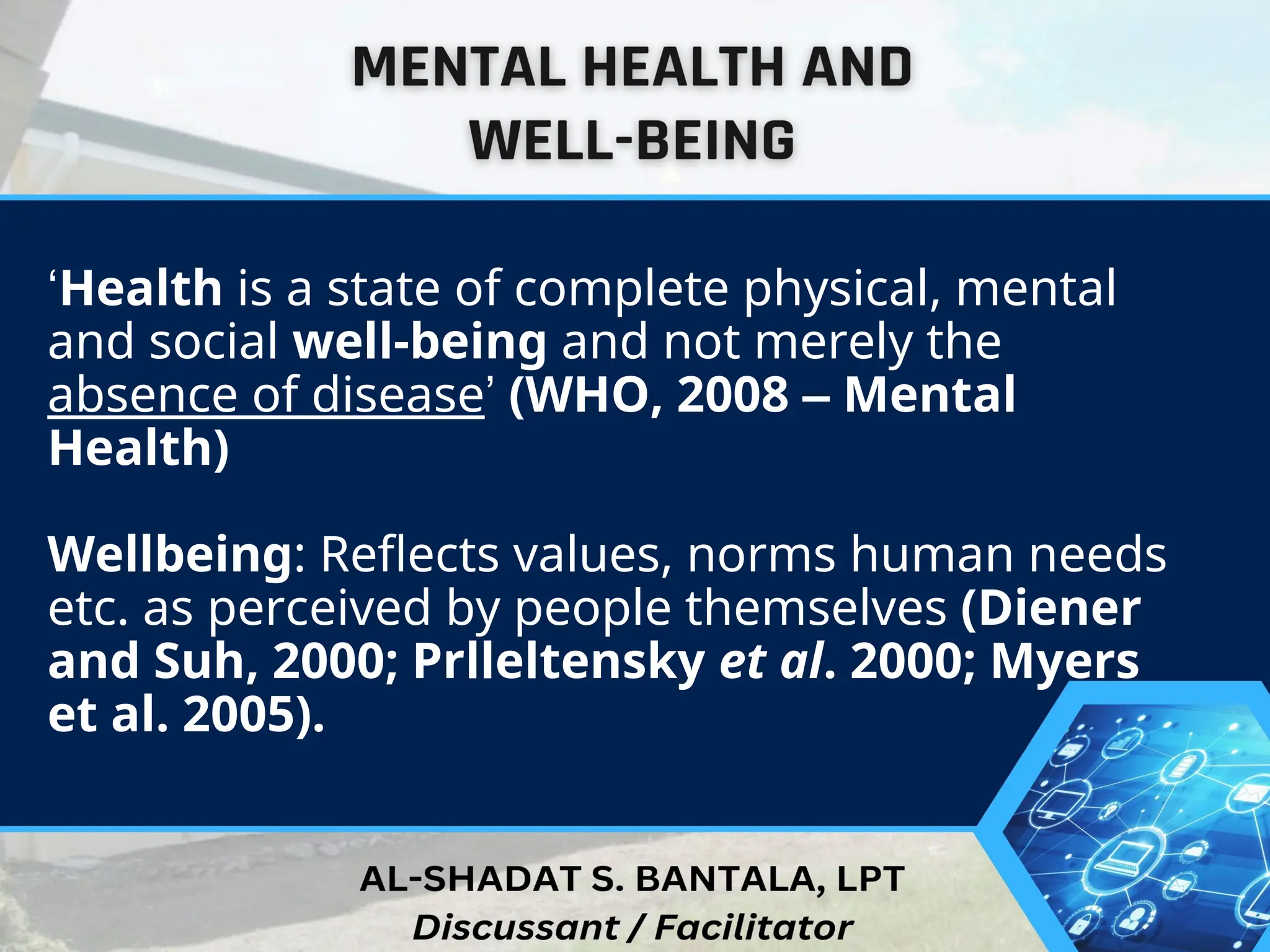
‘Health is a state of complete physical, mental
and social well-being and not merely the
absence of disease’ (WHO, 2008 – Mental
Health)
Wellbeing: Reflects values, norms human needs
etc. as perceived by people themselves (Diener
and Suh, 2000; Prlleltensky et al. 2000; Myers
et al. 2005).
 Understandings of ‘mental health’ and ‘mental illness’
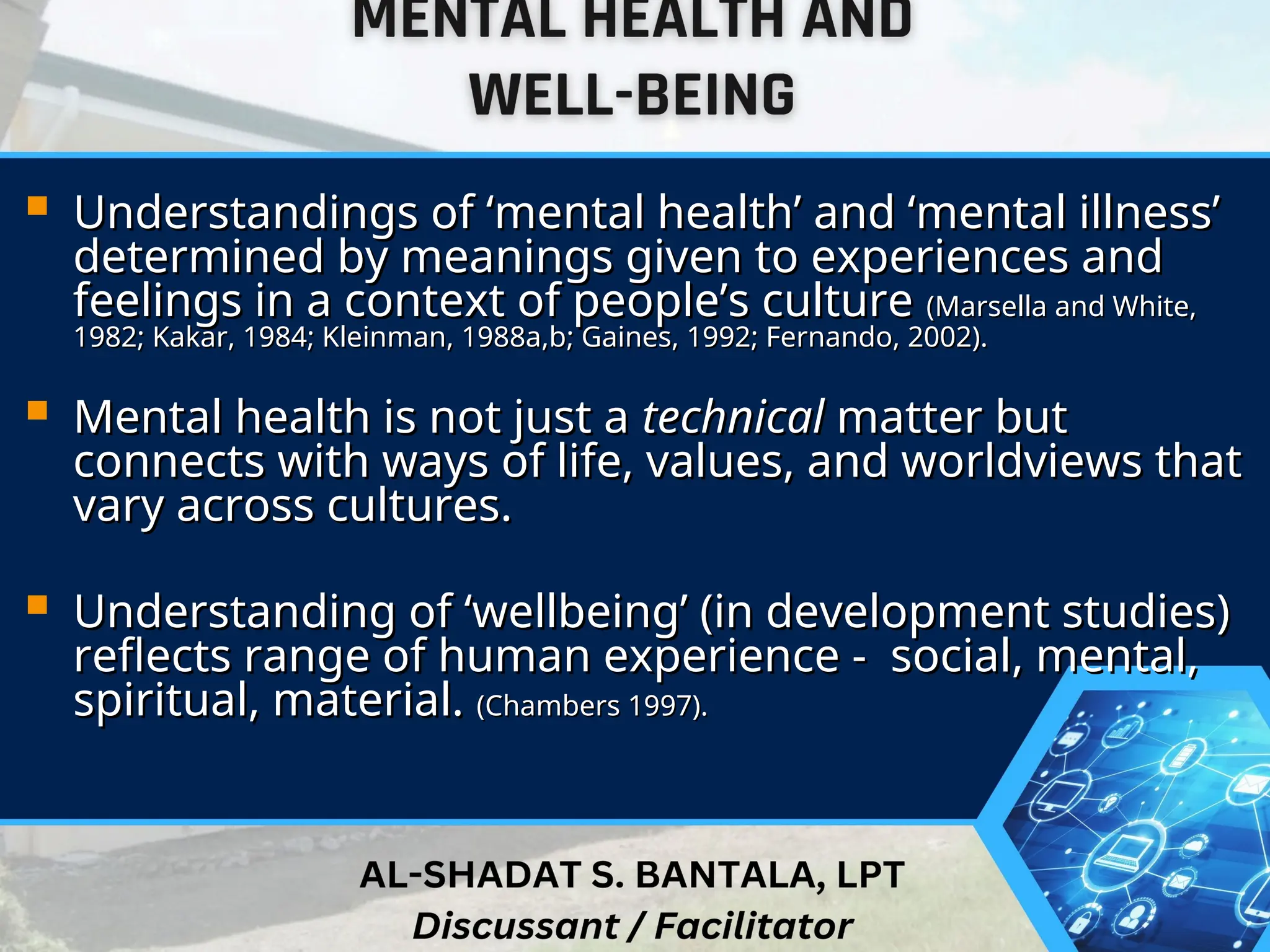
Understandings of ‘mental health’ and ‘mental illness’
determined by meanings given to experiences and
feelings in a context of people’s culture
feelings in a context of people’s culture (Marsella and White,
(Marsella and White,
1982; Kakar, 1984; Kleinman, 1988a,b; Gaines, 1992; Fernando, 2002).
 Mental health is not just a
Mental health is not just a technical
technical matter but
matter but
connects with ways of life, values, and worldviews that
vary across cultures.
 Understanding of ‘wellbeing’ (in development studies)
Understanding of ‘wellbeing’ (in development studies)
reflects range of human experience - social, mental,
spiritual, material.
spiritual, material. (Chambers 1997).
(Chambers 1997).
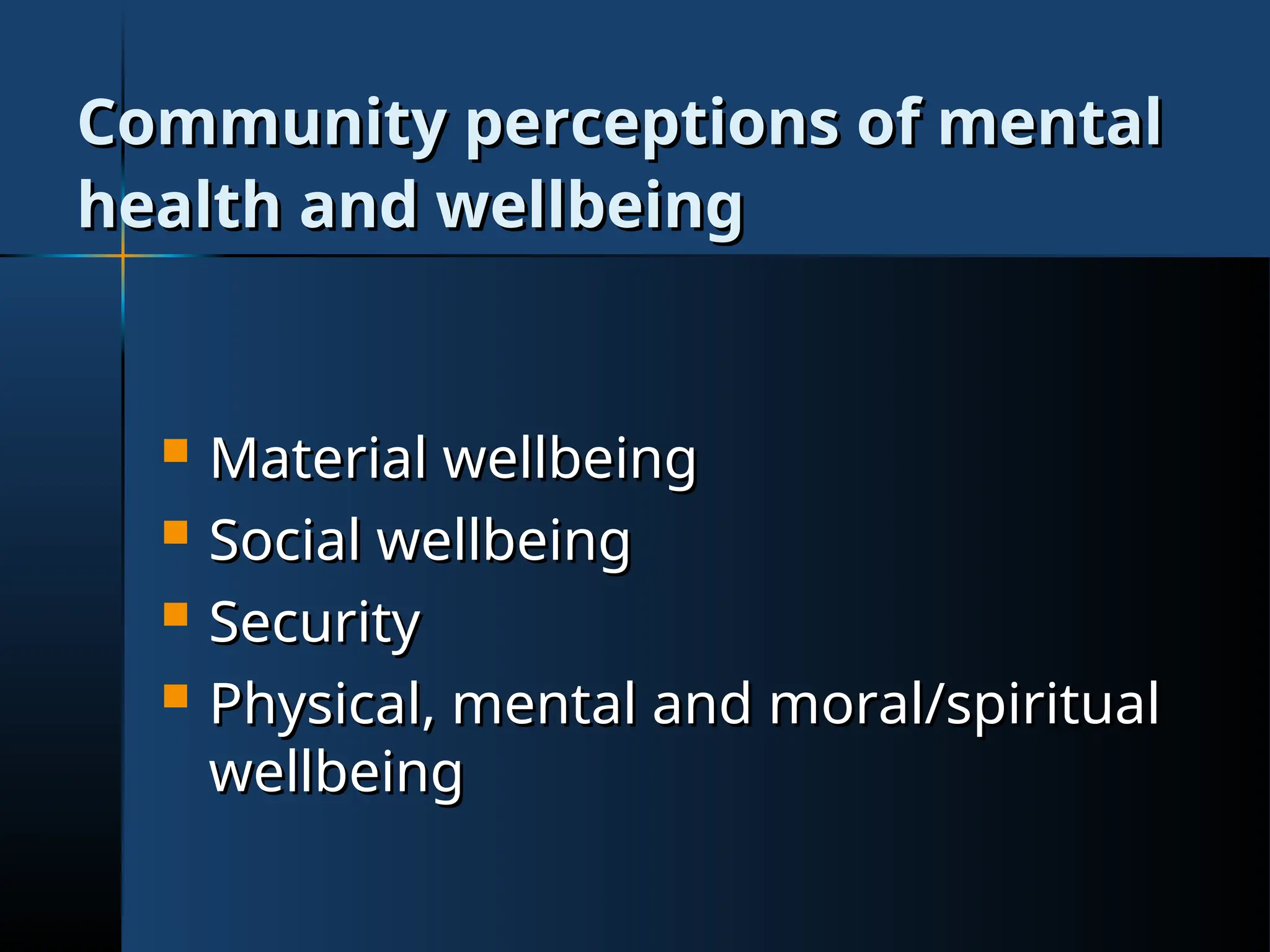
Community perceptions of mental
health and wellbeing
 Material wellbeing
Material wellbeing
 Social wellbeing
Social wellbeing
 Security
Security
 Physical, mental and moral/spiritual
Physical, mental and moral/spiritual
wellbeing
wellbeing
Material wellbeing
Material wellbeing
 having stable
having stable
employment/livelihoods
 having stable cash incomes
having stable cash incomes
 access to adequate land
access to adequate land
 having permanent, secure and
having permanent, secure and
spacious house
spacious house
Social wellbeing
Social wellbeing
 providing good education and socialization for
providing good education and socialization for
children
children
 caring for children
caring for children
 unity and harmony within family
unity and harmony within family
 unity and harmony within community
unity and harmony within community
 unity and harmony with neighbouring
unity and harmony with neighbouring
communities/host communities
Social wellbeing
Social wellbeing
 access to services
access to services
 self-respect and dignity
self-respect and dignity
 clean and free environment
clean and free environment
 free of alcohol and drug abuse
free of alcohol and drug abuse
Security
Security
 a secure environment for their living
a secure environment for their living
without fear and outside threats
 a secure physical environment and
a secure physical environment and
protection from natural disasters and
conflicts
conflicts
 free movement and living without being
free movement and living without being
subject to suspicion
Security
Security
 a
a peaceful
peaceful atmosphere free of regular
atmosphere free of regular
checks and intimidation from security
forces.
forces.
 secure and strong houses to prevent
secure and strong houses to prevent
intruders
intruders
 houses that ensure privacy and personal
houses that ensure privacy and personal
safety
safety
 community members coming together to
community members coming together to
intervene and resolve problems and issues
Physical, mental and moral and
spiritual wellbeing
spiritual wellbeing
 living without illness and suffering
living without illness and suffering
 having mental happiness
having mental happiness
 having good thoughts/feelings towards others
having good thoughts/feelings towards others
 living with courage/endeavour, self-initiative and drive
living with courage/endeavour, self-initiative and drive
 living with wisdom (not acting on emotions/rational
living with wisdom (not acting on emotions/rational
behaviour)
behaviour)
 moral behaviour of community members
moral behaviour of community members
 careful spending
careful spending
 living religiously
living religiously
What reduces community
mental health and wellbeing?
 political violence and natural
political violence and natural
disasters
disasters
 displacement
displacement
 poverty
poverty
 poor housing conditions
poor housing conditions
 conflicts within family and
conflicts within family and
community
community
 social exclusion and isolation
social exclusion and isolation
What reduces community
mental health and wellbeing?
 injustice and discrimination
injustice and discrimination
 urbanization
urbanization
 communicable diseases
communicable diseases
 work stress
work stress
 alcoholism, drug abuse and sexual
alcoholism, drug abuse and sexual
abuse
abuse
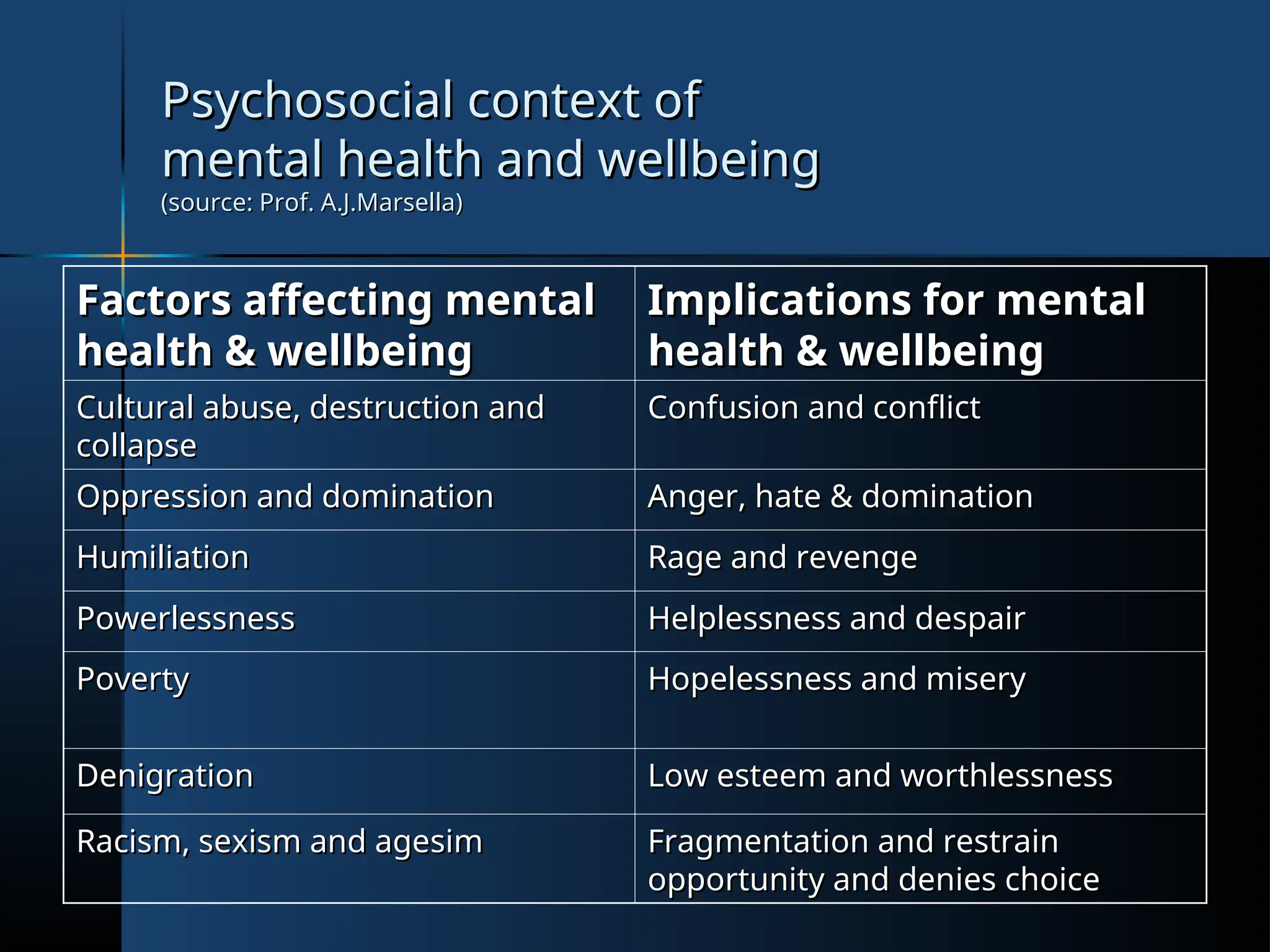
Psychosocial context of
mental health and wellbeing
(source: Prof. A.J.Marsella)
Factors affecting mental
health & wellbeing
health & wellbeing
Implications for mental
health & wellbeing
health & wellbeing
Cultural abuse, destruction and
collapse
collapse
Confusion and conflict
Oppression and domination
Oppression and domination Anger, hate & domination
Anger, hate & domination
Humiliation
Humiliation Rage and revenge
Rage and revenge
Powerlessness
Powerlessness Helplessness and despair
Helplessness and despair
Poverty
Poverty Hopelessness and misery
Hopelessness and misery
Denigration
Denigration Low esteem and worthlessness
Low esteem and worthlessness
Racism, sexism and agesim
Racism, sexism and agesim Fragmentation and restrain
Fragmentation and restrain
opportunity and denies choice
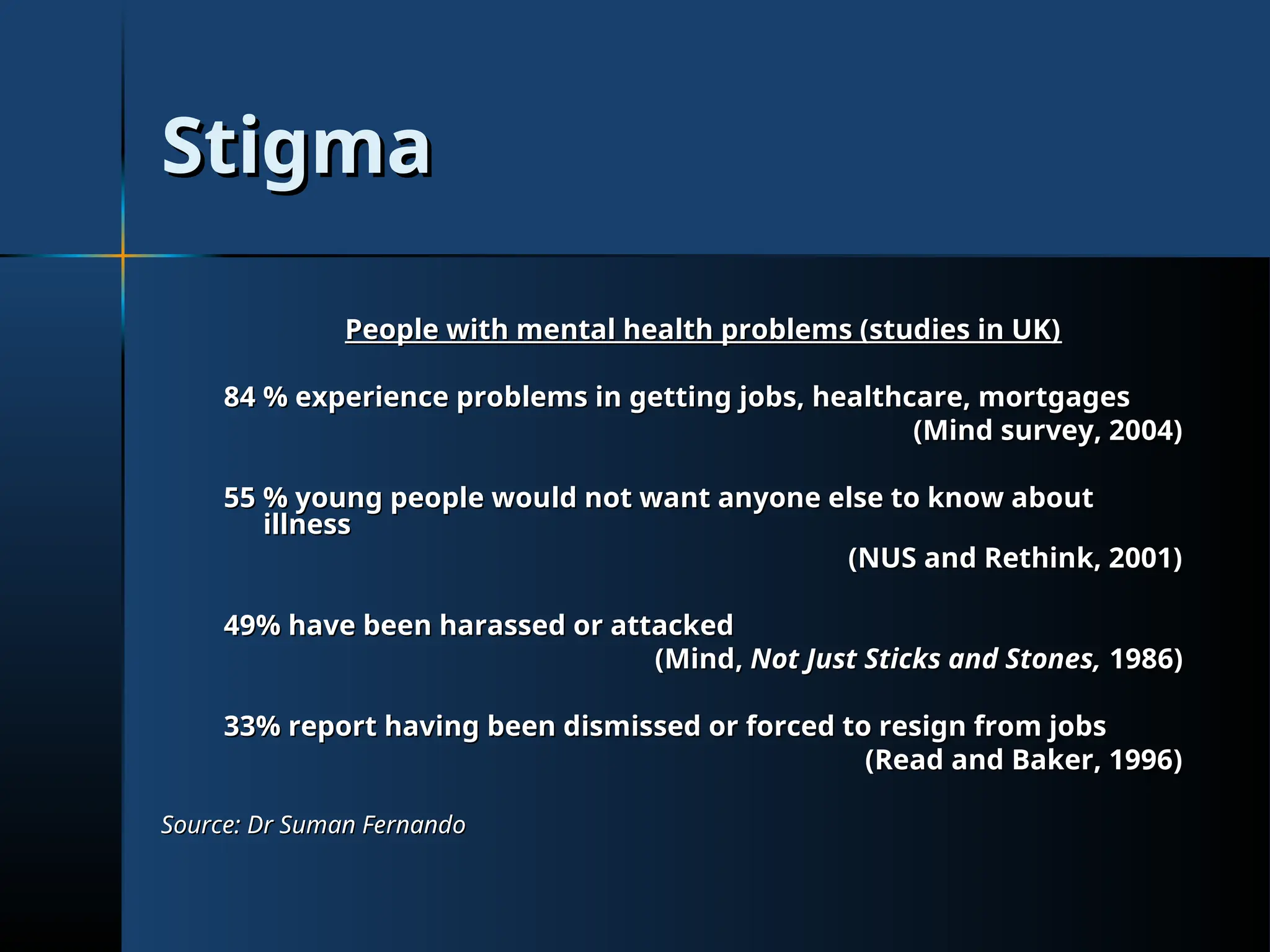
Stigma
Stigma
People with mental health problems (studies in UK)
84 % experience problems in getting jobs, healthcare, mortgages
(Mind survey, 2004)
(Mind survey, 2004)
55 % young people would not want anyone else to know about
illness
illness
(NUS and Rethink, 2001)
49% have been harassed or attacked
(Mind,
(Mind, Not Just Sticks and Stones,
Not Just Sticks and Stones, 1986)
1986)
33% report having been dismissed or forced to resign from jobs
(Read and Baker, 1996)
Source: Dr Suman Fernando
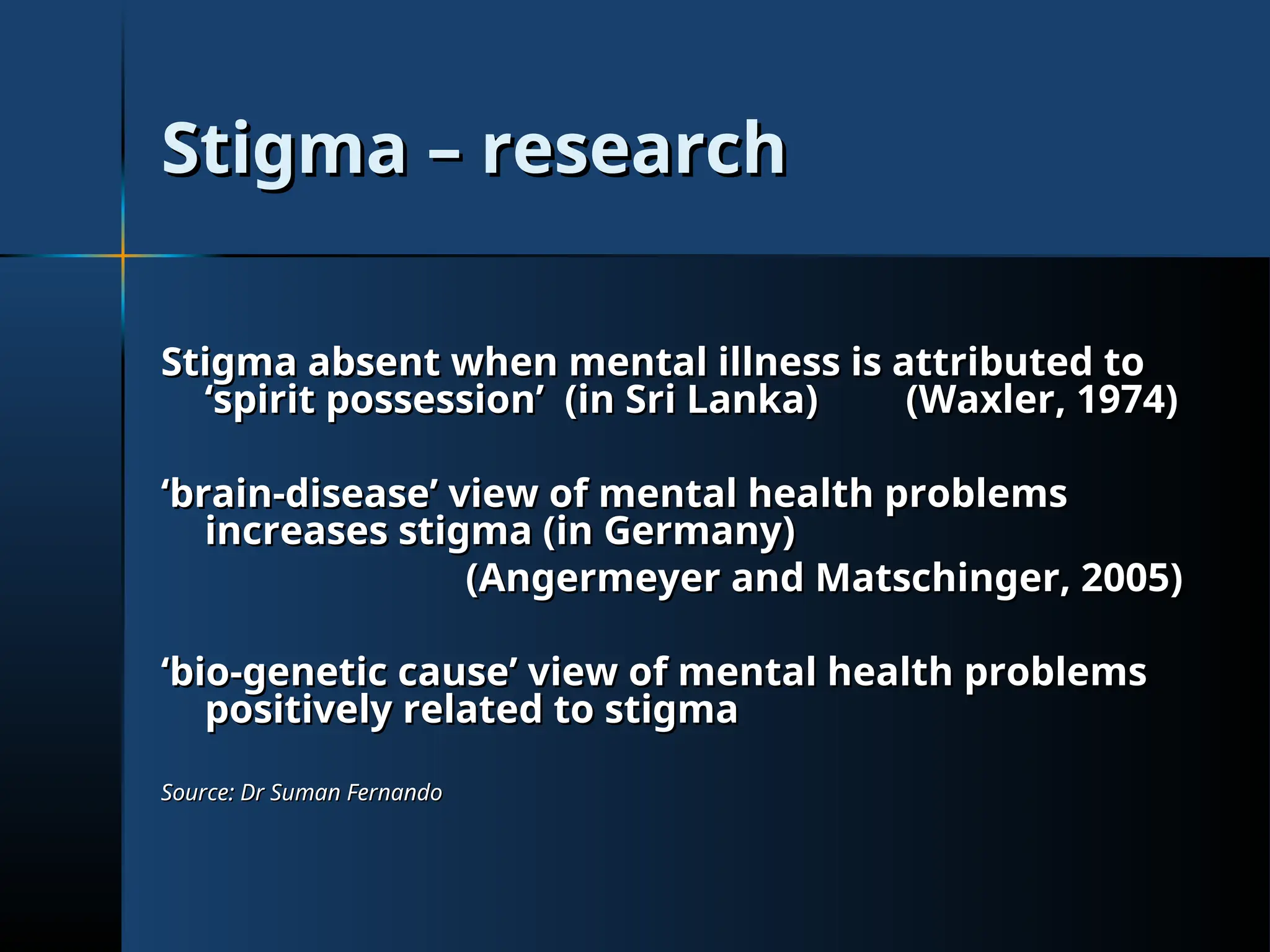
Stigma – research
Stigma – research
Stigma absent when mental illness is attributed to
‘spirit possession’ (in Sri Lanka)
‘spirit possession’ (in Sri Lanka) (Waxler, 1974)
(Waxler, 1974)
‘
‘brain-disease’ view of mental health problems
brain-disease’ view of mental health problems
increases stigma (in Germany)
(Angermeyer and Matschinger, 2005)
‘
‘bio-genetic cause’ view of mental health problems
bio-genetic cause’ view of mental health problems
positively related to stigma
Source: Dr Suman Fernando
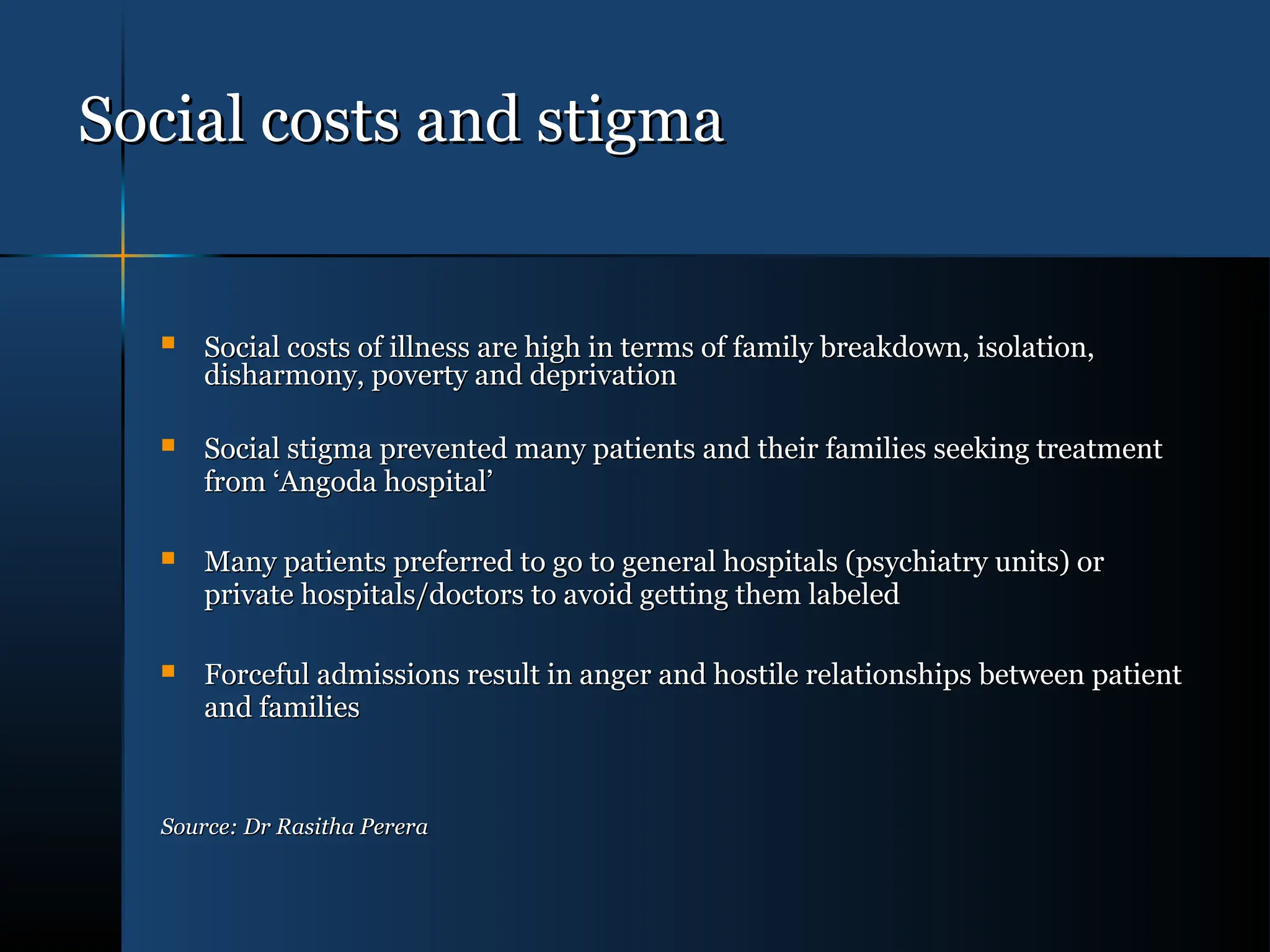
Social costs and stigma
 Social costs of illness are high in terms of family breakdown, isolation,
Social costs of illness are high in terms of family breakdown, isolation,
disharmony, poverty and deprivation
 Social stigma prevented many patients and their families seeking treatment
Social stigma prevented many patients and their families seeking treatment
from ‘Angoda hospital’
 Many patients preferred to go to general hospitals (psychiatry units) or
Many patients preferred to go to general hospitals (psychiatry units) or
private hospitals/doctors to avoid getting them labeled
 Forceful admissions result in anger and hostile relationships between patient
Forceful admissions result in anger and hostile relationships between patient
and families
and families
Source: Dr Rasitha Perera
Care givers were reluctant to take the patient
home and desired a long stay when
patients:-
patients:-
 were aggressive at home
were aggressive at home
 do not take treatment as prescribed
do not take treatment as prescribed
 mess up family/home affairs
mess up family/home affairs
 do not have a care giver at home
do not have a care giver at home
Dr Rasitha Perera
Dr Rasitha Perera
Family response to persons with mental
illness
Care givers were reluctant to take the
patient home and desired a long stay when
patients:-
patients:-
 are dependent on others / lack of productivity
are dependent on others / lack of productivity
 misuse psychoactive substance
misuse psychoactive substance
 show hostility
show hostility
 maintain poor self care
maintain poor self care
Source: Dr Rasitha Perera
Family response to persons with mental
illness
 Illness was the major cause for many patients to remain single, separated
Illness was the major cause for many patients to remain single, separated
or divorced
or divorced
 50% of the patients experienced disharmony with their families
50% of the patients experienced disharmony with their families
 1/3
1/3rd
rd
of the patients were considered a burden to the family
 Only 1/4
Only 1/4th
th
of the patients received better family care
 1/3
1/3rd
rd
of the care givers were not satisfied with the current status of the
patient
patient
Source: Dr Rasitha Perera
Family response to persons with mental
illness
Promoting mental health
and wellbeing
and wellbeing
Interventions
Interventions
Social
Social
Medical (treatments)
Strengthening resilience and support
Individual
Individual
Family
Family
Community
Community
Promoting recovery (
Promoting recovery (‘
‘recovery approach
recovery approach’
’)
)
Developing hope
Developing hope
Overcoming barriers
Overcoming barriers
Social inclusion
Social inclusion
Source: Dr Suman Fernando
Mental Health
Mental Health
Interventions
Interventions
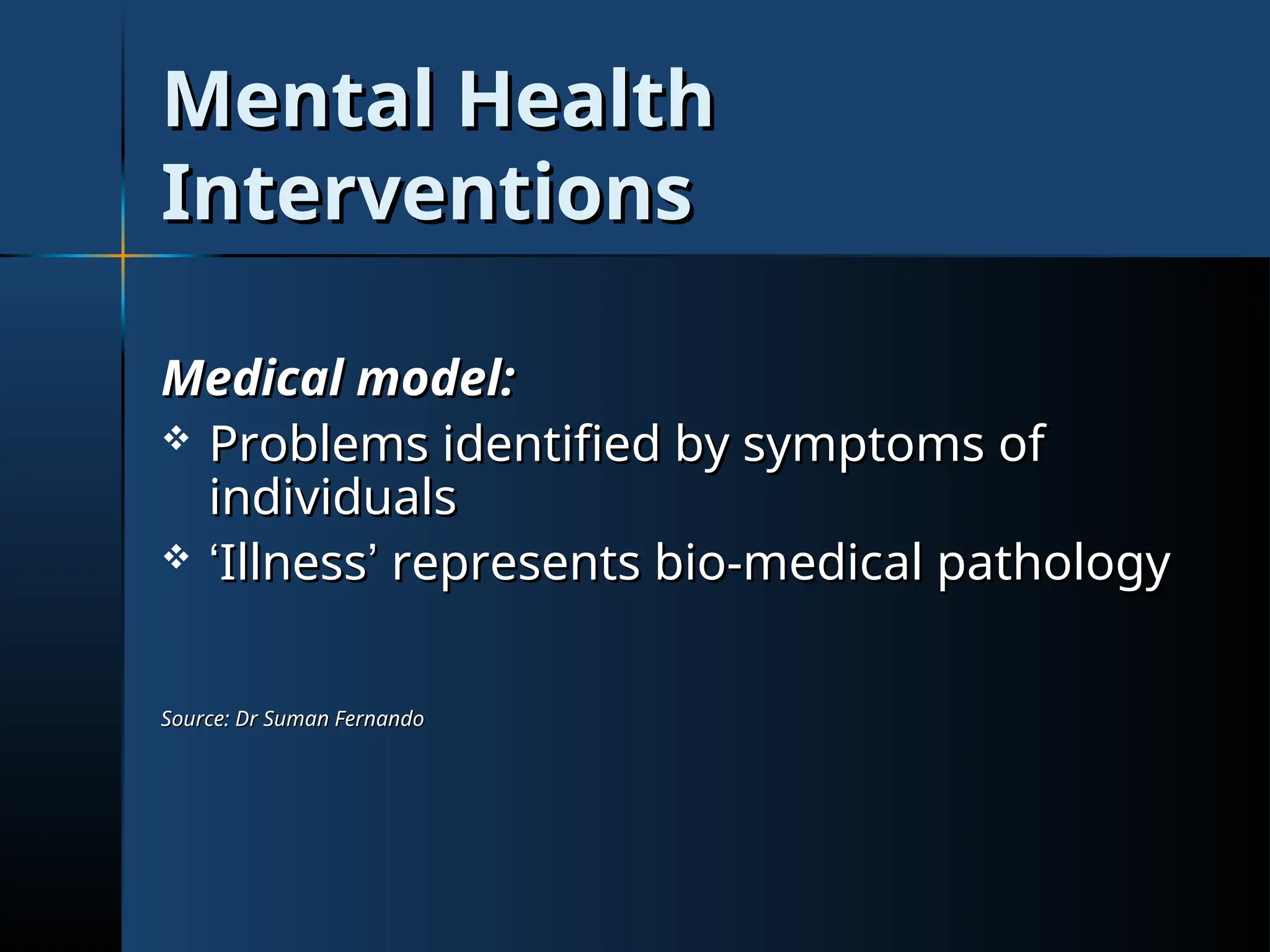
Medical model:
Medical model:
 Problems identified by symptoms of
Problems identified by symptoms of
individuals
individuals
 ‘
‘Illness
Illness’
’ represents bio-medical pathology
represents bio-medical pathology
Source: Dr Suman Fernando
Mental Health
Mental Health
Interventions
Interventions
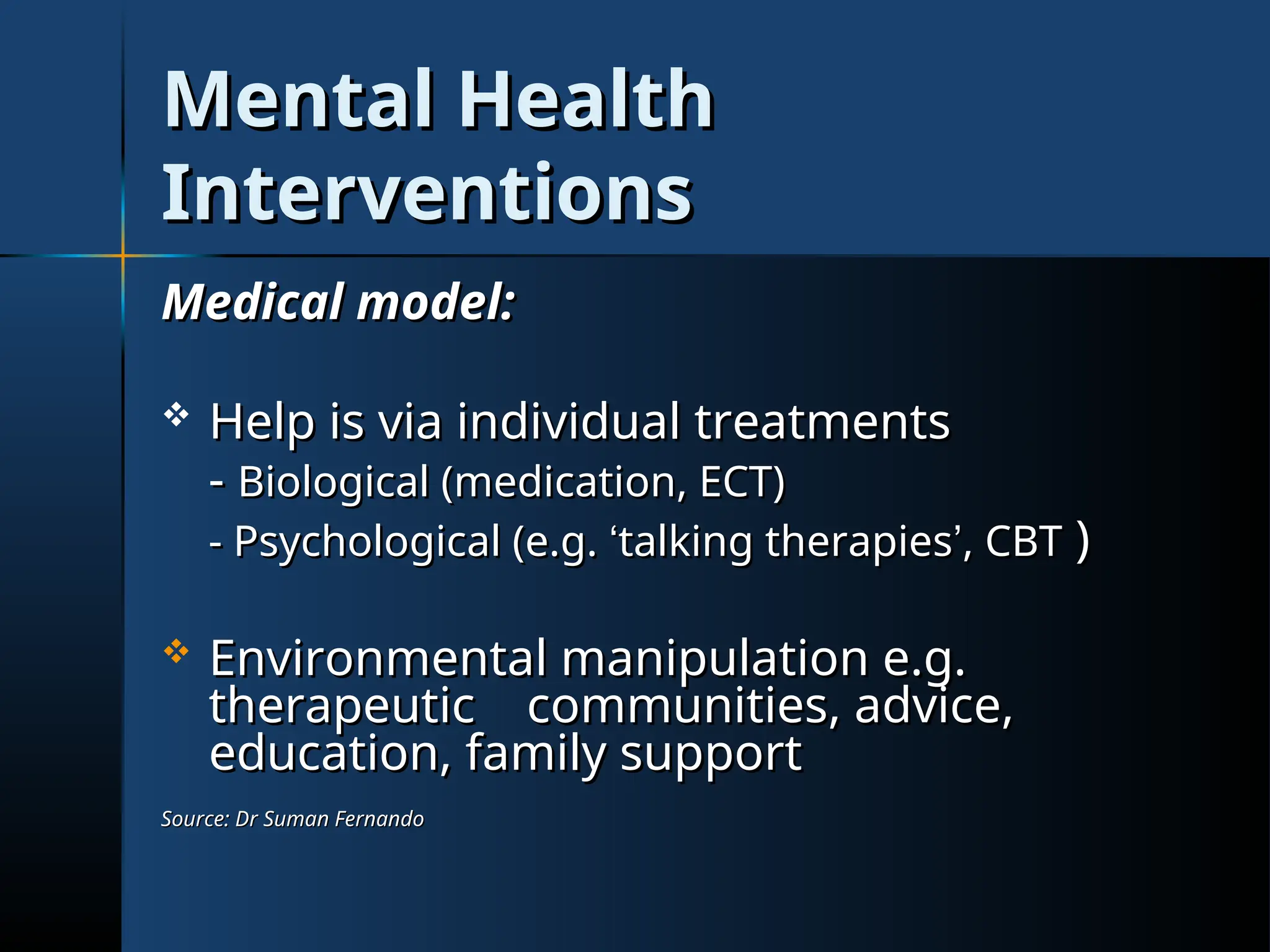
Medical model:
Medical model:
 Help is via individual treatments
Help is via individual treatments
-
- Biological (medication, ECT)
Biological (medication, ECT)
- Psychological (e.g.
- Psychological (e.g. ‘
‘talking therapies
talking therapies’
’, CBT
, CBT )
)
 Environmental manipulation e.g.
Environmental manipulation e.g.
therapeutic communities, advice,
education, family support
Source: Dr Suman Fernando
Mental Health
Mental Health
Interventions
Interventions
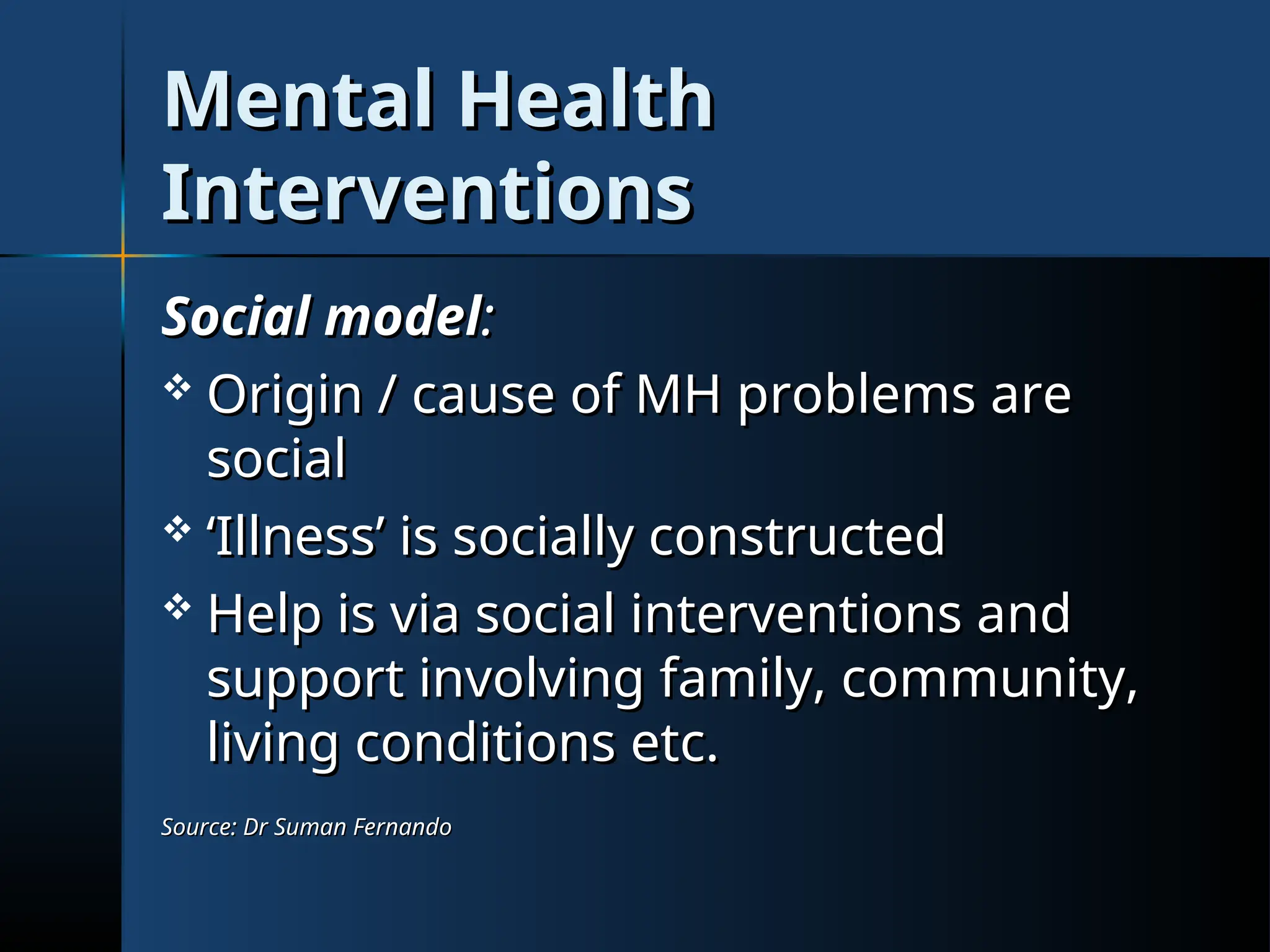
Social model
Social model:
:
 Origin / cause of MH problems are
Origin / cause of MH problems are
social
social
 ‘
‘Illness’ is socially constructed
Illness’ is socially constructed
 Help is via social interventions and
Help is via social interventions and
support involving family, community,
living conditions etc.
Source: Dr Suman Fernando
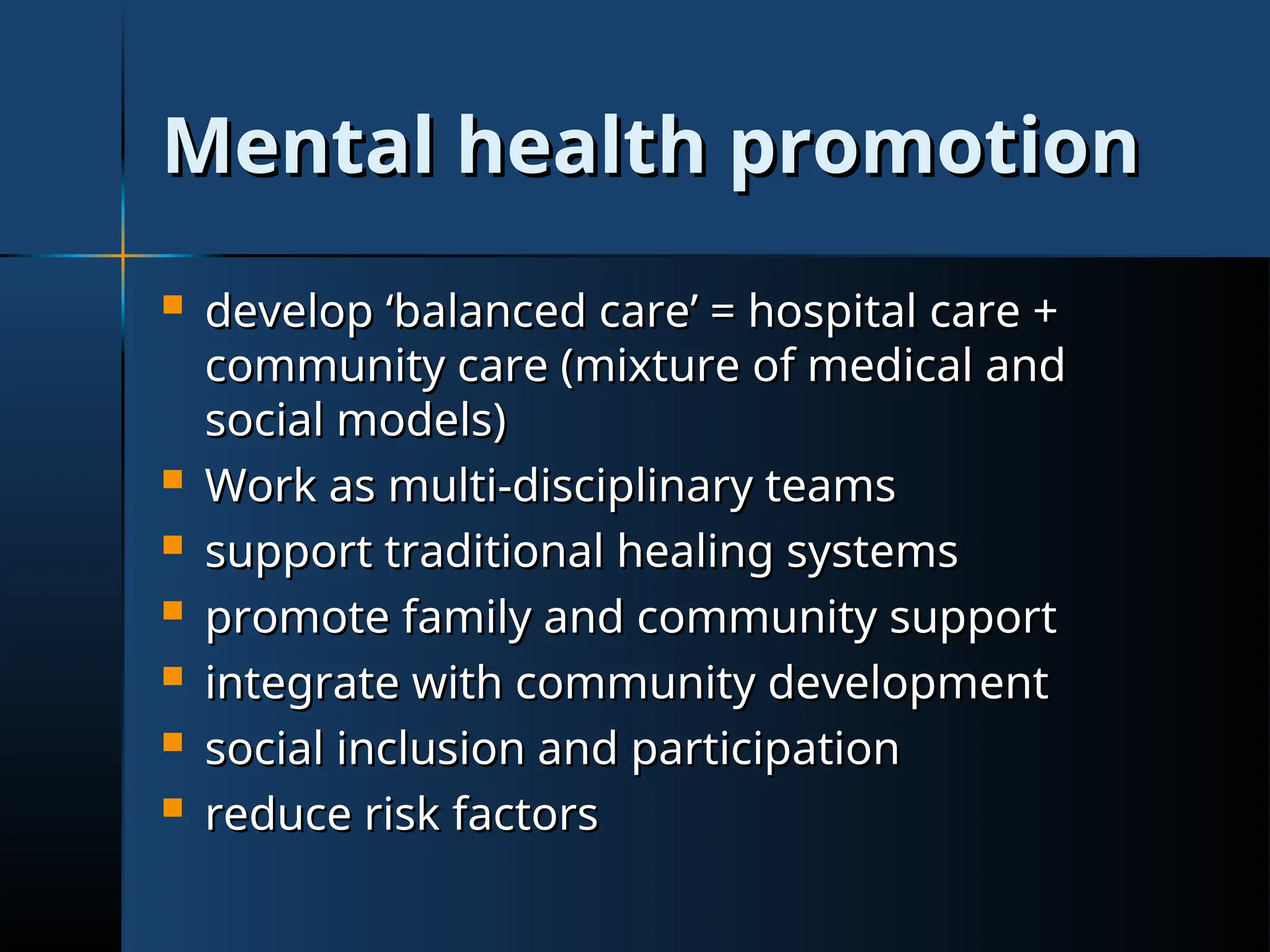
Mental health promotion
 develop ‘balanced care’ = hospital care +
develop ‘balanced care’ = hospital care +
community care (mixture of medical and
social models)
social models)
 Work as multi-disciplinary teams
Work as multi-disciplinary teams
 support traditional healing systems
support traditional healing systems
 promote family and community support
promote family and community support
 integrate with community development
integrate with community development
 social inclusion and participation
social inclusion and participation
 reduce risk factors
reduce risk factors
Factors affecting mental
health and wellbeing of
children
children
 Lack of access to education and facilities
Lack of access to education and facilities
 Child neglect, ill-treatment and poor care
Child neglect, ill-treatment and poor care
 Malnutrition
Malnutrition
 Traumatic experiences – loss of family members,
Traumatic experiences – loss of family members,
displacement, detention, physical injuries
 Substance abuse
Substance abuse
 Sexual abuse and child prostitution
Sexual abuse and child prostitution
 Child trafficking and labour
Child trafficking and labour
 Domestic violence
Domestic violence
Factors affecting mental
health and wellbeing of
children
children
 Family break downs e.g. divorce,
Family break downs e.g. divorce,
separation, desertion
 Recruitment as child soldiers / Child Labor
Recruitment as child soldiers / Child Labor
 Parents working abroad
Parents working abroad
 Competition and pressures for
Competition and pressures for
‘achievement’
‘achievement’
 Disabilities
Disabilities
Mental health problems
of children (1)
of children (1)
May present as:
May present as:
 emotional problems
emotional problems such as phobias, excessive
such as phobias, excessive
anxiety, depression, irrational fears
 Unusual behaviour / conduct
Unusual behaviour / conduct such as
such as
aggressiveness, timidity
 Inattention / overactivity
Inattention / overactivity at school or home
at school or home
Mental health problems
of children (2)
of children (2)
May present as:
May present as:
 Difficulties / delay in
Difficulties / delay in acquiring certain skills such as
acquiring certain skills such as
speech, writing, reading
 Problems in attachment
Problems in attachment to parents or caregivers
to parents or caregivers
such as not showing or responding to affection
(when severe may be autism)
 Food fads / eating problems
Food fads / eating problems such a refusing to eat,
such a refusing to eat,
induced vomiting (may be anorexia)
Mental health problems
of children (3)
of children (3)
 sleeping problems
sleeping problems such as excessive
such as excessive
sleepiness,
sleepiness, insomnia (may be sign
insomnia (may be sign
of more severe illness)
 Post traumatic problems
Post traumatic problems such as re-
such as re-
living traumatic
living traumatic incidents (may
incidents (may
become ‘post traumatic stress
disorder’ – PTSD)
disorder’ – PTSD)
Dealing with Mental health
problems of children
Try to pick up:
Try to pick up:
 Special needs that child may have such as
Special needs that child may have such as
early learning difficulties, dyslexia
(recognition of words and writing letters),
hearing loss (early deafness), visual
impairment
impairment
 Problems in the child’s interactions with
Problems in the child’s interactions with
other children, teachers and others in
authority
authority
Dealing with Mental health
problems of children
 Family problems at home
Family problems at home
 Difficulties in socialization (not
Difficulties in socialization (not
mixing, isolating)
mixing, isolating)
How can the teachers
help?
help?
 Paying more attention to children
Paying more attention to children
with special needs or ‘problems’ (20-
30 percent of children)
 Providing a safe context for children
Providing a safe context for children
to talk
to talk
 Listening and talking to children
Listening and talking to children
How can the teachers help?
(2)
(2)
 Making referrals to relevant specialists
Making referrals to relevant specialists
(e.g. children with severe emotional
disturbance, post traumatic states,
eating disorders, deafness, autism,
family issues)
family issues)
 Enabling children to develop appropriate
Enabling children to develop appropriate
life-skills, self-esteem and resilience
Prevention of mental
health problems (1)
health problems (1)
 Acquiring professional skills in
Acquiring professional skills in
understanding child development and
mental health
mental health
 Creating a supportive school
Creating a supportive school
environment that is conducive to
learning and developing life skills
 Providing mental health education,
Providing mental health education,
knowledge, attitudes and behaviours
to all children
to all children
Prevention of mental
health problems (2)
health problems (2)
 Educating parents and community
Educating parents and community
members on risk and protective
factors of mental health
 Identifying factors that place
Identifying factors that place
children at risk and reinforcing
protective factors
protective factors
Challenges for Teachers
 How can we provide a safe and
How can we provide a safe and
supportive environment in which all
students can maximize their learning?
 How can we remain accessible and
How can we remain accessible and
responsive to their needs?
 How can we assist our students to
How can we assist our students to
develop their ability to cope with
challenges and stress?
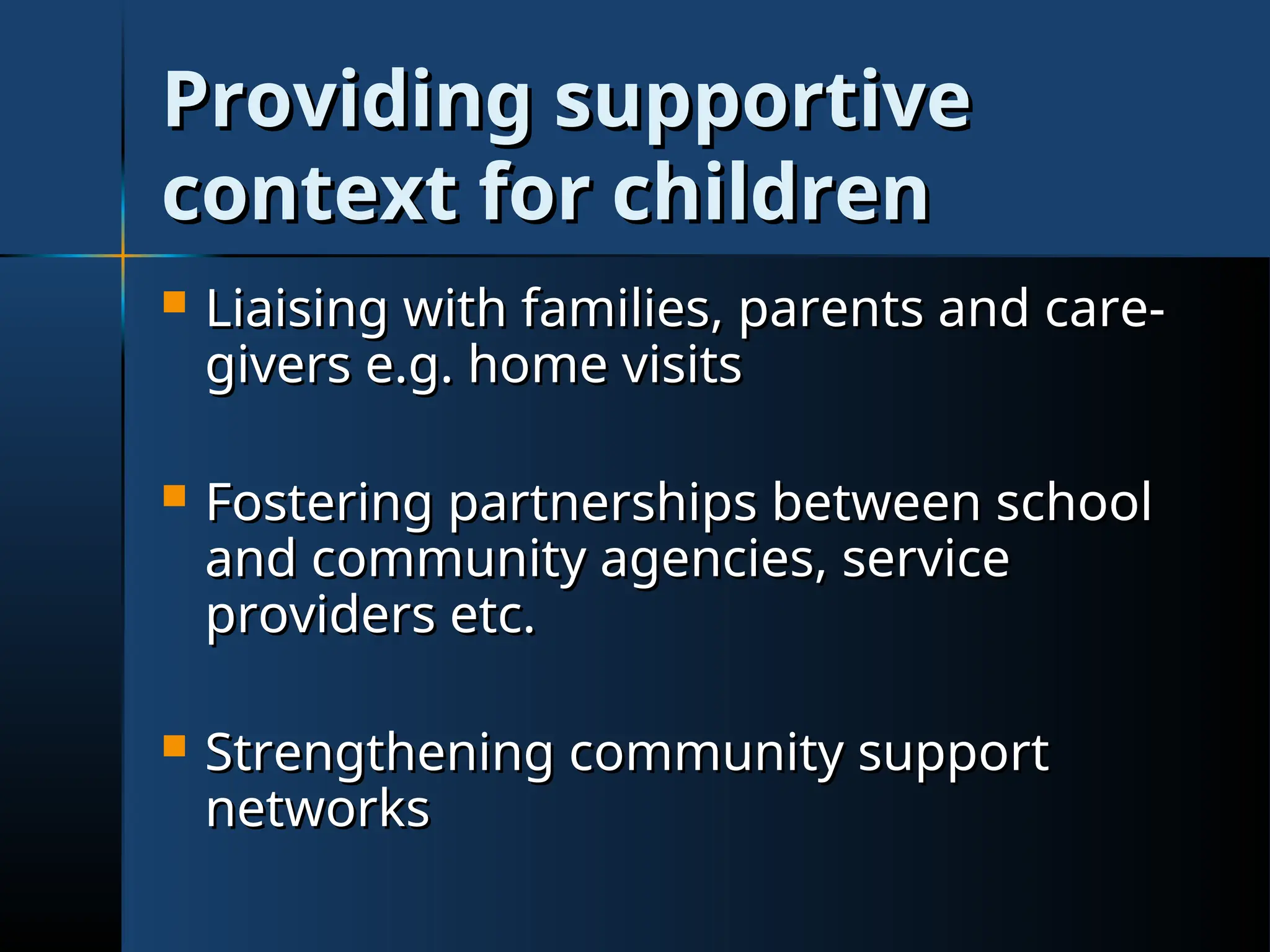
Providing supportive
context for children
 Liaising with families, parents and care-
Liaising with families, parents and care-
givers e.g. home visits
 Fostering partnerships between school
Fostering partnerships between school
and community agencies, service
providers etc.
providers etc.
 Strengthening community support
Strengthening community support
networks
networks
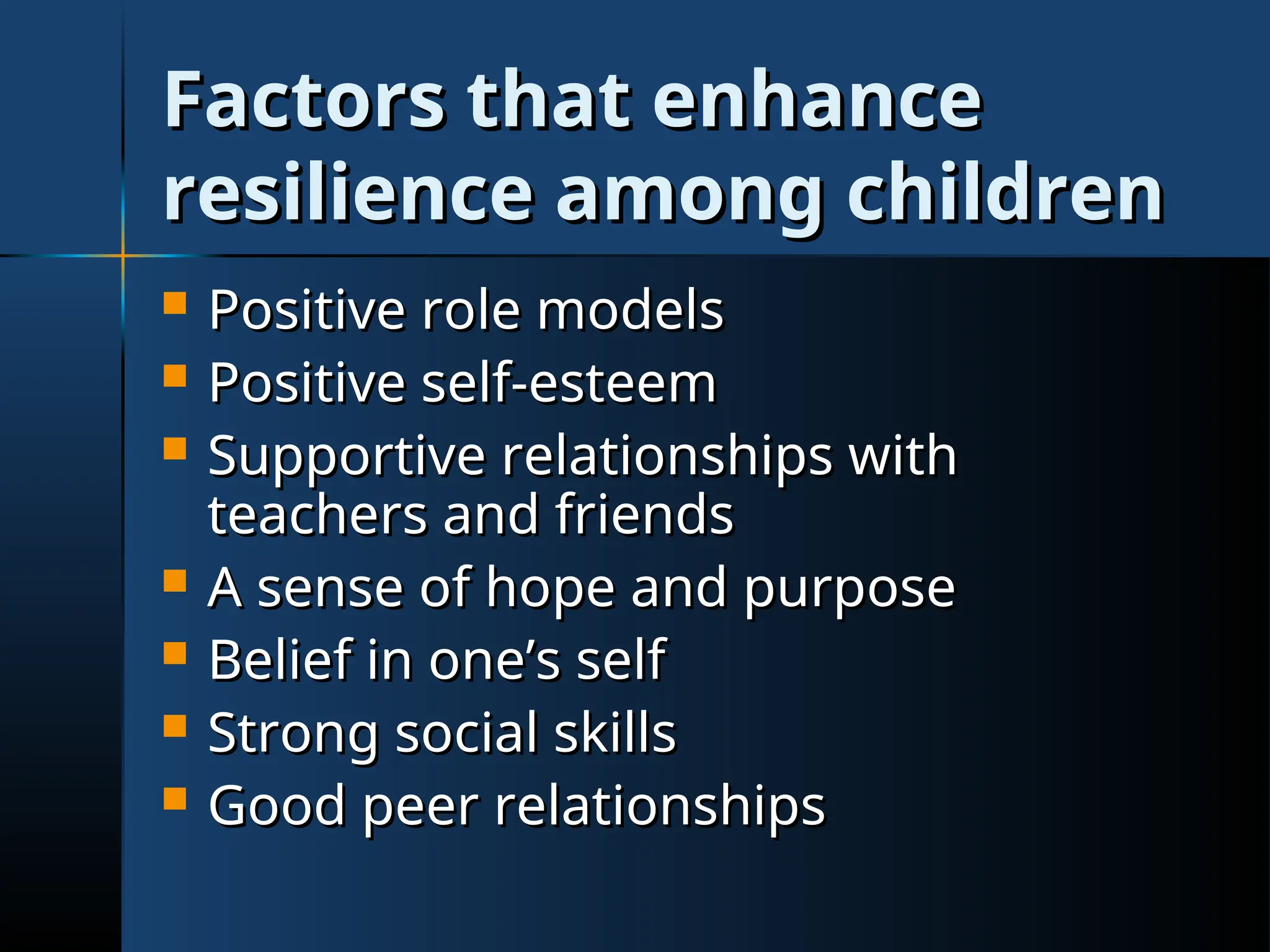
Factors that enhance
resilience among children
 Positive role models
Positive role models
 Positive self-esteem
Positive self-esteem
 Supportive relationships with
Supportive relationships with
teachers and friends
 A sense of hope and purpose
A sense of hope and purpose
 Belief in one’s self
Belief in one’s self
 Strong social skills
Strong social skills
 Good peer relationships
Good peer relationships
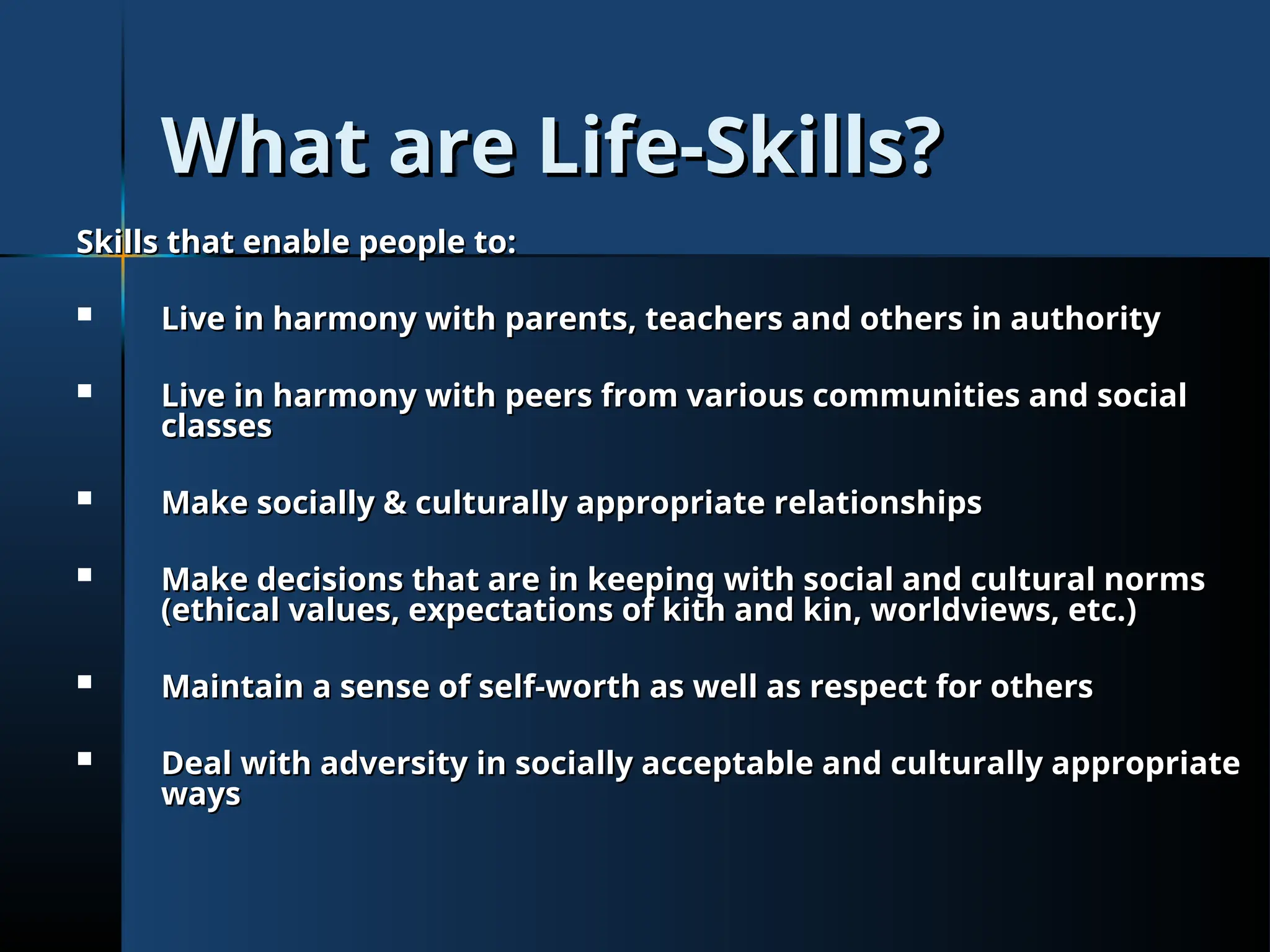
What are Life-Skills?
Skills that enable people to:
 Live in harmony with parents, teachers and others in authority
Live in harmony with parents, teachers and others in authority
 Live in harmony with peers from various communities and social
Live in harmony with peers from various communities and social
classes
classes
 Make socially & culturally appropriate relationships
Make socially & culturally appropriate relationships
 Make decisions that are in keeping with social and cultural norms
Make decisions that are in keeping with social and cultural norms
(ethical values, expectations of kith and kin, worldviews, etc.)
 Maintain a sense of self-worth as well as respect for others
Maintain a sense of self-worth as well as respect for others
 Deal with adversity in socially acceptable and culturally appropriate
Deal with adversity in socially acceptable and culturally appropriate
ways
ways
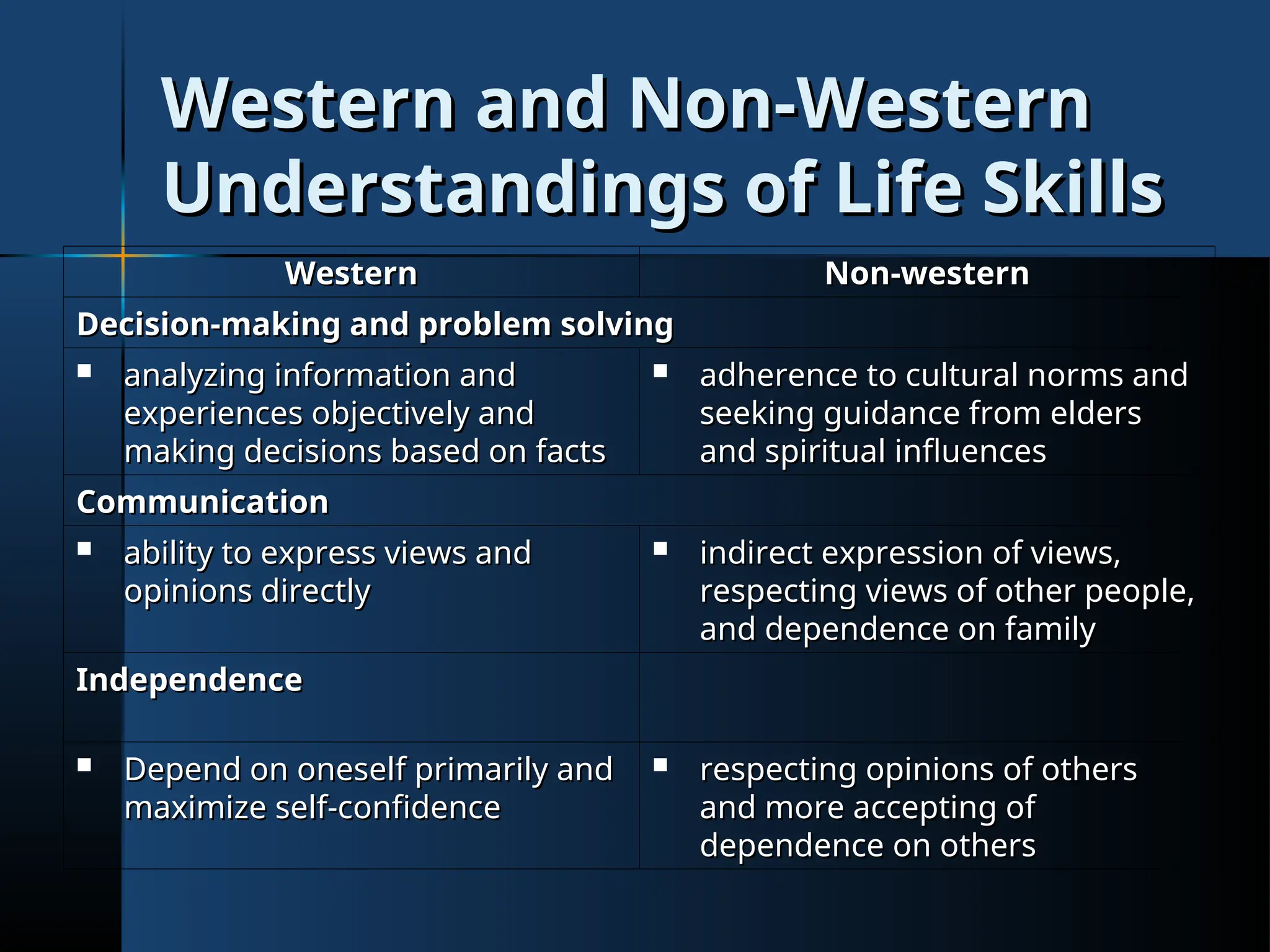
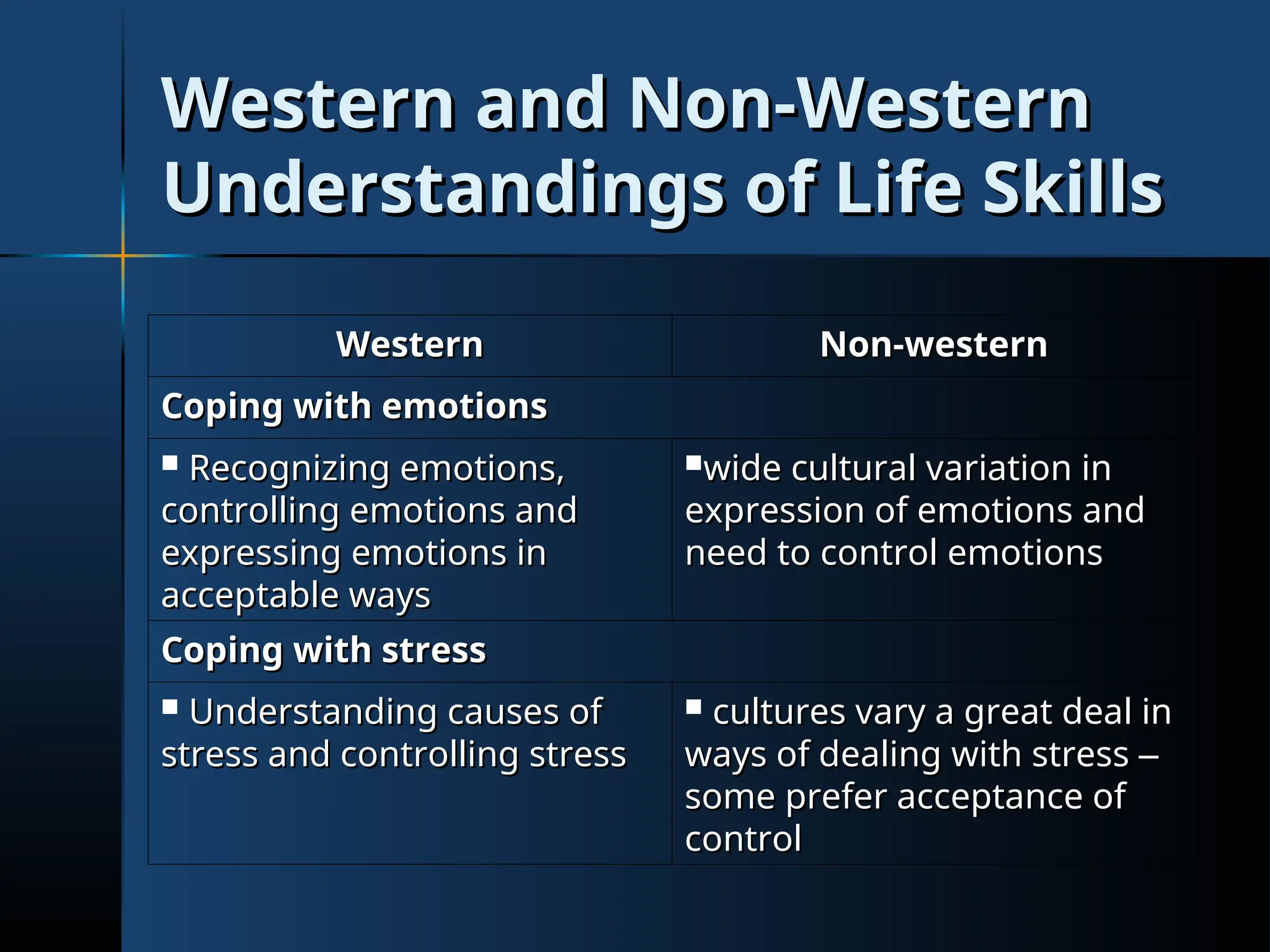
Western and Non-Western
Understandings of Life Skills
Western
Western Non-western
Non-western
Decision-making and problem solving
 analyzing information and
analyzing information and
experiences objectively and
making decisions based on facts
 adherence to cultural norms and
adherence to cultural norms and
seeking guidance from elders
and spiritual influences
Communication
Communication
 ability to express views and
ability to express views and
opinions directly
opinions directly
 indirect expression of views,
indirect expression of views,
respecting views of other people,
and dependence on family
Independence
Independence
 Depend on oneself primarily and
Depend on oneself primarily and
maximize self-confidence
 respecting opinions of others
respecting opinions of others
and more accepting of
dependence on others
Western and Non-Western
Understandings of Life Skills
Western
Western Non-western
Non-western
Coping with emotions
 Recognizing emotions,
Recognizing emotions,
controlling emotions and
expressing emotions in
acceptable ways
acceptable ways
wide cultural variation in
wide cultural variation in
expression of emotions and
need to control emotions
Coping with stress
Coping with stress
 Understanding causes of
Understanding causes of
stress and controlling stress
 cultures vary a great deal in
cultures vary a great deal in
ways of dealing with stress
ways of dealing with stress –
–
some prefer acceptance of
control
control
Workshop and Teachers
Output
Output
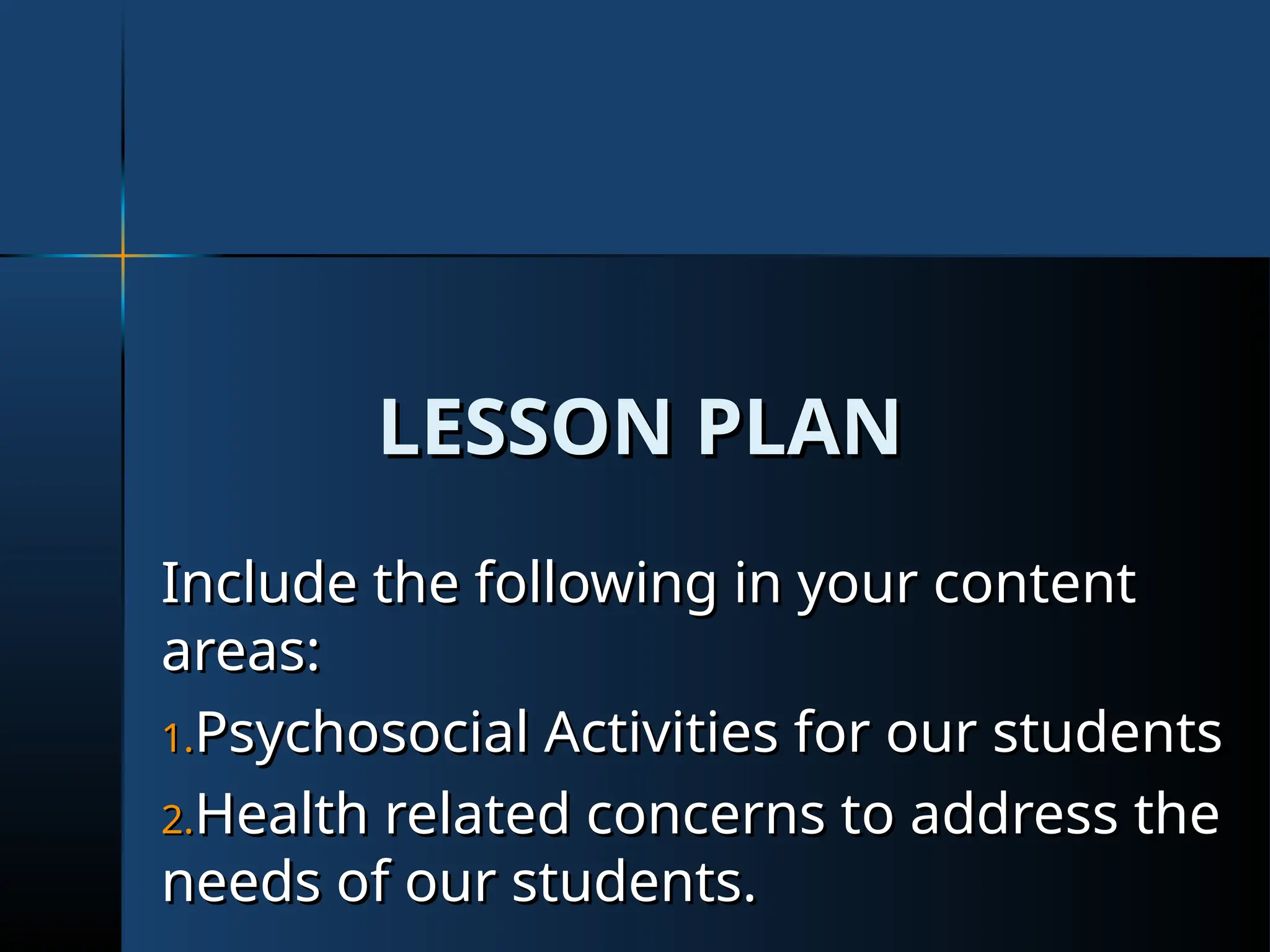
LESSON PLAN
LESSON PLAN
Include the following in your content
areas:
areas:
1.
1.Psychosocial Activities for our students
Psychosocial Activities for our students
2.
2.Health related concerns to address the
Health related concerns to address the
needs of our students.

INSET_Discussant_Mental Health Awareness Program.ppt

  • 4.
    ‘Health is astate of complete physical, mental and social well-being and not merely the absence of disease’ (WHO, 2008 – Mental Health) Wellbeing: Reflects values, norms human needs etc. as perceived by people themselves (Diener and Suh, 2000; Prlleltensky et al. 2000; Myers et al. 2005).
  • 5.
     Understandings of‘mental health’ and ‘mental illness’ Understandings of ‘mental health’ and ‘mental illness’ determined by meanings given to experiences and determined by meanings given to experiences and feelings in a context of people’s culture feelings in a context of people’s culture (Marsella and White, (Marsella and White, 1982; Kakar, 1984; Kleinman, 1988a,b; Gaines, 1992; Fernando, 2002). 1982; Kakar, 1984; Kleinman, 1988a,b; Gaines, 1992; Fernando, 2002).  Mental health is not just a Mental health is not just a technical technical matter but matter but connects with ways of life, values, and worldviews that connects with ways of life, values, and worldviews that vary across cultures. vary across cultures.  Understanding of ‘wellbeing’ (in development studies) Understanding of ‘wellbeing’ (in development studies) reflects range of human experience - social, mental, reflects range of human experience - social, mental, spiritual, material. spiritual, material. (Chambers 1997). (Chambers 1997).
  • 6.
    Community perceptions ofmental Community perceptions of mental health and wellbeing health and wellbeing  Material wellbeing Material wellbeing  Social wellbeing Social wellbeing  Security Security  Physical, mental and moral/spiritual Physical, mental and moral/spiritual wellbeing wellbeing
  • 7.
    Material wellbeing Material wellbeing having stable having stable employment/livelihoods employment/livelihoods  having stable cash incomes having stable cash incomes  access to adequate land access to adequate land  having permanent, secure and having permanent, secure and spacious house spacious house
  • 8.
    Social wellbeing Social wellbeing providing good education and socialization for providing good education and socialization for children children  caring for children caring for children  unity and harmony within family unity and harmony within family  unity and harmony within community unity and harmony within community  unity and harmony with neighbouring unity and harmony with neighbouring communities/host communities communities/host communities
  • 9.
    Social wellbeing Social wellbeing access to services access to services  self-respect and dignity self-respect and dignity  clean and free environment clean and free environment  free of alcohol and drug abuse free of alcohol and drug abuse
  • 10.
    Security Security  a secureenvironment for their living a secure environment for their living without fear and outside threats without fear and outside threats  a secure physical environment and a secure physical environment and protection from natural disasters and protection from natural disasters and conflicts conflicts  free movement and living without being free movement and living without being subject to suspicion subject to suspicion
  • 11.
    Security Security  a a peaceful peacefulatmosphere free of regular atmosphere free of regular checks and intimidation from security checks and intimidation from security forces. forces.  secure and strong houses to prevent secure and strong houses to prevent intruders intruders  houses that ensure privacy and personal houses that ensure privacy and personal safety safety  community members coming together to community members coming together to intervene and resolve problems and issues intervene and resolve problems and issues
  • 12.
    Physical, mental andmoral and Physical, mental and moral and spiritual wellbeing spiritual wellbeing  living without illness and suffering living without illness and suffering  having mental happiness having mental happiness  having good thoughts/feelings towards others having good thoughts/feelings towards others  living with courage/endeavour, self-initiative and drive living with courage/endeavour, self-initiative and drive  living with wisdom (not acting on emotions/rational living with wisdom (not acting on emotions/rational behaviour) behaviour)  moral behaviour of community members moral behaviour of community members  careful spending careful spending  living religiously living religiously
  • 13.
    What reduces community Whatreduces community mental health and wellbeing? mental health and wellbeing?  political violence and natural political violence and natural disasters disasters  displacement displacement  poverty poverty  poor housing conditions poor housing conditions  conflicts within family and conflicts within family and community community  social exclusion and isolation social exclusion and isolation
  • 14.
    What reduces community Whatreduces community mental health and wellbeing? mental health and wellbeing?  injustice and discrimination injustice and discrimination  urbanization urbanization  communicable diseases communicable diseases  work stress work stress  alcoholism, drug abuse and sexual alcoholism, drug abuse and sexual abuse abuse
  • 15.
    Psychosocial context of Psychosocialcontext of mental health and wellbeing mental health and wellbeing (source: Prof. A.J.Marsella) (source: Prof. A.J.Marsella) Factors affecting mental Factors affecting mental health & wellbeing health & wellbeing Implications for mental Implications for mental health & wellbeing health & wellbeing Cultural abuse, destruction and Cultural abuse, destruction and collapse collapse Confusion and conflict Confusion and conflict Oppression and domination Oppression and domination Anger, hate & domination Anger, hate & domination Humiliation Humiliation Rage and revenge Rage and revenge Powerlessness Powerlessness Helplessness and despair Helplessness and despair Poverty Poverty Hopelessness and misery Hopelessness and misery Denigration Denigration Low esteem and worthlessness Low esteem and worthlessness Racism, sexism and agesim Racism, sexism and agesim Fragmentation and restrain Fragmentation and restrain opportunity and denies choice opportunity and denies choice
  • 16.
    Stigma Stigma People with mentalhealth problems (studies in UK) People with mental health problems (studies in UK) 84 % experience problems in getting jobs, healthcare, mortgages 84 % experience problems in getting jobs, healthcare, mortgages (Mind survey, 2004) (Mind survey, 2004) 55 % young people would not want anyone else to know about 55 % young people would not want anyone else to know about illness illness (NUS and Rethink, 2001) (NUS and Rethink, 2001) 49% have been harassed or attacked 49% have been harassed or attacked (Mind, (Mind, Not Just Sticks and Stones, Not Just Sticks and Stones, 1986) 1986) 33% report having been dismissed or forced to resign from jobs 33% report having been dismissed or forced to resign from jobs (Read and Baker, 1996) (Read and Baker, 1996) Source: Dr Suman Fernando Source: Dr Suman Fernando
  • 17.
    Stigma – research Stigma– research Stigma absent when mental illness is attributed to Stigma absent when mental illness is attributed to ‘spirit possession’ (in Sri Lanka) ‘spirit possession’ (in Sri Lanka) (Waxler, 1974) (Waxler, 1974) ‘ ‘brain-disease’ view of mental health problems brain-disease’ view of mental health problems increases stigma (in Germany) increases stigma (in Germany) (Angermeyer and Matschinger, 2005) (Angermeyer and Matschinger, 2005) ‘ ‘bio-genetic cause’ view of mental health problems bio-genetic cause’ view of mental health problems positively related to stigma positively related to stigma Source: Dr Suman Fernando Source: Dr Suman Fernando
  • 18.
    Social costs andstigma Social costs and stigma  Social costs of illness are high in terms of family breakdown, isolation, Social costs of illness are high in terms of family breakdown, isolation, disharmony, poverty and deprivation disharmony, poverty and deprivation  Social stigma prevented many patients and their families seeking treatment Social stigma prevented many patients and their families seeking treatment from ‘Angoda hospital’ from ‘Angoda hospital’  Many patients preferred to go to general hospitals (psychiatry units) or Many patients preferred to go to general hospitals (psychiatry units) or private hospitals/doctors to avoid getting them labeled private hospitals/doctors to avoid getting them labeled  Forceful admissions result in anger and hostile relationships between patient Forceful admissions result in anger and hostile relationships between patient and families and families Source: Dr Rasitha Perera Source: Dr Rasitha Perera
  • 19.
    Care givers werereluctant to take the patient Care givers were reluctant to take the patient home and desired a long stay when home and desired a long stay when patients:- patients:-  were aggressive at home were aggressive at home  do not take treatment as prescribed do not take treatment as prescribed  mess up family/home affairs mess up family/home affairs  do not have a care giver at home do not have a care giver at home Dr Rasitha Perera Dr Rasitha Perera Family response to persons with mental illness
  • 20.
    Care givers werereluctant to take the Care givers were reluctant to take the patient home and desired a long stay when patient home and desired a long stay when patients:- patients:-  are dependent on others / lack of productivity are dependent on others / lack of productivity  misuse psychoactive substance misuse psychoactive substance  show hostility show hostility  maintain poor self care maintain poor self care Source: Dr Rasitha Perera Source: Dr Rasitha Perera Family response to persons with mental illness
  • 21.
     Illness wasthe major cause for many patients to remain single, separated Illness was the major cause for many patients to remain single, separated or divorced or divorced  50% of the patients experienced disharmony with their families 50% of the patients experienced disharmony with their families  1/3 1/3rd rd of the patients were considered a burden to the family of the patients were considered a burden to the family  Only 1/4 Only 1/4th th of the patients received better family care of the patients received better family care  1/3 1/3rd rd of the care givers were not satisfied with the current status of the of the care givers were not satisfied with the current status of the patient patient Source: Dr Rasitha Perera Source: Dr Rasitha Perera Family response to persons with mental illness
  • 22.
    Promoting mental health Promotingmental health and wellbeing and wellbeing Interventions Interventions Social Social Medical (treatments) Medical (treatments) Strengthening resilience and support Strengthening resilience and support Individual Individual Family Family Community Community Promoting recovery ( Promoting recovery (‘ ‘recovery approach recovery approach’ ’) ) Developing hope Developing hope Overcoming barriers Overcoming barriers Social inclusion Social inclusion Source: Dr Suman Fernando Source: Dr Suman Fernando
  • 23.
    Mental Health Mental Health Interventions Interventions Medicalmodel: Medical model:  Problems identified by symptoms of Problems identified by symptoms of individuals individuals  ‘ ‘Illness Illness’ ’ represents bio-medical pathology represents bio-medical pathology Source: Dr Suman Fernando Source: Dr Suman Fernando
  • 24.
    Mental Health Mental Health Interventions Interventions Medicalmodel: Medical model:  Help is via individual treatments Help is via individual treatments - - Biological (medication, ECT) Biological (medication, ECT) - Psychological (e.g. - Psychological (e.g. ‘ ‘talking therapies talking therapies’ ’, CBT , CBT ) )  Environmental manipulation e.g. Environmental manipulation e.g. therapeutic communities, advice, therapeutic communities, advice, education, family support education, family support Source: Dr Suman Fernando Source: Dr Suman Fernando
  • 25.
    Mental Health Mental Health Interventions Interventions Socialmodel Social model: :  Origin / cause of MH problems are Origin / cause of MH problems are social social  ‘ ‘Illness’ is socially constructed Illness’ is socially constructed  Help is via social interventions and Help is via social interventions and support involving family, community, support involving family, community, living conditions etc. living conditions etc. Source: Dr Suman Fernando Source: Dr Suman Fernando
  • 26.
    Mental health promotion Mentalhealth promotion  develop ‘balanced care’ = hospital care + develop ‘balanced care’ = hospital care + community care (mixture of medical and community care (mixture of medical and social models) social models)  Work as multi-disciplinary teams Work as multi-disciplinary teams  support traditional healing systems support traditional healing systems  promote family and community support promote family and community support  integrate with community development integrate with community development  social inclusion and participation social inclusion and participation  reduce risk factors reduce risk factors
  • 27.
    Factors affecting mental Factorsaffecting mental health and wellbeing of health and wellbeing of children children  Lack of access to education and facilities Lack of access to education and facilities  Child neglect, ill-treatment and poor care Child neglect, ill-treatment and poor care  Malnutrition Malnutrition  Traumatic experiences – loss of family members, Traumatic experiences – loss of family members, displacement, detention, physical injuries displacement, detention, physical injuries  Substance abuse Substance abuse  Sexual abuse and child prostitution Sexual abuse and child prostitution  Child trafficking and labour Child trafficking and labour  Domestic violence Domestic violence
  • 28.
    Factors affecting mental Factorsaffecting mental health and wellbeing of health and wellbeing of children children  Family break downs e.g. divorce, Family break downs e.g. divorce, separation, desertion separation, desertion  Recruitment as child soldiers / Child Labor Recruitment as child soldiers / Child Labor  Parents working abroad Parents working abroad  Competition and pressures for Competition and pressures for ‘achievement’ ‘achievement’  Disabilities Disabilities
  • 29.
    Mental health problems Mentalhealth problems of children (1) of children (1) May present as: May present as:  emotional problems emotional problems such as phobias, excessive such as phobias, excessive anxiety, depression, irrational fears anxiety, depression, irrational fears  Unusual behaviour / conduct Unusual behaviour / conduct such as such as aggressiveness, timidity aggressiveness, timidity  Inattention / overactivity Inattention / overactivity at school or home at school or home
  • 30.
    Mental health problems Mentalhealth problems of children (2) of children (2) May present as: May present as:  Difficulties / delay in Difficulties / delay in acquiring certain skills such as acquiring certain skills such as speech, writing, reading speech, writing, reading  Problems in attachment Problems in attachment to parents or caregivers to parents or caregivers such as not showing or responding to affection such as not showing or responding to affection (when severe may be autism) (when severe may be autism)  Food fads / eating problems Food fads / eating problems such a refusing to eat, such a refusing to eat, induced vomiting (may be anorexia) induced vomiting (may be anorexia)
  • 31.
    Mental health problems Mentalhealth problems of children (3) of children (3)  sleeping problems sleeping problems such as excessive such as excessive sleepiness, sleepiness, insomnia (may be sign insomnia (may be sign of more severe illness) of more severe illness)  Post traumatic problems Post traumatic problems such as re- such as re- living traumatic living traumatic incidents (may incidents (may become ‘post traumatic stress become ‘post traumatic stress disorder’ – PTSD) disorder’ – PTSD)
  • 32.
    Dealing with Mentalhealth Dealing with Mental health problems of children problems of children Try to pick up: Try to pick up:  Special needs that child may have such as Special needs that child may have such as early learning difficulties, dyslexia early learning difficulties, dyslexia (recognition of words and writing letters), (recognition of words and writing letters), hearing loss (early deafness), visual hearing loss (early deafness), visual impairment impairment  Problems in the child’s interactions with Problems in the child’s interactions with other children, teachers and others in other children, teachers and others in authority authority
  • 33.
    Dealing with Mentalhealth Dealing with Mental health problems of children problems of children  Family problems at home Family problems at home  Difficulties in socialization (not Difficulties in socialization (not mixing, isolating) mixing, isolating)
  • 34.
    How can theteachers How can the teachers help? help?  Paying more attention to children Paying more attention to children with special needs or ‘problems’ (20- with special needs or ‘problems’ (20- 30 percent of children) 30 percent of children)  Providing a safe context for children Providing a safe context for children to talk to talk  Listening and talking to children Listening and talking to children
  • 35.
    How can theteachers help? How can the teachers help? (2) (2)  Making referrals to relevant specialists Making referrals to relevant specialists (e.g. children with severe emotional (e.g. children with severe emotional disturbance, post traumatic states, disturbance, post traumatic states, eating disorders, deafness, autism, eating disorders, deafness, autism, family issues) family issues)  Enabling children to develop appropriate Enabling children to develop appropriate life-skills, self-esteem and resilience life-skills, self-esteem and resilience
  • 36.
    Prevention of mental Preventionof mental health problems (1) health problems (1)  Acquiring professional skills in Acquiring professional skills in understanding child development and understanding child development and mental health mental health  Creating a supportive school Creating a supportive school environment that is conducive to environment that is conducive to learning and developing life skills learning and developing life skills  Providing mental health education, Providing mental health education, knowledge, attitudes and behaviours knowledge, attitudes and behaviours to all children to all children
  • 37.
    Prevention of mental Preventionof mental health problems (2) health problems (2)  Educating parents and community Educating parents and community members on risk and protective members on risk and protective factors of mental health factors of mental health  Identifying factors that place Identifying factors that place children at risk and reinforcing children at risk and reinforcing protective factors protective factors
  • 38.
    Challenges for Teachers Challengesfor Teachers  How can we provide a safe and How can we provide a safe and supportive environment in which all supportive environment in which all students can maximize their learning? students can maximize their learning?  How can we remain accessible and How can we remain accessible and responsive to their needs? responsive to their needs?  How can we assist our students to How can we assist our students to develop their ability to cope with develop their ability to cope with challenges and stress? challenges and stress?
  • 39.
    Providing supportive Providing supportive contextfor children context for children  Liaising with families, parents and care- Liaising with families, parents and care- givers e.g. home visits givers e.g. home visits  Fostering partnerships between school Fostering partnerships between school and community agencies, service and community agencies, service providers etc. providers etc.  Strengthening community support Strengthening community support networks networks
  • 40.
    Factors that enhance Factorsthat enhance resilience among children resilience among children  Positive role models Positive role models  Positive self-esteem Positive self-esteem  Supportive relationships with Supportive relationships with teachers and friends teachers and friends  A sense of hope and purpose A sense of hope and purpose  Belief in one’s self Belief in one’s self  Strong social skills Strong social skills  Good peer relationships Good peer relationships
  • 41.
    What are Life-Skills? Whatare Life-Skills? Skills that enable people to: Skills that enable people to:  Live in harmony with parents, teachers and others in authority Live in harmony with parents, teachers and others in authority  Live in harmony with peers from various communities and social Live in harmony with peers from various communities and social classes classes  Make socially & culturally appropriate relationships Make socially & culturally appropriate relationships  Make decisions that are in keeping with social and cultural norms Make decisions that are in keeping with social and cultural norms (ethical values, expectations of kith and kin, worldviews, etc.) (ethical values, expectations of kith and kin, worldviews, etc.)  Maintain a sense of self-worth as well as respect for others Maintain a sense of self-worth as well as respect for others  Deal with adversity in socially acceptable and culturally appropriate Deal with adversity in socially acceptable and culturally appropriate ways ways
  • 42.
    Western and Non-Western Westernand Non-Western Understandings of Life Skills Understandings of Life Skills Western Western Non-western Non-western Decision-making and problem solving Decision-making and problem solving  analyzing information and analyzing information and experiences objectively and experiences objectively and making decisions based on facts making decisions based on facts  adherence to cultural norms and adherence to cultural norms and seeking guidance from elders seeking guidance from elders and spiritual influences and spiritual influences Communication Communication  ability to express views and ability to express views and opinions directly opinions directly  indirect expression of views, indirect expression of views, respecting views of other people, respecting views of other people, and dependence on family and dependence on family Independence Independence  Depend on oneself primarily and Depend on oneself primarily and maximize self-confidence maximize self-confidence  respecting opinions of others respecting opinions of others and more accepting of and more accepting of dependence on others dependence on others
  • 43.
    Western and Non-Western Westernand Non-Western Understandings of Life Skills Understandings of Life Skills Western Western Non-western Non-western Coping with emotions Coping with emotions  Recognizing emotions, Recognizing emotions, controlling emotions and controlling emotions and expressing emotions in expressing emotions in acceptable ways acceptable ways wide cultural variation in wide cultural variation in expression of emotions and expression of emotions and need to control emotions need to control emotions Coping with stress Coping with stress  Understanding causes of Understanding causes of stress and controlling stress stress and controlling stress  cultures vary a great deal in cultures vary a great deal in ways of dealing with stress ways of dealing with stress – – some prefer acceptance of some prefer acceptance of control control
  • 44.
    Workshop and Teachers Workshopand Teachers Output Output
  • 45.
    LESSON PLAN LESSON PLAN Includethe following in your content Include the following in your content areas: areas: 1. 1.Psychosocial Activities for our students Psychosocial Activities for our students 2. 2.Health related concerns to address the Health related concerns to address the needs of our students. needs of our students.