Inroads into Data:
Getting Involved in Data
at Your Institution
Margaret Henderson
Director, Research Data Management
mehenderson@vcu.edu
@mehlibrarian
Beyond the SEA Webinar, November 18, 2015
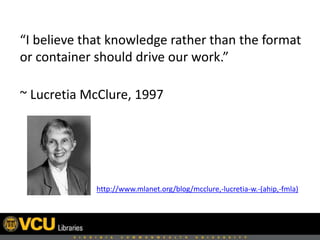
“I believe that knowledge rather than the format
or container should drive our work.”
~ Lucretia McClure, 1997
http://www.mlanet.org/blog/mcclure,-lucretia-w.-(ahip,-fmla)
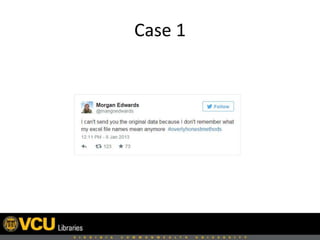
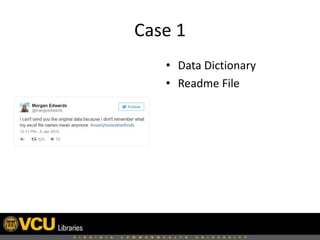
Case 1
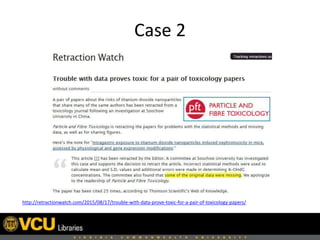
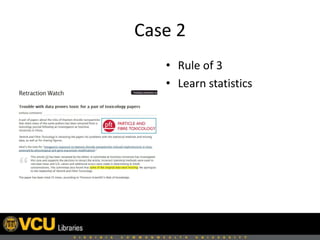
Case 2
http://retractionwatch.com/2015/08/17/trouble-with-data-prove-toxic-for-a-pair-of-toxicology-papers/
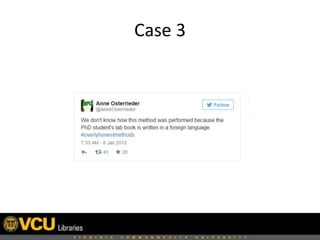
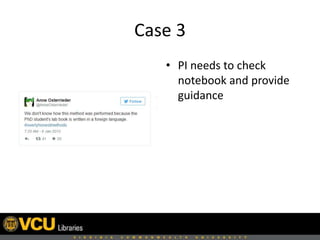
Case 3
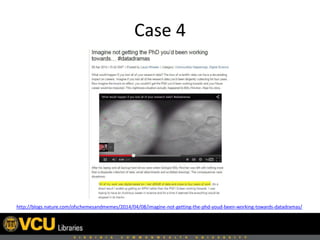
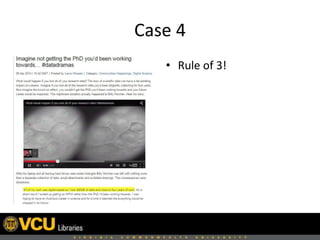
Case 4
http://blogs.nature.com/ofschemesandmemes/2014/04/08/imagine-not-getting-the-phd-youd-been-working-towards-datadramas/
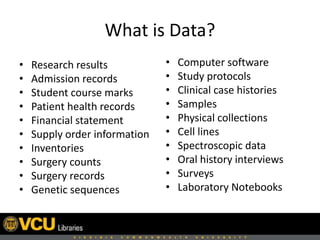
What is Data?
• Research results
• Admission records
• Student course marks
• Patient health records
• Financial statement
• Supply order information
• Inventories
• Surgery counts
• Surgery records
• Genetic sequences
• Computer software
• Study protocols
• Clinical case histories
• Samples
• Physical collections
• Cell lines
• Spectroscopic data
• Oral history interviews
• Surveys
• Laboratory Notebooks
“If it gives you pain, it is Big Data.”
~ Donald Brown, Director of Virginia Integrative Data Institute,
speaking at Research Data and Technology Fair presented by
Claude Moore Health Sciences Library, University of Virginia
Health System
Presentation link at http://guides.hsl.virginia.edu/research-fair
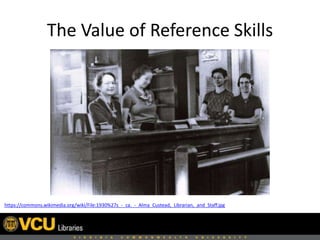
The Value of Reference Skills
https://commons.wikimedia.org/wiki/File:1930%27s_-_ca._-_Alma_Custead,_Librarian,_and_Staff.jpg
Environmental Scan
• PEST - political, economic, social, and
technological factors
• PESTEL – add environmental and legal factors
• SWOT – strengths, weaknesses, opportunities,
and threats
• Six Forces Model – competition, new entrants,
end users, suppliers, substitutes, and
complementary products
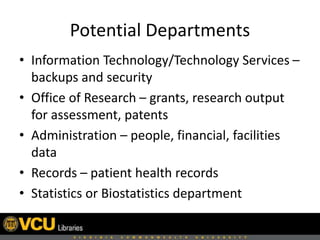
Potential Departments
• Information Technology/Technology Services –
backups and security
• Office of Research – grants, research output
for assessment, patents
• Administration – people, financial, facilities
data
• Records – patient health records
• Statistics or Biostatistics department
The Noun Project - http://t.co/oGuXfP7NBq
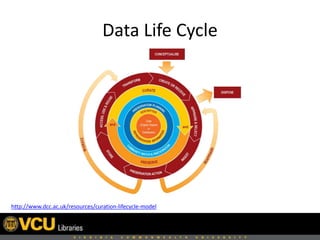
Data Life Cycle
http://www.dcc.ac.uk/resources/curation-lifecycle-model
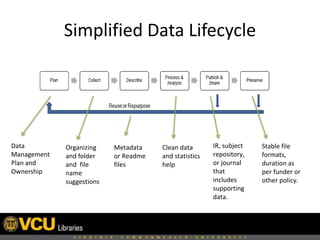
Simplified Data Lifecycle
Data
Management
Plan and
Ownership
Organizing
and folder
and file
name
suggestions
Metadata
or Readme
files
Clean data
and statistics
help
IR, subject
repository,
or journal
that
includes
supporting
data.
Stable file
formats,
duration as
per funder or
other policy.
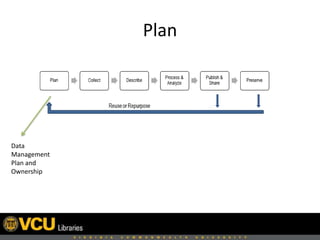
Plan
Data
Management
Plan and
Ownership
Data Management Plans
Outlines how a researcher will:
• collect
• organize
• back up
• storing
• share
the data for a project, and indicates who the
data steward will be.
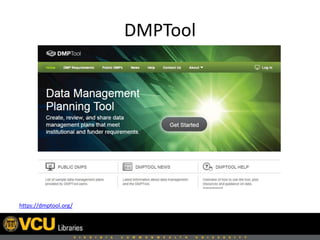
DMPTool
https://dmptool.org/
NIH Policies
• Public Access: ...all investigators funded by the NIH submit or have
submitted for them to the National Library of Medicine’s PubMed Central
an electronic version of their final peer-reviewed manuscripts upon
acceptance for publication, to be made publicly available no later than 12
months after the official date of publication. https://publicaccess.nih.gov/
• Data Sharing: extension of NIH policy on sharing research resources, and
reaffirms NIH support for the concept of data sharing.
http://grants.nih.gov/grants/guide/notice-files/NOT-OD-03-032.html
• Genomic Data Sharing: Applies to all NIH-funded research that generates
large-scale human or non-human genomic data, as well as the use of
those data for subsequent research. Requires “Genomic Data Sharing
Plan”.Allows for expenses in project budget.
http://grants.nih.gov/grants/guide/notice-files/NOT-OD-07-088.html
NSF Policies
NSF Data Sharing Policy
Investigators are expected to share with other researchers, at no more than
incremental cost and within a reasonable time, the primary data, samples,
physical collections and other supporting materials created or gathered in
the course of work under NSF grants. Grantees are expected to encourage
and facilitate such sharing. See Award & Administration Guide (AAG) Chapter
VI.D.4. http://www.nsf.gov/bfa/dias/policy/dmp.jsp
NSF Data Management Plan Requirements
Proposals submitted or due on or after January 18, 2011, must include a
supplementary document of no more than two pages labeled “Data
Management Plan”. This supplementary document should describe how the
proposal will conform to NSF policy on the dissemination and sharing of
research results. See Grant Proposal Guide (GPG) Chapter II.C.2.j for full
policy implementation. https://www.nsf.gov/eng/general/dmp.jsp
NSF Policies
NSF Data Sharing Policy
Investigators are expected to share with other researchers, at no more than
incremental cost and within a reasonable time, the primary data, samples,
physical collections and other supporting materials created or gathered
in the course of work under NSF grants. Grantees are expected to
encourage and facilitate such sharing. See Award & Administration Guide
(AAG) Chapter VI.D.4. http://www.nsf.gov/bfa/dias/policy/dmp.jsp
NSF Data Management Plan Requirements
Proposals submitted or due on or after January 18, 2011, must include a
supplementary document of no more than two pages labeled “Data
Management Plan”. This supplementary document should describe how the
proposal will conform to NSF policy on the dissemination and sharing of
research results. See Grant Proposal Guide (GPG) Chapter II.C.2.j for full
policy implementation. https://www.nsf.gov/eng/general/dmp.jsp
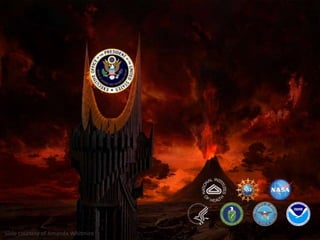
Slide courtesy of Amanda Whitmire
OSTP Memorandum
Increasing Access to the Results of Federally Funded Scientific
Research -February 22, 2013
“ensuring that, … the direct results of federally funded scientific
research are made available to and useful for the public,
industry, and the scientific community. Such results include peer-
reviewed publications and digital data.”
“develop plans to make the results of federally-funded research
publically available free of charge within 12 months after
original publication.”
https://www.whitehouse.gov/blog/2013/02/22/expanding-public-access-results-federally-funded-research
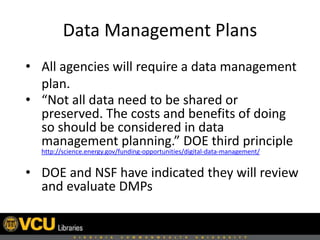
Data Management Plans
• All agencies will require a data management
plan.
• “Not all data need to be shared or
preserved. The costs and benefits of doing
so should be considered in data
management planning.” DOE third principle
http://science.energy.gov/funding-opportunities/digital-data-management/
• DOE and NSF have indicated they will review
and evaluate DMPs
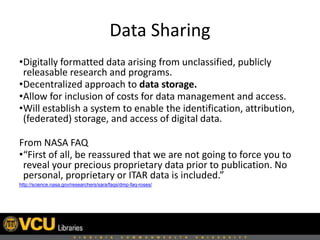
Data Sharing
•Digitally formatted data arising from unclassified, publicly
releasable research and programs.
•Decentralized approach to data storage.
•Allow for inclusion of costs for data management and access.
•Will establish a system to enable the identification, attribution,
(federated) storage, and access of digital data.
From NASA FAQ
•“First of all, be reassured that we are not going to force you to
reveal your precious proprietary data prior to publication. No
personal, proprietary or ITAR data is included.”
http://science.nasa.gov/researchers/sara/faqs/dmp-faq-roses/
https://commons.wikimedia.org/wiki/File:SMPTE_Color_Bars.svg
AND NOW BACK TO OUR
REGULARLY SCHEDULED PROGRAM
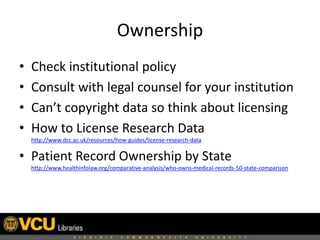
Ownership
• Check institutional policy
• Consult with legal counsel for your institution
• Can’t copyright data so think about licensing
• How to License Research Data
http://www.dcc.ac.uk/resources/how-guides/license-research-data
• Patient Record Ownership by State
http://www.healthinfolaw.org/comparative-analysis/who-owns-medical-records-50-state-comparison
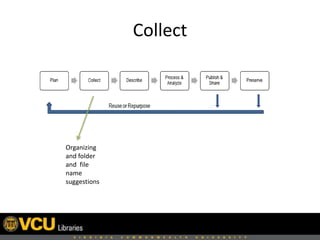
Collect
Organizing
and folder
and file
name
suggestions
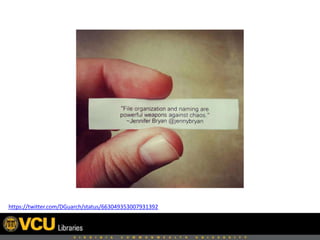
https://twitter.com/DGuarch/status/663049353007931392
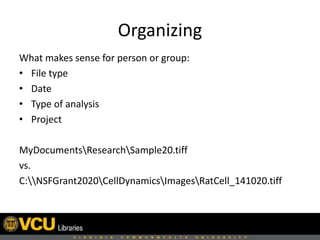
Organizing
What makes sense for person or group:
• File type
• Date
• Type of analysis
• Project
MyDocumentsResearchSample20.tiff
vs.
C:NSFGrant2020CellDynamicsImagesRatCell_141020.tiff
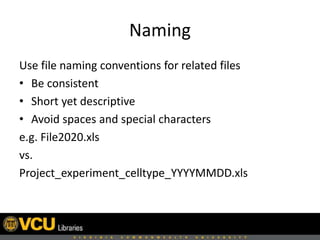
Naming
Use file naming conventions for related files
• Be consistent
• Short yet descriptive
• Avoid spaces and special characters
e.g. File2020.xls
vs.
Project_experiment_celltype_YYYYMMDD.xls
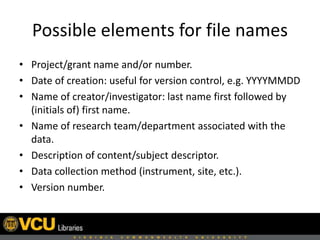
Possible elements for file names
• Project/grant name and/or number.
• Date of creation: useful for version control, e.g. YYYYMMDD
• Name of creator/investigator: last name first followed by
(initials of) first name.
• Name of research team/department associated with the
data.
• Description of content/subject descriptor.
• Data collection method (instrument, site, etc.).
• Version number.
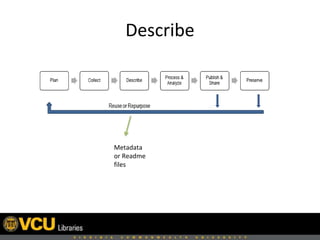
Describe
Metadata
or Readme
files
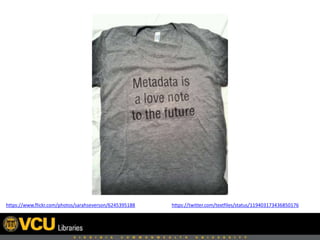
https://www.flickr.com/photos/sarahseverson/6245395188 https://twitter.com/textfiles/status/119403173436850176
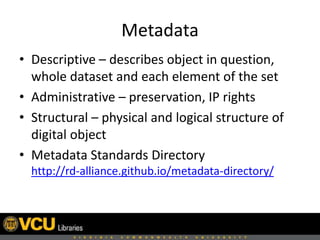
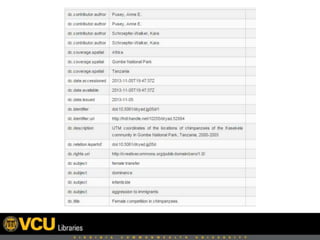
Metadata
• Descriptive – describes object in question,
whole dataset and each element of the set
• Administrative – preservation, IP rights
• Structural – physical and logical structure of
digital object
• Metadata Standards Directory
http://rd-alliance.github.io/metadata-directory/
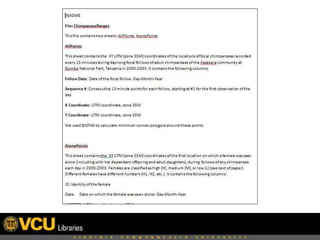
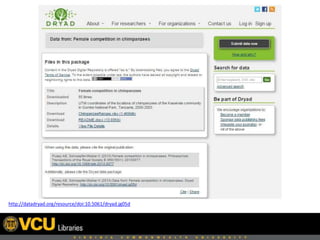
Readme Files
• Names + contact information for people associated with the
project
• List of files, including a description of their relationship to one
another
• Copyright + licensing information
• Limitations of the data
• Funding sources / institutional support
• Any information necessary for someone with no knowledge of
your research to understand and / or replicate your work.
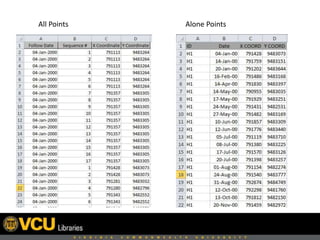
http://datadryad.org/resource/doi:10.5061/dryad.jg05d
All Points Alone Points
Data Dictionary
• Define terms used
• If measurements are made, gives units and
explains exactly how measured or calculated
• How item is recorded, especially when there
are multiple options, e.g. date
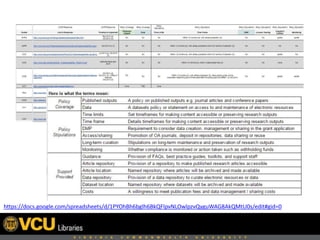
https://docs.google.com/spreadsheets/d/1PYOhBh6bglh6BkQFlpvNLOwlpzvQyguWAG8AkQMtU0s/edit#gid=0
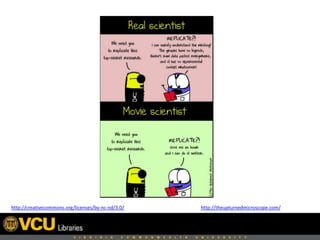
http://creativecommons.org/licenses/by-nc-nd/3.0/ http://theupturnedmicroscope.com/
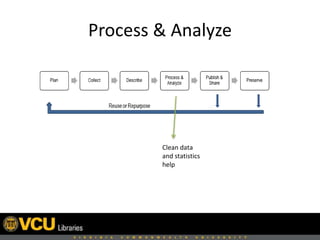
Process & Analyze
Clean data
and statistics
help
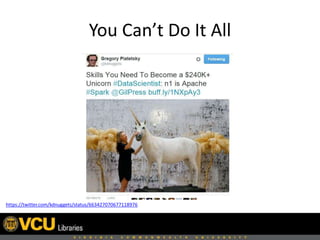
You Can’t Do It All
https://twitter.com/kdnuggets/status/663427070677118976
Tools for Data Cleaning
• Open Refine - to clean and transform data to
different formats http://openrefine.org/
• Trifecta Wrangler – free version of the program, so
some limitations
https://www.trifacta.com/trifacta-wrangler
• NLM-Scrubber – clinical text de-identification
https://scrubber.nlm.nih.gov/
• Johns Hopkins Coursera on Data Science
https://www.coursera.org/specializations/jhudatascience
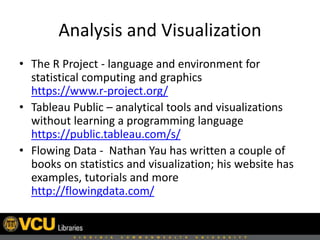
Analysis and Visualization
• The R Project - language and environment for
statistical computing and graphics
https://www.r-project.org/
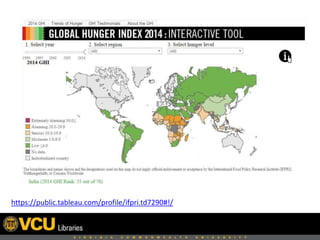
• Tableau Public – analytical tools and visualizations
without learning a programming language
https://public.tableau.com/s/
• Flowing Data - Nathan Yau has written a couple of
books on statistics and visualization; his website has
examples, tutorials and more
http://flowingdata.com/
https://public.tableau.com/profile/ifpri.td7290#!/
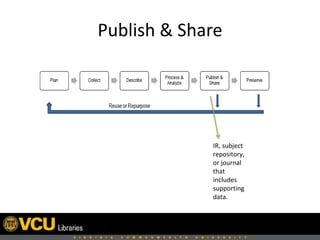
Publish & Share
IR, subject
repository,
or journal
that
includes
supporting
data.
Sharing Data
• Helps to avoid duplication, thereby reducing costs and wasted
effort.
• Promotes scientific integrity and debate.
• Enables scrutiny of research findings and allows for validation of
results.
• Leads to new collaborations between data users and data creators.
• Improves research and leads to better science.
• Enables the exploration of topics not envisioned by the initial
investigators.
• Permits the creation of new datasets by combining data from
multiple sources.
• Increases citations.*
* A study by Piwowar, Day and Fridsma showed a 69% increase in citation,
http://www.plosone.org/article/info:doi%2F10.1371%2Fjournal.pone.0000308
Ways to Share Data
Upload to open repository; general, subject, or
institutional.
• figshare http://figshare.com/
• Zenodo https://zenodo.org/
• Open Science Framework https://osf.io/
• DataVerse http://dataverse.org/
• Search Registry of Research Data Repositories
http://www.re3data.org/
Supplemental file with journal article or link to
the upload.
– Be sure to check the contract.
– Will the data be available to the public as per
OSTP if grant funded?
– Will the rights conflict with institutional ownership
of the data?
Tried and true methods? Send files upon
request. Upload to personal web site.
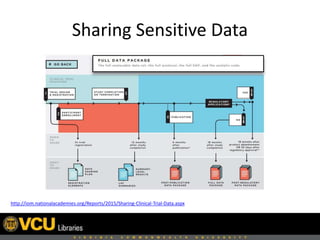
Sharing Sensitive Data
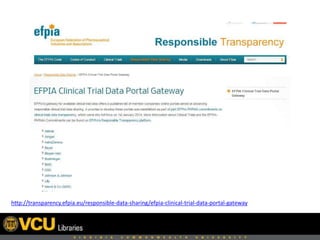
http://iom.nationalacademies.org/Reports/2015/Sharing-Clinical-Trial-Data.aspx
Controlled Access
• Researchers must request access to database,
explaining research and providing IRB
approval forms.
• Data must be anonymized in some way before
being made publicly available.
http://transparency.efpia.eu/responsible-data-sharing/efpia-clinical-trial-data-portal-gateway
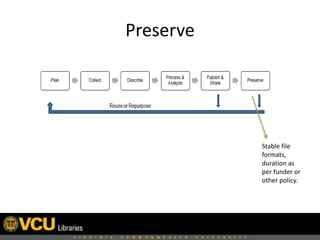
Preserve
Stable file
formats,
duration as
per funder or
other policy.
Storage vs Backup
storage = working files
The files you access regularly and change frequently. In
general, losing your storage means losing current
versions of the data.
backup = regular process of copying data separate from
storage.
You don’t really need it until you lose data, but when
you need to restore a file it will be the most important
process you have in place.
Rule of 3
Keep THREE copies of your data –
TWO onsite –
ONE offsite
Example – One: Laptop – Two: External hard drive –
Three: Cloud storage
This ensures that your storage and backup is not all in
the same place – that’s too risky!
http://dataabinitio.com/?p=320
Preservation
Considerations
• How long must the data be kept?
• What is the long-term value of the data?
Appraisal of Data
1. Relevance to Mission
2. Scientific, Social, Cultural, Historical Value
3. Uniqueness
4. Potential for Redistribution
5. Non-Replicability
6. Economic Case
7. Full Documentation
from NECDMC, Module 7 activity, http://library.umassmed.edu/necdmc/modules
based on Whyte and Wilson http://www.dcc.ac.uk/resources/how-guides/appraise-select-data
Where to Preserve Data
• Dryad
• Figshare
• Subject Repository
• Institutional Repository
• Government Repository
Don’t Forget Print
• Set a schedule to scan lab notebooks and other print
materials (makes for a good back up and easier to share
data within group).
• Print original should have similar security to digital data (i.e.
good, secure storage and labelling of files).
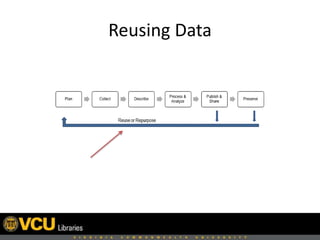
Reusing Data
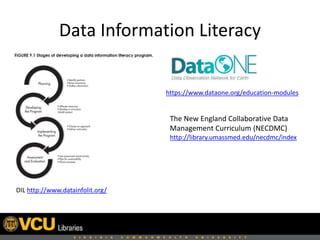
Data Information Literacy
DIL http://www.datainfolit.org/
https://www.dataone.org/education-modules
The New England Collaborative Data
Management Curriculum (NECDMC)
http://library.umassmed.edu/necdmc/index
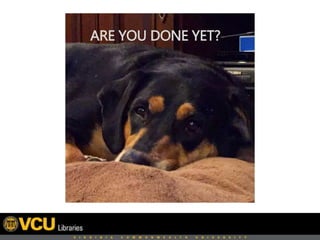
ARE YOU DONE YET?
Case 1
• Data Dictionary
• Readme File
Case 2
• Rule of 3
• Learn statistics
Case 3
• PI needs to check
notebook and provide
guidance
Case 4
• Rule of 3!
Librarians and Data
• Subject headings = Organization
• Cataloging = Metadata
• Reference = Data Reference and Interviewing
• Collections = Purchasing data sets, Deciding what
data to keep
• Archives = Preservation, Deciding what to keep
• Instruction = Instruction
• Policy = Funder Policies
• Scholarly Communication = Data Citation,
Licensing
GreatDixterGardens,Sussex,Englandbyukgardenphotos
Garden metaphor and design by Jamene Brooks-Kieffer
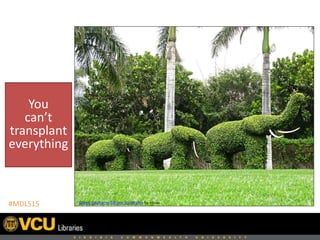
You
can’t
transplant
everything
Green Elephants Garden Sculptures by epsos
#MDLS15
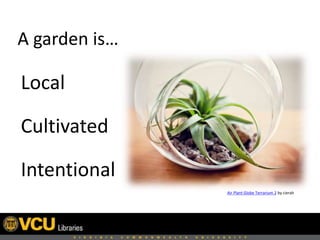
A garden is…
Local
Cultivated
Intentional
Air Plant Globe Terrarium 2 by cierah
CactusGardenatKnott'sBerryFarmsby
dailyorganizedchaos
HappyEasterfromGeorgia'sCallawayGardens!by
ugardener
final terrarium by bangada
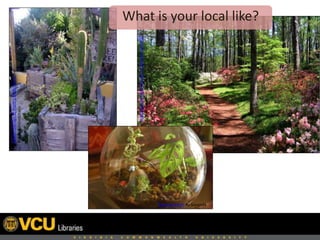
What is your local like?
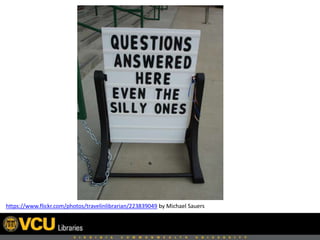
https://www.flickr.com/photos/travelinlibrarian/223839049 by Michael Sauers
References
• Bishop, D. 2015. Who’s Afraid of Open Data. Blog post on BishopBlog.
http://deevybee.blogspot.co.uk/2015/11/whos-afraid-of-open-data.html
• Carlson, Jake R. 2011. "Demystifying the Data Interview: Developing a Foundation for Reference
Librarians to Talk with Researchers about their Data." Reference Services Review 40 (1): 7-23.
• Choudhury, S. 2013. Open Access & Data Management Are Do-Able Through Partnerships. In:
ASERL; 2013 Summertime Summit: "Liaison Roles in Open Access & Data Management: Equal Parts
Inspiration & Perspiration," https://smartech.gatech.edu/handle/1853/48696
• Christensen-Dalsgaard, et.al. 2012.Ten Recommendations for Libraries to Get Started with Research
Data Management: Final report of the LIBER working group on E-Science / Research Data
Management . Ligue des Bibliothèques Européennes de Recherche (LIBER)
http://libereurope.eu/wp-content/uploads/The%20research%20data%20group%202012%20v7%20final.pdf
• McClure, Lucretia W. 1997. "Knowledge and the Container." In Health Information Management.
What Strategies? Proceedings of the 5th European Conference of Medical and Health Libraries,
Coimbra, Portugal, September 18–21, 1996, edited by Suzanne Bakker, 258-260: Springer
Netherlands. doi:10.1007/978-94-015-8786-0_86
• Rinehart, Amanda K. September 2015. "Getting Emotional about Data: The Soft Side of Data
Management Services." C&RL News 76 (8): 437-440.
• Ross, Catherine Sheldrick, Kirsti Nilsen, and Marie L. Radford. 2009. Conducting the Reference
Interview: A how-to-do-it Manual for Librarians. 2nd ed. New York: Neal-Schuman Publishers.
Resources
• Educating Yourself on Research Data Management: Resources and
Opportunities (resource list) Greater Midwest Region webinar by
Abigail Goben and Rebecca Raszewski, Nov. 16, 2015
• Midwest Data Librarians Symposium - presentations and other
materials http://dc.uwm.edu/mdls/2015/
• Pinfield, Stephen, Andrew M. Cox, and Jen Smith. 2014. "Research
Data Management and Libraries: Relationships, Activities, Drivers
and Influences." PloS One 9, no. 12: e114734.
doi:10.1371/journal.pone.0114734
• Sweeney L, Crosas M, Bar-Sinai M. Sharing Sensitive Data with
Confidence: The Datatags System. Technology Science. 2015101601.
October 16, 2015. http://techscience.org/a/2015101601
• Table of NIH Data Sharing Policies and Repositories
https://www.nlm.nih.gov/NIHbmic/nih_data_sharing_policies.html

Inroads into Data: Getting Involved in Data at Your Institution

  • 1.
    Inroads into Data: GettingInvolved in Data at Your Institution Margaret Henderson Director, Research Data Management mehenderson@vcu.edu @mehlibrarian Beyond the SEA Webinar, November 18, 2015
  • 2.
    “I believe thatknowledge rather than the format or container should drive our work.” ~ Lucretia McClure, 1997 http://www.mlanet.org/blog/mcclure,-lucretia-w.-(ahip,-fmla)
  • 3.
  • 4.
  • 5.
  • 6.
  • 8.
    What is Data? •Research results • Admission records • Student course marks • Patient health records • Financial statement • Supply order information • Inventories • Surgery counts • Surgery records • Genetic sequences • Computer software • Study protocols • Clinical case histories • Samples • Physical collections • Cell lines • Spectroscopic data • Oral history interviews • Surveys • Laboratory Notebooks
  • 9.
    “If it givesyou pain, it is Big Data.” ~ Donald Brown, Director of Virginia Integrative Data Institute, speaking at Research Data and Technology Fair presented by Claude Moore Health Sciences Library, University of Virginia Health System Presentation link at http://guides.hsl.virginia.edu/research-fair
  • 11.
    The Value ofReference Skills https://commons.wikimedia.org/wiki/File:1930%27s_-_ca._-_Alma_Custead,_Librarian,_and_Staff.jpg
  • 12.
    Environmental Scan • PEST- political, economic, social, and technological factors • PESTEL – add environmental and legal factors • SWOT – strengths, weaknesses, opportunities, and threats • Six Forces Model – competition, new entrants, end users, suppliers, substitutes, and complementary products
  • 13.
    Potential Departments • InformationTechnology/Technology Services – backups and security • Office of Research – grants, research output for assessment, patents • Administration – people, financial, facilities data • Records – patient health records • Statistics or Biostatistics department
  • 14.
    The Noun Project- http://t.co/oGuXfP7NBq
  • 15.
  • 16.
    Simplified Data Lifecycle Data Management Planand Ownership Organizing and folder and file name suggestions Metadata or Readme files Clean data and statistics help IR, subject repository, or journal that includes supporting data. Stable file formats, duration as per funder or other policy.
  • 17.
  • 18.
    Data Management Plans Outlineshow a researcher will: • collect • organize • back up • storing • share the data for a project, and indicates who the data steward will be.
  • 19.
  • 21.
    NIH Policies • PublicAccess: ...all investigators funded by the NIH submit or have submitted for them to the National Library of Medicine’s PubMed Central an electronic version of their final peer-reviewed manuscripts upon acceptance for publication, to be made publicly available no later than 12 months after the official date of publication. https://publicaccess.nih.gov/ • Data Sharing: extension of NIH policy on sharing research resources, and reaffirms NIH support for the concept of data sharing. http://grants.nih.gov/grants/guide/notice-files/NOT-OD-03-032.html • Genomic Data Sharing: Applies to all NIH-funded research that generates large-scale human or non-human genomic data, as well as the use of those data for subsequent research. Requires “Genomic Data Sharing Plan”.Allows for expenses in project budget. http://grants.nih.gov/grants/guide/notice-files/NOT-OD-07-088.html
  • 22.
    NSF Policies NSF DataSharing Policy Investigators are expected to share with other researchers, at no more than incremental cost and within a reasonable time, the primary data, samples, physical collections and other supporting materials created or gathered in the course of work under NSF grants. Grantees are expected to encourage and facilitate such sharing. See Award & Administration Guide (AAG) Chapter VI.D.4. http://www.nsf.gov/bfa/dias/policy/dmp.jsp NSF Data Management Plan Requirements Proposals submitted or due on or after January 18, 2011, must include a supplementary document of no more than two pages labeled “Data Management Plan”. This supplementary document should describe how the proposal will conform to NSF policy on the dissemination and sharing of research results. See Grant Proposal Guide (GPG) Chapter II.C.2.j for full policy implementation. https://www.nsf.gov/eng/general/dmp.jsp
  • 23.
    NSF Policies NSF DataSharing Policy Investigators are expected to share with other researchers, at no more than incremental cost and within a reasonable time, the primary data, samples, physical collections and other supporting materials created or gathered in the course of work under NSF grants. Grantees are expected to encourage and facilitate such sharing. See Award & Administration Guide (AAG) Chapter VI.D.4. http://www.nsf.gov/bfa/dias/policy/dmp.jsp NSF Data Management Plan Requirements Proposals submitted or due on or after January 18, 2011, must include a supplementary document of no more than two pages labeled “Data Management Plan”. This supplementary document should describe how the proposal will conform to NSF policy on the dissemination and sharing of research results. See Grant Proposal Guide (GPG) Chapter II.C.2.j for full policy implementation. https://www.nsf.gov/eng/general/dmp.jsp Slide courtesy of Amanda Whitmire
  • 24.
    OSTP Memorandum Increasing Accessto the Results of Federally Funded Scientific Research -February 22, 2013 “ensuring that, … the direct results of federally funded scientific research are made available to and useful for the public, industry, and the scientific community. Such results include peer- reviewed publications and digital data.” “develop plans to make the results of federally-funded research publically available free of charge within 12 months after original publication.” https://www.whitehouse.gov/blog/2013/02/22/expanding-public-access-results-federally-funded-research
  • 25.
    Data Management Plans •All agencies will require a data management plan. • “Not all data need to be shared or preserved. The costs and benefits of doing so should be considered in data management planning.” DOE third principle http://science.energy.gov/funding-opportunities/digital-data-management/ • DOE and NSF have indicated they will review and evaluate DMPs
  • 26.
    Data Sharing •Digitally formatteddata arising from unclassified, publicly releasable research and programs. •Decentralized approach to data storage. •Allow for inclusion of costs for data management and access. •Will establish a system to enable the identification, attribution, (federated) storage, and access of digital data. From NASA FAQ •“First of all, be reassured that we are not going to force you to reveal your precious proprietary data prior to publication. No personal, proprietary or ITAR data is included.” http://science.nasa.gov/researchers/sara/faqs/dmp-faq-roses/
  • 27.
  • 28.
    Ownership • Check institutionalpolicy • Consult with legal counsel for your institution • Can’t copyright data so think about licensing • How to License Research Data http://www.dcc.ac.uk/resources/how-guides/license-research-data • Patient Record Ownership by State http://www.healthinfolaw.org/comparative-analysis/who-owns-medical-records-50-state-comparison
  • 29.
  • 30.
  • 31.
    Organizing What makes sensefor person or group: • File type • Date • Type of analysis • Project MyDocumentsResearchSample20.tiff vs. C:NSFGrant2020CellDynamicsImagesRatCell_141020.tiff
  • 32.
    Naming Use file namingconventions for related files • Be consistent • Short yet descriptive • Avoid spaces and special characters e.g. File2020.xls vs. Project_experiment_celltype_YYYYMMDD.xls
  • 33.
    Possible elements forfile names • Project/grant name and/or number. • Date of creation: useful for version control, e.g. YYYYMMDD • Name of creator/investigator: last name first followed by (initials of) first name. • Name of research team/department associated with the data. • Description of content/subject descriptor. • Data collection method (instrument, site, etc.). • Version number.
  • 34.
  • 35.
  • 36.
    Metadata • Descriptive –describes object in question, whole dataset and each element of the set • Administrative – preservation, IP rights • Structural – physical and logical structure of digital object • Metadata Standards Directory http://rd-alliance.github.io/metadata-directory/
  • 37.
    Readme Files • Names+ contact information for people associated with the project • List of files, including a description of their relationship to one another • Copyright + licensing information • Limitations of the data • Funding sources / institutional support • Any information necessary for someone with no knowledge of your research to understand and / or replicate your work.
  • 38.
  • 41.
  • 42.
    Data Dictionary • Defineterms used • If measurements are made, gives units and explains exactly how measured or calculated • How item is recorded, especially when there are multiple options, e.g. date
  • 43.
  • 44.
  • 45.
    Process & Analyze Cleandata and statistics help
  • 46.
    You Can’t DoIt All https://twitter.com/kdnuggets/status/663427070677118976
  • 47.
    Tools for DataCleaning • Open Refine - to clean and transform data to different formats http://openrefine.org/ • Trifecta Wrangler – free version of the program, so some limitations https://www.trifacta.com/trifacta-wrangler • NLM-Scrubber – clinical text de-identification https://scrubber.nlm.nih.gov/ • Johns Hopkins Coursera on Data Science https://www.coursera.org/specializations/jhudatascience
  • 48.
    Analysis and Visualization •The R Project - language and environment for statistical computing and graphics https://www.r-project.org/ • Tableau Public – analytical tools and visualizations without learning a programming language https://public.tableau.com/s/ • Flowing Data - Nathan Yau has written a couple of books on statistics and visualization; his website has examples, tutorials and more http://flowingdata.com/
  • 49.
  • 50.
    Publish & Share IR,subject repository, or journal that includes supporting data.
  • 51.
    Sharing Data • Helpsto avoid duplication, thereby reducing costs and wasted effort. • Promotes scientific integrity and debate. • Enables scrutiny of research findings and allows for validation of results. • Leads to new collaborations between data users and data creators. • Improves research and leads to better science. • Enables the exploration of topics not envisioned by the initial investigators. • Permits the creation of new datasets by combining data from multiple sources. • Increases citations.* * A study by Piwowar, Day and Fridsma showed a 69% increase in citation, http://www.plosone.org/article/info:doi%2F10.1371%2Fjournal.pone.0000308
  • 52.
    Ways to ShareData Upload to open repository; general, subject, or institutional. • figshare http://figshare.com/ • Zenodo https://zenodo.org/ • Open Science Framework https://osf.io/ • DataVerse http://dataverse.org/ • Search Registry of Research Data Repositories http://www.re3data.org/
  • 53.
    Supplemental file withjournal article or link to the upload. – Be sure to check the contract. – Will the data be available to the public as per OSTP if grant funded? – Will the rights conflict with institutional ownership of the data? Tried and true methods? Send files upon request. Upload to personal web site.
  • 54.
  • 55.
    Controlled Access • Researchersmust request access to database, explaining research and providing IRB approval forms. • Data must be anonymized in some way before being made publicly available.
  • 56.
  • 57.
  • 58.
    Storage vs Backup storage= working files The files you access regularly and change frequently. In general, losing your storage means losing current versions of the data. backup = regular process of copying data separate from storage. You don’t really need it until you lose data, but when you need to restore a file it will be the most important process you have in place.
  • 59.
    Rule of 3 KeepTHREE copies of your data – TWO onsite – ONE offsite Example – One: Laptop – Two: External hard drive – Three: Cloud storage This ensures that your storage and backup is not all in the same place – that’s too risky! http://dataabinitio.com/?p=320
  • 60.
  • 61.
    Considerations • How longmust the data be kept? • What is the long-term value of the data?
  • 62.
    Appraisal of Data 1.Relevance to Mission 2. Scientific, Social, Cultural, Historical Value 3. Uniqueness 4. Potential for Redistribution 5. Non-Replicability 6. Economic Case 7. Full Documentation from NECDMC, Module 7 activity, http://library.umassmed.edu/necdmc/modules based on Whyte and Wilson http://www.dcc.ac.uk/resources/how-guides/appraise-select-data
  • 63.
    Where to PreserveData • Dryad • Figshare • Subject Repository • Institutional Repository • Government Repository
  • 64.
    Don’t Forget Print •Set a schedule to scan lab notebooks and other print materials (makes for a good back up and easier to share data within group). • Print original should have similar security to digital data (i.e. good, secure storage and labelling of files).
  • 65.
  • 66.
    Data Information Literacy DILhttp://www.datainfolit.org/ https://www.dataone.org/education-modules The New England Collaborative Data Management Curriculum (NECDMC) http://library.umassmed.edu/necdmc/index
  • 67.
  • 68.
    Case 1 • DataDictionary • Readme File
  • 69.
    Case 2 • Ruleof 3 • Learn statistics
  • 70.
    Case 3 • PIneeds to check notebook and provide guidance
  • 71.
  • 72.
    Librarians and Data •Subject headings = Organization • Cataloging = Metadata • Reference = Data Reference and Interviewing • Collections = Purchasing data sets, Deciding what data to keep • Archives = Preservation, Deciding what to keep • Instruction = Instruction • Policy = Funder Policies • Scholarly Communication = Data Citation, Licensing
  • 73.
  • 74.
  • 75.
    A garden is… Local Cultivated Intentional AirPlant Globe Terrarium 2 by cierah
  • 76.
  • 77.
  • 78.
    References • Bishop, D.2015. Who’s Afraid of Open Data. Blog post on BishopBlog. http://deevybee.blogspot.co.uk/2015/11/whos-afraid-of-open-data.html • Carlson, Jake R. 2011. "Demystifying the Data Interview: Developing a Foundation for Reference Librarians to Talk with Researchers about their Data." Reference Services Review 40 (1): 7-23. • Choudhury, S. 2013. Open Access & Data Management Are Do-Able Through Partnerships. In: ASERL; 2013 Summertime Summit: "Liaison Roles in Open Access & Data Management: Equal Parts Inspiration & Perspiration," https://smartech.gatech.edu/handle/1853/48696 • Christensen-Dalsgaard, et.al. 2012.Ten Recommendations for Libraries to Get Started with Research Data Management: Final report of the LIBER working group on E-Science / Research Data Management . Ligue des Bibliothèques Européennes de Recherche (LIBER) http://libereurope.eu/wp-content/uploads/The%20research%20data%20group%202012%20v7%20final.pdf • McClure, Lucretia W. 1997. "Knowledge and the Container." In Health Information Management. What Strategies? Proceedings of the 5th European Conference of Medical and Health Libraries, Coimbra, Portugal, September 18–21, 1996, edited by Suzanne Bakker, 258-260: Springer Netherlands. doi:10.1007/978-94-015-8786-0_86 • Rinehart, Amanda K. September 2015. "Getting Emotional about Data: The Soft Side of Data Management Services." C&RL News 76 (8): 437-440. • Ross, Catherine Sheldrick, Kirsti Nilsen, and Marie L. Radford. 2009. Conducting the Reference Interview: A how-to-do-it Manual for Librarians. 2nd ed. New York: Neal-Schuman Publishers.
  • 79.
    Resources • Educating Yourselfon Research Data Management: Resources and Opportunities (resource list) Greater Midwest Region webinar by Abigail Goben and Rebecca Raszewski, Nov. 16, 2015 • Midwest Data Librarians Symposium - presentations and other materials http://dc.uwm.edu/mdls/2015/ • Pinfield, Stephen, Andrew M. Cox, and Jen Smith. 2014. "Research Data Management and Libraries: Relationships, Activities, Drivers and Influences." PloS One 9, no. 12: e114734. doi:10.1371/journal.pone.0114734 • Sweeney L, Crosas M, Bar-Sinai M. Sharing Sensitive Data with Confidence: The Datatags System. Technology Science. 2015101601. October 16, 2015. http://techscience.org/a/2015101601 • Table of NIH Data Sharing Policies and Repositories https://www.nlm.nih.gov/NIHbmic/nih_data_sharing_policies.html

Editor's Notes

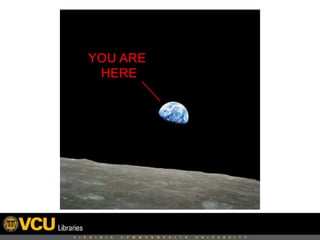
  • #11 Where to start, well, first you have to figure out where you are.