


SANOFI – I-NONNI 2.0: WHEN DIGITAL
BECOMES THERAPEUTICS
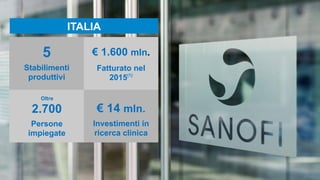
5
Stabilimenti
produttivi
€ 1.600 mln.
Fatturato nel
2015(1)
2.700
Persone
impiegate
Oltre
€ 14 mln.
Investimenti in
ricerca clinica
ITALIA
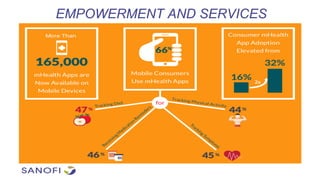
EMPOWERMENT AND SERVICES
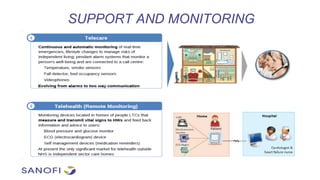
SUPPORT AND MONITORING
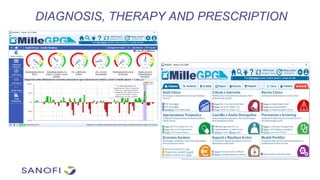
DIAGNOSIS, THERAPY AND PRESCRIPTION
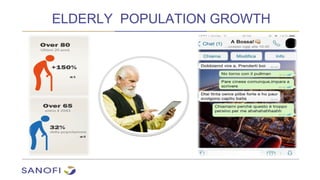
ELDERLY POPULATION GROWTH
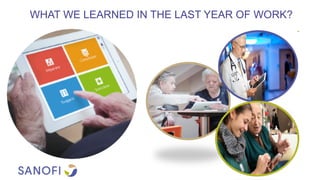
WHAT WE LEARNED IN THE LAST YEAR OF WORK?
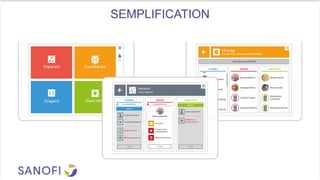
SEMPLIFICATION
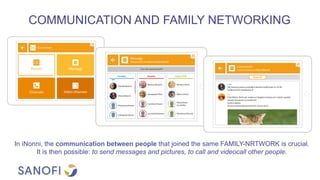
COMMUNICATION AND FAMILY NETWORKING
In iNonni, the communication between people that joined the same FAMILY-NRTWORK is crucial.
It is then possible: to send messages and pictures, to call and videocall other people.
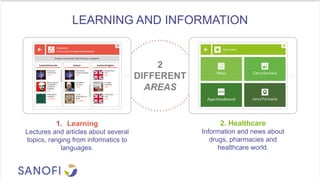
2
DIFFERENT
AREAS
1.  Learning
Lectures and articles about several
topics, ranging from informatics to
languages.
2. Healthcare
Information and news about
drugs, pharmacies and
healthcare world.


LEARNING AND INFORMATION
#pharmavalueadded
PHARMACEUTICAL COULD ADD VALUE BUILDING
MORE AFFORDABLE TOOLS (FROM A MEDICAL/
SCIENTIFIC POINT OF VIEW) MOVING FROM FROM
PREVENTION AND WELLNESS TO HEALTH
MONITORING AND CARE (ADHERENCE TO
THERAPY, THERAPEUTIC CONTINUITY, SUPPORT TO
THE THERAPY)
PEOPLE AFFECTED BY COGNITIVE DECLINE
36 mln. WW,
10 min. in EU
1 mln. in ITA + around 3 mln. relatives
It is scientifically proven that mental exercise can slow the cognitive decline
and treating learning disorders. Numbers of international and national
studies show it.
•  physiological age-related degeneration
•  patients suffering from dementia in the initial phase
•  Alzheimer's patients
www.ilgiornale.it/news/brain-training-non-solo-gioco-cos-cura-
lalzheimer.html
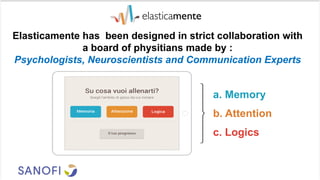
Elasticamente is an application
that, through a gamification
approach and a digital structure,
trains the cognitive functions that
are commonly affected by the
brain ageing process.
* Some exercises of Elasticamente have
been integrated in iNonni as well.
by iNonni
a. Memory
b. Attention
c. Logics
Elasticamente has been designed in strict collaboration with
a board of physitians made by :
Psychologists, Neuroscientists and Communication Experts
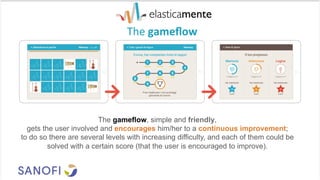
The gameflow, simple and friendly,
gets the user involved and encourages him/her to a continuous improvement;
to do so there are several levels with increasing difficulty, and each of them could be
solved with a certain score (that the user is encouraged to improve).
The	
  gameflow	
  
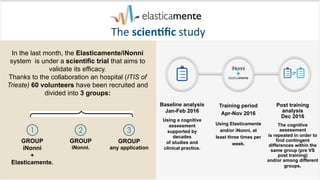
In the last month, the Elasticamente/iNonni
system is under a scientific trial that aims to
validate its efficacy.
Thanks to the collaboration an hospital (ITIS of
Trieste) 60 volunteers have been recruited and
divided into 3 groups:
The	
  scien-fic	
  study	
  
GROUP
iNonni
+
Elasticamente.
GROUP
iNonni.
GROUP
any application
Baseline analysis
Jan-Feb 2016
Using a cognitive
assessment
supported by
decades
of studies and
clinical practice.
Training period
Apr-Nov 2016
Using Elasticamente
and/or iNonni, at
least three times per
week.
Post training
analysis
Dec 2016
The cognitive
assessment
is repeated in order to
find contingent
differences within the
same group (pre VS
post training)
and/or among different
groups.
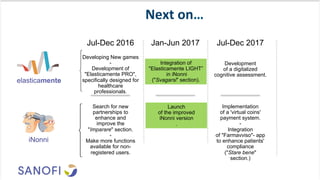
Next	
  on…	
  
Jul-Dec 2016
Developing New games
-
Development of
"Elasticamente PRO",
specifically designed for
healthcare
professionals.
Search for new
partnerships to
enhance and
improve the
"Imparare" section.
-
Make more functions
available for non-
registered users.
iNonni
elasticamente
Integration of
"Elasticamente LIGHT”
in iNonni
("Svagarsi" section).
Development
of a digitalized
cognitive assessment.
Implementation
of a 'virtual coins'
payment system.
-
Integration
of "Farmavviso"- app
to enhance patients'
compliance
("Stare bene"
section.)
Launch
of the improved
iNonni version
.
Jan-Jun 2017 Jul-Dec 2017
THANKS	
  
Designed & powered by Sponsored by
www.fab-lab.it www.zentiva.it
marco.grespigna@sanofi.com
Much like every other prominent industry, the medical field is becoming inexorably digitized. Digital disruption and transformation within the healthcare profession is a Hard Trend — something that will happen, something we can count on
seeing in the future. But these developments aren’t exactly futuristic, far-off advancements; we’re starting to see them in our everyday lives and they’re already improving the quality of healthcare we as patients can expect to receive.
The digitization of the healthcare industry will invariably advance the field’s transformation from the Break-Fix model of medicine — reactively treating maladies and ailments as they occur — to the Predict-and-Prevent model — an
anticipatory combination of detective work and cutting-edge technology that addresses the root causes of health afflictions and focuses on staving off future issues by advocating major lifestyle changes, behavioral changes, or preventative
practices.
We’re already witnessing the confluence of emerging technology with healthcare and an increasing awareness of our own bodies, and this trend will only continue to develop and expand.
The first, most rudimentary form of this idea is represented by wearable tech. Wearable pedometers and heart monitors have been around for years, letting people keep track of how far they walk on a daily, weekly,
or even monthly basis, further letting them track the amount of calories they’re burning when they exercise. These devices also let people monitor their heart rates, as most doctors advise raising your heart rate for a
period of at least 30 minutes every time you exercise. Recently, the newly released Apple Watch, along with competing smart watches, has given wearers the ability to track an array of different types of health stats,
generating huge amounts of data that can potentially be used in conjunction with medical records, doctors, and hospitals to provide a better, more personalized level of service.
There are, of course, more health-essential pieces of technology, like pain-free blood sugar monitoring devices for diabetics, autoinjectors for epinephrine to stave off diabetic shock, and naloxone nasal sprays that
can stop a heroin overdose in its tracks, saving the victim within seconds of administration.
Better still, we’ve seen the recent emergence of a slew of health-related apps — programs that act as your own personal trainer, track and analyze your basic health and exercise data, provide you nutritional and
dietary instruction while counting the calories you consume, offer a litany of brainteasers and games that improve cognitive and linguistic faculty, regulate your sleep cycle and help you meditate, and encourage
productivity through incentives and gentle reminders.
And lets not forget new apps for the remote monitoring of chronic illnesses and apps for remote diagnostics to name a few.
All of this new technology, from apps that function as personal trainers to lifesaving pocket-sized devices, represents an enormous wave of digital disruption for the medical industry in its present form. If your phone
is essentially helping you to predict and prevent medical problems, providing a more intimate, personal level of service than your doctor ever could, your need for basic medical services and consultation will likely
decrease.
The overarching theme of this wave of digital disruption is that patients are increasingly taking control over their own healthcare, and these patient-friendly advancements will only continue developing in the near
future. It’s a Future Fact that these advancements will increase, and soon; the medical industry can either capitalize on this Hard Trend, or suffer the looming round of disruption.
We’ll soon witness the next wave of personal technology tailored to our individual medical needs. Imagine you’ve just gotten a major surgery; you’ve been released from the hospital and are convalescing at home.
With today’s medical system, you’d need constant personal monitoring — visits from relatives and nurses, trips to and from the doctor, and a host of inconvenient tests. What if, however, your smartwatch could track
your vitals and transmit the data in real time to your surgeon, your primary physician, and the hospital at which your surgery was done? This data would be analyzed by smart software that could identify any extant
or pending problems, and if something serious was likely to happen, you would automatically be scheduled for an appointment and sent a text letting you know when and where to come in for a check up. Aside from
being hugely cost-effective for patients, it’s also extremely convenient. Why trouble yourself with going to your doctor for a checkup when you’re vitals and overall condition are being monitored in the comfort of your
own home? The same idea can be applied to people with chronic or otherwise serious diseases, like diabetes, heart disease, or cancer: wearables and smart software can work together to alert your chosen medical
professionals to any problems on the horizon, preventing catastrophe and saving you money.
Nobody likes unnecessary visits to the doctor, and that’s why so many now have the ability to text medical questions to a nursing or pharmaceutical hotline or customer service center, or an online hub with a chat
window, like we see on so many companies’ tech support pages. You could refill a prescription using your smartphone, access your lab results, and use resources like instructional videos or health and wellness
news feeds. And even if you do have to go to the doctor, you could register for an appointment online or via a mobile app.
We’re also going to see a tremendous increase in transparency as the medical industry continues to evolve. Interactive medical records are a great first step, sure — but soon, you’ll be able to shop around for
products and services. Many individual hospitals are part of a larger chain, yet prices for the same procedures and products at these hospitals can vary wildly. Recently, innovative insurance companies, like Capital
Blue Cross, are giving patients a mobile app that gives them the ability to compare prices and efficiently and effectively select procedures, products and services that fit their budgets. Many have asserted medical
prices will only continue to increase, but this is a Soft Trend, meaning something can be done about it. When prices are made transparent to customers as Capital Blue Cross is doing, hospitals will have to offer
competitive pricing, driving these prices down.
More and more, patients across the US and the world are taking charge of their own healthcare, and hospitals, pharmacies, insurance companies, and medical professionals, are finding themselves forced to adapt
to this new wave of digital disruption or face losing patients and falling behind their competitors. And since everyone, without exception, needs healthcare, this is great news for all of us.
©2015 Burrus Research, Inc. All Rights Reserved.
Follow Daniel Burrus on Twitter: www.twitter.com/DanielBurrus
I-nonni 2.0: when digital becomes therapeutics

I-nonni 2.0: when digital becomes therapeutics

  • 1.
    SANOFI – I-NONNI2.0: WHEN DIGITAL BECOMES THERAPEUTICS
  • 2.
    5 Stabilimenti produttivi € 1.600 mln. Fatturatonel 2015(1) 2.700 Persone impiegate Oltre € 14 mln. Investimenti in ricerca clinica ITALIA
  • 4.
  • 5.
  • 6.
  • 7.
  • 9.
    WHAT WE LEARNEDIN THE LAST YEAR OF WORK?
  • 10.
  • 11.
    COMMUNICATION AND FAMILYNETWORKING In iNonni, the communication between people that joined the same FAMILY-NRTWORK is crucial. It is then possible: to send messages and pictures, to call and videocall other people.
  • 12.
    2 DIFFERENT AREAS 1.  Learning Lectures andarticles about several topics, ranging from informatics to languages. 2. Healthcare Information and news about drugs, pharmacies and healthcare world.     LEARNING AND INFORMATION
  • 13.
    #pharmavalueadded PHARMACEUTICAL COULD ADDVALUE BUILDING MORE AFFORDABLE TOOLS (FROM A MEDICAL/ SCIENTIFIC POINT OF VIEW) MOVING FROM FROM PREVENTION AND WELLNESS TO HEALTH MONITORING AND CARE (ADHERENCE TO THERAPY, THERAPEUTIC CONTINUITY, SUPPORT TO THE THERAPY)
  • 14.
    PEOPLE AFFECTED BYCOGNITIVE DECLINE 36 mln. WW, 10 min. in EU 1 mln. in ITA + around 3 mln. relatives It is scientifically proven that mental exercise can slow the cognitive decline and treating learning disorders. Numbers of international and national studies show it. •  physiological age-related degeneration •  patients suffering from dementia in the initial phase •  Alzheimer's patients www.ilgiornale.it/news/brain-training-non-solo-gioco-cos-cura- lalzheimer.html
  • 15.
    Elasticamente is anapplication that, through a gamification approach and a digital structure, trains the cognitive functions that are commonly affected by the brain ageing process. * Some exercises of Elasticamente have been integrated in iNonni as well. by iNonni
  • 16.
    a. Memory b. Attention c.Logics Elasticamente has been designed in strict collaboration with a board of physitians made by : Psychologists, Neuroscientists and Communication Experts
  • 17.
    The gameflow, simpleand friendly, gets the user involved and encourages him/her to a continuous improvement; to do so there are several levels with increasing difficulty, and each of them could be solved with a certain score (that the user is encouraged to improve). The  gameflow  
  • 18.
    In the lastmonth, the Elasticamente/iNonni system is under a scientific trial that aims to validate its efficacy. Thanks to the collaboration an hospital (ITIS of Trieste) 60 volunteers have been recruited and divided into 3 groups: The  scien-fic  study   GROUP iNonni + Elasticamente. GROUP iNonni. GROUP any application Baseline analysis Jan-Feb 2016 Using a cognitive assessment supported by decades of studies and clinical practice. Training period Apr-Nov 2016 Using Elasticamente and/or iNonni, at least three times per week. Post training analysis Dec 2016 The cognitive assessment is repeated in order to find contingent differences within the same group (pre VS post training) and/or among different groups.
  • 19.
    Next  on…   Jul-Dec2016 Developing New games - Development of "Elasticamente PRO", specifically designed for healthcare professionals. Search for new partnerships to enhance and improve the "Imparare" section. - Make more functions available for non- registered users. iNonni elasticamente Integration of "Elasticamente LIGHT” in iNonni ("Svagarsi" section). Development of a digitalized cognitive assessment. Implementation of a 'virtual coins' payment system. - Integration of "Farmavviso"- app to enhance patients' compliance ("Stare bene" section.) Launch of the improved iNonni version . Jan-Jun 2017 Jul-Dec 2017
  • 21.
    THANKS   Designed &powered by Sponsored by www.fab-lab.it www.zentiva.it marco.grespigna@sanofi.com
  • 22.
    Much like everyother prominent industry, the medical field is becoming inexorably digitized. Digital disruption and transformation within the healthcare profession is a Hard Trend — something that will happen, something we can count on seeing in the future. But these developments aren’t exactly futuristic, far-off advancements; we’re starting to see them in our everyday lives and they’re already improving the quality of healthcare we as patients can expect to receive. The digitization of the healthcare industry will invariably advance the field’s transformation from the Break-Fix model of medicine — reactively treating maladies and ailments as they occur — to the Predict-and-Prevent model — an anticipatory combination of detective work and cutting-edge technology that addresses the root causes of health afflictions and focuses on staving off future issues by advocating major lifestyle changes, behavioral changes, or preventative practices. We’re already witnessing the confluence of emerging technology with healthcare and an increasing awareness of our own bodies, and this trend will only continue to develop and expand. The first, most rudimentary form of this idea is represented by wearable tech. Wearable pedometers and heart monitors have been around for years, letting people keep track of how far they walk on a daily, weekly, or even monthly basis, further letting them track the amount of calories they’re burning when they exercise. These devices also let people monitor their heart rates, as most doctors advise raising your heart rate for a period of at least 30 minutes every time you exercise. Recently, the newly released Apple Watch, along with competing smart watches, has given wearers the ability to track an array of different types of health stats, generating huge amounts of data that can potentially be used in conjunction with medical records, doctors, and hospitals to provide a better, more personalized level of service. There are, of course, more health-essential pieces of technology, like pain-free blood sugar monitoring devices for diabetics, autoinjectors for epinephrine to stave off diabetic shock, and naloxone nasal sprays that can stop a heroin overdose in its tracks, saving the victim within seconds of administration. Better still, we’ve seen the recent emergence of a slew of health-related apps — programs that act as your own personal trainer, track and analyze your basic health and exercise data, provide you nutritional and dietary instruction while counting the calories you consume, offer a litany of brainteasers and games that improve cognitive and linguistic faculty, regulate your sleep cycle and help you meditate, and encourage productivity through incentives and gentle reminders. And lets not forget new apps for the remote monitoring of chronic illnesses and apps for remote diagnostics to name a few. All of this new technology, from apps that function as personal trainers to lifesaving pocket-sized devices, represents an enormous wave of digital disruption for the medical industry in its present form. If your phone is essentially helping you to predict and prevent medical problems, providing a more intimate, personal level of service than your doctor ever could, your need for basic medical services and consultation will likely decrease. The overarching theme of this wave of digital disruption is that patients are increasingly taking control over their own healthcare, and these patient-friendly advancements will only continue developing in the near future. It’s a Future Fact that these advancements will increase, and soon; the medical industry can either capitalize on this Hard Trend, or suffer the looming round of disruption. We’ll soon witness the next wave of personal technology tailored to our individual medical needs. Imagine you’ve just gotten a major surgery; you’ve been released from the hospital and are convalescing at home. With today’s medical system, you’d need constant personal monitoring — visits from relatives and nurses, trips to and from the doctor, and a host of inconvenient tests. What if, however, your smartwatch could track your vitals and transmit the data in real time to your surgeon, your primary physician, and the hospital at which your surgery was done? This data would be analyzed by smart software that could identify any extant or pending problems, and if something serious was likely to happen, you would automatically be scheduled for an appointment and sent a text letting you know when and where to come in for a check up. Aside from being hugely cost-effective for patients, it’s also extremely convenient. Why trouble yourself with going to your doctor for a checkup when you’re vitals and overall condition are being monitored in the comfort of your own home? The same idea can be applied to people with chronic or otherwise serious diseases, like diabetes, heart disease, or cancer: wearables and smart software can work together to alert your chosen medical professionals to any problems on the horizon, preventing catastrophe and saving you money. Nobody likes unnecessary visits to the doctor, and that’s why so many now have the ability to text medical questions to a nursing or pharmaceutical hotline or customer service center, or an online hub with a chat window, like we see on so many companies’ tech support pages. You could refill a prescription using your smartphone, access your lab results, and use resources like instructional videos or health and wellness news feeds. And even if you do have to go to the doctor, you could register for an appointment online or via a mobile app. We’re also going to see a tremendous increase in transparency as the medical industry continues to evolve. Interactive medical records are a great first step, sure — but soon, you’ll be able to shop around for products and services. Many individual hospitals are part of a larger chain, yet prices for the same procedures and products at these hospitals can vary wildly. Recently, innovative insurance companies, like Capital Blue Cross, are giving patients a mobile app that gives them the ability to compare prices and efficiently and effectively select procedures, products and services that fit their budgets. Many have asserted medical prices will only continue to increase, but this is a Soft Trend, meaning something can be done about it. When prices are made transparent to customers as Capital Blue Cross is doing, hospitals will have to offer competitive pricing, driving these prices down. More and more, patients across the US and the world are taking charge of their own healthcare, and hospitals, pharmacies, insurance companies, and medical professionals, are finding themselves forced to adapt to this new wave of digital disruption or face losing patients and falling behind their competitors. And since everyone, without exception, needs healthcare, this is great news for all of us. ©2015 Burrus Research, Inc. All Rights Reserved. Follow Daniel Burrus on Twitter: www.twitter.com/DanielBurrus