Examining the relationships between attendance, online
engagement and assessment outcomes in undergraduates; an
observational prospective, multicentre study.
Jane Holland*, Eric Clarke*, Morag Monro , Evelyn Kelleher , Mark Glynn 
*RCSI Dublin, DCU Dublin
Funded by 3U Partnership
N-STEP Strand 1 Initiative
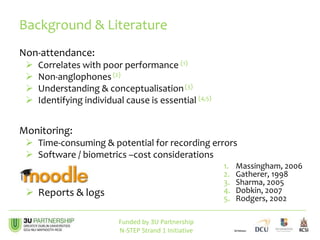
Non-attendance:
 Correlates with poor performance (1)
 Non-anglophones(2)
 Understanding & conceptualisation(3)
 Identifying individual cause is essential (4,5)
Monitoring:
 Time-consuming & potential for recording errors
 Software / biometrics –cost considerations
 Reports & logs
Background & Literature
1. Massingham, 2006
2. Gatherer, 1998
3. Sharma, 2005
4. Dobkin, 2007
5. Rodgers, 2002
Funded by 3U Partnership
N-STEP Strand 1 Initiative
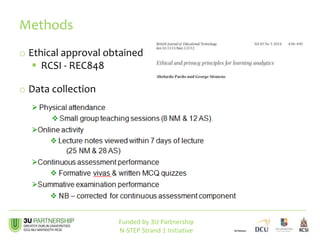
o Ethical approval obtained
 RCSI - REC848
o Data collection
Methods
Funded by 3U Partnership
N-STEP Strand 1 Initiative
Physical
attendance
Online
activity
Continuous
assessment
Summative
examination
NM
New entrants (n=329) 8 24 2.9% 63.5 %
Repeat (n=29) 7 14 2.3% 54.4 %
AS
New entrants (n=329) 12 25 2.9% 66.3 %
Repeat (n=29) 8 15 2.3% 55.8 %
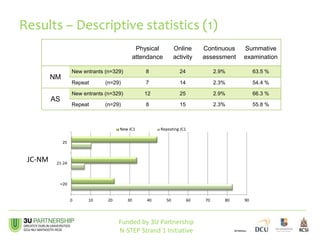
Results – Descriptive statistics (1)
Funded by 3U Partnership
N-STEP Strand 1 Initiative
JC-NM
0 10 20 30 40 50 60 70 80 90
<20
21-24
25
New JC1 Repeating JC1
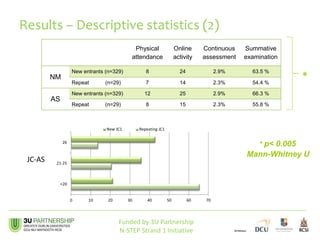
Results – Descriptive statistics (2)
Funded by 3U Partnership
N-STEP Strand 1 Initiative
Physical
attendance
Online
activity
Continuous
assessment
Summative
examination
NM
New entrants (n=329) 8 24 2.9% 63.5 %
Repeat (n=29) 7 14 2.3% 54.4 %
AS
New entrants (n=329) 12 25 2.9% 66.3 %
Repeat (n=29) 8 15 2.3% 55.8 %
*
* p< 0.005
Mann-Whitney U
JC-AS
0 10 20 30 40 50 60 70
<20
21-25
26
New JC1 Repeating JC1
Physical
attendance
Online activity
Continuous
assessment
NM
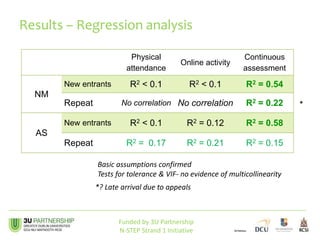
New entrants R2 < 0.1 R2 < 0.1 R2 = 0.54
Repeat No correlation No correlation R2 = 0.22
AS
New entrants R2 < 0.1 R2 = 0.12 R2 = 0.58
Repeat R2 = 0.17 R2 = 0.21 R2 = 0.15
Results – Regression analysis
Basic assumptions confirmed
Tests for tolerance & VIF- no evidence of multicollinearity
*? Late arrival due to appeals
*
Funded by 3U Partnership
N-STEP Strand 1 Initiative
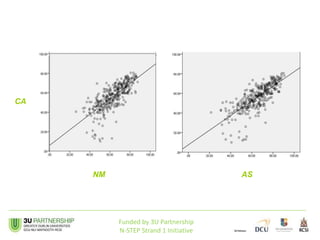
CA
NM AS
Funded by 3U Partnership
N-STEP Strand 1 Initiative
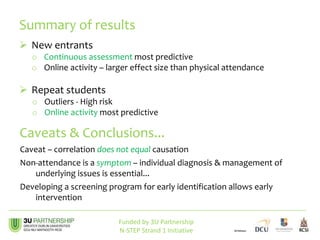
 New entrants
o Continuous assessment most predictive
o Online activity – larger effect size than physical attendance
 Repeat students
o Outliers - High risk
o Online activity most predictive
Summary of results
Funded by 3U Partnership
N-STEP Strand 1 Initiative
Caveats & Conclusions...
Caveat – correlation does not equal causation
Non-attendance is a symptom – individual diagnosis & management of
underlying issues is essential...
Developing a screening program for early identification allows early
intervention
1. Massingham P, Herrington T. Does attendance matter? An examination of student
attitudes, participation, performance and attendance. Journal of university teaching
& learning practice. 2006;3(2):3.
2. Gatherer, D., & Manning, F. C. (1998). Correlation of examination performance with
lecture attendance: a comparative study of first-year biological sciences
undergraduates. Biochemical Education, 26(2), 121-123.
3. Sharma, M. D., Mendez, A., & O’Byrne, J. W. (2005). The relationship between
attendance in student‐centred physics tutorials and performance in university
examinations. International Journal of Science Education, 27(11), 1375-1389.
4. Dobkin C, Gil R, Marion J. Causes and consequences of skipping class in college:
Mimeo, UC Santa Cruz 2007.
5. Rodgers JR. Encouraging tutorial attendance at university did not improve
performance. Australian Economic Papers. 2002;41(3):255-66.
References
Funded by 3U Partnership
N-STEP Strand 1 Initiative

Inmed 2015 Holland

  • 1.
    Examining the relationshipsbetween attendance, online engagement and assessment outcomes in undergraduates; an observational prospective, multicentre study. Jane Holland*, Eric Clarke*, Morag Monro , Evelyn Kelleher , Mark Glynn  *RCSI Dublin, DCU Dublin Funded by 3U Partnership N-STEP Strand 1 Initiative
  • 2.
    Non-attendance:  Correlates withpoor performance (1)  Non-anglophones(2)  Understanding & conceptualisation(3)  Identifying individual cause is essential (4,5) Monitoring:  Time-consuming & potential for recording errors  Software / biometrics –cost considerations  Reports & logs Background & Literature 1. Massingham, 2006 2. Gatherer, 1998 3. Sharma, 2005 4. Dobkin, 2007 5. Rodgers, 2002 Funded by 3U Partnership N-STEP Strand 1 Initiative
  • 3.
    o Ethical approvalobtained  RCSI - REC848 o Data collection Methods Funded by 3U Partnership N-STEP Strand 1 Initiative
  • 4.
    Physical attendance Online activity Continuous assessment Summative examination NM New entrants (n=329)8 24 2.9% 63.5 % Repeat (n=29) 7 14 2.3% 54.4 % AS New entrants (n=329) 12 25 2.9% 66.3 % Repeat (n=29) 8 15 2.3% 55.8 % Results – Descriptive statistics (1) Funded by 3U Partnership N-STEP Strand 1 Initiative JC-NM 0 10 20 30 40 50 60 70 80 90 <20 21-24 25 New JC1 Repeating JC1
  • 5.
    Results – Descriptivestatistics (2) Funded by 3U Partnership N-STEP Strand 1 Initiative Physical attendance Online activity Continuous assessment Summative examination NM New entrants (n=329) 8 24 2.9% 63.5 % Repeat (n=29) 7 14 2.3% 54.4 % AS New entrants (n=329) 12 25 2.9% 66.3 % Repeat (n=29) 8 15 2.3% 55.8 % * * p< 0.005 Mann-Whitney U JC-AS 0 10 20 30 40 50 60 70 <20 21-25 26 New JC1 Repeating JC1
  • 6.
    Physical attendance Online activity Continuous assessment NM New entrantsR2 < 0.1 R2 < 0.1 R2 = 0.54 Repeat No correlation No correlation R2 = 0.22 AS New entrants R2 < 0.1 R2 = 0.12 R2 = 0.58 Repeat R2 = 0.17 R2 = 0.21 R2 = 0.15 Results – Regression analysis Basic assumptions confirmed Tests for tolerance & VIF- no evidence of multicollinearity *? Late arrival due to appeals * Funded by 3U Partnership N-STEP Strand 1 Initiative
  • 7.
    CA NM AS Funded by3U Partnership N-STEP Strand 1 Initiative
  • 8.
     New entrants oContinuous assessment most predictive o Online activity – larger effect size than physical attendance  Repeat students o Outliers - High risk o Online activity most predictive Summary of results Funded by 3U Partnership N-STEP Strand 1 Initiative Caveats & Conclusions... Caveat – correlation does not equal causation Non-attendance is a symptom – individual diagnosis & management of underlying issues is essential... Developing a screening program for early identification allows early intervention
  • 9.
    1. Massingham P,Herrington T. Does attendance matter? An examination of student attitudes, participation, performance and attendance. Journal of university teaching & learning practice. 2006;3(2):3. 2. Gatherer, D., & Manning, F. C. (1998). Correlation of examination performance with lecture attendance: a comparative study of first-year biological sciences undergraduates. Biochemical Education, 26(2), 121-123. 3. Sharma, M. D., Mendez, A., & O’Byrne, J. W. (2005). The relationship between attendance in student‐centred physics tutorials and performance in university examinations. International Journal of Science Education, 27(11), 1375-1389. 4. Dobkin C, Gil R, Marion J. Causes and consequences of skipping class in college: Mimeo, UC Santa Cruz 2007. 5. Rodgers JR. Encouraging tutorial attendance at university did not improve performance. Australian Economic Papers. 2002;41(3):255-66. References Funded by 3U Partnership N-STEP Strand 1 Initiative

Editor's Notes

  • #3 1. Massingham P, Herrington T. Does attendance matter? An examination of student attitudes, participation, performance and attendance. Journal of university teaching & learning practice. 2006;3(2):3. 2. Gatherer D, Manning FC. Correlation of examination performance with lecture attendance: a comparative study of first-year biological sciences undergraduates. Biochemical Education. 1998;26(2):121-3. 3. Sharma MD, Mendez A, O’Byrne JW. The relationship between attendance in student-centred physics tutorials and performance in university examinations. International Journal of Science Education. 2005;27(11):1375-89. 4. Dobkin C, Gil R, Marion J. Causes and consequences of skipping class in college: Mimeo, UC Santa Cruz 2007. 5. Rodgers JR. Encouraging tutorial attendance at university did not improve performance. Australian Economic Papers. 2002;41(3):255-66.
  • #8 Graph 1 – NM x vs CA y Graph 2 - AS x vs CA y