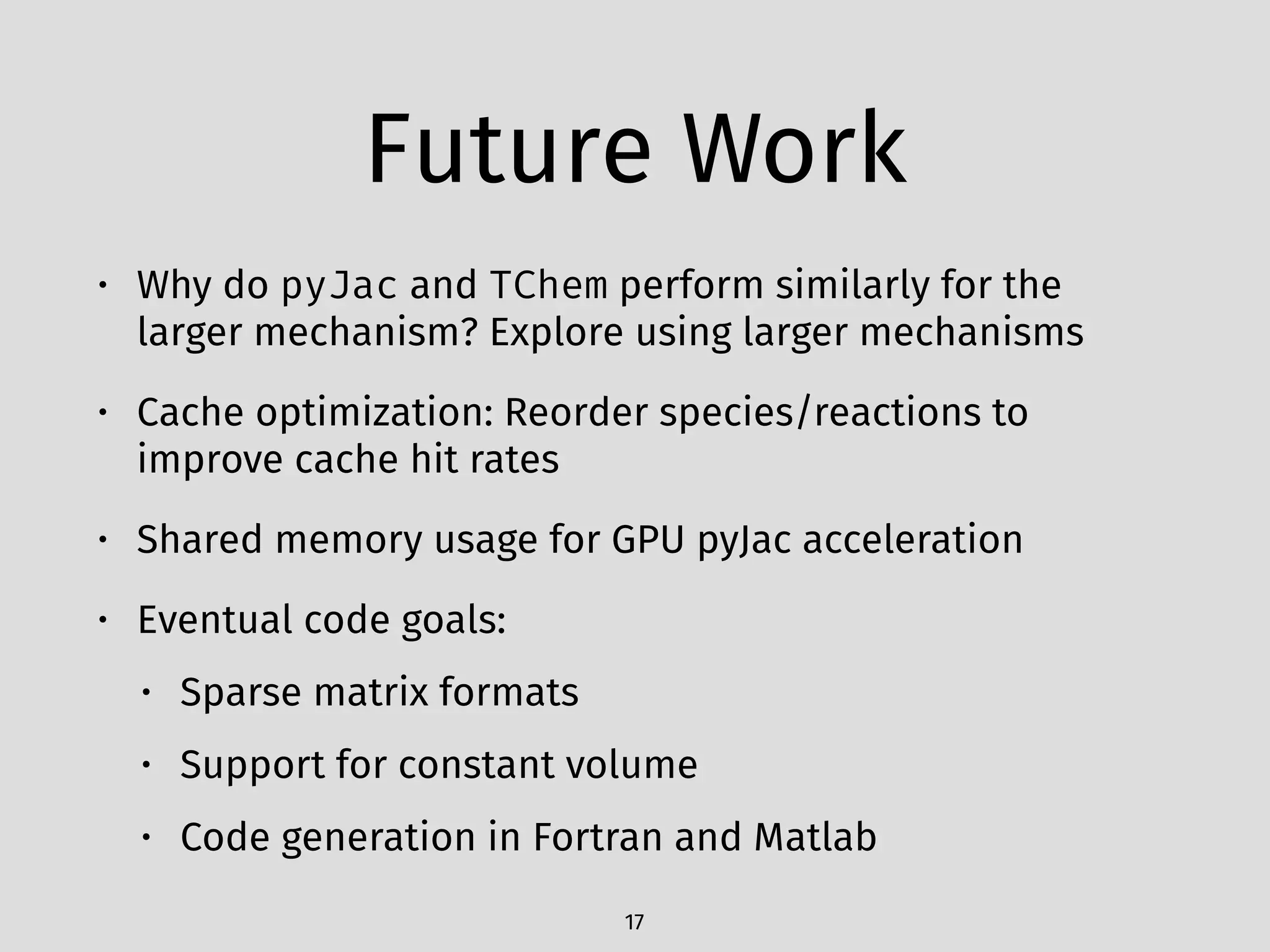


Initial investigation of pyJac:
an analytical Jacobian
generator for chemical kinetics
Kyle Niemeyer
Oregon State University
Nicholas Curtis, Chih-Jen Sung
University of Connecticut
Fall 2015 Meeting of WSSCI
5 October 2015
Funding: NSF awards 1535065 & 1534688
0
5
10
15
20
25
-10 -9 -8 -7 -6 -5 -4 -3 -2 -1
Numberofspecies
log10(Characteristic time (s))
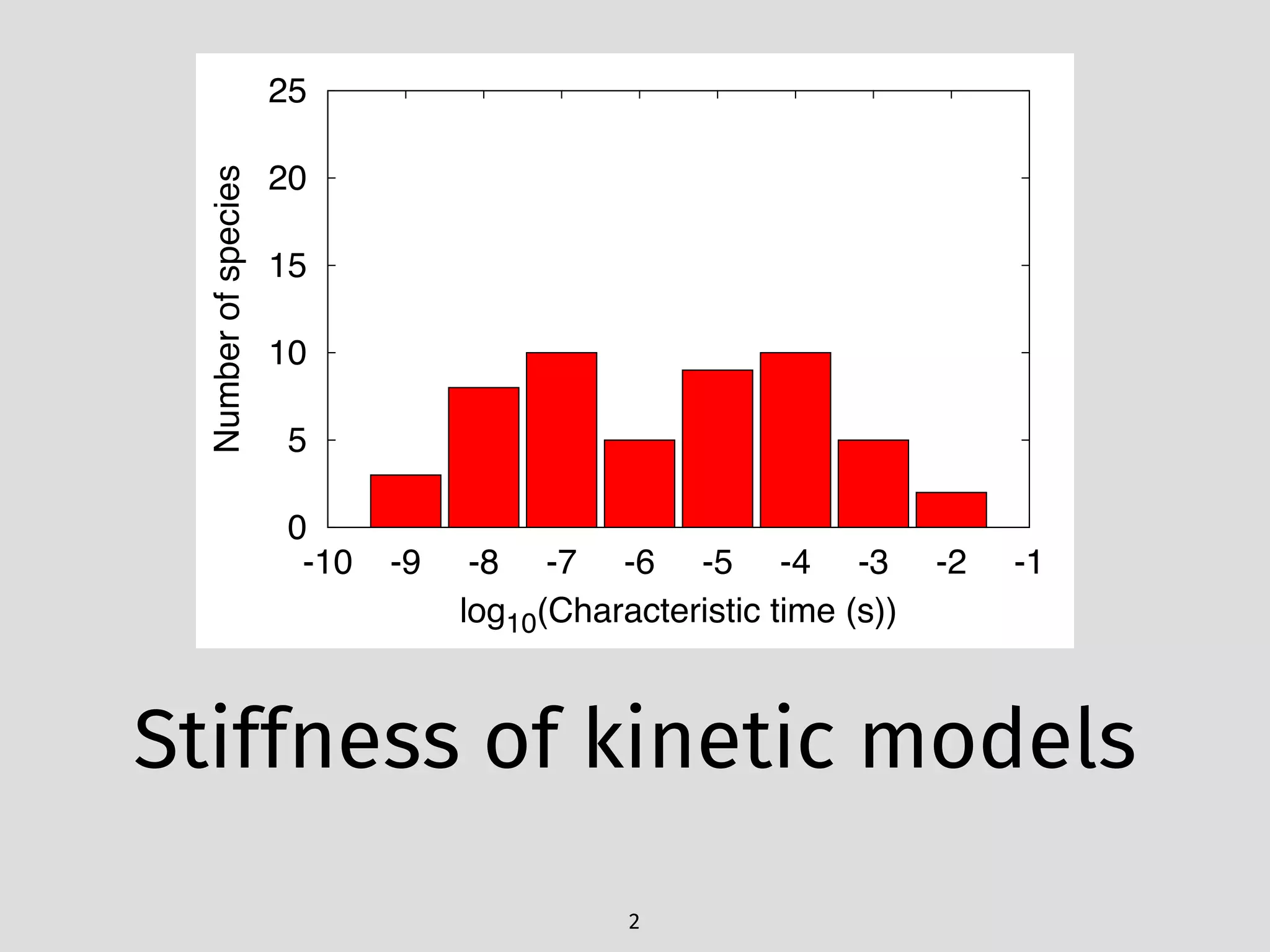
Stiffness of kinetic models
2
0
5
10
15
20
25
-10 -9 -8 -7 -6 -5 -4 -3 -2 -1
Numberofspecies
log10(Characteristic time (s))
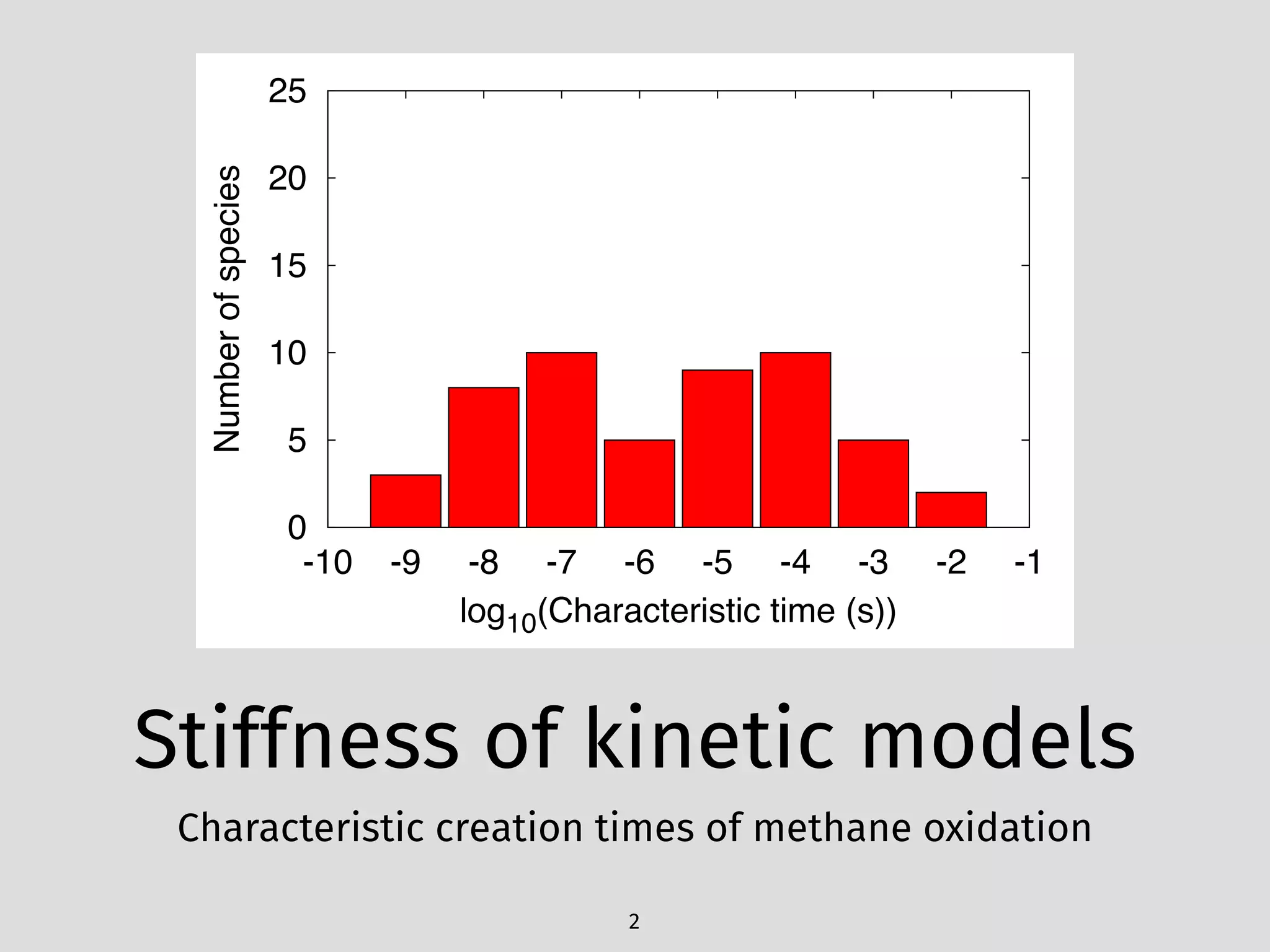
Stiffness of kinetic models
Characteristic creation times of methane oxidation
2
Motivation
3
Motivation
• Stiffness
3
Motivation
• Stiffness
3
implicit integration algorithms
Motivation
• Stiffness
• Require Jacobian matrix—repeatedly evaluated
and factorized
3
implicit integration algorithms
Motivation
• Stiffness
• Require Jacobian matrix—repeatedly evaluated
and factorized
• Jacobian typically obtained via finite differences
3
implicit integration algorithms
Motivation
• Stiffness
• Require Jacobian matrix—repeatedly evaluated
and factorized
• Jacobian typically obtained via finite differences
• Scales with (Nspecies)2
3
implicit integration algorithms
NumberofReactions
10
100
1000
10000
100000
Number of Species
10 100 1000 10000
before 2005
since 2005
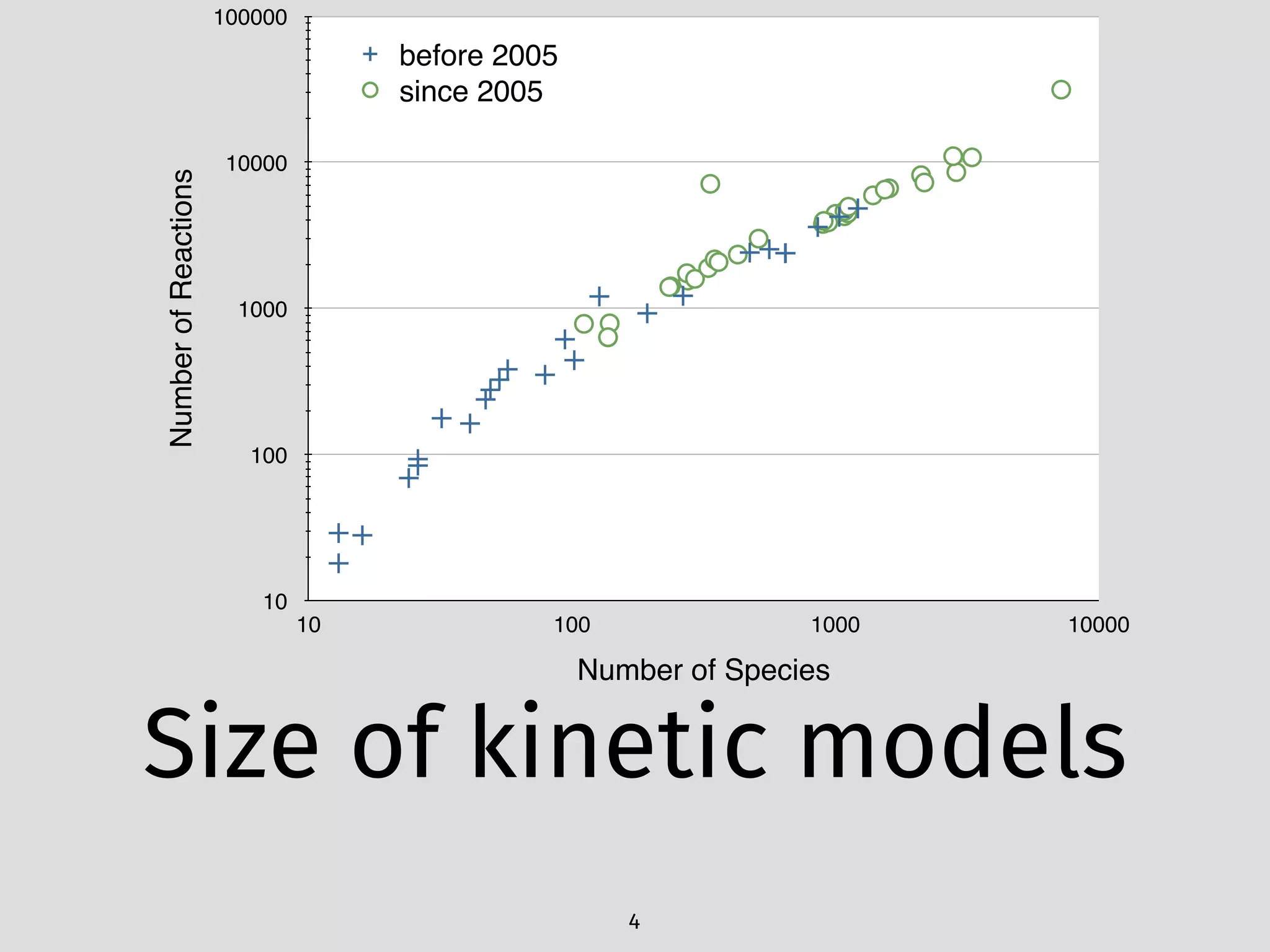
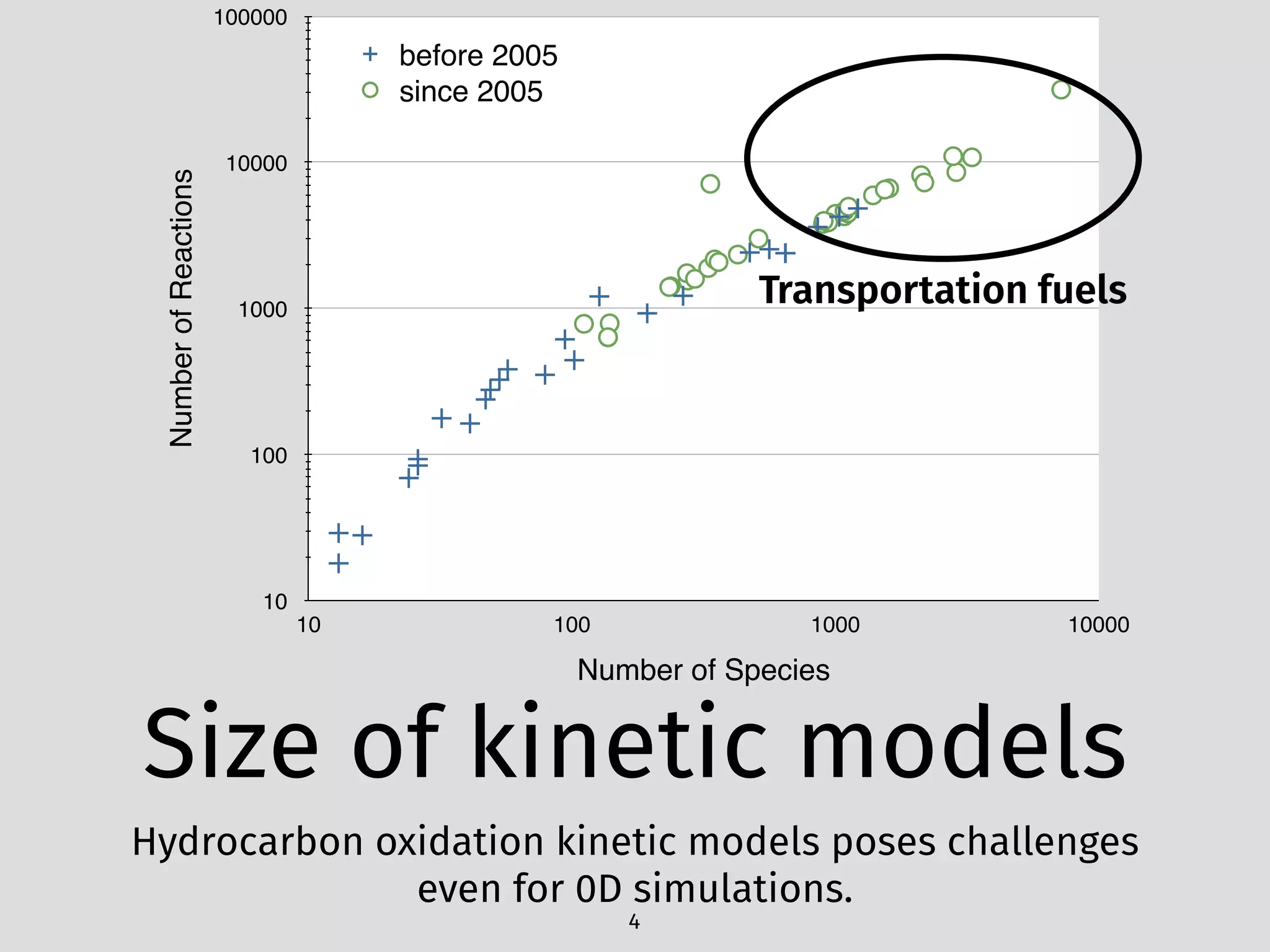
Size of kinetic models
4
NumberofReactions
10
100
1000
10000
100000
Number of Species
10 100 1000 10000
before 2005
since 2005
Size of kinetic models
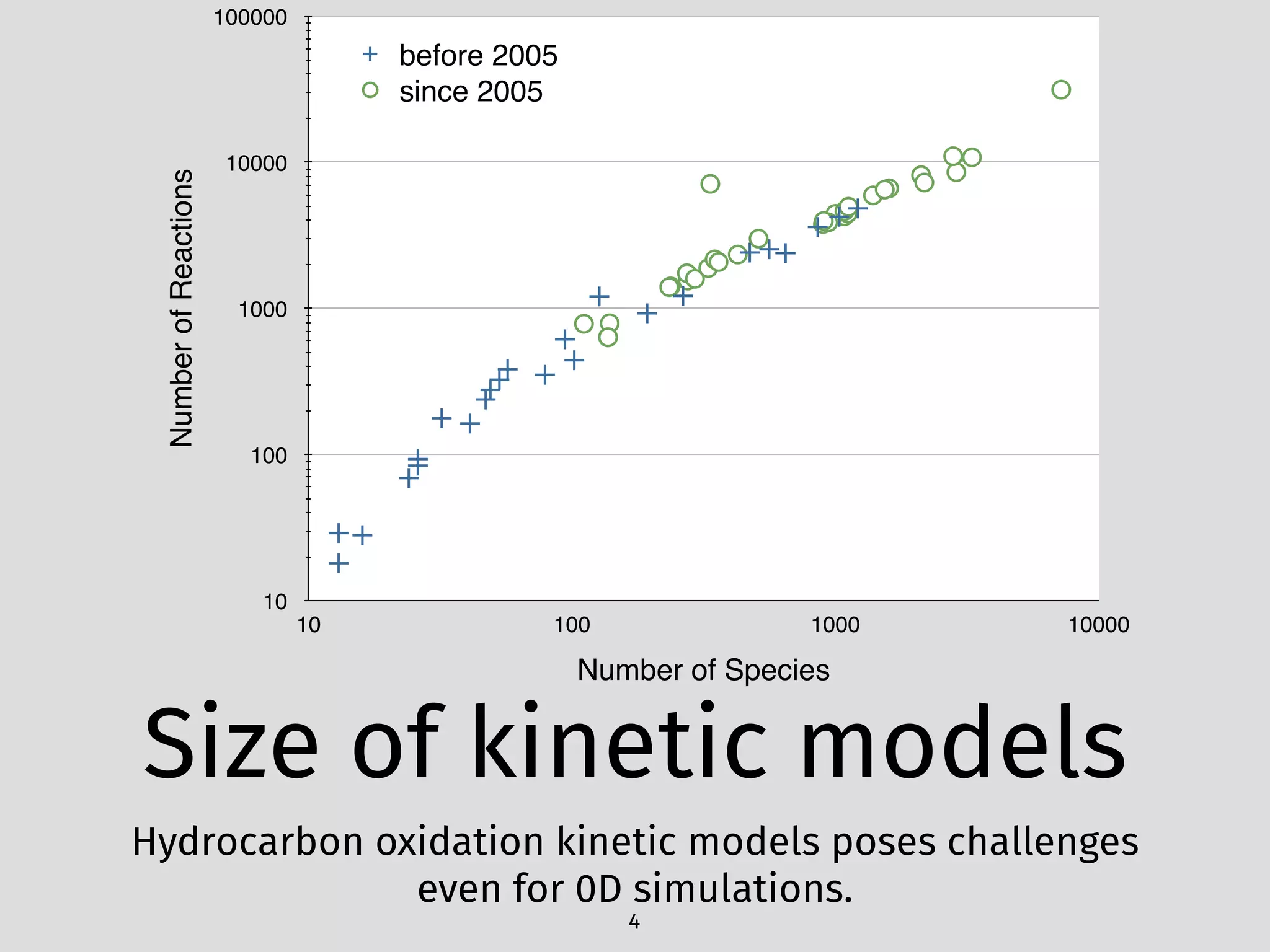
Hydrocarbon oxidation kinetic models poses challenges
even for 0D simulations.
4
NumberofReactions
10
100
1000
10000
100000
Number of Species
10 100 1000 10000
before 2005
since 2005
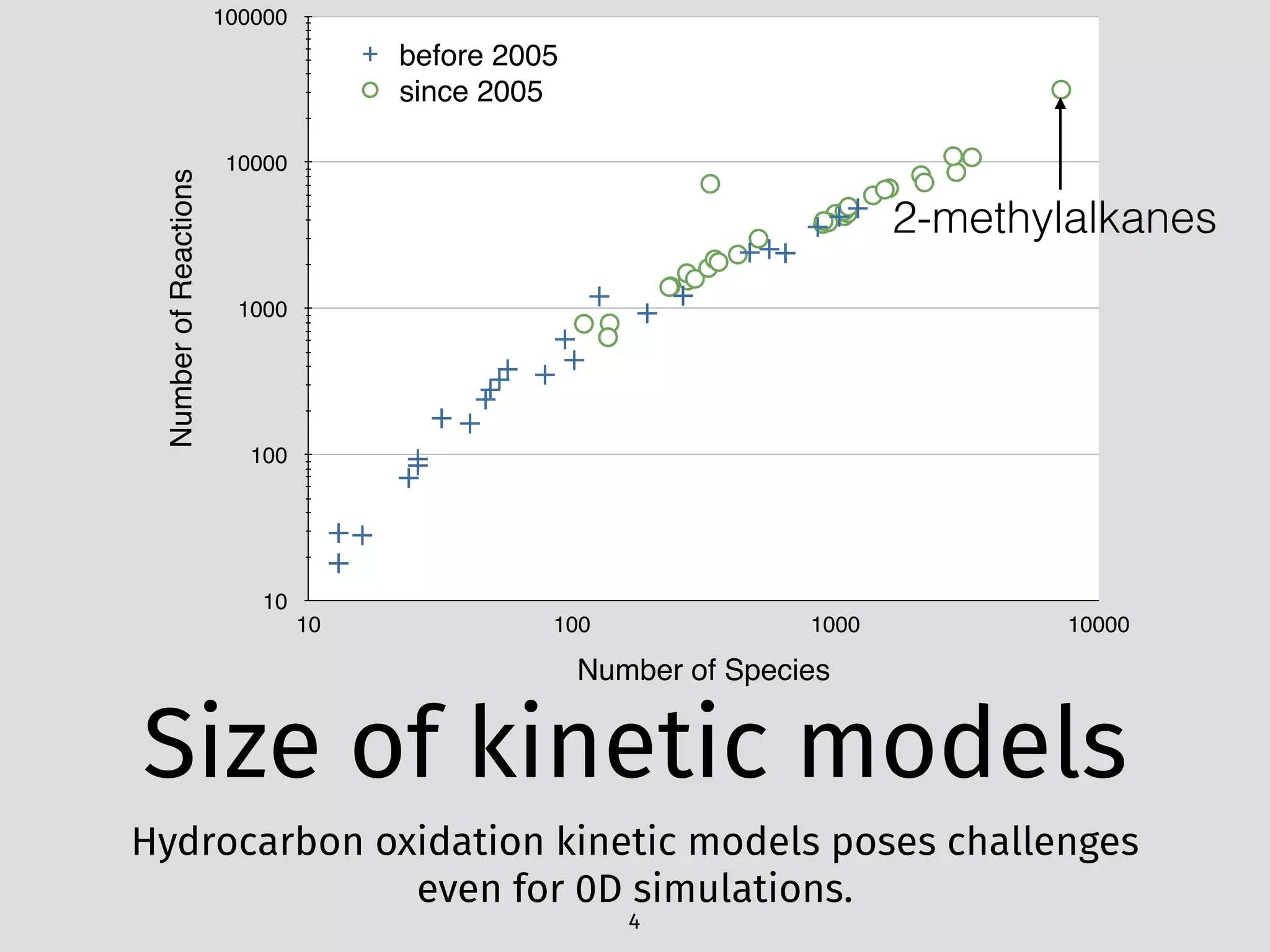
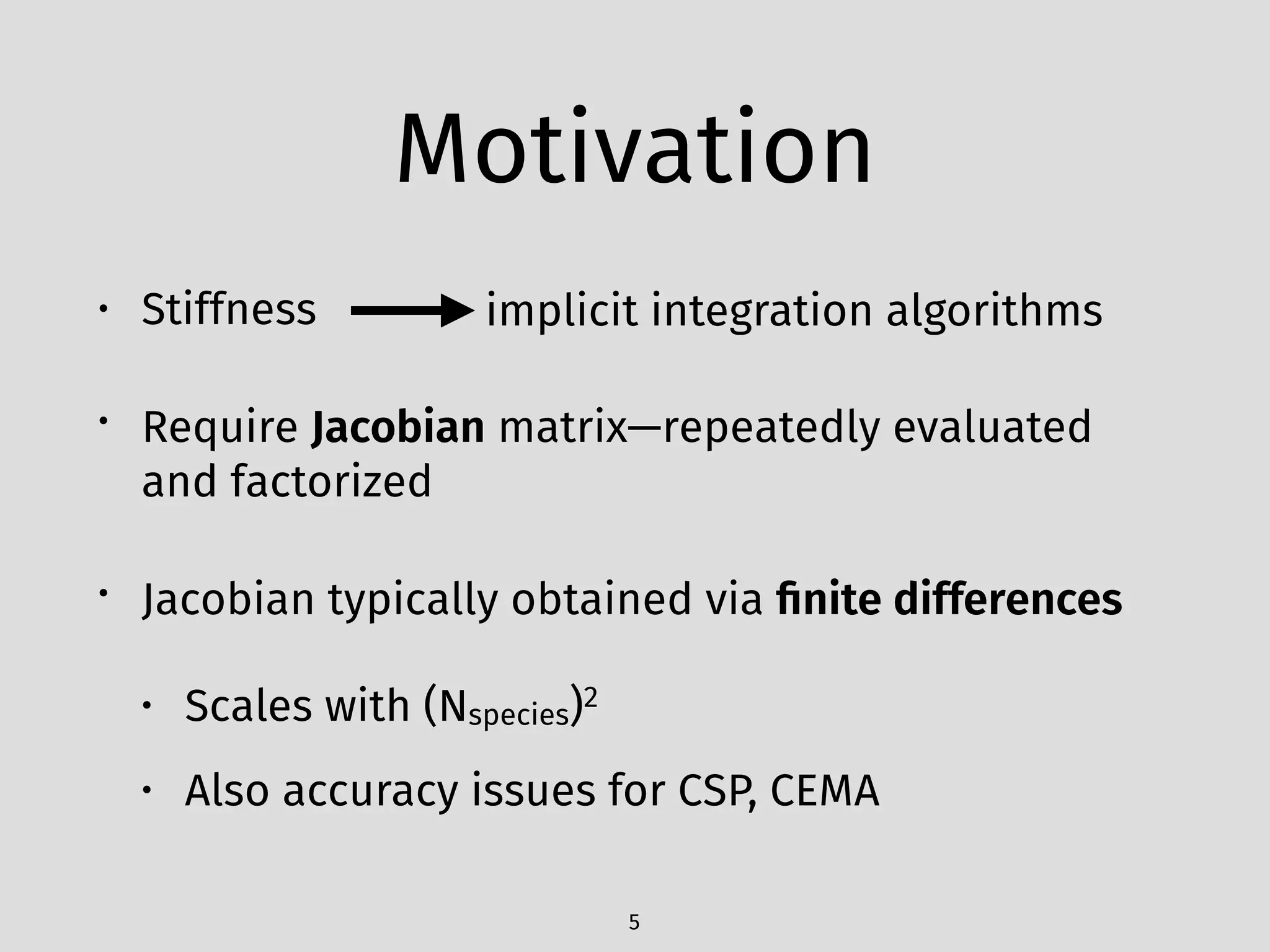
Size of kinetic models
Hydrocarbon oxidation kinetic models poses challenges
even for 0D simulations.
4
Transportation fuels
NumberofReactions
10
100
1000
10000
100000
Number of Species
10 100 1000 10000
before 2005
since 2005
Size of kinetic models
Hydrocarbon oxidation kinetic models poses challenges
even for 0D simulations.
4
2-methylalkanes
Motivation
5
implicit integration algorithms• Stiffness
• Require Jacobian matrix—repeatedly evaluated
and factorized
• Jacobian typically obtained via finite differences
• Scales with (Nspecies)2
Motivation
• Also accuracy issues for CSP, CEMA
5
implicit integration algorithms• Stiffness
• Require Jacobian matrix—repeatedly evaluated
and factorized
• Jacobian typically obtained via finite differences
• Scales with (Nspecies)2
Introducing pyJac
6
Introducing pyJac
• Accelerate chemical kinetic integration by
providing source code to evaluate chemical kinetic
Jacobian matrices analytically
6
Introducing pyJac
• Accelerate chemical kinetic integration by
providing source code to evaluate chemical kinetic
Jacobian matrices analytically
• pyJac capable of generating source code for CPU
and GPU architectures
6
Introducing pyJac
• Accelerate chemical kinetic integration by
providing source code to evaluate chemical kinetic
Jacobian matrices analytically
• pyJac capable of generating source code for CPU
and GPU architectures
• Compatible with both CHEMKIN- and Cantera-
format mechanisms
6
… What is a Jacobian, again?
7
… What is a Jacobian, again?
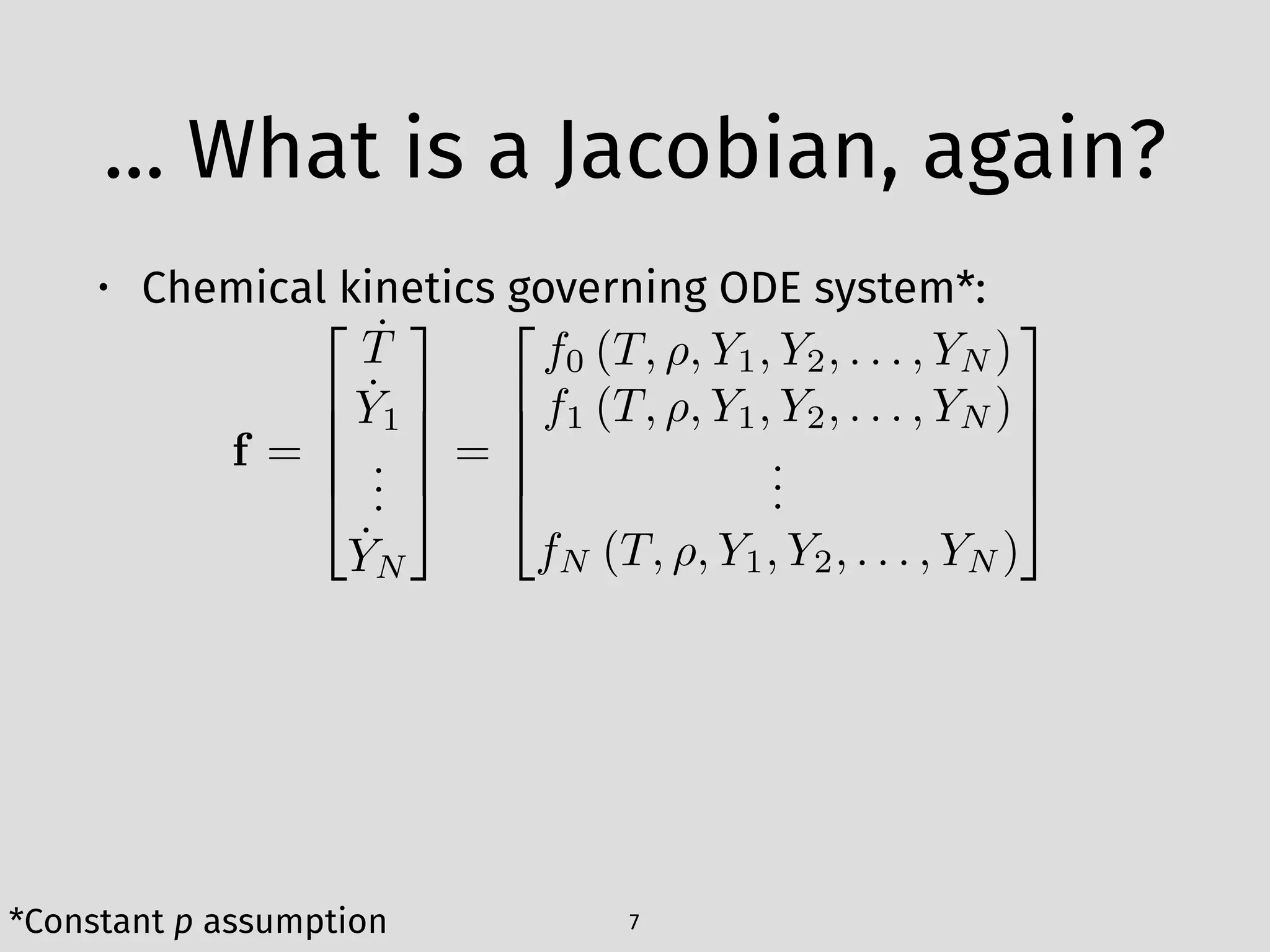
• Chemical kinetics governing ODE system*:


7
… What is a Jacobian, again?
• Chemical kinetics governing ODE system*:


7
f =
2
6
6
6
4
˙T
˙Y1
...
˙YN
3
7
7
7
5
=
2
6
6
6
4
f0 (T, ⇢, Y1, Y2, . . . , YN )
f1 (T, ⇢, Y1, Y2, . . . , YN )
...
fN (T, ⇢, Y1, Y2, . . . , YN )
3
7
7
7
5
*Constant p assumption
… What is a Jacobian, again?
• Chemical kinetics governing ODE system*:


• Jacobian matrix:
7
f =
2
6
6
6
4
˙T
˙Y1
...
˙YN
3
7
7
7
5
=
2
6
6
6
4
f0 (T, ⇢, Y1, Y2, . . . , YN )
f1 (T, ⇢, Y1, Y2, . . . , YN )
...
fN (T, ⇢, Y1, Y2, . . . , YN )
3
7
7
7
5
J =
df
dy
=
2
6
6
6
6
4
@ ˙T
@y
@ ˙Y1
@y
...
@ ˙YN
@y
3
7
7
7
7
5
=
2
6
6
6
6
4
@ ˙T
@T
@ ˙T
@Y1
· · · @ ˙T
@YN
@ ˙Y1
@T
@ ˙Y1
@Y1
· · · @ ˙Y1
@YN
...
...
...
...
@ ˙YN
@T
@ ˙YN
@Y1
· · · @ ˙YN
@YN
3
7
7
7
7
5
*Constant p assumption
Analytical Jacobian
Following a lot of math…
8
Jk+1,1 =
Wk
⇢
✓
@ ˙!k
@T
+
˙!k
T
◆
=
Wk
⇢
NreacX
i=1
⌫ki

@ci
@T
(Rf,i Rr,i) + ci
✓
@Ri
@T
+
Rf,i Rr,i
T
◆
Jk+1,j+1 =
Wk
⇢
✓
@ ˙!k
@Yj
+ ˙!k
W
Wj
◆
=
Wk
⇢
"
˙!k
W
Wj
+
NreasX
i=1
⌫ki
✓
@ci
@Yj
(Rf,i Rr,i)
+ ci
Nsp
X
l=1
⌫0
li
W
Wj
Rf,i + ljkf,i
⇢
Wl
[Xl]⌫0
li 1
Nsp
Y
n=1
n6=l
[Xn]⌫0
ni
!
Nsp
X
l=1
⌫00
li
W
Wj
Rr,i + ljkr,i
⇢
Wl
[Xl]⌫00
li 1
Nsp
Y
n=1
n6=l
[Xn]⌫00
ni
!!!#
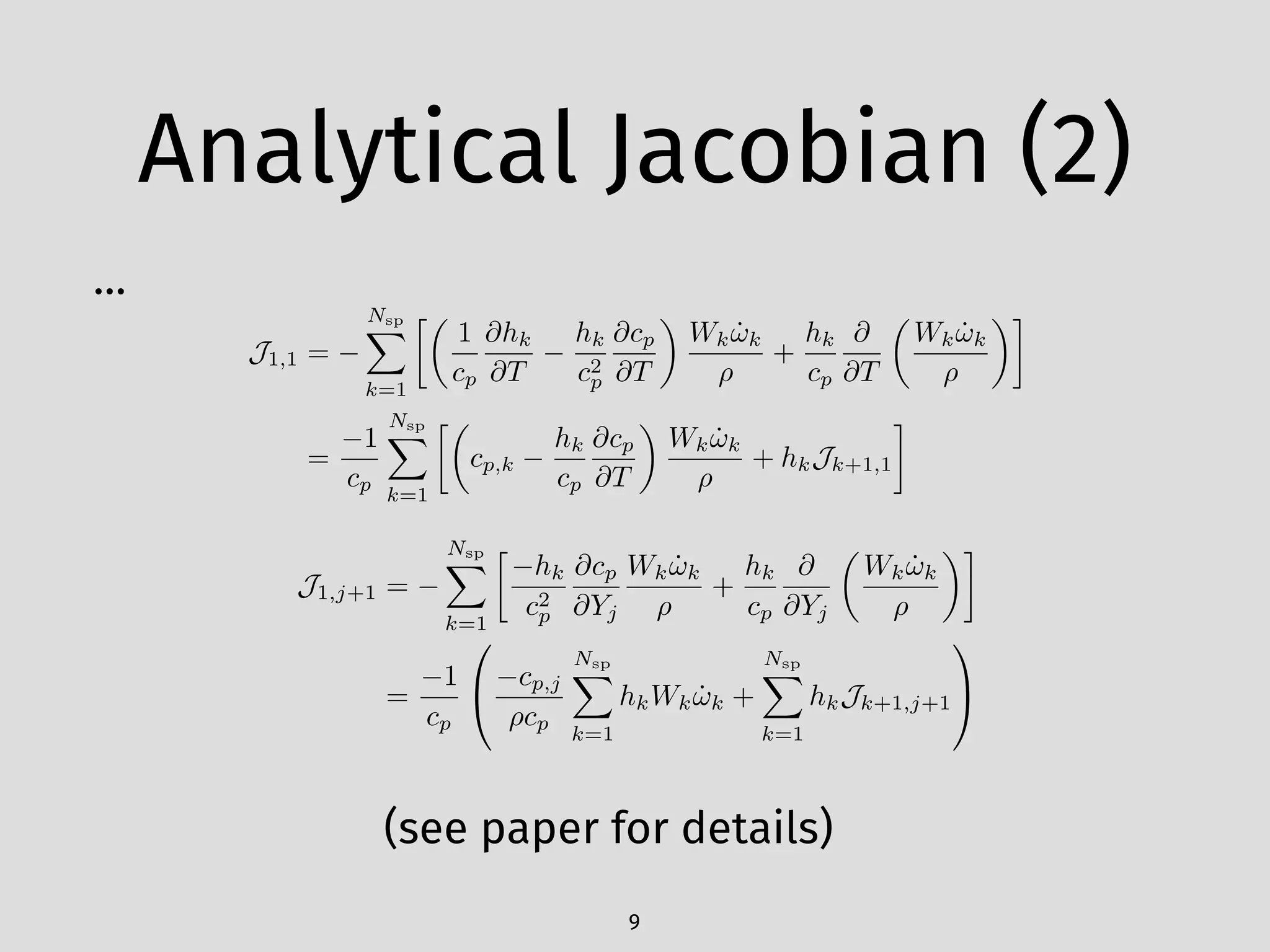
Analytical Jacobian (2)
…
9
J1,1 =
Nsp
X
k=1
✓
1
cp
@hk
@T
hk
c2
p
@cp
@T
◆
Wk ˙!k
⇢
+
hk
cp
@
@T
✓
Wk ˙!k
⇢
◆
=
1
cp
Nsp
X
k=1
✓
cp,k
hk
cp
@cp
@T
◆
Wk ˙!k
⇢
+ hkJk+1,1
J1,j+1 =
Nsp
X
k=1

hk
c2
p
@cp
@Yj
Wk ˙!k
⇢
+
hk
cp
@
@Yj
✓
Wk ˙!k
⇢
◆
=
1
cp
0
@ cp,j
⇢cp
Nsp
X
k=1
hkWk ˙!k +
Nsp
X
k=1
hkJk+1,j+1
1
A
(see paper for details)
Optimized Evaluation
10
Optimized Evaluation
• General idea:
10
Optimized Evaluation
• General idea:
• Large portions of Jacobian entries constant for a single
reaction
10
Optimized Evaluation
• General idea:
• Large portions of Jacobian entries constant for a single
reaction
• Compute this portion once, and update as needed for
all species pairs
10
Optimized Evaluation
• General idea:
• Large portions of Jacobian entries constant for a single
reaction
• Compute this portion once, and update as needed for
all species pairs
• Potential increase in computational efficiency
10
Optimized Evaluation
• General idea:
• Large portions of Jacobian entries constant for a single
reaction
• Compute this portion once, and update as needed for
all species pairs
• Potential increase in computational efficiency
• Most expensive calculation can be performed once per
reaction
10
Optimized Evaluation
• General idea:
• Large portions of Jacobian entries constant for a single
reaction
• Compute this portion once, and update as needed for
all species pairs
• Potential increase in computational efficiency
• Most expensive calculation can be performed once per
reaction
• Species pairs updates relatively simple in comparison
10
Validation: PaSR (1)
11
Validation: PaSR (1)
11
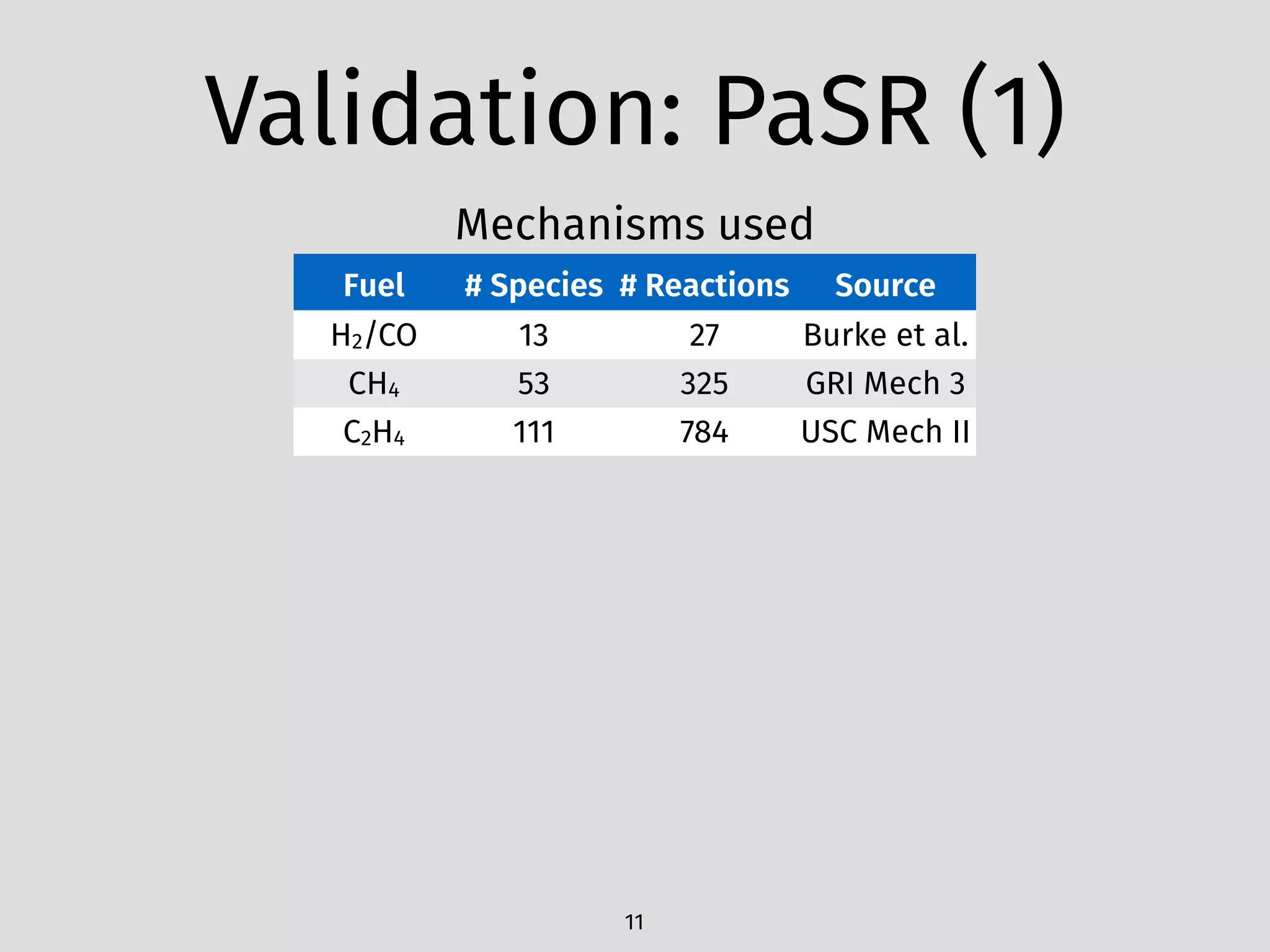
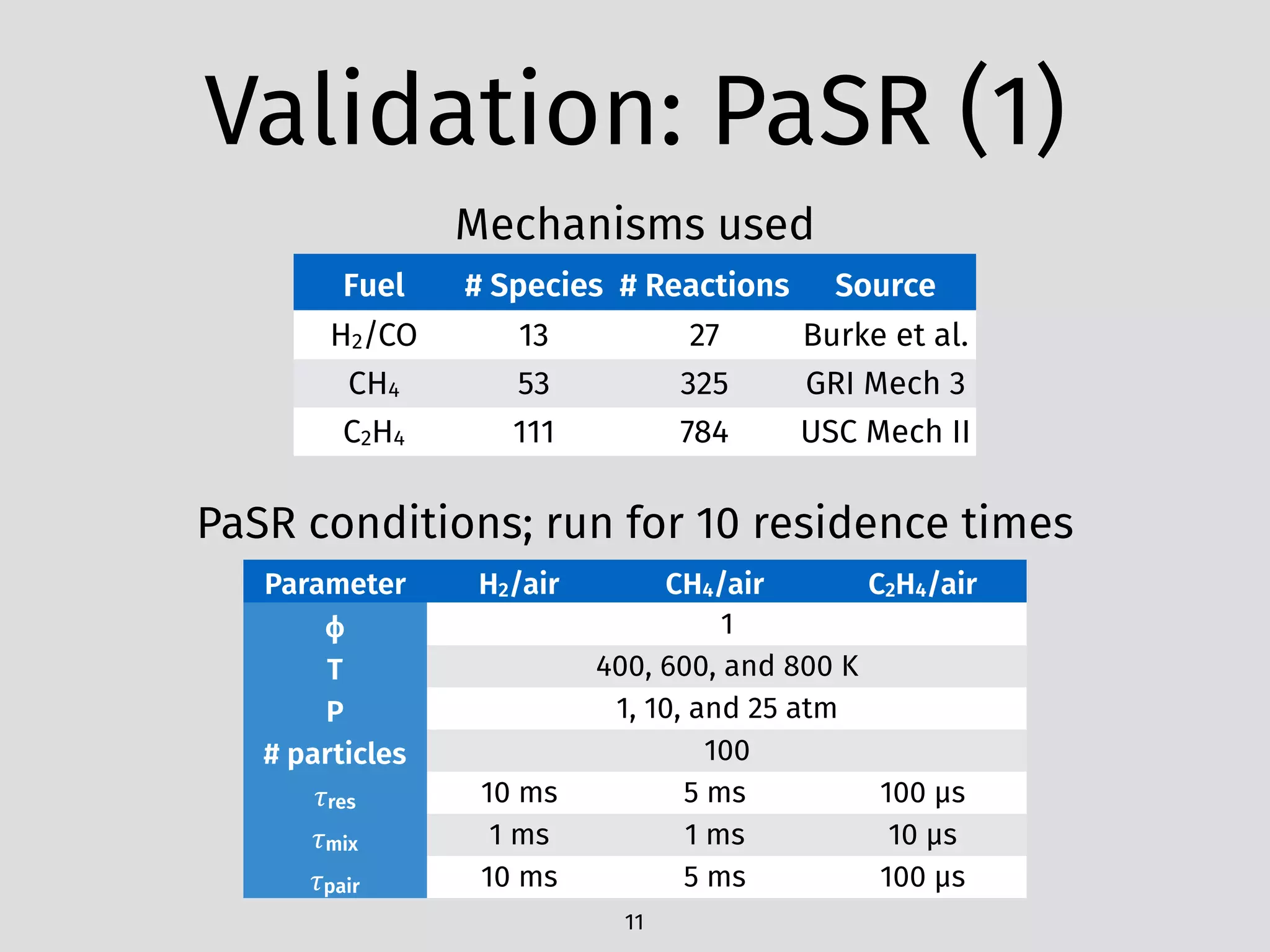
Fuel # Species # Reactions Source
H2/CO 13 27 Burke et al.
CH4 53 325 GRI Mech 3
C2H4 111 784 USC Mech II
Mechanisms used
Validation: PaSR (1)
11
Parameter H2/air CH4/air C2H4/air
ϕ 1
T 400, 600, and 800 K
P 1, 10, and 25 atm
# particles 100
𝜏res 10 ms 5 ms 100 μs
𝜏mix 1 ms 1 ms 10 μs
𝜏pair 10 ms 5 ms 100 μs
PaSR conditions; run for 10 residence times
Fuel # Species # Reactions Source
H2/CO 13 27 Burke et al.
CH4 53 325 GRI Mech 3
C2H4 111 784 USC Mech II
Mechanisms used
Validation: PaSR (2)
12
Validation: PaSR (2)
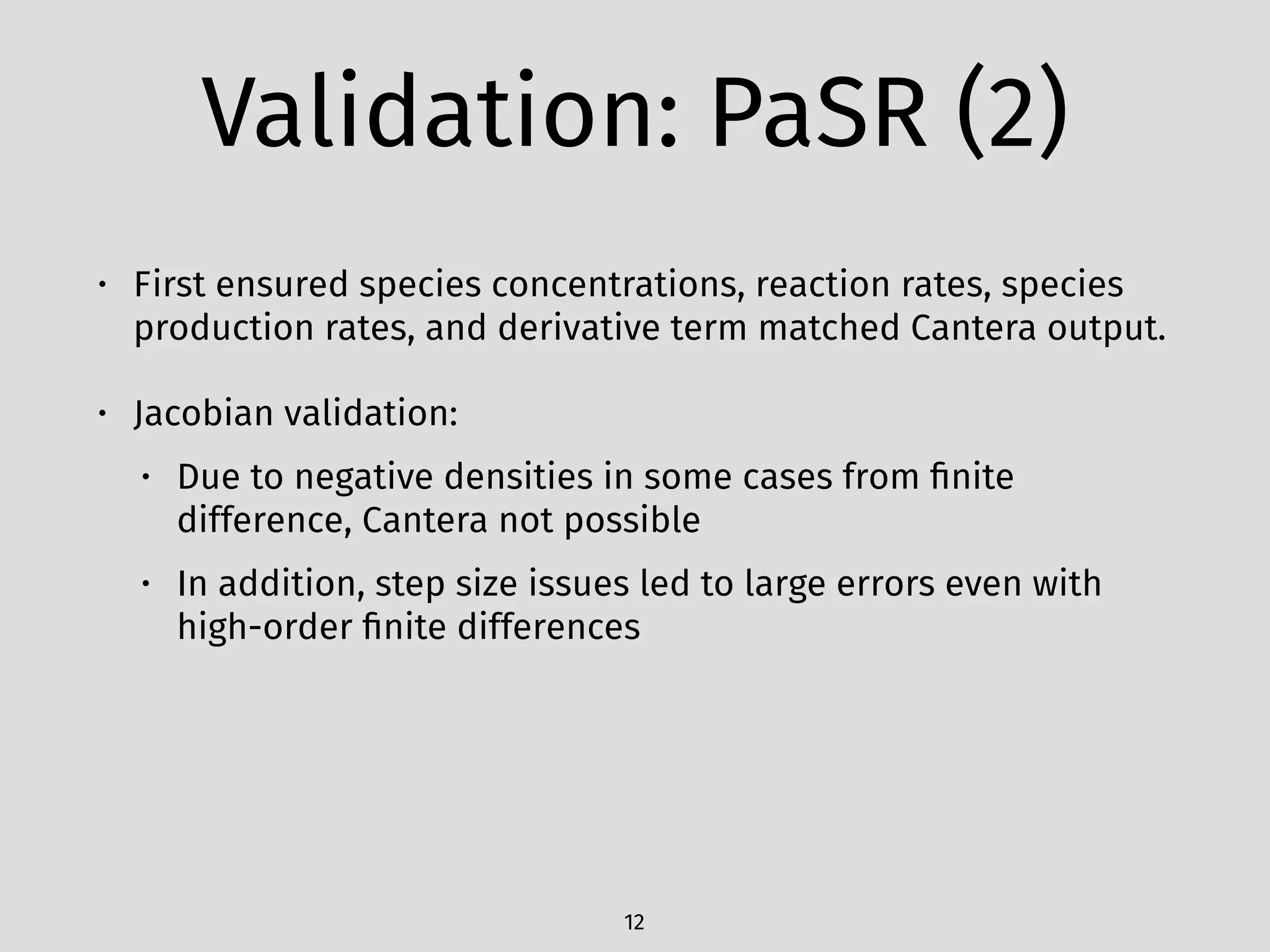
• First ensured species concentrations, reaction rates, species
production rates, and derivative term matched Cantera output.
12
Validation: PaSR (2)
• First ensured species concentrations, reaction rates, species
production rates, and derivative term matched Cantera output.
• Jacobian validation:
12
Validation: PaSR (2)
• First ensured species concentrations, reaction rates, species
production rates, and derivative term matched Cantera output.
• Jacobian validation:
• Due to negative densities in some cases from finite
difference, Cantera not possible
12
Validation: PaSR (2)
• First ensured species concentrations, reaction rates, species
production rates, and derivative term matched Cantera output.
• Jacobian validation:
• Due to negative densities in some cases from finite
difference, Cantera not possible
• In addition, step size issues led to large errors even with
high-order finite differences
12
Validation: PaSR (2)
• First ensured species concentrations, reaction rates, species
production rates, and derivative term matched Cantera output.
• Jacobian validation:
• Due to negative densities in some cases from finite
difference, Cantera not possible
• In addition, step size issues led to large errors even with
high-order finite differences
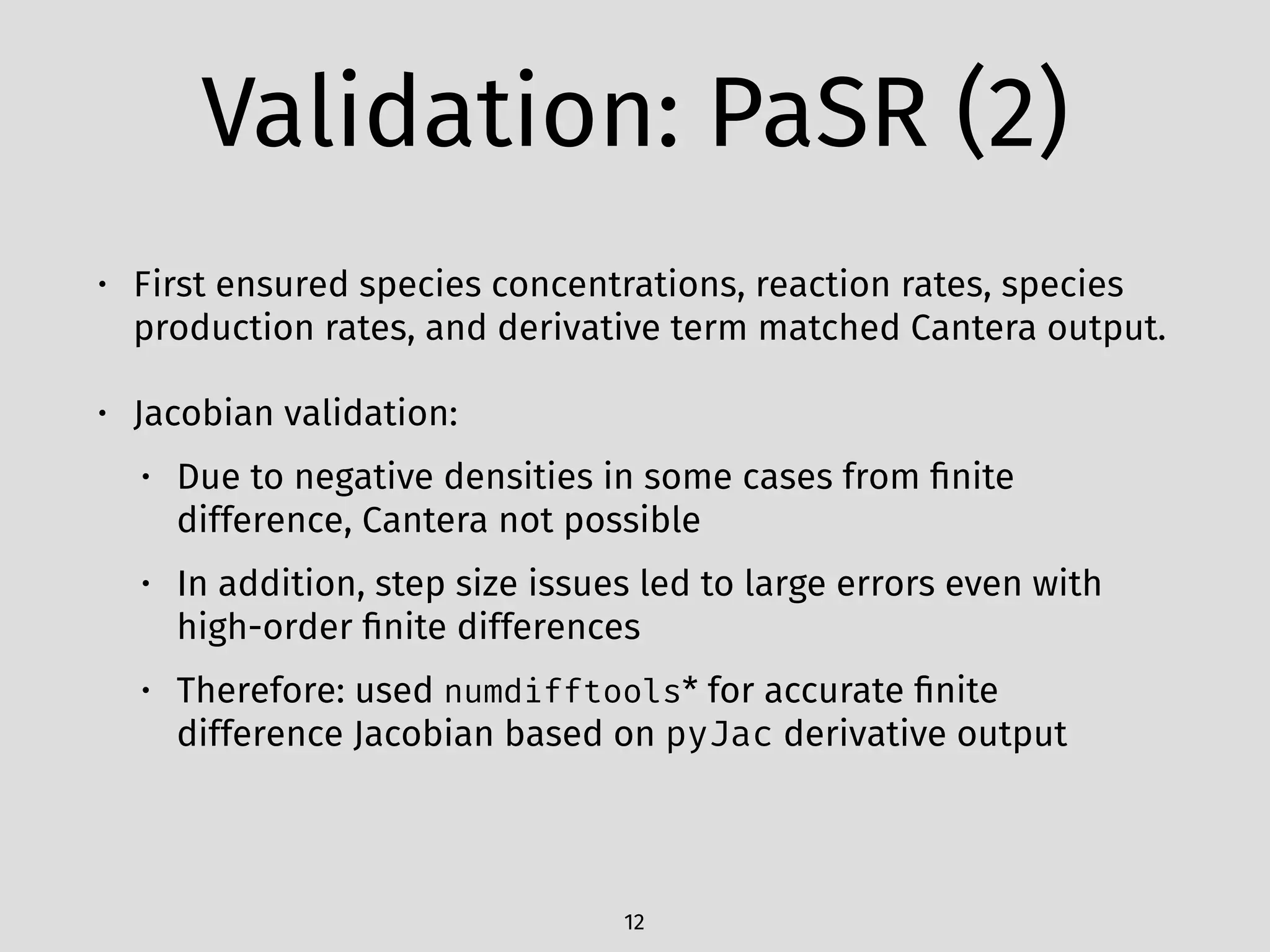
• Therefore: used numdifftools* for accurate finite
difference Jacobian based on pyJac derivative output
12
Validation: PaSR (2)
• First ensured species concentrations, reaction rates, species
production rates, and derivative term matched Cantera output.
• Jacobian validation:
• Due to negative densities in some cases from finite
difference, Cantera not possible
• In addition, step size issues led to large errors even with
high-order finite differences
• Therefore: used numdifftools* for accurate finite
difference Jacobian based on pyJac derivative output
12
*uses multiple-term Richard extrapolation of
central differences (order 4–10)
Validation: PaSR (3)
13
Mechanism Sample size Mean Error Max Error
H2/CO 900,900 2.4×10⁻⁶ % 0.87%
CH4 450,900 3.4×10⁻³ % 0.26%
C2H4 91,800 2.2×10⁻⁵ % 3.4×10⁻³ %
Validation: PaSR (3)
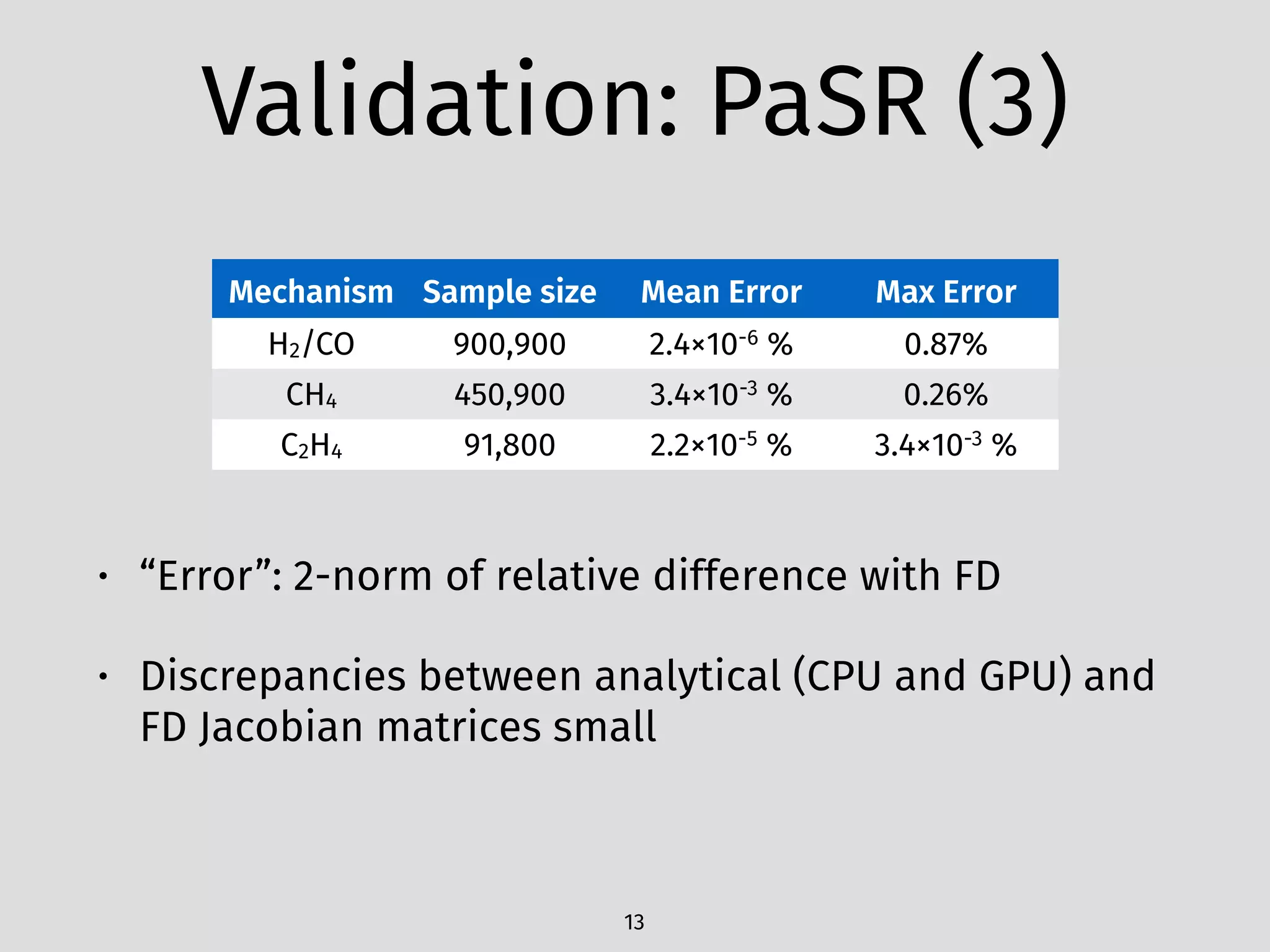
• “Error”: 2-norm of relative difference with FD
13
Mechanism Sample size Mean Error Max Error
H2/CO 900,900 2.4×10⁻⁶ % 0.87%
CH4 450,900 3.4×10⁻³ % 0.26%
C2H4 91,800 2.2×10⁻⁵ % 3.4×10⁻³ %
Validation: PaSR (3)
• “Error”: 2-norm of relative difference with FD
• Discrepancies between analytical (CPU and GPU) and
FD Jacobian matrices small
13
Mechanism Sample size Mean Error Max Error
H2/CO 900,900 2.4×10⁻⁶ % 0.87%
CH4 450,900 3.4×10⁻³ % 0.26%
C2H4 91,800 2.2×10⁻⁵ % 3.4×10⁻³ %
Validation: PaSR (3)
• “Error”: 2-norm of relative difference with FD
• Discrepancies between analytical (CPU and GPU) and
FD Jacobian matrices small
• Maximum error less than 1% for all cases considered.
13
Mechanism Sample size Mean Error Max Error
H2/CO 900,900 2.4×10⁻⁶ % 0.87%
CH4 450,900 3.4×10⁻³ % 0.26%
C2H4 91,800 2.2×10⁻⁵ % 3.4×10⁻³ %
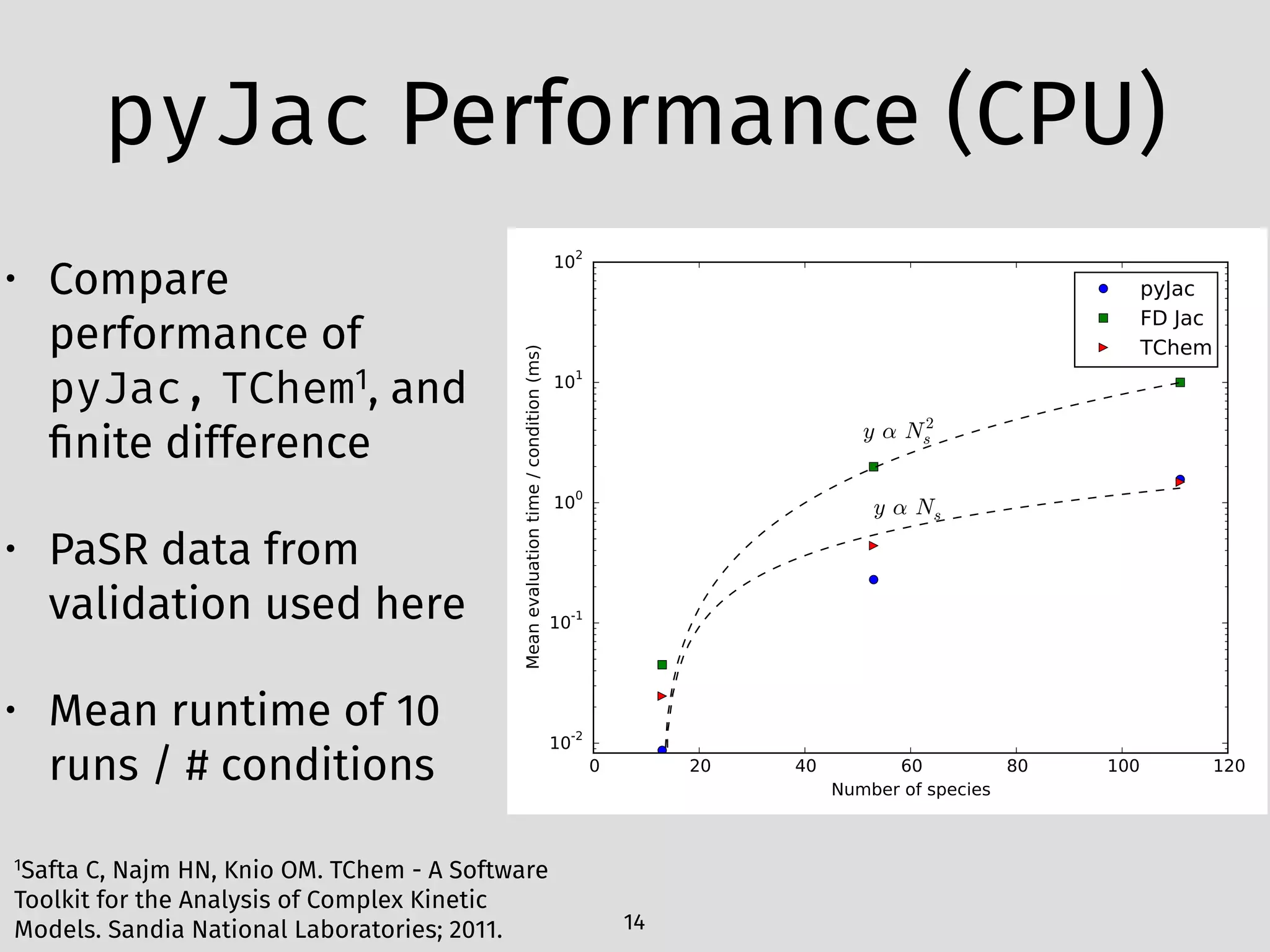
pyJac Performance (CPU)
14
pyJac Performance (CPU)
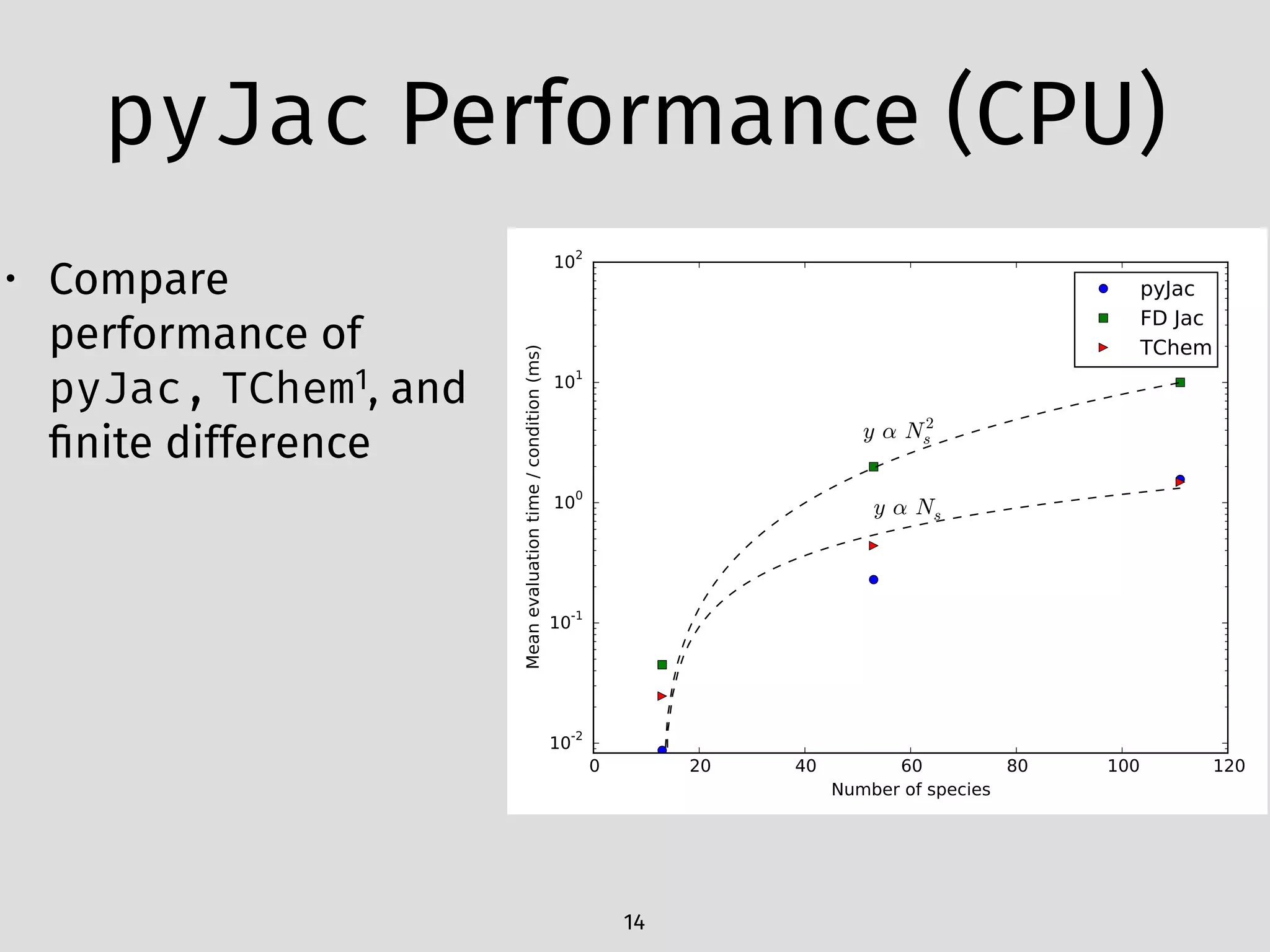
• Compare
performance of
pyJac, TChem1, and
finite difference
14
pyJac Performance (CPU)
• Compare
performance of
pyJac, TChem1, and
finite difference
14
1Safta C, Najm HN, Knio OM. TChem - A Software
Toolkit for the Analysis of Complex Kinetic
Models. Sandia National Laboratories; 2011.
pyJac Performance (CPU)
• Compare
performance of
pyJac, TChem1, and
finite difference
• PaSR data from
validation used here
14
1Safta C, Najm HN, Knio OM. TChem - A Software
Toolkit for the Analysis of Complex Kinetic
Models. Sandia National Laboratories; 2011.
pyJac Performance (CPU)
• Compare
performance of
pyJac, TChem1, and
finite difference
• PaSR data from
validation used here
• Mean runtime of 10
runs / # conditions
14
1Safta C, Najm HN, Knio OM. TChem - A Software
Toolkit for the Analysis of Complex Kinetic
Models. Sandia National Laboratories; 2011.
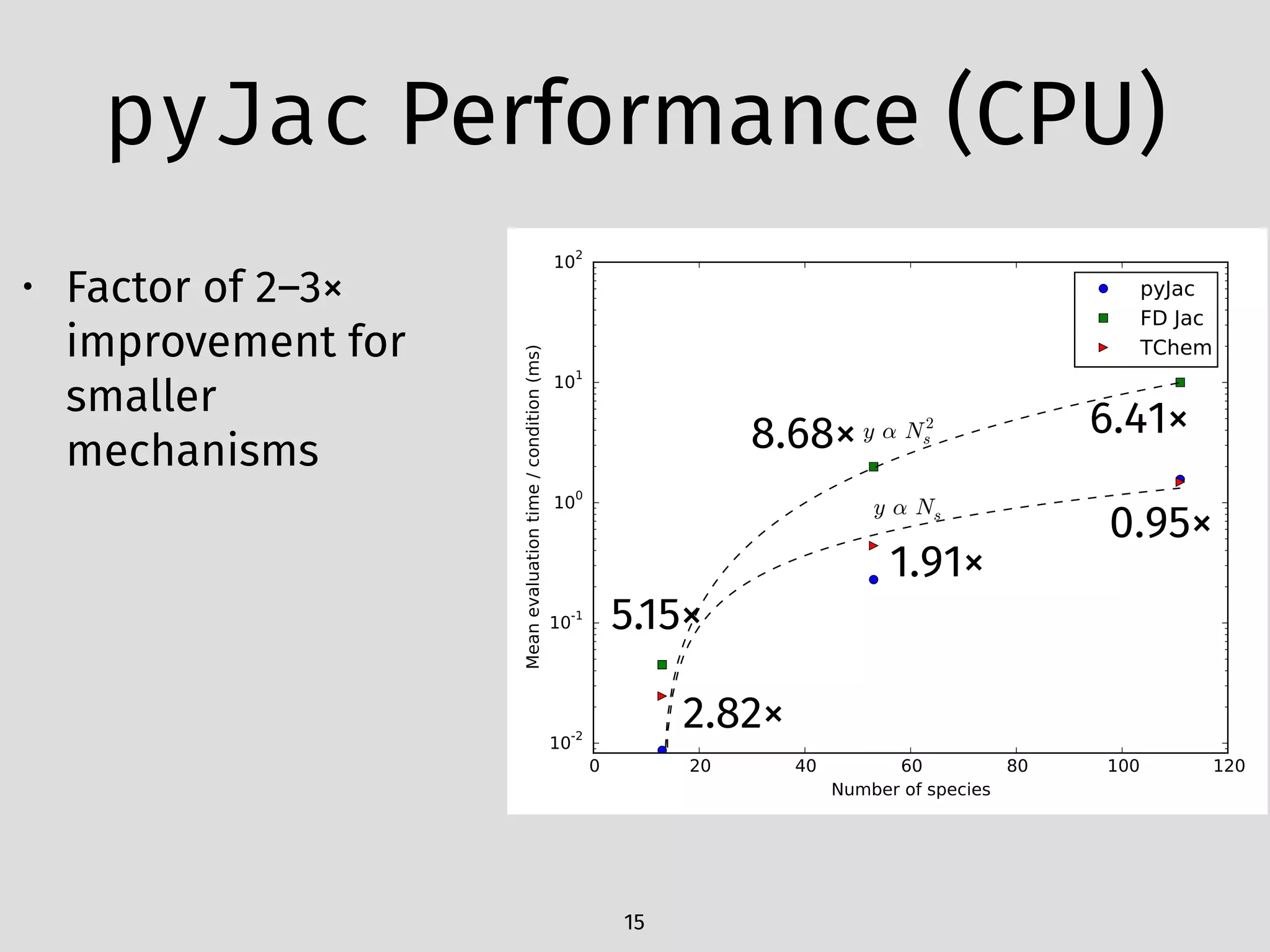
pyJac Performance (CPU)
15
0.95×
1.91×
2.82×
5.15×
8.68× 6.41×
pyJac Performance (CPU)
15
• Factor of 2–3×
improvement for
smaller
mechanisms
0.95×
1.91×
2.82×
5.15×
8.68× 6.41×
pyJac Performance (CPU)
15
• Factor of 2–3×
improvement for
smaller
mechanisms
• Similar/worse
performance for
largest?
0.95×
1.91×
2.82×
5.15×
8.68× 6.41×
pyJac Performance (CPU)
15
• Factor of 2–3×
improvement for
smaller
mechanisms
• Similar/worse
performance for
largest?
• Slight superlinear
scaling for both
0.95×
1.91×
2.82×
5.15×
8.68× 6.41×
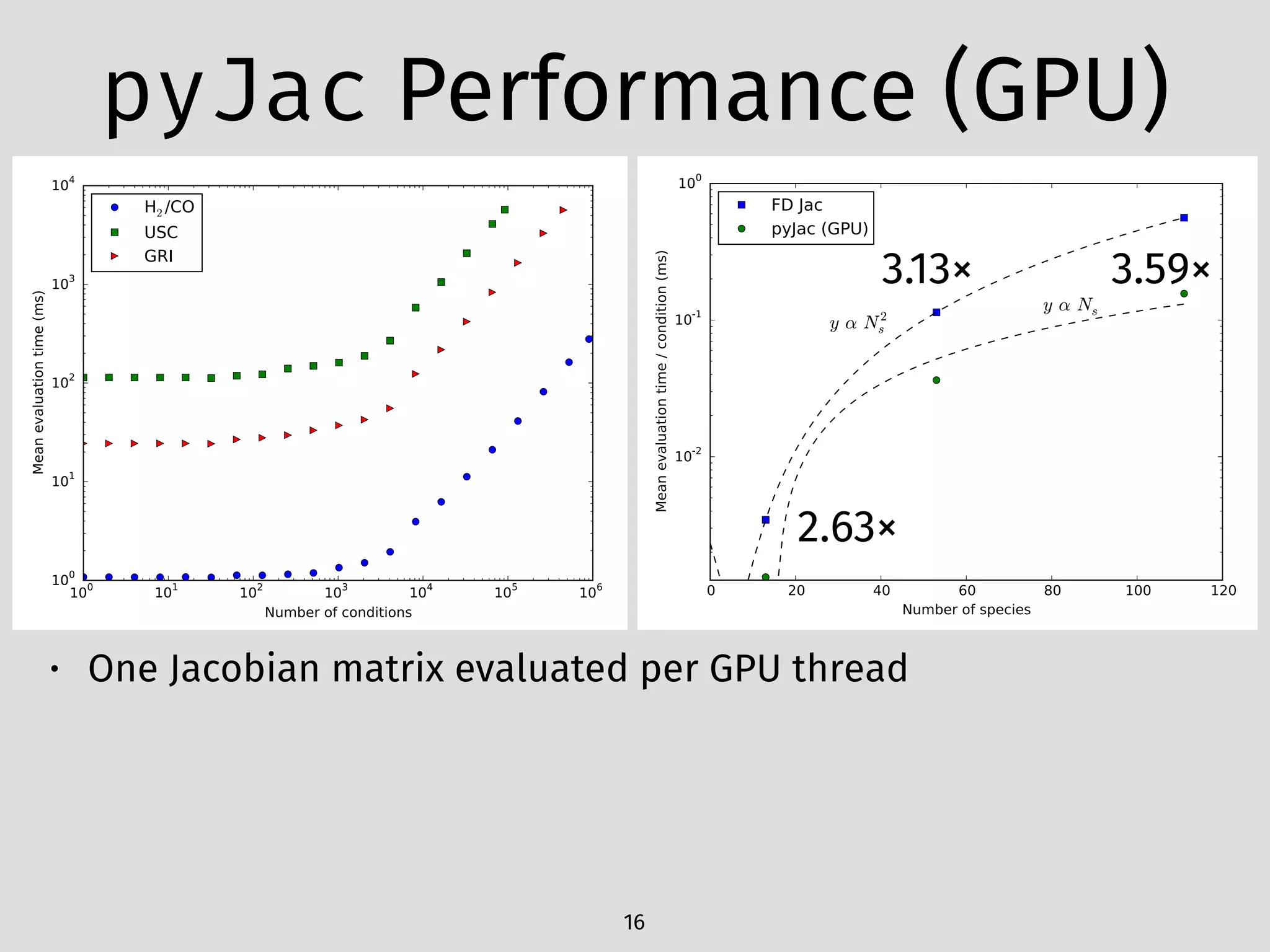
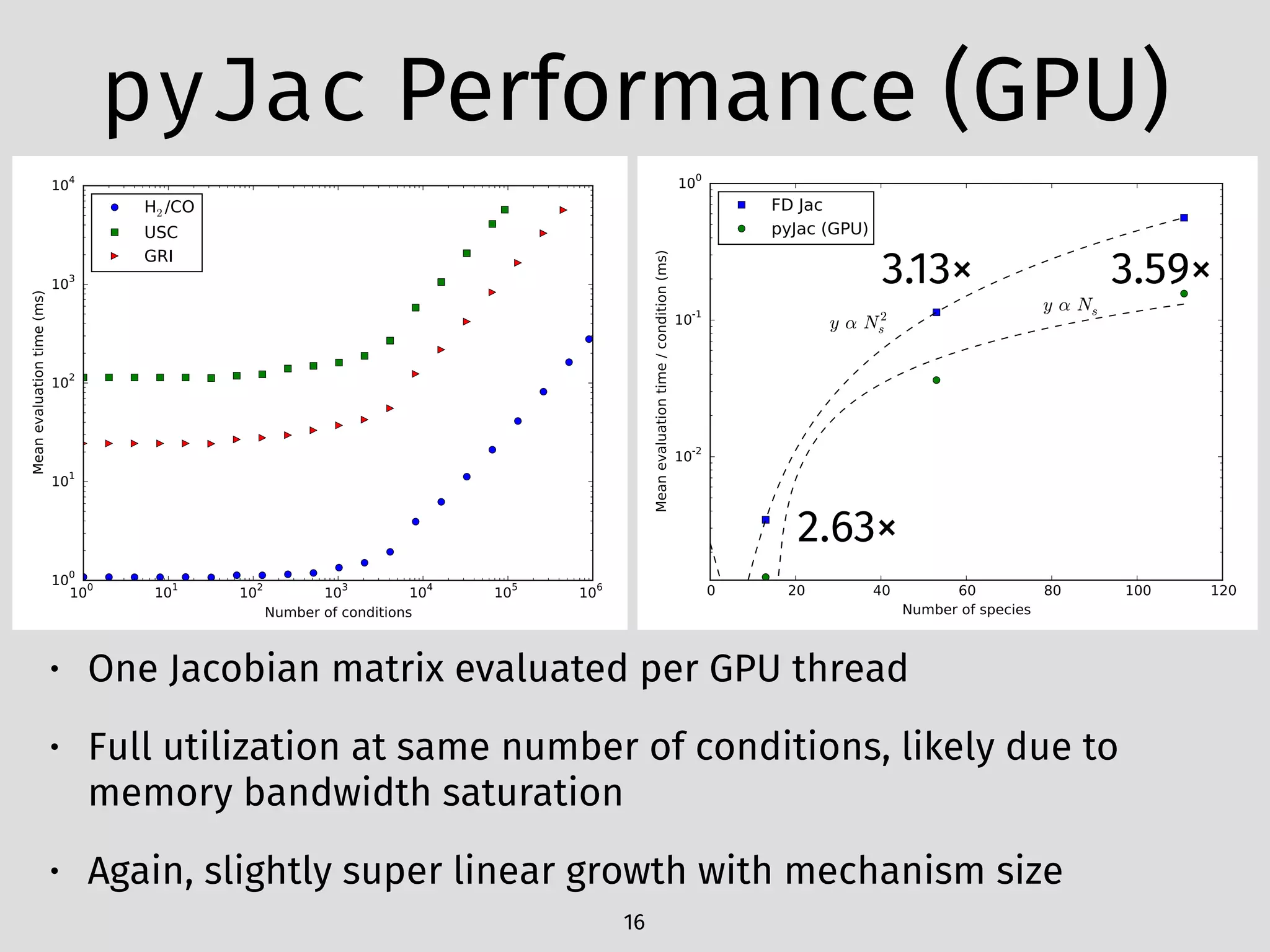
pyJac Performance (GPU)
16
2.63×
3.13× 3.59×
pyJac Performance (GPU)
• One Jacobian matrix evaluated per GPU thread
16
2.63×
3.13× 3.59×
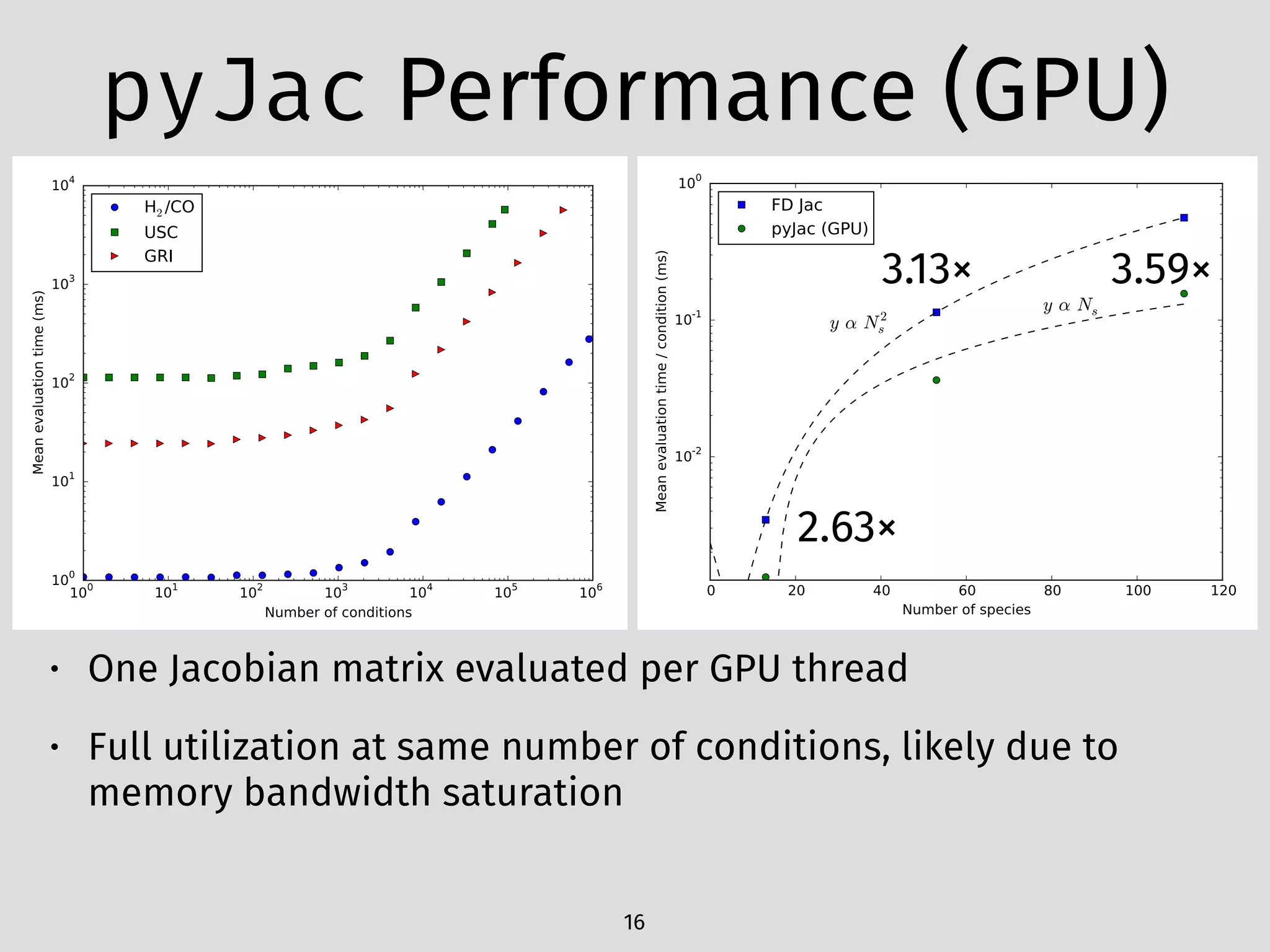
pyJac Performance (GPU)
• One Jacobian matrix evaluated per GPU thread
• Full utilization at same number of conditions, likely due to
memory bandwidth saturation
16
2.63×
3.13× 3.59×
pyJac Performance (GPU)
• One Jacobian matrix evaluated per GPU thread
• Full utilization at same number of conditions, likely due to
memory bandwidth saturation
• Again, slightly super linear growth with mechanism size
16
2.63×
3.13× 3.59×
Future Work
17
Future Work
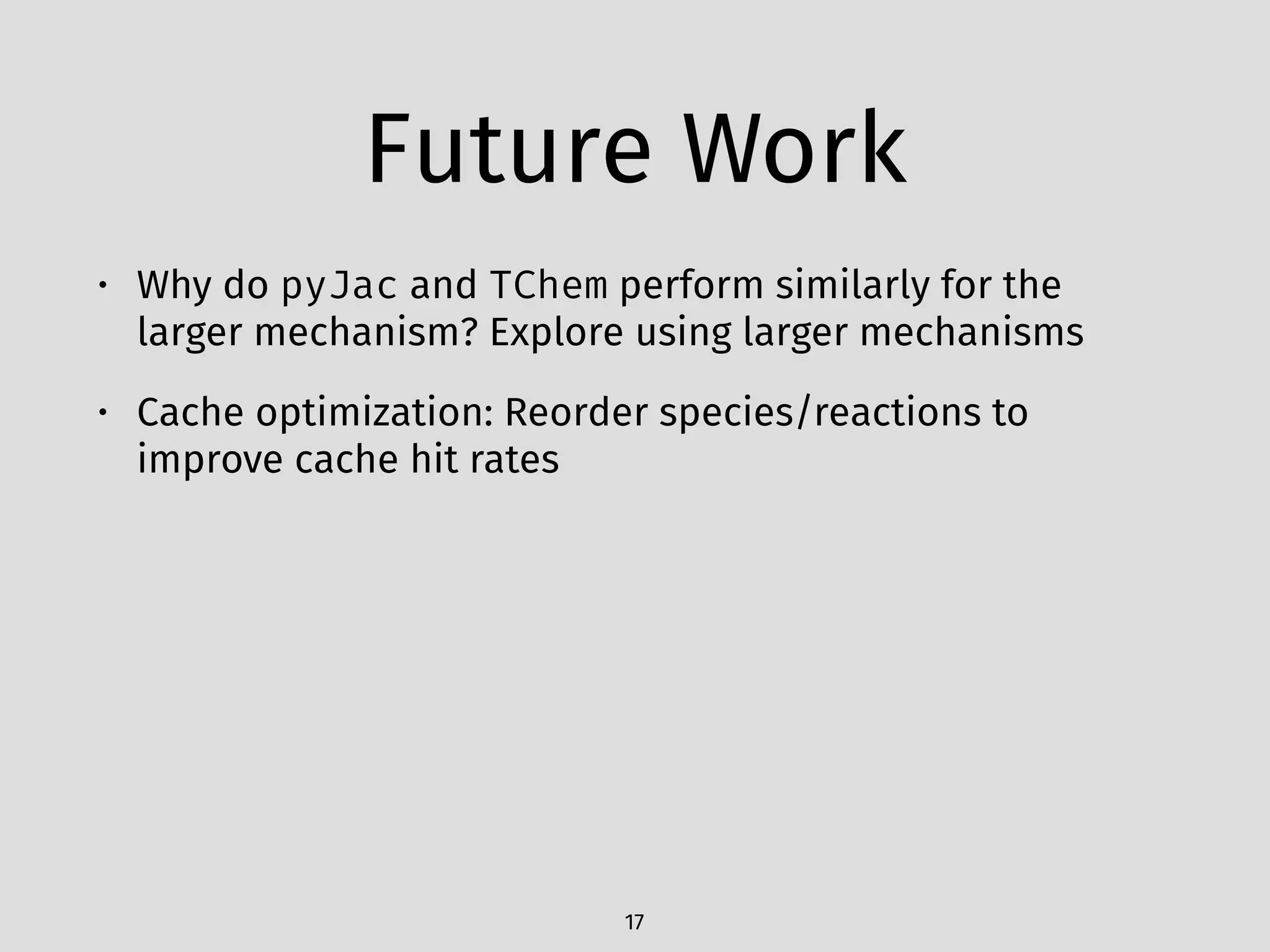
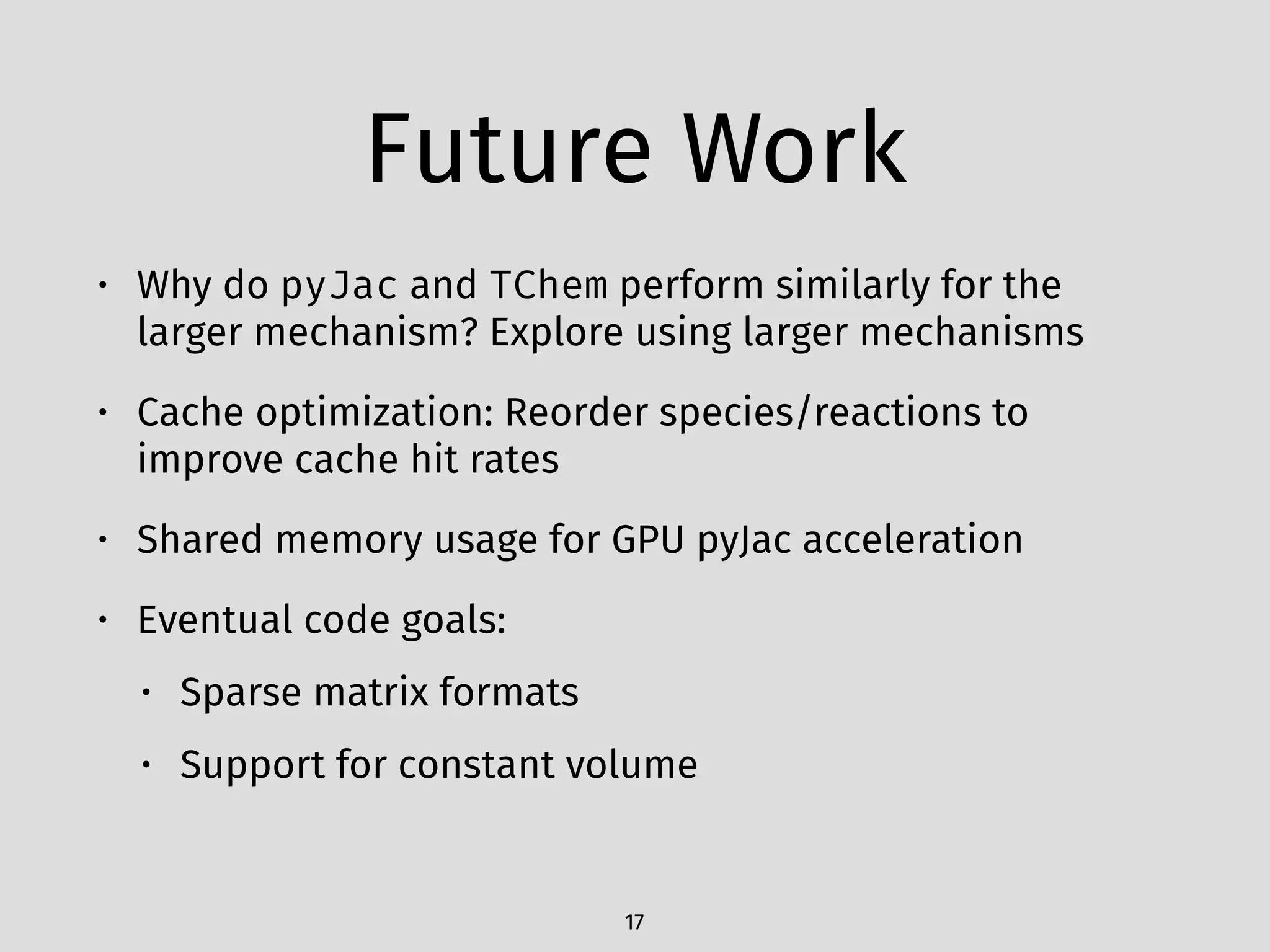
• Why do pyJac and TChem perform similarly for the
larger mechanism? Explore using larger mechanisms
17
Future Work
• Why do pyJac and TChem perform similarly for the
larger mechanism? Explore using larger mechanisms
• Cache optimization: Reorder species/reactions to
improve cache hit rates
17
Future Work
• Why do pyJac and TChem perform similarly for the
larger mechanism? Explore using larger mechanisms
• Cache optimization: Reorder species/reactions to
improve cache hit rates
• Shared memory usage for GPU pyJac acceleration
17
Future Work
• Why do pyJac and TChem perform similarly for the
larger mechanism? Explore using larger mechanisms
• Cache optimization: Reorder species/reactions to
improve cache hit rates
• Shared memory usage for GPU pyJac acceleration
• Eventual code goals:
17
Future Work
• Why do pyJac and TChem perform similarly for the
larger mechanism? Explore using larger mechanisms
• Cache optimization: Reorder species/reactions to
improve cache hit rates
• Shared memory usage for GPU pyJac acceleration
• Eventual code goals:
• Sparse matrix formats
17
Future Work
• Why do pyJac and TChem perform similarly for the
larger mechanism? Explore using larger mechanisms
• Cache optimization: Reorder species/reactions to
improve cache hit rates
• Shared memory usage for GPU pyJac acceleration
• Eventual code goals:
• Sparse matrix formats
• Support for constant volume
17
Future Work
• Why do pyJac and TChem perform similarly for the
larger mechanism? Explore using larger mechanisms
• Cache optimization: Reorder species/reactions to
improve cache hit rates
• Shared memory usage for GPU pyJac acceleration
• Eventual code goals:
• Sparse matrix formats
• Support for constant volume
• Code generation in Fortran and Matlab
17
Conclusions
18
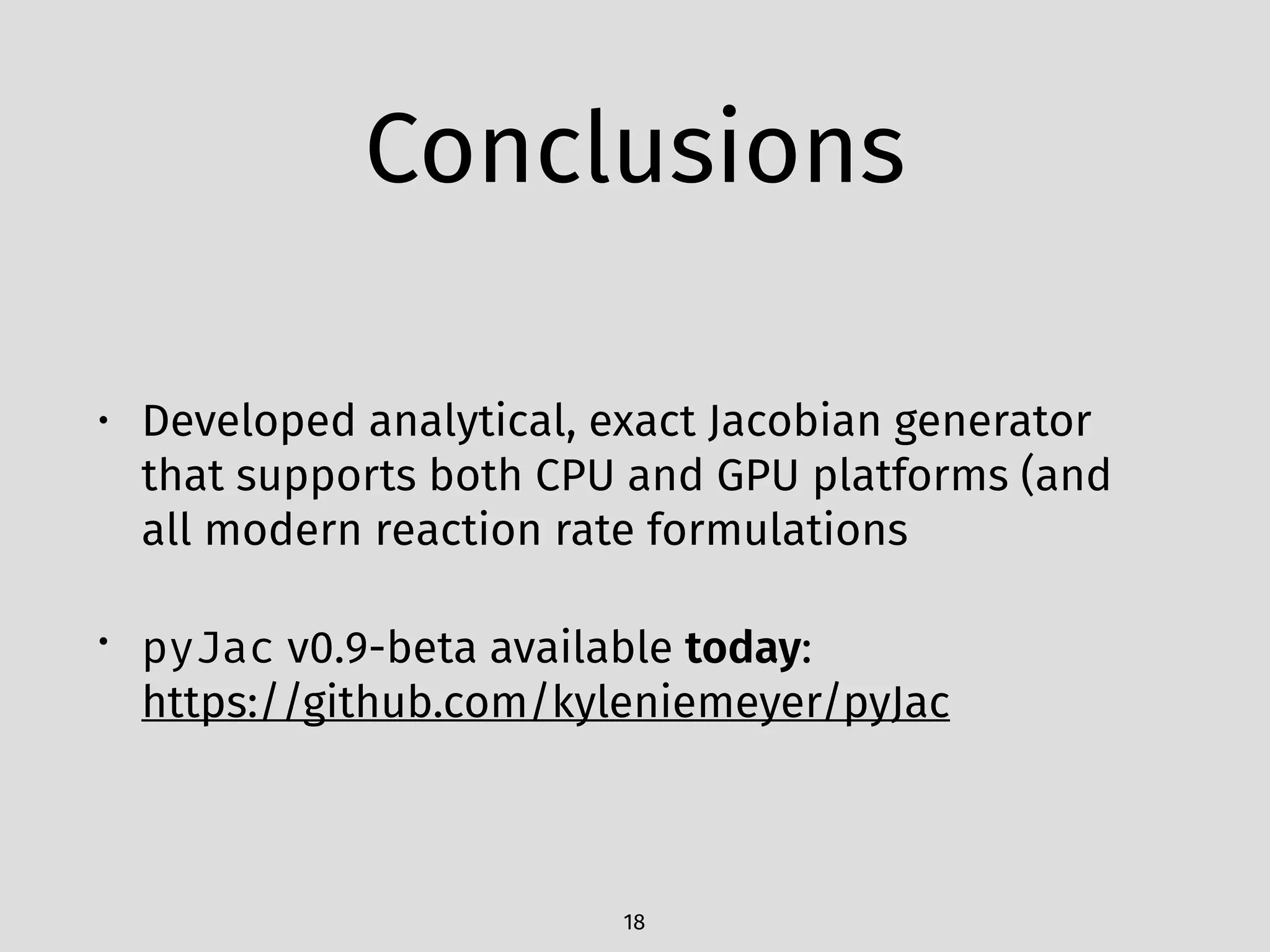
Conclusions
• Developed analytical, exact Jacobian generator
that supports both CPU and GPU platforms (and
all modern reaction rate formulations
18
Conclusions
• Developed analytical, exact Jacobian generator
that supports both CPU and GPU platforms (and
all modern reaction rate formulations
• pyJac v0.9-beta available today: 

https://github.com/kyleniemeyer/pyJac
18
Thank you! Questions?
19
Thank you! Questions?
19
?
Thank you! Questions?
19
?Looking for graduate students!
Backup Slides
20
PaSR
• Cantera-based PaSR implementation; premixed combustion
with fresh fuel/air mixture & pilot streams
• Pairwise mixing, reaction fractional steps, inflow/outflow
events
21
Richardson Extrapolation
• A simple forward first order derivative approximation:

• Rewritten as:

• Now let

• Finally, combining these:

• Combined with use of high-order derivatives, this approach
allows use of larger step sizes.
22
f0
(x) =
f(x + h) f(x)
h
+
h
2
f00
(x) +
h2
3!
f000
(x) . . .
f0
(x) = Lh +
h
2
f00
(x) +
h2
3!
f000
(x) . . .
f0
(x) = Lh/2 +
h
4
f00
(x) +
h2
4 · 3!
f000
(x) . . .
f0
(x) = 2 ⇥ (2) (1) = 2Lh/2 Lh + O(h2
) + . . .

Initial investigation of pyJac: an analytical Jacobian generator for chemical kinetics

  • 1.
    Initial investigation ofpyJac: an analytical Jacobian generator for chemical kinetics Kyle Niemeyer Oregon State University Nicholas Curtis, Chih-Jen Sung University of Connecticut Fall 2015 Meeting of WSSCI 5 October 2015 Funding: NSF awards 1535065 & 1534688
  • 2.
    0 5 10 15 20 25 -10 -9 -8-7 -6 -5 -4 -3 -2 -1 Numberofspecies log10(Characteristic time (s)) Stiffness of kinetic models 2
  • 3.
    0 5 10 15 20 25 -10 -9 -8-7 -6 -5 -4 -3 -2 -1 Numberofspecies log10(Characteristic time (s)) Stiffness of kinetic models Characteristic creation times of methane oxidation 2
  • 4.
  • 5.
  • 6.
  • 7.
    Motivation • Stiffness • RequireJacobian matrix—repeatedly evaluated and factorized 3 implicit integration algorithms
  • 8.
    Motivation • Stiffness • RequireJacobian matrix—repeatedly evaluated and factorized • Jacobian typically obtained via finite differences 3 implicit integration algorithms
  • 9.
    Motivation • Stiffness • RequireJacobian matrix—repeatedly evaluated and factorized • Jacobian typically obtained via finite differences • Scales with (Nspecies)2 3 implicit integration algorithms
  • 10.
    NumberofReactions 10 100 1000 10000 100000 Number of Species 10100 1000 10000 before 2005 since 2005 Size of kinetic models 4
  • 11.
    NumberofReactions 10 100 1000 10000 100000 Number of Species 10100 1000 10000 before 2005 since 2005 Size of kinetic models Hydrocarbon oxidation kinetic models poses challenges even for 0D simulations. 4
  • 12.
    NumberofReactions 10 100 1000 10000 100000 Number of Species 10100 1000 10000 before 2005 since 2005 Size of kinetic models Hydrocarbon oxidation kinetic models poses challenges even for 0D simulations. 4 Transportation fuels
  • 13.
    NumberofReactions 10 100 1000 10000 100000 Number of Species 10100 1000 10000 before 2005 since 2005 Size of kinetic models Hydrocarbon oxidation kinetic models poses challenges even for 0D simulations. 4 2-methylalkanes
  • 14.
    Motivation 5 implicit integration algorithms•Stiffness • Require Jacobian matrix—repeatedly evaluated and factorized • Jacobian typically obtained via finite differences • Scales with (Nspecies)2
  • 15.
    Motivation • Also accuracyissues for CSP, CEMA 5 implicit integration algorithms• Stiffness • Require Jacobian matrix—repeatedly evaluated and factorized • Jacobian typically obtained via finite differences • Scales with (Nspecies)2
  • 16.
  • 17.
    Introducing pyJac • Acceleratechemical kinetic integration by providing source code to evaluate chemical kinetic Jacobian matrices analytically 6
  • 18.
    Introducing pyJac • Acceleratechemical kinetic integration by providing source code to evaluate chemical kinetic Jacobian matrices analytically • pyJac capable of generating source code for CPU and GPU architectures 6
  • 19.
    Introducing pyJac • Acceleratechemical kinetic integration by providing source code to evaluate chemical kinetic Jacobian matrices analytically • pyJac capable of generating source code for CPU and GPU architectures • Compatible with both CHEMKIN- and Cantera- format mechanisms 6
  • 20.
    … What isa Jacobian, again? 7
  • 21.
    … What isa Jacobian, again? • Chemical kinetics governing ODE system*:


 7
  • 22.
    … What isa Jacobian, again? • Chemical kinetics governing ODE system*:


 7 f = 2 6 6 6 4 ˙T ˙Y1 ... ˙YN 3 7 7 7 5 = 2 6 6 6 4 f0 (T, ⇢, Y1, Y2, . . . , YN ) f1 (T, ⇢, Y1, Y2, . . . , YN ) ... fN (T, ⇢, Y1, Y2, . . . , YN ) 3 7 7 7 5 *Constant p assumption
  • 23.
    … What isa Jacobian, again? • Chemical kinetics governing ODE system*:


 • Jacobian matrix: 7 f = 2 6 6 6 4 ˙T ˙Y1 ... ˙YN 3 7 7 7 5 = 2 6 6 6 4 f0 (T, ⇢, Y1, Y2, . . . , YN ) f1 (T, ⇢, Y1, Y2, . . . , YN ) ... fN (T, ⇢, Y1, Y2, . . . , YN ) 3 7 7 7 5 J = df dy = 2 6 6 6 6 4 @ ˙T @y @ ˙Y1 @y ... @ ˙YN @y 3 7 7 7 7 5 = 2 6 6 6 6 4 @ ˙T @T @ ˙T @Y1 · · · @ ˙T @YN @ ˙Y1 @T @ ˙Y1 @Y1 · · · @ ˙Y1 @YN ... ... ... ... @ ˙YN @T @ ˙YN @Y1 · · · @ ˙YN @YN 3 7 7 7 7 5 *Constant p assumption
  • 24.
    Analytical Jacobian Following alot of math… 8 Jk+1,1 = Wk ⇢ ✓ @ ˙!k @T + ˙!k T ◆ = Wk ⇢ NreacX i=1 ⌫ki  @ci @T (Rf,i Rr,i) + ci ✓ @Ri @T + Rf,i Rr,i T ◆ Jk+1,j+1 = Wk ⇢ ✓ @ ˙!k @Yj + ˙!k W Wj ◆ = Wk ⇢ " ˙!k W Wj + NreasX i=1 ⌫ki ✓ @ci @Yj (Rf,i Rr,i) + ci Nsp X l=1 ⌫0 li W Wj Rf,i + ljkf,i ⇢ Wl [Xl]⌫0 li 1 Nsp Y n=1 n6=l [Xn]⌫0 ni ! Nsp X l=1 ⌫00 li W Wj Rr,i + ljkr,i ⇢ Wl [Xl]⌫00 li 1 Nsp Y n=1 n6=l [Xn]⌫00 ni !!!#
  • 25.
    Analytical Jacobian (2) … 9 J1,1= Nsp X k=1 ✓ 1 cp @hk @T hk c2 p @cp @T ◆ Wk ˙!k ⇢ + hk cp @ @T ✓ Wk ˙!k ⇢ ◆ = 1 cp Nsp X k=1 ✓ cp,k hk cp @cp @T ◆ Wk ˙!k ⇢ + hkJk+1,1 J1,j+1 = Nsp X k=1  hk c2 p @cp @Yj Wk ˙!k ⇢ + hk cp @ @Yj ✓ Wk ˙!k ⇢ ◆ = 1 cp 0 @ cp,j ⇢cp Nsp X k=1 hkWk ˙!k + Nsp X k=1 hkJk+1,j+1 1 A (see paper for details)
  • 26.
  • 27.
  • 28.
    Optimized Evaluation • Generalidea: • Large portions of Jacobian entries constant for a single reaction 10
  • 29.
    Optimized Evaluation • Generalidea: • Large portions of Jacobian entries constant for a single reaction • Compute this portion once, and update as needed for all species pairs 10
  • 30.
    Optimized Evaluation • Generalidea: • Large portions of Jacobian entries constant for a single reaction • Compute this portion once, and update as needed for all species pairs • Potential increase in computational efficiency 10
  • 31.
    Optimized Evaluation • Generalidea: • Large portions of Jacobian entries constant for a single reaction • Compute this portion once, and update as needed for all species pairs • Potential increase in computational efficiency • Most expensive calculation can be performed once per reaction 10
  • 32.
    Optimized Evaluation • Generalidea: • Large portions of Jacobian entries constant for a single reaction • Compute this portion once, and update as needed for all species pairs • Potential increase in computational efficiency • Most expensive calculation can be performed once per reaction • Species pairs updates relatively simple in comparison 10
  • 33.
  • 34.
    Validation: PaSR (1) 11 Fuel# Species # Reactions Source H2/CO 13 27 Burke et al. CH4 53 325 GRI Mech 3 C2H4 111 784 USC Mech II Mechanisms used
  • 35.
    Validation: PaSR (1) 11 ParameterH2/air CH4/air C2H4/air ϕ 1 T 400, 600, and 800 K P 1, 10, and 25 atm # particles 100 𝜏res 10 ms 5 ms 100 μs 𝜏mix 1 ms 1 ms 10 μs 𝜏pair 10 ms 5 ms 100 μs PaSR conditions; run for 10 residence times Fuel # Species # Reactions Source H2/CO 13 27 Burke et al. CH4 53 325 GRI Mech 3 C2H4 111 784 USC Mech II Mechanisms used
  • 36.
  • 37.
    Validation: PaSR (2) •First ensured species concentrations, reaction rates, species production rates, and derivative term matched Cantera output. 12
  • 38.
    Validation: PaSR (2) •First ensured species concentrations, reaction rates, species production rates, and derivative term matched Cantera output. • Jacobian validation: 12
  • 39.
    Validation: PaSR (2) •First ensured species concentrations, reaction rates, species production rates, and derivative term matched Cantera output. • Jacobian validation: • Due to negative densities in some cases from finite difference, Cantera not possible 12
  • 40.
    Validation: PaSR (2) •First ensured species concentrations, reaction rates, species production rates, and derivative term matched Cantera output. • Jacobian validation: • Due to negative densities in some cases from finite difference, Cantera not possible • In addition, step size issues led to large errors even with high-order finite differences 12
  • 41.
    Validation: PaSR (2) •First ensured species concentrations, reaction rates, species production rates, and derivative term matched Cantera output. • Jacobian validation: • Due to negative densities in some cases from finite difference, Cantera not possible • In addition, step size issues led to large errors even with high-order finite differences • Therefore: used numdifftools* for accurate finite difference Jacobian based on pyJac derivative output 12
  • 42.
    Validation: PaSR (2) •First ensured species concentrations, reaction rates, species production rates, and derivative term matched Cantera output. • Jacobian validation: • Due to negative densities in some cases from finite difference, Cantera not possible • In addition, step size issues led to large errors even with high-order finite differences • Therefore: used numdifftools* for accurate finite difference Jacobian based on pyJac derivative output 12 *uses multiple-term Richard extrapolation of central differences (order 4–10)
  • 43.
    Validation: PaSR (3) 13 MechanismSample size Mean Error Max Error H2/CO 900,900 2.4×10⁻⁶ % 0.87% CH4 450,900 3.4×10⁻³ % 0.26% C2H4 91,800 2.2×10⁻⁵ % 3.4×10⁻³ %
  • 44.
    Validation: PaSR (3) •“Error”: 2-norm of relative difference with FD 13 Mechanism Sample size Mean Error Max Error H2/CO 900,900 2.4×10⁻⁶ % 0.87% CH4 450,900 3.4×10⁻³ % 0.26% C2H4 91,800 2.2×10⁻⁵ % 3.4×10⁻³ %
  • 45.
    Validation: PaSR (3) •“Error”: 2-norm of relative difference with FD • Discrepancies between analytical (CPU and GPU) and FD Jacobian matrices small 13 Mechanism Sample size Mean Error Max Error H2/CO 900,900 2.4×10⁻⁶ % 0.87% CH4 450,900 3.4×10⁻³ % 0.26% C2H4 91,800 2.2×10⁻⁵ % 3.4×10⁻³ %
  • 46.
    Validation: PaSR (3) •“Error”: 2-norm of relative difference with FD • Discrepancies between analytical (CPU and GPU) and FD Jacobian matrices small • Maximum error less than 1% for all cases considered. 13 Mechanism Sample size Mean Error Max Error H2/CO 900,900 2.4×10⁻⁶ % 0.87% CH4 450,900 3.4×10⁻³ % 0.26% C2H4 91,800 2.2×10⁻⁵ % 3.4×10⁻³ %
  • 47.
  • 48.
    pyJac Performance (CPU) •Compare performance of pyJac, TChem1, and finite difference 14
  • 49.
    pyJac Performance (CPU) •Compare performance of pyJac, TChem1, and finite difference 14 1Safta C, Najm HN, Knio OM. TChem - A Software Toolkit for the Analysis of Complex Kinetic Models. Sandia National Laboratories; 2011.
  • 50.
    pyJac Performance (CPU) •Compare performance of pyJac, TChem1, and finite difference • PaSR data from validation used here 14 1Safta C, Najm HN, Knio OM. TChem - A Software Toolkit for the Analysis of Complex Kinetic Models. Sandia National Laboratories; 2011.
  • 51.
    pyJac Performance (CPU) •Compare performance of pyJac, TChem1, and finite difference • PaSR data from validation used here • Mean runtime of 10 runs / # conditions 14 1Safta C, Najm HN, Knio OM. TChem - A Software Toolkit for the Analysis of Complex Kinetic Models. Sandia National Laboratories; 2011.
  • 52.
  • 53.
    pyJac Performance (CPU) 15 •Factor of 2–3× improvement for smaller mechanisms 0.95× 1.91× 2.82× 5.15× 8.68× 6.41×
  • 54.
    pyJac Performance (CPU) 15 •Factor of 2–3× improvement for smaller mechanisms • Similar/worse performance for largest? 0.95× 1.91× 2.82× 5.15× 8.68× 6.41×
  • 55.
    pyJac Performance (CPU) 15 •Factor of 2–3× improvement for smaller mechanisms • Similar/worse performance for largest? • Slight superlinear scaling for both 0.95× 1.91× 2.82× 5.15× 8.68× 6.41×
  • 56.
  • 57.
    pyJac Performance (GPU) •One Jacobian matrix evaluated per GPU thread 16 2.63× 3.13× 3.59×
  • 58.
    pyJac Performance (GPU) •One Jacobian matrix evaluated per GPU thread • Full utilization at same number of conditions, likely due to memory bandwidth saturation 16 2.63× 3.13× 3.59×
  • 59.
    pyJac Performance (GPU) •One Jacobian matrix evaluated per GPU thread • Full utilization at same number of conditions, likely due to memory bandwidth saturation • Again, slightly super linear growth with mechanism size 16 2.63× 3.13× 3.59×
  • 60.
  • 61.
    Future Work • Whydo pyJac and TChem perform similarly for the larger mechanism? Explore using larger mechanisms 17
  • 62.
    Future Work • Whydo pyJac and TChem perform similarly for the larger mechanism? Explore using larger mechanisms • Cache optimization: Reorder species/reactions to improve cache hit rates 17
  • 63.
    Future Work • Whydo pyJac and TChem perform similarly for the larger mechanism? Explore using larger mechanisms • Cache optimization: Reorder species/reactions to improve cache hit rates • Shared memory usage for GPU pyJac acceleration 17
  • 64.
    Future Work • Whydo pyJac and TChem perform similarly for the larger mechanism? Explore using larger mechanisms • Cache optimization: Reorder species/reactions to improve cache hit rates • Shared memory usage for GPU pyJac acceleration • Eventual code goals: 17
  • 65.
    Future Work • Whydo pyJac and TChem perform similarly for the larger mechanism? Explore using larger mechanisms • Cache optimization: Reorder species/reactions to improve cache hit rates • Shared memory usage for GPU pyJac acceleration • Eventual code goals: • Sparse matrix formats 17
  • 66.
    Future Work • Whydo pyJac and TChem perform similarly for the larger mechanism? Explore using larger mechanisms • Cache optimization: Reorder species/reactions to improve cache hit rates • Shared memory usage for GPU pyJac acceleration • Eventual code goals: • Sparse matrix formats • Support for constant volume 17
  • 67.
    Future Work • Whydo pyJac and TChem perform similarly for the larger mechanism? Explore using larger mechanisms • Cache optimization: Reorder species/reactions to improve cache hit rates • Shared memory usage for GPU pyJac acceleration • Eventual code goals: • Sparse matrix formats • Support for constant volume • Code generation in Fortran and Matlab 17
  • 68.
  • 69.
    Conclusions • Developed analytical,exact Jacobian generator that supports both CPU and GPU platforms (and all modern reaction rate formulations 18
  • 70.
    Conclusions • Developed analytical,exact Jacobian generator that supports both CPU and GPU platforms (and all modern reaction rate formulations • pyJac v0.9-beta available today: 
 https://github.com/kyleniemeyer/pyJac 18
  • 71.
  • 72.
  • 73.
    Thank you! Questions? 19 ?Lookingfor graduate students!
  • 74.
  • 75.
    PaSR • Cantera-based PaSRimplementation; premixed combustion with fresh fuel/air mixture & pilot streams • Pairwise mixing, reaction fractional steps, inflow/outflow events 21
  • 76.
    Richardson Extrapolation • Asimple forward first order derivative approximation:
 • Rewritten as:
 • Now let
 • Finally, combining these:
 • Combined with use of high-order derivatives, this approach allows use of larger step sizes. 22 f0 (x) = f(x + h) f(x) h + h 2 f00 (x) + h2 3! f000 (x) . . . f0 (x) = Lh + h 2 f00 (x) + h2 3! f000 (x) . . . f0 (x) = Lh/2 + h 4 f00 (x) + h2 4 · 3! f000 (x) . . . f0 (x) = 2 ⇥ (2) (1) = 2Lh/2 Lh + O(h2 ) + . . .