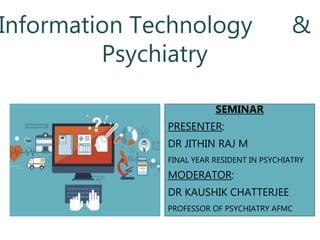
Information Technology &
Psychiatry
SEMINAR
PRESENTER:
DR JITHIN RAJ M
FINAL YEAR RESIDENT IN PSYCHIATRY
MODERATOR:
DR KAUSHIK CHATTERJEE
PROFESSOR OF PSYCHIATRY AFMC
Greetings from AFMC !
2
“ मयाध्यक्षेण प्रकृ ति: सूयिे सचराचरम ्।
हेिुनानेन कौन्िेय जगद्विपररिितिे ॥”
Sloka 10, Chapter 9 (Raja vidya raja guhya yogam), Bhagavadgita
3
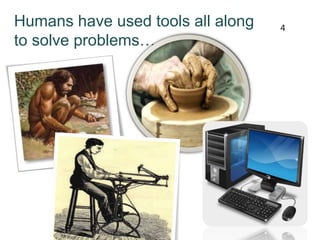
Humans have used tools all along
to solve problems…
4
5
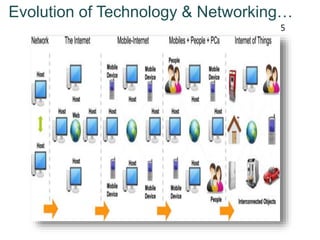
Evolution of Technology & Networking…
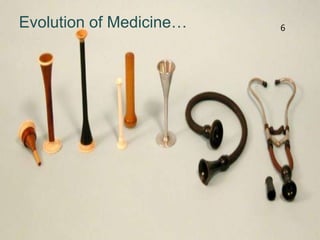
Evolution of Medicine… 6
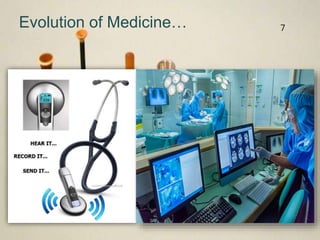
Evolution of Medicine… 7
8
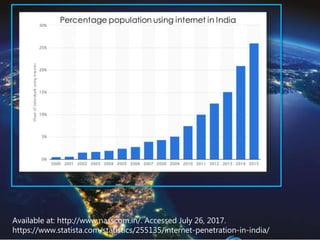
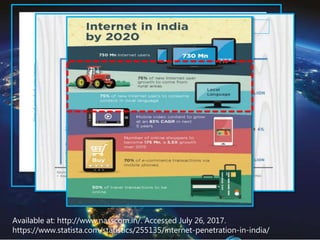
Available at: http://www.nasscom.in/. Accessed July 26, 2017.
https://www.statista.com/statistics/255135/internet-penetration-in-india/
9
Available at: http://www.nasscom.in/. Accessed July 26, 2017.
https://www.statista.com/statistics/255135/internet-penetration-in-india/
10
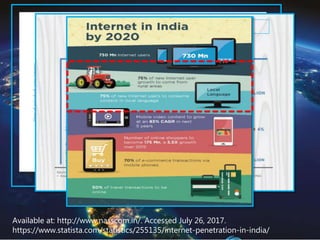
Available at: http://www.nasscom.in/. Accessed July 26, 2017.
https://www.statista.com/statistics/255135/internet-penetration-in-india/
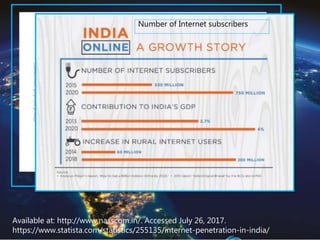
Number of Internet subscribers
11
Available at: http://www.nasscom.in/. Accessed July 26, 2017.
https://www.statista.com/statistics/255135/internet-penetration-in-india/
Number of Internet subscribers
12
Available at: http://www.nasscom.in/. Accessed July 26, 2017.
https://www.statista.com/statistics/255135/internet-penetration-in-india/
Number of Internet subscribers
13
14
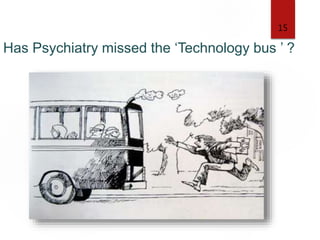
Has Psychiatry missed the ‘Technology bus ’ ?
15
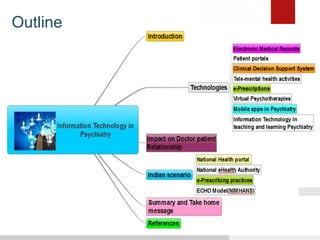
16Outline
17
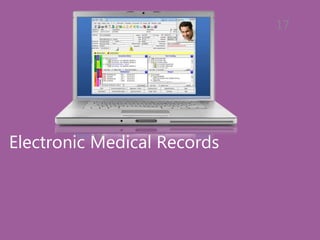
Electronic Medical Records
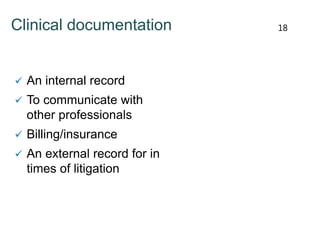
Clinical documentation
 An internal record
 To communicate with
other professionals
 Billing/insurance
 An external record for in
times of litigation
18
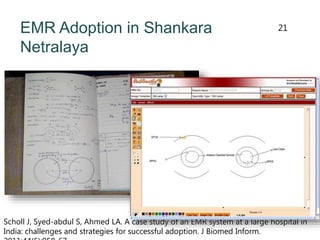
Clinical document section-
Shankara Netralaya, Chennai
19
Scholl J et al. A case study of an EMR system at a large hospital in India: challenges and
strategies for successful adoption. J Biomed Inform. 2011
Electronic Medical Record
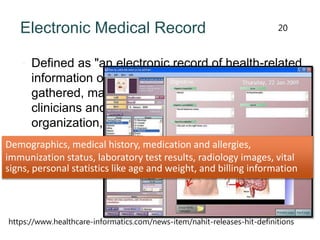
 Defined as "an electronic record of health-related
information on an individual that can be created,
gathered, managed, and consulted by authorized
clinicians and staff within one health care
organization,"
20
Demographics, medical history, medication and allergies,
immunization status, laboratory test results, radiology images, vital
signs, personal statistics like age and weight, and billing information
https://www.healthcare-informatics.com/news-item/nahit-releases-hit-definitions
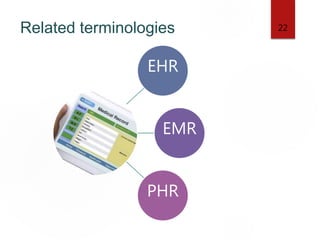
EMR Adoption in Shankara
Netralaya
Scholl J, Syed-abdul S, Ahmed LA. A case study of an EMR system at a large hospital in
India: challenges and strategies for successful adoption. J Biomed Inform.
21
Related terminologies
EHR
EMR
PHR
22
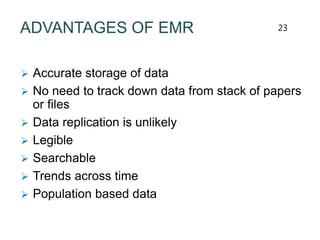
ADVANTAGES OF EMR
 Accurate storage of data
 No need to track down data from stack of papers
or files
 Data replication is unlikely
 Legible
 Searchable
 Trends across time
 Population based data
23
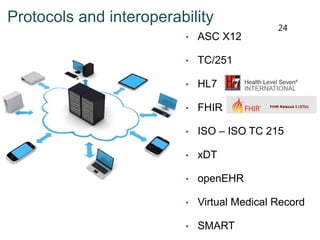
Protocols and interoperability
• ASC X12
• TC/251
• HL7
• FHIR
• ISO – ISO TC 215
• xDT
• openEHR
• Virtual Medical Record
• SMART
24
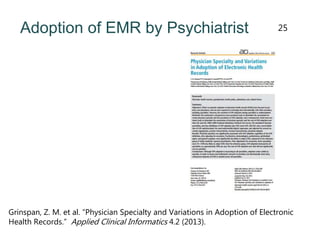
Adoption of EMR by Psychiatrist 25
Grinspan, Z. M. et al. “Physician Specialty and Variations in Adoption of Electronic
Health Records.” Applied Clinical Informatics 4.2 (2013).
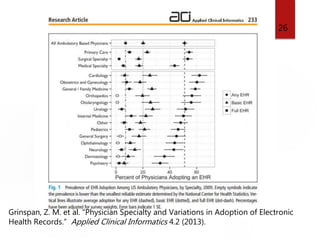
26
Grinspan, Z. M. et al. “Physician Specialty and Variations in Adoption of Electronic
Health Records.” Applied Clinical Informatics 4.2 (2013).
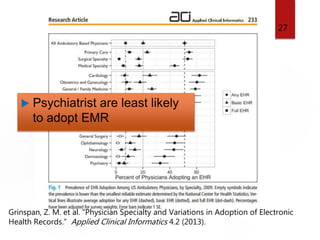
27
 Psychiatrist are least likely
to adopt EMR
Grinspan, Z. M. et al. “Physician Specialty and Variations in Adoption of Electronic
Health Records.” Applied Clinical Informatics 4.2 (2013).
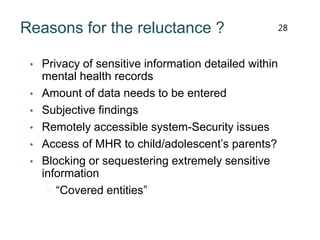
Reasons for the reluctance ?
• Privacy of sensitive information detailed within
mental health records
• Amount of data needs to be entered
• Subjective findings
• Remotely accessible system-Security issues
• Access of MHR to child/adolescent’s parents?
• Blocking or sequestering extremely sensitive
information
 “Covered entities”
28
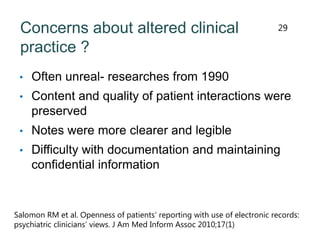
Concerns about altered clinical
practice ?
• Often unreal- researches from 1990
• Content and quality of patient interactions were

preserved
• Notes were more clearer and legible
• Difficulty with documentation and maintaining
confidential information
Salomon RM et al. Openness of patients’ reporting with use of electronic records:
psychiatric clinicians’ views. J Am Med Inform Assoc 2010;17(1)
29
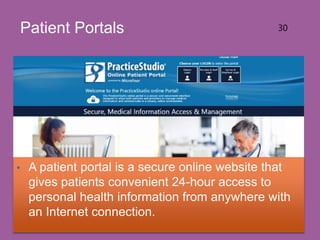
Patient Portals 30
• A patient portal is a secure online website that
gives patients convenient 24-hour access to
personal health information from anywhere with
an Internet connection.
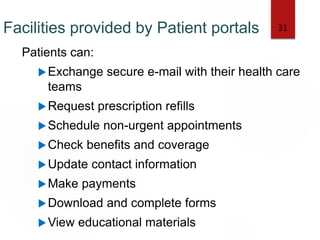
Facilities provided by Patient portals
Patients can:
Exchange secure e-mail with their health care
teams
Request prescription refills
Schedule non-urgent appointments
Check benefits and coverage
Update contact information
Make payments
Download and complete forms
View educational materials
31
Psychiatry and Patient Portals
• Most behavioral health notes are now excluded
• Many health portals and organizations are
moving to full transparency
• Driving factors: Research like “OpenNote” study
32
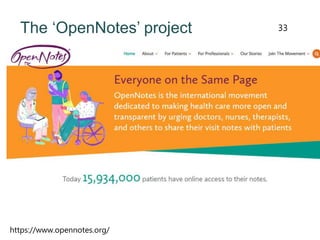
The ‘OpenNotes’ project
https://www.opennotes.org/
33
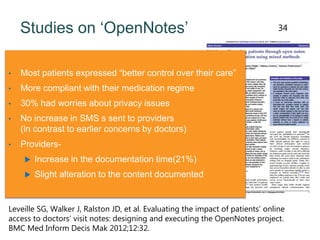
Studies on ‘OpenNotes’
• Most patients expressed “better control over their care”
• More compliant with their medication regime
• 30% had worries about privacy issues
• No increase in SMS s sent to providers
(in contrast to earlier concerns by doctors)
• Providers-
 Increase in the documentation time(21%)
 Slight alteration to the content documented
Leveille SG, Walker J, Ralston JD, et al. Evaluating the impact of patients’ online
access to doctors’ visit notes: designing and executing the OpenNotes project.
BMC Med Inform Decis Mak 2012;12:32.
34
Implementable in Psychiatry ?
• Entering a minefield !
 How will a patient respond if he/she reads about
the personality disorder diagnosis?
 What about F20 patient reading that her firm beliefs
are ‘delusional’?
Kahn MW, Bell SK, Walker J, et al. A piece of my mind. Let’s show patients their
mental health records. JAMA 2014;311(13):1291–2.
35
Implementable in Psychiatry ?
• TransparencyOpportunities
More active participation by patients and may
reduce the stigma they experience.
Kahn MW, Bell SK, Walker J, et al. A piece of my mind. Let’s show patients their
mental health records. JAMA 2014;311(13):1291–2.
36
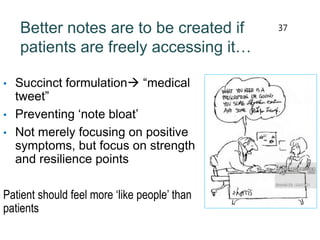
Better notes are to be created if
patients are freely accessing it…
• Succinct formulation “medical
tweet”
• Preventing ‘note bloat’
• Not merely focusing on positive
symptoms, but focus on strength
and resilience points
Patient should feel more ‘like people’ than
patients
37
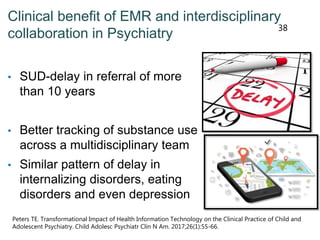
Clinical benefit of EMR and interdisciplinary
collaboration in Psychiatry
• SUD-delay in referral of more
than 10 years
• Better tracking of substance use
across a multidisciplinary team
• Similar pattern of delay in
internalizing disorders, eating
disorders and even depression
38
Peters TE. Transformational Impact of Health Information Technology on the Clinical Practice of Child and
Adolescent Psychiatry. Child Adolesc Psychiatr Clin N Am. 2017;26(1):55-66.
CDS-Clinical decision Support 39
CDS-Clinical decision Support
 Computerized alerts
and reminders for
providers and patients
 Clinical guidelines
 Condition-specific order
sets
 Focused patient data
reports and summaries
Documentation
templates
 Diagnostic support
 Contextually relevant
reference information
40
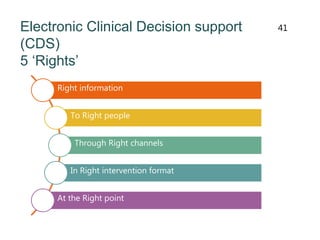
Electronic Clinical Decision support
(CDS)
5 ‘Rights’
Right information
To Right people
Through Right channels
In Right intervention format
At the Right point
41
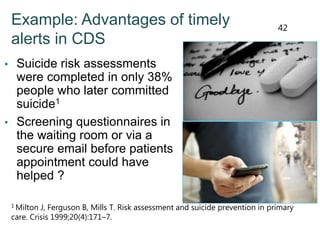
Example: Advantages of timely
alerts in CDS
• Suicide risk assessments
were completed in only 38%
people who later committed
suicide1
• Screening questionnaires in
the waiting room or via a
secure email before patients
appointment could have
helped ?
1 Milton J, Ferguson B, Mills T. Risk assessment and suicide prevention in primary
care. Crisis 1999;20(4):171–7.
42
Impact on doctor patient
relationships
43
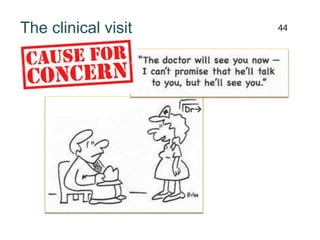
The clinical visit
Dr
44
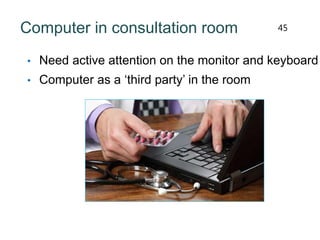
Computer in consultation room
• Need active attention on the monitor and keyboard
• Computer as a ‘third party’ in the room
45
Effect of EMR on patient interaction
• Less data for psychiatry
• Extrapolation from few studies in psychiatry and
many studies in general medicine
• Difference in population and their needs to be kept
in mind while interpreting results
46
Evidence…
• The General medical literature over the last 20
years
Consistently shows that computers in the
examining room do not have a negative effect on
Patient perceptions of the encounter
May even increase patient satisfaction
Koide D, Asonuma M, Naito K, et al. Evaluation of electronic health records from
viewpoint of patients. Stud Health Technol Inform 2006;122:304.
47
Evidence…
• Physicians using an EHR produced more complete
assessments1
• But they tend to have less focus on psychosocial
issues or issues of how illness affects a patient’s life1
• Use of EHR can alter or disrupt nonverbal
communication between physician and patient,
which can alter rapport building, patient comfort, and
disclosure patterns.2
1). Makoul G, Curry RH, Tang PC. The use of electronic medical records: communication patterns in
outpatient encounters. J Am Med Inform Assoc 2001;8(6):610–5.
2). Mcgrath JM, Arar NH, Pugh JA. The influence of electronic medical record usage on nonverbal
communication in the medical interview. Health Informatics J 2007; 13(2):105–18.
48
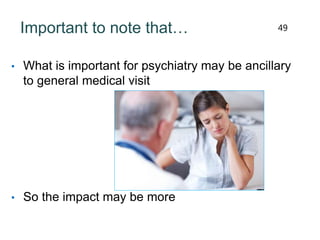
Important to note that…
• What is important for psychiatry may be ancillary
to general medical visit
• So the impact may be more
49
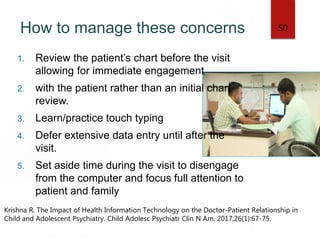
How to manage these concerns
1. Review the patient’s chart before the visit
allowing for immediate engagement
2. with the patient rather than an initial chart
review.
3. Learn/practice touch typing
4. Defer extensive data entry until after the
visit.
5. Set aside time during the visit to disengage
from the computer and focus full attention to
patient and family
Krishna R. The Impact of Health Information Technology on the Doctor-Patient Relationship in
Child and Adolescent Psychiatry. Child Adolesc Psychiatr Clin N Am. 2017;26(1):67-75.
50
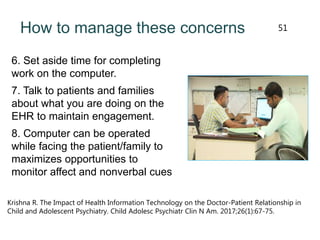
How to manage these concerns
6. Set aside time for completing
work on the computer.
7. Talk to patients and families
about what you are doing on the
EHR to maintain engagement.
8. Computer can be operated
while facing the patient/family to
maximizes opportunities to
monitor affect and nonverbal cues
Krishna R. The Impact of Health Information Technology on the Doctor-Patient Relationship in
Child and Adolescent Psychiatry. Child Adolesc Psychiatr Clin N Am. 2017;26(1):67-75.
51
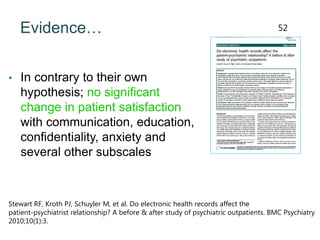
Evidence…
• In contrary to their own
hypothesis; no significant
change in patient satisfaction
with communication, education,
confidentiality, anxiety and
several other subscales
Stewart RF, Kroth PJ, Schuyler M, et al. Do electronic health records affect the
patient-psychiatrist relationship? A before & after study of psychiatric outpatients. BMC Psychiatry
2010;10(1):3.
52
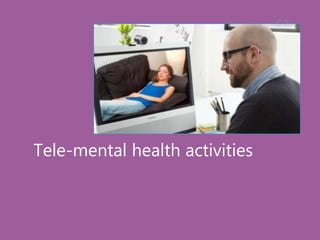
Tele-mental health activities
53
Tele-mental health activities
• Accessibility gap exist in Psychiatry care
• ‘Tele-mental health’-Umbrella term
• Definition:
 Behavioral and mental health services that are provided
via synchronous telecommunications technologies,
including discipline-specific applications such as tele-
psychiatry and tele-psychology1
1) Luxton D, Nelson E, Maheu M. A practitioner’s guide to telemental health: how to
conduct legal, ethical, and evidence-based telepractice. Washington, DC: American
Psychological Association Press; 2016
54
Tele-mental health
• Providers and patients/families at different
locations interact in real time
• Relatively low-cost technology solution
• Relies largely rely on verbal communication and
observation
55
Luxton D, Nelson E, Maheu M. A practitioner’s guide to telemental health: how to conduct
legal, ethical, and evidence-based telepractice. Washington, DC: American Psychological
Association Press; 2016
Tele-mental health
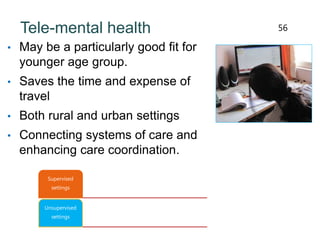
• May be a particularly good fit for
younger age group.
• Saves the time and expense of
travel
• Both rural and urban settings
• Connecting systems of care and
enhancing care coordination.
56
Supervised
settings
Unsupervised
settings
ECHOTM Model
• Project ECHO® (Extension for Community Healthcare
Outcomes)
• Movement to de-monopolize knowledge and amplify
the capacity to provide best practice care for
underserved people all over the world
• A range of behavioural health topics also
• Weekly brief didactic updates around best practices &
Case presentations from participating sites
Moto- “Move knowledge, not patients ! ”
57
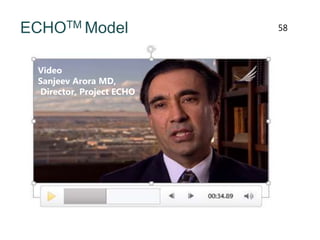
ECHOTM Model 58
Video
Sanjeev Arora MD,
Director, Project ECHO
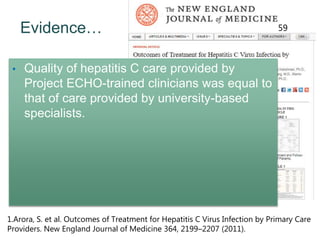
Evidence…
1.Arora, S. et al. Outcomes of Treatment for Hepatitis C Virus Infection by Primary Care
Providers. New England Journal of Medicine 364, 2199–2207 (2011).
59
• Quality of hepatitis C care provided by
Project ECHO-trained clinicians was equal to
that of care provided by university-based
specialists.
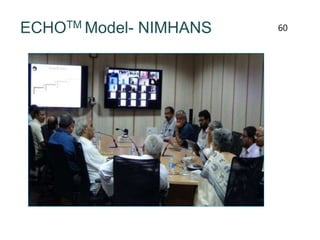
ECHOTM Model- NIMHANS 60
Evidence..
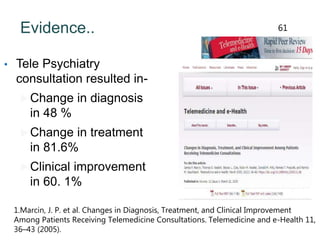
• Tele Psychiatry
consultation resulted in-
Change in diagnosis
in 48 %
Change in treatment
in 81.6%
Clinical improvement
in 60. 1%
1.Marcin, J. P. et al. Changes in Diagnosis, Treatment, and Clinical Improvement
Among Patients Receiving Telemedicine Consultations. Telemedicine and e-Health 11,
36–43 (2005).
61
e-Prescribing
62
e-Prescribing
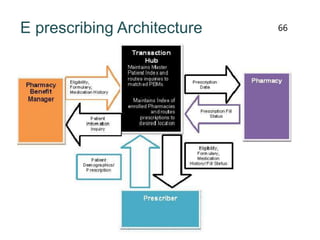
• e-Prescribing is defined as the process of
electronically generating, transmission and filing
a prescription order by a physician,
instead of using paper or faxed prescriptions
63
• Physicians can transmit an electronic prescription to a
pharmacy directly from the point of care.
• e-Prescribing improves accuracy, enhances patient safety
and quality of care since there is no handwriting for the
pharmacist to interpret
Virk P, Bates DW, Halamka J, Fournier GA, Rothschild JM. Analyzing Transaction
Workflows in an ePrescribing System. AMIA Annual Symposium Proceedings.
2006;2006:1129.
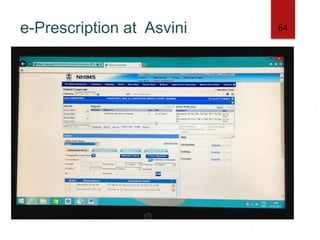
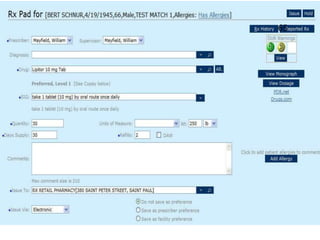
e-Prescription at Asvini 64
65
E prescribing Architecture 66
Benefits
Reduce prescribing and dispensing errors
Avoid more adverse drug interactions and reactions
Able offer to substitute less expensive drug
alternatives by checking the formulary
Improve medication compliance
Reduce the incidence of drug diversion (drug
abuse) by alerting providers and pharmacists of
duplicative prescriptions for controlled substances
Troy Trenkle, Director, Office of E-Health Standards and Services
The Benefits of E-prescribingU.S. Department of Health & Human Services (Dec2007)
https://web.archive.org/web/20080916200221/http://www.hhs.gov/asl/testify/2007/12/t2007120
4c.html
67
Limitations
• Financial Cost and Return on Investment (ROI)
• Change management
• Hardware and software selection
• Accidental data input
• Security and privacy
• Verification of electronic signatures, in ensuring
the medical integrity of the prescriptions
received by pharmacists
• Hacking
• System downtimeAmerican Medical Association. (2011). A Clinician's Guide to Electronic Prescribing.
Retrieved December 17, 2011, from: http://www.ama-
assn.org/ama1/pub/upload/mm/472/electronic-e-prescribing.pdf
68
Online treatment and virtual
psychotherapies
69
The need
Only 20% of youth meeting cut-off points
on mental health screening questionnaires
receiving services1
1Kataoka SH, Zhang L, Wells KB. Unmet need for mental health care among US
children: variation by ethnicity and insurance status. Am J Psychiatry 2002;
159(9):1548–55.
70
Reasons
Insufficient workforce
Concentration in urban areas
Costs and resources required to regularly
attend sessions that are necessary for proper
care
Lack of knowledge and stigma toward mental
health services
1Kataoka SH, Zhang L, Wells KB. Unmet need for mental health care among US
children: variation by ethnicity and insurance status. Am J Psychiatry 2002;
159(9):1548–55.
71
Solutions..?
 Online and virtual therapies that could serve as
alternatives and adjuncts to other services
 Creating low cost, widely available resources
 Several methods, majority focused on CBT
principles
72
Online and virtual therapies
Online and
Virtual therapies
Self Guided
Supported
Therapist
Teacher
Parent
Higher efficacy and
adherence
Spek V, Cuijpers P, Nyklicek I, et al. Internet-based cognitive behaviour therapy
for symptoms of depression and anxiety: a meta-analysis. Psychol Med 2007;
37(3):319–28.
73
Online and virtual therapies
 Completion rates-vary between 12% to 100% with a
median rate of 56% 1
 Higher in supported programs
 For youth-A parent, caregiver, or teacher could play
the role of supporter -More knowledge about the
child’s behaviour and context
1. Waller R, Gilbody S. Barriers to the uptake of computerized cognitive behavioural
therapy: a systematic review of the quantitative and qualitative evidence. Psychol Med
2009;39(5):705–12.
74
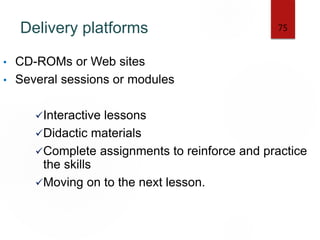
Delivery platforms
• CD-ROMs or Web sites
• Several sessions or modules
Interactive lessons
Didactic materials
Complete assignments to reinforce and practice
the skills
Moving on to the next lesson.
75
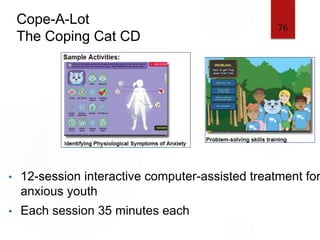
Cope-A-Lot
The Coping Cat CD
• 12-session interactive computer-assisted treatment for
anxious youth
• Each session 35 minutes each
76
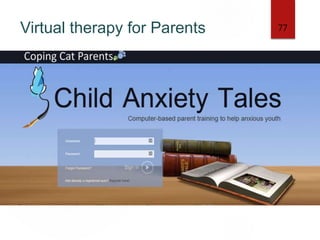
Virtual therapy for Parents 77
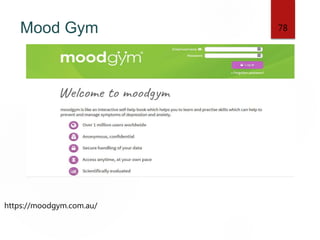
Mood Gym
https://moodgym.com.au/
78
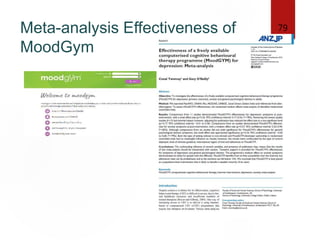
Meta-analysis Effectiveness of
MoodGym
79
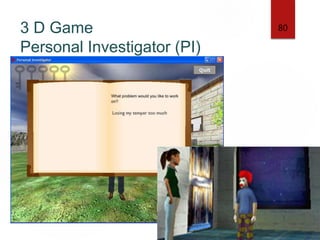
3 D Game
Personal Investigator (PI)
80
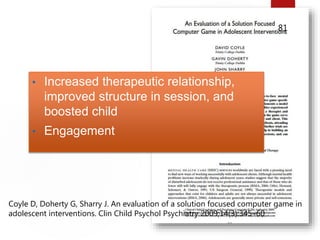
• Increased therapeutic relationship,
improved structure in session, and
boosted child
• Engagement
Coyle D, Doherty G, Sharry J. An evaluation of a solution focused computer game in
adolescent interventions. Clin Child Psychol Psychiatry 2009;14(3):345–60
81
Internet based interventions also
useful in :
• Depression and anxiety1 , Chronic pain 2,
• Encopresis 3 , Smoking cessation 4
• 1 Richardson T, Stallard P, Velleman S. Computerised cognitive behavioural therapy for the
prevention and treatment of depression and anxiety in children and adolescents: a systematic
review. Clin Child Fam Psychol Rev 2010;13(3):
• 2 Palermo TM, Wilson AC, Peters M, et al. Randomized controlled trial of an Internet-
delivered family cognitive-behavioral therapy intervention for children and adolescents with
chronic pain. Pain 2009;146(1–2):205–13.
• 3Ritterband LM, Thorndike FP, Lord HR, et al. An RCTof an Internet Intervention for pediatric
encopresis with one year follow-up. Clin Pract pediatr Psychol 2013
• 4Patten CA, Croghan IT, Meis TM, et al. Randomized clinical trial of an Internet based versus
brief office intervention for adolescent smoking cessation. Patient Educ Couns 2006
82
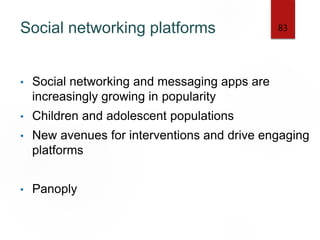
Social networking platforms
• Social networking and messaging apps are
increasingly growing in popularity
• Children and adolescent populations
• New avenues for interventions and drive engaging
platforms
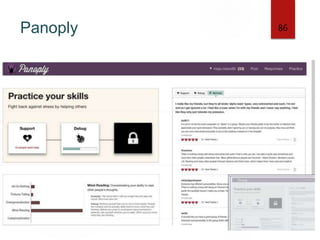
• Panoply
83
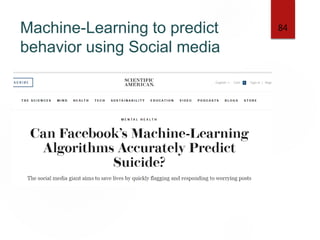
Machine-Learning to predict
behavior using Social media
84
Beginning of Social Media
Psychiatry?
85
Panoply 86
IT in psychiatric education
87
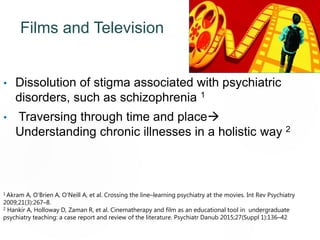
Films and Television
• Dissolution of stigma associated with psychiatric
disorders, such as schizophrenia 1
• Traversing through time and place
Understanding chronic illnesses in a holistic way 2
88
1 Akram A, O’Brien A, O’Neill A, et al. Crossing the line–learning psychiatry at the movies. Int Rev Psychiatry
2009;21(3):267–8.
2 Hankir A, Holloway D, Zaman R, et al. Cinematherapy and film as an educational tool in undergraduate
psychiatry teaching: a case report and review of the literature. Psychiatr Danub 2015;27(Suppl 1):136–42
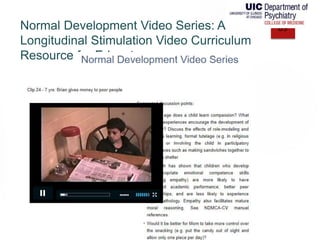
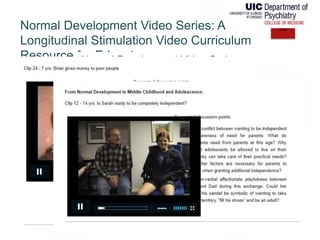
Normal Development Video Series: A
Longitudinal Stimulation Video Curriculum
Resource for Educators
89
Normal Development Video Series: A
Longitudinal Stimulation Video Curriculum
Resource for Educators
90
The Up Series 91
Video feedback in treatment
• In Treating personality disorder
• Perinatal psychiatric illness
• Improving Parent Child Interaction
• SUD
• Principle
 Patient’s confused self image v/s real image
on screen
 Strong memory formation
92
Impact of Video feedback on an
episode of DT and treatment
outcome in patients of ADS
PhD Thesis. Lt Col Sojan Baby, CAM NIMHANS
Oct 2017
• 90 patients
• Randomized to TAU and Video feedback arm
• Result: Average quantity of drinking was reduced
in intervention arm (narrowly missed statistical
significance)
• Denial was much less and motivation levels were
high
93
Web based simulations-Virtual
patients
• Web-based simulations- Are already being used
for medical training
• Advantages-Opportunity to practice clinical skills
and problem solving in settings that are less
anxiety provoking
94
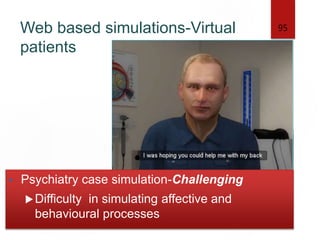
Web based simulations-Virtual
patients
95
• Psychiatry case simulation-Challenging
Difficulty in simulating affective and
behavioural processes
Evidence 96
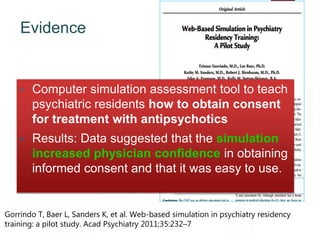
• Computer simulation assessment tool to teach
psychiatric residents how to obtain consent
for treatment with antipsychotics
• Results: Data suggested that the simulation
increased physician confidence in obtaining
informed consent and that it was easy to use.
Gorrindo T, Baer L, Sanders K, et al. Web-based simulation in psychiatry residency
training: a pilot study. Acad Psychiatry 2011;35:232–7
MOOC
• Typical MOOC- Course of few weekss, broken down
into weekly modules
• Each module-A single or few topics related to the
subject
• The format of teaching is through video lectures,
demonstrations, essential readings and quizzes
• Students can put forth their questions and opinions in
discussion boards moderated by content providers
• Courses typically require somewhere between 3 to 10
hours of participant involvement per week
• Assessment of the participants is typically through
multiple choice questions, extended matching
questions and true-false type questions
97
S Sarkar et al. Adapting massive open online courses for medical education. International Journal
of Advanced Medical and Health Research. 2015;2(1):68.
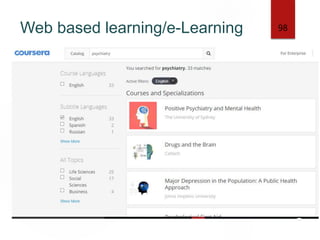
Web based learning/e-Learning
• MOOC
• Set of educational material hosted on
an internet site, accessible to the
learners through their devices
• Thousands of students-hence
acknowledged as massive
98
MOOC- Advantages
 Ease of access
 Attract students from all over the world, offering a chance of
cross-fertilization of ideas from different parts of the globe
 Globally renowned professors may reach out to a large
number of students through these courses, which they
might not be able to cater through regular classroom-based
courses
 Also, a course once made can be delivered a number of
times, thus reducing the recurring efforts and costs.
 Less administrative hassle and lower costs of delivery of
the educational content.
99
S Sarkar et al. Adapting massive open online courses for medical education. International Journal
of Advanced Medical and Health Research. 2015;2(1):68.
MOOC- Disadvantages
• High dropout rates.
• Assessments in MOOCs rely on self-reported
fidelity to honour code
• MOOCs are usually introductory short-duration
courses which can hardly be substitutes of in-
depth full-time courses.
• How the employers and funders would
appraise ?
• There is limited financial incentive for course
content developers
100
S Sarkar et al. Adapting massive open online courses for medical education. International Journal
of Advanced Medical and Health Research. 2015;2(1):68.
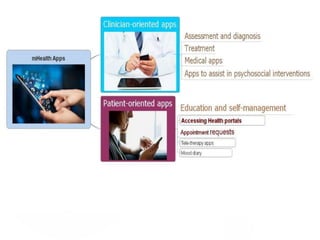
Mobile App based Mental health
interventions
10
1
102
103
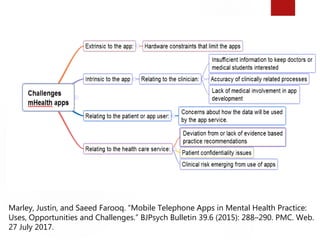
Marley, Justin, and Saeed Farooq. “Mobile Telephone Apps in Mental Health Practice:
Uses, Opportunities and Challenges.” BJPsych Bulletin 39.6 (2015): 288–290. PMC. Web.
27 July 2017.
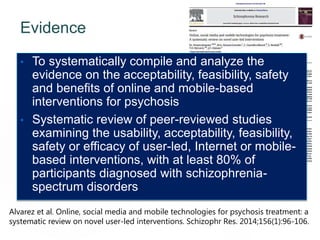
Evidence 104
• To systematically compile and analyze the
evidence on the acceptability, feasibility, safety
and benefits of online and mobile-based
interventions for psychosis
• Systematic review of peer-reviewed studies
examining the usability, acceptability, feasibility,
safety or efficacy of user-led, Internet or mobile-
based interventions, with at least 80% of
participants diagnosed with schizophrenia-
spectrum disorders
Alvarez et al. Online, social media and mobile technologies for psychosis treatment: a
systematic review on novel user-led interventions. Schizophr Res. 2014;156(1):96-106.
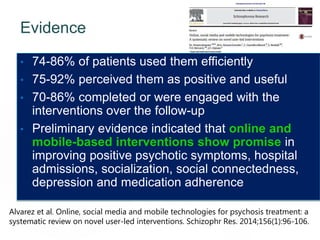
Evidence 105
• 74-86% of patients used them efficiently
• 75-92% perceived them as positive and useful
• 70-86% completed or were engaged with the
interventions over the follow-up
• Preliminary evidence indicated that online and
mobile-based interventions show promise in
improving positive psychotic symptoms, hospital
admissions, socialization, social connectedness,
depression and medication adherence
Alvarez et al. Online, social media and mobile technologies for psychosis treatment: a
systematic review on novel user-led interventions. Schizophr Res. 2014;156(1):96-106.
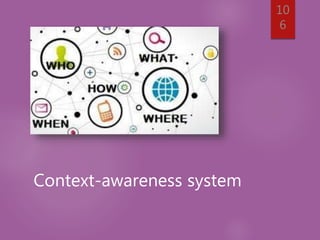
Context-awareness system
10
6
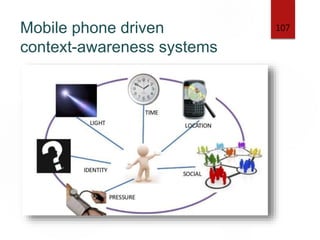
Mobile phone driven
context-awareness systems
107
Research 108
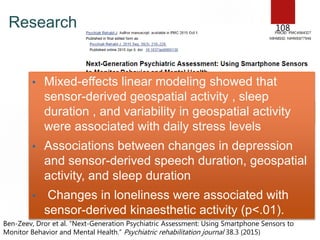
• Mixed-effects linear modeling showed that
sensor-derived geospatial activity , sleep
duration , and variability in geospatial activity
were associated with daily stress levels
• Associations between changes in depression
and sensor-derived speech duration, geospatial
activity, and sleep duration
• Changes in loneliness were associated with
sensor-derived kinaesthetic activity (p<.01).
Ben-Zeev, Dror et al. “Next-Generation Psychiatric Assessment: Using Smartphone Sensors to
Monitor Behavior and Mental Health.” Psychiatric rehabilitation journal 38.3 (2015)
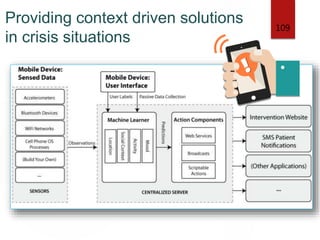
Providing context driven solutions
in crisis situations
109
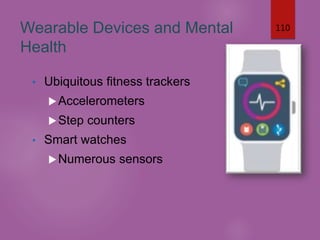
Wearable Devices and Mental
Health
• Ubiquitous fitness trackers
Accelerometers
Step counters
• Smart watches
Numerous sensors
110
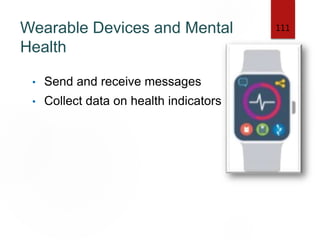
Wearable Devices and Mental
Health
• Send and receive messages
• Collect data on health indicators
111
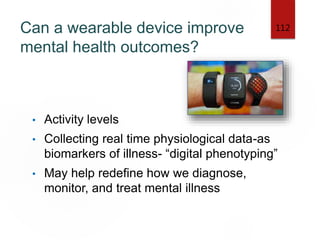
Can a wearable device improve
mental health outcomes?
• Activity levels
• Collecting real time physiological data-as
biomarkers of illness- “digital phenotyping”
• May help redefine how we diagnose,
monitor, and treat mental illness
112
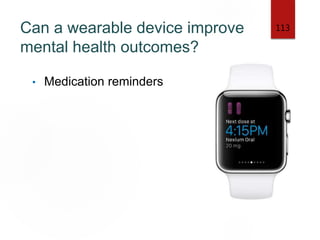
Can a wearable device improve
mental health outcomes?
• Medication reminders
113
Will patients with mental illness
want to use wearable devices?
• Early evidence
25% of activity trackers are owned by
those aged 55 years or older.
77% of participants found activity trackers
useful and 45% reported that they
increased motivation for healthier living
114
AARP. Building a Better Tracker: Older Consumers Weigh in on Activity and Sleep
Monitoring Devices. 2016
Will patients with mental illness
want to use wearable devices?
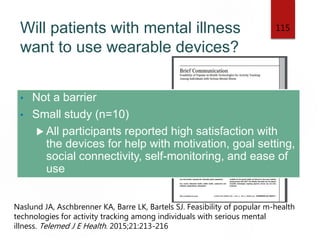
• Not a barrier
• Small study (n=10)
 All participants reported high satisfaction with
the devices for help with motivation, goal setting,
social connectivity, self-monitoring, and ease of
use
115
Naslund JA, Aschbrenner KA, Barre LK, Bartels SJ. Feasibility of popular m-health
technologies for activity tracking among individuals with serious mental
illness. Telemed J E Health. 2015;21:213-216
Indian Scenario
11
6
11
7
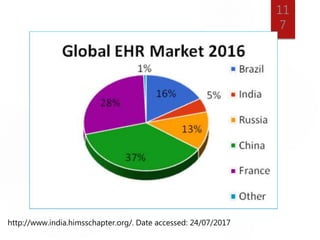
http://www.india.himsschapter.org/. Date accessed: 24/07/2017
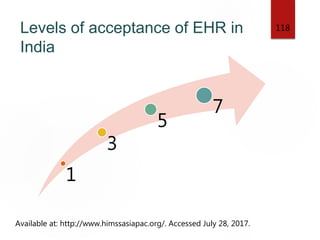
Levels of acceptance of EHR in
India
118
1
3
5
7
Available at: http://www.himssasiapac.org/. Accessed July 28, 2017.
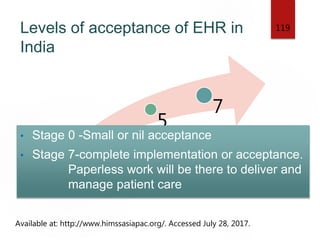
Levels of acceptance of EHR in
India
119
1
3
5
7
Available at: http://www.himssasiapac.org/. Accessed July 28, 2017.
• Stage 0 -Small or nil acceptance
• Stage 7-complete implementation or acceptance.
Paperless work will be there to deliver and
manage patient care
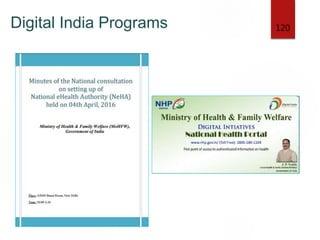
Digital India Programs 120
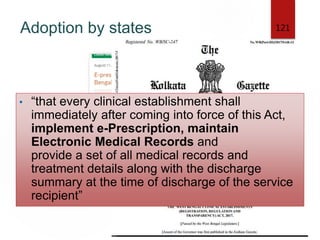
Adoption by states 121
• “that every clinical establishment shall
immediately after coming into force of this Act,
implement e-Prescription, maintain
Electronic Medical Records and
provide a set of all medical records and
treatment details along with the discharge
summary at the time of discharge of the service
recipient”
Summary and take home
message
12
2
Summary and take home
message
• Information technology in the 21st century
 Dramatic changes to psychiatric practice and
psychotherapy
• There are many new possibilities are:
 EMR/HER
 Patient portals
 Tele-psychiatry
 Virtual therapies
 e-Prescribing
 Mobile Mental Health Apps
123
Summary and take home message
• An EMR/HER-Systematized collection of
patient’s health information stored in a digital
format
• Psychiatrist are least likely to adopt EMR
• Patient confidentiality issues are a major
concern
• Content and quality of patient interactions were
preserved
124
Summary and take home message
• Tele-psychiatry technologies- allows wide
outreach into the underserved population
• e-Prescriptions-reduced error and enhances
adherence
• Youth may adopt better to online and virtual
therapies
• MOOC allows wider access to educational
content
125
Summary and take home message
• Context awareness systems and wearable
devices uses numerous sensors to pick up real-
time ‘biometric’ data
• Governments across the globe including India
are promoting eMental Health in a big way
126
127
Thank You
12
8

Information Technology & Psychiatry

  • 1.
    Information Technology & Psychiatry SEMINAR PRESENTER: DRJITHIN RAJ M FINAL YEAR RESIDENT IN PSYCHIATRY MODERATOR: DR KAUSHIK CHATTERJEE PROFESSOR OF PSYCHIATRY AFMC
  • 2.
  • 3.
    “ मयाध्यक्षेण प्रकृति: सूयिे सचराचरम ्। हेिुनानेन कौन्िेय जगद्विपररिितिे ॥” Sloka 10, Chapter 9 (Raja vidya raja guhya yogam), Bhagavadgita 3
  • 4.
    Humans have usedtools all along to solve problems… 4
  • 5.
  • 6.
  • 7.
  • 8.
    8 Available at: http://www.nasscom.in/.Accessed July 26, 2017. https://www.statista.com/statistics/255135/internet-penetration-in-india/
  • 9.
    9 Available at: http://www.nasscom.in/.Accessed July 26, 2017. https://www.statista.com/statistics/255135/internet-penetration-in-india/
  • 10.
    10 Available at: http://www.nasscom.in/.Accessed July 26, 2017. https://www.statista.com/statistics/255135/internet-penetration-in-india/ Number of Internet subscribers
  • 11.
    11 Available at: http://www.nasscom.in/.Accessed July 26, 2017. https://www.statista.com/statistics/255135/internet-penetration-in-india/ Number of Internet subscribers
  • 12.
    12 Available at: http://www.nasscom.in/.Accessed July 26, 2017. https://www.statista.com/statistics/255135/internet-penetration-in-india/ Number of Internet subscribers
  • 13.
  • 14.
  • 15.
    Has Psychiatry missedthe ‘Technology bus ’ ? 15
  • 16.
  • 17.
  • 18.
    Clinical documentation  Aninternal record  To communicate with other professionals  Billing/insurance  An external record for in times of litigation 18
  • 19.
    Clinical document section- ShankaraNetralaya, Chennai 19 Scholl J et al. A case study of an EMR system at a large hospital in India: challenges and strategies for successful adoption. J Biomed Inform. 2011
  • 20.
    Electronic Medical Record Defined as "an electronic record of health-related information on an individual that can be created, gathered, managed, and consulted by authorized clinicians and staff within one health care organization," 20 Demographics, medical history, medication and allergies, immunization status, laboratory test results, radiology images, vital signs, personal statistics like age and weight, and billing information https://www.healthcare-informatics.com/news-item/nahit-releases-hit-definitions
  • 21.
    EMR Adoption inShankara Netralaya Scholl J, Syed-abdul S, Ahmed LA. A case study of an EMR system at a large hospital in India: challenges and strategies for successful adoption. J Biomed Inform. 21
  • 22.
  • 23.
    ADVANTAGES OF EMR Accurate storage of data  No need to track down data from stack of papers or files  Data replication is unlikely  Legible  Searchable  Trends across time  Population based data 23
  • 24.
    Protocols and interoperability •ASC X12 • TC/251 • HL7 • FHIR • ISO – ISO TC 215 • xDT • openEHR • Virtual Medical Record • SMART 24
  • 25.
    Adoption of EMRby Psychiatrist 25 Grinspan, Z. M. et al. “Physician Specialty and Variations in Adoption of Electronic Health Records.” Applied Clinical Informatics 4.2 (2013).
  • 26.
    26 Grinspan, Z. M.et al. “Physician Specialty and Variations in Adoption of Electronic Health Records.” Applied Clinical Informatics 4.2 (2013).
  • 27.
    27  Psychiatrist areleast likely to adopt EMR Grinspan, Z. M. et al. “Physician Specialty and Variations in Adoption of Electronic Health Records.” Applied Clinical Informatics 4.2 (2013).
  • 28.
    Reasons for thereluctance ? • Privacy of sensitive information detailed within mental health records • Amount of data needs to be entered • Subjective findings • Remotely accessible system-Security issues • Access of MHR to child/adolescent’s parents? • Blocking or sequestering extremely sensitive information  “Covered entities” 28
  • 29.
    Concerns about alteredclinical practice ? • Often unreal- researches from 1990 • Content and quality of patient interactions were preserved • Notes were more clearer and legible • Difficulty with documentation and maintaining confidential information Salomon RM et al. Openness of patients’ reporting with use of electronic records: psychiatric clinicians’ views. J Am Med Inform Assoc 2010;17(1) 29
  • 30.
    Patient Portals 30 •A patient portal is a secure online website that gives patients convenient 24-hour access to personal health information from anywhere with an Internet connection.
  • 31.
    Facilities provided byPatient portals Patients can: Exchange secure e-mail with their health care teams Request prescription refills Schedule non-urgent appointments Check benefits and coverage Update contact information Make payments Download and complete forms View educational materials 31
  • 32.
    Psychiatry and PatientPortals • Most behavioral health notes are now excluded • Many health portals and organizations are moving to full transparency • Driving factors: Research like “OpenNote” study 32
  • 33.
  • 34.
    Studies on ‘OpenNotes’ •Most patients expressed “better control over their care” • More compliant with their medication regime • 30% had worries about privacy issues • No increase in SMS s sent to providers (in contrast to earlier concerns by doctors) • Providers-  Increase in the documentation time(21%)  Slight alteration to the content documented Leveille SG, Walker J, Ralston JD, et al. Evaluating the impact of patients’ online access to doctors’ visit notes: designing and executing the OpenNotes project. BMC Med Inform Decis Mak 2012;12:32. 34
  • 35.
    Implementable in Psychiatry? • Entering a minefield !  How will a patient respond if he/she reads about the personality disorder diagnosis?  What about F20 patient reading that her firm beliefs are ‘delusional’? Kahn MW, Bell SK, Walker J, et al. A piece of my mind. Let’s show patients their mental health records. JAMA 2014;311(13):1291–2. 35
  • 36.
    Implementable in Psychiatry? • TransparencyOpportunities More active participation by patients and may reduce the stigma they experience. Kahn MW, Bell SK, Walker J, et al. A piece of my mind. Let’s show patients their mental health records. JAMA 2014;311(13):1291–2. 36
  • 37.
    Better notes areto be created if patients are freely accessing it… • Succinct formulation “medical tweet” • Preventing ‘note bloat’ • Not merely focusing on positive symptoms, but focus on strength and resilience points Patient should feel more ‘like people’ than patients 37
  • 38.
    Clinical benefit ofEMR and interdisciplinary collaboration in Psychiatry • SUD-delay in referral of more than 10 years • Better tracking of substance use across a multidisciplinary team • Similar pattern of delay in internalizing disorders, eating disorders and even depression 38 Peters TE. Transformational Impact of Health Information Technology on the Clinical Practice of Child and Adolescent Psychiatry. Child Adolesc Psychiatr Clin N Am. 2017;26(1):55-66.
  • 39.
  • 40.
    CDS-Clinical decision Support Computerized alerts and reminders for providers and patients  Clinical guidelines  Condition-specific order sets  Focused patient data reports and summaries Documentation templates  Diagnostic support  Contextually relevant reference information 40
  • 41.
    Electronic Clinical Decisionsupport (CDS) 5 ‘Rights’ Right information To Right people Through Right channels In Right intervention format At the Right point 41
  • 42.
    Example: Advantages oftimely alerts in CDS • Suicide risk assessments were completed in only 38% people who later committed suicide1 • Screening questionnaires in the waiting room or via a secure email before patients appointment could have helped ? 1 Milton J, Ferguson B, Mills T. Risk assessment and suicide prevention in primary care. Crisis 1999;20(4):171–7. 42
  • 43.
    Impact on doctorpatient relationships 43
  • 44.
  • 45.
    Computer in consultationroom • Need active attention on the monitor and keyboard • Computer as a ‘third party’ in the room 45
  • 46.
    Effect of EMRon patient interaction • Less data for psychiatry • Extrapolation from few studies in psychiatry and many studies in general medicine • Difference in population and their needs to be kept in mind while interpreting results 46
  • 47.
    Evidence… • The Generalmedical literature over the last 20 years Consistently shows that computers in the examining room do not have a negative effect on Patient perceptions of the encounter May even increase patient satisfaction Koide D, Asonuma M, Naito K, et al. Evaluation of electronic health records from viewpoint of patients. Stud Health Technol Inform 2006;122:304. 47
  • 48.
    Evidence… • Physicians usingan EHR produced more complete assessments1 • But they tend to have less focus on psychosocial issues or issues of how illness affects a patient’s life1 • Use of EHR can alter or disrupt nonverbal communication between physician and patient, which can alter rapport building, patient comfort, and disclosure patterns.2 1). Makoul G, Curry RH, Tang PC. The use of electronic medical records: communication patterns in outpatient encounters. J Am Med Inform Assoc 2001;8(6):610–5. 2). Mcgrath JM, Arar NH, Pugh JA. The influence of electronic medical record usage on nonverbal communication in the medical interview. Health Informatics J 2007; 13(2):105–18. 48
  • 49.
    Important to notethat… • What is important for psychiatry may be ancillary to general medical visit • So the impact may be more 49
  • 50.
    How to managethese concerns 1. Review the patient’s chart before the visit allowing for immediate engagement 2. with the patient rather than an initial chart review. 3. Learn/practice touch typing 4. Defer extensive data entry until after the visit. 5. Set aside time during the visit to disengage from the computer and focus full attention to patient and family Krishna R. The Impact of Health Information Technology on the Doctor-Patient Relationship in Child and Adolescent Psychiatry. Child Adolesc Psychiatr Clin N Am. 2017;26(1):67-75. 50
  • 51.
    How to managethese concerns 6. Set aside time for completing work on the computer. 7. Talk to patients and families about what you are doing on the EHR to maintain engagement. 8. Computer can be operated while facing the patient/family to maximizes opportunities to monitor affect and nonverbal cues Krishna R. The Impact of Health Information Technology on the Doctor-Patient Relationship in Child and Adolescent Psychiatry. Child Adolesc Psychiatr Clin N Am. 2017;26(1):67-75. 51
  • 52.
    Evidence… • In contraryto their own hypothesis; no significant change in patient satisfaction with communication, education, confidentiality, anxiety and several other subscales Stewart RF, Kroth PJ, Schuyler M, et al. Do electronic health records affect the patient-psychiatrist relationship? A before & after study of psychiatric outpatients. BMC Psychiatry 2010;10(1):3. 52
  • 53.
  • 54.
    Tele-mental health activities •Accessibility gap exist in Psychiatry care • ‘Tele-mental health’-Umbrella term • Definition:  Behavioral and mental health services that are provided via synchronous telecommunications technologies, including discipline-specific applications such as tele- psychiatry and tele-psychology1 1) Luxton D, Nelson E, Maheu M. A practitioner’s guide to telemental health: how to conduct legal, ethical, and evidence-based telepractice. Washington, DC: American Psychological Association Press; 2016 54
  • 55.
    Tele-mental health • Providersand patients/families at different locations interact in real time • Relatively low-cost technology solution • Relies largely rely on verbal communication and observation 55 Luxton D, Nelson E, Maheu M. A practitioner’s guide to telemental health: how to conduct legal, ethical, and evidence-based telepractice. Washington, DC: American Psychological Association Press; 2016
  • 56.
    Tele-mental health • Maybe a particularly good fit for younger age group. • Saves the time and expense of travel • Both rural and urban settings • Connecting systems of care and enhancing care coordination. 56 Supervised settings Unsupervised settings
  • 57.
    ECHOTM Model • ProjectECHO® (Extension for Community Healthcare Outcomes) • Movement to de-monopolize knowledge and amplify the capacity to provide best practice care for underserved people all over the world • A range of behavioural health topics also • Weekly brief didactic updates around best practices & Case presentations from participating sites Moto- “Move knowledge, not patients ! ” 57
  • 58.
    ECHOTM Model 58 Video SanjeevArora MD, Director, Project ECHO
  • 59.
    Evidence… 1.Arora, S. etal. Outcomes of Treatment for Hepatitis C Virus Infection by Primary Care Providers. New England Journal of Medicine 364, 2199–2207 (2011). 59 • Quality of hepatitis C care provided by Project ECHO-trained clinicians was equal to that of care provided by university-based specialists.
  • 60.
  • 61.
    Evidence.. • Tele Psychiatry consultationresulted in- Change in diagnosis in 48 % Change in treatment in 81.6% Clinical improvement in 60. 1% 1.Marcin, J. P. et al. Changes in Diagnosis, Treatment, and Clinical Improvement Among Patients Receiving Telemedicine Consultations. Telemedicine and e-Health 11, 36–43 (2005). 61
  • 62.
  • 63.
    e-Prescribing • e-Prescribing isdefined as the process of electronically generating, transmission and filing a prescription order by a physician, instead of using paper or faxed prescriptions 63 • Physicians can transmit an electronic prescription to a pharmacy directly from the point of care. • e-Prescribing improves accuracy, enhances patient safety and quality of care since there is no handwriting for the pharmacist to interpret Virk P, Bates DW, Halamka J, Fournier GA, Rothschild JM. Analyzing Transaction Workflows in an ePrescribing System. AMIA Annual Symposium Proceedings. 2006;2006:1129.
  • 64.
  • 65.
  • 66.
  • 67.
    Benefits Reduce prescribing anddispensing errors Avoid more adverse drug interactions and reactions Able offer to substitute less expensive drug alternatives by checking the formulary Improve medication compliance Reduce the incidence of drug diversion (drug abuse) by alerting providers and pharmacists of duplicative prescriptions for controlled substances Troy Trenkle, Director, Office of E-Health Standards and Services The Benefits of E-prescribingU.S. Department of Health & Human Services (Dec2007) https://web.archive.org/web/20080916200221/http://www.hhs.gov/asl/testify/2007/12/t2007120 4c.html 67
  • 68.
    Limitations • Financial Costand Return on Investment (ROI) • Change management • Hardware and software selection • Accidental data input • Security and privacy • Verification of electronic signatures, in ensuring the medical integrity of the prescriptions received by pharmacists • Hacking • System downtimeAmerican Medical Association. (2011). A Clinician's Guide to Electronic Prescribing. Retrieved December 17, 2011, from: http://www.ama- assn.org/ama1/pub/upload/mm/472/electronic-e-prescribing.pdf 68
  • 69.
    Online treatment andvirtual psychotherapies 69
  • 70.
    The need Only 20%of youth meeting cut-off points on mental health screening questionnaires receiving services1 1Kataoka SH, Zhang L, Wells KB. Unmet need for mental health care among US children: variation by ethnicity and insurance status. Am J Psychiatry 2002; 159(9):1548–55. 70
  • 71.
    Reasons Insufficient workforce Concentration inurban areas Costs and resources required to regularly attend sessions that are necessary for proper care Lack of knowledge and stigma toward mental health services 1Kataoka SH, Zhang L, Wells KB. Unmet need for mental health care among US children: variation by ethnicity and insurance status. Am J Psychiatry 2002; 159(9):1548–55. 71
  • 72.
    Solutions..?  Online andvirtual therapies that could serve as alternatives and adjuncts to other services  Creating low cost, widely available resources  Several methods, majority focused on CBT principles 72
  • 73.
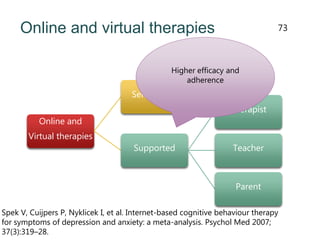
    Online and virtualtherapies Online and Virtual therapies Self Guided Supported Therapist Teacher Parent Higher efficacy and adherence Spek V, Cuijpers P, Nyklicek I, et al. Internet-based cognitive behaviour therapy for symptoms of depression and anxiety: a meta-analysis. Psychol Med 2007; 37(3):319–28. 73
  • 74.
    Online and virtualtherapies  Completion rates-vary between 12% to 100% with a median rate of 56% 1  Higher in supported programs  For youth-A parent, caregiver, or teacher could play the role of supporter -More knowledge about the child’s behaviour and context 1. Waller R, Gilbody S. Barriers to the uptake of computerized cognitive behavioural therapy: a systematic review of the quantitative and qualitative evidence. Psychol Med 2009;39(5):705–12. 74
  • 75.
    Delivery platforms • CD-ROMsor Web sites • Several sessions or modules Interactive lessons Didactic materials Complete assignments to reinforce and practice the skills Moving on to the next lesson. 75
  • 76.
    Cope-A-Lot The Coping CatCD • 12-session interactive computer-assisted treatment for anxious youth • Each session 35 minutes each 76
  • 77.
  • 78.
  • 79.
  • 80.
    3 D Game PersonalInvestigator (PI) 80
  • 81.
    • Increased therapeuticrelationship, improved structure in session, and boosted child • Engagement Coyle D, Doherty G, Sharry J. An evaluation of a solution focused computer game in adolescent interventions. Clin Child Psychol Psychiatry 2009;14(3):345–60 81
  • 82.
    Internet based interventionsalso useful in : • Depression and anxiety1 , Chronic pain 2, • Encopresis 3 , Smoking cessation 4 • 1 Richardson T, Stallard P, Velleman S. Computerised cognitive behavioural therapy for the prevention and treatment of depression and anxiety in children and adolescents: a systematic review. Clin Child Fam Psychol Rev 2010;13(3): • 2 Palermo TM, Wilson AC, Peters M, et al. Randomized controlled trial of an Internet- delivered family cognitive-behavioral therapy intervention for children and adolescents with chronic pain. Pain 2009;146(1–2):205–13. • 3Ritterband LM, Thorndike FP, Lord HR, et al. An RCTof an Internet Intervention for pediatric encopresis with one year follow-up. Clin Pract pediatr Psychol 2013 • 4Patten CA, Croghan IT, Meis TM, et al. Randomized clinical trial of an Internet based versus brief office intervention for adolescent smoking cessation. Patient Educ Couns 2006 82
  • 83.
    Social networking platforms •Social networking and messaging apps are increasingly growing in popularity • Children and adolescent populations • New avenues for interventions and drive engaging platforms • Panoply 83
  • 84.
  • 85.
    Beginning of SocialMedia Psychiatry? 85
  • 86.
  • 87.
    IT in psychiatriceducation 87
  • 88.
    Films and Television •Dissolution of stigma associated with psychiatric disorders, such as schizophrenia 1 • Traversing through time and place Understanding chronic illnesses in a holistic way 2 88 1 Akram A, O’Brien A, O’Neill A, et al. Crossing the line–learning psychiatry at the movies. Int Rev Psychiatry 2009;21(3):267–8. 2 Hankir A, Holloway D, Zaman R, et al. Cinematherapy and film as an educational tool in undergraduate psychiatry teaching: a case report and review of the literature. Psychiatr Danub 2015;27(Suppl 1):136–42
  • 89.
    Normal Development VideoSeries: A Longitudinal Stimulation Video Curriculum Resource for Educators 89
  • 90.
    Normal Development VideoSeries: A Longitudinal Stimulation Video Curriculum Resource for Educators 90
  • 91.
  • 92.
    Video feedback intreatment • In Treating personality disorder • Perinatal psychiatric illness • Improving Parent Child Interaction • SUD • Principle  Patient’s confused self image v/s real image on screen  Strong memory formation 92
  • 93.
    Impact of Videofeedback on an episode of DT and treatment outcome in patients of ADS PhD Thesis. Lt Col Sojan Baby, CAM NIMHANS Oct 2017 • 90 patients • Randomized to TAU and Video feedback arm • Result: Average quantity of drinking was reduced in intervention arm (narrowly missed statistical significance) • Denial was much less and motivation levels were high 93
  • 94.
    Web based simulations-Virtual patients •Web-based simulations- Are already being used for medical training • Advantages-Opportunity to practice clinical skills and problem solving in settings that are less anxiety provoking 94
  • 95.
    Web based simulations-Virtual patients 95 •Psychiatry case simulation-Challenging Difficulty in simulating affective and behavioural processes
  • 96.
    Evidence 96 • Computersimulation assessment tool to teach psychiatric residents how to obtain consent for treatment with antipsychotics • Results: Data suggested that the simulation increased physician confidence in obtaining informed consent and that it was easy to use. Gorrindo T, Baer L, Sanders K, et al. Web-based simulation in psychiatry residency training: a pilot study. Acad Psychiatry 2011;35:232–7
  • 97.
    MOOC • Typical MOOC-Course of few weekss, broken down into weekly modules • Each module-A single or few topics related to the subject • The format of teaching is through video lectures, demonstrations, essential readings and quizzes • Students can put forth their questions and opinions in discussion boards moderated by content providers • Courses typically require somewhere between 3 to 10 hours of participant involvement per week • Assessment of the participants is typically through multiple choice questions, extended matching questions and true-false type questions 97 S Sarkar et al. Adapting massive open online courses for medical education. International Journal of Advanced Medical and Health Research. 2015;2(1):68.
  • 98.
    Web based learning/e-Learning •MOOC • Set of educational material hosted on an internet site, accessible to the learners through their devices • Thousands of students-hence acknowledged as massive 98
  • 99.
    MOOC- Advantages  Easeof access  Attract students from all over the world, offering a chance of cross-fertilization of ideas from different parts of the globe  Globally renowned professors may reach out to a large number of students through these courses, which they might not be able to cater through regular classroom-based courses  Also, a course once made can be delivered a number of times, thus reducing the recurring efforts and costs.  Less administrative hassle and lower costs of delivery of the educational content. 99 S Sarkar et al. Adapting massive open online courses for medical education. International Journal of Advanced Medical and Health Research. 2015;2(1):68.
  • 100.
    MOOC- Disadvantages • Highdropout rates. • Assessments in MOOCs rely on self-reported fidelity to honour code • MOOCs are usually introductory short-duration courses which can hardly be substitutes of in- depth full-time courses. • How the employers and funders would appraise ? • There is limited financial incentive for course content developers 100 S Sarkar et al. Adapting massive open online courses for medical education. International Journal of Advanced Medical and Health Research. 2015;2(1):68.
  • 101.
    Mobile App basedMental health interventions 10 1
  • 102.
  • 103.
    103 Marley, Justin, andSaeed Farooq. “Mobile Telephone Apps in Mental Health Practice: Uses, Opportunities and Challenges.” BJPsych Bulletin 39.6 (2015): 288–290. PMC. Web. 27 July 2017.
  • 104.
    Evidence 104 • Tosystematically compile and analyze the evidence on the acceptability, feasibility, safety and benefits of online and mobile-based interventions for psychosis • Systematic review of peer-reviewed studies examining the usability, acceptability, feasibility, safety or efficacy of user-led, Internet or mobile- based interventions, with at least 80% of participants diagnosed with schizophrenia- spectrum disorders Alvarez et al. Online, social media and mobile technologies for psychosis treatment: a systematic review on novel user-led interventions. Schizophr Res. 2014;156(1):96-106.
  • 105.
    Evidence 105 • 74-86%of patients used them efficiently • 75-92% perceived them as positive and useful • 70-86% completed or were engaged with the interventions over the follow-up • Preliminary evidence indicated that online and mobile-based interventions show promise in improving positive psychotic symptoms, hospital admissions, socialization, social connectedness, depression and medication adherence Alvarez et al. Online, social media and mobile technologies for psychosis treatment: a systematic review on novel user-led interventions. Schizophr Res. 2014;156(1):96-106.
  • 106.
  • 107.
  • 108.
    Research 108 • Mixed-effectslinear modeling showed that sensor-derived geospatial activity , sleep duration , and variability in geospatial activity were associated with daily stress levels • Associations between changes in depression and sensor-derived speech duration, geospatial activity, and sleep duration • Changes in loneliness were associated with sensor-derived kinaesthetic activity (p<.01). Ben-Zeev, Dror et al. “Next-Generation Psychiatric Assessment: Using Smartphone Sensors to Monitor Behavior and Mental Health.” Psychiatric rehabilitation journal 38.3 (2015)
  • 109.
    Providing context drivensolutions in crisis situations 109
  • 110.
    Wearable Devices andMental Health • Ubiquitous fitness trackers Accelerometers Step counters • Smart watches Numerous sensors 110
  • 111.
    Wearable Devices andMental Health • Send and receive messages • Collect data on health indicators 111
  • 112.
    Can a wearabledevice improve mental health outcomes? • Activity levels • Collecting real time physiological data-as biomarkers of illness- “digital phenotyping” • May help redefine how we diagnose, monitor, and treat mental illness 112
  • 113.
    Can a wearabledevice improve mental health outcomes? • Medication reminders 113
  • 114.
    Will patients withmental illness want to use wearable devices? • Early evidence 25% of activity trackers are owned by those aged 55 years or older. 77% of participants found activity trackers useful and 45% reported that they increased motivation for healthier living 114 AARP. Building a Better Tracker: Older Consumers Weigh in on Activity and Sleep Monitoring Devices. 2016
  • 115.
    Will patients withmental illness want to use wearable devices? • Not a barrier • Small study (n=10)  All participants reported high satisfaction with the devices for help with motivation, goal setting, social connectivity, self-monitoring, and ease of use 115 Naslund JA, Aschbrenner KA, Barre LK, Bartels SJ. Feasibility of popular m-health technologies for activity tracking among individuals with serious mental illness. Telemed J E Health. 2015;21:213-216
  • 116.
  • 117.
  • 118.
    Levels of acceptanceof EHR in India 118 1 3 5 7 Available at: http://www.himssasiapac.org/. Accessed July 28, 2017.
  • 119.
    Levels of acceptanceof EHR in India 119 1 3 5 7 Available at: http://www.himssasiapac.org/. Accessed July 28, 2017. • Stage 0 -Small or nil acceptance • Stage 7-complete implementation or acceptance. Paperless work will be there to deliver and manage patient care
  • 120.
  • 121.
    Adoption by states121 • “that every clinical establishment shall immediately after coming into force of this Act, implement e-Prescription, maintain Electronic Medical Records and provide a set of all medical records and treatment details along with the discharge summary at the time of discharge of the service recipient”
  • 122.
    Summary and takehome message 12 2
  • 123.
    Summary and takehome message • Information technology in the 21st century  Dramatic changes to psychiatric practice and psychotherapy • There are many new possibilities are:  EMR/HER  Patient portals  Tele-psychiatry  Virtual therapies  e-Prescribing  Mobile Mental Health Apps 123
  • 124.
    Summary and takehome message • An EMR/HER-Systematized collection of patient’s health information stored in a digital format • Psychiatrist are least likely to adopt EMR • Patient confidentiality issues are a major concern • Content and quality of patient interactions were preserved 124
  • 125.
    Summary and takehome message • Tele-psychiatry technologies- allows wide outreach into the underserved population • e-Prescriptions-reduced error and enhances adherence • Youth may adopt better to online and virtual therapies • MOOC allows wider access to educational content 125

  • 126.
    Summary and takehome message • Context awareness systems and wearable devices uses numerous sensors to pick up real- time ‘biometric’ data • Governments across the globe including India are promoting eMental Health in a big way 126
  • 127.
  • 128.