







Things to Know
about Nursing
in the UK
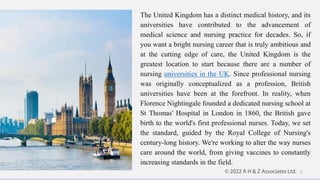
The United Kingdom has a distinct medical history, and its
universities have contributed to the advancement of
medical science and nursing practice for decades. So, if
you want a bright nursing career that is truly ambitious and
at the cutting edge of care, the United Kingdom is the
greatest location to start because there are a number of
nursing universities in the UK. Since professional nursing
was originally conceptualized as a profession, British
universities have been at the forefront. In reality, when
Florence Nightingale founded a dedicated nursing school at
St Thomas' Hospital in London in 1860, the British gave
birth to the world's first professional nurses. Today, we set
the standard, guided by the Royal College of Nursing's
century-long history. We're working to alter the way nurses
care around the world, from giving vaccines to constantly
increasing standards in the field.
2
According to British Council, the
National Health Service, the UK's
world-famous public healthcare
system, provides the majority of that
care. The publicly supported model,
which is now 70 years old, is tightly
intertwined with private practice and
the larger healthcare system, and
much of your coursework will
provide you firsthand knowledge of
how it works. As a result, when you
start practicing professionally, you'll
have a wealth of experience to offer
your employer, regardless of where
you work.
3
Outstanding Teaching Facilities
The United Kingdom is home to three of the world's greatest
nursing schools: King's College London (second), the
University of Southampton (fifth), and the University of
Manchester (sixth) (eighth). Also, a lot of nursing courses in
London universities are available. However, with almost 90
universities providing nearly 500 nursing degrees, you'll have
plenty of options for starting or furthering your nursing career.
Because of the modular nature of university education in the
United Kingdom, you'll be able to specialize as you learn by
selecting the modules that most interest you. So, whether
you're considering a career in midwifery, or you're passionate
about caring for individuals with learning disabilities, or you're
still undecided, you'll find lots of support, information, and
opportunities to help you make your selections and find your
right path.
4
What You’ll Discover at Nursing Universities
A nursing degree in the United Kingdom will immerse
you in every area of nursing theory and practice,
including the real-world issues you'll face after
graduation. The growing need for nurses in the United
Kingdom, combined with a scarcity of competent nurses,
has made nursing a highly competitive field of study.
1.Real-World Experience: You don't have to wait until
you graduate to find out what it's like to care for people
when you study nursing in the UK. Because there are so
many good partnerships between universities and
hospitals all throughout the UK, you'll be able to put
theory into practice almost immediately in a clinical
setting, giving you confidence in your professional role
from the start.
5
2.Cutting-edge Training: You'll also be trained
on the most cutting-edge medical technology to
ensure that you're prepared for the real thing,
wherever you choose to go. You'll be learning
from lecturers who are at the cutting edge of
contemporary medicine, thanks to the newest
medical research coming out of UK universities.
3.English for Medicine: You'll also be trained
on the latest up-to-date medical equipment to
ensure that you're prepared for the real thing, no
matter where you go. You'll be learning from
lecturers who are at the cutting edge of
contemporary medicine, with the latest medical
research coming from UK universities as well.
6
International Entry Requirements for Nurse
Nursing is a very competitive field of study, and
it is critical to demonstrate not only academic
competence but also the necessary personality to
take on such a demanding role while applying.
Students must have strong numeracy and literacy
skills, be excellent communicators, and be able to
operate in a team setting under pressure.
● 30 points is a typical International
Baccalaureate requirement.
● Typical A level Requirements: ABB
● Typical IELTS Requirements: 7.0 overall
with no less than 6.0 in any one component
7
Career after Studying Nursing
A top-up programme is one of the choices
for international students who want to study
nursing in the UK but don't want to commit
to a three- or four-year nursing degree.
Prospective students might think can
international students study nursing in the
UK? Top-up programmes provide a flexible
pathway for overseas students with a
diploma in nursing from a country other than
the United Kingdom to convert to a nursing
degree in an expedited program that could
span anywhere from 12 to 18 months,
depending on the university's policies.
8
International students pursuing a degree
in nursing at the undergraduate or
postgraduate level must complete the
Overseas Nursing Programme (ONP) as
part of their studies. This program
permits international nursing students to
become registered nurses in the United
Kingdom, allowing them to work in
either the NHS or the private sector. As a
trainee, a registered nurse in the United
Kingdom can expect to earn between
£24,970 and £30,615 per year after
earning a nursing degree. With
additional experience and certifications,
this annual compensation will increase.
9
UK Universities Offer Nursing
The growing demand for nurses in the United Kingdom,
along with the shortage of competent nurses, has made
nursing a highly competitive field of study. The growing
demand for nurses in the United Kingdom, along with the
shortage of competent nurses, has made nursing a highly
competitive field of study.
1.Coventry University: The School of Nursing,
Midwifery, and Health at Coventry University is one of the
university's main schools, offering undergraduate,
postgraduate, and doctorate programs in nursing,
midwifery, physiotherapy, occupational therapy, dietetics,
paramedic science, and operating department practice.
Nursing undergraduate and postgraduate applications are
now being accepted for January 2022 admissions.
10
2.University of Hertfordshire: The School of Health and
Social Work has a long-standing reputation as a healthcare
education center of excellence. The university will integrate
your study with the practical experience from the moment you
begin. The University will be home for half of the course. The
other half of your time will be spent gaining practical experience
in a variety of clinical settings. You'll learn about "normal" adult
growth and how to deal with departures from it. In hospitals and
the community, you'll promote health and give actual patient
care. This is where you'll spend half of your time. You'll go to
lectures to learn how to deliver a holistic assessment care plan
that takes into account a person's mental, emotional, and
physical well-being. You'll spend the remaining 50% of your
time in a variety of assignments during the course of your three
years of study, working alongside qualified health care
practitioners.
11
3.De Monfort University: The Nursing and
Midwifery Council (NMC) has validated its courses,
and they benefit from more than 50 years of teaching
expertise as well as rotations in a variety of hospital
and community settings. In 2018, the Nursing and
Midwifery Council proposed new national
educational standards for registered nurses called
Future Nurse Standards of Proficiency. From
September 2021 onwards, the curriculum will be
based on these nurse education standards.
Adult nurses play an important role in healthcare by
restoring and promoting health, supporting patients
and their families, and responding to the diverse
healthcare requirements of individuals or
communities.
12
In the end, most nursing degrees
run for four years, during which
time students will study a wide
range of topics related to nursing.
Compulsory life science courses
will be offered, as well as
internships in various community
and medical centers for students
to obtain personal experience in
their field. During your studies,
you will be exposed to all aspects
of nursing through lectures,
tutorials, practical sessions, and
group work.
13
www.ahzassociates.co.uk
Thanks!
14

Things to Know about Nursing in the UK

  • 1.
    Things to Know aboutNursing in the UK
  • 2.
    The United Kingdomhas a distinct medical history, and its universities have contributed to the advancement of medical science and nursing practice for decades. So, if you want a bright nursing career that is truly ambitious and at the cutting edge of care, the United Kingdom is the greatest location to start because there are a number of nursing universities in the UK. Since professional nursing was originally conceptualized as a profession, British universities have been at the forefront. In reality, when Florence Nightingale founded a dedicated nursing school at St Thomas' Hospital in London in 1860, the British gave birth to the world's first professional nurses. Today, we set the standard, guided by the Royal College of Nursing's century-long history. We're working to alter the way nurses care around the world, from giving vaccines to constantly increasing standards in the field. 2
  • 3.
    According to BritishCouncil, the National Health Service, the UK's world-famous public healthcare system, provides the majority of that care. The publicly supported model, which is now 70 years old, is tightly intertwined with private practice and the larger healthcare system, and much of your coursework will provide you firsthand knowledge of how it works. As a result, when you start practicing professionally, you'll have a wealth of experience to offer your employer, regardless of where you work. 3
  • 4.
    Outstanding Teaching Facilities TheUnited Kingdom is home to three of the world's greatest nursing schools: King's College London (second), the University of Southampton (fifth), and the University of Manchester (sixth) (eighth). Also, a lot of nursing courses in London universities are available. However, with almost 90 universities providing nearly 500 nursing degrees, you'll have plenty of options for starting or furthering your nursing career. Because of the modular nature of university education in the United Kingdom, you'll be able to specialize as you learn by selecting the modules that most interest you. So, whether you're considering a career in midwifery, or you're passionate about caring for individuals with learning disabilities, or you're still undecided, you'll find lots of support, information, and opportunities to help you make your selections and find your right path. 4
  • 5.
    What You’ll Discoverat Nursing Universities A nursing degree in the United Kingdom will immerse you in every area of nursing theory and practice, including the real-world issues you'll face after graduation. The growing need for nurses in the United Kingdom, combined with a scarcity of competent nurses, has made nursing a highly competitive field of study. 1.Real-World Experience: You don't have to wait until you graduate to find out what it's like to care for people when you study nursing in the UK. Because there are so many good partnerships between universities and hospitals all throughout the UK, you'll be able to put theory into practice almost immediately in a clinical setting, giving you confidence in your professional role from the start. 5
  • 6.
    2.Cutting-edge Training: You'llalso be trained on the most cutting-edge medical technology to ensure that you're prepared for the real thing, wherever you choose to go. You'll be learning from lecturers who are at the cutting edge of contemporary medicine, thanks to the newest medical research coming out of UK universities. 3.English for Medicine: You'll also be trained on the latest up-to-date medical equipment to ensure that you're prepared for the real thing, no matter where you go. You'll be learning from lecturers who are at the cutting edge of contemporary medicine, with the latest medical research coming from UK universities as well. 6
  • 7.
    International Entry Requirementsfor Nurse Nursing is a very competitive field of study, and it is critical to demonstrate not only academic competence but also the necessary personality to take on such a demanding role while applying. Students must have strong numeracy and literacy skills, be excellent communicators, and be able to operate in a team setting under pressure. ● 30 points is a typical International Baccalaureate requirement. ● Typical A level Requirements: ABB ● Typical IELTS Requirements: 7.0 overall with no less than 6.0 in any one component 7
  • 8.
    Career after StudyingNursing A top-up programme is one of the choices for international students who want to study nursing in the UK but don't want to commit to a three- or four-year nursing degree. Prospective students might think can international students study nursing in the UK? Top-up programmes provide a flexible pathway for overseas students with a diploma in nursing from a country other than the United Kingdom to convert to a nursing degree in an expedited program that could span anywhere from 12 to 18 months, depending on the university's policies. 8
  • 9.
    International students pursuinga degree in nursing at the undergraduate or postgraduate level must complete the Overseas Nursing Programme (ONP) as part of their studies. This program permits international nursing students to become registered nurses in the United Kingdom, allowing them to work in either the NHS or the private sector. As a trainee, a registered nurse in the United Kingdom can expect to earn between £24,970 and £30,615 per year after earning a nursing degree. With additional experience and certifications, this annual compensation will increase. 9
  • 10.
    UK Universities OfferNursing The growing demand for nurses in the United Kingdom, along with the shortage of competent nurses, has made nursing a highly competitive field of study. The growing demand for nurses in the United Kingdom, along with the shortage of competent nurses, has made nursing a highly competitive field of study. 1.Coventry University: The School of Nursing, Midwifery, and Health at Coventry University is one of the university's main schools, offering undergraduate, postgraduate, and doctorate programs in nursing, midwifery, physiotherapy, occupational therapy, dietetics, paramedic science, and operating department practice. Nursing undergraduate and postgraduate applications are now being accepted for January 2022 admissions. 10
  • 11.
    2.University of Hertfordshire:The School of Health and Social Work has a long-standing reputation as a healthcare education center of excellence. The university will integrate your study with the practical experience from the moment you begin. The University will be home for half of the course. The other half of your time will be spent gaining practical experience in a variety of clinical settings. You'll learn about "normal" adult growth and how to deal with departures from it. In hospitals and the community, you'll promote health and give actual patient care. This is where you'll spend half of your time. You'll go to lectures to learn how to deliver a holistic assessment care plan that takes into account a person's mental, emotional, and physical well-being. You'll spend the remaining 50% of your time in a variety of assignments during the course of your three years of study, working alongside qualified health care practitioners. 11
  • 12.
    3.De Monfort University:The Nursing and Midwifery Council (NMC) has validated its courses, and they benefit from more than 50 years of teaching expertise as well as rotations in a variety of hospital and community settings. In 2018, the Nursing and Midwifery Council proposed new national educational standards for registered nurses called Future Nurse Standards of Proficiency. From September 2021 onwards, the curriculum will be based on these nurse education standards. Adult nurses play an important role in healthcare by restoring and promoting health, supporting patients and their families, and responding to the diverse healthcare requirements of individuals or communities. 12
  • 13.
    In the end,most nursing degrees run for four years, during which time students will study a wide range of topics related to nursing. Compulsory life science courses will be offered, as well as internships in various community and medical centers for students to obtain personal experience in their field. During your studies, you will be exposed to all aspects of nursing through lectures, tutorials, practical sessions, and group work. 13
  • 14.