"information risk management in cybersecurity" Lecture 2
1.
Risk Assessment
Threat assessment
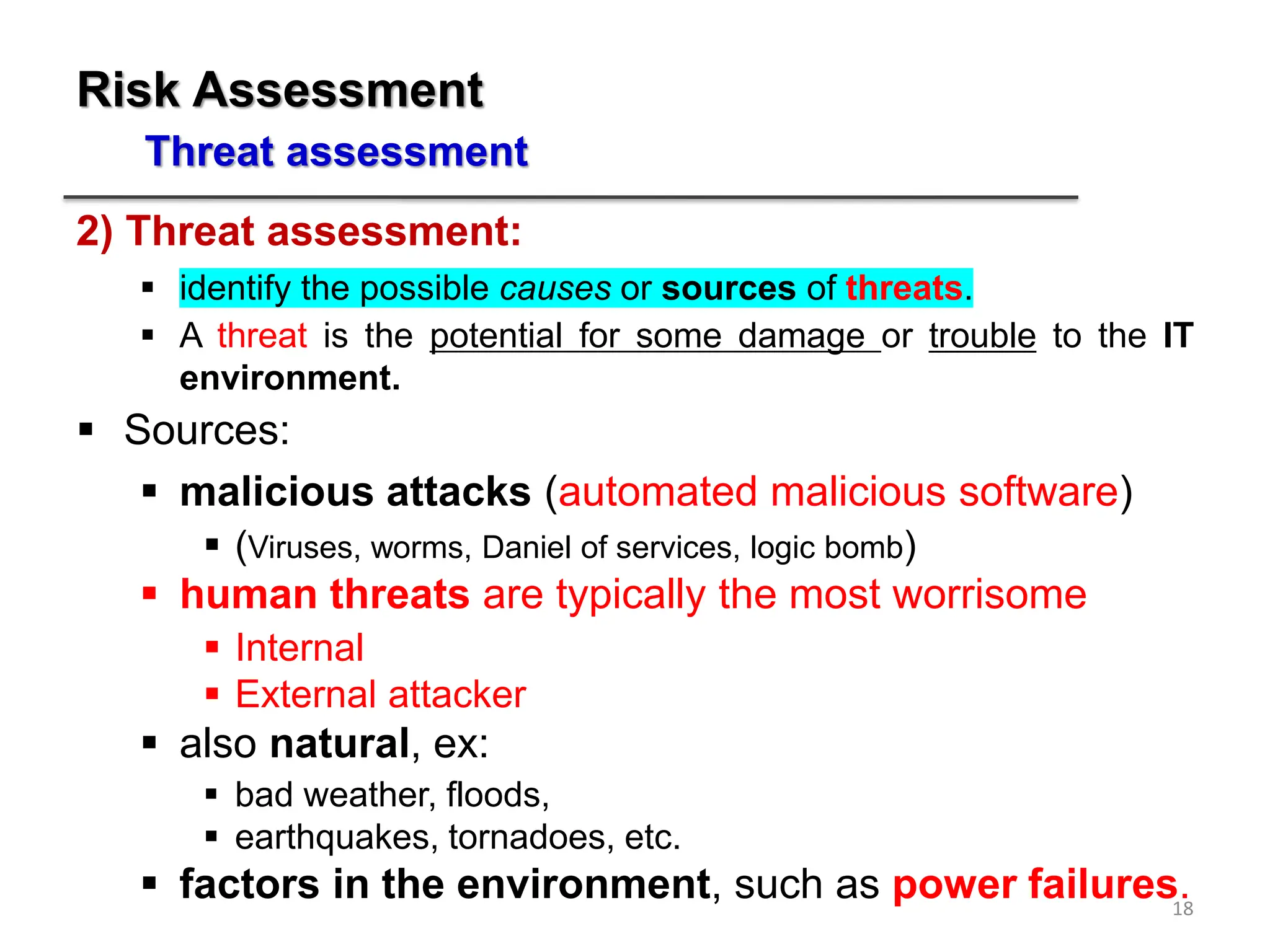
2)Threat assessment:
▪ identify the possible causes or sources of threats.
▪ A threat is the potential for some damage or trouble to the IT
environment.
▪ Sources:
▪ malicious attacks (automated malicious software)
▪ (Viruses, worms, Daniel of services, logic bomb)
▪ human threats are typically the most worrisome
▪ Internal
▪ External attacker
▪ also natural, ex:
▪ bad weather, floods,
▪ earthquakes, tornadoes, etc.
▪ factors in the environment, such as power failures.
18
2.
Risk Assessment
Threat assessment
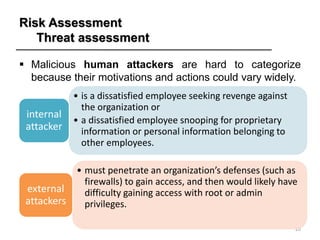
▪Malicious human attackers are hard to categorize
because their motivations and actions could vary widely.
20
• is a dissatisfied employee seeking revenge against
the organization or
• a dissatisfied employee snooping for proprietary
information or personal information belonging to
other employees.
internal
attacker
• must penetrate an organization’s defenses (such as
firewalls) to gain access, and then would likely have
difficulty gaining access with root or admin
privileges.
external
attackers
3.
Risk Assessment
Threat assessment
▪Not all human threats have a malicious intention; for
example, a threat might arise from negligence (such as
forgetting to change a default computer account) or
accident (perhaps misconfiguring a firewall to allow
unwanted traffic, or unknowingly downloading malicious
software).
21
4.
Risk Assessment
Threat assessment
▪In a way, internal attackers are the most worrisome
because they presumably have direct access to an
organization’s valuable assets and perhaps have
computer accounts with high user privileges (e.g., Unix
root or Windows admin).
22
5.
Risk Assessment
Threat assessment
▪External attackers might include:
▪ amateur “hackers” motivated by curiosity or ego,
▪ professional criminals looking for profit or theft,
▪ terrorists seeking destruction or extortion,
▪ military agents motivated by national interests, or
▪ industrial spies attempting to steal proprietary information
for profit.
23
6.
Risk Assessment
Threat assessment
▪External threats might even include automated malicious
software, namely viruses and worms, that spread by
themselves through the internet.
▪ It might be feasible to identify major external threats, but
a possibility always exists for a new unknown external
threat.
24
7.
Risk Assessment
Vulnerability analysis
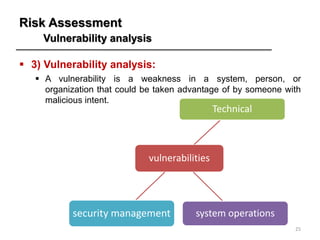
▪3) Vulnerability analysis:
▪ A vulnerability is a weakness in a system, person, or
organization that could be taken advantage of by someone with
malicious intent.
25
vulnerabilities
Technical
system operations
security management
8.
Risk Assessment
Vulnerability analysis
▪3) Vulnerability analysis:
▪ Technical vulnerabilities are perhaps the easiest to
identify by:
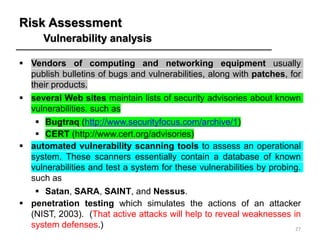
1. Vendors of computing and networking equipment
2. Web sites such as Bugtraq
3. automated vulnerability scanning tools
4. penetration testing
26
9.
Risk Assessment
Vulnerability analysis
▪Vendors of computing and networking equipment usually
publish bulletins of bugs and vulnerabilities, along with patches, for
their products.
▪ several Web sites maintain lists of security advisories about known
vulnerabilities. such as
▪ Bugtraq (http://www.securityfocus.com/archive/1)
▪ CERT (http://www.cert.org/advisories)
▪ automated vulnerability scanning tools to assess an operational
system. These scanners essentially contain a database of known
vulnerabilities and test a system for these vulnerabilities by probing.
such as
▪ Satan, SARA, SAINT, and Nessus.
▪ penetration testing which simulates the actions of an attacker
(NIST, 2003). (That active attacks will help to reveal weaknesses in
system defenses.) 27
10.
Risk Assessment
Vulnerability analysis
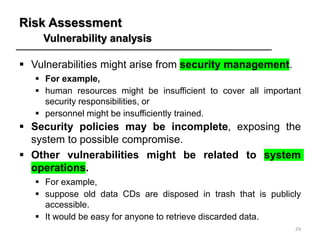
▪Vulnerabilities might arise from security management.
▪ For example,
▪ human resources might be insufficient to cover all important
security responsibilities, or
▪ personnel might be insufficiently trained.
▪ Security policies may be incomplete, exposing the
system to possible compromise.
▪ Other vulnerabilities might be related to system
operations.
▪ For example,
▪ suppose old data CDs are disposed in trash that is publicly
accessible.
▪ It would be easy for anyone to retrieve discarded data.
29
11.
Risk Assessment
Impact analysis
30
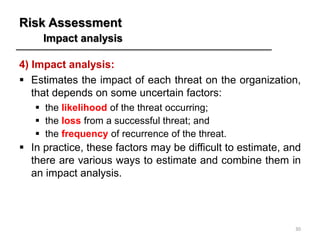
4)Impact analysis:
▪ Estimates the impact of each threat on the organization,
that depends on some uncertain factors:
▪ the likelihood of the threat occurring;
▪ the loss from a successful threat; and
▪ the frequency of recurrence of the threat.
▪ In practice, these factors may be difficult to estimate, and
there are various ways to estimate and combine them in
an impact analysis.