An information report is a piece of text that presents
information about a subject.
Its purpose is to classify and/or describe using facts about the
subject's parts, behaviour and qualities.
The subject isusually generalrather than particular, for example
'skin' rather than an individual person'sskin.
Whenyouwantto present informationaboutanobject,animal,person orplace.
How do wewrite informationreport?
1.Classifications
a. Introduceyourtopic
b. Tell whatthe object oranimalis, whoperson is or
where theplaceis
2.Description
Useparagraphswithtopicsentences to organizethedifferent bundlesof
information.
a.Object :size, shape,features, dynamics,where it is usedoffound.
b.Person :characteristics, where he/she lives ordoes, achievements.
c.Animal : appearance,behaviour, habitat,breeding.
d.Place :size, facts,features.
3.Conclusion(optional)
Youmaywanttomakepersonal commentaboutthe subject ofthe report
A written explanation usually involves three steps:
1.First, there is the general statement about the
event of thing.
2.Nextfollows, a series of paragraphs that tell
the hows andwhys.
3.The final step is aconcluding paragraph.
An information report provides readers with information by providing
them with facts.
Generally, an information report is written to provide facts about living
or non-livingobject. It can be an individual object or agroup of objects.
Somesuggestions are:
Galaxies,SeaCreatures,School,Aircraft,TheTitanic,Pollution.
The challenge in writing a good information report is to provide the
audiencewith plenty of factsand evidence about a topic.
Information reports usuallyinclude the following grammatical
features:
1. technicallanguage related to the subject
2. technicaluse of the timeless present tense
3. technicaluse of general nouns (e.g. galaxies,sea
creatures, school etc.) rather thanproper nouns.
4.technicallinkingverbs to describe behaviours of qualities
(e.g. cells are surrounded by membrane)
1. A GENERAL OPENING STATEMENT IN THE FIRST PARAGRAPH
a.This statementtellsthe audiencewhatthe textis going tobeabout.
b.Thiscan include ashortdescriptionofthesubject.
c.This canincludea definitionofthesubject.
2. A SERIES OFPARAGRAPHS ABOUT THE SUBJECT
a.Eachparagraphusuallybegins with atopicsentence.
b.Thetopic sentencein thebeginning ofeach paragraphpreviews theinformation
containedin the restoftheparagraph.
c.Thesentencesafterthispreview give moredetails.
d.Eachparagraphshouldgive informationaboutone featureofthesubject.
e.Theseparagraphsbuild adescriptionofthe subject ofthereport.
f.Theseparagraphsmayinclude technicallanguage thatis relatedtothe subject.
3. A CONCLUDING PARAGRAPH (Optional)
a.The concluding paragraphsignals theend ofthe text.
b.Thisparagraphcan summarizethe report
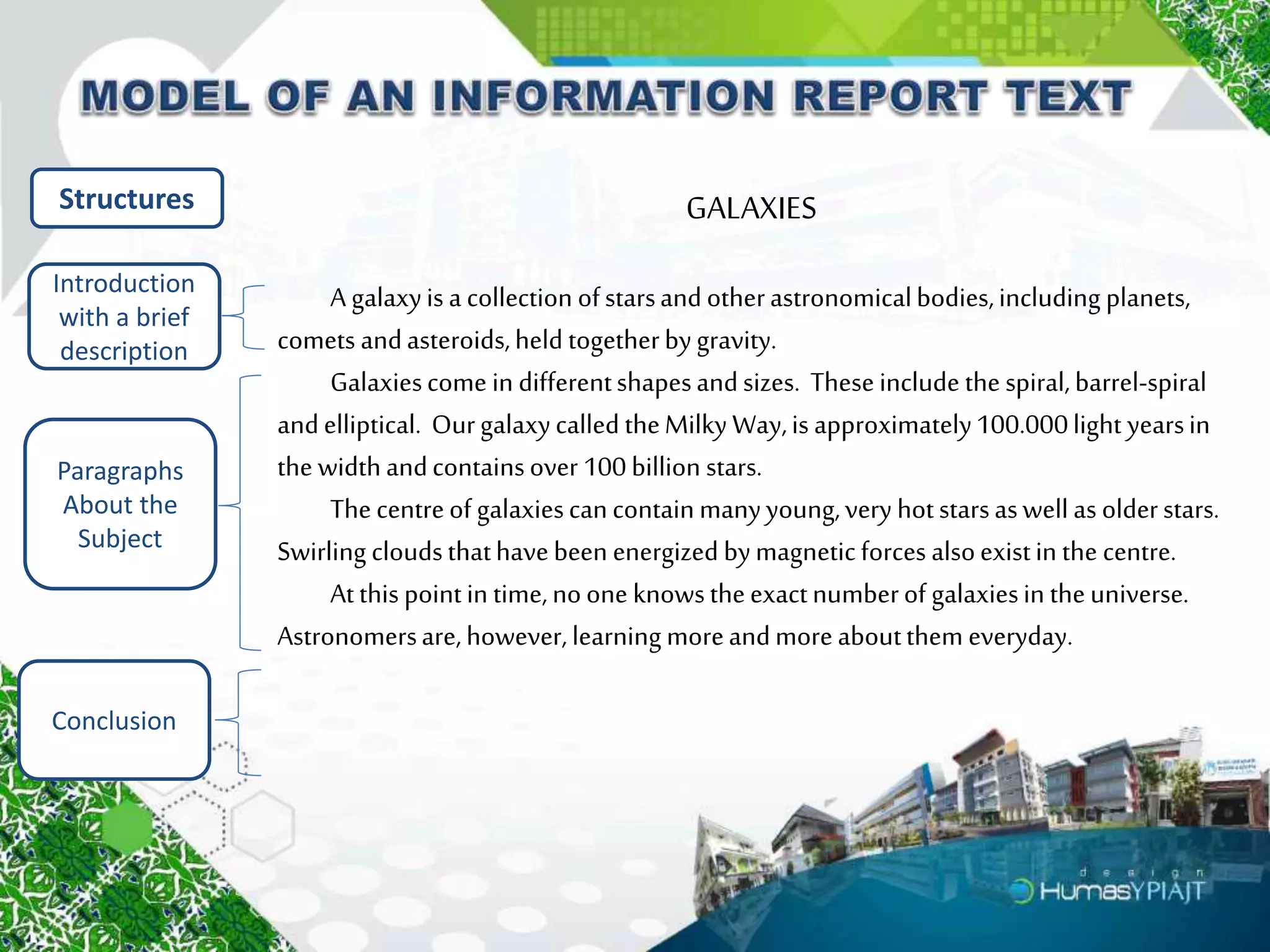
GALAXIES
A galaxyisa collection ofstarsandotherastronomicalbodies,including planets,
comets andasteroids,held togetherbygravity.
Galaxiescome in differentshapesandsizes. Theseinclude the spiral,barrel-spiral
andelliptical. Ourgalaxycalled theMilky Way,is approximately100.000light yearsin
the widthandcontainsover 100billion stars.
Thecentreof galaxiescancontainmanyyoung,very hotstarsaswellas olderstars.
Swirling cloudsthathavebeen energized bymagneticforces alsoexistin the centre.
Atthis pointin time,noone knowstheexactnumberof galaxiesin theuniverse.
Astronomersare,however,learning moreandmoreaboutthem everyday.
Structures
Introduction
with a brief
description
Paragraphs
About the
Subject
Conclusion
GALAXIES
A galaxyisa collection ofstarsandotherastronomicalbodies,including planets,
comets andasteroids,held togetherbygravity.
Galaxiescome in differentshapesandsizes. Theseinclude the spiral,barrel-spiral
andelliptical. Ourgalaxycalled theMilky Way,is approximately100.000light yearsin
the widthandcontainsover 100billion stars.
Thecentreof galaxiescancontainmanyyoung,very hotstarsaswellas olderstars.
Swirling cloudsthathavebeen energized bymagneticforces alsoexistin the centre.
Atthis pointin time,noone knowstheexactnumberof galaxiesin theuniverse.
Astronomersare,however,learning moreandmoreaboutthem everyday.
Grammatical
Features
Timeless
Present
Tense
Technical
Terms
Related to
the Subject
General
Nouns

Information Report Text

  • 1.
    An information reportis a piece of text that presents information about a subject. Its purpose is to classify and/or describe using facts about the subject's parts, behaviour and qualities. The subject isusually generalrather than particular, for example 'skin' rather than an individual person'sskin.
  • 2.
    Whenyouwantto present informationaboutanobject,animal,personorplace. How do wewrite informationreport? 1.Classifications a. Introduceyourtopic b. Tell whatthe object oranimalis, whoperson is or where theplaceis 2.Description Useparagraphswithtopicsentences to organizethedifferent bundlesof information. a.Object :size, shape,features, dynamics,where it is usedoffound. b.Person :characteristics, where he/she lives ordoes, achievements. c.Animal : appearance,behaviour, habitat,breeding. d.Place :size, facts,features. 3.Conclusion(optional) Youmaywanttomakepersonal commentaboutthe subject ofthe report
  • 3.
    A written explanationusually involves three steps: 1.First, there is the general statement about the event of thing. 2.Nextfollows, a series of paragraphs that tell the hows andwhys. 3.The final step is aconcluding paragraph.
  • 4.
    An information reportprovides readers with information by providing them with facts. Generally, an information report is written to provide facts about living or non-livingobject. It can be an individual object or agroup of objects. Somesuggestions are: Galaxies,SeaCreatures,School,Aircraft,TheTitanic,Pollution. The challenge in writing a good information report is to provide the audiencewith plenty of factsand evidence about a topic.
  • 5.
    Information reports usuallyincludethe following grammatical features: 1. technicallanguage related to the subject 2. technicaluse of the timeless present tense 3. technicaluse of general nouns (e.g. galaxies,sea creatures, school etc.) rather thanproper nouns. 4.technicallinkingverbs to describe behaviours of qualities (e.g. cells are surrounded by membrane)
  • 6.
    1. A GENERALOPENING STATEMENT IN THE FIRST PARAGRAPH a.This statementtellsthe audiencewhatthe textis going tobeabout. b.Thiscan include ashortdescriptionofthesubject. c.This canincludea definitionofthesubject. 2. A SERIES OFPARAGRAPHS ABOUT THE SUBJECT a.Eachparagraphusuallybegins with atopicsentence. b.Thetopic sentencein thebeginning ofeach paragraphpreviews theinformation containedin the restoftheparagraph. c.Thesentencesafterthispreview give moredetails. d.Eachparagraphshouldgive informationaboutone featureofthesubject. e.Theseparagraphsbuild adescriptionofthe subject ofthereport. f.Theseparagraphsmayinclude technicallanguage thatis relatedtothe subject. 3. A CONCLUDING PARAGRAPH (Optional) a.The concluding paragraphsignals theend ofthe text. b.Thisparagraphcan summarizethe report
  • 7.
    GALAXIES A galaxyisa collectionofstarsandotherastronomicalbodies,including planets, comets andasteroids,held togetherbygravity. Galaxiescome in differentshapesandsizes. Theseinclude the spiral,barrel-spiral andelliptical. Ourgalaxycalled theMilky Way,is approximately100.000light yearsin the widthandcontainsover 100billion stars. Thecentreof galaxiescancontainmanyyoung,very hotstarsaswellas olderstars. Swirling cloudsthathavebeen energized bymagneticforces alsoexistin the centre. Atthis pointin time,noone knowstheexactnumberof galaxiesin theuniverse. Astronomersare,however,learning moreandmoreaboutthem everyday. Structures Introduction with a brief description Paragraphs About the Subject Conclusion
  • 8.
    GALAXIES A galaxyisa collectionofstarsandotherastronomicalbodies,including planets, comets andasteroids,held togetherbygravity. Galaxiescome in differentshapesandsizes. Theseinclude the spiral,barrel-spiral andelliptical. Ourgalaxycalled theMilky Way,is approximately100.000light yearsin the widthandcontainsover 100billion stars. Thecentreof galaxiescancontainmanyyoung,very hotstarsaswellas olderstars. Swirling cloudsthathavebeen energized bymagneticforces alsoexistin the centre. Atthis pointin time,noone knowstheexactnumberof galaxiesin theuniverse. Astronomersare,however,learning moreandmoreaboutthem everyday. Grammatical Features Timeless Present Tense Technical Terms Related to the Subject General Nouns