THE
INFORMATION
AGE
Dr. Shiela Maglente
STS Instrutor
G–1
Norie Banculo
Erica Manlapas
Angelyn Grecia
Ivo moñeba
CONTENTS
At the end of the lesson the students must:
1. Explain the importance of social media sites to
modern day living.
2. Explain the importance of information for
communication process.
3. Be familiar with the important key elements in
the communication process.
INFORMATION AGE
Also known as the COMPUTER AGE, DIGITAL
AGE, or NEW MEDIA AGE in human history
characterized by the shift from traditional
industry that the Industrial revolution brought
through industrialization, to an economy on
information computerization.
Before the rise of
computers,
information was being
spread using print out
materials, established
by Johannes
Gutenberg.
WHO IS GUTENBERG?
Johannes Gutenberg
A German inventor and craftsman who
introduced letter press printing to Europe with
his movable–type printing press. His version
was the first to spread across the world.
THE PRE– GUTENBERG WORLD
During the time when printing press was
not yet available, information could be
processed in a tendinous manner. Books
were written and produced by hand. They
were made in surfaces of clay, wax papyrus
and parchment.
THE GUTENBERG REVOLUTION
It begun with the introduction of printing
specifically the movable printing press by
Gutenberg.
Books printed in the Gutenberg erawere
called incunabula ( meaning cradle or
birthplace).
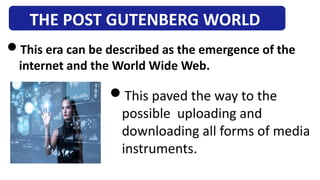
THE POST GUTENBERG WORLD
This era can be described as the emergence of the
internet and the World Wide Web.
This paved the way to the
possible uploading and
downloading all forms of media
instruments.
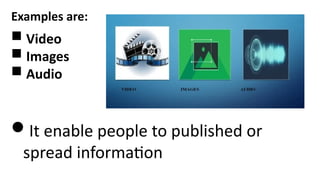
Examples are:
 Video
 Images
 Audio
It enable people to published or
spread information
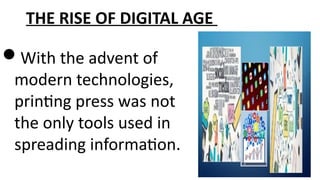
THE RISE OF DIGITAL AGE
With the advent of
modern technologies,
printing press was not
the only tools used in
spreading information.
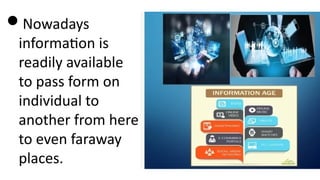
Nowadays
information is
readily available
to pass form on
individual to
another from here
to even faraway
places.
 COMPUTER
Invented by Charles Babbage, known as
the " father of computers".
This technology was designed for
mathematical calculations and simple
decision –making capabilities .
INTERNET
Developed in California, US in the
late 1960's
The internet was mostly used by the
scientists to communicate to other
scientists.
World Wide Web
Commonly known as " WWW".
It was invented by Sir Tim Berners Lee, a
British Computer scientist that started in
1990's.
WWW, was basically invented for
commercial purposes.
Electronic Mail or E–mail
Communication was made easier through
E–mail.
This is the invention of which was
controversially claimed by V.A Shiva
Ayyadurai, an Indian born American
scientist and entrepreneurs.
FACEBOOK
It is a social networking websites
where people could one another
and meet on line to share each
other's thought's ideas, experiences,
photos, and videos which they feel
would be worth sharing .
YOUTUBE
One of the best ways to watch videos
that can also be shared.
It contains videos about enormous
aspects of life through this website.
TWITTER
Created in March 2006 by , Jack
Dorsey, Noah Glass, Biz Tone and Evan
Williams.
It is another networking website where
people post and interact with message
or "Tweets".
MESSENGER
An instant messaging service and
software application.
This can be used to sent messages to
other people through written
messages, voice calls and video calls.
GOOGLE
It offers us a variety of features beyond
searching for words, this may include
synonyms, or words meaning, time zones,
maps, weather forecast , sports score,
calculations, etc.
Also for research or journal articles as
references for these and dissertations.
INSTAGRAM
This can be used to enhance and
give style to your photos which can
later be shared with others using
the same application.
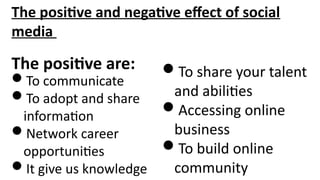
The positive and negative effect of social
media
The positive are:
To communicate
To adopt and share
information
Network career
opportunities
It give us knowledge
To share your talent
and abilities
Accessing online
business
To build online
community
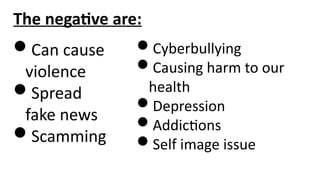
The negative are:
Can cause
violence
Spread
fake news
Scamming
Cyberbullying
Causing harm to our
health
Depression
Addictions
Self image issue
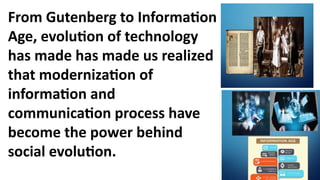
From Gutenberg to Information
Age, evolution of technology
has made has made us realized
that modernization of
information and
communication process have
become the power behind
social evolution.
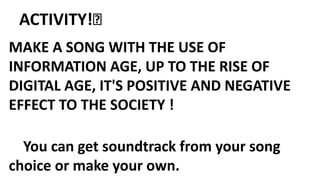
ACTIVITY!💡
MAKE A SONG WITH THE USE OF
INFORMATION AGE, UP TO THE RISE OF
DIGITAL AGE, IT'S POSITIVE AND NEGATIVE
EFFECT TO THE SOCIETY !
You can get soundtrack from your song
choice or make your own.
THANK YOU
Student Science and Technology Exhibition

INFORMATION-AGE-Science, Technology and Society

  • 1.
    THE INFORMATION AGE Dr. Shiela Maglente STSInstrutor G–1 Norie Banculo Erica Manlapas Angelyn Grecia Ivo moñeba
  • 2.
    CONTENTS At the endof the lesson the students must: 1. Explain the importance of social media sites to modern day living. 2. Explain the importance of information for communication process. 3. Be familiar with the important key elements in the communication process.
  • 3.
    INFORMATION AGE Also knownas the COMPUTER AGE, DIGITAL AGE, or NEW MEDIA AGE in human history characterized by the shift from traditional industry that the Industrial revolution brought through industrialization, to an economy on information computerization.
  • 4.
    Before the riseof computers, information was being spread using print out materials, established by Johannes Gutenberg.
  • 5.
    WHO IS GUTENBERG? JohannesGutenberg A German inventor and craftsman who introduced letter press printing to Europe with his movable–type printing press. His version was the first to spread across the world.
  • 6.
    THE PRE– GUTENBERGWORLD During the time when printing press was not yet available, information could be processed in a tendinous manner. Books were written and produced by hand. They were made in surfaces of clay, wax papyrus and parchment.
  • 7.
    THE GUTENBERG REVOLUTION Itbegun with the introduction of printing specifically the movable printing press by Gutenberg. Books printed in the Gutenberg erawere called incunabula ( meaning cradle or birthplace).
  • 8.
    THE POST GUTENBERGWORLD This era can be described as the emergence of the internet and the World Wide Web. This paved the way to the possible uploading and downloading all forms of media instruments.
  • 9.
    Examples are:  Video Images  Audio It enable people to published or spread information
  • 10.
    THE RISE OFDIGITAL AGE With the advent of modern technologies, printing press was not the only tools used in spreading information.
  • 11.
    Nowadays information is readily available topass form on individual to another from here to even faraway places.
  • 12.
     COMPUTER Invented byCharles Babbage, known as the " father of computers". This technology was designed for mathematical calculations and simple decision –making capabilities .
  • 13.
    INTERNET Developed in California,US in the late 1960's The internet was mostly used by the scientists to communicate to other scientists.
  • 14.
    World Wide Web Commonlyknown as " WWW". It was invented by Sir Tim Berners Lee, a British Computer scientist that started in 1990's. WWW, was basically invented for commercial purposes.
  • 15.
    Electronic Mail orE–mail Communication was made easier through E–mail. This is the invention of which was controversially claimed by V.A Shiva Ayyadurai, an Indian born American scientist and entrepreneurs.
  • 16.
    FACEBOOK It is asocial networking websites where people could one another and meet on line to share each other's thought's ideas, experiences, photos, and videos which they feel would be worth sharing .
  • 17.
    YOUTUBE One of thebest ways to watch videos that can also be shared. It contains videos about enormous aspects of life through this website.
  • 18.
    TWITTER Created in March2006 by , Jack Dorsey, Noah Glass, Biz Tone and Evan Williams. It is another networking website where people post and interact with message or "Tweets".
  • 19.
    MESSENGER An instant messagingservice and software application. This can be used to sent messages to other people through written messages, voice calls and video calls.
  • 20.
    GOOGLE It offers usa variety of features beyond searching for words, this may include synonyms, or words meaning, time zones, maps, weather forecast , sports score, calculations, etc. Also for research or journal articles as references for these and dissertations.
  • 21.
    INSTAGRAM This can beused to enhance and give style to your photos which can later be shared with others using the same application.
  • 22.
    The positive andnegative effect of social media The positive are: To communicate To adopt and share information Network career opportunities It give us knowledge To share your talent and abilities Accessing online business To build online community
  • 23.
    The negative are: Cancause violence Spread fake news Scamming Cyberbullying Causing harm to our health Depression Addictions Self image issue
  • 24.
    From Gutenberg toInformation Age, evolution of technology has made has made us realized that modernization of information and communication process have become the power behind social evolution.
  • 25.
    ACTIVITY!💡 MAKE A SONGWITH THE USE OF INFORMATION AGE, UP TO THE RISE OF DIGITAL AGE, IT'S POSITIVE AND NEGATIVE EFFECT TO THE SOCIETY ! You can get soundtrack from your song choice or make your own.
  • 26.
    THANK YOU Student Scienceand Technology Exhibition