Chapter 10
Influence
and
Negotiation
Learning Objectives
• After studying this chapter, you should be
able to explain:
– What persuasion is and its role in the
influence process
– Six primary approaches to influence
– Negotiations
– International applications and concerns
Persuasion
• Persuasion and influence are not identical.
• Persuasion is a change in a private
attitude or belief resulting from the receipt
of a message.
• Influence is an action that leads to a
change in behavior.
• Persuasion is a deeper form of change
than influence.
Persuasion
• Cognitive response model of
persuasion: A model that views the most
direct cause of persuasion as the self-talk
of the target audience, not the persuasion
method itself or its deliverer.
Persuasion
• Reasons why people may respond to a
persuasive message:
– Many people would like to build a more
accurate view of the world and how it works.
– People would like to be consistent with their
own values (the consistency principle) in
order to avoid cognitive dissonance.
– People also care about what others think.
Influence
• Social influence: Encouraging a change
in behavior that was caused by real or
imagined external pressure.
• Three behavior outcomes deriving from a
successful influence attempt:
– Conformity
– Compliance
– Obedience
Influence
• Conformity: Changing one’s behavior to
match the perceived requirements of
others.
• Compliance: The act of changing one’s
behavior in response to a direct request.
• Obedience: Changing one’s behavior in
response to a directive from an authority
figure.
Influence
• Six universal principles of influence
– Social proof: A principle of influence that
states people are more likely to want to do
something if they believe that many others are
doing the same thing or buying the same
product.
– Authority: A principle of influence that states
people are more likely to say yes to a request
or purchase a product if an authority says it is
good to do so.
Influence
• Six universal principles of influence (cont.)
– Liking: A principle of influence that holds that
people are more likely to be influenced by
those whom they like or with whom they have
similarities.
– Consistency: A principle of influence that
indicates how people are influenced by
showing how their previous statements or
stated values fit with a recommendation or
request.
Influence
• Six universal principles of influence (cont.)
– Reciprocation: A principle of influence that
states people are more likely to say yes to a
request when the requester has done
something for that person in the past.
– Scarcity: A principle of influence that argues
that people are more likely to buy a product or
want to do something that they perceive as
scarce, unique, or dwindling in availability.
Influence
• Social proof
– People like to follow the crowd.
– It is helpful to appeal to what the larger group
is doing.
– Using an opinion leader (or two) is quite
important.
– People faced with strong group consensus
sometimes go along even though they think
the others may be incorrect.
Influence
• Social proof (cont.)
– Social validation is important in cultures with
high group cohesiveness (East Asia).
– To encourage a behavior, show that many
others are doing that same thing, particularly
people who are similar to those you are trying
to influence.
– To discourage a behavior, do not say that
many others are doing the action you want to
discourage.
Influence
• Authority
– The authority principle is helpful to some
extent because we do not have time to
evaluate every decision we make.
– Studies by Stanley Milgram.
– People are more influenced by those who
display their credentials and awards as a
signal of their authority.
Influence
• Liking
– People seek opinions from and are thus
influenced by those who they like, are similar
to, or feel connected with in some way.
– Similarity increases liking.
– Differences decrease liking and thus
influence.
– Managers can use similarities to build
relations with external and internal customers.
Influence
• Liking (cont.)
– Praise can establish liking while criticism can
have the opposite effect.
– Able managers can use praise to repair an
already damaged relationship.
– There are cultures where negative comments
may be even more damaging than in others.
– Focusing on others’ needs instead of talking
about what you want can establish liking.
Influence
• Consistency
– Once individuals go on record in favor of an
idea or product, they typically prefer to stick to
that position.
– Thus, seemingly insignificant commitments
can lead to large behavior changes.
– Decision makers have a tendency to escalate
their commitments to decisions that are not
working out and should be terminated.
Influence
• Reciprocation
– People are more willing to comply with
requests from those who have provided
something to them first.
– Gifts can increase the number of donations.
– Balanced reciprocity: Securing a promise of
a near-immediate return for a favor done or a
gift given; thought to be particularly important
in China and in ethnic Chinese communities
around the world.
Influence
• Scarcity
– People find objects and opportunities more
attractive to the degree that they are scarce.
– Reactance: When we are told that we cannot
have or do something, then we want it more.
– Scarcity does not just influence consumers
but also can be influential inside firms as well.
Negotiations
• Negotiating: A process in which at least
two partners with different needs and
viewpoints try to reach agreement on
matters of mutual interest.
Negotiations
• Cognitive shortcuts and negotiation
– Even in the careful, studied process of a long
negotiation, decisions can be affected by:
• Availability
• Loss aversion
• Consistency
• Other heuristics
Negotiations
• Balance of power
– In any negotiation, one side may have more
leverage.
– It is not always clear which firm has the power
in a relationship.
– Negotiating skill is especially critical because
it can help maximize what you receive from
the negotiations.
Negotiations
• Types of negotiations
– Distributive (or fixed-pie) negotiations: This
type assumes a fixed set of resources to
bargain over, although this assumption may
not be accurate and should be challenged by
the other side.
– Integrative (or expanding-pie) negotiations:
This type looks aggressively for win-win
solutions that also enlarge the resources that
both sides might capture in negotiations.
The Negotiation Process
• Common biases that appear at the start of
a negotiation:
– Unrealistic expectations
– Anchors
– Escalation of commitment
The Negotiation Process
• The Best Alternative to a Negotiated
Agreement (BATNA)
– Decisions should not be evaluated in
isolation, but must be assessed in the context
of other reasonable alternatives at hand.
– Negotiators must be fully aware of their
alternatives.
– It is better to quit a lengthy negotiation than to
accept a deal at a loss.
The Negotiation Process
• The importance of information
– Having well-organized and relevant
information is crucial to effective negotiations.
– It is important to collect as much information
as possible because most negotiators will not
offer the information up front.
The Negotiation Process
• The importance of information - Common
biases:
– Most people make decisions based on vivid
experiences and events – Unfortunately,
memory is often selective and subject to the
availability heuristic.
– Individuals are often as impressed by the
theatricality of a presentation as its
substance.
The Negotiation Process
• A reservation price is the firm’s absolute
bottom price that is acceptable.
• Target price is the value that you would like to
have.
• Impasse: When a manager and his or her
negotiating partner cannot reach an agreement.
• Ultimatum: Requiring someone or a group to do
specific thing in a specific way in order for
negotiations to continue.
The Negotiation Process
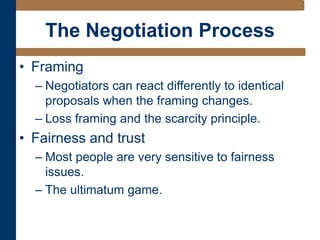
• Framing
– Negotiators can react differently to identical
proposals when the framing changes.
– Loss framing and the scarcity principle.
• Fairness and trust
– Most people are very sensitive to fairness
issues.
– The ultimatum game.
The Negotiation Process
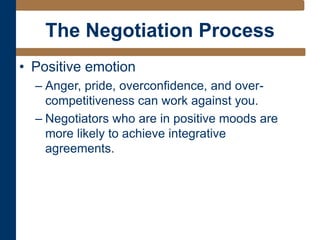
• Positive emotion
– Anger, pride, overconfidence, and over-
competitiveness can work against you.
– Negotiators who are in positive moods are
more likely to achieve integrative
agreements.
The Negotiation Process
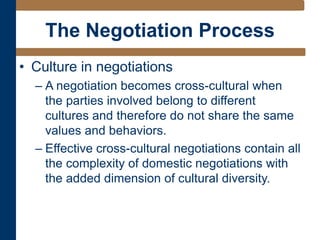
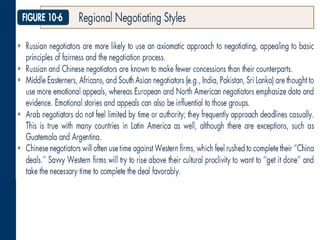
• Culture in negotiations
– A negotiation becomes cross-cultural when
the parties involved belong to different
cultures and therefore do not share the same
values and behaviors.
– Effective cross-cultural negotiations contain all
the complexity of domestic negotiations with
the added dimension of cultural diversity.
Influence  and  Negotiation

Influence and Negotiation

  • 1.
  • 2.
    Learning Objectives • Afterstudying this chapter, you should be able to explain: – What persuasion is and its role in the influence process – Six primary approaches to influence – Negotiations – International applications and concerns
  • 3.
    Persuasion • Persuasion andinfluence are not identical. • Persuasion is a change in a private attitude or belief resulting from the receipt of a message. • Influence is an action that leads to a change in behavior. • Persuasion is a deeper form of change than influence.
  • 4.
    Persuasion • Cognitive responsemodel of persuasion: A model that views the most direct cause of persuasion as the self-talk of the target audience, not the persuasion method itself or its deliverer.
  • 5.
    Persuasion • Reasons whypeople may respond to a persuasive message: – Many people would like to build a more accurate view of the world and how it works. – People would like to be consistent with their own values (the consistency principle) in order to avoid cognitive dissonance. – People also care about what others think.
  • 6.
    Influence • Social influence:Encouraging a change in behavior that was caused by real or imagined external pressure. • Three behavior outcomes deriving from a successful influence attempt: – Conformity – Compliance – Obedience
  • 7.
    Influence • Conformity: Changingone’s behavior to match the perceived requirements of others. • Compliance: The act of changing one’s behavior in response to a direct request. • Obedience: Changing one’s behavior in response to a directive from an authority figure.
  • 8.
    Influence • Six universalprinciples of influence – Social proof: A principle of influence that states people are more likely to want to do something if they believe that many others are doing the same thing or buying the same product. – Authority: A principle of influence that states people are more likely to say yes to a request or purchase a product if an authority says it is good to do so.
  • 9.
    Influence • Six universalprinciples of influence (cont.) – Liking: A principle of influence that holds that people are more likely to be influenced by those whom they like or with whom they have similarities. – Consistency: A principle of influence that indicates how people are influenced by showing how their previous statements or stated values fit with a recommendation or request.
  • 10.
    Influence • Six universalprinciples of influence (cont.) – Reciprocation: A principle of influence that states people are more likely to say yes to a request when the requester has done something for that person in the past. – Scarcity: A principle of influence that argues that people are more likely to buy a product or want to do something that they perceive as scarce, unique, or dwindling in availability.
  • 11.
    Influence • Social proof –People like to follow the crowd. – It is helpful to appeal to what the larger group is doing. – Using an opinion leader (or two) is quite important. – People faced with strong group consensus sometimes go along even though they think the others may be incorrect.
  • 12.
    Influence • Social proof(cont.) – Social validation is important in cultures with high group cohesiveness (East Asia). – To encourage a behavior, show that many others are doing that same thing, particularly people who are similar to those you are trying to influence. – To discourage a behavior, do not say that many others are doing the action you want to discourage.
  • 13.
    Influence • Authority – Theauthority principle is helpful to some extent because we do not have time to evaluate every decision we make. – Studies by Stanley Milgram. – People are more influenced by those who display their credentials and awards as a signal of their authority.
  • 14.
    Influence • Liking – Peopleseek opinions from and are thus influenced by those who they like, are similar to, or feel connected with in some way. – Similarity increases liking. – Differences decrease liking and thus influence. – Managers can use similarities to build relations with external and internal customers.
  • 15.
    Influence • Liking (cont.) –Praise can establish liking while criticism can have the opposite effect. – Able managers can use praise to repair an already damaged relationship. – There are cultures where negative comments may be even more damaging than in others. – Focusing on others’ needs instead of talking about what you want can establish liking.
  • 16.
    Influence • Consistency – Onceindividuals go on record in favor of an idea or product, they typically prefer to stick to that position. – Thus, seemingly insignificant commitments can lead to large behavior changes. – Decision makers have a tendency to escalate their commitments to decisions that are not working out and should be terminated.
  • 17.
    Influence • Reciprocation – Peopleare more willing to comply with requests from those who have provided something to them first. – Gifts can increase the number of donations. – Balanced reciprocity: Securing a promise of a near-immediate return for a favor done or a gift given; thought to be particularly important in China and in ethnic Chinese communities around the world.
  • 18.
    Influence • Scarcity – Peoplefind objects and opportunities more attractive to the degree that they are scarce. – Reactance: When we are told that we cannot have or do something, then we want it more. – Scarcity does not just influence consumers but also can be influential inside firms as well.
  • 19.
    Negotiations • Negotiating: Aprocess in which at least two partners with different needs and viewpoints try to reach agreement on matters of mutual interest.
  • 20.
    Negotiations • Cognitive shortcutsand negotiation – Even in the careful, studied process of a long negotiation, decisions can be affected by: • Availability • Loss aversion • Consistency • Other heuristics
  • 21.
    Negotiations • Balance ofpower – In any negotiation, one side may have more leverage. – It is not always clear which firm has the power in a relationship. – Negotiating skill is especially critical because it can help maximize what you receive from the negotiations.
  • 22.
    Negotiations • Types ofnegotiations – Distributive (or fixed-pie) negotiations: This type assumes a fixed set of resources to bargain over, although this assumption may not be accurate and should be challenged by the other side. – Integrative (or expanding-pie) negotiations: This type looks aggressively for win-win solutions that also enlarge the resources that both sides might capture in negotiations.
  • 23.
    The Negotiation Process •Common biases that appear at the start of a negotiation: – Unrealistic expectations – Anchors – Escalation of commitment
  • 24.
    The Negotiation Process •The Best Alternative to a Negotiated Agreement (BATNA) – Decisions should not be evaluated in isolation, but must be assessed in the context of other reasonable alternatives at hand. – Negotiators must be fully aware of their alternatives. – It is better to quit a lengthy negotiation than to accept a deal at a loss.
  • 25.
    The Negotiation Process •The importance of information – Having well-organized and relevant information is crucial to effective negotiations. – It is important to collect as much information as possible because most negotiators will not offer the information up front.
  • 26.
    The Negotiation Process •The importance of information - Common biases: – Most people make decisions based on vivid experiences and events – Unfortunately, memory is often selective and subject to the availability heuristic. – Individuals are often as impressed by the theatricality of a presentation as its substance.
  • 27.
    The Negotiation Process •A reservation price is the firm’s absolute bottom price that is acceptable. • Target price is the value that you would like to have. • Impasse: When a manager and his or her negotiating partner cannot reach an agreement. • Ultimatum: Requiring someone or a group to do specific thing in a specific way in order for negotiations to continue.
  • 28.
    The Negotiation Process •Framing – Negotiators can react differently to identical proposals when the framing changes. – Loss framing and the scarcity principle. • Fairness and trust – Most people are very sensitive to fairness issues. – The ultimatum game.
  • 29.
    The Negotiation Process •Positive emotion – Anger, pride, overconfidence, and over- competitiveness can work against you. – Negotiators who are in positive moods are more likely to achieve integrative agreements.
  • 30.
    The Negotiation Process •Culture in negotiations – A negotiation becomes cross-cultural when the parties involved belong to different cultures and therefore do not share the same values and behaviors. – Effective cross-cultural negotiations contain all the complexity of domestic negotiations with the added dimension of cultural diversity.