Inflation
In economics, inflationis a rise in the general
level of prices of goods and services in an
economy over a period of time. When the
general price level rises, each unit of currency
buys fewer goods and services.
3.
Definitions of inflation
Accordingto Webster's “An increase in the
amount of currency in circulation, resulting in a
relatively sharp and sudden fall in its value and
rise in prices: it may be caused by an increase
in the volume of paper money issued, or a
relative increase in expenditures as when the
supply of goods fails to meet the demand”.
According to Prof. Samuelson “inflation occurs
when general level of prices & cost are rising”.
DEMAND-PULL INFLATION
Any inflationthat results from an increase in
demand is called demand-pull inflation
• Caused by
Increased Incomes
Decreased income taxes
Decreased tendency to save
Consumers expect prices to rise in the future
More money in the economy
6.
COST-PUSH INFLATION
Any inflationthat results from a decrease in
supply is called cost-push inflation.
• Caused by
Increased costs of raw materials
Increased Wages
Failure to replace capital goods as they age,
reducing its productivity, or increasing its
maintenance costs
Falling Productivity of workers
7.
Measuring Inflation
Producer PriceIndex
•The PPI measures the average change in the sale prices for the entire
domestic market of raw goods and services.
•These goods and services are bought by consumers from their primary
producers, bought indirectly from retail sellers and purchased by
producers themselves.
•The PPI comprises prices of both capital equipment and consumer
goods.
•The industries that compile the PPI include mining, manufacturing,
agriculture, fishing, forestry, natural gas, electricity, construction, waste
and scrap materials.
•Sales and excise taxes are not taken into account while determining
PPI.
8.
The Consumer PriceIndex
– Economists have developed a measure called the
consumer price index (CPI),
– Which is based on a typical market basket of goods and
services required by the average consumer.
– This market basket usually consists of items from eight
major group
1. Food and beverages
2. Housing
3. Apparel
4. Transportation
5. Medical care
6. Entertainment
7. Personal care
8. Other goods and services
9.
The Consumer PriceIndex
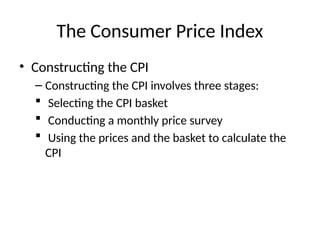
• Constructing the CPI
– Constructing the CPI involves three stages:
Selecting the CPI basket
Conducting a monthly price survey
Using the prices and the basket to calculate the
CPI
10.
The Consumer PriceIndex
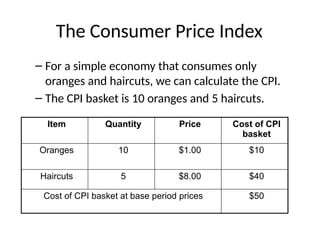
– For a simple economy that consumes only
oranges and haircuts, we can calculate the CPI.
– The CPI basket is 10 oranges and 5 haircuts.
Item Quantity Price Cost of CPI
basket
Oranges 10 $1.00 $10
Haircuts 5 $8.00 $40
Cost of CPI basket at base period prices $50
11.
The Consumer PriceIndex
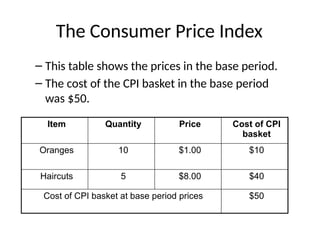
– This table shows the prices in the base period.
– The cost of the CPI basket in the base period
was $50.
Item Quantity Price Cost of CPI
basket
Oranges 10 $1.00 $10
Haircuts 5 $8.00 $40
Cost of CPI basket at base period prices $50
12.
The Consumer PriceIndex
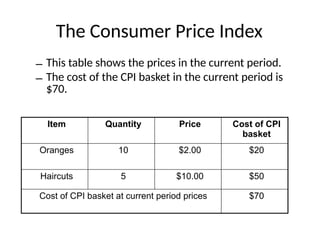
Item Quantity Price Cost of CPI
basket
Oranges 10 $2.00 $20
Haircuts 5 $10.00 $50
Cost of CPI basket at current period prices $70
– This table shows the prices in the current period.
– The cost of the CPI basket in the current period is
$70.
13.
The Consumer PriceIndex
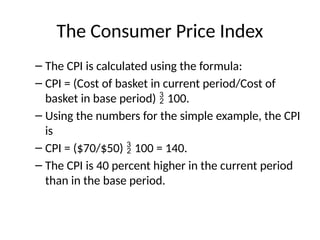
– The CPI is calculated using the formula:
– CPI = (Cost of basket in current period/Cost of
basket in base period) 100.
– Using the numbers for the simple example, the CPI
is
– CPI = ($70/$50) 100 = 140.
– The CPI is 40 percent higher in the current period
than in the base period.
14.
The Consumer PriceIndex
• Measuring Inflation
– The main purpose of the CPI is to measure
inflation.
– The inflation rate is the percentage change in the
price level from one year to the next.
– The inflation formula is:
– Inflation rate = [(CPI this year – CPI last year)/CPI
last year] 100.
15.
Difference between PPIand CPI
• The first difference between the indexes is the targeted goods and services.
The producer price index focuses on the whole output of producers. This
index is very broad, including not only the goods and services purchased by
producers as inputs in their own operations or as investment, but also
includes goods and services bought by consumers from retail sellers and
directly from the producer.
In contrast, the consumer price index targets goods and services that are
bought for consumption by urban residents. The CPI includes imports; the
PPI does not.
• The second fundamental difference between the indexes includes the prices.
In the producer price index, taxes are not included for the producer's returns.
Conversely, the consumer price index includes taxes because these factors
do directly impact the consumer by having to pay more for the goods and
services.
16.
Controlling inflation
There arebroadly two ways of controlling inflation in an
economy:
•
1). Monetary measures
2). Fiscal measures
Monetary Measures
• The most important and commonly used method to control
inflation is monetary policy of the Central Bank. Most central
banks use high interest rates as the traditional way to fight or
prevent inflation.
17.
Monetary measures usedto control inflation include:
(i) Bank rate policy
(ii) CRR
(iii) Open market operations
18.
Fiscal measures tocontrol inflation include:
(i)Increase in Taxes
(ii) Increase in savings
(iii) surplus budgets

![The Consumer Price Index
• Measuring Inflation
– The main purpose of the CPI is to measure
inflation.
– The inflation rate is the percentage change in the
price level from one year to the next.
– The inflation formula is:
– Inflation rate = [(CPI this year – CPI last year)/CPI
last year] 100.](https://image.slidesharecdn.com/inflation-250329145301-e8d50d8a/85/Inflation-pptxInflation-pptxInflation-pptx-14-320.jpg)