Arithmetic Expressions
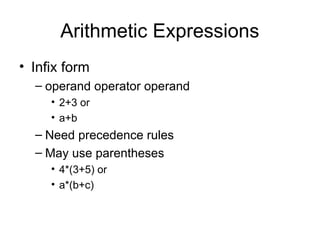
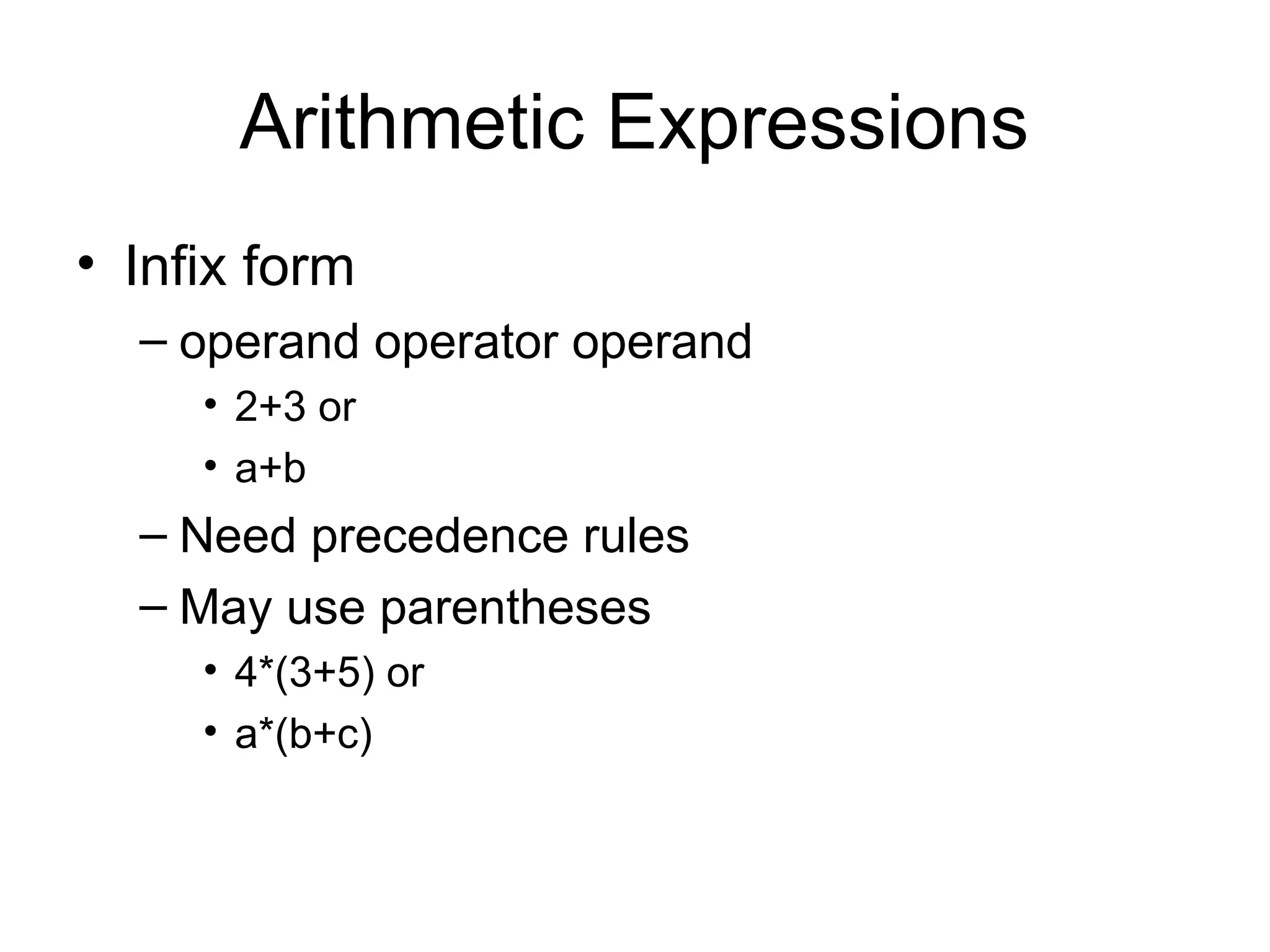
• Infix form
– operand operator operand
• 2+3 or
• a+b
– Need precedence rules
– May use parentheses
• 4*(3+5) or
• a*(b+c)
Arithmetic Expressions
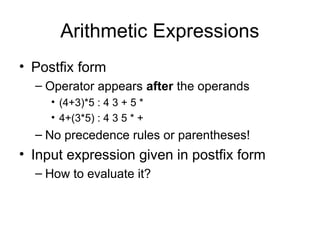
• Postfix form
– Operator appears after the operands
• (4+3)*5 : 4 3 + 5 *
• 4+(3*5) : 4 3 5 * +
– No precedence rules or parentheses!
• Input expression given in postfix form
– How to evaluate it?
Evaluating Postfix Expressions
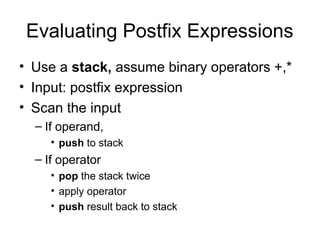
• Use a stack, assume binary operators +,*
• Input: postfix expression
• Scan the input
– If operand,
• push to stack
– If operator
• pop the stack twice
• apply operator
• push result back to stack
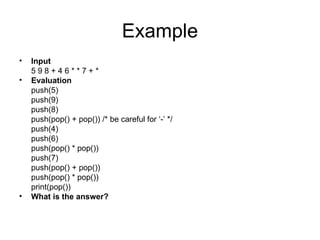
Example
• Input
5 9 8 + 4 6 * * 7 + *
• Evaluation
push(5)
push(9)
push(8)
push(pop() + pop()) /* be careful for ‘-’ */
push(4)
push(6)
push(pop() * pop())
push(7)
push(pop() + pop())
push(pop() * pop())
print(pop())
• What is the answer?
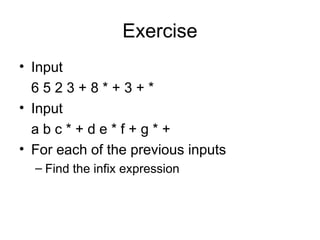
Exercise
• Input
6 5 2 3 + 8 * + 3 + *
• Input
a b c * + d e * f + g * +
• For each of the previous inputs
– Find the infix expression
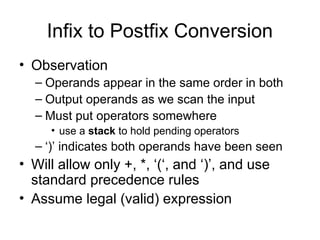
Infix to Postfix Conversion
• Observation
– Operands appear in the same order in both
– Output operands as we scan the input
– Must put operators somewhere
• use a stack to hold pending operators
– ‘)’ indicates both operands have been seen
• Will allow only +, *, ‘(‘, and ‘)’, and use
standard precedence rules
• Assume legal (valid) expression
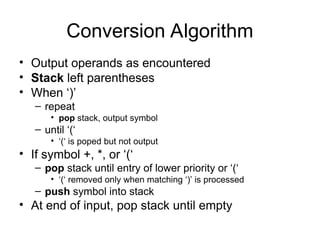
Conversion Algorithm
• Output operands as encountered
• Stack left parentheses
• When ‘)’
– repeat
• pop stack, output symbol
– until ‘(‘
• ‘(‘ is poped but not output
• If symbol +, *, or ‘(‘
– pop stack until entry of lower priority or ‘(‘
• ‘(‘ removed only when matching ‘)’ is processed
– push symbol into stack
• At end of input, pop stack until empty
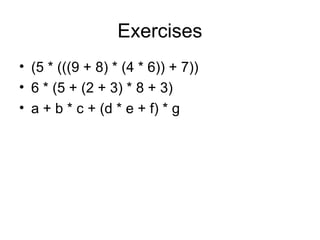
Exercises
• (5 * (((9 + 8) * (4 * 6)) + 7))
• 6 * (5 + (2 + 3) * 8 + 3)
• a + b * c + (d * e + f) * g

Arithmetic notation conversion infix to1

  • 1.
    Arithmetic Expressions • Infixform – operand operator operand • 2+3 or • a+b – Need precedence rules – May use parentheses • 4*(3+5) or • a*(b+c)
  • 2.
    Arithmetic Expressions • Postfixform – Operator appears after the operands • (4+3)*5 : 4 3 + 5 * • 4+(3*5) : 4 3 5 * + – No precedence rules or parentheses! • Input expression given in postfix form – How to evaluate it?
  • 3.
    Evaluating Postfix Expressions •Use a stack, assume binary operators +,* • Input: postfix expression • Scan the input – If operand, • push to stack – If operator • pop the stack twice • apply operator • push result back to stack
  • 4.
    Example • Input 5 98 + 4 6 * * 7 + * • Evaluation push(5) push(9) push(8) push(pop() + pop()) /* be careful for ‘-’ */ push(4) push(6) push(pop() * pop()) push(7) push(pop() + pop()) push(pop() * pop()) print(pop()) • What is the answer?
  • 5.
    Exercise • Input 6 52 3 + 8 * + 3 + * • Input a b c * + d e * f + g * + • For each of the previous inputs – Find the infix expression
  • 6.
    Infix to PostfixConversion • Observation – Operands appear in the same order in both – Output operands as we scan the input – Must put operators somewhere • use a stack to hold pending operators – ‘)’ indicates both operands have been seen • Will allow only +, *, ‘(‘, and ‘)’, and use standard precedence rules • Assume legal (valid) expression
  • 7.
    Conversion Algorithm • Outputoperands as encountered • Stack left parentheses • When ‘)’ – repeat • pop stack, output symbol – until ‘(‘ • ‘(‘ is poped but not output • If symbol +, *, or ‘(‘ – pop stack until entry of lower priority or ‘(‘ • ‘(‘ removed only when matching ‘)’ is processed – push symbol into stack • At end of input, pop stack until empty
  • 8.
    Exercises • (5 *(((9 + 8) * (4 * 6)) + 7)) • 6 * (5 + (2 + 3) * 8 + 3) • a + b * c + (d * e + f) * g