Infinity and its Cardinality   Robin K. Hill 6 February, 2012 University of Wyoming
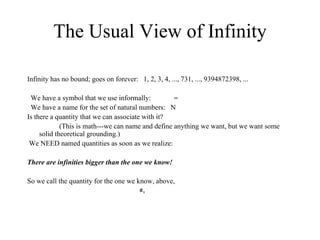
The Usual View of Infinity Infinity has no bound; goes on forever:  1, 2, 3, 4, ..., 731, ..., 9394872398, ...   We have a symbol that we use informally:  We have a name for the set of natural numbers:   N Is there a quantity that we can associate with it?   (This is math---we can name and define anything we want, but we want some solid theoretical grounding.)   We NEED named quantities as soon as we realize: There are infinities bigger than the one we know!   So we call the quantity for the one we know, above,   
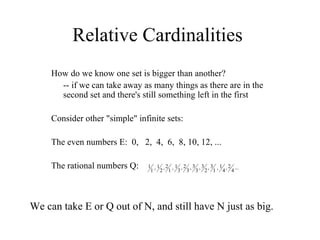
Relative Cardinalities   How do we know one set is bigger than another?  -- if we can take away as many things as there are in the second set and there's still something left in the first   Consider other "simple" infinite sets:   The even numbers E:  0,  2,  4,  6,  8, 10, 12, ...   The rational numbers Q:   We can take E or Q out of N, and still have N just as big.
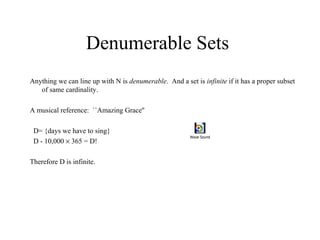
Denumerable Sets   Anything we can line up with N is  denumerable .  And a set is  infinite  if it has a proper subset of same cardinality.   A musical reference:  ``Amazing Grace''   D= {days we have to sing} D - 10,000    365 = D!   Therefore D is infinite.
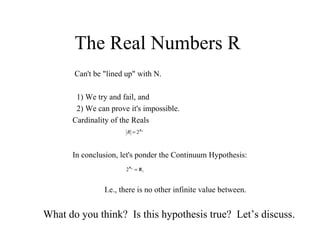
The Real Numbers R   Can't be "lined up" with N.   1) We try and fail, and 2) We can prove it's impossible. Cardinality of the Reals In conclusion, let's ponder the Continuum Hypothesis:    I.e., there is no other infinite value between.   What do you think?  Is this hypothesis true?  Let’s discuss.

Infinity and Cardinality

  • 1.
    Infinity and itsCardinality Robin K. Hill 6 February, 2012 University of Wyoming
  • 2.
    The Usual Viewof Infinity Infinity has no bound; goes on forever: 1, 2, 3, 4, ..., 731, ..., 9394872398, ...   We have a symbol that we use informally: We have a name for the set of natural numbers:  N Is there a quantity that we can associate with it?   (This is math---we can name and define anything we want, but we want some solid theoretical grounding.)   We NEED named quantities as soon as we realize: There are infinities bigger than the one we know!   So we call the quantity for the one we know, above,  
  • 3.
    Relative Cardinalities How do we know one set is bigger than another? -- if we can take away as many things as there are in the second set and there's still something left in the first   Consider other "simple" infinite sets:   The even numbers E: 0, 2, 4, 6, 8, 10, 12, ...   The rational numbers Q:   We can take E or Q out of N, and still have N just as big.
  • 4.
    Denumerable Sets Anything we can line up with N is denumerable . And a set is infinite if it has a proper subset of same cardinality.   A musical reference: ``Amazing Grace''   D= {days we have to sing} D - 10,000  365 = D!   Therefore D is infinite.
  • 5.
    The Real NumbersR Can't be "lined up" with N.   1) We try and fail, and 2) We can prove it's impossible. Cardinality of the Reals In conclusion, let's ponder the Continuum Hypothesis:   I.e., there is no other infinite value between. What do you think? Is this hypothesis true? Let’s discuss.