Chapter 5
Industry and
Competitor Analysis
Bruce R. Barringer
R. Duane Ireland
Copyright ©2012 Pearson Education, Inc. publishing as Prentice Hall 5-1
Chapter Objectives
1 of 2
1. Explain the purpose of an industry analysis.
2. Identify the five competitive forces that determine
industry profitability.
3. Explain the role of “barriers to entry” in creating
disincentives for firms to enter an industry.
4. Identify the nontraditional barriers to entry that are
especially associated with entrepreneurial firms.
5. List the four industry-related questions to ask
before pursuing the idea for a firm.
Copyright ©2012 Pearson Education, Inc. publishing as Prentice Hall 5-2
Chapter Objectives
2 of 2
6. Identify the five primary industry types and the
opportunities they offer.
7. Explain the purpose of a competitor analysis.
8. Identify the three groups of competitors a new firm
will face.
9. Describe ways a firm can ethically obtain
information about its competitors.
10. Describe the reasons for completing a competitive
analysis grid.
Copyright ©2012 Pearson Education, Inc. publishing as Prentice Hall 5-3
What is Industry Analysis?
• Industry
– An industry is a group of firms producing a similar product
or service, such as airlines, fitness drinks, furniture, or
electronic games.
• Industry Analysis
– Is business research that focuses on the potential of an
industry.
Copyright ©2012 Pearson Education, Inc. publishing as Prentice Hall 5-4
Why is Industry Analysis Important?
Industry Analysis
Importance
• Once it is determined that a new
venture is feasible in regard to the
industry and market in which it
will compete, a more in-depth
analysis is needed to learn the ins
and outs of the industry.
• The analysis helps a firm determine
if the target market it identified
during feasibility analysis is
favorable for a new firm.
Copyright ©2012 Pearson Education, Inc. publishing as Prentice Hall 5-5
Three Key Questions
When studying an industry, an entrepreneur must answer
three questions before pursuing the idea of starting a firm.
Is the industry
accessible—in other
words, is it is realistic
place for a new
venture to enter?
Are there positions in
the industry that avoid
some of the negative
attributes of the
industry as a whole?
Does the industry
contain markets that
are ripe for innovation
or are underserved?
Question 1 Question 3
Question 2
Copyright ©2012 Pearson Education, Inc. publishing as Prentice Hall 5-6
How Industry and Firm-Level Factors
Affect Performance
• Firm-Level Factors
– Include a firm’s assets, products, culture, teamwork among
its employees, reputation, and other resources.
• Industry-Level Factors
– Include threat of new entrants, rivalry among existing
firms, bargaining power of buyers, and related factors.
• Conclusion
– In various studies, researchers have found that from 8% to
30% of the variation in firm profitability is directly
attributable to the industry in which a firm competes.
Copyright ©2012 Pearson Education, Inc. publishing as Prentice Hall 5-7
Techniques Available to Assess Industry
Attractiveness
Study Environmental
and Business Trends
The Five Competitive
Forces Model
Assessing Industry Attractiveness
Copyright ©2012 Pearson Education, Inc. publishing as Prentice Hall 5-8
Studying Industry Trends
• Environmental Trends
– Include economic trends, social trends, technological
advances, and political and regulatory changes.
– For example, industries that sell products to seniors are
benefiting by the aging of the population.
• Business Trends
– Other trends that impact an industry.
– For example, are profit margins in the industry increasing
or falling? Is innovation accelerating or waning? Are input
costs going up or down?
Copyright ©2012 Pearson Education, Inc. publishing as Prentice Hall 5-9
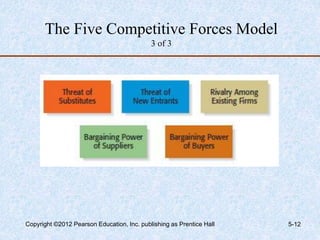
The Five Competitive Forces Model
1 of 3
• Explanation of the Five Forces Model
– The five competitive forces model is a framework for
understanding the structure of an industry.
– The model is composed of the forces that determine
industry profitability.
– They help determine the average rate of return for the firms
in an industry.
Copyright ©2012 Pearson Education, Inc. publishing as Prentice Hall 5-10
The Five Competitive Forces Model
2 of 3
• Explanation of the Five Forces Model (continued)
– Each of the five forces impacts the average rate of return
for the firms in an industry by applying pressure on
industry profitability.
– Well managed firms try to position their firms in a way that
avoids or diminishes these forces—in an attempt to beat the
average rate of return of the industry.
Copyright ©2012 Pearson Education, Inc. publishing as Prentice Hall 5-11
The Five Competitive Forces Model
3 of 3
Copyright ©2012 Pearson Education, Inc. publishing as Prentice Hall 5-12
Threat of Substitutes
1 of 3
• Threat of Substitutes
– The price that consumers are willing to pay for a product
depends in part on the availability of substitute products.
– For example, there are few if any substitutes for
prescription medicines, which is one of the reasons the
pharmaceutical industry is so profitable.
– In contrast, when close substitutes for a product exist,
industry profitability is suppressed, because consumers will
opt out if the price gets too high.
Copyright ©2012 Pearson Education, Inc. publishing as Prentice Hall 5-13
Threat of Substitutes
2 of 3
• Threat of Substitutes (continued)
– The extent to which substitutes suppress the profitability of
an industry depends on the propensity for buyers to
substitute between alternatives.
– This is why firms in an industry often offer their customers
amenities to reduce the likelihood that they will switch to a
substitute product, even in light of a price increase.
Copyright ©2012 Pearson Education, Inc. publishing as Prentice Hall 5-14
Threat of Substitutes
3 of 3
• This independently owned
coffee shop doesn’t just sell
coffee.
• It also offers its patrons a
convenient and pleasant place
to meet, socialize, and study.
• It provides these amenities to
decrease the likelihood that its
customers will “substitute”
coffee at this shop for less
expensive alternatives.
Copyright ©2012 Pearson Education, Inc. publishing as Prentice Hall 5-15
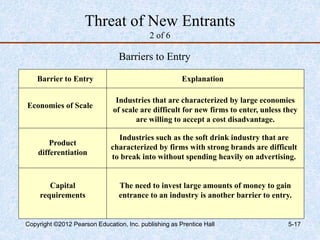
Threat of New Entrants
1 of 6
• Threat of New Entrants
– If the firms in an industry are highly profitable, the industry
becomes a magnet to new entrants.
– Unless something is done to stop this, the competition in
the industry will increase, and average industry profitability
will decline.
– Firms in an industry try to keep the number of new entrants
low by erecting barriers to entry.
• A barrier to entry is a condition that creates a disincentive for a new
firm to enter an industry.
Copyright ©2012 Pearson Education, Inc. publishing as Prentice Hall 5-16
Threat of New Entrants
2 of 6
Barrier to Entry Explanation
Economies of Scale
Product
differentiation
Capital
requirements
Barriers to Entry
Industries that are characterized by large economies
of scale are difficult for new firms to enter, unless they
are willing to accept a cost disadvantage.
Industries such as the soft drink industry that are
characterized by firms with strong brands are difficult
to break into without spending heavily on advertising.
The need to invest large amounts of money to gain
entrance to an industry is another barrier to entry.
Copyright ©2012 Pearson Education, Inc. publishing as Prentice Hall 5-17
Threat of New Entrants
3 of 6
Barrier to Entry Explanation
Cost advantages
independent of size
Access to distribution
channels
Government and
legal barriers
Barriers to Entry (continued)
Existing firms may have cost advantages not related
to size. For example, the existing firms in an industry
may have purchased land when it was less expensive
than it is today.
Distribution channels are often hard to crack. This is
particularly true in crowded markets, such as the
convenience store market.
Some industries, such as broadcasting, require the
granting of a license by a public authority to compete.
Copyright ©2012 Pearson Education, Inc. publishing as Prentice Hall 5-18
Threat of New Entrants
4 of 6
• Nontraditional Barriers to Entry
– It is difficult for start-ups to execute barriers to entry that
are expensive, such as economies of scale, because money
is usually tight.
– Start-ups have to rely on nontraditional barriers to entry to
discourage new entrants, such as assembling a world-class
management team that would be difficult for another
company to replicate.
Copyright ©2012 Pearson Education, Inc. publishing as Prentice Hall 5-19
Threat of New Entrants
5 of 6
Barrier to Entry Explanation
Nontraditional Barriers to Entry
Strength of
management team
If a start-up puts together a world-class management
team, it may give potential rivals pause in taking on
the start-up in its chosen industry.
First-mover
advantage
If a start-up pioneers an industry or a new concept
within an industry, the name recognition the start-up
establishes may create a barrier to entry.
Passion of the
management team
and employees
If the employees of a start-up are motivated by the
unique culture of a start-up, and anticipate a large
financial reward, this is a combination that cannot be
replicated by larger firms.
Copyright ©2012 Pearson Education, Inc. publishing as Prentice Hall 5-20
Threat of New Entrants
6 of 6
Barrier to Entry Explanation
Nontraditional Barriers to Entry (continued)
Unique business
model
Inventing a new
approach to an
industry
If a start-up is able to construct a unique business
model and establish a network of relationships that
makes the business model work, this set of advantages
creates a barrier to entry.
If a start-up invents a new approach to an industry
and executes it in an exemplary fashion, these factors
create a barrier to entry for potential imitators.
Internet domain
name
Some Internet domain names are so “spot-on” that
they give a start-up a meaningful leg up in terms of e-
commerce opportunities.
Copyright ©2012 Pearson Education, Inc. publishing as Prentice Hall 5-21
Rivalry Among Existing Firms
1 of 3
• Rivalry Among Existing Firms
– In most industries, the major determinant of industry
profitability is the level of competition among existing
firms.
– Some industries are fiercely competitive, to the point where
prices are pushed below the level of costs, and industry-
wide losses occur.
– In other industries, competition is much less intense and
price competition is subdued.
Copyright ©2012 Pearson Education, Inc. publishing as Prentice Hall 5-22
Rivalry Among Existing Firms
2 of 3
Factors that determine the intensity of the rivalry among
existing firms in an industry.
Number and
balance of
competitors
Degree of
difference
between products
The more competitors there are, the more likely it
is that one or more will try to gain customers by
cutting its price.
The degree to which products differ from one
product to another affects industry rivalry.
Copyright ©2012 Pearson Education, Inc. publishing as Prentice Hall 5-23
Rivalry Among Existing Firms
3 of 3
Factors that determine the intensity of the rivalry among existing
firms in an industry (continued)
Growth rate of an
industry
Level of fixed
costs
The competition among firms in a slow-growth
industry is stronger than among those in fast-
growth industries.
Firms that have high fixed costs must sell a higher
volume of their product to reach the break-even
point than firms with low fixed costs.
Copyright ©2012 Pearson Education, Inc. publishing as Prentice Hall 5-24
Bargaining Power of Suppliers
1 of 3
• Bargaining Power of Suppliers
– Suppliers can suppress the profitability of the industries to
which they sell by raising prices or reducing the quality of
the components they provide.
– If a supplier reduces the quality of the components it
supplies, the quality of the finished product will suffer, and
the manufacturer will eventually have to lower its price.
– If the suppliers are powerful relative to the firms in the
industry to which they sell, industry profitability can suffer.
Copyright ©2012 Pearson Education, Inc. publishing as Prentice Hall 5-25
Bargaining Power of Suppliers
2 of 3
Factors that have an impact on the ability of suppliers to
exert pressure on buyers
Supplier
concentration
Switching costs
Switching costs are the fixed costs that buyers
encounter when switching or changing from one
supplier to another. If switching costs are high, a
buyer will be less likely to switch suppliers.
When there are only a few suppliers that supply a
critical product to a large number of buyers, the
supplier has an advantage.
Copyright ©2012 Pearson Education, Inc. publishing as Prentice Hall 5-26
Bargaining Power of Suppliers
3 of 3
Factors that have an impact on the ability of suppliers to exert
pressure on buyers (continued)
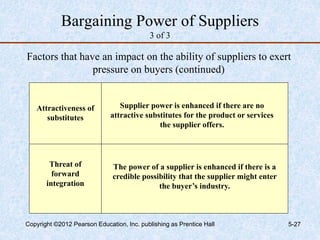
Attractiveness of
substitutes
Threat of
forward
integration
The power of a supplier is enhanced if there is a
credible possibility that the supplier might enter
the buyer’s industry.
Supplier power is enhanced if there are no
attractive substitutes for the product or services
the supplier offers.
Copyright ©2012 Pearson Education, Inc. publishing as Prentice Hall 5-27
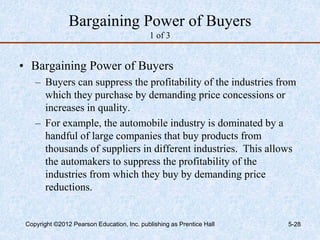
Bargaining Power of Buyers
1 of 3
• Bargaining Power of Buyers
– Buyers can suppress the profitability of the industries from
which they purchase by demanding price concessions or
increases in quality.
– For example, the automobile industry is dominated by a
handful of large companies that buy products from
thousands of suppliers in different industries. This allows
the automakers to suppress the profitability of the
industries from which they buy by demanding price
reductions.
Copyright ©2012 Pearson Education, Inc. publishing as Prentice Hall 5-28
Bargaining Power of Buyers
2 of 3
Factors that have an impact on the ability of suppliers to exert
pressure on buyers
Buyer group
concentration
Buyer’s costs
The greater the importance of an item is to a
buyer, the more sensitive the buyer will be to the
price it pays.
If there are only a few large buyers, and they buy
from a large number of suppliers, they can
pressure the suppliers to lower costs and thus
affect the profitability of the industries from which
they buy.
Copyright ©2012 Pearson Education, Inc. publishing as Prentice Hall 5-29
Bargaining Power of Buyers
3 of 3
Factors that have an impact on the ability of buyers to exert
pressure on suppliers (continued)
Degree of
standardization
of supplier’s
products
Threat of
backward
integration
The power of buyers is enhanced if there is a
credible threat that the buyer might enter the
supplier’s industry.
The degree to which a supplier’s product
differs from its competitors affects the buyer’s
bargaining power.
Copyright ©2012 Pearson Education, Inc. publishing as Prentice Hall 5-30
First Application of the Five Forces Model
1 of 2
• First Application of the Model
– The five forces model can be used to assess the
attractiveness of an industry by determining the level of
threat to industry profitability for each of the forces.
– If a firm fills out the form shown on the next slide and
several of the threats to industry profitability are high, the
firm may want to reconsider entering the industry or think
carefully about the position it would occupy.
Copyright ©2012 Pearson Education, Inc. publishing as Prentice Hall 5-31
First Application of the Five Forced Model
2 of 2
Assessing Industry Attractiveness Using the Five Forces Model
Copyright ©2012 Pearson Education, Inc. publishing as Prentice Hall 5-32
Second Application of the Five Forces Model
1 of 2
• Second Application of the Model
– The second way a new firm can apply the five forces model
to help determine whether it should enter an industry is by
using the model to answer several key questions.
– The questions are shown in the figure on the next slide, and
help a firm project the potential success of a new venture in
a particular industry.
Copyright ©2012 Pearson Education, Inc. publishing as Prentice Hall 5-33
Second Application of the Five Forces Model
2 of 2
Using the Five Forces Model to Pose Questions to Determine the Potential
Success of a New Venture in an Industry
Copyright ©2012 Pearson Education, Inc. publishing as Prentice Hall 5-34
• Emerging Industries
– Industries in which standard operating procedures have yet
to be developed.
• Opportunity: First-mover advantage
• Fragmented Industries
– Industries that are characterized by a large number of firms
of approximately equal size.
• Opportunity: Consolidation
Industry Types and the Opportunities
They Offer
1 of 3
Copyright ©2012 Pearson Education, Inc. publishing as Prentice Hall 5-35
• Mature Industries
– Industries that are experiencing slow or no increase in
demand.
• Opportunities: Process innovation and after-sale service innovation
• Declining Industries
– Industries that are experiencing a reduction in demand.
• Opportunities: Leadership, establishing a niche market, and
pursuing a cost reduction strategy
Industry Types and the Opportunities
They Offer
2 of 3
Copyright ©2012 Pearson Education, Inc. publishing as Prentice Hall 5-36
• Global Industries
– Industries that are experiencing significant international
sales.
• Opportunities: Multidomestic and global strategies
Industry Types and the Opportunities
They Offer
3 of 3
Copyright ©2012 Pearson Education, Inc. publishing as Prentice Hall 5-37
Competitor Analysis
• What is a Competitor Analysis?
– A competitor analysis is a detailed analysis of a firm’s
competition.
– It helps a firm understand the positions of its major
competitors and the opportunities that are available.
– A competitive analysis grid is a tool for organizing the
information a firm collects about its competitors.
Copyright ©2012 Pearson Education, Inc. publishing as Prentice Hall 5-38
Identifying Competitors
Types of Competitors New Ventures Face
Copyright ©2012 Pearson Education, Inc. publishing as Prentice Hall 5-39
Sources of Competitive Intelligence
1 of 3
• Collecting Competitive Intelligence
– To complete a competitive analysis grid, a firm must first
understand the strategies and behaviors of its competitors.
– The information that is gathered by a firm to learn about its
competitors is referred to as competitive intelligence.
– A new venture should take care that it collects competitive
intelligence in a professional and ethical manner.
Copyright ©2012 Pearson Education, Inc. publishing as Prentice Hall 5-40
Sources of Competitive Intelligence
2 of 3
Ethical ways to obtain information about competitors
• Attend conferences and trade shows.
• Purchase competitors’ products.
• Study competitors’Web sites.
• Set up Google and Yahoo! e-mail alerts.
• Read industry-related books, magazines, and Web sites.
• Talk to customers about what motivated them to buy your
product as opposed to your competitor’s product.
Copyright ©2012 Pearson Education, Inc. publishing as Prentice Hall 5-41
Sources of Competitive Intelligence
3 of 3
• Many companies attend
trade shows to not only
display their products,
but to see what their
competitors are up to.
• This is a photo of the
2011 Consumer
Electronics Trade Show
in Las Vegas.
Copyright ©2012 Pearson Education, Inc. publishing as Prentice Hall 5-42
Completing a Competitive Analysis Grid
• Competitive Analysis Grid
– A tool for organizing the information a firm collects about
its competitors
– A competitive analysis grid can help a firm see how it
stacks up against its competitors, provide ideas for markets
to pursue, and identify its primary sources of competitive
advantage.
Copyright ©2012 Pearson Education, Inc. publishing as Prentice Hall 5-43
Competitive Analysis Grid for Element Bars
Copyright ©2012 Pearson Education, Inc. publishing as Prentice Hall 5-44
All rights reserved. No part of this publication may be reproduced,
stored in a retrieval system, or transmitted, in any form or by any
means, electronic, mechanical, photocopying, recording, or otherwise,
without the prior written permission of the publisher. Printed in the
United States of America.
Copyright ©2012 Pearson Education, Inc.
publishing as Prentice Hall
Copyright ©2012 Pearson Education, Inc. publishing as Prentice Hall 5-45

Industry and Competitor Engineering Analysis.ppt

  • 1.
    Chapter 5 Industry and CompetitorAnalysis Bruce R. Barringer R. Duane Ireland Copyright ©2012 Pearson Education, Inc. publishing as Prentice Hall 5-1
  • 2.
    Chapter Objectives 1 of2 1. Explain the purpose of an industry analysis. 2. Identify the five competitive forces that determine industry profitability. 3. Explain the role of “barriers to entry” in creating disincentives for firms to enter an industry. 4. Identify the nontraditional barriers to entry that are especially associated with entrepreneurial firms. 5. List the four industry-related questions to ask before pursuing the idea for a firm. Copyright ©2012 Pearson Education, Inc. publishing as Prentice Hall 5-2
  • 3.
    Chapter Objectives 2 of2 6. Identify the five primary industry types and the opportunities they offer. 7. Explain the purpose of a competitor analysis. 8. Identify the three groups of competitors a new firm will face. 9. Describe ways a firm can ethically obtain information about its competitors. 10. Describe the reasons for completing a competitive analysis grid. Copyright ©2012 Pearson Education, Inc. publishing as Prentice Hall 5-3
  • 4.
    What is IndustryAnalysis? • Industry – An industry is a group of firms producing a similar product or service, such as airlines, fitness drinks, furniture, or electronic games. • Industry Analysis – Is business research that focuses on the potential of an industry. Copyright ©2012 Pearson Education, Inc. publishing as Prentice Hall 5-4
  • 5.
    Why is IndustryAnalysis Important? Industry Analysis Importance • Once it is determined that a new venture is feasible in regard to the industry and market in which it will compete, a more in-depth analysis is needed to learn the ins and outs of the industry. • The analysis helps a firm determine if the target market it identified during feasibility analysis is favorable for a new firm. Copyright ©2012 Pearson Education, Inc. publishing as Prentice Hall 5-5
  • 6.
    Three Key Questions Whenstudying an industry, an entrepreneur must answer three questions before pursuing the idea of starting a firm. Is the industry accessible—in other words, is it is realistic place for a new venture to enter? Are there positions in the industry that avoid some of the negative attributes of the industry as a whole? Does the industry contain markets that are ripe for innovation or are underserved? Question 1 Question 3 Question 2 Copyright ©2012 Pearson Education, Inc. publishing as Prentice Hall 5-6
  • 7.
    How Industry andFirm-Level Factors Affect Performance • Firm-Level Factors – Include a firm’s assets, products, culture, teamwork among its employees, reputation, and other resources. • Industry-Level Factors – Include threat of new entrants, rivalry among existing firms, bargaining power of buyers, and related factors. • Conclusion – In various studies, researchers have found that from 8% to 30% of the variation in firm profitability is directly attributable to the industry in which a firm competes. Copyright ©2012 Pearson Education, Inc. publishing as Prentice Hall 5-7
  • 8.
    Techniques Available toAssess Industry Attractiveness Study Environmental and Business Trends The Five Competitive Forces Model Assessing Industry Attractiveness Copyright ©2012 Pearson Education, Inc. publishing as Prentice Hall 5-8
  • 9.
    Studying Industry Trends •Environmental Trends – Include economic trends, social trends, technological advances, and political and regulatory changes. – For example, industries that sell products to seniors are benefiting by the aging of the population. • Business Trends – Other trends that impact an industry. – For example, are profit margins in the industry increasing or falling? Is innovation accelerating or waning? Are input costs going up or down? Copyright ©2012 Pearson Education, Inc. publishing as Prentice Hall 5-9
  • 10.
    The Five CompetitiveForces Model 1 of 3 • Explanation of the Five Forces Model – The five competitive forces model is a framework for understanding the structure of an industry. – The model is composed of the forces that determine industry profitability. – They help determine the average rate of return for the firms in an industry. Copyright ©2012 Pearson Education, Inc. publishing as Prentice Hall 5-10
  • 11.
    The Five CompetitiveForces Model 2 of 3 • Explanation of the Five Forces Model (continued) – Each of the five forces impacts the average rate of return for the firms in an industry by applying pressure on industry profitability. – Well managed firms try to position their firms in a way that avoids or diminishes these forces—in an attempt to beat the average rate of return of the industry. Copyright ©2012 Pearson Education, Inc. publishing as Prentice Hall 5-11
  • 12.
    The Five CompetitiveForces Model 3 of 3 Copyright ©2012 Pearson Education, Inc. publishing as Prentice Hall 5-12
  • 13.
    Threat of Substitutes 1of 3 • Threat of Substitutes – The price that consumers are willing to pay for a product depends in part on the availability of substitute products. – For example, there are few if any substitutes for prescription medicines, which is one of the reasons the pharmaceutical industry is so profitable. – In contrast, when close substitutes for a product exist, industry profitability is suppressed, because consumers will opt out if the price gets too high. Copyright ©2012 Pearson Education, Inc. publishing as Prentice Hall 5-13
  • 14.
    Threat of Substitutes 2of 3 • Threat of Substitutes (continued) – The extent to which substitutes suppress the profitability of an industry depends on the propensity for buyers to substitute between alternatives. – This is why firms in an industry often offer their customers amenities to reduce the likelihood that they will switch to a substitute product, even in light of a price increase. Copyright ©2012 Pearson Education, Inc. publishing as Prentice Hall 5-14
  • 15.
    Threat of Substitutes 3of 3 • This independently owned coffee shop doesn’t just sell coffee. • It also offers its patrons a convenient and pleasant place to meet, socialize, and study. • It provides these amenities to decrease the likelihood that its customers will “substitute” coffee at this shop for less expensive alternatives. Copyright ©2012 Pearson Education, Inc. publishing as Prentice Hall 5-15
  • 16.
    Threat of NewEntrants 1 of 6 • Threat of New Entrants – If the firms in an industry are highly profitable, the industry becomes a magnet to new entrants. – Unless something is done to stop this, the competition in the industry will increase, and average industry profitability will decline. – Firms in an industry try to keep the number of new entrants low by erecting barriers to entry. • A barrier to entry is a condition that creates a disincentive for a new firm to enter an industry. Copyright ©2012 Pearson Education, Inc. publishing as Prentice Hall 5-16
  • 17.
    Threat of NewEntrants 2 of 6 Barrier to Entry Explanation Economies of Scale Product differentiation Capital requirements Barriers to Entry Industries that are characterized by large economies of scale are difficult for new firms to enter, unless they are willing to accept a cost disadvantage. Industries such as the soft drink industry that are characterized by firms with strong brands are difficult to break into without spending heavily on advertising. The need to invest large amounts of money to gain entrance to an industry is another barrier to entry. Copyright ©2012 Pearson Education, Inc. publishing as Prentice Hall 5-17
  • 18.
    Threat of NewEntrants 3 of 6 Barrier to Entry Explanation Cost advantages independent of size Access to distribution channels Government and legal barriers Barriers to Entry (continued) Existing firms may have cost advantages not related to size. For example, the existing firms in an industry may have purchased land when it was less expensive than it is today. Distribution channels are often hard to crack. This is particularly true in crowded markets, such as the convenience store market. Some industries, such as broadcasting, require the granting of a license by a public authority to compete. Copyright ©2012 Pearson Education, Inc. publishing as Prentice Hall 5-18
  • 19.
    Threat of NewEntrants 4 of 6 • Nontraditional Barriers to Entry – It is difficult for start-ups to execute barriers to entry that are expensive, such as economies of scale, because money is usually tight. – Start-ups have to rely on nontraditional barriers to entry to discourage new entrants, such as assembling a world-class management team that would be difficult for another company to replicate. Copyright ©2012 Pearson Education, Inc. publishing as Prentice Hall 5-19
  • 20.
    Threat of NewEntrants 5 of 6 Barrier to Entry Explanation Nontraditional Barriers to Entry Strength of management team If a start-up puts together a world-class management team, it may give potential rivals pause in taking on the start-up in its chosen industry. First-mover advantage If a start-up pioneers an industry or a new concept within an industry, the name recognition the start-up establishes may create a barrier to entry. Passion of the management team and employees If the employees of a start-up are motivated by the unique culture of a start-up, and anticipate a large financial reward, this is a combination that cannot be replicated by larger firms. Copyright ©2012 Pearson Education, Inc. publishing as Prentice Hall 5-20
  • 21.
    Threat of NewEntrants 6 of 6 Barrier to Entry Explanation Nontraditional Barriers to Entry (continued) Unique business model Inventing a new approach to an industry If a start-up is able to construct a unique business model and establish a network of relationships that makes the business model work, this set of advantages creates a barrier to entry. If a start-up invents a new approach to an industry and executes it in an exemplary fashion, these factors create a barrier to entry for potential imitators. Internet domain name Some Internet domain names are so “spot-on” that they give a start-up a meaningful leg up in terms of e- commerce opportunities. Copyright ©2012 Pearson Education, Inc. publishing as Prentice Hall 5-21
  • 22.
    Rivalry Among ExistingFirms 1 of 3 • Rivalry Among Existing Firms – In most industries, the major determinant of industry profitability is the level of competition among existing firms. – Some industries are fiercely competitive, to the point where prices are pushed below the level of costs, and industry- wide losses occur. – In other industries, competition is much less intense and price competition is subdued. Copyright ©2012 Pearson Education, Inc. publishing as Prentice Hall 5-22
  • 23.
    Rivalry Among ExistingFirms 2 of 3 Factors that determine the intensity of the rivalry among existing firms in an industry. Number and balance of competitors Degree of difference between products The more competitors there are, the more likely it is that one or more will try to gain customers by cutting its price. The degree to which products differ from one product to another affects industry rivalry. Copyright ©2012 Pearson Education, Inc. publishing as Prentice Hall 5-23
  • 24.
    Rivalry Among ExistingFirms 3 of 3 Factors that determine the intensity of the rivalry among existing firms in an industry (continued) Growth rate of an industry Level of fixed costs The competition among firms in a slow-growth industry is stronger than among those in fast- growth industries. Firms that have high fixed costs must sell a higher volume of their product to reach the break-even point than firms with low fixed costs. Copyright ©2012 Pearson Education, Inc. publishing as Prentice Hall 5-24
  • 25.
    Bargaining Power ofSuppliers 1 of 3 • Bargaining Power of Suppliers – Suppliers can suppress the profitability of the industries to which they sell by raising prices or reducing the quality of the components they provide. – If a supplier reduces the quality of the components it supplies, the quality of the finished product will suffer, and the manufacturer will eventually have to lower its price. – If the suppliers are powerful relative to the firms in the industry to which they sell, industry profitability can suffer. Copyright ©2012 Pearson Education, Inc. publishing as Prentice Hall 5-25
  • 26.
    Bargaining Power ofSuppliers 2 of 3 Factors that have an impact on the ability of suppliers to exert pressure on buyers Supplier concentration Switching costs Switching costs are the fixed costs that buyers encounter when switching or changing from one supplier to another. If switching costs are high, a buyer will be less likely to switch suppliers. When there are only a few suppliers that supply a critical product to a large number of buyers, the supplier has an advantage. Copyright ©2012 Pearson Education, Inc. publishing as Prentice Hall 5-26
  • 27.
    Bargaining Power ofSuppliers 3 of 3 Factors that have an impact on the ability of suppliers to exert pressure on buyers (continued) Attractiveness of substitutes Threat of forward integration The power of a supplier is enhanced if there is a credible possibility that the supplier might enter the buyer’s industry. Supplier power is enhanced if there are no attractive substitutes for the product or services the supplier offers. Copyright ©2012 Pearson Education, Inc. publishing as Prentice Hall 5-27
  • 28.
    Bargaining Power ofBuyers 1 of 3 • Bargaining Power of Buyers – Buyers can suppress the profitability of the industries from which they purchase by demanding price concessions or increases in quality. – For example, the automobile industry is dominated by a handful of large companies that buy products from thousands of suppliers in different industries. This allows the automakers to suppress the profitability of the industries from which they buy by demanding price reductions. Copyright ©2012 Pearson Education, Inc. publishing as Prentice Hall 5-28
  • 29.
    Bargaining Power ofBuyers 2 of 3 Factors that have an impact on the ability of suppliers to exert pressure on buyers Buyer group concentration Buyer’s costs The greater the importance of an item is to a buyer, the more sensitive the buyer will be to the price it pays. If there are only a few large buyers, and they buy from a large number of suppliers, they can pressure the suppliers to lower costs and thus affect the profitability of the industries from which they buy. Copyright ©2012 Pearson Education, Inc. publishing as Prentice Hall 5-29
  • 30.
    Bargaining Power ofBuyers 3 of 3 Factors that have an impact on the ability of buyers to exert pressure on suppliers (continued) Degree of standardization of supplier’s products Threat of backward integration The power of buyers is enhanced if there is a credible threat that the buyer might enter the supplier’s industry. The degree to which a supplier’s product differs from its competitors affects the buyer’s bargaining power. Copyright ©2012 Pearson Education, Inc. publishing as Prentice Hall 5-30
  • 31.
    First Application ofthe Five Forces Model 1 of 2 • First Application of the Model – The five forces model can be used to assess the attractiveness of an industry by determining the level of threat to industry profitability for each of the forces. – If a firm fills out the form shown on the next slide and several of the threats to industry profitability are high, the firm may want to reconsider entering the industry or think carefully about the position it would occupy. Copyright ©2012 Pearson Education, Inc. publishing as Prentice Hall 5-31
  • 32.
    First Application ofthe Five Forced Model 2 of 2 Assessing Industry Attractiveness Using the Five Forces Model Copyright ©2012 Pearson Education, Inc. publishing as Prentice Hall 5-32
  • 33.
    Second Application ofthe Five Forces Model 1 of 2 • Second Application of the Model – The second way a new firm can apply the five forces model to help determine whether it should enter an industry is by using the model to answer several key questions. – The questions are shown in the figure on the next slide, and help a firm project the potential success of a new venture in a particular industry. Copyright ©2012 Pearson Education, Inc. publishing as Prentice Hall 5-33
  • 34.
    Second Application ofthe Five Forces Model 2 of 2 Using the Five Forces Model to Pose Questions to Determine the Potential Success of a New Venture in an Industry Copyright ©2012 Pearson Education, Inc. publishing as Prentice Hall 5-34
  • 35.
    • Emerging Industries –Industries in which standard operating procedures have yet to be developed. • Opportunity: First-mover advantage • Fragmented Industries – Industries that are characterized by a large number of firms of approximately equal size. • Opportunity: Consolidation Industry Types and the Opportunities They Offer 1 of 3 Copyright ©2012 Pearson Education, Inc. publishing as Prentice Hall 5-35
  • 36.
    • Mature Industries –Industries that are experiencing slow or no increase in demand. • Opportunities: Process innovation and after-sale service innovation • Declining Industries – Industries that are experiencing a reduction in demand. • Opportunities: Leadership, establishing a niche market, and pursuing a cost reduction strategy Industry Types and the Opportunities They Offer 2 of 3 Copyright ©2012 Pearson Education, Inc. publishing as Prentice Hall 5-36
  • 37.
    • Global Industries –Industries that are experiencing significant international sales. • Opportunities: Multidomestic and global strategies Industry Types and the Opportunities They Offer 3 of 3 Copyright ©2012 Pearson Education, Inc. publishing as Prentice Hall 5-37
  • 38.
    Competitor Analysis • Whatis a Competitor Analysis? – A competitor analysis is a detailed analysis of a firm’s competition. – It helps a firm understand the positions of its major competitors and the opportunities that are available. – A competitive analysis grid is a tool for organizing the information a firm collects about its competitors. Copyright ©2012 Pearson Education, Inc. publishing as Prentice Hall 5-38
  • 39.
    Identifying Competitors Types ofCompetitors New Ventures Face Copyright ©2012 Pearson Education, Inc. publishing as Prentice Hall 5-39
  • 40.
    Sources of CompetitiveIntelligence 1 of 3 • Collecting Competitive Intelligence – To complete a competitive analysis grid, a firm must first understand the strategies and behaviors of its competitors. – The information that is gathered by a firm to learn about its competitors is referred to as competitive intelligence. – A new venture should take care that it collects competitive intelligence in a professional and ethical manner. Copyright ©2012 Pearson Education, Inc. publishing as Prentice Hall 5-40
  • 41.
    Sources of CompetitiveIntelligence 2 of 3 Ethical ways to obtain information about competitors • Attend conferences and trade shows. • Purchase competitors’ products. • Study competitors’Web sites. • Set up Google and Yahoo! e-mail alerts. • Read industry-related books, magazines, and Web sites. • Talk to customers about what motivated them to buy your product as opposed to your competitor’s product. Copyright ©2012 Pearson Education, Inc. publishing as Prentice Hall 5-41
  • 42.
    Sources of CompetitiveIntelligence 3 of 3 • Many companies attend trade shows to not only display their products, but to see what their competitors are up to. • This is a photo of the 2011 Consumer Electronics Trade Show in Las Vegas. Copyright ©2012 Pearson Education, Inc. publishing as Prentice Hall 5-42
  • 43.
    Completing a CompetitiveAnalysis Grid • Competitive Analysis Grid – A tool for organizing the information a firm collects about its competitors – A competitive analysis grid can help a firm see how it stacks up against its competitors, provide ideas for markets to pursue, and identify its primary sources of competitive advantage. Copyright ©2012 Pearson Education, Inc. publishing as Prentice Hall 5-43
  • 44.
    Competitive Analysis Gridfor Element Bars Copyright ©2012 Pearson Education, Inc. publishing as Prentice Hall 5-44
  • 45.
    All rights reserved.No part of this publication may be reproduced, stored in a retrieval system, or transmitted, in any form or by any means, electronic, mechanical, photocopying, recording, or otherwise, without the prior written permission of the publisher. Printed in the United States of America. Copyright ©2012 Pearson Education, Inc. publishing as Prentice Hall Copyright ©2012 Pearson Education, Inc. publishing as Prentice Hall 5-45