Chapter -1
Introduction to
Industrial Engineering
© All rights reserved to A. Shtub.
And Y. Cohen. Do not copy or use
without a written permission
1
The course subjects
The course presents the variety of subjects that occupy
the Industrial Engineer. The emphasis is on the broad
perspective of the Industrial Engineering (IE)
profession. IE includes a wide variety of subjects
related to planning the organizational operations of
both manufacturing and service industries, the layout
planning, the functional planning, the material
handling, the quality control and operational decision
making.
© All rights reserved to A. Shtub.
And Y. Cohen. Do not copy or use
2
Studying Framework
 Course Lectures
Textbook:
Avraham Shtub & Yuval Cohen: Introduction to
Industrial Engineering. CRC Press, 2016.
 Accompanying slides
© All rights reserved to A. Shtub.
And Y. Cohen. Do not copy or use
3
4
Background: Why IE
?
• Fierce Competition in Economy.
• Customers demands are rising.
• Challenge for industries to produce goods of right
quantity, quality , in time and at minimum cost.
• Industrial Engineering (IE) plays a pivotal role in
meeting these challenges.
• We have various techniques in Industrial
Engineering to analyse and improve the work
methods, to eliminate waste, proper allocation and
utilization of resources.
The Role of Engineering
Engineering (design):
Engineering (design): A process of translating
the functional requirements and need fulfillment
to formal engineering specifications:
– as clear instructions for execution
– by an experienced operator.
© All rights reserved to A. Shtub.
And Y. Cohen. Do not copy or use
5
The roles of
an Industrial Engineer
Industrial Engineers (IEs)
Industrial Engineers (IEs) Design the
organizational operations,
organizational operations, including:
including:
•Methods
Methods
•Processes
Processes
•Schedules
Schedules
•Quality & Procurement procedures
Quality & Procurement procedures
•Layout and Ergonomic workplace design
Layout and Ergonomic workplace design
© All rights reserved to A. Shtub.
And Y. Cohen. Do not copy or use
6
7
Industrial Engineering Definition
American Institute of Industrial Engineers (AIIE)
defines Industrial Engineering as follows:
•Industrial Engineering is concerned with the
design, improvement and installation of
integrated system of men, materials and
equipment. It draws upon specialized knowledge
and skills in the mathematical, physical sciences
together with the principles and methods of
engineering analysis and design to specify, predict
and evaluate the results to be obtained from such
system.
8
The objectives of IE
• The main objectives of industrial
engineering are:
1- Helping the organization achieving its goals
by planning its operations and
contingencies.
2- Improving the organization performance by
increasing its productivity, quality and
competitiveness.
3- Improving the effective utilization of
resources and time. Eliminating waste.
© All rights reserved to A. Shtub.
And Y. Cohen. Do not copy or use
© All rights reserved to A. Shtub.
And Y. Cohen. Do not copy or use
9
Management Components
 Planning
 Organizing
 Staffing
 Directing
 Motivating
 Leading
 Controlling
IE Work Tools
:
• Basic Economics and Finance tools
• Human factor management tools
• Mathematical models (i.e. Optimization)
• Information Systems tools
• Engineering (physics, drawing, specifications)
• Decision making
• Management tools (e.g. Project management)
© All rights reserved to A. Shtub.
And Y. Cohen. Do not copy or use
10
11
Techniques of Industrial
Engineering
• Following tools and techniques are used to improve productivity of the
organization by optimum utilization of resources.
1- Method Study.
2- Time Study (Work Measurement).
3- Motion Economy.
4- Financial and Non Financial Incentives.
5- Value Analysis.
6- Production, Planning and Control.
7- Inventory Control.
8- Job Evaluation.
9- Material Handling Analysis.
10-Ergonomics (Human Engineering).
11- System Analysis.
12- Operations Research Techniques.
12
Historical Contributions
to Industrial Engineering
1776 - Adam Smith: through his book titled Wealth of
Nations laid foundation to scientific manufacturing. Through
his concept of division of labour which included the skill
development, time savings and the use of specialized
machine was able to influence.
1864 - James Watt: Steam Engine advanced the use of
mechanical power to increase productivity. Industrial
Revolution.
13
1859-1915 - Frederick Taylor was a mechanical engineer
and initiated investigations of better work methods in
Westinghouse corp. He proposed following actions:
•Data Collection and standards for workers.
•Scientifically training of workers.
•Cooperation between management and labour for better
production.
•Divide work between management and labour and assigning
to those who are best suited.
Historical Contributions
to Industrial Engineering
14
1893- Henry L. Gantt:
•Measurement of management results by Gantt Charts.
•Recognition of social responsibility of business and industry.
•Advocated training of workers by management.
1917- Frank and Lillian Gilbreth: developed micro-motion
study, a breakdown of work into fundamental elements called
therbligs - as a tool for work analysis.
Historical Contributions
to Industrial Engineering
Historical Chronological
Review of IE Development
1911 – F. Taylor published “The Principles of
Scientific Management”. Management as a
well defined methodology that involves
quantitative measures.
1913 – Henry Ford – The integrated
assembly line. The integration between
work stations to reduce the average time
per car. At the beginning of 1913 the time
per car was 12.5 hours, 8 months later it
was reduced to 93 minutes.
© All rights reserved to A. Shtub.
And Y. Cohen. Do not copy or use
15
1917 – Harris – Inventory Management
Model
1930s – Howthorn (Harvard) trials for measuring
the effects of environmental changes on workers’
performance.
1930s – Significant advance in applying SPC and
Statistical analysis in Quality Control (QC).
1940s – Birth of Operations Research (OR) –
Mathematical models for optimizing operational
© All rights reserved to A. Shtub.
And Y. Cohen. Do not copy or use
16
Historical Chronological Review
of IE Development
1950s and 1960s – The birth of the
integrative approach, and the Industrial
Engineering as a profession.
1970s and 1980s – Computerization of data
and operations research. Computer based
management tools. Material Requirement
Planning (MRP) systems.
© All rights reserved to A. Shtub.
And Y. Cohen. Do not copy or use
17
Historical Chronological Review
of IE Development
1980s and 1990s – Most organizations
adopt philosophical tools such as JIT
(Just In Time), TQC (Total Quality Mgt.),
and Six Sigma. The MRP systems extend
to MRP-II.
2000s - ISO-9000, ERP systems, Supply
Chain information sharing, search-
based optimization.
2010s – Analytics, Cloud computing, Big
data, Data mining.
© All rights reserved to A. Shtub.
And Y. Cohen. Do not copy or use
18
Historical Chronological Review
of IE Development
The Competitive Market:
Strugling to stay
competitive
Starting from the 1990s, the globalization and
the globalized information systems - created
increasing global competition in the business world.
Any organization in a competitive market, must give
the first priority to its customers and their needs,
requirements, and wants.
© All rights reserved to A. Shtub.
And Y. Cohen. Do not copy or use
19
© All rights reserved to A. Shtub.
And Y. Cohen. Do not copy or use
20
Basic Processes
 Development process – from idea to a new product
or new process, then to a well operating prototype.
 Infrastructure construction – from the prototype to
a successful design, implementation and testing of the
facility.
Sales – From the market-study and its requirement
identification, to receiving the orders from customers.
Supply – From receiving the customer’s order, to the
delivery of products and getting paid.
Service – From the customer call for service to a
service completion satisfying the customer.
© All rights reserved to A. Shtub.
And Y. Cohen. Do not copy or use
21
The process of supplying
orders
Several chapters of the book deals with the process of
supplying orders. One of the chapters even focuses on the
process that starts from a customer order, and continues to
the delivery of the ordered products or services, achieving
customer satisfaction.
© All rights reserved to A. Shtub.
And Y. Cohen. Do not copy or use
22
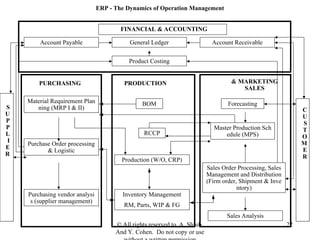
ERP - The Dynamics of Operation Management
PURCHASING MARKETING
&
SALES
PRODUCTION
FINANCIAL & ACCOUNTING
S
U
P
P
L
I
E
R
C
U
S
T
O
M
E
R
Material Requirement Plan
ning (MRP I & II)
Purchase Order processing
& Logistic
Purchasing vendor analysi
s (supplier management)
Account Payable
Product Costing
Account Receivable
General Ledger
BOM
Production (W/O, CRP)
Inventory Management
RM, Parts, WIP & FG
Forecasting
Sales Analysis
Sales Order Processing, Sales
Management and Distribution
(Firm order, Shipment & Inve
ntory)
Master Production Sch
edule (MPS)
RCCP
© All rights reserved to A. Shtub.
And Y. Cohen. Do not copy or use
without a written permission
23
Studying Engineering and
Management
An approach based on models – Developing
models dedicated for solving problems or
supporting decisions in engineering and
management.
 Case Study Approach – Analyzing a case
study based on description of specific
relevant situations as the case-studies.
© All rights reserved to A. Shtub.
And Y. Cohen. Do not copy or use
without a written permission
24
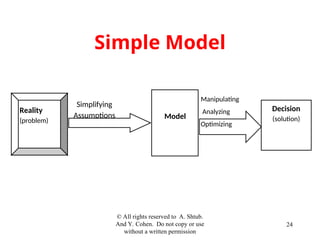
Simple Model
Reality
(problem)
Simplifying
Assumptions Model
Manipulating
Analyzing
Optimizing
Decision
(
solution
)
© All rights reserved to A. Shtub.
And Y. Cohen. Do not copy or use
without a written permission
25
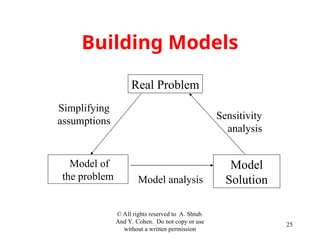
Building Models
Real Problem
Model of
the problem
Simplifying
assumptions
Model
Solution
Model analysis
Sensitivity
analysis
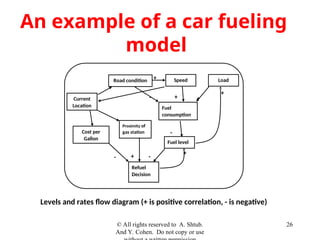
An example of a car fueling
model
© All rights reserved to A. Shtub.
And Y. Cohen. Do not copy or use
26
+
Fuel level
Proximity of
gas station
Refuel
Decision
Fuel
consumption
Load
Speed
Road condition
+
+
-
+
+
-
-
Current
Location
+
Cost per
Gallon
-
Levels and rates flow diagram (+ is positive correlation, - is negative)
Process Management
Integrative Dynamic Management entails:
Integration of processes
Integration of Organizational Units
Integration of Data and Models
© All rights reserved to A. Shtub.
And Y. Cohen. Do not copy or use
27
28
Industrial Engineering in
Service Sector
• The service sector has grown considerably in the
last century employing large number of industrial
engineers in the various service industries such
as:
1- Health Service.
2- Government Organizations.
3- Banking & Insurance
4- Transportation and Logistics
5- Utilities (electricity, water, gas, etc.)
© All rights reserved to A. Shtub.
And Y. Cohen. Do not copy or use
without a written permission
29
The Operational Simulator
 Simulation approach
 Case study approach
 Dynamic approach
 Model based approach
 Integrative approach

Industrial Engineering Introduction Part 0

  • 1.
    Chapter -1 Introduction to IndustrialEngineering © All rights reserved to A. Shtub. And Y. Cohen. Do not copy or use without a written permission 1
  • 2.
    The course subjects Thecourse presents the variety of subjects that occupy the Industrial Engineer. The emphasis is on the broad perspective of the Industrial Engineering (IE) profession. IE includes a wide variety of subjects related to planning the organizational operations of both manufacturing and service industries, the layout planning, the functional planning, the material handling, the quality control and operational decision making. © All rights reserved to A. Shtub. And Y. Cohen. Do not copy or use 2
  • 3.
    Studying Framework  CourseLectures Textbook: Avraham Shtub & Yuval Cohen: Introduction to Industrial Engineering. CRC Press, 2016.  Accompanying slides © All rights reserved to A. Shtub. And Y. Cohen. Do not copy or use 3
  • 4.
    4 Background: Why IE ? •Fierce Competition in Economy. • Customers demands are rising. • Challenge for industries to produce goods of right quantity, quality , in time and at minimum cost. • Industrial Engineering (IE) plays a pivotal role in meeting these challenges. • We have various techniques in Industrial Engineering to analyse and improve the work methods, to eliminate waste, proper allocation and utilization of resources.
  • 5.
    The Role ofEngineering Engineering (design): Engineering (design): A process of translating the functional requirements and need fulfillment to formal engineering specifications: – as clear instructions for execution – by an experienced operator. © All rights reserved to A. Shtub. And Y. Cohen. Do not copy or use 5
  • 6.
    The roles of anIndustrial Engineer Industrial Engineers (IEs) Industrial Engineers (IEs) Design the organizational operations, organizational operations, including: including: •Methods Methods •Processes Processes •Schedules Schedules •Quality & Procurement procedures Quality & Procurement procedures •Layout and Ergonomic workplace design Layout and Ergonomic workplace design © All rights reserved to A. Shtub. And Y. Cohen. Do not copy or use 6
  • 7.
    7 Industrial Engineering Definition AmericanInstitute of Industrial Engineers (AIIE) defines Industrial Engineering as follows: •Industrial Engineering is concerned with the design, improvement and installation of integrated system of men, materials and equipment. It draws upon specialized knowledge and skills in the mathematical, physical sciences together with the principles and methods of engineering analysis and design to specify, predict and evaluate the results to be obtained from such system.
  • 8.
    8 The objectives ofIE • The main objectives of industrial engineering are: 1- Helping the organization achieving its goals by planning its operations and contingencies. 2- Improving the organization performance by increasing its productivity, quality and competitiveness. 3- Improving the effective utilization of resources and time. Eliminating waste. © All rights reserved to A. Shtub. And Y. Cohen. Do not copy or use
  • 9.
    © All rightsreserved to A. Shtub. And Y. Cohen. Do not copy or use 9 Management Components  Planning  Organizing  Staffing  Directing  Motivating  Leading  Controlling
  • 10.
    IE Work Tools : •Basic Economics and Finance tools • Human factor management tools • Mathematical models (i.e. Optimization) • Information Systems tools • Engineering (physics, drawing, specifications) • Decision making • Management tools (e.g. Project management) © All rights reserved to A. Shtub. And Y. Cohen. Do not copy or use 10
  • 11.
    11 Techniques of Industrial Engineering •Following tools and techniques are used to improve productivity of the organization by optimum utilization of resources. 1- Method Study. 2- Time Study (Work Measurement). 3- Motion Economy. 4- Financial and Non Financial Incentives. 5- Value Analysis. 6- Production, Planning and Control. 7- Inventory Control. 8- Job Evaluation. 9- Material Handling Analysis. 10-Ergonomics (Human Engineering). 11- System Analysis. 12- Operations Research Techniques.
  • 12.
    12 Historical Contributions to IndustrialEngineering 1776 - Adam Smith: through his book titled Wealth of Nations laid foundation to scientific manufacturing. Through his concept of division of labour which included the skill development, time savings and the use of specialized machine was able to influence. 1864 - James Watt: Steam Engine advanced the use of mechanical power to increase productivity. Industrial Revolution.
  • 13.
    13 1859-1915 - FrederickTaylor was a mechanical engineer and initiated investigations of better work methods in Westinghouse corp. He proposed following actions: •Data Collection and standards for workers. •Scientifically training of workers. •Cooperation between management and labour for better production. •Divide work between management and labour and assigning to those who are best suited. Historical Contributions to Industrial Engineering
  • 14.
    14 1893- Henry L.Gantt: •Measurement of management results by Gantt Charts. •Recognition of social responsibility of business and industry. •Advocated training of workers by management. 1917- Frank and Lillian Gilbreth: developed micro-motion study, a breakdown of work into fundamental elements called therbligs - as a tool for work analysis. Historical Contributions to Industrial Engineering
  • 15.
    Historical Chronological Review ofIE Development 1911 – F. Taylor published “The Principles of Scientific Management”. Management as a well defined methodology that involves quantitative measures. 1913 – Henry Ford – The integrated assembly line. The integration between work stations to reduce the average time per car. At the beginning of 1913 the time per car was 12.5 hours, 8 months later it was reduced to 93 minutes. © All rights reserved to A. Shtub. And Y. Cohen. Do not copy or use 15
  • 16.
    1917 – Harris– Inventory Management Model 1930s – Howthorn (Harvard) trials for measuring the effects of environmental changes on workers’ performance. 1930s – Significant advance in applying SPC and Statistical analysis in Quality Control (QC). 1940s – Birth of Operations Research (OR) – Mathematical models for optimizing operational © All rights reserved to A. Shtub. And Y. Cohen. Do not copy or use 16 Historical Chronological Review of IE Development
  • 17.
    1950s and 1960s– The birth of the integrative approach, and the Industrial Engineering as a profession. 1970s and 1980s – Computerization of data and operations research. Computer based management tools. Material Requirement Planning (MRP) systems. © All rights reserved to A. Shtub. And Y. Cohen. Do not copy or use 17 Historical Chronological Review of IE Development
  • 18.
    1980s and 1990s– Most organizations adopt philosophical tools such as JIT (Just In Time), TQC (Total Quality Mgt.), and Six Sigma. The MRP systems extend to MRP-II. 2000s - ISO-9000, ERP systems, Supply Chain information sharing, search- based optimization. 2010s – Analytics, Cloud computing, Big data, Data mining. © All rights reserved to A. Shtub. And Y. Cohen. Do not copy or use 18 Historical Chronological Review of IE Development
  • 19.
    The Competitive Market: Struglingto stay competitive Starting from the 1990s, the globalization and the globalized information systems - created increasing global competition in the business world. Any organization in a competitive market, must give the first priority to its customers and their needs, requirements, and wants. © All rights reserved to A. Shtub. And Y. Cohen. Do not copy or use 19
  • 20.
    © All rightsreserved to A. Shtub. And Y. Cohen. Do not copy or use 20 Basic Processes  Development process – from idea to a new product or new process, then to a well operating prototype.  Infrastructure construction – from the prototype to a successful design, implementation and testing of the facility. Sales – From the market-study and its requirement identification, to receiving the orders from customers. Supply – From receiving the customer’s order, to the delivery of products and getting paid. Service – From the customer call for service to a service completion satisfying the customer.
  • 21.
    © All rightsreserved to A. Shtub. And Y. Cohen. Do not copy or use 21 The process of supplying orders Several chapters of the book deals with the process of supplying orders. One of the chapters even focuses on the process that starts from a customer order, and continues to the delivery of the ordered products or services, achieving customer satisfaction.
  • 22.
    © All rightsreserved to A. Shtub. And Y. Cohen. Do not copy or use 22 ERP - The Dynamics of Operation Management PURCHASING MARKETING & SALES PRODUCTION FINANCIAL & ACCOUNTING S U P P L I E R C U S T O M E R Material Requirement Plan ning (MRP I & II) Purchase Order processing & Logistic Purchasing vendor analysi s (supplier management) Account Payable Product Costing Account Receivable General Ledger BOM Production (W/O, CRP) Inventory Management RM, Parts, WIP & FG Forecasting Sales Analysis Sales Order Processing, Sales Management and Distribution (Firm order, Shipment & Inve ntory) Master Production Sch edule (MPS) RCCP
  • 23.
    © All rightsreserved to A. Shtub. And Y. Cohen. Do not copy or use without a written permission 23 Studying Engineering and Management An approach based on models – Developing models dedicated for solving problems or supporting decisions in engineering and management.  Case Study Approach – Analyzing a case study based on description of specific relevant situations as the case-studies.
  • 24.
    © All rightsreserved to A. Shtub. And Y. Cohen. Do not copy or use without a written permission 24 Simple Model Reality (problem) Simplifying Assumptions Model Manipulating Analyzing Optimizing Decision ( solution )
  • 25.
    © All rightsreserved to A. Shtub. And Y. Cohen. Do not copy or use without a written permission 25 Building Models Real Problem Model of the problem Simplifying assumptions Model Solution Model analysis Sensitivity analysis
  • 26.
    An example ofa car fueling model © All rights reserved to A. Shtub. And Y. Cohen. Do not copy or use 26 + Fuel level Proximity of gas station Refuel Decision Fuel consumption Load Speed Road condition + + - + + - - Current Location + Cost per Gallon - Levels and rates flow diagram (+ is positive correlation, - is negative)
  • 27.
    Process Management Integrative DynamicManagement entails: Integration of processes Integration of Organizational Units Integration of Data and Models © All rights reserved to A. Shtub. And Y. Cohen. Do not copy or use 27
  • 28.
    28 Industrial Engineering in ServiceSector • The service sector has grown considerably in the last century employing large number of industrial engineers in the various service industries such as: 1- Health Service. 2- Government Organizations. 3- Banking & Insurance 4- Transportation and Logistics 5- Utilities (electricity, water, gas, etc.)
  • 29.
    © All rightsreserved to A. Shtub. And Y. Cohen. Do not copy or use without a written permission 29 The Operational Simulator  Simulation approach  Case study approach  Dynamic approach  Model based approach  Integrative approach