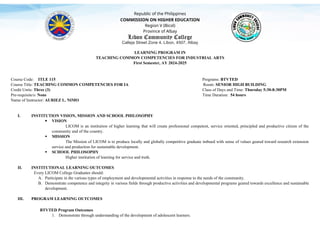
Republic of the Philippines
COMMISSION ON HIGHER EDUCATION
Region V (Bicol)
Province of Albay
Libon Community College
Calleja Street Zone 4, Libon, 4507, Albay
LEARNING PROGRAM IN
TEACHING COMMON COMPETENCIES FOR INDUSTRIAL ARTS
First Semester, AY 2024-2025
Course Code: ITLE 115 Programs: BTVTED
Course Title: TEACHING COMMON COMPETENCIES FOR IA Room: SENIOR HIGH BUILDING
Credit Units: Three (3) Class of Days and Time: Thursday 5:30-8:30PM
Pre-requisite/s: None Time Duration: 54 hours
Name of Instructor: AURIEZ L. NIMO
I. INSTITUTION VISION, MISSION AND SCHOOL PHILOSOPHY
 VISION
LICOM is an institution of higher learning that will create professional competent, service oriented, principled and productive citizen of the
community and of the country.
 MISSION
The Mission of LICOM is to produce locally and globally competitive graduate imbued with sense of values geared toward research extension
service and production for sustainable development.
 SCHOOL PHILOSOPHY
Higher institution of learning for service and truth.
II. INSTITUTIONAL LEARNING OUTCOMES
Every LICOM College Graduates should:
A. Participate in the various types of employment and developmental activities in response to the needs of the community.
B. Demonstrate competence and integrity in various fields through productive activities and developmental programs geared towards excellence and sustainable
development.
III. PROGRAM LEARNING OUTCOMES
BTVTED Program Outcomes
1. Demonstrate through understanding of the development of adolescent learners.
2. Exhibit comprehensive knowledge in various learning areas in the secondary curriculum.
3. Create and utilize appropriate materials and assessment tools to enhance instruction and improve learning outcomes.
4. Design and implement assessment tool and procedures to measure secondary learning outcomes.
5. Manifest enthusiasm and positive attitudes to foster exemplary service to the needs of the community.
6. Show a deep and principled understanding of how educational processes relate to larger historical, social, cultural and political processes.
7. Apply a wide range of teaching process skills (including curriculum development, educational assessment, and teaching approaches) and;
8. Reflect on the relationships among the teaching process skills, the learning processing in the students, the nature of the content/subject matter and the
other factors affecting educational process in order to constantly improve their teaching knowledge, skills, and practices.
IV. COURSE DESCRIPTION
This course provides prospective teachers a foundation in teaching different competencies in Industrial Arts track, including concepts that will help to
develop knowledge, skills, and attitude to perform different tasks on the track chosen. It covers common competencies on personal entrepreneurial
competencies, environment and market, and occupational safety and health. It also includes different exploratory courses of Industrial Arts to give
prospective teachers skills and knowledge on the track chosen.
V. COURSE OBJECTIVES
At the end of the course, the students should be able to:
1. Actively participate in small and whole group discussion forums by analyzing, constructing/creating, and evaluating information presented
within the textbook, external readings/resources, student research, class activities, and field-experience.
2. Demonstrate understanding of the course materials through objective examinations and preparing and peer-microteaching, and group
interdisciplinary lesson projects.
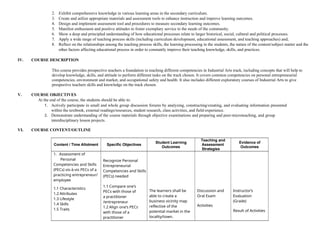
VI. COURSE CONTENT/OUTLINE
Content / Time Allotment Specific Objectives
Student Learning
Outcomes
Teaching and
Assessment
Strategies
Evidence of
Outcomes
1. Assessment of
Personal
Competencies and Skills
(PECs) vis-à-vis PECs of a
practicing entrepreneur/
employee
Recognize Personal
Entrepreneurial
Competencies and Skills
(PECs) needed
1.1 Characteristics
1.2 Attributes
1.3 Lifestyle
1.4 Skills
1.5 Traits
1.1 Compare one’s
PECs with those of
a practitioner
/entrepreneur
1.2 Align one’s PECs
with those of a
practitioner
The learners shall be
able to create a
business vicinity map
reflective of the
potential market in the
locality/town.
Discussion and
Oral Exam
Activities
Instructor’s
Evaluation
(Grade)
Result of Activities
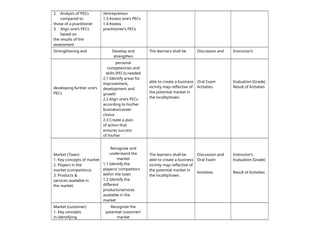
2. Analysis of PECs
compared to
those of a practitioner
3. Align one’s PECs
based on
the results of the
assessment
/entrepreneur
1.3 Assess one’s PECs
1.4 Assess
practitioner’s PECs
Strengthening and Develop and
strengthen
The learners shall be Discussion and Instructor’s
developing further one’s
PECs
personal
competencies and
skills (PECs) needed
2.1 Identify areas for
improvement,
development and
growth
2.2 Align one’s PECs
according to his/her
business/career
choice
2.3 Create a plan
of action that
ensures success
of his/her
able to create a business
vicinity map reflective of
the potential market in
the locality/town.
Oral Exam
Activities
Evaluation (Grade)
Result of Activities
Market (Town)
1. Key concepts of market
2. Players in the
market (competitors)
3. Products &
services available in
the market
Recognize and
understand the
market
1.1 Identify the
players/ competitors
within the town
1.2 Identify the
different
products/services
available in the
market
The learners shall be
able to create a business
vicinity map reflective of
the potential market in
the locality/town.
Discussion and
Oral Exam
Activities
Instructor’s
Evaluation (Grade)
Result of Activities
Market (customer)
1. Key concepts
in identifying
Recognize the
potential customer/
market
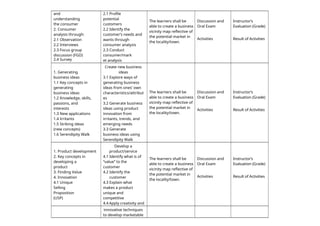
and
understanding
the consumer
2. Consumer
analysis through:
2.1 Observation
2.2 Interviews
2.3 Focus group
discussion (FGD)
2.4 Survey
2.1 Profile
potential
customers
2.2 Identify the
customer’s needs and
wants through
consumer analysis
2.3 Conduct
consumer/mark
et analysis
The learners shall be
able to create a business
vicinity map reflective of
the potential market in
the locality/town.
Discussion and
Oral Exam
Activities
Instructor’s
Evaluation (Grade)
Result of Activities
1. Generating
business ideas
1.1 Key concepts in
generating
business ideas
1.2 Knowledge, skills,
passions, and
interests
1.3 New applications
1.4 Irritants
1.5 Striking ideas
(new concepts)
1.6 Serendipity Walk
Create new business
ideas
3.1 Explore ways of
generating business
ideas from ones’ own
characteristics/attribut
es
3.2 Generate business
ideas using product
innovation from
irritants, trends, and
emerging needs
3.3 Generate
business ideas using
Serendipity Walk
The learners shall be
able to create a business
vicinity map reflective of
the potential market in
the locality/town.
Discussion and
Oral Exam
Activities
Instructor’s
Evaluation (Grade)
Result of Activities
1. Product development
2. Key concepts in
developing a
product
3. Finding Value
4. Innovation
4.1 Unique
Selling
Proposition
(USP)
Develop a
product/service
4.1 Identify what is of
“value” to the
customer
4.2 Identify the
customer
4.3 Explain what
makes a product
unique and
competitive
4.4 Apply creativity and
The learners shall be
able to create a business
vicinity map reflective of
the potential market in
the locality/town.
Discussion and
Oral Exam
Activities
Instructor’s
Evaluation (Grade)
Result of Activities
innovative techniques
to develop marketable
product
4.5 Employ a USP to
the product/service
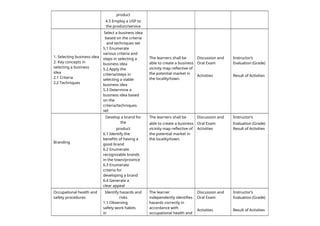
1. Selecting business idea
2. Key concepts in
selecting a business
idea
2.1 Criteria
2.2 Techniques
Select a business idea
based on the criteria
and techniques set
5.1 Enumerate
various criteria and
steps in selecting a
business idea
5.2 Apply the
criteria/steps in
selecting a viable
business idea
5.3 Determine a
business idea based
on the
criteria/techniques
set
The learners shall be
able to create a business
vicinity map reflective of
the potential market in
the locality/town.
Discussion and
Oral Exam
Activities
Instructor’s
Evaluation (Grade)
Result of Activities
Branding
Develop a brand for
the
product
6.1 Identify the
benefits of having a
good brand
6.2 Enumerate
recognizable brands
in the town/province
6.3 Enumerate
criteria for
developing a brand
6.4 Generate a
clear appeal
The learners shall be
able to create a business
vicinity map reflective of
the potential market in
the locality/town.
Discussion and
Oral Exam
Activities
Instructor’s
Evaluation (Grade)
Result of Activities
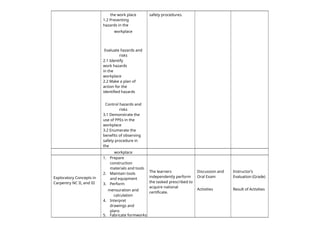
Occupational health and
safety procedures
Identify hazards and
risks
1.1 Observing
safety work habits
in
The learner
independently identifies
hazards correctly in
accordance with
occupational health and
Discussion and
Oral Exam
Activities
Instructor’s
Evaluation (Grade)
Result of Activities
the work place
1.2 Preventing
hazards in the
workplace
Evaluate hazards and
risks
2.1 Identify
work hazards
in the
workplace
2.2 Make a plan of
action for the
identified hazards
Control hazards and
risks
3.1 Demonstrate the
use of PPEs in the
workplace
3.2 Enumerate the
benefits of observing
safety procedure in
the
safety procedures.
workplace
Exploratory Concepts in
Carpentry NC II, and III
1. Prepare
construction
materials and tools
2. Maintain tools
and equipment
3. Perform
mensuration and
calculation
4. Interpret
drawings and
plans
5. Fabricate formworks
The learners
independently perform
the tasked prescribed to
acquire national
certificate.
Discussion and
Oral Exam
Activities
Instructor’s
Evaluation (Grade)
Result of Activities
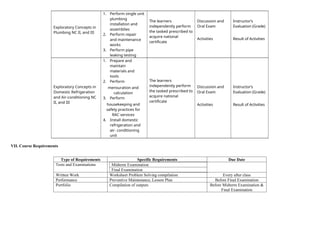
Exploratory Concepts in
Plumbing NC II, and III
1. Perform single unit
plumbing
installation and
assemblies
2. Perform repair
and maintenance
works
3. Perform pipe
leaking testing
The learners
independently perform
the tasked prescribed to
acquire national
certificate
Discussion and
Oral Exam
Activities
Instructor’s
Evaluation (Grade)
Result of Activities
Exploratory Concepts in
Domestic Refrigeration
and Air-conditioning NC
II, and III
1. Prepare and
maintain
materials and
tools
2. Perform
mensuration and
calculation
3. Perform
housekeeping and
safety practices for
RAC services
4. Install domestic
refrigeration and
air- conditioning
unit
The learners
independently perform
the tasked prescribed to
acquire national
certificate
Discussion and
Oral Exam
Activities
Instructor’s
Evaluation (Grade)
Result of Activities
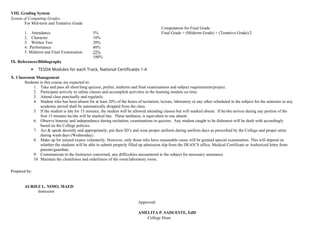
VII. Course Requirements
Type of Requirements Specific Requirements Due Date
Tests and Examinations Midterm Examination
Final Examination
Written Work Worksheet Problem Solving compilation Every after class
Performance Preventive Maintenance, Lesson Plan Before Final Examination
Portfolio Compilation of outputs Before Midterm Examination &
Final Examination
VIII. Grading System
System of Computing Grades:
For Mid-term and Tentative Grade
Computation for Final Grade
1. Attendance 5% Final Grade = (Midterm Grade) + (Tentative Grade)/2
2. Character 10%
3. Written Test 20%
4. Performance 40%
5. Midterm and Final Examination 25%
100%
IX. References/Bibliography
 TESDA Modules for each Track, National Certificates 1-4
X. Classroom Management
Students in this course are expected to:
1. Take and pass all short/long quizzes, prelim, midterm and final examinations and subject requirements/project.
2. Participate actively in online classes and accomplish activities in the learning module on time.
3. Attend class punctually and regularly.
4. Student who has been absent for at least 20% of the hours of recitation, lecture, laboratory or any other scheduled in the subject for the semester or any
academic period shall be automatically dropped from the class.
5. If the student is late for 15 minutes, the student will be allowed attending classes but will marked absent. If he/she arrives during any portion of the
first 15 minutes he/she will be marked late. Three tardiness, is equivalent to one absent.
6. Observe honesty and independence during recitation, examinations or quizzes. Any student caught to be dishonest will be dealt with accordingly
based on the College policies.
7. Act & speak decently and appropriately; pin their ID’s and wear proper uniform during uniform days as prescribed by the College and proper attire
during wash days (Wednesday).
8. Make up for missed exams voluntarily. However, only those who have reasonable cause will be granted special examination. This will depend on
whether the students will be able to submit properly filled up admission slip from the DEAN’S office, Medical Certificate or Authorized letter from
parents/guardian.
9. Communicate to the Instructor concerned, any difficulties encountered in the subject for necessary assistance.
10. Maintain the cleanliness and orderliness of the room/laboratory room.
Prepared by:
AURIEZ L. NIMO, MAED
Instructor
Approved:
AMELITA P. SADUESTE, EdD
College Dean

‌Industrial Arts Common Competencies.docx

  • 1.
    Republic of thePhilippines COMMISSION ON HIGHER EDUCATION Region V (Bicol) Province of Albay Libon Community College Calleja Street Zone 4, Libon, 4507, Albay LEARNING PROGRAM IN TEACHING COMMON COMPETENCIES FOR INDUSTRIAL ARTS First Semester, AY 2024-2025 Course Code: ITLE 115 Programs: BTVTED Course Title: TEACHING COMMON COMPETENCIES FOR IA Room: SENIOR HIGH BUILDING Credit Units: Three (3) Class of Days and Time: Thursday 5:30-8:30PM Pre-requisite/s: None Time Duration: 54 hours Name of Instructor: AURIEZ L. NIMO I. INSTITUTION VISION, MISSION AND SCHOOL PHILOSOPHY  VISION LICOM is an institution of higher learning that will create professional competent, service oriented, principled and productive citizen of the community and of the country.  MISSION The Mission of LICOM is to produce locally and globally competitive graduate imbued with sense of values geared toward research extension service and production for sustainable development.  SCHOOL PHILOSOPHY Higher institution of learning for service and truth. II. INSTITUTIONAL LEARNING OUTCOMES Every LICOM College Graduates should: A. Participate in the various types of employment and developmental activities in response to the needs of the community. B. Demonstrate competence and integrity in various fields through productive activities and developmental programs geared towards excellence and sustainable development. III. PROGRAM LEARNING OUTCOMES BTVTED Program Outcomes 1. Demonstrate through understanding of the development of adolescent learners.
  • 2.
    2. Exhibit comprehensiveknowledge in various learning areas in the secondary curriculum. 3. Create and utilize appropriate materials and assessment tools to enhance instruction and improve learning outcomes. 4. Design and implement assessment tool and procedures to measure secondary learning outcomes. 5. Manifest enthusiasm and positive attitudes to foster exemplary service to the needs of the community. 6. Show a deep and principled understanding of how educational processes relate to larger historical, social, cultural and political processes. 7. Apply a wide range of teaching process skills (including curriculum development, educational assessment, and teaching approaches) and; 8. Reflect on the relationships among the teaching process skills, the learning processing in the students, the nature of the content/subject matter and the other factors affecting educational process in order to constantly improve their teaching knowledge, skills, and practices. IV. COURSE DESCRIPTION This course provides prospective teachers a foundation in teaching different competencies in Industrial Arts track, including concepts that will help to develop knowledge, skills, and attitude to perform different tasks on the track chosen. It covers common competencies on personal entrepreneurial competencies, environment and market, and occupational safety and health. It also includes different exploratory courses of Industrial Arts to give prospective teachers skills and knowledge on the track chosen. V. COURSE OBJECTIVES At the end of the course, the students should be able to: 1. Actively participate in small and whole group discussion forums by analyzing, constructing/creating, and evaluating information presented within the textbook, external readings/resources, student research, class activities, and field-experience. 2. Demonstrate understanding of the course materials through objective examinations and preparing and peer-microteaching, and group interdisciplinary lesson projects. VI. COURSE CONTENT/OUTLINE Content / Time Allotment Specific Objectives Student Learning Outcomes Teaching and Assessment Strategies Evidence of Outcomes 1. Assessment of Personal Competencies and Skills (PECs) vis-à-vis PECs of a practicing entrepreneur/ employee Recognize Personal Entrepreneurial Competencies and Skills (PECs) needed 1.1 Characteristics 1.2 Attributes 1.3 Lifestyle 1.4 Skills 1.5 Traits 1.1 Compare one’s PECs with those of a practitioner /entrepreneur 1.2 Align one’s PECs with those of a practitioner The learners shall be able to create a business vicinity map reflective of the potential market in the locality/town. Discussion and Oral Exam Activities Instructor’s Evaluation (Grade) Result of Activities
  • 3.
    2. Analysis ofPECs compared to those of a practitioner 3. Align one’s PECs based on the results of the assessment /entrepreneur 1.3 Assess one’s PECs 1.4 Assess practitioner’s PECs Strengthening and Develop and strengthen The learners shall be Discussion and Instructor’s developing further one’s PECs personal competencies and skills (PECs) needed 2.1 Identify areas for improvement, development and growth 2.2 Align one’s PECs according to his/her business/career choice 2.3 Create a plan of action that ensures success of his/her able to create a business vicinity map reflective of the potential market in the locality/town. Oral Exam Activities Evaluation (Grade) Result of Activities Market (Town) 1. Key concepts of market 2. Players in the market (competitors) 3. Products & services available in the market Recognize and understand the market 1.1 Identify the players/ competitors within the town 1.2 Identify the different products/services available in the market The learners shall be able to create a business vicinity map reflective of the potential market in the locality/town. Discussion and Oral Exam Activities Instructor’s Evaluation (Grade) Result of Activities Market (customer) 1. Key concepts in identifying Recognize the potential customer/ market
  • 4.
    and understanding the consumer 2. Consumer analysisthrough: 2.1 Observation 2.2 Interviews 2.3 Focus group discussion (FGD) 2.4 Survey 2.1 Profile potential customers 2.2 Identify the customer’s needs and wants through consumer analysis 2.3 Conduct consumer/mark et analysis The learners shall be able to create a business vicinity map reflective of the potential market in the locality/town. Discussion and Oral Exam Activities Instructor’s Evaluation (Grade) Result of Activities 1. Generating business ideas 1.1 Key concepts in generating business ideas 1.2 Knowledge, skills, passions, and interests 1.3 New applications 1.4 Irritants 1.5 Striking ideas (new concepts) 1.6 Serendipity Walk Create new business ideas 3.1 Explore ways of generating business ideas from ones’ own characteristics/attribut es 3.2 Generate business ideas using product innovation from irritants, trends, and emerging needs 3.3 Generate business ideas using Serendipity Walk The learners shall be able to create a business vicinity map reflective of the potential market in the locality/town. Discussion and Oral Exam Activities Instructor’s Evaluation (Grade) Result of Activities 1. Product development 2. Key concepts in developing a product 3. Finding Value 4. Innovation 4.1 Unique Selling Proposition (USP) Develop a product/service 4.1 Identify what is of “value” to the customer 4.2 Identify the customer 4.3 Explain what makes a product unique and competitive 4.4 Apply creativity and The learners shall be able to create a business vicinity map reflective of the potential market in the locality/town. Discussion and Oral Exam Activities Instructor’s Evaluation (Grade) Result of Activities innovative techniques to develop marketable
  • 5.
    product 4.5 Employ aUSP to the product/service 1. Selecting business idea 2. Key concepts in selecting a business idea 2.1 Criteria 2.2 Techniques Select a business idea based on the criteria and techniques set 5.1 Enumerate various criteria and steps in selecting a business idea 5.2 Apply the criteria/steps in selecting a viable business idea 5.3 Determine a business idea based on the criteria/techniques set The learners shall be able to create a business vicinity map reflective of the potential market in the locality/town. Discussion and Oral Exam Activities Instructor’s Evaluation (Grade) Result of Activities Branding Develop a brand for the product 6.1 Identify the benefits of having a good brand 6.2 Enumerate recognizable brands in the town/province 6.3 Enumerate criteria for developing a brand 6.4 Generate a clear appeal The learners shall be able to create a business vicinity map reflective of the potential market in the locality/town. Discussion and Oral Exam Activities Instructor’s Evaluation (Grade) Result of Activities Occupational health and safety procedures Identify hazards and risks 1.1 Observing safety work habits in The learner independently identifies hazards correctly in accordance with occupational health and Discussion and Oral Exam Activities Instructor’s Evaluation (Grade) Result of Activities
  • 6.
    the work place 1.2Preventing hazards in the workplace Evaluate hazards and risks 2.1 Identify work hazards in the workplace 2.2 Make a plan of action for the identified hazards Control hazards and risks 3.1 Demonstrate the use of PPEs in the workplace 3.2 Enumerate the benefits of observing safety procedure in the safety procedures. workplace Exploratory Concepts in Carpentry NC II, and III 1. Prepare construction materials and tools 2. Maintain tools and equipment 3. Perform mensuration and calculation 4. Interpret drawings and plans 5. Fabricate formworks The learners independently perform the tasked prescribed to acquire national certificate. Discussion and Oral Exam Activities Instructor’s Evaluation (Grade) Result of Activities
  • 7.
    Exploratory Concepts in PlumbingNC II, and III 1. Perform single unit plumbing installation and assemblies 2. Perform repair and maintenance works 3. Perform pipe leaking testing The learners independently perform the tasked prescribed to acquire national certificate Discussion and Oral Exam Activities Instructor’s Evaluation (Grade) Result of Activities Exploratory Concepts in Domestic Refrigeration and Air-conditioning NC II, and III 1. Prepare and maintain materials and tools 2. Perform mensuration and calculation 3. Perform housekeeping and safety practices for RAC services 4. Install domestic refrigeration and air- conditioning unit The learners independently perform the tasked prescribed to acquire national certificate Discussion and Oral Exam Activities Instructor’s Evaluation (Grade) Result of Activities VII. Course Requirements Type of Requirements Specific Requirements Due Date Tests and Examinations Midterm Examination Final Examination Written Work Worksheet Problem Solving compilation Every after class Performance Preventive Maintenance, Lesson Plan Before Final Examination Portfolio Compilation of outputs Before Midterm Examination & Final Examination
  • 8.
    VIII. Grading System Systemof Computing Grades: For Mid-term and Tentative Grade Computation for Final Grade 1. Attendance 5% Final Grade = (Midterm Grade) + (Tentative Grade)/2 2. Character 10% 3. Written Test 20% 4. Performance 40% 5. Midterm and Final Examination 25% 100% IX. References/Bibliography  TESDA Modules for each Track, National Certificates 1-4 X. Classroom Management Students in this course are expected to: 1. Take and pass all short/long quizzes, prelim, midterm and final examinations and subject requirements/project. 2. Participate actively in online classes and accomplish activities in the learning module on time. 3. Attend class punctually and regularly. 4. Student who has been absent for at least 20% of the hours of recitation, lecture, laboratory or any other scheduled in the subject for the semester or any academic period shall be automatically dropped from the class. 5. If the student is late for 15 minutes, the student will be allowed attending classes but will marked absent. If he/she arrives during any portion of the first 15 minutes he/she will be marked late. Three tardiness, is equivalent to one absent. 6. Observe honesty and independence during recitation, examinations or quizzes. Any student caught to be dishonest will be dealt with accordingly based on the College policies. 7. Act & speak decently and appropriately; pin their ID’s and wear proper uniform during uniform days as prescribed by the College and proper attire during wash days (Wednesday). 8. Make up for missed exams voluntarily. However, only those who have reasonable cause will be granted special examination. This will depend on whether the students will be able to submit properly filled up admission slip from the DEAN’S office, Medical Certificate or Authorized letter from parents/guardian. 9. Communicate to the Instructor concerned, any difficulties encountered in the subject for necessary assistance. 10. Maintain the cleanliness and orderliness of the room/laboratory room. Prepared by: AURIEZ L. NIMO, MAED Instructor Approved: AMELITA P. SADUESTE, EdD College Dean