K to 12 BASIC EDUCATION CURRICULUM
JUNIOR HIGH SCHOOL TECHNICAL LIVELIHOOD EDUCATION AND SENIOR HIGH SCHOOL - TECHNICAL-VOCATIONAL-LIVELIHOOD TRACK
HOME ECONOMICS – BREAD AND PASTRY PRODUCTION
K to 12 Home Economics – Bread and Pastry Production Curriculum Guide December 2013 *LO – Learning Outcome Page 1 of 14
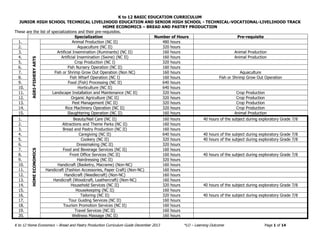
These are the list of specializations and their pre-requisites.
Specialization Number of Hours Pre-requisite
1.
AGRI-FISHERYARTS
Animal Production (NC II) 480 hours
2. Aquaculture (NC II) 320 hours
3. Artificial Insemination (Ruminants) (NC II) 160 hours Animal Production
4. Artificial Insemination (Swine) (NC II) 160 hours Animal Production
5. Crop Production (NC I) 320 hours
6. Fish Nursery Operation (NC II) 160 hours
7. Fish or Shrimp Grow Out Operation (Non NC) 160 hours Aquaculture
8. Fish Wharf Operation (NC I) 160 hours Fish or Shrimp Grow Out Operation
9. Food (Fish) Processing (NC II) 640 hours
10. Horticulture (NC II) 640 hours
11. Landscape Installation and Maintenance (NC II) 320 hours Crop Production
12. Organic Agriculture (NC II) 320 hours Crop Production
13. Pest Management (NC II) 320 hours Crop Production
14. Rice Machinery Operation (NC II) 320 hours Crop Production
15. Slaughtering Operation (NC II) 160 hours Animal Production
1.
HOMEECONOMICS
Beauty/Nail Care (NC II) 160 hours 40 hours of the subject during exploratory Grade 7/8
2. Attractions and Theme Parks (NC II) 160 hours
3. Bread and Pastry Production (NC II) 160 hours
4. Caregiving (NC II) 640 hours 40 hours of the subject during exploratory Grade 7/8
5. Cookery (NC II) 320 hours 40 hours of the subject during exploratory Grade 7/8
6. Dressmaking (NC II) 320 hours
7. Food and Beverage Services (NC II) 160 hours
8. Front Office Services (NC II) 160 hours 40 hours of the subject during exploratory Grade 7/8
9. Hairdressing (NC II) 320 hours
10. Handicraft (Basketry, Macrame) (Non-NC) 160 hours
11. Handicraft (Fashion Accessories, Paper Craft) (Non-NC) 160 hours
12. Handicraft (Needlecraft) (Non-NC) 160 hours
13. Handicraft (Woodcraft, Leathercraft) (Non-NC) 160 hours
14. Household Services (NC II) 320 hours 40 hours of the subject during exploratory Grade 7/8
15. Housekeeping (NC II) 160 hours
16. Tailoring (NC II) 320 hours 40 hours of the subject during exploratory Grade 7/8
17. Tour Guiding Services (NC II) 160 hours
18. Tourism Promotion Services (NC II) 160 hours
19. Travel Services (NC II) 160 hours
20. Wellness Massage (NC II) 160 hours
K to 12 BASIC EDUCATION CURRICULUM
JUNIOR HIGH SCHOOL TECHNICAL LIVELIHOOD EDUCATION AND SENIOR HIGH SCHOOL - TECHNICAL-VOCATIONAL-LIVELIHOOD TRACK
HOME ECONOMICS – BREAD AND PASTRY PRODUCTION
K to 12 Home Economics – Bread and Pastry Production Curriculum Guide December 2013 *LO – Learning Outcome Page 2 of 14
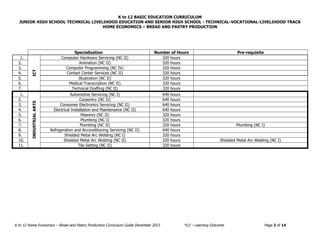
Specialization Number of Hours Pre-requisite
1.
ICT
Computer Hardware Servicing (NC II) 320 hours
2. Animation (NC II) 320 hours
3. Computer Programming (NC IV) 320 hours
4. Contact Center Services (NC II) 320 hours
5. Illustration (NC II) 320 hours
6. Medical Transcription (NC II) 320 hours
7. Technical Drafting (NC II) 320 hours
1.
INDUSTRIALARTS
Automotive Servicing (NC I) 640 hours
2. Carpentry (NC II) 640 hours
3. Consumer Electronics Servicing (NC II) 640 hours
4. Electrical Installation and Maintenance (NC II) 640 hours
5. Masonry (NC II) 320 hours
6. Plumbing (NC I) 320 hours
7. Plumbing (NC II) 320 hours Plumbing (NC I)
8. Refrigeration and Airconditioning Servicing (NC II) 640 hours
9. Shielded Metal Arc Welding (NC I) 320 hours
10. Shielded Metal Arc Welding (NC II) 320 hours Shielded Metal Arc Welding (NC I)
11. Tile Setting (NC II) 320 hours
K to 12 BASIC EDUCATION CURRICULUM
JUNIOR HIGH SCHOOL TECHNICAL LIVELIHOOD EDUCATION AND SENIOR HIGH SCHOOL - TECHNICAL-VOCATIONAL-LIVELIHOOD TRACK
HOME ECONOMICS – BREAD AND PASTRY PRODUCTION
K to 12 Home Economics – Bread and Pastry Production Curriculum Guide December 2013 *LO – Learning Outcome Page 3 of 14
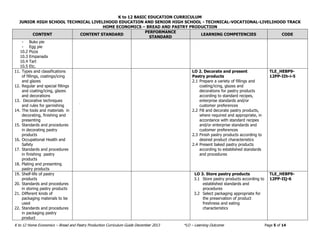
(160 hours)
Course Description:
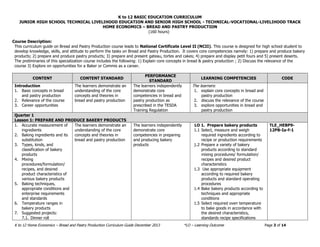
This curriculum guide on Bread and Pastry Production course leads to National Certificate Level II (NCII). This course is designed for high school student to
develop knowledge, skills, and attitude to perform the tasks on Bread and Pastry Production. It covers core competencies namely: 1) prepare and produce bakery
products; 2) prepare and produce pastry products; 3) prepare and present gateau, tortes and cakes; 4) prepare and display petit fours and 5) present deserts.
The preliminaries of this specialization course includes the following: 1) Explain core concepts in bread & pastry production ; 2) Discuss the relevance of the
course 3) Explore on opportunities for a Baker or Commis as a career.
CONTENT CONTENT STANDARD
PERFORMANCE
STANDARD
LEARNING COMPETENCIES CODE
Introduction
1. Basic concepts in bread
and pastry production
2. Relevance of the course
3. Career opportunities
The learners demonstrate an
understanding of the core
concepts and theories in
bread and pastry production
The learners independently
demonstrate core
competencies in bread and
pastry production as
prescribed in the TESDA
Training Regulation
The learners:
1. explain core concepts in bread and
pastry production
2. discuss the relevance of the course
3. explore opportunities in bread and
pastry production
Quarter 1
Lesson 1: PREPARE AND PRODUCE BAKERY PRODUCTS
1. Accurate measurement of
ingredients
2. Baking ingredients and its
substitution
3. Types, kinds, and
classification of bakery
products
4. Mixing
procedures/formulation/
recipes, and desired
product characteristics of
various bakery products
5. Baking techniques,
appropriate conditions and
enterprise requirements
and standards
6. Temperature ranges in
bakery products
7. Suggested projects:
7.1. Dinner roll
The learners demonstrate an
understanding of the core
concepts and theories in
bread and pastry production
The learners independently
demonstrate core
competencies in preparing
and producing bakery
products
LO 1. Prepare bakery products
1.1 Select, measure and weigh
required ingredients according to
recipe or production requirements
1.2 Prepare a variety of bakery
products according to standard
mixing procedures/ formulation/
recipes and desired product
characteristics
1.3 Use appropriate equipment
according to required bakery
products and standard operating
procedures
1.4 Bake bakery products according to
techniques and appropriate
conditions
1.5 Select required oven temperature
to bake goods in accordance with
the desired characteristics,
standards recipe specifications
TLE_HEBP9-
12PB-Ia-f-1
K to 12 BASIC EDUCATION CURRICULUM
JUNIOR HIGH SCHOOL TECHNICAL LIVELIHOOD EDUCATION AND SENIOR HIGH SCHOOL - TECHNICAL-VOCATIONAL-LIVELIHOOD TRACK
HOME ECONOMICS – BREAD AND PASTRY PRODUCTION
K to 12 Home Economics – Bread and Pastry Production Curriculum Guide December 2013 *LO – Learning Outcome Page 4 of 14
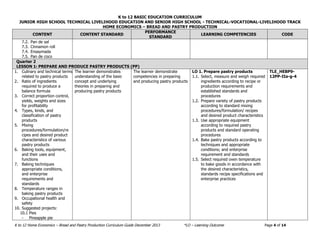
CONTENT CONTENT STANDARD
PERFORMANCE
STANDARD
LEARNING COMPETENCIES CODE
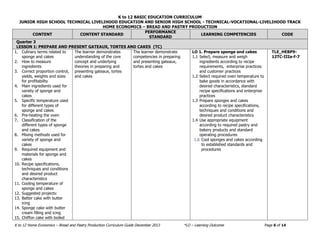
7.2. Pan de sal
7.3. Cinnamon roll
7.4. Ensaymada
7.5. Pan de coco
Quarter 2
LESSON 1: PREPARE AND PRODUCE PASTRY PRODUCTS (PP)
1. Culinary and technical terms
related to pastry products
2. Ratio of ingredients
required to produce a
balance formula
3. Correct proportion control,
yields, weights and sizes
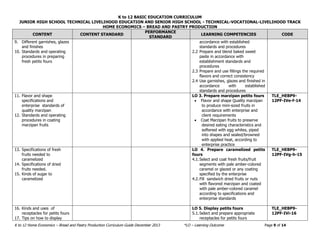
for profitability
4. Types, kinds, and
classification of pastry
products
5. Mixing
procedures/formulation/re
cipes and desired product
characteristics of various
pastry products
6. Baking tools, equipment,
and their uses and
functions
7. Baking techniques
appropriate conditions,
and enterprise
requirements and
standards
8. Temperature ranges in
baking pastry products
9. Occupational health and
safety
10. Suggested projects:
10.1 Pies
- Pineapple pie
The learner demonstrates
understanding of the basic
concept and underlying
theories in preparing and
producing pastry products
The learner demonstrate
competencies in preparing
and producing pastry products
LO 1. Prepare pastry products
1.1. Select, measure and weigh required
ingredients according to recipe or
production requirements and
established standards and
procedures
1.2. Prepare variety of pastry products
according to standard mixing
procedures/formulation/ recipes
and desired product characteristics
1.3. Use appropriate equipment
according to required pastry
products and standard operating
procedures
1.4. Bake pastry products according to
techniques and appropriate
conditions; and enterprise
requirement and standards
1.5. Select required oven temperature
to bake goods in accordance with
the desired characteristics,
standards recipe specifications and
enterprise practices
TLE_HEBP9-
12PP-IIa-g-4
K to 12 BASIC EDUCATION CURRICULUM
JUNIOR HIGH SCHOOL TECHNICAL LIVELIHOOD EDUCATION AND SENIOR HIGH SCHOOL - TECHNICAL-VOCATIONAL-LIVELIHOOD TRACK
HOME ECONOMICS – BREAD AND PASTRY PRODUCTION
K to 12 Home Economics – Bread and Pastry Production Curriculum Guide December 2013 *LO – Learning Outcome Page 5 of 14
CONTENT CONTENT STANDARD
PERFORMANCE
STANDARD
LEARNING COMPETENCIES CODE
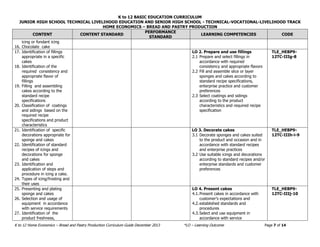
- Buko pie
- Egg pie
10.2 Pizza
10.3 Empanada
10.4 Tart
10.5 Etc.
11. Types and classifications
of fillings, coatings/icing
and glazes
12. Regular and special fillings
and coating/icing, glazes
and decorations
13. Decorative techniques
and rules for garnishing
14. The tools and materials in
decorating, finishing and
presenting
15. Standards and procedures
in decorating pastry
products
16. Occupational Health and
Safety
17. Standards and procedures
in finishing pastry
products
18. Plating and presenting
pastry products
LO 2. Decorate and present
Pastry products
2.1 Prepare a variety of fillings and
coating/icing, glazes and
decorations for pastry products
according to standard recipes,
enterprise standards and/or
customer preferences
2.2 Fill and decorate pastry products,
where required and appropriate, in
accordance with standard recipes
and/or enterprise standards and
customer preferences
2.3 Finish pastry products according to
desired product characteristics
2.4 Present baked pastry products
according to established standards
and procedures
TLE_HEBP9-
12PP-IIh-i-5
19. Shelf-life of pastry
products
20. Standards and procedures
in storing pastry products
21. Different kinds of
packaging materials to be
used
22. Standards and procedures
in packaging pastry
product
LO 3. Store pastry products
3.1 Store pastry products according to
established standards and
procedures
3.2 Select packaging appropriate for
the preservation of product
freshness and eating
characteristics
TLE_HEBP9-
12PP-IIj-6
K to 12 BASIC EDUCATION CURRICULUM
JUNIOR HIGH SCHOOL TECHNICAL LIVELIHOOD EDUCATION AND SENIOR HIGH SCHOOL - TECHNICAL-VOCATIONAL-LIVELIHOOD TRACK
HOME ECONOMICS – BREAD AND PASTRY PRODUCTION
K to 12 Home Economics – Bread and Pastry Production Curriculum Guide December 2013 *LO – Learning Outcome Page 6 of 14
CONTENT CONTENT STANDARD
PERFORMANCE
STANDARD
LEARNING COMPETENCIES CODE
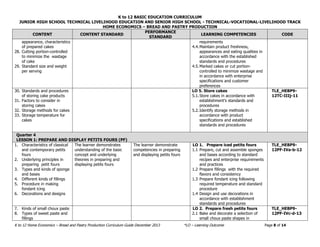
Quarter 3
LESSON 1: PREPARE AND PRESENT GATEAUX, TORTES AND CAKES (TC)
1. Culinary terms related to
sponge and cakes
2. How to measure
ingredients
3. Correct proportion control,
yields, weights and sizes
for profitability
4. Main ingredients used for
variety of sponge and
cakes
5. Specific temperature used
for different types of
sponge and cakes
6. Pre-heating the oven
7. Classification of the
different types of sponge
and cakes
8. Mixing methods used for
variety of sponge and
cakes
9. Required equipment and
materials for sponge and
cakes
10. Recipe specifications,
techniques and conditions
and desired product
characteristics
11. Cooling temperature of
sponge and cakes
12. Suggested projects:
13. Batter cake with butter
icing
14. Sponge cake with butter
cream filling and icing
15. Chiffon cake with boiled
The learner demonstrates
understanding of the core
concept and underlying
theories in preparing and
presenting gateaux, tortes
and cakes
The learner demonstrate
competencies in preparing
and presenting gateaux,
tortes and cakes
LO 1. Prepare sponge and cakes
1.1 Select, measure and weigh
ingredients according to recipe
requirements, enterprise practices
and customer practices
1.2 Select required oven temperature to
bake goods in accordance with
desired characteristics, standard
recipe specifications and enterprise
practices
1.3 Prepare sponges and cakes
according to recipe specifications,
techniques and conditions and
desired product characteristics
1.4 Use appropriate equipment
according to required pastry and
bakery products and standard
operating procedures
1.6 Cool sponges and cakes according
to established standards and
procedures
TLE_HEBP9-
12TC-IIIa-f-7
K to 12 BASIC EDUCATION CURRICULUM
JUNIOR HIGH SCHOOL TECHNICAL LIVELIHOOD EDUCATION AND SENIOR HIGH SCHOOL - TECHNICAL-VOCATIONAL-LIVELIHOOD TRACK
HOME ECONOMICS – BREAD AND PASTRY PRODUCTION
K to 12 Home Economics – Bread and Pastry Production Curriculum Guide December 2013 *LO – Learning Outcome Page 7 of 14
CONTENT CONTENT STANDARD
PERFORMANCE
STANDARD
LEARNING COMPETENCIES CODE
icing or fondant icing
16. Chocolate cake
17. Identification of fillings
appropriate in a specific
cakes
18. Identification of the
required consistency and
appropriate flavor of
fillings
19. Filling and assembling
cakes according to the
standard recipe
specifications
20. Classification of coatings
and sidings based on the
required recipe
specifications and product
characteristics
LO 2. Prepare and use fillings
2.1 Prepare and select fillings in
accordance with required
consistency and appropriate flavors
2.2 Fill and assemble slice or layer
sponges and cakes according to
standard recipe specifications,
enterprise practice and customer
preferences
2.3 Select coatings and sidings
according to the product
characteristics and required recipe
specification
TLE_HEBP9-
12TC-IIIg-8
21. Identification of specific
decorations appropriate for
sponge and cakes
22. Identification of standard
recipes of icings and
decorations for sponge
and cakes
23. Identification and
application of steps and
procedure in icing a cake.
24. Types of icing/frosting and
their uses
LO 3. Decorate cakes
3.1 Decorate sponges and cakes suited
to the product and occasion and in
accordance with standard recipes
and enterprise practices
3.2 Use suitable icings and decorations
according to standard recipes and/or
enterprise standards and customer
preferences
TLE_HEBP9-
12TC-IIIh-i-9
25. Presenting and plating
sponge and cakes
26. Selection and usage of
equipment in accordance
with service requirements
27. Identification of the
product freshness,
LO 4. Present cakes
4.1.Present cakes in accordance with
customer’s expectations and
4.2.established standards and
procedures
4.3.Select and use equipment in
accordance with service
TLE_HEBP9-
12TC-IIIj-10
K to 12 BASIC EDUCATION CURRICULUM
JUNIOR HIGH SCHOOL TECHNICAL LIVELIHOOD EDUCATION AND SENIOR HIGH SCHOOL - TECHNICAL-VOCATIONAL-LIVELIHOOD TRACK
HOME ECONOMICS – BREAD AND PASTRY PRODUCTION
K to 12 Home Economics – Bread and Pastry Production Curriculum Guide December 2013 *LO – Learning Outcome Page 8 of 14
CONTENT CONTENT STANDARD
PERFORMANCE
STANDARD
LEARNING COMPETENCIES CODE
appearance, characteristics
of prepared cakes
28. Cutting portion-controlled
to minimize the wastage
of cake
29. Standard size and weight
per serving
requirements
4.4.Maintain product freshness,
appearances and eating qualities in
accordance with the established
standards and procedures
4.5.Marked cakes or cut portion-
controlled to minimize wastage and
in accordance with enterprise
specifications and customer
preferences
30. Standards and procedures
of storing cake products
31. Factors to consider in
storing cakes
32. Storage methods for cakes
33. Storage temperature for
cakes
LO 5. Store cakes
5.1.Store cakes in accordance with
establishment’s standards and
procedures
5.2.Identify storage methods in
accordance with product
specifications and established
standards and procedures
TLE_HEBP9-
12TC-IIIj-11
Quarter 4
LESSON 1: PREPARE AND DISPLAY PETITS FOURS (PF)
1. Characteristics of classical
and contemporary petits
fours
2. Underlying principles in
preparing petit fours
3. Types and kinds of sponge
and bases
4. Different kinds of fillings
5. Procedure in making
fondant icing
6. Decorations and designs
The learner demonstrates
understanding of the basic
concept and underlying
theories in preparing and
displaying petits fours
The learner demonstrate
competencies in preparing
and displaying petits fours
LO 1. Prepare iced petits fours
1.1 Prepare, cut and assemble sponges
and bases according to standard
recipes and enterprise requirements
and practices
1.2 Prepare fillings with the required
flavors and consistency
1.3 Prepare fondant icing following
required temperature and standard
procedure
1.4 Design and use decorations in
accordance with establishment
standards and procedures
TLE_HEBP9-
12PF-IVa-b-12
7. Kinds of small choux paste
8. Types of sweet paste and
fillings
LO 2. Prepare fresh petits fours
2.1 Bake and decorate a selection of
small choux paste shapes in
TLE_HEBP9-
12PF-IVc-d-13
K to 12 BASIC EDUCATION CURRICULUM
JUNIOR HIGH SCHOOL TECHNICAL LIVELIHOOD EDUCATION AND SENIOR HIGH SCHOOL - TECHNICAL-VOCATIONAL-LIVELIHOOD TRACK
HOME ECONOMICS – BREAD AND PASTRY PRODUCTION
K to 12 Home Economics – Bread and Pastry Production Curriculum Guide December 2013 *LO – Learning Outcome Page 9 of 14
CONTENT CONTENT STANDARD
PERFORMANCE
STANDARD
LEARNING COMPETENCIES CODE
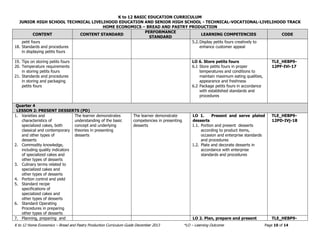
9. Different garnishes, glazes
and finishes
10. Standards and operating
procedures in preparing
fresh petits fours
accordance with established
standards and procedures
2.2 Prepare and blend baked sweet
paste in accordance with
establishment standards and
procedures
2.3 Prepare and use fillings the required
flavors and correct consistency
2.4 Use garnishes, glazes and finished in
accordance with established
standards and procedures
11. Flavor and shape
specifications and
enterprise standards of
quality marzipan
12. Standards and operating
procedures in coating
marzipan fruits
LO 3. Prepare marzipan petits fours
 Flavor and shape Quality marzipan
to produce mini-sized fruits in
accordance with enterprise and
client requirements
 Coat Marzipan fruits to preserve
desired eating characteristics and
softened with egg whites, piped
into shapes and sealed/browned
with applied heat, according to
enterprise practice
TLE_HEBP9-
12PF-IVe-f-14
13. Specifications of fresh
fruits needed to
caramelized
14. Specifications of dried
fruits needed.
15. Kinds of sugar to
caramelized
LO 4. Prepare caramelized petits
fours
4.1.Select and coat fresh fruits/fruit
segments with pale amber-colored
caramel or glazed or any coating
specified by the enterprise
4.2.Fill sandwich dried fruits or nuts
with flavored marzipan and coated
with pale amber-colored caramel
according to specifications and
enterprise standards
TLE_HEBP9-
12PF-IVg-h-15
16. Kinds and uses of
receptacles for petits fours
17. Tips on how to display
LO 5. Display petits fours
5.1.Select and prepare appropriate
receptacles for petits fours
TLE_HEBP9-
12PF-IVi-16
K to 12 BASIC EDUCATION CURRICULUM
JUNIOR HIGH SCHOOL TECHNICAL LIVELIHOOD EDUCATION AND SENIOR HIGH SCHOOL - TECHNICAL-VOCATIONAL-LIVELIHOOD TRACK
HOME ECONOMICS – BREAD AND PASTRY PRODUCTION
K to 12 Home Economics – Bread and Pastry Production Curriculum Guide December 2013 *LO – Learning Outcome Page 10 of 14
CONTENT CONTENT STANDARD
PERFORMANCE
STANDARD
LEARNING COMPETENCIES CODE
petit fours
18. Standards and procedures
in displaying petits fours
5.2.Display petits fours creatively to
enhance customer appeal
19. Tips on storing petits fours
20. Temperature requirements
in storing petits fours
21. Standards and procedures
in storing and packaging
petits fours
LO 6. Store petits fours
6.1 Store petits fours in proper
temperatures and conditions to
maintain maximum eating qualities,
appearance and freshness
6.2 Package petits fours in accordance
with established standards and
procedures
TLE_HEBP9-
12PF-IVi-17
Quarter 4
LESSON 2: PRESENT DESSERTS (PD)
1. Varieties and
characteristics of
specialized cakes, both
classical and contemporary
and other types of
desserts
2. Commodity knowledge,
including quality indicators
of specialized cakes and
other types of desserts
3. Culinary terms related to
specialized cakes and
other types of desserts
4. Portion control and yield
5. Standard recipe
specifications of
specialized cakes and
other types of desserts
6. Standard Operating
Procedures in preparing
other types of desserts
The learner demonstrates
understanding of the basic
concept and underlying
theories in presenting
desserts
The learner demonstrate
competencies in presenting
desserts
LO 1. Present and serve plated
desserts
1.1. Portion and present desserts
according to product items,
occasion and enterprise standards
and procedures
1.2. Plate and decorate desserts in
accordance with enterprise
standards and procedures
TLE_HEBP9-
12PD-IVj-18
7. Planning, preparing and LO 2. Plan, prepare and present TLE_HEBP9-
K to 12 BASIC EDUCATION CURRICULUM
JUNIOR HIGH SCHOOL TECHNICAL LIVELIHOOD EDUCATION AND SENIOR HIGH SCHOOL - TECHNICAL-VOCATIONAL-LIVELIHOOD TRACK
HOME ECONOMICS – BREAD AND PASTRY PRODUCTION
K to 12 Home Economics – Bread and Pastry Production Curriculum Guide December 2013 *LO – Learning Outcome Page 11 of 14
CONTENT CONTENT STANDARD
PERFORMANCE
STANDARD
LEARNING COMPETENCIES CODE
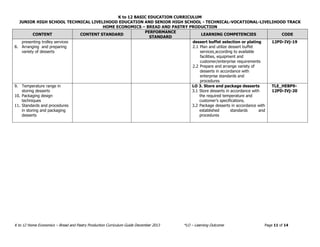
presenting trolley services
8. Arranging and preparing
variety of desserts
dessert buffet selection or plating
2.1 Plan and utilize dessert buffet
services according to available
facilities, equipment and
customer/enterprise requirements
2.2 Prepare and arrange variety of
desserts in accordance with
enterprise standards and
procedures
12PD-IVj-19
9. Temperature range in
storing desserts
10. Packaging design
techniques
11. Standards and procedures
in storing and packaging
desserts
LO 3. Store and package desserts
3.1 Store desserts in accordance with
the required temperature and
customer’s specifications.
3.2 Package desserts in accordance with
established standards and
procedures
TLE_HEBP9-
12PD-IVj-20
K to 12 BASIC EDUCATION CURRICULUM
JUNIOR HIGH SCHOOL TECHNICAL LIVELIHOOD EDUCATION AND SENIOR HIGH SCHOOL - TECHNICAL-VOCATIONAL-LIVELIHOOD TRACK
HOME ECONOMICS – BREAD AND PASTRY PRODUCTION
K to 12 Home Economics – Bread and Pastry Production Curriculum Guide December 2013 *LO – Learning Outcome Page 12 of 14
GLOSSARY
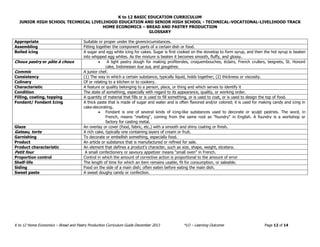
Appropriate Suitable or proper under the givencircumstances.
Assembling Fitting together the component parts of a certain dish or food.
Boiled icing A sugar and egg white icing for cakes. Sugar is first cooked on the stovetop to form syrup, and then the hot syrup is beaten
into whipped egg whites. As the mixture is beaten it becomes smooth, fluffy, and glossy.
Choux pastry or pâte à choux  A light pastry dough for making profiteroles, croquembouches, éclairs, French crullers, beignets, St. Honoré
cake, Indonesian kue sus, and gougères.
Commis A junior chef.
Consistency (1) The way in which a certain substance, typically liquid, holds together; (2) thickness or viscosity.
Culinary Of or relating to a kitchen or to cookery.
Characteristic A feature or quality belonging to a person, place, or thing and which serves to identify it
Condition The state of something, especially with regard to its appearance, quality, or working order.
Filling, coating, topping A quantity of material that fills or is used to fill something, or is used to coat, or is used to design the top of food.
Fondant/ Fondant Icing A thick paste that is made of sugar and water and is often flavored and/or colored; it is used for making candy and icing in
cake-decorating.
 Fondant is one of several kinds of icing-like substances used to decorate or sculpt pastries. The word, in
French, means "melting", coming from the same root as "foundry" in English. A foundry is a workshop or
factory for casting metal.
Glaze An overlay or cover (food, fabric, etc.) with a smooth and shiny coating or finish.
Gateau, torte A rich cake, typically one containing layers of cream or fruit.
Garnishing To decorate or embellish something, especially food.
Product An article or substance that is manufactured or refined for sale.
Product characteristic An element that defines a product's character, such as size, shape, weight, etcetera.
Petit four A small confectionery or savoury appetizer means “small oven” in French.
Proportion control Control in which the amount of corrective action is proportional to the amount of error
Shelf-life The length of time for which an item remains usable, fit for consumption, or saleable.
Siding Food on the side of a main dish; often eaten before eating the main dish.
Sweet paste A sweet doughy candy or confection.
K to 12 BASIC EDUCATION CURRICULUM
JUNIOR HIGH SCHOOL TECHNICAL LIVELIHOOD EDUCATION AND SENIOR HIGH SCHOOL - TECHNICAL-VOCATIONAL-LIVELIHOOD TRACK
HOME ECONOMICS – BREAD AND PASTRY PRODUCTION
K to 12 Home Economics – Bread and Pastry Production Curriculum Guide December 2013 *LO – Learning Outcome Page 13 of 14
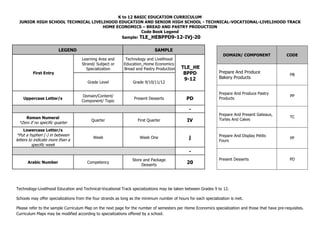
Code Book Legend
Sample: TLE_HEBPPD9-12-IVj-20
LEGEND SAMPLE
First Entry
Learning Area and
Strand/ Subject or
Specialization
Technology and Livelihood
Education_Home Economics
Bread and Pastry Production TLE_HE
BPPD
9-12
Grade Level Grade 9/10/11/12
Uppercase Letter/s
Domain/Content/
Component/ Topic
Present Desserts PD
-
Roman Numeral
*Zero if no specific quarter
Quarter First Quarter IV
Lowercase Letter/s
*Put a hyphen (-) in between
letters to indicate more than a
specific week
Week Week One j
-
Arabic Number Competency
Store and Package
Desserts
20
DOMAIN/ COMPONENT CODE
Prepare And Produce
Bakery Products
PB
Prepare And Produce Pastry
Products
PP
Prepare And Present Gateaux,
Tortes And Cakes
TC
Prepare And Display Petits
Fours
PF
Present Desserts PD
Technology-Livelihood Education and Technical-Vocational Track specializations may be taken between Grades 9 to 12.
Schools may offer specializations from the four strands as long as the minimum number of hours for each specialization is met.
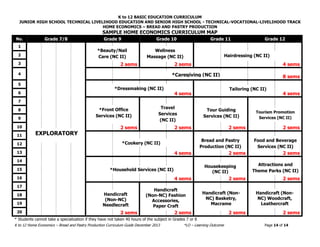
Please refer to the sample Curriculum Map on the next page for the number of semesters per Home Economics specialization and those that have pre-requisites.
Curriculum Maps may be modified according to specializations offered by a school.
K to 12 BASIC EDUCATION CURRICULUM
JUNIOR HIGH SCHOOL TECHNICAL LIVELIHOOD EDUCATION AND SENIOR HIGH SCHOOL - TECHNICAL-VOCATIONAL-LIVELIHOOD TRACK
HOME ECONOMICS – BREAD AND PASTRY PRODUCTION
K to 12 Home Economics – Bread and Pastry Production Curriculum Guide December 2013 *LO – Learning Outcome Page 14 of 14
SAMPLE HOME ECONOMICS CURRICULUM MAP
No. Grade 7/8 Grade 9 Grade 10 Grade 11 Grade 12
1
2 sems 2 sems 4 sems
2
3
4
8 sems
5
4 sems 4 sems6
7
2 sems 2 sems 2 sems 2 sems
8
9
10
11
4 sems 2 sems 2 sems
12
13
14
4 sems 2 sems 2 sems
15
16
17
2 sems 2 sems 2 sems 2 sems
18
19
20
* Students cannot take a specialization if they have not taken 40 hours of the subject in Grades 7 or 8
*Caregiving (NC II)
*Dressmaking (NC II)
Handicraft
(Non-NC)
Needlecraft
Handicraft
(Non-NC) Fashion
Accessories,
Paper Craft
Handicraft (Non-
NC) Basketry,
Macrame
Handicraft (Non-
NC) Woodcraft,
Leathercraft
*Beauty/Nail
Care (NC II)
Wellness
Massage (NC II) Hairdressing (NC II)
EXPLORATORY
Tailoring (NC II)
Tour Guiding
Services (NC II)
Travel
Services
(NC II)
*Front Office
Services (NC II)
Tourism Promotion
Services (NC II)
*Cookery (NC II)
Bread and Pastry
Production (NC II)
Food and Beverage
Services (NC II)
Housekeeping
(NC II)
Attractions and
Theme Parks (NC II)*Household Services (NC II)

TLE CURRICULUM GUIDEBread and pastry cg (1)

  • 1.
    K to 12BASIC EDUCATION CURRICULUM JUNIOR HIGH SCHOOL TECHNICAL LIVELIHOOD EDUCATION AND SENIOR HIGH SCHOOL - TECHNICAL-VOCATIONAL-LIVELIHOOD TRACK HOME ECONOMICS – BREAD AND PASTRY PRODUCTION K to 12 Home Economics – Bread and Pastry Production Curriculum Guide December 2013 *LO – Learning Outcome Page 1 of 14 These are the list of specializations and their pre-requisites. Specialization Number of Hours Pre-requisite 1. AGRI-FISHERYARTS Animal Production (NC II) 480 hours 2. Aquaculture (NC II) 320 hours 3. Artificial Insemination (Ruminants) (NC II) 160 hours Animal Production 4. Artificial Insemination (Swine) (NC II) 160 hours Animal Production 5. Crop Production (NC I) 320 hours 6. Fish Nursery Operation (NC II) 160 hours 7. Fish or Shrimp Grow Out Operation (Non NC) 160 hours Aquaculture 8. Fish Wharf Operation (NC I) 160 hours Fish or Shrimp Grow Out Operation 9. Food (Fish) Processing (NC II) 640 hours 10. Horticulture (NC II) 640 hours 11. Landscape Installation and Maintenance (NC II) 320 hours Crop Production 12. Organic Agriculture (NC II) 320 hours Crop Production 13. Pest Management (NC II) 320 hours Crop Production 14. Rice Machinery Operation (NC II) 320 hours Crop Production 15. Slaughtering Operation (NC II) 160 hours Animal Production 1. HOMEECONOMICS Beauty/Nail Care (NC II) 160 hours 40 hours of the subject during exploratory Grade 7/8 2. Attractions and Theme Parks (NC II) 160 hours 3. Bread and Pastry Production (NC II) 160 hours 4. Caregiving (NC II) 640 hours 40 hours of the subject during exploratory Grade 7/8 5. Cookery (NC II) 320 hours 40 hours of the subject during exploratory Grade 7/8 6. Dressmaking (NC II) 320 hours 7. Food and Beverage Services (NC II) 160 hours 8. Front Office Services (NC II) 160 hours 40 hours of the subject during exploratory Grade 7/8 9. Hairdressing (NC II) 320 hours 10. Handicraft (Basketry, Macrame) (Non-NC) 160 hours 11. Handicraft (Fashion Accessories, Paper Craft) (Non-NC) 160 hours 12. Handicraft (Needlecraft) (Non-NC) 160 hours 13. Handicraft (Woodcraft, Leathercraft) (Non-NC) 160 hours 14. Household Services (NC II) 320 hours 40 hours of the subject during exploratory Grade 7/8 15. Housekeeping (NC II) 160 hours 16. Tailoring (NC II) 320 hours 40 hours of the subject during exploratory Grade 7/8 17. Tour Guiding Services (NC II) 160 hours 18. Tourism Promotion Services (NC II) 160 hours 19. Travel Services (NC II) 160 hours 20. Wellness Massage (NC II) 160 hours
  • 2.
    K to 12BASIC EDUCATION CURRICULUM JUNIOR HIGH SCHOOL TECHNICAL LIVELIHOOD EDUCATION AND SENIOR HIGH SCHOOL - TECHNICAL-VOCATIONAL-LIVELIHOOD TRACK HOME ECONOMICS – BREAD AND PASTRY PRODUCTION K to 12 Home Economics – Bread and Pastry Production Curriculum Guide December 2013 *LO – Learning Outcome Page 2 of 14 Specialization Number of Hours Pre-requisite 1. ICT Computer Hardware Servicing (NC II) 320 hours 2. Animation (NC II) 320 hours 3. Computer Programming (NC IV) 320 hours 4. Contact Center Services (NC II) 320 hours 5. Illustration (NC II) 320 hours 6. Medical Transcription (NC II) 320 hours 7. Technical Drafting (NC II) 320 hours 1. INDUSTRIALARTS Automotive Servicing (NC I) 640 hours 2. Carpentry (NC II) 640 hours 3. Consumer Electronics Servicing (NC II) 640 hours 4. Electrical Installation and Maintenance (NC II) 640 hours 5. Masonry (NC II) 320 hours 6. Plumbing (NC I) 320 hours 7. Plumbing (NC II) 320 hours Plumbing (NC I) 8. Refrigeration and Airconditioning Servicing (NC II) 640 hours 9. Shielded Metal Arc Welding (NC I) 320 hours 10. Shielded Metal Arc Welding (NC II) 320 hours Shielded Metal Arc Welding (NC I) 11. Tile Setting (NC II) 320 hours
  • 3.
    K to 12BASIC EDUCATION CURRICULUM JUNIOR HIGH SCHOOL TECHNICAL LIVELIHOOD EDUCATION AND SENIOR HIGH SCHOOL - TECHNICAL-VOCATIONAL-LIVELIHOOD TRACK HOME ECONOMICS – BREAD AND PASTRY PRODUCTION K to 12 Home Economics – Bread and Pastry Production Curriculum Guide December 2013 *LO – Learning Outcome Page 3 of 14 (160 hours) Course Description: This curriculum guide on Bread and Pastry Production course leads to National Certificate Level II (NCII). This course is designed for high school student to develop knowledge, skills, and attitude to perform the tasks on Bread and Pastry Production. It covers core competencies namely: 1) prepare and produce bakery products; 2) prepare and produce pastry products; 3) prepare and present gateau, tortes and cakes; 4) prepare and display petit fours and 5) present deserts. The preliminaries of this specialization course includes the following: 1) Explain core concepts in bread & pastry production ; 2) Discuss the relevance of the course 3) Explore on opportunities for a Baker or Commis as a career. CONTENT CONTENT STANDARD PERFORMANCE STANDARD LEARNING COMPETENCIES CODE Introduction 1. Basic concepts in bread and pastry production 2. Relevance of the course 3. Career opportunities The learners demonstrate an understanding of the core concepts and theories in bread and pastry production The learners independently demonstrate core competencies in bread and pastry production as prescribed in the TESDA Training Regulation The learners: 1. explain core concepts in bread and pastry production 2. discuss the relevance of the course 3. explore opportunities in bread and pastry production Quarter 1 Lesson 1: PREPARE AND PRODUCE BAKERY PRODUCTS 1. Accurate measurement of ingredients 2. Baking ingredients and its substitution 3. Types, kinds, and classification of bakery products 4. Mixing procedures/formulation/ recipes, and desired product characteristics of various bakery products 5. Baking techniques, appropriate conditions and enterprise requirements and standards 6. Temperature ranges in bakery products 7. Suggested projects: 7.1. Dinner roll The learners demonstrate an understanding of the core concepts and theories in bread and pastry production The learners independently demonstrate core competencies in preparing and producing bakery products LO 1. Prepare bakery products 1.1 Select, measure and weigh required ingredients according to recipe or production requirements 1.2 Prepare a variety of bakery products according to standard mixing procedures/ formulation/ recipes and desired product characteristics 1.3 Use appropriate equipment according to required bakery products and standard operating procedures 1.4 Bake bakery products according to techniques and appropriate conditions 1.5 Select required oven temperature to bake goods in accordance with the desired characteristics, standards recipe specifications TLE_HEBP9- 12PB-Ia-f-1
  • 4.
    K to 12BASIC EDUCATION CURRICULUM JUNIOR HIGH SCHOOL TECHNICAL LIVELIHOOD EDUCATION AND SENIOR HIGH SCHOOL - TECHNICAL-VOCATIONAL-LIVELIHOOD TRACK HOME ECONOMICS – BREAD AND PASTRY PRODUCTION K to 12 Home Economics – Bread and Pastry Production Curriculum Guide December 2013 *LO – Learning Outcome Page 4 of 14 CONTENT CONTENT STANDARD PERFORMANCE STANDARD LEARNING COMPETENCIES CODE 7.2. Pan de sal 7.3. Cinnamon roll 7.4. Ensaymada 7.5. Pan de coco Quarter 2 LESSON 1: PREPARE AND PRODUCE PASTRY PRODUCTS (PP) 1. Culinary and technical terms related to pastry products 2. Ratio of ingredients required to produce a balance formula 3. Correct proportion control, yields, weights and sizes for profitability 4. Types, kinds, and classification of pastry products 5. Mixing procedures/formulation/re cipes and desired product characteristics of various pastry products 6. Baking tools, equipment, and their uses and functions 7. Baking techniques appropriate conditions, and enterprise requirements and standards 8. Temperature ranges in baking pastry products 9. Occupational health and safety 10. Suggested projects: 10.1 Pies - Pineapple pie The learner demonstrates understanding of the basic concept and underlying theories in preparing and producing pastry products The learner demonstrate competencies in preparing and producing pastry products LO 1. Prepare pastry products 1.1. Select, measure and weigh required ingredients according to recipe or production requirements and established standards and procedures 1.2. Prepare variety of pastry products according to standard mixing procedures/formulation/ recipes and desired product characteristics 1.3. Use appropriate equipment according to required pastry products and standard operating procedures 1.4. Bake pastry products according to techniques and appropriate conditions; and enterprise requirement and standards 1.5. Select required oven temperature to bake goods in accordance with the desired characteristics, standards recipe specifications and enterprise practices TLE_HEBP9- 12PP-IIa-g-4
  • 5.
    K to 12BASIC EDUCATION CURRICULUM JUNIOR HIGH SCHOOL TECHNICAL LIVELIHOOD EDUCATION AND SENIOR HIGH SCHOOL - TECHNICAL-VOCATIONAL-LIVELIHOOD TRACK HOME ECONOMICS – BREAD AND PASTRY PRODUCTION K to 12 Home Economics – Bread and Pastry Production Curriculum Guide December 2013 *LO – Learning Outcome Page 5 of 14 CONTENT CONTENT STANDARD PERFORMANCE STANDARD LEARNING COMPETENCIES CODE - Buko pie - Egg pie 10.2 Pizza 10.3 Empanada 10.4 Tart 10.5 Etc. 11. Types and classifications of fillings, coatings/icing and glazes 12. Regular and special fillings and coating/icing, glazes and decorations 13. Decorative techniques and rules for garnishing 14. The tools and materials in decorating, finishing and presenting 15. Standards and procedures in decorating pastry products 16. Occupational Health and Safety 17. Standards and procedures in finishing pastry products 18. Plating and presenting pastry products LO 2. Decorate and present Pastry products 2.1 Prepare a variety of fillings and coating/icing, glazes and decorations for pastry products according to standard recipes, enterprise standards and/or customer preferences 2.2 Fill and decorate pastry products, where required and appropriate, in accordance with standard recipes and/or enterprise standards and customer preferences 2.3 Finish pastry products according to desired product characteristics 2.4 Present baked pastry products according to established standards and procedures TLE_HEBP9- 12PP-IIh-i-5 19. Shelf-life of pastry products 20. Standards and procedures in storing pastry products 21. Different kinds of packaging materials to be used 22. Standards and procedures in packaging pastry product LO 3. Store pastry products 3.1 Store pastry products according to established standards and procedures 3.2 Select packaging appropriate for the preservation of product freshness and eating characteristics TLE_HEBP9- 12PP-IIj-6
  • 6.
    K to 12BASIC EDUCATION CURRICULUM JUNIOR HIGH SCHOOL TECHNICAL LIVELIHOOD EDUCATION AND SENIOR HIGH SCHOOL - TECHNICAL-VOCATIONAL-LIVELIHOOD TRACK HOME ECONOMICS – BREAD AND PASTRY PRODUCTION K to 12 Home Economics – Bread and Pastry Production Curriculum Guide December 2013 *LO – Learning Outcome Page 6 of 14 CONTENT CONTENT STANDARD PERFORMANCE STANDARD LEARNING COMPETENCIES CODE Quarter 3 LESSON 1: PREPARE AND PRESENT GATEAUX, TORTES AND CAKES (TC) 1. Culinary terms related to sponge and cakes 2. How to measure ingredients 3. Correct proportion control, yields, weights and sizes for profitability 4. Main ingredients used for variety of sponge and cakes 5. Specific temperature used for different types of sponge and cakes 6. Pre-heating the oven 7. Classification of the different types of sponge and cakes 8. Mixing methods used for variety of sponge and cakes 9. Required equipment and materials for sponge and cakes 10. Recipe specifications, techniques and conditions and desired product characteristics 11. Cooling temperature of sponge and cakes 12. Suggested projects: 13. Batter cake with butter icing 14. Sponge cake with butter cream filling and icing 15. Chiffon cake with boiled The learner demonstrates understanding of the core concept and underlying theories in preparing and presenting gateaux, tortes and cakes The learner demonstrate competencies in preparing and presenting gateaux, tortes and cakes LO 1. Prepare sponge and cakes 1.1 Select, measure and weigh ingredients according to recipe requirements, enterprise practices and customer practices 1.2 Select required oven temperature to bake goods in accordance with desired characteristics, standard recipe specifications and enterprise practices 1.3 Prepare sponges and cakes according to recipe specifications, techniques and conditions and desired product characteristics 1.4 Use appropriate equipment according to required pastry and bakery products and standard operating procedures 1.6 Cool sponges and cakes according to established standards and procedures TLE_HEBP9- 12TC-IIIa-f-7
  • 7.
    K to 12BASIC EDUCATION CURRICULUM JUNIOR HIGH SCHOOL TECHNICAL LIVELIHOOD EDUCATION AND SENIOR HIGH SCHOOL - TECHNICAL-VOCATIONAL-LIVELIHOOD TRACK HOME ECONOMICS – BREAD AND PASTRY PRODUCTION K to 12 Home Economics – Bread and Pastry Production Curriculum Guide December 2013 *LO – Learning Outcome Page 7 of 14 CONTENT CONTENT STANDARD PERFORMANCE STANDARD LEARNING COMPETENCIES CODE icing or fondant icing 16. Chocolate cake 17. Identification of fillings appropriate in a specific cakes 18. Identification of the required consistency and appropriate flavor of fillings 19. Filling and assembling cakes according to the standard recipe specifications 20. Classification of coatings and sidings based on the required recipe specifications and product characteristics LO 2. Prepare and use fillings 2.1 Prepare and select fillings in accordance with required consistency and appropriate flavors 2.2 Fill and assemble slice or layer sponges and cakes according to standard recipe specifications, enterprise practice and customer preferences 2.3 Select coatings and sidings according to the product characteristics and required recipe specification TLE_HEBP9- 12TC-IIIg-8 21. Identification of specific decorations appropriate for sponge and cakes 22. Identification of standard recipes of icings and decorations for sponge and cakes 23. Identification and application of steps and procedure in icing a cake. 24. Types of icing/frosting and their uses LO 3. Decorate cakes 3.1 Decorate sponges and cakes suited to the product and occasion and in accordance with standard recipes and enterprise practices 3.2 Use suitable icings and decorations according to standard recipes and/or enterprise standards and customer preferences TLE_HEBP9- 12TC-IIIh-i-9 25. Presenting and plating sponge and cakes 26. Selection and usage of equipment in accordance with service requirements 27. Identification of the product freshness, LO 4. Present cakes 4.1.Present cakes in accordance with customer’s expectations and 4.2.established standards and procedures 4.3.Select and use equipment in accordance with service TLE_HEBP9- 12TC-IIIj-10
  • 8.
    K to 12BASIC EDUCATION CURRICULUM JUNIOR HIGH SCHOOL TECHNICAL LIVELIHOOD EDUCATION AND SENIOR HIGH SCHOOL - TECHNICAL-VOCATIONAL-LIVELIHOOD TRACK HOME ECONOMICS – BREAD AND PASTRY PRODUCTION K to 12 Home Economics – Bread and Pastry Production Curriculum Guide December 2013 *LO – Learning Outcome Page 8 of 14 CONTENT CONTENT STANDARD PERFORMANCE STANDARD LEARNING COMPETENCIES CODE appearance, characteristics of prepared cakes 28. Cutting portion-controlled to minimize the wastage of cake 29. Standard size and weight per serving requirements 4.4.Maintain product freshness, appearances and eating qualities in accordance with the established standards and procedures 4.5.Marked cakes or cut portion- controlled to minimize wastage and in accordance with enterprise specifications and customer preferences 30. Standards and procedures of storing cake products 31. Factors to consider in storing cakes 32. Storage methods for cakes 33. Storage temperature for cakes LO 5. Store cakes 5.1.Store cakes in accordance with establishment’s standards and procedures 5.2.Identify storage methods in accordance with product specifications and established standards and procedures TLE_HEBP9- 12TC-IIIj-11 Quarter 4 LESSON 1: PREPARE AND DISPLAY PETITS FOURS (PF) 1. Characteristics of classical and contemporary petits fours 2. Underlying principles in preparing petit fours 3. Types and kinds of sponge and bases 4. Different kinds of fillings 5. Procedure in making fondant icing 6. Decorations and designs The learner demonstrates understanding of the basic concept and underlying theories in preparing and displaying petits fours The learner demonstrate competencies in preparing and displaying petits fours LO 1. Prepare iced petits fours 1.1 Prepare, cut and assemble sponges and bases according to standard recipes and enterprise requirements and practices 1.2 Prepare fillings with the required flavors and consistency 1.3 Prepare fondant icing following required temperature and standard procedure 1.4 Design and use decorations in accordance with establishment standards and procedures TLE_HEBP9- 12PF-IVa-b-12 7. Kinds of small choux paste 8. Types of sweet paste and fillings LO 2. Prepare fresh petits fours 2.1 Bake and decorate a selection of small choux paste shapes in TLE_HEBP9- 12PF-IVc-d-13
  • 9.
    K to 12BASIC EDUCATION CURRICULUM JUNIOR HIGH SCHOOL TECHNICAL LIVELIHOOD EDUCATION AND SENIOR HIGH SCHOOL - TECHNICAL-VOCATIONAL-LIVELIHOOD TRACK HOME ECONOMICS – BREAD AND PASTRY PRODUCTION K to 12 Home Economics – Bread and Pastry Production Curriculum Guide December 2013 *LO – Learning Outcome Page 9 of 14 CONTENT CONTENT STANDARD PERFORMANCE STANDARD LEARNING COMPETENCIES CODE 9. Different garnishes, glazes and finishes 10. Standards and operating procedures in preparing fresh petits fours accordance with established standards and procedures 2.2 Prepare and blend baked sweet paste in accordance with establishment standards and procedures 2.3 Prepare and use fillings the required flavors and correct consistency 2.4 Use garnishes, glazes and finished in accordance with established standards and procedures 11. Flavor and shape specifications and enterprise standards of quality marzipan 12. Standards and operating procedures in coating marzipan fruits LO 3. Prepare marzipan petits fours  Flavor and shape Quality marzipan to produce mini-sized fruits in accordance with enterprise and client requirements  Coat Marzipan fruits to preserve desired eating characteristics and softened with egg whites, piped into shapes and sealed/browned with applied heat, according to enterprise practice TLE_HEBP9- 12PF-IVe-f-14 13. Specifications of fresh fruits needed to caramelized 14. Specifications of dried fruits needed. 15. Kinds of sugar to caramelized LO 4. Prepare caramelized petits fours 4.1.Select and coat fresh fruits/fruit segments with pale amber-colored caramel or glazed or any coating specified by the enterprise 4.2.Fill sandwich dried fruits or nuts with flavored marzipan and coated with pale amber-colored caramel according to specifications and enterprise standards TLE_HEBP9- 12PF-IVg-h-15 16. Kinds and uses of receptacles for petits fours 17. Tips on how to display LO 5. Display petits fours 5.1.Select and prepare appropriate receptacles for petits fours TLE_HEBP9- 12PF-IVi-16
  • 10.
    K to 12BASIC EDUCATION CURRICULUM JUNIOR HIGH SCHOOL TECHNICAL LIVELIHOOD EDUCATION AND SENIOR HIGH SCHOOL - TECHNICAL-VOCATIONAL-LIVELIHOOD TRACK HOME ECONOMICS – BREAD AND PASTRY PRODUCTION K to 12 Home Economics – Bread and Pastry Production Curriculum Guide December 2013 *LO – Learning Outcome Page 10 of 14 CONTENT CONTENT STANDARD PERFORMANCE STANDARD LEARNING COMPETENCIES CODE petit fours 18. Standards and procedures in displaying petits fours 5.2.Display petits fours creatively to enhance customer appeal 19. Tips on storing petits fours 20. Temperature requirements in storing petits fours 21. Standards and procedures in storing and packaging petits fours LO 6. Store petits fours 6.1 Store petits fours in proper temperatures and conditions to maintain maximum eating qualities, appearance and freshness 6.2 Package petits fours in accordance with established standards and procedures TLE_HEBP9- 12PF-IVi-17 Quarter 4 LESSON 2: PRESENT DESSERTS (PD) 1. Varieties and characteristics of specialized cakes, both classical and contemporary and other types of desserts 2. Commodity knowledge, including quality indicators of specialized cakes and other types of desserts 3. Culinary terms related to specialized cakes and other types of desserts 4. Portion control and yield 5. Standard recipe specifications of specialized cakes and other types of desserts 6. Standard Operating Procedures in preparing other types of desserts The learner demonstrates understanding of the basic concept and underlying theories in presenting desserts The learner demonstrate competencies in presenting desserts LO 1. Present and serve plated desserts 1.1. Portion and present desserts according to product items, occasion and enterprise standards and procedures 1.2. Plate and decorate desserts in accordance with enterprise standards and procedures TLE_HEBP9- 12PD-IVj-18 7. Planning, preparing and LO 2. Plan, prepare and present TLE_HEBP9-
  • 11.
    K to 12BASIC EDUCATION CURRICULUM JUNIOR HIGH SCHOOL TECHNICAL LIVELIHOOD EDUCATION AND SENIOR HIGH SCHOOL - TECHNICAL-VOCATIONAL-LIVELIHOOD TRACK HOME ECONOMICS – BREAD AND PASTRY PRODUCTION K to 12 Home Economics – Bread and Pastry Production Curriculum Guide December 2013 *LO – Learning Outcome Page 11 of 14 CONTENT CONTENT STANDARD PERFORMANCE STANDARD LEARNING COMPETENCIES CODE presenting trolley services 8. Arranging and preparing variety of desserts dessert buffet selection or plating 2.1 Plan and utilize dessert buffet services according to available facilities, equipment and customer/enterprise requirements 2.2 Prepare and arrange variety of desserts in accordance with enterprise standards and procedures 12PD-IVj-19 9. Temperature range in storing desserts 10. Packaging design techniques 11. Standards and procedures in storing and packaging desserts LO 3. Store and package desserts 3.1 Store desserts in accordance with the required temperature and customer’s specifications. 3.2 Package desserts in accordance with established standards and procedures TLE_HEBP9- 12PD-IVj-20
  • 12.
    K to 12BASIC EDUCATION CURRICULUM JUNIOR HIGH SCHOOL TECHNICAL LIVELIHOOD EDUCATION AND SENIOR HIGH SCHOOL - TECHNICAL-VOCATIONAL-LIVELIHOOD TRACK HOME ECONOMICS – BREAD AND PASTRY PRODUCTION K to 12 Home Economics – Bread and Pastry Production Curriculum Guide December 2013 *LO – Learning Outcome Page 12 of 14 GLOSSARY Appropriate Suitable or proper under the givencircumstances. Assembling Fitting together the component parts of a certain dish or food. Boiled icing A sugar and egg white icing for cakes. Sugar is first cooked on the stovetop to form syrup, and then the hot syrup is beaten into whipped egg whites. As the mixture is beaten it becomes smooth, fluffy, and glossy. Choux pastry or pâte à choux  A light pastry dough for making profiteroles, croquembouches, éclairs, French crullers, beignets, St. Honoré cake, Indonesian kue sus, and gougères. Commis A junior chef. Consistency (1) The way in which a certain substance, typically liquid, holds together; (2) thickness or viscosity. Culinary Of or relating to a kitchen or to cookery. Characteristic A feature or quality belonging to a person, place, or thing and which serves to identify it Condition The state of something, especially with regard to its appearance, quality, or working order. Filling, coating, topping A quantity of material that fills or is used to fill something, or is used to coat, or is used to design the top of food. Fondant/ Fondant Icing A thick paste that is made of sugar and water and is often flavored and/or colored; it is used for making candy and icing in cake-decorating.  Fondant is one of several kinds of icing-like substances used to decorate or sculpt pastries. The word, in French, means "melting", coming from the same root as "foundry" in English. A foundry is a workshop or factory for casting metal. Glaze An overlay or cover (food, fabric, etc.) with a smooth and shiny coating or finish. Gateau, torte A rich cake, typically one containing layers of cream or fruit. Garnishing To decorate or embellish something, especially food. Product An article or substance that is manufactured or refined for sale. Product characteristic An element that defines a product's character, such as size, shape, weight, etcetera. Petit four A small confectionery or savoury appetizer means “small oven” in French. Proportion control Control in which the amount of corrective action is proportional to the amount of error Shelf-life The length of time for which an item remains usable, fit for consumption, or saleable. Siding Food on the side of a main dish; often eaten before eating the main dish. Sweet paste A sweet doughy candy or confection.
  • 13.
    K to 12BASIC EDUCATION CURRICULUM JUNIOR HIGH SCHOOL TECHNICAL LIVELIHOOD EDUCATION AND SENIOR HIGH SCHOOL - TECHNICAL-VOCATIONAL-LIVELIHOOD TRACK HOME ECONOMICS – BREAD AND PASTRY PRODUCTION K to 12 Home Economics – Bread and Pastry Production Curriculum Guide December 2013 *LO – Learning Outcome Page 13 of 14 Code Book Legend Sample: TLE_HEBPPD9-12-IVj-20 LEGEND SAMPLE First Entry Learning Area and Strand/ Subject or Specialization Technology and Livelihood Education_Home Economics Bread and Pastry Production TLE_HE BPPD 9-12 Grade Level Grade 9/10/11/12 Uppercase Letter/s Domain/Content/ Component/ Topic Present Desserts PD - Roman Numeral *Zero if no specific quarter Quarter First Quarter IV Lowercase Letter/s *Put a hyphen (-) in between letters to indicate more than a specific week Week Week One j - Arabic Number Competency Store and Package Desserts 20 DOMAIN/ COMPONENT CODE Prepare And Produce Bakery Products PB Prepare And Produce Pastry Products PP Prepare And Present Gateaux, Tortes And Cakes TC Prepare And Display Petits Fours PF Present Desserts PD Technology-Livelihood Education and Technical-Vocational Track specializations may be taken between Grades 9 to 12. Schools may offer specializations from the four strands as long as the minimum number of hours for each specialization is met. Please refer to the sample Curriculum Map on the next page for the number of semesters per Home Economics specialization and those that have pre-requisites. Curriculum Maps may be modified according to specializations offered by a school.
  • 14.
    K to 12BASIC EDUCATION CURRICULUM JUNIOR HIGH SCHOOL TECHNICAL LIVELIHOOD EDUCATION AND SENIOR HIGH SCHOOL - TECHNICAL-VOCATIONAL-LIVELIHOOD TRACK HOME ECONOMICS – BREAD AND PASTRY PRODUCTION K to 12 Home Economics – Bread and Pastry Production Curriculum Guide December 2013 *LO – Learning Outcome Page 14 of 14 SAMPLE HOME ECONOMICS CURRICULUM MAP No. Grade 7/8 Grade 9 Grade 10 Grade 11 Grade 12 1 2 sems 2 sems 4 sems 2 3 4 8 sems 5 4 sems 4 sems6 7 2 sems 2 sems 2 sems 2 sems 8 9 10 11 4 sems 2 sems 2 sems 12 13 14 4 sems 2 sems 2 sems 15 16 17 2 sems 2 sems 2 sems 2 sems 18 19 20 * Students cannot take a specialization if they have not taken 40 hours of the subject in Grades 7 or 8 *Caregiving (NC II) *Dressmaking (NC II) Handicraft (Non-NC) Needlecraft Handicraft (Non-NC) Fashion Accessories, Paper Craft Handicraft (Non- NC) Basketry, Macrame Handicraft (Non- NC) Woodcraft, Leathercraft *Beauty/Nail Care (NC II) Wellness Massage (NC II) Hairdressing (NC II) EXPLORATORY Tailoring (NC II) Tour Guiding Services (NC II) Travel Services (NC II) *Front Office Services (NC II) Tourism Promotion Services (NC II) *Cookery (NC II) Bread and Pastry Production (NC II) Food and Beverage Services (NC II) Housekeeping (NC II) Attractions and Theme Parks (NC II)*Household Services (NC II)