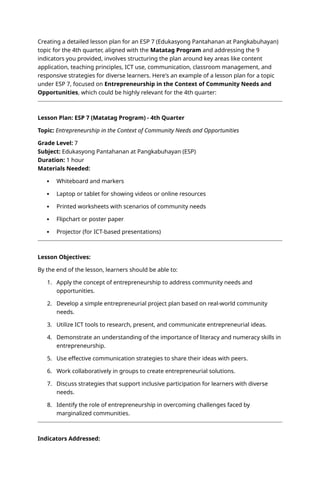
Creating a detailed lesson plan for an ESP 7 (Edukasyong Pantahanan at Pangkabuhayan)
topic for the 4th quarter, aligned with the Matatag Program and addressing the 9
indicators you provided, involves structuring the plan around key areas like content
application, teaching principles, ICT use, communication, classroom management, and
responsive strategies for diverse learners. Here's an example of a lesson plan for a topic
under ESP 7, focused on Entrepreneurship in the Context of Community Needs and
Opportunities, which could be highly relevant for the 4th quarter:
Lesson Plan: ESP 7 (Matatag Program) - 4th Quarter
Topic: Entrepreneurship in the Context of Community Needs and Opportunities
Grade Level: 7
Subject: Edukasyong Pantahanan at Pangkabuhayan (ESP)
Duration: 1 hour
Materials Needed:
 Whiteboard and markers
 Laptop or tablet for showing videos or online resources
 Printed worksheets with scenarios of community needs
 Flipchart or poster paper
 Projector (for ICT-based presentations)
Lesson Objectives:
By the end of the lesson, learners should be able to:
1. Apply the concept of entrepreneurship to address community needs and
opportunities.
2. Develop a simple entrepreneurial project plan based on real-world community
needs.
3. Utilize ICT tools to research, present, and communicate entrepreneurial ideas.
4. Demonstrate an understanding of the importance of literacy and numeracy skills in
entrepreneurship.
5. Use effective communication strategies to share their ideas with peers.
6. Work collaboratively in groups to create entrepreneurial solutions.
7. Discuss strategies that support inclusive participation for learners with diverse
needs.
8. Identify the role of entrepreneurship in overcoming challenges faced by
marginalized communities.
Indicators Addressed:
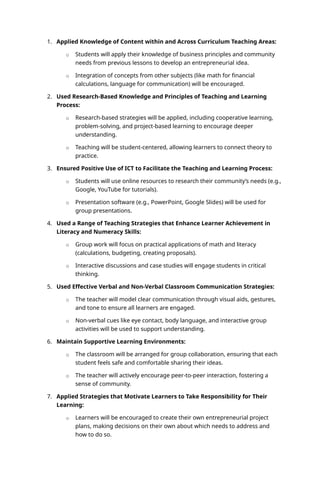
1. Applied Knowledge of Content within and Across Curriculum Teaching Areas:
o Students will apply their knowledge of business principles and community
needs from previous lessons to develop an entrepreneurial idea.
o Integration of concepts from other subjects (like math for financial
calculations, language for communication) will be encouraged.
2. Used Research-Based Knowledge and Principles of Teaching and Learning
Process:
o Research-based strategies will be applied, including cooperative learning,
problem-solving, and project-based learning to encourage deeper
understanding.
o Teaching will be student-centered, allowing learners to connect theory to
practice.
3. Ensured Positive Use of ICT to Facilitate the Teaching and Learning Process:
o Students will use online resources to research their community’s needs (e.g.,
Google, YouTube for tutorials).
o Presentation software (e.g., PowerPoint, Google Slides) will be used for
group presentations.
4. Used a Range of Teaching Strategies that Enhance Learner Achievement in
Literacy and Numeracy Skills:
o Group work will focus on practical applications of math and literacy
(calculations, budgeting, creating proposals).
o Interactive discussions and case studies will engage students in critical
thinking.
5. Used Effective Verbal and Non-Verbal Classroom Communication Strategies:
o The teacher will model clear communication through visual aids, gestures,
and tone to ensure all learners are engaged.
o Non-verbal cues like eye contact, body language, and interactive group
activities will be used to support understanding.
6. Maintain Supportive Learning Environments:
o The classroom will be arranged for group collaboration, ensuring that each
student feels safe and comfortable sharing their ideas.
o The teacher will actively encourage peer-to-peer interaction, fostering a
sense of community.
7. Applied Strategies that Motivate Learners to Take Responsibility for Their
Learning:
o Learners will be encouraged to create their own entrepreneurial project
plans, making decisions on their own about which needs to address and
how to do so.
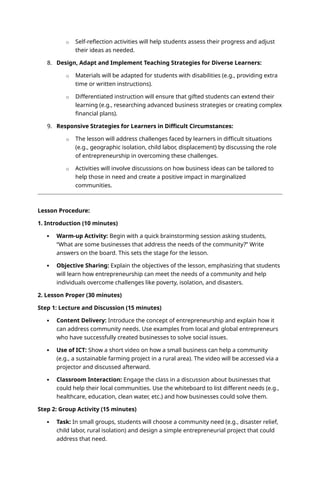
o Self-reflection activities will help students assess their progress and adjust
their ideas as needed.
8. Design, Adapt and Implement Teaching Strategies for Diverse Learners:
o Materials will be adapted for students with disabilities (e.g., providing extra
time or written instructions).
o Differentiated instruction will ensure that gifted students can extend their
learning (e.g., researching advanced business strategies or creating complex
financial plans).
9. Responsive Strategies for Learners in Difficult Circumstances:
o The lesson will address challenges faced by learners in difficult situations
(e.g., geographic isolation, child labor, displacement) by discussing the role
of entrepreneurship in overcoming these challenges.
o Activities will involve discussions on how business ideas can be tailored to
help those in need and create a positive impact in marginalized
communities.
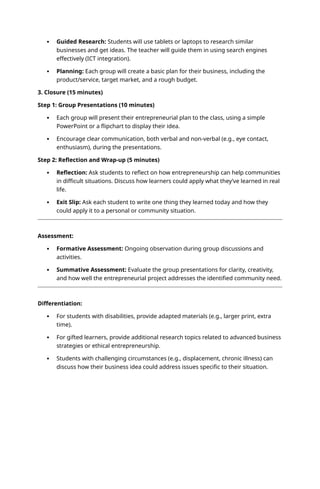
Lesson Procedure:
1. Introduction (10 minutes)
 Warm-up Activity: Begin with a quick brainstorming session asking students,
“What are some businesses that address the needs of the community?” Write
answers on the board. This sets the stage for the lesson.
 Objective Sharing: Explain the objectives of the lesson, emphasizing that students
will learn how entrepreneurship can meet the needs of a community and help
individuals overcome challenges like poverty, isolation, and disasters.
2. Lesson Proper (30 minutes)
Step 1: Lecture and Discussion (15 minutes)
 Content Delivery: Introduce the concept of entrepreneurship and explain how it
can address community needs. Use examples from local and global entrepreneurs
who have successfully created businesses to solve social issues.
 Use of ICT: Show a short video on how a small business can help a community
(e.g., a sustainable farming project in a rural area). The video will be accessed via a
projector and discussed afterward.
 Classroom Interaction: Engage the class in a discussion about businesses that
could help their local communities. Use the whiteboard to list different needs (e.g.,
healthcare, education, clean water, etc.) and how businesses could solve them.
Step 2: Group Activity (15 minutes)
 Task: In small groups, students will choose a community need (e.g., disaster relief,
child labor, rural isolation) and design a simple entrepreneurial project that could
address that need.
 Guided Research: Students will use tablets or laptops to research similar
businesses and get ideas. The teacher will guide them in using search engines
effectively (ICT integration).
 Planning: Each group will create a basic plan for their business, including the
product/service, target market, and a rough budget.
3. Closure (15 minutes)
Step 1: Group Presentations (10 minutes)
 Each group will present their entrepreneurial plan to the class, using a simple
PowerPoint or a flipchart to display their idea.
 Encourage clear communication, both verbal and non-verbal (e.g., eye contact,
enthusiasm), during the presentations.
Step 2: Reflection and Wrap-up (5 minutes)
 Reflection: Ask students to reflect on how entrepreneurship can help communities
in difficult situations. Discuss how learners could apply what they’ve learned in real
life.
 Exit Slip: Ask each student to write one thing they learned today and how they
could apply it to a personal or community situation.
Assessment:
 Formative Assessment: Ongoing observation during group discussions and
activities.
 Summative Assessment: Evaluate the group presentations for clarity, creativity,
and how well the entrepreneurial project addresses the identified community need.
Differentiation:
 For students with disabilities, provide adapted materials (e.g., larger print, extra
time).
 For gifted learners, provide additional research topics related to advanced business
strategies or ethical entrepreneurship.
 Students with challenging circumstances (e.g., displacement, chronic illness) can
discuss how their business idea could address issues specific to their situation.
ESP 7Calassroom Observation Tool for Teachers

  • 1.
    Creating a detailedlesson plan for an ESP 7 (Edukasyong Pantahanan at Pangkabuhayan) topic for the 4th quarter, aligned with the Matatag Program and addressing the 9 indicators you provided, involves structuring the plan around key areas like content application, teaching principles, ICT use, communication, classroom management, and responsive strategies for diverse learners. Here's an example of a lesson plan for a topic under ESP 7, focused on Entrepreneurship in the Context of Community Needs and Opportunities, which could be highly relevant for the 4th quarter: Lesson Plan: ESP 7 (Matatag Program) - 4th Quarter Topic: Entrepreneurship in the Context of Community Needs and Opportunities Grade Level: 7 Subject: Edukasyong Pantahanan at Pangkabuhayan (ESP) Duration: 1 hour Materials Needed:  Whiteboard and markers  Laptop or tablet for showing videos or online resources  Printed worksheets with scenarios of community needs  Flipchart or poster paper  Projector (for ICT-based presentations) Lesson Objectives: By the end of the lesson, learners should be able to: 1. Apply the concept of entrepreneurship to address community needs and opportunities. 2. Develop a simple entrepreneurial project plan based on real-world community needs. 3. Utilize ICT tools to research, present, and communicate entrepreneurial ideas. 4. Demonstrate an understanding of the importance of literacy and numeracy skills in entrepreneurship. 5. Use effective communication strategies to share their ideas with peers. 6. Work collaboratively in groups to create entrepreneurial solutions. 7. Discuss strategies that support inclusive participation for learners with diverse needs. 8. Identify the role of entrepreneurship in overcoming challenges faced by marginalized communities. Indicators Addressed:
  • 2.
    1. Applied Knowledgeof Content within and Across Curriculum Teaching Areas: o Students will apply their knowledge of business principles and community needs from previous lessons to develop an entrepreneurial idea. o Integration of concepts from other subjects (like math for financial calculations, language for communication) will be encouraged. 2. Used Research-Based Knowledge and Principles of Teaching and Learning Process: o Research-based strategies will be applied, including cooperative learning, problem-solving, and project-based learning to encourage deeper understanding. o Teaching will be student-centered, allowing learners to connect theory to practice. 3. Ensured Positive Use of ICT to Facilitate the Teaching and Learning Process: o Students will use online resources to research their community’s needs (e.g., Google, YouTube for tutorials). o Presentation software (e.g., PowerPoint, Google Slides) will be used for group presentations. 4. Used a Range of Teaching Strategies that Enhance Learner Achievement in Literacy and Numeracy Skills: o Group work will focus on practical applications of math and literacy (calculations, budgeting, creating proposals). o Interactive discussions and case studies will engage students in critical thinking. 5. Used Effective Verbal and Non-Verbal Classroom Communication Strategies: o The teacher will model clear communication through visual aids, gestures, and tone to ensure all learners are engaged. o Non-verbal cues like eye contact, body language, and interactive group activities will be used to support understanding. 6. Maintain Supportive Learning Environments: o The classroom will be arranged for group collaboration, ensuring that each student feels safe and comfortable sharing their ideas. o The teacher will actively encourage peer-to-peer interaction, fostering a sense of community. 7. Applied Strategies that Motivate Learners to Take Responsibility for Their Learning: o Learners will be encouraged to create their own entrepreneurial project plans, making decisions on their own about which needs to address and how to do so.
  • 3.
    o Self-reflection activitieswill help students assess their progress and adjust their ideas as needed. 8. Design, Adapt and Implement Teaching Strategies for Diverse Learners: o Materials will be adapted for students with disabilities (e.g., providing extra time or written instructions). o Differentiated instruction will ensure that gifted students can extend their learning (e.g., researching advanced business strategies or creating complex financial plans). 9. Responsive Strategies for Learners in Difficult Circumstances: o The lesson will address challenges faced by learners in difficult situations (e.g., geographic isolation, child labor, displacement) by discussing the role of entrepreneurship in overcoming these challenges. o Activities will involve discussions on how business ideas can be tailored to help those in need and create a positive impact in marginalized communities. Lesson Procedure: 1. Introduction (10 minutes)  Warm-up Activity: Begin with a quick brainstorming session asking students, “What are some businesses that address the needs of the community?” Write answers on the board. This sets the stage for the lesson.  Objective Sharing: Explain the objectives of the lesson, emphasizing that students will learn how entrepreneurship can meet the needs of a community and help individuals overcome challenges like poverty, isolation, and disasters. 2. Lesson Proper (30 minutes) Step 1: Lecture and Discussion (15 minutes)  Content Delivery: Introduce the concept of entrepreneurship and explain how it can address community needs. Use examples from local and global entrepreneurs who have successfully created businesses to solve social issues.  Use of ICT: Show a short video on how a small business can help a community (e.g., a sustainable farming project in a rural area). The video will be accessed via a projector and discussed afterward.  Classroom Interaction: Engage the class in a discussion about businesses that could help their local communities. Use the whiteboard to list different needs (e.g., healthcare, education, clean water, etc.) and how businesses could solve them. Step 2: Group Activity (15 minutes)  Task: In small groups, students will choose a community need (e.g., disaster relief, child labor, rural isolation) and design a simple entrepreneurial project that could address that need.
  • 4.
     Guided Research:Students will use tablets or laptops to research similar businesses and get ideas. The teacher will guide them in using search engines effectively (ICT integration).  Planning: Each group will create a basic plan for their business, including the product/service, target market, and a rough budget. 3. Closure (15 minutes) Step 1: Group Presentations (10 minutes)  Each group will present their entrepreneurial plan to the class, using a simple PowerPoint or a flipchart to display their idea.  Encourage clear communication, both verbal and non-verbal (e.g., eye contact, enthusiasm), during the presentations. Step 2: Reflection and Wrap-up (5 minutes)  Reflection: Ask students to reflect on how entrepreneurship can help communities in difficult situations. Discuss how learners could apply what they’ve learned in real life.  Exit Slip: Ask each student to write one thing they learned today and how they could apply it to a personal or community situation. Assessment:  Formative Assessment: Ongoing observation during group discussions and activities.  Summative Assessment: Evaluate the group presentations for clarity, creativity, and how well the entrepreneurial project addresses the identified community need. Differentiation:  For students with disabilities, provide adapted materials (e.g., larger print, extra time).  For gifted learners, provide additional research topics related to advanced business strategies or ethical entrepreneurship.  Students with challenging circumstances (e.g., displacement, chronic illness) can discuss how their business idea could address issues specific to their situation.