Classes of Argumentation:
Induction
Induction is the process of reasoning whereby
from the concurrence or conjunction of
particular instances or phenomena we draw a
general principle, rule o postulate.
In Induction, the mind starts from particular
phenomena, facts or instances; and from their
conjunction or concurrence it infers a general
truth.
“If two or more instances of a phenomenon under
investigation have only one instances in common , the
circumstances in which one alone all the instances
agree is the cause of the given phenomenon.”
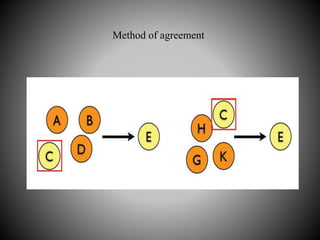
The Method of agreement
Method of agreement
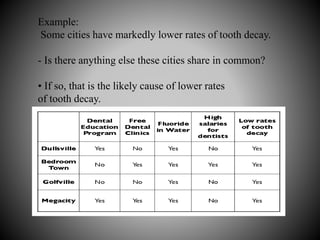
Example:
Some cities have markedly lower rates of tooth decay.
- Is there anything else these cities share in common?
• If so, that is the likely cause of lower rates
of tooth decay.
Four patients all show amnesia after brain injury:
- Patient 1--damage to the prefrontal cortex and the
hippocampus
-Patient 2--damage to the hippocampus and amygdala
-Patient 3--damage to the thalamus and hippocampus
- Patient 4--damage to the hypothalamus and hippocampus
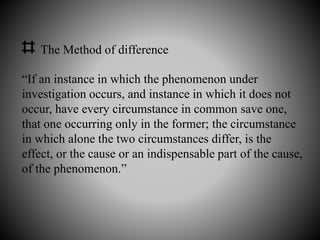
The Method of difference
“If an instance in which the phenomenon under
investigation occurs, and instance in which it does not
occur, have every circumstance in common save one,
that one occurring only in the former; the circumstance
in which alone the two circumstances differ, is the
effect, or the cause or an indispensable part of the cause,
of the phenomenon.”
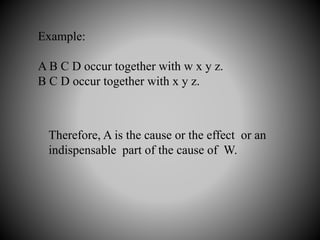
Example:
A B C D occur together with w x y z.
B C D occur together with x y z.
Therefore, A is the cause or the effect or an
indispensable part of the cause of W.
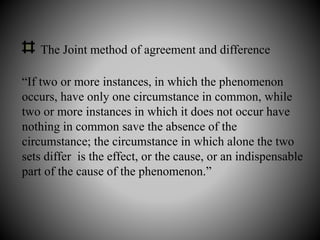
The Joint method of agreement and difference
“If two or more instances, in which the phenomenon
occurs, have only one circumstance in common, while
two or more instances in which it does not occur have
nothing in common save the absence of the
circumstance; the circumstance in which alone the two
sets differ is the effect, or the cause, or an indispensable
part of the cause of the phenomenon.”
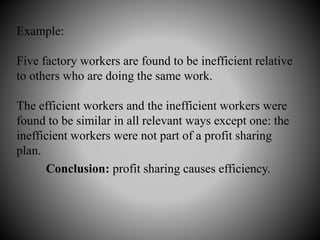
Example:
Five factory workers are found to be inefficient relative
to others who are doing the same work.
The efficient workers and the inefficient workers were
found to be similar in all relevant ways except one: the
inefficient workers were not part of a profit sharing
plan.
Conclusion: profit sharing causes efficiency.
The Method of residues
“Sub duct from any phenomenon such part is known
by previous inductions to be the effect of certain
antecedents, and the residue of the phenomenon is
the effect of the remaining antecedents.”
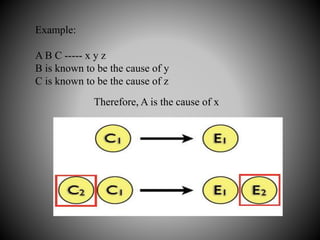
Example:
A B C ----- x y z
B is known to be the cause of y
C is known to be the cause of z
Therefore, A is the cause of x
The Method of concomitant variations
“Whatever phenomenon varies in any manner when
ever another phenomenon varies in some particular
manner is either a cause or an effect of the
phenomenon or connected with it’s through come fact
of causation.”
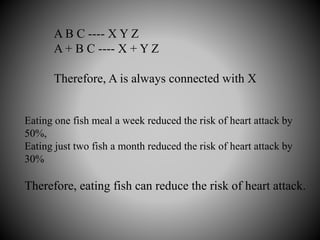
A B C ---- X Y Z
A + B C ---- X + Y Z
Therefore, A is always connected with X
Eating one fish meal a week reduced the risk of heart attack by
50%,
Eating just two fish a month reduced the risk of heart attack by
30%
Therefore, eating fish can reduce the risk of heart attack.
What is Mill saying?
Mill’s methods are useful in clarifying our
understanding of cause and how we test for
it.
one and only one factor is the cause, and it
is one you have considered.
Argument from Antecedent Probability
Antecedent Probability
Is an inference from a known cause to an
unknown effect. This type of argument is also
called an priori argument.
This is an argument from cause to effect.
To bring another fact.
Reference:
http//www.Science and Mill's Methods of Induction by Roberto
Ruiz on Prezi.com
Phil12_W10_Mill's_methods(2-22-2010).pdf
http://en.wikipedia.org/w/index.php?title=Inductive_reasoning&old
id=559982096
Deductive and Inductive Arguments", Internet Encyclopedia

Inductive methods

  • 1.
  • 2.
    Induction is theprocess of reasoning whereby from the concurrence or conjunction of particular instances or phenomena we draw a general principle, rule o postulate. In Induction, the mind starts from particular phenomena, facts or instances; and from their conjunction or concurrence it infers a general truth.
  • 5.
    “If two ormore instances of a phenomenon under investigation have only one instances in common , the circumstances in which one alone all the instances agree is the cause of the given phenomenon.” The Method of agreement
  • 6.
  • 7.
    Example: Some cities havemarkedly lower rates of tooth decay. - Is there anything else these cities share in common? • If so, that is the likely cause of lower rates of tooth decay.
  • 8.
    Four patients allshow amnesia after brain injury: - Patient 1--damage to the prefrontal cortex and the hippocampus -Patient 2--damage to the hippocampus and amygdala -Patient 3--damage to the thalamus and hippocampus - Patient 4--damage to the hypothalamus and hippocampus
  • 9.
    The Method ofdifference “If an instance in which the phenomenon under investigation occurs, and instance in which it does not occur, have every circumstance in common save one, that one occurring only in the former; the circumstance in which alone the two circumstances differ, is the effect, or the cause or an indispensable part of the cause, of the phenomenon.”
  • 10.
    Example: A B CD occur together with w x y z. B C D occur together with x y z. Therefore, A is the cause or the effect or an indispensable part of the cause of W.
  • 11.
    The Joint methodof agreement and difference “If two or more instances, in which the phenomenon occurs, have only one circumstance in common, while two or more instances in which it does not occur have nothing in common save the absence of the circumstance; the circumstance in which alone the two sets differ is the effect, or the cause, or an indispensable part of the cause of the phenomenon.”
  • 12.
    Example: Five factory workersare found to be inefficient relative to others who are doing the same work. The efficient workers and the inefficient workers were found to be similar in all relevant ways except one: the inefficient workers were not part of a profit sharing plan. Conclusion: profit sharing causes efficiency.
  • 13.
    The Method ofresidues “Sub duct from any phenomenon such part is known by previous inductions to be the effect of certain antecedents, and the residue of the phenomenon is the effect of the remaining antecedents.”
  • 14.
    Example: A B C----- x y z B is known to be the cause of y C is known to be the cause of z Therefore, A is the cause of x
  • 15.
    The Method ofconcomitant variations “Whatever phenomenon varies in any manner when ever another phenomenon varies in some particular manner is either a cause or an effect of the phenomenon or connected with it’s through come fact of causation.”
  • 16.
    A B C---- X Y Z A + B C ---- X + Y Z Therefore, A is always connected with X Eating one fish meal a week reduced the risk of heart attack by 50%, Eating just two fish a month reduced the risk of heart attack by 30% Therefore, eating fish can reduce the risk of heart attack.
  • 17.
    What is Millsaying? Mill’s methods are useful in clarifying our understanding of cause and how we test for it. one and only one factor is the cause, and it is one you have considered.
  • 18.
  • 19.
    Antecedent Probability Is aninference from a known cause to an unknown effect. This type of argument is also called an priori argument. This is an argument from cause to effect. To bring another fact.
  • 21.
    Reference: http//www.Science and Mill'sMethods of Induction by Roberto Ruiz on Prezi.com Phil12_W10_Mill's_methods(2-22-2010).pdf http://en.wikipedia.org/w/index.php?title=Inductive_reasoning&old id=559982096 Deductive and Inductive Arguments", Internet Encyclopedia