US-INDIA
TRADE RELATION
INTRODUCTION
 Trade between the United States and India has grown steadily ever since India’s economy
began to take off in the mid-1990s and its information technology sector shot to
prominence in the early 2000s. From 1999 to 2020, trade in goods and services between
the two countries surged from $16 billion to more than $149.
 USA is now INDIA’s 2nd largest trading partner in goods and services. Although it is
beneficial for India to be able to trade with a developed country like US, but as trade
between Washington and New Delhi has increased, so too have tensions regarding tariffs
and foreign investment limitations along with issues in agricultural trade.
 Even after having the issues the two countries share democratic values and growing
convergence on bilateral, regional, and global issues have provided a strong base for
India-U.S. relations. And with COVID-19 pandemic(which originated from China) all over
the world it is expected that the trade relations between INDIA-USA is likely to improve.
INDEX
1. FOREIGN TRADE RELATION WITH INDIA
2. INDIA’S TRADE RELATIONS WITH U.S.
3. MAJOR IMPORT & EXPORT WITH U.S.
4. GROWTH AND DEVELOPMENT OF INDIA-US
5. CURRENT TRADE RELATIONS
6. TRADE BARRIERS
7. CONCLUSION
FOREIGN TRADE RELATIONS WITH INDIA
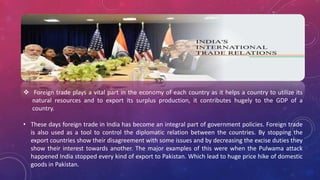
 Foreign trade plays a vital part in the economy of each country as it helps a country to utilize its
natural resources and to export its surplus production, it contributes hugely to the GDP of a
country.
• These days foreign trade in India has become an integral part of government policies. Foreign trade
is also used as a tool to control the diplomatic relation between the countries. By stopping the
export countries show their disagreement with some issues and by decreasing the excise duties they
show their interest towards another. The major examples of this were when the Pulwama attack
happened India stopped every kind of export to Pakistan. Which lead to huge price hike of domestic
goods in Pakistan.
• India used to be a protectionist state for a long time, but the country
has become progressively more open to international trade. Currently,
trade represents 43.3% of the country's GDP. The country mainly
exports petroleum oils (14.6%), diamonds (7.9%), medicaments (4%),
articles of jewellery (3.8%), and rice (2.3%), while it imports petroleum
oils (22.6%), gold (6.3%), diamonds (5.2%), coal and similar solid fuels
(4.8%), petroleum gas and other gaseous hydrocarbons (3.7%).
• India's main partners are the United States, the United Arab Emirates,
Hong Kong, China, Singapore, Saudi Arabia, and Iraq. The country has
recently signed free trade agreements with South Korea and ASEAN.
INDIA’S TRADE RELATION WITH U.S.
 History of Indo-US Relations:
 In the past, Indo-US relations were overshadowed by Cold War politics. The Indo-Soviet
friendship and the US-Pak alliance were the two major irritants.
 Presidents Kennedy and Lyndon Johnson were in favour of maintaining good relations with India.
Even though during 1950’s and 1960’s both New Delhi and Washington were in opposite site of
each other.
 The Sino-Indian dispute in 1962 brought about enhanced bilateral cooperation between the two
countries. In the mid-1980s the US strategies to wean India away from the Soviet Union.
 Dramatic turn occurred in the 1990s—the Cold War was terminated with the disintegration of
the Soviet Union and US-Pak relations nosedived, because of the latter’s clandestine nuclear
program.
Present Indo-US relations under Modi Government
 Presently Indo-US relations are improving leading to several official visits. Though there is the
burden of history, the US is no longer looked upon as “interventionist” by India. One reason could
be the presence of non-Congress governments in New Delhi.
 India is viewed as the largest democracy and emerging economic power, despite its numerous
domestic problems. As per report it is observed as reliable and potential partner in Asia if US
relations sour with China.
 Indian students enrolled at U.S. colleges and universities contributing over $8 billion to the U.S.
economy. As the total number of Indian students in the United States has more than doubled over
the last decade.
 In 2019, overall U.S.-India bilateral trade in goods and services reached $149 billion. U.S. energy
exports are an important area of growth in the trade relationship.
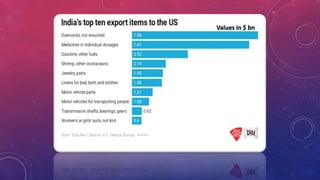
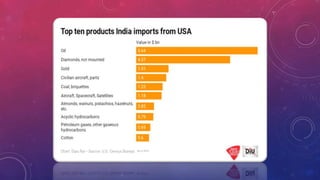
MAJOR IMPORT AND EXPORT WITH U.S.
Values in $ bn
AGRICULTURAL PRODUCTS
For agricultural products, India and United States both have interest in improving their market
access to each other for greater trade.
 The fresh fruit exports from the U.S were approximately $827 million in 2018.
 Agricultural products like apples, walnuts, almonds, lentils among 29 Products, subject to India’s
proposed retaliatory tariffs effective from June 16, 2019. Where future growth trends are looking
upwards.
 U.S. poultry are likely to benefit with the recent resolution of World Trade Organization(WTO)
case on India’s poultry imports as it was stopped by India because of Avian Influenza. Now India’s
growing demand for poultry is still increasing.
 In the post covid world, India is having some soymeal(animal feed) supply issues. With hundreds
of millions of live- stock, India’s soymeal supply gap can be filled by the U.S as it is one of the
major soymeal producers in the world.
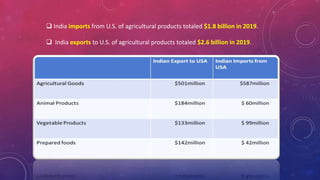
 India imports from U.S. of agricultural products totaled $1.8 billion in 2019.
 India exports to U.S. of agricultural products totaled $2.6 billion in 2019.
CRUDE OIL
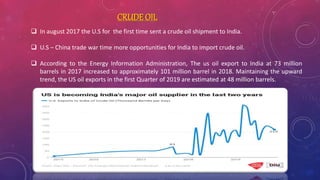
 In august 2017 the U.S for the first time sent a crude oil shipment to India.
 U.S – China trade war time more opportunities for India to import crude oil.
 According to the Energy Information Administration, The us oil export to India at 73 million
barrels in 2017 increased to approximately 101 million barrel in 2018. Maintaining the upward
trend, the US oil exports in the first Quarter of 2019 are estimated at 48 million barrels.
 Demand for oil increase day by day, even after having huge oil reserve due to
economic development of India.
 India produced oil average of 846000 bbl/d and used 2.63 million bbl/d.
 Trade experts believe that the trend of widening trade ties between New Delhi
and Washington will continue in the coming years also as both the sides are
engaged in further deepening the economic ties.

 Presence of Indian Diaspora in the US is one of the main reasons for increasing
bilateral trade.
Clothing and Textiles
India’s readymade garment and other apparels are the famous Indian products around the world. It
has a history of time craftsmanship and global appeal.
Cotton and silk along with denim are the few Indian products that have a high demand in USA and
other western countries.
 India is second largest exporter of textiles and apparel with a massive raw material and
manufacturing base. India’s overall exports of apparel or readymade garments marginally $16.1
billion to US according to the commerce ministry.
 U.S. clothing and textiles imports from India have jumped since the beginning of 2005, as
production shifted from other nations to India. Also to promote export of readymade garments and
made-ups, government of India increased merchandise export from India scheme rates from 4 to 6
% under the mid-term review of foreign policy 2015-2021.
 Imports of textile yarn, fabric made-up articles grew 8.58% to $168.64 million in June. However
exports of cotton yarn/fabrics/made ups, handloom products grew 24% to $586.2 million.
 Man-made yarn/fabrics/made-ups export rose 8.45% to $403.4 million. Exports of all textile
readymade garments dipped by 12.3% to $13.5 billion.
 The Indian apparel industry saw consecutively declining numbers for the overall exports in October,
November and December 2017- a fall of 39% , 11% and 8% year on year respectively thanks to impact
of the Good and Services Tax (GST), rolled out in July and discontinuance of certain export incentives.
Gems and Jewellery
The Gems and Jewellery sector in India plays a significant role in the Indian Economy. India’s gems and
jewellery sector is one of the largest in the world, contributing 29 per cent to the global jewellery
consumption.The U.S. is the largest consumer of gems and jewellery in the world contributing nearly
40percent of the global production.
 India’s gems and jewellery sector hopes to tap a $1-billion export opportunity arising out of an
ongoing trade war between the United States and China.
 Market size of gems and jewellery will grow to US$ 103.06 billion during 2019-2023.
 India’s import of gems and jewellery stood at US$ 24.01 billion in FY20P.
 India exported U.S. $18.66 billion worth of cut and polished diamonds in FY2OP. It contributed 64%
to the total gems and jewellery export.
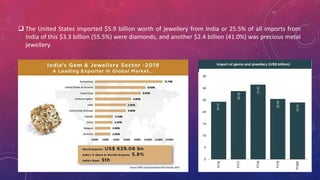
 The United States imported $5.9 billion worth of jewellery from India or 25.5% of all imports from
India of this $3.3 billion (55.5%) were diamonds, and another $2.4 billion (41.0%) was precious metal
jewellery.
Growth and Development of Trade Between
INDIA & US
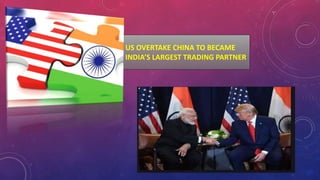
US OVERTAKE CHINA TO BECAME
INDIA’S LARGEST TRADING PARTNER
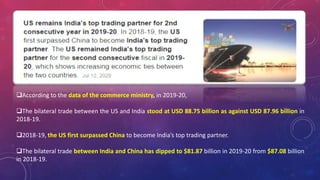
According to the data of the commerce ministry, in 2019-20,
The bilateral trade between the US and India stood at USD 88.75 billion as against USD 87.96 billion in
2018-19.
2018-19, the US first surpassed China to become India’s top trading partner.
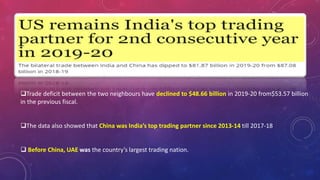
The bilateral trade between India and China has dipped to $81.87 billion in 2019-20 from $87.08 billion
in 2018-19.
Trade deficit between the two neighbours have declined to $48.66 billion in 2019-20 from$53.57 billion
in the previous fiscal.
The data also showed that China was India’s top trading partner since 2013-14 till 2017-18
 Before China, UAE was the country’s largest trading nation.
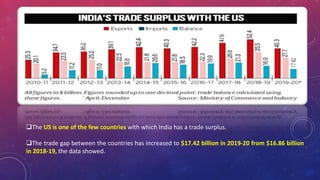
The US is one of the few countries with which India has a trade surplus.
The trade gap between the countries has increased to $17.42 billion in 2019-20 from $16.86 billion
in 2018-19, the data showed.

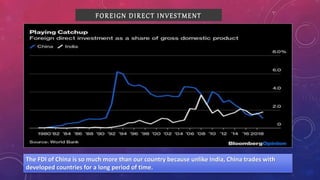
FOREIGN DIRECT INVESTMENT
The FDI of China is so much more than our country because unlike India, China trades with
developed countries for a long period of time.
CURRENT TRADE
RELATIONS
U.S.-India Current Trade Relations
The United States and India view one another as important strategic partners to advance
common interests regionally and globally. So they both focused on commencing the bilateral trade
between them for a long time. The trading relationship is more consequential for India as USA is one of
it’s largest goods export market. Now we know that, U.S.-India foreign direct investment (FDI) is small,
but growing. Defense sales also are significant in bilateral trade. Civilian nuclear commerce, stalled for
years over differences on liability protections, has produced major potential U.S. supply contracts.
NOW LET’S TALK ABOUT SOME OF THE TOPICS UNDER CURRENT TRADE:
1.Tariffs:
This is one of the major factors as tariff policies is having an impact on both the countries. India’s
tariff hikes include raising tariffs on cell phones from 0% originally to 15% to 20%. India opposes the 25%
steel and 10% aluminum tariffs that the United States has imposed under the national-security based
Section 232 of the Trade Expansion Act of 1962. India imposed higher tariffs affecting about $1.4 billion
of U.S. exports, such as nuts, apples, and chemicals. USA is continuously asking India to reduce its Tariff
rates and its creating issues in trade relation between the countries. So India decided to solve the tariff
issues bilaterally.
2. U.S. Generalized System of Preferences (GSP):
Effective June 5, 2019, President Trump terminated India’s eligibility for GSP, a U.S. trade and
development program, for failure to provide equitable and reasonable market access. In 2018, India was
the largest beneficiary of GSP; over one-tenth ($6.3 billion) of U.S. goods imports from India entered
duty-free under the program, such as chemicals, auto parts, and tableware.
3. Investment:
India aims to attract foreign investment and has made FDI reforms, such as raising foreign
equity caps for insurance and defense, and other strides to improve its business environment. U.S.-
Indian FDI {Foreign Direct Investment} is linked to U.S. and Indian jobs and exports in a range of sectors.
4. Defense Trade:
The two nations have signed defense contracts worth more than $15 billion since 2008, up from
$500 million in all previous years combined. India’s purchase of a multibillion-dollar deal to purchase the
Russian-made S-400 air defense system may trigger U.S. sanctions on India.
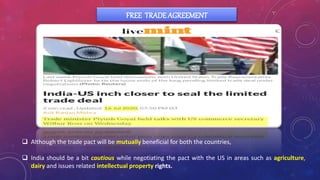
FREE TRADE AGREEMENT
 Although the trade pact will be mutually beneficial for both the countries,
 India should be a bit cautious while negotiating the pact with the US in areas such as agriculture,
dairy and issues related intellectual property rights.
WHY THIS DEAL IS IMPORTANT FOR INDIA ?
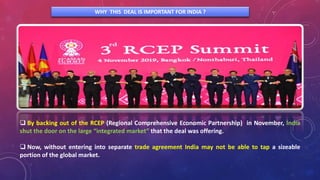
 By backing out of the RCEP (Regional Comprehensive Economic Partnership) in November, India
shut the door on the large “integrated market” that the deal was offering.
 Now, without entering into separate trade agreement India may not be able to tap a sizeable
portion of the global market.
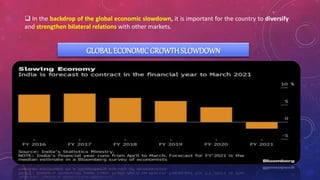
 In the backdrop of the global economic slowdown, it is important for the country to diversify
and strengthen bilateral relations with other markets.
GLOBALECONOMICGROWTHSLOWDOWN
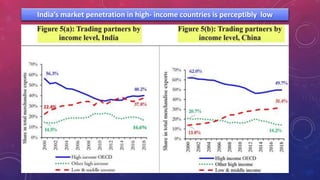
India’s market penetration in high- income countries is perceptibly low
WHAT US-INDIA NEGOTIATING ON?
India is seeking-
 Relaxation in US visa regime, (like H1B & L1 visa)
 Exemption from high duties imposed by the US on certain steel and aluminum products, and
 Greater market access for its products from sectors such as agriculture, automobile, automobile
components and engineering.
On the other hand, the US wants-
 Greater market access for its farm and manufacturing products, dairy items, medical devices, and
data localization,
 Apart from cut on import duties on some information and communication technology products.
TRADE BARRIERS
Problems in India – US trade deal
 Disagreement over tariffs
 Subsidies
 Data protection
 Intellectual property
 Access for Agriculture and Dairy produce
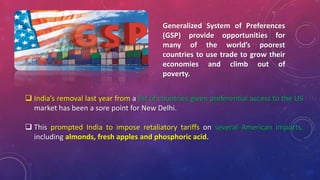
Generalized System of Preferences
(GSP) provide opportunities for
many of the world’s poorest
countries to use trade to grow their
economies and climb out of
poverty.
 India’s removal last year from a list of countries given preferential access to the US
market has been a sore point for New Delhi.
 This prompted India to impose retaliatory tariffs on several American imports,
including almonds, fresh apples and phosphoric acid.
CONCLUSION
We feel that India and the US could begin with some “low hanging fruit”.
The India-U.S. trade relationship stands solid today with a promising future. The latest trends
in increasing volumes of bilateral trade between the two economies point to
complementarity of commercial interests. Reaching $238 billion by 2025 may not be very
difficult to achieve given the present dynamics of the commercial engagement. The policy
gaps in the trade dynamics of the two countries have led to several contentious issues albeit
trade volumes have been steadily expanding, suggesting there is tremendous interest among
the businesses from both sides and immense potential remains untapped. This potential may
be unlocked with appropriate policy measures from both sides.
Presented By-
MOUPRIYA SHAW, INDRANIL BARIK, SOURAV JANA, SUDIP
MANDAL, UDARCIS DUTTA, BHRAMAN BAUR, ARIJIT
MAZUMDER, GAUTAM KHEMKA, RAJU RANJAN, PAYEL MANDAL
ASSIGNMENT GROUP- 4, SEC- ASHOKA 2B
REFERENCE LINKS
 https://www.google.com/search?q=india+trade+surplus+with+US&tbm=isch&ved=2ahU
KEwjJk5Lu
 https://www.ibef.org/industry/gems-jewellery-india.aspx.
 https://www.istockphoto.com/photo/united-states-and-india-two-flags-together-textile-
cloth-fabric-texture-gm1093163274-293365482
 https://www.cfr.org/report/economic-relations-india
 https://www.indiatoday.in/amp/diu/story/india-us-trade-deal-gsp-donald-trump-visit-
narendra-modi-1649134-2020-02-23
 https://crsreports.congress.gov
 https://www.eia.gov/dnav/pet/hist/LeafHandler.ashx?n=PET&s=MCREX_NUS-
NIN_1&f=M
THANK YOU

US-INDIA TRADE RELATION

  • 1.
  • 2.
    INTRODUCTION  Trade betweenthe United States and India has grown steadily ever since India’s economy began to take off in the mid-1990s and its information technology sector shot to prominence in the early 2000s. From 1999 to 2020, trade in goods and services between the two countries surged from $16 billion to more than $149.  USA is now INDIA’s 2nd largest trading partner in goods and services. Although it is beneficial for India to be able to trade with a developed country like US, but as trade between Washington and New Delhi has increased, so too have tensions regarding tariffs and foreign investment limitations along with issues in agricultural trade.  Even after having the issues the two countries share democratic values and growing convergence on bilateral, regional, and global issues have provided a strong base for India-U.S. relations. And with COVID-19 pandemic(which originated from China) all over the world it is expected that the trade relations between INDIA-USA is likely to improve.
  • 3.
    INDEX 1. FOREIGN TRADERELATION WITH INDIA 2. INDIA’S TRADE RELATIONS WITH U.S. 3. MAJOR IMPORT & EXPORT WITH U.S. 4. GROWTH AND DEVELOPMENT OF INDIA-US 5. CURRENT TRADE RELATIONS 6. TRADE BARRIERS 7. CONCLUSION
  • 4.
  • 5.
     Foreign tradeplays a vital part in the economy of each country as it helps a country to utilize its natural resources and to export its surplus production, it contributes hugely to the GDP of a country. • These days foreign trade in India has become an integral part of government policies. Foreign trade is also used as a tool to control the diplomatic relation between the countries. By stopping the export countries show their disagreement with some issues and by decreasing the excise duties they show their interest towards another. The major examples of this were when the Pulwama attack happened India stopped every kind of export to Pakistan. Which lead to huge price hike of domestic goods in Pakistan.
  • 6.
    • India usedto be a protectionist state for a long time, but the country has become progressively more open to international trade. Currently, trade represents 43.3% of the country's GDP. The country mainly exports petroleum oils (14.6%), diamonds (7.9%), medicaments (4%), articles of jewellery (3.8%), and rice (2.3%), while it imports petroleum oils (22.6%), gold (6.3%), diamonds (5.2%), coal and similar solid fuels (4.8%), petroleum gas and other gaseous hydrocarbons (3.7%). • India's main partners are the United States, the United Arab Emirates, Hong Kong, China, Singapore, Saudi Arabia, and Iraq. The country has recently signed free trade agreements with South Korea and ASEAN.
  • 7.
  • 8.
     History ofIndo-US Relations:  In the past, Indo-US relations were overshadowed by Cold War politics. The Indo-Soviet friendship and the US-Pak alliance were the two major irritants.  Presidents Kennedy and Lyndon Johnson were in favour of maintaining good relations with India. Even though during 1950’s and 1960’s both New Delhi and Washington were in opposite site of each other.  The Sino-Indian dispute in 1962 brought about enhanced bilateral cooperation between the two countries. In the mid-1980s the US strategies to wean India away from the Soviet Union.  Dramatic turn occurred in the 1990s—the Cold War was terminated with the disintegration of the Soviet Union and US-Pak relations nosedived, because of the latter’s clandestine nuclear program.
  • 9.
    Present Indo-US relationsunder Modi Government  Presently Indo-US relations are improving leading to several official visits. Though there is the burden of history, the US is no longer looked upon as “interventionist” by India. One reason could be the presence of non-Congress governments in New Delhi.  India is viewed as the largest democracy and emerging economic power, despite its numerous domestic problems. As per report it is observed as reliable and potential partner in Asia if US relations sour with China.  Indian students enrolled at U.S. colleges and universities contributing over $8 billion to the U.S. economy. As the total number of Indian students in the United States has more than doubled over the last decade.  In 2019, overall U.S.-India bilateral trade in goods and services reached $149 billion. U.S. energy exports are an important area of growth in the trade relationship.
  • 10.
    MAJOR IMPORT ANDEXPORT WITH U.S.
  • 11.
  • 13.
    AGRICULTURAL PRODUCTS For agriculturalproducts, India and United States both have interest in improving their market access to each other for greater trade.  The fresh fruit exports from the U.S were approximately $827 million in 2018.  Agricultural products like apples, walnuts, almonds, lentils among 29 Products, subject to India’s proposed retaliatory tariffs effective from June 16, 2019. Where future growth trends are looking upwards.  U.S. poultry are likely to benefit with the recent resolution of World Trade Organization(WTO) case on India’s poultry imports as it was stopped by India because of Avian Influenza. Now India’s growing demand for poultry is still increasing.  In the post covid world, India is having some soymeal(animal feed) supply issues. With hundreds of millions of live- stock, India’s soymeal supply gap can be filled by the U.S as it is one of the major soymeal producers in the world.
  • 14.
     India importsfrom U.S. of agricultural products totaled $1.8 billion in 2019.  India exports to U.S. of agricultural products totaled $2.6 billion in 2019.
  • 15.
    CRUDE OIL  Inaugust 2017 the U.S for the first time sent a crude oil shipment to India.  U.S – China trade war time more opportunities for India to import crude oil.  According to the Energy Information Administration, The us oil export to India at 73 million barrels in 2017 increased to approximately 101 million barrel in 2018. Maintaining the upward trend, the US oil exports in the first Quarter of 2019 are estimated at 48 million barrels.
  • 16.
     Demand foroil increase day by day, even after having huge oil reserve due to economic development of India.  India produced oil average of 846000 bbl/d and used 2.63 million bbl/d.  Trade experts believe that the trend of widening trade ties between New Delhi and Washington will continue in the coming years also as both the sides are engaged in further deepening the economic ties.  Presence of Indian Diaspora in the US is one of the main reasons for increasing bilateral trade.
  • 17.
    Clothing and Textiles India’sreadymade garment and other apparels are the famous Indian products around the world. It has a history of time craftsmanship and global appeal. Cotton and silk along with denim are the few Indian products that have a high demand in USA and other western countries.  India is second largest exporter of textiles and apparel with a massive raw material and manufacturing base. India’s overall exports of apparel or readymade garments marginally $16.1 billion to US according to the commerce ministry.  U.S. clothing and textiles imports from India have jumped since the beginning of 2005, as production shifted from other nations to India. Also to promote export of readymade garments and made-ups, government of India increased merchandise export from India scheme rates from 4 to 6 % under the mid-term review of foreign policy 2015-2021.
  • 18.
     Imports oftextile yarn, fabric made-up articles grew 8.58% to $168.64 million in June. However exports of cotton yarn/fabrics/made ups, handloom products grew 24% to $586.2 million.  Man-made yarn/fabrics/made-ups export rose 8.45% to $403.4 million. Exports of all textile readymade garments dipped by 12.3% to $13.5 billion.  The Indian apparel industry saw consecutively declining numbers for the overall exports in October, November and December 2017- a fall of 39% , 11% and 8% year on year respectively thanks to impact of the Good and Services Tax (GST), rolled out in July and discontinuance of certain export incentives.
  • 19.
    Gems and Jewellery TheGems and Jewellery sector in India plays a significant role in the Indian Economy. India’s gems and jewellery sector is one of the largest in the world, contributing 29 per cent to the global jewellery consumption.The U.S. is the largest consumer of gems and jewellery in the world contributing nearly 40percent of the global production.  India’s gems and jewellery sector hopes to tap a $1-billion export opportunity arising out of an ongoing trade war between the United States and China.  Market size of gems and jewellery will grow to US$ 103.06 billion during 2019-2023.  India’s import of gems and jewellery stood at US$ 24.01 billion in FY20P.  India exported U.S. $18.66 billion worth of cut and polished diamonds in FY2OP. It contributed 64% to the total gems and jewellery export.
  • 20.
     The UnitedStates imported $5.9 billion worth of jewellery from India or 25.5% of all imports from India of this $3.3 billion (55.5%) were diamonds, and another $2.4 billion (41.0%) was precious metal jewellery.
  • 21.
    Growth and Developmentof Trade Between INDIA & US
  • 22.
    US OVERTAKE CHINATO BECAME INDIA’S LARGEST TRADING PARTNER
  • 23.
    According to thedata of the commerce ministry, in 2019-20, The bilateral trade between the US and India stood at USD 88.75 billion as against USD 87.96 billion in 2018-19. 2018-19, the US first surpassed China to become India’s top trading partner. The bilateral trade between India and China has dipped to $81.87 billion in 2019-20 from $87.08 billion in 2018-19.
  • 24.
    Trade deficit betweenthe two neighbours have declined to $48.66 billion in 2019-20 from$53.57 billion in the previous fiscal. The data also showed that China was India’s top trading partner since 2013-14 till 2017-18  Before China, UAE was the country’s largest trading nation.
  • 25.
    The US isone of the few countries with which India has a trade surplus. The trade gap between the countries has increased to $17.42 billion in 2019-20 from $16.86 billion in 2018-19, the data showed.
  • 26.
    FOREIGN DIRECT INVESTMENT TheFDI of China is so much more than our country because unlike India, China trades with developed countries for a long period of time.
  • 27.
  • 28.
    U.S.-India Current TradeRelations The United States and India view one another as important strategic partners to advance common interests regionally and globally. So they both focused on commencing the bilateral trade between them for a long time. The trading relationship is more consequential for India as USA is one of it’s largest goods export market. Now we know that, U.S.-India foreign direct investment (FDI) is small, but growing. Defense sales also are significant in bilateral trade. Civilian nuclear commerce, stalled for years over differences on liability protections, has produced major potential U.S. supply contracts. NOW LET’S TALK ABOUT SOME OF THE TOPICS UNDER CURRENT TRADE: 1.Tariffs: This is one of the major factors as tariff policies is having an impact on both the countries. India’s tariff hikes include raising tariffs on cell phones from 0% originally to 15% to 20%. India opposes the 25% steel and 10% aluminum tariffs that the United States has imposed under the national-security based Section 232 of the Trade Expansion Act of 1962. India imposed higher tariffs affecting about $1.4 billion of U.S. exports, such as nuts, apples, and chemicals. USA is continuously asking India to reduce its Tariff rates and its creating issues in trade relation between the countries. So India decided to solve the tariff issues bilaterally.
  • 29.
    2. U.S. GeneralizedSystem of Preferences (GSP): Effective June 5, 2019, President Trump terminated India’s eligibility for GSP, a U.S. trade and development program, for failure to provide equitable and reasonable market access. In 2018, India was the largest beneficiary of GSP; over one-tenth ($6.3 billion) of U.S. goods imports from India entered duty-free under the program, such as chemicals, auto parts, and tableware. 3. Investment: India aims to attract foreign investment and has made FDI reforms, such as raising foreign equity caps for insurance and defense, and other strides to improve its business environment. U.S.- Indian FDI {Foreign Direct Investment} is linked to U.S. and Indian jobs and exports in a range of sectors. 4. Defense Trade: The two nations have signed defense contracts worth more than $15 billion since 2008, up from $500 million in all previous years combined. India’s purchase of a multibillion-dollar deal to purchase the Russian-made S-400 air defense system may trigger U.S. sanctions on India.
  • 30.
    FREE TRADE AGREEMENT Although the trade pact will be mutually beneficial for both the countries,  India should be a bit cautious while negotiating the pact with the US in areas such as agriculture, dairy and issues related intellectual property rights.
  • 31.
    WHY THIS DEALIS IMPORTANT FOR INDIA ?  By backing out of the RCEP (Regional Comprehensive Economic Partnership) in November, India shut the door on the large “integrated market” that the deal was offering.  Now, without entering into separate trade agreement India may not be able to tap a sizeable portion of the global market.
  • 32.
     In thebackdrop of the global economic slowdown, it is important for the country to diversify and strengthen bilateral relations with other markets. GLOBALECONOMICGROWTHSLOWDOWN
  • 33.
    India’s market penetrationin high- income countries is perceptibly low
  • 34.
    WHAT US-INDIA NEGOTIATINGON? India is seeking-  Relaxation in US visa regime, (like H1B & L1 visa)  Exemption from high duties imposed by the US on certain steel and aluminum products, and  Greater market access for its products from sectors such as agriculture, automobile, automobile components and engineering. On the other hand, the US wants-  Greater market access for its farm and manufacturing products, dairy items, medical devices, and data localization,  Apart from cut on import duties on some information and communication technology products.
  • 35.
  • 36.
    Problems in India– US trade deal  Disagreement over tariffs  Subsidies  Data protection  Intellectual property  Access for Agriculture and Dairy produce
  • 37.
    Generalized System ofPreferences (GSP) provide opportunities for many of the world’s poorest countries to use trade to grow their economies and climb out of poverty.  India’s removal last year from a list of countries given preferential access to the US market has been a sore point for New Delhi.  This prompted India to impose retaliatory tariffs on several American imports, including almonds, fresh apples and phosphoric acid.
  • 38.
    CONCLUSION We feel thatIndia and the US could begin with some “low hanging fruit”. The India-U.S. trade relationship stands solid today with a promising future. The latest trends in increasing volumes of bilateral trade between the two economies point to complementarity of commercial interests. Reaching $238 billion by 2025 may not be very difficult to achieve given the present dynamics of the commercial engagement. The policy gaps in the trade dynamics of the two countries have led to several contentious issues albeit trade volumes have been steadily expanding, suggesting there is tremendous interest among the businesses from both sides and immense potential remains untapped. This potential may be unlocked with appropriate policy measures from both sides.
  • 39.
    Presented By- MOUPRIYA SHAW,INDRANIL BARIK, SOURAV JANA, SUDIP MANDAL, UDARCIS DUTTA, BHRAMAN BAUR, ARIJIT MAZUMDER, GAUTAM KHEMKA, RAJU RANJAN, PAYEL MANDAL ASSIGNMENT GROUP- 4, SEC- ASHOKA 2B
  • 40.
    REFERENCE LINKS  https://www.google.com/search?q=india+trade+surplus+with+US&tbm=isch&ved=2ahU KEwjJk5Lu https://www.ibef.org/industry/gems-jewellery-india.aspx.  https://www.istockphoto.com/photo/united-states-and-india-two-flags-together-textile- cloth-fabric-texture-gm1093163274-293365482  https://www.cfr.org/report/economic-relations-india  https://www.indiatoday.in/amp/diu/story/india-us-trade-deal-gsp-donald-trump-visit- narendra-modi-1649134-2020-02-23  https://crsreports.congress.gov  https://www.eia.gov/dnav/pet/hist/LeafHandler.ashx?n=PET&s=MCREX_NUS- NIN_1&f=M
  • 41.