INDIGO- LOUIS FISCHER
This Photo by Unknown Author is licensed under
CC BY-ND
This Photo by Unknown Author is licensed under CC Byprea
Presented by: Shivani Singh, APS- DELHI
LOUIS FISCHER
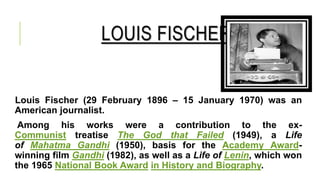
Louis Fischer (29 February 1896 – 15 January 1970) was an
American journalist.
Among his works were a contribution to the ex-
Communist treatise The God that Failed (1949), a Life
of Mahatma Gandhi (1950), basis for the Academy Award-
winning film Gandhi (1982), as well as a Life of Lenin, which won
the 1965 National Book Award in History and Biography.
CHAMPARAN
ABOUT THE
CHAPTER
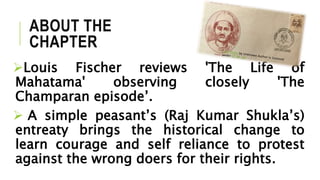
Louis Fischer reviews 'The Life of
Mahatama' observing closely 'The
Champaran episode’.
 A simple peasant’s (Raj Kumar Shukla’s)
entreaty brings the historical change to
learn courage and self reliance to protest
against the wrong doers for their rights.
SYNOPSIS
In this story, louis describes Gandhi’s struggle for
the poor peasants of Champaran who were the
sharecroppers with the British planters. They led
a miserable life and were forced to grow indigo
according to an agreement. They suffered a great
injustice due to the landlord system in Bihar.
Gandhi waged a war for about a year against
their atrocities and brought justice to the poor
peasants
g
THEME
Revolves around the issue of help rendered to the
sharecroppers of Chamaparan.
Theme of independence struggle.
About the importance of teaching self- reliance
to the poor section like the peasants.
Gandhijis method of seeking justice and his
‘satyagraha’.
The Champaran satyagraha as the first example
of civil disobedience.
Characters
•Raj Kumar Shukla: A sharecropper
•Charles Freer Andrews: A follower of Gandhi
•Kasturba:Wife of Gandhi
•Devdas: youngest son of Gandhi
SUMMARY
This Photo by Unknown Author is
licensed under CC BY-NC-ND
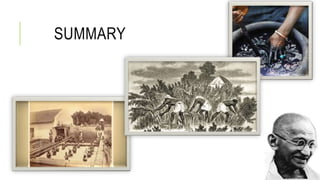
This story describesGandhi’s struggle for the poor peasants of Champaran. In those days
most of arable land in the Champaran district was divided into large estate owned by
Englishmen and worked by Indian tenants.The chief commercial crop was Indigo.The
landlords compelled all tenants to plant 15% of their Indigo and surrender the entire
Indigo harvest as rent.This was done by long term contract.
The British didn’t need the Indigo crop any more when Germany had developed
synthetic Indigo. Just to release the peasants from the 15% agreement they demanded
compensation. Some illiterate peasants agreed but the others refused.One of the
sharecroppers named Raj Kumar Shukla met Gandhi in this regard and compelled him to
visit Champaran because of the long term injustice of landlords.Then the two of them
boarded a train for the city of Patna in Bihar. From there Shukla led him to the house of a
lawyer named Rajendra Prasad. Mahatma Gandhi’s humble and simple attire made the
servants mistook him as another poor peasant. He surveyed before taking any vital step
in order to get those peasants justice. It was the time when British government punished
those who in any condition gave shelter to national leaders or protesters.
Gandhi’s arrival and the nature of his mission spread like a
wildfire. Many lawyers and peasant groups came in large
numbers to support him. The lawyers accepted the fact that
their charges were high and for a poor peasant it will be
irksome. Gandhi rebuked them for collecting big fee from the
sharecroppers.
He stressed on counseling as this would give the peasants
enough confidence to fight their fear. He managed to get
justice after a yearlong battle for the peasants. He also made
arrangements for the education, health, and hygiene for the
families of the poor peasants. He gave them the lesson of self-
reliance
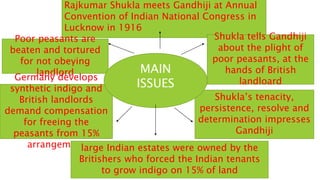
Rajkumar Shukla meets Gandhiji at Annual
Convention of Indian National Congress in
Lucknow in 1916
Poor peasants are
beaten and tortured
for not obeying
landlord
Shukla tells Gandhiji
about the plight of
poor peasants, at the
hands of British
landloard
Shukla’s tenacity,
persistence, resolve and
determination impresses
Gandhiji
Germany develops
synthetic indigo and
British landlords
demand compensation
for freeing the
peasants from 15%
arrangementlarge Indian estates were owned by the
Britishers who forced the Indian tenants
to grow indigo on 15% of land
MAIN
ISSUES
WHAT DOES GANDHI DO?
Gandhiji accompanies Shukla to Rajendra Prasad’s home -is
treated like a poor yeoman -not allowed to drink water from the
well/sit on ground -not able to meet R. Prasad
leaves for Muzzaffarpur to gather more information about indigo
peasants’ case. Lawyers brief Gandhiji and are chided by him for
collecting big fees
Gandhiji reaches champaran and meets Secretary of the British
landlords Association but gets no information and is called an
outsider.
Proceeds to visit British official Commissioner of the Tirhut division.
He is bullied and asked to leave the district
Reaches Motihari, gets a notice to leave Champaran, disobeys the
order. During Court trial calls it ‘Conflict of duties’ but he is
compelled towards ‘the voice’ of conscience
Lawyers are motivated to court arrest. Gandhiji says, “ The battle of
Champaran is won.”
Receives a letter from Magistrate that the case is being
dropped-Civil disobedience had triumphed
Far- flung enquiry into the grievances of the farmers
Depositions od ten- thousand peasants taken down.
Documents collected
Has four protracted meetings with the lt. Governor.
A commission of enquiry is appointed into the sharecroppers’
situation.
The commission consisted of landlords, government officials
and Gandhi as the sole representative of the peasants
Agrees to 25% of refund by British landlords who are forced to
give up money and prestige as well
Huge evidence is collected and presented- victory
aims to improve
social and
cultural status of
Champaran
taken initiatives
in improving
health services by
involving
volunteers
teaches villager about
cleanliness, hygiene to
be self-reliant and
independent
Shows the fear
stricken peasants that
they are free and
strong enough to win
battles and protest
against injustice.
doesn’t ask
Charles Freer
Andrews to stay
with him as a
lesson for others
to be self-reliant
and have
courage
shows Gandhiji’s
foresight-beyond
political and
economic
solutions
CHAMPARAN :
A TURNING
POINT
IMPORTANT QUESTIONS AND ANSWERS
1. Why did Rajkumar Shukla want to meet Gandhiji?
Ans. Raj Kumar Shukla was a sharecropper from Champaran. He
was illiterate but resolute. He had come to the Congress session
to complain about the injustice of the landlord system in Bihar.
He was sure that Gandhiji could help them. He wanted Gandhiji to
come to Champaran district.
2. What was the main problem of Sharecroppers in Champaran?
Ans. The land was divided into large estates that were owned by
Englishmen. The Chief commercial crop was indigo. The landlord
forced all the tenants to plant 15 percent of their holdings with
indigo and surrender the entire indigo harvest as rent. This was
done by a long term contract.
3. How did Gandhiji react after receiving summon to appear in
court the next day?
Ans. Gandhiji received a summon to appear in the court but
disobeyed the order. He remained awaken all night. He telegraphed
Rajendra Prasad to come from Bihar with influential friends. He
sent instructions to the ashram. He wired a full report to the
Viceroy
4. How did Civil Disobedience triumph for the first time in modern
India?
Ans. Gandhiji did not obey the British authorities, order to leave
Chamapran. The summons were also served but he remained firm.
Additional Questions
1. How could Shukla convince Gandhiji to
come to Chamaparan?
2. What arrangements did Gandhiji make
before reaching Champaran?
3. How was Gandhiji treated at Rajendra
Prasad's house?
4. Why did Gandhiji agree to a settlement of
25% refund to the farmers?
Additional Questions
1. How could Shukla convince Gandhiji to come to
Chamaparan?
2. What arrangements did Gandhiji make before
reaching Champaran?
3. How was Gandhiji treated at Rajendra Prasad's
house?
4. Why did Gandhiji agree to a settlement of 25%
refund to the farmers?
THANKYOU!

Indigo

  • 1.
    INDIGO- LOUIS FISCHER ThisPhoto by Unknown Author is licensed under CC BY-ND This Photo by Unknown Author is licensed under CC Byprea Presented by: Shivani Singh, APS- DELHI
  • 3.
    LOUIS FISCHER Louis Fischer(29 February 1896 – 15 January 1970) was an American journalist. Among his works were a contribution to the ex- Communist treatise The God that Failed (1949), a Life of Mahatma Gandhi (1950), basis for the Academy Award- winning film Gandhi (1982), as well as a Life of Lenin, which won the 1965 National Book Award in History and Biography.
  • 4.
  • 5.
    ABOUT THE CHAPTER Louis Fischerreviews 'The Life of Mahatama' observing closely 'The Champaran episode’.  A simple peasant’s (Raj Kumar Shukla’s) entreaty brings the historical change to learn courage and self reliance to protest against the wrong doers for their rights.
  • 6.
    SYNOPSIS In this story,louis describes Gandhi’s struggle for the poor peasants of Champaran who were the sharecroppers with the British planters. They led a miserable life and were forced to grow indigo according to an agreement. They suffered a great injustice due to the landlord system in Bihar. Gandhi waged a war for about a year against their atrocities and brought justice to the poor peasants g
  • 7.
    THEME Revolves around theissue of help rendered to the sharecroppers of Chamaparan. Theme of independence struggle. About the importance of teaching self- reliance to the poor section like the peasants. Gandhijis method of seeking justice and his ‘satyagraha’. The Champaran satyagraha as the first example of civil disobedience.
  • 8.
    Characters •Raj Kumar Shukla:A sharecropper •Charles Freer Andrews: A follower of Gandhi •Kasturba:Wife of Gandhi •Devdas: youngest son of Gandhi
  • 9.
    SUMMARY This Photo byUnknown Author is licensed under CC BY-NC-ND
  • 10.
    This story describesGandhi’sstruggle for the poor peasants of Champaran. In those days most of arable land in the Champaran district was divided into large estate owned by Englishmen and worked by Indian tenants.The chief commercial crop was Indigo.The landlords compelled all tenants to plant 15% of their Indigo and surrender the entire Indigo harvest as rent.This was done by long term contract. The British didn’t need the Indigo crop any more when Germany had developed synthetic Indigo. Just to release the peasants from the 15% agreement they demanded compensation. Some illiterate peasants agreed but the others refused.One of the sharecroppers named Raj Kumar Shukla met Gandhi in this regard and compelled him to visit Champaran because of the long term injustice of landlords.Then the two of them boarded a train for the city of Patna in Bihar. From there Shukla led him to the house of a lawyer named Rajendra Prasad. Mahatma Gandhi’s humble and simple attire made the servants mistook him as another poor peasant. He surveyed before taking any vital step in order to get those peasants justice. It was the time when British government punished those who in any condition gave shelter to national leaders or protesters.
  • 11.
    Gandhi’s arrival andthe nature of his mission spread like a wildfire. Many lawyers and peasant groups came in large numbers to support him. The lawyers accepted the fact that their charges were high and for a poor peasant it will be irksome. Gandhi rebuked them for collecting big fee from the sharecroppers. He stressed on counseling as this would give the peasants enough confidence to fight their fear. He managed to get justice after a yearlong battle for the peasants. He also made arrangements for the education, health, and hygiene for the families of the poor peasants. He gave them the lesson of self- reliance
  • 12.
    Rajkumar Shukla meetsGandhiji at Annual Convention of Indian National Congress in Lucknow in 1916 Poor peasants are beaten and tortured for not obeying landlord Shukla tells Gandhiji about the plight of poor peasants, at the hands of British landloard Shukla’s tenacity, persistence, resolve and determination impresses Gandhiji Germany develops synthetic indigo and British landlords demand compensation for freeing the peasants from 15% arrangementlarge Indian estates were owned by the Britishers who forced the Indian tenants to grow indigo on 15% of land MAIN ISSUES
  • 13.
    WHAT DOES GANDHIDO? Gandhiji accompanies Shukla to Rajendra Prasad’s home -is treated like a poor yeoman -not allowed to drink water from the well/sit on ground -not able to meet R. Prasad leaves for Muzzaffarpur to gather more information about indigo peasants’ case. Lawyers brief Gandhiji and are chided by him for collecting big fees
  • 14.
    Gandhiji reaches champaranand meets Secretary of the British landlords Association but gets no information and is called an outsider. Proceeds to visit British official Commissioner of the Tirhut division. He is bullied and asked to leave the district
  • 15.
    Reaches Motihari, getsa notice to leave Champaran, disobeys the order. During Court trial calls it ‘Conflict of duties’ but he is compelled towards ‘the voice’ of conscience Lawyers are motivated to court arrest. Gandhiji says, “ The battle of Champaran is won.” Receives a letter from Magistrate that the case is being dropped-Civil disobedience had triumphed
  • 16.
    Far- flung enquiryinto the grievances of the farmers Depositions od ten- thousand peasants taken down. Documents collected Has four protracted meetings with the lt. Governor. A commission of enquiry is appointed into the sharecroppers’ situation. The commission consisted of landlords, government officials and Gandhi as the sole representative of the peasants
  • 17.
    Agrees to 25%of refund by British landlords who are forced to give up money and prestige as well Huge evidence is collected and presented- victory
  • 18.
    aims to improve socialand cultural status of Champaran taken initiatives in improving health services by involving volunteers teaches villager about cleanliness, hygiene to be self-reliant and independent Shows the fear stricken peasants that they are free and strong enough to win battles and protest against injustice. doesn’t ask Charles Freer Andrews to stay with him as a lesson for others to be self-reliant and have courage shows Gandhiji’s foresight-beyond political and economic solutions CHAMPARAN : A TURNING POINT
  • 19.
  • 20.
    1. Why didRajkumar Shukla want to meet Gandhiji? Ans. Raj Kumar Shukla was a sharecropper from Champaran. He was illiterate but resolute. He had come to the Congress session to complain about the injustice of the landlord system in Bihar. He was sure that Gandhiji could help them. He wanted Gandhiji to come to Champaran district. 2. What was the main problem of Sharecroppers in Champaran? Ans. The land was divided into large estates that were owned by Englishmen. The Chief commercial crop was indigo. The landlord forced all the tenants to plant 15 percent of their holdings with indigo and surrender the entire indigo harvest as rent. This was done by a long term contract.
  • 21.
    3. How didGandhiji react after receiving summon to appear in court the next day? Ans. Gandhiji received a summon to appear in the court but disobeyed the order. He remained awaken all night. He telegraphed Rajendra Prasad to come from Bihar with influential friends. He sent instructions to the ashram. He wired a full report to the Viceroy 4. How did Civil Disobedience triumph for the first time in modern India? Ans. Gandhiji did not obey the British authorities, order to leave Chamapran. The summons were also served but he remained firm.
  • 22.
    Additional Questions 1. Howcould Shukla convince Gandhiji to come to Chamaparan? 2. What arrangements did Gandhiji make before reaching Champaran? 3. How was Gandhiji treated at Rajendra Prasad's house? 4. Why did Gandhiji agree to a settlement of 25% refund to the farmers?
  • 23.
    Additional Questions 1. Howcould Shukla convince Gandhiji to come to Chamaparan? 2. What arrangements did Gandhiji make before reaching Champaran? 3. How was Gandhiji treated at Rajendra Prasad's house? 4. Why did Gandhiji agree to a settlement of 25% refund to the farmers?
  • 24.