Indigo
By louis Fischer
PRESENTATION BY
Manish M Velip
Mohit M Gaonkar
Gaurav G. Gaonkar
Shivam G. Gaonkar
Charit S. Gaonkar
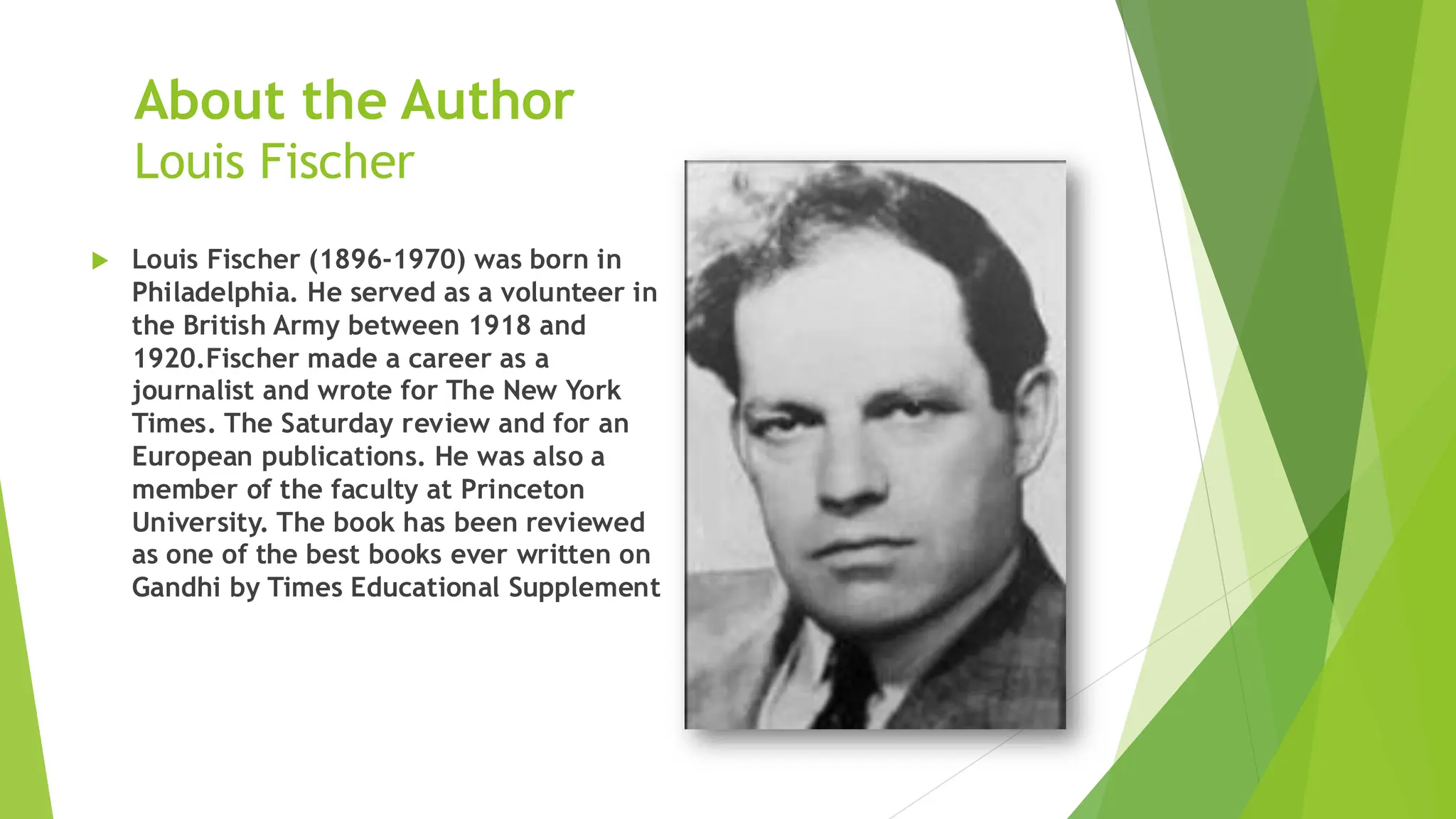
About the Author
Louis Fischer
 Louis Fischer (1896-1970) was born in
Philadelphia. He served as a volunteer in
the British Army between 1918 and
1920.Fischer made a career as a
journalist and wrote for The New York
Times. The Saturday review and for an
European publications. He was also a
member of the faculty at Princeton
University. The book has been reviewed
as one of the best books ever written on
Gandhi by Times Educational Supplement
INTRODUCTION
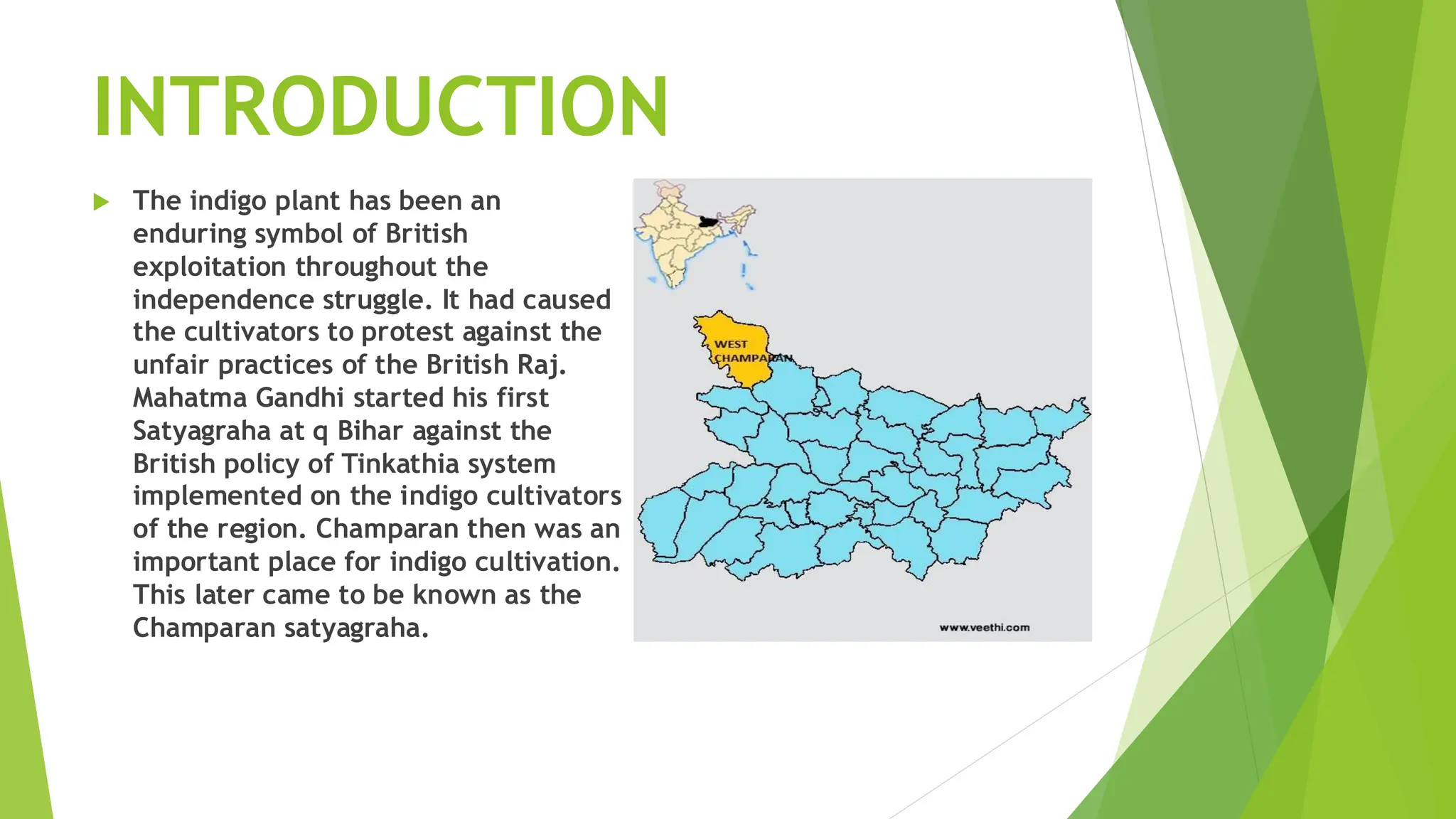
 The indigo plant has been an
enduring symbol of British
exploitation throughout the
independence struggle. It had caused
the cultivators to protest against the
unfair practices of the British Raj.
Mahatma Gandhi started his first
Satyagraha at q Bihar against the
British policy of Tinkathia system
implemented on the indigo cultivators
of the region. Champaran then was an
important place for indigo cultivation.
This later came to be known as the
Champaran satyagraha.
CHAMPARAN FARMERS
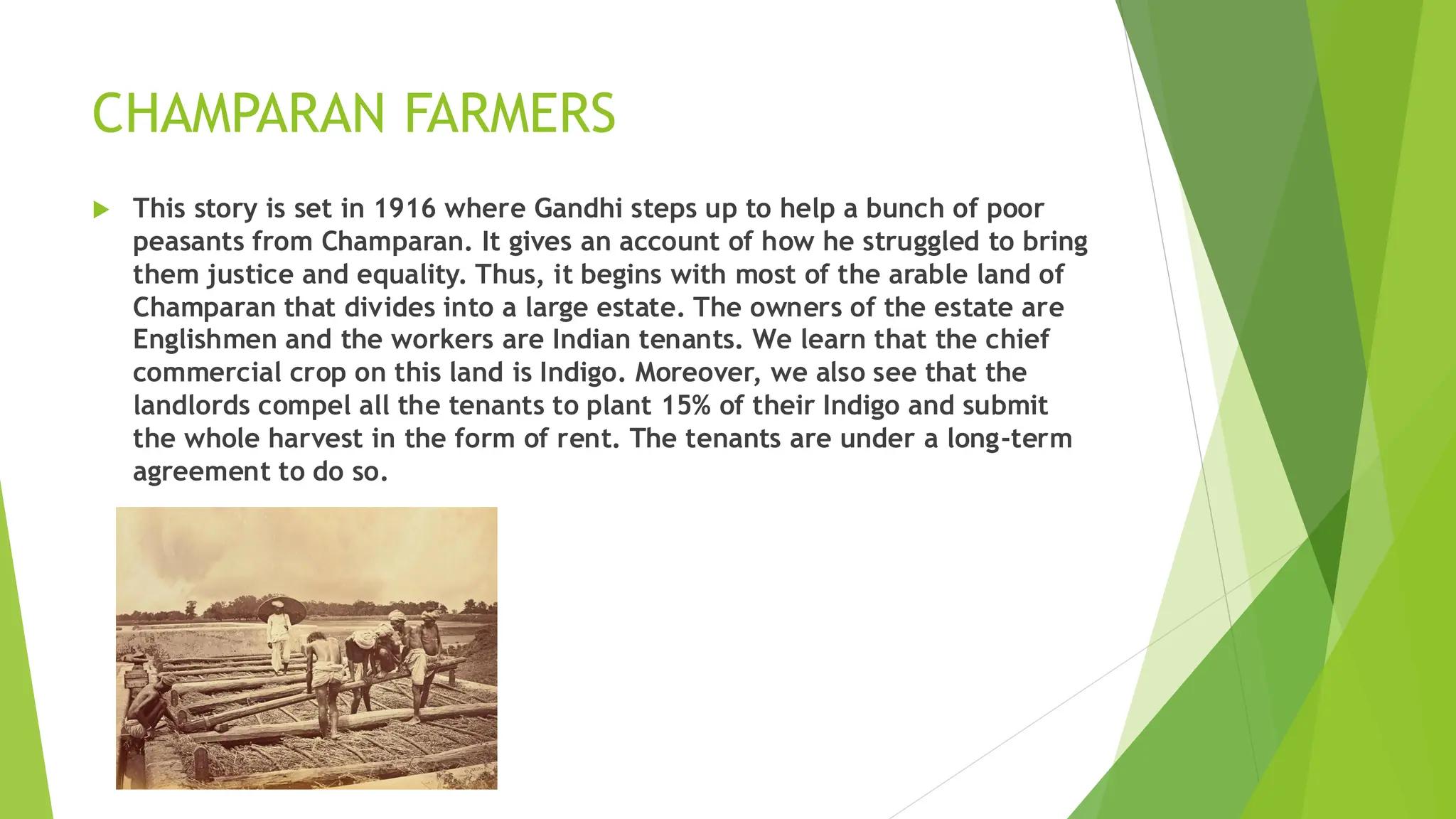
 This story is set in 1916 where Gandhi steps up to help a bunch of poor
peasants from Champaran. It gives an account of how he struggled to bring
them justice and equality. Thus, it begins with most of the arable land of
Champaran that divides into a large estate. The owners of the estate are
Englishmen and the workers are Indian tenants. We learn that the chief
commercial crop on this land is Indigo. Moreover, we also see that the
landlords compel all the tenants to plant 15% of their Indigo and submit
the whole harvest in the form of rent. The tenants are under a long-term
agreement to do so.
INDIGO PLANT
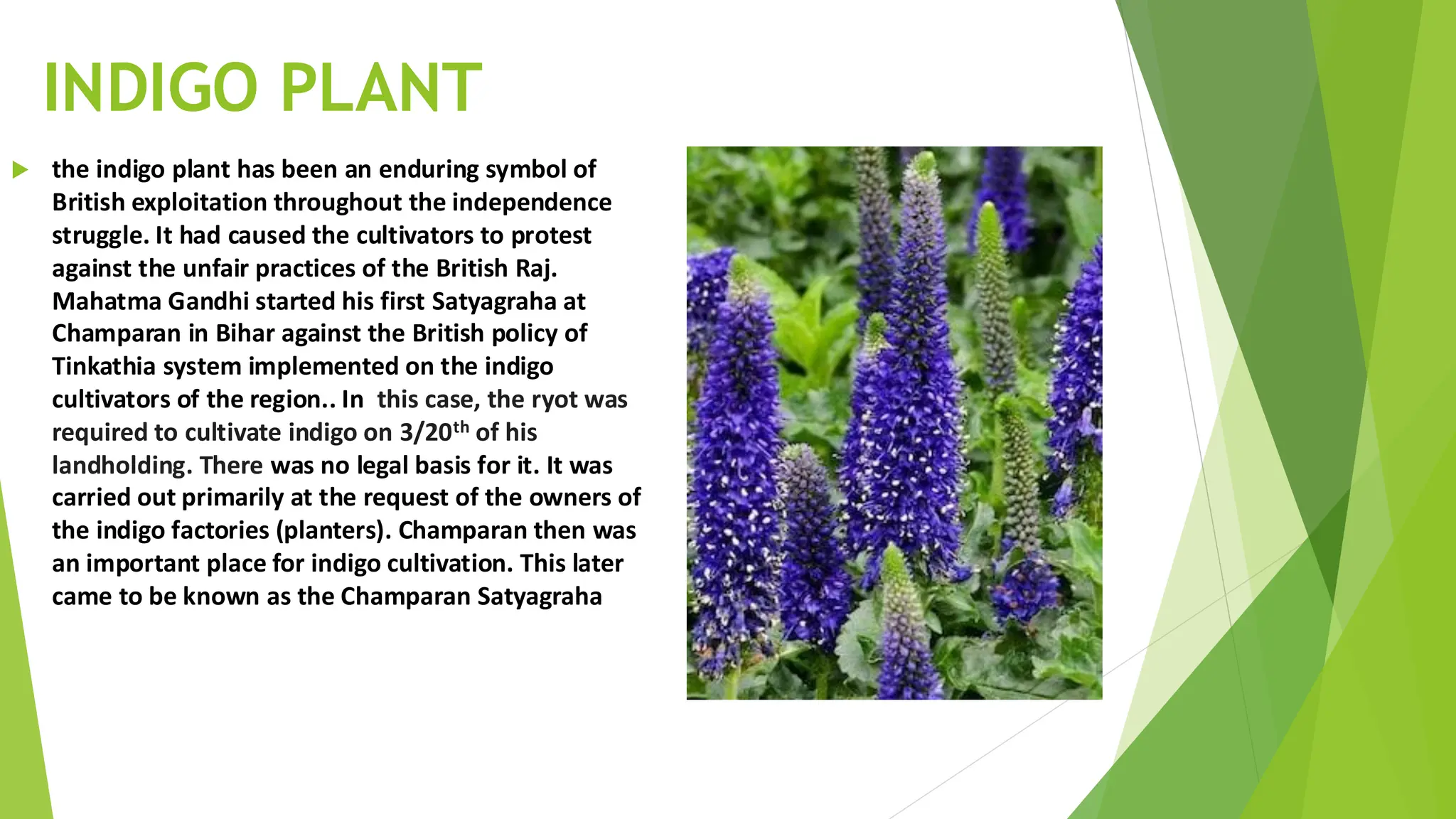
 the indigo plant has been an enduring symbol of
British exploitation throughout the independence
struggle. It had caused the cultivators to protest
against the unfair practices of the British Raj.
Mahatma Gandhi started his first Satyagraha at
Champaran in Bihar against the British policy of
Tinkathia system implemented on the indigo
cultivators of the region.. In this case, the ryot was
required to cultivate indigo on 3/20th of his
landholding. There was no legal basis for it. It was
carried out primarily at the request of the owners of
the indigo factories (planters). Champaran then was
an important place for indigo cultivation. This later
came to be known as the Champaran Satyagraha
However, Germany starts developing
synthetic Indigo. Thus, the British do
not require the indigo crop any more.
Thus, in order to release the poor
peasant from their agreement of
15%,they start demanding
compensation. While some of the
uneducated peasants agreed on this,
the other did not agree. Thus, we
notice that one of the sharecroppers,
Raj Kumar Shukla arranges for a
meeting with Gandhi.
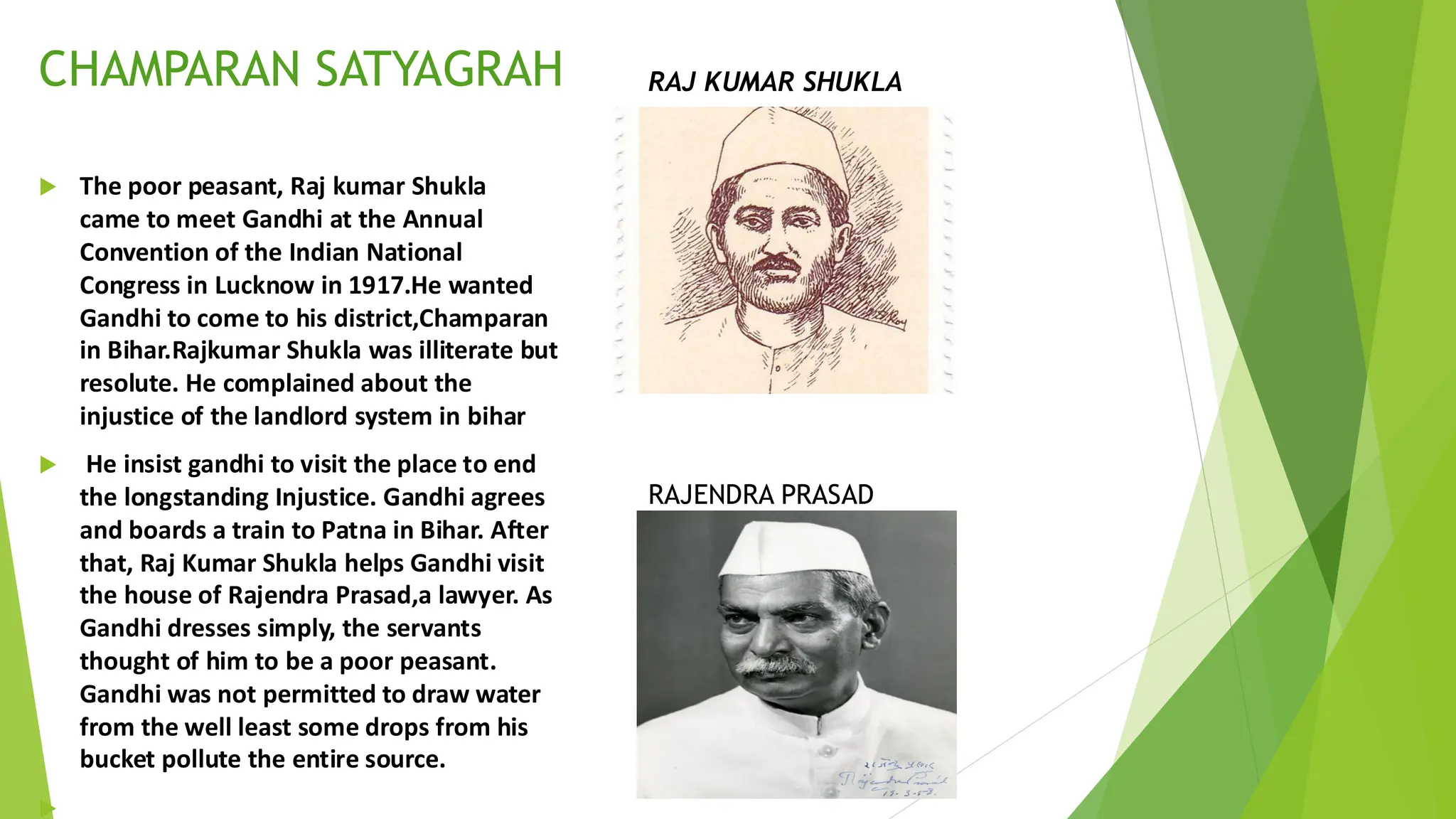
 The poor peasant, Raj kumar Shukla
came to meet Gandhi at the Annual
Convention of the Indian National
Congress in Lucknow in 1917.He wanted
Gandhi to come to his district,Champaran
in Bihar.Rajkumar Shukla was illiterate but
resolute. He complained about the
injustice of the landlord system in bihar
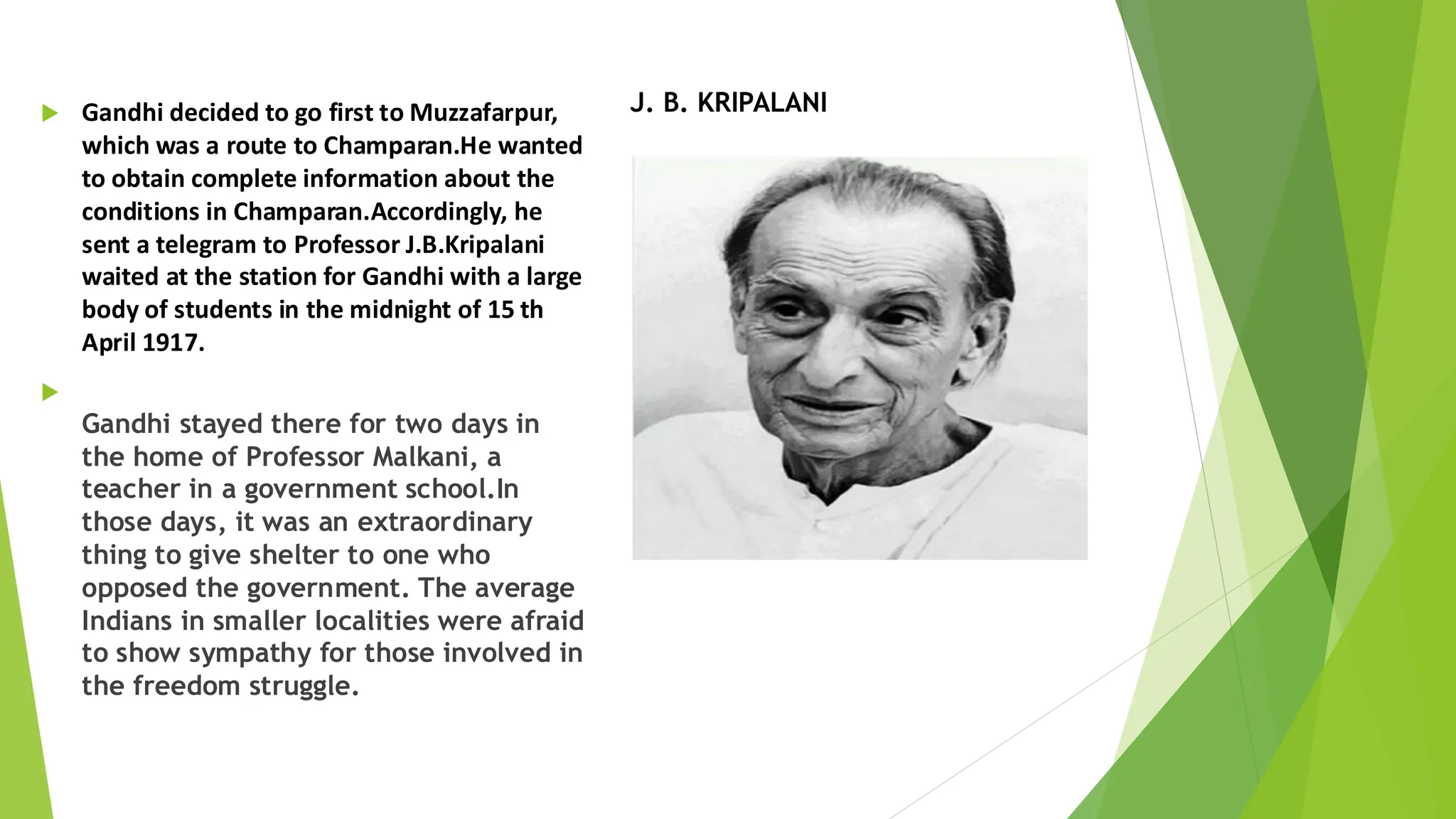
 He insist gandhi to visit the place to end
the longstanding Injustice. Gandhi agrees
and boards a train to Patna in Bihar. After
that, Raj Kumar Shukla helps Gandhi visit
the house of Rajendra Prasad,a lawyer. As
Gandhi dresses simply, the servants
thought of him to be a poor peasant.
Gandhi was not permitted to draw water
from the well least some drops from his
bucket pollute the entire source.

CHAMPARAN SATYAGRAH RAJ KUMAR SHUKLA
RAJENDRA PRASAD
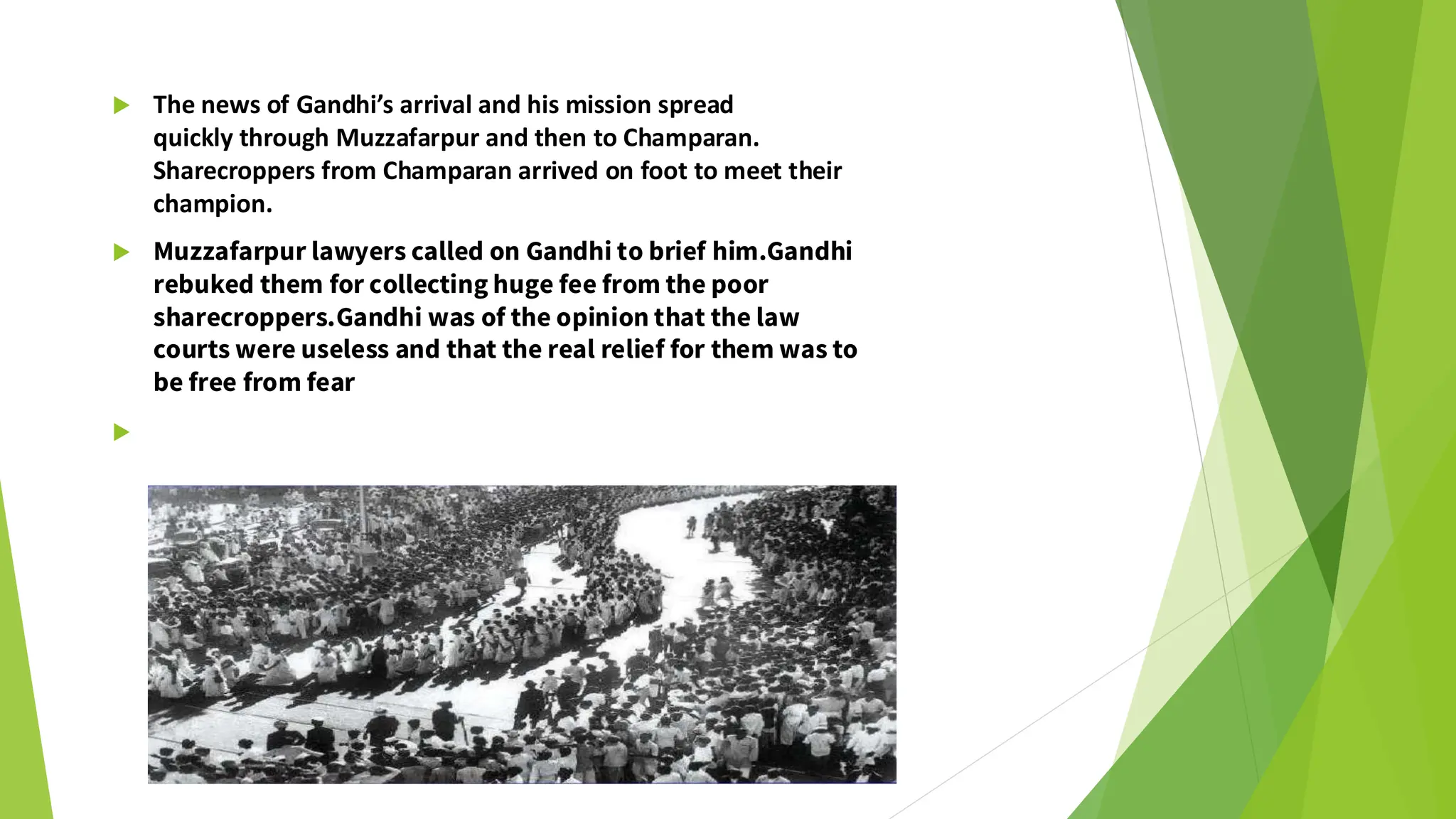
 Gandhi decided to go first to Muzzafarpur,
which was a route to Champaran.He wanted
to obtain complete information about the
conditions in Champaran.Accordingly, he
sent a telegram to Professor J.B.Kripalani
waited at the station for Gandhi with a large
body of students in the midnight of 15 th
April 1917.

Gandhi stayed there for two days in
the home of Professor Malkani, a
teacher in a government school.In
those days, it was an extraordinary
thing to give shelter to one who
opposed the government. The average
Indians in smaller localities were afraid
to show sympathy for those involved in
the freedom struggle.
J. B. KRIPALANI
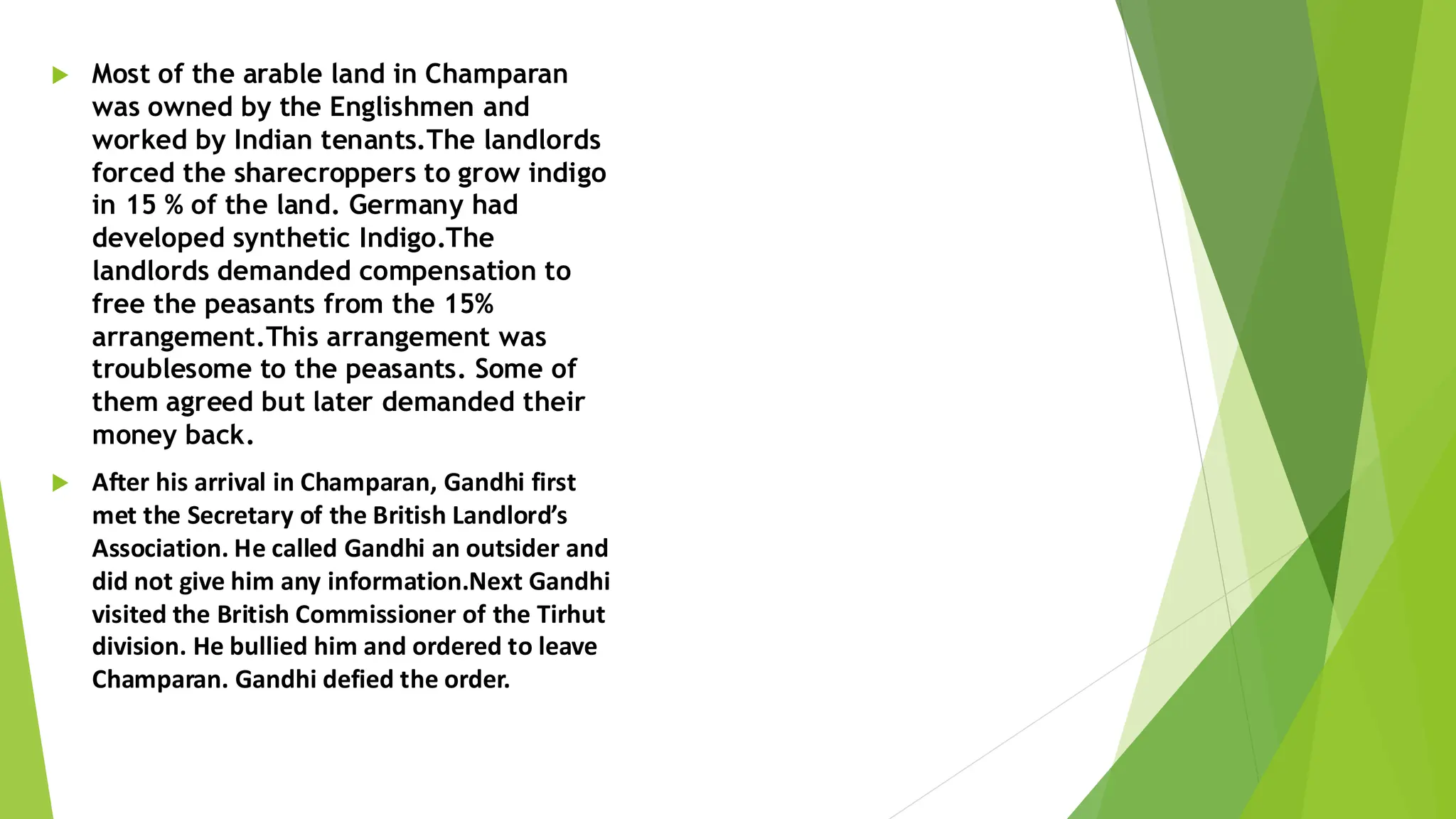
 The news of Gandhi’s arrival and his mission spread
quickly through Muzzafarpur and then to Champaran.
Sharecroppers from Champaran arrived on foot to meet their
champion.
 Muzzafarpur lawyers called on Gandhi to brief him.Gandhi
rebuked them for collecting huge fee from the poor
sharecroppers.Gandhi was of the opinion that the law
courts were useless and that the real relief for them was to
be free from fear

 Most of the arable land in Champaran
was owned by the Englishmen and
worked by Indian tenants.The landlords
forced the sharecroppers to grow indigo
in 15 % of the land. Germany had
developed synthetic Indigo.The
landlords demanded compensation to
free the peasants from the 15%
arrangement.This arrangement was
troublesome to the peasants. Some of
them agreed but later demanded their
money back.
 After his arrival in Champaran, Gandhi first
met the Secretary of the British Landlord’s
Association. He called Gandhi an outsider and
did not give him any information.Next Gandhi
visited the British Commissioner of the Tirhut
division. He bullied him and ordered to leave
Champaran. Gandhi defied the order.
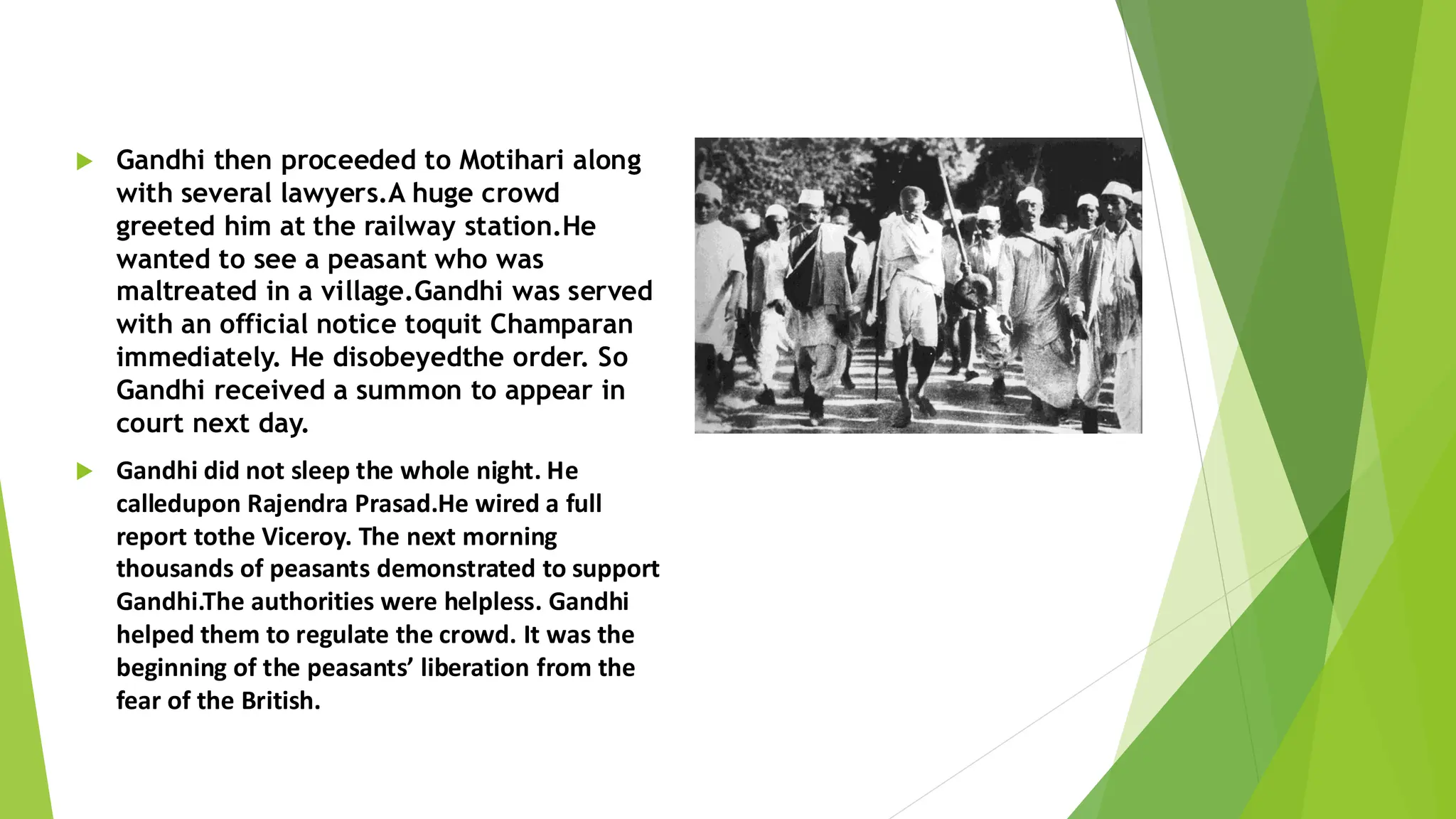
 Gandhi then proceeded to Motihari along
with several lawyers.A huge crowd
greeted him at the railway station.He
wanted to see a peasant who was
maltreated in a village.Gandhi was served
with an official notice toquit Champaran
immediately. He disobeyedthe order. So
Gandhi received a summon to appear in
court next day.
 Gandhi did not sleep the whole night. He
calledupon Rajendra Prasad.He wired a full
report tothe Viceroy. The next morning
thousands of peasants demonstrated to support
Gandhi.The authorities were helpless. Gandhi
helped them to regulate the crowd. It was the
beginning of the peasants’ liberation from the
fear of the British.
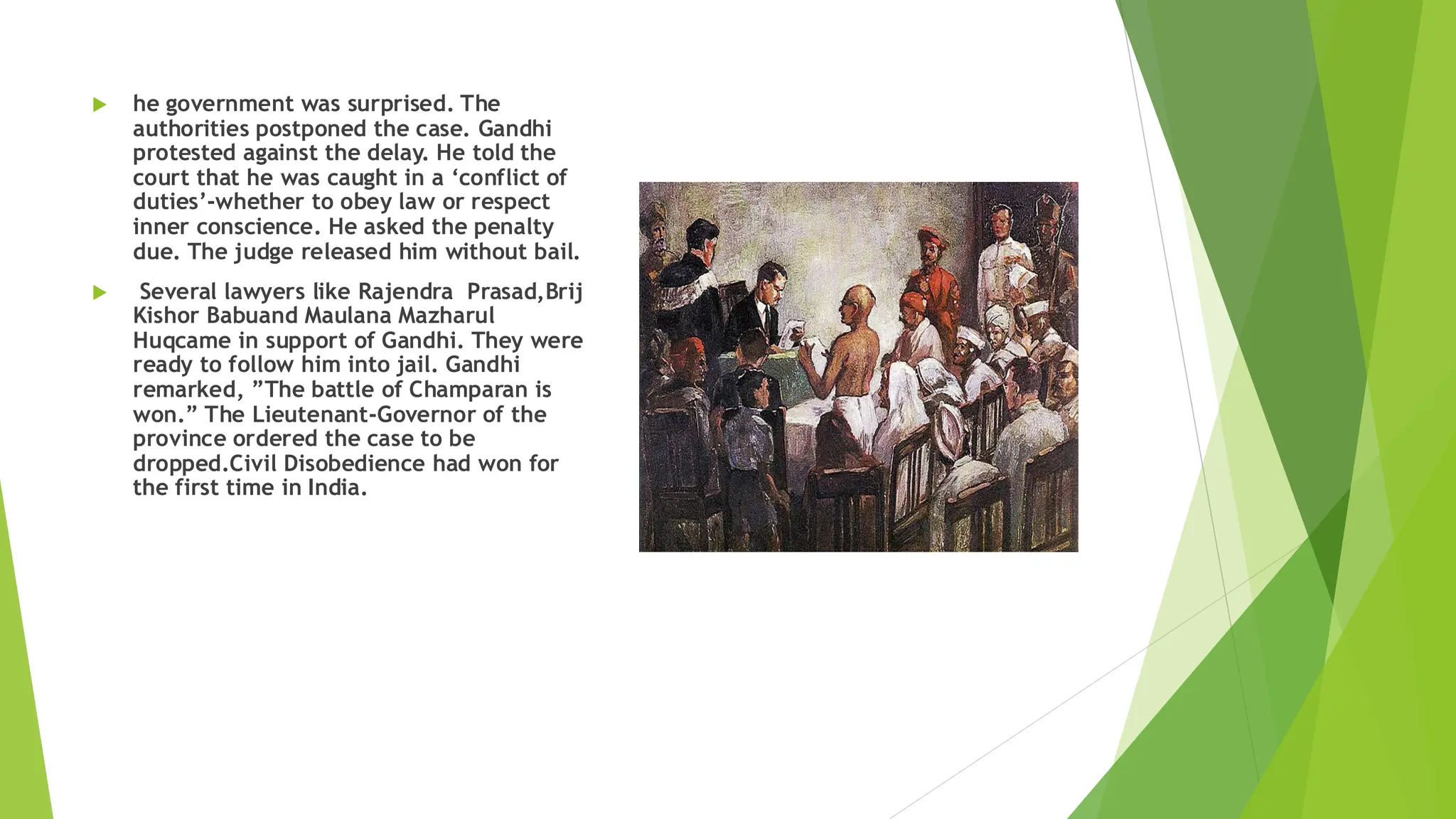
 he government was surprised. The
authorities postponed the case. Gandhi
protested against the delay. He told the
court that he was caught in a ‘conflict of
duties’-whether to obey law or respect
inner conscience. He asked the penalty
due. The judge released him without bail.
 Several lawyers like Rajendra Prasad,Brij
Kishor Babuand Maulana Mazharul
Huqcame in support of Gandhi. They were
ready to follow him into jail. Gandhi
remarked, ”The battle of Champaran is
won.” The Lieutenant-Governor of the
province ordered the case to be
dropped.Civil Disobedience had won for
the first time in India.
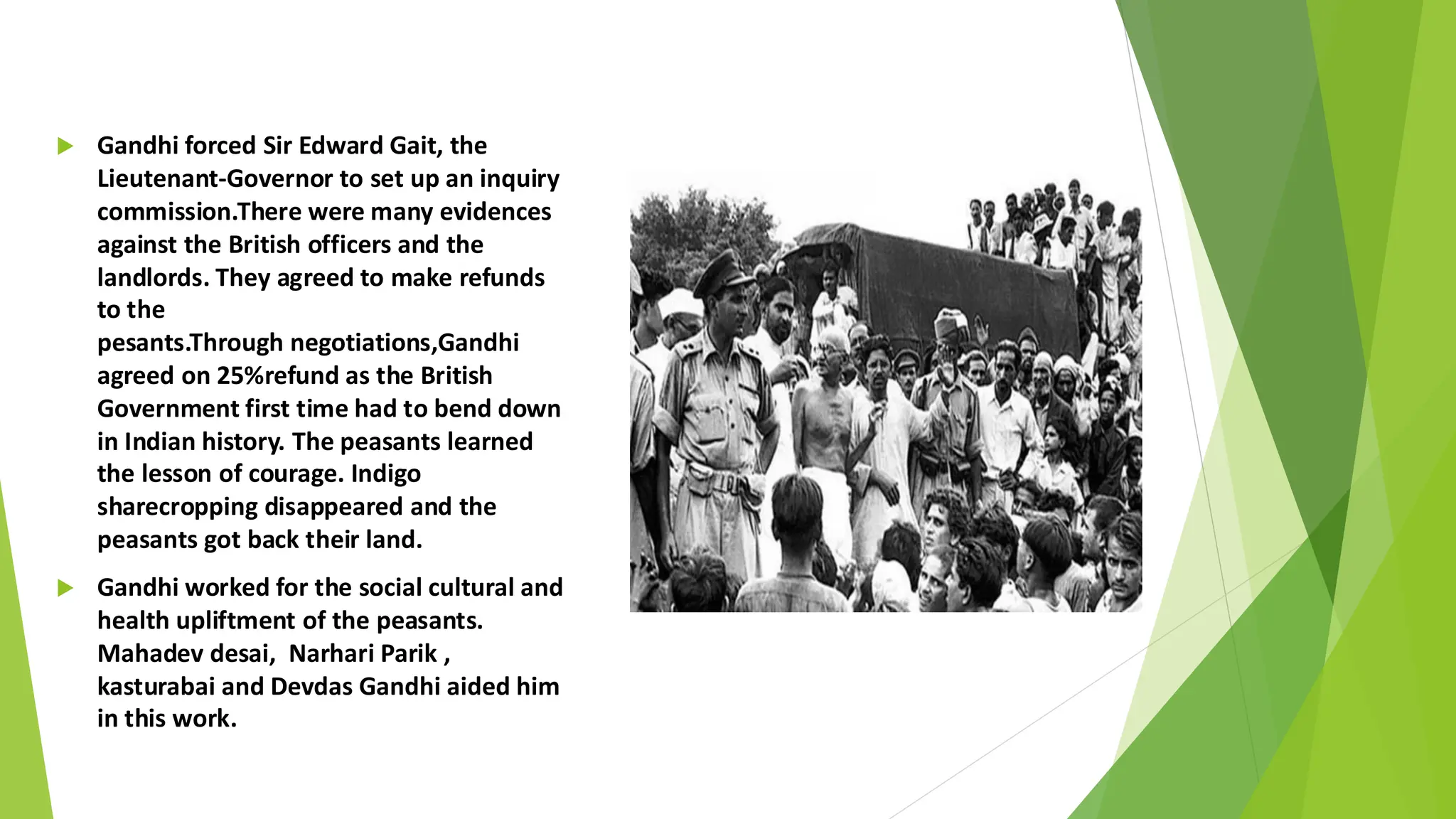
 Gandhi forced Sir Edward Gait, the
Lieutenant-Governor to set up an inquiry
commission.There were many evidences
against the British officers and the
landlords. They agreed to make refunds
to the
pesants.Through negotiations,Gandhi
agreed on 25%refund as the British
Government first time had to bend down
in Indian history. The peasants learned
the lesson of courage. Indigo
sharecropping disappeared and the
peasants got back their land.
 Gandhi worked for the social cultural and
health upliftment of the peasants.
Mahadev desai, Narhari Parik ,
kasturabai and Devdas Gandhi aided him
in this work.
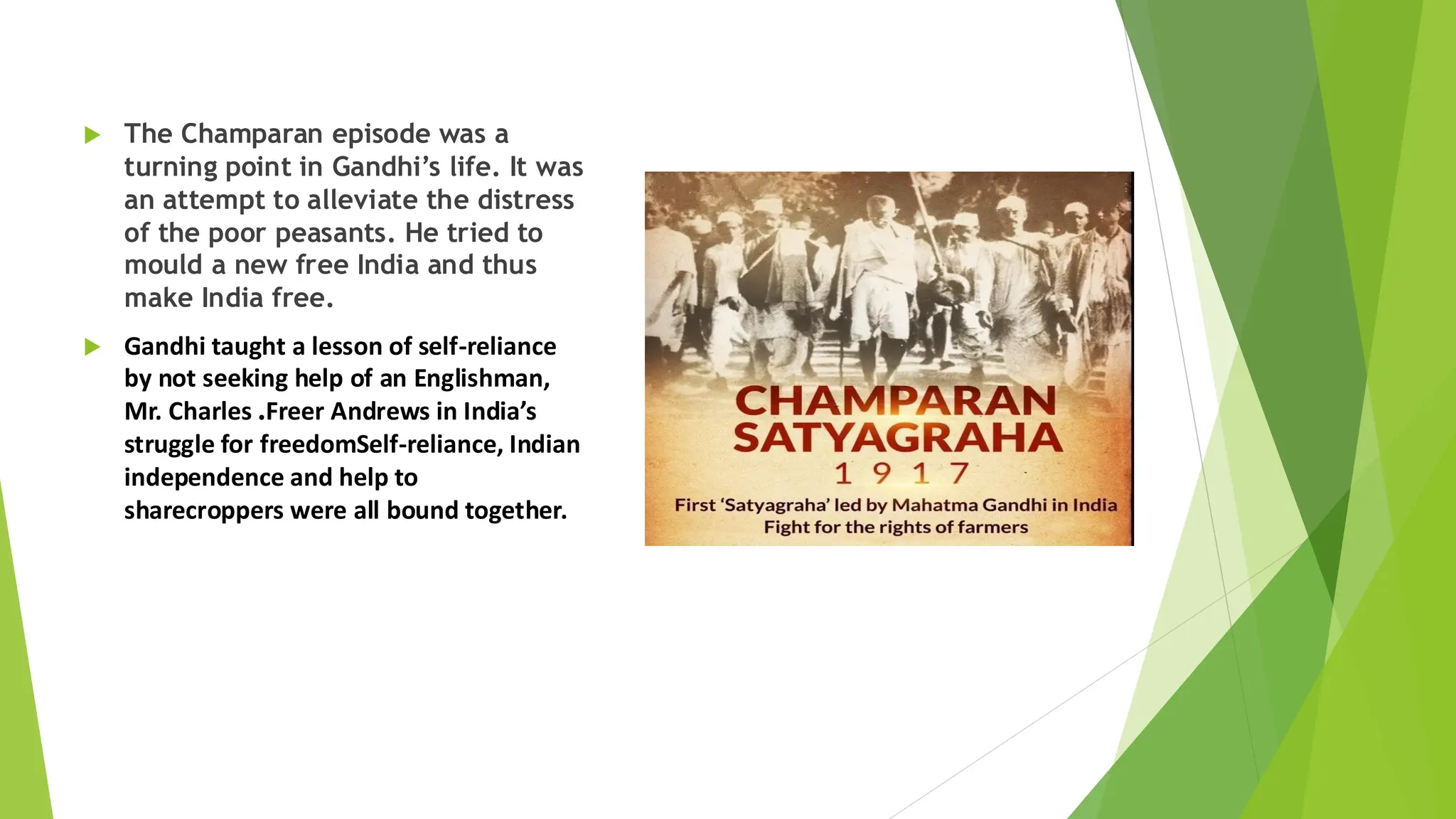
 The Champaran episode was a
turning point in Gandhi’s life. It was
an attempt to alleviate the distress
of the poor peasants. He tried to
mould a new free India and thus
make India free.
 Gandhi taught a lesson of self-reliance
by not seeking help of an Englishman,
Mr. Charles .Freer Andrews in India’s
struggle for freedomSelf-reliance, Indian
independence and help to
sharecroppers were all bound together.
THANK YOU

Ppt on indigo lesson class 12 science project

  • 1.
  • 2.
    PRESENTATION BY Manish MVelip Mohit M Gaonkar Gaurav G. Gaonkar Shivam G. Gaonkar Charit S. Gaonkar
  • 3.
    About the Author LouisFischer  Louis Fischer (1896-1970) was born in Philadelphia. He served as a volunteer in the British Army between 1918 and 1920.Fischer made a career as a journalist and wrote for The New York Times. The Saturday review and for an European publications. He was also a member of the faculty at Princeton University. The book has been reviewed as one of the best books ever written on Gandhi by Times Educational Supplement
  • 4.
    INTRODUCTION  The indigoplant has been an enduring symbol of British exploitation throughout the independence struggle. It had caused the cultivators to protest against the unfair practices of the British Raj. Mahatma Gandhi started his first Satyagraha at q Bihar against the British policy of Tinkathia system implemented on the indigo cultivators of the region. Champaran then was an important place for indigo cultivation. This later came to be known as the Champaran satyagraha.
  • 5.
    CHAMPARAN FARMERS  Thisstory is set in 1916 where Gandhi steps up to help a bunch of poor peasants from Champaran. It gives an account of how he struggled to bring them justice and equality. Thus, it begins with most of the arable land of Champaran that divides into a large estate. The owners of the estate are Englishmen and the workers are Indian tenants. We learn that the chief commercial crop on this land is Indigo. Moreover, we also see that the landlords compel all the tenants to plant 15% of their Indigo and submit the whole harvest in the form of rent. The tenants are under a long-term agreement to do so.
  • 6.
    INDIGO PLANT  theindigo plant has been an enduring symbol of British exploitation throughout the independence struggle. It had caused the cultivators to protest against the unfair practices of the British Raj. Mahatma Gandhi started his first Satyagraha at Champaran in Bihar against the British policy of Tinkathia system implemented on the indigo cultivators of the region.. In this case, the ryot was required to cultivate indigo on 3/20th of his landholding. There was no legal basis for it. It was carried out primarily at the request of the owners of the indigo factories (planters). Champaran then was an important place for indigo cultivation. This later came to be known as the Champaran Satyagraha
  • 7.
    However, Germany startsdeveloping synthetic Indigo. Thus, the British do not require the indigo crop any more. Thus, in order to release the poor peasant from their agreement of 15%,they start demanding compensation. While some of the uneducated peasants agreed on this, the other did not agree. Thus, we notice that one of the sharecroppers, Raj Kumar Shukla arranges for a meeting with Gandhi.
  • 8.
     The poorpeasant, Raj kumar Shukla came to meet Gandhi at the Annual Convention of the Indian National Congress in Lucknow in 1917.He wanted Gandhi to come to his district,Champaran in Bihar.Rajkumar Shukla was illiterate but resolute. He complained about the injustice of the landlord system in bihar  He insist gandhi to visit the place to end the longstanding Injustice. Gandhi agrees and boards a train to Patna in Bihar. After that, Raj Kumar Shukla helps Gandhi visit the house of Rajendra Prasad,a lawyer. As Gandhi dresses simply, the servants thought of him to be a poor peasant. Gandhi was not permitted to draw water from the well least some drops from his bucket pollute the entire source.  CHAMPARAN SATYAGRAH RAJ KUMAR SHUKLA RAJENDRA PRASAD
  • 9.
     Gandhi decidedto go first to Muzzafarpur, which was a route to Champaran.He wanted to obtain complete information about the conditions in Champaran.Accordingly, he sent a telegram to Professor J.B.Kripalani waited at the station for Gandhi with a large body of students in the midnight of 15 th April 1917.  Gandhi stayed there for two days in the home of Professor Malkani, a teacher in a government school.In those days, it was an extraordinary thing to give shelter to one who opposed the government. The average Indians in smaller localities were afraid to show sympathy for those involved in the freedom struggle. J. B. KRIPALANI
  • 10.
     The newsof Gandhi’s arrival and his mission spread quickly through Muzzafarpur and then to Champaran. Sharecroppers from Champaran arrived on foot to meet their champion.  Muzzafarpur lawyers called on Gandhi to brief him.Gandhi rebuked them for collecting huge fee from the poor sharecroppers.Gandhi was of the opinion that the law courts were useless and that the real relief for them was to be free from fear 
  • 11.
     Most ofthe arable land in Champaran was owned by the Englishmen and worked by Indian tenants.The landlords forced the sharecroppers to grow indigo in 15 % of the land. Germany had developed synthetic Indigo.The landlords demanded compensation to free the peasants from the 15% arrangement.This arrangement was troublesome to the peasants. Some of them agreed but later demanded their money back.  After his arrival in Champaran, Gandhi first met the Secretary of the British Landlord’s Association. He called Gandhi an outsider and did not give him any information.Next Gandhi visited the British Commissioner of the Tirhut division. He bullied him and ordered to leave Champaran. Gandhi defied the order.
  • 12.
     Gandhi thenproceeded to Motihari along with several lawyers.A huge crowd greeted him at the railway station.He wanted to see a peasant who was maltreated in a village.Gandhi was served with an official notice toquit Champaran immediately. He disobeyedthe order. So Gandhi received a summon to appear in court next day.  Gandhi did not sleep the whole night. He calledupon Rajendra Prasad.He wired a full report tothe Viceroy. The next morning thousands of peasants demonstrated to support Gandhi.The authorities were helpless. Gandhi helped them to regulate the crowd. It was the beginning of the peasants’ liberation from the fear of the British.
  • 13.
     he governmentwas surprised. The authorities postponed the case. Gandhi protested against the delay. He told the court that he was caught in a ‘conflict of duties’-whether to obey law or respect inner conscience. He asked the penalty due. The judge released him without bail.  Several lawyers like Rajendra Prasad,Brij Kishor Babuand Maulana Mazharul Huqcame in support of Gandhi. They were ready to follow him into jail. Gandhi remarked, ”The battle of Champaran is won.” The Lieutenant-Governor of the province ordered the case to be dropped.Civil Disobedience had won for the first time in India.
  • 14.
     Gandhi forcedSir Edward Gait, the Lieutenant-Governor to set up an inquiry commission.There were many evidences against the British officers and the landlords. They agreed to make refunds to the pesants.Through negotiations,Gandhi agreed on 25%refund as the British Government first time had to bend down in Indian history. The peasants learned the lesson of courage. Indigo sharecropping disappeared and the peasants got back their land.  Gandhi worked for the social cultural and health upliftment of the peasants. Mahadev desai, Narhari Parik , kasturabai and Devdas Gandhi aided him in this work.
  • 15.
     The Champaranepisode was a turning point in Gandhi’s life. It was an attempt to alleviate the distress of the poor peasants. He tried to mould a new free India and thus make India free.  Gandhi taught a lesson of self-reliance by not seeking help of an Englishman, Mr. Charles .Freer Andrews in India’s struggle for freedomSelf-reliance, Indian independence and help to sharecroppers were all bound together.
  • 16.