Indian Premier League
Submitted by Rishab Saini
X – A
19
professional Twenty20 cricket league in India
The Indian Cricket League was founded in 2007, with funding provided by Zee
Entertainment Enterprises. The ICL was not recognised by the Board of Control for
Cricket in India (BCCI) or the International Cricket Council (ICC) and the BCCI were
not pleased with its committee members joining the ICL executive board. To prevent
players from joining the ICL, the BCCI increased the prize money in their own
domestic tournaments and also imposed lifetime bans on players joining the ICL,
which was considered a rebel league by the board. BCCI started a new Twenty20
league that would rival the Indian Cricket League. In early 2008, the BCCI announced
the launch of the Indian Premier League, a new franchise based T20 league, which is
among the first of its kind in the cricketing world. The league was based on the
Premier League of England and the NBA in the United States.
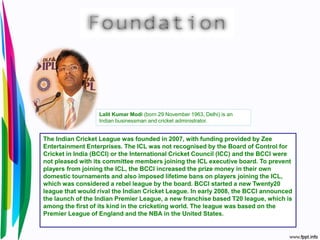
Lalit Kumar Modi (born 29 November 1963, Delhi) is an
Indian businessman and cricket administrator.
Tournament Format
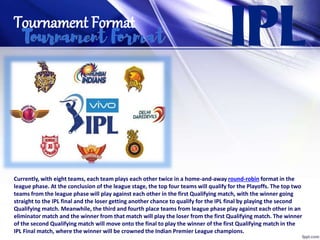
Currently, with eight teams, each team plays each other twice in a home-and-away round-robin format in the
league phase. At the conclusion of the league stage, the top four teams will qualify for the Playoffs. The top two
teams from the league phase will play against each other in the first Qualifying match, with the winner going
straight to the IPL final and the loser getting another chance to qualify for the IPL final by playing the second
Qualifying match. Meanwhile, the third and fourth place teams from league phase play against each other in an
eliminator match and the winner from that match will play the loser from the first Qualifying match. The winner
of the second Qualifying match will move onto the final to play the winner of the first Qualifying match in the
IPL Final match, where the winner will be crowned the Indian Premier League champions.
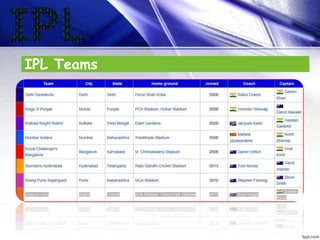
IPL Teams
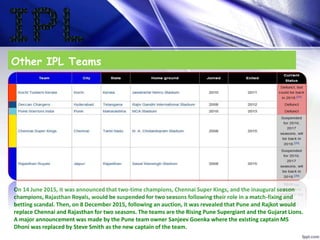
On 14 June 2015, it was announced that two-time champions, Chennai Super Kings, and the inaugural season
champions, Rajasthan Royals, would be suspended for two seasons following their role in a match-fixing and
betting scandal. Then, on 8 December 2015, following an auction, it was revealed that Pune and Rajkot would
replace Chennai and Rajasthan for two seasons. The teams are the Rising Pune Supergiant and the Gujarat Lions.
A major announcement was made by the Pune team owner Sanjeev Goenka where the existing captain MS
Dhoni was replaced by Steve Smith as the new captain of the team.
Other IPL Teams
Tournament and salary rules
 Some of the team composition rules are as follows:
• A minimum squad strength of 16 players, one physiotherapist and a coach.
• No more than 10 foreign players on the squad and a maximum of 4 foreign players in the
playing XI.
• A minimum of 14 Indian players must be included in each squad.
• A minimum of 6 players from the BCCI under-22 pool must be included in each squad.
 A team can acquire players through five ways: The annual auction, signing domestic
players, signing uncapped players, trading players, and signing replacements. In the trading
window, a player can only be traded with his consent, with the franchise paying the
difference if any between the old and new contract. If the new contract is worth more than
the older one, the difference is shared between the player and the franchise selling the
player
 Each team is given a two-and-a-half-minute "strategic timeout" during each innings;
one must be taken by the bowling team between the ends of the 6th and 9th overs,
and one by the batting team between the ends of the 13th and 16th overs
Salary cap
 The total spending cap for a franchise in the first player auction was US$5
million. Under-22 players are to be remunerated with a minimum annual
salary of US $20,000, whereas for others the minimum was US$50,000.
 Prize money
The 2015 season of the IPL offered a total prize money of ₹40 crore
(US$6.2 million), with the winning team netting ₹15 crore (US$2.3 million).[54] The
first and second runners up received 10 and 7.5 crores, respectively, with the
fourth placed team also winning 7.5 crores. The others teams are not awarded any
prize money. The IPL rules mandate that half of the prize money must be
distributed among the players.
Individual awards
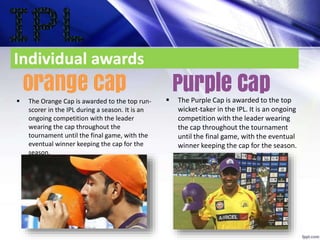
 The Orange Cap is awarded to the top run-
scorer in the IPL during a season. It is an
ongoing competition with the leader
wearing the cap throughout the
tournament until the final game, with the
eventual winner keeping the cap for the
season.
 The Purple Cap is awarded to the top
wicket-taker in the IPL. It is an ongoing
competition with the leader wearing
the cap throughout the tournament
until the final game, with the eventual
winner keeping the cap for the season.
IPL Governing Council
The is responsible for all the functions of the tournament. The members are Rajeev
Shukla, Ajay Shirke, Sourav Ganguly, Anurag Thakur andAnirudh Chaudhry. In
January 2016, the Supreme Court appointed Lodha Committee to recommend
separate governing bodies for the Board of Control for Cricket in India (BCCI) and
the Indian Premier League (IPL), whereJustice RM Lodha suggested a One State-
One Memberpattern for the board.
Indian Premier League

Indian Premier League

  • 1.
    Indian Premier League Submittedby Rishab Saini X – A 19 professional Twenty20 cricket league in India
  • 2.
    The Indian CricketLeague was founded in 2007, with funding provided by Zee Entertainment Enterprises. The ICL was not recognised by the Board of Control for Cricket in India (BCCI) or the International Cricket Council (ICC) and the BCCI were not pleased with its committee members joining the ICL executive board. To prevent players from joining the ICL, the BCCI increased the prize money in their own domestic tournaments and also imposed lifetime bans on players joining the ICL, which was considered a rebel league by the board. BCCI started a new Twenty20 league that would rival the Indian Cricket League. In early 2008, the BCCI announced the launch of the Indian Premier League, a new franchise based T20 league, which is among the first of its kind in the cricketing world. The league was based on the Premier League of England and the NBA in the United States. Lalit Kumar Modi (born 29 November 1963, Delhi) is an Indian businessman and cricket administrator.
  • 3.
    Tournament Format Currently, witheight teams, each team plays each other twice in a home-and-away round-robin format in the league phase. At the conclusion of the league stage, the top four teams will qualify for the Playoffs. The top two teams from the league phase will play against each other in the first Qualifying match, with the winner going straight to the IPL final and the loser getting another chance to qualify for the IPL final by playing the second Qualifying match. Meanwhile, the third and fourth place teams from league phase play against each other in an eliminator match and the winner from that match will play the loser from the first Qualifying match. The winner of the second Qualifying match will move onto the final to play the winner of the first Qualifying match in the IPL Final match, where the winner will be crowned the Indian Premier League champions.
  • 4.
  • 5.
    On 14 June2015, it was announced that two-time champions, Chennai Super Kings, and the inaugural season champions, Rajasthan Royals, would be suspended for two seasons following their role in a match-fixing and betting scandal. Then, on 8 December 2015, following an auction, it was revealed that Pune and Rajkot would replace Chennai and Rajasthan for two seasons. The teams are the Rising Pune Supergiant and the Gujarat Lions. A major announcement was made by the Pune team owner Sanjeev Goenka where the existing captain MS Dhoni was replaced by Steve Smith as the new captain of the team. Other IPL Teams
  • 6.
    Tournament and salaryrules  Some of the team composition rules are as follows: • A minimum squad strength of 16 players, one physiotherapist and a coach. • No more than 10 foreign players on the squad and a maximum of 4 foreign players in the playing XI. • A minimum of 14 Indian players must be included in each squad. • A minimum of 6 players from the BCCI under-22 pool must be included in each squad.  A team can acquire players through five ways: The annual auction, signing domestic players, signing uncapped players, trading players, and signing replacements. In the trading window, a player can only be traded with his consent, with the franchise paying the difference if any between the old and new contract. If the new contract is worth more than the older one, the difference is shared between the player and the franchise selling the player  Each team is given a two-and-a-half-minute "strategic timeout" during each innings; one must be taken by the bowling team between the ends of the 6th and 9th overs, and one by the batting team between the ends of the 13th and 16th overs
  • 7.
    Salary cap  Thetotal spending cap for a franchise in the first player auction was US$5 million. Under-22 players are to be remunerated with a minimum annual salary of US $20,000, whereas for others the minimum was US$50,000.  Prize money The 2015 season of the IPL offered a total prize money of ₹40 crore (US$6.2 million), with the winning team netting ₹15 crore (US$2.3 million).[54] The first and second runners up received 10 and 7.5 crores, respectively, with the fourth placed team also winning 7.5 crores. The others teams are not awarded any prize money. The IPL rules mandate that half of the prize money must be distributed among the players.
  • 8.
    Individual awards  TheOrange Cap is awarded to the top run- scorer in the IPL during a season. It is an ongoing competition with the leader wearing the cap throughout the tournament until the final game, with the eventual winner keeping the cap for the season.  The Purple Cap is awarded to the top wicket-taker in the IPL. It is an ongoing competition with the leader wearing the cap throughout the tournament until the final game, with the eventual winner keeping the cap for the season.
  • 9.
    IPL Governing Council Theis responsible for all the functions of the tournament. The members are Rajeev Shukla, Ajay Shirke, Sourav Ganguly, Anurag Thakur andAnirudh Chaudhry. In January 2016, the Supreme Court appointed Lodha Committee to recommend separate governing bodies for the Board of Control for Cricket in India (BCCI) and the Indian Premier League (IPL), whereJustice RM Lodha suggested a One State- One Memberpattern for the board.