Indian Premier League-IPL
ContentsConceptInceptionBusiness ModelFranchiseesSponsorsRules & RegulationsGoverning BodyPlayersThe Journey so far
ConceptThe IPL was designed after an intensive study of the primary sporting leagues around the world such as the NHL, NBA, NFL and EPL.  A detail & critical analysis of the theoretical models as well as  systematic evaluation of  the result and impact of each of these leagues SWOT analysis Individual market contexts are taken into consideration.Final blueprint is preparedThe IPL design is one that has been meticulously refined to work for Cricket. The league structure has been modelled so as to flourish in the uniquely Indian context, and drive the development of grassroots talent in Indian cricket. Such concept can only be successful if all stakeholders’ interests are safeguarded.An in-depth analysis has been done in this context.
InceptionBrain-child of Mr. Lalit Modi,then Vice- President, BCCIIn late June 2007, discussed with Mr. Andrew Wildblood of the International Management Group (IMG), the sports management giants.In 2008, the IPL was born.20,February 2008-auction for players was held in Mumbai.18,April 2008-first match of IPL  took place in Bangalore.Schedule-46 days 59 matches
Business ModelThe revenues for the IPL and the franchisees come from three streams: media rights,
sponsorships under the central or local pool, and
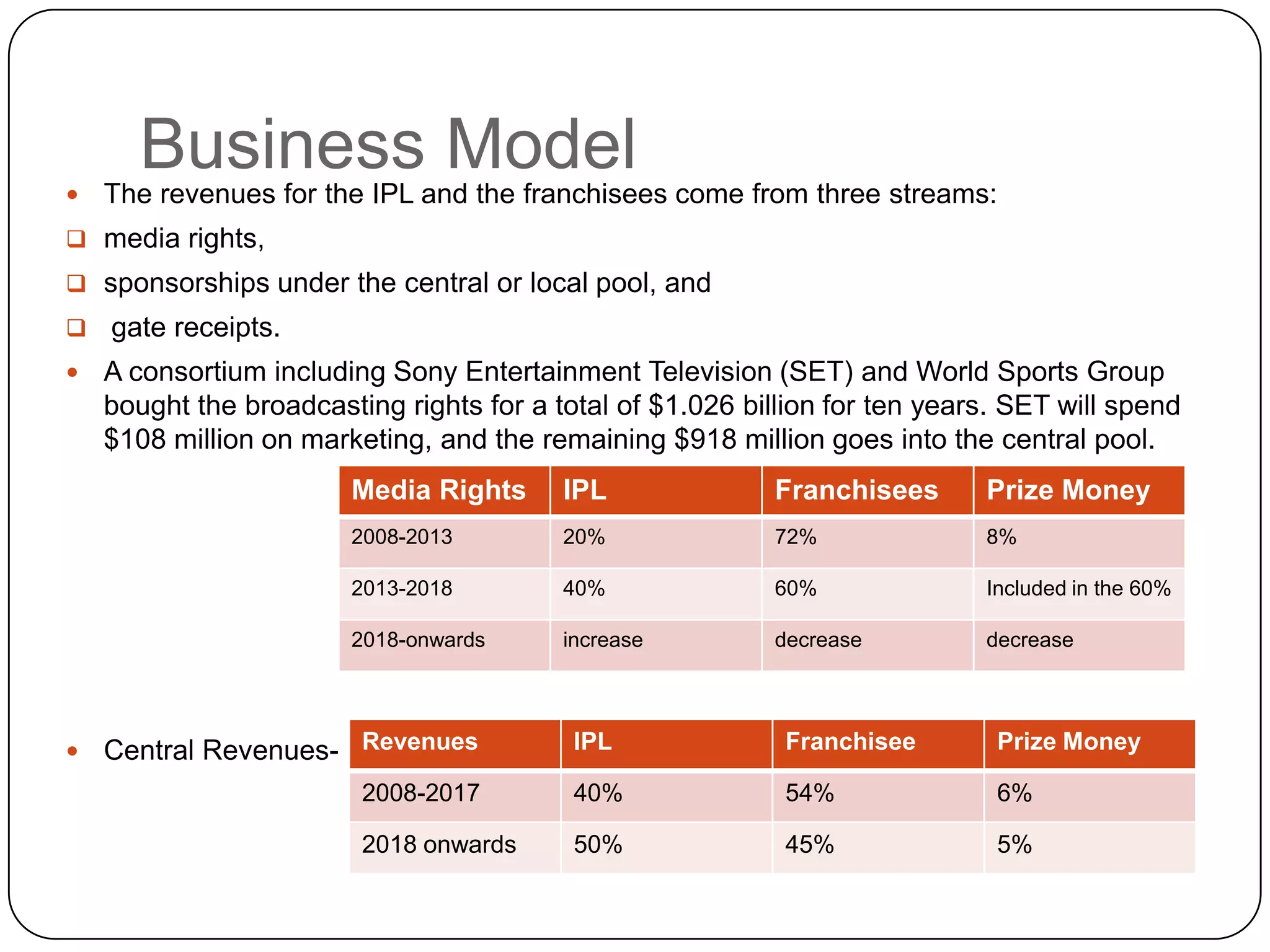
gate receipts.A consortium including Sony Entertainment Television (SET) and World Sports Group bought the broadcasting rights for a total of $1.026 billion for ten years. SET will spend $108 million on marketing, and the remaining $918 million goes into the central pool. Central Revenues-
Cont.Gate ReceiptsOther revenues include selling advertising space in the stadia for home matches, licensing products for their team like T-shirts, getting sponsorship for the team uniform, advertising on tickets and so on. As already mentioned, 20% of all of this will then go to IPL.
Franchisees2008-2010-No. of Franchisees are 82011 onwards
Franchisees own the teams in perpetuity, but make the payments in installments over the next 10 years. In addition, each team spends $4-6 million per year on players and team personnel. Players signed three-year contracts with the franchisee, and icon players excepted, can be traded after the first season. Stadiums could cost up to Rs 30 lakh per match, and each team is also expected to spend approximately $3-4 million per year on marketing, promotion, and event management costs.The franchisees’ expenses include team franchising installments, player and personnel, marketing, stadium expenses, and promotion, event management and administration.
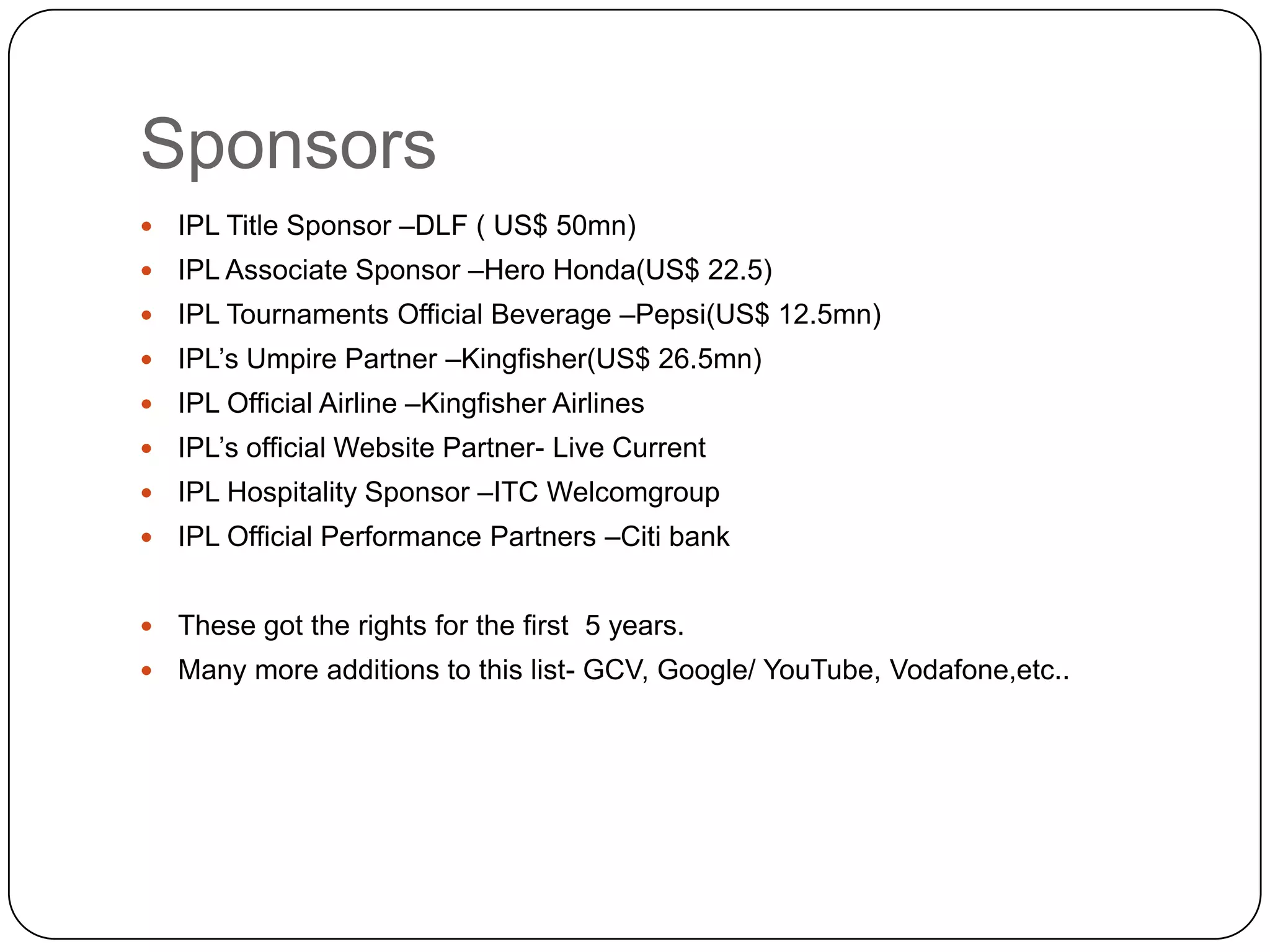
SponsorsIPL Title Sponsor –DLF ( US$ 50mn)IPL Associate Sponsor –Hero Honda(US$ 22.5)IPL Tournaments Official Beverage –Pepsi(US$ 12.5mn)IPL’s Umpire Partner –Kingfisher(US$ 26.5mn)IPL Official Airline –Kingfisher AirlinesIPL’s official Website Partner- Live CurrentIPL Hospitality Sponsor –ITC WelcomgroupIPL Official Performance Partners –Citi bank  These got the rights for the first  5 years.Many more additions to this list- GCV, Google/ YouTube, Vodafone,etc..
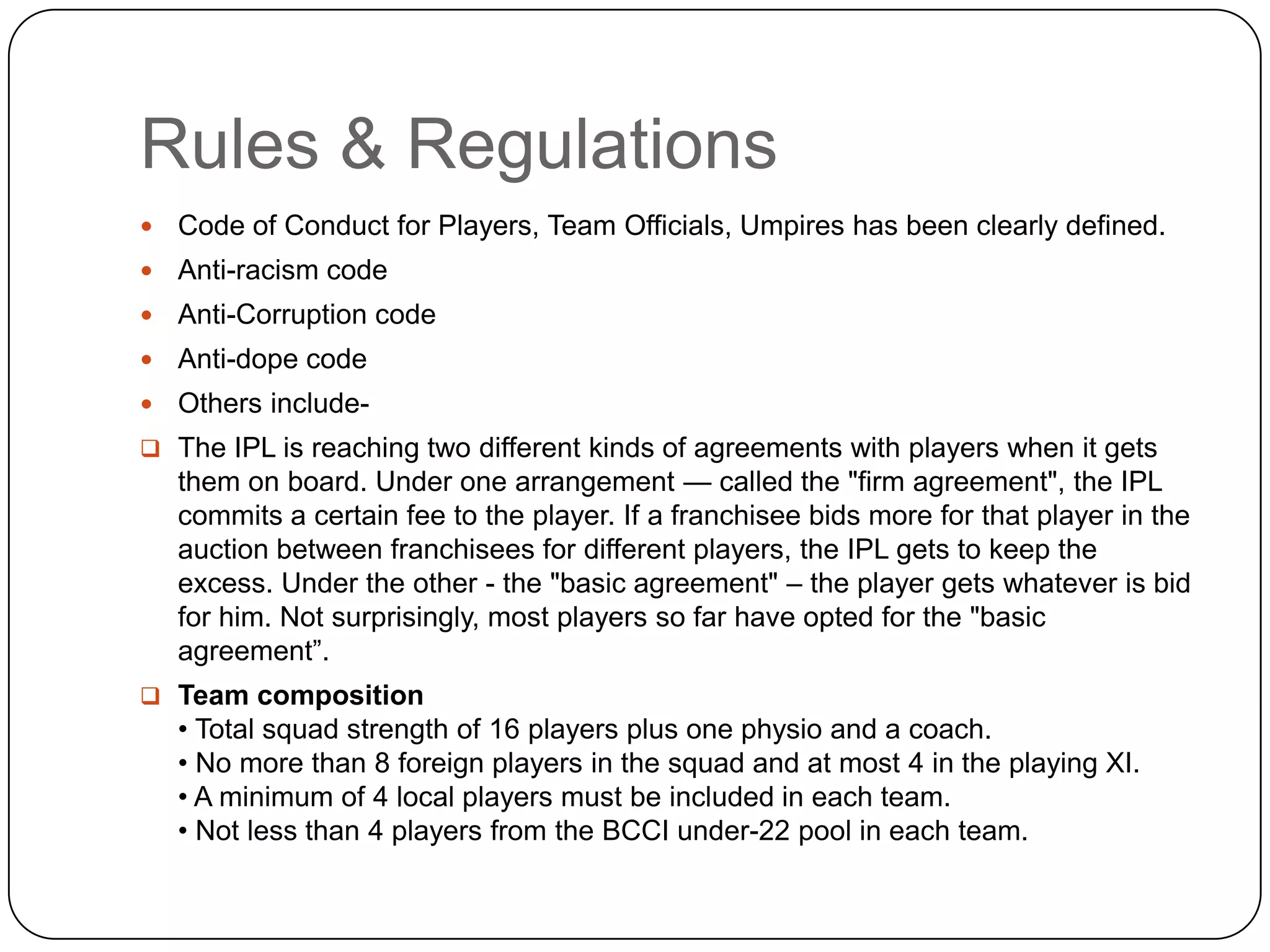
Rules & RegulationsCode of Conduct for Players, Team Officials, Umpires has been clearly defined.Anti-racism codeAnti-Corruption codeAnti-dope codeOthers include-The IPL is reaching two different kinds of agreements with players when it gets them on board. Under one arrangement — called the "firm agreement", the IPL commits a certain fee to the player. If a franchisee bids more for that player in the auction between franchisees for different players, the IPL gets to keep the excess. Under the other - the "basic agreement" – the player gets whatever is bid for him. Not surprisingly, most players so far have opted for the "basic agreement”.
Team composition• Total squad strength of 16 players plus one physio and a coach.• No more than 8 foreign players in the squad and at most 4 in the playing XI.• A minimum of 4 local players must be included in each team.• Not less than 4 players from the BCCI under-22 pool in each team.Governing CouncilMr. Lalit Modi -Chairman And Commissioner, IPLMr. Shashank Manohar -President, BCCIMr. N Srinivasan- BCCI SecretaryMr. Niranjan Shah-IPL Vice-chairmanMr Inderjit Singh Bindra-President, Punjab Cricket AssociationMr. M  P Pandove-honorary Treasurer, BCCIMr. Chirayu Amin-  BCCI  Vice-presidentMr. Arun Jaitley - BCCI Vice-president And President, Delhi And District Cricket AssociationMr. Sanjay Jagdale - BCCI Joint-secretaryMr. Rajeev Shukla –Chairman, Media And Finance Committee, BCCIMr. Ravi Shastri -Former India CaptainMr. Sunil Gavaskar-Former India CaptainMr. Mansoor Ali Khan Pataudi -Former India Captain

I P L Business Model

  • 1.
  • 2.
    ContentsConceptInceptionBusiness ModelFranchiseesSponsorsRules &RegulationsGoverning BodyPlayersThe Journey so far
  • 3.
    ConceptThe IPL wasdesigned after an intensive study of the primary sporting leagues around the world such as the NHL, NBA, NFL and EPL. A detail & critical analysis of the theoretical models as well as systematic evaluation of the result and impact of each of these leagues SWOT analysis Individual market contexts are taken into consideration.Final blueprint is preparedThe IPL design is one that has been meticulously refined to work for Cricket. The league structure has been modelled so as to flourish in the uniquely Indian context, and drive the development of grassroots talent in Indian cricket. Such concept can only be successful if all stakeholders’ interests are safeguarded.An in-depth analysis has been done in this context.
  • 4.
    InceptionBrain-child of Mr.Lalit Modi,then Vice- President, BCCIIn late June 2007, discussed with Mr. Andrew Wildblood of the International Management Group (IMG), the sports management giants.In 2008, the IPL was born.20,February 2008-auction for players was held in Mumbai.18,April 2008-first match of IPL took place in Bangalore.Schedule-46 days 59 matches
  • 5.
    Business ModelThe revenuesfor the IPL and the franchisees come from three streams: media rights,
  • 6.
    sponsorships under thecentral or local pool, and
  • 7.
    gate receipts.A consortiumincluding Sony Entertainment Television (SET) and World Sports Group bought the broadcasting rights for a total of $1.026 billion for ten years. SET will spend $108 million on marketing, and the remaining $918 million goes into the central pool. Central Revenues-
  • 8.
    Cont.Gate ReceiptsOther revenuesinclude selling advertising space in the stadia for home matches, licensing products for their team like T-shirts, getting sponsorship for the team uniform, advertising on tickets and so on. As already mentioned, 20% of all of this will then go to IPL.
  • 9.
  • 10.
    Franchisees own theteams in perpetuity, but make the payments in installments over the next 10 years. In addition, each team spends $4-6 million per year on players and team personnel. Players signed three-year contracts with the franchisee, and icon players excepted, can be traded after the first season. Stadiums could cost up to Rs 30 lakh per match, and each team is also expected to spend approximately $3-4 million per year on marketing, promotion, and event management costs.The franchisees’ expenses include team franchising installments, player and personnel, marketing, stadium expenses, and promotion, event management and administration.
  • 11.
    SponsorsIPL Title Sponsor–DLF ( US$ 50mn)IPL Associate Sponsor –Hero Honda(US$ 22.5)IPL Tournaments Official Beverage –Pepsi(US$ 12.5mn)IPL’s Umpire Partner –Kingfisher(US$ 26.5mn)IPL Official Airline –Kingfisher AirlinesIPL’s official Website Partner- Live CurrentIPL Hospitality Sponsor –ITC WelcomgroupIPL Official Performance Partners –Citi bank  These got the rights for the first 5 years.Many more additions to this list- GCV, Google/ YouTube, Vodafone,etc..
  • 12.
    Rules & RegulationsCodeof Conduct for Players, Team Officials, Umpires has been clearly defined.Anti-racism codeAnti-Corruption codeAnti-dope codeOthers include-The IPL is reaching two different kinds of agreements with players when it gets them on board. Under one arrangement — called the "firm agreement", the IPL commits a certain fee to the player. If a franchisee bids more for that player in the auction between franchisees for different players, the IPL gets to keep the excess. Under the other - the "basic agreement" – the player gets whatever is bid for him. Not surprisingly, most players so far have opted for the "basic agreement”.
  • 13.
    Team composition• Totalsquad strength of 16 players plus one physio and a coach.• No more than 8 foreign players in the squad and at most 4 in the playing XI.• A minimum of 4 local players must be included in each team.• Not less than 4 players from the BCCI under-22 pool in each team.Governing CouncilMr. Lalit Modi -Chairman And Commissioner, IPLMr. Shashank Manohar -President, BCCIMr. N Srinivasan- BCCI SecretaryMr. Niranjan Shah-IPL Vice-chairmanMr Inderjit Singh Bindra-President, Punjab Cricket AssociationMr. M P Pandove-honorary Treasurer, BCCIMr. Chirayu Amin- BCCI Vice-presidentMr. Arun Jaitley - BCCI Vice-president And President, Delhi And District Cricket AssociationMr. Sanjay Jagdale - BCCI Joint-secretaryMr. Rajeev Shukla –Chairman, Media And Finance Committee, BCCIMr. Ravi Shastri -Former India CaptainMr. Sunil Gavaskar-Former India CaptainMr. Mansoor Ali Khan Pataudi -Former India Captain
  • 14.
    PlayersSachin Tendulkar,Rahul Dravid,SauravGanguly,Yuvaraj Singh,Mahendra Singh Dhoni,Ricky Ponting,Bret Lee, Matthew Hayden, Anil Kumble, Andrew Symonds, Adam Gilchrist,Shane Warne, Glen McGrath, Virender Sehawag,VVS Laxman,Umar Gul,Shoaib Akhthar,Misbah,Stephen Fleming to name a few…..IPL 2008-Mahendra Singh Dhoniwas the most expensive cricketer to be bought at $1.5 million followed by Andrew Symonds & Sanath Jayasuriya.IPL 2009-Kevin Pietersen and Andrew Flintoff have become the costliest players in IPL as they were sold for a record price of $ 1.5 millionfollowed by JP Duminy & Shaun Tait.IPL 2010-Kieron Pollard and Shane Bond emerged as the most expensive players, being sold for a whopping $750,000 (approx. Rs3.42 crore) followed by Kemar Roach & Waney Parnell.Domestic players like Manish Pandey,C Pujara,M Tiwary,A Mithun,R Jadeja,Y Pathan etc…..have become very successful which brought them into the limelight.
  • 15.
    The Journey sofar….Indian cricket entered into a new era with the Indian Premier League on 20 April,2008 in Bangalore.The UK-based brand consultancy, Brand Finance, has valued the IPL at $4.13 billion in 2010.[It was valued at U$2.01 billion in 2009 by the same consultancy.In 2010, the IPL expects to have 80 official merchandising deals. It has signed a deal with Swiss watchmaker Bandelier to make official watches for the IPL.A wonderful platform for the young Indian Cricket players.Platform for Corporates to market & promote their product and achieve a healthy penetration.(eg;-Vodafone).Non-stop entertainment for viewers for almost 2months.